- Laws: You are currently not allowed to use anything besides pure helium
- Osmosis: Natural separation would occur, so you would need to make sure to mix helium and hydrogen constantly.
- Cleaning: They have to constantly monitoring the humidity of the helium and have to remove it with a specialized machine on a humid day. This would not work with a mixed gas (with the current design).
- (Speculation) Do not mix it in the first place: Create a sealed off hydrogen balloon in a helium balloon. This would have other problem like different expansion based on temperature. The devil is in the details here...
> Venus has a CO2 atmosphere. Because CO2 is about 50% denser than Earth air, ordinary Earth air could be a lifting gas on Venus. This has led to proposals for a human habitat that would float in the atmosphere of Venus at an altitude where both the pressure and the temperature are Earth-like.
1. Hot air balloons get their lift from hot air; and,
2. Dirigibles can get their lift from hydrogen; thus,
3. Hot hydrogen dirigible?
Blah blah blah ... exploding dirigibles ... blah blah blah. The lifting efficiency is outrageous.
Air is about 30 grams per mole and hydrogen is two grams per mole. So going entirely weightless you could go from 28 grams of lift per mole to 30 grams of lift per mole, a 7% increase.
You'd want to be damn sure about the reliability of your thermocontroller though.
Incidentally, using 8.5% hydrogen as lift gas will make a gnat's fart of difference; the lift force is proportional to the difference in density between air and lift gas - both helium and hydrogen are way less dense than air.
My understanding is that the intention is not to create a mixture with better lift, but which is cheaper - helium being significantly more expensive than hydrogen due to supply issues.
What few sources I can find online for elemental prices suggest helium is anywhere from 2x to 10x more expensive than hydrogen, by weight. Even an 8% substitution would be economically significant at those prices - although, as the submission says, you may lose those margins through the bad reputation of hydrogen as a lifting gas.
I haven't read the article, but I presume that the use of hydrogen is a non-starter. No-one wants a flaming fireball raining down on them.
lol. tl;dr (apropos in this case): "So, 8.5% hydrogen in helium appears to be non-flammable, whereas anything above 8.7% is flammable. Eight percent hydrogen really doesn't provide much in the way of cost savings. You probably ought to consider another question concerning your airship business. Are the cost savings by using a 8.5% mixture of hydrogen worth all the trouble and effort it will take to convince your customers that the mixture is safe, as opposed to avoiding the safety questions altogether by using 100% helium?" [implied: probably not]
> but I presume that the use of hydrogen is a non-starter. No-one wants a flaming fireball raining down on them.
it'll probably work just fine on coastal or oceanic automated shipping routes. And oceanic routes would slightly mitigate the risk of someone catastrophically holepunching one with a Class IV laser.
Sorry it’s not the answer [the author] is looking for.
You can have a stoichiometric mixture that will not be flammable because both reagents would be in right proportions but very diluted in the inert gas.
And a mixture that is very non-stoichiometric can still be very flammable, no problem. The extra gas most of the time performs the same role as inert gas -- dilutes the reagents and takes away energy from the reaction. There are exceptions, though, where you can have different results depending on the mix (for example your burning producing CO rather than CO2 because of abundance of carbon relative to oxygen in the mix).
https://www.thecgo.org/benchmark/bring-back-hydrogen-lifting...
https://phys.org/news/2021-10-helium-south-africa-gold.html
https://us.eitidc.com/new-helium-reserve-discovered/
It seems the situation isn't nearly as bad as was purported back when the helium crisis was the hot new story.
With positive airflow around possible leaks, sufficient H2 to sustain a flame can be prevented. In a collision, gas released goes up and out of trouble.
You will get a ~8% reduction of cost, but you get other large costs like dealing with hydrogen onsite and dealing with contaminated helium. How does that re-compress? How do you make sure your mixture stays at the right percentage.
What is the purpose here?
Venting helium is expensive, but venting hydrogen is not. You can't do this with a mix but you could vent hydrogen if it's in separate internal bags. That's a possible use, but again you'd need to look at total costs.
Read up properly here for this mixing idea, but there seems little purpose -
Flammability limits of hydrogen-diluent mixtures in air https://prism.ucalgary.ca/bitstream/handle/11023/164/ucalgar... (2012)
"Hydrogen-helium mixtures fail to propagate a flame at 92% helium in the fuel mixture under atmospheric pressure (Calgary, 89k Pa) and ambient temperature. Therefore, only a small percentage of the helium in dirigibles can be safely offset with hydrogen. This is in agreement with previously reported data.
The lean flammability limits of hydrogen binary mixtures with argon, carbon dioxide, and nitrogen diluents in air for upward flame propagation appear to be very close to the limits predicted using the adiabatic flame temperature concept"
NASA has calculations of hydrogen balloons up to 90km, carrying a 10kg object. [0]
Wind at that altitude can be as much as ~50 m/s, and occasionally even travel from west to east (important for orbital launching). [1] http://www.ccpo.odu.edu/SEES/ozone/class/Chap_2/2_4.htm
Low Earth orbit requires at minimum ~6.5km/s, so launching from the equator into the right stratospheric wind could allow a 10kg launch into orbit from a balloon if it can accelerate from Earth's natural rotation plus the wind speed, totaling around 500m/s, to 6500m/s. [2]
Traditional small rockets seem to have a lower limit in the 100s of kg total mass. Using a solid microrocket(s) [3], you might be able to get a payload into orbit between 10-500 grams. I know MIT was working on this as well as micro-jet engines... [4]
[0] https://www.grc.nasa.gov/WWW/K-12/Numbers/Math/Mathematical_...
[1] http://www.ccpo.odu.edu/SEES/ozone/class/Chap_2/2_4.htm
[2] https://en.wikipedia.org/wiki/Orbital_speed
[3] https://www-bsac.eecs.berkeley.edu/projects/microrockets/mas...
[4] https://www.semanticscholar.org/paper/Performance-of-a-High-...
https://en.m.wikipedia.org/wiki/Rockoon
If you mainly care about altitude as with a sounding rocket, it can help quite a bit.
Also some launche loop designs have parts of the structure supported by inflatable members.
And there are even plans for a rather exotic airship design that could be flown to orbit with the help of solar powered electric engines:
Neat!
I have often wondered about super strong materials, a sphere with vacuum inside.
But they'd certainly look cool.
One cost-reduction approach would be that the beams could be mass-produced for efficiencies of scale. The top panels could be simply plastic sheeting.
The problem is that hydrogen is a very small molecule and readily escapes containment. It can even travel along grain boundaries through solid metal.
"Traveling along grain boundaries" can only leak trace amounts. With, as I said, positive airflow, trace leaks can be constantly diluted below the concentration where ignition is possible.
Except for the cases when there's an open flame nearby or sufficient heat, as is the case in a non-insignificant number of collisions. What if a hydrogen engine collides with a standard petrol engine? Or if the gas becomes exposed to hot surfaces during the oxygen mixing? The gas expansion is also a major cause of explosion. You essentially pull oxygen into the fuel, and rapid fuel-air mixing is a known cause of detonation.
Well, ignoring one of the largest hydrogen explosions in History which occurred in the open air under the exact circumstances you say are impossible: https://en.wikipedia.org/wiki/Hindenburg_disaster. You mention earlier that this is not the hydrogen, and instead just the fabric. That's been debunked repeatedly: https://www.airships.net/hindenburg/disaster/myths/#hydrogen...
You also mention nobody died in the fire as a result of the hydrogen, which is also debunked: https://www.airships.net/hindenburg/disaster/myths/#hydrogen
"This is probably the most absurd myth about the Hindenburg disaster, yet it is frequently promoted by hydrogen fuel advocates."
In addition, hydrogen tanks are not just sitting there in a vacuum. In order for the hydrogen to "leap skyward", you have to have it, again like I said earlier, not come in contact with anything that will induce combustion. Also, you need a perfectly open environment. Your point about the mixture being above 75% just shows a somewhat naïve understanding of the physical chemistry at play here. All it takes is for an area near the fuel supply to hit the right fuel-air mixture ratio, which leads to combustion, as in common elementary school science experiments (the hydrogen 'pop' demo). This event leads to a pulling in of the air and fuel around it, sustaining the exposition.
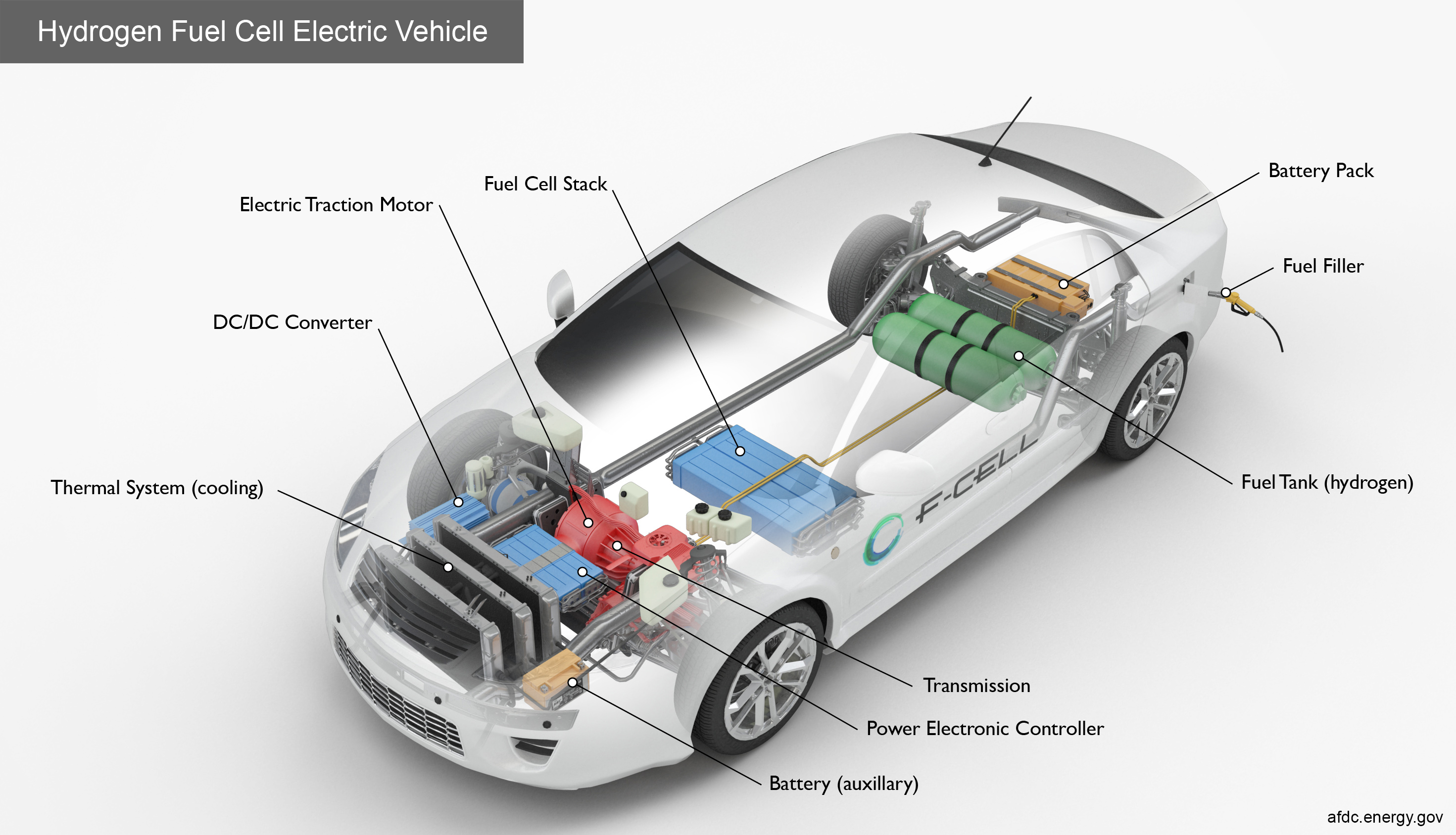
Hydrogen cars have the tanks contained within a sealed environment towards the rear of the car: https://afdc.energy.gov/files/vehicles/hydrogen-high-res.jpg
That's part of why the comment said "a percentage" you don't have to refill.
A modern craft would not be made of readily flammable material.
The gas-bag and paint theory is debunked: https://www.airships.net/hindenburg-paint/
The "nobody died from the hydrogen" line is debunked: https://www.airships.net/hindenburg/disaster/myths/#advocate...
That the craft is made out of flammable material is debunked: https://www.airships.net/hindenburg/disaster/myths/#flammabl...
I don't see that claim in the comments you're replying to.
[1] https://en.wikipedia.org/wiki/The_Lone_Gunmen_(TV_series)#Si...
So, no, not especially conceivable. Or plausible.
Air masses 1.2 Kg per cubic meter, so 240,000Kg of air in that volume normally.
Helium masses 0.18Kg per cubic meter[2], so replacing that volume with Helium gets it down to 36,000Kg.
Hydrogen masses 0.08Kg per cubic meter[2], so replacing that volume with Hydrogen gets it down to 16,000Kg.
Huge balloons containing almost-nothing, as soon as you replace the inside with something it gets heavier. Aerogel is 1Kg per cubic meter without the air in it, says Wikipedia. So adding AeroGel to Hydrogen it would be 216,000Kg in that volume displacing 240,000Kg of air. Hardly buoyant at all.
Wikipedia has something called AeroGraphene mentioned[4] which is down to 160g per cubic meter. If that could be scaled up to the same volume with vacuum in it, it would be 32,000Kg and filled with the mass of Hydrogen, 48,000Kg, but that's still less buyoant overall than using Helium lift gas. Hydrogen isn't really "a feasible approach to lifting any amount of cargo", if it was then airships would be everywhere. The rest of the structure of the ship was heavy in the Zeppelin days, leaving little extra lift for people or things. Out of a Whitehouse sized vehicle it could lift low hundreds of tons. Maybe better today with carbon fibre and lightweight engines and such.
[1] https://www.airships.net/hindenburg/size-speed/
[2] https://www.aqua-calc.com/calculate/volume-to-weight
Small-molecule gases diffuse through solid matter (search for "helium leak iphone" if you haven't read that fascinating story), so hydrogen will be slowly leaking out of aerogel, much like it does leak from a normal balloon.
Air diffuse back inside at a much, much slower rate - with net effect that pressure inside drops. This will crush/crumple aerogel, with no easy "top it off" option available for normal balloons.
So couldn't you build, say a giant pyramid reaching out into the stratosphere using hydrogwn infused aerogel ? :)
Really though, doesn't AeroGel work by being mostly nothing? The more gas and less substance it has, at some point you may as well use a cloth balloon and only have the surface area size, no?
[1] In this video on Space Elevators - https://www.youtube.com/watch?v=dc8_AuzeYKE
AeroGel.org says: "Aerogels can usually hold a gently applied load of up to 2,000 times their weight and sometimes more. But since aerogels are so low in density, it doesn’t take much force to achieve a pressure concentration equivalent to 2,000 times the material’s weight at a given point. The amount of pressure required to crush most aerogels with your fingers is about what it would take to crush a piece of Cap’n Crunch® cereal." - https://www.aerogel.org/?p=3 (it goes on to say Aerogels differ in strength, but most can be made stronger by making them denser and heavier).
I have seen a suggestion, probably in a HN submission, that remaking classic Zeppelin design but replacing the duralumin structure, metal tensioning wires, coated cloth outer shell, and animal guts lift bags with modern carbon fibre, kevlar, and foils could knock 80-90% off their mass. What is all the structure in a Zeppelin doing, why can't they be shaped like hot-air balloons?
With an aerogel infusion, the volume of the aerogel is the same as the volume of the lifting gas. Picture a huge blimp lifting a huge-blimp-sized lump of something underneath. Even aerogel, light as it is, adds up.
In other words - it's barely useful, and the only reason it works is because of the square-cube law: the weight of the envelope goes up as the square of the dimension, while the lifting power goes up as the cube. If you want to fill the volume with something, you lose the scaling advantage.
The fact that an aerogel-filled blimp might still conceivably be neutrally buoyant is actually testament to how incredibly light aerogel is. If you filled the Hindenburg with water, it would be more than half the weight of the Empire State Building.
True!
I've always had a soft spot for aerogel. I discovered it as a kid back around 2000 when Disneyland had this NASA/JPL Mars rover exhibit and they had a piece of aerogel on display. When I got home I researched it and was really impressed by all its properties. My mom got me some broken pieces of it off eBay (at the time this was way cheaper than buying an intact slab). My parents were pretty cool in nurturing my nerdiness. hah
The more I think about it, the more it seems like aerogel in a hydrogen balloon isn't the best idea for other reasons. If any moisture makes its way into the balloon, I bet it wouldn't take long for the density to suddenly drop catastrophically.
The Hindenberg disaster, in fact, involved no exploding hydrogen. It was a big fire. Fire can be very destructive. There is no need to invent imaginary explosions to explain destruction from fire.
It is a fact that fewer than half who were aboard died. Those who did die obviously could have been burned, and, despite your absurd and repeated accusation, I never claimed otherwise. Nobody who was not aboard died.
Burning hydrogen moves upward the same as non-burning hydrogen. Gas in contact with flame does not magically become non-buoyant.
We are not, in fact, discussing "hydrogen cars", so whatever "sealed environment" you picture in them is wholly irrelevant.
> Burning hydrogen moves upward the same as non-burning hydrogen. Gas in contact with flame does not magically become non-buoyant.
Correct, it burns. Like it did in the Hindenburg. I have no idea what your point is.
> We are not, in fact, discussing "hydrogen cars", so whatever "sealed environment" you picture in them is wholly irrelevant.
This is a counter-argument for your previous points that leaks are irrelevant. My point is simple: No, they're not. You're trying to side-step this point by saying "well, I'm not talking about that" when you did right here:
> H2 under pressure moves outward, and in a containment breach tends to, instead, increase the H2 fraction above the 75% that can sustain a flame until most of the gas has escaped and leapt skyward.
Which is complete nonsense if you look into what's around a containment system. Which is my point -- containment is never not in a confined environment. You talk about some positive airflow system, sure, that's fine. What if the failure affects that? Well now you have to consider the risks all over again.
> involved no exploding hydrogen
This is a pedantic nitpick. In day to day usage, people say explosion to mean "rapid, uncontrolled fire". That does not negate my point -- that was one of the largest hydrogen fires in history.
You sound like you have tunnel vision on the advantages of hydrogen for industrial uses. There's a reason we don't use it. It's dangerous, and engineering solutions to mitigate the danger are prone to failure. If you want more: https://www.airships.net/hydrogen-airship-accidents/
The world uses literally millions of tons of hydrogen every year, industrially. That the only event of any note that you can get any traction with was over 80 years ago should give you a clue. Noisy scaremongering does not improve anybody's life. Give it a rest.
https://news.ycombinator.com/item?id=29096388
Then click parent. Go ahead, I’ll wait.
Smugness indeed.
You're the wrong one, sorry.
Edit: Oh, you the same person as that other comment. You're completely imagining the claim that hydrogen didn't kill anyone! I'm not surprised you feel such a sense of superiority if you're that confused about what's actually being claimed here.
If you want to understand this thread, I suggest you start at the start.
Hint 1: I gave you the name of the person I answered to.
Hint 2: No matter how often you repeat it, it wasn't you.
Hint 3: Maybe it helps if you draw a flow chart of the different statements in the conversation!
But, see, don't worry. Because you jumped into a conversation between the post I replied to and myself, I assumed you had to add something to that conversation. I realize that I was mistaken and you just swooped in to offload some unrelated fun fact. My bad, won't happen again!
Yes, there was a higher level comment from someone else. But it wasn’t the one you replied to.