A few years back they raided a German host of the Riseup email service due to some alleged online threat [0]
They didn't just stop there, they also moved on to the nearby CCC maker space, for which they didn't even have a permit, and also raided that.
Among the things they found there was 3D printers, chemicals to feed said 3D printer, and a small 3D printed model of the Hiroshima nuclear bomb.
They confiscated all of that under the suspected offense of "trying to create an explosive device" [1]
Can't make this stuff up, reality is stranger than fiction.
[0] https://www.golem.de/news/zwiebelfreunde-polizei-durchsucht-...
[1] https://www.spiegel.de/netzwelt/web/hausdurchsuchungen-bei-n...
[1] https://www.berliner-zeitung.de/en/the-cdus-leaky-campaign-a...
Seems like government assisted bullying is the default M.O. in Germany if you're the little guy and happen to step on the toes of the rich and powerful.
IMHO, in this regard, Germany is way worse than the US.
Much worse than that, they raided the private home of one of the members of the nonprofit organization Zwiebelfreunde that passes on donations to riseup and runs a few tor exit nodes. That person has kids and family, he couldn't even work because they took all the hardware.
But Julia Reda, the CCC and netzpolitik.org are just great!
It's always the same excuse every single time. I have to wonder if this stuff actually protects children.
This gives such a bad image. They should be ashamed!
Any idea when we can suggest the Germans have a sense of humour?
We're approaching a situation where even electricity providers, not to mention OS and browser providers, can be forced to do the bidding copyright holders, to the detriment of everyone else.
Perhaps then will these verehrende Richter be able to grasp the matter.
The regional court were the ones according to which the operator of a commercially operated website is liable for copyright infringing content that he links to, even without knowledge.
The local court is even worse regarding copyright infringement.
Main problem with german law is that the courts have too much freedom because they know, the lawmakers produce low quality laws nowadays.
Just compare any old law with any of the newer ones… Germany is losing it, sadly.
Is that just me?
The Oberlandesgericht Hamburg was particular known for a Richter with the name Buske. He was well know for his "interesting" rulings. It went so far that IP/copyright/personal rights/media lawyers coined the term "Buskeismus" (Buskeism). He is retired since about a year, but his spirit seems to still live on especially in Hamburg's courts.
Needless to say that there is billions of recursive DNS around the world. Their own FritzBox runs a damn recursive DNS server that is able to resolve whatever they request. What - will they now sue themselfes to make that right? The spooky internet made me do it!!
Maybe they file a lawsuit against a weak player so that they can reuse the result against other bigger players.
When it comes to laws and their enforcement, I often wonder what HN users think would be a good approach. Most often my impression is that the favored approach seems to be of the form "the internet does not need any laws" paired with a condescending tone that everyone else doesn't understand the internet.
Explanation:
DNS blocks are the easiest hurdle to put up to deterrent most people. Sure DNS blocks can be easily circumnavigated, but so can locks. (It being easily avoided by more informed users might actually be a plus, preventing overzealous censorship being too effective.)
Actual enforcement of domestic law on providers based in other countrs (of the deemed illegal content) is not realistically possible/not a good tradeoff of using resources and most importantly: Not their business. But that does not mean that a country has to accept everything that is legal somewhere (or at least not persecuted in that jurisdiction).
Similar reasons prohibit enforcement on foreign DNS zones. Therefore, local DNS resolvers, even if just relaying to those foreign ones, would be the target of enforcement.
Who or what pays their bills, though? Servers burn up electricity, consume bandwidth and require maintenance. None of that is free.
> Quad9 is a not-for-profit organization whose operational budget comes entirely from sponsorships and donations.
Huh? So what does Quad9 do? Block or not block?
Some of the people may be more sympathetic towards privacy-first tools than the european average, but that doesn't mean the government/leadership is.
Quad9 was the most interesting free DNS service out there, better than google/CF imo.And i'm not saying this as an "anti-german" talking-point,but there are actually very few countries were privacy was pushed as a principle in institutions, see Nordic countries or even to an extreme: CH(where if i recall correctly you cannot record someone even in public w/o their permission). However this smells like something that is not germany-specific but colluded across countries & big corporations: keep cracking down on piracy(even though it's basically a fact that these P2P methods of sharing copyrighted content actually made Sony/Hollywood/etc more money than not)
I can see Govt's in particular NSA, GCHQ, aka 5 eyes, 7 eyes etc losing alot of control over the internet in the foreseeable future.
If anything it would be funny to see what creative means the morons come up with to try and stop them.
Or how some gyms required the membership cancellation be done by post during the 2020 lockdowns.
Paper based bureaucracy in Germany is an exhaustive tradition that has survived the internet age and seems is not going away anytime soon.
https://www.welt.de/wirtschaft/article191846877/Hotelanmeldu...
Doch die Hotels dürfen nicht, und daran sind die Sicherheitsbehörden schuld, vertreten durch Bundesinnenminister Horst Seehofer (CSU). Die Ermittler wollen die Möglichkeit haben, über Fingerabdrücke und DNA-Spuren auf dem Meldezettel, Bösewichten auf die Spur zu kommen. „Das klingt wie ein Aprilscherz“, sagt Hotelsprecher Luthe, „ist aber keiner.“
They notified me by post that I needed to provide them with some information on their online tool. Here was the process: 1) Go to link, fill in form with personal detailed. Print, sign and post. 2) Receive a login password via post after 1-2 weeks 3) Login and do the the thing they asked.
Honestly why bother with an online system, just send me the form and I'll send it back. Done.
Also, applying to universities here also involves sending NOTARISED copies of all your documents, via post, along with the application. I don't think I've ever in my life applied to university by sending a thick brown envelope.
Besides that, all of our policies and national decisions are still heavily influenced by Germany like most EU countries.
I wanted to vote in German elections but that requires me sending 2(!) letters because for some reason web forms don't exist.
That's how you open new User accounts (Active Directory) in one of the biggest insurance company's in Germany (from Local-IT to HQ-IT) ;)
Not limited to germany.
/S
Already leapfrogged Germany in payment tech, in terms of open geodata the same (opened up most GIS datasets, even if sometimes quality is mediocre).
Now, if it weren't for the clowns in the government that got inflation out of control...
When I saw it, I slammed the laptop shut and was so disturbed that I went to wash my hands
That only means that her father was crazy, I don't know a single shop that closes during lunch time. The smaller places I know intentionally shift their opening hours to explicitly open early, during lunch or during closing hours.
> and only took cash
Afaik most electronic payment providers require that you hide their transaction fees in the normal price, so a shop that doesn't offer electronic payments can be cheaper. However most places support contact less payments so that must have been some years ago.
And then of course there are many smaller places that only accept cash payments for the same reason they only enter half of your order into their cash register.
I think the culture around employment contracts preventing people from quiting when they want, penalty free, and the letter of recommendation requirements from a previous employer are insane. Seems like you would really have to go above and beyond to not get screwed on your next job by a bitter ex employer.
Also find the gov owning large shares in the private sector (Volvo.. Ect) to be a conflict of interest and may encourage them to bypass emissions laws for example.
Just seems like a lot of institutional trust.
The three strike / hadopi bullshit was clearly a political move to satisfy the biggest copyright holder, a lot of it was completely unenforceable and even unconstitutional from the start. In the end, very few people even got to the third strike, and they couldn't even do what they "promised" (forbidding the person from having an internet connection) and had to go through costly court procedure just to give fines in the end. It was just a machine to burn public money for the miniscule benefit of a few. It died very fast because nobody wanted to try to make this bullshit actually work and burn even more money when they have to get re-elected.
PS: I moved to Germany and I want to move out asap because of how outdated everything is here.
Or lets not concentrate on persons, but on concepts instead. What makes anyone competent to be at the top of any branch, resort, ministry? Their staff? Then why not appoint someone from the staff to that position?
It's all non-sense now, a tragicomedy at best. Regardless of party and age.
So they're like the East District of Texas of the EU?
* https://en.wikipedia.org/wiki/United_States_District_Court_f...
* https://www.logikcull.com/blog/the-supreme-court-frees-paten...
It would seem to me that the definition of a good judge is one who always predicts how a higher court would act, and acts the same.
I was in court the other day when a criminal defendant's case was brought back up because it had been reversed on appeal due to the judge making errors in his instructions to the jury. The defendant had already spent five years in prison and to avoid another trial decided to take an offer by the prosecutor to go home that day in exchange for his guilty plea. The judge just chuckled as they read out the reversal order and basically said (not verbatim) "Whoopsie, my bad." For wrongly convicting a person.
In fact, now you have me thinking about it, I can't remember a single time being in court where a judge has taken a reversal seriously. All of their reactions have always been flippant and jovial.
Some judges get extraordinary amounts of reversals.
Judges regularly piss the appellate courts off with their shitty work. I can think of two local criminal cases recently where the appellate courts were mad because they ruled in both cases that there was absolutely no evidence of the guilt of the defendant. Another one I was in court for - a prisoner presented a 17 count suit against the prison guards for essentially torturing him over a decade-long period and the judge flicked through it and simply said "case dismissed". The guy flipped out in court. The appellate court reversed, but they were shocked because each of the 17 counts needed a several-step analysis to determine its credibility and the judge did nothing -- and the appeals court then had to do all the work. That particular judge is super hilarious when his robe is off and we are all waiting around in the courtroom - he'll shoot the shit with me all day, and then put his robe on and deny all my motions lol.
The most prominent example in more or less recent times is also from Hamburg: Ronald Schill, nicknamed "judge without mercy" for his harsh sentences, who was a judge at an Amtsgericht (the lowest level of ordinary jurisdiction) in Hamburg from 1993 to 2001. He then went into politics for a right-wing law-and-order party he founded, that prospered for a short period of time in Hamburg that even entered into a coalition government with the CDU and made him second mayor and senator of the interior of Hamburg.[2]
[1] Art. 97 GG. [2] The Wikipedia article about him at https://en.wikipedia.org/wiki/Ronald_Schill contains some hair-raising details about his views and actions.
Does a DNS-Server from a Non-profit needs something like content-ID from youtube?
Or does a Non-profit DNS-provider needs hordes of lawyers just to check every single complaint in the future?
Would you like that?
Germany already has a law to block websites at ISP level, why bother a DNS provider with it? ...oh i know why, because it's not enough to block it, Sony knows it and the hordes of lawyers at telecom etc knows it, so you go after the easy prey.
That's the problem!
Yes, that is a problem, but not the one I thought people complain about. Maybe the comments doing so stuck with me the most and I overestimate how many there were, but even rereading most comments with what the problem is according to you in mind, many do not seem to address this problem at all.
> Does a DNS-Server from a Non-profit needs something like content-ID from youtube? > > Or does a Non-profit DNS-provider needs hordes of lawyers just to check every single complaint in the future? > > Would you like that?
No. Quad9 was also provided with a deadline way too short to implement anything.
But after researching that bit a bit more, I changed my mind a bit about the process: I initially wrote that quad9 is in the wrong, I don't believe that anymore.
On one hand it would be more efficient to directly contact the providers that can do something about the infringement (youtube, DNS providers, whatever your prefered target would be), on the other hand it makes it easier to abuse. I still don't know of any good solution that's not just telling one side to go and shove it.
> Germany already has a law to block websites at ISP level, why bother a DNS provider with it?
My understanding was that this is also a DNS block and is frought with the same criticism (I may have accidentally projected that topic on the commenters here though, as the complaints seem to be the same). I'd gladly change that understanding :)
You've answered your own question. DNS blocks are not just "easily circumnavigated", they're completely ineffective. Use a different resolver, run your own resolver, add the domain to a hosts file… DNS is the simplest and easiest method of finding a site's IP address, but hardly the only method. Even very non-technical users can locate and follow simple step-by-step guides to get around a DNS block. This order is akin to having someone's name purged from the phone book when there are many other ways to find the same information. Given that the DNS block will be ineffective in preventing any of the (alleged and mostly imaginary) harm from the (alleged) copyright infringement which the target of the order isn't even involved in, what purpose is served by issuing the injunction?
At the very least Quad9 deserves compensation for any costs incurred in implementing this injunction, given that they are being unwillingly dragged into the middle of a dispute between two other unrelated parties. Ideally this compensation would come directly out of the judge's salary for issuing such a pointless injunction, but I suppose it could be paid by the plaintiff instead for requesting the injunction in the first place.
Yes, they will get the chance to argue in front of a higher court. But they can't skip the lower court.
If I understand it correctly (Quad9 is a bit sparse on details here), this was a decision to uphold the original injunction. This decision is open to immediate appeal to a higher court, but Quad9 will have to show that there's an especially high urgency for that. Otherwise they will have to wait for the judgment in the principal case.
But it costs time, money and should not be necessary.
It is meant to prevent preventable lawsuits (which would be a lot more expensive), but has been weaponised by lawyer firms specialising in copyright enforcement. After a few of these law firms were countersued for inconsistent claims, the law about Abmahnungen was tightened a bit.
I have yet to see an Abmahnung benefitting the GEMA. Law firms usually work for studios.
First the offender should pay for his persecution, then tax, then the victim but never some random citizen.
Yesterday I got an alert that I was on the last day to file my taxes (if I didn't want to pay a €25 late-filing fee). On my lunch break I SSO'd into the tax agency website, which showed me a pre-compiled form with all the mortgage payments and medical expenses I'd made during the year already deducted, plus a house renovation expense that was registered but not automatically deducted because the system couldn't automatically determine if it qualified. I didn't have to insert any data, except for updating my email address as it still had my old GMail one. I saved it and submitted the tax form as-is, just in case.
Later that evening, I googled around a bit and determined that the renovation work did indeed qualify for the deduction. I reopened the website, clicked on 'Submit Corrective Tax Form' and entered the expense amount. I needed to provide the cadastral reference IDs for the renovated building/s, so I opened my tax agency home page -> Cadastral Query and copy-pasted them from it. Five minutes later I had submitted the second tax form and had two copies in my inbox: one in PDF, and one in RPF (its native columnar file format, in case I wanted to edit it later with a Java desktop application).
Here's the thing, though:
As little as five years ago, all of that would have required me to personally keep a bunch of paper trails and most likely professional help. "Cadastral query" was a by-word for "ponderous bureaucratic mess" and the practical advice was to start filing your taxes at least a couple months in advance.
However, once public-services SSO ("SPID") was introduced in 2015, it enabled a cascade of formerly in-person services to go full digital relatively quickly, because the most critical hard part - authn/authz - was solved. I think Germany should be perfectly able to shake off its dead-tree culture if it clears the same hurdle.
I report two examples here. When I moved to Germany two years ago, I was able to register in the official list of Italians living abroad ("AIRE") and to cancel my previous residence in Italy just by using "SPID" SSO on the Italian Ministry of Foreign Affairs website. Moreover, last week I was able to pay my parents' Italian car tax through an app on my smartphone.
On the contrary, last month I had to extend my driving license and I decided to get a German one. I've been told at the Driving Licence Department that I need to provide a document to show what country I come from ("Initial entry registration in the Federal Republic of Germany"). There was no way to provide such document other than going to the town hall of the first place where I lived after arriving in Germany two years ago, asking for such document, getting the paper copy after paying, and bringing it to the town hall of the city where I currently live. The trip only took about an hour, but I wonder how I could have done if I lived on the other side of Germany.
The funny thing is that my friends in Italy think that I moved to a super efficient country where everything is the top of innovation and digital technology (classic German stereotype among Italians) while none of this is possible in Italy and queuing at some public office is the only way to get these services done.
A better one would to maintain working platforms based on old, rad hardened devices.
The electromagnetic pulse (EMP) produced by nuclear weapons detonated above the atmosphere [1] is destroying many electronic devices in a large radius. "Every" seems too strong of a statement, though, a majority of devices which are small and not connected to wires may survive. The problem though is that even just destroying a large part of devices is enough to disrupt food and water sources and transportation capabilities in a wide area. EMP, while radiation, is not ionizing radiation--its frequencies are below a few 100 MHz. It damages electric and electronic equipment by voltage surges produced in (longer) wires attached to the devices.
> old, rad hardened devices
Radiation hardening [2] is referring to protection from ionizing radiation. While nuclear weapons of course produce lots of that (and it is what is then partially converted to the EMP when it hits the atmosphere), it is of somewhat more localized (~tens of kilometers rather than thousands from the point of detonation), and it appears, secondary concern. Ionizing radiation affects humans and devices similarly. Radiation hardening for devices presumably only makes sense if humans are protected, too, lest they can't use the equipment anymore. During my research I ran across "systems-generated EMP effects", though, which may be an exception (an amount of ionizing radiation low enough to not kill or damage humans much, but high-densitiy enough due to the short duration to destroy electronics). Maybe you were referring to this, I don't know. It seems that EMP protection is more important, though, especially considering that the context here was writing documents, which is probably not a priority if surviving the nearby low-altitude nuclear detonation that's necessary to produce systems-generated EMP effects?
[1] https://en.wikipedia.org/wiki/Nuclear_electromagnetic_pulse [2] https://en.wikipedia.org/wiki/Radiation_hardening [3] https://en.wikipedia.org/wiki/Radiation_hardening#Systems-ge...
Not to mention that electronics in the military are usually hardened anyway.
The reasoning is probably the same in both cases: They want to know that you can receive mail at the given address. There are faster ways to confirm that, though, such as uploading an image of a recent utility bill in your name.
And the irony (for me at least) is, that corruption and fraud is still rampant in Germany (e.g. during corona, tons of fake PCR tests being billed to govt. Pharmacies issuing fake vaccine certificates).
This solves nothing.
In cases of press and internet law, many lawyers argue that the event happened everywhere in Germany, and that they are accordingly free to choose whatever place of venue they like.
Since the system works alright in general there's not much love from law professionnels for a change. This internet thing is just a fad anyway.
It’s uncharted land for all of us - Angela Merkel 2016, translated.
I have a new revolutionary idea....setup internet filters ON your children's devices, and there are tons of websites with pre made filters (often every country has his own) and even crazier most ISP/Routers already have them implemented, on the Mobile-phones you setup VPN (back to your home-router (also already implemented from most ISP's) so even the Phones have those filters) ;)
Too much work?* Then shut up talking about protecting your/our children's, and let them browse every f*ing social media network including 4chan, tictok and that terrible facebook owned thing.
*Not talking to the parent obviously, but to everyone who thinks it should be any other way.*****You cannot make the internet child safe, the only point of influence is what you suggested, which means parents need to get informed here. Maybe through schools of their kids.
I won't stop the government from trying though, especially the German one, which brought us presents like NetzDG. Really popular export and inspiration for dictators around the world.
Exactly that's the trick, not sure about the downvotes you get, but let's say in the 60', against that anti-freedom of expression/opinion?..you have to be a communist. Against Homeland security after 9/11? You have to be a terrorist, against total surveillance? Do you have something to hide? Against Apples photo scanner? Why do you have child-porn on it? And finally against destroying jews-owned shops...well we know the answer....
Well nobody said cash payments should be banned, but it sucks when cash is the only way to pay in some places, meaning I always have to carry a bulky wallet filled with banknotes and coins just in case the bar, restaurant, shop, cafe, deli, parking meter or whatever, does not accept digital payments.
I also used cash for buying greens since that's not yet legalized, but for everything else that's been legal for over 100 years already, please accept digital payments.
Because just because people want CC/contactless payments to be accepted everywhere, doesn't mean they want cash to be banned, if you wish to stay anonymous.
So why should you deprive everyone of contactless payments if you wish to stay anonymous, when you can acomodate both.
My beef is a lot of places only take cash.
You're highlighting one small convenience of cash and ignoring its many real disadvantages.
People forget the only thing that is important is the exchange not the material used to do so. It’s all promises at the end of the day.
In a purely cashless society, the central bank could force a -10 per cent interest on all savings, thus forcing people to spend even if they don't want to.
(This was, for example, discussed on the IMF blog pages: https://blogs.imf.org/2019/02/05/cashing-in-how-to-make-nega...)
This is harder to do in economies where people can take their money out of the bank as cash. There, the lower limit for interest seems to be around -1 per cent.
Promises that the money will be worth it the next day, sure. But at least I have my cash in my hand (and some stored where I live), so access to it can't just be denied.
Whoever thinks getting paid in cash is "free" is going to be outcompeted really quickly.
But even (some) old people seem to prefer paying with card today, so change is slow.
I only use cash for public transports.
Yes it is, it's a bit like the CCP, if they think it's anything against them (truthfully or not) they bite first and second, then stop talking about it and hope everyone forgets. Works pretty well for everyone directly involved...so no pressure to change anything.
Or, to go back to 2001, to the 'Frankfurter Steuerfahnder-Affäre', where people tried to do their job, and got mobbed, bullied, canceled and even psychiatrized for it!
But won after years of law-suits.
* https://www.faz.net/aktuell/rhein-main/schadenersatz-fuer-st...
[1] https://www.bloomberg.com/news/articles/2021-11-22/vaccine-h...
So this trend into more authoritarian structures is very real in a very objective way.
And if everything keeps going as it does, there's a non zero probability this situation won't be of a temporary nature, just like there is a non zero probability that vaccines will need to be boosted/reapplied even more often.
Sum all of that up, and it's a quite dystopian scenario we are possibly heading into.
Cash is only worth what someone else agrees it is worth.
So another way to find out where a satellite is pointing would be to detect the transmissions its receiving or "landing" right?
So then the military wouldnt need these radomes as anyone near by could detect the overlapping footprint of the signal hitting the ground, unless its no more accurate than using something we can find in mediaportal to work out signal strength and quality. [1]
So then the ground could detect where the satellite is, which renders the use of the radomes somewhat unnecessary.
And then there is the fact Space has its own jurisdiction.
Now I do know HP were working as a Mil contractor in the 90's developing line of sight laser communication for the battlefield namely because it used the property of light to highlight eavesdropping, whether that has developed enough to be an uplink to satellites I dont know, but that is a lot harder to detect for obvious reasons and then the law would seem to be rather ineffective if light is being used to land signals sometime in the future. Anyway off topic so no more from me on this deviation.
[1] https://media.defense.gov/2016/Sep/16/2001635620/-1/-1/0/160... [2] https://www.team-mediaportal.com/wiki/display/MediaPortal1/S...
It was one of the only places in the service area (most of the world, minus near the poles) that I know of that Inmarsat blocked out service.
(There was a way to override the GPS on the terminal to make it report to the network that you were somewhere else, but we tried not to tell customers about that - or Inmarsat obviously!)
StarLink is not licenced for use in India yet, but do you think the US mil or any other Nato mil will want some control over military coup's like when the military rolled into (Burma) Myanmar earlier this year and the internet was shut down? Not the only country to shutdown the internet or censor it when thinking about the Great Firewall of China either. https://www.bbc.co.uk/news/world-asia-55901774 https://en.wikipedia.org/wiki/Internet_in_Myanmar#Re-censors...
But I'm not sure how big the cells are. It could be that they are as big as to cover most of India? Doubt it though.
But yeah it would be great if we had a truly independent internet provider for an affordable price.
And if Starlink did start broadcasting in Indian airwaves without a permit (not really possible since they’d need a ground station but assume they place some ground stations around India’s borders), it would be a good opportunity for India to test its anti satellite weaponry.
SpaceX is a US entity and will be forever. SpaceX intellectual property cannot even legally be transferred to an entity not approved by the Department of Defense.
Same goes for Bezos, emperors from rods grace.
Urbi at orbi-tal bombardment threat. Government will play nice with a smiling face, cause everyone is happy.
And I think simple convenience (not having to carry a slightly heavier wallet) does not quite weigh (heh) the same as privacy.
So until we get the ratchet of increasing surveillance solved it is entirely reasonable to push back on cashless transactions.
Why is that a problem? The bank is doing the reporting, not you and it's not like the government is stopping you from transferring over 10000€, electronically or in cash. You are free to do that. I transferred over 50k without any issues. And you can still use cash to buy weed if anonymity is what you wish, or use cash to pay some handyman to fix stuff around your house or piano lessons for your kids, without paying taxes.
The issue is with large cash sums, as believe it or not, money laundering and tax fraud is a real thing, and large cash transactions make this a breeze.
So, knowing how much tax money the taxpayers are loosing every year thanks to cash driven tax fraud, I'm all in favor of more scrutiny on large cash transactions and moving to more transparent wire transitions.
Because they're boiling the frog. It doesn't stop at reporting. And it doesn't stop at 10k€. And it often does not get inflation-adjusted, so the real limit keeps getting lower too even without regulatory changes.
[0] https://www.europe-consommateurs.eu/en/shopping-internet/cas...
> So, knowing how much tax money the taxpayers are loosing every year thanks to cash driven tax fraud
I assume the bulk of tax fraud happen by corporations cooking their books, using legal loopholes and writing their own legislation, not by average citizens paying a car in cash. If it were about tax fraud they would have set the limit once, decades ago, and kept increasing it with inflation, not the opposite. Organized crime isn't something novel after all. So this reeks like a post-rationalization for more surveillance.
Also, tax reporting is the duty of the merchant for most transactions, private citizens shouldn't have their privacy voided just because others evade taxes. Instead make it mandatory to provide bills (with audit logs) and prosecute customers after tax fraud has been uncovered if they knowingly benefited from the tax fraud (e.g. by waiving the billing). Create bounties for people reporting billing evasion. I believe something like that has been implemented in greece. Search for privacy-compatible solutions instead of proclaiming that taxes and privacy cannot coexist.
Cash is a facilitating fluid which should be channeled into diverse investments which are not based on monetary value such as property and resources, not stashed in large piles. Holding any cash in any quantity is a risk. Doesn’t matter if it’s magic numbers in a computer or bits of paper in a mattress.
As for cash only society, sorry but fuck that.
As usual, some people want to undergo this risk in order to balance out other risks. For example, your bank account can be frozen under a variety of scenarios, even unjustly so. In such situation, it is better to have emergency cash at hand.
Diverse investments are good, but some liquidity is good as well. If you e.g. need to escape a starting civil war, things that can be carried on a person and have near universal acceptance are more valuable than a roll of blue chip stocks or a nice house that you cannot take with you. I have met people who escaped the siege of Sarajevo; cash and gold went a long way helping them out.
"As for cash only society, sorry but fuck that. "
That isn't something I proposed.
It's called inflation and it doesn't care if your money was securely left in your mattress
Countries like Italy cannot inflate their way out of debt anymore. ECB, at least officially, is trying to keep inflation low. But negative interest rates would help the heavily indebted countries to ease their debt service burden.
(If such constellation of parameters is sustainable, IDK, but that debt isn't going anywhere.)
By penalizing their creditors, sure. That should teach them (and anyone else paying attention) not to lend to such countries in the future.
It reminds me of Baron Munchhausen pulling himself out of the swamp by his own hair.
> Reuters states that since Starlink officially registered its business in India on November 1st, it has already seen over 5,000 preorders in the country [0]
That's from The Verge's article a few days ago.
> And if Starlink did start broadcasting in Indian airwaves without a permit (not really possible since they’d need a ground station but assume they place some ground stations around India’s borders)
They don't need to. It could just as easily operate from across the border, the ground station I'm connected to is in Canada even though I live in the United States.
> it would be a good opportunity for India to test its anti satellite weaponry.
Maybe if they had a geostationary satellite, sure. Starlink is a LEO constellation though, so if they took down a satellite this weekend, SpaceX would launch 60 more by next Saturday (and service wouldn't be interrupted since there's considerable redundancy built into the system). Unless India intends to take out a few hundred satellites and be responsible for potentially catastrophic space debris, I think it wouldn't be a good opportunity for them to test their anti-satellite weaponry.
[0] https://www.theverge.com/2021/11/27/22804830/starlink-india-...
As to the economics of anti-satellite warfare, you only have to destroy a small number of satellites to create a gap in coverage that will periodically sweep across the whole globe.
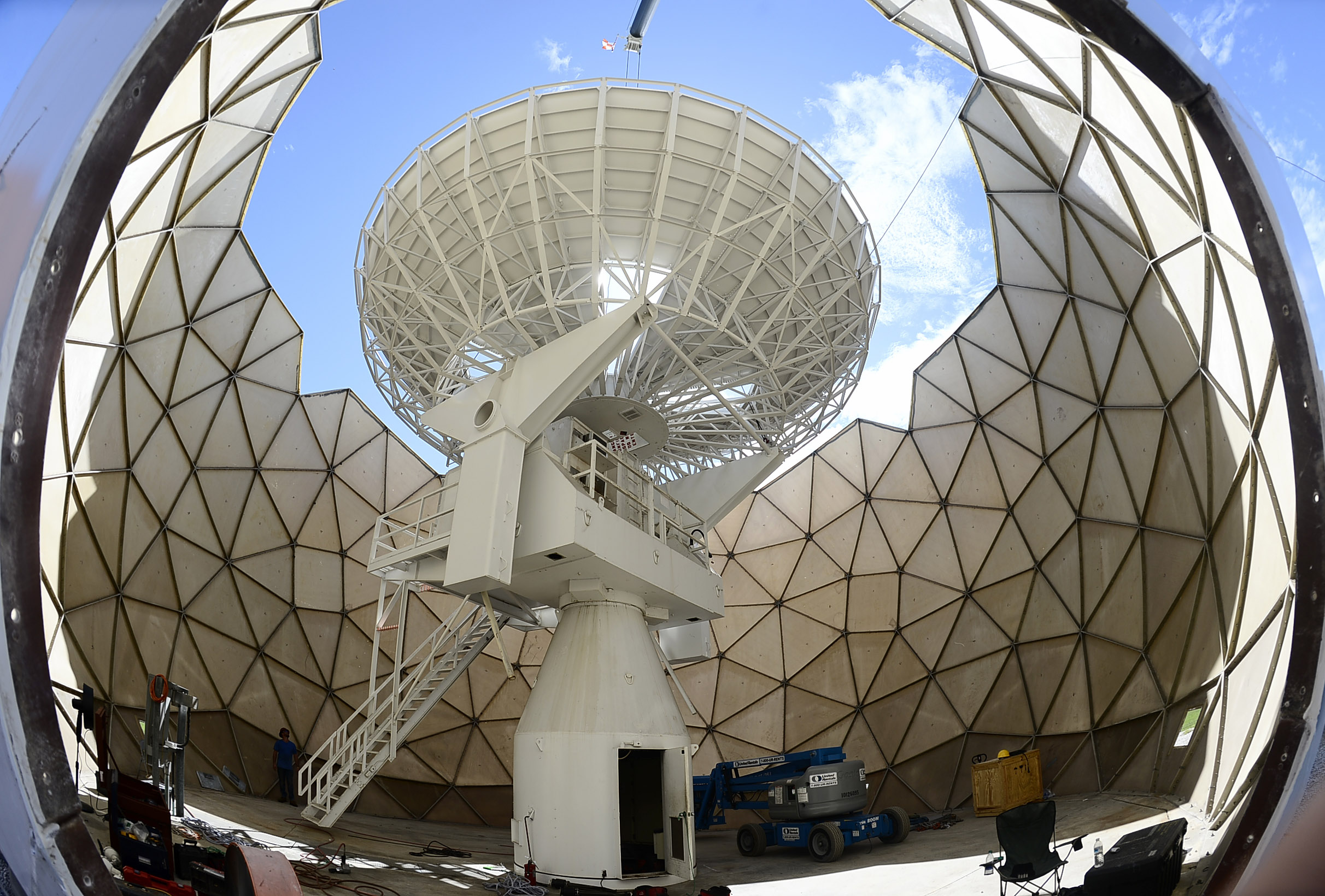
Antenna operators build radomes because they provide resistance to weather and other sources of environmental damage (birds are a big one). The spheroid/polyhedron "golf ball" shape is mostly used on large antennas because it's a structurally strong shape for the weight. It's also volume efficient for circular & spherical antennas, and handles rotating elements well.
Also, it's impossible to hide a satellite in space. Every nation with a space program tracks every orbiting object that's even remotely big enough to be a functional artificial satellite. It's mostly radar, but also visible light, IR, and UV cameras. There are no "stealth" satellites, mostly because you can't hide a launch... And once you know about the existence of a satellite, it's trivial to track it indefinitely. Civilian satellite spotters even do this with military satellites.
The only important thing you can keep somewhat secret about an orbiting satellite is it's specific capabilities. We don't know exactly what kind of telescopes or radar are deployed on Russian spy satellites, and they don't know the exact details of American equipment... But it's not even that hard for ground observers to guess at a satellite's likely mission and general capabilities, based on its orbit, visible structure, etc.
The parent comment's terminology is kinda strange, but that might just be a non-native English speaker... I'm more focused on the fact that their two "endnotes" in the parent post are just images, they don't actually cite any useful information.
>Also, it's impossible to hide a satellite in space. Every nation with a space program tracks every orbiting object that's even remotely big enough to be a functional artificial satellite. There are no "stealth" satellites, mostly because you can't hide a launch...
This isn't entirely true. First, satellites absolutely and do maneuver after launch, so they are not limited purely by the orbit they launch into. That is of course limited by how much propellant they carry onboard, but it is done (and for spy sats particularly). Second and more generally, for any object in space it's impossible to have persistent [0] omnidirectional stealth across all bands (due to thermodynamics). However, it's very much possible to have single band stealth (a shape that is radar stealth for example) as well as unidirectional multiband stealth, and because space is so big often that may be enough for a given scenario. For spy satellites in HEO they may as well be presenting a single side all the time to any Earth-based observers, and while some nations could react to that by launching tracking sats even farther the vast majority of actors (anyone on the level of ground-based amateur astronomers for sure) lack that capability. Transmission out can use the same idea, in space P2P laser links are generally invisible out of path, so a stealth sat could stealthily have comms to a non-stealth relay even further out.
As a practical matter right now it seems extremely doubtful any serious such systems are in place due to the huge hit on mission-effective mass which gets worse at distance, though it wouldn't be surprising if there have been some experiments at least. But with launch systems like Starship and enormously more mass to throw at problems, we may well see a certain number of much more serious stealth spy platforms eventually.
----
0: In principle one could achieve perfect EM stealth temporarily by carrying onboard empty volume, a heat and a cold source (like a whole lot of liquid helium/nitrogen) then running as a closed system performing thermodynamic work averaging those out. Could run for some fixed period of time until the useful differential was exhausted and only be observable by interaction with mass in space or gravity. But who knows if that'll ever actually get utilized, since the unidirectional concept can be extended by an advanced space faring organization too. One can keep going farther and farther away from a target and compensate with a larger aperture with enough space capacity. If we imagine some aliens or something with an Earth observing stealth platform out in the Oort cloud say, it could be a kilometer across and very hot on the extrasolar facing side yet still damn near impossible for us to notice. Or of course someone could hide in the thermal noise of other sources. Interesting to speculate about from a hard scifi perspective anyway.
Yes, my original statement is entirely true. You're offering a poorly sketched basket of theoretical ideas, none of which change the reality that no nation has EVER attempted to add low-observability features to it's military satellites... Mostly because none of the ideas you sketched would actually work, in practice, to effectively hide a functional satellite.
Talking about manuvering propellant is completely beside the point... The US, Russia, and China are all perfectly capable of tracking manuverable spacecraft and satellites, and we all do so 24/7/365.
Think about this, for a minute... Ever since the deployment of nuclear-capable ICBMs (~1961), space has been THE primary delivery avenue for the single biggest existential threat (thermonuclear war) to the most paranoid and technologically advanced nations on earth. Space is where you get nuked from! We have all invested MASSIVE resources into making sure we can detect and track literally anything in space, because it is the single most important battlefield in human history.
If effective low-observability spacecraft were a real thing, don't you think that at some point in the last 60 years, one of these nations would have deployed such a weapon... or addressed the concept in an arms control treaty... Or even discussed it publicly?
If you find some credible examples of anybody discussing low-observability ICBMs, I'd gladly walk this back. But I'm pretty confident that you're not going to be able to.
I'm unconvinced of that. Classified satellites are routinely tracked and sometimes even photographed by amateur astronomers; surely the peer competitors of governments can do better. I suspect these domes are primarily intended to conceal which satellite is being talked to.
Either way though, I don't think radomes are meant to conceal the position of the satellites themselves.
No, it is not. I'm not offering theory, I'm offering physics.
>none of which change the reality that no nation has EVER attempted to add low-observability features to it's military satellites
That you've never heard reports of projects like "Misty" (by the US NRO) is nice, but doesn't inspire much confidence in your statements either.
>Mostly because none of the ideas you sketched would actually work, in practice, to effectively hide a functional satellite.
Of course they would. This isn't, well, rocket science. We know how to make radar stealth shapes. Same math would work in space, in fact even more easily since there is no need to worry about aerodynamics nor necessarily stealth except in one direction. Lowering optical observability isn't even just a military thing, SpaceX themselves are literally doing it with Starlink, the subject of this subthread! They've been doing that to reduce albedo so as to cause less disruption for Earth-based astronomy. As I said, I certainly don't know if any major efforts have been made at serious thermal stealth, but not because it's some complex idea but merely due to tradeoffs in mass. Starship will allow launching 100-150 tons to LEO though with much larger fairings (last reported diameter I saw was 9m). As with all sorts of other things that will offer, the military will certainly be able to contemplate spending mass and volume on things that wouldn't have been worth the tradeoff before.
>The US, Russia, and China are all perfectly capable of tracking manuverable spacecraft and satellites, and we all do so 24/7/365.
Sure, the same way they can track maneuverable aircraft... so long as they aren't stealthed.
>Ever since the deployment of nuclear-capable ICBMs (~1961),space has been THE primary delivery avenue for the single biggest existential threat (thermonuclear war) to the most paranoid and technologically advanced nations on earth. Space is where you get nuked from!
You've gone entirely off topic and also seem pretty confused here. It's right there in the name: ICBM, the "B" is "ballistic", not "orbital". Orbital nukes are in fact specifically banned by treaty as too disruptive. ICBMs and SLBMs follow a ballistic trajectory. They're not space-based. There has been significant support for not making orbit a battlefield, due to rightful concerns about things like Kessler syndrome. Part of MAD and monitoring that has indeed been rocket launch monitoring satellites as well as ground based stations, but none of that has anything to do with spy sats. Monitoring sats have zero need to be stealthy, just to cover the whole planet at once. If either ICBMs are detected being launched or suddenly all your monitoring satellites get taken out, well conclusions can be drawn. In fact part of the core part of MAD is specifically to forego things which could be destabilizing by increasing odds a first strike could work.
>If effective low-observability spacecraft were a real thing, don't you think that at some point in the last 60 years, one of these nations would have deployed such a weapon... or addressed the concept in an arms control treaty... Or even discussed it publicly?
Um, nope? Not at all? As I said, while there have been experiments I don't think they are that much of a thing yet because there wasn't much need nor the mass budget for it. Up until modern times not that many countries/organizations could in fact track all the spy sats, and anyway the far more important interest was simply having lots and lots of them. Why put budget into fewer stealthy ones vs more and more better ones? But as the barriers to observation and tracking have fallen, and as mass/vol budgets go up, the time may indeed come when stealth will get renewed focus beyond existing experiments.
Again, when theorizing about future things that haven't necessarily been done yet, necessarily it's important to consider the physics of it. The physics here though are pretty straight forward frankly.
>If you find some credible examples of anybody discussing low-observability ICBMs
I remain completely mystified how you jumped from "a satellite in space" to "ICBM" if you have the slightest clue about what any of this stuff is. ICBMs aren't satellites, cannot be stealthed, and have zero need to be stealthed either. The only thing they need is decoys and that indeed has been done and is part of the reason (along with destabilization) serious strategic missile defense (against a peer opponent, not merely a rogue state handful) is considered infeasible. Stealth satellites would be about intelligence or perhaps fallback CnC or comms.
https://www.staradvertiser.com/2013/04/01/breaking-news/gian...