Common Jobs in a Medieval City(medievalists.net) |
Common Jobs in a Medieval City(medievalists.net) |
[1] https://spruceaustin.com/uncategorized/history-of-the-uphold...
The knocker-upper would rap on window panes with a long stick to wake factory workers before dawn. They were careful not to rap too hard, so as not to wake people who might want to use their service without paying.
The knocker upper knocker upper wakes a knocker upper.
Milkmen, Elevator operator, Switchboard Operator, Ice Cutter, Bowling Pin Setter, Film projectionist, Lamplighter, Leech collector, Alchemist, Bematist, Redsmith, Daguerreotypist, Town crier
I only stopped milkman service here in Palo Alto a couple of years ago (though the dairy downtown shut down maybe 30 years ago). It turned out to be a direct milkman->teenager pipeline which was better than walking to the grocery store twice a day.
https://www.crediton.gov.uk/Portals/0/Downloads/job-vacancie...
Projectionist
https://careers.atg.co.uk/opportunities/job-search/job-detai...
Milkman quite common round here https://shonesmilkandnews.co.uk
Switchboard operator https://www.jobs.nhs.uk/xi/direct_apply/?vac_ref=916883814
Fairly sure elevator operators in Blackpool tower exist and ride in the car with you. Less sure about Eiffel Tower, I do remember one in the car on the Empire State Building. In india of course you can barely get in the elevator because of the operator and his stool.
Nostalgia alone would almost make me a customer. But now I'm so used to milk from their glass bottles that I really notice (and dislike) the taste of milk from plastic.
Town crier is now the guy flipping a sign for the new burger joint.
[1]: https://i.pinimg.com/736x/79/2b/89/792b8997970b433b06b10721b...
These guys do doorstop milk deliveries to much of the UK. In our area they comes on Tuesday, Thursday and Saturday mornings at around 5:30am.
Milk in old fashioned glass bottles, Welsh cakes, yoghurt... Yummy!
6 – Tailors
7 – Notaries
8 – Barbers
9 – Retailers
10 – Stonemasons
More notaries than barbers, retailers and stonemasons!
I guess "gossip" was everybody's job, like textile production, so nobody's. According to ACOUP, all female members ("the distaff side") of almost all households spent any time not devoted to other tasks on spinning thread or yarn, albeit less so after the spinning jenny spread after 1200.
You would likely have been a peasant. The veil of ignorance doesn’t even make exceptions for HN readers.
I remember him talking about how access to a ship (even if over long distance) with a good machine shop was critical to just get locals up and running with basic metal tools for everyday use and medical uses.
It reminded me of the importance of a local blacksmith and such.
https://acoup.blog/2020/09/18/collections-iron-how-did-they-...
I learned a lot about the production and manufacturing of metal (iron) items. If I recall correctly, for iron production, a lot of people are involved in obtaining the fuel (wood, ash, charcoal) and not so many blacksmiths are necessary
Before then a city might have a couple in employee of the noble to make armor or swords, but the common person did without, or handed down tools until they couldn't be used at all. In a village a blacksmith was a side job of a talented farmer, but it couldn't pay the bills as nobody could afford to buy much custom made metal.
That being said, arms manufacturing was a very well developed industry during tue middle ages. Including general contractors, cuttlers, in case of weapons that coordinated the work of the people making the blades, the handles, the scarbords and dis the heat treatment.
If anything, the classic blacksmith went into decline during yhe industrial revolution. With tools, weapons and everyday stuff being mass produced in a factory somewhere.
Of course literate was relative: before the printing press there wasn't much to read (book took months to copy by hand). You were reading and writing short notes. Spelling wasn't standardized so you phonetically spelled things and had to figure out what the other person meant. Good enough for letters, but nobody was writing books on anything since teaching in person was (or seemed to be) more efficient.
I'm not a historian, but the above seems like a good argument. Does anyone have a real reference as to the truth?
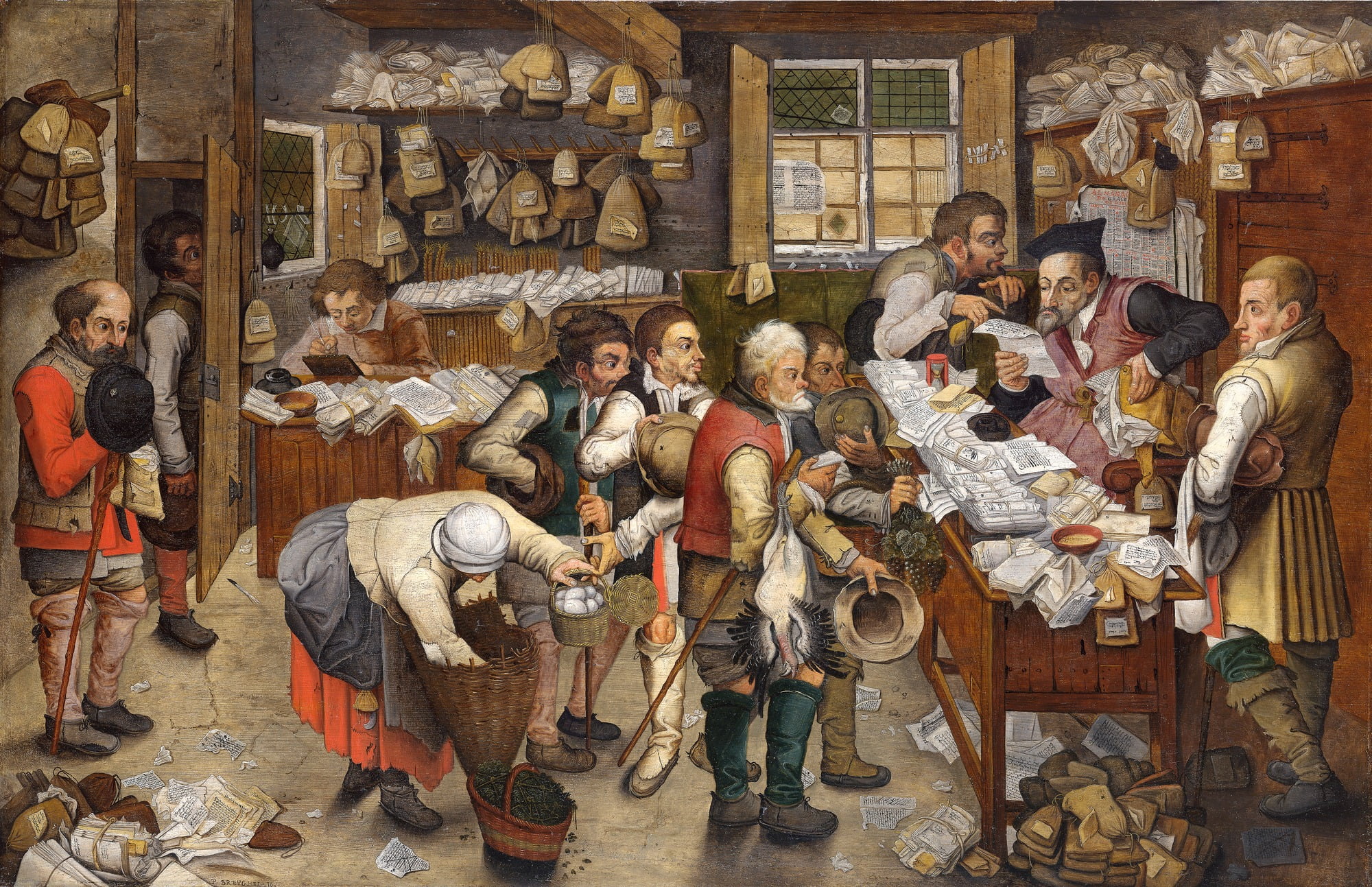
[1] https://kunstberatung-zurich.com/wp-content/uploads/2018/12/...
[2] https://kunstberatung-zurich.com/pieter-breughel-payment-of-...
Barbers ~ Doctors today.
What surprised me was the many shoemakers.
There's a long tradition of conspiracy theorizing around Shakespeare, that he didn't actually write his own plays, that they were instead written by Francis Bacon or Queen Elizabeth or something ridiculous. These arguments usually start from his background: how could the son of a common glovemaker have gotten the sort of education necessary to write like this?
The thing is, glovemaker was a highly skilled profession. Exactly like you said, any dum dum could cut a hole in a sheet of fabric and call it a poncho, but handmade shoes and gloves take serious craftsmanship. This kind of profession would have put Shakespeare's family firmly in the upper-middle class.
Stuff done "at home" obviously involves work, but it wasn't a "profession" in a notional sense so it wasn't recorded. Certainly we should assume that there was trade within and between cities based on this kind of output too (i.e. "Is that one of Marie's sweaters?", "Here's a few coins, go to Sophie down the street and see if she has any more of that jam from last summer").
He ended up keeper of a coffee shop in Glasgow, and his daughter was on a ship to Australia in 1891.
> on a ship to Australia in 1891
I don't know what the right comparison is today. According to [0], the fashion industry accounts for about 3% of world GDP. Perhaps shoes are a quarter of that?
> They were organized in different guilds, based on the street in which they kept their shops. In 1360, nine cobblers’ guilds were attested in documents, all situated within the city’s walls
I know almost nothing about medieval France, but perhaps peasants from smaller surrounding cities may have come to this one to learn or work, leading to this skew?
According to the article, the shoemakers were organized in guilds, so possibly this would standardize the reporting to the city gov.
[0] https://stacker.com/new-york/new-york-city/most-common-jobs-...
- skillful
- useful
- well organized enough
Today people don't do much, they don't master much, most of it is done far away in large shops or plants. It's rarely that useful (we're overwhelmingly comfy) and recent management practices are surreal most of the time.
I talked to a few people that prefered low wage in exchange for more skills or usefulness, even if the job might look less impressive in the first place.
Most common would be truck driver, for-hire driver, salesperson, lawyer, or janitor.
Farmers Truck Drivers Shop Staff Medical Specialists Teachers Infrastructure specialists (power,fuel,extending into IT work) --- Purveyors of leisure activities, bars/brewing, restaurants/takeaways, online gaming, gambling --- Venture capitalists and financial experts Consultants specializing in skimming and offshoring Sales, marketing and influencers
I'll let you assign the weightings
Seriously.
Given all the other food being bought we didn’t really have to have milk delivered, but milk the doorstep seemed to result in less junk food consumption.
As an empty nester I drink less than half a gallon a week.
Slapping a wedge of metal on a pole and calling it a pike could be done by anyone though, I suppose.
They were born only a couple of months apart and had the same sort of background- the sons of skilled craftsmen working with leather (Marlowe's father was a shoemaker) who attended their local grammar school.
Both schools still exist- King's School Canterbury is a much more prestigious institution than King Edward VI School Stratford these days, but I'm not sure how much of a difference there is then.
The course of their lives diverged in their late teens- while Marlowe obtained a scholarship to study at Cambridge, Shakespeare married Anne Hathaway in some haste as she was pregnant with his daughter...
(assuming I'm average...)
A Rare Case of Polyorchidism: Four Testes: https://www.ncbi.nlm.nih.gov/pmc/articles/PMC4747319/
I think people still repaired socks after knitting them was automated for that reason.
The first automated knitting machine was from 1589. Queen Elizabeth I denied its inventor a patent “because of her concern for the employment security of the kingdom's many hand knitters whose livelihood might be threatened by such mechanization” (https://en.wikipedia.org/wiki/William_Lee_(inventor))
Edit: maybe not. https://www.historylink.org/File/5721 learned me that gear for us soldiers in World War One was knitted manually. Maybe, those machines weren’t used (much) yet by then?
With medieval production methods, I would bet that making from scratch is significantly more labour-intensive than repairing.
All those binaries destroyed with the disks and insufficient disaster recovery would have to be rewritten!
As far as I can tell, before like 1880 they prescribed mercury for everything.
Even though they were universally terrible, when you read their writings they're no less confident in what they were doing than modern doctors are.
My favorite historical doctor was Benjamin Rush, a "founding father," who was hilariously bad at his job even for the time.
But you are right, generally speaking you had the choice between really bad, utterly had, extremely bad and outright killing theit patients bad doctors for the most part of history.
Medical malpractice is the third-leading cause of death. (After cancers and cardiovascular problems, aka "old age".)
This is inevitable as we can't really experiment on people and do real science.
This is still the case in many communities worldwide, a good pharmacist is a real anchor for providing care for day-to-day health care. It's a great filtering mechanism too, the pharmacist as a buffer for frivolous doctor's visits.
Contrast that to here in the US. When's the last time somebody sought out direct medical care from a pharmacist? Pretty much the kneejerk always is go straight to a doctor, no matter how small the discomfort.
I do have about 1/4 convict heritage though.
Similarly, Smith is a common surname because smiths, while relatively common, were rare enough that a given community was unlikely to have two with the same first name. There were almost certainly more shepherds than smiths in England when surnames started becoming heritable, but the surname Shepherd is less common.
https://acoup.blog/2020/09/25/collections-iron-how-did-they-...
Would you mind sharing some more details, such as where was the village? This is exactly the type of history story that I enjoy telling my children.
If you'd prefer to share privately, my Gmail username is the same as my HN username. Thank you!
True. In medieval Europe charcoal burner was typically a very specialized profession.
https://en.wikipedia.org/wiki/Charcoal_burner#Medieval_charc...
"During the Middle Ages, charcoal burners were ostracised. Their profession was considered dishonourable and they were frequently accused of evil practices. Even today there is a certain denigration of this former occupation."
This thread reminds me of Kingdom Come: Deliverance, a computer RPG which has done in incredible job recreating aspects of life in medieval Bohemia. It has a fantastic level of historical accuracy and things like charcoal trading as a dependency to a forge are integral to one of the DLCs of the game.
But even if they had, trade over large distances was surprisingly common. When I was a kid and spending summer vacations on the countryside, my grandparents were involved in a business of selling timber that was felled in some forests about 500 km away. The lumberjacks would bring the logs during the summer months, lots of it (maybe hundreds of cubic meters), and my grandparents would sell it to whoever needed it throughout the year. This was happening during Communism, so I guess it was some form of under-the-tables Capitalism at work. I imagine similar arrangements existed throughout the Middle Ages.
[1] https://wanderingcows.wordpress.com/2014/05/02/the-charcoal-...
This is actually an interesting example of a market state that's sort of intermediate between barter and full monetization. Not everyone is going to want wood, making it a bad currency. Except that The Charcoal Guy always does want wood, so transactions that somehow involve him suddenly can use wood as currency.
As to that specifically, I'd guess (based on not much) that he inherited it.
>flunkies, who serve to make their superiors feel important, e.g., receptionists, administrative assistants, door attendants, makers of websites whose sites neglect ease of use and speed for looks;
They serve, hence, not a bullshit job. We might look down on it, but they are providing value to their employer. Sadly perhaps, humans are just deeply subjective. See again my religion example. Also, this seems really dismissive of receptionists/PAs. These people do a lot of real work.
>goons, who act to harm or deceive others on behalf of their employer, e.g., lobbyists, corporate lawyers, telemarketers, public relations specialists, community managers;
Not very nice no, but again they provide value to their bosses. Probably to themselves too.
>duct tapers, who temporarily fix problems that could be fixed permanently, e.g., programmers repairing bloated code, airline desk staff who calm passengers whose bags do not arrive;
This just seems to be naïve idealism.
>box tickers, who create the appearance that something useful is being done when it is not, e.g., survey administrators, in-house magazine journalists, corporate compliance officers, quality service managers;
Here it gets interesting. These people may actually be the first that don't provide value, but trick others into thinking they do.
>taskmasters, who manage—or create extra work for—those who do not need it, e.g., middle management, leadership professionals.
This is a mix of dumb (mis)managers, and malicious time wasters. I think it's obvious that a lot of resources of all kinds are wasted by inefficiencies caused by stupidity. That's a human (as in, we as a species) problem. Then there's malice, which fits into the "tricks others into believing they provide value" category.
Anyway, that's just my take on it.
IDK, I think these sort of workers provide value too. Some industries need QA (quality service manager), or else we'd see a lot more shoddy production across the board. Compliance officers provide a defense against fees/fines incurred by violations of law/policy. Survey administrators ensure the quality of survey collection via planning/organizing/QAing. In-house magazine journalists... well it depends on the company, but some company blogs are actually entertaining/useful. I always kind of hated the Graeber book because it's ultimately just a value judgement that people could be doing something better with their time... which is probably true... in a perfect world? But until then, the occasional corp blog post keeps me from bashing my head in on Monday morning :)
Imo, receptionists, administrative assistant and "makers of websites whose sites neglect ease of use and speed for looks" are all actually useful. Their function is not just to make someone feel superior. Instead, I would argue that whoever wrote that was caught in own feeling of superiority over service staff.
That's the crux, isn't it? What kind of "value" are we talking about? The argument doesn't hold unless we start defining this in concrete terms. That's where you'll find that there are many different ways to attribute value. Inevitably, value attributing is inherently human and therefor subjective. "value", such as it is, is a social construct.
Sure, many of the "bullshit jobs" "provide value to employers", but that doesn't invalidate the argument to grant them the moniker "bullshit job".
So, what makes a job a "bullshit job"? Well, the defining criteria would be that they only exist to the benefit of their employer. They don't generate any value as far as the stakeholders of an employer is concerned: clients, customers, members, patrons, patients, visitors, other employees, etc.
Dedicating staff to calm passengers whose bags do not arrive is a clear cost/benefit trade-off as far as the airline is concerned. Clearly, it's cheaper / easier to have staff comfort passengers, then fix the issue in a structural fashion. The example of a "bullshit job" is apt, because the customers of the airline can clearly push through the illusion that the airline would actually care about their luggage.
Context matters as far as public perception is concerned, though. Things are not always that clear cut.
For instance, corporations aren't necessarily "evil" or "good" in binary terms. Their impact on the world tends to be judged in a morally ambivalent fashion. A corporate lawyer may defend not just their employer, but also squarely aligns their convictions / principles with the ambiguous impact their employer may or may not have on the world, for better or worse. Arguably, the tobacco industry has enabled the social mobility of millions of people, and at the same time, their product has caused the death of millions as well. Depending on what moral stance you'd take, it's valid to perceive a corporate lawyer both as a "goon" defending a reprehensible view on the world, as well as a honest employee defending the livelihoods of many. (note: I'm not taking sides here, it's just an example!)
In a complex and ambiguous world, "bullshit jobs" are labelled as such because they are perceived as such through the lens of current morals, values, socio-economic, political, cultural zeitgeist. A corporate lawyer is seen as a "bullshit job" because society accepts the ambivalence in what they do, and why their role is a thing, even though it's role most people feel the world wouldn't have to need in the first place.
That makes the definition pretty useless though.
To use an example from the comments, the charcoal maker takes wood and turns it to charcoal, and a blacksmith takes charcoal and turns it into iron.
Okay so two friends organize a charcoal making scheme both doing the same thing making charcoal. They sell to blacksmiths so they are providing them with value so their jobs are not bullshit.
One day a blacksmith asks if one of the friends would make charcoal for him, and he'll pay for what they work, and that friend agrees. The other continues on her own. So now one friend suddenly has a bullshit job despite not doing anything much different, and the other friend's job is not bullshit despite doing almost exactly the same thing as the bullshit job.
I haven't read Bullshit Jobs, but if that really is his definition then it sounds like it's just some unhinged anti-employer rant that fails to understand what value is or how organizations work.
Lets not forget the most significant stakeholder from many business's perspectives, investors. Many of these "bullshit jobs" enable businesses to operate at the scale required for continual economic growth. Except for very tiny businesses, execs are generally going to be too busy to answer the company phone line or greet guests.
Graeber sees these as inefficiencies, leaning on his experience as an academic lifer, but academia is a very different, if adjacent, market to the capital-driven industrial world. He seems to miss his own point that so many of these jobs are in the service of ever-increasing economic expectations.
Give me an offset stick burner, that I have to fiddle with constantly. That is the proper art of smoking.
Sadly now all I've retained are a few dirty smudges.
> Would anyone like to have the dentist use his time to answer the phone rather than fix teeth?
I don't care who answers the telephone as long as they are competent to answer questions and have authority to solve problems.
In the US it would be something like:
Receptionist: 30k / year
Nurse: 80k / year.
So you have:
Doctor's office 1: 3x Nurse, 240k per year in salary
Doctor's office 2: 2x Nurse, 1x Receptionist, 190k pear year.
That 50k in extra cost has to come from somewhere. Lower paid doctors, higher costs, ???
It always struck me as weird that the guardhouse gate to enter was manned by a $12 hour off-brand security guard. I mentioned it to someone at one point, and I was told "Do you know how much it costs to train a Marine? It would be an outrageous waste of resources to staff that guardhouse with a Marine."
Go figure.
This model is strongly influenced by the size of the clinic: we usually have small clinics owned and run by the only doctor in the clinic (though they sometimes team up). As the amount of patients per day is hard-limited by the doctors time, such small clinics have no need for a full-time receptionists.