Report: 90% of nurses considering leaving the profession in the next year(healthcareitnews.com) |
Report: 90% of nurses considering leaving the profession in the next year(healthcareitnews.com) |
- Nurses were getting burned out before the pandemic, and the US has a nursing shortage that's been going on for about 90 years (it started with an infrastructure buildout in the 1930s).* So it's a secular problem, with chronic as well as acute causal factors.
- There is a ladder of nursing credentials, and the shortage effects them differently. Hiring for roles like CNA and LPN/LVN has exploded because of the shortage of RNs and above. CNAs get trained in 4-12 weeks to do the heavy lifting of care; RNs get ~3 year degrees to perform much more complicated tasks.
- Burnout, and the nursing shortage, are in a positive feedback loop/downward spiral. That is, the more nurses burn out, the more they cause other nurses to burn out. Short-staffed facilities have a very hard time pulling back to normal staffing, because nobody wants to join a skeleton crew. (I know of long-term care facilities where the scheduling nurses (the bosses) are working the graveyard shift because they can't fill it.)
- Many nurses work rigid schedules on 12-14 shifts, and a lot of medical errors happen at the end of those shifts. **
- The hot US job market (Great resignation, great reshuffle) is hitting nursing especially hard; it is very sensitive to external shocks. There are paths to easier work and higher pay.
- Many healthcare facilities and systems don't give nurses flexibility or the possibility of advancement. (One family member will need to quit her current job and come back in a year or two to her current employer if she wants to move up a pay grade -- which is like some tech companies -- but slower moving and lower paying.)
- Many facilities are run entirely on foreign staff (the H2-B visa allows that). And many nurses are imported from the Philippines.
* https://www.nursing.upenn.edu/nhhc/workforce-issues/where-di...
** https://www.nytimes.com/video/opinion/100000008158650/covid-...
(plug: if you're interested in this problem, we're hiring: https://culture.clipboardhealth.com)
small sample size but agree on most points
Few people have been as relentlessly toxic and unforgiving on social media as nurses.
As a child of a nurse, that job has sucked for at least the past 40 years. The pay is average. Workplace is a cesspool of gossip and toxic work culture. Management is generally terrible. Also, the pandemic has exposed how many in the profession really are just narcissists.
The amount of facebook posts from indignant nurses spreading the most horrible comments , just to receive likes and be perceived as heroes, these past two years have made my stomach turn.
Its about time we cleaned up in healthcare. Not just aduquate pay, making sure we properly manage healthcare professionals and evolve healthcare management to grow where its needed.
I am 100% positive a flexible healthcare system that expands and shrinks after societal need is possible.
Not this crazy old fashioned fixed set of beds for x or y, that gets cut in some wave when they are needed less. Only to cause havoc in years when they are needed more.
Make sure the good nurses dont burn out and quit leaving the narcissist and ego maniacs behind.
There are amazing nurses out there, but we need to face that many of them are absolute shit at their jobs. And should seek other venues. This exodus may be a good thing in the end.
Hrmmm. Pretty sure if 90% of nurses actually left the profession it would be a serious problem.
That being said, I would be surprised if this actually happened. If even 5% left the profession would probably become more lucrative, since pay would have to rise to retain those who remain. Meanwhile, although nursing is not super highly compensated, the alternatives for someone who has only a nursing education and skillset will likely be worse. That may lead to a gap in ideation about leaving vs actually leaving, because the fact of the matter is that we all still have to put food on the table.
Saddest thing is that I really felt I was helping, but have to admit I've become burnt out in the healthcare field - Just have $500 or so in scrubs invested...
Taking the time has hurt my career in many ways, I do believe. I have a ton of respect for many nurses, but many travelers are worse than you might imagine. Over-extended, far over-paid for their work. And really don't care about the facility they are working with (or throwing others under the bus to cover up their own mistakes)...
It was a valuable thing to experience, and I do believe I helped many people, but it's a very different thing to be at the bottom rung than the one designing and implementing various systems. God forbid someone can see a workflow issue, propose multiple solutions, and have travelers ignore it because the workflow issue makes them more money.
Not a rant against nurses at all - As someone with over 20 years in various roles of engineering, it was quite an eye opener to me.
The issue with entitled, mean patients strikes me. While I'm sure a fair bit of this is due to the way in which misinformation about COVID and other health issues spreads on social media, I have a hard time believing this is the primary cause of this grumpiness. It seems more likely that the average person is just fed up being taken to town by a completely inhumane system that really ought to be the most humane of systems. Nurses are the front line representatives of a system that exploits people when they are most vulnerable.
Now, I'm not saying nurses deserve this at all. They're not to blame for the state of things. But the observation might go some ways in explaining the psychology of the phenomenon.
Source: Got nurses in the family.
In my opinion nurse should have shorter 8 hrs shifts and 4 per week . In this capitalistic driven health care system, where being a patient and health care provider comes with a cost.
That is 0.00008 % of all RN's in the US.
Kind of weird that the usa prioritizes software developers over healthcare workers in the immigration system .
Immigrant doctors have to be willing to live in the least popular parts of the US.
> One reason USCIS may grant the national interest waiver is because a physician agrees to work for a period of time in a designated underserved area.
Nursing educators aren't exactly a dime a dozen. The average age of a masters prepared nursing educator in the us ranges between 56-62. Doctorally prepared is higher. The country is facing a nursing shortage, and a nursing educator shortage.
Now my doctor has an interesting theory that some of the pain points for nurses is being created by the hospital systems and industry themselves as an excuse to say we dont have enough nurses and bring in nurses from other countries like the Philippines, as they'll be glad to come to the US and work for less, and will be so grateful for the opportunity that they'll go along with whatever the hospital says they need to do. (This was in the context of vaccines.)
The other thing that has nurses worked up is recently is this case: https://www.cbsnews.com/news/radonda-vaught-nurse-guilty-dea...
What a shitshow.
Then if they work for years they might increase in pay band from like 2 to 4 which takes them up to like 20k-22k
Absolute joke for the hard work they do
Just kidding. Teachers used to almost all be male until public schooling and the resultant budgeting turned them female (to pay them less.) It's like reverse computer-programming where the profession turned male when they started paying more.
Pay them and they won't leave. Pay them a lot, and dudes will start writing essays about how the reason women aren't being hired and are leaving the profession is because they naturally have less of an interest and aptitude for nursing than males.
(I have a nurse in my family)
Lots of considering leaving a profession, also considering losing fat on Jan 1, and saving for retirement.
When people are surveyed there is a big difference between why they say and why they actually are doing the action. For example "Yeah, covid has been tough... and those insurance companies though... And doctors really dont respect my profession... Oh my [pregnancy/parental leave/dream of being a DJ]? yeah that has nothing to do with it."
These kinds of opinion surveys are just barely "science" .
[1] https://www.icn.ch/system/files/2021-07/ICN%20Policy%20Brief...
I'm trying to think of how any of those can be solved with "technology" :-/
And that's ignoring the other factors that GP mentioned. I don't get assaulted on a daily/weekly basis. I'm not getting coughed on by COVID-infected patients who want to kill me because they don't believe that COVID is real. I don't endure a regular drumbeat of patient deaths and the constant second-guessing "what if I did X differently". I don't need to handle people's bodily fluids. And then there's the politics, internal and external (the conspiracy nuts, the fucked-up pecking order in hospitals, unions, insurance- and pharma-driven policies, politicization of healthcare, etc). I could go on and on, and I only know one nurse personally.
Nurses are not paid anywhere near "pretty well." They're treated like shit and the pay isn't anywhere near fair compensation for the service that they provide.
Looking at my area (NYC), I'd have to take over a 50% pay cut from my engineering job to be "paid well" as a nurse. And I suspect my job is a lot less stressful.
A nice 9-5 weekday nursing job makes a couple dollars more per hour than the receptionist out front.
Last year she retired from the profession entirely, a few years ahead of "normal retirement age", and now she works part-time at a local farm/fruit stand. The main things that drove her to retire early was management insisting on 12 hour shifts and not hiring enough staff.
I my mom's case, she was mostly doing paperwork, so many of the arguments weren't as applicable. She had done 8 or 10 hour shifts for a while and found that she really preferred it (and was staying on top of her work), but then a different manager was brought in that forced everyone back onto the "standard" 12 hour shifts.
And really, this is a red herring; the real problem started long before COVID. This video essay nails it (or so care practitioners at my workplace say, anyway): https://www.nytimes.com/video/opinion/100000008158650/covid-...
Ugggh, maybe it can't? As the main problems seem to be political, not tech related?
You might as well ask how IT can be used to fix homelessness or police brutality?
The nurses seemed excellent...but the amount of time and emotional energy they had to put into dealing with multiple computerized systems - just within my friend's room, to replace an empty IV bag - was staggering. The "smart" IV pump was the worst - a crappy little display, a minimized number of flaky buttons as the only interface, and the nurse had to drill down into multiple sub-sub-sub menu's to do even basic stuff.
My first thought was that you could triple nurse productivity (as in "care given to sick humans") if you had two IT tech's following each nurse around, tasked with doing all the "re-redundant data entry & dealing with computerized shit" that had obviously become the nurse's primary job.
My second thought was that interfaces which the nurse had to deal with should be restricted to 1950's-industrial-control-panel style - nothing but well-labeled, single-purpose physical buttons, switches, & dials. And the data entry that they had to do was restricted to wax pencils on well-laminated paper - which could be fed to a scanner, to update the patient records database. (Displays, say of vital signs & such, could be fancy. But the "50's control panel" rule could put an end to "oh, that information is hidden down in a sub-sub-sub-menu here..." shit.)
Second hand impression from a doctor friend.
This is pretty much universal in my experience. As a dev, it always seems to boil down to these. It's amazing how the business doesn't know their processes, can't document them accurately, or simply don't care to analyze and document them. Garbage requirements become a garbage system.
I have family members in medicine, and they see the same thing. There was a really good opportunity at that time to address some glaring issues with healthcare, and we ended up with this thing that did not address those issues and created a lot more issues.
The travel nurses make significantly more and now that she has basically hit her cap (after just four years) I've been trying to convince her to move to a different unit or get a different job
If a student wants a health care professional job, medicine and dentistry are better options and require just as much academic competition. Failing that, the student is better off going into tech or law.
If they're not smart enough for either of those? I dunno? Onlyfans? Permanent serfdom? I fear that our new society will have many who are left behind and struggling.
Lots of people ... most people work jobs that fall into that category.
I'm not sure that means much. I don't know how many folks who go into nursing are likely to just chose to be a developer or if it is that simple for them.
I have some friends from university who became nurses, one of which I was roommates with for two years during school. I helped them study for 'their most difficult math test' and it was a relatively straightforward test on changing units. They would not have passed a first year calculus class. The majority of their academic work was memorization, and then lots of hands on work in hospitals. The reason they get paid well is because the job is important and stressful, not because it requires highly technical people of which there is limited supply.
I don't say that as a slight - I know many nurses who are very intelligent people, its merely a judgement as to the academic rigor involved in getting your nursing credentials.
PS I worked at home depot during busy periods in the summer when the store was understaffed, I've worked as a waiter where I was the only person on shift because the owners/manager were idiots, and I've worked cleaning big chicken barns out in preparation for new chickens and those were all significantly more stressful than my technical work. Stress is not correlated with difficulty or limit of supply.
Tangentially: I'm not sure what the relevancy of "passing a first year calculus class" is. Just about every BA/BS passes one, and I (a program analysis researcher) have never even remotely needed by calculus knowledge in my day job. I don't think it's a good proxy for technical skill whatsoever, given that "technical skill" is a domain-specific qualifier.
I think the "hardest" job I ever worked was a PC tech support call center or a job at a pizza place. I didn't pick my hours ... and the job was a heck of a lot harder than my coding job that pays WAY more.
But it wasn't like I could just go and get a coding job at the drop of a hat.
If we're using job difficulty and stress as some of our metrics for fair pay, then I would argue that tech support and pizza delivery should also be higher paying! But even with that, it doesn't seem unreasonable to factor in the professional qualifications (and corresponding time and money commitments) required of nursing. Relative to all three, it's a remarkably low-paying job.
It cost something like 15% of the nursing workforce, people who were already Covid immune, since they had worked the Covid front lines from day one.
But we pretended the vaccine helped stop the spread of Covid. It doesn't. And we pretended the vaccine had no meaningful risks. It does. And we pretended that natural (recovery) immunity didn't exist. It not only exists, but it's far stronger than anything a vaccine can do.
And yet we pretended anyway. And now we're paying the price. Pretending makes for bad public policy.
There are a lot of things we need to stop pretending about.
1. Everyone pays lip service. People stand at airports and say thank you for your service the same way they open their windows at 7PM and start clapping and cheering during shift turnover. Sometimes they'll say they know people who are veterans or 'frontline healthcare workers' as a sign of solidarity
2. Nobody actually wants to hear what you went through. Hearing people die or knowing people are about to die in sometimes painful, unfortunate ways is too raw for people to try to seek out and understand, despite the fact that for a significant portion of the population that's how we're going to go out, in a hospital with all sorts of drugs pumped into our system
3. There's a constant barrage of emotional/mental harm. Believe it or not, you don't magically 'harden up' immediately. Absorbing/witnessing drastic outcomes gets easier, but the burden doesn't get lighter. This isn't to mention physical harm. People do all sorts of things out of desperation and frustration.
4. The systems that manage you are byzantine if not kafkaesque. You're never sure how the decisions are made, yet you're the one that will be paying the most for it. You know deep down that you're just a number on a spreadsheet, and the only reason that keeps you going is internal motivation to do what you think is right, so you push on
5. The people who can help rarely think about you. Very few politicians will mention your name or your union that is doing its best to get some kind of safe nurse:patient ratios or even get the hospital to pay for your scrubs that they mandate. Very few billionaires have mentioned healthcare workers or veterans at all. As a whole, until someone has an emergency that threatens their physical or financial status, healthcare and security is treated as a black box with unreal expectations and extra sensitivity to deviations from said expectations, despite a complete lack of introspection and information on how those expectations came to be
I don't know what the solution is. In healthcare, every system is so deeply connected to the rest that destroying one or even refactoring takes down everything else, and we need it to stay online. The same applies to the continuation of geopolitics by other means. You can give every IC the best EMR system, the best rifle and radio, the best monitor/laptop/keyboard, but it's all for nothing if the system as a whole is a dumpster fire. Her frustration is palpable every time she finishes a rough shift (probably 2 out of 3), and the best I can do is lend my ear and pour a glass of wine.
That being said, I am grateful that she is continuing on the path. Our shared experiences have brought us closer than ever.
https://www.beckershospitalreview.com/workforce/if-1-in-5-he...
Now, the problem is that when people started quitting, there were fewer nurses to take care of the patients and their ratios went up. During normal times, a floor nurse might be 6-8 patients to one nurse, a step down unit might be 4-1, and an ICU might be 1-1 or 1-2. It depends on the level of care required. Now, they're doing more than double this on a regular basis. And, frankly, they can't do it, at least safely. There's a number that a nurse can call if they believe they have an unsafe number of patients in order to get some kind of legal protection, but they still have to see that number of patients. And, frankly, it's incredibly stressful because they really, truly can't take care of that many patients, so they quit. A friend of my wife is a nurse trainer at a large hospital. They're having 80% of new nurses quit during their onboarding process because the ratios are absurd. A good portion of my wife's time is spent figuring out who's the least sick patient to discharge from the ICU because they don't have the staff.
Unfortunately, I don't think we're even close for this to being over either. The constant refrain is that COVID is the new normal and we need to adjust. I would contend that a new normal would imply a stable operating point and I do not believe this to be the case. It's going to take a really long time to restaff appropriately where the patient ratios and stress level manageable. Long time means years because, really, hospitals want and need BSNs and not just associates level training. In the mean time, every time we have a COVID surge, the hospital gets flooded, everyone gets overworked and abused, and more people quit.
I think your would be headline is a fair inference to come to, though not the sole cause.
With how over sensationalised our media is, can we avoid complaining when headlines actually directly match the thing they're reporting on for once?
One fundamental force in nursing is that a nursing shift is unpredictable. Some shifts go very smoothly, some are absolute trainwrecks. Patients are, definitionally, sick enough to be in a hospital, and they can start declining very quickly. This means that whatever you are doing at any given moment is often interrupted by a new priority that must be handled RIGHT NOW. It means that your 'plan of attack' for the day (which patients get [meds | baths | food | mobility | turns | dressing changes] when) is often delayed, sometimes by several hours. Any number of things could push the schedule back - incontinence care, a doctor stopping by to discuss a patient with you, a patient fall, a medical emergency, a lonely patient. A few curveballs can put you way into the weeds.
Consequently, the culture on a floor is key to how good your shift is gonna be. If you help others out when you have some slack and they help you out in turn when you are behind, it really smooths out those rough days. If other nurses let you drown, you drown.
The biggest thing that a hospital can do to help nurses is to adequately staff their floors. If everyone is drowning because the floor is understaffed, no one has time to help each other. If you're caring for six patients instead of four (on a med-surge floor), there are days where there literally isn't enough time to do all the nursing care everyone deserves. Documentation can be, and often is, done after passing off your patients in report. After you've already "dropped" documentation from your during-shift schedule, patient mobility - getting people up and walking, or even just sitting up in a chair for meals - is the usually the next thing go. After that, hygiene. Nobody dies if they don't get a bath, but another patient certainly could die if you don't do X. Next up comes pain medication requests and incontinence care. For me, it was enormously stressful not being able to provide the quality of care that the patients deserve.
This can be a huge factor in burnout. The pandemic made things worse in a bunch of different ways. Besides the stress of caring for patients with a deadly virus, you also now have to add on several minutes to every patient interaction for donning and doffing PPE. That's even less time to do the nursing part of the job while you're dealing with a more critical patient population (who will need more care). Burnout rates increase and nurses leave, either leaving the profession or taking contracts that, even if the conditions are no better or much worse), at least pay a premium. Hospitals that were well-staffed face staffing shortages, and hospitals that were already short on staff are now in a staffing crisis. The hospitals have to spring for travel contracts, and the nurses that did stay are angrier that other nurses are making multiples of their pay for doing the same work.
Given that this thread has some 900+ comments already, this comment will start off pretty far down the list. But I see some people mentioning that you are working on trying to make things better for nurses - I'm guessing that those people will read the thread more thoroughly. I would love to chat with you about whatever it is that your startup / company / weekend hackathon project is doing in this space. I've dedicated five years of my life to the problem space and would happily share my thoughts and experiences.
It's unsurprising that what has happened in the past couple of years is putting stress on a system with the slack pulled out of it.
And this is why we need savvy shareholders who vote in AGMs.
What's worse is it belies an ugly aspect of human nature (particularly pervasive in the US IME) that people absolutely do not give a fuck about anyone else when it comes down to it. As long as someone is fortunate enough to have decent health insurance through their job, people who don't are lazy.
The big picture here is that the wealthy want people dependent on jobs and to be in debt (eg student debt) because it makes them compliant.
So I'm not surprised nurses are leaving. Insurance companies make providing healthcare an absolutely miserable business and deliberately killing people ("prior authorizations", "pre-existing conditions", etc) should not be the basis for commercial enterprise. Denying someone life-saving or life-changing care should not be a profit motive.
What's worse is that a lot of the burnout is effectively caused by people who are profoundly selfish and are voluntarily choosing to get sick and die of what is now a highly preventible disease.
It's a hard situation because people depend on nurses so collectively they're torn. Teachers OTOH aren't life-critical (but still obviously important) so I'd actually like to see them make a mass exodus over all the right-wing censorship they're facing in most states.
It sounds like they're just being overworked. So, just have the nurses take a 20 minute break every 2 hours, to go out and take a walk. The hospital can require it if it comes to that but why wouldn't they just want to do it? and if the hospital doesn't want to do it, then the nurses should insist on it and walk off the job if not given their breaks. I would imagine the hospital would rather agree to 20 min breaks every 2 hours rather than loosing 90% of their workforce forever: they don't have a choice, they have to agree.
Registered Nurse (RN): The 'specialized nurses' you talk of, and what this article is mainly about. Requires at least an associate's degree to be licensed, but increasingly an bachelor's is expected. Only they can administer any medication a doctor prescribes, and only they can assess your condition.
Licensed Practical Nurse (LPN): If they are certified they can also do blood draws. Requires graduation from an LPN program (usually about one year) to be licensed. They perform easily predicted tasks like a dressing change that do not require assessment. They can also administer some drugs based on the situation.
Unlicensed Assistive Personnel (UAP): In a big hospital, these are who are checking your temperature most of the time. They can only do basic tasks that do not require any medical training, even if their experience is larger than the RNs and LPNs they're under.
There are also many different technicians. In a big hospital, an RN acts as a middle manager delegating their work to these many different tiers. In an ICU, or in a small hospital, it will be done much more by themselves.
There's just something masochist about their profession.
You can do almost any job with almost any degree.
If you're a typical white-collar professional in say some business/science/engineering field you'll typically, unlike nurses, live somewhere with abundant other high wage jobs.
There’s a lot of white collar work that only requires a nonspecific college degree, but I’m not aware of such a high demand for for HR staff or accounts payable specialists.
Salary for nurses varies widely, and in some places, they're wage-competitive with Amazon delivery drivers now. I can easily see people deciding that even though they like helping folks, getting paid less than the people who drive around and drop packages all day doesn't seem like a fair deal.
Men making less than the median for their gender (something like $55k in the US) are still marriageable; plenty of women marry men who can’t support families on their salary alone. Even at the median salary, supporting two people — let alone a larger family — could be a struggle, depending on debts and other commitments.
And then there are women who are not married to a man who makes money, either because they remain unmarried or because their husband has lost his job or cannot work for some reason.
Further, even if the cards align, it’s not great to be in a position of dependence on your spouse's salary. Sometimes you have to split up and sometimes your spouse dies without leaving significant insurance or inheritance.
It'd also be enlightening for people in this thread to have hospital executives explain how they have some of the highest patient numbers in history yet they're hemorrhaging so much money their physicians had to take pay cuts.
Nurses, due to their profession having relatively low barriers to entry yet requiring years of operational knowledge to truly be effective, need collective bargaining. Nurses do strike, and nurse strikes are actively occurring on the U.S. West Coast. However, the unions they represent are small and have little power overall. For a strike to be successful you need solidarity from a majority of workers in the area you want to impact. You also need buy-in from the hospital/region that union nurses will provide superior care to non-union nurses. Something that's hard to do when your average executive thinks that the most complicated thing a nurse does is sticking a patient.
It's not about the illegality, it's really just about people dying. Yes you can go on a strike but your patient that's in critical condition won't survive on principle. You could say "just don't care about the patient and strike anyway", but that's extremely hard to do.
Striking when it hurts some millionaire owner is one thing, you wouldn't feel bad about yourself. Striking when it hurts someone post-op who did nothing wrong aside from being sick isn't noble, you get to live with the fact that as an individual you could have saved them, yet you didn't because you wanted money.
Not a chance, not a speculation, but absolute awareness of the number of patients that will not receive care and likewise will die as a result.
I don’t think it’s fair to blame nurses for poor treatment when they have a multitude of terrible options to pursue in order to improve their working conditions.
They pride themselves in it being so hard instead of realizing that this is glaring problem that needs to be solved instead of nurtured.
This begins from medschool being prohibitively hard, to a lack of global licensing process, to doctors being on duty for 36+hrs when you cant legally drive a truck without stopping after 8hrs.
Its all wrong at every level.
And truckers are being abused in similar ways.
So hospital administration will have a fresh crop of graduates, new to the system, to abuse. The cycle will continue unabated.
I make slight improvements to computer systems. In most of the jobs I've done, despite my best efforts to work for reasonably ethical companies, I've not been convinced I've made anyone's lives better. Yet my salary is 2-3 times hers.
I find it hard to believe there can't be a better way to arrange this kind of stuff.
Even in the (US) medical system, pay/insurance reimbursement is based on the number of procedures you do, not how involved the treatment is. This is why surgeons get paid so much more.
If there are lot of participants in a labor pool, naturally wages will be under constant pressure. The barriers to entry also play a role.
For those RN's quitting, they will simply be replaced by foreign workers. It's similar to how certain jobs no longer have locals in it anymore, instead relying on migrant workers. It's the reality in Singapore for instance and naturally creates an implicit caste system.
Now the markets have evolved/evolving where incumbent locals are no longer granted the same privileges they once enjoyed, somebody who does not have the luxury to consider alternatives will be the ones who fill the jobs, and get the blame when the descendants of local incumbents cannot make their way back.
This is sort of the system I am seeing emerging and it explains the anxiety of us vs them. In reality, the government, markets simply do not care for such superficiality. It seeks to accomodate those who are productive, not sit around waiting for higher powers to "fix". And as such, this dynamic ensures wages in certain industries stagnate, and it's especially true in markets with the characteristics I mentioned above: low barrier to entry and abundant supply of labor.
How do you define and measure "social value"?
1. Hire more nurses to spread the load around
2. Pay existing nurses more
3. Incentivize people to get the technical training required to become a nurse.
"But what about my boss's 4th home?" I know. I am worried about that too. i pay 1500/mo to live there, and the costs will probably trickle down to me. we will have to figure something out.
"But we don't have the money! Who is going to pay for it?" Well. Then I guess the goose is cooked. We no longer have the resources to run a functioning society. I want you to think about that, and maybe think if we could get the funding from somewhere.
We are out of trained workers. The money diet our overlords put us on has officially starved us. Welcome to the 3rd world. Hope you saved up enough money for a ticket to Elysium.
Nobody wants to take out student loan debt anymore. If you are over 30, let me fill you in: cost of college has gotten even more insane than when we were in school.
we are seeing the same thing in our courts. Everyone is mad at the PDX DA for turning people loose all the time, but the secret is: there are not enough public defenders, and we can't hold people indefinitely without cause. There are literally not enough lawyers graduating from law school/graduated in the past to fill these spots.
Our society is falling apart and all anyone can talk about is how lazy the homeless are and obsess over what genitals people are born with.
Absolutely! Thanks, this made me laugh out loud. It's almost as if the people in charge of society don't have the same interests as the rest of us..
The reason why, at least for that doctor, wasn't really the stress from patients. It was all the damned paperwork and the stress that created.
So pay isn't the problem.
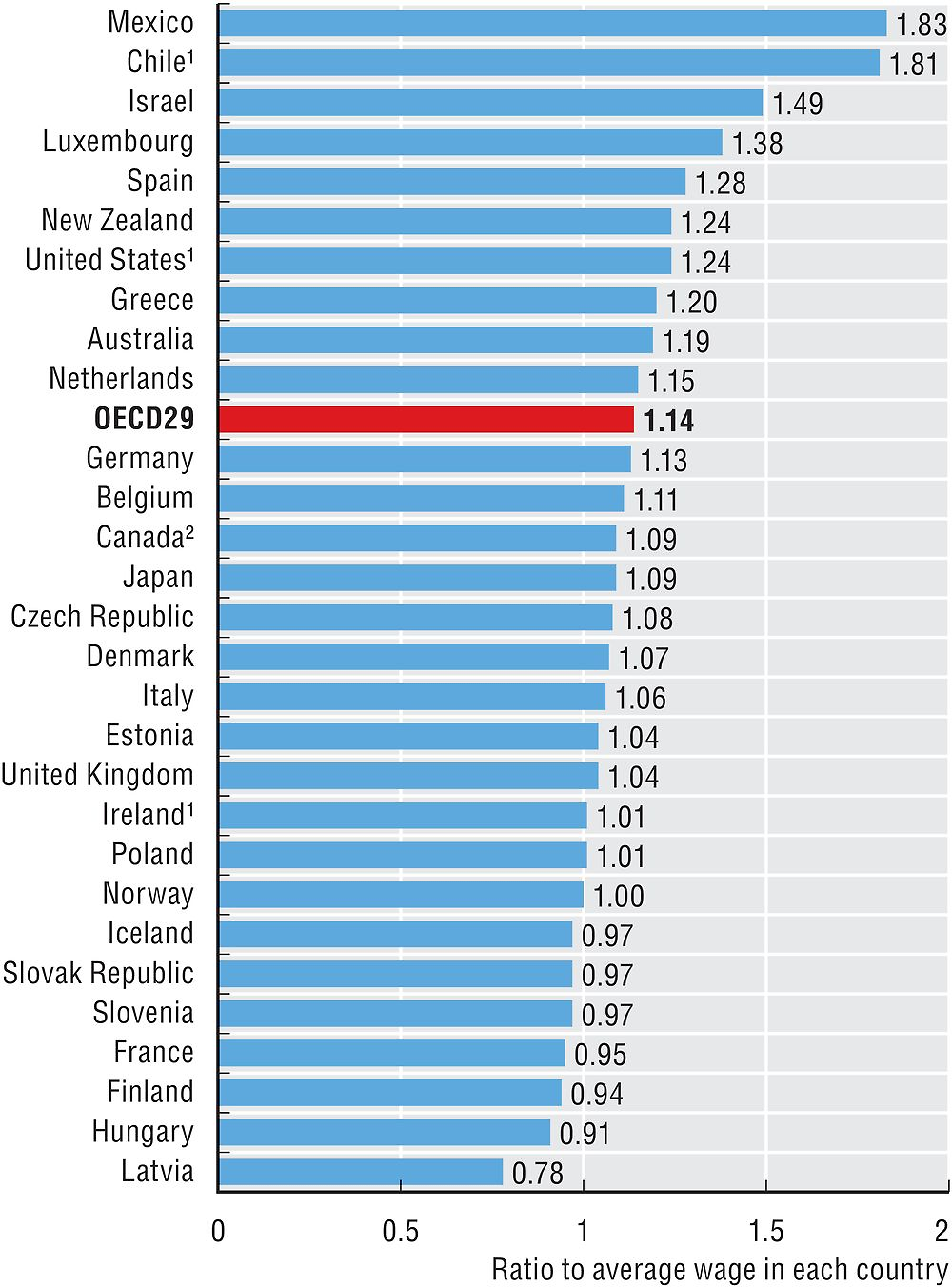
The U.S. is also above the OECD average for the number of nurses per 1000 population: https://www.researchgate.net/publication/334515420/figure/fi...
So staffing isn't the problem either.
The U.S. is below the OECD average for the number of doctors per 1000 population: https://www.nurses.co.uk/Images/Blog/media/ddad9fa9-b06d-43d...
If nurses could work a regular 40 hours a week and be paid more, as they would like, the additional money and staffing need to come from somewhere. In the United States, we've decided that private hospitals could have the right to exist. Most nurses are thus beholden to a free market. So the question is why other hospitals aren't trying to poach nurses with better wages and schedules. The reason may be that the supply of nurses remains large enough that hospitals don't feel pressured to make these concessions. The business model of hospitals is also drastically different from that of, e.g., tech companies. Tech companies can afford to pay their employees outrageous salaries because it is possible for one software engineer to create a product that will generate $100M in revenue. A nurse's labor has a cap on how much economic value it can generate. Hence why nursing salaries are constrained.
USA healthcare pretty broken, and sliding into catastrophe. Nurse dissatisfaction is just the tip of the iceberg, or the canary in the coalmine.
> Eighty-four percent of emergency room nurses and 96% of intensive care or critical care nurses have a 4:1 ratio, which is double the optimal target of 2:1.
> Thirty-six percent of nurses said they've seen patients with acute health conditions walk out of the ER because of the wait times for an inpatient bed. And 37% said that surgeries had to be rescheduled because of bed shortages.
In fact the entire website is probably a PR plant.
It's super, duper complex with lots of paperwork. The complexity is too great to run a small practice, the Medicare/Medicaid fees are too small to make up for it, and it increases the importance of administrators in the hospital system.
If I had a bunch of time I'd love to go through and write up a proposed alternative approach, and congressional bill -- but I have to imagine even if I did that, no one would listen to it.
CRNA is the Nurse Practitioner version of Anesthesiologists.
They're paying for less anesthesiologists and hiring more Certified Registered Nurse Anesthetist because they're cheaper, perform a sweeping majority of the same function, and multiple can be supervised by an anesthesiologist who is on hand to fill the small gap between theirs and the CRNA scope of practice.
I think you're right in the sense that I expect we won't shoot to automate the menial tasks first, and instead will let our hubris guide us to automate the high-skill tasks. But speaking optimistically, there's a lot of productive automation that can happen. Heck, a lot of it has already happened via digital record keeping.
This is an orphan statistic. What percentage of nurses considered leaving every year five years ago? Ten? Twenty?
It is also partly because the number of patients is increasing disproportionately, mostly because people are getting older. An individual at the age of 50 needed fewer medical appointments than an individual at the age of 70. That's literally from 2002 to today.
There just aren't enough nurses and doctors to tend to such a large old population.
This survey has such a low number of responses to make any meaningful conclusion from. 200 people surveyed. Non surprising stats like 71% of respondents having 15+ years of experience wanting to quit.
What really should be the lesson here is that capitalism does what capitalism does best:
It cuts costs.
- More patients to nurse ratio (Simply unsafe given most medical professionals already lack sleep)
- Little to no compensation relief on the way. (Huge boom of travel nursing during pandemic)
- Excess job responsibilities (More paperwork/aid duties, less actual nursing)
- New talent / old talent challenges (Larger incentive to switch jobs, hard to properly train)
We better figure out something soon. The medical field feels like it's holding on by a thread. Insurance companies run rampant with no end in sight. Health care continues to increase in costs and fail patients to the point of walking out or even dying to get care.
While I think generally speaking, nurses like my sister just want to feel appreciated like other jobs people are burning out in. You can do that in many different ways:
- Don't overwork them.
- Don't underpay them.
- Don't give them unwanted responsibilities.
- Most importantly, listen to them.
I think you may find that people actually do love the profession as it's one of the most noble professions out there, just that they are being forced out of doing something they love because of greed. Greed is not good.
The tragic insertion of a middle layer, the insurance industry (AKA Death Panels), makes it even more tragic and inefficient.
You can not seek profits in a competitive environment without reducing every cost to the bare minimum. Of course they are going to cut staff costs, and the number of properly staffed beds to the bare minimum, it minimizes costs. If a surge happens, they're happy to pay a little bit of a premium in the cost side for extra staffing. It's more than compensated by the extra billing.
But the recent public health emergency was a seiche, a tsunami, a pulse of unanticipated magnitude. (Unanticipated in the minds of those looking to meet this quarter's numbers, not in the minds of long term strategic thinkers).
The wrong type of people are in charge of health care in the US, and our nation will not be secure until this changes.
Her most recent gig was in Antarctica. I mean, cool, right?
And why is it so hard to find the raw data from the actual survey? I'm surprised this is scoring so well on HN.
[0] https://www.hospiq.com/about-us/press-releases/new-hospital-...
So much sacrifice for the greater good, we the public are not worth it.
Another profession I always think of are math teachers, they are good people.
And no, "excellent work ethic" isn't enough.
While some parts of the tech industry are miserable, on average they are definitely overpaid as compared to nurses or even doctors in some countries. And there are plenty of non miserable places in tech, especially if you relocate. Some Europe software shops seem out of this world when compared to US gaming companies, some of which sound like sweat shops.
In the same way that national defense has been driven into a profit making venture (and encouraging the support for proxy wars), health care has become a beast beyond monopolistic power, able to drive demand for its own supply. The net result has been to give responsibility without authority to the providers. Nurses are subject to mandatory overtime. Physicians are required to take unreimbursed call. These services were once the hallmark of a devoted provider. Now they are exploited by a corporate profit seeking behemoth.
Patients now have such large deductibles that they prefer to pay me in cash for a negotiated lower price. No longer is health insurance actually insurance. It has become more of a coupon or in the language of today's generation, a groupon.
Even retirees who with Medicare only had to pay 20% of unreimbursed allowable expenses, have increasing burdens. The premium for part B (yes you have to pay for the part of Medicare that does not cover the hospital) has increased 15% this year and the government stated this is largely the result of a single dementia therapy - a pill that costs $56,000.
I think we could fix the problem if we required our lawmakers to actually pay for their healthcare. They get it for free. In addition, each gets a multimillion dollar stipend to run their office, separate and apart from their generous salary. For doing what? pushing emails. And they are so afraid of offending any part of their constituency that they spend most of their time arguing about non-issues. Their ridiculous behavior is creating a fertile environment for the next tyrant who will prromise salvation and deliver true misery.
the health of the patient became subordinate to the economic incentives of the hospitals and the other involved institutions (insurance providers, pharmaceutical corporations, etc...)
and so I have the hypothesis that this happened because people (young adults) going into medicine because of a vocation to help and heal others become disheartened when they find out it's all about institutional profit; only them who get into this becuase "doctors make good money" really make it to the end (which is not terrible, as they usually do learn the methods and techniques of medicine, but that in the long run prioritize money over health).
health care should have never been allowed to become a capitalist marketplace.
I can't even imagine what nurses have gone through being front line staff interacting with patients (and their families) all day. We need a zero-tolerance policy for families that verbally abuse front line staff, but instead they are often let off due to "stress of a family member in hospital" or the need for "family centered care".
Well, I'm jotting that down in a notebook.
EDIT: Also interesting relationship with sustainability [2].
[1] https://link.springer.com/article/10.1007/s10100-021-00766-1
[2] https://www.researchgate.net/figure/Sustainability-curve-map...
If you have the opportunity to take a look at the content of your typical business administration book, or even the Harvard Business Review magazine, they essentially are collections of success stories. Instead of setting the narrative, they go and say “this or that worked/didn’t work, to get this company out of a slump”.
The issue, I believe, stems from the fact that “bringing in the MBAs” happens when a company doesn’t hit inflated targets, and for that you have to thank the c-suite, which isn’t necessarily a bunch of kids with master degrees.
When in reality, efficiency and fragility are two sides of the same coin. You might not want to maximize your efficiency if you also want to be resilient.
One of the PTs I know spent at least as much time filling out paperwork as he did with patients. This was partly due to the volume of paperwork required by govt / insurance / lawyers / whatever, and partly due to absolutely awful software.
Result. Spent 2 years trying to work when I couldn’t get out of bed and was mostly blind.
All because doctors didn’t want to spend 20 minutes filling out forms. Plus Disability companies lie constantly until various deadlines pass.
He was admittedly older and had never particularly embraced computers and so forth.
(And then my new PCP retired during the pandemic.)
For people with chronic conditions a PCP makes sense, for the rest of us it is just another pointless loop you have to jump through.
1. A few doctors left practices after they got taken over by a bigger entity and the hoops they had to jump trough weren't worth it, so they retired.
2. The insurance companies - they control EVERYTHING. One thing that happens a lot is that they don't allow her to order an MRI unless she orders an X-Ray first - even if what they're testing for wouldn't show up on an X-Ray. And this slows down the process of diagnosis by days. There are more examples of things like this - things that should be up to the provider, but end up being up to the insurance company (what drug to prescribe or what treatment to pursue first) - it makes no sense (at least from what I hear from her).
FHIR would be a good idea, but in practice its hard to correlate a patient across the systems. Few hospitals and doctors setup a push notification for when they change a patient's record.
Essentially all of the software needs to be redone with a focus on a centralized record tracking system. The rewrite needs practitioners (all of them, not just Docs, but the lowly CNA too) to drive the requirements. Admins should be included, but not the target of day to day UI.
How much could it cost to pay someone else to do this? Surely less than a doctor makes doing it... It can become its own profession. It's a separate skill - separate from what a doctor should be focusing on.
On a side note, it seems that a lot of professions would benefit from having an assistant - a thing that seems to have disappeared - if what I've seen in old movies in shows is to be believed. Another side-case of this is the fact that technical people tend to be promoted into management roles and have to deal with attendance and time-sheets - why not have someone else do it? The work only suffers.
Do you think when someone evaluates if they're paid enough they're thinking 'what is my income relative to what someone else's income is in Belgium relative to other people in Belgium?'
Also, it looks like the outrageous costs of healthcare in the US don't correlate at all with nurses' wages. If I were a nurse, I would feel demoralised if I was doing a lot of the hard work, yet administrators and middlemen still get the most money.
Most nurses work three 12 hour shifts and are paid for 40. It's so prevalent that a lot of them will pick up an extra shift or two at an entirely different hospital.
You don't have enough data to determine that as you are assuming that the staffing levels should be the same between countries when due to things like a huge push to increase profits, more paperwork, and other such things they can be drastically different.
Or pay is a problem elsewhere too.
https://www.elationhealth.com/
Speaking from personal experience, moonlighting as a paramedic, paperwork is a universal challenge in healthcare (I often spend more time documenting a call than the call itself took from patient contact to transfer of care to the ER). It is shockingly rare for EHRs (regardless of the speciality they focus on) to actively try to make life better for the clinician. That's a large part of why I'm at Elation for my day job; the founders (and therefore the whole company) have a ton of empathy for the doctors (and staff) we serve.
The Scribe had a laptop and could look up whatever info was needed while the doc was doing his thing. If a scrip is needed the scribe types it in to the system and then the doc had to read it and approve.
Just keeping the docs hands clean from not having to touch a dirty laptop/iPad all the time has a health benefit I bet.
1. Many new nurses make the same or more and long time nurses. It's frustrating when the nurse in charge with the most experience is making less than new nurses. Some hospitals are even trying to stop nurses from talking about pay.
2. Patients in COVID have become downright mean. Add this to the problems nurses have management and doctors (who are often rude and arrogant) and it's a poor culture. The quality of the environment, from a mental health standpoint, is on the decline.
3. IT systems that they have to use were designed by people who have not talked with the workers who use them. They may have been designed with laws and compliance in mind. Nurses aren't the people who choose or pay for these systems. But, they use them a lot (maybe the most) and it's obvious they weren't taken into account when designing the UX. It's maddening for them.
This one is big for product designers. Often we listen to the people who pay for it and miss out on the people who actually have to use it.
4. Nurses are the catch all for jobs. Not enough aides? Nurses do the work. Food service workers don't want to take food into a patients room... nurses will do it. Not only do they have higher ratios of patients but they fill in the work when other areas have shortages, too. So, the work per patient goes up. Pay doesn't go up, though.
Hospitals have made sure they hire JUST ENOUGH nurses to cover shifts and no more. With covid hitting, this blew out the number of nurses needed resulting in a lot of "I know you've already worked 60 hours, but can you do another 20? we are short!".
Rather than hiring permanent people or upping salary, Hospitals have instead elected to just use travel nurses and an extreme premium so as to avoid any salary increases.
The fix is one that Hospital admins don't want. Pay your nurses more and hire more than the minimum to cover shifts so a nurse being out sick doesn't result in another working a 80 hour week.
So, instead it's been day old pizza with superhero stickers.
I look at academia which is rife with money sloshing around, and see undergraduate classes are taught by grad students who make ~30k a year who are basically the Nurses of the academic world and treated like garbage. The justice system is dysfunctional, courts systems are overwhelmed and understaffed so criminals just enter and exit like a revolving door, and police is basically useless because the best they can do is taxi criminals into the system that automatically spits them out again, while they take the brunt of public criticism for how they are forced to deal with a problem that is mostly beyond their scope.
In all of these cases it seems like the bottom if falling out of these institutions, and the responsibilities have fallen on their respective janitors to deal with it when the solutions need to come from places that have been incentivized to create the mess in the first place.
My mom was a nurse, my aunt was a nurse, my sister is a nurse and my best friend’s mom is a nurse. I really can’t believe anyone continues to be a nurse given the insane working conditions these folks have to put up with. Twelve hour shifts, overflowing with patients, watching newcomers earn more than seasoned veterans… When I compare it to my laid back software engineering job it’s like I’m living in an entirely different universe. The hospital industry is a hugely demoralizing place.
On top of that, they also hire as few orderlies and nursing assistants as possible, so the nurse doesn't even have anyone to offload things to, and ends up having to do more work on more patients.
This has been a problem well before the pandemic.
It's a trope among nurses that they are so busy they don't have time to use the bathroom, let alone eat lunch.
Source: My wife is a nurse, most of her friends are nurses, and she left the profession ~a year before the pandemic because of exactly these issues.
He kept getting vacation requests denied due to lack of staffing, yet if he asked if they were looking to hire, the answer was always No.
He was super lucky and had some early cryptocurrency investments pay off big, so he decided he was done with it retired. He said that he loved helping people as a nurse, but not at the cost of his own physical and mental health, having to work 60-80 hours/week. If he ever gets back into it, he would establish at the interview phase that he works 50 hours/week tops, and that vacation "requests" are not requests, but notices.
As someone who worked in hospitals to help redesign their processes, this one piqued my interest.
For every project I worked on (and I mean literally every one), the team lead wanted to jump to the solution that they just need the ability to hire more people. In the rare instances where they were able to convince hospital admins to do so, it never fixed the problem. Not once.
Why? Because it never addressed the root causes. They needed to take a process-oriented approach. There's a saying that adding more people to a broken process makes things worse. You can hide a lot of quality issues with inventory; if you have a requirements for 100 widgets a day and you have a crap process that only makes 10 quality widgets, you can meet your goal by increasing throughput 10x, but nobody thinks that would be a good approach. It's the same with injecting more staff onto a broken system. If the system causes nurses to spend disproportionate amounts of time on admin work and not on direct patient care, it may be better to look at your admin processes rather than just hire more nurses.
It's natural when people to feel overwhelmed to think the solution is to just hire more people, but it's almost always better to hold off on hiring until the system/process is fixed.
Edit: I'm curious about the downvoting. I think it would help illuminate the conversation if you could explain where your disagreement lies. I'm basing my statements on actually tracking when hiring was increased to the levels desired and metrics did not improve.
Then I open my recruiter inbox and I see like 20 new B2C healthcare startups.
It really feels like the entire economy is designed to prevent problems being solved. Some people in healthcare are making massive amounts of money and the quality of life of everyone that performs the actual work has taken a nosedive when it was already a really crappy situation.
In case people want an idea of what travel nurses made during COVID...
https://khn.org/news/highly-paid-traveling-nurses-fill-staff...
> In April, she packed her bags for a two-month contract in then-COVID hot spot New Jersey, as part of what she called a “mass exodus” of nurses leaving the suburban Denver hospital to become traveling nurses. Her new pay? About $5,200 a week, and with a contract that required adequate protective gear.
> Months later, the offerings — and the stakes — are even higher for nurses willing to move. In Sioux Falls, South Dakota, nurses can make more than $6,200 a week. A recent posting for a job in Fargo, North Dakota, offered more than $8,000 a week. Some can get as much as $10,000.
Anecdotally, I know a travel nurse who works in pediatric ICUs (PICUs). One shift a couple months ago, the overnight staff on her unit was >80% travelers. And this is in peds units that aren't as affected by COVID, because ~1/2 of the patients are cardiac babies with congenital heart issues. The only case I can see for not paying staff more to increase retention is that they can respond to a dip in cases over the summer, but that can't possibly be an 80% decrease in patients. Maybe they're waiting until travel rates come down to offer an increase in pay so their 1.2x salary offer is more enticing in comparison to the travel rates, but the current system is ridiculous financially. I did mention that we've seen first-hand that hospitals can afford to pay nurses $4k/week, though, and I'm sure I'm not the only one who noticed.
This is a two-edged sword. If you hire more than you need, the nurses' hours will be cut during normal situations and they won't make enough money. If hospitals don't cut extra hours and instead keep the staff on the clock, a public scandal will erupt surrounding well-paid medical professionals sitting around doing nothing.
Hearsay from the nurses I know: a large hospital near me has a separate budget line item for full time nurses vs. travel nurses or other "mercenery" roles. This incentive system will never create the best patient care, but I suppose that's not really the goal.
With additional nuance that this kind of thing used to be protected a bit by the additional guard of a pharmacist. The automated dispensary changed those criminally liable people into a checkbox bypass that this nurse (and from the sounds of it, the rest of them by effect of policy) regularly bypassed.
https://khn.org/news/article/radonda-vaught-fatal-drug-error...
On an individual basis, nurses are overworked because they choose to be and their employers allow for it. The standard work week is 3 12 hour shifts, which is much less than most professionals work. Like a retail or warehouse worker, they are expected to clock out as soon as possible and leave when the shift ends. Those of us with salary jobs knows how difficult that can be in our arrangements and how much "free" work we end up performing. They get paid premiums for everything; night, weekend, etc. And since they're hourly, they typically LIKE the overtime and signup for it as much as possible. They also might work FT at one hospital and pull extra shifts at another hospital on a PRN basis. These things are very common. Just like in a retail environment, people typically LIKE to work holidays so long as it's voluntary because it's 1.5x pay (or more?).
> Rather than hiring permanent people or upping salary, Hospitals have instead elected to just use travel nurses and an extreme premium so as to avoid any salary increases.
This makes no sense. Capacity is the problem, paying more for the same capacity does not solve the problem. Hospitals try very hard to avoid overtime and the travel nurses due to the cost. It's also a very elastic model to balance and a lot of flex (non Full Time) folks are needed to fill the gaps and manage cost somewhat.
> The fix is one that Hospital admins don't want. Pay your nurses more and hire more than the minimum to cover shifts so a nurse being out sick doesn't result in another working a 80 hour week.
That is the current system. The problem is usually time. If someone calls in sick, they do it an hour before their shift starts. They usually can solve for this. Either they call from their roster or a supervisor level person with an active RN license steps into the clinical side that day. Staffing at 2x just in case everyone calls in makes no sense. Staffing at 5x just in case a pandemic hits makes no sense.
Hospitals barely make money as it is, I don't see how this is a sustainable solution. Paying more does not create capacity in this industry.
It's also important to note that "nurse" is a very generic term. For example, ICU nurses is a very distinct type of nurse that has been dealing with COVID first hand (caring for vent patients). They are the ones you hear about making $150-200/hour in COVID times. It is difficult to become an ICU nurse. It hasn't been possible for a surgical nurse to pivot to ICU nurse in these times so the labor pool has been rather fixed, or shrinking due to natural churn and inability to onboard new folks. It would be akin to suggesting why does some [insert super specific domain expertise] developer make $1M/year at FAANG when they could hire a PHP coder for $15/hour on a freelance website. There is no immediate/cheap substitute for the experience and knowledge that the expensive developer has, so they cost more. This is happening in nursing where some are thriving while many actually got furloughed early on in the pandemic.
My personal opinion on the matter, is one only has to look at the demographics of an average nurse. It's become quite "old" and like other industries, the boomer's retiring is causing a labor issue. The handful of nurses that made 5-10 years of salary since Q1.2020 are now ready to retire early as well. I don't blame them.
5. Pay cuts - Most of the critical doctor specialties (ER, ICU, primary) that were the backbone of the pandemic got "raises" that were less than inflation (hers was 1.5%) while profitable elective specialties got big raises. The root cause is the billing system where elective surgeries bill pay out more than critical roles. Still, it's extremely demoralizing to be called a "pandemic hero" and have your pay get cut.
6. Criminal and Financial Liablity - Healthcare is delivered by a team yet the financial and criminal penalties for mistakes are assessed at the individual level. Recently a nurse was given a criminal sentence for a drug mistake which many believe was systematic failure (bad UI / IT systems, bad hospital practices, AND negligence on the nurse). Imagine getting sued or jail time as an engineer for dropping a production database. The few malpractice cases my partner has been involved in, it was very clear that the issues were systematic and perpetuated by hospital practices. However, if they had gone to trial, an arbitrary worked would d have been sued and the hospital wouldn't change its crappy practices. Institutions have effectively dodged liability in many cases.
7. Chronic understaffing and burnout - most ICUs have been understaffed throughout the pandemic. From an economics POV it seems crazy that their is a labor shortage but salaries are effectively dropping.
With the inflation numbers this year I have no idea what we are going to do, since we are already 6-7% in the hole from the 2021 cuts and now inflation is 8-9% ( assuming the economic numbers are correct... )
So...this is also the biggest reason (besides lack of pay or basic human dignity) that restaurants and retailers are having a lot more trouble finding employees. Rude (and sometimes violent) customers were already an issue, but they've become absolute animals lately. It's increasingly bad for your own health, mentally and physically, to have any public-facing job. In the last few years, we've let go any pretense of expecting people to be civil and reasonable, and adult children are rewarded for their behavior instead of being trespassed.
Teachers are also quitting in droves (and in the middle of the school year, in some cases) for the same reason. Children are awful and the parents are worse. You risk sickness and violence, and are constantly harassed by parents. Then there's the whole attack on the curricula and book banning...
The FAA reported 1099 incidents with unruly passengers last year, up from a normal 100-300 in prior years. Because some sorts of people simply won't do what they're told...and disobeying flight crew instructions is generally a federal crime.
Everyone's increasingly overworked and underpaid, and they have to deal with degenerates like that daily. Of course they want out.
We're having a societal implosion.
You're right that there are definitely opportunities for improvement here. As a Product person that has worked in EMR/Healthcare IT systems, I can tell you the biggest challenge is most of the decisions are driven by legally-required compliance. In many cases, you literally cannot make it better because the brokenness is /by design/ to comply with the law.
Nearly across the board, especially in the US, our legal and regulatory climate has not kept up with technology and often actively works to the detriment of technical innovation and improving our systems.
Systems that nobody has ever asked us to use. Entire APIs with full access to key data, that nobody uses.
Shared system resources (e.g., registers, main memory, secondary storage) are released back to the system, protected from disclosure to other systems/applications/users, and users cannot intentionally or unintentionally access information remnants.
I think this is looking at the problem wrong. The problem is that implementing positive change in these systems is impossible for reasons far outside the control of any product designer or developer currently on the team.
This software is old, has byzantine requirements, probably cut costs all over the place, and conceived in a board room without the benefit of an adequate development lifecycle or stakeholders advocating for the users.
It probably takes 3 months to move a button around, and instead of moving that button executives are having them push a feature that earns a few more million, or a feature that the customers want more then a UX improvement.
I've worked here before... Half our customers are complaining about feature X that doesn't work right/ is inconvenient. Exec: we don't care they are already paying us on a 3 year contract. Hack this new feature into the program that a potential new customer wants.
Horrible places to work they are. Thats why I avoid using any long term contracts like the plague. The second I see call for pricing I close the window.
A developer working on something is different from a product designer. For product designer I don't mean a UI/UX developer. I mean someone empowered to design the thing. This is often a leader or product manager.
Product design isn't something taught well in most schools. It's often out of sight and mind. An engineer who was good at building hardware or writing code didn't learn the skills needed for product design through that. Product design requires looking at the whole system differently.
> It probably takes 3 months to move a button around, and instead of moving that button executives are having them push a feature that earns a few more million, or a feature that the customers want more then a UX improvement.
A better UX would reduce the amount of time nurses spend using these systems. That productivity could be used to do more other work (like taking on more patients). I don't like this argument but it's easy to make in terms of cost effectiveness.
I don't think the cost effective conversations are happening. I expect there isn't that level of depth to these. It's hard to do when a purchasing organization (like a hospital) only have a few options and they are all bad.
This is an opportunity. To build software that is both compliant and has a good UX. There's an opportunity to disrupt all the crap software here.
Look at the RaDonda Vaught case or the Michelle Heughins case; terrifying to be looking at jail time for a med error.
Many nurses are watching these cases more closely and deciding that since staffing isn't getting any better and they won't be protected, it's not worth the risk.
She pulled the wrong med, and then injected it and walked out of the room rather than observing for effects. Also the med she pulled had warnings on all sides of the bottle and on the top saying very clearly that it's fatal to administer without ventilation. This went beyond a mistake to negligence.
* Vaught stated her department was not understaffed, nor was she tired. The incident also occurred in 2017, so pre-pandemic
* Vaught went to dispense Versed (generic name midazolam) by the brand name, instead of the generic name as they're trained to do. This led to her selecting vercuronium bromide instead
* Vaught stated she had dispensed midazolam several times before, which would have had to have been by the generic name
* Vaught ignored several warnings from the dispensing machine stating the patient was not prescribed vercuronium bromide
* Vaught ignored the red cap on the vial dispensed that stated it was a paralytic agent
* Vaught ignored that vercuronium bromide needed to be reconstituted with sterile water (unlike midazolam, which comes as a liquid). She stated she thought it was odd that she didn't have to reconstitute it before when dispensing the correct medicine
* Vaught did not scan in the medication before or after giving it to the patient, which would have likely prompted another warning about it not being prescribed
* Vaught could not recall exactly how much she gave to the patient
* Vaught immediately left the room after injection, and did not wait to observe the patient for any side-effects
All of this information is available in the DA discovery documents (https://www.documentcloud.org/documents/6785652-RaDonda-Vaug...) and the CMS report (https://www.documentcloud.org/documents/5346023-CMS-Report.h...).
The opinions on the case I've observed have been nurses who aren't aware of this and saying she should not have been convicted, and the nurses who are aware who think the conviction is fair ...ish. The latter is at least unanimous she should have her license revoked.
Most agree that Vanderbilt should be held responsible for negligence as well. My wife's hospital for instance does not stock _any_ paralytics within machines, to prevent it being accidentally dispensed without involving the pharmacy. There's also evidence that Vanderbilt tried to cover the incident up.
I've made a point of stressing to any RN I've talked about it with the importance of having a lawyer with you when talking with investigators. Vaught straight up incriminated herself multiple times during her initial interview.
[1]https://www.npr.org/sections/health-shots/2022/03/24/1088397...
And of course, a lot of nurses are in the job for the human connection, and will consequently be burned out at an increasing rate.
To some degree this might actually be good long term, because it will be that much harder for hospitals to manipulate nurses into working around the limitations of the system to provide real care, which allows the administration to turn a blind eye to their own flaws. There's going to be a surge of malicious compliance that ends up shining a bright spotlight on just how abusive and dysfunctional hospital systems really are.
And patients will ultimately be the ones who suffer.
The nurse in that case was prosecuted for criminal reckless homicide (not malpractice, which is civil negligence.) The characterization of the hospitals direct responsibility is negligence not arising to criminal (gross) negligence (as the principal of respondeat superior doesn't apply in criminal law, the employees recklessness would not be imputed to the employer the way it would in a civil case.)
As for civil liability if the hospital, that was settled out of court with the victims family, the hospital did not get off scot free.
This... isn't a new thing that deserves the “now” label like it is a change. Criminal wrongdoing by employees (including in healthcare) very often does not rise to a level of criminality for the employer, and that's been true for a long time.
https://www.npr.org/sections/health-shots/2022/03/25/1088902...
There's no way to get a certification with online learning or with any kind of in person time schedule compatible with my job... ok... maybe I can get time off? I have to re-get all sorts of immunizations I already have and re-do medical checks that I already had to get for my green card, like a year ago... ok... that's a lot more time off. Oh, they drug check me! well... I guess even I would work on healthcare more for vocational reasons I'm not doing it while I'm in California. It's just too much of a hassle and with the staff shortages I feel I'm just being taken advantage off.
In Nevada it's only take the course, pass the exam and you can already go on an ambulance, so are most other states.
> This one is big for product designers. Often we listen to the people who pay for it and miss out on the people who actually have to use it.
This resonates with me strongly for two reasons. First my mother is a retired RN, and the electronic record keeping was her biggest frustration. It is hilarious to me how much my mother hates computers, while I make a living in software.
Second, I'm now working for a startup, Smarter Dx (we're hiring: https://angel.co/company/smarterdx/jobs ) that works with these records and tries to make better use of them. To the extent that we're successful, incentives are created for the hospital to improve them, conceivably including improving the UX that nurses see. I don't mean to underestimate the difficulty of the problem, but I think it's possible to at least push in the right direction.
20 minutes later (while my mom was well on her way into work) the phone rang again- it was a false alarm, she didn't need to come in anymore. Naturally, it was my (not so happy) dad who answered.
By the time she got in, they didn't have anything for her, so sent her back home.
At the time, there wasn't quite such a crunch in nursing, so the pay part wasn't accurate yet, but everything else you listed (substitute COVID for %50+ of patients) was already true 30 years ago.
You couldn't be more right about that. Last week a nurse had to use a computer in my wife's hospital room to log that she'd given her a painkiller. The IT staff had failed to configure the hospital computers to disable windows updates or restrict them to off-hours and the nurse was forced to stand there for ten solid minutes while Update churned, the pc restarted, and Update churned some more.
I'd add to #1 that travel (temp) nurses are making 4x+ more than staff nurses, I've heard as high as $13-17k per week in high-demand areas. This exacerbates the problem, as staff nurses hear this, and if they can, they leave. Travel nurses can be great, but they won't know the facility and workflows and people as well as staff nurses: staff nurses now pick up more slack, all while getting paid 1/10th what their new colleagues are. This is more than most doctors.
For #3, this problem is made worse by additional compliance burden. Nurses need to document more and more, click more and more, read more and more… with less and less time. And on systems that are unpleasant to use. Among other issues, this leads to problems like these[0], which drive more and more nurses away.
I'm working with a badass team on solving some parts of these problems, particularly relating to technology and workflows. If you're interested (across basically any role, but product designers, engineers, product managers are top of mind right now), let me know (email in bio)!
[0]: https://www.cbsnews.com/news/radonda-vaught-nurse-guilty-dea...
- Demanding work: 12 hour shifts, irregular schedules, night shifts, physically exhausting, limited breaks (including bathroom/water!)
- High responsibility with unsafe conditions. You're literally responsible for people's lives. Poor staffing ratios stretch you thin and make you more likely to make mistakes. And if you make a mistake, you're at huge risk for litigation... and now criminal consequences too. Responsibilities, resources, and staffing stretched even thinner due to the pandemic.
- Administration that treats you as something to be optimized and does the absolute bare minimum to support you. Instead they tack on additional tasks, expectations, and requirements ("no water at a nurse's station!"). They encourage a culture where nurses provide a concierge service to 'guests' instead of critical care to patients.
- Hostile/entitled patients. I'd guess many/most patients are not an issue, but it only takes a couple of difficult/combative patients to really ruin your conditions.
- Low pay given the responsibility and working conditions for non-travel nurses. https://nurseslabs.com/nurse-salary/#nurse_salaries_by_state Like many others pointed out here, in tech I make way more than a nurse for a job that's less demanding, has far lower stakes, and is of far less value to society.
To me the blame lies mainly in middle/upper management, whose role is to build and empower an effective workforce. If 90% of your workers are considering leaving, you blew it.
Sometimes, it feels like we’re min-maxing ourselves to death over here.
I feel like a waitress, custodian, social worker, therapist, punching bag and other stuff - It's never ending. This has effected my mental health so much that I am slowly doing my career switch to SWE. While I know every job has it's own difficulties bs/stress/politics, the one's i deal with as a nurse now I can no longer deal with. I don't regret this career path because it has taught me a lot, and their is something better for me out there.
Career: I did consider other areas of nursing, but they didn't satisfy me, ICU is relatively the most enjoyable for me. On a regular hospital floor/intermediate floor, a nurse will be given 4-5 patients and let me tell you its a ZOO! In ICU i only have 2, and those keep you busy the whole shift. They're both different kinds of crazy.
I will say, being a nurse in California is 5x better than anywhere else simply because their are laws that allow us to have uninterrupted breaks!
I just wanted to say that it’s a sad state of affairs when we’re happy to expect uninterrupted breaks. Goes to show just how much we _really_ supported our frontline workers.
Best of luck to you!
The American people will do anything for their veterans except take them seriously.
Outside of the existing issues with Bedside nursing (long days, physically demanding) - the primary issue is staffing. Pre-pandemic the ratios were already bad but now many are leaving for travel contracts which carry significantly better wages. It quickly becomes a loop where employees leave for Travel Contracts, and then can only be backfilled with Travel Contracts. The remaining FT staff nurses are left making much less money, and have to assist "training" with the outside Travel nurses. And while this is nothing against them - The travel RNs also often have a different "vibe" as they are much less focused on long term improvement or problem solving within the Unit.
Also ICU/PCU/ER nursing throughout the pandemic was a terribly depressing place to be. Leaving many of my Wifes colleagues (including herself) with what is essentially PTSD with little or no support from the Hospital System.
From my perspective, the entire healthcare industry is set up to treat any frontline worker without an MD after their name as completely expendable, nothing more than a row in a spreadsheet that can be optimized for middle management to hit next quarter's bonus targets.
You can meet all metrics management sets out for you, have amazing patient satisfaction scores, etc, and every 6 months some spreadsheet wielding online MBA graduate is going to show up to turn the screws and tell you you need to work harder for the same pay, and to just be happy you aren't getting laid off.
At some point in time, the workers realize the joke is on them and find another profession.
1. Safe mandated staffing ratios. California is one that does this and many nurses seem happy with the ratios.
2. Safe harbor laws. If the nurse feels they are pushed into a risky situation, they should have a right to notify management which will take on liability if they do not resolve it. A few states have this but hospitals bully nurses not to invoking it.
3. Better pay for the liability they take. Unlike management, they could go to prison for mistakes they make. There was a recent case nurses were outraged about.
4. Unions are beneficial. In California the nurses union is pretty strong to negotiate better terms and conditions.
The nursing crisis is 57 years old now: https://pubmed.ncbi.nlm.nih.gov/14252064/ (1965)
Similar articles
    WHY THE NURSING SHORTAGE PERSISTS.
    HALE T. N Engl J Med. 1964 May 21;270:1092-7. doi: 10.1056/NEJM196405212702105. PMID: 14121489 No abstract available.

    STUDENTS' DISAPPOINTMENTS IN PUBLIC HEALTH NURSING.
HANSEN AC, THOMAS DB. Nurs Outlook. 1965 May;13:68-72. PMID: 14291737 No abstract available.[0] https://trends.google.com/trends/explore?date=all&geo=US&q=n... [1] https://trends.google.com/trends/explore?date=all&geo=US&q=n... [2] https://trends.google.com/trends/explore?date=all&geo=US&q=n... [3] https://trends.google.com/trends/explore?date=all&geo=US&q=n...
Nursing is a well paying middle-class job without a lot of transferable skills to other professions. Don't say programming. It isn't the solution to everything. Other low-entry-barrier jobs pay much less and have exploitation problems of their own. For a lot of middle class families, dual income is essential to maintain their lifestyle. So SAHM is not an option. Nursing has clearly gone through a rough 2 years, but I suspect that things are going back to normal now. Why leave now ?
> High patient-to-nurse staffing ratios
This bit is confusing me. If supply-demand is in the Nurse's favor, then don't they get more leverage on what QOL and wages they can demand ? It is not like they can fire a senior nurse on low pay, when new nurses are harder to find and demand higher wages. I know that the nurses refusing work and resulting deaths has bad optics, but it doesn't look like hospitals have a lot of leverage right now.
> Administrative burden and manual tasks
Sounds like an opportunity for a startup to disrupt the space. But, the jaded side of me thinks that the startup will fail due to insufficient political leverage with hospitals/insurance/law-makers.
> health IT
Keep calling it health IT and the problems will never be solved. Solving hard problems needs reframing of the resources dedicated to it. When tech workers are seen as assets and not cost-centers, these problems will solve themselves.
I have many friends and relatives that are nurses, MDs, and therapists.
Compensation is about as backwards as you can get. Seniority has no impact on your pay. Once you hit the ceiling you’ll never make more money. This is especially true for Nurses and therapists. Even if you switch jobs. The market rate is what you’re going to get paid (within 10%).
My wife is a PT and made 3x more traveling as a contract therapist than she did as a full time employee. Three times. That’s absolutely absurd.
Benefits are also beyond comical. Healthcare insurance costs for healthcare workers are higher and the benefits are worse than if you just bought Obamacare directly.
Beyond horrible pay with no upward mobility, you’ll also have to deal with completely disconnected management that has never done any clinical work in their lives. They’ll bitch and moan about saving money, and often enforce policies that put clinicians at risk of malpractice. All to save money.
So yeah. If I were to give any young people advice, it would be to stay as far away from healthcare as you can.
Self-insurance seems pretty common anymore. Which amounts to - you can receive treatment in the hospital you work in. You'd at least think it would at least be free, but nope.
That NP is the key. Just a BSN will earn you under six figures in most of the USA. We get job mailers because my partner is licensed but non-practicing. And these are advertising nursing positions for $35-40/hr.
According to the BLS, an RN earns an median of $78k a year. $100k/yr is the top 15%.
- "Almost HALF Of San Francisco Residents Considering Leaving City" (according to survey of 500)
- "One in three New Yorkers Considering Leaving The State"
- "Over Half Of Young Lawyers Considering Quitting by 2027, IBA Report."
Look for X people considering Y, and you'll find them. Considering is cheap.
The awful experience of nurses, absolutely, true. But this, like so many others, is a silly poll that doesn't say anything.
A lot of people did leave NYC, and probably NYS. So if a much larger number than usual are considering leaving <fill-in-the-blank>, chances are that a larger number than usual will leave <fill-in-the-blank>.
But this sounds like the employee satisfaction corollary to Sturgeon’s Law [1].
“90% of employed people are considering leaving their profession in the next year.”
This survey would be more compelling if it compared nurses responses with the general employed population over time. I only skimmed so maybe it does and I missed it.
This was generally the case prior to pandemic due to how poor the work environment has become, but the pandemic seems to have broken the few remaining folks who still had hopes and dreams.
How doctors of all professions lost their professional agency to do-nothing administrators within a generation is quite puzzling and a bit terrifying to me.
I wish I had more access to nurses during the process. I was always told they were too busy. I just wanted to observe, as I do with any client I write systems for, and was denied. I can say that at least 2 other groups were working on the exact same project as I in the hospital system, and we "won". We all worked in isolation from one another, I discovered the others by accident.
The top of major healthcare systems is wasteful and full of "little kingdoms". The ideas that "AI is going to help" and "nurses need to feel heard" are basically incompatible. Throwing money at artificial brains is always to substitute real ones, and the concept itself is contradictory to employee development. Why train a bunch of nurses endlessly on a subject when you can train an AI once?
We're supposed to be improving & developing people's lives here, not improving a box. For centuries we've found new ways of thinking that have made us better at science and medicine. Computers could do that, but we're not using them to teach each other. We're using them to replace one another.
It may sound silly, but I've reached the point that the theory Dune puts forth seems right.
But yeah, in general, this is a problem (healthcare in general, healthcare expenses, nurse job experience) where almost all other countries with similar wealth are doing so much better than us, it shouldn't be that mysterious to solve it, right? It's not like, who knows if it's even possible to do better! Like, we know it is... figuring out what the difference between them and us isn't trivial, but it should be easier than something there isn't a model for.
The most obvious difference would seem to be how insurance (and universal coverage thereof) is handled.
Guess what my first major investment was?
sqrt((p*(1-p)/n)
sqrt((0.9*0.1)/200) = 0.021
So 95% confidence interval for this ~ 0.86 - 0.94
Does that radically change the message of this article?
"I plan on quitting my job if I had money" wow stop the presses.
The deaths were always hard when working with little kids - and there were a couple a month. But towards the end of COVID they were losing 4 kids PER WEEK (anecdote - I have no data other than listening to them vent) that this nurse firmly believed were avoidable had they received appropriate care.
What caused them to exit was how the hospital handled COVID: they postponed all elective surgeries. For these children, an elective surgery was anything where they "wouldn't die tomorrow" if the surgery wasn't done (somewhat of an oversimplification - but ballpark correct).
During that time hearts got worse, cancer progressed, bodies shut down until electives became emergencies... Success rates of surgeries dropped. And once restrictions started lifting the staff was underwater, they had a huge backlog of "electives" piled up on top of the normal ingress - kids were dying from waiting.
Considering it was bothersome for both healthcare workers and the public, in my opinion the friction is more between the healthcare workers and management/government entities (& their policies) rather than "some patient bothered me" cases.
I guess my point is, not only is the current healthcare labor market at stake, but hiring/pay/working conditions now are having upstream impacts on the labor pipeline of people coming into the market, or evaluating entering healthcare. Having recently gone to the ER with my toddler, I can tell you this is not an area you want the market going for lowest bidder when you do have to use healthcare services.
Sans the covid anomaly, immigration has never been higher in Western nations. The issue isn't restrictive migration. It's that we're not treating nurses well. That means fewer people pick this career, and more nurses leave prematurely. Suggesting that we need to import more nurses is only admitting that migrant nurses are willing to work for worse pay and worse working conditions, and I don't think that's fair to anyone.
I can speak to this a bit. After interviewing lots of hospital workers, I can tell you that the hospital quality people love EHRs because the reporting functions actually work. Previously, it was not possible to measure how well the hospital was doing and convince the doctors to improve practices - think washing hands before doing examinations.
EHRs are shitty because (1) the big players are entrenched - they are already implemented and the cost / disruption to switch to a new EHR is extremely high, and (2) the market isn’t big enough to justify the level of investment it will take to break through - Apple made more money from one product (AirPods) last year than all the EHR vendors combined.
At this point my hope is that mobile devices and meta-EHRs are able to crack this.
Part of EHR's problems are definitely that the market is only one single country, the United States.
The nurses aides would argue that they do the majority of the frontline work while getting paid a fraction of what the nurses make, and get even less credit.
I think non-performance-based pay is something endemic to many female-dominated professions. My wife used to work in childcare, and it did her head in that she was paid less than complete idiots who'd been working there longer than she had.
- There is a ladder of nursing credentials, and the shortage effects them differently. Hiring for roles like CNA and LPN/LVN has exploded because of the shortage of RNs and above. CNAs get trained in 4-12 weeks to do the heavy lifting of care; RNs get ~3 year degrees to perform much more complicated tasks.
- Burnout, and the nursing shortage, are in a positive feedback loop/downward spiral. That is, the more nurses burn out, the more they cause other nurses to burn out. Short-staffed facilities have a very hard time pulling back to normal staffing, because nobody wants to join a skeleton crew. (I know of long-term care facilities where the scheduling nurses (the bosses) are working the graveyard shift because they can't fill it.)
- Many nurses work rigid schedules on 12-14 shifts, and a lot of medical errors happen at the end of those shifts. *
- The hot US job market (Great resignation, great reshuffle) is hitting nursing especially hard; it is very sensitive to external shocks. There are paths to easier work and higher pay.
- Many healthcare facilities and systems don't give nurses flexibility or the possibility of advancement. (One family member will need to quit her current job and come back in a year or two to her current employer if she wants to move up a pay grade -- which is like some tech companies -- but slower moving and lower paying.)
- Many facilities are run entirely on foreign staff (the H2-B visa allows that). And many nurses are imported from the Philippines.
* https://www.nursing.upenn.edu/nhhc/workforce-issues/where-di...
* https://www.nytimes.com/video/opinion/100000008158650/covid-...
(plug: if you're interested in this problem, we're hiring: https://culture.clipboardhealth.com)
I'm curious what the consequences of this are, how does this impact the profession in the US?
(2) is a really perverse statistical phenomenon, and it's unfortunate that nurses are bearing the brunt of our civic and public information failures. It must be particularly soul-draining to heal someone who resents the single thing that would have protected them the most from needing hospitalization in the first place.
Pedantic, but: I think it's the responsibility of the people that pay for it to talk to the people who use it, and buy the best software.
I have a hard time believing that you can sit a bunch of nurses in a room to talk about the software, and that they'd design and/or elaborate on an awesome UX. Is there an example of that ever working? People have funny ideas about what they want. Homer Simpson's car design is a meme for a reason.
Maybe, but nurses have also used "because covid" as an excuse to engage in some pretty awful behavior. Fathers have only very recently been allowed in the room during ultrasounds, for instance. NICUs only recently started allowing both parents to visit at the same time.
It sounds like the issues nurses face are global and do not significantly change across different systems (the system in my country is completely different from USA)
It probably comes down to the fact that this is a human problem and to solve it we must radically change the expectations around care and primarily being taken care of.
There's no technological deus ex machina or amount of training that can change the situation without shifting the POV.
IMO people working in HC are subject to a lot of stress and must be protected at the cost of making it a bit unpleasant for the patients to be cured.
It's such a fundamental foundation of our lives that the system should be calibrated to create the best possible working environment for those who are working instead of moving it toward a customer reviewd activity that focuses on their satisfaction.
I know it can sound unpopular, but receiving the best medical care possible is not a right, it's a goal that more often than not it's almost impossible to achieve, so let's improve the working conditions so that the workers can give their best without questioning too much all the sacrifices that the job requires.
If you know ANYTHING about finance, that should send shivers up your back and also make you realize why this happening with nursing.
Private Equity is where you go to get money if:
• Your business is floundering and no one will loan to you
• Your industry is in the ebbing phase and not growing
• You are ignorant or naive about getting money for business
• You haven't done your due diligence
• Your company is in play for a hostile take-over
Having Private Equity getting involved is always a major Red Flag if not Black Flag.
In general, Private Equity knows nothing about your business norms or markets - they don't care. They are a one-size-fits-all investor and that primarily means "Cut Costs on Everything".
It's very akin to having a lawyer become your CEO (e.g. Sears/Kmart) - it's a omen of VERY BAD things being imminent.
A case in point: the COVID bounties from Medicare for testing, admissions, treatment AND DEATH BY COVID are exactly something that Private Equity would love maximally, dream up and probably try to enact with lobbyists.
This was exactly my experience when I worked for a medical software startup. Our (very unfinished) software got deployed in a hospital with no training, no orientation, no nothing, and it was such a disaster that it was a patient safety issue. Mind you, the engineering team had no say in any of this, not that we were even given the chance, and we weren't even aware that the deployment was for real. We were under the impression that the deployment was for testing purposes, because we were aware that the software was unfinished.
It was a breathtakingly poor decision purely on the part of managers (and, frankly, sales) on both sides of that deal and it was doctors and patients who suffered because of it. An absolute nightmare all around and I'm glad to no longer be there.
This!! I had a friend who retired early because she was literally being worked to death. A big part of that is the hours she spent after hours trying to deal with the new IT system.
Anyway, it's nice to make software like that :-)
>This one is big for product designers. Often we listen to the people who pay for it and miss out on the people who actually have to use it.
Thats an interesting comment because I know the main developer for one of the most popular hospital systems used throughout Europe and its popular because its good.
Saying that, I also know there are medical consultants at a world famous hospital who dont really know how to program but because of their position have got their software in use when it perhaps shouldnt be.
I know alot of US programmers doing various medical systems for local hospitals and health care regions with various standards of programming skills.
Like you I also know of people in various roles, from world famous multi millionaire consultants to nurses on the front line. Every team & dept is different. Sometimes its a managerial problem at the top of the health trust, other times its just the team and low level management.
Saying that there is a culture of taking a sicky probably because they see consultants putting private work before NHS work and they see the wages some of these consultants get paid and Google Scholar, PubMed, DrugBank etc keeps highlighting the inadequacies of the teaching, ie they dont keep up to date, some areas appear to be decades behind the science other areas are within a few years of the latest research.
Too much reliance on drug companies when superior non patentable solutions already exist.
Interesting thread because this is my current $dayjob! I work for an organization that is both a tech company, and a medical services provider, so we can optimize away the boundary between vendor and customer as far as the software is concerned. My particular area of interest is in providing system programmability that can be exploited by tech-capable clinicians to provide both better patient outcomes and more pleasant provider experience. Basically don't try to have software developers understand every last detail of the practice of medicine. Instead provide a programable platform that's usable by a subset of clinicians.
Ultimately, it is not the radiologists or technologists who make this decision. From a purely technical point of view, modern systems hardly differ from each other, at least as far as diagnosis is concerned. The fact that a better UX means new users need less training and the time between scan and diagnosis is reduced are hardly taken into account when making a purchase decision.
Every time the computers went down at a friends ER, the waiting room emptied out as the staff were able to use paper forms and just get their jobs done, instead of being forced through thousands of menu clicks and choices that made no sense.
EVERY SINGLE TIME -- Epic or as I call it... the Epic Failure. I always give my condolences to staff forced to use it.
No idea where you live but in German hospitals I've never been given the food by anyone but a nurse. There are literally zero people/professions besides doctors, nurses, and cleaning staff near patient rooms.
I worked at a large emr company and the developers had access to nurses and were required to support go lives a few times a year to support nurses on the floor.
This is a very common issue with enterprise systems, since incentives aren't aligned. Users of such systems aren't the ones choosing them.
I wonder if you are talking about Eclipse software which seems to be universally frustrating for doctors and nurses across many countries.
Is it mainly lack of information (and exhaustion) that prevents these more experienced nurses from negotiating for what they're worth?
My mom worked in food service for several years at a hospital and took the food into the rooms. Is this not the norm?
For profit healthcare is an abomination and a blight on the very soul of this country. If I believed in religion I would say God will judge us very harshly for allowing this system to stay in place for so long.
Working in Healthcare IT I can only concur on this point.
For me there's multiple reasons behind this issue :
1. Regulations. First and foremost, IT is here to help/force users in complying to those regulations. So it's the first thing that dictates how you'll develop the piece of software. Those regulations are mostly written by people that aren't Healthcare professionals nor IT professionals. They are regulations people. So they can't produce something that makes sense for Healthcare people and is even harder to _solve_ for IT people. And those regulations are updated quite frequently, most often creating breaking changes. So if you want to keep up (and you have to if you don't want people ending in jail) you must work fast, meaning skipping important steps to produce something user oriented.
2. There isn't much money. At least on my side of the Atlantic. This is not necessarily a huge problem because contrary to people at FAANG-like companies, here most people are focused on helping people to help other people, not on their paycheck. But there's so much middle-men taking their cut that in the end, you only worked understaffed with unrealistic schedules. Meaning the only way to deliver something is to take big shortcuts. And again, leaving UX/UI on the side of the road to reach the main goal : being compliant with regulations. And when I say there isn't much money, it's partially true. When it's about buying a nice startup, there is heaps of cash. Because you need to keep the market as closed as possible. But when it's time to actually invest in making better software, the wallet is empty.
3. There's a weird mindset where in most cases, end-users are simply not considered. At my previous jobs, I always asked to sit with actual users of the software to see how they work and what their actual requirements are. Since I joined Healthcare IT, on the ~20 projects I worked on, there's only one case where I was authorized to do so. On all the other cases, the "IT Project Manager" (whatever this is) just said that they knew exactly what the users needed, even though they never actually worked with them. And on the project I was allowed to work correctly, instead of the original proposal that was agreed on, based on my observations, I came up with a solution that was much simpler for the users, easier to build for the IT team, so delivered faster and at a lower cost. So the customer was happy and decided to sign a contract for another piece of software at the company. Everyone happy in the end. But it's an exception. In the other domains I worked on, it seems obvious to everyone that gathering intel from the actual users was mandatory to produce something valuable. Here, management think they know better. They don't.
And honestly I don't see how it can improve since those three points keep getting worse and worse every half-year.
Mean customers, and rude coworkers? I sympathize, but this is a reality in a lot of industries. I have no reason to believe that healthcare here is worse than average.
The example stories they have shared are the type of thing I can't relate to and I've worked in software, general engineering, food service, construction, and tech support (I answered calls for 3 years).
All jobs suck donkey dick, but jobs directly dealing with sick and dying people are on a different level.
I think a computer guided system would help. My experience in lower grades, high school, college and grad school is that there is a consistent lack of showing students the concept of self-study, this is exemplified with the famous self studiers AKA autodidacts, like Newton as a prime example. This skill is a very important one to develop early in children. Sort of give a person a fish a day - or teach him how to fish. Online teaching at all levels up to and perhaps including grad school is well suited to complex programs that show a student a module of this or that. This can be history or mechanics. After the module is presented, the student is queried on the facts of the lesson and then asked what he can deduce from the lesson. Say the 300 against the Persians - why did the Persians fail? The student should then deduce that because the front of battle was only 30 people wide that it was a battle of 30 against 30, and better training, armor, skill and weapons that meant the Persian masses were useless - it was an attritive war of 30:30 until one side lost enough men that it became 30:29, 30:28....30:1 = war over. Some students have greater intelligence and will analyze this aspect correctly. Those that do not are sent to the first fork..... and on to the full analysis. In this case, the Greek better arms/skills may well have endured until the entire 300,000 Persians were killed, via re-supply from various Greek city-states - in this case, the Persians did an end run and were able to change the combat ratio to the point where the Greeks were overwhelmed.
Going to the general case:- The auto-didactic skill of the student needs to be developed one-on-one via the skillful design of the course material, with forks and subforks and re-entrant forks into the stream as each student masters an item and proceeds. At every point there should be a fork for every fail point - you can have as many forks as needed to imbue understanding. Modern computer systems are quite capable of this degree of complex interaction - but it requires a good amount of work with both masters in topics(many of them to variegate the forks) and up to now I have seen few produced. Large amounts of $$ and time have been spent on thousands of parallel minimalist approaches - it needs a central command/fund structure. /rant...
Nurse: It's really hard for us to hold on to our good nurses, we can't afford support staff so they get stressed out and leave for traveling gigs.
Me: Why can't you afford support staff?
Nurse: The traveling nurses cost 3x more. We have to hire traveling nurses to replace the ones that left for traveling gigs.
Me: ...
Nurse: I know...
Me: Can't we just... pretend they are all traveling nurses?
Nurse: I know...
I'm not a big fan of defrauding your employer, but sort of hope that some of these "traveling nurses" are somehow swapping gigs secretly and subletting their temporary housing to college students.
Whereas an FTE nurse is a recurring annual expense, so higher wages will lead to higher long-term costs.
Everyone in hospital administration is expecting demand to die down once COVID surges die down, so they don’t want to make any long-term financial changes.
Covid just gave the realization that even if we face a global crisis where nurses are dying on the front, the rest of society is not willing to provide the bare minimum these people deserve.
The pay to responsibility ratio for nurses is absurdly low. So unfortunate given the difficulty of the profession. I guess we'll see if anything changes over the next handful of years.
More and more, nurses have to act like robots to remain in compliance, and that's not what any of them signed up for, and the increasing lack of intangible reward that comes from caring for people and creating a human connection, means they demand more explicit monetary reward for temporarily suppressing their humanity to do the job.
- A large fraction of patients see the pandemic as overblown and nurses as perpetuating the myth. It's gotta be hard to care for someone who mistrusts you from the beginning.
- For those nurses taking care of COVID patients, it's probably tough to watch the cycle of death, and moreso when you know many could have taken steps to prevent it.
- The pandemic obviously puts a strain on the healthcare system, including its workers. More patients, longer hours, etc surely gets to be exhausting after doing it for 2 years.
- Administration that says they care but do the bare minimum to boost conditions or morale. A pizza party isn't as meaningful when you're struggling with an unsafe patient load.
- There's a feedback loop. As more nurses quit, the burden gets heavier on those who remain.
So even if pay hasn't dropped, the conditions have gotten worse. It's not a surprise that eventually people decide that it just isn't worth it anymore.
I knew of certain defunct malls that decided to get rid of things that doesn't make money and only keep the high profit inventories.
Soon people stopped coming and they went under..
It's a bit harder for me to see this as an acceptable approach to health care. Not every segment of the economy needs to be a constant drunkard's walk in search of maximum profitability in the aggregate. Sometimes what the public actually desires is stability and reliability.
> Soon people stopped coming
Ah, yes. Why didn't we think of this before? By increasing the cost of (geriatric) healthcare, we can destroy demand. That's how supply/demand curves work right? In this way the invisible hand delivers unto us a fountain of youth ;)
The first, mentioned already in this thread, is that maximizing profits should not be the ultimate yardstick in all cases.
The second is that we are not setting incentives correctly in healthcare: preventative care still plays second fiddle to curative care. If the healthcare industry were purely free market, this could be attributed to individuals not understanding the long-term benefits of preventative care, or overly discounting the distant future. But the healthcare system is not purely free market. The largest payers, public and private, could do a lot to correct the incentives by setting their reimbursements accordingly.
https://www.nbcnews.com/health/health-care/private-equity-fi...
I hate every part of it.
The WWII generation fixed the ozone hole, but their kids didn’t lift a finger for global warming.
Subsequent generations are scrambling to pick up the pieces for our kids, while crap like this, and our rapidly collapsing democracy keep sabotaging our efforts. Heck, in California, we’re actively causing psychological harm to an entire generation of kids (with masks) because of a tiny minority of anti-vaxxer school teachers.
Of course, progressive boomers exist, as do idiotic younger people. However, the current generation of leadership in the US has completely failed us.
Anyway, it’s not surprising to me that that crowd decided to shunt healthcare resources away from their (great) grandkids and into elder care.
It's really crazy that the only way it seems like we can get these senators/congresspeople out of office is death from old age.
The fact is, your mind DOES deteriorate when you get older. That's why so many phone scams are special built to target older people.
A change I'd make to the constitution is that "nobody over the age of 70 can hold a governmental position".
oh man, I choose to laugh so I don't start crying hahaha.
I want to turn this into an argument of why age-reversal and other longevity research is such a bad idea (personally, I think it's kind of evil; but maybe I've seen too many villanous cartoon characters throwing everything under the bus so the can live forever).
Let's not pretend these are comparable challenges.
> our rapidly collapsing democracy keep sabotaging our efforts.
When people say stuff like this, are they being hyperbolic or do they actually mean it? How long is the democratic tradition in the US that is collapsing?
If it's entire purpose was to provide pediatric healthcare it should probably have registered itself as a not-for-profit.
We are talking about the people who clean up the nastiest human waste that our bodies are capable of producing. I was already surprised that this number was ever less than 100% tbh
I couldn't do it, and god bless them, but that is unlikely a cause of people leaving the profession - that would be like a computer programmer saying they were leaving the profession because they suddenly found out they have to stare at a screen most of the day.
I also find that '90%' number suspect as someone that works very closely with the healthcare community - there is a lot of turnover, and its hard to hire nurses right now - but almost always when someone leaves their job it is because they went down the street and got a 25% raise, i.e. they didn't leave their profession, just their job.
She left the profession due to the long hours, low pay, and poor treatment.
If you’d cut your pay down to 25% of what you make, work 12h a day with a single 30min lunch break (that gets interrupted regularly), including several weekends and nights every month, without guaranteed vacations for holiday season/new year’s eve, work in a team that’s 50% understaff but still needs to deliver no matter what, without any carrer path forward, you’d leave your current SWE job right away. And in comparison, you’d still not be be even to close to what they do (i.e: cleaning up body fluids).
For me, the question "have you considered leaving your career in the past year?" Is not specific enough to have a reasonable answer, so I'd like to know what the questions were more specifically.
More importantly, a lot of them will be leaving though burnout and depression (a significant number of hospital staff is already on this course).
here are some "articles" on the subject:
https://www.bmj.com/content/373/bmj.n1594
https://www.beckersasc.com/benchmarking/22-of-physicians-con...
https://www.medpagetoday.com/practicemanagement/practicemana...
And one of these articles (the last) is from 2013, talking about a change in healthcare practices (corporate unification), the ACA (limits on accepting medicare patients) and the health reform law (liability reform). So, I guess medical burnout has been coming log before Covid and we have just been ignoring it?
I was at my family's Easter lunch last week and one of my uncles who's an MD was telling me about the mass exodus of doctors from the profession since COVID hit. Anyone who was thinking about retiring did so once the pandemic took off.
He then tried to convince me that I'm not too old to go to medical school. Yeah, no thanks.
By the end she was seeing twice as many patients a day as before with no time to do admin stuff at work even after skipping her lunch break so she also had to do more work when she got home. The reward for doing double the work as before? A 10% pay increase barely above inflation. Meanwhile a few coworkers left and no new ones were hired so the workload just kept increasing.
It puts providers in such a bad position because the only way to push back is to drop the level of care, which has real human consequences.
https://www.massnurses.org/public/resources/bargaining-unit/...
'Step' is years of experience
Outside of hospitals, and outside of RNs, unionization is much less common. E.g. in a clinic setting very few employees are unionized.
I have a family member who works in public health and is trying to staff nursing positions. She has something like a $400k budget to hire 4 nurses at $100k each (let's say). She is unable to fill the positions because cost of living in her area has gone up so much. She'd rather have 2 nurses at $200k each instead of zero nurses, but she's simply not allowed to do that. She's trying to change policy but it's a massive uphill battle.
Power's concentrated very high up in health care, and it's exercised through the use of rigid policies. It certainly seems like nurses should command higher wages, but the bureaucracy has become very effective at preventing basically anything from changing quickly.
When we got married, my wife (Physicians Assistant) made handily more than I did. $140k to my $82k midwest, software development job.
10 years later, she makes $130k (after cutting hours back) and I make $4-500k as a software engineer in the midwest. The two markets crossed drastically
Where are they going?
For us, home.
This is a massive outlier though. In your case, the exception proves the rule.
The rule: "The 1% of Nurses that found a partner in the US top 1 percentile will be able to quit their job."
Only in a vaccuum. It pays far worse than other jobs at the same rate given the effort and stress the job entails.
> don't they get more leverage on what QOL and wages they can demand ?
Sure, but it needs to get far worse. The hospitals are only going to budge once walkouts are organized. But that can't happen without strong unions, most nurses just need to pay the bills which is why they continue to put up with it.
I'm not sure you understand who has the leverage. The hospitals can let healthcare deteriorate far beyond current expectations. They still get paid in the end. The environment for patients and nurses will only get worse.
I find it cheaper to fly back to Europe and pay out of pocket (uninsured) for anything non-trivial along with my flight ticket than pay for California services. Only two things I miss: a) nicely decorated clinics and nurses taking my vitals and information instead of the doctor b) heart attack or stroke chance while reading the bill.
(Of course, I have the advantage of having people to stay with. Perhaps, Airbnb will start offering health services that way soon.)
/s
Seriously, we need to start looking as health care for its value as health care and not a money grab; we pay enough taxes to have a hospital running without the fear of profitability I believe -- in California at least.
Following up on this apart from my reply above, my observation is instead of raising pay they simply let roles languish. It's bizarre.
But then again it feels like that's what happens when nursing/AP care is treated as a cost center. It seems like they aren't concerned with addressing a market as much as keeping cost/income the same as it has always been.
Depends on location. Most professions I know with that much effort and stress get paid a lot less than $100K, which is the median nurse pay in my area. Amazon pays a lot less.
[1] The labor participation and employment rates for military spouses (especially when adjusted for age and education) are so low that they're almost off the charts. The causes are frequent cross-country moves to economically struggling locations, and an extreme need for flexible schedules (e.g. for when service members get deployed and spouses become de facto single parents). Medicine seems to be unique in that it's everywhere, always hiring, and often allows for part-time employment.
Whelp, that the whole point. When you have a good paying job and people are leaving in droves for ??? anything else, maybe even teaching or staying home. That's a bad sign.
Until I saw hospital nursing, I had never seen a company run by HR.
Every decision starts and ends with HR. From hiring, to wages, to discipline and promotion, to IT and pay-roll, to reorganization and spending priorities, there is a rule for that. Maybe that rule originally came from the CEO or the CNO, but they say things like "may" and get interpreted as "shall" (or the manager faces a bad review and/or termination) or they are interpreted beyond any rational meaning. My best explanation is that it comes from a fear of litigation and a lack of leadership at the top. The final hilarious story is the CEO negotiating a big deal with lawyers and VPs shaking hands... and then saying without joking, "but I'll have to get HR's approval". The meeting wasn't important enough for HR to show up, but they had the last say.
Your comment on lack of leadership is spot on. No one wants to be accountable. Instead HR departments put in place bureaucracy that works to deny individual fallibility in the name of a "system of human resource management". They want to treat people like a cog in a machine instead of as people.
I have a lot of friends at various levels of healthcare, from nursing up through low and mid-level administrative positions.
The one thing they all seem to agree on is that patient satisfaction surveys have been terrible for healthcare.
Once the emphasis shifted to patient satisfaction, everything became more of a game of catering to what the patient thinks they want. With the spread of rampant medical misinformation on the internet and the rise of alternative-medicine podcasts/blogs/influencers masquerading as informed medical professionals they have a constant influx of patients who show up believing they have a certain condition or need a certain medication. If you disagree too much or refuse to give them the medication they want, you risk a negative review. Too many negative reviews could negatively impact your compensation or even cost you your job.
Even at offices that don't perform patient satisfaction surveys, providers are at the mercy of negative online reviews. Again, if you don't do exactly what the patient thinks they want, you risk scathing online reviews.
This is terrifyingly problematic given the trend of people to self-diagnose with anxiety or infections who show up demanding Xanax or antibiotics. Puts doctors in a situation where they don't really think prescribing those medications is a good idea, but they also feel like they can't deny too many patients or they risk their reputation/bonus/reviews.
It's also a huge problem with conditions like obesity or alcoholism or smoking, where the doctors can see obvious patient-induced health issues but the patient really doesn't want to hear the truth from their doctor.
My Wife is an ER nurse manager and while you have many self entitled idiotic patients that think they are staying in a resort versus visiting an ER, the patient satisfaction surveys is not very high in regards to the issue and why nurses are leaving.
My wife actually had a person complain that the ER did not have cow bells to call for a nurse (She claimed to be a retired nurse and they always had that for back up, lol) and they constantly complain how come they came in first for a stubbed toe, but another patient with a gunshot wound or heart attack is being seen first.
The bigger issue as why nurses are leaving the field from what she has seen and experienced is:
1. wages: The wages are beyond inadequate in certain nursing specialties and many have left to become traveling nurses or contracted nurses that get paid double the standard nurse pay.
2. Burn out: Besides covid, Hospitals Patient to nurse ratio is often exceeded and no accountability for the hospital to break those ratios. Nor any consideration for a high demand patient versus a low demand patient. Then when something goes wrong the hospital looks to pin it on the nurses. This was an issue before covid . but covid just added fuel to the fire.
3. BS. nurses get bs from ALL sides. They get bs from the patients and even more bs from upper management who set unrealistic process in place that is more concerned by hiding accountability and making things look good on paper than actual patient care. Then you had that whole BS covid movement crap calling nurses hero but besides lip service they did absolutely nothing for them. In fact they did the opposite. I know my wife had to fight the executives because they wanted to make nurses use their vacation time for sick time if they got covid. Their explanation for this that if the nurses got covid it was not likely from the hospital as the hospital takes extreme precautions to prevent it. The funny thing was that the same hospital spewing that BS also wanted nurses to not wear mask due to possible shortages at the beginning of covid. Insert the BS is to DAMN High meme here.
4. RaDonda Vaught's conviction. This is certainly not helping the case to get more nurses.
It's clear from your comment that the source of the problem is the increasingly sharp divide between what the credentialed medical professionals believe and what lay people believe. The satisfaction survey is simply uncovering that fact.
It would be vastly worse if patients were being treated and had no recourse when they felt their health was mismanaged. It may well be the case that the patients are wrong, but it is extremely dystopian to imagine a world where individuals are not empowered to make decisions about their own bodies.
10/10 plan to get sick again.
He did consider that a career change, I think in the same sort of way that a computer programmer like (presumably) most of us would consider quitting Google to work on an indie app or videogame development would be a career change.
The larger point is, medical professionals are bailing from the hospital system, which looks pretty busted.
The demand for nurses is increasing as people are leaving and there are more from the boomer generation hitting an age where they need more care.
The supply has stayed the same. Schools local to me have not increased output for various reasons (lack of instructors, lack of space in local hospitals where nurses train, etc). The supply is too low.
So, we have a supply and demand problem. Travel nurses get paid a lot more because of this.
The solution is to produce more nurses. Something few are talking about.
One of the local schools, to me, turned away half of applicants because the program isn't increasing capacity.
You just summarized the decline of Western civilization in one phrase.
This has happened almost everywhere and efforts to push back have proven extremely difficult. I personally place a lot of the blame on the educational system for overproducing administrative skill sets and underproducing practical skill sets. There is some role for those things of course but we have far too many people for the administrative roles we really need and far too few for many other professions. This combined with the tendency of people to recruit people like themselves has oversaturated the market with administrators looking for reasons to exist.
The rot is to the point that we have the spectacle of Elon Musk looking like superman. Why does he look like superman? Because he actually does things instead of having meetings to discuss the meeting schedule. He's just a reasonably competent engineer and business founder with huge resources who... does things... and this makes him look superhuman by comparison to the hordes of administrators that only discuss doing things and commission studies about hypothetically doing things.
The sad thing is that this is so very obvious, and yet such an intractable problem to solve. The entrenched systems at every level of society will fight you at every turn when you try to improve things.
See also (2): Monty Python’s bicycle repairman sketch.
Influence can propagate so easily through mass media, meaning that it is now possible to generate enough business interest just through "hyping" (it's difficult to achieve this when messages have limited reach) --- combined with the fact that it is often cheaper and less risky to "talk" than to actually "do", we end up with a culture where hyping is preferred whenever possible.
I would bet it's caused by:
- stifling bureaucracy
- hostile legal climate
- massive start up costs
The only winning move is not to play. Let the system fall apart and join on the later upswing. The unfortunate part is all the needless suffering people will endure during this process.
My mother switched to an administrative role internally, 10 years before she got retired and my sister went from nurse to anesthetist and now in the progress of moving to IT as a domain expert for medical software so she can work from home.
This should terrify everyone. Large segments of our society are failing us despite being stuffed to the gills with administrative staff that don't contribute much to productivity but rob professions of their independence. We're managing ourselves to death.
My mom was a long-retired medical director of a hospital and even she was shocked at poor quality of care, compassion and competence. Even in the ER of a recognized trauma center, things were pretty meh. Some specialist floors and ICU were good, but when an infection caused by poor hospital hygiene struck, he was relegated to the “medical” floor, where he was not fed, medicated, turned or treated with respect. Ultimately we maintained a 24x7 staffing of family volunteers for over 6 weeks.
Many of the staff frankly sucked. But it was easy to see why - the staffing levels were so poor pre-COVID, that any RN risks license every day by virtue of being there. The smart ones GTFO. You can’t care for 15 patients.
I’m pretty sure both of these will implode under the bureaucratic weight at some point — the financial and social costs of the excessive administrators is not justified by their (often minimal or negative) value added.
In my experience, the administrators are often doctors at hospitals and people all the way to the top have to have strong medical backgrounds. That's not to say there aren't do-nothing administrators, but those do-nothing administrators are often doctors. They tend to adhere to the way things are and always were as an orthodoxy, like 1st year residency is the worst and at these points quality of life improve, but it's almost like a fraternity hazing justifying the insane hours, complete loss of work life balance just because this is how it is. Candidly, there does seem to be a guilty pleasure there.
There is little to no real discussion on how to improve not only the work conditions but also the user experience of medical care. In my view, it starts at the top; organizationally, they are lacking an entire skillset to make any improvements what-so-ever.
Everything is controlled by insurance companies. You can’t do anything unless it’s exactly how insurance wants and only for what insurance will pay.
It limits everything, including how every profession can be compensated simply because you can’t easily hire somebody for more than what insurance will pay for their services. You can, but the funds have to come from somewhere.
* I strongly believe that only physicians should be running hospitals. Certainly not administrators whose only education is an MHA and only experience is working for for-profit health companies. Medical decisions need to be made outside of cost considerations. The only factors should be medical science, quality of life, and patient wishes (in that order).
** In stark contrast to asking questions and trying to understand. But I have family members who are the "look everything up and then try to tell my doctor how they're going to treat me" ilk and it's crazy.
*** I don't think the above points are unique to US healthcare other than cost considerations, but that's all I have experience with.*
There was a time when hospitals could have helped the nurses with the stress and workload, but the admins bungled it at every possible turn, and now it seems they missed their window.
A lot of it has to do with size and the complexity that goes along with it. So, as hospitals get bigger, do more, and increase in size and complexity these issues become worse.
The economics math even mirrors factories... a factory that can build 100 things compared to one that just produces one thing.
The book was enlightening, even though many of the time frames called out in the book were wrong. Disrupting medicine is a lot harder than something like technology.
It’s is like that in other professions too if it’s only the tech that gets compensated well. There is a shortage of skilled labour.
There’s near-infinite demand for healthcare and a constrained (mostly artificially) supply.
Insurance, people and government can’t solve the problem of the supply and demand by throwing money on it.
You either expand supply or remove demand. Given removing demand is... not desirable. The only alternative to fix the issue is remove regulation and expand supply. That’s it.
Insurance makes the issue worse by increasing demand and in a way limiting supply through requirements and procedures.
Government limits supply through regulation AND expands demand by paying for procedures.
An approach is to deregulate, such as removing government licensing, remove Medicare, etc.
Imo Prices would drop >95% within a 2-5 years (to India or Mexico levels).
I worked in medical billing for a few years and the issues are beyond obvious.
Unfortunately the American public hasn't figured out what the real issue is yet. They reason why they haven't is mostly because the Democrat party , Republican party, entertainment industry , the Main Stream Media, tech industry, and the the Commission on Presidential Debates (CPD) has them occupied with the symptoms of the REAL issue in order to keep them chasing their tails.
The REAL ISSUE why healthcare isn't getting fixed is because of Conflict of interest.The American public hasn't figured out that going to congress who is riddled with conflict of interest and who designed the existing system that we have in place and is benefiting from it, might not be the best idea to fix healthcare.
In fact the best thing to fix healthcare (and the other 99 problems)is to STFU about it and focus ONLY On reducing conflict of interest in congress. Until we reduce conflict of interest in congress nothing will be fixed.
The Democrat party ,republican party, CPD and MSM want you focused on everything but reducing conflict of interest in congress. In order to fix healthcare and any of the other issues we must FIRST try to minimize conflict of interest by implementing the following as a start:
1. Term limits
2. Closing or reducing revolving doors between private and public sector.
3. No private campaigning contributions. Use tech to overcome the need of money.
4. Reform lobbying by doing away with the money aspect of it and utilizing technology to get your voice heard.
5. Pay congress members more and better benefits, but in return demand complete transparency from financial information to limitations in investments , NCA , and make pay and benefits tied to the general overall approval of congress by the American tax payers.
6.etc
Both party and the MSM solution to fix healthcare is the equivalent of going to the MOB and asking them to fix crime in your neighborhood which the MOB is benefiting from and is promoting. It just makes no sense to talk solutions with people riddled with conflict of interest.
You want to fix healthcare stop talking about healthcare and get the individual republicans and individual democrats to put their political ideology on hold and join forces to demand that their party ONLY focuses on reducing conflict of interest in congress.
Hospitals are legally enforced local monopolies (look up Certificates of Need). Meanwhile, you might have a dozen choices of insurance companies, but they all suck because they have to take what the hospital billing departments give them and take the blame or risk being dumped by the hospital.
This is the part that makes the whole experience so sadly ridiculous. Nobody could ever tell patients what something might cost and let them make choices, it was (and is) "Sign here to acknowledge you'll ultimately be responsible for all charges, no matter what they turn out to be." But the insurance company doesn't operate like that, they say "Want to be part of our network? Guess what, you have to ask us for permission or we just won't pay you."
We need to rip off the bandaid, as it were, and reboot the damn system. Pick one of any number of good examples from other modern industrialized nations that have functioning healthcare, and copy it. Yes, everything will be a zoo for a while. We'll survive, and maybe even come out the other side with a better system. And maybe some bankrupt insurance companies, let me find my handkerchief.
Healthcare can be either care or industry.
Applying corporate values to a healthcare system leads to maximum wealth extraction from both providers and patients.
In this context innovation focuses not on the care part but on the extraction. The care is secondary.
How can anyone who cares be a proponent or coexist with a healthcare industry?
Apart from administrators and insurers, I think a large problem is that the job has become substantially more difficult and technology intense, while support and pay hasn't kept pace. At the same time, liability is more serious these days, which I don't think is a bad thing, but certainly sucks for the workers who have to constantly justify themselves and can get crucified for mistakes.
Framed that way, this sounds terrible. But... the truth is actual health care outcomes for insured patients in the USA are extremely good. This holds in comparison to other nations, when corrected for GDP and patient income, etc...
"Insurance companies" are, at least in the narrow sense, doing what we pay them to do really well.
They may or may not be making things easier for nurses, which is a different metric. But nurses aren't their customers, we are. And we're getting a fairly good[1] product.
[1] Albeit extremely expensive relative to other nations.
I had not done an eye appointment in years and years because my vision is generally very good - I went in expecting to offer cash, negotiate, and generally play a bit of hardball. I was amazed when the front desk person IMMEDIATELY perked up, looked super happy, and started offering massive discounts before I even threw numbers out. The eye doctors as well were very enthusiastic.
Unsurprisingly, this means many normal people can't afford a therapist and they're getting harder to find.
https://www.verywellhealth.com/health-insurance-companies-un....
In theory, this sounds like a great way to make sure insurance companies aren't just taking unreasonable profits, and that they are spending money on medical care, not administration, keeping the business lean.
In _practice_, what it means is that profits are constrained by medical costs, so the insurance companies are literally incentivized to pay _more_ for medical services. Originally, insurance companies were supposed to be an intelligent negotiator on behalf of their customers. After all, their experts should know much more than a layperson every will.
But with the poisoned incentive to raise costs, customers are basically held hostage by a bag faith negotiator. Not bad faith as in malicious, but in terms of having an enormous conflict of interest.
In the very early nineties, insurance companies lured doctors in with promises of referral if they would just accept certain terms. Originally, this was to the benefit of the doctor -- more referrals. But only originally: once lock-in occurred, the insurance companies began to set their own terms. They couldn't have accomplished this without some greed on the part of many doctors early on.
This seems like the root of the problem, and insurance seems like what "fixes" that but causes tons of downstream unwanted side-effects.
She's looking to switch jobs now and her first offer expected her to travel to locations deep in queens, manhattan and brooklyn, seeing on average 50 patients a day. She currently works at one of the largest hospital chains in NY and is now negotiating an offer from the other largest chain, initially she was told to not worry about salary and that they'd be able to match her previous offer, then HR called her and told her she had 1 and not 2 years of experience so the best offer they can offer her is lower than expected, she said she wouldn't be able to do it so the HR people went to check again to see what they can do and it turns out they called up the hospital that my SO works at now and checked their pay tiers and said they can only match the number that they were told. The new position was close to where we live so she considered taking it anyways but they just called her again and asked her if she'd be willing to travel to other locations multiple times a week to help fill in gaps (but weren't even able to tell her which locations before accepting the offer).
TLDR: don't let your friends and family go into healthcare
Turned a "trusted professional" advisory role into a keyboard role.
Same thing with professors.
One of their neighbors used to work for a home healthcare company in the area.
Is it?
The financialization of every aspect of life, in this case with for-profit hospitals through multiple layers of insurance middle-men, the exodus you describe would seem one of the natural byproducts from miles away.
The profit model of the U.S. healthcare industry might have something to do with it. The fact that hospitals are run like businesses and have shareholders is insane to me. I know other countries' healthcare systems got hit hard by the pandemic too, but it seems like the uniquely capitalist nature of healthcare in the U.S. sets it up to mistreat workers and cut corners for the benefit of administrators and executives.
My 6 month old son was put on topical steroids for a small rash on his back and the doctors solution when this turned into a progressive issue was more and stronger topical steroids.
Eventually I learned about topical steroid withdrawal, and after a hellish withdrawal period, my son has no real skin conditions.
https://www.youtube.com/watch?v=PpW4VV2bsD8&t=28s
And yes, my son at ~1 year old was red and bleeding like that head to toe.
When I brought up steroid withdrawal I was rudely dismissed by multiple doctors including dermatologists.
Doctors currently have willful blinders on at a minimum, and some may be a true embodiment of evil. I hope the whole for profit medical system crashes and burns.
I can agree that executive compensation is exorbitant, but do not agree that "MBA types" (what does that even mean?) have no value add. There's nothing inherent with being in the health care industry that translates directly into administering a (large) business. Why would you think doctors or nurses would be good at that?
I agree that Doctors and Nurses would likely be poor administrators - however the disparity in income is incomprehensible in healthcare.
It's toxic but it's the direction the world is moving to as long as the people in power keep choking their underlings and taking away every piece of joy they ever had.
Doctors and hospitals are not necessarily aligned groups (either with each other or with nurses) on the issues, and private insurers, state governments (as market participants themselves, via operating public insurers such as Medicaid agencies), and other players are also very powerful lobbies.
It's like asking why most software devs don't go to bat for technical support people.
>This... isn't a new thing that deserves the “now” label like it is a change. Criminal wrongdoing by employees (including in healthcare) very often does not rise to a level of criminality for the employer, and that's been true for a long time.
Of course criminal charges for a patient death cannot be administered on an entity like an entire hospital, I didn't mean to insinuate that. But those who share responsibility for her actions: the administrators, doctors, morticians, everyone involved in designing the processes which led to this disaster and being involved in covering it up (i.e. the "hospital"), all seem at least partially liable if we are looking at this mistake through a criminal lens. Would you agree?
Some studies say that medical error is the third leading cause of death in the US [1] - yet how often do we see "criminal reckless homicide" brought against nurses? There was an incredibly disingenuous serious of mistakes that had to happen for this nurse to mess up so badly, don't get me wrong. But when nurses are working 50-70 hours a week doing 14 hour shifts under extremely high pressure from management, these insane strings of mistakes are simply going to be an occurrence, and we shouldn't be using our tax dollars to pay for shitty lawyers to go after them for these mistakes. It's a waste of everybody's time, energy, and money, is detrimental to patients, and is a contributor to the fact that 90% of nurses are considering leaving the profession.
[1]https://news.yale.edu/2020/01/28/estimates-preventable-hospi...
This is just abusing the nurse to save a buck.
The problem is that they had two consecutive shifts.
The alternative is that the hospital hires enough people so they can schedule them such that everybody has time to go home relax and sleep after they are done with a shift.
What I've seen in the past 30 years is a gradual shift towards becoming some sort of wellness centers for disease: patients that complain about other patients, patients that complain about their accomodations, patients that complain about therapies, most of all patients relatives that want to have a say on everything that's going on up to the point that doctors simply do what asked to not waste too much time with them.
And to add insult to injury, all the legalities that made taking a decision virtually impossible without risking too much.
Of course there are situations were malpractice causes more damages than the illness itself and those must be reprimanded, we can't afford to disrupt trust in medicine in any way, but the results should be taken into higher consideration than the opinions.
ER, intensive care and other kinds of "hardcore" department should also be judged differently, just like it happens to military personnel who are not subject to regular justice while on duty.
Grouping these people as conspiratorial is unfair and seems politically motivated. While you definitely have some overlap with conspiratorial people, people have a right to be skeptical of medical care, which is often incorrect and potentially life threatening. Being able to explain things concisely and with evidence is a core skill for a nurse, much like being able to explain to someone why their technical decisions are setting them up for failure is a core skill for a software architect.
But from talking to nurses, this isn't the drive for negative workplace satisfaction. Patients who are hospitalized are less likely to be mentally stable: many pathways to hospitalization come from extremely poor decision making, and many of these people are repeatedly hospitalized. Combine this with the fact that it's a very physical job, primarily handled by women, and you have a multi-faceted problem that's not as easy to solve as just giving people right-think.
Personally I think the pathway to fixing this is appropriately valuing nursing care, what is often a highly-skilled profession with large physical, legal, and downstream risk, and compensating people appropriately. While nursing is a disproportionately paid job relative to educational requirements, current compensation really doesn't accurately account for just how demanding a job it is.
The amount of nurses you see who become addicted to painkillers, benzos, etc., is truly sad. Much like teaching, it's an area where I feel that society is inaccurately evaluating what the overall impact could be if the role functioned well.
If your purpose isn't to return a profit to stakeholders, but to serve some social purpose eligible for charity nonprofit status plus like “pediatric healthcare”, registering as a nonprofit gives you more surplus revenue because of tax exemption and the ability to accept donations that are tax deductible for the donors.
It’s also often good PR.
Preventing the Collapse of Civilization. https://www.youtube.com/watch?v=ZSRHeXYDLko
The precedent RaDonda's conviction set is far from favorable to a profession which is already very difficult and taxing. This is a BIG reason.
ER is definitely a different ballgame. Thanks for the additional perspective.
The patient satisfaction surveys apply more to domains where repeat visits are the norm: Family doctor, nurse practitioners, and so on. (Ideally, none of us becomes a frequent customer of the ER nurses!)
It blows my mind that super long shifts are the norm for a job that's generally more exerting/stressful than your average 9-5. But it's a viscious cycle now because of the shortages of qualified staff.
Here in BC we have a full on crisis where family doctors are retiring at an alarming rate and not being replaced.
Having said that we also need to look at patients taking more accountability for their health and consequences for wasting medical professional times.
The majority of the blame here lies with the thousands of politicians, bureaucrats, and administrators who haven't reformed the system in *sixty years*. Not the people who were doing their best with much less information than their successors have had.
There are a lot of first actions that need to be reexamined in the 21st century.
Like what did you expect to happen? We're not stupid.
At the place I'm at right now, we have an unlimited policy and I've got 25 days of PTO planned over the course of the year that's all been approved.
But yeah...I do know not every place is that good about it.
At all jobs, vacation time was almost never a problem. Maybe that's more the case now that I'm a freelancer, though. I just announce when I won't be available, and although we do try to plan things so that we never have the entire team gone at the same time (unless the company as a whole plans for that; Christmas breaks are often like that), they always accept my absense. It's really notifications, rather than requests.
But this is Netherland. We've got quite a different work culture than the US does.
Saying someone's profession doesn't require "talent or brains" is just insulting. Saying something is "unskilled labor" is one thing, but if you're having a heart attack in a hospital bed, you're going to be lucky there's a person there with some talent at dealing with that (i.e. a nurse).
She's been punched in the face by a patient, she's had coworkers who sabotage each other due to personal vendettas, she's had bosses go on racist tirades in meetings, and on and on and on. As I remind my wife whenever she has a particularly awful day, there's a reason why the classic NP-hard CS problem is literally named the Nurse Scheduling Problem[1]. And yes, she's considering a career change.
There's a culture problem there.
Mistreatment by doctors and management isn't excused by that, but I think it can be seen (partially) through that lens.
There's also the fact that science might lock up, since old scientists have more reputation at stake in the old theories (there's an adage "science advances one funeral at a time"). We're not ready as a species for immortality
"X advances one funeral at a time".
But why? Are elderly clients underserved in that area? Are they going to ditch their original care provider and all come here?
Old people in the USA are EXTREMELY wealthy in terms of healthcare purchasing power. All retired people have medicare. Many retired people have additional healthcare coverage from their former employers (doesn't exist anymore -- disappeared along with pensions -- but this benefit used to be common). Many retired people have significant savings in addition to medicare and private health insurance.
Most new parents have little to no government assistance, do not have significant expendable income, and have little to no accumulated wealth. Children, of course, are even poorer than their deadbeat parents.
Or by cutting the cost.
That is American corporations in a nutshell. Outsource everything, put layers upon layers, and insulate yourself. Then when fecal matter hits the rotary you can put the blame on others and, at worst, you get fired and there's little to no worry about any sort of legal reprecussion because... well you weren't accountable for the problems in the first place!
It's a massive problem created from little cuts here and there with a few big lawsuits mixed in.
I'm just sharing what I've seen - middle management treats MDs drastically different than NPs and PAs, even in states where the latter have almost the same scope of practice.
This is not to say that MDs don't have their own reasons to be mad at the system - insurance, changes in patient attitudes, etc.
There's just a large range in quality amongst doctors. What you're calling "willful blinders" or "true embodiment of evil" is more likely just a failure to adapt out of a simple paradigm: {Inflammation}->{Treatment = steroids}. And a failure to recognize when that was causing a loop. Maybe they forgot about steroid withdrawal. In fact, as someone with quite an interest in pharmacology and some background as a paramedic, this is the first I've ever heard of it, and I love obscure medication issues.
As I mentioned in my comment I mentioned steroid withdrawal to many doctors when my son was literally only sleeping an hour or so a night from itching and I was dismissed out of hand.
If its not kickbacks, then its such a terrible arrogance as to be evil.
How can a dermatologist not know of my son's condition? Particularly seeing as steroids have been around for a while as you've mentioned. Even when I brought the idea to the dermatologist, after a bit of head nodding his solution was another two weeks of a yet stronger steroid to `calm it down`, and then to taper.
There's a nonprofit trying to get doctors to properly acknowledge the condition.
There's as I linked above about a million videos of people recovering from TSW as well.
There's even a study out of Autstralia that followed 10 children with what was called bad eczema, but after a withdrawal period every child at max had pruritis on elbows or knees.
https://www.medicaljournals.se/acta/content_files/files/pdf/...
If my job were skin, and topical steroids was one of the main things I used as a tool, how could I not know about these issues? You'd have to be such a hack that nobody would consider you a professional, yet the same dermatologist that offered yet another round of steroids had his office on the penthouse suite of a downtown building with a showcase displaying awards.
It may seem hyperbolic to you, but you didn't live through this like I did. You didn't see your young child in complete misery due to medical authorities you thought you could trust misguiding you. It's evil of some form.
The correct diagnosis was: That sounds like chronic inflammation. Hit the gym and lose 20 lbs, fattie.
there's bound to be at least a third option and the fact that you ignored it is part of the problem.
Im not sure where you are getting the ‘you ignored it’ comment, when the new rates were announced we adjusted pay according to the decrease in rates.
Insurance is a scam on patients and providers.
Keep in mind, the boomers are retiring and there aren't enough Gen X to replace them. Here's the graph of job postings for my specialty (takes a bit of finagling for it to render, esp. mobile, but suffice to say the system is going bonkers): https://www.pathologyoutlines.com/jobs?jbl=1
Welcome to being an engineer, if that's what you want to call yourself. The engineer who approves a bridge design can be held liable if it collapses due to a design fault.
Another aspect is that certain HIPAA allowances for data usage require a lawyer's expertise, not an engineer's. For example, can a health insurer use patient data to train a model w/o first obtaining patient consent? If the model will be used for "healthcare operations" (i.e., adjudicating claims), you might argue that the answer is yes. If the same model will be used for suggesting treatment options to doctors, you might argue that the answer is no. If you answer wrongly, you are hit with a statutory fine.
It's like having a fine for painting the bridge the wrong color because there is a law that bridges must be green, but you used lime. Not because you're worried about the bridge collapsing, but because the law says so.
Generally, civil engineers don't need to worry about fines or jail as long as things stay up.
Basically, contracts can control the liability in most cases, but HIPPA prevents that by explicitly defining liability under the statute.
Here's some info on the engineer portion.
https://www.nspe.org/resources/professional-liability/liabil...
*HIPAA
This isn't some outlier event either, democracy has been receding around the world for years. I really, really hope the trend reverses itself, but am scared at how real the threat is.
> democracy has been receding around the world for years
I am skeptical. Majoritarian democracy in the US has only really existed for 40-50 years and I perceive it as continuing to expand both here and abroad.
If enough states had sent contested election results (eg a county or state’s election board is tied in approval or does not approve the results because of one die-hard) then the matter would have gone to the house of reps.
How many of those reps voted not to certify the election results? Now, in the event of contested state results, each state in the house of reps would get one vote. There’s more red states than blue states…how many unscrupulous representatives, who already voted not to certify the results, would it have taken to grant Trump the election?
For what it’s worth, many of the key states in the election had narrowly certified election results. In some cases it came down to a single individual who could have flipped the other way, and the results would have been contested.
You do not realize what a narrow path democracy treads. The anti-democratic forces do understand this, and the last few years have been empowering to them.
And that’s an easy scenario that doesn’t even take into account the very real possibility of political violence - don’t forget that people showed up to the US capitol with weapons and tools for kidnapping.
Honestly I find your take to be either naivety, denial, or willfully obscuring the truth to promote anti-democratic goals.
https://talkingpointsmemo.com/news/j-michael-luttig-op-ed-ja...
Not only that, but global warming was an already known problem at the time CFCs and ozone were being solved.
(I managed a team where post-Covid, 3 left to make >$500k, 2-4 round up the $3250-$425k range. It sure _feels_ average)
Outside of that, $250k is pretty much top of the like for a SWE.
$250k still puts you in the top 2 Percentile of the US. So, while double the nurses would get to retire cuz of rich husbands, 98% would still be in the same pickle.
I'm reminded of that episode of Arrested Development. "I mean it's just one banana Michael, how much could it possibly cost? $10?" "You've never actually set foot inside of a grocery store before, have you?"
My point is that you can get a BA and go sit at a decently cushy desk job for 60k-80k/year in many parts of the US. Nursing might pay a bit more but at much greater cost to one's health.
> Amazon pays a lot less.
Yes, I wasn't comparing nursing to jobs with much lower wages.
But it also isn't an option for everyone. Many don't have the flexibility to switch to travel nursing. For example, you may not be able to get a nearby contract and may not be able to travel (e.g. because you have children). Plus, traveling isn't an option for new nurses without experience, who now have to work in hospitals that are hemorrhaging experienced nurses to traveling AND have worse staffing ratios than ever.
> The $5200/wk rate is more likely 3 or 4 12-hour shifts
3 or 4 12 hour shifts a week is normal for salaried nurses. $5200/wk isn't. It's over double.
> which pay outrageously but often require a full week of 12-hour shifts or something similar with the expectation the nurse will only do one week then recover.
I'm not sure what you're trying to say. Yes, it may be a full week of 12 hour shifts, but it's still a much higher pay. And if you get the next week off, it's a fantastic deal.
For context, pre-pandemic, I knew a nurse who often would do this schedule for her salaried job - she requested it as she liked having a full week off.
What I mentioned elsewhere: Travel nurses have a lot more control over the contracts they take. They can work fewer hours per year and still make significantly more. They may have stretches of long hours in a given contract, but annually they work less.
It's a normal shift schedule, and they pay travel nurses much more than staff nurses to work the same shift schedule. These are typically 3 month contracts, but not always.
> I'm not sure what you're trying to say. Yes, it may be a full week of 12 hour shifts, but it's still a much higher pay. And if you get the next week off, it's a fantastic deal.
I don't disagree, but a lot of people do not want to work (or feel like they can't provide good care for) 12 hours every day for a week.
What happens is they'll accept a few weeks (or 2 months) of long hours, and then take a month off and relax. As you can imagine, if they're getting paid $6000/week, they can easily take a lot of time off and still get paid more annually than their salaried counterparts (while overall working fewer hours per year).
Game developers are likely the people who love video games and so are willing to put up with the worse working conditions in order to work on the games they love.
Healthcare workers are not slaves they can quit after all.
Campaign finance restrictions.
Referenda that can't be overriden by legislature should require 50% of eligible voter population to support, not 50% of voters in that particular election.
No special elections.
What about things like AirBnB? Limiting those is a form of NIMBYism as is limiting where factories and polluting buildings can be placed and/ran.
that is the whole point of owning land and being a member of a community
Now, if a serious illness comes along, some people do wake up and realize it's not a f*cking game. But certainly not all.
People here just have inherently less trust in the government providing good services. It has nothing to do with people below them on the socioeconomic ladder. People prefer the devil they know. That’s it.
The thing that everyone is overlooking here is that EMR software is not designed with patient outcomes as the top priority. Every single EMR software I've seen in the field has been designed with BILLING as the top priority -- everything is organized around making sure that you can bill for the maximum number of services.
I don't think this can possibly change without regulation. The incentives are all wrong at every other layer.
Better documentation means more revenue. If your doctors and nurses are not filling in the forms because the interface isn't user friendly, you're losing money.
This is not actually the way the system works, as currently designed, and so correspondingly this is not how EMR systems are designed. The documentation that matters is capturing the procedure codes and inventory codes for billing -- and EMR systems and the associated hospital workflows and security mechanisms are designed around making sure that those billing codes must be entered in order to do anything else.
> I don't think the cost effective conversations are happening.
I think it would take years to overhaul these products and the conversations on that and how the price would roll down hill to the healthcare organizations have happened, and been summarily shut down.
I also think startups have tried to sell software via this value prop but have not managed anything close to feature parity or sales-org-maturity as the dominant enterprise players.
> This is an opportunity.
I think various startups and other organizations are trying but there is a reason enterprise-style organizations exist and dominant their various verticals.
Its not only about a good product, its about navigating painfully expensive sales cycles of multi-year or even near-decade, political wheeling and dealing at the municipal, state, and federal levels, dealing with compliance and legal liabilities etc.
> This is an opportunity.
Is it though? Hospitals still run. Yeah its expensive as hell, nurses are quitting, but I don't see the horsemen of the apocalypse quite yet. Healthcare outcomes are ok-ish. Young people are still entering the medical field as a viable profession.
You are incorrect that "n is 1" since, by that logic one survey talking to 100,000 nurses would be the same as one talking to 3.
If you would like an alternate, more Bayesian formulation we can use the Beta distribution which is parameterized by alpha (numbers of 'yes') and beta (number of 'no').
This approach is a bit more intuitive than the Frequentist method since it answers the question "what do we believe to be the expected rate of nurses answering 'yes'"
In this case alpha=180 and beta=20, we'll include uniform prior of alpha_prior = 1, and beta_prior = 1
For Betas the posterior is defined quite nicely as:
Beta(alpha_posterior, beta_posterior) = Beta(alpha_likelihood + alpha_prior, beta_likelihood + beta_prior)
In general for Beta distributions we can compute the expectation as:
E[Beta(alpha,beta)] = alpha/(alpha + beta)
In this case: 181/202 = ~0.9
And the variance of a Beta distributed random variable is:
Var[Beta(alpha, beta)] = (alpha*beta)/((alpha+beta)^2 * (alpha + beta + 1))
Which for our case is:
0.00046
and the standard deviation of this is just it's square root:
0.021
Which gives us the same answer as we get with the normal approximation.
I had a friend who ran an unprofitable arcade for some time. His trash was nothing but food and drinks from other local businesses, particularly piles of bubble tea cups from a place across the street. It seemed rather likely it was worth paying him a bit to stay there.
Businesses exist to give us what we want. Those that do it well are profitable, those that don’t aren’t.
Keep in mind that the effort spent to make healthcare more stable could have instead been used to provide more healthcare overall. Or something else entirely, like shoes or haircuts.
All services are not as good as they could be, because the effort beyond “good enough” gets shifted to some other more valuable purpose, where things are not good enough yet.
the truly tragic part of all of this is that as much as we would like to imagine these nurses confidently walking away from a bad situation like some sort of power move.. a lot of them are not. A lot are finally leaving because they are broken and feel broken enough that they dont feel capable of being responsible for patients anymore.
To reiterate- many (most?) nurses that quit still want to help people, but no longer feel capable of helping. That is a level of trauma that can be passed down to the next generation. It might take effort to let the gravity of this reality sink in.
Anecdotally, my mom is a nurse and she has come home and cried due to sheer helplessness to her work problems on more than one occasion. Shes near retirement age and switched careers into this late in life to help people so this is pretty much it for her. If the system does not show mercy and continues to grind her out then she leaves the workforce feeling helpless and broken.
It goes beyond payment. better pay will go a LONG way, and is absolutely necessary.. but it is not enough. There needs to be more redundancy, because 100% utilization of that kind of resource in that kind of system is something that would get you a failing grade in system design.
They won't live long enough to have to deal with their consequences of their actions, and they clearly don't care if they burn the planet down before their kids inherit it.
I think this translates to an age limit of 65-75.
More importantly, I think this should be applied to voters as well.
I don't think the companies developing the software care, because they're getting paid either way.
Given that the USA pays higher-than-average prices for poorer-than-average outcomes, I'd say this is a spurious hypothetical, mostly useful for helping to demarcate the point where economics ceases to be an empirical, scientific pursuit and instead becomes a sort of low-rigor offshoot of moral philosophy.
But, back in the realm of epiricism, we know that this is one of those situations where closer government regulation can produce higher quality of service at lower cost, because the rest of the developed world has figured out multiple successful formulae for doing so. The only clear downside, if you can call it that, is that their hospital administrators don't seem to have quite such large collections of luxury watches.
Most people realize that a business will only change if a significant portion of buyers change their spending habits, and individually choosing to not support a business out of ethical concerns only hurts themselves.
Then there ends up being a lot of people who buy products from businesses they hate, and would support collective action against those businesses, like passing laws.
People like that aren't dumb, they are just trying to work around how their next best option is so much worse than buying the original product.
Who’s going to care for all of them? Do we just make healthcare even more expensive, raise everyone’s pay, and hire a fuckload of new nurses? I’ve never heard of an RN being out of work for very long; I can’t imagine there’s a lot of well-trained RNs looking to be hired. Seems like we’ve backed ourselves into a corner we’re about to wall off.
Does anyone know how we fix this? I’m very interested in hearing ideas.
I think this is an assumption we have to accept. The implication is that there are not enough nurses. Which means we need to protect the ones we have, and incentivize people to join. And we need to be creative / strategic / tactical about it because it is not a problem we can just throw money at (and as you mentioned, the money doesnt exist anyway).
Step 1: protecting the nurses we still have.
a) Increase denial of care. Nursing seems to be in need of triage. Or rather, "the system" needs to bear responsibility for triage instead of putting the weight on nurses and simply forgiving them for reasonable mistakes as a result of being overloaded
b) Reduced workload for nurses. Formalize the maximum acceptable workload for a nurse. Maybe provide compromised solutions that patients can agree to for any work beyond the maximum (less documentation, less liability, etc - an acceptance akin to treating a soldier on the battlefield. ie "do whatever you can, i'd rather something than nothing")
c) Increase usage of care workers (cheaper workers that RN's can delegate some responsibilities to)
d) Make a public awareness of how loaded a healthcare locations workforce is (so patients can self-manage in the moment; ie. my urgent care is very busy right now, let me go a couple towns over)
Step 2: Incentivize new nurses
a) Measure how many RN's exist that are not working as nurses. Do a case study to see what would bring them back
b) promote the profession to the youth like we did for STEM in the 2000's
c) reduce training needs. break apart the responsibilities of an RN and group them by categories that non-RN's / care workers can become certified in. allow RN's to delegate more work to "nursing category specialists" like IV management, medical history relevance, cleaning up shit, covid testing, etc. (whatever categories make sense)
Step 1 will support step 2, as it will be easier to recruit new nurses if nurses are better protected.
the important thing to remember is that we cannot control the demand on the healthcare system. We need to protect that system from collapsing if demand becomes too high. We must also provide a means for providing some treatment instead of no treatment in situations where full treatment is not possible due to excessive demand.
Personally, I think we coddle patients way too much. I understand wanting to protect people from their own stupidity, but we really need to stop trying to make the healthcare system a pleasant customer service experience. Let them be busy level-4 service technicians who do not have time for our bullshit.
Hire a much cheaper dedicated friendly person to provide friendly interaction. have them relay anything medically relevant if it pops up. Let them be the first person to show up to the room and decide if a nurse is really necessary, etc.
Basically, i think we need to evolve / progress RN's to be more like Doctors and prop up a less qualified class of healthcare worker underneath the RN's
Obviously higher pay would increase their abuse tolerance, but I think it is only part of the problem and a short term solution since no amount of pay will offset stress problems.
County level nurses seem to have much better work conditions than hospital nurses.
Nurses are generally payed very well. This is a supply problem driven by increasing restrictions on nursing degrees and insurance.
Not enough nurses and high cost leaves hospitals understaffed and nurses overworked, leading to a feedback cycle.
But, before COVID there was already a supply problem. The supply problem has been slowly getting worse for years and then COVID accelerated it. If every nurse came back to working as a nurse who wanted to work there would still be a supply problem.
Supply has not been growing to meet the demand growth for years.
I suppose you could just pay people more money to make it worth it but the long hours take a toll in other ways as well and contribute to burnout no matter how much you get paid.
The way I would generally approach such a problem is by running monte carlo simulations. Assuming the true rate of nurses quitting is X, what is the chance that a random sample of 200 nurses has the expectation of quitting >= 90%. To get the lower bound of the confidence interval, I will run this simulation for several values of X, starting at say X=60%, increasing until I get >95% chance that a random sample of 200 nurses has E(quitting) > 90%. Do you think this approach makes sense ?
For example
> Assuming the true rate of nurses quitting is X, what is the chance that a random sample of 200 nurses has the expectation of quitting >= 90%.
You have just described the Binomial distribution [0], which is probably the most elementary distribution you learn about when studying probability and statistics (even the Bernoulli is just a special case of it). There's no need to run simulations to answer this particular question.
There are also some fundamental misunderstandings with your approach:
> increasing until I get >95% chance that a random sample of 200 nurses has E(quitting) > 90%.
The probability of getting > 90% 'yes/quitting' (i.e. more than 180) if the true probability 'yes' is in fact 0.9 is only 0.46. You won't cross your threshold of 95% here until you reach X=0.933
If you wanted to construct the 95% CI from pure simulation, a better approach would be to sample 200 observations from a 0.9 Bernoulli random variable (just sample from a uniform, and check if it's less than 0.9), compute the mean of the samples, and repeat this 10,000 or so times. Then look at the empirical CDF [1] (fairly easy to implement in code) and look at the lower 2.5% and upper 2.5% values and you have your bounds (which will be the same as the ones I posted within some epsilon).
I do recommend, if you're seriously interested in understanding this, picking up a basic probability/stats book and work your way through it.
0. https://en.wikipedia.org/wiki/Binomial_distribution 1. https://en.wikipedia.org/wiki/Empirical_distribution_functio...
I agree, someone with a compromised ability to evaluate risk is probably more than capable at doing most desk jobs. However, the last thing we need is politicians who's aging brains have been compromised in evaluating future risks. Putting someone most likely to send scammers gift cards in charge of foreign policy and assessing climate change risks is simply a recipe for disaster.
It doesn't seem all that crazy to demand that the ~300 people running the US not be at an age where mental decline is common.
[1] https://www.scientificamerican.com/article/why-older-adults-... [2] https://neurosciencenews.com/ventromedial-prefrontal-cortex-...
Here are some problems that _don't_ prevent people of any age from becoming a congressman or woman:
- Alcohol abuse
- Narcissism and/or sociopathy
- High debt
- Cult membership
- Most importantly: Personal financial interest in specific policy changes
Why not start with these? Banning elderly because they on average tend to be more gullible seems like a weird way of addressing governmental issues.
On a different level, I find the idea of banning people from governmental positions based on a specific trait deeply undemocratic, and a slippery slope. Principiis obsta.
https://www.businessinsider.com/inside-indias-no-frills-hosp...
So like a 2000 bed hospital just for heart surgeries. Like you're saying, the more a heart surgeon specializes, the better they are at it and the cheaper they can do it. Better Outcomes for less money.
> Like you're saying, the more a heart surgeon specializes, the better they are at it and the cheaper they can do it. Better Outcomes for less money.
Not necessarily.
1. A heart surgeon is going to be doing heart surgery at more or less the same frequency regardless of whether the hospital they're at handles only heart patients or not. Wouldn't they?
2. I doubt if anybody here considers them cheap. Yes it's probably cheaper than in the US, but still it's rather expensive. But then again, since life is priceless, ...
https://www.reuters.com/article/us-healthcare-quality-surger...
Maybe cheap is the wrong term, but less expensive? I mean $800 may be expensive but certainly it's better than more?
Our options are either to mandate publicly available price lists that are adhered to and hope the market pushes things downwards, mandate prices, or socialize insurance (so that the sole representative of everyone can negotiate the price downwards using the leverage of the provider risking losing most if not all their clients). Or, you know, keep doing what we're doing which is working so well (/sarcasm).
They just sent me a bunch of small bills in the mail one at a time and had a text field online where I could blindly pay them without indicating whether or not I had completed my payments.
Of note, my vet insurance doesn't negotiate on my behalf; they just pay X% afterwards. The price the provider quotes for a given service is the price everyone gets (probably; some of the smaller vets might modify it if someone is low income and in need).
> If there are people with the skills that are willing to travel, it seems that a system that maintained maximum capacity in all locations would be a very wasteful one.
The general idea here is that more and more nurses are willing to do this because they are underpaid and overworked in their regular (non-Travel Nurse) positions. I didn’t see anyone arguing for “maximum capacity” either… just better wages and working conditions.
> basic skills appear to be VERY transferable from location to location
If you read the parent comment by sllewe you will see that there are other costs and concerns around this which do more to stress existing nurses at whatever hospital is being filled with travel nurses. Imagine training a new someone every week (or however often new travel nurses pop up) while also having to do your own job… especially when you are already being overworked and when a miscalculation on your part could result in loss of life. All the while knowing that the travel nurse is making significantly more money than you, negotiated their hours of availability and doesn’t have to care about the unit beyond whatever contract length they signed up for..
The reason why it's expected for nursing in particular is the indicator that something here is very wrong.
The problems are caused by a "just in time" approach to staffing, where you have exactly enough people to cover the shifts at bare minimum. What solution would you suggest other than more people? They are not saying to throw more nurses at patients simultaneously, they are saying to hire more nurses so existing ones aren't bound to spent the entire week stretching themselves across the hospital.
Also, I think you are being downvoted because you are applying software engineering rules to medicine.
>What solution would you suggest other than more people?
It obviously depends on the situation but most of the time it comes down to reducing process waste. That may be automation through software where a nurse was hired specifically to only generate reports 40 hours a week, to re-designing a layout that minimizes travel time for nurses when they are delivering to patients. My experience with the staffing situation is that managers did not know how to staff to meet the needs of their patient loads and just revert to simple heuristics that left them understaffed at some times while being overstaffed at others.
I think talking about micro-optimizations like this misses the forest through the trees.
It's neat and cool. Fun to wring out those last bits of efficiency. But the fact you even need to discuss it shows how hiring adequate amount of bedside staff is the absolute last thing any medical system will do.
> revert to simple heuristics that left them understaffed at some times while being overstaffed at others
Showing that they were better than modern day automated shift planning.
I will submit that if your hospital floor staff is not 50% idle on your average given fully-staffed boring day, you are understaffed. Only extremely exceptional events should cause your staff to be booked 100%. When it happens it should be root cause analyzed and be immediate cause for executive concern.
The trope of card playing nurses should be true, because of all industries there are - you want surge capacity in healthcare. Both physically speaking in terms of warm bodies available, as well as mentally speaking in brains not being stressed to their max the entire shift.
I understand these ideas don't end up with maximal efficiency. I am likely naive as well - but it's pretty clear that hospital systems are being operated in an intentional manner to keep staffing cut to the bone right up until the point the system or people break.
This doesn't just hold true for healthcare, it's endemic in a lot of service industries where the bottom tier employees are expected to live in service of the profession and take up all the slack from above.
Here, better traffic design is necessary. And room alternative, more efficient forms of traffic (public transport, bikes).
I do think nursing (and many similar fields) do need to hire more people, but I also suspect they have to redesign how nurses work. Less overhead, more focus on the core of their work. Streamline the processes, especially the administrative side, and not expect them to fill in for many other kinds of work at the hospital. Get separate specialists for that.
I get the impression that the same is often true for teachers, academics and cops: too much focus on administration, which takes the focus away from the reasons they chose these jobs in the first place. Streamline the administrative process, or have dedicated administrators help them with the boring stuff, so the nurses, teachers and cops can focus on the actual content of their jobs.
If it's because it provides more patient care beyond what a nurse can provide in a good system, it might be a valid point. But if it's because the system is fundamentally broken, I'm skeptical that hiring more people will actually fix anything. From personal experience, it will only create a lag that will require the same need for more hires down the road.
I'm a UK doctor working in the field, always looking to optimise processes while keeping quality.
Email is in my profile.
They have been very clear and upfront about the goal. They want to "solve" racial discrepancies in graduation rates so they've taken the classes often failed and are removing them.
For a while now it feels like the left and the right are attempting to one-down each other on how stupid they can get. That proposal seems like an example of the left trying to out-stupid Trump and the alt-right. Don't worry I'm sure the right is working on things even dumber than this, and then those will have to be topped, and so on. In 2024 we will have Dr. Oz and Marjorie Taylor Greene running against Oprah Winfrey and Kamala Harris.
I'm not sure how this downward spiral ties into the administrative position over saturation problem, but I have the intuition that it does somehow. Maybe what we have are a whole ton of people who don't really know how to do things who vote. Voting is ultimately a hiring decision, so what we get is a voting process that hires a whole bunch of either administrators who themselves don't know how to do things or crackpots because people without practical knowledge can't spot a crackpot.
Since they got by without any practical skills, they don't value such things. Now, they want to eliminate them entirely from the educational system.
The managers are at war with the individual contributors, and they don't understand that someone has to actually do work, or the system will collapse.
> Burnham’s claim was that capitalism was dead, but that it was being replaced not by socialism, but a new economic system he called “managerialism”; rule by managers.
In 1941.
The problems stems from people believing they are consumers of healthcare, on equal footing with the practitioner they are seeing. They're not, objectively. A 45 minute Google search doesn't equal 4 years of college (usually in something like biochem but not always), 4 years of medical school, 3-7 years of residency training and potentially another 1-4 years of fellowship training. If you're seeing anyone above a family doctor/PCP, they 100% know more about your condition than you do, whether you've been living with it for a decade or not.
That doesn't mean you don't have autonomy, or that you shouldn't question your doctor's decisions and ask for explanations, but it does mean you should err on the side of thinking the person whose spent at least a decade, but probably closer to two, educating themselves to get where they are probably knows what they're talking about.
I was with you up until this point. Part of the problem is that this cannot be true in all cases, unless either (a) your condition is commonplace (b) the doctor specializes in your condition.
Yes, doctors know more than you in almost every way about bodies about medicine, about drugs. However, people with relatively uncommon conditions have been enabled (largely by the internet) to create communities of fellow condition-sufferers, and the collections of anecdata that result represent a resource that generalist doctors do not have access to. The good specialists, in some cases, will take occasional dips in to augment their own knowledge and expertise.
Case in point: my daughter has had two major hip surgeries. While there is no way anyone in their right minds would have chosen someone who had not performed these surgeries previously (preferably, many times), and while it was completely clear that the surgeons really really really knew what they were doing, it was also the case that various online communities made up of people who have been through this procedure were able to provide lots of information that the surgeons could/would not. This was particularly true of the recovery process, where there were a number of common oddities that most people who have the procedure experience, and they're really not a problem. They are scary however, and the actual medical professionals really had nothing useful to say about them.
There's another issue with the blanket "doc knows best" rule. If you've had a GP for many years, or a specialist helping you with a condition for many years, then it's probably a great rule of thumb. On the other hand, if you've moved, or for any other reason switched doctors, and you're the kind of person who does pay attention to their body, there's a reasonable chance that you're going to know things about yourself/your body that the new doc(s) will likely not be aware of. They can (and will) learn, of course, and there's no reason to be aggressive or patronizing about it. But for example, you may understand the way you typically recover from antibiotic treatments, or the consequences of lack of sleep, or your tendency to always pull a lower back muscle given certain movements, etc. etc. in ways that your (newish) doctor may not yet be wise to.
Objectively, the patient is the only one who has 500,000 hours of experience with the unique and very complicated system we call a body, and is objectively the only one who comprehends what they're feeling. They're also the one who experiences the consequences, they're the only ones with literal skin in the game. How much is all of this worth?
It's a difficult thing. The answer is some mix of giving the doctor and patient power.
The patient may be comprehending how they feel but that absolutely doesn't mean that they understand the complex interactions within their body, which the physician does know.
But in the real world, if someone is receiving bad care they don't continue making followup appointments with that doctor. Nobody continues going back to the same bad doctor over and over again and writing negative reviews. It's really easy to calculate churn rate for individual providers.
The hot topic now is tracking outcomes: The idea is that with enough data collection and crunching, we can eventually start tracking which providers have better outcomes among their patients. This is one of those things that sounds great on paper but has a lot of challenges in the real world. It's also prone to gaming, as we've seen from surgeons who have learned to avoid difficult cases so they can avoid the risk of another patient death statistic.
I don't think that's necessarily incongruent with the OPs point. If the metrics are being gamed or the metrics are being used to inaccurately gauge provider care, those are systemic issues. Or it could be the case of well-intentioned, but poorly chosen metrics.
> There are 2 types of billing, even for hospitalized patients. FFS and DRG based payments. Fee For Service does depend on capturing those billing codes correctly. But DRG based payments depend solely on documentation and the billing codes are irrelevant. FFS is 2/3s of US health care spend currently ($2.6T) while DRG is $1.3T.
It's honestly surprising that more haven't taken the jump and is really shocking that hospitals aren't doing more to retain critical staff.
But on the hiring side, experience is one of the most widely accepted signals of value.
IF the tradeoff is bad at 200k/yr, it wont be better at 225k/yr or 250k/yr
About the cheapness aspect, what I've seen in India is that if a hospital specializes in a specific type of treatment, there's a good chance it is going to be expensive. Unless it's run by the government or something. But a lot of super-speciality hospitals near me are private hospitals.
We DO!
Testosterone production peaks at 18/19.
The minimum age for Congress is 25, for the Senate 30, and for the president 35.
> Why not start with these?
This is a false dilemma.
I've said we would limit age, I did not say there shouldn't be other limits or that it was the most important limit.
However, this seems to be unsatisfying to modern management styles. Apparently if you aren't running the employees into the ground like an Amazon warehouse, you're "leaving something on the table".
It may be different in practice than you are imagining. It's been years so I don't have the exact numbers, but something on the order of 10-20% increased patient throughput in radiology of a major metropolitan hospital that provides for an underserved community. (Keep in mind, it's not just nurses who have to traverse hospitals but patients. Many of them are old or lack mobility, so the changes are compounded.) I don't consider that "micro" but you may have different expectations. As a comparison, I don't think nurses would think a 20% increase in staffing is trivial, but my preference is to measure at the patient level, because that is the outcome I'm most concerned with.
>Showing that they were better than modern day automated shift planning.
Can you explain? I'm not following this statement. I was involved because it wasn't working.
>you want surge capacity in healthcare.
I agree. But like all complicated systems, you rarely get something for nothing. The trope in healthcare is you can choose between quality, cost, and access, but you only get to choose two. Lots of slack in the provider supply side is great for surge capacity, but it generally comes at the expense of cost. That's difficult when many of the same people who complain about the lack of providers also like to point out the cost of healthcare. I would prefer to take system-level view so we aren't essentially just shifting the waste around in the system and instead work to cut it out completely. In this case, excess capacity isn't waste but a desired measure of resilience. But I do think it needs to be measured and managed. My experience has been that nurse managers will just constantly increase the slack in the system rather than address the other issues.
And I absolutely agree there are issues, across many industries, where JIT thought-processes are short-sighted. COVID, and prior to that, Fukashima, has demonstrated this error. There are certain critical systems that we do not want operating at maximum input/output efficiency. If the staffing issues I've referenced were consciously framed in that sort of pragmatic, data-driven argument, I would be the first to stand behind it. But often they were really coming from a "we're-overwhelmed-and-don't-know-what-else-to-do-so-just-hire-more-people" perspective.
In my opinion, healthcare has reached the state where the people who receive the benefit are too far removed from the people who pay for it and given there is no "victim" of price gauging, the prices will just keep going up up and way.
I defer to those wiser than me for the solution. I don't like complaining without being constructive so here is my ignorant pass at it. This will require a few key steps: 1) Yes, we need more supply (by deregulating the profession) 2) I personally think a more effective solution would be to gradually eliminate insurance except for catastrophic risk (like emergency medical care from a car accident). #2 will shift responsibility to the individual and the system will be capped at what they can charge based on the average person's ability to pay for it (which is how it works in many parts of the world).
I agree with you and the quote above is because of insurance. Medicare will pay 10% of that total and your father would be charged 2-5%. If he has private insurance you’ll see something different, maybe 15% and your father would be charged 3-6%. If he’s going out of network could be 100%. Hospitals / practices charge insane bills because people pay just a small fraction typically. It really impacts those without insurance or private insurance the worst. It is insane.
This is why I have suggested deregulation, particularly around licensing. It drives down the cost. Insurance may cover doctor X, but if nurse Y can do it for 5% the price... well use the nurse. All doctors would have to reduce prices and insurance would have to raise the coverage amount to compete. It’s what is done elsewhere in the world.
So it looks like software development? Are you comfortable for your life to be in the hands of a rando who just finished a 6-months bootcamp?
The problem is a large swath of the population that believe in all earnestly that squeezing profit is some magical tool for a functioning economy.
Too bad US is so good at PR, this mind virus is wreaking havoc all over the world.
In france your public insurance allows you to walk in a private clinic or hospital too, as a relative did and they cover her post-cancer treatment better than in the public hospital (by her account at least).
So yeah, "free market deregulation" may be an oversimplification but you have a problem in the US that's also far more than just being for-profit. We have for-profit over here and it works.
And that includes private & public institution doing medical R&D and selling their products to the national health services and private clinics, like quite a bunch of spanish companies do, for example. I say this becase it weirdly pops as an argument when it's totally unrelated, and it may be only a tiny fraction of the total cost.
Most healthcare in the west is subsidized by the US. The US market is far more lucrative, so companies do R&D and make capital from the US. The US also subsidizes in terms of both military and energy almost every western country. Even then, Europe has a higher tax rate and on average is far poorer.
I’m well educated on this subject and worked in this area in the US and spent time in other countries. You have no idea what you’re taking about.
These claims are outrageous and totally unsubstantiated. How does US subsidise energy of France or Japan?
"Most healthcare in the west is subsidized by the US." "The US market is far more lucrative, so companies do R&D and make capital from the US. "
You are subsidising the companies, not my healthcare. And they pay out this money in dividends to shareholders. I am sure they are very gratefull, maybe you should ask them for a rebate.
Stop subsidising them and overpaying - do you think healthcare costs in Europe will rise? If you do, I've got a wager.
The US is broken because we somehow believe that a highly regulated market is "free" as long as the government isn't paying for it. We literally have the worst of both worlds.
This worked so well for Rosemary Kennedy when she could be prescribed an ice pick lobotomy. And so well for Eben Byers when his doctor prescribed him radioactive water, and he drank so much his jaw rotted off. It works brilliantly for this woman[1] and her cheap Turkish dentist work leaving her in pain. And for, well all of this junk: https://en.wikipedia.org/wiki/List_of_unproven_and_disproven...
Deregulation is what we had when things were terrible. Regulation and licensing is what we use to block the most obvious junk 'treatments' and the worst con artists.
> "Given removing demand is... not desirable."
Removing demand is enormously desirable. Regulate the shit out of CocaCola, Marlboro, and all the other health destroying parasites and their advertising, tax them, rework town and city planning to remove driving as the primary transport in life and all the associated exhaust fumes, rework public schooling and rebuild trust in the government and medics so people aren't anti-health-advice on principle, rework employment so that employees have some rights and aren't stressed out all the time with no sick breaks. Rework medical access so people can see medical professionals, and sickness can be caught and treated early, which reduces demand on seeing much sicker people later.
> "Insurance makes the issue worse by increasing demand and in a way limiting supply through requirements and procedures."
Insurance makes the issue worse by driving up costs to patients and at the same time driving down pay to medical staff, by insurance taking as much as possible. Without insurance, supply and demand could remain the same, medical staff earn more, patients pay less, and services be more efficient with less time wasted fighting insurance companies and filling in insurance paperwork.
[1] https://old.reddit.com/r/northernireland/comments/ua9me9/eas...
a) Forsyth County, GA in 1987
b) Michelle Obama’s senior thesis at Princeton
And in my experience it is not even about the money most of the time but more the work pressure and conditions.
I don't think that's true. Increasing the amount of nurses means simply increasing the amount of care. If you have twice as many nurses, you'll have twice as much care for your patients. No way nurses would be sitting around doing nothing.
They employ on-call, PRN, contract nurses, etc to fill in the gaps which mostly works in non-pandemic situations.
Also if I never have to hear people complain about bloated admin budgets in education and healthcare ever again it’ll be too soon. Those admins aren’t sitting around on their thumbs—they’re dealing with the ridiculous legal and administrative system the insurance companies and government have created. Those people are absolutely critical for the institution to exist.
https://www.beckershospitalreview.com/finance/12-latest-hosp...
This is in the US, and I can't figure out why the Department of Labor hasn't cracked down on the medical industry yet. It's really horrific, especially because these are the people we're supposed to be relying on to keep us healthy and safe.
How hard is it to enforce 8 hour days 5 days a week? Every other industry has figured it out.
It's already happened with low-wage fast food jobs. Health care is next. Nurses and doctors will be replaced by poorly-trained third-world counterparts.
Yes that's basically what Quebec (and probably other provinces) is doing.
> Do twice as much work for half as much money
I might get tomatoes thrown at me for this, but anecdotally "third-world" nurses are usually not as good due to having experience on different equipment, drugs and often languages. It's better than having no one to cover the shift, but it can be seriously dangerous due to lack of training on specific protocols.
They get paid the exact same amount of money and are in the same union, so they absolutely don't do "twice as much work for half as much money".
Regarding the pay structure for nurses, over time the unions will be filled with mostly third-world ones, so I predict their bargaining position will be weakened and they will accept worse conditions.
For every story of 'X leaves to do Y', there are a thousand people claiming they'll leave, that never do.
The problem is – and this may be very bizarre in a society as capitalistic as the US – healthcare should not be beholden to making a profit.
Rehabilitating people is clearly "valuable" to the economy in that without people to participate in the economic system, a debt-based economy collapses; I'd argue that healthcare is much more valuable to capitalism than is reflected on a balance sheet of paper costs/revenues/profits, and yet a system such as ours has absolutely no way in its current form to price that in (sure, in an academic defense you could wave hands that "positive externalities" such as these should be priced in to the model, but it's clear with the racket the medical industry has found itself in that will never happen practically).
The main issue profit-seeking conflicts with is that whole rehabilitating/healing/saving people is an intrinsically good thing to do, and that letting people who have full lives to live die or suffer is an intrinsically bad thing to do.
What's not sustainable is that healthcare has to survive within the confines of a system that is many times in complete opposition to it. Other otherwise-capitalist countries have at least tried to insulate their healthcare industry from market forces, meanwhile the US has just wrapped it in another layer of capitalism with its insurance market.
Capacity is generally limited by staffing, not space or actual beds. When hospitals report how many "beds" they have available, they're generally not talking about the furniture.
' October 22, 2020, the FDA approved remdesivir (Veklury) for the treatment of COVID-19 for adults and certain pediatric patients requiring hospitalization '
That stuff is lethal. https://www.fiercebiotech.com/biotech/gilead-mulls-repositio...
They aren't supposed to.
It doesn't match up to the reality of the US's "system"
[0]: https://www.beckershospitalreview.com/rankings-and-ratings/1....
Strange to see that HN, which is generally suspicious of copaganda, falls for very transparent nursepaganda.
Absolutely. To each according to their authority.
RaDonda Vaught made a mistake, and admitted it, repeatedly, in multiple interviews.
But that mistake was only partly because of her free will. Vanderbilt University Medical Center incentivized her to make that choice, for their own profit, and with control over her employment.
RaDonda Vaught goes to prison.
VUMC pays a fine and nobody goes to prison.
I think HN takes a dim view of a company holding someone's contract in their hands, saying "Do something illegal or I tear this up," and then blaming the employee when everything explodes.
They're playing chicken with patients' lives, and passing off the charges to their employees when they lose.
When you have millions of drugs being issued, there will be some legitimate mistakes happening -- some will even cause death. If you want people to actual work in healthcare, they shouldn't be fearing for their lives for being less than perfect.
“In response to a story like this one, there are two kinds of nurses,” Garner said. “You have the nurses who assume they would never make a mistake like that, and usually it’s because they don’t realize they could. And the second kind are the ones who know this could happen, any day, no matter how careful they are. This could be me. I could be RaDonda.”
https://khn.org/news/article/radonda-vaught-nurse-error-medi...
HN readers can look at this case filing:
https://www.documentcloud.org/documents/6785652-RaDonda-Vaug...
> Also the med she pulled had warnings on all sides of the bottle and on the top saying very clearly that it's fatal to administer without ventilation.
The linked PDF includes images of medicine in question. There's a single warning on top that reads "WARNING: PARALYZING AGENT" and a red cap. I don't see any warnings on the side. The vial appears to be tiny, smaller than my thumb.
But yes, she made a series of mistakes, listed on the last two pages of the PDF.
I am not a nurse, but I can easily imagine how someone could make the errors she did in an overworked and high-stress environment. It's a cascading series of errors that starts with overriding the medicine cabinet when she can't find the medicine she's looking for. But according to her defense, overriding the cabinet had become almost standard operating procedure at Vanderbilt at that timeframe. Once she starts down this path, she's operating on automatic and almost blind to what she's doing.
I agree she was negligent. I don't think she should go to prison for it. In the bigger picture, this is causing more nurses to quit, likely leading to more medical errors and deaths, not fewer.
My gf did both and while she was tired after 12 hours, overall I think she preferred it.
From the article:
> Janie Harvey Garner, the founder of Show Me Your Stethoscope, a nursing group on Facebook with more than 600,000 members, worries the conviction will have a chilling effect on nurses disclosing their own errors or near errors, which could have a detrimental effect on the quality of patient care.
> "Health care just changed forever," she said after the verdict. "You can no longer trust people to tell the truth because they will be incriminating themselves."
That's the exact opposite of how the NTSB operates. It satisfies the infantile urge to blame and shame a supposed evildoer, to the great detriment of everybody in the long run.
Bingo! I have a friend in the UK who organizes "post-mortem" (no pun intended) workshops and process training for hospital staff, precisely to do the NTSB-like thing after medical procedure errors occur. Rather than trying to point fingers and identify scapegoats, the central question is: "what went wrong here, and how do we reduce the chances of that happening again?"
Of course, occasionally the answer might be "We hired the wrong person, and we should fire them", but that seems to be only very rarely true.
Do you believe that people who vote for "tough on crime" prosecutors are seeking harsh punishment of mistakes?
Or do they want criminals acting in malice to have the book thrown at them so other people aren't needless victims?
This was driven purely by the state prosecutor.
Not sure that that is a good idea, justice is about more than just those immediately affected by a crime
If you are responsible for the death of another person due to your own negligence then you should be prosecuted for a crime and be removed from any scenario where you are able to repeat that mistake.
Furthermore, the nurse is in a profession where people die all the time due to reasons beyond the nurse's control, and surviving relatives are not always rational in who they blame. So nurses will be falsely accused much more often than police.
There are so, so many differences between the two meds, I don't see how confusing them would be possible short of gross negligence (for context, I am a paramedic, and often administer medications (including both of the meds involved here) in a high stress environment).
Vecuronium (the paralyzing drug) is a powder in the vial and you need to first inject saline it into the vial, shake it up, and then draw out the "reconstituted" med. This is very unusual (there are only a handful of medications in common use that require this, and Midazolam, the intended med, is _definitely_ not one of them). The reconstitution process means she would have had to look at the top of the vial several times, and warning on the tops of vials are, again, very uncommon. Also uncommon is the red cap on the vial.
I have made errors before while caring for patients, and I will likely make them again. I am very aware of the fact that we all can make mistakes, but the number of mistakes that needed to be made here far exceeds the standard of what is reasonable, and is well into the territory of "gross negligence", in my opinion.
But let me allow for a second that this is a case of gross negligence, despite the fact that CMS investigated Vanderbilt and found many other issues in the workplace:
https://www.documentcloud.org/documents/6535181-Vanderbilt-C...
It's not clear to me how criminalizing her mistake helps prevent future medical errors. Do you think criminally prosecuting her was the right decision?
but we literally have a law for "negligent homicide"?
Her employer, by not creating a culture of safety, set her up for failure.
I just don't see how in the long term this prosecution reduces medical errors and generally disagree with criminalizing mistakes; even ones such as this.
edit: minor grammar fix
The hospital has far too many incentives to play fast and loose and then leave the nurses in the lurch with a system stacked against them. The hospital has far too many incentives to skimp on training and safety. etc.
Should this nurse also have her license looked into? Yeah, it looks like it. And is it up to the hospital to fire her or not? Yes.
However, barring actual proof of premeditation, all charges and fines should land on the hospital--not the nurse.
With staff shortages nurses dont have the time for that.
Hire 2x more nurses - so there is 2x more time for each patient.
No, very different from every other med in the drawer. The red cap on the vial is very unusual (reserved for very dangerous meds like this), and the bold printed warning on the top (that you have to look at at least twice while while preparing to administer this medication) is also something used very rarely.
Edit: I should say that doesn’t mean I think it makes any sense the hospital isn’t liable and jail time for the nurse seems odd
1 - what does the 'non-premium', i.e. bottomn of the barrel service look like, is that incompetent people offering rock bottom prices (resulting in death?).
2 - are you sure you can identify a life threatening situation correctly? Because my father did not.
3 - how do you know the 'premium' provider in question results in better outcomes, rather than being the same rubbish well presented in fancy packaging?
I think markets are efficient here and there are plenty of services we operate in now with similar spectrums of quality (food, airlines, general contracting, dental work, etc).
The gap between my position and yours i believe fundamentally is that I believe people can and ultimately should be accountable for their decisions. I suspect you believe they need to be protected by a system of accreditation. I guess I don’t put too much weight into that.
When you own the outcome, you are far more likely to do research, ask questions, compare etc.
2- I’m very sorry to hear that. I believe most people can most of the time. The more people are tasked with doing this, the more likely they will be to invest the time and effort to understand their health choices, seek counsel of others and potentially lead healthier lives.
I too am a bit scarred by the medical system. My sister was diagnosed with colon cancer at 33 and it was discovered “just in time” because she kept rejecting the quick diagnoses multiple doctors in Boston gave her. Had she not self advocated she’d likely be dead. I made a similar mistake when my son was born during Covid. We went into an nyc hospital foolishly thinking that if you are nice, quiet and well mannered you will be treated with respect. My wife went into labor alone in a waiting room where she was abandoned for hours despite us telling them how long she was already in labor and her ringing the help button numerous times. I wasn’t allowed until she went into the delivery room but she never made it there.
The lesson for me was clear 1- do your research 2- be prepared to self advocate 3- doctors are humans. Humans make mistake, they have limited and often flawed memories but unlike software development professionals, they do not have the benefit of being able to deploy state of the art systems, technologies and libraries
Happy to take this offline if you care to. My email is in the profile.
The issue I'm pointing to is that sometimes it's "needed" because of a bad process, like when there is redundant work. Sometimes it's needed because the system needs slack to compensate for disruptions in system dynamics. Sometimes it's "needed" because "that's how we've always done things." Point being, if it's needed, it should be because it contributes directly to better patient outcomes rather than bad processes.
Help me understand this. Make it make sense...
1. Hospitals pay their nurses $X, which is way too low
2. Nurses quit because they're underpaid and overworked
3. Hospitals have a nurse staffing crisis and so pay travel nurses 2 * $X (or more!)
4. Hospitals are in a panic over the cost of travel nurses, yet instead of paying their nurses more to keep them around and eliminate the need for travel nurses, they ask the government to cap the cost of travel nurses
My mind is exploding over the ridiculousness of it.
Apropos of nothing but why is the knee jerk reaction "we need executive action to fix this staffing problem?"
If there's a location that isn't profitable to operate a hospital in then the hospital will probably fail. America is the country still clinging to market-driven healthcare services and the market can be a cruel mistress.
And all that doesn't at all erode the fact that nurses are paid pauper's wages at extremely profitable hospitals - some tech companies are going out of business, some probably closed their doors today... that doesn't mean that all engineers are expected to work for 60hrs/week at $15/hr.
https://www.gpb.org/news/2022/04/08/wellstar-closing-er-hosp...
https://www.post-gazette.com/opinion/editorials/2022/04/04/c...
In 2020 the US median salary for an RN was $75K. That was well above the median household income. Hardly pauper's wages.
Most hospitals are not extremely profitable. In fact the majority are run by governments or non-profit organizations.
https://www.kff.org/other/state-indicator/hospitals-by-owner...
Tech companies will pay engineers as little as they can get away with. Expectations have nothing to do with it. Wages are set by the market.
> The objectives of a well-run M&M conference are to identify adverse outcomes associated with medical error, to modify behavior and judgment based on previous experiences, and to prevent repetition of errors leading to complications. Conferences are non-punitive and focus on the goal of improved patient care.
0: https://en.wikipedia.org/wiki/Morbidity_and_mortality_confer...
When failures happen, it's usually the organization rather than the individual that's key to changing.
I think the question of "should we put this person in prison for these actions" is equivalent to any other criminal act (which isn't a clear cut answer either, in my opinion).
From what I've seen there's been a lot of reporting on her case, and how Vandy rightfully deserves a lot of pain, and a lot on how a subset of nurses feel she's been railroaded, but I've not seen what you claim and would like to know where I missed it.
I'll also re note that pharmacists have carried this burden for over a hundred years, and their removal from the process is part of how this chain of mistakes happened to begin with.
From the article:
"pursued penalties and criminal charges only against the nurse and not the hospital itself...Vanderbilt received no punishment for the fatal drug error...appears to support defense arguments that Vaught's fatal error was made possible by systemic failures at Vanderbilt."
That certainly seems to lay claim that there are more issues than the single nurse. Holding others accountable doesn't negate her culpability but it would prevent her from becoming a scapegoat.
What you need to realize is that nursing salaries in the US are NOT uniform. From what I've seen in past discussions about it is they range anywhere from $20/hr -> $100k/year. The $100k/year are usually achieved only in cities and generally only by travel nurses.
The majority of nurses, that I've seen, are clocking in at 50->60k yearly salary.
Sort of like saying "Oh, that google dev makes $300k a year. How much more do devs in the US need?"
"Sysadmin" seems the most readily comparable title in IT, going from "I push software to Windows PCs" to "I manage supercomputer clusters."
And the answer to that is "how much is Google worth?" If your business relies on the efforts of software engineers to design and build your primary products, they should have the primary equity in the company. So no, even Google developers aren't paid nearly enough...and they're certainly overworked, regardless of how much they make.
The average tenure at Google is 4 years. This means that most current Google's have joined when the company was already at sky high valuation. They made incremental improvements to the product line. But arguing that they should own the majority of the shares is just ridiculous. Think about it: if google had made no new development in the last 4 years, how much would it still be worth ? The answer is: not as much as today, but probably quite a lot.
Current employees thus deserve a part of the pie, as they are the one tending for it. But when they joined the pie was already very nice, and they had 0 impact on that. Not with their work nor their investment, so they can't claim that part for themselves.
While $100K/year is not the norm throughout the country, it is normal in my city (non-SV). Travel nurses made a lot more during COVID.
From my conversations, pay is not the reason they are considering leaving. Working conditions are.
Something something freemarket no longer applies when it comes to paying peons?
It never did.
They will bear a lot of that, because these people care for their patients and leaving a job because of bad circumstances also means leaving their patients behind with those bad circumstances.
Which is not something that comes easy to everybody who makes "helping others" such a big part of their work motivation.
People get into it because they love it, and then have their love exploited for profit by businesses masquerading as social charities.
Some hospitals and clinics do great philanthropic work. There are also a lot that don't, but have the same cross over their door.
To be honest, I am amazed that Canada has a healthcare system left.
Decades of mismanagement and underinvestment aside, almost any Canadian healthcare worker can cross the border and instantly see a substantial pay bump and increase in QoL.
I do imagine within the next 20 years, Canadian healthcare is going to look vastly different. Like something from an emerging market, where sure there is universal healthcare, but you generally avoid it if you have the means.
Already happened. It's impossible to get a primary care physician in the Maritime provinces and in BC.
For example, I have to pay $9000 a year BEFORE my insurance starts covering healthcare costs. (at $5000 my insurance starts paying out and I owe 10% of the bill). My insurance does not cover medicine costs at all.
Besides they need their health workers too.
This seems perfectly consistent with econ101. Prices for something is high, so we need more supply.
Might ship in more nurses, and until they do, the beds that can't be staffed don't count towards capacity.
> 50% occupancy
Having the capacity to staff those beds is not the same as the beds being occupied. Beds are occupied by patients, not nurses.
I happen to work at a healthcare company that reports number of beds and did receive FEMA sourced labor during the pandemic in some of our rural hospitals that were short staffed and literally do not have the physical labor pool to tap into.
I think you’re discussing how you like to interpret the metrics of beds and occupancy but it’s not how it’s actually discussed in the industry.
https://www.drugdiscoverytrends.com/50-of-2021s-best-selling...
' Veklury (remdesivir) Gilead Sciences $5,565,000,000.00 COVID-19 requiring hospitalization '
And it is administered via IV, so add maybe $1000 for the IV procedure.
It doesn't even work for helping recovery. Literally poison with no medical use anywhere for anything. Another drug company and hospital emergency payday.
LTAC companies, in capitalism, would simply not accept patients if they thought they were too sick to make money on. Accepting parients put them out of business. The government wants hospitals to admit as many patients as they can in a health crisis. So , I feel this was more of a case where they acted quick and broad and didn’t actual think much about whether the drug was valid. If doctors want to prescribe it, it shouldn’t bankrupt the hospital where they work. The clinical value is up to the medical professions to figure out.
As an example, if we assume you are a software engineer and you double your work hours, will you double your code output? Probably not, just like it's not a 1:1 translation of nurse hours to patient care.
Combined with willfully ignoring that basically all floors are intentionally understaffed and have been for years.
Instead of $250k, halve the work load somehow and make it two $125k.
If there is no number, then society cannot afford it.
But this is nursing, not trying to find ways around the 2nd law of thermodynamics. If nurses received $300k/year income, then there probably would not be a shortage since the barrier to entry is not that high.
If we really want to get down to the nitty gritty of it, most people cannot afford quality nurse care (or doctors or hospitals). So the question really comes down to how much wealth is society willing to redistribute to those who need it in the form of healthcare?
“Nurses” can be used to mean many things (CNAs, LVNs/LPNs, RNs) but this is specifically RNs, who, make much more than that, generally (median $77.6k/yr) https://www.bls.gov/ooh/healthcare/mobile/registered-nurses....
Given the amount of school a nurse must have, that’s low.
Not even close if you are talking about the USA (and actual nurses, not CNA's or MAs) - starting pay for 2 year RN degrees near me are about 55-65K, and you easily go over 100K in a few years.
Only a small subset of prosecutors elected in the most liberal districts are rewarded by their constituencies for exercising prosecutorial discretion. I say that without making any judgment as to whether they're using that discretion well — I'm just observing that very few prosecutors work that way.
Well, I think your position is probably one of ignorance. Plenty of people I talk to are for tough prosecution on things like violent crime and against tough prosecution for simple drug possession.
> Only a small subset of prosecutors elected in the most liberal districts are rewarded by their constituencies for exercising prosecutorial discretion. I say that without making any judgment as to whether they're using that discretion well — I'm just observing that very few prosecutors work that way.
Yes, that does seem to be a trend. Prosecutorial discretion is actually important, but it doesn't mean you let crime run rampant, either.
I don't live in a jurisdiction that elect prosecutors, but is this actually a thing? Do candidates/incumbents run campaign ads on their conviction rate? Are voters researching/talking about the conviction rate of the candidates like it's a pissing contest?
https://theintercept.com/2019/02/07/kamala-harris-san-franci...
> If the conviction rate had been measured by actual cases pursued, rather than all cases referred by police, Hallinan said, his office would have had a conviction rate that was relatively similar to Los Angeles and other major cities.
> And Hallinan was getting results. Overall, crime rates were plummeting. Violent crime had gone down close to 60 percent in San Francisco since Hallinan took office.
> Still, the low conviction rate resulted in headline after headline about San Francisco’s permissive attitude toward crime, a media environment harnessed by the Harris campaign.
It's hard to adequately staff to that level when the systems/processes are largely unmanaged. By definition, an unmanaged process doesn't know how much nursing gets spent on each element, from patient care to admin work. So it becomes just a guess as to how many you need; when people work in unmanaged processes they tend to feel overwhelmed and the knee-jerk reaction is to hire more people. And often when you add more people to an unmanaged process, the inefficiency can compound, leading you to feel like you need more people to fill the continuing gaps.
Hiring more people can be part of the solution. But you need to understand and manage the process first to get to the right answer.
This was found to be by recklessness, which is beyond negligence but short of malice.
> We use the word "accident", but it's never really an accident.
Acts due to negligence, and even recklessness, really are accidents.
> Furthermore, the nurse is in a profession where people die all the time due to reasons beyond the nurse's control, and surviving relatives are not always rational in who they blame.
Surviving relatives don't make prosecutorial decisions, nor are they triers of fact in criminal cases.
> So nurses will be falsely accused much more often than police.
That...doesn't follow from what you’ve described, even taking everything preceding it as true.
I'm not sure this is true, specifically because the difference between a nonviolent traffic stop and a lethal (to the officer) traffic stop can be a split second.
If my keyboard had a 0.01% chance of lethally shocking me... I'm pretty sure that would alter my typing behavior.
The biggest cause for police death are traffic accidents.
Negligence means "failure to take proper care in doing something", which is often just called an accident.
That is exactly what the nurse did, she failed to take proper care and someone died. The nice thing about the law is that what the relatives feel should not matter at all, that's why we are supposed to have impartial prosecutors that review the facts and determine if charges are warranted.
Bottom line, no matter the profession if you fail to take proper care and someone dies as a result, you should be prosecuted and prevented from getting the opportunity to do it again.
This is not true, because you're equivocating on the word "proper". An accident is failure to take proper care, where proper care means "care that follows the rules". Negligence is failure to take proper care, where "proper" means "can reasonably be expected". They are not the same thing.
We don't allow plaintiffs to sue without standing. Why do we allow DAs to prosecute without a victim?
The state has a justification to pursue crime, but it seems like that should be limited when there's (no victim) or (victim who disagrees with prosecution).
In reality, the justice system is imperfect, inequal access to defense, imperfect identification of killers, etc.
All murder is bad.
But I'd certainly say murdering a good person is worse than murdering a bad one. And if a family, who on average has more incentive to think well of the victim than anyone, doesn't... should that be ignored?
My position is precisely that "I looked at nursing work in hospital and it was unmanaged." (not in every instance, of course, but certainly in those relevant to this conversation)
I'm not arguing that hospitals aren't currently a shitshow, I'm aware I've worked in them. That doesn't excuse this nurse's complete lack of respect for the risks she took.
We cannot prosecute our way out of medical errors, and what you claim is at odds with the opinions of medical professionals.
https://www.nytimes.com/2022/04/15/opinion/radonda-vaught-me...
We do sometimes punish pilots criminaly. For example one easy way to go to prison is trying to fly a plane under the influence of alcohol. (Here is an example [1])
We do not punish criminaly pilots for other kind of mistakes. For example you are unlikely to go to prison if you miscalculate the required fuel for a flight.
I don’t know the details about the nurse. Was it more like the first or more like the second?
I'm not sure what world you live in, but I'd like to live in the one where criminal negligence resulting in avoidable death is prosecuted.
I looked up my local hospital network, UCHealth (Colorado, there are many UCHealths it would seem), and their EBITDA in 2021 was 16.6%. Mayo Clinic posted 1.2 billion dollars in _operating profit_ in 2021, and also have a gigantic investing arm with several billion dollars under management.
Then we look at networks like Spectrum in Michigan, who posted only a 3.6% margin, or Henry Ford, with a negative operating margin offset by investment income, and it becomes clear that _some_ hospitals barely make their budget while _others_ rake in dollars.
Profit how? Your 2 examples of UCHealth and Mayo Clinic are both non-profits.
Instead, the story as I've heard it seems to be similar to education: massive administrative overhead permitted by fundamentally broken insurance billing.
Sure I may not know healthcare but they really need to fix their shit.
The sad truth is labor in America is incredibly expensive. Healthcare is extremely labor intensive. And everything else is expensive too. We don’t pay the came cost from the source for things like drugs, medical supplies, etc. A thing that cost $100 in another country costs $1000 in the US. That’s from the manufacturer who can control what price they charge. It’s capitalism doing it’s thing. But we also have a ton of middle men. Insurance, brokers, wholesalers, distributors, and on and on. All of who need a margin of profit and maintains some level of administration overhead. So when people here say administrators and too bloated and over paid, it’s really the supply chain that is deep and prices that are uncontrolled.
Even parts of this thread exemplifies how difficult it is to get agreement on what the problem/solution even is. People are complaining that healthcare is too expensive others saying nurses need to be paid more or have hospitals increase staffing. These ideas are in complete opposition.
I’m guessing if you’ve seen that is hyper localized to some place/issue.
The situation is so bad that regulation or standard practices encouraging employers to document compensation figures instead of quasi-mythical salary figures would do a lot of good to reduce confusion in this area.
We probably agree about the staffing levels to an extent, but I would be curious to hear the staffing estimation methodologies used in your experience.
I'm not sure its the flex in this argument you think it is.
And furthermore, perversely-incentivized blindness. Get a high conviction rate, by throwing the book at people charged with "PR bad" crimes, regardless of the individual, and as long as they aren't politically connected and potentially useful in your future political career.
Compared to that motivation of your average DA / USA, "How surviving family feels" doesn't seem worse.
I mean they clearly are still working there, they can always do a bit more to cover right?
My position is not that they were always adequately staffed, but that in my experience increasing staffing did not fix the problems as expected because the problems were rooted in more systemic issues. As I've stated elsewhere staffing may be part of the solution but rarely a panacea. Also, my stance is that fixing the systemic issues will help them do less non-patient-centered work so they can focus more on being a healthcare provider, where they are the most valuable.
https://www.jerrypournelle.com/reports/jerryp/iron.html
"In any bureaucratic organization there will be two kinds of people:
First, there will be those who are devoted to the goals of the organization. Examples are dedicated classroom teachers in an educational bureaucracy, many of the engineers and launch technicians and scientists at NASA, even some agricultural scientists and advisors in the former Soviet Union collective farming administration.
Secondly, there will be those dedicated to the organization itself. Examples are many of the administrators in the education system, many professors of education, many teachers union officials, much of the NASA headquarters staff, etc.
The Iron Law states that in every case the second group will gain and keep control of the organization. It will write the rules, and control promotions within the organization."
These are all jobs where people sign up for the job. Whether it’s altruism or genuine passion. They’re willing to compromise and put up with less pay and harder working conditions.
But because they’re willing to compromise, these people are pushed to their limit. With not only low pay and shit conditions, but higher-ups which actively exploit their altruism and passion. “If you don’t work, patients / children are going to suffer!” coming from the same beaurocracy which created the situation where a) they suffer or b) you work extra hours.
They’re being pushed past the limit in fact, which is why there’s now a nursing and teaching shortage despite these actually being popular fields. A lot of people want to work these professions, they just don’t want the jobs.
He nicked it from Robert Michels, who wrote about the Iron Law of Oligarchies in 1911: https://en.wikipedia.org/wiki/Iron_law_of_oligarchy
I was reading some old Analog magazines the other day, and man, Pournelle was one deranged man in his "non-fiction".
It's possible this dichotomy works in theory only. Being generous, it's possible they just disagree about the goals of the organization.
As a result only those who act to increase the power/wealth at the expense of all else, such as the original goals of the organisation, get promoted and hang around. The end result, an organisation that achieves very little, and consumes huge amounts of resources, full of people who really don’t care about the fundamental goals of the organisation.
Note that the strict formulation of this law (ie. "in _every_ case..") is profoundly anti-democratic in that it assumes no democracy can ever exist or function. Of course, I hope your household provides a good counter example (if not, then you should seek outside support).
Anyway, for those of us who still believe in democracy, it has long been recognised that the cost of it is that everyone has to be a adult who takes responsibility for basic things in life like maintaining the social fabric of the institutions you belong to in order to prevent them from being taken over by sociopaths.
So the question is, will we support medical professionals in doing this? In the UK, before COVID, when junior doctors went on strike to try and remedy the situation, the media denounced them as enemies of the people and they were completely crushed by the state (with the help of their own professional organisations like the BMJ). https://www.ncbi.nlm.nih.gov/pmc/articles/PMC4902702/
And for that I completely blame the 'right' thinking, honest, hardworking nerd types - even when given the reins to power they will often not take it, because it is uninteresting work, compared the cool gadget/problem they are working on.
Every institution has already been taken over by sociopaths. That's why it's called an "iron law", and not a mere concern.
why is this such a common story across pretty much every single industry? There's more people in the country than 10, 20, 30 years ago. More customers, more money. Why do they think they can handle more work with less workers whose salary is less when adjusting for inflation?
In the academia that contains money sloshing around, the only grad students teaching are the ones who want to.
In the academia that doesn't contain money sloshing around, it's a different story.
But the truth is, no one in academia is making bank from academia directly -- not the grad students, certainly, but also not the adjuncts, or even the professors. You have to look higher up the chain (or, I guess, laterally?) for that. (Yes, there's the caveat that some faculty make good use of their prestigious affiliations or professional connections to increase income from outside of academia.)
Staying when you want to leave indicates there's enough compensation to 'make it worth it' at least versus whatever shitty alternatives you have. Leaving when you want to stay, to me, would be a much bigger indicator that nurses who want to stay in the profession can't because of wage/benefits/conditions issues.
The criminal justice system may be overwhelmed, but its reaction certainly isn't to just let criminals "exit like a revolving door". The US is still incarcerating people at 10x the rate of other wealthy countries.
Nurses being overworked is simply due to there not being enough nurses. It matters little if there's too much bureaucracy somewhere, or if too much money is spent on pharmaceuticals (about twice as expensive as anywhere else) or if doctors make too much money or if the US has a uniquely unhealthy population.
yes but this begs the obvious question of "why?", which either leads to the immediate thoughts of
1. not enough people want to be nurses 2. companies don't want to hire more nurses
I'm assuming #1 is false, so #2 is the go-to conclusion, at least on the high level. I'm sure I'm missing some more nuanced #3/4/5 explanations, but it does seem to ultimately come down to money that isn't being spent (be it maliciously or simply due to not having the budget).
What some people will call government waste - other people will call ethical employee treatment... sure there are a lot of other sources of inefficiency outside of your comment - but complaining about overpaid government bureaucrats is essentially advocating for the same race-to-the-bottom that has stagnated wages in large parts of the labour pool.
Hah, wasn't it UCLA who recently got excoriated for advertising for grad students to teach undergraduate classes with this stellar line:
"This is an uncompensated position"?
You're delusional. America has more people in jail, serving longer sentences, than _any country in history_.
Here: https://www.cnn.com/2018/06/28/us/mass-incarceration-five-ke...
During covid Business owners saw that the consumer was willing to take it so they will continue to run on skeleton crews as long as the consumer takes it.
Sure the consumer will complain but they are still using their money to buy from skeleton run places.Partly because most industries nowadays are Oligarch control and what one does the other does as well and the consumer has lost their control of the marketplace.
We are living in a world where the big guys have the majority control of the market place and the market want's skeleton crews.
This is seen across the board in all big business run industries. However with nursing, especially in the ER and the ICU that are now running a skeleton crew the consequence is your health and even your life. Until the big healthcare providers,insurance industry, hospitals, doctors , etc start to get sued over low staffing as the cause of death nothing will change and they know how to document to prevent such a case.
yeah...or stay in business because their prices aren't 10x their competitors.
The anti-capitalism is strong on HN these days...
>The demand also doesn't neccessarily increase linearly with the population.
for elastic goods, no. But medicine is about as inelastic a product as you can get.
I think the conclusion of this sort of economic thinking is basically: Give your employees just enough money that they can keep they keep their head above the water but not enough to flourish, and just enough pressure/responsibility that they don't have energy to do anything else, but not too much that they have a complete mental breakdown that leaves them with the conclusion that they should leave your industry at any cost.
When you spent a lot of time and money into a specialized and demanding career, I imagine it practically very difficult to actually change your career, even if it's killing you. It's probably even worse if you have familial obligations. You likely do not have time or energy to better your situation after hours, and if you quit, you potentially resign yourself (perhaps) to many years of destitution while you accumulate the necessary knowledge to do something else. I would not be surprised if many people just bear bad conditions because the cost to do anything else worth one's time is simply too high.
I recall hearing about one desert conflict "gratuitous" allocation of several times the prior typical water per day resulted in outsized military performance. I think it may have been the Six Day War. But Silicon Valley is basically the exemplar of that business model as they specifically go with a very high COL area in the world's richest country instead of mass outsourcing. Even assuming that the actor is a heartless and selfish bastard what truly matters first is net profit.
It is the same fallacious false economy seen both among slaveowners and the Soviet Union. That the labor is free or already paid for so don't worry about its efficiency.
There are a lot of jobs openings available to someone with an RN certificate and some experience. Unemployment in that group is close to zero. They don't all work in direct patient care roles.
Many people don't have even a little optionality.
I definitely feel for those paying child support, because 'imputed income' means you must pay at whatever rate the judge thinks you can make the best money at. You can never take a more relaxing lower paying job, because it will result in your imprisonment. Those people really have no future in the US -- their only option to throttle back their income is suicide, leave the country, or wait to go to jail. I blame society for the existence of these debtor's prisons, not nursing employers.
Another interpretation is that the economy is a tool for exploiting people. For example, human beings are inherently of the opinion that human decency is good, they want to be functioning members of society, they care about the wellbeing of others, and if they are paid crap and treated like garbage, they will endure that, even to the point of great personal cost, emotional distress, mental illness, alcoholism, and even death. But as long as they don't quit, then everything is fine.
If you want to see an indocator of terrible compensation - check why pretty much noone (at least here) wants to be a nurse.
Profession is rapidly aging because new ppl are not joining. And they are not joining because work is hard and pay is terrible.
The whole Healthcare system if we dont get robots in place fast is going to crumble soon like a house of cards.
https://www.npr.org/sections/health-shots/2021/10/25/1047290...
The work is hard, but the pay is well above many other jobs and there are jobs everywhere.
People don't 'switch careers' when they've spent years getting good at it. What they do instead is sit around posting on HackerNews and fucking the dog in all sorts of other ways.
Do you realize the irony of it all? This place gets like 1/10th the traffic on weekends. That's not a coincidence.
There are, of course, onlookers who are unable to even perceive the moral dimensions that normal human beings take for granted. Perhaps they were beamed down from the mothership just yesterday? The prevalence of psychopathy among human beings cannot be as high as it would appear from the average internet message-board, can it?
In healthcare I get the feeling that a lot of workers feel stuck in that there are many patients and people depending on them, and to leave would sort of be like abandoning them while increasing the burden on ex-cowoerkers.
Not necessarily. The "transaction costs" of switching careers are huge. If you want to make comparable money to nursing, you probably need training in something else, which likely requires a period of low or no income, possibly years of schooling or other training, etc.
It's hard to switch careers after 30 -- not always impossible, but certainly hard to revert back to the lifestyle of a 20-something for some time. People may stick it out despite unhappiness.
Doesn't mean compensation is adequate.
At what point in time did America have better jobs? A lot of people may reference the glory days of 70s and 80s manufacturing, but those jobs went from bad to good with the power of unionization. There was no free lunch.
I certainly doesn’t seem it.
+ "that is so large so there's a pyramid to climb and a bunch of sociopaths who start climbing".
Smaller orgs can get away, can avoid the iron law.
But a big country is a bit doomed
They are not like computer programmers who can make an industrial process be 10,000x faster. They cannot magically care 10,000x more, no matter how relaxed and comfortable they are.
Furthermore, as they are pushed closer and closer to failure, the collapse in patient care standards does not result in a collapse in profit. People aren't going to not seek medical treatment, it's a basic human need, sometimes a life or death need.
So we're back to the question: does that mean they should be exploited and milked of all their caring, at the same time the standard of care collapses, because the economic incentives reward that?
And that is fundamentally a moral/humanitarian question in which you have to make an adult moral judgement.
+ emigration of nurses to Germany
It's easy on the body, compared to similar paid blue collar jobs, like union construction. And it seems better than office work.
Durning the AIDS crisis a lot of nurses--who could quit did. They quit because many were legitmetly scared.
Hospitals got worried, and told their marketing departments to throw out the word, "We need nurses!". Most smaller hospitals had a hard time keeping qualified egos (The Medical Doctor), and they couldn't be bothered besides doing just the bare minimum.
Let's not forget their are many classifications of nurses (RN, LVN, etc., and porely trained Candy Stripers, or cheap help, hospitals (especially union controlled) use instead of nurses. Some are not porely trained though, but nursing unions don't like competition. I'm not berating unions. Moneynot spent on help seems to go to administrators anyway.)
(I went to school with nursing students. Most were divorced. Most were around mid 30's. This was in the 90's. Now nursing is a good path to middleclass for immigrants.)
That is no longer the case and many now require 4 year bachelor programs to be hired as RN nurses. My wife has her bachelors in nursing and runs an ER and the hiring requirements includes a bachelors degree in nursing and not a 2 year degree.
https://www.latimes.com/business/story/2022-01-24/wisconsin-...
Yes, you hire them back at travel nurse rates, while you lobby for your state legislators to ban your employees from doing any work if they quit.
https://medium.com/geekculture/the-dead-sea-effect-d71df1372...
https://en.m.wikipedia.org/wiki/Federal_Employees_Retirement...
The teacher retirement systems I know of have rules like (age + years_worked)>=80 ==> full pension benefits.
Retiring after 20y will earn you a smaller monthly and is only possible (under that rule-of-80 above) if you start teaching at age 40. Teachers are much more likely to retire after 25+y (age_start=30, age_retire=55).
But I'll go ahead and explain the joke. There is a long history of the private sector using the spectre of communism (or socialism, or "big government" or "nanny state") as a canard to prevent sensible policies eg. anything that would improve patient care, even if it were at minuscule costs and will use that canard to justify lobbying aggressively to prevent it. And if they cannot obstruct legislative action then they switch to defunding the state bodies which enforce the regulations as an exercise in "cost cutting" because "the state is wasting your hard earned taxes!!" etc.
Hope you have a better rest of your day.
Edit: I mean, once you have set a regulation, and established a body to police it, you have already interfered with the market, so even what you are suggesting could be described as having "done a communism"
Depending on the type of job you also get a different "product" depending on how much you pay and you might not be able to measure it. Employees cut corners in the least visible way and do not brag about extra effort if they are paid well enough.
This[0] was a fun read.
>Nursing care services are the most intensely used hospital services by acute hospital inpatients yet are poorly economically measured [...] >Nurses are an anomaly in the current inpatient billing system. Rather than bill for the actual services provided to the patient or the amount of time spent providing nursing care, the cost of nursing is embedded into the line item for room and board, which is the same fixed cost for every patient receiving the same level of care within a particular institution. In other words, all patients cared for on a given unit are billed the same room and board charge regardless of the actual amount of nursing care the patient utilized during that hospitalization.
[0] - http://frogfind.com/read.php?a=https://www.ncbi.nlm.nih.gov/...
It depends on what portion of the cost of production is materials vs capital costs vs labor. You're presuming that labor is a small portion of the cost of production, which is probably true if you're selling them for $10. If it's an extremely low cost item, like plastic washers, labor can still be a significant part of the production costs. It also depends on whether you carry that down the supply chain, since part of your material cost is someone else's labor costs.
> Nursing care services are the most intensely used hospital services by acute hospital inpatients yet are poorly economically measured
This doesn't strike me as utterly insane. Most treatment prices should include the cost to have a nurse deliver it. The tiers of rooms should roughly approximate the amount of nursing care required outside of treatments. It's not perfect, but it might be better on the net than having nurses spend more time on the patient chart to add billing items.
I.e. it might be overall better to not have a specific line item for "rolled patient over to prevent sores" that the nurse has to enter in, and then billing has to argue with insurance about whether a roll was needed or not. It might be cheaper for everyone to figure out the average cost of providing nursing per tier, add a profit margin, and charge everyone that.
I'm not saying it is better, but it seems at least plausible.
I'm consistently surprised by misunderstandings of supply and demand.
There is a labor market. It's relatively free, all things considered. Sometimes companies conspire to keep prices down (see: high tech antitrust lawsuit/settlement) but usually the thing that keeps wages low isn't business owner collusion it's the availability of workers accepting work with a low wage.
Sure, all things being equal business owners would like to pay less for labor. They'd also like to pay less rent, less for insurance, lower taxes, etc. And sometimes they want to pay less than anyone is willing to accept, and sometimes instead of raising wages they rant about it on Twitter or in opinion pieces or whatever.
But that doesn't get them employees!
But if you have a labor shortage and low wages at the same time, that means that workers accepting work with a low wage aren't available, but the employers are keeping wages low anyway. (And in this context, poor working conditions amount to "low wages" because they decrease the value of the job to the employee.)
In capitalism, "labor shortage" means "the employers had better pay their employees more, or else they won't have the employees to compete against other employers who will pay more".
This is basically how it works when you're married, though, at least in my family. Whether I'm unemployed or my work life is booming, the child cost the same for me as when I'm not. During bad times I liquidate my engineering tools / spend from savings / go into debt / sell my vehicle to take care of my kid if needed. On the flip side during the good times the extra money goes into investments and retirement. The amount I need to take care of the kid is fixed, with the amount I spend having virtually nothing to do with the amount I make. My level of personal real spending has changed very little since I got my first near minimum wage job after leaving home at 18; and definitely not linearly with my salary (at best I eat out more now, but that's because I'm busier making money). When the kid came they've always been a relatively fixed cost -- or at least unaffected by our salaries.
My kid would not be effected the slightest, better or worse, for my wage unless I was stuck below ~$12/hr for an extended time, so maybe it would make more sense to take a variable amount up to say $12/hr and then just a fixed price after that.
>doesn't mean that what you can afford is enough to raise the child well
Really depends. Some children grow up in situations where money is scarce but nonetheless have fulfilling childhoods that lead them towards success. It's also worth noting parents who can provide other things in lieu of money -- such as a homestead where they grow their own food and build their own house is perfectly acceptable in a marriage but somehow not acceptable as part of child support enforcement. It doesn't make sense.
>This has the benefit of allowing low earning parents to pay less
Again this is an odd choice. When I am making nothing, I still contribute half to the family costs. When I'm making 6 figures, my half stays the same. Both my wife and I have a deal where we pay half the costs. That way there is no resentment that someone is paying more just because they make more. It happens to be my wife makes significantly more money than me, but we still pay 50/50 costs of child and other bills with the remainder going into our own unshared accounts. It would be extraordinarily selfish and greedy of me for me to demand my wife to pay more simply because she makes more money, yet if we divorced this is precisely what the judge would order in many states. No matter how nasty the divorce I would simply return her share of her savings along with anything over half for spending of the child -- to not do so would make me a vile and greedy person who cowardly uses the violence of the state to unjustly take from others.
In our case the cost of the child is about 6-8% of our current salaries; so as you can see from child support calculators, about half of the money calculated by child support worksheets would be entirely for the lolz of the judge.
>So the compromise is to base the amount paid on the amount the parent makes
Unfortunately this isn't how it works, as above alluded. Once you make a certain amount it becomes your 'imputed income'. Once you set the precedent you can earn a maximum, the judge expects that to be your income you're capable of. You pay based on that higher amount whether you relax back to a lower paying job or not. In this way you're set up into a trap where if you try to get a higher paying job to save up to pay off years of child support, you're stuck in an even more fucked position and meanwhile if your kid is like mine and has a relatively fixed cost then the rest is bled off as backdoor alimony as a reward to your ex-spouse for divorcing you.
Only a profit-averse business owner would turn away revenue-exceeding-costs work merely because it involves paying workers more -- that business will likely not last super long unless there are special circumstances in play.
Exactly, remove regulations from health care. I'm dead serious. Regulatory burden on nurses and health care workers are insane. It's completely plausible the net effect would be far more people saved than lost, due to greater access to healthcare and lower burdens to achieving outcomes.
For example, hospitals spend a lot of money complying with CMS reporting rules on iatrogenic harm such as bed sores and secondary infections. Should they stop doing that?
You're right, apologies for not being specific.
>Which specific regulations would you propose to remove?
Specifically, all of them.
>Should they stop doing that?
Object to framing of the question. Hints at a false dichotomy. Desirable outcomes can be achieved without precisely following a regulation.
- an attitude of "most patients are just trying to wring medications out of you" - an ego-hit of "if I didn't make the diagnosis, I don't want to help" (this applies to both patients coming in with a suspicion of what they have, or getting a diagnosis from another doctor) - burn-out/overworking, where doctors have a hard time managing all the different cases coming at them without dropping the ball here and there
It's not a simple, single-cause problem at all, but just want to provide an alternative point of view about patients who look things up or come in asking about a specific condition or diagnosis.
When I got my ADHD diagnosis after a quarter-century, I went in specifically asking about ADHD because I had seen some flags that made me think I might have ADHD. Contrast that with the people doctors screen out who are trying to get a stimulant prescription despite not needing it, and you have a situation where it's hard for doctors to tell who does or doesn't need meds, and where patients with actual conditions have to fight hard for those to be diagnosed.
Even in cases like POTS, which has no medication involved in treatment, just lifestyle changes, and yet people close to me who have POTS all had an uphill battle getting it recognized by anyone, especially doctors who could diagnose (disclaimer: sample size = 3).
I told my doctor I had already been diagnosed with ADHD because I had a strong suspicion I had it and wanted to see for myself if the medication helped (it helped massively). I think medicine should be accessible for patients who need it but I don't know how to avoid large amounts of patients then taking medications for the wrong thing, which would probably happen if it was a free-for-all. It kinda comes down to the question of having the personal freedom to hurt yourself doing something stupid, which is a balance (a little of that freedom is good, too much probably bad). All-in-all I lean toward the current system of using on experts to make the final decision. Still, I would be really pissed if a doctor prevented me from getting stimulants for something I believe I need, so I am not 100% satisfied with the current system either.
Thanks for mentioning POTS, btw. Despite how many people have it, it's still fairly poorly known about even within the medical community.
I just can't understand this argument. Women already live 5 years longer than men on average. You mean to tell me if the system didn't discriminate so strongly against their best interest they'd live even longer than men?
I have found it helpful to approach it in more of a teamwork-like mentality. Don't just read WebMD and try to diagnose yourself - journal your symptoms, observe the trends, record data. If it seems like it points to a specific condition hop on Google Scholar and look for some legitimate new research the average doctor may not have heard about. Print that out and then when you go in show them and ask questions without attempting to specifically diagnose yourself.
You could be totally wrong but with some background info your doctor is much more likely to accurately diagnose and take you seriously.
In my experience, I have had:
1. Doctors that know nothing about a really basic ailment and not have any meaningful guidance or treatment to suggest
2. Doctors that Google something literally in front of me, things that I have already Googled myself, and draw the wrong conclusion because they're looking at results at a glance - when I had searched myself earlier and dug deeper though, it was clear to me the result he was looking at was just plain wrong
3. Doctors that provide very little to no guidance about a wide selection of medications available to treat a problem, leaving me to essentially guess which option of a dozen or more I should go with
4. Doctors that force me to advocate for myself and my condition before they agree to help treat it - so much so that I had to visit 4 different doctors to find one that would, wasting nearly a thousand dollars of office visits with nothing to show for it.
It's no wonder people do their own research and dare to advocate for themselves. Most doctors are fucking worthless.
I still think it’s better than the other extreme of just showing up and trusting the professionals. That should work in theory, but my experience for myself and those around me is it’s incredibly ineffective. If what you’re dealing with requires the least bit of thought, odds are you’re getting brushed off to the extent you allow.
The real model of US healthcare is essentially apprentice/master, with the patient as apprentice. Apprentice does a lot of the work, not all, some needs to be approved by the master and the apprentice better know how to learn from the master, when to push back, and how to make it seem like it was their idea all along. You can imagine how this falls apart for mental health.
The skills need to run a hospital are quite different than those required to be a doctor. I'm not saying hospitals aren't unique - I believe they are and their adminstration is highly specialized. Doctors should inform the administration at every level but it would be a waste of their training and a bad idea for doctors to run everything.
> Medical decisions need to be made outside of cost considerations. The only factors should be medical science, quality of life, and patient wishes (in that order).
Would you be as quick to say "Doctors should work without pay." ?
This is how it is for other professional industries. As an attorney, you can lose your license for sharing any profits with someone who isn't a lawyer. I believe states typically require accounting and engineering firms to either be wholly or two-thirds owned by such professionals as well.
That's not always the case. The reason I stopped writing mobile applications long ago was because the mobile carriers were doing exactly this, and not even providing enough paperwork for you to argue with them about it.
People like to lambast the Apple App Store for being greedy, but the fact of the matter is that people netted 3x as much off Apple that they did from the carriers. They are asking too much money now but their rates were absolutely defensible at the time. It's not a coincidence that we had a gold rush that started almost exactly when the App Store became a viable target.
One might ask what would happen if we joined the rest of the 1st World in providing medical care and marginalized private health insurance. Would it be a similar watershed moment?
The issue is if you have someone with a scientific background doing politics, what you have at the end is still a politician. Same thing here. An MD doing hospital administration is an administrator.
Which is not to devalue specialist expertise in these roles. I definitely think you want people with these backgrounds in those roles as well. Just not necessarily exclusively. A career administrator has different skills than a physician, you want people with both, and other, roles working to run a hospital.
The real problem as I see it is probably the incentives, constraints, and pressures they work under, or towards. A physician forced to run a for-profit hospital maximizing returns is going to make a lot of the same decisions as someone with a business background in the same situation. The thing is to change the situation, not put different people into that role and expect them to do it dramatically better.
In the end, labor hours of professionals are finite. Even if you don't need to pay doctors, you only have so many, they can only work so many hours, you will need to prioritize who to help in what way, which procedures to do. Same with all the other personnel, the consumable stuff, the devices/scanners/equipment, etc. So someone is going to have to prioritize. It can be just "how much quality of life can we save using the resources we have", regardless of the patient's ability to pay/insurance/citizenship, but some prioritization will need to happen. The policy of the death panels can be changed, but their existence is inevitable.
This is why it makes no sense to have doctors and nurses waste time battling insurance companies over treatments, and hospitals over staffing. Their time is indeed too valuable.
A common attitude which may cause:
Health care is extremely costly in the United States. Although the rate of growth in spending has attenuated in recent years, per capita spending on health care is estimated to be 50 to 200 percent greater in the United States than in other economically developed countries. Despite leading the world in costs, however, the United States ranks twenty-sixth in the world for life expectancy and ranks poorly on other indicators of quality.
https://journalofethics.ama-assn.org/article/complex-relatio...
On the other hand, imagine the world where Coca-Cola makes billions on healthy drinks, people are slim and fit until they die, and half of the money spent on treatment of chronic diseases of excess can be used for something else.
This is not unique to the US. Can't really say "but we only have 25% obesity here" and call that any kind of win. Maybe the US leads in this regards (though it varies by region, some areas have European-level obesity rates), but obesity is a worldwide problem.
It's really jarring to read an otherwise reasonable comment that drops a whopper like this. Nothing exists outside of cost considerations. The NSA has cost considerations. The Space Shuttle had cost considerations (obviously, not great ones!). The design of nuclear submarines involves cost considerations, however unsettling that may seem. You're telling me that my broken hand needs to be judged outside of cost considerations? Give me a break.
The problem is that there is a lack of "trustworthy" parties to evaluate cost expectations in medicine. The patient often doesn't understand their condition or its treatments, the doctor has a clear perverse incentive to inflate costs, and the insurance company may actually be better off if the patient dies. At least that's the conventional picture. Leftist pundits often complain that the American economy is based on "greed", but a more precise criticism is that there has recently been a trend away from expecting benevolence and for-its-own-sake honesty from anyone under any circumstances, or equivalently an increasing cynicism about human motivations. It remains to be seen whether a medical system can function when nobody expects to trust anyone.
It absolutely did, and great ones too. The program was too costly and never lived up to the original expectations of fast and easy access to orbit.
Falcon 9 + Dragon is the first American human-rated launcher and ship that can be labeled as somewhat cost effective.
I think this is exacerbated by doctors a lot of the time. I'm in Canada so it's obviously a very different system, but visits to a GP often have strict time limits and "one issue only" rules. When you can only talk about one symptom, and you only have 5 minutes to explain it, it's natural to try and do homework first to see what you're going to use your limited time on.
Strong disagree. This same attitude pervades the military ("only pilots should run the air force") and really all it does is that lower representation of the interests of the other non-pilot 90% of your organization and put a pilot bias on every decision being made.
Anecdotally, this has been true in my experience on complex engineering projects. When the project manager is a mechanical engineer, guess which systems get the most time, money, and priority? Mechanical. And when it's an electrical engineer, the electrical system gets the priority. When it's a software engineer, the software etc. They all recognize the other systems, but availability bias skews their worldview and priorities to the neglect of others.
More than that - hands on healthcare should not be a for profit industry. The need to make profit is fundamentally opposed to providing the best care. As the push for profit increases, more people get sick and die. This goes for long term care as well, which is facing a similar staffing crisis for similar reasons.
Can you elaborate on your rationale? I ask because I've worked in hospitals run by a cadre of physicians and it was not run well. Anecdotal, obviously, so I'm curious on your thoughts on what they provide.
My worry is that it can lead to an unbalanced technocracy. It's like saying a politician needs to come from [industry x] to govern [industry x]. Technical competence is a necessary, but insufficient criteria when managing a multifaceted problem. The risk is that the front-line physician priorities would always become the organization's top priority. In reality, a hospital administrator has to manage competing priorities across many different domains.
This actually isn't necessarily true when you learn how billing codes work. Most insurance companies pay out at a fixed rate per billing code based on your plan. That doesn't change. What does change is that hospitals can retroactively apply new additional billing codes.
This happened to us once for an ER visit where we got 3 additional surprise bills over 6 months because the hospital retroactively applied new billing codes to our visit.
The doctors and specialists gave me every treatment under the son to no avail.
Then I did my own research and read I should try OTC psuedophredrine. It worked like a charm. Now every time I catch a cold (and when I got Covid), I pop psuedophredrine for a few days and I am good.
Yes, psuedophredrine is suggested to treat Covid if you have virus induced asthma.
Second anecdote: I have relatively mild cerebral palsy. As I’ve gotten older, my affected foot tightens up especially in the winter. My neurologist said it was physical and not neurological. I went on vacation and was drinking more alcohol than I usual do. I noticed I was walking without pain. I did my research when I got home and found a prescription muscle relaxant with the fewest side effects and ask my doctor about it. He prescribed it to me.
He didn’t bother telling me that I should get blood work done to check for liver problems. I had to bring it up to him.
I can now walk without pain and run when properly conditioned.
If you look up possible treatments /side effects and your personal history you will be in a better position to engage and weight options. If you blindly accept everything you will end up on the most profitable treatment plan plan insurance allowed.
(Disclaimer: I have been on the design team for several hospitals, including El Camino and San Francisco General, in the bay area - and I have a family of doctors and nurses in my family - my brother was head of the Veteran Administration for the state of Alaska, and is currently CMO for a large health provider (he is a doctor)
---
That said, the "running" of a hospital isa hell of a lot more than medicine (when we are specifically talking to the running of -- but this comment was made in relation to costs/efficiencies as far as outcomes, patient treatment, insurance etc...)
Hospitals are really complex ecosystems and should be thought of more like an aircraft carrier than an other form of business.
The costs within the realm of a hospital are ridiculous - as are the methods and manner in which hospitals raise money.
Insurance is cancer to be sure, but there are so many other factors that go into the operational costs of a hospital - and I don't just mean ngoing care and operations - systems and technology and medicine evolve. People are people and regardless have the same hierachy of needs in any environment.
You have every single actor as an enemy of the hospital bottom line:
New tech, $$
Older nursing pop $$
Current nursing/doctor market salaries $$
Maintenance for existing systems $$
Insurance billing code lock-in $$
Competing hospitals for doctors and nursing staff $$
California $$
Corruption $$
Utilities and related redundant infra to ensure life systems
The ridiculous cost to upgrade
The list goes on and on...
(The cheapest hospital project I worked on was hundreds of millions of dollars)
etc...
Hospitals are really expensive to run, and it requires a hell of a lot more skills than simply being a "doctor" to run one.
This is precisely why I think we will never be able to effectively treat healthcare as a "free market" with tools like HSAs, posted price sheet, etc. The end user can never know the true cost of their procedure until it's long over (sometimes years later) and often don't get to choose at all.
Keep in mind they also have to do a stupid amount of paperwork these days for every patient and the place they work for may be overscheduling the crap out of them - generally (unfortunately) I always consider my first appointment to be sort of a wash due to this and assume I am not going to really get anywhere until the second time I see them.
However, I think acknowledging when one doesn't know something is a skill many could benefit from improving...
Doctors are not like other proffeshions, they cannot put things right if the opportunity for treatment is missed
Doctors that blatantly lie to your face because they want to push some procedure.
It's possible to meet the sole criteria of science, quality, and patient wishes with exploding costs. I think the OP's point was that money has to come from somewhere.
We’re “fixing” this by flooding the market with less trained nurse practitioners and PE. Doctors are being gobbled up by regional medical cartels and put where they can maximize billing.
In reality though, the overwhelming majority of cases that walk into a doctors office on any given day do not require an actual MD - NP and PA's are more than capable of handling many, many things that a typical patient needs.
Everybody tends to think they need a 'real doctor', they usually don't. Its good they are there when they are really needed, but do you really need an MD to diagnose a sore throat, adjust your BP meds or many other routine things that are people are seen for everyday?
And still, in many countries, including highly industrialized ones, hospitals are run by doctors. So either US administrators are making their hospitals run a lot better (which does not seem to be the case), or the core incentives each group optimizes for are different.
Why do you think law firms and accountancies are partnerships? Because the best proffesional for managing lawyers/accountants/develipers is such a proffeshional with loads of experience. Thats why we have progression, you gain management skill as you bevome more senior but you still know how the industry works and the people you manage
There are plenty of things that could be done better now by non-lawyers with the help of lawyers (look at Rocket law).
What states are these, Canadian states?
In the US, many many many SaaS shops are wholly owned by businessmen / bean counters. It's like, weird, to be an engineer who runs a software company.
> SaaS shop
Now, I get we like to refer to ourselves as Software Engineers, but surely you understand he means actual certified engineering firms, not groups of code monkeys, right? Software is virtually never engineering, you'd have to get to a situation like flight control software before you're doing anything legit
[1] https://www.harborcompliance.com/information/engineering-fir...
I think the practical issue is those fields that have similar restrictions basically predate a major societal shift. We now consider the only valid limits on profit and ambition to be market forces. I'm not sure restricting hospitals in this way is less radical than just nationalizing them, in terms of practical politics.
Anyway, again, sure. I'm not informed enough on this subject to know what model would actually work best. I think the problem is the raw exclusive profit motive rather than who specifically is running them, but there are a lot of ways to eliminate that.
Indeed! Whereas a doctor might say yes, give that patient with cancer the treatment they need, the MBA is going to say no, it costs to much, let them die. If the goal is to maximize profit, the MBA is doing a better job. If the goal is to maximize the health of your patients, the doctor is. We must realize that these two goals are fundamentally in conflict with one another.
The question isn't whether a doctor or an MBA should be running a for profit hospital, it's whether we should even have for profit hospitals. If we care about people more than profits, then clearly we should not.
It sucks and no one likes it, but what is the alternative?
Each human life is worth infinity? So we should bankrupt the entire country, spending 10 trillion dollars on a surgery that has a 1% chance to save a 98 year olds life?
Obviously that is an extreme example.. but the point is sound. We only have so many resources, how do they get divided up? Should be spend millions to give 80 year olds 1 more year of life? Do we value life on the reverse of age, so a baby we value at 10 million dollars, but a 90 year old we value at $20,000? What if that 90 year old is your Grandpa?
(There are complexities and counter-examples that moderate this generally true statement.)
Defund the organisation to point of total chaos and near-collapse. Blame employees for collapse in work quality.
Here are some more generally true statements:
Increase profits and improve efficiency by cutting out maintenance tasks and firing the people who do them. Blame accidents or outages on employees, customers, bystanders.
People die? Company goes bust? Who cares? Even if there are consequences, the executives/officials to blame have already taken the money and moved on to the next thing. You can't prosecute them or get the money back (unless they were stupendously dumb and got directly involved and stayed on 'til the bitter end and centres of power were so affected that prosecutors can't ignore it: see Theranos, Enron, etc.).
> It's actually not sure that they are doing work. > (There are complexities and counter-examples that moderate this generally true statement.)
Guess, based on that I cannot really have a counter argument here :)
What makes you think government is that much worse than the private sector in this regard?
Sure a lot of people coast in the private sector, hiding in the corners of their organizations. But if the business allows too much of that to happen, they go bust. In government, they just go get a tax increase.
You seem to think that people cannot escape the consequences of their actions, and that consequences arrive swiftly and fairly. But I should think a quick look around the world we actually live in will disabuse you of that notion in short order. Especially when it comes to gigantic centres of power with vast reserves of cash and well protected revenue streams.
And if you've worked in any tech company, you've probably already seen that the people who coast do not "hide in corners" they make up an entire class, called "management", especially "middle management", they're front and centre because they have no productive work to do so they can devote the majority of their time to extravagant displays justifying their existence and their elevated positions and compensation.
People that go out of their way to say that their startups have a higher mission make me uneasy. I don't know if they're just trying to convince others that they're running something other than for-profit businesses driven by expected returns on investment for investors, or if they truly believe it themselves. It's either borderline manipulation or delusion, and neither are something I want to hitch myself to.
Oh, no, that reads like I just turned into a Musk fanboy. Surely there's got to be some non-Musk company that I can add to that list?
It was funny and personable. Still one of the better VPs I remember.
Because how to get filthy rich is by changing (improving) the world.
Hah, sorry. If you don't qualify a general statement, you'll get jumped on by people supplying the qualifier for you. I wish it weren't like that.
Relative size is a good point, certainly. We can look to several huge companies to see frustrating interaction points (hence my qualifier.)
Biotech startups? Develop a cure for horrible disease X (save lives, give people a few more years with their families, etc–feels good?)–and then get rich selling that cure.
I think Blue Origin's messaging is in principle similar to SpaceX (Bezos wants to save the environment by moving manufacturing to orbit, etc.) It is just that SpaceX rather obviously delivers on that message, and has grown rich delivering; Blue Origin hasn't delivered much yet, and it is hard to grow rich prior to delivery–but maybe, give them a few more years, they'll finally get their act together, and they'll become more SpaceX-like.
One might ask why that is; while some is surely due to natural decline in later years, one could likely also posit that the cost-fears leading up through that period (decades), and the general inability to get people to do preventative care throughout adulthood contribute to that significantly.
Indeed.
It is one consequence of a highly atomized culture. I suspect it happens because individuals are expected to take responsibility for their care (basically, this is the human side of cost-shifting and corporate planning around the care gradient available to someone at a given wealth level).
To someone at the end of their life, money is usually less interesting to them than a few more days of breathing. So the market provides.
To be clear, I'm talking about the absolute twilight of one's life that's reached regardless of levels of preventative care. I think there's potentially an opposite point that could be made: taking care of one's self can prolong this period and make it cost more. Someone who drops dead of a heart attack one afternoon won't have the same end-of-life costs as someone who gradually becomes enfeebled with age.
[0] https://www.ncbi.nlm.nih.gov/pmc/articles/PMC4638275/
[1] https://www.medicalnewstoday.com/articles/gender-bias-in-hea...
Edit: It originally appears to be getting heavily downvoted.
https://www.health.harvard.edu/blog/women-and-pain-dispariti...
> a 2000 study[0] published in The New England Journal of Medicine found that women are seven times more likely than men to be misdiagnosed and discharged in the middle of having a heart attack.
0: http://www.nejm.org/doi/full/10.1056/NEJM200008243430809
https://www.independent.co.uk/life-style/health-and-families...
> women with chronic pain conditions are more likely to be wrongly diagnosed with mental health conditions than men and prescribed psychotropic drugs, as doctors dismiss their symptoms as hysterics [1].
1: https://psycnet.apa.org/record/1990-98104-000
https://www.ncbi.nlm.nih.gov/pmc/articles/PMC4843483/
> racial bias in pain perception is associated with racial bias in pain treatment recommendations... Black Americans are systematically undertreated for pain relative to white Americans.
I agree that they do exists and am aware of the research showing it. I work in healthcare.
I didn’t make the grandparent comment that got downvoted but was interested to know why it was happening.
The second point is entirely accurate. It's one of the major factors that makes communism, socialism, untenable in many ways.
What's hilarious / frustrating is how these same people think that humans in a libertarian utopia won't be corrupt, won't want for money and power, and as a result, "Sure, remove all regulation - the market will get more efficient! It certainly won't end up like the railroads in the 19th century, or something out of an Upton Sinclair novel!"
Never the supplier using ill gotten capital from predatory business practices to lobby or perpetrate regulatory capture.
Nope, it's always those pesky regulators sticking their hands out. Never those Captains of Industry! Paragons of Humanity and Unquestionable Beings of Moral Fiber and Impeccably Ethical Manner!
Women have a hard time getting symptoms, esp around pain, taken seriously. Oftentimes these symptoms are downplayed or ignored, regardless of the sex/gender of the medical professional.
It's like you completely disregarded my comment and decided instead to just proselytize.
I don't understand your argument. Just because women live longer on average, they're supposed to live in pain without treatment?
Let's stop trying to come up with "simple" solutions to the healthcare catastrophe in the US because the reality is more complex.
Every time someone makes an argument like this, it's always to say that somehow, medical treatment in the USA is special compared to other countries. We couldn't possibly have universal healthcare work here. Please.
"For every problem, there is a solution that is simple, neat, and wrong."
Don't kid yourself into thinking a complex system that makes up 20% of GDP is going to have a simple solution. Just a couple examples you'd have to contend with:
1) Insurance companies get a say too, according to the Constitution. That means they get to lobby in their own interests. That political problem itself is a boondoggle.
2) The US funds a disproportionate amount of medical R&D. Some of that fat is going to be cut from research. You need to have a plan on how that will effect long term quality of care and innovation.
3) Physician licensures are limited by the AMA. If you expand coverage, you will need to expand supply because any time something becomes "free", people will consume more of it. That's not a necessarily bad thing in healthcare, but needs to be addressed. The AMA also gets to defend their political interests.
There's lots and lots of other issues. I'm not claiming the US healthcare system is great. But pretending it has a simple fix is naïve.
While I know HN is probably SV and software biased, saying "only" $120k comes across as out-of-touch for the way most people live. For comparison, the median SF lawyer makes $191k according to BLS data. I could not quickly find 90 percentile data for the area.
This is a pretty wild straw man fallacy, but I'd like to give a good faith response nonetheless.
You may not know, but the US spends more per capita on healthcare than any other country in the world, by a longshot. Many other countries provide unimpeded treatment for all of their patients. If a doctor in Japan wants chemo, the patient gets chemo, and treatment starts immediately. So how does it make sense that we spend more on our patients but doctors are still told no, the patient can't have that treatment? It's because a larger share of our biggest-in-the-world healthcare spending goes to for profit companies, like insurance companies, than anywhere in the world.
So when an insurance company says no to a treatment, it's not because we don't collectively spend enough for that treatment, we do! It's just that the insurance company wants that spending for themselves.
https://www.econtalk.org/christy-ford-chapin-on-the-evolutio...
Spoiler alert -- the author being interviewed doesn't have a solution, quick, easy or otherwise. But the history is fascinating -- in the end there are a lot fewer villians than you might imagine. A lot of good faith decisions seemingly made in the public interest over the past 150 years have led us into a weird local minimum that seems inescapable. Where we are was not inevitable, and as they say if something is unsustainable it has to end eventually, but before suggesting sweeping solutions I'd recommend hearing a detailed history.
I know for example, my grandmother who lived in europe many years ago, had failing kidneys. While today it's likely she could have subsisted for more years on dialysis, perhaps that money didn't need to be spent.
Life is finite, and racking up bills at EOL is a waste. People need to learn how let others die with grace, instead of giving chest compressions to a 85 year old 80lb grandmother.
Your interlocutor was actually using "reductio ad absurdum", which is a valid style of argumentation. https://en.wikipedia.org/wiki/Reductio_ad_absurdum
You didn't address the scenario as presented, or demonstrate how it violated a principle you had described. Instead, you shifted to excoriating the insurers for greed and waste.
Should the insurance company bankrupt itself on the first client? If not, how should they decide how much to spend on each? I should note that non-profit hospitals have similar results as for-profit hospitals (in the USA), so there's little evidence of shareholder greed playing a significant role (though there are many other stakeholders including employees).
Of course resources are finite, nobody ever argues that they're infinite. But we treat healthcare as if there's a constant scarcity of medicine with how much is charged because there's a constant urge to squeeze even more profits out of patients who probably have only 2 choices- pay for the medicine or die.
But slack can also be perceived as waste, which can be cut.
And if your budget is cut, you are likely to see that slack as "first thing on the copping block" with the consequence that the queue begins to expand. But most systems have natural buffers which delay catastrophic failure. By that point there have been elections, you have retired, etc. and someone else is left holding the bag.
At that point you can blame the organisation for being "slow", or "inefficient", and then you can cut it's funding further, or destroy it outright or maybe outsource it to the private sector.
Then the private sector can drive profits by asset stripping and cutting safety or vital maintenance work, then when the whole system collapses, you can hold the taxpayer hostage by demanding a bailout of the, presumably vital, service (or you can renationalise it), and the whole cycle starts again.
Welcome to our planet, enjoy your stay, it's likely to be a brief one :)
I'm glad you've enjoyed writing your comments--like your style. :)
https://en.wikipedia.org/wiki/Mass_killings_under_communist_...
In reality they get about 7 times the allocated health expenditure that males get.
Otherwise good points I think, @scaramanga:
>>> cutting out maintenance tasks and firing the people who do them. Blame accidents ... Who cares? ... You can't prosecute them
It's like when people point out how much the US spends on the military compared to other Western industrialized nations. Part of that discrepancy is due to the fact that the US disproportionately funds organizations like NATO. Other countries reap the benefit without footing the bill. There was a lot of outrage in Europe when the US tried to enforce the NATO GDP spend that other countries already agreed to.
The US can do better, but I would argue we can't unless we fully understand the complexities of the system. That means not getting enamored by the idea that there are simple fixes. The first step IMO is getting the political will to do so (and to understand the tradeoffs within a complex system), because many of the potentially solutions are stymied at Congress.
What part of that didn't you understand? Where did I say the captains of industry aren't corrupt. I said "everyone."
The consumer has the power to voluntarily spend or not spend with a particular health care provider for the vast majority of health care decisions. Their providers are beholden to the customer.
The regulator, on the other hand, is not beholden to the customer this way. The regulator, are typically integrated as part of government and thus not only are they unbeholden to the customer but they also are part of the same entity as men with guns who can use violence to achieve their ends. They are nearly always unelected and only in the loosest sense does the customer have any control -- no one seriously votes for their senators / representative based on who they approve of in say the FDA (can 99% of voters even name a single regulator in say the FDA?) -- that vote is dominated by other even more important issues you need your representative for. These regulators are effectively an ultimate source of corruption, backed by guns and only in the most tangential sense accountable to consumers but with wide latitude to control industry in ways that harm the consumer.
Yes everyone is corrupt, including the 'captains of industry' and even the 'consumer' but regulators make things massively worse. Regulators create an amplification effect of corruption.
And your number is correct according to Census data.
https://dqydj.com/average-median-top-individual-income-perce...
The average person does not develop software and does not live in a major city. If somebody is making double the median wage and 2.5x the average wage and complaining about keeping a roof over their head, they can probably expect some sideways glances. It's like when people complain about the difficulty of making ends meet once they make their Lexus payment and pay their kids private tuition bill. The subjective struggle may be legitimate but it's still out of touch with the experience of most people.
Yeah, more efficient nodes can delay that effect, but it seems that in real world system the existence of buffers means that consequences are delayed in ways that have significance (across careers, elections, etc) and those factors tend to dominate.
yw, nice that anyone reads it, without that i'd just be another mad shouty bloke on the internet, maybe i still am :)
But eventually the work got done and we kept getting work because Big Companies buy from other Big Companies. You're not going to risk tendering to a 3 man office who gets it done faster, cheaper, better because if it doesn't happen questions will be asked. Unfortunately there are a lot of talented small businesses out there but they just don't get the work due to this.
Of course, eventually yes it's impossible to ignore the value gap. But I've seen companies threaten to leave but keep paying the bills for many years because in a big company, it's not really anyone's problem in particular and it's easier to just keep going along to get along. One example we had was B2C email communications, there are so many cheaper more capable players out there but they just got us to do it because we did other stuff for them.
I've known people in every corporation I've worked for who accomplished nothing and were not managers. I was often given the job of trying to turn whatever they did into something useful. Everybody knew who they were. I remember one person, we'll call "Smith". "Smith" would check in code, and it was always so bad that someone else would have to redo the whole thing. After a while, the term "smith-code" became a generic term for code that was worse than nothing.
How bad can you be that your name becomes a generic term for useless work?
"Smith" eventually got laid off. The team was relieved.
I've known a few Smith's in my time, one thing they all had in common was the protection of a manager who had no interest in the quality of Smith's work, as long as Smith would take his side in any disputes. When the consequences became too great, the manager would suddenly understand the problem and approve the minimum of changes to fix it, while taking credit for the work. Smith would not complain about this slight because he understood the nature of the transaction.
Edit: btw. congrats getting rid of your Smith, these people can be very difficult to dislodge. Presumably your guy did not have the protection of a manager.
Zilog was the maker of the Z80 microprocessor that powered a huge number of games consoles and simple computers in the 80s. Also still around - its parent company was acquired for $750 million.
I had to look up Curtis-Mathis because it wasn't a thing in the UK.
And MicroPro / WordStar International does seem to be legitimately dead: acquired by SoftKey who were acquired by Mattel who have since gotten rid of all the associated brands.
But in any practical sense, they ceased to exist. (I meant Lotus of 1-2-3 fame, not car fame.)
Their scopes are still for sale and still good.
> part of an umbrella corporation
meaning their former glory is gone. When I was starting out Tektronix was a very big deal in computers and electronics. I haven't even heard their name in 20-30 years.
Come on. They often try to sue each other out of business, get the government to declare competition illegal, "cut off their air supply", "knife their baby", etc.
> because we did other stuff for them
There you go. Not because of the goodness of their hearts.