Rocket Mortgage to trim 8% of workforce as home-loan market shrinks(detroitnews.com) |
Rocket Mortgage to trim 8% of workforce as home-loan market shrinks(detroitnews.com) |
I have almost finished a 4 months long process of buying a summer house (including one failed deal), and my first financial agent - a very bright and fast girl - was fired right in the middle of my first transaction... and nobody told me a word about it - neither the manager, not the new agent, so I was sitting in the dark for a week or so. The agent that I got instead of a fired girl was very slow and unresponsive, so I've changed the financial company. Guess they will need to continue to "downsize"...
Why would anyone want to fire a nice worker and keep a worse one is beyond my understanding.
One thing that blew my mind was how terrible most mortgage companies I contacted are. I lost count of how many places I contacted that were slow and unhelpful about everything, and it kind of blew my mind. I was reaching out to companies offering them thousands of dollars in business and the usual response was "meh". There must be some pretty large moats in this industry because most shops are clearly not competing on competence or customer service.
The true demand from people with the intend to actually live in the estates has been constantly decreasing since around 2000; the real salarys dropped since then, so did the buying power.
The only reasons people found buyers at x3-x10 (!) prices were
a) that there is a class of people wealthy enough to still afford the purchase, even at those completely-out-of-touch prices, and
b) that people were given loans they should either never have gotten (2008) or that they shouldn't have asked for (because it's dumb to buy estates where the price is set by people and institutions that have n times your own income/net worth)
When 90 (?) percent of people simply lack the buying power to participate in the real estate market, but the other 10% happily sell each other estates, that's not a bubble, the real estate market just stopped interfacing with the vast majority of the population.
As housing became more and more expensive to young professionals, some people in this group have worked harder and harder to buy property, even to the point where it no longer seems rational. For example, parents taking a lot of wealth out of their retirement savings or their own homes to assist children in buying. Professionals are working more than otherwise makes sense for their stage in life (young families with two full-time parents). They are committing a large share of their monthly budget, often right until the start of retirement.
They do this because they believe in the importance of owning property - beyond any reasonable narrow economic justification.
Of course, there is an inequality aspect to this - not everyone's parents have capital, not everyone can command a high enough wage.
But crucially, the presence of this group of people arguably turns the bubble into something else. These buyers put a floor on the market. If prices drop even a little, or something else changes to make mortgages slightly more affordable, they rush in and buy the dip. By doing this, they sustain the high prices for everyone else in the market.
This will probably happen now. Higher rates will make current prices unsustainable. As soon as they correct to the point where monthly payments are back to what they were last year, there will be buyers, only too happy to overextend themselves to get out of renting.
It's inaccurate to characterize these people as likely to default. They are actually very good mortgage risks - they have already shown themselves to be very committed to ownership. And the resources which got them into a position to buy mean they will keep on paying short of a disaster. The truly unrealistic borrowers of pre-2008 have never been let back into the market.
> When 90 (?) percent of people simply lack the buying power to participate in the real estate market, but the other 10% happily sell each other estates, that's not a bubble, the real estate market just stopped interfacing with the vast majority of the population.
Nonsense. The home ownership rate is 65%, in-line with the long term average and the same as it was in the year 2000
I bought my house in early 2007 and mortgages were indeed crazy back then. My analysis said that at the mortgage rates for a 30 year fixed mortgage back then (a tad over 6%) said that my ideal home financially would be around $H or less, that I could go up to 1.25 $H without house payments being high enough to crimp my currently lifestyle, and maybe I could push it to 1.5 $H if the house and location were really great.
When I went to get a mortgage from the now infamous Countrywide Financial they looked at the same data I had and pre approved my for a loan of around 3 $H.
That was an absolutely ridiculous amount. I had the analysis to prove that, so just laughed and went back to looking at homes in the under 1.5 $H range [1].
A lot of people who didn't know how to do their own analysis thought that the mortgage companies would only approve them up to what they could reasonably afford, and so getting a pre approval for much higher made them think they could actually afford way more expensive houses than they actually could.
[1] In case anyone is curious, I found a house that was almost perfect as far as size, layout, and location for 0.9 $H and almost bought it, but then found that its water source was a well owned and shared by a group of 4 houses. I could not get satisfactory information on how maintenance and repair of the well was handled. I ended up with a place a little bigger, in a better location, but without quite as nice a layout for 1.16 $H.
This. And it was not only happening in the housing market, but also in a few other markets such as arts and certain jewelry. What happened during the last ~10 years is that the huge loads of money pumped into the financial system by central banks ended up with only a select group of people, who just got richer and richer and were looking for ways to spend or invest their excess money. And that caused an inflation in the markets where they liked to spend it.
c) private equity firms are buying up insane amounts of real estate, being able to outbid regular home buyers and (don’t quote me on this b/c I’m not 100% sure) pay cash for the properties they buy.
~20% or my housing "cost" is paid for by a tax break for owning a house. Another ~20% is principal.
When you also factor in that the Fed guarantees to devalue money at AT LEAST ~3% per year, and you have 5x leverage (or more) - that's another ~15% effectively subsidized by the government.
So when you have sufficient cash flow - it's easy to look at your housing "cost" as only ~40% of the actual payment.
Compared to rents, this is a steal.
Many of the investor class had the first mover advantage where they simply bought a house before everyone else and can now leverage those gains into more investment/rental income property. Couple that with foreign investment. Couple that with home equity and margin loans. Couple that with the private sector collecting houses. Couple that with mortgage fraud where people don’t pay investor taxes and continuously buy homes as a first time home owner. Couple that with with all kinds of things. I know a home owner that owns multiple homes, stopped paying taxes on one and had a tax lien discharge. They go on to sell that other home at profit and pay off the IRS. They never took the hit on their first home in any way. Multiple ownership is a problem, period.
We finally end up to where we are today and the only powerful entity that modulates this is the Fed, but not a single politician is taking up the battle over the fact that the multiple home ownership is killing our society at the moment.
I just bought a new house with 2% on the interest-only part and 1.6% on the annuity part!
In the month after rates grew by about 0.5% though. Seems like we hit the bottom and are climbing very slowly.
The mortgage we took out two years ago (2 year fix, ~60% LTV) had a introductory rate of 1.2%.
That falls back to 3.something variable in September. We'll probably look for another fixed but current 2yr fixed rates seem to be around 2.3% (plus a £1k application). That's an uncomfortable increase on a big loan.
What's interesting is the rates on bigger loans (eg 90% LTV) aren't much more (2.4%+application). That's not what I'd expect a bank to offer if they expected a bursting bubble.
So, obviously, US banks have to price more risk into their rates.
I got mine with about 1% interest two years ago and do almost 5% redemption, fixed almost over the whole time. Just 2 years or so left at the end.
I'm expecting rates to reverse at some point. Mortgage companies will either need to compete to get some business or just give up.
My question is: why would you fix for 30yr when you know you're paying multiple points to offset market uncertainty? Remortgaging every couple of years takes a bit of time, and shopping around, but is much cheaper.
To fix your monthly payment for the next 30 years.
Furthermore, with a fixed rate mortgage you can benefit from interest rate volatility since you can always buy back the debt at par. In practice this means you can:
1. Take out a fixed rate loan for $n at x%
2. If the rate doubles (to 2x%) you can refinance and you now only owe half ($n/2)
3. If the rate falls to x% again you can refinance again and now you owe the original amount ($n/2) at the original rate (x%)
This ignores the cost of refinancing the loan, so you’ll be paying some fixed sum for that (which is lost), but if rates moves sufficiently this is a huge benefit that you don’t get with a variable rate mortgage loan.
* This is based on how the Danish Realkredit mortgage works. I’m not certain, but I believe fixed rate mortgages work the same way in other countries.
https://bebusinessed.com/history/history-of-mortgages/
Fannie and Freddie basically agree to "back" those new mortgages (typically buying them from banks and selling them off later) as long as they conform to certain requirements - 15 or 30 year terms, 10-20% down payments, etc.
It's a massive subsidy for the housing market in the US, but also addresses the social goal of making housing accessible. You can get a mortgage and the monthly payment (interest + principle) never changes over the 30 year life of the loan.
This is an incorrect statement. It is true only if short term interest rates (on average) remain flat or decrease over the next 30 years.
Put another way, by getting a fixed rate loan you are paying for insurance against rising interest rates (+inflation), you’re saying it’s ALWAYS cheaper not to buy insurance - but the honest answer thsts probably been true recently, but not always historically, and may not be true in the future.
Here in Belgium I think most people got those.
>why would you fix for 30yr when you know you're paying multiple points to offset market uncertainty?
Because my rate was 0,98% fixed for 20 years here in Belgium. I'd have done the same if I needed 30 (which is rare here as 20 or 25 is more common) The chances of coming out ahead long term starting out with a higher variable rate are rather slim
Because you are leveraged to the gills and a rate hike could lose you your entire principal.
At least in the US it is always better to get a fixed rate loan (meaning fixed for the life of the loan, typically 30 years).
This means your mortgage payment can never go up no matter how high rates climb in the market.
But if rates go down, you can always refinance to a lower rate and ratchet your payments down and lock them there.
It's as close to a free lunch as thing come. Your housing payment can never go up but can only go down.
In Germany, 15 years, 20 years, and up to 30 years is common. I took 20 years.
A close friend of mine working at a bank has an internal benefit, that the 10 year fixed rate applies for her as a fixed rate for however it takes to pay-off.
A refi bubble? Maybe (but that's more of a fad than a bubble)
Real estate bubble? Sort of.
Housing affordability bubble? Not really. Interest rates move profits from home sellers to banks.
Housing affordability is driven by supply+demand. Housing prices are driven by" Affordability minus Interest Rates: Low Rates + High Price = Monthly Payment = High Rates + Lower Price
Combine that with the fact that these areas are often in National Parks which have restrictions on new-builds and you'll inevitably reduce the amount of people actually living in the area.
It’s an absurd example but cities frequently see these effects when they let AirBNB and rental properties run wild.
Like a pimp, AirBNB is the helpfull middleman for the desperate or the sociopaths.
So, yes, at it's core AirBNB is horrible.
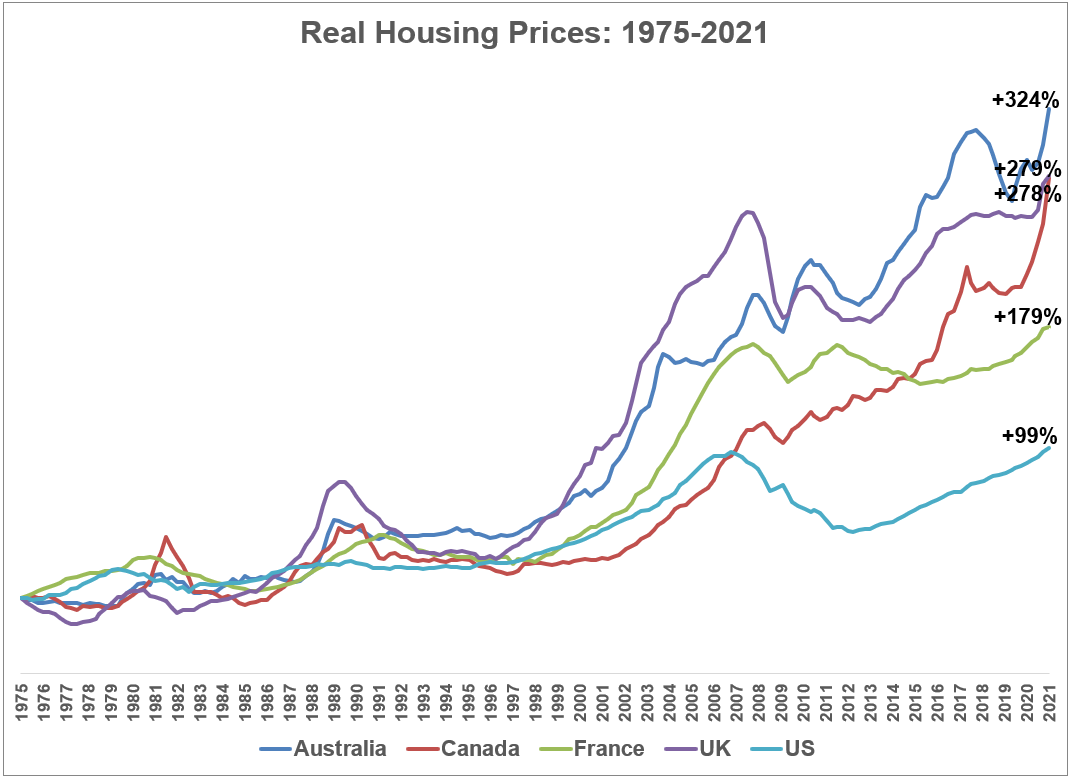
Canada never had a 2008 housing crash. Housing has been on a tear since the early 2000's and the average sale price of a home (nationally) is 2x that of the US despite lower salaries, higher taxes and a lack of 30-year fixed rates.
That is a bubble. My opinion is the US market is hot, but not a bubble. It could turn into one, but if this is a real correction, the fear of a bubble is much less.
The Toronto suburbs are already falling in price and Canada is only ~1 month into 4-5 rate hikes this year. And unlike the US: 1) most mortgages need to be renewed in a much higher interest rate environment and 2) a lot of Canada has recourse loans - they can come after your other assets if you sell you house for less than the loan value. No sending the keys to bank and walking away like in the US.
Toronto and Vancouver cores will correct, but rebound. Small towns and suburbs? It's going to be a bloodbath.
Reasonable houses in my small US town are available for ~$100,000 (there's also listings north of $400,000, it isn't just a lack of economic activity).
Probably have to look at the US on a regional basis to do a meaningful analysis.
I was able to do way, way better by going with a local bank, as did my friends.
The only thing I can figure is they are better for folks with "good" (not "excellent") credit and can maybe close the loan faster.
I'm self-employed. I make about 200k/year. I had 0 debt (I paid off my house the prior year). I had 20% for up to 350k. I had an 812 credit score.
When I applied they asked for my P&R statements for 2 years. The current year showed a $400 deficit (which was due to charitable giving). They said that I was losing money.Therefore I was too great of a risk.
I explained to them why the numbers were $400 lowers. I told them that I already had another $20k in receivables. I told them my present house was on the market. All to no avail. I was too great of a risk.
It was at this point that I knew they had little idea how to work in the industry. If they turned me down, they were turning other stable individuals down. I promptly sold my shares and moved on.
The realtor of the condo I eventually purchased recommended a broker. They looked at the same info and laughed at Rocket. The new broker gladly took the loan.
The world is bigger than tech.
Also Rocket recently shifted their technology strategy to build fewer point solutions in house where there was an adequate market solution available, focusing more on customer facing technology to build in house.
The last 3 years have been a gold rush for the refi business.
That and we are probably in a general housing slowdown off the highs which is related to the first point anyway via rates rising.
Something like 25% of loan holders refinanced during Covid.
Less people are buying right now compared to this time last year which was a genuine frenzy at 2.8% rates.
Simply put, one of the biggest mortgage booms in history just came to an end. Rates were at all-time lows. That meant an unbelievable boom in demand for mortgage refis.
Then when the Fed started taking inflation seriously, mortgage rates (which tend to track 2-3% above 10-year treasury yields) skyrocketed to 10-year highs. This means that very few people are in a position to benefit from a refi, and that business is pretty much dried up. The refi business is the specialty of Rocket Mortgage and other online lenders.
There is tremendous demand for housing right now, due to millenials being homebuying age and housing preferences changing with the pandemic. However, supply is tightly constrained. Boomers are aging in-place, home builders aren't completing homes due to building supply and labor disruption, investors are buying properties (smaller effect than people claim), and sellers don't want to sell without a home to buy. So for-sale inventory is at all time lows. This means less demand for purchase money mortgages, the main other product of a mortgage bank.
Mortgage lending is notoriously labor intensive. Nearly every lender, like Rocket, staffed up huge to meet the demand of the refi boom. Now, nearly every lender finds itself overstaffed for a mortgage market bust. Hence, layoffs. Every lender from the largest (Rocket) to the smallest is impacted.
This is just how the mortgage industry works, though. It is both seasonal and dependent on the economic cycle.
I don't think this is a sign of a bubble bursting but more of a sign that unless you currently own and can hang onto it, you'll be a renter soon no matter your status.
"There must be some pretty large moats in this industry because most shops are clearly not competing on competence or customer service."
There is. It is a capital intensive business that has licensing requirements for every state that you do business in. There are mortgage companies that will loan you the money and then turn around and sell that loan to an investor who would then service the loan. There are also mortgage companies that will loan you the money and also service the loan for its entire lifetime. In the case of the former, you can make your money back relatively quickly as you should be trying to sell the loan to an investor around the time of closing but there is risk in doing so. If you haven't done your due diligence about the borrower and something negative about the borrower comes to light (such as borrower lying about income) then the company that is buying the loan can pull out and now you are on the hook for a large loan that you issued to somebody who may not be qualified. With the latter, your income is going to be slow at first since you would only be making money from monthly payments.
I refinanced in fall of 2020 and contacted a few companies off bankrate. Some send spam automailers, but better.com had a quick first contact and everything else was automated and quick. The estimates were autogenerated so no waiting on a loan officer to create spreadsheets and fill informs. And all the underwriting was tracked through a web site so no manual emailing or scanning or anything.
It was a pretty efficient process and it was nice to not have to wait on humans. I did have to cal once or twice and they were very responsive.
Also FWIW: Even here in small town America, lenders are dealing with tens of millions in volume every day. You will build a relationship with them over time, not on. any single deal.
Now, they are a complete shitshow. I had an unusually complex return and decided to go with them. Big mistake.
While waiting (I had an appointment but that mattered not, I was waiting pver 1.5 hours).
My wait came to an end as I watched a kid, his wife and new daughter ask some questions no one knew how to answer.
His question was why he owed taxes. I, from my chair, knew the answer- he hadn't had anything deducted from his substantial unemployment and thus owed on those as he would have a regular job.
No one at this location, including the 'manager' knew or could find out this information. I watched as they slowly went up the ladder asking while trying not to freak out, and as the poor young couple were in hysetics.
I just left after seeing all of this.
They are reading the same or worse prompts than any free file service and are charging hundreds to thousands of dollars for the privilege and the 'tax experts' are anything but.
In the end all of these companies resell their mortgages to the big banks and so the amounts are very similar. It's all in how they get their fees: up front or behind or in points.
My guess is local banks and credit unions are the most likely source. They keep the loans on their portfolio instead of selling them like the mortgage companies.
If you're discussing builder financing: New in-progress construction loans are different than traditional mortgages. Not everybody plays in that space.
Banks often consider mortgages to be a loss leader to acquire customers for other services. They often don't have the best rates when rates are low, but they might have other perks like custom loan programs and longer locks.
Certainly there are still some people who are wealthy enough to keep their vacation homes vacant most of the time (and prefer it that way, since doing short-term rentals tends to involve quite a bit of wear-and-tear on a house and its furnishings). But many list on Airbnb now. I consider this a net positive for society.
Of course, Airbnb isn't all roses. In many places, investors buy up housing stock that would otherwise be used for long-term rentals, and deprive locals of much-needed stable housing. My guess would be that this is even -- unfortunately -- the primary use of Airbnb these days (I doubt they are primarily people renting out a room in their already-occupied house anymore). So this does suck.
On the renter side, I've found a lot of great places to stay through Airbnb over the years, experiences hotels just can't provide, and often prices hotels can't match. Should I just not be allowed to have these sorts of experiences? (It's totally fair if the answer to that is "yes", as much as it'd be disappointing.)
Can we find some sort of balance so that we can curb most of the negatives that come with real-estate investing, but keep most of the positives?
[0] Yes, vacation rental companies existed before Airbnb, but Airbnb completely changed this space.
You are missing a critical issue. Airbnb makes it way more affordable to have this second home, so now many more only-sorta-wealthy people can afford vacation homes while pricing people out of the local housing market.
why? Do you think the average person is renting out vacation homes for extended stays?
Yes, having cool places to stay is fun but there are better ways to accomplish that then rich people renting out their 2-nth homes.
A little bit of Googling around seems to indicate that there are ~95,000,000 single family homes in the US. So all of those AirBnB's represent less than 1% of all homes. If all of those AirBnB's were in a given year they may have an impact on purchase prices. Yet these purchases have been spread out over many years which leads me to believe their impact is negligible as a driving force in price appreciation. Are they a player, sure, are they a big player.....probably not nearly as much as people think.
And I agree with you that number is much lower than I would have expected, and doesn't seem like enough to meaningfully move housing prices overall. Also consider that some number of those listings are people renting out a spare room in their owner-occupied property, which I don't think is fair to count "against" Airbnb; not sure what that number is, though.
It would be interesting to also see more local numbers. Like what percent of units in each of SF, NYC, downtown LA, Chicago, DC, etc. are listed on Airbnb? There are a lot of housing units in small towns and cities across the US that don't have much tourist appeal, so they likely don't see many Airbnb listings. But they also likely don't have housing-cost issues like some cities that are more attractive to tourists.
I think people try to invent complicated reasons for skyrocketing home prices, when it's fairly simple: we aren't building enough in the places where people want to live. Sure, other things (Airbnb, foreign investment[0], cheap credit, etc.) don't help matters, but I think they're pretty minor factors. If there's demand, and you don't meet it, prices go up. Econ 101.
It's interesting to note that Vancouver and Toronto instituted 20% and 15% (respectively) foreign buyer taxes for home purchases a bunch of years ago. These taxes did actually do their job of deterring foreign buyers, but, sadly, home prices still continued to go up, undeterred. And now Canada overall has barred foreign buyers for two years. I doubt it will help. I expect Airbnb bans would have a similar non-effect.
The site hostsorter.com uses a citation from muchneeded.com[2].
When looking at the muchneeded.com link I see: "11. There are 660,000 listings in the United States."
However he citation for the above statistic is a site called pulse.ng[3].
When I get to the pulse.ng site I finally see the root source of the 660K figure you quoted. I also see that not only is the article from 5 years ago(2017) but there is no citation given at all for the statistic that is regurgitated from the previously 3 links.
[1] https://hostsorter.com/airbnb-statistics/
[2] https://muchneeded.com/Airbnb-statistics/
[3] https://www.pulse.ng/bi/tech/tech-airbnb-now-has-more-listin...
I prefer having discussion about the underlying issues causing these emotions though, they keep being mentioned here all the time but I guess its easier to just bash the messenger rather than fight government and selfishness/greed in general population.
Of course, the housing crisis is death by a thousand different cuts, but there are studies out there indicating in many cities AirBnB is responsible for around ~5% of the rental price.
For my apartment, that translates to paying ~$180/mo because of the induced demand from AirBnB.
I would love to see investors get burned too, but I don't think there's anything to pop. We're just a decade behind Canada.
That's not healthy
The other side is that anyone who sells right now will need to buy at the top of the market, possibly incur the 5%+ interests rates(if they didn't make out extremely well) and afford the increase in taxes on their new home's possibly insane property valuation. This is of course in addition to all the other current inflationary concerns of maintaining a house right now.
Rents have outpaced mortgage costs and the return on investment has been ridiculous. People all over here have jumped into it. Hell, I've had people tell me I should do it... No F'in way I'm dealing with tenants and house calls in the middle of the night, though. I fix my own house, poorly and struggle to do that. I fix computers and call people to fix the house, usually, so it gets done right. I venture out of my lane every once and again, but I know I'll usually call a professional =)
If you made a good enough offer you could buy it from them. Investors aren't trying to hoard. They want to make a return on their investment.
"Return on investment" shouldn't be more important than housing people affordably.
Are homes for living in, or for making money? That's the fundamental question we need to resolve. Because if its the former, then we are doing an abysmal job at satisfying that need. If its the latter, then we're doing a bang up job.
If you have a good working relationship that you can used for good terms, then go for it. But don’t go with a local bank because you think you’ll continue to work with them.
All that said, our local CU does in fact keep their own mortgage portfolio. This may be rare, I don't know. They're a large CU associated with a government contractor.
When I bought my house they had the best deal (rate + closing costs) hands down. When I refinanced they were no longer offering 30yr loans on their portfolio (and I wasn't interested in 10/15), but still were originating them to sell. Unfortunately the 30yr rates were not as quite good as I could get elsewhere and closing costs were close to a wash so I went another direction.
That said, they were phenomenal during the whole origination process, and they gave us a rock bottom rate (2.375%).
My only fear is servicing being transferred multiple times, rapidly, then having to decipher who to pay now.
Credit Unions tend to be different (at least the 3 I'm a member of, maybe this is not universal) in keeping loans in-house.
The banks will indeed most likely sell off the loan as soon as it's done.
Not that it matters either way.
When I looked into it they wouldn't do jumbo loans (which is just anything slightly above the median home price in the state of California these days) and their rates on traditional loans were worse than the big bank I was comparing it to.
On top of that it's not even an automated tech solution like they pretend it is, it seems to be just a thin veneer of a shiny website that then connects you to a traditional lender. So it's not even really any more convenient in terms of submitting paperwork and stuff, at least for the initial quote that was my experience.
If not for that I'd have preferred someone local, you could tell you were just a number over there, and there were a bunch of communication issues around scheduling the appraisal that were annoying to sort out.
My local rates were over 3% for a 15 year, they got me 2.25% + .25% in points.
Despite that bad start, I was very happy with how they serviced the loan. They didn't play any games or make things harder than it needed to be. If you sent in extra money they both applied it to the principle immediately, and pushed your next payment date out accordingly (and cumulatively), so you could retroactively treat it as a prepayment if something came up. This was really nice, and none of my other mortgages have done both - the better ones automatically applied it to the principle, and the worse ones treated it as prepayment unless you jumped through hoops to inform them otherwise each payment. I did end up taking advantage of this to help get through some unexpected medical expenses.
Paying off the loan was also trivial - just sent in the last payment and the loan was done and they sent me the necessary documentation. That is how all my car loans have worked, but for some reason previous mortgages have required some extra steps for the final payoff, or the mortgage ends up in some weird purgatory state.
As times get tougher, the edge cases will probably become a lucrative section of market. Rocket's been troublesome before. I doubt they have the capacity to pivot (given, again, their apparent lack of skilled brokers/underwriters).
Spending a lot of time to work with an individual client in order to make $1k-$2k or whatever they make ushering a loan over to fannie or freddie is not good business- especially during the recent market.
They should have been honest with OP about what the limitations are. Conforming loans (i.e. Fannie & Freddie) are notoriously tricky for self-employed borrowers. Salespeople gonna salesperson, though.
Anecdata - I have friends that lived there for 8+ years, then moved to the south in the last 2 years and their property value barely budged.
You've got to be ready to overbid (our first SFH got overbid by 70k), "best and last", and deal with 5+ bids per house.
You can find stuff away from public transit/no walkability but then why move to Chicago at that point?
If trends continue, prices will start falling. You might be able to offer under asking, too.
I bought 15% under asking in October of last year.
Chicago didn't really go crazy like Phoenix or Palm Springs...
That is a wild revelation to someone comparing greater Denver housing market, where adding 30% is required just to be considered....
I've been watching Zillow pretty consistently over the past few weeks, and have noticed price drops as well as longer days on the market in the Chicago area.
Knowing values don't increase much isn't really a deterrent considering the desirability of the location.
Getting an accepted offer? Getting better by the day, in many areas.
1) The cash is better used to diversify across other investments. These investments will likely out-earn the mortgage interest.
2) The government gives you tax write offs for mortgage interest. Not as beneficial for everyone as it used to be but there’s a good chance you will be able to deduct if your mortgage is in a high cost of living area. Up to $750k in mortgage debt.
3) A home is an illiquid asset. By borrowing the money and keeping your own money in liquid assets you gain flexibility and can jump on good opportunities.
Agreed though that having tons of runway is wise.
The vast, vast majority of homeowners do not foreclose ever. It’s no more “servitude” than paying the person who holds the note to rent from them instead of holding the note directly.
You’re responsible for maintenance and upgrades. And it’s harder to move to a new place if you own vs rent. These things are true. But “lifetime of servitude” is comically hyperbolic and ignores all the positives of homeownership that historically vastly outweigh those negatives.
With 30-year rates around 6% right now, the math becomes a lot tighter as well. Where are you going to find 6%+ investments right now?
Second, your mortgage interest (plus other deductions) need to be high enough to warrant itemizing deductions. At the start of 2021, my mortgage balance was $270K with a rate of 2.275%. Even including a $7,000 donation to charity, it wasn't enough for my wife and I to itemize.
That said, it's much better to mortgage than pay cash for reasons outlined already in this thread.
Would you say that mortgage is probably driven down 8% because just can't afford the down payment anymore, or people like me who seem to have an irrational aversion to it?
You can't control rent prices any more than you can employment. At least with buying, you will likely have some appreciation eventually. The government gives you back the interest you pay. You have an asset you can borrow against in bad times. You are paying the future's housing bill at today's prices. Inflation is your fried after you have bought your house. A house is the best way 90% of Americans have to build equity. Additionally, with all the NIMBYism everywhere, the likelihood of appreciation is almost guaranteed (outside of dead towns)
1. All remodels lose money, except MAYBE a minor kitchen remodel.
2. Ergo, if you buy a house that was remodeled, you win.
3. Ergo, upgrade instead of add-on, so start small and buy up.
By a substantial margin, having a large home mortgage leaves you in a better financial position the vast majority of the decades, even if you lose your job and are forced to sell mid decade.
Makes passing meaningful legislation hard, especially if it will actively hurt a substantial number of voters (and every politician).
Low rates?! BOA is offering me 4.9% on 400k/800k, fixed for 30yr. But they still want 4% for a 5year ARM. Even after income tax deductions, how the hell do Americans afford houses with this sort of nonsense.
I guess that's what TFA is really driving at. It's getting hard to lend money on housing in the US.
It will be surprising if Powell doesn't do a second pivot and go Dovish well before 6.
Obviously I'm not a fortune teller and many people disagree.
If the interest rates tip up for an extended duration, yes, it's possible that longer term fixed rates could be cheaper, but of course the banks insulate themselves against that possibility with even higher rates if they suspect it's likely.
It's possible they won't insulate enough. IME, betting against banks looking out for #1 is foolish.
I don't know about that. I recently got a 10/1 ARM at 3.75% for my second home and it was a full 1.125% below a 30 fixed due to FHFA changes [0].
[0]: https://www.ezhomesearch.com/blog/second-home-mortgage-rates....
It causes bubble after bubble while central bank holds the bag.
Loans lower 400k are easier to issue, I learned in the process. Because >400k has much more requirements for the bank on collateral required by the regulation authorities.
Someone with a $750-$1M home is getting roughly the maximum tax break available, and someone with a $5M home is paying for everything above that first $1M themselves* without any extra tax incentives.
*Except in California due to prop 13 many of them are paying a tiny fraction of the property tax they should be paying, but that's a separate issue.
Home buyers buying these x10 houses are pretty much limited to the top 10% in income - the vast majority of them are not ultra wealthy.
And this "blame the government" for the the housing shortage is the same old tired trope that's invariably wheeled out when defending Airbnb. The "discussion" never seems have any more depth once that blame is assigned though. The fact is people have fought at the local government level, from Miami, to Berlin to NYC to London. It turns out that legislation itself isn't enough as it is regularly flouted or just plain ignored. Actually enforcing the legislation is difficult. And regular citizens and local governments are simply no match against the mega-Corp. Or is there another pithy and overly reductionist talking point to that complex problem as well?
Some places sell off the loan and the servicing, that's more annoying.
I literally said “deduction”. Who did you think you were replying to?
Even if you can only live in one at a time, you may want to temporarily live somewhere else. What if you feel like going to the beach for a weekend?
The wealthiest suburbs are on the north shore, the towns directly north of the city starting with evanston going to lake forest. Oak park area is basically the Berkeley of chicago, lots of highly educated, high earning left leaners. Naperville and hinsdale have a lot of money too, never been myself though.
And other places consistently go for "less than asking" - but the end result is the same, really.
1) I used their seller's agent, and he gave me ~3% to get the deal done. So really only 12% under asking.
2) The asking price was too high to begin with.
3) The market had started to cool, and they wanted to sell since Winter was coming and Winter isn't a great time to sell a $1M+ condo in Chicago.
Why do the stays have to be extended? I consider simply making more nice real estate in desirable locations accessible to more people a good thing. Doesn't matter if it's for a long weekend or several months.
> Yes, having cool places to stay is fun but there are better ways to accomplish that then rich people renting out their 2-nth homes.
Such as? Hotels are the primary existing option, and they're fine, but not always what I'm looking for (especially if I want to cook; hotel rooms with full kitchens are rare and expensive). Hostels are meh; I'm not a broke college student anymore. Actual bed and breakfasts are nice, but aren't for everyone. If I want to stay in something that feels like an actual home for a short duration, is there a better way than something like Airbnb?
To be clear, I agree with the top-level poster's bit about us not needing people hoarding homes just so they can rent them out as Airbnbs. That's exclusionary, (literally) rent-seeking behavior. But is there no middle ground where people like that don't get to satisfy their greed, but we still get to have nice things?
Not necessarily a bad policy, imo, but doesn't make buying cheaper.
However, AirBNBs and rental houses suck away the usable land such that you begin to meaningfully remove potential long-term residents from the city. The flipside of this, of course, would be apartments/duplexes, which would add more long-term residents than single-family zoning would allow, even with the problem of AirBNB proliferation.
In this casual retelling I read it as a neutral noun describing gender.
Substitute the equivalent here with 'guy' and we wouldn't be having this discussion.
Thinking harder, I guess 'gal' would have been more appropriate. But in any case I feel this reveals more about the reader and their proclivity to engage in 'culture-war topics' than anything substantial.
Just sounds informal to me, nbd
It feels like there's a few signs now that the so-called "18-year property cycle" is due to be cut short this time around. I've only recently heard the idea so I'm not sure how it's real it is (outside of their circles that have a vested interested in the timeline it predicts). UK lenders seem to be now toughening lending rules rather than relaxing them as they were "supposed" to. Not sure it's a good time to invest or not!
Not sure why brokers didn't mention them to you. Perhaps they like to show people low headline rates, or perhaps they see longer initial terms as bad for the broking business?
We will drop 0.4% once we get below 66% LTV or so. Also, ours is 20 years fixed. The variable or 5 year fixed was even lower still, around 1.5% at 100% LTV.
It's still ridiculously low, which is why we're happy to pay a bit more to get it fixed for 20 years.
E.g, if buying costs $x, you pay $y a year for loan, insurance, maintenance, etc, and sell for $x later, and $y per year was less than the cost of renting, you win.
But most people would call that a "good deal" vs a "good investment".
Dealing with the local credit union was super easy for everything. Not that HSBC was bad, but the credit union was always local people to talk to and never any problems.
I had a loan that got passed around a number of times back in the day, ending up with Countrywide each time.
The median age of a home in the US is 37 years, which means 50% of homes were built before 1985. Compare building codes from before 1985 and 2022 and it's a huge difference. Now housing codes are there for our safety, but we also need to recognize that it makes homes much more expensive and complex all while 50% of people are living in homes built under "less safe" code standards and are just fine.
I myself live in a home built in 1967. It's a lovely home and just as livable as a home built today. Only a few select projects were needed to improve safety in places that mattered like replacing the electrical panel and some modifications to my deck.
When going through insurance pricing in the case of catastrophe (fire/earthquake/landslide) with my insurer, they estimated that the cost to rebuild my home today to modern standards is equal to our purchase price for the home and the land, which is crazy and gets even crazier when you consider that the cost of the land is about 2/3 of the value of my property.
Furthermore, the more labor and complexity that goes into building a home, the more homebuilders focus on upscale homes instead of mass market homes because of opportunity cost, especially when the permitting process is also so onerous. The only cheaply built housing options these days are apartments and condos. 40+ years ago we were building full single family homes for the cost of building an apartment today. That's insane.
It is also capped at $750k of mortgage debt, which is not much for the 10% of filers who are itemizing and using the deduction.
The homeownership rate is counted in terms of households, no? So it can be kept artificially high just by having 20-somethings no longer move out of their parents' houses.
https://www.nytimes.com/2021/07/08/realestate/baby-boomers-r...
and
Canada is basically the US minus the 2008 crash. It's just price inflations non-stop for 20 plus years.
My understanding is prices crashed hard in the 70s, there was a slight decline in 1990 and 2008, and other than that they've been going up 5-10% per year.
(And yeah people would rather pay the government than invest in your startup so lets not pretend investing in main street was a real option)
Anecdotally, I’m seeing crazy numbers for “average” houses in the small towns surrounding the DFW metroplex. Hell, the house my parents built in 2006 for $140k is now selling for $350k. 1200 sqft mass produced trac home.
But it’s an hour drive to downtown Dallas (less if no traffic) so plenty of people are commuting but making city salaries. It’s the same in every city across America.
Warnings for noise complaints and rubbish don't really work if the person is just going to be gone by the time a third strike happens.
Or just google it, there are plenty of examples
Over the last two or so years, mortgage rates hit historic lows, which meant the demand for cheap mortgages increased significantly, both from people wanting to enter the market and those refinancing. Consider that the $500k mortgage that would have cost $2300/mo in 2019 suddenly costs like $1600/mo in 2021.
Absolutely I jumped on that train, as many others did. Lenders were overwhelmed and had to hire a lot to meet this demand.
If you missed that window, well rates are above what they were pre-pandemic, looking back at least a decade, so refinancing for lower payments no longer makes sense for most borrowers. People still are buying homes, but high prices and that disappeared “once-in-a-lifetime deal” are going to suppress demand.
Which is why you often see houses being purchased by new families, the kids are the first thing that really begins to put down roots (as you don't want to move them from their school/friends).
In fact, all three of your examples are on the list of fastest growing locations - Halifax at 8th and Barrie at 13th https://canadamag.ca/fastest-growing-cities-in-canada/
Kelowna grew 14% over 5 years? So 2.7% a year? Or 5,500 people per year?
Kelowna is a tiny town in the middle of BC. Jobs are scarce. Vast swaths of undeveloped land surround the town. Wages are pretty typical, yet a modest house is $1,000,000. Does that make any sense?
Your list has Kamloops. Have you been to Kamloops? It's an old saw mill town. Again, lots of room to build. Houses are $800,000 to $1,000,000.
You can buy a small house, within San Francisco city limits for $1.5M. This is where wages are 2x that of Canada. Mortgages are 30-year fixed and there is no room to build any more houses and it's surrounded by water on 3 sides.
So why would Kelowna cost just 33% less than San Francisco? I could see arguing downtown Toronto and Vancouver are "pricey" but not ridiculous, but Kelowna?
And your list has Edmonton! One of the fastest growing cities! But wait, it's actually one of the cheapest too. What's going on?
Like I said, bloodbath.
It’s been a few years since I was there but last I was it had the very common tourist pattern of expensive vacation homes near the water for wealthy part time occupants and reasonable housing further away for permanent residents.
Frankly that area was better than many tourist areas where workers have to commute long distances to live in crap apartments or worse dormitories.
And once it becomes a trend, they all just collectively give up apparently.
While this phenomenon is bad for people looking for long-term primary homes, it is nice to be able to afford a vacation home when you couldn't before. Certainly I would prioritize locals over non-locals looking for a second home, but can't we have both? Build more.
The market doesn't care whether someone is buying a vacation home or buying the only home that lets them stay in the region. It is the responsibility of the state to put its thumb on the scale in favor of positive externalities that the market is agnostic between.
How is it that the high-IQ HN zeitgeist centers on the contradictory positions of "climate change is an existential threat" and "we must expend more resources and build more housing"?
Seems like reducing population in high-carbon-footprint countries is the obvious solution to both problems.
What am I missing, here?
Rate locks are backed by rate swaps. The cost of purchasing a rate swap ultimately comes out of your pocket in the form of additional rate on the loan (the lender can add overhead of course). The cost of rate swaps has doubled in the past 3 months and quadrupled in the past 18 months. I believe it's currently around 3% on 10 year loans, so a 60 day lock on a $500K 10Y mortgage would cost about $2500 while a 200 day lock would cost over $8000.
One interesting hypothesis is that the focus on fixed-rate 30Y mortgages is fundamentally destabilizing for the US and world economy, because the stability and optionality of 30Y mortgages is paid for by added volatility of the 10Y debt market through those same swaps. Per this theory, US 30Y fixed-rate mortgages are effectively subsidized by the rest of the world. https://byrnehobart.medium.com/the-30-year-mortgage-is-an-in...
These guidelines are set for BROAD populations - specifically very poor and "normal" people have the same guidelines. For poor people, a high threshold is important to "get them in a house" - they might genuenly need to spend 30% of their income on rent or mortgage. For "normal" people, that same percent is "way too much money" for "way too much house".
The result is that normal people get approved for a big fat mortgage. But we don't want a big fat house, we try and buy a normal house, but we really want it so we pay "just a little more than it is actually worth" and drive the price up "just a little".
Of note, FNMA and FDMC adjust their guidelines for high COL areas and some other guidelines. And also, their guidelines have moved over time. Also, it is a generally accepted "fact" that home ownership is good, and poor people should be encouraged to buy a house.
Which has the undesirable effect that it makes it difficult for workers to move to where the good jobs are, so now you have situations where workers are stuck in place A, doing job 1 for $X even though they should probably go to place B, and do job 2 for $Y -- because to move from A to B they'd have to buy a house in place B, and sell their house in place A, which is both annoying and relatively expensive.
This varies culturally, IIRC Poland and Germany - despite being neighbours - have different cultural assumptions about whether it's "normal" to buy a home rather than renting.
Maybe a shift to more Work From Home reduces the problem by allowing workers to take more jobs in place B despite actually living in place A.
The problem here is really with the supply of homes. If there was a good supply, issues like this would never arise, or would rarely arise, because there is always a house just as good down the street that you don't have to overpay for.
Part of the problem is the supply chain but I bet alot can be done by the govt to get out of the way. Of course the other side of the coin is activists that scream both: "We need more housing" and "how dare you build more housing" in the same sentence.
Important to compare like renting a modest Apartment. If that payment that works for you is X, maybe 3X is too much house? Houses also take a lot of repair, and need things like new roofs and HVAC.
There are a few areas of the country where you basically cannot rent from a private party anymore. 90%+ are one of a handful of mega rental corps.
(to separate the house from the group, not a maintenance hedge)
I have no idea if it would have actually been possible, though. Wells aren't allowed to be too close to septic tanks and septic drain fields, and there are other spacing constraints too. From what I recall of the way the house was placed on the lot and where the septic tank and drain field were there may not have been anyplace on the lot acceptable for a new well.
Could also have assumed that a well problem would entirely fall on you (worst case) and budget accordingly.
It’s surely possible for that assumption to be true, but I start out skeptical.
I'd like to understand how people think about a longer-term fixed deals. How do you know where you'll be in more than 5 years? If you need to move don't you get hammered by the ERCs? Can you really rely on transferring products?
Habito One is an interesting product, that seems to be a lifetime fix (Which I have personally never seen before the UK but maybe it exists) with no ERC! Obviously the rate is less attractive but rates are still so low and I think you can offset as well.
  1. Often if you move house they will let you transfer your mortgage (actually take out a similar product and avoid the refi costs).
  2. If you win the lottery, or otherwise are in a situation to prepay your whole mortgage? Well you might care much less about the 5% early fees in that case.
3. You can prepay usually 10% a year, at their discretion, without any early fees. If you just become a fair bit richer than you expected, prepaying at this level will reduce the mortgage quite quickly.https://www.nar.realtor/newsroom/nar-report-shows-share-of-m...
You are, of course, free to assign any motivation to me that you like.
However I am on the older side and the only times I ever heard "girl" used were as a pronoun for a younger person or as a diminutive for a person seen as lesser than the speaker.
For example, my older family members would refer to "the typing pool girls" or "the makeup counter girl" or, by comparison, "the woman at the county clerk's office."
So it is a bit astounding to me, especially now, to hear someone casually refer to someone who is providing a professional service to them as a "girl."
Still, there is a definition in Merriam-Webster’s: “girl (1c): young woman” - I wonder - is it outdated?
Upd. Also this: “a person seen as lesser than the speaker” was impossible in the culture I’ve grown up in. So if there is a subtle nuance in my choice of the word “girl” it is “I felt pleasure each time I heard her voice”, not “she was lesser than me”.
Cultural differences…
Taking the poster's statement in isolation, interpreting it as a younger/diminutive person is a fair reading as well.
In this case, the full context is of a casual/informal retelling here on HN so it changes how it should be interpreted (or at least, put in consideration).
Plus he was complimenting her; makes the diminutive interpretation less likely.
All nitpicks in the end as result of lossy text comms over light, no big deal :)
I think the parent was referring to "financial agent" being a professional context, not HN.
https://urbaneer.com/blog/when-dreams-of-domesticity-became-...
Let’s say half that - 2,750 homes needed.
Last year Kelowna built 3,200 new homes alone.
https://www.kelownadailycourier.ca/news/article_bb3f2eae-8ac...
And of all the tourist spots in the Okanagan, Kelowna is not a top destination - it's the smaller cosy towns with the corner store and 2 acre lots on the hills overlooking the lakes. Those cost $2M+ and seem a bit more justifiable to me at least. It's like comparing Tahoe, CA to say Tracy, CA.
And I have a family member who owns a 2 bed condo in a small town further south and the price has gone from $300k to $500k. For a plain condo built in 90's in a town of 25,000 filled with people over 60 years old.
It's nuts.
If you invest on top of that and get some small decent return you come out even more on top.
If I have $300k in cash today, and I want to buy a $300k house, then I can get a mortgage and let inflation shrink my mortgage payments, but it's also shrinking the $300k I have in cash.
I don't see how you can profit from the mortgage unless you find an investment for your cash with yields significantly higher than your mortgage interest rate.
Buy a house (with mortgage) for 4%. Inflation is 5% a year. Invest the money in real assets (literally anything diversified).
Your mortgage price goes down in future dollars because of the delta between interest rates and inflation.
Even if inflation isn't happening, mortgage rates tend to be fairly low risk, so any diversified bucket of assets has a historical return greater than the mortgage rate, especially over a 30 year period.
If you bought a 13% mortgage in 1984 (highest), in 30 years, S&P returns 11% by 2014, so even if you never refinance, during the highest interest rates you're only down 2%. If you refinance at basically any time in the 90s/00s you're way ahead.
Some index funds though might beat your mortgage rate anyway, so it’s even better.
A $300,000 home with a 20% down payment and 80% borrowed at 5.0%* will cost you __$523,813.88__ over the 30 year life of the loan.
Logically, cash just sitting in the bank 1% or less in interest should go towards your loan costing more than 1% or towards avoiding $5k-$8k of closing costs on a mortgage.
*Today’s interest rates are 5.125% for a 30 yr fixed rate mortgage.
Ignoring income taxes, paying $10k down on a 5% mortgage with 25 years remaining is the same as purchasing a $10k bond at 5% that matures in 25 years.
One downside, is that pre-paying your mortgage doesn't change the cash-flow immediately, it just changes the end date of the mortgage.
So the invest/pay off home trade-off is there for everyone. Even for people like doctors, whose investments might not necessary be market-based.
Of course, I've also heard that a significant fraction of those moving in are single men, to the point where the city has gotten the nickname "Menver".
[0] https://www.metrodenver.org/regional-data/data-central?categ...
Someone else had mentioned that the meme started at least 10-15 years ago.
Some areas around it had a very "Portland" or "Seattle" feel a few decades ago, and for a time they were a "well-kept secret". Not so much now, so the next big city may be somewhere else soon.
Note - there is a reason housing prices in Chicago are stagnant...people are leaving.
I would not classify Chicago as anything close to an "affordable" housing market. Probably a toss up whether the least affordable area in the midwest to median income earners is Chicago or Minneapolis? Either area, you will be paying through the nose compared to, say, here in Wisconsin.
Buying and selling real estate involves high transaction costs - there are closing costs and transfer taxes on the buy side, and 6% commissions and transfer taxes on the sell side - which means in order to break even, you need to have some amount of appreciation.
Then there's the opportunity cost of living in a home that doesn't appreciate while literally everyone else in the country is getting rich merely by owning homes in states that have increasing populations.
And to top it all off, Chicago homes are not cheap and the property taxes are astronomical, so it's not like you're getting an amazing deal to make up for it.
Secondly, only the people who can afford to live in those high cost of living areas would get rich off of these increasing property values you're talking about. The worst thing a person can do is move somewhere to live beyond their means because "when I sell I'll be making a killing!" Out here in flyover country, unless you live in Chicago or Minneapolis, you're probably not seeing 30% per annum increases in your property values.
Finally, yeah, we in the midwest already know Chicago is not cheap. You buy there because you're well off, and you're going to make those ridiculous returns you were talking about. But the rest of us just deal with the areas we can afford. Which is probably not Tribune Tower.
>But crucially, the presence of this group of people arguably turns the bubble into something else.
I agree with this, it's not a bubble in the sense of 2008. I said so in the comment you replied to! We're in the same boat here.
By the way: I'm precicely in that demographic. I just turned 30 and do well for myself as an employed consultant, but I wouldn't consider buying the dip, unless the dip is at least ~100% of the current market prices (which I don't see happening, but who knows). Going in debt for 30-40 years has zero appeal for me, it just seems like a terrible move. The counter-argument I hear from people my age group is always the same "but then you'll never own anything!" -- then so be it, whats the point?! Even if someone gave me a million Euros, I wouldn't spend 600k of those on a house and then another 300k on renovations, that seems like a terrible waste of resources. With that kind of money, you can buy three small companies in Germany, or stop worrying about retirement, etc. Buying estate = de facto being in debt for the entire career and then some, plus having to pay all repairs, anything. I don't see how that would ease my life at all. If someone wants to give me a house, nice, but buying a house just for the sake of doing so reminds me of a signature I often read on market-ticker.org -- leave the rats race to the rats.
Buying a house isn't for everyone, sure. But this is a serious misunderstanding of what "going into debt" is. You're not buying a TV you'll throw out in 5 years, you're buying an asset class that has a history of appreciating in value over 100+ years that you can get incredible leverage on. In the US and Canada, at least, buying a house for a decent deal (in "normal" times, not at insane prices) is a no-brainer investment.
You mention buying companies...that's just a different asset class, but the idea is the same. It's not valueless the moment you buy it, you now have an asset.
>Buying estate = de facto being in debt for the entire career and then some, plus having to pay all repairs, anything.
Do you think this is all happening for free as a renter? At what point in your life do you plan on not paying for shelter?
Correction - over a time period of decreasing interest rates. Housing, on its own, is a depreciating asset. It is a consumable like a TV. It deteriorates with time.
"Housing always goes up", without an understanding of why it has been going up, can be a dangerous belief and could be one of the reasons why housing at the moment is so expensive relative to rents.
This is precisely the problem. It's not just companies buying up homes, it's also private individuals buying up housing to relist on AirBnB or other sites in order to further extract value out of their purchase.
If you look at a country like say, Japan they don't have this issue because housing depreciates and is not treated as an investment.
Going into debt at the lowest interest rate you'll ever be offered to buy a leveraged asset that's likely to increase in price and reduce the overhead you pay on your largest expense, housing, and hedge against the risk of rent increases and security against the whims of landlords?
> Germany
Oh, Germany. Somehow Germany has escaped the constantly increasing house price effect, as has Japan.
If you owned a house in London its annual value increases would almost certainly out-earn your salary. And you don't have to pay tax on that.
Look, if I had enough money around, I'd maybe consider the gamble. But I don't want to buy property to sell it later, I just want to live somewhere. I'm not interested in placing bets on my salary, and I'm not interested in financial longterm-obligations. Maybe in 10 years I want a year off? What then? Maybe I want to change careers to something less intellectually demanding. Maybe I want to spend 50 hours a week with my kids. None of those are feasible if I need the salary. "No debt" is synonymous to freedom on so many levels in life design. The choice is not even close to me.
I make enough money not to worry about rent, even if it should substantially increase, which I don't see happening anyway, simply because then most people wouldn't be able to afford it and political change would become opportune in election-based systems.
>If you owned a house in London
Whats the point of even thinking about owning a house in London? Seriously. I come from uneducated parents that left me €0 and completely unprepared for life, so in my 20s, I first had to dig myself out of that crap. Now I make a good living, but I'm not rich, or filthy rich, or even wealthy. I have to actually make the money to pay that thing. Look at the development of real estate prices in the last 20 years and tell me that's a reasonable choice if I don't even intend to sell the property later (just to be stuck in the same situation again, with more cash, but in the same dilemma). It's pointless. I don't treat my lifetime-expenses as a game of assets, I opt for quality of life, which I don't achieve by giving it all to some property-owning entity who sells it to me at 3 times the price they paid a couple decades ago. I mean, you can justify doing so, but I don't see me being able to justify it.
I hope that was sarcasm since housing in Germany has gotten super expensive.
To a large extent house prices are sensitive to interest rates. A bank will look to your income and say you can make a monthly payment of $X. At historically low interest rates that’s gonna mean a bigger loan. As everyone’s ability to borrow goes up, so do the prices. As rates rise, for the $X dollar payment, the ability to borrow declines, and that puts a down draft on house prices.
Oh boi. When you buy this you are giving all this benefit to the seller that takes these into account. You are not making a profit off of it unless the value increases more than the market expectation for it.
So its a leveraged bet that it will be better than expected by the market, and if it goes the other way you are toast.
You wouldn't buy a house unless it was essentially free? A dip of ~100% means prices at ~0% their current level.
> Going in debt for 30-40 years has zero appeal for me, it just seems like a terrible move.
Debt on its own doesn't matter so much. You already know that you will need to live somewhere for the rest of your life, so that expense is unavoidable. The question is whether you want the amount of that expense to fluctuate according to the market, or if you want to lock in a steadily-decreasing expense with a 30-year fixed rate mortgage (steadily decreasing in real terms, because $100 in 30 years will be worth $50–60; yes, property taxes are likely to increase, and maintenance will move with the market, but mortgage interest and principal will decrease in real terms).
> Even if someone gave me a million Euros, I wouldn't spend 600k of those on a house and then another 300k on renovations, that seems like a terrible waste of resources. With that kind of money, you can buy three small companies in Germany, or stop worrying about retirement, etc.
$1.05 million is hardly enough to live on. That's just $35,000 per annum. It's not nothing, and I surely wouldn't sneer at a gift of $1.05 million, but it wouldn't let me retire today.
So is $1mi. For a lot of countries, this is money you could retire on.
I somewhat agree with your argument. Housing costs more than other assets compared to its economic value, exactly because people have an emotional reaction to the idea of owning it - or the idea of not owning it.
However I have seen middle-class people overextend themselves to 'buy the dip', while their equally wealthy peers sit it out, for over 15 years now. Many of the people who did the former now consider themselves to have got a bargain, while many of the latter changed their minds and ended up buying several years later and at much higher prices.
I'm definitely not arguing that this makes buying right and renting wrong! Just that so far, this is how that choice played out.
I am curious what you guys think of this statement. I think the idea is if the potential rent you get out of your investment is too much under one percent, you might be better off investing in something else?
Now imagine a smallish 4 bed, 2 bath, 1,638 sqft built home on a 5,861 sqft lot in Longmont, Colorado (so not exactly a city but my preference because municipal fiber) that has a sticker price of USD 499,900. I can't imagine paying USD 4,999 every month in rent for this house at the moment. What gives? Is rent too low? My instinct is home prices are way too high but it can't just be "dumb money" keeping prices high, right? Eventually, there should be more supply causing prices to drop? Is something preventing this correction? If so, how do we fix it?
That's not the best way to look at it.
Unless you plan on being homeless, you're already inevitably committed to a monthly housing payment for most of your life.
So the decision becomes, do you pay someone else to enrich them and commmit to having to pay for the rest of your life? Or do you invest in something where you partly pay yourself and there is an end (even if far) to the payments, so when you're old you no longer have those monthly payments?
What are the closing costs of purchasing a whole company? How much would you pay for an accountant to go over the books and a lawyer to go over the forms?
I don't know how much homes cost in Germany, but surely if people have 600k to spend, they would buy companies too, would they not? Why do they buy homes instead?
"Higher rates will make current prices unsustainable. As soon as they correct to the point where monthly payments are back to what they were last year, there will be buyers, only too happy to overextend themselves to get out of renting."
So, higher rates are effectively a transfer of wealth from homeowners to banks? How does this serve to combat the current inflation issue?
Regardless of high or low rates, banks borrow low and lend high, and live on the difference.
High rates, if you want to express yourself in those terms, a transfer of wealth from people with debt to people with assets.
With the housing shortage and unmet demand, we are at the margins whereby the ones buying are well-off.
The question to ask is if the rate of new housing and the rate of capable buyers will diverge.
As long as supply is low enough that the supply of capable buyers keep outbidding each other, housing prices will keep rising or at least plateau.
Higher rates will have an affect on diminishing the rate of capable buyers entering the market, but if supply is still low and the demand for home ownership remains high, I don't foresee anything drastic happening to the housing market.
Yet another case of how society would be better off if people practiced what they preached.
If you buy during amazingly low rates, you'll feel happy when the rates shoot up (and maybe sad if you look at Zillow, but if you're not moving who cares?) - and if you buy during rising rates you'll be glad you got in when you did, and if you buy at the peak, well, you can refinance later.
I can’t speak for the rest of Europe. It’s a big place you know.
When people in one market talk about their fixed rate mortgages adjusting rates, it sounds strange to people familiar with other markets, just reinforcing the “real estate is local” adage.
In France, for example, the standard mortgage is fixed rate, for the whole duration of the loan, which is usually 20 to 25 years.
https://www.bankofengland.co.uk/bank-overground/2020/why-are...
(In 2020, more than half of new mortgages were fixed for 5 years or more.)
Why do you refinance if rates go up? Surely the point is that if rates go up you've locked in a better rate
How does half your debt disappear if rates go up?
> Why do you refinance if rates go up? Surely the point is that if rates go up you've locked in a better rate
You don't have to, but you can choose to either (a) keep the same rate and owe the same amount, or (b) get the new (higher) rate and owe less.
> How does half your debt disappear if rates go up?
It doesn't exactly. However, the market value of your mortgage loan halves if the rate doubles (roughly). This means you can:
1. Take out a loan for half the original amount, at double the interest rate
2. Buy back your original loan
3. Destroy the original loan (which is fine since you are both creditor and debtor for that loan)
This leaves you with the loan taken in step 1.
To understand why it works this way it's instructive to think of a loan as an exchange of wealth for income. One party has some savings (wealth) and would like to exchange it for an income (e.g. to pay recurring expenses). Another party has an income and would like to trade it for wealth (e.g. to buy a house). Viewing a loan in this way, the interest rate is nothing more than the current price of a certain income stream (measured in percent per year).
For example, let's assume that the current market price for an income of $2 per year is $100. This is equivalent to an interest rate of 2% per year. I have $100 that I'm willing to part with for an income of $2 per year, and you have an income of at least $2 per year that you're willing to sell for $100. We make the deal. Now, the day after we shake hands to make the deal, the current market price for an income of $2 per year falls to $50. This is equivalent to a doubling of the interest rate (from 2% per year to 4% per year). I still have the income of $2 per year that I paid $100 for yesterday, but if I want to sell this to someone else I can only get $50 for it. And if you were to ask me to buy back the loan for $50 I would have nothing against that, since I could go out immediately after and buy the same $2/year income for those $50.
If you've sold your $2/year income for $100 yesterday, why on earth do you want to buy it back and resell it for $50?
e: Oh wait I see. You want to go to the bank and say "I know I owe you $100+interest over the life of the mortgage, but what if I just pay you back $50 right now and we call it even?" Does that actually work?
It is "their house" and things like that also, but I hesitate to directly say that they own it.
Sure, but .. nothing else is fixed for those 30 years? Not your salary, the price of fuel, your place of work, life circumstances? And you're paying a premium at the start for this.
It's more apparent in the UK where you can choose how long you want the fix for and see the interest rate you're offered go up.
> you can benefit from interest rate volatility since you can always buy back the debt at par.
Obviously the bank knows this and charges you a small premium over the spot rate so they don't lose money.
> If the rate doubles (to 2x%) you can refinance and you now only owe half ($n/2)
I don't understand this: the amount outstanding - the redemption value - of a fixed rate mortgage is known in advance at every month throughout its term, regardless of what the market interest rate is?
Even among fixed rate products, there’s an option to buy down the fixed rate. Those usually have a point in the future where all choices are about the same, shorter favoring not paying points and long favoring buying discount points (this crossover point varies over time by current and expected rates, but is in the 4-8 year range typically).
Ideally one could renounce the citizenship, oh wait...
FYI you're describing a bond loan. Most countries, including America, don't really offer these, so most people won't understand what you're talking about.
[1] http://www.nasdaqomxnordic.com/bonds/denmark/microsite?Instr...
I do wonder, if we just had 10Y mortgages, would home prices just crash? People won't buy what they can't afford (I mean, sure, they do to some extent, but not if their monthly payment would double), so sellers might just be forced to sell for less. The first "generation" of 10Y-only mortgages would be disastrous for current owners, as their existing 30Y mortgages would be underwater. Or maybe people just would stop moving...
I just glanced at the article you linked, and realized I'd read it back when it was posted, and agreed with its conclusions. I just don't know what the solution is.
Overall, the city’s population grew nearly 2% from 2010 to 2020 — from 2.6 million residents to 2.7 million, according to data released from the 2020 census. That’s a change from the population decline the city had experienced from 2000 to 2010, when the city lost nearly 7% of its population.
https://chicago.suntimes.com/2021/8/12/22622062/chicago-cens...
But I think its fair to say that growth is generally pretty stagnant especially when you consider there are places across the country that aren't name NY or LA, that are absolutely booming (Denver, Dallas, Houston, Austin, Portland, Miami, Seattle, etc.)
> Probably a toss up whether the least affordable area in the midwest to median income earners is Chicago or Minneapolis? Either area, you will be paying through the nose compared to, say, here in Wisconsin.
This is true, but purchasing property in Chicago is relatively affordable if you compare against other major metros.
The point is this - housing prices in Chicago are somewhat stagnant by simple supply and demand laws, where the demand is not nearly what other major metros are experiencing in the country. This is good for buyers and bad for sellers. If chi/IL gov't stays the same, I don't expect anyone buying now will be in a sellers market anytime soon.
The rule of thumb is now obsolete, and 30-40 times rent is perfectly common in lots of places.
The newsletter is quite a lot more aggressive than even the rule of thumb from the 'good old days' when interest rates were much higher.
I used to pay around 0.2% of the market price of my apartment per month. The landlord was a professional property management company, and this situation persisted through several new contracts.
Actual rental revenue received can be significantly lower than calculated if there are vacancies, etc. It’s much easier to do on an apartment building with many units.
Does this have all taxes(property,rent,etc) included in the cost?
Going back to the Canadian mortgages, they have terms of 5-10 years but they can be amortized over up to 25 years. So their standard practice is effectively a balloon payment of up to 80% that is expected to be refinanced at rates in effect at the end of the term. This still financializes housing over up to 25 years (similar to the US) but without subsidizing the interest rate optionality.
In the US, balloon payments are heavily discouraged by federal regulation on what kinds of mortgages can be financially supported by the government.
The downside (for the borrower, anyway), of course, is that if you do live in the same house long-term, you'll have more-frequent forced refinancing events that might result in an unfavorable interest rate. But that otherwise seems pretty reasonable, and arguably (as the article you linked points out), the ability to "lock" your interest rate for such a long time isn't great for the market.
I suspect home prices won't fall by as much as you think they will. I suspect institutional investors will become major buyers and lease out those units; which would crash homeownership - at least in the popular metros
So, why can't you put on a funny hat and glasses, get a new mortgage at the higher rate, and then go buy your existing one at a discount?
After all the boomer generation, on average, has over-provisioned for old age, whereas millenials are still underhoused.
Have they over-provisioned? Everything I have read indicates meager savings for the vast majority of the population, who will need to rely on Medicaid and Social Security to eek out the remainder of their living costs.
Nursing home care is especially costly in the event one does not die quickly, and the government can and I assume will seek to reimburse itself from the estate once the elder dies.
A large number of poorer elder people will be in dire financial straits, forced to work beyond their ability to do so and unable to pay for health care.
However there are also a smaller number of extremely rich baby boomers and a very large number of comfortable middle-class ones. The former will obviously pass on large amounts of wealth. The latter have been forced to save large amounts for their old age, because they have known since middle age that the state would not provide for them very well.
In some cases they have decent final salary based pensions and other very good retirement benefits, no longer available to younger generations. In other cases, they have invested significant sums over the last decades and also made large investment gains.
This group has tended to save for the 'worst case' scenario - a long retirement of leisure spending, followed by drawn out old age with significant care needs. Most of them will not need all this capital - they'll either die younger than expected, or have better health into their 80s and 90s than they feared. The excess will be handed on to their children - and will be a significant source of intra-generational inequality in the future.
Remember also that middle-class baby boomers remain an electoral 500-lb gorilla. Governments have been very reluctant to claw back their benefits and care provisions as fast as has happened to other groups. In some cases they will be provided for better than expected when they planned for retirement.
Renewing after 5 years will presumably get you whatever rate is then? Which might be much higher.
It's always better to get a fixed rate (for the life of the loan) mortgage. If rates go up, you're protected. If rates go down, you can refinance to cheaper rates.
Mortgages are (almost) always 30 years duration.
I don't know what country in Europe you can't get fixed rates but it's not the Netherlands, that I know for sure. (Also there really isn't a 'Europe' for these things, every country is different)
In the United States we don't call that "fixed". We call that an adjustable rate mortgage. For example, my mortgage is fixed at 3% for its entire 30 year term and can properly be called "fixed".
People in the United States are leery of ARMs after what happened during the mortgage crisis in 2006-2011 so proper labeling is more important.
I could also have picked 30 years for a 'real' fixed mortgage. It just gets a bit more expensive. But it's definitely possible to get 30 year fixed if you really want to, every bank offers it.
In the Netherlands an 'adjustable rate mortgage' means monthly, quarterly or yearly variable rates.
Canada is similar to the UK - you amortize (pay back) the loan over 25-30 years. However, your mortgage is either variable (interest rate floats over time) or fixed (interest rate does change), but the loans are only for 1 to 5 years. At the end, you either "renew" your mortgage with the same lender or you "refinance" entirely.
So you can have a "fixed" mortgage, but not for the entire amortization period. But you're correct, it's more similar to the ARM mortgages in the US (potentially fixed for 5-10 years, then floating after).
The suggestion that 'the return will take longer than it has in the past' is a prediction with no evidential basis.
Lack of flexibility at precisely the right time?
Owning in any large city + servicing debt during the pandemic when you must move elsewhwre that is sane (and less risky to your health) would seem to have a premium attached to it
If you somehow bought a house at a reasonable earnings multiple, say 4x earnings, then your house has appreciated essentially what you earned over the last 5 years. This is just math.
https://www.bloomberg.com/graphics/property-prices/london/ shows the median as having gone up around 6% in total since 2017. Trying a mix of neighbourhoods in that tool, I can't see any which are close to 100% up.
We looked at a home that sold for £415K in 2017 for example and we were outbid. It went for 865K
Flats aren't so hot, that's for sure, but there's been masses of price growth over the last 5 years on houses. There's a stunning lack of stock on the market.
The situation is so bad that there isn't even housing stock available. You are generally better off moving out or buying whatever you can.
[0] https://www.savills.co.uk/research_articles/229130/323909-0
12 Years underwater... optimistically given that its already not looking great for their 8% prediction for 2022
Sure sounds like this group would have had happier, more rewarding life experiences, and at a macro level made a more appropriate investment of effort, had they been able to trust a social safety net.
https://dqydj.com/net-worth-by-age-calculator-united-states/
75th percentile gets to only $800k by age 70, and that is including the equity in their home. Maybe the beneficiaries of the 70% to 90% households will end up with real estate worth a few hundred thousand, but I do not see much wealth being passed down beyond that.
Labor is only going to get more expensive as greater proportions of the population age out of the workforce and become labor buyers rather than suppliers. Unless many start dying younger than anticipated without using a lot of medical and nursing home care, I would not expect much if I was their descendant.
Note that the upper quartile having $800k includes $500k which isn't in their primary residence. Older people tend to own cheaper houses than you might think, since they are more likely to live in more rural areas.
If you're 70 and have a house you might be able to live quite a few years on half a million. In practice, you have a decent chance of dying before you spend all your capital.
There is no gamble, that's why it is almost a free lunch. If rates keep going down as last ~10 years, you're never locked in, you keep refinancing to a lower and lower rate. If rates go up, you stay put with a fixed rate that can't ever go up. You win both ways.
In the USA there is no penalty to pay off a loan and refinance (there might be exceptions but never seen one) so you can do it at any time as frequently as you like and keep ratcheting the rates down.
There's also not such a huge difference. Looking at zillow today, 30-year fixed shows 4.95% and a 7-year adjustable at 4.81%
The interesting thing about these ingredients that decide the multiple, is that they can turn sharply. If interest rates go up, and multiple starts to contract, at some point the belief that house prices always go up will be shaken, and instead of pricing in future house price growth, people will start pricing in future contraction.
Level of rents is a function of the state of local economy (broad salary levels, more or less) and house supply. Can probably broadly be approximated as GDP growth - so fairly low.
So at interest rates at very low levels and arguable on the way up, and growth expectations seemingly very positive, and economic growth looking shaky, it looks as if house prices may have more downside than upside.
1) the house itself (this generally depreciates)
2) land (this generally appreciates)
3) a retirement account with great tax benefits (this value can fluctuate based on local, state, and federal laws)
4) a ticket into a good school district (this value will fluctuate based on the the performance of local schools)
5) a ticket to partake in a thriving local economy (this value will fluctuate with the local economy, and has recently been shaken up by the rise of remote work)
Any speculation on real estate prices and whether or not we're in a bubble has to take these things into account.
I also have a theory that high RE prices are a perfect vehicule for stashing/laundering large sums of money....
Also to what extent isn't it political cronyism with the construction industry that leads to such shitty urbanistic decisions like we have in Romania where people are pawns to short term greed ...
It's worse. It's the land being leased for 70 years. House usually can't last that long anyway. But not owning the land and no guaranteed usufruct after 70 years is big.
You could have looked at interest rates below 3.5% in 2013 and said the exact same thing; that was the lowest interest rate in over 40 years!
That's exactly what you already do if you're renting: you're betting that you will be able to work and earn enough salary to afford the rent, with your adjusted expenses. That's "pfft easy" when you're in 20's, easy in your 30's, okay in your 40's (kids need money, yo), doable in your 50's, oh shit when you're 52 because surprise! economic downturn / medical emergency / anything else that might happen. And now you don't have a place to live in and spending your retirement money to rent one, or take a dip in your quality of life.
If you're not paying for your mortgage, you're likely paying for one of your landlord.
As you say, keeping up with rent is easy (not necessarily, but for those in professional careers) early in life, but as your income plateaus later in your career it starts to become harder to keep up with relentless rent increases.
But then it's in retirement that a lifetime of renting really hurts. Suddenly you have no income anymore other than whatever small retirement benefits if any, but rents keep going up.
That assumes that the mortgage (+tax, +maintenance, +etc) is the same cost or less than renting is. That almost certainly isnt the case at first - at least in the area I live, I see houses renting for far less than just the interest on the mortgage would be (if purchased today, presumably the owners bought at lower prices and/or lower interest rates).
Same. Which is exactly why I bought a house in 2011. In hindsight it was the perfect time, but at the time the market was still bumpy. At the end of the day, I had a stable job and needed to live somewhere.
> I make enough money not to worry about rent, even if it should substantially increase
The house next door to me rents for 2.5x my mortgage.
My salary has continued to go up, while my cost to live has continued to go down (I refied at the rate bottom). If I want to take a year off I can either rent out my house or just carry the cost at this point. Buying this house gave my wife and I more flexibility because with some decent certainty (+/- small amounts for taxes/insurance fluctuations) I can tell you what my cost to live will be next month or 24 months from now.
Finally, buying a house with a mortgage is best way for a normal person to protect against inflation. Housing is typically a families #1 or #2 expense, and being able to mostly lock that cost is a huge win 3-5-10 years out.
And you were more likely to be able to because it was 2011. Fewer people can do the same today, at least at a similar comfort level of cost of house to income ratio.
Also, 2011 was still very uncertain. Would the market continue to go down, and would I keep my job were all real questions.
Is today a questionable time to buy? Probably, but what type of correction is needed in a ~7% inflationary environment for it to shift into an ok time to buy? 10%? 20%?
The point is there is always uncertainty and only in hindsight did 2011 look like a great time.
I didn't buy because it was a step onto the property ladder. I bought because it was less of a gamble than renting. I ended up staying in my first house for 17 years, whereas my record under a single landlord was 3.
> Maybe in 10 years I want a year off? What then? Maybe I want to change careers to something less intellectually demanding. Maybe I want to spend 50 hours a week with my kids. None of those are feasible if I need the salary.
During those 17 years I took at least two pay cuts, and multiple 2-6 month breaks between jobs, all affordable because I owned rather than rented. Lower outgoings made it possible to save more, plus my mortgage provider offers payment holidays. No landlord ever did!
> I opt for quality of life, which I don't achieve by giving it all to some property-owning entity who sells it to me at 3 times the price they paid a couple decades ago.
I mean, isn't "paying rent to a private landlord" doing just that? Except "sells it to me" is actually "allows me to live there, until they decide not to" and all the money you spent is gone.
† I lucked out with a lump sum/windfall through my employer; I'm making no claims that getting a deposit is easy/attainable
I don't know how things work where you are, but here in the US if you are renting, you are essentially helping someone else pay their debt. And they can kick you out when they please. The main benefit is that you can stop paying on a much shorter time scale (1yr lease contract?) or take time off, but if you don't rent you should require a smaller cash flow which should be possible to save up for.
One last thing, don't forget that you can sell the property in the future (or even rent it out, hence letting someone else pay YOUR debt). That should factor in your cost/benefit calculations. Even if it does not appreciate at crazy rates like the current insane market has led us to expect, it will very likely be a lot more than zero.
The rent/but dichotomy really comes down to what axis of “freedom” you want to optimize for, and if you want to stay in the house and area more than 10 years.
He can rent out the house and travel. And probably make money.
Aibnb or estate agents, managed properties, whatever.
No debt is indeed great freedom in general.
But housing is different. Do you plan to live somewhere? You still have to pay for it. For as long as you live you'll need to live somewhere and that means paying for it. Whether you call it rent or mortgage, you're still paying, there's no escape.
So, within those constraints, it is better to invest in a house than to enrich someone else for the rest of your life.
Indeed! I've taken a long break from working to be with my child, which I could afford to do only because I'd bought a home years earlier. If I'd been renting with ever-increasing rents I never could have done that.
Stange argument, all rights are legal contructs - how do I know my employer will pay me for work done, or my neighbour won't rob be in my sleep and slit my neck?
If we don't trust legal constructs, we can't have a civilisation.
Regardless, ownership is a useful legal construct the benefits of which seem to outweigh those of being a tenant.
[0] https://landlordknowledge.co.uk/ground-rents-banned-under-ne...
Renting vs buying comparisons need to account for lot more than those two numbers but that's all I see posted most of the time.
"Realtor costs" are again different some estate agents in the UK charge a % of the sale price others a minimal fixed cost.
I'm sure that these things differ massively in different countries as well so it's hard to put an average number on that.
In terms of opportunity cost of the money again it depends on how you would invest that money you could put it in something very high risk and show a huge imbalance in buying a home vs investing in crypto or something like that. In the UK most low risk savings accounts will track lower than inflation on a property only the stock market will track higher but again that's higher risk and so not comparable. Also most savings accounts in the UK are capped at a max amount that can be saved per year.
As I said though if you try to compare mortgage vs something like stock market it's not really comparable. Also to note the large index funds in the USA track much higher on average than most other countries.
I've seen people use the S&P as an example that house prices don't track to the same amount and that you can compound any gains to make large sums of money. What's interesting about this is that the reason you make so much money with that model is that compound interest is non-linear in growth which means over say 40 years you make most of the growth at the end of the period (Literally in the last 20%). This also means that if the end of your growth curve ends on a bad few years for the S&P you'll do much worse than the average so the risk is still very high on even index funds.
Overall though my current mortgage cost is 2.5 x lower than rent for a comparable property. So you'd have to factor in the opportunity cost of that extra per month I save not paying into rent into your equation as well.
The big unpredictable element is home repair costs.
This is generally true because prices generally go up. My brother almost bought a $200K condo in SF 30 years ago but it was slightly out of reach on his $60K Sun micro income, and his $500 room for rent was cheaper. The condo has gone up about 8X and rent (assuming market rate, it was under rent control) 5X. So as expensive as it is to rent in SF, it’s relatively more expensive to buy. It’s unknown if that trend will continue. It doesn’t seem rational but the city seems intent on continuing to severely restrict supply.
Agreed, at first the monthly cost of ownership is likely higher than rent. But my quoted comment was about retirement age, which is at the tail end, not at first.
It doesn't take long for rent to catch up and from there on rent will forever go up while the mortgage will either stay fixed or only go down via refinances. Even if refinancing doesn't work (in a rising rate market like right now) the mortgage is effectively going down via inflation while rents keep up with inflation.
In my case the first year of ownership was fairly painful as the cost was much higher than previous rent (although for a nicer place). By the second year was able to refinance so it wasn't bad anymore. By the third year, with rents rising, my mortgage was already about par with local rents.
Ever since then, rents have gone up massively (about 4x-5x) and my mortgage has only gone down (today about 30% of the inital monthly payment in absolute dollars, or effectively only about 15% considering inflation).
Most importantly, it will be paid off before I retire so once I'm on a limited fixed income that's one monthly cost I won't have to worry about. Having seen some forever-renter extended family reach retirement age with rising rents, it's a sad and painful situation.
My advice to anyone is that unless you hate your future self, buy a house in your 30s if at all possible.
Since 1980, in the US, rents have increased 9% per year. In 20 years, the rent will be 2-4x, whereas my mortgage will remain the same (modulo a lowered interest deduction).
Even if it's about as financially efficient (which I doubt), it's a very powerful feeling to have locked down a fixed cost of housing for as long as I want to live in California.
Not always, in some EU countries, some rental agreements have the tenant pay for certain maintenance, plus insurance.
Property taxes in the USA go towards local government services like garbage collection and street maintenance, just like council rates. So I believe property tax and council rates are still analogous.