Vintage computer ads(rarehistoricalphotos.com) |
Vintage computer ads(rarehistoricalphotos.com) |
In 1984? No, it did not. Most everyone was using dot matrix printers in 1984.
Between 2X and 6X as expensive as a dot matrix. So around $2k for a mid-price model and $4k for a faster and more reliable model at the high end.
Dot matrix printers were relatively affordable. But still expensive. Maybe $300 for a budget model, up to a few k for a high end model with a 132 chars and a double density print head.
Adjusted prices are roughly 2.7X. So almost $800 for a basic dot matrix, up to a ballpark $10k for a high end printer.
Just for printing.
Compare with today where a mono laser costs ~$150 for a basic model, $300-$600 for added scanning and copying, and $400-$800 for a colour laser with extra features.
I wish my father was alive for me to thank him yet again for this marvelous gift that must have put him out quite a bit.
If you adjust for inflation assuming the year was 1980, the drive would cost $12,000 in today’s dollars. So today’s drives are over 800 million times cheaper. Plus lighter and way faster I’m sure. So more than 1B times better, easily, with 42 years of progress.
I still recall when I had to upgrade from MS Word 4.x/Mac, which did still fit on a single floppy (together with a basic OS), to MS Word 5.x/Mac, which was more then 5MB, on an MPB 100 with a 20MB disk: I had to dump half of the installed applications most of the data in order for Word to fit. Soon, HDs increased to 10 times the size to keep up with this, but soon enough, 220MB was less than that 20MB had been before. Same with GB-drives, and so on. If you want to transpile a simple text file of a few lines into another simple text file, you may need an entire drive for dependencies…
To my own observations, drive sizes always stayed about the same in relation to what you could put onto them. But, at the same time, requirements for temporary storage are steadily increasing, which may provide you with even less usable space.
As for price, yes, economies of scale. If you’re selling billions and billions of drives, you may do things that were unthinkable, when the total number of sales was still in the 100Ks, at a fraction of the cost.
https://twitter.com/WalterBright
Yes, I built the computer, floppy drive, and terminal from Heathkits. They all worked first try! I really enjoyed those kits.
Sadly, the only thing left is the terminal sitting in the garage.
The last hard drive I bought was a Seagate Exos X18 18 TB Sata hard drive on my 3.6 GHz AMD Ryzen 7 3700X CPU. It cost about $300 and has perpetually remained about 80% full.
There were hard drives mounted directly on an interface card, they would take up two slots, when five available slots max was pretty much standard.
Are hosting services that allow serving different files based on user agent really that hard to find? Or has everyone just drank the Google Flavor Aid?
Until a standard has both been accepted by a significant majority, and there has been plenty of time for the standard to be adopted, it's bad to simply turn on a feature and say, "screw you" to everyone who has an older device or computer that can't run the latest software.
Serving different files to different user agents is not desirable, sure, but it's better than this crap - have the latest or it doesn't work. You know this, I think.
So is it that people are shitty and elitist, or is that people are just ignorant? If the former, then we can't change that - people will be shitty if they choose to be shitty. Sounds like you advocate for that.
If people are just ignorant about the fact that their web site doesn't work on older phones, tablets, Macs, or older non-Chrome browsers, then they should be told.
We had dedicated DBAs and sys admins. Most of the difficulty in getting applications built was A) being young and not knowing what I was doing, B) communicating and getting approved configuration changes with the sys admins for whatever stupid thing we were being asked to do by bizdev, C) communicating and getting approved scheme changes in the database with the DBAs without having a local copy we could modify at will to test anything before going to staging.
Today, I have my servers in the cloud. I'm given 2 cores at 1ghz with like 4gb of RAM. It's about $2k a year. Every year. Or in that ballpark. It's not a huge diff from 17 years ago.
My laptop has 14 cores running at atleast 3.5ghz, with 64gb of RAM. Plus a massive GPU. It also cost about $2k. I work in VR so I spend that every two years.
The server backends I build now are not significantly different than I ever did. The front ends are significantly more complex (I thought I was pretty hot shit making a 2D graphics API in JS out of absolutely positioned DIVs as "pixels" back then, before Canvas was a thing, and now I do full motion 3D in VR at 120hz).
So IDK. I probably got some minor details wrong, I'm not going to look absolutely everything up. Take it for a rough approximation.
One thing that strikes me is that, operationally, things are vastly different, but not necessarily easier. I don't have to get anyone to approve anything anymore, but that's mostly because I'm the one in charge now and I know what I'm doing now. Front end tooling has improved thanks to TypeScript, but that's also come with massive amounts of other complications because it still needs to be JS at the end of the day. NPM has made it easier to get and manage dependencies, but the creaking tower of transpilers and bundling tools has clawed a lot of those gains back.
I used to be able to clone a repo, start visual studio, hit F5, and after about 45s for a full, first time rebuild, I'd be in the app. Now I need to restore dependencies, make sure all the build tools are at the right versions, make sure all the separate build tools are running in the right order and time. Sometimes it doesn't work, because it's not clear why TypeScript is using VS' outdated lib.d.ts files that install by default instead of the ones that are in my node_modules.
It "works", but it's deeply dissatisfying. I can never tell if introducing a new project into the repo is going to break first-time setup. I'm able to do more on the project I have already setup, but seeing up new projects has gotten so difficult that I often find myself so mentally overwhelmed (disgust, avoidance, etc) that I just don't, I go back to working on the one project instead of trying something new.
Don't know where I'm going with this, but there it be.
Progress is a value judgement.
also a lot a very cringe inducing. but no less amazing.
I was actually surprised there were only two photos of "pinup" type girls... and then shortly later, a photo of a naked dude! And then a businesswoman "walking into the light" carrying a PC! I guess I was expecting much worse.
The photo of the naked dude is not exploiting his appearance. The photo of the business woman may be interpreted as something like "even a woman can carry it."
https://i.pinimg.com/originals/e6/37/b1/e637b1345d6f13bd14c6...
"PS/2 It!" (1989) https://archive.org/details/ibmpersonalsystem2ps2computercom...
"We're Your Type" (1984/6?) https://www.youtube.com/watch?v=ce3NYMG_qoA
"The IBM Retail Solution" (1983) https://digital.hagley.org/FILM_2018222_FC229_01
I mean, I guess that's the entire point of the second one's message, but IBM seems to have been pretty consistent with the diversity around then.
--
Edit: The collection behind that last one (https://digital.hagley.org/2018222) is full of short documentaries about employment that are similarly interesting, e.g.:
"Understanding Norms:" (1970s) https://digital.hagley.org/FILM_2018222_FC53
"Office Practice : Business Manners and Customs" (1972 ) https://digital.hagley.org/FILM_2018222_FC164
"People to People" (1974) https://digital.hagley.org/FILM_2018222_FC169
"Jobs in the World of Work : A Good Place To Be" (1969) https://digital.hagley.org/FILM_2018222_FC175
Look at the way women are portrayed in the majority of these ads: onlookers, sidelined, demure; a sidekick (or worse) for their more dynamic men.
No wonder there are so few women in tech, and shame on all of you for belittling an insightful and important comment.
(I’m not white and I don’t care, it’s just an observation)
And for people with operating systems too old to run any browser version that supports WebP, they're also way behind on security updates, so we should be encouraging them to upgrade to a newer OS.
Almost without exception, the models depicted in the store window ads were obese women of color. Even for athletic wear.
Whatever weird fetishism the marketing world has going on now, it’s absolutely not representative relative to local demographics, nor nation-wide demographics.
Obviously I can't speak to whatever local ads you saw, but I don't believe the "almost without exception" for an instant. Here's the front page of Forever 21, sort of a reasonable approximation to an "indoor mall" environment: https://www.forever21.com/
Out of 55 models with faces that I see, 27 are white (or at least plausibly white-presenting, obviously there's some ambiguity here as there always is with any kind of ethnic definition).
So... 50% almost exactly. A bit lower than the population at large (though probably much closer to the younger/urban target market). Hardly a lack of representation, which is what you claim to be seeing. But my guess is that absent these numbers, you'd look at that page and think "almost without exception..." right?
sort of, but not quite
even in my 99% indigenous European country, I'm seeing the same trend with the fancy brand ads in our malls - 50/50 or so with women models, 90% with men
I do realize of course the reason is that nobody bothers localizing these ads for our tiny market, but still, these ads don't reflect the demographics of the largest market either
it doesn't bother me though. if anything, not being the target demographic for 500$ shoes made by SEA child slaves is a badge of honor
I’m even impressed that there’s asian representation; they’re generally grossly under-represented.
(Also, I feel like I’ve been trolled into looking at Forever 21’s website).
You don’t have to believe me, but I’m also not going to go through the mall recording exactly what percentage of stores featured extremely obese women of color as their front-and-center spokesmodel.
We were incredibly poor, so my mother nearly killed him, but he insisted that personal computers were here to stay, and that his children needed to become acquainted.
Nearly 40 years later, he was right. I have made, and continue to make, a great living on these crazy machines.
There was a small slice of time where consumer, programmable computers were affordable to a large audience in the 80's and very early 90's. Adding to that era was the magazines that provided amazing content such as programs and news. Antic, Byte, Creative Computing, and Dr. Dobbs were the building blocks.
In college I’d upgrade every three to six months and sell the old system off to someone for a good percentage of the new hotness.
Isn't this the honest truth.
You are so very right. Do we even realize that smart cell phones have become a required utility? So 25 years ago I would have had a $50 phone bill instead of a $500 phone bill for phones that are required for me to do anything with my government, like renew a driver's license.
Many made fun of "Obama phones," but I think I understand the point of them. I'm not a fan of these phones (and technology in general) leaving people behind because they cannot pay for it.
> or are we being spied on and stolen from by an increasingly ubiquitous industry with no conscience or self awareness
In the name of "security." Yes, we are being spied on and treated as human batteries, just like in the Matrix.
It sounds like you're equating "tech industry" with Big Tech¹, but the tech industry is not an evil monolith. Even Alphabet is not an evil monolith, Apple is a radically different beast than Meta, etc.
If you've decided that working in tech is default evil, you could choose a political path focused on breaking up and regulating Big Tech. But there are also plenty of good people leveraging tech for good, too.
¹a.k.a. "MANAMANA": Microsoft, Apple, Netflix, Alphabet, Meta, Amazon, Nvidia, and Adobe
how does your personal wealth in this industry
Like Bill Gates philanthropy, I assume they believe focusing resources towards vaccines and other general population philanthropic investments is more important.
The Living Computer Museum was unique. I remember especially they had a room set up like an old 80s living room with an Atari VCS 2600, and a window looking outside. It wasn't important in the sense of "progress", but it provided a shared historical perspective.
I hope whatever takes its place is cool.
I'm tired of moving.
I eventually got a C64, but that was after my dad brought home a IBM PC for a few months to do chemical calculations in a spreadsheet. He said it was revolutionary that he could put this machine on the factory floor reactor and develop plug-in-chug calculations for reactions.
He also contracted a local EE to develop a CNC marine buoy winding machine based on the PC. I remember talking to the guy as a kid and he said it was compiled BASIC. It interfaced to the gantry motors and servo system via a giant, custom control board he made.
Only fifteen percent of American households had a computer in 1990.
Then there's the usual confusion about inflation. In a theoretical sense a $3K hard drive would be like spending $9K now, but with massive economic decline and income inequality the real comparison is in the 80s families could scare up $3K if they really wanted, but now people can only afford $1K phones with exotic high interest rate financing, so people were either three times richer back then or nine times richer back then. Either way times are not good now. The point of an ad for a $3K hard drive from the 80s is not that it would in some theoretical sense cost $9K now or would store a million times as much data now, but that short decades ago people could afford to spend $3K and now they're stressed at spending merely $300. Another few decades of permanent economic decline and we as a people will be stressed at spending only $30.
Most of the consumer-level ads try to link their product with success and intelligence, whereas all advertisements now focus on competitively showing off your former wealth or some variation on "We are woke so our products must be good" LOL. Tech ads in 2022 look a lot more like mechanical gold watch ads in the 70s or designer jeans ads from the 80s.
The other point missed in the article is computer mags from my youth were absolutely chock full of software advertisements for $1000 compilers and $500 word processor and spreadsheet software. When I was a little kid a nice C compiler cost about half my dad's car, then as a teen you could get a decent K+R compatible compiler for a hundred bucks from radio shack (I paid 50 on sale using money I saved) and as a young adult, development tools are all free and you download linux and emacs and start writing code for the cost of some bbs download time, and later internet download time. Most of the software that we take for granted as being free today in 2022 used to sell for at least hundreds of dollars in the 80s and at least $50 in the early 90s, then the internet hit and you just download gcc "for free".
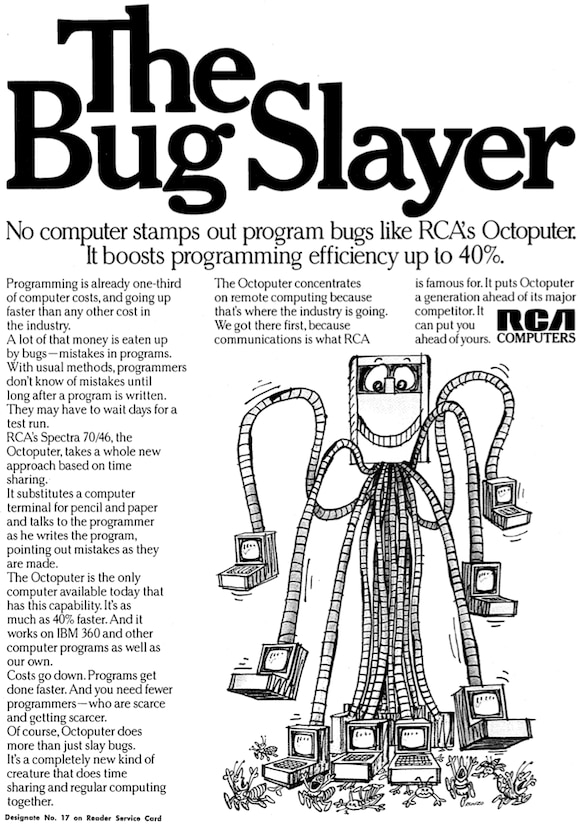
The friendly RCA computer monster, the octoputer and the octopeeper product.
There's an entire campaign with this creature. There's even vintage mugs for sale
https://file.vintageadbrowser.com/o3yyp9bbfn25fj.jpg
Here it is when a "younger brother" https://live.staticflickr.com/2936/14696676103_bdb77a4827_b....
Surrounded by its users https://pbs.twimg.com/media/EflEFwMU0AAN58C?format=png&name=...
Slaying bugs https://www.pingdom.com/wp-content/uploads/2013/05/octoputer...
And winning the computer room https://pbs.twimg.com/media/EflFX5CUwAAhira?format=jpg&name=...
It was a cruel joke for the ad to spark your interest whereby you would circle the number, mail in the bingo card to the publisher (3-5 days), whose lead management group would process it (3-5 days), then send the lead to the company or dealer (3-5 days), who would assign it to a sales rep (3-5 days), who was working their leads and getting back to potential customers (3-5 days), who would then ignore the call because they had lost interest in the product or couldn't remember requesting information.
Compare that with today where making a phone call to the sales team takes too long (3-5 minutes) and it's easier to just go get the damn information yourself.
Then I convinced my boss to buy me a copy of dBase II and set out to learn that as well. I was spending every work night until 11 pm. Got tired of that so I withdrew $3500 out of my meager savings and bought an IBM XT clone from a new company in Flint. I remember adding a modem so that I could explore CompuServe, a large mainframe based online service by H & R Block.
I'm not entirely sure I'm just jaded by time - I feel like maybe computers became commodity appliances, for an entirely different crowd, but I stayed the same.
- Oscar Wilde.
This thing sat in its cardboard packaging for at least 6-9 months. My dad had no idea how to set it up, and his English wasn’t good enough to just read the manual I guess. When I was in first grade, one of my dads friends came over and helped my dad set it up. They installed AOL. My dad gave my older sibling the password but wouldn’t share tell me.
The first time I used the computer, I spent a good hour I think staring at Mighty Morphin Power Rangers content on the “Kids Only” AOL channel.
This literally changed my life. I learned HTML when I was in the 3rd grade. The next year, I learned PHP because all of the cool Quake 3 clans had web pages where you could post updates without having to change HTML and re upload files over FTP. By 5th grade, all the cool people on IRC (Dalnet or EFNet I think) were talking about object oriented PHP.
I learned how to write objects in PHP, although OOP didn’t really make sense to me. I remember using some library to add my Quake 3 clan’s logo as a watermark on images I would upload to our website.
As a kid growing up in the 1990s with both of my parents being alive then, it was truly a different time. I believed I could accomplish just about anything. By 1999/2000, I knew I’d wanted to do something with computers when I grew up. By 2001/2002, I was poking around in Java a bit. Unfortunately I didn’t really learn much computer science until college. And I didn’t really appreciate data structures and design until really starting my career.
Sometimes I do wonder how things could have been different if I was born in the 70s or 80s.
Many late hours, trying to keep up.
You did very well, I think.
I feel very fortunate to have come along at a time where home computers were simple enough to understand.
The circuits were literally black boxes, so no doubt the real old-timers would chuckle at this assertion: they had to build the computers out of discrete electrical components, one transistor at a time... But I could understand a CPU that had a single register, an "accumulator"...
If anyone at the Computer History Museum reads this: Get the 70s/80s micro computers out from behind the display cases!!! CHM has at least one of every computer you can think of, why not take the extras and put them on the floor for visitors to play with? It's like torture wandering through the displays and not being able to play with all those computers and video games you lusted over as a kid.
I learned to program on the TI, TI-BASIC first, then Extended Basic, then some Assembler. The C64 was great because you had to understand how to work directly with hardware. On the TI, you would nice library call like CALL SOUND. On the C64 you'd have to POKE everything to the correct address to coax sound out of it (often what you would do in a single line on the TI would take 4-5 lines on the C64, but the C64 was fast, and had lots of memory). Good times.
So it's only approprate to have him as a spokesman sitting at a computer keyboard, with his document looking not much different than sheet music. And he looks like he is tickling the ivories there, sticking mainly to the black keys I see.
Maybe a bit like Irving Berlin, who was the most popular songwriter for so many decades, and who only played on the black keys.
Interestingly, Berlin's personal Steinway is now in the Smithsonian since it is a one-of-a-kind chromatic piano where he could mechanically shift the musical key the black keys were tuned for.
So he could get together with artists like Sinatra and play his tunes as originally written but in the singers' preferred key.
Now Borge was actually quite improvisational for a clasical musician.
He could get up there, introduce himself and play a number of 30 to 60 second interludes, and get away with saying or merely acting like he hadn't made his mind up what full piece to play.
Then there could be a little monologue for a while which was one good reason so many were there to see him, but regardless of how excellent that was, the elephant in the room since the beginning had always been the significant percentage of the crowd who wanted nothing but the music.
Zappa had this too.
Borge would flip up his coat-tails, move closer to the microphone and say in his European accent "Do you want to hear Great Music? Classics?"
He then quickly extends his arms in the characteristic way for more freedom of movement, puts his hands on the keys, moves closer to the microphone again and says "Too bad!"
As to how far we have progressed, I'd rather see us talk about how we interact with technology and how it changes our lives.
Smart phones are powerful computers. They are ubiquitous. They're the computers we all have now. What have they accomplished? I can always contact someone, though loneliness seems to have increased. People can also contact me all the time, sometimes with video. Nobody wears watches because they carry phones, so we missed the Dick Tracy future. Nobody can be lost anymore because they (and many other entities) always know where on earth they are. All of those things are absent from the old ads.
Our "progress" is mostly about surveillance whereas the old ads were all about what individuals could accomplish. And there's definitely progress in how things are marketed to us. Aren't those old ads clunky?
As someone who graduated college when the 1980s came to an end, I can say it was unusual for a household to HAVE a computer. They were a major purchase, any communication with the outside world was via dial-up modem to a BBS, and most families had no practical reason for them.
https://en.wikipedia.org/wiki/One_on_One:_Dr._J_vs._Larry_Bi...
See https://www.giantbomb.com/dr-j-and-larry-bird-go-one-on-one/...
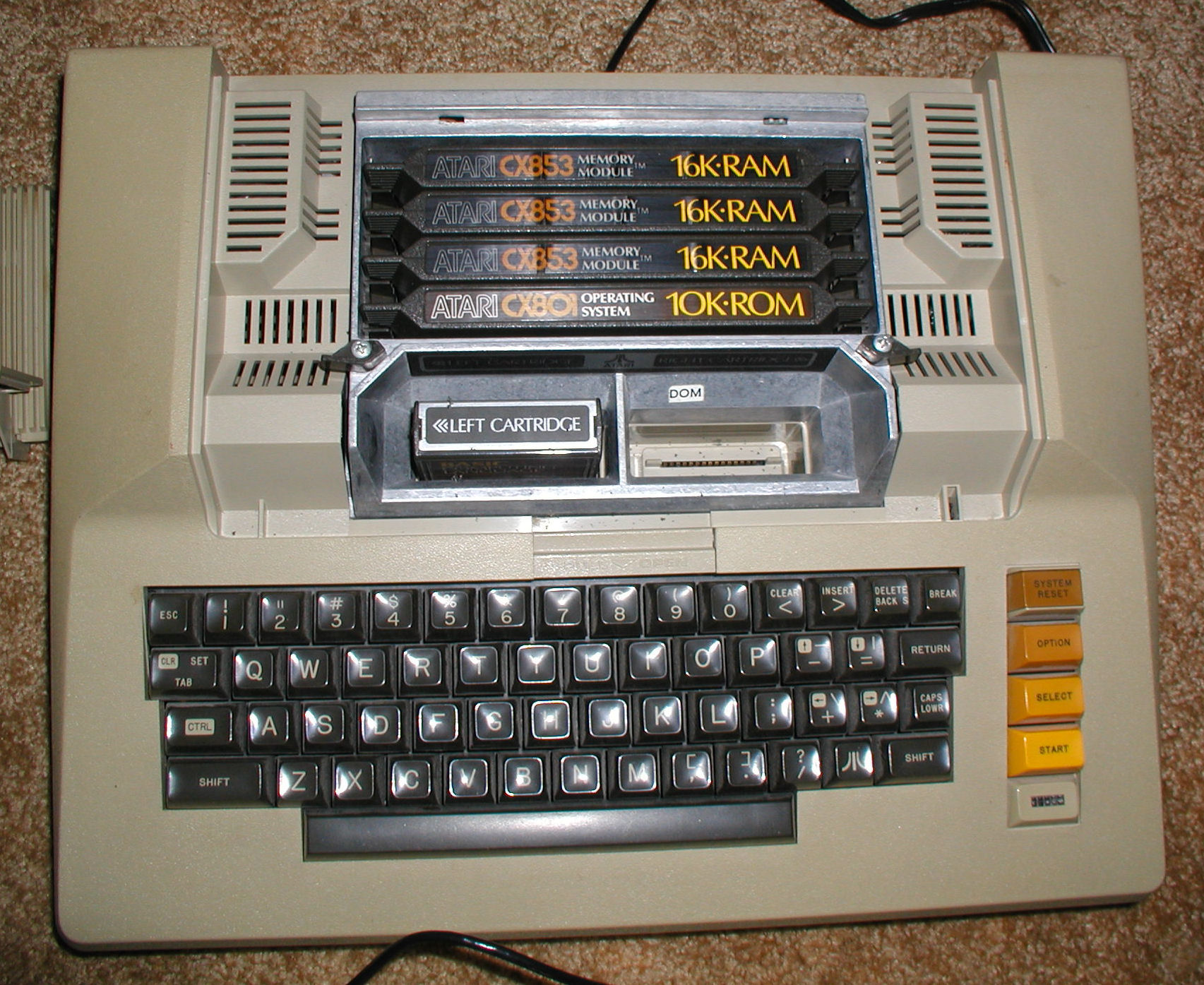
http://www.vintagecomputer.net/atari/800/atari_800_48kRAM-10...
Archive.org has the BYTE archives.
https://archive.org/details/BYTE-MAGAZINE-COMPLETE
It is fun to go back and browse them.
I like that the author showed a lot of ads with girls operating the computer. Typically it was boys (or whatever) with his sister just passively standing by. Of course it was the 80s and apparently it was quite common for the “family computer” to be installed in the son’s room.
TBH my favorite part was being reminded of the absurd clothing people wore in those days and the incredible clutter of stuff people had everywhere.
I know for a fact 30M commodore 64s were sold in the 80s in the USA. Not all commodores, not all home computers, just the classic model C64, 30M units sold. That's in a country that used to only have 250M people, so in theory 12% of Americans as of 1990 had purchased one specific model, the C64, leaving only 3% for all other models combined, which seems very unlikely.
Some of those probably went to schools not homes, although schools were owned by Apple II in those days...
My suspicion is many of those were unused in basements and closets, or the question was phrased weirdly like "have you purchased a computer in the last three years" or "used a home computer in the last month" or they defined "home computer" to be "not an IBM (office) or Apple (school) product" or something like that.
Trammel claimed 30m based on a remembered estimate of rough sales numbers per year, but the only estimate that’s based on objective evidence - serial number analysis - is 12.5m.
https://web.archive.org/web/20160306232450/http://www.pageta...
People overestimate the speed of the spread of computers.
I didn't have a computer where I worked until 1994. And then, it was shared by eight people.
At my next job in 1995, I made them buy a computer for the office as a term of employment. At the time, I suggested that a laptop might be a good option, since the computer would be shared by three people. For the next two years, the sales guys made fun of me for wanting to put a computer, and for wanting one that fits on my lap.
I later heard that when I left, they sold the computer. I wonder how those blissfully computer-free sales guys are doing today.
When I worked for Westinghouse in 1996 was the first time I was in an office that has one computer per person. But not every department had computers at all. And most who did were just terminals hooked up to a Vax in accounting.
When I worked for a large regional media company in 1997, everyone had a computer. Only a couple of them had internet access, and that was only e-mail. This was during the days when so many people were getting AOL at home that it became uselessly bogged down by its own popularity.
1999: Everyone in the office had their own computer. Not everyone used them. But at least they all had internet access.
(OT: I'm sad that the macOS spell checker didn't know the word "Vax" just now)
I remember buying an AST 386 for my use at home, I'm guessing it cost about $4K or more in today's dollars, so it is true that business-class PCs at home were probably relatively rare at that time.
(edit this was for a 'real' PC compatible or Mac, you could probably find C64s and etc at the flea market.)
My mom had a word processor around then as well (can't remember which came first), a single purpose device for writing with a keyboard, a CRT monitor, and a printer. Looked somewhat like this[0] but I can't remember whether it was the same brand or not.
We also had a IIci. It came out I’m 89, and I was shocked to learn how insanely expensive it was at launch - $6000… $14k adjusted for inflation.
The line to buy it would through nearly every aisle in the store, out the front door and down the block, for over a week. People were asking for forwards on their paychecks, taking out loans, selling cars, anything they could do to get a computer at this magic price point.
The main selling point? It had a modem and people could see what this "internet" business was all about for the first time.
It isn't riveting conversation, just stuff like "Sunset" (to make the lights warmer), "remind me to buy cheese when I get to $GroceryStore", "play $album please", but it adds up.
I also take a lot of pictures, which have become unreasonably good to the point where I'm still learning how to take a better picture with my fancy mirrorless than I can take with my phone. Both of them are computers.
After I take those pictures it does accurate analysis of what's in them, so when I search for cats, or spider, or flowers, it finds them. It does this on the device, which is pretty cool.
I have another computer that flies, I can tell it to fly circles around a target or do a bit of following. It's neither an expensive nor featureful example of its class. It flies for a real 25 minutes on one battery and weighs 249 grams.
There's another one which cleans my floor, to be honest we could have done an okay job of that in the 90s, batteries and chips were almost up to it.
Then there's the one that I can tell to make fantasy dwarves and it just does it. I think that's the one younger me would have been most impressed by.
It could also burn a CD without freezing the system or producing a coaster.
For example, the field of 3D graphics. Games and animated movies have become a lot more realistic and feature filled thanks to more powerful graphics cards. In fact, Disney specifically puts a lot of effort into making hair realistic. That was impractical a decade ago, and impossible a decade prior.
Even if you need bigtime compute power for video games, there are game streaming services where someone else's computer will do that for you.
I have a high-end graphics card and all the processing power I need to play games... but I am still wasting all of that whenever that isn't what I'm doing, aren't I?
* The arrival of video cards around 1997 (focus shifted from general computation to digital signal processing)
* The arrival of the iPhone around 2007 (focus shifted from performance to power consumption)
I'd vote to undo these setbacks by moving to local data processing, where a large number of cores each have 1/N of the total memory, shared by M memory busses. Memory controllers would manage shuffling data to where it's needed so that the memory appears as 1 contiguous address space to any process.
In other words, this would look identical to the desktop CPUs we have today, just with a large number of cores (over 256) and a memory bandwidth many hundreds or thousands of times faster than what we have now if it uses content-addressable memory with copy-on-write internally. The speed difference is like comparing BitTorrent to FTP, and why GPUs run orders of magnitude faster than CPUs (unfortunately limited to their narrow use cases).
This would let us get back to traditional programming in the language of our choice (perhaps something like Erlang, Go or Octave/MATLAB) rather than shaders.
Apple appears to be trying to do this with their M1 and ideas loosely borrowed from transputers. But since their goals are proprietary, they won't approach anything close to the general computing power available from the transistor count for at least a decade, maybe never.
So there's an opportunity here for someone to reintroduce multicore CPUs and scalable transputers composed of them. Then we could write whatever OpenGL/Vulkan/Metal/TensorFlow libraries we wanted over that, since they are trivial with the right architecture.
This would also allow us to drop async and parallel keywords from our languages and just use higher-order methods which are self-parallelizing. Processing big data would "just work" since Amdahl's law only applies to serial and sequential computation.
The advantages are so numerous that I struggle to understand why things would stay the way they are other than due to the Intel/Nvidia hegemony. And I've felt this way since 1997, back when people thought I was crazy for projecting to the endgame like with any other engineering challenge.
Cheap RAM is DDR. Fast RAM would be on-die but that would be very expansive, or maybe now on package (but with some tech to be developed). But appart from decoupling latencies of accesses, I don't really see the point of having N busses (from local core to its local memory), especially if you need a very large number of cores. More memory channels seems good enough. The bandwidth is already hard to saturate on well-designed SoC like the M1 Pro and above, probably improvement to the latency could yield to better benefits than trying to increase the bandwidth more.
> In other words, this would look identical to the desktop CPUs we have today, just with a large number of cores (over 256) and a memory bandwidth many hundreds or thousands of times faster than what we have now if it uses content-addressable memory with copy-on-write internally. The speed difference is like comparing BitTorrent to FTP, and why GPUs run orders of magnitude faster than CPUs (unfortunately limited to their narrow use cases).
"content-addressable memory with copy-on-write internally" are you describing what caches already kind of do, in a way (esp. if I mix that with: "memory appears as 1 contiguous address space to any process")? The good news would then be: we already have them :)
What remains, that I think I fully understand what you mean, seems to be: more cores. The other good news here is that: it is in progress. If 6 years ago you would have gotten 6 to 8 cores on an enthusiast platform, you would now probably chose 12 to 16 cores on just a basic one (and even more on a modern enthusiast one)
There has been a pause but in recent years but it was basically Intel having process difficulties, and being caught up by the rest of the industry. Including some with power consumption also in mind, and given what an high perf CPU dissipates today, power consumption has also become key to unlock raw performance anyway.
- 2007 single-core performance: Geekbench 5 score ~ 500.
- 2021 MacBook Air M1 single core: 1750
Ok, only a factor of 3 or so. And only 2x as many cores.
I'm comparing Core 2 Extreme to a low power portable design, albeit one with notably high single-core performance.
My watch has orders of magnitude more processing power and working memory than my first PC in the mid 90’s. It weighs maybe 200 grams and runs on battery power for ~20 hours.
If that doesn’t feel like progress then I dunno …
Yes, we can handle much larger data now with proper hardware, however, most people don't do that, their needs for documents and spreadsheets are just the same as it was earlier, but modern systems somehow manage to be worse despite having orders of magnitude more processing power and working memory.
Firstly, that never happened. The moment my ZX81 came into our house there were nightly fights for the television (early computers needed the telly as a display). The computer completely alienated my parents and siblings who were mainly grateful that my interest in electronics and hacking was a pacifier.
Secondly, the distance between those images of technology as a connecting force and today's reality could hardly be more striking. Personal computers are objects of radical individualism. Four member of the family each staring into their own 6 inch digital world, face lit from below in blueish light would be the right image.
So the question of "how far we've come" is more nuanced than kilobytes of RAM and megahertz of processing power.
They were always so dressed up, like they were planning on attending a wedding and at the last minute decided to play Donkey Kong.
The real world looks as it always did, as I sit here "computing" in my gym shorts and a dirty tee shirt from changing the lawnmower oil this morning.
I still have the F series keyboard from that computer, which ended up housing my first three motherboards as well.
Its worth pointing out that I was paying something ridiculous like $115 for health insurance around 1990 and its running about $1750 now for my wife and I, and that's with horrifying copays and stuff. Somebody with $70K is still getting $70K, they're just spending it on rent and medical expenses now instead of $3K hard drives.
On one hand, instead of life involving $3K hard drives, now we supposedly have better medical care and nicer houses. On the other hand, its not like lifespans are increasing, LOL.
On of the big things that has changed is the massive increase in housing costs and rents causing all kinds of economic issues.
It's easy to remember our youth, and think of how easy it was. And it may have been for us (well, I was working or in college most of the 80s), but not our parents who foot the bills.
For these sorts of searches, I use archive.org: https://archive.org/search.php?query=Savvy++%22Excalibur+Tec...
Perhaps https://archive.org/details/InterfaceAge198207/page/n111/mod... ?
Pipes (the tobacco kind, not the Unix kind) used to be a lot more popular back then.
Edit: Dr. Dobb's review at https://archive.org/details/1985-03-dr-dobbs-journal/page/11... . Says SAVVY PC was written in MMS Forth "this despite John Dvorak's statment in his InfoWorld column, "Inside Track," that no decent program was ever written in Forth". :)
Losses include much less economic headroom for everyone who isn't upper middle class or higher, with a fair percentage of the population falling out at the low end, much more homelessness, and a cutthroat nickel and dime everything neoliberal culture in business. So while computers and cars are cheaper, health care and college expenses are much higher.
There was still some lingering benign paternalism in business in the 80s and especially the 70s, but that's much rarer now.
And serious stressors like climate catastrophe are much more imminent.
Technology, transportation, and food are cheaper.
Unfortunately major essentials such as housing, health care, and education are drastically more expensive.
Outside of cartels and rent-seekers, I can't imagine people saying "you know, we really need to make housing, health care, and education unaffordable for more people."
It's particularly disappointing that technology doesn't seem to have reduced the cost of health care or education - the cartels seem to have won by restricting supply and exploiting indirect payment systems.
4MB used to make people believe they'd do everything for life, accounting, programming, graphics whatever. It was infinite joy with only 320x200 points.
Now you sell a 4k capable pocket datacenter running on 5W and people are barely satisfied for a year.
Now imagine a long life where you had all the sweets you could ever eat available all the time. Your attitude to them is going to be far different.
In addition, back in the 90s computers were going to attract 'computer people' and the rest would ignore them. Now they are just a fact of life, even for the disinterested.
Just imagine: assuming tech evolves a lot slower. What would happen? People would still be OK, games would still be fun, business would carry on regardless.
Nowadays we have 57 sexes, 570 TV networks, and libraries in the city have evolved to their true purpose of sheltering the unhoused. And soon we won’t be burdened by our privacy belongings!
https://twitter.com/wef/status/800965291215818752?s=21
I mean, who wouldn’t see this as leveling up?
Having a grandfather who left the country in 1968 for West Germany gifting me one when we visited him.
> And what were the "legal" alternatives?
Buying one at an outrageous markup in an exclusive shop. I don't remember the exact number (although I could find it out) but the price tag was something like five month of average Czechoslovak wages at the time. Apparently in the US the equivalent would have been paying $10000 for one (in 1988, mind you). Of course in Germany it cost something like 299 DM or so...
>The report in Time adds many new details, particularly the role of the Central Intelligence Agency and the Roman Catholic Church in opening networks across which telephones, fax machines, printing presses, photocopiers, computers and intelligence information moved to Solidarity.
Personal possession anecdote from book "High-tech za żelazną kurtyną. Elektronika, komputery i systemy sterowania w PRL" (978-83-8098-094-5)
>In 1984, "Informatyka" magazine, involved in the dissemination of these machines, reported on the adventures of Mr. Przemysław, who received in April [...] a package from his brother in Toronto, containing the VIC-20 microcomputer, power supply, cassette recorder, a set of cassettes for television games and English language learning and connecting cables. The Customs Office in Gdynia refused to issue an import license, stating that it could issue [...] only if the computer was necessary for the citizen's professional or scientific work
It slowly got better in second half of the 80s. COCOM relaxed import sanctions in 1984 on low end 8bit gaming machines:
"New Media Behind the Iron Curtain: Cultural History of Video, Microcomputers and Satellite Television in Communist Poland" https://research.utu.fi/converis/getfile?id=51338894&portal=...
>The breakthrough in the domestication of computers in Poland took place in the mid-1980s, most likely between 1984 and 1986. In the global context, this might have been relatively late, but in the context of the Eastern bloc it seems that Poland was within the norm. There are two main reasons behind this chronology: one international, one local. Firstly, on an international level, the embargo on 8-bit technology was relaxed in 1984. Computers had been at the heart of the CoCom debate since the mid-1970s, but – as Mastanduno reports – it was not until July 1984 that the embargo on the most popular 8-bit microcomputers was removed, even though at the same time new restrictions were introduced regarding various telecommunications software and solutions.
In 1985 you could finally legally buy 8bit Atari in Pewex - chain of shops exclusively accepting $western currency$. Personal ownership of western currency was illegal :-) but regime was running low on foreign cash to repay international loans so they came up with this brilliant plan of opening shops where you could spend your smuggled black market money semi officially.
>Secondly, on a local level, as Kluska reports, in the autumn of 1984, the “[Polish] customs office ceased to make it difficult for citizens to import microcomputer equipment.”
In 1986 weekend computer market opened up in Warsaw in rented School building. It ran weekly uninterrupted up to ~2012 with one location change. Interview with founder https://spidersweb.pl/plus/2021/04/gielda-komputerowa-prl-la... VHS recording from 1994 https://archive.org/details/gielda-komputerowa-na-grzybowski... Official 'Polish Film Chronicle' newsreel from 1992 https://www.youtube.com/watch?v=mxQqsqqH8ao
DRAM was $32 a meg for soooooo long
(haha wow, speaking of which, hn edits emoji out of posts on this site, amazing)
The Living Computer Museum is unique in that they maintain running instances of the computers in their collection.
For instance, the only running CDC 6600 series (a 6500, I think).
What's more, they offer free remote logins on at least some of their computers.
If they were to shut down, we'd be in danger of losing a significant chunk of tech history.
How is this different from owning anything? I have a bike, but I’m not riding it literally all the time. But I still don’t think owning it is a waste.
Nowadays it’s hard to really notice the upgrades without running benchmarks.
10 print “hello”
20 goto 10
64 bytes of basic tokens - so program size was limited to about 10 short lines.
https://atariprojects.org/2019/12/24/try-basic-programming-o... with video of a program running: https://atariprojects.org/wp-content/uploads/2019/12/BASIC-V...
Can you explain this? I don’t understand your reasoning. Doesn’t the issue of “cheaper to manufacture” have anything to do with price?
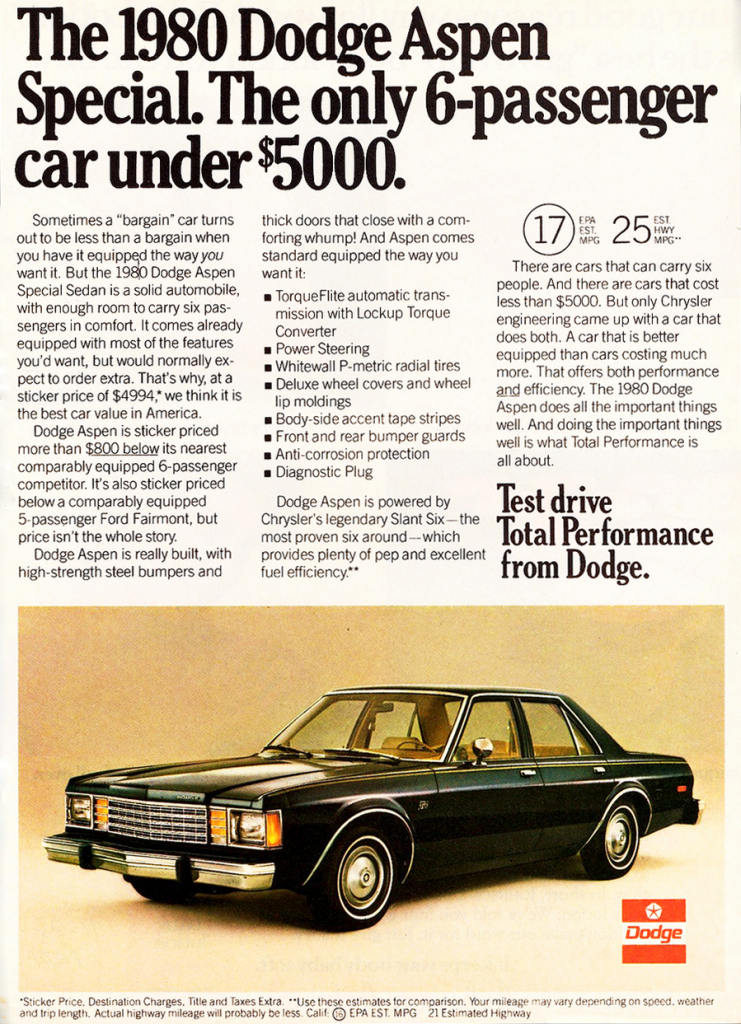
Here's a brand new sedan you could buy for under $5k during the same period. https://blog.consumerguide.com/wp-content/uploads/sites/2/20...
The sort of person that could afford to plonk $3k a few megabytes of storage without thinking about it too hard back then wasn't the sort of person that needs a payment plan to afford an iPhone today, it's the sort of person who's never needed to save for a new car.
So easy to forget these mind-boggling prices, as they were usual and customary (for that level) at the time.
That's heartening. I'm also trying to do a good job as a dad, letting my daughter have positive experiences with computers, to learn to have fun, respect but also command them, to be in control.
Even if you’re fond/nostalgic for older hardware and games, that doesn’t mean you can’t recognize that things have improved.
I remember in the late 80s most people could not type. Typing was done by secretaries and was a specialized skill. There were (optional) for-credit classes in high school dedicated to teaching typing and nothing else.
I got a bunch of part-time temp office jobs as a teenager because I could type fast, having grown up with computers, while my friends would get jobs at supermarkets or convenience stores, etc.
The temp agencies had me do typing tests (on typewriters, not computers) before placing me. I blew them away at some ungodly WPM speed that I no longer remember. Not atypical by todays standards, I’m sure, but standards were different then.
Often I would be the only person in a small office who could type. I certainly was the only male who could type. Everyone else was female.
Imagine that today!
She grew up in roughly the same area where we lived when I was a kid, and so she actually want to a previous iteration of a girl's school I've visited in the 1990s, but back then as well as sex segregated selective education (ie my school was specifically for boys who "tested well" at age 12, hers was for girls who likewise tested well at age 12) the assumptions about future life roles were... very static. She wasn't doing well enough to be sent to University, so the assumption was she'd get a secretarial type job, and probably marry in her 20s, get pregnant and drop out of the work force.
So, they taught her to type. This is the 1960s, so she's not learning Word, she's learning how to use a manual typewriter, because it's expected she'll be in a typing pool, maybe a clerk, or at most a PA. She actually had very different ideas of what she'd do, and after finishing her course turned down a Computer Operator job because it wouldn't lead to what she was interested in - but in the end as predicted she ended up married, pregnant (with me) and giving up work in 1975.
Anyway, fast forward twenty years, my sister and I have "flown the nest" so to speak and money is tight, my father has been made redundant and will never have another white collar job for the rest of his life - so she gets an administrative job. Understandably they want somebody who can type, and she checks the box even though she's been out of the workforce for twenty years. Hasn't much idea how to use Word or indeed Windows, but she's fairly smart and can muddle along. It's interesting how unexpectedly that skill, which she didn't really value at the time, was crucial to her again.
Eventually the IT stuff was too much for her, and she took early retirement because both the extra IT training and the constant pressure to "do more with less" (the government likes the idea of a powerful military, but doesn't like spending money on it, she was an administrator for the Ministry of Defence) made it intolerable. But if she'd never learned typing as a teenager I think she'd have really struggled to find work with a "Homemaker gap" in her CV matching the IT revolution.
But I barely passed, because there was no error correction allowed. No backspace key. Although business typewriters of the time often had the ability to let you correct at least one character, either by buffering a few keystrokes or with actual "white out" over-printing, it was just as common to find yourself working for someone with a cheap typewriter and a bottle of white paint.
That was 1988. Summer job temp placement office at hometown university.
I attended college far away, a place noted for its computer science department, where there were $20,000 workstations on campus for the department's students. I don't know how many students had their own machines in the dorm, but the ratio on our floor was 1/12.
Businesses change slowly. Equipment doesn't get replaced on a whim. It has to be amortized and there's tax thingies that mean business equipment lifecycles are 3 to 5 years, minimum.
At my first job bagging groceries and stocking shelves, we wore a dress shirt and a tie.
At my first corporate software job, it was only a year or two past the time they had to wear a suit and tie to work. By the end of the 90's people went to work at a corporate job dressed the way I dressed at the beginning of the 90's to go skateboarding.
In business, I was just joking the other week that, in the course of my career, we've gone from business suits being the expected attire at industry events to jeans with T-shirts at least being perfectly acceptable.
lol. sweet.
Funny how many of the ads say "Call us for more information about our offerings!" instead of a "For more info: www....".
1989 is the very beginning of "the Internet might be useful for general purposes by non-scientists." And incidentally, the same year BGP was dreamed up. https://en.m.wikipedia.org/wiki/The_World_(internet_service_...
So most computers were running boxed retail software with extremely limited hard drive data space (if present at all).
Computer control of modems using standardized Hayes(+) command sets over RS-232 serial ports (1981), the Bell breakup (1984) and subsequent competition, and increased modem manufacturer competition breaking price-per-baud standards and increasing affordability (~1988) were required enablers to take it mass market.
It took until the early 90s that you could (a) buy a PC at a reasonable price, (b) buy a modem at a reasonable price (that was guaranteed to work with your PC), (c) dial into an ISP's local number... from anywhere in the US.
Yes, some people lived in NYC, Chicago, SF, etc. and had access to knowledge and BBS infrastructure at local rates earlier than that, but most people didn't.
Here's an interesting discussion link. Merely being on wikipedia doesn't mean its correct that site is a hive of disinfo in general:
https://www.pagetable.com/?p=547
This site even mentions the peculiar 30M figure.
I would tend to believe the linked site's serial number analysis result of exactly 12.5M. The americans did something like that to the germans in WWII, it turns out a remarkably small totally random sample of sequentially assigned serial numbers is enough to very accurately predict the highest number sold. Assuming very random sampling, which is never truly random, of course.
Doesn't change the overall outcome, however, when there's a stat that a small segment of an industry is "about" the size of what's claimed to be the entire industry, something's off in the numbers.
A mere 12.5M sold remains 5% of the entire USA population at that time, and honestly, having been there, almost everyone I knew had a PC clone or some apple product, usually a mac. The number must be larger than 10%. "a computer" was required at college ... ed.gov claims there are 19.4 M college students in the USA right now and google claims 332M people in the USA right now, so about 6% of the population are in college right now, so back in 1990 guess "around" 6% of the population was required to own a computer just to attend higher ed ... the claimed 10% seems like an incredibly low number.
In 1990? No way. I was taking college courses (for HS credit) in 1990, and the first I heard of a requirement to bring your own computer was years after that.
Another thing that skews the numbers is that my household during the 80s had two Color Computers, a C64, and an Amiga 500, but no one else in my social circle had anything more general than a Nintendo or Atari console.
Computer Science courses generally just required a remote dumb terminal, such as a VT100 or ADM 3a. These were available in a few rooms around campus as well.
All engineering students had a computer, though.
One person on my course caused a minor stir by bringing a "laptop" to a lecture to take notes in about 1991 - the keyboard was so noisy that they only did it once!