Apple Unveils M2(apple.com) |
Apple Unveils M2(apple.com) |
And real function keys instead of a touchbar?
They seem to be making weirdly inconsistent choices in the product line.
I thought they were going to be getting rid of the touchbar (and maybe adding more ports?) and they were only still in the legacy 13" because it was legacy. But apparently they mean to indefinitely have a 13" Pro with a touchbar and a 14" Pro (actually the same size device, just less bezel, I think?) with function keys?
And the new M2 Air has a magsafe power connector (like the M1 14" and 16" Pro)... but the new M2 13" Pro does not? Why?
I was about to buy a 14" M1 Pro, not because I needed the speed at all, but I wanted magsafe, I didn't want a touchbar, and two USB-C ports (inclusive of power supply) is not enough. Also the built in HDMI out was nice.
The new Air has everything I want except the HDMI. Separate magsafe power PLUS two more usb ports (that's enough for me), no touchbar... yeah, I'll be waiting for this and saving significant money over the 14" M1 Pro I was about to get.
I guess if you really love the touchbar, this is the only thing that has it? (That HN hates and we all thought they were getting rid of based on the M1 Pro's). Or you really hate magsafe power connectors, this is the only new laptop that lacks it?
Its interesting that they don't have the same screen. The Air is .3in larger and supports more colors?
Air 13.6-inch (diagonal) LED-backlit display with IPS technology; 2560-by-1664 native resolution at 224 pixels per inch with support for 1 billion colors
MBP 13.3-inch (diagonal) LED-backlit display with IPS technology; 2560-by-1600 native resolution at 227 pixels per inch with support for millions of colors
Same logic for how they keep the iPhone SE with a physical home button.
I miss my 100Mhz IBM PC with 16 MBs of RAM & Visual Studio.
4k video editing - I admit is a valid use case, not something I've ever had to do. But I doubt most people buying these are video editors.
If someone came out with a nub-sized flash drive that sat nearly flush with the edge of the Mac, I'd definitely get one. I was really hoping the base MBP would be revamped, and I'd be able to get an SD card slot and avoid Apple's insane storage tax...
- CPU: 100% faster
- GPU: 600% faster
Apple M1 (2020) vs M2 (2022)
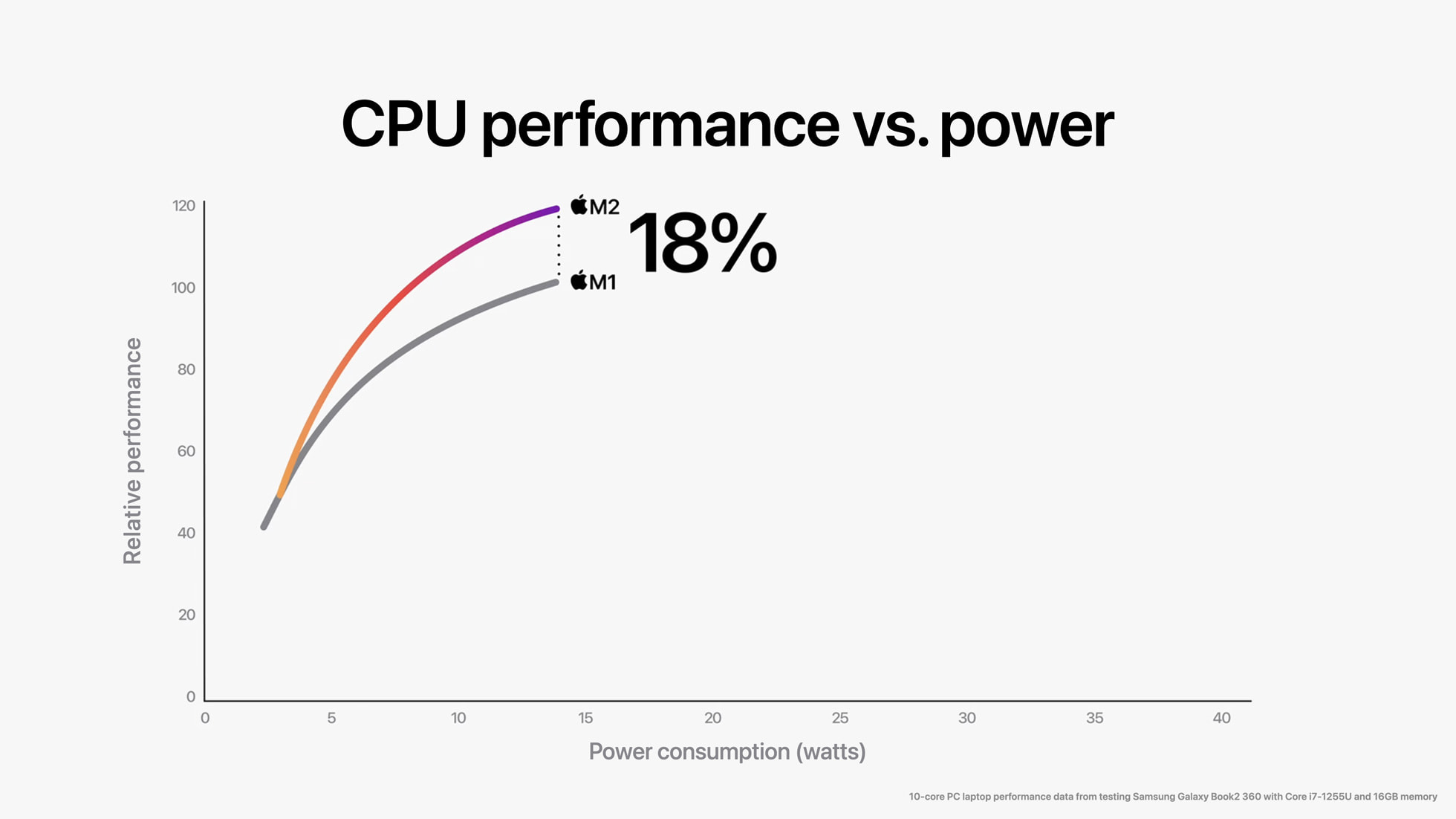
- CPU: 18% faster
- GPU: 35% faster
Diminishing returns.
600% of 1$
18% of 1 000 000$
Which % do you prefer ?
unless you can charge with both on new macs?
Any benchmarks yet?
Note that Apple do not mention AMD. M1 and M2 probably still kick AMD to the dirt on the power efficiency front, but the cost for performance end would be difficult to quantify (and the AMD performance ceiling is also significantly higher).
Intel is not significantly faster, just more power hungry. That’s the mean difference in day to day usage.
Did you want to compare the M2 to a specific Intel CPU? The M2 is better.
https://www.apple.com/newsroom/images/live-action/wwdc-2022/...
This was the first comparison on the page. M2 has 18% more relative performance than an M1. You can argue about the relative part, but the certainly included the comparison (and do for GPU, etc...).
Supply chains. Good ol’ supply chains.
The “Mac” is really the “MacBook”—very solid majority of devices sold are laptops, followed by iMacs, then minis, then a teeeeeny sliver of Mac Pros.
Well, probably. People infer it from quarterly earnings. Apple no longer breaks it down explicitly by category. But it’s a very safe assumption the biggest selling Macs, by far, are laptops, and they are prioritizing silicon for those.
That said I'm sure it's nice for _someone_.
Edit: I just realized that the magsafe connector can be disconnected from the brick, and a standard usb type-c cable can be used thusly making the charger as useful as the old one, provided you buy an admittedly cheap in the big picture cable.
I totally get your point and can't disagree with it. But I really love the magsafe connector for power. It's just so nice. usb-c feels slow clunky in comparison. Just for a straight power supply use case, I think magsafe is superior to usb-c.
So I wonder if anyone is contemplating an adapter? There's probably going to be too much of a mismatch of power requirements or something to make it viable.
I actually run with Garmin (Spotify & downloaded music) + Airpods.
Pretty much all disc drives that have been produced in the history of disc drives come with a little pinhole where you can stick in a paperclip to manually push the opening mechanism exactly for this kind of scenario, so you can recover your disc if your computer or drive fails.
Except Apple computers, of course, because such a useful piece of functionality would be ugly and an abomination unto Saint Jobs, or something. So I had to spend a few hours opening up that MacBook that very clearly wasn't designed with "opening up" in mind. I was lucky this machine wasn't in warranty and dead, so putting it back together wasn't really a concern.
It was something like this: https://everymac.com/systems/apple/macbook_pro/macbook-pro-u...
RAW photos straight off my Sony A7iii bog down Lightroom, but not horribly so. Once I try to scroll through a few hundred of them and apply bulk edits things slow more. Photoshop is fine unless I open more than about 10 large files simultaneously.
Editing 1080p video in Final Cut Pro I can bog it down from time to time. 4K is utterly unworkable unless I let it convert it all to ProRes - even then it's quite slow.
I should also mention during all of this the fan is absolutely screaming, and battery life is about 30-40 minutes - it's essentially un-useable for demanding tasks on even a warm day and when not plugged in
All-in-all it's acceptable, but I will get a used M1 MBP as soon as I can afford it.
M2 MacBook Air 13" with 8-core GPU (10-core would be $80 more)
* 16GB RAM, 512GB storage: $1599
* 16GB RAM, 1TB storage: $1799
M1 14" MacBook Pro with 14-core GPU
* 16GB RAM, 512GB storage: $1999
* 16GB RAM, 1TB storage: $2199
So $400 cheaper, ~20%
Like... they just found a manufacturer that already made these screens and didn't want to retool for Apple's order, or what? Why extra 4 pixels?
I wanted to get a revamped MBP, but after seeing the horrendous stats (2 ports, no MagSafe, no SD/HDMI!) it was a no-brainer to get in line for the MBA, which is cheaper, lighter, and has more ports and a better camera.
I bought it to see if I could play movies from my phone. It didn't work, so I chucked it in a drawer.
More recently, I bought a 50" TV to use as a giant developer monitor, and this cable works better than my Dell's HDMI port. What happens is that the HDMI port can only do 4k at 30hz, but this does 4k at 60hz.
You'd think something like that wouldn't matter for an IDE, but shockingly, moving a mouse at 30hz is... Just... Weird.
This is such a ludicrous argument. If something is faster, it's faster. What's the problem?
This is firing on all cylinders. The organizational structure and performance is a marvel for this.
Apple also made a huge leap forward with their cooling designs. Making the laptop thicker and investing in proper cooling design made a huge difference.
My M1 laptop is significantly quieter than my old Intel laptop at the same power consumption level. It’s not even close.
Apple’s last generation chassis and cooling solution were relatively terrible, which makes the new M1 feel even more impressive by comparison.
The x86 MBP was stuck in a vicious cycle of getting overheated, running the fan all the time at high speed, sucking up enormous amounts of cat hair, and jamming up the motherboard and cooling vents: the hotter it got, the faster the fans ran, the more cat hair it sucked up, the worse the cooling and more snuggly warm the insides got, the more attractive it was for the cat to sleep next to.
Indeed. Turns out there is some utility in function over form. God I hated Ive's bizarre need to shave with the damn thing.
Multiply this by adding the chipsets, other IO controllers, and discrete onboard GPUs.
I suspect Apple are being overly conservative now, partially because these chip designs are new, partially because no internal team wants to be where fingers point if the design is inadequate, and partially because a SoP design gives them a bit more space/flexibility to do so.
Work have me an M1 MBP and I have yet to hear it make a noise, it's amazing.
Then again, Apple has a long history of sacrificing cooling performance for form factor.
I think Rosetta + Swift + SwiftUI might have been a bit much change for the developers at Apple and the users are now paying the price.
I hope they focus on some principles behind stable software next.
Most of my problems these days are with their bluetooth drivers, though. Anything with a bluetooth connection randomly reconnects throughout the day. Most annoying with the mouse and magic trackpad. (And while I appreciate suggestions, future posters, it still happens after a clean install / nvram clear, so it's unlikely to be configuration related).
This is also anecdotal with a sample size of one, but I can't recall experiencing Apple app stability issues in recent Monterey releases on an M1 Air. It may be worth digging into crash logs. https://macreports.com/crash-reports-how-to-use-them-to-trou...
Totally agree, plus Sirouji, who seems like a modern day wizard
It would be a marketing failure though, and sustained would translate into a longer-term business failure.
I remember having a conversation with someone who worked on hard drives in the 80s. He got so ^%$^$# excited telling me about all the improvements he worked on between generations; they were mostly things like tighter calibrations, and refinements.
Point being: Don't knock releases like this.
But really we've only had 2.5 released cycles so far. Not much to go by.
Considering that M1 was already an overkill for the most tasks, I think it is a meaningful "tok" upgrade.
Besides, I kind of expect the trend of ASIC to continue. Instead of having more extreme and extreme lithography, it kind of feels more appropriate to have computation specific developments.
Apple just teased ~18% CPU increase while staying on TSMC 5nm.
Sounds like they are doing just fine.
Also, if Intel can keep up this time, and if tsmc/apple slouches, I wonder if there will be Apple silicon and Intel x86-64/risc macs/apppe devices on available simultaneously?
https://www.slashgear.com/833760/apples-3nm-processor-is-abo...
Edit: Also the pro is missing the magsafe charger. Are they phasing out the 13" pro?
Quite happy with my M1 Pro, a beat and a hell of a purchase.
I think Apple knows a lot of customers care about this and want it to be a barrier getting them into a pro machine. The cheapest laptop they sell with multi-external-monitor support is $1k more than their cheapest laptop overall ($2k vs $1k).
18% faster at the same performance per watt is a nice increase. Interesting to see if this will ever make it to their desktop computers.
18% faster at the same wattage, which means 18% higher perf/watt.
It is commonly assumed that M1 shares high performance Firestorm cores with A14.
It looks like Geekbench scores for A15 over A14 is about 18% in multithreaded, and 10% in single thread.
It is also very likely that the M2 uses the same Avalanche cores as in A15. So I would suspect that this translates to a 10% increase in single threaded performance between M2 and M1 as well.
Incidentally, A15 runs at around 3.2 Ghz vs 3 Ghz for A14. So the majority of the speed-up between A14 and A15 comes directly from increasing clock frequency. M1 runs at 3.2 Ghz.
Also, the first computer where getting the upgraded hard drive (512GB or 1TB) really helps with the low ram because of the integration bus they have with the drive for swap. It's fast.
The M1 generation looks to be a bit of an "introductory offer" to get people looking at apple who otherwise wouldn't have... once they have established their mindshare as being a performance leader worth considering over x86, they can raise prices back up.
M2 starting at $1200 looks pretty nice to me. Avoids many of the corners cut on the competition like: plastic chassis, tiny trackpad, poor fans that get noisier in the first year, poor Intel iGPU, poor battery life, etc.
What will happen with the M3? Will the base Air start at $1500?
Will the M2 Air drop its price to $999 when the M3 is released?
I'm not saying the M2 Air is not worth its price compared to x86 laptops, but it's ridiculous that the cheapest Apple laptop is way overkill for its intended audience. Even the M1 is already overkill for users that typically spend the majority of their time in a browser or using Office.
It is just the previous MacbookPro 13" with the M1 replaced with an M2. The Air is better in all regards if I read the spec correctly.
If I had to guess, we'll next see a Macbook Pro 14"/16" with M2 Pro/Max, and the Mac Pro will be M2 Ultra.
"compared to the latest 12-core PC laptop chip [...] M2 provides nearly 90 percent of the peak performance"
That doesn't make sense. Twice the performance of a 10-core Intel CPU, but only 90% of the performance of a 12-core? This implies Intel more than doubles performance when going from 10 to 12 cores. Reading the footnotes, the 10- and 12-core Intel CPUs that Apple used for benchmarking are the i7-1255U and i7-1260P which have respectively 2P+8E and 4P+8E cores (performant and efficient cores). So the second Intel CPU actually has twice the number of performant cores than the first.
This means the benchmark mostly depends on performant cores and nearly doesn't use or doesn't depend on efficient cores. If so, that's a rather useless benchmark for evaluating the CPU as a whole (P and E cores.)
But what this also means is that Apple is being sneaky. The M2 has 4P + 4E cores (not revealed in the press release, but we can tell from the die shot). Thus comparing it to an Intel CPU with only 2P cores (i7-1255U) is guaranteed to make the M2 look better as the benchmark doesn't use E cores (see above.)
What I'd love to see is the M2 put up against a Zen 3 or 3+ mobile CPU like the Ryzen 7 6800U (15–28 W) which straight up has 8 regular ("performant") cores.
It's 2x the perf if you compare the max power draw performance of the M2 vs the performance of the Intel CPU at the same power draw (so not maxed out)
It's 90% performance of the Intel CPU when they're both maxed out, while taking quarter of the power draw
Anyone know if this means much in practice for a typical dev user?
https://singhkays.com/blog/apple-silicon-m1-video-power-cons...
Though Apple doesn’t super explicitly say that.
As for AV1…well, we don’t really know yet. That’s deep in the weeds, and it’s entire possible the M2 does have accelerated decoding, but they just didn’t spell that out yet.
There's a joke here somewhere... all those poor M2 suckers when M3 is about to be released. Something like that.
It seems like MacOS on M1 architecture can play almost everything! Like, there are so many titles that don't have OSX listed as ever being released for, but it can either be played out the box or with a slight tweak. But I guess that does preclude Steam releases if you don't have direct access to the per game, installers.
And nowadays these indie games release on all major consoles, mobile, and windows, macos.
What are you encountering? A few examples on whats missing for you?
https://www.applegamingwiki.com/wiki/Home paints a sorry picture of the state of M1 gaming (partially due to dropping 32 bit support).
1) Update all the first-party Valve games to 64-bit since the 32-bit binaries are no longer supported
2) Bring Proton support to MacOS, which is what Steam uses to run Windows games on Linux and the Steam Deck console.
Works surprisingly well. You can find videos on youtube.
Who would buy one of these? The Touch Bar is an evolutionary dead-end, and the design of the new 14” and 16” Pros seemed specifically targeted at addressing the well-known shortfalls of this previous generation.
13” is the perfect size of laptop IMO, the battery life is insane, the performance is great, the screen is good enough for me (I don’t care about higher refresh rates etc)
If the M2 is just more of the same but faster, yes please. Why fix something that isn’t broken?
I'd have to test the keyboard though, the new pro keyboard is awesome so maybe I don't want to miss out on that.
13in pro starts at $1299. The newer 14in starts at $1999.
If I had to buy a laptop today I would get the 13”. The Touch Bar is no issue to me as I use it docked 75% of the time.
“A 1080p web cam, thinner chassis, mag safe and 100$ cheaper. What a steal”
Yes. The 13" Pro is currently the only pro model with a M2 processor. I updated my comment for added clarity.
- size
- Touch Bar (last chance to buy mbp that does not have useless-to-me Fn keys)
New Macbook Air: New design & M2 chip
New Macbook Pro 13": Old design & M2 chip
Macbook Pro 14" & 16": New design & M1 Pro/Max chips
It's also the only "new" M1 or M2 machine with touchbar (seems to have been dropped elsewhere) and without the new magsafe.
It seems to be kind of a mistake, and a mistake to buy it.
But the phase-out period is very long in recent Apple products (which is probably a good thing especially for enterprise context.)
The 13" Pro is now also the only Mac with a TouchBar, which is just strange.
So, why update it? Redesign it instead.
Likewise in the desktop world, the single core performance of the M1 is on par with top of the line chips, and M2 will be the same, and intel and amd work fine on linux.
Apples decision to keep a locked box has nothing to do with performance, solely to do with keeping people in the ecosystem for revenue.
But I'm also a "weirdo" who doesn't like Apple-made hardware (the trackpad, touchbar, keyboard, mouse, etc. are all inferior IMO), so maybe you're looking for something different there.
I know I haven't exactly babied it, what with it having been plugged in in my home office for basically two straight years during the pandemic, but the battery is shot at this point— getting barely an hour of life. Often it'll be supposedly sleeping in lid-shut mode but be cooking itself for no reason. Then it'll wake up and immediately go into a power-panic shutdown, only to assert that the battery is full after all when it reboots connected to juice. And now the HDMI port is also toast (verified under multiple OSes to be a hardware issue).
Maybe I just got a bad year, but this is supposed to be Dell's premium machine and I don't think I can justify giving them another chance after this. It's just nowhere near reliable enough to be used on the road, and not performant enough to be a true desktop replacement. So I don't know who is using this machine and for what.
Please, it’s not that weird of an opinion.
> (the trackpad […] are all inferior IMO)
Oh.
But I think I agree when it comes to anything like drag-and-drop.
I really like the laptop otherwise, but battery/power management is utter crap on it, both on Windows and on Linux.
Of course an m1's battery life is better. Everything else sucks in comparison imo but I admit this is very subjective.
The track pad and display suck for a laptop in 2022. The display has issues with calibration and resolution (understandable from where they're at right now, but still it's trash compared to an XPS or MB). The trackpad has mechanical issues that cause it to wiggle, its been reported on the forum (and personally to staff a few times) but they don't seem to have a decent way to fix it.
Its been a nightmare calibrating the touchpad to my liking, on my XPS and Macbook it has always "just worked" (even on Linux!)
The entire industry struggles to match Apple’s fit and finish, it will be an uphill battle for a hardware based startup. I do hope they succeed.
For build quality I think they're still behind Asus, Lenovo, and Samsung.
How to install: https://git.zerfleddert.de/cgi-bin/gitweb.cgi/m1-debian/
- One week suspend, resume under linux (reliable).
- Keyboard and trackpad centered under display, and as good as best of class from 10 years ago.
- 4K / hidpi display
- no/minimal fan, cool running
- 12+ hour "typical" battery life; at least 4 when running slack and zoom (and maybe compilation jobs)
- as fast as a 10 year old midrange desktop e.g. i7: 2700)
- don't care about video acceleration, but video out must reliably work.
- No dual GPU switchover garbage.
- not intel brand (the last N Intel machines I have used have had severe chipset/cpu issues)
- ability to not run systemd in a supported config.
All the laptops I have found fail on multiple of these points. My pine book pro meets as many of them as most high end laptops do (so, not all that many), but at least it was cheap and worked out of the box.
Still waiting for a "real" laptop to replace it, but everything I've seen has glaring fatal flaws.
hopefully get some ryzen 6000 series laptop options this year. the thinkpad z13 looks promising, but will have to wait for reviews to start rolling in.
Apple has said that Windows availability on the M series processors is up to Microsoft. Bootcamp is no longer needed, you can now install alternative OSes on the same drive and boot into whichever you want. At least that's the way Asahi works.
Apple's hypervisor API is the way to go in any case. If companies use that Apple will take care of all necessary drivers. Doing things on bare metal will require a lot of work and Apple won't help with that.
It’s the very best such setup possible.
They all have severe drawbacks in some way. They even used the Elitebook brand to make cheap shit and now no one likes it. Gamers wanted the Omen, turned out to be shit.
I bet the thermals are horrible, the keyboard sucks and/or will break in a year or two, the battery life will be bad, the BIOS updates will cause problems with no way to revert, the drives may suddenly fail and Linux still won't work properly on them :D
$$$ but can be had for 40% off.
A good spec with the nice screen and discrete graphics is < $3k.
Upsides: Great for Ubuntu, everything just works. Screen is beautiful. Keyboard is brilliant.
Downsides: Can get hot. Battery life sucks. Still 11th gen - Tiger Lake.
previous gen cpu
only 16gig
pretty underwhelming to be honest
You weren't even able to skip to the next song, like you can on the old function keys. Play & skip to next song are probably my most used buttons, one of which never stand-alone existed on the Touch Bar.
I think it would have been better accepted if Apple make it more customizable right out of the box, instead of relying on half-baked solutions from tinkerers to program it.
In my opinion, it should also have been in addition to the function keys, not a replacement.
Hence, it's a nuisance. Not something I go insane about like some do, but it is a very definite day-to-day annoyance.
I think it's mildly disappointing and I won't miss it.
I'd imagine changing brightness or sound volume + mute/unmute only with on screen controls and/or keyboards shortcuts could work, but that's a lot of shortcuts to remember for stuff that are only done a few times a day.
Hey, Apple: why not just lose the touch bar and make the whole screen taller and touch sensitive instead, huh?
The best tool is the one you have, not the one that doesn't exist. In September you could then wait for the M2 MAX coming in June. The in June wait for the M3 in September.
I can't imagine telling a client, "I'll get that video to you around Christmas. I'm waiting for another version of a computer that just came out to come out."
When it's raining, you want an umbrella, not to wait in the rain until someone builds a cafe to hide in.
Taking Apple's 20% claim at face value:
Geekbench Single Core - M1, M1 Pro: 1700, M2: 2040
Geekbench Multi Core - M1: 7700, M1 Pro 8-core: 9000, M2: 9200, M1 Pro 10-core: 12400
Of course we'll see M2 Pro/Max sooner or later, which will presumably match M2 on single core just like the previous gen.
If the M2 has 18% higher PPW, and keeps the same TDP / power draw, that's 18% higher performances (remains to be seen whether it's across the board for E-cores, or for P-cores) it's about 25% below the 6+2 M1 Pro, and about 70% below the 8+2 M1P. At least looking purely at the CPU.
The M1 Pro is a 6+2 configuration, so it will have a little bit of an edge in core configuration, but Apple claims 18% faster on this generation, which might cancel out that edge a little bit (I'm guessing slightly slower still, but close). The M1 Pro does have a 40% larger GPU, but the M2 is 35% faster (again, taking Apple at face value) so it should again be similar-ish in gpu performance, very slightly slower (135/140 = 96% as fast).
The big difference is still that M1 Pro gets support for much larger memory, and the 14" has a much better port configuration, the 13" is basically still the same old chassis with USB-C and the touch bar, just updated with a newer processor.
They will need to get developers up to speed porting their apps to ARM before they are even in a position to re-boot their Windows ARM strategy.
But this is a multi-year journey which is likely to give Intel/AMD time to produce something more competitive.
If I buy an ARM machine any time in the next 5 years, it will almost certainly run macOS or Linux, with Windows relegated to an x86 box that I use for gaming.
> But this is a multi-year journey which is likely to give Intel/AMD time to produce something more competitive.
And during this time Apple is going to release M2 Pro/Max, M3, etc. I just have a hard time seeing how Intel/AMD catchup in the laptop space.
a series of strategic and communication mistakes kinda wasted the shot, and when they finally fixed the desktop side of the experience was too little too late.
That's Apple's marketing but the 12th Gen P chips are perfectly capable of keeping up with Apple on the performance side and AMD's likely to be able to compete on the power consumption side as well. Yes, x86 is likely to never match ARM on battery life, but I believe they can be reasonably close for it not to be an issue.
Apple _may_ take over the consumer space but this will be more due to the shift from desktop/laptop computing to phones and tablets than anything with the M* series of processors.
If we could deploy Apple products in a business environment we would in a heartbeat. But Microsoft just is better here currently on a lot of fronts - the last time I chased my tail here it didn't pay off.
If Apple wants to compete for the business market I think they should! We need first class user account management that INTEGRATES with other stuff (ie, google email etc etc). Right now you can federate from active directory to almost anything (SonicWall/VPN for remote users, WiFi for onprem user devices, vSphere for VM management etc etc). If you sync to google you can then use google one click sign-ons everywhere on the web SAAS side.
We then need office running perfectly.
Then we'd probably do our legacy apps on some VMs and chrome for SAAS apps.
We also need to be able to run MacOS virtually. We have remote users who talk to an on-prem VMs, separates their personal and work stuff, we can lock down and monitor the on-prem VMs and they can watch netflix with no worries using home machine. How does this work with Apple? It's easy with Windows.
I think there would be some demand from smaller co's to make the switch if there was a solution which allowed what folks are looking for -> migration to cloud as offices go virtual with controlled "desktops" delivered to users while still allowing in office / warehouse / factory deployments.
I still feel like Microsoft is the strongest software company on earth. Consider that not even the confines of this M1 MacBook prevent me from being able to compile & run my .NET apps without modification. Apple's hypothetical hegemony does not cross over in the same way.
Until Apple can get me to look at their Xcode offerings and think "wow fuck visual studio, GitHub, et. al.", I do not think their takeover of the computing world will begin.
But I agree. Apple is pulling ahead a decent amount here and likely will stay in that leading position for a while, like they did in the phone space, and that makes all the competitors that much less appealing.
That timeframe does not inspire much confidence in me, seeing as it is three whole years after M1-based products first hit store shelves.
As someone who can remember this never changing, that's a pretty steep slope...
https://www.statista.com/statistics/218089/global-market-sha...
If you look at the trend, macOS is gaining worldwide market share while Windows is steadily dropping.
And macOS share in USA has already reached close to 25%.
Note that is for desktop PCs: many people don’t own a PC/laptop so the market share is far far lower than that, especially outside of rich countries. Microsoft is now primarily just business software?
https://gs.statcounter.com/os-market-share/desktop/worldwide
They're also using essentially the same cores between their mobile and desktop products. Apple is their own ARM ecosystem. An improved core for the A-series chips is an automatic improvement for the next M-series chip. Most arm licensees have to wait for ARM to come out with new cores.
The fact Apple can book the initial runs of any of TSMC's process nodes is just one of many of their advantage over other ARM and x86 manufacturers.
But the process node is also not the main reason.
What matters is only microarchitecture. And Apple has by far the most performant microarchitecture design of all CPUs.
Customers kept paying Qualcomm for their SoC with ARM designed cores, so once again, Qualcomm had no reason to actually do anything but sit on their patents.
Intel had a similar story, since Sandy Bridge "x86_64" part of CPU barely changed, most of the performance gain was somewhere from better process, more custom instructions (avx2, etc.), higher TDP (since ryzen).
It's not ARM vs x86, it's Apple ARM cores vs everyone elses cores.
I don't think they have any chance to match Apple in terms of efficiency while buying third party chips. The advantage comes from controlling the whole stack I think. Apple knows exactly what accelerators will be available for each generation, and their communication between hardware and software folks is presumably much tighter.
Is the Wintel laptop/Macbook gap even that much larger than the Android/iPhone gap?
The market for non-Apple devices is, I think, pretty large.
That said, the big business is still big business: Azure (Cloud), Office, and device management (MDM) / active directory are big focuses even in a heterogeneous computing environment that includes Chromebooks and Macs.
Intel or AMD back on their feet can probably match Apple in perf/watt. And I guess they are the closest competitors in the PC market.
In the 10 years between my 40 core HP server's release and the Ryzen 5950x's 16 cores, performance increased ~10%, but the TDP of the 5950x is 10% of the quad xeons in the HP. This is ignoring the fact that a single 5950x cost less in any market than a single xeon in that HP upon release.
Does anyone else remember the Cavium ThunderX processors? Whatever happened to those? the perf/watt on those was supposed to be outstanding...
The biggest problem is the hardware: you're basically just buying a poorly performing laptop with probably lagging Linux support if you get tired of Windows, and you could just buy an M1 Macbook and get superior performance and battery life for the same cost, and you can even just run Windows on that using Parallels and still get good performance. The AArch64 laptop market is mostly just Qualcomm processors and Apple, and if you actually care about the performance profile, there's basically no comparison between the two right now with current offerings; the Mac is the winner, and you can even run Linux on it.
In general, compared to a Macbook:
- It has a touchscreen
- It has a detachable keyboard
- It has a pen input
Microsoft's execution on the device is flawed. (IE, in order to use it as a laptop it needs a much more sturdy hinged keyboard,) but there's clear differentiators in their lineup.
IMO: Apple's lack of a touchscreen and detachable keyboard (or 270 degree fold) really hurts the Macbook lineup. If I could get a Macbook that I could also use as a table, or an iPad that truly ran OSX, I'd be happy.
Me I am a Linux user, had already had a job that "forced" me to use Linux back in 2009 (yes, my boss demanded everyone used Linux, in 2009 and I absolutely did not complain as it had been my choice since 2005).
I came to Mac that year and was very enthusiastic about what I had heard was like a polished, commercially supported Linux distro.
I left three years later after having spent significant time trying to adapt to it.
I was relieved to get back, even to Windows.
Last fall I got a Mac Mini.
Some of the warts are now fixable, but I only use it for things I won't have to do in anger or fear or anything like that.
What you mean to say is: you buy a laptop for which Linux has drivers for. Windows is not in this equation, my friend.
The increased core frequency alone brings in around that number already.
https://overclock3d.net/news/cpu_mainboard/amd_calls_its_zen...
https://images.anandtech.com/doci/17429/34312453.jpg
Same power budget.
The new slightly thicker Pros are great, but their chassis’ are not a significant factor in how they perform relative to the old Intel models.
The new M2 Air is the thinnest an Air has ever been. I bet it will perform excellently as well.
[0]: https://www.ifixit.com/News/46884/m1-macbook-teardowns-somet...
Its surprisingly good and I think this is partially because of Apple’s network effects
But aside from that the rosetta translations work really well, allowing a lot of x86/x64 to work
And then there is Crossover which is a GUI for WINE
And then VMs
I got a Windows 95 game playing on my M1 yesterday with Crossover, more resource intensive stuff seems to be doing well too, with maybe flagship games failing some enthusiast benchmark
They are pretty much exactly the same height/width, if you put one on top of the other they line up close to perfectly. The 14" just has less bezel.
The M1 14" is thicker and heavier though.
[0]: https://browser.geekbench.com/ios_devices/iphone-13-pro [1]: https://browser.geekbench.com/android_devices/samsung-sm-s90...
See this thread: https://news.ycombinator.com/item?id=31521995
bonus: it’s a niche I can’t imagine Apple going after any time soon!
I was very confused that they wouldn’t have it, it just seemed bizarre to ever have win/arm without it?
They are still selling the M1 Air at $1000.
For many years it was one of the most popular laptops ever. Popular as in admired and famous, but also for the people.
They added MagSafe charging.
It’s thinner and lighter (the previous model was already thin and light).
They added some new colors (I’m partial to the blue).
The screen is a few pixels taller (however a new notch takes some of those pixels away).
The camera is higher quality, the speakers are a bit better, and the screen gets a bit brighter.
The weight and colours are a good point. Thanks for the summary! <3
https://www.hardwaretimes.com/amds-ryzen-7-6800u-is-35-more-...
> 2 SODIMM, so 64 GB RAM
sweet :D
this looks more interesting https://wccftech.com/hp-unleashes-zhan-x-a-14-inch-laptop-up...
And I'm the kind of developer who will make pull requests to fix bugs that bother me, so everything being proprietary rather than open source is also a big pain point.
I use Ubuntu for everything, and customize almost everything.
Ubuntu VM in a Mac isn't what I want. I want full access to all capabilities of the system, and no hassles with using all my GPU, RAM, and direct access to all disks and hardware interfaces. If I'm just going to sit in Ubuntu all day with VM resources maxed out, I might as well it be the host OS not the guest OS.
Mind you, I would like to see them follow in Apple's footsteps on the train the M1 is creating. It certainly makes it FEEL like there is more runway down this path then Intel's, with caveats for potential hardware vulnerabilities like specter that simply haven't been found yet on Apple silicon to inhibit optimizations.
- Variable instruction sizes make the front-end more complex and limits the decoding width;
- Delayslot makes superscalar front-end more complex;
- Page size limits VIPT L1 cache size;
- Dedicated SIMD/FP architectural registers allow dedicated SIMD/FP physical register files;
...
The choice and design of the ISA is extremely important, it's hard to argue that the ARM ISA has no impact on M1&M2 performance.
But the ISA choice is obviously not enough to explain the whole performance of the M1&M2. Likewise, the manufacturing process cannot fully explain the performance of the M1&M2.
The Apple microarchitecture is by far the most performant and efficient of all high-end superscalar CPU.
But be careful with simplistic explanations, the microarchitecture is always constrained by the ISA/architecture, and the x86 ISA has some flaws that can affect the microarchitecture (least on the power consumption).
Quote: “Although I've worked on x86 obviously for 28 years, it's just an ISA, and you can build a low-power design or a high-performance out any ISA. I mean, ISA does matter, but it's not the main component - you can change the ISA if you need some special instructions to do stuff, but really the microarchitecture is in a lot of ways independent of the ISA. There are some interesting quirks in the different ISAs, but at the end of the day, it's really about microarchitecture.”
In the end, ISA is such a small part that impacts the design of a modern high performance CPU that it is almost negligible. It is physically impacting only the decode unit, but the decode unit is only a few percent of die area. Feel free to listen to the whole interview to get a feeling.
These days the shrinks are smaller, i.e. 5nm -> 4nm -> 3nm, but each gen lasts longer, and provides very modest improvements in power and clock speed. They are also coming out in ever slower release cycles.
So now the competition has more time to catch up, and less of a disadvantage of they are a process behind. TSMC is currently leading, Apple, Nvidia, AMD, and others are bidding for the latest/greatest, while Samsung and Intel try to close the gap with their fabs.
Apple has an advantage of doing several generations in phones/tablets before bringing out the M1. Additionally they have an architecture license, so they do custom cores, not just what ARM is offering. This allowed them to tune their designs, use engineers from various companies they acquired to tune their chips, and get rid of the cruft, like 32 bit compatibility.
With all that said I expect Apples the perf/watt advantage to decrease over time. What does seem somewhat unique is they have build in a relatively small, power efficient, and inexpensive package (compared to similar functionality) 128, 256, 512, and 1024 bit wide memory interfaces. Sure you could build a dual socket Epyc with 16 dimms and likely burns north of 100s of watts and takes at least 1 rack unit, or you could buy a mbp m1 max. To match the M1 ultra you'd have to switch to some exotic CPUs that use HBM and sold by companies that typically send 3-6 sales people in suites before revealing their prices.
Same. The short time I was exposed to the touchbar it felt like I was constantly being berated for my keyboard posture. Apparently the "at rest" position of my left hand leaves my middle/ring fingers hovering over the escape key (I had the earlier model that didn't have a physical escape key).
Not to mention losing access to the physical f-keys decimated my custom hotkey usage for certain software.
Having said that, the desktop form factor has its place. My next PC will be a desktop. But it will also be a Windows PC. I wish there was a Windows PC that had the same level of integration, and performance per watt, as the M1 Mac mini.
But if you appreciate that things are engineered in a way to make repair-ability and upgrade-ability easy to make your life better and have less hassle, perhaps the Framework has better build quality.
Did you stop reading after the first paragraph?
I think the point is that it seems silly to say “two orders or magnitude” when there’s no quantitative metric. Is it more informative than “way better”
Not sure if it's Windows, too much work surveillance-ware, or just HP being garbage, but my M1 Mac will last twice as long as I've ever needed it to without getting plugged in. Even my older Intel MBP lasts most of the day.
That's still nowhere near what you get on a MacBook Air but perfectly usable imo.
My 2014 MBP13 still gets better life than my daily driver XPS13 9370.
Sadly while apple has 128 bit wide memory on the low end (66-100GB/sec on the mac mini and mba), 256 bit wide (200GB/sec), 512 bits wide (400GB/sec), and 1024 bits wide (800GB/sec). Nothing wider than 128 bits looks to be coming to standard laptops or desktops in the non-apple world. I don't really count HEDT chips like the threadripper pro, since they are very expensive and very limited, and burn many 100s of watts.
However, no screen brightness control, no sound or YouTube currently. And there's some page size weirdness that means Chrome/Electron (?) is not usable, so no VS Code.
If you can live with that, it's so nice having Linux on the M1 hardware.
My guess is 18 of them.
Often it gets the performance too, but that’s kind of like a lucky break.
But, more importantly, it's like comparing two cars based on horsepower when in practice both will get you to the same place, on the same road, at the same time.
https://www.scss.tcd.ie/doug.leith/apple_google.pdf
"iOS sends the MAC addresses of nearby devices, e.g. other handsets and the home gateway, to Apple together with their GPS location. Users have no opt out from this and currently there are few, if any, realistic options for preventing this data sharing."
If you think Apple is somehow not abusing their position of power, that's just foolish. Apple is definitely one of the more evil (if not the most) companies out there.
Now they are getting into cars, tracking your Speed, your Location, How you Drive your car. And you are worried about your Windows sending telemetry about what you click on the start menu lol? Really that's your concern?
[citation needed]
HP Spectre Laptop Computer 13.5" WUXGA+ Touch Screen Intel Core i7 16 GB memory;
Count the number of ways it's better and cheaper.
https://www.walmart.com/ip/HP-Spectre-Laptop-Computer-13-5-W...
This is not a comparable machine. It may win in a drag race, but there is way more to a laptop than FLOPS.
And I don't even use a Mac. I primarily run Windows and Linux. I'm not some brainwashed cultist like you think.
EDIT: And the CPU is still considerably slower than the M1[1], so it doesn't even win the hypothetical drag race.
1: https://www.notebookcheck.net/i7-1195G7-vs-M1-vs-M1-Max_1318...
The next HP I ran into was provided by my employer. Within 9 months the battery started bulging and the trackpad stopped working. They replaced the battery, which turned into yet another spicy pillow after another 9 months.
Eventually, my employer provided me a newer HP, one of their $2,700 mobile workstations. This is my current work machine. It has had keyboard connector problems almost identical to those I had 15 years ago. But even without those problems, I'm shocked HP charges so much money for this machine. Despite the metal chassis, it feels flimsy. The 1080p screen has reasonable pixel density (not quite "retina", but serviceable). However, the quality of the panel itself is atrocious. It looks like the cheapest IPS panels you could buy in 2011; horrible color reproduction, awful contrast, atrocious panel uniformity, backlight bleed out the ass. Even the viewing angle is mediocre by IPS standards.
I will never willingly spend money on anything from HP.
That's an undesirable generation that lacks efficiency cores and gets barely two thirds the performance of the lowest specced M1, and has 13h of standby time compared to the Apples 18h of video playback. Not remotely comparable, and wildly overpriced comparitively.
https://www.cpubenchmark.net/compare/Intel-i7-1195G7-vs-Appl...
i7-1195G7 => 1605 Apple M1 => 1729
2/3s? Are you being a little liberal with your interpretation? I'd say its a wash and pretty much the same thing.
- 8GB on the Air is not the same as it'd 8GB on the HP, macOS + Apple silicon's memory efficiency means it can do more with less.
- The new M2 Air has a better screen by resolution, size, and by brightness (400 vs 500 nits). I wasn't able to find colour gamut specs for the HP Spectre.
- By all metrics battery wise the M2 Air handily beats the Spectre.
- The Spectre comes with bloatware like McAfee LiveSafe and other HP software that aren't essential.
- In ever benchmark (real world and simulated) the Intel® Core™ i7-1195G7 loses to the M1 so it'd be reasonable to assume it'd lose to the M2 as well. I mean it's a 10nm process versus a 5nm so not at all surprising. In some benches the difference is nearly 2x in favour of the M1 which is astounding. Again, we're not even comparing the i7-1195G7 to the M2.
- The wireless chips between are both (802.11ax) so they're on equal footing there.
- The M2 Air has a higher resolution webcam.
- The Spectre does not have fast charging.
- The Spectre has a dual mic array compared to the triple of the M2 Air's. We haven't gotten real world tests of M2 Air yet for it's video conferencing capabilities but if we use the M1 Air's capabilities as a base point then it's safe to safe it'll be better than the Spectre's.
Last year I had a friend who used the M1 Air as a stopgap (from his old Intel MBP) until the 2021 Pros came out and it performed amazingly with a heavy load. I'm talking about running Photoshop+Illustrator simultaneously along with VS Code and node server while have dozens of tabs open all on the 8GB of RAM. I'm positive the Spectre could do the same but the thing is his never made a peep in noise because it literally couldn't since it didn't have any fans.
Hardware is more than it's basal specs, it's about how holistically said specs integrate with one another to create a unified device.
To be frank, comparing a now three year old machine that it's original MSRP is $1600 USD now on sale for $1400 to a 2022 $1500 machine is a bit silly. Even more so when you look closer to the details.
Sources:
https://www.apple.com/macbook-air-m2/specs/
https://www.walmart.com/ip/HP-Spectre-Laptop-Computer-13-5-W...
"2x in favour of the M1 which is astounding" False, Intel bests M1 in single core. and pretty close in multi core, i12 beats it and M2 easily. See: https://www.newegg.com/titanium-blue-msi-ge-series-raider-ge... Though pricey, but it beats M1 Max too, so. This laptop completely destroys every SINGLE SPEC of M1 Air, MBP and MBP Max; except perhaps battery life.
M2 air has a webcam? Considering M1 didnt even have one, LOL, that was ... fast.
Fast charging? OK? So what? It's not like I'm gonna sit there and watch it charge. Gimmick, also fast charging wastes/ruins your battery much sooner, I'd rather slow charge 95% of the time.
Bloatware that can easily be uninstalled or opted out from at purchase time? I would consider all the shit APPLE installs BLOAT WARE too. Case and point, why do I need health app (that I need a subscription for), Apple TV app (I dont have it), Apple Home Kit. Hell I cant even uninstall some of these apps.
Resolution, is a tiny bit better, if you want better res there are better than Air res available easily, it's not exactly revolutionary and some people dont like higher res on a small screen. Example: https://www.walmart.com/ip/seort/955928442/
You are just grasping for straws and it's boring to respond. You were running 2 apps simultaneously? Wow, I run like 50 now. There was nothing really interesting with M2.
Source? I agree for other points.
Allows for increased sustained performance as benchmarks have shown with M1.
Which you shouldn't. They are, once again, using performance per watt. Nothing guarantees that it even runs at the same wattage.
https://visualstudiomagazine.com/articles/2022/05/27/news-ro...
I've been using VS 2022 on "Windows 11 for ARM" inside Parallels Desktop on my M1 Max MBP, and it's just barely usable as VS 2022 is 64-bit. JetBrains Rider is pretty good on macOS, and "VS 2022 for Mac" is coming along now, but full VS would be nice.
And the deal is that current ARM processors have higher IPC than even the latest Intel and AMD processors and are much more diverse. The biggest ARM CPUs have 128 cores that have higher multi-threaded performance than any CPU by Intel/AMD and a Cortex-X2 has higher IPC than any Intel/AMD.
1: https://en.wikipedia.org/wiki/List_of_Microsoft_Windows_vers...
So not yet, but seems pretty close. Marcan has a Patreon if you want to support it.
Instead, those docks use a technology called DisplayLink which has nothing to do with DSC. DisplayLink means that external monitors are basically "software" displays that are tremendously slower and often very limited in resolutions and frame rates. Having any DisplayLink display connected also breaks HDCP and can cause other problems.
Sorry- I'm horrible at reading Apple Specs and inferring the capabilities
https://www.apple.com/macbook-pro-13/specs/
People have gotten round it by connecting additional screens using display link adapters.
Running external display at 4k@60Hz is possible but not straight forward, it requires patch core graphic framework, or using 3rd party boot loader. Newer models do not have this limitation afaik.
M1 != M1 Pro/Max/Ultra.
If you have an M1 Pro or M1 Max or M1 Ultra, that is not "[your] m1".
Each chip has significantly different capabilities in a number of aspects. As far as display support goes,
M1 = 1 external display[0]
M1 Pro = 2 external displays
M1 Max = 4 external displays (3 USB-C + 1 HDMI)[1]
[0]: the exception is the M1 Mac Mini, which doesn't have an internal display, so it can use two external displays.
[1]: once again, the desktop version without a built-in monitor can support one additional monitor, so the Mac Studio with M1 Max can support 5 displays.
I also liked the matte texture of the ThinkPad, but I think that era is over (the XPS isn't glassy like Apple's at least, but still lacks texture).
FWIW, I have animation time set to 0 on my Android phone to avoid these kinds of behaviors but given that the primary interaction was through them on Apple, it was unavoidable.
Apple is willing to force its partners and customers to make the switch or get left behind. Microsoft would never do that, so Windows on ARM will presumably languish in application support indefinitely.
smartphones, even embedded devices, including cars nowadays are all on ARM, servers are building momentum too, not because it is shiny, but because of tangible gains on many aspects
> Apple is willing to force its partners and customers to make the switch or get left behind.
That's not true at all, the chip doesn't matter when you sell software, hardware and services
It's like changing the internals of your Camera to provide a better experience and quality, why do you care about it? in fact you don't! You want a better Camera, company will pick what's best for the better Camera
Apple provide a transparent translation layer to accompany the transition with Rosetta, it's effortless for the users
That's the problem of Microsoft, they are incapable of designing proper UX solution to accompany their customers to better solutions, instead they force their customers to be stuck with inefficient solution, Microsoft don't even care nor dare cleaning their OS to provide up-to-date solutions
It's a bloaty mess of 5 generations of different UI/UX
Choosing Windows prevents you from having a seamless experience from your Watch -> Phone -> Desktop -> Car
That's what Microsoft fanboy don't understand, they protect their poor decision making, their inefficient products and ultimately, it leads to the death of their products
Microsoft Windows consumers are stuck
That's why Windows Mobile, Metro, UWP, WinUI all flopped, the platform is no longer up to date
And it's not just a chip issue, it's the whole ecosystem and culture, always too late to make changes, and here, incapable of providing a transition path, hence they are failing behind apple
to be clear though: spectre/meltdown are not an x86 issue. POWER, SPARC, and indeed even ARM (although only some of their products have OoO/speculation) were affected as well. There is no magic to ARM that magically makes it secure if you don't protect against side-effecting.
I generally agree with the rest of your points, Microsoft is stuck in legacy hell with x86 and they are stuck with a customer base that specifically values that (everyone else has departed for linux or osx, they have "dead sea effect"ed themselves into a high-maintenance customer base), and they've done a super shitty job in general with 5 different generations of UX lava-layered over the top, and x86 is clearly falling behind in energy efficiency. But security isn't something intrinsic to ARM or x86, you can design a secure x86 processor and you can design an insecure ARM processor.
Yes they do, I am typing this in a fully functional 10+ year old Thinkpad running Linux and getting updates to software.
I know people with with Apple Laptops that they can no longer get security updates due to the chip change. There only option is to install another OS to keep on that hardware.
But they chose to pay for a brand new model instead of leaving their OS of choice.
So, Apple is able to pull these people along raking in the doe because they are willing to send 1500+ USD to Apple every few years.
Good for Apple, PT Barnum comes to mind with Apple.
Maybe if you stop accusing people of being fanboys, discussions could be more productive.
In fact, your entire post is all trolling, FUD, and no substance or arguments.
And if you consider that arm cellphone chips are already behind Apple cellphone chips (which the M1/2 improved on)… not great performance for windows.
The file save dialog box has this unbelievable limit of 38 viewable characters! I regularly have to deal with 50+ character naming conventions where the first 38 characters are the same among many files. It is a huge hassle of cursor navigation that is so unnecessary as I am looking at all this unused real estate in the dialog box.
I save ~50 - ~100 character filenames all the time. I even cut, copy, and paste bits of them in that little box. It doesn't feel like a big deal to me.
But yeah, it's the little things like this that belie Apple's reputation for attention to detail.
I'm not gonna pretend to know about how IT works in business, but most employees at big tech companies do all their work on Macs, so it's certainly possible in some cases.
Open-LDAP should be able to get you most of the way there. Stuff like CIFS allows for mountable shares, and roaming profiles is easily handled by LDAP login and a mounted /home
Oh wait, then you could use actual FOSS systems, Sorry I forgot that this was about Apple.. Ok so they can license AD, giving M$!a bone in the process
I think Samba went to GPLv3 and updates for it on mac seemed to stop entirely cold which killed this as the easy integration glue. Does anyone remember details? This great integration point went away and basically you end up tilting at windmills.
This is like someone screaming that Linux is a toy because it’s not really UNIX unlike SCO.
Depend in any way on a Google Account for anything critical? That's something I oppose with all my will.
It's mostly about reducing idle power consumption sleep mode, and closed lid hibernation.
Most battery loss in mobile devices can be attributed to two things.
The screen, and how much is lost when the device is idle in your pocket/backpack.
https://wiki.freebsd.org/Myths#FreeBSD_is_Just_macOS_Without...
>Darwin - which consists of the XNU kernel, IOkit (a driver model), and POSIX compatibility via a BSD compatibility layer - makes up part of macOS (as well as iOS, tvOS, and others) includes a few subsystems (such as the VFS, process model, and network implementation) from (older versions of) FreeBSD, but is mostly an independent implementation. The similarities in the userland, however, make it much easier to port macOS code to FreeBSD than any other system - partially because a lot of command-line utilities were imported along with the BSD bits from FreeBSD. For example, both libdispatch (Grand Central Dispatch in Apple's marketing) and libc++ were written for macOS and worked on FreeBSD before any other OS.
The other thing that has driven me crazy is the wide-gamut 4K screen. The text is nice and crisp, but good luck with sRGB content. Basically all content for non Adobe professionals is fubar'd. I eventually made the situation tolerable by finding an old version of Dell PremierColor and using its sRGB profile (newer versions of the software on Microsoft Store quit working on the 9570 and the color profiles do nothing - imagine that). Still get terrible color banding and crushed blacks, and I'm not even sure investing in a colorimeter would fix it.
Overall I've come to the same conclusion as you. In 2018 this was a $2000 machine (Costco price below retail), and I also can't justify giving Dell another chance.
Its a shame because otherwise I really liked the laptop. Gorgeous screen, good trackpad and keyboard, and a perfect size imo.
NOPE! It wakes itself from lid-shut sleep and cooks itself whenever I put it in a bag, it will crash and reboot if the Thunderbolt cable gets jostled, and I get maybe 90 minutes on battery life after weeks of optimization script fiddling. I wanted to like it so badly because at the time, the processor was a steal. Matching the old 7820-HQ's performance with a bottom-tier i5 8300H felt like magic, but nothing else lived up to the hype.
Can't speak for wake behaviour cause I have never encountered issues on my 15" 9570 but you can actually make it much, much better with a bit of work.
You need to work around plundervolt flags and enable undervolting(there's a tutorial in some reddit threat on how to do this), then undervolt CPU a bit, this way it almost never throttles. As for thermals, just changing paste to Kryonaut and adding few stacked thermal pads so they connect to the chassis in few places according to some tutorials I found made insane improvements. I play Valorant on mine and I went from almost constant throttling, to no issues at all, even during longer sessions. It's also almost never running fans on higher speeds during normal work.
But I agree, my next machine will be a MBP with Mx chip, I don't want to put in so much work into something that costs a small fortune just so it works properly.
I don't want to go back to OS X, but its hard to find good build quality and a high res screen.
Also, my battery was terrible after a couple of years. I had it plugged in as well. I bought a replacement this year and it was easy enough to switch out. Hopefully I can just keep this going and use it as an RDP machine.
[1] https://www.reddit.com/r/Dell/comments/onvh42/xps_9560_tpm_d...
https://superuser.com/questions/1668861/alert-tpm-device-is-...
My guess is that Dell didn't update the TPM firware, my guess is this breaks some keys so can't be done automatically and a BIOS update at some point then screws up the handshake with the older TPM firmware unless the laptop is fully powered off.
But I'm not a huge fan of dell hardware.
Same. It fires up full fans and all in the middle of the night.
It’s a nice form factor, but much like me growing tired of stuff like “android slowdown syndrome” and me getting an iPhone last fall … I feel like I’m being pushed to try a Mac laptop for a cycle….
I just don’t want to deal with this stuff anymore.
Yeah, my second seems to have succumbed to that as well. There's a setting in the BIOS that says "I plan on keeping this plugged in all the time" and it'll do better battery management that way.
The screen is "nice enough", the battery life is probably fine but she uses it 99% plugged in, the keyboard seems nice enough but it has a numpad so everything is off-centre, etc. It plays the games she wants and runs the app she wants, and it was like $1100, the build quality is good, and it's way faster than anything else we had in the house at the time (with the possible exception of our iPhones).
The only real complaint I have is that it seems as though, by and large, HP and the retailer (CostCo) seem to not really know that this model exists, so when I search for information I have to find the closest model number I can and hope that it's basically the same laptop. Also, spare parts are ridiculous; I paid $50 plus shipping on eBay to a third party from the UK for replacement rubber feet, but it was only one foot. No other official HP parts resellers actually had the part in stock, even though it was only two years old and there were multiple identical (ish?) models.
At least when I want parts for a two (or eight) year old Macbook I can actually find them from someone sufficiently reputable on the same continent as I am.
Where are you getting those numbers?
The link I gave has Intel at 10843 multithreaded and M1 at 14653. That's actually closer to 3/4, now that I do the math, but it's also close to half the TDP (and everyone knows Intel lowballs their TDPs). And once again, this is a comparison between Apple's lowest-binned chips (which currently sell in a laptop $400 cheaper than the one you linked) and one of Intel's highest bins (which, even though it's old, is still 6 months newer than the M1)
Sure that's quite a bit less than 409GB, but there's other major parts of the chip like the GPU, video codec acceleration, and neural engine.
Seems pretty unique and useful to me, not everything fits in cache.
This used to be a regular (non-accessibility) setting, not sure why they hid it away a few versions ago.
I think most issues people have with using the trackpad are due to the fact that the default is that you have to click the trackpad like a mouse button in order to perform a "click." Most people coming from Windows want to use tap to click and I think that is what leads to confusing results.
I'm not on the super-power-user end, but imo the price/performance for the air, as well as the form factor seems to be a sweet spot.
Only time I got any similar issues were when I was hitting the ram pretty hard, but MUCH better than my i9 32 Gb with the same problem on memory (FUCK YOU DOCKER!)
On the M1 air, I sometimes notice that the battery is draining a little bit quickly, and will check and see that I have like 10 Safari windows open and minimized, with over a hundred tabs in total, but I hadn't noticed any slowdown or performance issues.
I suggest you try wired before blaming the CPU.
https://www.microsoft.com/en-us/download/details.aspx?id=533...
Also, it would make you infertile and it’d drain the battery faster than the charger can recharge it.
https://medium.com/illumination/how-to-solve-overheating-iss....
A lot of these benchmarks run for several minutes and test the system as it OVERHEATs, simulating real conditions and Intel i12 beats M1/M2. So this doesnt change anything or bring any new information.
I can say that’s definitely not the case of the Intel laptop I’m currently using.
(my original comment was some rhetorical question, I edited it to be more direct and less passive-agressive)
They had some promising years but I always sensed a struggle in the wheelhouse.
Now they are back to forcing Edge on people, ads on login screen and in the Start menu are their new inventions and their store is almost as broken as ever and most importantly hard earned trust flew out the window in the process.
Who is the bigger threat here? The real threat to user freedom is the tribalism of picking the "lesser evil" when there are workable non-evil solutions like linux.
In my view, the only desktop-grade OS I prefer over the modern Mac is MacOS 9. It was much easier to use and understand from top to bottom. On the other hand, it lacked a lot of features I've come to take for granted (pre-emptive multitasking, multithreading, protected memory, support for modern hardware, gestures, etc).
I do really miss the spatial Finder though.
I built my computer in 2017, and it's still very capable of running modern games, and in three years it will still be perfectly fine. But I won't be able to run Windows 11 unless I do weird hacks and workarounds, or try to source a TPM that works with my motherboard.
The laptop itself has nothing to do with it. If they decided to put an M1 Pro chip into the MacBook Air, it would be able to have 2 external displays.
M1’s GPU came equipped to only support the internal monitor and one external monitor… a very slim configuration, but that’s likely influenced by its smartphone processor ancestry. Smartphones don’t need to power a bunch of displays.
The larger M1 chips have bigger GPUs with more of those fixed function blocks.
It isn’t artificial market segmentation at a software level, but it is certainly market segmentation at a hardware level, and something they knew would happen when they designed these chips.
In the end, they were pretty spot on about the market segments. Most people want/need external display support… but one external display is plenty for most people. People who need more are likely to also want more in general, and the higher end options satisfy that.
It still would have been nice for them to upgrade things for M2.
I disagree. The topic comes up repeatedly whenever Apple Silicon is discussed. It’s my impression that for quite a lot of us the base M1 or M2 would be everything we wish for from a pure performance perspective. Yet the limited display output options are the only thing that force us towards the Pro and higher tiers.
It seems like a deliberate limitation and I don’t like this form of product segmentation.
I agree that they were pretty spot on with the market segmentation. I’m one of the folks who doesn’t need more than a single external monitor, and I consider myself a power user when it comes to resource consumption. I just wish the cost of ram would come down, holy moly.
Why do you lie? The newly announced macOS supports Intel based macs
https://9to5mac.com/2022/06/06/macos-13-ventura-supported-ma...
It's not a great choice for gamers, but for people that only play games casually/occasionally it's a surprisingly good choice.
https://en.wikipedia.org/wiki/DisplayPort#Display_Stream_Com...
There are always people like "audiophiles" who claim to be able to distinguish impossibly small differences, and there is perhaps a very small number of people with exceptional hearing who actually do... but 320kbps compressed audio is "audibly lossless" for most of the population. The exact same thing applies here, by all appearances. I'm sure there are mp3 test cases where the compression does something terrible, just like with DSC... that just isn't what people actually encounter day to day.
I can't see the second study linked which is on IEEE, but if you look at the fist one, Figure 4 shows that DSC was "visually lossless" in almost all test cases. Let me quote one thing from that study:
> As described above, the HDR content was selected to challenge the codecs, in spite of this both DSC 1.2a and VDC-M performed very well. This finding is consistent with previous series of experiments using SDR images.
So, this testing was done with samples that would challenge the codecs... and they still did great. It doesn't appear to be "marketing lies" at all. It appears to be a genuine attempt to describe a technology that enables new capabilities while dealing with the imperfect limitation in bandwidth of the available hardware.
Do you have some terrible personal experience with DSC to share? Did you do a blind test so that you weren't aware of whether DSC was enabled or not when making your judgments? Are you aware that almost all non-OLED monitors (especially high refresh rate) always have artifacts around motion, even without DSC?
I haven't personally had a chance to test out DSC other than perhaps some short experiences, which is why I based my initial comment on googling what other people experienced and how Wikipedia describes it. You pointed me to a study which seems to confirm that DSC is perfectly fine.
Common sense suggests that "visually lossless" means no detectable difference by the naked eye ever, not in "almost all test cases". MP3 is a very old codec, and it's possible that there are still some "killer samples" that can be ABXed by skilled listeners with good equipment even when encoded by a modern version of LAME. A better example of something that could reasonably called "audibly lossless" might be something like Opus at 160kbps, for which I've seen no evidence of any successful ABX. But even that is is usually called "transparent", not "audibly lossless", so not only is "visually lossless" a lie, the name itself is propaganda.
I'm not Apples greatest fan (see my latest comment), but there is a major difference between iCloud or OneDrive being pre-installed, both which is OK with me, and Candy Crush showing up in the start menu on my work laptop or some stupid game altering my login screen, again on my work laptop.
And yes, I too am a Linux user.
Why choose between various dumb and evil options if nice is available? (I know, some people get as mad at font problems and alignment on Linux as I get on microlagging on Windows and boneheaded CMD-TAB on Mac, but each to their own.)
When you hide the problems, they resurface years later, and here we are!
Apple moving to ARM allows their entire lineup to have a seamless ecosystem, apps runs natively everywhere, iOS/iPadOS/macOS
Microsoft indeed is stuck and had to come up with a full VM to support an OS with a different architecture, and android apps for a different kind of chip! is that FUD? am i a troll? come on, let's be serious!
Exactly, i used to use microsoft products, until recently i switched all my machines to linux, i don't even use apple products, i have an M1 only just to test my software, for everything else it's a VM
My claims are objectives, from experience, and everything is documented and archived
To your blind fanboy eyes only the opposite can be true?, "apple sucks, microsoft is the best?"
You might be living in an alternate reality where "Windows Phone XAML Edition Pro 2004" is #1 in the charts, and the cloud native OS is "Windows Bloated Server Millenium 1914 Product of Seattle Hell Yeah Brother"
For laptops, less than you'd think. A huge chunk of people buy laptops so they can work on the dinner table and then put their computer away easily when it's time for the family dinner.
Source: I spent about five years selling laptops to people. That was a while ago, but I don't think much changed here. If anything, things changed the other way (battery life is even less important for laptops than it was) since a lot of people also have a smartphone or tablet.
And as battery lives get longer, there are diminishing returns as well. The difference between 1 hour and 4 hours is huge. The difference between 4 and 8 hours pretty large. After that? Less so.
In my experience noise and heat (or rather, lack thereof) are more important, although also not hugely so for a lot of people, just more so than battery life.
However, I think MS/Intel will start losing also corporate space. With the staffing problems, companies are looking for ways to score cheap points, and I'm starting to see "free choice of a laptop, including MacBook" as one of the benefits even in some big corps.
The facts on the ground are that Apple's Mac sales are rapidly growing and in the last quarter half of all Mac buyers were new. That clearly indicates that something new to the Mac platform is attracting users.
So whether they know specifically about M1 or not they do know that the Macs have better characteristics than in previous years which M1 is responsible for.
And given that in all Mac marketing the M1 has been heavily advertised logically at least some proportion of users do know about it and do see it as a key differentiator.
I would have never expected a Unix workstation in such a corporate setup when I started 15 years ago.
And then there’s this: https://support.microsoft.com/en-us/office/use-office-for-ma...
I remember a speech given by one of the leaders of Mac development at Microsoft saying that new features are tested out on the Mac first, and if they work out, they're brought into the Windows version.
Is that no longer the case?
I did manage to make it handle Zoom just fine by opening it up and blowing it out with an air duster, which I've been doing about every 6 months since 2018 or so. The interior is a magnet for dust in a way that my Dell work laptop just isn't (even though that thing is a PoS in many other ways, most of which I suspect are down to Windows rather than the hardware).
After a periodic dusting it runs a whole lot better - no lag or dropped frames - even when the fans come on. It's still a nightmare for fan noise compared with my 2011 17" MBP (again, maxxed retail specs, but then replaced internal drive with SSD - which made it a new machine - and upgraded to 16GB RAM because you can replace at least some stuff in machines of this vintage), which then unfortunately died due to the GPU desoldering issue (I've already "fixed" it once by reflowing the solder, but this only held for a couple of weeks before it died again).
I think I'm going to wait for M2 MBPs and then splurge - hopefully get 7 years out of the new machine as well.
It's pretty much silent now, even with the CPU governor pegged to max.
But Teams was a nightmare of dropped sound and video in both directions.
It was not a well designed laptop.
I wish that I'd have been more firm with getting a replacement. I now have tinnitus after a year of a really loud laptop. I'm in my early 30s. I can't even tolerate my desktop with relatively quiet fans.
One day in the office, I shutdown my laptop for the day after the air conditioners turned off at 5pm. There were about 6 people left in the room, everyone noticed that "something had just turned off".
Be careful that your laptop doesn't damage your hearing.
Hmmmmm....
Does your laptop sound like:
       - A Dyson vacuum ?
       - A jet engine ?
       - A Harley Davidson exhaust ?
       - The sort of sounds you hear in the datacentre hot aisle ?
Well, I didn't think so either.
Not a cats chance in hell your laptop caused hearing damage.
More likely you had the laptop speakers too loud, or you had headphones plugged in which were set too loud.
pmset -g thermlog was showing below 30% CPU limit with only Zoom.
I swore I'll never buy MacBook again. Here I am with new 14' MBP... I have zoom, 10 IDE windows, slack, Spotify, Firefox with tons of cards, docker with ARM images and that thing barely turned fans to inaudible speeds. Only way I can make them relatively loud is by running heavy x86 docker images.
Since 2019, I have been using Zoom multiple times per day on an early 2019 and a last 2019 Intel-based Macbook. Both are 6-core Intel i7 based. One with 16GB, one with 32GB.
Roughly speaking, Zoom eats a single CPU core or so. This is far from ideal but the machine remains plenty usable. No insane fan noise, etc. No problems doing pairing sessions, etc.
This is not a defense of Apple, Zoom, or Intel for that matter. Not really a fan of the latter two myself. It's just interesting that your experience is "virtually unusable" while mine is "fine" -- I'm curious what the difference is.
It's actually a serious issue for sales these days, we have a compute expensive product that can't be demo'd effectively over zoom.
Hot jet engine: Meet on Firefox, slack video, zoom.
Works well: meet on Chrome, AWS chime, pop.
Is totally on MBP for being an odd one, but also on the software since we have counterexamples of good performance.
Without too much unkindness, MacBooks have been like this since the 1990s.
Many people I know wouldn't have considered them for one second before the M1.
IIRC, M1 was even vulnerable to some of the otherwise Intel-only Meltdown (cross-privilege boundaries) exploits, let alone the more-or-less ubiquitous Spectre (only within same-privilege boundaries) exploits.
https://en.wikipedia.org/wiki/Meltdown_(security_vulnerabili...
You're not in the minority for thinking this, there was some serious journalistic miscarriage there. To a lot of people, Intel and AMD are the whole world and if it doesn't affect AMD then it's Intel-only. Even people in tech journalism.
(thought I remember Oracle eventually admitting SPARC was vulnerable as well but I can't find it so maybe not)
As I recall, the initial investigation focused on Intel, AMD, and some ARM implementations, so that was what was reported; I personally didn't attempt to follow up on any subsequent investigations on other architectures, so I was unaware of any specific results on SPARC et al, good or bad.
Might it happen that more recent versions of macOS are extremely slower for Zoom? I’ve always thought they tune macOS for bigger L2 cache and it keeps paginating, but you’re telling me recent hardware is slower too.
I love the approach of testing new features on the Mac first, but it isn't sufficient since the Mac version was never updated to be 100% parity with the Windows version, which means some of the preexisting features would forever be missing from the Mac
https://www.scss.tcd.ie/doug.leith/apple_google.pdf
"iOS sends the MAC addresses of nearby devices, e.g. other handsets and the home gateway, to Apple together with their GPS location. Users have no opt out from this and currently there are few, if any, realistic options for preventing this data sharing."
Power corrupts and when one company wields too much of it, shit will hit the fan.
Better than Microsoft or Google on privacy is not a high bar.
Common sense suggests no such thing. When you buy a bottle of “water”, it actually has a bunch of stuff in it that isn’t water. How dare they?! When someone says “I’ll be there in 15 minutes”, it is highly unlikely that they will show up in exactly 900 seconds. Such liars! Why are you even meeting them? When people say airplanes are “safe”, you might angrily point out how many people have died, not realizing that “safe” is relative to other things and not an absolute in that context. This is common across basically everything in life. “There are no absolutes.” If you think common sense is to automatically assume every statement that even looks remotely absolute is intended to be taken absolutely… that is not common. Short statements will come off as absolute, when they are just intended to be taken as approximate, but even absolutes are usually meant to be taken as slightly less than absolute.
“Visually lossless” is a description of the by far most common experience with DSC. They’re not describing it as truly lossless, so you know there is some loss occurring. It is natural to assume that in extraordinary circumstances, that loss might be noticeable side by side… but you don’t have a side by side when using a monitor most of the time, so the very lossy human vision system will happily ignore small imperfections.
> so not only is "visually lossless" a lie, the name itself is propaganda.
Your whole comment shows that you don’t understand how communication works. It is “visually lossless” as far as people are concerned. The study shows that! This is not at all what propaganda looks like.
When Apple labeled their iPhone screen a “retina screen” because people would no longer notice the pixels, I suppose you called that a “lie” as well because you could lean in really close or use a microscope? The retina display density achieved its stated goal.
There is literally no point in continuing this discussion when you take such an absolutist position and refuse to consider what alternative communications would look like. How about “99.9% visually lossless”? That would be even more confusing to people.
Communicating complicated concepts succinctly is a lossy process. Language is lossy. As they say, “all models are wrong, but some are useful.”
Your continued use of inflammatory and frankly incorrect language isn't helping your case. If this is "exploitative" marketing language that is "lying", you should file a case with some consumer protection body. You have also failed to demonstrate how you would communicate the overwhelming effectiveness of DSC that the study showed.
Nonsense.
The "rule of thumb" is that you are at risk of hearing damage in an environment where you cannot talk comfortably at normal voice level with somebody at arms length away.
I have owned many laptops in my time (including Macbooks). I have frequently pushed them hard (e.g. compiling code) to the point where the fans run for extended periods of time.
Not once have I had difficulty conversing in a relaxed normal fashion with somebody with arms length or even further away in the room. I've never had to raise my voice.
Its simple, if you don't believe me, get a calibrated decibel meter and take a reading in a controlled manner in a controlled environment. Frankly I'm willing to bet you hard money that the measured sound level with the laptop fans running at full whack will not be anywhere near hearing damage level.
You ended your comment with:
> More likely you had the laptop speakers too loud, or you had headphones plugged in which were set too loud.
To which I suggested that maybe he had very loud headphones because he was annoyed by his laptop fan and wanted to drown out the noise. Which, I concede, is probably not the best life decision, but I can imagine someone doing it.
I don’t think “honesty” is an issue at play here either way, as I have discussed in great detail (and with many examples that you surely have encountered), given how people (unfortunately?) communicate in the real world.
If the study had shown something substantially different (or if people online were frequently having bad experiences), I would totally have been onboard with calling it marketing overreach and lies.