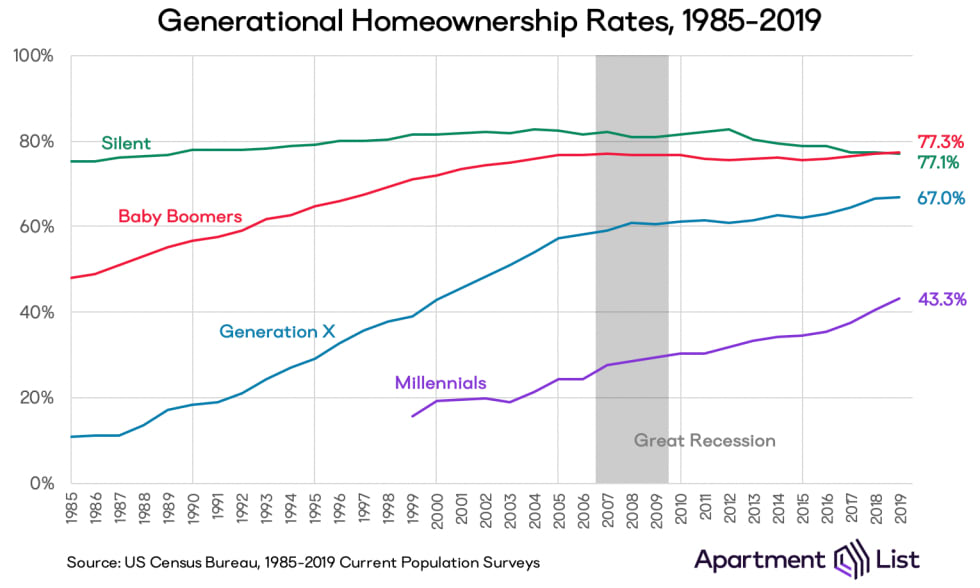
https://ercouncil.org/2018/chart-of-the-week-week-46/
For those a bit challenged, here’s a list of high income east eu countries:
https://en.wikipedia.org/wiki/World_Bank_high-income_economy
If you managed to fix a housing crisis, the only way of doing so is torpedoing retiree financial assets (mix of personal home equity and pension fund), which would shortly cause an increase in entitlement transfers to sustain retiree standards of living. The only way to ease the combined tax and rent-seeking load on younger workers is to reduce the total transfer to non-workers, and the political balance of power forbids this, so things will remain fucked.
The reality is that housing is the main mechanism used by the older wealthy folk for their pensions, and subsequently transfers wealth up through the generations.
What we need is a way for all that unproductive capital used to directly fund the businesses of the young, growing the real economy (rather than the financial).
Alongside that, additional legislative arrangements to provide security for renters.
Pension pots should be a return on investment, not speculation.
You're conflating financial "capital" with real productive capital here. In real terms, non-productive financial assets simply do not matter; whether landlords extract a billion or a trillion dollars makes not a whit of difference in the real goods and services the economy produces.
If you redirect financial assets from bidding up the value of housing to bidding up the value of small businesses, you've simply moved the siphon from cost of rent to the cost of owning your own business and/or suppressing wages.
I see at least two kind of schools on housing, one who talk about cheapness, typically from USA, Japan and few others. Another who talk about forever and ever duration, typically from south EU. Both have reasons and both to the extreme prove to be a disaster:
- in the JP/USA model a simple strong wind or a flood (from EU perspective) suffice to demolish houses, making big damages etc
- in the southern EU model houses are VERY old, they do not respond then to current needs and evolve them being not design to do so is a nightmare
Some countries choose the "division" model, like almost in the entire north-America with their residential-only suburbs, some mix at unbearable high density. Both models prove to be disastrous: the suburb model impose too much travel and being tied to some "district" nearby became a graveyard when the district change; too dense southern EU and Asian cities suffer the opposite issue: little travel is needed but things are so concentrated that there is no room to evolve.
Old Romans have a proverb: in medio stat virtus, "in the mean live the virtue", and I think that's well valid for housing... Too much dense => fail. Too little dense? Fail as well. Too diversified => fails, too much scaling issues. Too subdivided? => fails can't survive for long. Unfortunately evolving from a model to another, no matter if the change is good or bad, take MUCH, MUCH, MUCH time. Around homes we need infrastructures, like roads, aqueducts, power lines, TLCs, ... building a single home might be quick and easy BUT change the infra around normally is not. We still do not have the '30s dream of flying homes or semi-autonomous starships that can be moved easily everywhere... So far we do not even have flying cars (while they might be there technically)...
That's not much tied to richness: poorest countries have their housing issues as well, just in different terms. It's tied to the lack of Star Trek alike replicators and tech. Something that's not on the horizon nor for the rich nor for the poor. Is something we can and should tend to, but knowing it's far away.
Undertaxation is at the root of investment bubbles.
Accumulating economic energy devouring the containment of the system that created it, as at the root of the root of the rootproblem.
We need a dependency manager for discussion topics.
For most of us poors, money is a tool we need to survive. For the people who have the bulk of it, it's a weapon. And we're the targets. They love blowing us up; it's what they do. They care more about making others suffer than the material comforts (to which hedonic adaptation accrues quick) money affords. Putting the few "good jobs", the few jobs that offer us even a sliver of a chance (like 1%, but we're expected to work as if it were 95%) of being something more than an exploited worker, in congested and dysfunctional expensive cities is something they do because it's hilarious to them.
Barring a complete and final overthrow of corporate capitalism, you can't escape this crapsack world. The important land is already owned by reptilian shitasses. Billions of people are going without drinking water while a bunch of psychopaths fly around in private jets, destroying the planet because they find it comical.
> since the second world war, governments across the rich world have made three big mistakes. They have made it too difficult to build the accommodation that their populations require; they have created unwise economic incentives for households to funnel more money into the housing market; and they have failed to design a regulatory infrastructure to constrain housing bubbles.
The monotonic rise in the cost of housing is because of speculation. But this speculation is "legitimate" capitalism. The corpocracy certainly discourages the leftist notion of limiting capitalism.
> Housing is also a big reason why many people across the rich world feel that the economy does not work for them.
Housing is one of the reasons. Food, healthcare, and the environment are other reasons.
No, nothing changed, if anything it got worst post covid. The only countries that can do something are singapore and china, who are rationally treating housing as a basic need similar to food. In the western world things will probably never change on that front. The boomers built houses because they knew they d be appreciating forever - and they did, beyond their wildest dreams, while the economists were cheering. Millenials and GenZ will not touch housing because it's not an opportunity, and the barrier to entry is too high. Instead of housing bubbles, GenZ creates meme stock and crypto bubbles, and whatever comes next with the metaverse. Housing is very broken in europe, germans are building houses in the south where it's still cheap for their retirement. The housing stock will keep consolidating to fewer and fewer people, while the middle class will be using remote work for location arbitrage.
So why are people in China paying hefty loans for apartments that haven’t even been constructed yet? And now due to the housing bubble popping, construction has halted in so many parts of China that there is an epidemic of Chinese people who are refusing to pay their mortgages, and banks are refusing to let go of people’s money because fractional-reserve banking. China sure do have a serious housing crisis that’s arguably worse than that of the west.
No it isn't. Mortgages are not the only kind of fractional reserve banking. The currency is also fiat, its backed by the market's belief in the strength of the US government and economy. Gold back currencies also had pricing shocks, inflation/deflation and a myriad of other weird issues.
You're parroting the least informed version of Austrian Economics.
The mid century boom in housing is almost certainly a direct product of the inflationary and easy credit economy that was created by loosening the gold standard.
All of these trendy YIMBY schemes are great. All they need is a proviso requiring all the targets of the schemes to stick around while their neighborhoods and schools go downhill.
Let's just sit back and see how it plays out.
When houses and new developments get snatched up by investors and landlords as buy-to-lets (or even by Blackrock and pension funds), there is little outrage and calls for restricting who can buy them. The same argument is rehashed over and over and over again. Just build more houses!
I feel that there is a disconnect between these two schools of thought. I personally believe that, while indeed more houses should be built, we should also have a serious discussion about whether houses should be sold en-masse to very wealthy investors
Separately, GPU scalping is (was) only happening because of cryptocurrency booms which everyone knew were temporary. Not many people are naive enough to scream for AMD or NVIDIA to spend billions of dollars on new fabs because of a temporary trend. The housing supply issues, on the other hand, have been brewing for decades and are not temporary.
Hahahah look at this guy!
Bet you never tried to get a permit for home construction? Shit can take YEARS in most states/countries. Even worse if you dare suggest to make apartment complexes. N I M B Y
Population is the problem.
This is because the 'rich' people countries are having a population explosion despite the native 'rich' people havong a negative birth rate.
You can do the math as to why.
Housing has never been this much of a problem up until the past decade or two.
This is certainly untrue. Possibly housing has never been this particular problem in this particular place. Housing affordability plagued Germany of the early 20th century. Low quality housing of the type not possible to obtain in the US was widespread in US cities before the last 50-70 years.
>Population is the problem.
Misanthropic nonsense. Show us your 'math', if you're so sure of yourself. And better yet, state your underlying assumptions for all to see.
>This is because the 'rich' people countries are having a population explosion despite the native 'rich' people havong a negative birth rate.
Can you list these rich countries with 'population explosion[s]'? Population growth rate in the US is at its lowest since 1960 (start of the readily available data.) Considering the shift of the population toward the elderly in the rich welfare states like the US, we actually have a reckoning coming from too few working age people.
You gotta reach back to over a hundred years ago to find an example?
> Can you list these rich countries with 'population explosion[s]'?
What the hell are you talking about?
The population in the US is the highest it's been in history.
You're using a bullshit metric like growth rate which is a percentage of constantly increasing number? 1% of 100 is the same as 50% of 2. Of course the growth rate goes down as the population goes up.
The natives to the country have a declining birthrate. This is the responsible thing to do.
This decreases the population and returns the US to a stable population density.
If the US wasn't flooding the country with over a million non-natives every year both population AND housing would stabilize and NOT be a problem.
Population is the issue or more specifically non-native population.
There is a kind of home that can float anywhere though, I'm quite far long in my plans to move onto a sailing yacht. While my main motivation is a lifelong love of sailing and a desire for a nomadic lifestyle, I'd be lying if I said a small part of my motivation wasn't that shovelling money hand-over-fist into keeping a boat I own seaworthy is much more satisfying than shovelling money hand-over-fist into some random baby boomer's BTL portfolio every month!
You need fresh water and the cheap way to get is is from land, so you need land infra anyway, you also need food and you can't produce it locally, yes you can fish, but you do not live well ONLY on fish and some algae... Beside that logistics is a nightmare.
Long story short: FEW can live, perhaps even very well for some of them, on boats, but only if most others do not. That's an important issue too many forget even when they speak about Green New Deal: yes, we live in homes. We might WFH. BUT we also need factories, hospitals, schools, they are mandatory to live well and they need to be counted in the game: we need to sustain them as well. We need workers and they need a life as well. That's not much "housing problem" but is tied because we need a home to live BUT we also need to be physically nearby something else to do so as well. The dream of an autonomous home is not much different than the dream of an autonomous house-boat or starship or house-truck, house-airplane etc we can made "relatively autonomous" homes, tucks, ships, airplanes, ... where relatively means "you are free to live in in comfort FOR A LIMITED PERIOD OF TIME until something breaks, for instance, and such "things" can exists for you just because there is a complex industrial and social system behind. We still miss the 3D printer able to print itself...
That's the real issue... We are able to reproduce ourselves only with our body (well, if we can keep alive in nature) but we can't do the same for anything we build...
Not really.
Let's set up a quick boundary condition. Since you mentioned most people, you're talking about the lower-middle and middle classes. Let's keep the discussion on them. The working poor have it bad almost everywhere, and I think we both agree that there's more that can be done in most countries to support them.
For someone with a median household income, it's still very much possible to finding housing that is less than 25-30% of their household income. This is true even in high cost of living (HCOL) areas. Now, there are some cities or sections of cities that are unaffordable for someone with a median income, but these are very much the exceptions.
To put it simply, if you have a median household income for your country, in almost all locations in almost all OECD countries, you earn enough to follow a household budget that allows you to save 15-20% of your take home pay. If you can't save a portion of your income and you're not living off of a below-average wage, it's very likely that you either made decisions that aren't conducive to saving (e.g., you're house poor, car poor, or your discretionary spending is too high).
> along with healthcare in the US
Quality health care is expensive in most countries. The US has its own set of issues that make health care more expensive than in most other countries (e.g., population density), but it's not orders of magnitude higher. It's also offset by the higher salaries that people in the US earn over, say, the average EU state.
The ONLY way to prevent this is to either stop offering loans or force savings in some way (taxes, etc). But apparently both those options are off the books.
It is about 2-3x higher, which is not an order of magnitude, but is less than an order of magnitude away from being an order of magnitude.
Not, in any way, comforting unless our outcomes are 2-3x better, which they are not.
It's really not, at least when you compare OECD countries with one another.
For instance, per capita healthcare spending in the US is 11.4K. The OECD average is around 5.7K
Now, there are a lot of reasons for this gap:
1. Salaries are higher in the US. Health care workers are much better compensated there than, say, in France or Spain.
2. The US has a much lower population density. There are a lot of fixed costs with health care. There are real cost advantages to having a large majority of your population in dense urban areas.
3. The US is first to market/first to adoption for a lot of medical innovation. The R&D costs for anything health care related are enormous. Early adopters bear the brunt of these costs.
4. The US has a hybrid health care model. The two countries that use this model, the US and Switzerland, are one and three respectively for per capita health care spending.
Also there is the fact that much of the urban West had been destroyed in the incredibly brutal fighting of WWI, the Russian Civil War and WWII which left as many as 7 million unhoused orphans alone. With these considerations it's not as easy to ascribe the lack of housing to the Soviet political economy. Remember, the Soviet Union didn't get a Marshall plan like Europe.
The housing projects under the post Stalin premiers eventually mitigated much of the problem but there appear to have been chronically homeless still that were largely jailed (an outcome ironically similar to what we see in the U.S.).
Having the have it alls at gunpoint, forced to demonstrate the systems fitness & benefits to the citizens or perish. Which is why there needs to be a elphant graveyard clause in tax-law, that destroys all monopolies via taxation.
https://www.statista.com/statistics/1249206/us-ussr-comparis...
Also it's not necessarily correct to say you require land-based infrastructure; you can be somewhat independent from the shore for long periods on a sailing boat since people do ocean crossings all the time, you obviously don't need fuel for propulsion, you can generate electricity with various renewables like solar, wind, and the boat's motion through the water under sail, and your water supply comes from the sea via a reverse osmosis machine. Provided nothing breaks beyond your ability to repair it you're effectively limited only by what food you can carry.
There's absolutely an argument here that rents, as a basic dead-weight cost of all people within a society, don't affect the real economy or productivity.
This could be true, but only if the access to finance is distributed across society relatively equally, with a positive effect on productivity. My understanding of, at least in the UK, is that it's not.
The relationship between financial capital and other forms is lossy at the moment — the purpose of financial capital is the creation of new goods and services, and we've spent 40-odd years making sure it goes largely into something that already exists (housing).
In that process, funding for new stuff, for non-rent economic activity, hasn't been properly funded.
This is how the system is actually designed. Social security is a mandatory annuity/savings and disability insurance program. Many countries also have mandatory contributions into their 401K (OECD Pillar 2) equivalents.
Even in the US, where these contributions are mandatory, the tax code is set up to make them extremely desirable for the employer and the employee.
> loans for everything is standard now
Stopping this would be as simple as having an indebtedness line added to the tax code. In many countries, there is a maximum level of debt that a person is allowed to carry. Companies aren't allowed to issue new debt if the repayment for all of their current debt exceeds some percentage of their income.
But you're right, there's no political will to do anything like this since consumer debt helps to fuel the economy.
Henry Ford wasn't a good person. He was a rabid antisemite. But even he knew that he wouldn't be able to sell cars indefinitely if people couldn't afford to buy them, so he raised wages. The bosses, as a class, no longer have to do this. They can make enough fake money out of debt to keep their businesses alive. So that's what they're doing.
All this means we get artificial mediocre prosperity that is contingent on their piles of money getting bigger (i.e., all economic growth, meager as it has been, goes to them). And we know that they are willing to crash everything (or, to give an example that has actually happened, make lots of people sick with Covid-19) to keep themselves in charge and their piles of money growing bigger.
If the consumer debt game ended for some reason, the whole system would collapse immediately.
There's an economic analysis trick that can cut through a hell of a lot of cruft and confusing abstraction - whatever happens with the dollars and financial instruments you ignore, and you take a pure look at the real goods and services involved. In these terms, the landlord/tenant relationship looks like "some guy makes a bunch of widgets and only uses some of them, selling the rest for rent money. The rent money can be used to buy those widgets, letting the landlord consume that many widgets without physically making them. Generalize this about generic 'stuff' instead of just widgets."
This is what bothers me about your suggestion to redirect money from non-rent economic activity. How do you want to redirect the widget consumption to make the actual physical changes necessary to have additional productive economic activity? Do you want to apply the squeeze to landlord, tenants, or both? And again, I'm not asking where the money comes from because it's completely irrelevant to this analysis: a more productive set of businesses will require more machinery, warehouses, etc. The labor and material used for these come at the expense of making other stuff, and this physical investment of real goods and services is someone's stuff that they made without consuming.
Like, the lack of an answer to this question is really what makes me think this solution is wishful thinking. There's many answers to the question of who gets squeezed in terms of real consumption, but with very different consequences:
1) Nobody gets squeezed. Workers produce and consume the same, there's the same amount of real businesses, and the same amount of non-worker consumption. The difference is something like "instead of your job paying $4000/mo (after tax) while rent is $2000/mo, now your job pays $3000/mo and rent is $1000/mo". You still have the same excess production over consumption, but more of it gets siphoned off by your employer instead of your landlord.
2) Landlords get squeezed. Rents might get reduced, but this isn't necessary - what matters is landlord consumption goes down. If rents are lower, then workers have excess consumption available, but they forgo it in favor of productive investments in new businesses. If rents don't go down, then landlords forgo this consumption in favor of productive investments in new businesses. Either way, it's landlord consumption that is reduced, the only thing that changes is the nominal owner of these businesses.
3) Workers get squeezed. Rents might or might not change, again, and it's only relevant for who the on-paper owner of these new businesses are. If rent is the same, then workers have to save more and forgo more consumption to make the businesses exists. If rents change to finance this, then they go up so that landlords can build businesses without reducing their consumption.
4) Mix-and-match between the effects of various changes. You can literally get all three of the previous situations simultaneously - businesses get better at underpaying employees for their owners' benefit, landlords consume somewhat less, and workers also consume less, all while rents do anything.
In summary, allocating more investment into non-rent economic activity requires someone to not consume the real goods and services that go into making these businesses. It's some combination of the renter and the landlord depriving themselves of consumption, and if neither consumer budgets on the question then you've merely changed the financial description for why identical real transfers are happening.
> whatever happens with the dollars and financial instruments you ignore, and you take a pure look at the real goods and services involved
The trick of forgetting about money altogether in definitions of wealth is incredibly useful. It's definitely an idea we're missing today, when we're surrounded by ideas of wealth being primarily measured in currency, I think, but you're mostly right in that economics is the art of redirecting real resources in the real world.
There's a nice history to the idea too, where theorists as broad as the Georgists, who discount finance (and land) in their definition of wealth [0]; or Ricardo, who used it as a basis for Metallism from a perspective of a (mostly) labour theory of value.
If any reprioritisation of mortgage or buy-to-let finance ever happens, as you've rightly described, there will be various squeezes and reallocations of consumption and production. But what I think you're underestimating is that other configurations of the economy can be more (or less) productive than this one, even given the same amount of labour, energy, and resource.
> How do you want to redirect the widget consumption to make the actual physical changes necessary to have additional productive economic activity? Do you want to apply the squeeze to landlord, tenants, or both?
If you're solely talking about physical widget consumption, I don't think our current arrangement is particularly efficient. In the UK at least, new dwellings have mostly kept pace with population increases — we've got more bedrooms per capita than we've ever had in aggregate. Even so, there's still been a reduction in availability of rental properties and ownership for vast swathes of the population, notwithstanding the increases in homelessness and housing insecurity, with all of the stress and inefficiency that creates. Tenants (and prospective buyers who are attempting to save huge deposits) are also likely to consume the least, so we could theoretically redirect that consumption into other pursuits.
If we flip that around and talk about misallocation of widget production, there are very real resources today that are ultimately directed into purely financial returns, that could otherwise be directed in more productive, wealth-creating opportunities.
That's everything from:
– Landlords who would otherwise be working to produce goods and services, alongside all of the legal, retail, and management support they receive.
– Builders, architects, and project managers who are working to extract more of their tenant's labour, by badly refitting existing dwellings into flat shares, HMOs, rather than building new towns and cities.
– Financial institutions spending much of their time and energy on creating financial returns above increasing the real wealth of society.
– Tenants, who may otherwise be able to invest in other productive activities.
– People currently working in other industries, which may or may not be particularly useful to society (I have my list of favourites…), who may switch to a productive one.
– Speculative land investments from builders, who are using real energy to devise and capture the inflation created from QE, alongside various demand-side reforms like Help to Buy.
From a macro perspective, around 70+% of new money created in the UK goes into existing housing stock, and is mostly inflationary. We appear to have stumbled into a system where this financial inflation is captured by some and not by others, leading directly to inequality and the misallocation of real wealth.
[0] https://oll.libertyfund.org/title/george-progress-and-povert...
https://www.sfgate.com/bayarea/article/how-many-vacant-homes...
https://sfist.com/2022/02/01/report-10-of-san-franciscos-hou...
Next, the housing shortages in other previously-afforded cities are being bought up by... other Americans, some moving from such expensive metros. That boom that happened during the pandemic might finally be reversing:
https://fortune.com/2022/08/16/bubbly-housing-markets-are-sh...
Just the worlds entire populations wants to be in a small part of the world America or Europe for some reason.
Which isn't sustainable and is destabilizing those places.
The ultimate solution is to make other places desirable to live, which is confusing because the US and Europe are only a small portion of the worlds landmass.
The reason the laws are needed is because the land is being overrun by people.
Lifting the laws ruins someones neighborhood, keeping the laws makes it unaffordable to live there.
The solution is just to have less people who want the land.
>You gotta reach back to over a hundred years ago to find an example?
So, by 'never', you meant somewhere around 60 years? 75 years? I ask because you discount my 80 year-old example (chosen by availability because I'm reading an interesting book on the economics of Nazi Germany right now) as if it couldn't possibly be relevant because it's so long ago, while appealing to 'never' to attempt a weighty claim.
>The population in the US is the highest it's been in history.
And I hope that will continue, though things look bleak in that regard.
>You're using a bullshit metric like growth rate which is a percentage of constantly increasing number? 1% of 100 is the same as 50% of 2. Of course the growth rate goes down as the population goes up.
Yes, I'm using a percentage term for growth rate because it is appropriate for the comparison, unless you believe in some immutable constant carrying capacity for the US. Adding 1 million people to 10 million is not remotely similar to adding a million to 330 million, but that's the version you're arguing for.
>The natives to the country have a declining birthrate. This is the responsible thing to do.
Responsible to what? It's suicide by an entire species, not to mention dooming your descendants to lower standards of living as the viability of specialization gradually decays.
I'm out of time to respond to this comment, but your remaining points are equally in need of correction.
I suspect you hope that continues because it benefits you and your agenda. Not because it's what's best for a country.
If you don't understand basic science like carrying capacity of an area and stable population density...and how population's expand and contract to meet that stable density...if left without interference...then yeah, you're not going to understand my point.
I suspect you have an agenda so it's not a productive conversation.
Things will never get better in their original countries if everyone want's to go to a few very small parts of the world.
And things will eventually be undesirable in the places everyone is trying to immigrate to.
Whatever happened with staying in one place and making it better?
Getting rid of the line turns both sides into places of poverty and oppression.
Make the bad side of the line better.
Take some investment property. You buy it at some basis price, let's say 500k. You rent it out for 15k a year. Each year you can offset your rental income against deprecation of the property and property taxes - meaning, you pay no income tax on your rental income.
~30 years later, you've deprecated it down to an effective value of $0, so you hypothetically would have to start paying taxes on your rental income(of course, you can still deduct property taxes against that). What do you do? Well, there's something called a 1031 exchange - this lets you sell an investment property, and as long as the funds go directly into another investment property, you pay no capital gains taxes. So guess what? You can buy a brand new investment property with a new(albeit adjusted) cost basis, and you can start the entire cycle of depreciation and deduction all over again on your new, more expensive, property.
So, you've now held this property your entire life, and you die and pass it to your kids - well, great news, unless your estate is over 12 million dollars(and double that for a married couple), you pay no estate taxes. And even more fun - when you inherit property, the cost basis is "reset" to the present day value of the property at time of inheritance - So your children can now rent the property out, deprecate it, and pay no income tax on the rental income either, and continue the cycle.
The net result is that rental properties generate a ton of income for the owners, who pay almost nothing in taxes. Even if they do pay property tax, property tax rates are generally much lower than income tax rates.
And flipping to more and more expensive properties through 1031s requires more and more capital and only makes it cover less taxes. There's no tax benefits versus just keeping the first property and paying all the taxes and buying a separate property to depreciate.
If you sell a $500k property earning $40k/year where the depreciation covered 45% of your income, and you buy a $1 million property earning $80k/year, you get a new $500k to depreciate $18k/year. Then the depreciation only covers 22% of your income.
Depreciation is very fundamental to business tax law. I'm not sure how you'd "fix" that without penalizing non-rental companies for expanding.
So you buy the $500k property with $125k in cash and a $375k mortgage (25-30% down is typical for investment mortgages). Depreciation *plus mortgage interest expense* leads you to (for tax purposes) more or less break even on this investment after 10 years and so you pay no tax.
After those 10 years are up, you've now paid off around $68k of the principal, plus the asset has gained $250k in value. So from your initial $125k of capital invested, you now have ~$400k in capital that you can leverage into a $1.6M property in a 1031 exchange. That bigger loan comes with a much larger mortgage interest expense, so you continue to earn no taxable income while growing a larger and larger asset and taking a (relatively modest) cash-on-cash return.
If I can invest in real estate, rent it out for decades, and then sell it at a significant profit (which seems to be the case in many in-demand cities), then why should _any_ amount of that rental income get a to be balanced against imaginary depreciation?
The land beneath a building does not deprecate, whereas the value of the building should.
Since for most properties the majority of the value is in the land itself, your basis to deprecate would be much lower, and more realistic.
A land value tax would be a pretty straight forward solution to most of the issues around this.
You can fix it by only deprecating the original cost. A person who buys a 50 year old house shouldn't be able to depreciate a second time, (then next owner again)
This is a leveraged investment (meaning you have a mortage). What that means is for your 20% down payment (the actual money you invest), that 3.7% writeoff on income can be an 18.5% cash on cash yield (ROI) in which you pay no taxes, ever. Few properties on the market can get you a better yield than that. If your ultimate yield is less than that you can roll those losses over year over year, so that then later if/when you get more yield you still* don't have to pay any taxes. It's a really big tax loophole and is the reason Donald Trump pays almost nothing in taxes (and he admitted as much in the presidential debate).
*I own 3 properties in buffalo, one of the best rent to value markets in the US, and it's hard to find better yield than that even in that market. https://simplepassivecashflow.com/rv/
The other stuff (depreciation, 1031 exchange) are very sensible accounting. Depreciation applies only to the improvements (buildings) on the land, not the value of the land itself. This reflects genuine loss of value over time (buildings wear out). And in the event that you sell the property at a profit down the road, you have to pay back all that tax savings at higher regular income rates (not lower capital gains rates). This is called "depreciation recapture." So depreciation can defer taxes, but not eliminate them.
Likewise, when you do a 1031 exchange, your new property ends up with a lower cost basis based on the previous property, so that when you later sell it you still have to pay all that capital gains tax and depreciation recapture. It defers but does not reduce or eliminate taxes.
Of course - if you die while holding these properties, then your heirs get the cost basis reset ("stepped up"), which does indeed eliminate all these taxes. This is what we need to fix.
Why is that a problem?
Banks are also much more forgiving when it comes to down-payment, when they know it's going to be a rental, and you already have other rentals as collateral.
In essence, purchasing a rental unit with only 1%-5% down payment up-front, is kind of like purchasing stocks with 20x - 100x leverage. As long as you meet your mortgage payments, get steady rent, and don't get any crazy expenses - you're sitting on a goldmine.
Some of the guys I went to school with did just that. Bought a rental unit, while working. All their salary went toward down-payment of the next unit, and the banks were very forgiving when it came to new loans. After 10 years they had a nice portfolio of rentals, which they then sold to typical real-estate investment funds.
I don't think that's true. The interest rate on your loan will be more expensive if it's an investment property and the LTV requirements are more strict.
And if you're lying to the bank by saying it's a residence when it's meant for rental -- you've just committed fraud (it's one of the clauses in your mortgage).
Then I sold for cash (a pretty big no-no in terms of real estate investing) because I didn't enjoy such a concentrated risk.
When I sold, there's something called depreciation recapture. If the 27.5 year depreciation thing was used to offset your income taxes, part of your gains gets taxed as ordinary income. The cost basis of property is also lowered so that the capital gains is higher.
There's also tax trick called cost segregation that lets you depreciate certain parts of your property at an accelerated rate.
Basically, as the OP says, keep doing the 1031 exchange until you're dead and your heirs don't have to worry about depreciation recapture.
And are losing value on the property, which is the point of depreciation.
>~30 years later, you've deprecated it down to an effective value of $0
An no one will now rent, since your building has an effective value of $0 since it has become crap.
All throughout your list you ignore all the costs involved in being a landlord. Have any friends that have tried it? (I do). Did they become silly rich? Or did they quit because it is a major problem to actually make it very profitable versus other uses of capital and time? I'm a decently saavy investor (in many things), and have watched multiple friends start up rental properties, only to stop once it became clear that tenants destroy things, costs to maintain properties are volatile and astronomical, the work required is significant, and so on.
I have done the math on real estate investing many times, and each time have decided the returns are not worth it.
>The net result is that rental properties generate a ton of income for the owners
If it were so profitable, then tons of capital currently being spent on other uses (tech, medical, finance) would instead go into buying up more housing. But the fact is that being a landlord is not very profitable, so capital doesn't flood into that market - it is still mostly elsewhere.
Historically, housing has performed quite similar to the stock market for returns - as it should be. If housing were a better investment, money would flow in until they balanced. If housing is too poor an investment by screwing with taxes, then money will flow out into other more productive places. And if money flows out, people wanting housing will then have to pay even higher prices for less stock.
I'm sorry but this flies in the face of my experience. Most landlords I have met buy properties and then outsource their administration to property management companies. I have never seen or spoken to my last three landlords, none of whom lived anywhere near the same city as the property.
Landlordism is parasitic in the literal sense of the word. Landlords get rent and capital appreciation for doing nothing but possessing an ownership title. The propertyless pay the propertied a premium to live.
In light of both those observations, I would say any enrichment in this case is "silly", and that landlords don't tend to do much - or any - work.
>"If it were so profitable, then tons of capital currently being spent on other uses (tech, medical, finance) would instead go into buying up more housing."
This is a non sequitur. If X is profitable and the market knows X is profitable then it should, in theory, be attracting exactly the amount of capital it merits already. In the UK, where I live, the rental sector has exploded, jumping from 2.8 million households in 2007 to 4.5 million in 2017. [1]
[1] https://www.ons.gov.uk/economy/inflationandpriceindices/arti...
>An no one will now rent, since your building has an effective value of $0 since it has become crap.
Are you really in good faith trying to argue that nobody will rent a house that is 30+ years old?
The house depreciates while the land appreciates. In the US for the last 50 years has been net appreciation for most homes.
> If it were so profitable, then tons of capital currently being spent on other uses (tech, medical, finance) would instead go into buying up more housing.
Hedge funds have been buying houses at scale since the great recession.
> Historically, housing has performed quite similar to the stock market for returns
Which increases faster than incomes. Hence the way each generation has a declining rate of home ownership.
This isn't true. You will have put money into the property to keep its value up, also writing off all of those expenses, so that you can still rent it out.
Or/and just refuse to pay rent for years while you try to evict them.
Regarding the cost basis rest that is so people can upgrade their house without having to pay a tax bill. This is just deferring the tax not avoiding it. Without this it would be much harder to get a bigger house once you have kids. Most people would have a harder time moving and removing this would lower our quality of life.
so if they can't afford to pay tax on the windfall, they'd have to sell the house and buy a smaller one. is that the end of the world?
> Regarding the cost basis rest that is so people can upgrade their house without having to pay a tax bill
what they have in many european countries is that you can do this only on your primary residence. so you let people upgrade their homes, but not their rental properties
You're saying this as if the example is a cherrypicked outlier rather than ubiquitous.
> If people had to pay inheritance tax on their family home, how many could not afford such a tax bill and would have to get rid of their family home to please the tax man.
At some point in the value of a home, we're not really worried about that. We do not sympathize when someone can't keep their parent's $50 million dollar home tax-free. We've set that cap at around $12 million. It's a very high cap.
edit: we're happy to grab the estates of working people who end their lives in intensive care, nursing homes and hospices, before the Medicare kicks in.
I think it's fine to allow this treatment for a home used as a primary residence for the exact reasons you mention, but I don't understand the logic of allowing it for an investment property
If the goal is to help people consume more of <x>, then give them cash.
Giving assistance via tax rules is a way to discriminate who gets to benefit from government subsidized while maintaining plausible deniability. It also helps obfuscate the costs.
If your family is leaving you a house worth more than $12 million, you can afford to pay the tax man.
This is absolutely normal in the rest of the world, and there's nothing wrong with it. People don't go bankrupt over inherited property. The tax-free inheritance part is also ridiculous, in my humble opinion inheritance should be fully taxed.
a tax per square feet on residential properties where the owner doesn't live in for more than half a year, irregardless of wheter it's rented out or not, and independent from the tax from rent income. since "promoting good behaviour" trough taxation didn't work the last idk 50 years, it's time to be back to "punish bad behaviour"
Inherit the cost basis.
I'm speaking as someone who put all his retirement savings into index funds year after year, but then married someone whose job is related to real estate. Real estate feels more concrete and understandable to her than finance, so that's where our money goes now.
It's not easy free money, and I don't know why you would think that any high-profile, low-barrier-to-entry investment would be easy free money. Half of my friends have either bought property or are constantly talking about it. My friends are part of a horde of first-timers who believe, like you, that it's easy free money, and their belief inflates prices.
And that's not just my amateur opinion: my wife and I sit in on a developer happy hour where experienced developers constantly bemoan that they haven't been able to work with certain types of property in years, because they get outbid by naive first-time buyers who don't have a plan for making money other than betting on the market going endlessly up. People who are looking for income rather than appreciation are not seeing opportunities at the current prices.
Thanks to my wife managing our properties herself and having a lot of applicable skills from her profession, we manage to make some money, but every hour she spends managing property is an hour less (or two, really) that she can bill her clients. I doubt that if we adjusted for that it would work out to be a wise use of time. It's work she enjoys and finds satisfying, so we don't look that closely at whether her time (or our money) would be more profitably invested elsewhere, but I'm certainly not quitting my software development job to double our commitment to real estate.
I'm in Austin, one of the hottest markets in the country, so in the end, it's possible that everyone regardless of how naive they are will be rewarded by continued appreciation. Income from real estate hasn't been a game-changing multiplier for us, but appreciation might be. Or not. That aspect of it is just a gamble.
I mean that's fine, it's legal. But if that's the goal of real-estate, then of course it will never be affordable to the next generations. Everyone wants to do what you are doing.
It's free money in the sense that you are getting paid for having had the money to buy the property. Your wife might be putting in the time, but she is not more expert than 90% of people who could live there and maintain the property just as well (assuming they didn't have to pay you rent and the police didn't come to enforce your "property rights").
And yes, that means the stock market is also free money.
I spend a max of an hour a month on average on property management. Find good tenants (reduce the rent if you have to). On average my tenants have had 3+ year leases with minimal management.
Why aren't estates just taxed as income to the entity who it goes to? If my father croaks and leaves me $1m it should count as an additional $1m of income to me that year.
If it is $1m in property value, do you count that as still $1m of income? If so unless the child is in great financial situation with a lot of already liquid cash, they would be forced to sell part/all of the property to pay the taxes.
If a parent croaks and has a small business, mom and pop style. How would that be handled? If they had a small corner store making 100k/profit but has no assets vs a shop that sells very expensive equipment making 100k/yr in profit. But has hundreds of thousand in assets that would pass down.
Amounts over 12M are indeed taxed twice.
If you lower the taxes on rental income, more people will buy houses (and build new ones!) to take advantage of the reduction in taxes. However, they will still have to rent the apartments/houses out at market prices. The rental price will go down because now there is a greater supply of houses, and renting out an apartment at a lower rent is equally profitable as before (since you don't have to pay as much in taxes).
The cost of purchasing a house, however will increase, because there are more landlords competing to purchase the house with you.
Overall, the real problem is zoning single family homes everywhere, and rent control that disincentivizes building new housing.
In short, if I buy the rental property for $10. Deprecate it to $0 over 27.5 years. Then Sell it for $20. I then haft to pay taxes on the sale of the profitable asset.
###### Depreciation recapture is a tax provision that allows the IRS to collect taxes on any profitable sale of an asset that the taxpayer had used to previously offset taxable income ######
https://www.investopedia.com/terms/d/depreciationrecapture.a....
Firstly, why does the government deserve to tax these transactions at all? These landlords are already taxed on their income from their jobs, pay property taxes, pay taxes on all the products they buy. The government is extracting plenty of wealth from its citizens, why on earth would we demand more of people just for being successful in real estate? Will the government put their money to better use than these people spending it themselves on products and services? I think anyone who engages with public sector projects and services knows that the government does not efficiently spend money.
Let's imagine a world where 1031 exchanges are banned. What happens? Wealthy investors no longer sell properties at the same rate. What's the point? If my apartment building is cash flowing every year, and I'm stuck paying a huge capital gain tax on the sale, I'll just hold it for life and enjoy the cash flow. The rate of real estate transactions would collapse overnight, killing all of the jobs connected to it from appraisers, to brokers, to investment firms and wealth advisors. Now, not only does the government get less tax revenue because overall real estate transactions and taxable events are diminishing, but there is less incentive to build new projects.
The appetite of 1031 exchange buyers is one of the driving factors in development of new commercial real estate projects in the market! The profit motive spurs growth. Look at the Opportunity Zone legislation of 2017, a once in a lifetime chance to defer and eliminate capital gains as long as you are investing those gain dollars into real estate development in blighted areas. This tax incentive alone has generated hundreds of thousands of new residential units on the market that would never have been built without the tax incentive. Taxing real estate more would only slow growth, if we want people to take the time, effort and risk to build more housing units in the US, we need to incentivize them with less taxes.. not more.
States are going to have to step in and override cities that aren't being effective, this cannot be solved from the federal level. They are going to have to say, these permitting processes are too restrictive, homeowners can add backyard units or convert their homes to duplexes/etc, and make it easy for apartment builders to buy a few homes to make small apartment complexes even if the neighborhood hates it or the city has been stalling on that kind of development.
===
Subject line: IMMENSELY AGAINST multifamily development!
I am writing this letter to communicate our IMMENSE objection to the creation of multifamily overlay zones in Atherton … Please IMMEDIATELY REMOVE all multifamily overlay zoning projects from the Housing Element which will be submitted to the state in July. They will MASSIVELY decrease our home values, the quality of life of ourselves and our neighbors and IMMENSELY increase the noise pollution and traffic.
<address>
4 Properties on <street>
===
Everyone economic freedom and deregulation, until it means more people living near them.
(From https://www.theatlantic.com/ideas/archive/2022/08/marc-andre...)
Even in the cities where the renter population is bigger than the homeowners, such as in Seattle, half of the votes come from people of > 65 years old (all of whom are homeowners, likely more than one home). Young people simply won't vote at all.
There is very little incentives for the young people to vote. Even if you cancel all the regulations right now and allow for unlimited constructions in the cities like Seattle, SF of NY, one will need about 10 years or longer to build enough apartments for the price to go back to affordable (which is 2-3 years salary of an average worker in the area). So the after-next generation will profit from the effort of the current renter generation.
Nevertheless, I think young generation needs to engage in the politics with the uncompromised goal to crush the housing price, to prevent the economic collapse of the "rich" world and prevent entire Earth from sliding into the dictatorship. Such is life.
Once you hit that bar, your job becomes buying up housing like it's a Monopoly board.
As an individual you can either choose to win or lose this game. We're not going to change it, at least not within our lifetimes.
1. A zoning rule that requires home owners to live in the owned home. This would prevent remote/foreign money from meddling with local housing in particular areas, and prevents big corps from buying up all the homes and forcing people to lease them out. Some people want to lease though, so that's why I think it's more appropriate as a zoning tool for particular areas than as a city or state-wide law. Maybe this could manifest as a leasing tax. (As an aside, in the US this wouldn't work for typical apartment buildings, however maybe we should consider apartment owning model like they have in Japan...)
2. Ban NDAs for real estate leases, period. They just allow for shenanigans like lying about how much a property was leased for in the past. NDAs are usually a cancer but I admit they can be useful in certain contexts; real estate is not a valid context for NDAs.
3. You can only deprecate the improved value, not the value of the land. "The land beneath a building does not deprecate, whereas the value of the building should." -- a good idea by huevosabio that I saw in this thread.
4. Owners pay taxes on the claimed lease value, regardless of current occupancy. This would disincentivize owners from just sitting on dozens of properties refusing to lease because nobody wants to pay their unrealistic exorbitant rates. This is a plague in New York at the moment, where all the owners are playing a game of chicken with the economy to try to artificially prop up their building valuations by pretending that the supply/demand curve doesn't exist even in the face of record breaking unoccupancy (is that a word?).
People forget that the average home was ~700 square feet 100 years ago. It's 2400 today. How many people would be willing to put a family of 4 or 5 in a 700 square foot home today? Go to old towns and look at some of the houses that are 100+ years old and 2400 square feet. You know who lived in those homes 100 years ago? Really rich people like lawyers and business execs and they had servants cooking and cleaning. Today that's just expected to be a home for a normal family.
We could change what we think a home is for most people but I don't think most people are willing to accept that the home they can afford is closer to a prefabricated trailer than it is a traditional single family home.
Even apartments are super expensive to build and the reason you don't see many dwellings that aren't "luxury" is because the cost to construct and maintain them is so high that you'd never get your money back otherwise.
The overarching issue is that housing (something everyone needs) is being treated as an asset class.
As an asset class people who own it want it to increase in price which gives the government an incentive to maintain and increase this value.
Unfortunately this makes it more and more expensive for people who need housing.
Decoupling housing from investment is the solution but it is politically unpalatable now given the state we are in.
That is the real problem. Everything else is just a symptom of it.
It always has been and likely always will be an assert class - it can be sold later so it's an asset.
For well over 100 years the inflation adjusted price of new housing has been a quite similar rate per sq foot, despite the quality and safety having increased many fold over that time.
I didn’t say it was an asset. The majority of physical things you purchase are assets.
I said it was an “asset class” in the financial use of the term.
“ An asset class is a grouping of investments that exhibit similar characteristics and are subject to the same laws and regulations.”
It is being treated as an asset class as opposed to say a service or a utility.
We need housing and clothing, but we don’t treat or normal clothing as an asset class. We buy it and use it, we don’t expect it to appreciate in value.
So clearly, the problem cannot simply be that housing is an asset.
Right now it looks like we may be about to witness something else: inflation is picking up, and if wages even just remotely track the increase in consumer prices (not assured ofc, but conceivable in a time of low unemployment), then those loans and their monthly instalments will actually make up a smaller proportion of household income (especially for those borrowers with fixed-rate loans).
Which is like 90% of US mortgages [0].
[0]: https://www.financialsamurai.com/adjustable-rate-mortgages-a....
If wages go up enough, then you keep the house you have with a low fixed 30 year mortgage (because the mortgage can’t be replaced), and buy another when you want to move.
America used to build new cities from scratch all the time up until WW2. This creates competition between cities (new entrants) resulting in better policies all around.
And the best part is it results in more empty land becoming valuable, enabling either dense or suburban housing as desired (hopefully making it non partisan).
Seems to me primary barrier today is there’s no unincorporated land left in the US, so let’s create a system for allowing new incorporations to emerge somehow!
Housing insecurity drains people's life energy. People can't take risks, learn new things, etc. The smallest mistake has them living on the streets. Hundreds of millions of potential scientists, artists, etc. that we loose because they can't afford giving up their minimum wage job and face homelessnes.
The article seems to be focused on politics, but I think it is not a political problem, it's a philosophical one, or even moral.
Speculating with housing should be seen as badly as speculating with water, too basic of a thing to play with, I'm not sure people that haven't experienced housing insecurity understand this.
Normally, there would be a negative feedback mechanism to push back against this- when people can't pay rent or mortgage, then the prices would go back down. But if inequality increases enough, and there's a lot of extra cash sloshing around in the economy to be pushed into real estate as an investment rather than as a place to live, the feedback path breaks down as you have investors buying homes to flip them or just have a place to park their money, and the people who actually need homes to live in suffer for it.
There needs to be serious reform but it won't happen because it's against the interests of the people with the power to do it.
The profit from owning land becomes whatever use you put the land to, instead of profiting just from owning it.
I could talk about Georgism for paragraphs, but this does a better job: https://astralcodexten.substack.com/p/your-book-review-progr...
- too many unoccupied apartments or offices, and secondary residences
- cars is at the root of the decision, and this leads to people living 30+km away from where they have to go daily, which is a big environmental issue
We should transition away from individual cars to light vehicles to solve the climate crisis, and we (the government) should also manage the housing crisis to help with that
It's crazy that anyone with stable income can walk into a bank and get a __30__ Year loan to buy a house, at below the cost of inflation. The only reason it's possible is because the federal government (Fannie Mae/Freddie Mac) extend an unconditional guarantee to purchase back loans at a certain interest rate as long as they "conform" with some requirements.
You can see this is true by looking up the cost of investment loans that are not subsidized - interest rates for commercial loans like this are 8-10% today and access is limited to those who have demonstrated competency in the "landlord business" over a long time... i.e., they look more like business loans than home loans.
The government subsidizes up to 10 loans per person. Idk why this was the limit (worth researching), but probably should reduce 2 active loans (allow people to move their primary residence). This would eliminate most of the subsidy and would significantly reduce the "just hold it for 10 years and get free leverage" angle of investing. At that point, people would have to pour money into interest, operate at cash-flow negative to speculate on future value, and suddenly, most would not be interested.
Get rid of 10 subsidized loans per person and the system will quickly start normalizing.
2. (Some) Tax Advantages:
Effective tax rates are lower - but not much. It looks better than it is because while much of the cash flow can be deducted, whatever cannot be deducted is taxed at marginal income levels, rather than capital gains. That literally more than doubles the tax rate for most people, washing out almost all of the interest rate/cost deduction advantage. Doing a 1031 exchange reduce deductibility of depreciation on the next property meaning the cash flow shows up there as taxable.
However, the cost-basis step up at death is crazy and should go.
"You will own nothing, and be happy."
Is that why I have gotten several phone calls over the last few months from people asking if I'm interested in selling my house, many saying they will pay above current market rates and in cash?
I'm not in a big city. I'm in a county with a population density of around 600/mi^2, where the biggest city population is 40k and second biggest is about half that. My house is a little bit outside a town that is only about 10k.
It's about an hour on a good day to commute from here to the nearest big city.
It's not a place I'd expect there to be a lot of interest in speculative house buying...but I'm getting the calls and can't think of what else they might be.
However, it won't change how much you pay/month for the property as people will pay whatever they can afford to per month to live where they want to. It's just more of that payment will go to interest. So yes, the list price will crater but the actual cost to buy the place will be the same.
The only person it really benefits is cash buyers which most people aren't. This could actually make homes less accessible to most people as their mortgage bid will never beat a cash bid.
The whole non-anglosphere world works like that, more or less. Why are people so afraid of it?
The ridiculous thing is that, since the SALT deduction cap went into effect (and so narrowly avoided the axe this past week, ugh), people who live in states with high property taxes end up being able to deduct only a small amount of their property taxes on their primary home, but if they own investment property, they can typically still deduct all of it -- and I believe they can deduct on their state taxes as well, whereas the SALT deduction is only available at the federal level.
They now have the added buffer of rental/leasing agencies! Many of these are fly-by-night and skirt or outright ignore inconvenient laws like renter's rights.
Repairs? Cost sink, just don't renew complaintant's lease. Bonus you get to raise the rent again!
Want to get in touch with the owner? Most times you'll have to look up tax records and hope it's actually in the owner's name.
Makes rental properties probably 90/10 profit/cost.
I know people on both sides of the equation and it's more than a little insane the entitlement some landlords feel.
That depends on how much you put as a down payment. Work backwards from the payment to make it sensible.
Imagine the alternative, where all the depreciation rules you describe above don’t exist, and landlords have to pay a bunch more tax. In that world, the government has some extra money in the coffers, but how does anyone else benefit? Rents will not go down because landlords have to pay more tax, in fact quite the opposite will happen.
Really, I get that you might have moral feelings of unfairness about it, but you are focusing on a minor aspect of the housing market that only has positive impact on rents by bringing them lower.
We should be doing the opposite.
if the government can print money, what's the point of collecting money through taxes?
There’s a really good argument to be made that taxes are actually a huge part of why dollars have a stable value.
Let’s say you buy a house for $1 million. 1% interest rate means you have to pay $10,000 every year to your local tax board. That means that you need to acquire US$10,000 or you lose your home. That means you need to earn USD. If the USD hyperinflated, 1% of your house is now $100,000. Now you need to go earn $100,000 and pay that in taxes — which is actually making dollars more in demand, countering inflation.
EDIT: Lots of propaganda in these comments painting individual homeownership as the cure for our housing crisis. It's not. It's the cause.
I disagree. The federal government invests enormous resources into subsidizing home ownership. Everything from Fannie Mae guaranteeing mortgages to not taxing home owners on the imputed value of rent.
And I think that's all well and good, home ownership has many positive externalities. But there's zero point subsidizing demand for something when supply in inelastic. In those cases subsidies don't result in expanded supply, only increased prices. For example even if diamonds are good, it wouldn't make sense for the government to match first time diamond buyers payment, because the supply of diamonds is inherently limited. All it would do is drive up prices.
Modest proposal: the federal government should revoke all of its housing subsidies in any municipality that restricts the supply of housing. San Francisco would be more than free to continue to block development. But if it chooses to do so, then San Francisco home owners should no longer be eligible for Fannie/Freddie mortgages, no longer be able to tax deduct mortgage interest, and should have to pay income tax on the imputed rental value of their home.
FM does not guarantee most mortgages, only certain govt types like FHA and VA loans, which the govt decided to back in order to help low income people get loans (otherwise the rates would be even higher for them).
FM buys up a lot of mortgages and sells them to investors, then turns around and puts the money back into productive use.
>taxing home owners on the imputed value of rent
What does this mean? You want to tax homeowners as if they paid themselves rent? (Which even then is net zero, so no tax...)
If you want people to pay income tax on the imputed rental value (which is likely not even legal - they are not getting an income from ownership - and courts have held income tax must be on sources of income), then you will increase the cost of home ownership, putting even further out of reach for most people.
>In those cases subsidies don't result in expanded supply, only increased prices.
Yet many places subsidies do result in new housing.....
Agree, but that also means cutting those subsidies will not affect supply either. Minimal impact and politically difficult...
People are not natural economists and will basically dig in to support the status quo until that status quo changes, at which point they'll support the new one. Americans, for example, buy new cars at an average new price of $40k and for most of my life accepted uncritically that the value of those cars would plummet the second they were driven off the lot. They did not lobby for supply restrictions that would prevent it. They didn't ask their politicians to prop up "car values." They didn't try to avoid it, at all. They just accepted it.
They would do the same with housing, if they weren't already conditioned not to.
There's a legitimate reason why a car immediately loses its value. People are more likely to sell cars that have something wrong with them. The market price for a car that you just drove off the lot is not the market price for an average car of that age, it's the market price for the subset of cars of that age that people want to sell. Because a car in that subset is more likely to have something wrong with it, its value is lower. Even if you personally are not selling the car because there's something wrong with it, it's hard for the buyer to know this.
If people had magic X-ray eyes that could tell that the car you just drove off the lot doesn't have more problems than an average new car, then its sale price would be similar to a new car. But they don't.
That's a pretty unrealistic comparison, housing doesn't hold its value (or go up) because people are conditioned, there are real reasons.
There is an effectively infinite supply of new cars, as factories can much more easily ramp up production if there's more demand. (Sure, recent supply chain issues have made that problematic, but in normal times.)
Second, cars do inherently depreciate faster. A ten year old house is basically brand new whereas a ten year old car is probably mechanically sound but cosmetically often looking its age and a lot of people like new and shiny.
Many people do not want to own a home, they would rather rent. Someone has to be the landlord for all those people, and to all those someones, the home is an investment. You can only get rid of homes as investments if you get rid of renting.
Investors buy around 10-20% (depending on quarter) of all new properties (and likely because they paid to build most of that share).
That's a far cry from 100%.
This motivation is backwards. Getting zoning restrictions around your house removed multiplies the value of that house. NIMBYism comes from places where people live. YIMBYism maximizes property values, although there's an element of blockbusting because overbuilding and a change in neighborhood character can make a neighborhood so unpleasant to live in that holdouts will end up selling cheap.
I'm not sure a lot of NIMBYism comes from the notion of protecting home values.
If a home were to be upzoned for apartments the underlying land value would rise significantly, and this would be a significant financial windfall for the home owner. They should want to see their land be upzoned for apts but that's not what we see.
I think NIMBYism derives from the desire for exclusivity. When ones home and surrounding homes are ultra low density you are guaranteed to have few neighbours. This is what is eliminated when homes are rezoned for apartments.
Housing was never an investment before recent decades, with an emphasis on the housing bubble. Housing tracked inflation for 400 years.
https://thegoldobserver.substack.com/p/amsterdam-real-housin...
edit: the history of US house prices is that they strictly tracked inflation, then with government subsidy right after WWII, housing prices jumped up, then stayed flat at that new level for the next 50 years, then the turn of the millennium happens and housing becomes an investment (after a stock market crash.)
Not only has it been true historically - there's a real reason to allow it: it incentivizes owners to maintain and improve their properties. Further... maintenance of that property requires investment, both in time and labor. If you make it so that owners have no reward or incentive for improving their properties, they WON'T DO IT.
Why invest money into fixing your place if the price of the house is capped anyways? Trying to prevent this style of investment has almost always failed, and generally makes neighborhoods that are nice/attractive places to live much less nice and attractive - because people stop maintaining and improving them.
I think the real question right now that needs to be answered is: Why are we not able to create new urban areas in low cost areas? What has changed so that we no longer create towns?
Because frankly - right now the issue isn't housing, it's housing in areas where economic opportunities exist. Why are economic opportunities so exclusive to high population centers? What can we do to change that?
If you have the money to outright buy a rural property and build a house there, it's not a bad place to live. But you don't want to have to depend on the limited job market with an expensive mortgage and limited buyer pool.
Only when feudal societies developed you had landlords and serfs and that's hardly something to be proud about.
Of course.
The profit from selling a leveraged investment is based on the delta between what you pay to borrow the money and how quickly the asset goes up. Doesn't matter it that's a house, a stock, bonds, whatever.
Housing is particularly attractive for these bets, because it's so easy to qualify for a big loan and because the rates have been so low.
Once mortgage rates exceed about six percent, the incentive to invest in real estate will be much lower.
I don't believe this is the case as since 2008 the U.S. construction industry has not even built enough units to keep up with population growth. I believe this is a supply problem which is two-fold.
1) Restrictive zoning and permitting which really took off around the 70s
2) A boom and bust construction cycle which has convinced many to not risk it any longer and find other work (this which has been going on for decades but truly inflected after 2008).
surprise - this has already been signed in California; and amended, and further amended..
https://www.capradio.org/articles/2017/09/29/brown-brings-ho...
I don't know how this came to be such an obviously true common wisdom answer here at Hacker news. It's an extremely incomplete account of what causes NIMBYism. I'm sure at least some of it is purely a desire to maintain land value appreciation, but as others have already pointed out, in plenty of cases, conversion from single-family to multi-family zoning increases land value and the land owners still don't want that.
The basic cause of NIMBYism is these are people's homes you're talking about. They live there. They may have lived there for decades, possibly even for generations. They chose the place for the character and culture it had at the time of choosing, and they don't want that to change. If they enjoy a relatively quiet life with space, they don't want to see their home changed into a traffic jam with nowhere to park. They don't want to be perpetually surrounded by nonstop construction.
I'm not trying to say anyone who feels this way is inherently right. At some point, change is inevitable. I'm sure the original inhabitants didn't like it when European colonists spread strange diseases across the land and then wiped out the stragglers with superior firepower. I'm sure the ranchers of the west didn't like seeing their ranches turned into suburbs. And the suburbanites don't want to see multi-family housing in their once-quiet and relatively secluded homesteads.
Without making value judgments either way, though, I think you have to acknowledge there are far more basic instincts at play here than simple financial incentives. It's fair to say we at some point have no choice, and if the result is we can solve housing unavailability and especially homelessness, and the cost is a few or even a large number of people are left with the neighborhoods they grew up in changed drastically into places they no longer want to live, that may be worth it. But you should understand the full range of motivations for people who want stability in their homes and communities and not act like it's purely about financial gain and greed. Remember also that a fair number of communities in which concerns about gentrification are the greatest and people really oppose redevelopment are neighborhoods that these people were historically forced to live in because they were ostracized if not killed when they tried to live anywhere else. That community in its specific current form is what they see themselves as being a part of, far more than the larger city, state, or country that never wanted them in the first place. This is far more complex than you're making it sound.
You hit the nail on the head!
I'm often confused by how the vibe here is that thinking of housing as an investment is bad, and yet simultaneously consider that all housing-related decisions are strictly financially driven!
Reality from everyone I know is that housing is primarily about being a home. A nice place to live. A stable place for the kids to grow up. That's the primary motivation.
Investment? Sure, it's nice if it goes up over a lifetime, but that's not a driver in any decisions.
Also it certainly is not true for all homeowners btw, lots of municipalities have fairly minimal zoning laws.
You know how we got into this problem? Decades ago we used taxation and law to try and incentivize the development we wanted and disincentivize or prohibit what we didn't. And today the efficacy of that endeavor is obvious to even the most casual observer.
There is no compelling reason doing the exact same thing will work better for different values of "development we want" and "development we don't". Have you seen what gets developed when you incentivize mixed development? It's lifeless crap compared to the places that were built up prior to the advent of widespread usage restrictions on land where development happened organically without the input or prior approval of local government (i.e. people were basically free to do whatever within the permissive limits of the time).
How about we just get the government out of the business of telling people what and where they can and can't build. Let people develop what they think there is demand for. A few inappropriate industrial sites is a small price to pay for allowing pent up demand for residential and commercial construction to be satiated.
Meanwhile no one blinks twice when home prices increase 20% over just a few years and put housing out or reach of even more families.
https://hub.jhu.edu/2018/12/14/americans-dont-understand-sta...
I think people basically know this, if they're allowed to be honest with themselves. Nobody who ever lived in a college dorm and then spent a "magical year" in NYC and then bought a house in a suburb thinks they were just as invested in those first two places as they are in the third.
I started voting when I was 16 (my birth country allows that) and voted on every single election until I immigrated to the US - and then voted on every US election since becoming a citizen.
What if I vote, but people with interests aligned with mine tend not to? What if those people not voting are acting as rationally as the people who vote frequently?
Consider these two groups, who get the same number of votes, live under the government for the same amount of time, but rationally have different incentives to vote:
Home-owner:
* Bob moves in, lives there ten years.
Renters:
* John moves in, lives there two years, moves out.
* Phil moves in, lives there two years, moves out.
* Mike moves in, lives there two years, moves out.
* Jess moves in, lives there two years, moves out.
* Fred moves in, lives there two years, moves out.
If we assume these people are self-interested, Bob will, on average, vote more than the renters, because Bob values future-Bob's well-being more than John values Fred's. It's only through the altruism of John, Phil, Mike, and Jess that Fred will get to benefit from a government that accounts for his interests.
It's also true that each renter has an incentive to vote for things of short-term value and to discount long-term benefits, so maybe it's okay that Bob ends up more represented. But "John isn't voting as much as Bob" isn't a case of John being less responsible than Bob. It's that they legitimately have different incentives.
Sometimes I am considering running myself for a local government after getting my citizenship, with the only goal: drop housing price at my city for at least 70%. Once achieved - retire from politics :).
Do you think there's a correlation between having more leisure time (living from rent) and having more ability to do politics?
Do you think blaming the renters for not voting is the most constructive way of going forward, or does it reinforce the status quo?
Q2: Yes, obviously there is a positive correlation. This is exactly why renters need to fight: stakes are against them. Current status quo is in favor of homeowners; it will not be possible to change it while being passive. Renters and homeowners have conflict of interests, there is inevitable fight.
Q3: I think blaming is the call for fight. If renters want better deal, they need to fight. Is it most constructive? I don't know, this is the best I can come up with. Does it reinforces the status quo? No, I think inactivity reinforces it.
At least where I live, the “bank of mom and dad” either use their home equity to help their kids buy OR the kids are banking on getting the family home when they die.
We’re in too deep now. We basically painted ourselves into a corner where the economic engine is so intertwined with rising home prices that nobody wants the gravy train to end.
My best guess is tenancy laws change to be more and more in favor of tenants (SF, NYC) securing near permanent housing for current renters and massively disincentivizing an increase in supply of new rental units., completely screwing over those that come later.
Basically kicking the can down the road another few decades.
We're never going to be less "too deep". Kicking the can down the road condemns future generations to dealing with a worse problem.
Banking on your family dying - this is like saying "I am a worthless loser". I want old generation to live eternally, and still afford housing.
Aspiring homeowners will never become homeowners if the price is exclusionary.
Take SF: with average salary of 75-79K, the apartment cost starts from 1.1M. Only 8% has salary > than 100K, that makes the remaining 92% the "aspiring" homeowners.
They will stay "aspiring" for the rest of their life. The only think they (or rather, "we") can do - make sure that post-zoomer generation don't have to be "aspiring" for their entire lives.
At a certain point, if landlords strangle renters it can make hiring hard (workers can’t afford Cost of living if rents are too high), thus making the business environment uncompetitive.
Will the business community have more power than landlords?
I think so, eventually.
Ultimately, people vote with their feet, or government intervenes on behalf of those who would lose money.
https://sf.curbed.com/2018/3/19/17138290/peter-thiel-slumlor...
There are more politicians willing to admit they support gay people, I guess. But that's about it. Deep down where it counts - fiscal policy - nothing changes.
Homeowners and renters of course have the exact same politica power, one vote each.
If renters are for whatever reason choosing to not exercise that power, what can one do? They are free to vote, please do.
That said, I always vote and not once has there been anything on the ballot on whether to build more in my town, so it's not like it matters on that front.
That would be half of the 70-year average. 5 is the norm, and it never got below 4. And you opt for half of the lowest point ever?
If housing had the same tax treatment as stocks it’d be a horrible investment.
Gradual rent control with a point system works just fine.
Personally I would like to see renting [gradually] changed into lease/buy. That I've paid the value of the house 3 times now (and the construction cost 7 times) could mean I own at least some of the house? Doesn't seem unreasonable.
We're in a weird place in the US where young people are unwilling to flex any political power to stop elder people from financially taking advantage of them.
In all seriousness, no. The way you multiply housing count is by making buildings taller and closer together, not by spreading them further out. This is how we used to build cities before cars and roads ruined them.
Then their kids will have 4 kids, and you'll need 16x more units with respect to where you started.
Few generations after you have a much deeper problem that the one you started with. Now you live in a country with a population of over 1 billion, where protests cannot be controlled anymore and now you need a totalitarian regime with a massive surveillance and censorship apparatus to keep things under control.
The alternative is that everyone is stressed out and feels the pressure of a system that is over capacity.
Have you heard of Earth day? In 2022, it was April 22. It means that by April 22 we already consumed our environmental budget for the full year.
If we continue like this it's not going to be long until there's mandatory population control.
NOTE: this was edited
Not sure about the entire comment, but the above line is the clutch item. Once a renter turns into a homeowners, things change drastically. In the US you are typically highly leveraged once you buy a home. That means a 20% drop in home value wipes out all your equity. So once you buy into the system (esp with leverage) you have a huge incentive now to perpetuate the system that once enslaved you. Now you become the prison guard. Sadly, even the prison guard is in the prison of debt for many years, thus has to maintain the jail.
https://datacommons.org/tools/timeline#&place=country/USA&st...
What makes you say that housing costs are the cause? I've not heard of that argument before.
People should struggle now to the point that they can't have kids so that 3 generations down the line we don't need more housing?
Please correct me if I'm misunderstanding. Because this seems like a pretty hot take if I'm understanding you correctly.
Trouble being, this most likely takes the form of steeply rising taxes, which are ever-unpopular, and needs careful design. I also suspect just about everybody aspires to “make it” and then stop striving; this is somewhat antithetical to that (although the leak would be tiny at regular-people levels of wealth)
Dark ages are a thing. It's not at all guaranteed that you can preside over an injustice engine of this nature and have it persist at all: externalities will bite you.
I guess the follow-up is, 'given that this is going to blow up, how hard of a landing do you want? Do you want an apocalyptically ruined planet, or heads on pikes, or massive asset seizure, or all of the above in various combinations?'
We need to start treating housing as a vital resource, not an investment, and rationing it.
Japanese homes are generally prefabricated and have a lifespan of 20-30 years before they are disposed of and a new prefabricated home is put in its place. This is why housing is "cheap" in Japan.
I agree with your comment, but I enjoy the irony of it even more: https://en.wikipedia.org/wiki/Lizzie_Magie#The_Landlord's_Ga...
TL;DR Monopoly was based on The Lanlord's Game--a board game demonstrating the issues with land monopolism.
> In 1906, she moved to Chicago. That year, she and fellow Georgists formed the Economic Game Co. to self-publish her original edition of The Landlord's Game.
Real estate speculation is just such an utterly unproductive endeavor just on the face of it, it's incredible it got this bad.
We might be able to support more idle people, but not at everyone’s current quality of life. That “excess capital” goes off to chase prestige goods like paintings and handbags that soak up a small fraction of the labor pool.
If a huge percentage of the labor economy were devoted to the quality of life for billionaires, then I would very much agree with “eat the rich.”
The issue is relative to a lot of people. There was a much large "middle class" 50 years ago and most people were much closer to each other. That middle class has shrunk because a lot of it graduated into a new upper middle class. The upper middle class has no problems buying up property in the most sought after areas as they are close to the places these people work. 50 years ago, it was a larger group of similar middle-income people competing for these places. Today, they can't compete and are pushed out to less desirable places or they rent and complain they'll never be able to buy a home. When really it's that they won't be able to buy a home in the place they dream to live because there's more people that can outbid them than there are properties.
In several nations, we're in a unique moment in time as the majority of the population is old-ish. Old people are conservative in that they're looking for the exit, they've worked longer (more time to save/invest) and they've benefited from favorable macro conditions.
So you might as well say the opposite: a lot (most) wealth is locked up in an enormous group of people (the majority), so not in a tiny group of people.
On top of that, yes, there's also a small group of super rich.
The other aspect you didn't mention is globalization. The former middle class is now the lower class. The "mail man" in the 60s that could own a home and run a family on unskilled labor no longer exists, nor will it return.
This is the tendency of every economic system that has ever been seen or theorized. The wealth creation is what makes capitalism distinct.
I don't mean to say that 'capitalism' is the answer to the world's problems, but I point out that it's not the source of that particular intractable problem.
I mean, how do you think the Western world become so wealthy? How did China raise tens of millions out of poverty.
Capitalism!
4. Empty units isn't really a big problem. 4.5% of NYC apartments are vacant, the majority of those due to structural reasons such as tenants moving or repairs. The historical rate is around 3%, it's quite hard to get below that.
The solution is simple. Build more units. Relax zoning requirements, incentivize density where it makes sense.
We got into this hole by making it illegal to build. For example, it is illegal to build a building with 5 or more homes in 90% of San Francisco. (Buildings with 3 or more homes are illegal in 70%.)
I appreciate galaxy-brained legislation as much as the next policy wonk, but the solution in this case is simple. Making it legal to build homes → greater supply of homes. Greater supply → lower prices.
Ever notice that cars are not that expensive, even though many people absolutely need them and they're very complex machines with high safety standards? It helps that it's legal to build them.
Our current situation is like if we made it illegal to produce new cars. Cars would get really expensive, and you'd had a bunch of people saying maybe you shouldn't be able to write off your rental car depreciation, or own a car you aren't driving, and that producing more cars can't possibly be the solution because most new cars are "luxury cars" and how exactly does more luxury cars help the car affordability problem again?
Sorry, that got off the rails a bit. It's possible that some of your suggestions would be necessary too. But when you find yourself in a hole, your first step to getting out is to stop digging.
The East Coast is a great place to appreciate this dynamic. There are a lot of old suburbs and towns and they tend to be great places to live. The homes are beautiful and well maintained, the trees are mature, and they are generally expensive places to live.
Contrast them with adjacent towns that were built up post WW2 and the homes are ugly and isolated from restaurants and shops and they probably don't have a train station. And the property values are generally much lower.
Every non-rural home should be walkable to a real park, public transit into the anchoring city, and a town area with shops. So many post-WW2 suburbs are just wastelands where every home is an isolated island. But they aren't rural. It's weird.
At least for residential R/E in the US - you cannot depreciate land from taxable income.
> Owners pay taxes on the claimed lease value, regardless of current occupancy. This would disincentivize owners from just sitting on dozens of properties refusing to lease because nobody wants to pay their unrealistic exorbitant rates.
You're misunderstanding the point.
From an accounting perspective, you can pretend unleased units have revenue - and that vacancy is an expense.
You can get loans on your revenues (imaginary money in the case of R/E).
R/E speculators want as much debt as possible - because they know that debt (especially leveraged) at interest rates typical of the last 12 years was the free money cheat code.
This incentives them to have empty units at 100% above market rates - because they can qualify for twice as much debt to buy more properties to do the same thing - to speculate further on leveraged appreciation.
It's also the reason you regularly see building with outrageous rents yet they're giving you 3+ months free. Why not just lower the rent by 25%? Because then you qualify for 25% less new debt (which in many cases they need new debt just to cover their deeply negative cash-flow).
Not really. Try using "vacancy" instead.
This would reduce the housing stock.
The way capitalism works is that some people have excess capital, and they invest it. Housing is one such investment. People don't need multiple houses to live in, so multi-property owners rent out their investments, which is great because there are many people that can only afford renting, not buying.
In the uk for instance, the exact same new house, exact same materials, can be 100k GBP less in a cheaper area. Or even half in extreme cases.
Actually, the labor and land costs invert if you go to really unpopular areas, where the land is much cheaper, but no one lives there so labor is much more expensive.
We don’t have this as much in the USA. People generally want single family homes that are 2000 square feet+ and 1/5 acre of land. This is a lot of roof, a lot of siding, a lot of timber, a lot of flooring, a foundation, etc. Easily 6-figures in materials and even more for labor, etc. Especially if you go with premium materials. Windows installed are $2k/window. My would cost $70k to install all new, premium windows for example.
Premium hardwood quarter-sawn flooring in a 3000 sq foot gone is another $30k, etc. You can start to see how this adds up from $100k+ in materials for trash to many hundred thousand for premium, quality materials.
Interesting related graph: https://infogram.com/1pqdpn20vkmlelcq6qx7jzwz9pf00g9xnq5
Although we're currently in a frothy situation, scaled out a bit, it's not clear that housing prices are growing more than general inflation when adjusting for square footage. What _has_ happened is A) houses have gotten bigger and B) people per household has gotten smaller.
Here in the Netherlands, an ordinary home, which is not an apartment and not even necessarily a fully stand-alone home cost 400K EUR minimum. That's land, material, labor combined. And you'd have a hard time actually building it due to all the shortages in both labor and material.
A big part of that 400K is land cost. Land that is typically given out for development by the municipality. It's one of their main revenue streams. So that means you can't make land cheaper without it directly coming at the expense of local taxes. And they're already running deficits even with these high land costs.
We have a plan to build an additional 1 million homes in 10 years, but it can't be done due to shortages.
The other thing nobody seems to talk about is what happens during an economic downturn. In the aftermath of 2008, almost nothing new got build. After all, why would a commercial developer build something without a buyer? Meanwhile, the demand for housing is still there and growing (population growth), it's just that people are unwilling/unable to step in, temporarily.
This piled up backlog is the reason for the current drastic shortage. As is the case for construction workers. All laid off during the downturn, and didn't come back.
Guess what will happen during the next economic downturn? Yep.
My point: there will be no point of supply meeting demand or even over-supply.
Luxury is just a marketing term. Luxury apartments are the cheapest apartment that are legal to build. Stainless steel appliances and quartz countertops are a rounding error in construction costs.
An actual luxurious apartment does not have to call itself a luxury apartment, the price being multiple standard deviations above the mean speaks for itself.
Adding to this.
The government is always there, with its hands out looking to get a slice of the real-estate market.
- Property taxes
- Land transfer taxes
- Development fees
And once you buy your house, any attempt to improve it could trigger more government involvement. Building permits, inspection fees.
Your point is spot-on. I think a big part of it is "keeping up with the Joneses". Everyone wants that 3,000 square foot house, and naturally it has to be within walking distance from work.
Lastly - Location is a a major problem.
Here (Ontario) the common complaint is "i cant afford to live in Toronto" - Living in Toronto is NOT A RIGHT. No one owes you "affordable housing" in Toronto to avoid a commute. A Lot of people commute on the GO train daily..
Any new significant city will need billions if not tens of billions of dollars on transport links, water, sewer, etc, if there is even a way to bring a city sized amount of potable water.
And then you have to convince people to actually move their residences and jobs there. Most people don‘t like betting uprooting their whole family and social lives on a total unknown. History is littered of examples of new failed cities that in the best case scenario became really far bedroom communities, or in the worst case didn‘t get off the ground.
With enough investment in new roads and infrastructure we could easily build a huge city in Summit County, Colorado.
If we want new cities to be built, what is needed is high capacity rapid transit. For example, build a high speed rail line from Chicago to St. Louis, and watch as the small towns in between become cities.
This unlocks the possibility for serendipitous connections. It is awesome when you can meet a founder, a leading engineer, an investor, a designer and a PR person in a coffee line, forming a new company before finishing your morning coffee.
Talents concentrated in one place gives significant boost to their productivity. This is called a "proximity bonus" in video games; building dependent factories in the nearby slots gives them the productivity boost. This is what US is missing by being nimbyistic.
I think we should return to the 1950s ideas of a futuristic cities and invest in building giant arcologies, where entire Earth population can move if they want to, and where the least paid McFastFood worker would afford to buy a minimum apartment.
Run out of anything and it's just a 20 minute drive to go grab more from the factory.
But even here in just-over-500k city people are already resorting to Zoom calls from one's office/home (or lake-side getaways) over meeting in coffeeshop.
Ugh, I hope not. The 50s was the most infantile era, completely preoccupied with convenience and efficiency and big things that go wrooar. The vision of the future in the 50s was so cringey.
Jobs weren't "concentrated" per se by any form of planning or centralized action, employers simply shifted to urban centers because the amount of skilled workers and other necessities (such as high speed Internet, universities, road and rail infrastructure) was vastly higher there than in dilapidated flyover-state villages. Additionally, rural areas got devastated by mechanization of agriculture following WW2 and later-on the closure of manufacturing plants and the mining industries [1], which led to a massive rural flight movement as everyone who could fled to the only place where employment was available - urban areas.
The fix to the housing crisis would be to invest in rural areas again - there is no limitation in the nature of the work at all that stuff like a callcenter or a bunch of programmers can't work from some rural town, but as long as there is no actual high speed Internet or no amenities (healthcare, education institutions for children, entertainment) worth their name employers won't establish shop there and employees won't move there. Would you, even for free rent, move to some small town where your children have no perspective?
[1] https://www.theatlantic.com/business/archive/2012/01/where-d...
The fix is to enable builders to build enough housing, and not just single family detached housing, by removing regulations which allow NIMBY-ism. At the same time, prevent investors from hoarding houses and jacking up the prices. I find it similar to scalping GPU's and reselling them for more money, which was a common practice in the past few years during the chip shortage and crypto mining boom. This kind of investment provides very little value to consumers, and in my view only serves to extract money from the poor to the rich.
There’s actually a really big, fundamental problem with this approach. Cities hugely subsidize rural infrastructure already. Tax income generated by rural (and even suburban) developments can’t repay the construction and maintenance cost required for upkeep. Partly because it’s not dense, and partly because typical rural/suburban economic development looks like a stroad with chain restaurants and huge parking lots. (Where most of the land isn’t being economically productive, and the land that is isn’t really boosting the local economy that much.)
In the UK, jobs used to be at local factories and offices. It was rare for people to move for university then move to another city for work.
My Grandad worked at a local electronics factory. My Dad worked at a local auto parts refurbishment factory. My mother in her early 20s worked as a secretary for the emergency services. Moving away for university and then again to another city for work was almost unheard of. You worked and lived close to your family. Of course the 80s came along and everything changed.
most of those jobs in the 80s require only basic education
but when you have thousands of graduates coming out of universities, they'll be looking at very specific job positions, not any office job near home
Close on one property within 180 days.
Finding tenants has taken a significant amount of work as well. There are commercial brokers that act as matchmakers, but you still have to meet with the tenants, walk them through the space, talk about what kinds of modifications they want, figure out if the timelines are compatible, and do a little bit of due diligence. She does quite a few of these where the details don't quite work out because the tenant is looking for a different style of building, easier in-out for the parking, improvements we'd never agree to, etc.
The process of transitioning the properties to commercial was also time-consuming. Commercial has entirely different requirements, and upgrading the parking, accessibility, etc. took a lot of time, money, and back-and-forth with the city.
It's also conceivable that nobody really knows, that there is no common land registry that really matches the reality 'on the ground', ie the people considering themselves owners and receiving rents. In such a situation it would be very hard to make transactions, hence why it might appear impossible to buy real estate in some areas.
Although, that's effectively a tax on inheritance that's due at sale, which would probably be a fairly big incentive against ever selling, and instead structuring it as a long-term lease.
- bank can lend money to pay for the tax - collateral is big enough
- if you cannot pay immediately, state can have share of your property
- ownership could be transferred from the parent to the children before death, so the tax is not that big
now add in asset forfeiture driven by legally mandated black markets and the picture is ever so slightly more complete.
Then, from this tax, we can pay "forward" every adult tax payer (not children, only adults) a fixed amount that pays the cost of an imaginary nationwide median cost of a two bedroom unit. Only adults, all adults, regardless of whether you have no child or eight children. Must file a federal income tax return to qualify. Median nationwide cost somehow calculated and weighted by population, hopefully updated more than once a decade.
Everybody from Amazon.com to Walmart pays this land + building tax regardless of whether they are in Manhattan, New York or Deport, Texas. No exceptions.
https://turbotax.intuit.com/tax-tips/home-ownership/deductin... seems to indicate there's a cap on the amount, as well as number of homes (only primary and secondary, not third, fourth etc)
Or are people going around those caps somehow?
That doesn't change my point that the only way you can pay no tax is to have less than a 3.7% ROI before mortgage principal payments.
Again, that's a bad investment. If they put the money in the stock market or a better real estate market and got a 7% return, that would be 60% higher, even after taxes.
Sure, you build equity in the properties, but you'll have to pay all those taxes you've been putting off if you ever try to use that equity. I guess the kids could sell it before they depreciate it, but I can't imagine who would intentionally waste the potential of their money so they don't have to pay the (low) capital gains tax. Again, you'd make more money paying taxes on any almost investment making over 4.3%.
I'm not sure that's the case for the majority of the country. At-least it's not here in my greater metro area (suburbs or rural... yuppie downtown areas... perhaps, but again, downtown is not majority for most places)
Under usual market conditions, houses are headed to being on the older side and reaching the end of their effective lifetime, leaving little value left in the structure. You can renovate a home to bring it back to new-like condition, which restores value to the structure, but that cost must be maintained in the equation.
Summit County is currently in drought. Where is more potable water for more residents going to come from? (That‘s a pretty big problem in most of the West as drought conditions show no sign of improvement.)
The cities are located where they are, because barring major changes transport costs going from cheapest to most expensive are navigable waterways > rail > road > air. Flying out of small airports is pretty expensive and not something that most Americans can afford to do regularly.
https://www.ird.govt.nz/pages/campaigns/interest-limitation-...
It’s fairly limited in Japan at least, but it does a lot to offset property taxes.
But once you have them, they're hard to get rid of. When they were in charge for 40+ years, Labour defended them because they wanted to push for homeownership so working people didn't have to live at the mercy of landlords. In the 80s I believe they considered changing it, but then the Conservatives (who of course benefit disproportionately from the deduction) were in a position to block it. These days there is an interest deduction on ALL loans, not just mortgages. Why and how that happened I have no idea.
Maybe, parents are having less kids because they can’t afford to move to a place with an extra bedroom.
It's not possible to remove zoning completely. That's severe hubris, thinking that we introduced zoning to begin with for no legitimate reason. That's not true - it's necessary to plan city infrastructure and that requires zoning. Removing zoning altogether would be an unmitigated disaster.
There is no easy clean solution like "remove all the rules". You can't get government out of the business of city planning and basic infrastructure, and that's in more words what you mean.
There is a difference between good policy and bad policy. We need good policy. The only solution is that local governments somehow make better choices.
Industrial and maintenance automation for needing less labor.
Relying on next generation to fund your retirement is ok if you live modestly; but not ok if you live luxuriously.
Working person should not be doing worse than a non-working person; otherwise you have an extractive economy and social instability.
Because you know none of it actually pays for the building, it's just all for the artificial scarcity.
It depends on the quality you want for the build. There are homes being built today that use premium materials and the materials are expensive. You can easily spend $50k on windows, for example. Of course, lower end construction that price drops to like $10k.
You can buy prefabricated homes in the USA but it would be cool if "trailer" wasn't the only option. I don't think many people in the West would feel comfortable in a Japanese home though.
This doesn't explain why rent for apartments is cheaper in Tokyo than in the greater metropolitan area of similar cities in other countries like the US.
In this example, I'd say it is very legitimate that the Bob has over time more influence how local things are run, since he's a long-time local that has to live with it. All the others are transients that come and go.
It's pretty difficult to fit a massive apartment building on a house sized plot between two massive apartment buildings. The prices you will be offered are not what your neighbors were offered. There will also be pressure on you to sell because your neighborhood is now shit. Your house prices may still, all that being considered, have massively risen since you bought the house. The property taxes also rose proportionally, sucking away your equity.
Any reply to this other than vague sarcasm?
And the hypothetical boxed-in holdout scenario is simply not representative of what's happening in high demand areas in the US. We're preserving laundromats and parking lots in San Francisco and Manhattan. No one is trying to build towers in the middle of suburbia.
I also think it's not right to create this kind of arbitrary, large tax break that only applies in specific circumstances. I think if we're going to have a capital-gains tax (and maybe we shouldn't), then we should keep it simple and not have carve-outs.
If I sell my house while I'm on my death bed, I pay all the taxes. If I wait a week to die first, and then my heirs sell, no tax. This is wrong and unnecessary.
Maybe I'm cold-hearted, but "make it someone else's problem after I die" seems like a pretty decent incentive not to sell.
Or I have a neighbor house that’s a rental, but it’s still owned by the same (now) 90+ year old woman who used to live there, but who moved out 20 years ago. Her 70+ year old son is managing it now… Does she really still want to own this house, or is inertia and fear of taxes holding her back from selling? I don’t know.
I'm not sure it is a problem -- it just affects the true value of the property/asset.
But yes, I did some quick research and it appears homes in the UK are among the smallest in Europe. Lots of people on that island I guess. It's no wonder so many of them choose to move to the USA!
Here's an interesting graphic: https://www.businessinsider.com/ons-english-homes-are-a-thir...
https://rentprep.com/evictions/when-can-i-evict-a-tenant-for...
"Thus, the eviction process can take from five weeks to three months, assuming there are no delays. If there are delays, the process can take as much as a year."
[1] https://www.findlaw.com/realestate/landlord-tenant-law/how-l...
Generally when we see upzoning advocacy it's neighbourhood wide if not city wide.
You're ignoring what was written: if the building has value 0, then it is not maintained to keep the value up. Of you kept the value up, then it would not have an effective price of 0.
Of course most people put money into properties exactly to keep value up.
>also writing off all of those expenses
Writing off expenses does not make them free - you are still paying for them - out of otherwise profit. It just means you get taxed on net profit instead of taxed on property gross income. But you are still losing money.
Writing off expenses is not some free money giveaway.
The point was to illustrate that OP ignored costs involved for landlords in the thought experiment.
Governments love home owners. They are typically stable citizens in the work-force, law-abiding, reliable, etc. They have a high time preference and have every interest in maintaining the status quo, safety, anything that makes society pleasant.
A tax was established, yes, but was it reasonable to do so (was it reasonable to expect that it will do much) and did it do anything? It seems the answers are no to both those questions.
I think it's a good signaling tax though. (I'm 50-50 on the extra tax for foreign buyers. Ethically there shouldn't be any difference based on where one's passport is from, but practically of course there is.)
Anyway, the real problem is constrained supply. Vancouver is still a fucking suburb compared to dense cities.
https://www.youtube.com/watch?v=evYOhpjMql0
https://www.statista.com/statistics/960174/vacancy-rates-res...
https://www.cbre.nl/-/media/cbre/countrycanada/images/insigh...
https://vancouversun.com/business/real-estate/three-years-in...
That's if there are available builders. It took my mother the better part of a year to get her roof replaced, because there was no one available to do the job. I'd also argue that the place she lives in rural VA is pretty awful in most respects other than having space and she's not all that far from a town.
My hunch is that the housing crisis is simple supply and demand. People want to live in cities because of the better access to entertainment, amenities, and services. There aren’t enough houses to fill that demand. There’s no great city on earth that has a glut of housing. If there were, people would flock to that city to fill the housing. I think that’s the very nature of a city. In some sense, the more people that want to live in a city, the higher the quality of the city. That’s also directly correlated with housing cost, sadly.
A counterargument to this is that population growth has not been very high in the past few decades: https://fred.stlouisfed.org/graph/?g=SUL3
You certainly have valid points, especially in San Francisco. Nevertheless, looking at the broader market, outside of California, the market appears to be working: builders find a way to build what will sell and maximize their profits. Last week, I drove around a planned community in a middle-America state. Developers started building houses around ~2010 and are still building out the area. These developers had no problem building thousands of homes that were selling well until very recently.
https://www.cnbc.com/2021/09/14/america-is-short-more-than-5...
The only parts which are speculative are why. There is consistently lower workforce participation in construction though, that is also a fact.
https://finance.yahoo.com/news/construction-industry-after-r...
I'm glad the builders in your area have been able to work consistently. I would guess that they are likely riding a trend of a decreasing number of builders who are increasingly professionalized and technologized their operations. Regardless, that is an anecdote and the statistics paint a pretty clear picture.
The concern about decrease in home prices is just cover from accusations of discrimination, although keeping home prices high is a necessary component. But maximizing them is not.
Single families can compete against 2 families for the land, it is a lot harder when you can fit 10 units on the same property.
1. The land value.
2. The structure value.
3. The right to have this structure on the lot.
That is, if you tore down the structure you wouldn't generally be able to build anything anywhere near as large, because the building predates zoning.
Assessment ignores (3), and groups it in with (2), which then depreciates. Which isn't right, because (3) doesn't depreciate
https://nypost.com/2022/07/23/nancy-and-paul-pelosi-are-trad...
So yeah, they do insider trading, but they are sometimes also the dupes in these deals. Look at their history. They make money, yes, but they lose a lot to stupid investments too, ones they obviously made because some Steve-Jobs-wannabe got a meeting with them and fired their reality distortion ray.
True! It's exactly what happens with, for example, the richest man in the world right now. Everyone loves him because they think he has so much merit, but he's just a glorified recruiter and/or magnate, he doesn't have any technical knowledge at all.
I get the hate about him, but it's reached the point where people just make stuff up and it gets swept up into "truth" just because it feels good.
> Everyone wants to do what you are doing.
As with any other asset that makes money, there are reasons why property prices are what they are, and if it's a magic ticket to free wealth, you have to ask yourself why professionals with deep pockets aren't grabbing every property and driving prices up even further. In the case of properties that are within the reach of upper-middle-class earners, professionals are not willing to pay the prices that overexcited individual amateurs are.
> isn't your tenant basically paying off each property
...and it's special logic like this that convinces people that there's free wealth to be had. But there's no magic. There is a price. There is income. There are costs. There are assets that depreciate. The land is an asset that appreciates. That all adds up to a return on the investment. Professionals calculate the return and compare that to other things they could do with their money.
Amateurs (like us) just buy and hope and feel good because we're doing something that feels like rich person stuff. We're doing fine with our properties, but we'd be doing fine putting our money into index funds, too. In case it's not clear, I don't think our properties will turn out to be great investments for us unless the speculative aspect pays off big. But my wife actually enjoys the work of finding tenants, handling building maintenance, designing and overseeing improvements, etc., so we implicitly price her time at zero.
Let me repeat that to let it sink it: I think we'd be just as well off putting our money in the stock market. The main reason we've put a significant amount of our money in real estate because my wife enjoys it and doesn't mind putting a lot of personal work into our properties for free.
But... they are.
My Experience
Ever heard of Grant Cardone? He and his ilk are filling my youtube algorithm with seminars on how to do this. I meet strangers on planes telling me about gathering together in clusters of partners and buying up real estate. Ads on the radio hawk house-flipping courses. Robert Kioysaki sells book teaching how to do this. With just a little bit of inherited wealth - and American wealth is 60% inherited - people are building multi-generational legacies.
Research
In Massachusetts:
> In 2021, business entities purchased nearly 6,600 single-family homes across the state, more than 9 percent of all single-family homes sold. That’s nearly double the rate of such purchases a decade ago, according to a GBH News analysis of data provided by the Warren Group, a real estate data analysis firm. [0]
In 2021: >corporate investors snapped up 15 percent of U.S. homes for sale in the first quarter of this year [1]
In 2020: > a company called Treehouse Group was folded into Blackstone, then renamed in 2012, Invitation Homes was on a $10 billion spree, purchasing $150 million worth of houses per week.
In 2022: > About 2.5 million households shopping for a first home will be shut out of the market this year, estimates Nadia Evangelou, senior economist with the National Association of Realtors. That amounts to 15 percent of all first-time home buyers. In an already daunting market, investor purchasing is adding to the obstacles. [3]
> “The more that investors buy up entire communities and turn them into rental communities — people don’t have a choice anymore,”
References
[0] https://www.wgbh.org/news/local-news/2022/05/16/across-massa...
[1] https://slate.com/business/2021/06/blackrock-invitation-hous...
[2] https://nypost.com/2020/07/18/corporations-are-buying-houses...
[3] https://www.nytimes.com/2022/04/23/us/corporate-real-estate-...
There are a lot of naive newbies _and_ investors buying up property right now without a viable plan to ever make money on that property. This in turn drives up prices for both potential owners and "reasonable" landlords, then by extension for renters both because potential owners continue renting reducing supply and landlords need higher rent to break even let alone profit.
The worst is when investors stop maintenance on the property, it begins to deteriorate, then they write it off and bail. That turns what could have been a rehabilitation by a competent investor into a tear-down. More than a few apartment buildings are being ruined by this sort of thing, evicting all the tenants in the process.
In those cases the professionals are making money using people's dreams of becoming wealthy to sell books and seminars. Learn the One Simple Trick to turn your high salary into lasting wealth that Wall Street doesn't want you to know.
In the cases you cited where corporations are buying homes, yeah, there are firms that do a lot of quantitative research and forecasting and identify homes that they think are underpriced according to their rental value, ignoring the vast majority of properties on the market. If you're in a community they've identified as being underpriced, I guess it can look like they're buying up the whole world, but it's a selective strategy, completely different from the blanket assumption that property is an easy doorway to wealth and riches. As one of those articles notes, they don't compete against "wealthy boomers and the nation’s finance and tech bros," because we're willing to pay silly prices for property. They buy in neighborhoods where people like us aren't looking.
Also it isn't even as good as mminer237 mentions, as many states also have a much lower exemption, and there is work in congress to get rid of the step-up in basis (a bad thing, imo) and to reduce the $12MM lifetime gift & estate exemption (a very good thing).
So yes, there are some advantages, but OP is vastly exaggerating as if it is some freebie to landlords when it is not. There were some freebies introduced in the bills in the Trump term for the type of LLCs that Trump runs, but IDK if they were fixed in legislation in this term.
If you want a general complaint, perhaps the angle is that capital is taxed much less than labor, under some notion that lower taxation is necessary to get people with capitol to actually deploy it in investments. I think that is provably false, and certainly does not require the level of tax code favoritism it currently enjoys.
[0] source: tax & estate attny at biglaw firm in the household, although this is just from info absorbed by osmosis over years and is NOT a detailed legal analysis.
Investment property:
* Deduct maintenance costs
* Deduct insurance costs
* Deduct property taxes
* Deduct mortgage closing costs
* Deduct mortgage interest
* Deduct HOA dues
* Deduct property management fees
* Take advantage of depreciation deductions
* Avoid paying cap gains taxes on sale using 1031 exchanges
Primary residence:
* Deduct property taxes (only on federal taxes, and only up to $10k, assuming you don't have other SALT to deduct)
* Deduct mortgage interest (only up to a loan value of $750k)
* Avoid paying up to $250k in cap gains taxes on sale
Doesn't that seem incredibly lopsided to you? The current tax regime makes it very attractive to own an investment property, but a basic need -- housing! -- doesn't give you much in the way of tax breaks. And the breaks that are there, are capped.
No, it does not seem the slightest bit lopsided.
There is zero difference between the deductability of expenses you mentioned and expenses for any other business.
Businesses are generally taxed on their PROFITS, which are [INCOME] MINUS [COSTS].
The regular homeowner is not running a business.
The same thing is true of a truck or racecar. If you own it as personal property, you don't get to deduct much of anything. If you own it and run it as a business, you can deduct your expenses before counting profits and paying taxes.
The same object can be either a personal property or a business, and it is the ACTIVITY that matters, not the object.
Your argument is either attitude & ignorance gone wild, or demagoguery attempting to confuse the issue with sleight of hand.
If you think that home ownership should be more subsidized than just the mortgage interest deduction, just say so and advocate for those subsidies. It'd be much more cogent, but you evidently don't want that discussion, or expect it to be a loser, which it likely is.
If I go and buy a half lamb for my personal consumption, I can't deduct it from taxes.
If I buy half a lamb, cook it and sell, I can deduct the costs because it's a buisness.
The former would be absurd and in most cases would make it impossible to be in business-- you'd take a net loss on every transaction unless your markup was greater than your tax rate. Good that went through fewer hands would be astronomically less expensive.
So why do you think that it's weird that a landlord doesn't pay taxes on the portion of his income that goes to the costs of operating the business?
> Avoid paying cap gains taxes on sale using 1031 exchanges
This is deferring the tax, not avoiding it.
> If you want a general complaint, perhaps the angle is that capital is taxed much less than labor, under some notion that lower taxation is necessary to get people with capitol to actually deploy it in investments.
Yes, I recall when cap gains taxes dropped significantly during GWB and was, sadly, happy. Of course, I was just a dumb 20-something and didn't realize how much of boon to the wealthy it was.
I'm not saying that there are no advantages or deductions, only that this character is trying to portray it as the govt basically giving landlords all the funding to become landlords. If that were the case, he should simply do it — there's plenty of no/low money down ways to get into it —, but I notice that he is not doing it. It just smacks of a lot more attitude than fact.
Housing is only "scarce" in desirable places, and that's simply tautological. The sum of unfulfilled desires is the contrapositive of scarcity.
Housing is a market in which a very tiny percentage of goods are up for sale at any particular time, and the projected prices of those goods are heavily shared among a huge network of people who profit when the prices are high. The owners of those goods are often heavily leveraged, and can't afford to lower the price significantly, and the transaction and mortgage costs push them to raise the price to cover those costs at the next place they buy.
> They can only extract so much wealth from housing before people move for alternatives.
No such alternative, which is why the market is as lucrative to exploit as health care. Finding an "alternative" to health care is just to find another type of health care, and if you find an alternative to being housed, you've just found a new kind of house.
I guarantee you're not talking about homeless people here, but people who live in a home that they are renting, reasonably near the place they work.
edit: also, somehow these so-called poors are always wealthy programmers trying to buy million-dollar houses.
I agree though that a lot of suburbs are just wastelands and I would consider them to be depressing places to live. But people seem to love them for some reason. A lot of these places don't even have sidewalks but I guess it makes sense as there isn't really anywhere to walk to.
We've gotten to a point where capitalism in it's current incarnation motivates a decrease in efficiency, which we call rent-seeking. it's maximise the dollars per productivity rather than maximise productivity.
It's not like people would do nothing without work, either. We've had periods of history where there was more time and more resources than there was work to be done, and it caused explosions of fields like art and science, both of which are stagnating under the current paradigm (relative to the capabilities we have as a species * population)
And don't call it a "collapse": a change is not necessary to the worse, sometimes it is to the better.
In theory it will stop warming, which may cause many people to take that as "Well, looks like we can go back to burning fossil fuels!".
I think the modern doom and gloom era is very depressing. I am a technocrat and a futuristic optimist.
For me, the modern popular vision of future is not worth living for.
The popular vision for the future is _exactly_ technocratic.
> I am a [...] futuristic optimist
Me too. But 50s era techno-fetishization is not the lever to achieve a better future.
What I meant is an ability to be within the reach of any other person within an hour.
Using zoom for 3 years now (for obvious reasons) - I find it inferior to the private in-person communication. Problem that you need to schedule a meeting, which adds some formality and is usually harder, while you can have a pleasant chat with even a rich and powerful person while accidentally meeting them in a hall. For scheduling a zoom call, you need to find an excuse. To chat in a hall with someone - you don't need and excuse.
Is that all that significant? I live rurally and can be within reach of any other person in two different large cities (along with some smaller ones) within an hour. Under some circumstances, I can be at a shared meeting place in one of those cities before a person who lives in said city can get there. The highway is incredibly efficient.
Moreover, such proximity to the city – but also off the beaten path – seems to make it an attractive place for the rich and famous to have homes. I run into household names at the small town coffeeshop quite regularly.
What is significant, however, is the the city is much more amenable to wealth concentration. That small town coffeeshop might see 100 customers in a day, while a coffeeshop in a dense city can draw on thousands of customers, allowing a coffeeshop empire to be established. The small town coffeeshop will never be able to grow the same way.
I love how people seem to feel they can enforce their views of how a city should be build on others.
The fact of the matter is very clear.. we have so many detach houses because that is what people WANT.
For some odd reason there is a subset of the population who feel entitled to dictate how OTHERS should live. These people go on and on about "increasing density" while ignoring that some don't want to live like this.
The current state of affairs in the US is that, in most towns, detached single-family housing is the only thing you are legally allowed to build. When you buy land the local zoning board tells you what can be built on that land, and these zones are extremely fine-grained. Thus, the people who want detached houses are the ones who are dictating how others should live.
There is a huge demand for denser urban arrangements, because people would like to live closer to where they work and don't want to drive cars. This is why smaller houses in urban centers go for more money than larger houses in suburbs. This is an arbitrage opportunity for anyone with the capital to buy houses at the periphery of those urban centers and demolish or renovate them to house more people. Except that's illegal, so instead the market is stuck pricing by convenience, and you get a society that demands it's working class spend two or more unpaid hours of their lives each day driving from the suburbs into the city.
Historically, the transition to suburban home ownership as the default mode of living was also something dictated by elites rather than organically decided upon. To explain this we need to talk about cars, because suburbs and cars are basically a package deal. It is extremely inconvenient to live in the suburbs without owning a car, and cars do not work in cities where they have to compete for limited road space against pedestrians and public transit.
So the car companies demanded that the laws and cities change to make their business work. We invented the """crime""" of jaywalking[0] just to make cities more convenient to access in a large vehicle. Car companies even bought up and destroyed public transit, turning efficient streetcar and rail systems into buses that had to compete for road space with individual riders, and often lost. This meant more people having to buy back their freedom[1] by moving to the suburbs and buying cars to get to the job they used to walk to.
Had this decision not been made through top-down power and social engineering[2], the suburbanization of America would have been far more limited. We can see this in much of Europe and Asia, where attempts to level and rebuild cities in Henry Ford's divine image were resisted at every turn.
[0] "jay" is old-timey derogatory slang for rural farmers, roughly equivalent to today's "hick".
[1] I should point out that this freedom was an illusion because road capacity is far more limited for cars than it is for people. Suburbs will inevitably jam their streets and highways in ways that dense urban spaces cannot.
[2] As in, engineering society to work a certain way, not defrauding someone out of their login password
Yes, I said as much. The OP claimed they guaranteed mortgages, which they do not.
I'm decently aware of the MBS market - I developed MBS pricing algorithms in the late 90s/early 00s for putting houses in tranches after a friend at a mortgage company asked for help with algorithms. Turns out the problem was NP-hard (a lattice based linear programming problem if I recall), but good heuristics from the literature and some special sauce outperformed their current (at that time) pricing.
Around the time the whole market blew up I was considering going to hedge funds, and was working out details of how all the math, science, and computer algos work to prepare for interviewing. After the market crash, I moved on more into scientific and R&D computing. But I still read papers in the area out of curiosity.
But the fact is the market is not "guaranteed" in any sense - which is likely good as 2008 showed.
> At Fannie Mae, we provide liquidity to the single-family market by purchasing and guaranteeing mortgage loans made by lenders and issuing debt securities and mortgage-backed securities that attract global investors to finance U.S. housing.
https://www.fanniemae.com/about-us/what-we-do#:~:text=At%20F....
What? Of course Fannie and Freddie guarantee the MBS they issue. Which is an implicitly a guarantee from the US government. Otherwise they'd trade at much wider credit spreads, which would in turn lead to higher rates for home buyers. You don't have to take my word for it, here's the New York Fed's own words:
For agency MBS, the GSEs and Ginnie Mae promise full and timely payment of principal and interest, a guarantee that is either explicitly or implicitly backed by the federal government[1]
> You want to tax homeowners as if they paid themselves rent?
Alice, who has a 20% income tax rate, owns a house and rents it to Bob for $25k/year. Bob also has a 20% income tax rate, owns an identical house and rents it to Alice for $25k/year.
In total the government collects $10k/year in tax revenue from Alice and Bob from their rental income. Now let's say Alice and Bob swap houses and move back into their owner-occupied properties. This is an economically identical situation (remember the houses are identical). Both still own one home. Both are still consuming housing that's worth $25k/yr to them. Yet the government collects no tax revenue. Exempting the implicit value of rent is a subsidy favoring owner occupied housing.
> imputed rental value (which is likely not even legal)
The IRS already taxes tons of benefits based on the imputed income, even if no cash changes hand. For example, if your employer provides you life insurance, you have to pay income tax on the actuarial value of the policy even if you don't die during the coverage period.[2]
> then you will increase the cost of home ownership,
Not if the supply of housing is completely inelastic. Any increase in housing taxes will result in a commensurate fall in the sticker price that matches the tax increase. Economists have known this since Henry George.
[1]https://www.newyorkfed.org/medialibrary/media/research/staff...
[2]https://www.duq.edu/assets/Documents/benefits/_pdf/Imputed%2...
>What? Of course Fannie and Freddie guarantee the MBS they issue
Yes, they guarantee the MBS they issue, which is on a minority of all loans. The fact remains they do NOT guarantee most mortgages. They guarantee conforming loans, which are around 40% of all mortgage loans. And of all conforming loans, they only end up buying ~60% of them. So they at most guarantee around 24% of all mortgages, which is certainly not most mortgages.
>Alice, who ....
Ignoring the other side where landlords write stuff off and renters get tax breaks. On the ownership side, you're also missing lots of tax changes.
So not identical.
Also, the govt has an interest in property ownership as they have solid evidence that people owning property in a region make them less more stable. So there's very good reason to provide tax incentives for policy reasons. It's been shown that tax incentives, dollar for dollar, are pretty good incentives compared to most other forms of government spending to affect policy.
>The IRS already taxes tons of benefits based on the imputed income, even if no cash changes hand.
And they have tons the other way too - all because they desire to affect outcomes. So that they can do it is not really strong evidence to if they should do it, unless you address all the reasons they desire to do it.
>Not if the supply of housing is completely inelastic.
Which it is not [1]. "most areas that are widely regarded as supply-inelastic are, in fact, severely land-constrained by their topography" which is not most of the country.
[1] https://papers.ssrn.com/sol3/papers.cfm?abstract_id=1193422
Why stop at rent? Alice cooks at home? Tax implicit cost of dining out.
Alice goes shopping? Tax implicit delivery cost.
Alice conceives a child? Tax implicit IVF cost.
Alice gives birth? Tax implicit adoption cost.
Alice dies? Tax implicit execution cost.
When I go kayaking it costs me $35/hr for renting the kayak, which is income for the rental store and (presumably) they pay income tax on that.
Except I don't really pay because I bought my own kayak so I get to go for free whenever.
Your proposal amounts to abolishing the whole concept of property ownership.
Of course you would really rent a 500k property at something more like 2500 a month but even then you'd need a down payment near 200k to start making a profit.
500k property at 2.75% is $200k down gets you under 15k (this is very similar to my current mortgage)
Now you're going to object that the interest rate isn't that anymore, which is irrelevant. There are numbers that will work which are simply an example to illustrate how depreciation works, and you just don't like the arbitrary scenario.
The math makes sense.
The point is if you have 200k to put into a rental property you are already wealthy way beyond an average American.
If you really feel that way, I recommend getting loans to buy some rental properties and become rich.
Personally whenever I run the numbers on purchasing a rental property, it never has made sense economically so I haven't.
Yes, I got that. Housing has been such for well over 100 years, right?
It is not treated as a service or utility because, well it is neither of those things at all.
Even if you somehow forced it into such a market, the value would still likely be the same cost to a homeowner, since there is not going to be some free lunch here. People willing to pay $X to live at Y will continue to be willing to do that. Services and utilities do not mean free or low cost.
>treat or normal clothing as an asset class
Because it is cheap, it wears out, and goes to zero value. You really don't want the value of your house to be zero, meaning it has no utility to anyone, including you.
It institutes restrictions on the amount of shoes that can be made (so as not to crash the market). Supports the market by subsidizing mortgages so people can purchase shoes at high prices (note that people will always be able to buy shoes, they just might not have the money that the market is asking and so the market would need to adjust their price - hence why mortgages are important. They give everyone tax breaks on the income they make from renting out shoes to people without shoes and places restrictions on everyone so that everyone must have a complete set of shoes (no sandals allowed) and forces everyone to always wear shoes.
So now, the people who own shoes are happy. They decide the government is a great government because they are protecting their shoe interest and we have a situation where shoes are very expensive and always must be increasing in value for everyone (with shoes) to be happy.
Lots of people start investing money in shoes (driving up the value of shoes) because everyone knows the government are actively protecting the price of shoes. Which in turn drives up the "value" of shoes and the cost of shoes for people without shoes.
So, are shoes and houses that much different. Houses also require upkeep. You can resole your shoe, you can reroof your house. Some would say houses require much more upkeep. Sure, houses are a little more permanent and hard to steal. But a shoe very rarely burns down.
That is not how reality works. Prices go up because people are paying them - it has nothing to do with government. A seller wants the highest price, no matter what the govt or local markets do, and a buyer wants the lowest price, no matter what govt or local markets do. Each is competing against other sellers and buyers. At no point is the govt telling a seller they're too low or a buyer they're not high enough. If either side dislikes the deal, they walk.
It has nothing to do with being an asset class - the causality is the other way. Houses are valuable, are a significant amount of money for most people, and increase in value because, if nothing else, inflation - thus they're an asset. So is holding cash (which actually deflates in value, yet is an asset), so are bonds, stocks, annuities, pensions, and on and on.
As to the shoe example - here's more what happens:
People would all love it for their cars to increase in value, but in reality they do not. The govt is not making this market out of magic to satisfy people's desires - houses increase in value at slightly above inflation because the market values them so.
By your reasoning, govt is magically making prices go up, but the market would not simply follow along.
And, if the govt were magically making prices go up against market wishes, they're doing a terrible job at it - housing only increases around what other assets do - and that's the market doing it.
People have tried using govt or other forces to misprice markets, but that never lasts very long before wise investors pull the rug out and crash it.
History has a lot of examples of people both trying to fake high prices for force low prices by law and losing out to the market. The market commands vastly more resources than any govt to put things in check.
* You get to option the car with exactly the features/colors you want.
* People will pay a premium for something brand new.
* Financing for used cars usually carries a slightly higher interest rate.
* The actual cost at the dealership can vary significantly depending on the make/model/dealership
In fact the only reason why I bought new in the first place was because even a 10 year old tacoma is worth the better part of a new one. Guess it depends on your market but the premium for new looks pretty tiny or negative to me.
I too have seen this phenomenon, and I think it’s pretty common recently because the used car market is really out of whack. In my case, last year I bought a lightly used Sonata for about $30k with 12k miles, and today I could still trade it for about the same price with 31k miles on it.
Where you’re wrong is that this phenomenon doesn’t apply in general to the used car market but only in the last few years because of the chip shortage shrinking the supply of new cars. Short supply in turn increased demand for used cars, raising the prices.
I almost wonder if people overbought into the "new car must be more expensive" paradigm so they forgot new cars were competing against used cars, and the prices of used cars became irrationally high.
You and anovikov reach different conclusions because you're looking at different time scales. You're citing returns from 1870-2015; he's citing returns for the last 40 years, 1980-2020. The comment and paper you linked itself explains why: housing and equity returns were very comparable from the period 1870-1945, but equities significantly outperformed from 1945-present. I would bet on suburbanization as the cause: the U.S. embarked on a massive homebuilding project from 1945-2000, which kept supply high and prices relatively low during that period. Returns to housing since 2009 (when the bottom fell out of the homebuilding market) have much more closely matched equities.
You'll find very few people that actually want to whole-hog entirely get rid of capitalism. When you find people critiquing it, it's generally from the vantage point of "this is a rough edge that needs addressing via some government intervention". Housing (in addition to healthcare, education, transportation, and countless other areas) seems like one case where this is very obviously true.
Not really.
How about that principle of one person, one vote.
Reality, in my view, is absolutely chock-full of contradictions. I believe in the principle of one person, one vote; and I believe that what I said above happens also to be true. The dialectic doesn't care that we might wish things were simpler or more straightforward.
There is a gigantic country and world out there.
Still, fighting to make US cities more livable is a laudable goal.
It's a bit of a ratchet. Once the prices go high, it's very hard to turn back. The only way out is probably to inflate the currency until a loaf of bread is $15 but housing is reasonable again, or for the state or federal government to offer some kind of huge tax write-off for depreciating home values. The latter is unlikely given the financial crunch faced by governments.
Perhaps it would be more accurate to say that they managed to crumble their economy which brought the value of housing down with it? They had a massive housing boom before the "Lost Decades". Japan is no stranger to asset prices rising out of control.
That said, when I have looked at Tokyo pricing it has always been in line with high priced North American cities, only configured differently. The difference in configuration means that the sticker price is often lower, but you are getting less for that lower price. Apples to apples the prices have always shown to be in the same ballpark.
It just kills the discussion because it’s such an outlier.
I would not be a popular king, but it’s better to be feared than loved, I guess. I do understand what site I’m on.
> They will stay "aspiring" for the rest of their life.
They have a very viable option, which is to leave SF and go somewhere else where they can stop aspiring and afford to actually become homeowners if that's what they want.
I speak from first-hand experience, although in my case it was Manhattan not SF. I very badly wanted to live in Manhattan but no matter how I sliced the numbers, there was no way. Too expensive.
I didn't remain "aspiring" for the rest of my life though. I gave up on that dream and moved and bought a house elsewhere. It's worked just fine.
The best thing you'll get is a campaign promise to do something about it, but not much action. The only way something will actually be done about it is if the effects of it become economically catastrophic or people start rioting en masse.
Can speak to New York politics. Tenants' associations have massive sway. I've canvassed elections where a single building's tenants' association could predictably swing the outcome.
They also ally with developers when advantageous, e.g. to continue building housing stock. (Their divergent interests explain much of our affordable housing policies' idiosyncrasies.) This combination of activism and pragmatism beats the well-funded candidate every time in local politics because their elections are decided by margins of hundreds or even tens of votes.
> latter group can lobby and make campaign donations, the former can't exactly
Donations, at the local level, are a threat to incumbents through enabling primary challengers. And tenants' associations absolutely lobby. The problem is renters in most cities are some combination of disorganized, disengaged and/or ideological to a dogmatic degree.
[1]: https://tenantsunion.org/ [2]: https://council.seattle.gov/2021/09/27/sawant-congratulates-...
I saw this recently in a fight over parking regulations - all the homeowners wanted strictly regulated street parking in neighborhoods, but none of the renters did. Both parties showed up to the council meeting discussing the regulation. Guess who won? Adding insult to injury, existing laws give owners a process for obtaining extra parking passes for guests, while renters get no such option and need to take a bunch of documents to city hall to get a pass when they move in. For street parking.
US politicians serve the rich only because they think that donations will help them win. Make the donations irrelevant - "rich" will loose the political power. How to make the donations irrelevant - go to vote, especially if you are poor and powerless. Convince your friends to vote. And not for a president, but for a local mayor, city council, judge etc.
Zillow tried that and lost over a billion dollars - I'd expect lots of those purchases are not the money makers you think they are.
>Which increases faster than incomes.
Not for the same size houses - the median house now is many times the size of a median house from 1950, and a few times the size of a median house from 1970. If you buy the same house previous generations bought, you'd find prices relatively the same.
>Hence the way each generation has a declining rate of home ownership.
That's not what historical data shows [1,2], going all the way back to 1900. Each generation has had higher ownership rates at equal points in life than each previous one, except perhaps a recent one due to the 2008 crash, but they're catching back up again.
Certainly there is no way you can claim each generation declines and see the same data FRED and Census post.
For example, FRED shows that Q2, 2022, at 65.8% is higher than all of history except the decade before the crash, and it is trending up again.
[1] https://fred.stlouisfed.org/series/RHORUSQ156N
[2] https://www2.census.gov/programs-surveys/decennial/tables/ti...
> Not for the same size houses
Anecdotally, the price per square foot has also gone up in the places with the most jobs. To be clear, the whole context of the article is that we're talking about the (sub)urban areas that have seen substantial job growth. If zoning prevents large houses from being split then you're describing an increase in mansions while others can't afford a home.
Despite younger people moving to less prosperous regions where they can afford a home, yes, home ownership rates for younger generations have declined. Specifically, in the family and peak earning years from 30 to 50. https://ipropertymanagement.com/research/homeownership-rate-...
More clear example https://res.cloudinary.com/apartmentlist/image/fetch/f_auto,... from https://www.apartmentlist.com/research/homeownership-by-gene...
Here's a mortgage statement from US Bank showing the rate: https://imgur.com/a/Nq597zF
What it means to be projecting?
According to Karen R. Koenig, M. Ed, LCSW, projection refers to unconsciously taking unwanted emotions or traits you don't like about yourself and attributing them to someone else. A common example is a cheating spouse who suspects their partner is being unfaithful.
I've not taken any of my views and projected them anywhere.
you simply look around, and you can find TONS of so called "Social justice warriors" demanding more public transit, more density..
Usually under some "Stop urban sprawl" mantra - who gives them the right to enforce how others want to live?
https://www.frbsf.org/wp-content/uploads/sites/4/wp2017-25.p...
Why wouldn't you consider an investment something that has a relatively stable value in real terms - at least over a long enough period - and also provides a yield?
LOL, I wish. Renting in Munich for enough money that I'll never be able to save enough for a downpayment. If I ever want to own my home, I'll have to move to the German equivalent of Alabama, with all the issues that come with that.
> The fix is to enable builders to build enough housing, and not just single family detached housing, by removing regulations which allow NIMBY-ism.
Where? Seriously, where?! Urban areas literally don't have enough space left any more to build any kind of building at affordable prices (plot values have sometimes doubled over four years here [1]), not to mention the associated followup costs of high-density populations (you need expensive subways as public transport at some point, denser / more anonymous populations leading to lower societal cohesion and rising crime as a result) or the fact that most urban areas simply are unsustainable regarding climate change in the long term (no trees to provide shade = lots of heat).
[1] https://www.sueddeutsche.de/muenchen/muenchen-grundstueckspr...
Agricultural land here in the Netherlands sells at 6 euro per m2. With a single stroke of a pen that ground can become 300 euro per m2, when the municipality decides you can build a house there.
Same process in Germany. There is more than enough space. Problem is the price of plots is kept artificially high by municipalities, because they rely on the easy money it provides to finance their projects.
Hard disagree here. Munich, Berlin and Hamburg simply don't have much land in their borders any more. In Munich, we only have two major unpopulated areas left - the SEM Nord (900 ha, 50.000 people) and SEM Nordost (600 ha, 30.000 people) [1], and the currently under construction projects Freiham (25.000 people) and Bayernkaserne (15.000 people).
The opposition to these projects does have valid points, too: a city as large as Munich absolutely needs recreational areas for the populace as well as green areas for micro-climate and recreation, and the amount of both is really really low - the traffic to the existing lakes or the nearby Bavarian Alps is already immense and the areas are all struggling with the regional-tourist population issues like overcrowded trains, trash being left everywhere including in natural reserves or on farm land [2], overcrowded parking lots and vandalism [3], leading to sometimes outright violence against tourists from Munich [4].
"Just build more dense housing" may sound like an easy way out, but (too) dense housing has immense followup costs as well as all these people have to have other options in their lives than slave away as corporate drones and sleep. Otherwise, you end up with Japan-style psychological issues.
[1] https://de.wikipedia.org/wiki/St%C3%A4dtebauliche_Entwicklun...
[2] https://www.abendzeitung-muenchen.de/muenchen/umland/ausflue...
[3] https://www.merkur.de/lokales/region-tegernsee/dasgelbeblatt...
[4] https://www.abendzeitung-muenchen.de/bayern/tourismus-in-bay...
Then again those prices are in dying areas with little going on.
I remember when Mayor DeBlasio (https://en.wikipedia.org/wiki/Bill_de_Blasio) was running for Mayor in NYC. He was hugely against high-rise high-density condos in Brooklyn adjacent (4th Ave) to expensive $2M+ brownstones (incidentally where he lived, in Park Slope!)
He was the "left" candidate and didnt seem to understand the concept of supply and demand. Nor the concept that no every city dweller can afford a $2M brownstone.
The problem is that Left and Right alike wants to perpetuate the system because they are all so fully bought into the system. I'm sure Mayor DeBlasio fully understood the economics here, but supported NIMBYism because he and his money base wants to keep their wealth.
That also means this isnt a left or right issue, its more of a hopeless issue. The only way out is to buy into the system and join them.
This is the short term fix, and I completely agree with you.
The long term fix is, aside from letting local governments make minor regulatory changes to facilitate denser urban construction, to simply do nothing.
Cities are expensive. People will (and are) moving away from HCOL areas because of this. Businesses are adapting (e.g., with remote work) to hire people living in MCOL and LCOL areas. At the same time, new economic agglomerations are springing up in these areas to support growing populations.
Given enough time, two things will happen. Many of these MCOL and LCOL areas will become more expensive. Some will urbanize. Some wont. Second, eventually, people living in the areas that don't urbanize will realize that they actually would enjoy living in a HCOL area. And the cycle will continue.
Of course, vinyl windows, cheap flooring, builder grade kitchen and bathrooms bring the cost down significantly. But it still adds up. Foundations aren’t cheap.
Thats what puzzles me.
What changed in the dynamics of the american society in such way that new cities are no longer built? I get it in europe there barely and land left to develop, but the us and canada have plenty.
I can sort of paint the picture of what takes place here (Canada - also a large land mass country).
we have a rather large public rail system run by the government (GO Transit: https://www.gotransit.com/en/)
it is fairly cost effective, modern, and the trains are all new and comfortable.
we also have a major problem with a population which seems to refuse to accept they cant afford to live where they want.
Everything is about "affordable housing in Toronto", but this is unrealistic.
Once i had a conversation at work on this. A younger employee was complaining that he wasnt able to afford a nice house in Toronto and how "unfair" this was.
The problem is he was making these comments to 5 others, not one of us lived in Toronto either, as we cant afford it.
He refused to commute, and felt he was somehow "entitled" to live where he (and millions of others) want to live.
So in short, while the US and Canada have plenty of space, the population doesn't want to live there because the commutes are around an hour each way to work.
we also have serious NIMBY issues, where any attempt to increase population density is met with fierce resistance by the local residents who are concerned about their own property values.
It seems like the main issue is proximity to work and the reasonable demand for a short commute.
If that need would be satisfied then i think the resulting effect of wanting to build more in already crowded cities wouldnt be there, thus nimby’ism wouldnt be an issue because either since locals wouldnt feel threatened.
When i moved to london uk i had the same opinion as your colleague. I wanted a place to live as close as possible to work so that i would spend as little time wasted on commute as possible.
But remote work gave me the option to live anywhere and as such i chose an area outside london. Having the option to leave crowded centres i took it because it satisfies my need for work and a short commute.
So i am wondering isnt the root of all evil the fact that high paying jobs are clustered around large urban centres? Shouldnt tech have solved this issue by now? Even if people prefer office work, cant this work be done in smaller urban areas? Or at the edge of large cities such that people can easily commute from surrounding areas? I get it that in the last blue collar work had to be done in city centres so everyone can access services. But why do software engineers need to be seated in expensive city centres? Or indeed accountants, or even lawyers.
> Everyone wants that 3,000 square foot house, and naturally it has to be within walking distance from work.
The density that was built 100+ years ago was built pre cars. The cities that are dense are dense because they happened to develop at the right time.
Now, everyone in the political process of building a new city is going to question where they are going to have space for large cars, which leads to parking lots, 35ft+ or 10m+ wide streets, and of course quarter acre lots for detached single family homes with garages and driveways.
Creating a new Manhattan type region is simply out of the question due to costs. If the nation cannot even do proper upkeep on existing Manhattan, then there is not much chance of digging all the rail tunnels and etc etc for a new Manhattan.
I think the root of this issue is that we are forced to cluster in large cities for access to jobs. I think the way we approach blue collar work is wrong and tech should have solved it by now. There is no reason why we cant move most high end jobs to either small towns or in the proximity of large cities but in areas easily accessible from suburbs.
No need for a new manhattan. We need a totally new approach and it must be linked to how we work. I would be very happy to live in a small town, with narrow streets but well organised fast, cheap and reliable public transport, and work either remote or onsite but without the need to commute 2 hours a day total (24 hours of my life each 7 days).
https://en.wikipedia.org/wiki/Metropolitan_statistical_area
A bunch of places towards the top of the list (not just a few) have doubled or more in population over the past 30 years. It is just that in the US people have a death wish and often flock to places like Phoenix and Las Vegas and San Bernardino rather than some place sensible and organize cities into the same endless sprawl everywhere.
If you want to watch Netflix and forget about what's happening outside, that's your choice. But we are completely destroying this planet in every way.
There are lots of mouths to feed every day depending on systems that are not sustainable and may collapse. https://www.youtube.com/watch?v=RjsThobgq7Q
If you go camping and have limited amount of food rations, water, etc, you will make sensible decisions about how to consume the supplies you have. This is very similar.
For example, I agree people should ditch the dumb super hero movies and do something better. Maybe garden or learn to weld or something.
But I completely disagree with you that humans are destroying the planet in an unsustainable way.
Sure, there are huge challenge and excesses, but the human spirit should also bring solutions.
Particularly in the face of both energy and water shortages, we should be building coastal nuclear plants.
Not only do they provide clean energy, but they basically function as desalination plants.
That and it's pretty glib to make people "uncomfortable" so they don't procreate. Especially when here in the US we barely even have population growth.
As we humans advance, we destroy the habitat of other species. As industrial agriculture expands, we consume all the topsoil (soil with microorganisms, worms, etc. in it.), we extract dietary micronutrients from it, we pump all of the groundwater, kill all the pollinators and insects, then cause collateral damage to all migratory species that cross those territories.
We dump trash everywhere, we pollute the atmosphere, we pollute the oceans, we make the oceans more acidic, we are raising the temperature of the planet, our industrial plants dump toxic chemicals everywhere... and the list goes on and on and on.
You, on the other hand, are heavily influenced by an alternate reality which is a combination of television and Internet content, documentaries, and uplifting stories about how some experimental technology 50 years away from mass production that is prohibitively expensive and makes things 1% better for the environment, while things get 10% worse each year. You are completely out of touch with reality and the hunter gatherers from the future hunting contaminated vermin will hate you.
Whenever I talk to my young friends about Social Security's trust running dry in a decade they just handwave it away with stuff like: the government will just print more money or blame jeff bezos
Young people have no power because we largely are in the renter and working classes; while the home and business owners fight against every mention of renter protections, increased housing, worker protections, etc.
Not to mention we see the world we are growing up into is quickly becoming more and more inhabitable while living with the truth that the fossil fuel industry has been lying about climate change for 50 years.
Who are the populists you’re talking about? I can only think of Bernie and Yang. Trump isn’t a populist.
We aren’t ignorant either. We are a product of the social media machine and a decreasing faith in educational institutions. I think a lot of people are too scared of the future so they don’t think about it. Blaming an abstract for political problems has been a thing for long as politics as been around.
The city collects its taxes, the school district collects its taxes, the library collects its taxes, fire district, road department, forest preserve, etc. None of them can tell the other to do anything - they are all independent with independent funding. The county has its own taxes, but also has the function of actually providing the payment, billing and distribution services. So you only have to make a single payment.
By the way, property taxes in Florida work nearly the same as California and they don't have any problem building lots of housing.
Sooo... the last thousand some years, given that feudalism was widespread by the 11th century (and housing was absolutely an investment before that). Basically - half of recorded history (~400bc for Europe), and longer than the United States has existed.
I don't understand what you think this comment means...
> and housing was absolutely an investment before that
..and don't make absurd generalizations. Humanity is way older that the middle ages, and hundreds of different cultures existed around the world even during the middle ages.
Very few had the concept of investment and the idea a house has a monetary value that grows significantly over time was simply unheard.
> longer than the United States has existed.
Imperial units are bad but measuring history in united-states is even worse. The US is not even 250 years old.
> I don't understand what you think this comment means...
I can see that.
- Widespread (in Europe)
- Half of recorded (European) history
An exclusively European phenomenon, the bulk of which came and went while it was a backwater region with limited effect on the rest of the world.
Weird that it had limited effect on the rest of the world, since basically history from now back to about the 15th century represents a European hegemony, now a US hegemony that extends European Western philosophy to the world.
Seems that "limited effect" is pretty big. So much so that we're /literally discussing it now in 2022/.
That is irrelevant. The point was the role of other vehicles in investment properties, wherein the GP diverted into arguing about the specific numbers being used.
> The point is if you have 200k to put into a rental property you are already wealthy way beyond an average American.
That's your point, which is not in dispute.
There's a lot of truth in that, but it's also an oversimplification.
There is plenty of cheap land in California, here, have a quarter acre lot for $15K:
https://www.redfin.com/CA/California-City/Princeton-Ave-9350...
Of course it's cheap since nobody wants to live there. If everyone wants to live in San Francisco, it's going to be much more expensive. Building more helps but in the end there's only so much that can realistically be built in 50 square miles. Some people will always be left out so there will always be some unmet demand, so it'll never be dirt-cheap.
So yes policy obstruction is a thing, but there are also inherent reasons why popular places will never be cheap.
Not really. The way out is higher density. What we care about isn't land price, it's housing price - in other words, how much does it cost for people to get as much housing as they need. Lowering housing costs and rising land costs are perfectly compatible if you don't artificially restrict lots to 1 unit as most of the country has done.
And that's not even getting into the S-corp self-employment-tax dodge.
I thought that's mostly the point of the standard or itemized deduction (which businesses don't and shouldn't get).
We were so close to losing the cap on SALT deductions with the Inflation Reduction Act; I'm super bummed it didn't make it into the final bill.
It seems like a strange thing to have powerless concerns about as voting only selects a representative. In my experience, the most likely candidates are all reasonably suited to the job, leaving it to matter little who ultimately wins. Even if you are powerless it is not that big of a deal, being the most inconsequential part of the process.
The real work happens after the vote has taken place when you have to start engaging with the selected representative on the regular to make your perspective known. It is guaranteed that you didn't elect a mind reader. It is not clear if the younger generations are aware of that. This may be why they feel powerless.
It my youth the message was always "contact your local representative", but in recent times that message has changed to "how could <insert political figurehead> do this to us?" There is some apparent degree of learned helplessness at play; perhaps because greater media exposure gives us insights into places with strong dictatorships and we project their conditions upon ours.
Invariably, those with enough land ownership ties will ultimately run into municipal issues that will require approaching council, at very least forcing a deeper understanding of government upon them. This may also help explain why those who own things are apparently more engaged politically.
eg https://www.silverstarcarwashes.com/latest-news/silverstar-c... (this is of 6 planned)
Because of the city tax conditions and depreciation schemes available, enough capital will turn a net negative run cost into a positive capital sale in less than 10 years. It's the same thing as flat asphalt parking lot developments that covered southern california commercial land until the 90s.
It seems to be a gamification of city growth incentives.
The millions of marine animals drowning in single use plastic bottles will concur with you.
For two, the standard deduction is better seen as a personal exemption (which it subsumed), giving everyone a level of income that they don't have to pay tax on. Especially given that business expenses generally flow through as direct subtractions regardless of the standard deduction.
There is definitely tension between allowing deductions to account for actual income fairly, and the resulting (de facto) requirement that everyone do minutiae accounting for their personal finances.
They do guarantee some loans, as I wrote above. The marketing blurb you copies cleverly does not state they will guarantee any mortgage loan.
If they did, the housing crisis would not have been such a crisis - the crisis happened when so many investors realized the loans they bought could crash and cause them massive losses - precisely because FM does NOT guarantee all loans.
They guarantee certain loans (conforming loans), and charge a fee to investors for this when they purchase MBS from Fannie Mae. Conforming loans make up under 40% of all mortgage loans. Of all conforming loans made, Freddie and Fannie end up purchasing about 60% of those.
It may be that they stopped buying loans they deem too risky, but that didn't use to be the case.
> FM does not guarantee most mortgages, only certain govt types like FHA and VA loans, which the govt decided to back in order to help low income people get loans (otherwise the rates would be even higher for them).
And this.
> The OP claimed they guaranteed mortgages, which they do not.
So it read to me like they don't guarantee mortgages save for the "special" mortgages for underserved groups (FHA/VA). In fact, they do. They guarantee all the loans they buy, as far as I know. They only buy conforming loans. Conforming loans are another way of saying, loans that they will buy (and guarantee). Of course they don't guarantee loans they don't buy.
I used to work at a mortgage originator, and we sold the majority of our loans to Fannie and Freddie.
> Of all conforming loans made, Freddie and Fannie end up purchasing about 60% of those.
This is true, because private investors pay more than Freddie and Fannie for conforming loans.
(And I ignored that FM is not the Federal Govt for now...)
From the stats of conforming mortgages being 40% of mortgages and the FM only buying 60% of those, FM is at most guaranteeing (to investors, for a fee) around 24% of mortgages. That's well under 51%, right?
So FM not guaranteeing most mortgages is true, and it's not even close.
- you buy the property that you personally will live in
- you buy some other property and let it out to tenants or businesses
- you are a pension fund, mutual fund, hedge fund, day trader, bank, HFT etc which trades in derivatives based on mortgages
The first two have been going on for centuries at some level. The third only really got going at the point house prices completely disconnected from inflation.
(Btw, not sure if it was implied but the "you" in "you buy some other property and let it out to tenants or businesses" is often a pension fund or mutual fund.)
And the cost of buying a property and outsourcing its maintenance is 0 right?
The landlord magically pulls a home out of thin air and some group of people maintain for them for free?
>>Landlordism is parasitic in the literal sense of the word. Landlords get rent and capital appreciation for doing nothing but possessing an ownership title. The propertyless pay the propertied a premium to live.
This applies to any investment, including things like 401K, pensions, getting an education, or even taking care of one's health.
Why should anybody in an economy be better off than the other part of the population by being disciplined, making routine and early investments?
Good news is you can plan and start working to go over to the winning side by taking action on it today. Or you can call others 'parasites' for making smart decisions you don't make. Calling others names might mask your own failure, and downplay their achievements, but is unlikely to change anything for your or for them.
The building-lord should receive some return for their investment, as they have created value and added to it through maintenance.
The land-lord receives return for doing no work, no addition of value, and only through extracting the excess economic rent from their tenants.
Unfortunately, conversations around property investment and land taxes and so on tend to derail because the land-lord and building-lord are often the same person. The response to "the landlord is a leech on society" is "no, he built a house and maintains it!", but in reality it is "the land-lord is a leech on society, the building-lord is a contributor to society".
Note these extend to things like 401k, or a retirement savings scheme in the same way.
You feel like you are salty that you couldn't get a hold on such a resource in time.
Hm - the same could be said about your 401(k), but you probably expect to live off of it at some point in your life, right? At worst, buying and renting properties is a (risky) investment.
Next, instead of picking a window wrapping the biggest housing bust in a century, pick various decades and see how normal volatility behaves - and you might find this variability not uncommon.
In fact, from your own source, Figure 1 - the percent of rented properties is, well, nearly constant over the entire window (31% rented in 2007, 37% rented in 2017). And somewhere in there mortgage laws got significantly tighter - no need for pesky investors to be the cause of less mortgages.
So go figure, right? Lots of reasons and complexity in there.
There was a slight slump in rentals after the financial crisis, not before. So if anything it would depress the subsequent growth. In England the population grew over that period from about 51 million to 55 million. That's a 7% increase. Privately rented households, as per the link I posted above, rose by 63%. Hardly compelling.
>"In fact, from your own source, Figure 1 - the percent of rented properties is, well, nearly constant over the entire window (31% rented in 2007, 37% rented in 2017). And somewhere in there mortgage laws got significantly tighter - no need for pesky investors to be the cause of less mortgages."
Figure 1 shows private rentals increase from 13% in 2007 to 20% in 2017. Social rentals, which you are bizarrely conflating with private rentals, refers to social housing, and is exactly what I think should take the place of landlords. So its decline reinforces my point.
And a significant decline in mortgages over that time, likely due to mortgage law changes as a result of the crash. Making it slightly harder to get a mortgage would, over time, move people from mortgages to rentals, which is exactly what the data shows, right?
UK added Basel capital rules, the affordability test, and changed capital ceilings in banks, among other changes. Academic papers list these as being major drives in declines in UK mortgage rates. Those people rent instead.
All with no need for speculators to drive the market up - the laws changed.
>Social rentals, which you are bizarrely conflating with private rentals
Ah, so now we're only taking a subset of renters. Good idea.
Who do not actually pay for any repairs or upgrades to the property (that is the landlord's responsibility, and who in addition take an extra 5-20% of the rental upfront. Yes, it "outsources" actually dealing with the rental property and renters, but has no impact on the costs other than making them higher.
I know we like to give the benefit of doubt here on HN, but that crosses a line. Landlords are known to perhaps not take the best care of their property, but in general, even if a tenant totally trashes the place it isn't too hard to strip down whatever got abused and rebuild it. Same thing happened to us when we rented a property. Tenant did as much damage as you can imagine with pets and abuse short of ripping wires and pipes out of the walls. It was really annoying to fix, but not hard. In the [late] 2020 real estate market it was easy to sell it and the house appreciated like 30-40K since we sold it easily.
So you either left them out of your math, or you planned to do zero upkeep (hence, "nobody would rent it")
- a new roof (maybe two if they are 15 year rooves)
-new siding (unless fiber cement siding was installed originally)
-new exterior paint
-new windows
-major repairs to the driveway
-2 new furnaces
-2 to 3 new water heaters
-2 to 3 full new sets of appliances
-1 cosmetic kitchen remodel
-1 cosmetic remodel of each bathroom
-1 to 2 cosmetic relandscapings
-1 to 2 new floors (depending on the flooring material chosen)
-new exterior doors
-new garage doors and openers
None of this includes any repairs the home may have needed at the time of purchase. Nor does it include any upgrades. Nor does it include any unexpected repairs that may not be covered by insurance (there are many). Nor does it include any of the dozen or so minor repairs you either have to do yourself or get a handy man for.
I'm not going to symp for the landlords but maintaining property is brutally expensive. I know because I bought a 40 year old house. Since I bought a home I've become very convinced that there are a ton of landlords losing their ass out there. Some have been saved by the ridiculous property valuations we've seen lately. But that is not the norm. Houses typically increase in value at a pace with inflation.
Personally, I would only ever rent housing I had specced myself because the design choices and material choices have a huge impact on the cost of maintenance.
No one wrote that either. You're reading what you want to argue into what is written yet again.
> which would be 30% of the property value over 30 years
Ignoring increasing property value, compound interest, opportunity cost, that plenty of places put this between 1 and 4%, and that pretty much all places indicate the rate increases as the property ages, and that this rate is for owners whereas tenants are statistically worse on property, then sure.
For example, State Farm [1] recommends between 1% and 4%, which would vastly increase your estimate. And tenants are statistically worse on property than owners
In reality it's a far larger cost over 30 years than 30% of the original price.
[1] https://www.statefarm.com/simple-insights/residence/how-to-b...
Nope, pointing out that in order to keep the house rentable, the landlord has in put money into over all those years, which the OP left out.
A house that has had no money spent on for 30 years would not be rentable, right?
So depreciation is not a free ride.
Over 30 years all sorts of things would break, pipes, leaks, batteries corroding and leaking out, animals move in, windows broken, doors removed....
Detroit ruins show what zero money put into a building for 30 years looks like - gutted shells.
Show me an ad for a rentable place that has had zero money spent on the building for any maintenance for 30 years and I'll believe you.
Any number of things can result in houses being destroyed and become worthless prior to that time, including damage from earthquakes, fires. Additionally poor initial building standards, or changing building standards, or new regulatory barriers can make certain properties become not just worthless, but have an active cost to their owners and therefore have negative value.
Long term rentals - the gains are minimal given how much capital is completely locked in that property and not doing anything else. If you are lucky, you have long term nice tenants and stuff generally doesn't break (ie heating/wash machine bursting and flooding everything, including 5 apartments below). If unlucky, 1 bad accident that needs to be fixed asap will wipe out any income you have for given month, if not more.
Utterly random example - I got locked out (if thats the proper term) last sunday evening, went for a walk and big weird key wasn't turning in our old very massive (15cm thick & heavy) doors that look like they could handle a nuclear blast. Called some emergency services for this and they opened it, but showed me the lock basically disintegrated and I was lucky they didn't have to drill huge hole in those doors to get in and pay tripple the cost. The cost for new lock in those doors with all work? 2400 Swiss francs (cca 2500$), and that was work week rate of one of the cheaper agencies doing this, albeit in Geneva, one of the most expensive places to live. For a freaking lock that is just old design, fitting some 50 years old doors. Guess who pays that? Well me but I will get 100% reimbursement from agency who will get it from owner.
Properties are great if you inherit them and suddenly have a nice passive income (and management worries). Or if you are lucky with timing and in 10 years they jump 3x with value. Thats over now. I wouldn't invest in properties now unless its for primary residence and then a lot of emotions and other concerns come into equation, but financially its not great.
Obviously that wouldn't actually happen in real life, which I think is the GP's point.
Take this area, plenty of plots now housing cows. Distance to city centre (by car!) is 20 minutes.
Same thing to the North West, in between Munich, Grobenzell, Puchheim...
Buddy you are buying into the horsecrap being told by current homeowners. "It's full!"... Nope, not really. Just like in the Netherlands, about 50% of land in Germany is farmland. And even outside of big cities like Amsterdam and Munich there's plenty of space left. But you're not allowed to build there, let alone build high apartment complexes...
That area is precisely the site of the SEM Nordost [0], one of the two major remaining new construction areas. And as you can see on that newspaper map, it's the border of the city - the area to the east is already Aschheim territory. Munich cannot build outside of its borders, no matter how much farmland there is.
> Just like in the Netherlands, about 50% of land in Germany is farmland.
Uh, yeah, we have to grow the food we eat somewhere, Germany has over 80 million people to feed. We already import way too much food from elsewhere, especially the Amazon rainforest where beef for export to Europe is made on burned down rainforest area.
The territory of the city of Munich is already full, and you completely ignored my last point above, that a city also needs green areas for fresh wind to come into the city, recreational areas for the people, and that high-rises and other highly dense developments bring their own problems with them.
[0] https://www.hallo-muenchen.de/muenchen/suedost/muenchen-boge...
This gets into an interesting "can of worms" problem.
My background is finance which tends to be clustered around "financial hubs" (London, New York, Toronto...).
Again, I will keep my "Toronto" perspective as I am most familiar with it.
Why are all the banks located on "Bay street"? Because if you dont have a "bay street" address you are a "nobody". This odd mentality can be found globally, "wall street" , specific "pockets" of London.
The "big 5" banks here COULD build places in smaller urban areas, but those lack the "power" of that Bay street address.
Now that we established that for odd reasons you have to be located in "bay street" there is also the view that you must be "seen". Remote work is a career killer in Finance.
One large Canadian bank has started the "we want you back in the office" discussions :
https://financialpost.com/fp-work/rbc-staff-back-office-more...
RBC CEO asks staff to come into the office more often 'Technology can’t replicate the energy, spontaneity, big ideas, true sense of belonging and fun' of being in the office, CEO says
Now RBC has issued a press statement on this, the other Canadian banks will quickly follow suit (they move in lock-step with one another).
So.. work in finance, you need to be on "bay street" monday to friday. You don't want to commute, increase demand to live in Toronto.
Basic economics show that increased demand leads to increases in pricing..
See this :
https://www.blogto.com/real-estate-toronto/2022/08/toronto-r...
Moving everything that isn't client facing outside would do both a favour. Indeed demand drives prices up but it seems like the reasons behind that demand are a bit archaic.
As a side note I cant help but giggle about this: “true sense of belonging and fun”.
Sure. But why does it get such a sweet deal?
It's because we want to encourage business, since businesses produce things of value.
But how much does a landlord actually produce things of value, and how much is he just extracting value others are producing (a.k.a "rent")? That's an important thing to consider when we look at having this tax/tax break or not.
The distinction between extractive vs value-creating profits is very important.
That said, it's not automatically a "sweet deal", and identifying that difference is nontrivial. The same activity could be one or the other, depending on how it is done. Your example with a landlord is particularly thorny:
>>But how much does a landlord actually produce things of value, ...?
A good landlord creates a building from nothing, and maintains it in good condition for his/her tenants. What was an undeveloped parcel of land is now homes for all the families who live there. Considering all of the people yelling about lack of housing, that is something of real value. Even maintaining a building in good condition is a very expensive activity, and if the maintenance is not done, the homes will certainly revert to rubble.
So that good landlord is absolutely creating, for both his renters and society at large, serious value.
OTOH, a bad landlord doing superficially the exact same activity can be completely extractive - merely collecting rents and failing to maintain the building(s) in any way beyond what will keep them out of immediate trouble. The bad landlord extracts everything they can for current cashflow and allows the building(s) to degrade towards rubble, an anti-creative activity.
One is definitely creating value that is highly needed in our society, and the other is destroying and extracting it, yet both have the same business type, both have the same income and cost structure, etc..
Even more difficult, the same landlord can look like one or the other in different times - in high-demand times and/or markets, they can charge premium rents and profit while still doing lots of maintenance & upgrades, but in a down market, they may have high vacancy, and still lose money while doing the absolute minimum.
So, how do we tell the difference and tax them differently?
That's a serious question, and one which, if we can find an answer will really help the society improve.
Do you think they don't attempt to keep the house prices from crashing ? (also known as getting more affordable).
I think it's obvious that the US government is very interested in maintaining and increasing the monetary value of homes and real estate.
Here are some ways they influence them off the top of my head
1) monetary policy (Changing interest rates to encourage borrowing) 2) Subsidizing mortgages (Fannie mae, Freddie mac) - allows people to borrow more and so spend more 3) Zoning (reduces the amount of available land) 4) Bailing out banks involved in real estate 5) Tax relief for home ownership 6) Mortgage interest relief for home owners etc etc
Also known as wrecking tax base for police, schools, local and state economies.... This is a terrible idea - deliberately crashing any asset class, especially one underpinning the majority of local services.
Property taxes account for as much as 63% of state revenue (NH) to as little as 17% (DE and AL, both of which offset this loss by other specialized taxes). Over the US around 35% of state revenues are property tax.
For most states your desire would destroy the economy vastly worse than the 2008 recession or COVID, neither of which tanked such a huge amount of revenue used for services. Good idea there.
> 1) monetary policy
Also done because it affects all aspects of the economy, from manufacturing, to employment, to R&D, to medicine. Claiming this is done for housing is shortsighted. Such monetary policy is decorrelated from housing prices (which you can check in Excel if you like). So to change monetary policy simply to drive housing prices down is a blunt hammer that will also lessen employment, lessen investment in productive areas of the economy, lessen trade by making exports more expensive, etc.
>2) Subsidizing mortgages (Fannie mae, Freddie mac) - allows people to borrow more and so spend more
No, it does not make me able to afford more loan - that is determined by my income. It provides more liquidity for the market, lowering prices. If there was less liquidity, then money would be harder to get, making borrowing more expensive, not less expensive. If you look at research on what people borrow, the term is Ability to Pay (ATP) as the driving factor, which is based on income, not on Fannie providing liquidity. And if you read more research, you'll find that the increased liquidity lowers prices significantly. You have this completely backwards.
> 3) Zoning
Done to industrial plants being mixed with housing. Here's a paper [2] showing that the major driving cost of housing is the marginal cost of physical construction costs, not zoning. There are very few places where zoning is much of a restriction (mostly places where land is super scarce, which is not the majority of the US).
>4) Bailing out banks involved in real estate
The "bailouts" were loans to provide liquidity, repaid with interest, profiting the taxpayer [1]. Many banks were forced to take these loans against their will to prevent signaling to the market vulnerable banks, to lessen bank run issues [2]. This was the correct govt action to prevent further harm. I think you seriously misunderstand what the "bailouts" were or what they affected.
So on this point your belief is vastly removed from reality. Spend some time reading on the details of TARP and you'll learn banks paid taxpayers, not the other way around (and note taxpayers did not even fund TARP, the Fed did, who was paid back with interest - not a cent was raised in increased taxes).
> 6) Mortgage interest relief for home owners etc etc
This is done to encourage home ownership, not to make prices high or low (note mortgage interest deduction has existed through many boom and bust cycles of housing prices). A good place to check your claim is looking pre and post the recent big change in mortgage deduction laws, and again, there are decent econ papers studying the question. Such papers are vastly more accurate than your opinion.
[1] https://projects.propublica.org/bailout/
[2] http://archive.boston.com/business/articles/2009/05/15/first...
They do regulate and influence the real estate market specifically the price of housing. And as in the first point they don’t have any interest in the price dropping. If the only way the price is allowed to change is by increasing then that’s the only way it will change.
Most people who do manage to afford to live in Toronto still have to commute. you can get condo's right in the downtown core, but they are insanely expensive.
So the debate he had was a ~30 min commute and a "toronto" address vs a 45-60 min commute and an address in a small city outside Toronto.
I worked in toronto a very long time, dont know many people who actually lived there. Most commuted from cities in the GTA (Greater Toronto Area).
Sometimes the commute is sort of unavoidable.
What are the options to avoid a 30 min commute if you work in a specific industry which prefers "on site" work, and that company owns property in a city you cant afford to live in?
You can change industries, etc.. but those are personal choices.
Yes, I looked around see older colleagues in NYC spending 5/7 days working and traveling to and from work just to get 2/7 days to live and decided pretty quickly it was not for me. It is okay in your 20s beside you can work and then party and work and party, but if your goal is to raise kids then that 2 hours on a train commute per day is soul crushing.
Here is some data that solidly debunks your disguised claim of "trickle down":
https://www.epi.org/publication/ceo-pay-has-grown-90-times-f...
http://www.ibew.org/media-center/Articles/19Daily/1908/19082...
Sure. I said:
> It's a boon to anyone whose job was created by it as well
You then say:
> If you mean people got to keep their jobs = boon
No, I said the job in the first place is funded by investment. I couldn't have made it clearer.
If investors don't invest in your startup/scaleup then there is no job in the first place. Nothing about being grateful for keeping your job.
> The problem is, wealth was transferred upstream, en masse, and not taxed anywhere near labor.
You're thinking in terms of groups instead of individuals, and that the groups are static. You shouldn't (as it will lead to so many broken ways of thinking) and they aren't.
> Here is some data that solidly debunks your disguised claim of "trickle down"
It's not trickle down - I only go for nonpolitical theories, and the US left wing's labels to oversimplify and demonise some fairly standard economics doesn't hold up by that measure.
I'd rather you replied to what I said than straw man it. You will mislead casual readers by doing so.
Your entire post is misleading.
It contains the ASSUMPTION that the favorable capital tax rate (vs labor tax rate) is NECESSARY for the investment to happen.
This is obviously not the case. People with capital will want to deploy it so that it grows, as long as the tax rate on the profits is <100%.
What we do not have is the curve - how high can the tax rate be set relative to the tax on labor income before investment is ACTUALLY discouraged?
Only an assumption, based on the obviously self-serving assertions of people who own capital, that higher tax rates will make them just sit on their money and not deploy it profitably.
As you can see above, I'm happy to debunk oversimplification & demonization from the LW or RW, but "trickly down" is pretty much what the RW called it when it was flogged as a concept in the '80s, that "freeing up capital" for the rich would trickle down to everyone in the economy. The ACTUAL result was the opposite. Ratios of executive vs worker pay only increased from ~70x to over 300x, and the share of the total GDP going to labor declined to the lowest point ever.
The actual fact of the matter is that with lowering tax rates on capital, the "boon" you speak of is actually available to fewer people than ever.
It... doesn't seem like we do? I mean, it's not like pre-1990 we had skyrocketing unemployment and underinvestment in business, and lowering capital gains taxes fixed it.
The fact of the matter is that people with capital want to invest and grow that capital. It is absolutely false that if that activity is taxed, it will disappear. Just as obviously, if all capital gains are taxed at 100%, it will disappear. The question is the balance - how much to tax it so that the wealthy don't merely get wealthier at everyone elses' expense.
It may also be a good idea to tax underutilized capital, as land is taxed.
The point is reduce land entitlement a little bit. Yes, there's going to be some light incentive to cut loose and that's OK.
If he wasn't I probably did an extremely poor job of financial education while I was alive.
It's gonna be an obligation no matter what
Personally, I think the answer here is a continued and ongoing land tax. Occupying land should come with an expectation you contribute to the common good, because you don't "own" land. It's a shared good, just like air and water, and you should pay for use.
Primary residences should indeed not be subject to an inheritance tax - if they are continued to be used as a primary residence. Providing an ongoing home for a family unit[1] is a societal good, we shouldn't punish it.
[1] Definition of family is a hairy problem for another, longer post.
Being able to leave something to your descendants is a critical part of society. If people know they cant leave anything behind they start acting differently (and not in a good way). I understand a key part of communism is you and your family own nothing, but trust me you don't want people to have a use it or lose it attitude towards everything.
Owners of monopolies stand to benefit from not just a reasonable return on investment, but an excessive return on investment proportion to their contribution to society.
Many countries and societies have handled this in different ways, such as the idea of the commons, or Norway's taxation of oil extraction, or land value taxes and land leases.
> You feel like you are salty that you couldn't get a hold on such a resource in time.
I am a software developer, and as such am able to comfortably acquire land in a good location and provide for my family. However, many of my generation are unable to, unlike previous generations, because the good locations have all been taken by the previous generations. This is why we see enormous poverty next to enormous progress, because late comers to the party are so far behind as to be basically unable to "get on the ladder". The ladder is being pulled up before their eyes.
A great solution to this is to tax the excess economic rents that monopolies create, rather than taxing labour and capital. Henry George is the most famous proponent of such a system, and you can find out more here: https://www.gameofrent.com/ or at astralcodexten's book review of Progress and Poverty.
This means that those who contribute to society through labour and capital are not discouraged from doing so, but those who leech off others through monopoly rent extraction return that rent to the society that created it in the first place. This is a far more just and equitable solution.
Of course, many existing monopoly owners (e.g. landowners, and particularly property investors) hate the idea, because people tend to act in their own self-interest to the disadvantage of others.
If the landlord spends a single penny in paint does that make up for getting an asset that’s considered zero value but still gets to be sold for hundreds of thousands?
No it isn't.
https://www.workers.org/private-property/
>Private property, to a communist, is not your shoes or toothbrush, or even your house.
>Those things are called personal property and under socialism and under communism they continue to belong to workers in much the same manner as they do now.
Criticize people for what they actually believe, not what you imagine they believe.
As I understand, a key part is coming to the realization you and your family have already been robbed (or evicted to go back to your example), and then to ask what's next? At least as I understand Marx, particularly in Capital v. III, the point is to construct a world in which poor & working class regain collective control of resources like food, shelter, health that sustain life. The abolition of transfer of private property is intended to end the cycle of extracted (stolen) life-sustaining resources ending up in the hands of the same family (or dominant group).
As a case in point, the theft of Black farm land has been well documented https://www.reuters.com/world/us/us-black-farmers-lost-326-b.... The point of communist organizing in Alabama during the 1930's -- detailed in Robin DG Kelley's "Hammer and Hoe" -- was to protect Black small farm owners from theft of their meager lands, and to take actions so that sharecroppers (tenant farm workers) could collectively control enough land to sustain themselves.
- The last thousand some years (in Europe)
- Widespread (in Europe)
- Half of recorded (European) history
You may have misread my original comment, the “limited effect” was to describe Europe’s influence at that particular point in time, not feudalism/Europe’s influence since then.
You're assuming a cause effect relationship. The far more likely causes of this are automation (allowing more work done by machines than people) and globalisation (allowing reach of larger markets).
That's the mechanisms. As for the philosophy: I don't buy the idea that a CEO getting richer hurts me. What's important is that my standard of living is better than my parents', and my children's will be better still. If someone wants to risk it all for a big win then good for them. They will probably fail, and lose years off their life, but occasionally they will succeed. Only pointing at the people whose risk-taking paid off and saying "See!" is not a good way to understand (or communicate) the full picture of what's going on when people invest or run their own company.
So they have to inherit a $12m estate before they're taxed, if it's less, no estate tax.
And they don't pay taxes on that $12m if they're over the $12m, only the amount that it's over that $12m. If it's worth $12,000,001, they pay taxes on only $1.
Sources: https://www.forbes.com/sites/ashleaebeling/2021/11/11/new-hi...
Communism is, primarily and essentially, about the end of money. Other features of socialist countries are largely the result of how some theorists planned to achieve communism, although they invariably fail. (Some people insist on adding "so far".) Some communists on Quora directly addressed the question of homeownership here:
https://www.quora.com/What-is-the-general-view-on-owning-pri...
Somehow, all kinds of unrelated policies get called "communism" or "Marxism", even when they directly contradict what Marx said (e.g. restrictions on gun ownership). I don't think it's helpful to policy debates to have this syncretistic demon hanging around appropriating the bad name of communism.
If you’re lucky enough to receive a house as an inheritance, you pay tax on that, like every other income.
That's why it's a bunch of white people with title now, rather than all being native americans
You mean like how all the Interstate Highways got built? Except that wasn't "effectively", it was literally.
I hate to go all "citation needed" on you, but I'm not sure this is true.
Do I want to pay for upkeep of a property? Probably not. But since renting is basically equivalent to burning money in our economy, any responsible renter will eventually feel a pull towards ownership if only to stop the bleeding.
I think we need a society where renting isn't so expensive AND owning a property isn't so heavily subsidized by tax breaks. The entire housing market is a massive bubble because of investors and speculation. At some point, that bubble prices people out, leading to homelessness and missed opportunities because people aren't willing or able to move.
Much like freedom of car-free movement, housing ought to be a fundamental human right. Not a business or a place to hide your money.
Given the number of people that rent in large cities all over the world for their entire lives, I don't know why you would find my claim doubtful. Many people seem to want to live in large, densely populated areas, and for most people that is always going to mean renting.
> Much like freedom of car-free movement, housing ought to be a fundamental human right
I disagree with this as a blanket statement; neither car-free movement nor housing as a basic right will ever work in areas that are not densely populated. And many people (including me) want to live in areas that are not densely populated. We are quite willing to pay the costs of doing that and don't need handouts.
However, in densely populated areas, I think many people would agree with your statement--but I think they would also say that "housing as a human right", for them, means availability of affordable rentals, not home ownership.
The "for most people that is always going to mean renting" is that part that we could change through large scale collective policy. That's what Singapore has done for example. No one doubts whether people want to live in cities. We are asking whether the model of private landlords is the best way to manage large quantities of housing in cites. Look at Singapore:
"Eighty-two percent of Singapore’s residents live in HDB-built (Housing Development Board) apartments, of which there are more than 900,000. In contrast to both New York and Vienna, HDB encourages public housing residents to purchase their apartments. Nine out of ten HDB residents own their homes. The 50,000 rental units are, according to the HDB website, 'for the truly needy who have no other viable housing options.'" [1]
So yes, people want to live in dense cities. It does NOT automatically follow that they will have to rent. This is a policy choice.
[1] https://charterforcompassion.org/shareable-community-ideas/p...
How many could afford to buy though?
That said, renting in the short term is still something people will want to do. Some people will even want to do it longer term, if they want no responsibilities at all for repair and upkeep or freedom to leave with no strings attached at the end of the lease.
The number of people that end up never owning or wanting to own a home is likely small. But there is a very real case for non-ownership depending on what stage of life people are in and how they want to live their lives.
For someone moving every 6-12 months, spending a month or even two per year on buying properties and ensuring the previous owners aren't hiding issues isn't worth it. If a landlord hides something this type of tenant will only have to deal with it for a year at most, but if a seller hid something they would lose a lot of money on the move.
Moving every 6-12 months isn't the default, but it's relatively common for college students and recent graduates who haven't established roots yet. Next year it's a new city for a different job or a different school. For example, for many fields in the US going to the same university for grad and undergrad is highly discouraged.
(Not disagreeing with any of your other points.)
I think there's nothing wrong with renting, and for folks who just want shelter with a known cost up-front, it's a great solution. The problem is rental costs that creep up and up and up and housing policies that reward the haves (of housing) but indirectly penalize the have-nots (renters) because they miss out on massive tax writeoffs.
I don't have a paper to link to, but reading all the housing threads on HN for years there are always many people who sing the praises of renting for all kinds of reasons that make sense to them.
https://www.huduser.gov/portal/pdredge/pdr_edge_featd_articl...
And then in Singapore they have very high home ownership rates, so we could also be dramatically reducing the number of people who actually need to rent, reducing the need for private investment:
https://charterforcompassion.org/shareable-community-ideas/p...
Plus your single example of being satisfied with your landlord is not evidence that we should accept landlords across the board. My own landlord sucks at repairing things that need repair, and I find it very frustrating.
Owning a home, even if its value is deprecating, is fundamentally still more attractive than renting. You get to recoup at least some of your investment, and you don't have property management invading your personal life.
Most people simply can't afford to buy homes in the first place.
Making ownership more accessible would attract a lot of prospective buyers, and getting rid of the landlord role and land investment would likely have that effect.
1 - No national election day holiday, so wage-earners often have to forgo income to vote.
2 - Long lines, too few voting stations, exacerbate point 1
3 - Inconsistent voting laws as you cross municipal boundaries (mostly state to state).
3b - particularly WRT mail-in/absentee ballots.
4 - constant undermining of the voting system as a whole by the GOP. This has really ramped up in the last ~8 years, but it's been there much longer.
The first 3 are more likely to impact poorer citizens, who are also more likely to rent their homes.
We'd do well as a country to allow nationwide mail-in voting.
Mostly, I don't think we should be encouraging a ton of people to all show up at the same place at the same time. That's just asking for long lines and other issues.
I think it'd be much better to just drag voting out of the course of a month and actually encourage people to not show up on election day. Or to just vote by mail more, I haven't been a poll since I was a child (and back then we had levers!) but from what I hear now half the time you're just filling out a mail ballet in person now.
Nine of that applies to a Democratic-run state with mail-in-only voting.
This is visible in county-level voting rates. The counties east of the Cascade mountains tend to be more conservative than the counties west of the Cascades, or areas surrounding metros like Spokane, and they also tend to have lower voter participation rates.
https://www.washingtonpost.com/business/2018/10/15/where-peo...
From what I see WA had a turnout of 75% compared to USA's 66%.
https://docs.google.com/spreadsheets/d/1h_2pR1pq8s_I5buZ5agX...
PSA: You can register as a poll worker and work election day to guarantee you have time to vote. There's a high chance that your work will give you the time off to go work as a poll worker without it eating into your PTO (and you get paid to boot!).
As an ex-linecook, LOL, there are too many assumptions baked in here to be in the realm of reality for working class jobs
1st you are assuming people have one employer to worry about, not multiple.
2nd you are assuming people have a set schedule daily or weekly.
3rd you are assuming people have PTO.
4th you are assuming the employer will give any amount of shit about volunteerism.
5th you are assuming they won't be given a point or docked for missing a shift.
https://thehill.com/opinion/campaign/561886-whos-not-voting-...
This is however contrasted by the confusing bit that not being registered was the biggest reason people didn’t vote, above apathy and political disengagement.
And it seems likely they didn't make the (often minimal) effort to get registered because of apathy or political disengagement.
What did it look like for you to get registered to vote?
Yes, it is harder for renters, but it is designed to be harder. This is to prevent renters from having political power and making homeowner's houses more expensive. One more reason to fight, from my point of view.
1) Some people are under more stress than others, and are less able to summon the effort to vote. Admittedly, this does also include people in rather different circumstances, such as elderly homeowners who become unwell at election time (especially after the postal vote deadline).
2) Voting arrangements aren't uniform between countries (or even within one country), and travelling some distance to a polling station and then queuing to vote is a burden some voters might experience much more than others.
My house is 25 years old (bought it new) and from your list, the only things I've done is exterior paint and water heater.
I've also done cosmetic landscaping but that was strictly optional, as I like to work on the yard.
A new house will have much less costs to maintain over 25 years than a 50 years old house.
Having owned a few houses (both relatively new), and having gfs with houses and seeing the stuff they've done, and with helping my mom and sister with their house decisions and fixing, the list above is not far off.
State Farm says to budget 1-4% of the value of a house for annual upkeep costs. You're significantly below that it sounds.
Certainly far below, maybe like 0.1%
Although basing it on the market value doesn't make much sense since housing prices cycle wildly up and down, whereas maintenance just increases with inflation.
What you'll end up with is people "relocating" for a year to avoid paying inheritance tax.
Or, you know, keep posting oneliners.
It's a country with 300 million people, there's plenty of people for anything. I'd wager that in percentual terms, the absolute majority would benefit from an election day holiday.
States in the US have more atonomy than states in most of the rest of the world. So much so that it often doesn't make sense to compare national US figures to national figures in other nations - education being a good example - https://learn.uvm.edu/blog/blog-education/vermont-eighth-gra...
But the same applies to voting. The federalist system under which the US operates allows communities and localities the flexibility to operate in a manner consistent with local needs and values.
So, a national holiday really only makes sense for those presidential election years. Or, we could declare "first Tuesday after first Monday in Nov" as an annual holiday, and many states would likely line up their fall elections on that date. Primaries would still be a mess, but they always will, as they're not always open elections anyways (some states require party membership or declared party affiliation to vote in primaries).
I know for a fact (through living here) that Denmark and probably the rest of Scandinavia has property tax and inheritance tax -- holding on to family property is almost as expensive as buying new property.
Which part of Europe are you referring to? I once had Greek colleague who complained about having to maintain three generations worth of houses, so that might be one place where things are as you describe?
Further, you won't ever come up with a system that is 100% inclusive, secure, reliable, and economical. That should never be the goal since it's not achievable or necessary. Covering 99% of cases is good enough.
https://www.vote.org/early-voting-calendar/
If people want to participate, they have many options.
I've found that if you need to argue edge cases (single parent, hourly schedule that almost completely overlaps poll hours, no absentee, no early voting or mail-in, and an employer that violates law) as you have in your post, you do not have a compelling argument.
Have you somehow inherited into a rent-controlled apartment still paying the same $5 rent from 1800?
Yes most of the city is rent controlled, this is a ten year old rental contract. Rent is about 600€ and apartment I estimate would be 500-600k. Could also be more though, I'm not exactly up to date.
https://charterforcompassion.org/shareable-community-ideas/p...
A change of address is informing the government you moved and happens millions of times a year. Automating it doesn't just save citizens 10’s of millions of hours per year it also saves all the effort by all these different agencies when people communicate the same information to multiple agencies.
You have oversimplified the details of this sort of integration and conflated local vs federal institutions. The best way to do this change would be through your state's BMV/DMV, and many states already update your registration (or offer to) when you submit an address change there.
Registration and voting are easy and well documented in every state in which I've lived or researched.
Same process, just s/USPS/SMTP/. But if that's fine, why make the user jump through the email hoop? Hell, digital ballots would give you stronger guarantees for verifying your vote. Publish all the ballots publicly and base the final tally for digital votes on that public ledger. Every voter will have a code they can use to pull up their specific ballot and see that it's correct. And since the codes are public that's not actually enough to prove it was yours (yay non-repudiation).
No cryptography, no hashes, no zero trust proofs. The internet is only used to move a document from A->B and security model could be explained to the least technical person since it's a direct analogue of how you would do it IRL.
if you're worried about voting being a black box, it already kind of is. what proof did you get that your last vote was accounted for properly? who counted it?
if you're worried about "hacking" you're not paying quite enough attention. We have secure systems that exist. At least as secure as a fuckton of snail mail managed by tens of thousands of the worlds most insecure asset, people.
I like your system. Ping me if there's ever an open codebase and I'll contribute.
https://www.seattletimes.com/seattle-news/politics/which-wa-...
Arkansas had <26% (457,856 votes / 1,762,024 registered voters) [1].
38% is looking pretty good.
[1]: https://results.enr.clarityelections.com/AR/112731/web.28556...
I disagree with your assertion. Even so, alistairSH's conclusion: "We'd do well as a country to allow nationwide mail-in voting." like it was solution to solving lack of voting from renters, when cherry-picking data gets us 12 points at best. It might be part of a solution, but it's demonstrably not a majority difference.
All this presumes every possible vote is equally valid.
Obviously registering (and voting) is harder for some people than others but registering to vote is not, in general, an arduous process.
What if your job wouldn't let you off during the town hall's regular hours? What if you don't have transportation? What if you don't have the necessary forms of identification?
> I assume I could call the town clerk, and they'd send me a form in the mail
What if you're not already registered and cannot just fill out a form to send in? What if you have to provide proof of residency in the form of a bill in your name and current address that matches your ID? What if you don't have an ID because you can't get to the DMV because you can't get time off work to go get it, or you don't have transportation, or you don't have internet access to set an online appointment with the DMV, or your credit is bad enough that the bills are only in your roommate's name to avoid headache with those companies?
I guess my point is, it's very flippant to just say, "well it's easy for me, so it's probably pretty easy for everyone else, so it must be apathy as the only solution."
Right but the data suggests that apathy is the primary reason. I think we should make it easier to vote, but it’s not empathy if the people you’re trying to empathize with don’t actually feel that way.
It’s not that it takes a lot of effort per person to update the DMV and voter records it’s dumb specifically because most government agencies are automatically updated. So essentially this is just wasting 330 million peoples time for absolutely zero benefit.
"Hellscapes" is uncalled for. Many people like living in single family homes. The goal of housing should not be to enforce a single cookie cutter configuration on everybody. It should be to enable a free market in housing so that all of the different preferences people have for housing can have a reasonable chance of being met. I agree zoning laws should not favor single family homes to the detriment of other types, but equally they should not disfavor single family homes.
This can easily go too far in the other direction though, carving up a single family sized living space into 5 tiny 400 sqft apartments. There have to be incentives for mixed sized living spaces.
And yet there are plenty of single family homes and 2500+ sqft apartments if you want that. Just in the USA, if you want to live small - the government forcibly tells you that you’re not welcome here.
A national holiday might help some workers, but not all. Gas stations still need staffed, etc.
To me, it's a scenario of pick your poison - continue to be unaffordable because society is not willing to accept the consequences of its failures, or eat the consequences for a brighter future. In cities like SF, I don't see a world where it will ever get affordable if they insist that everyone needs to live in 1000+ sqft apartments, unless you plan to pack it to the gills with ultra-tall skyscrapers (never happening) or it becomes so undesirable to live there that people just stop moving there (unlikely, but given the rampant human rights violations it commits everyday to its denizens... well maybe that's the most likely scenario).
Aside, Americans don't know what small apartments even mean. The presence of super tiny Tokyo apartments is a great thing IMO, it means that people can still live centrally even if they aren't rich. I think a lot of people would happily accept a well-designed 200 sqft apartment over a 2-hour commute, if society gave them that option, since Tokyo residents do that en masse everyday.
So, check mail box as normal. Receive ballot. Research candidates (or not) and fill out. Drop in the mailbox. Not much different than paying paper bills.
Who were you imagining would be alienated by mail-in voting?
We could do mandatory extended timeframe/hours in-person voting but that costs a lot more (paying to staff the sites, rent locations because you can't just borrow a school cafeteria for a day like we do now, etc).
I think mail-in ballots best serve voters in an environment where they are the norm, rather than the exception. For example, the campaign cycles, like debates, that target the large segment of undecided voters right before election day. The mail-in voter has to be more informed about candidates and policy than an average voter to come to an equivalent informed decision about their vote weeks before the average voter. Yes, if the goal is to simply increase voter turnout, universal mail-in ballots are probably great. I wonder if that best serves the voter, though - hence my question.
My familiarity is with the Indian electoral system, which is highly regarded (at least within the country). Mail-in ballots are an option for a subset of people, but they make up for it by making polling booths readily accessible - your booth is just a short walk away. Election days are holidays, but I'm sure it still impacts workers in similar ways. Still, voter turnout is usually not too bad. Expanding mail-in voting has been discussed as an option for the very large floating population of migrant workers, but we don't have a solution yet. The logistics of offering universal mail-in ballots for a country approaching 1.4 billion is daunting. Already, the General Elections need to be spaced out over several weeks to allow electoral officials and poll workers to cover the entire country.
Yes, universal. Oregon (USA) has used universal vote-by-mail for many years now. It's widely considered one of the best systems in the US. Voter rolls are updated by the DMV (or via state websites), everybody receives a ballot by mail prior to the election. Voters can return the ballot by mail, at a drop-box, or they can choose to vote in-person. Voters don't have to vote any earlier - as long as the ballot is post-marked by election day, it will be counted.
https://en.wikipedia.org/wiki/Elections_in_Oregon https://states.aarp.org/oregon/election-voting-guide