iPhone 14 Pro Camera Review: Scotland(austinmann.com) |
iPhone 14 Pro Camera Review: Scotland(austinmann.com) |
With Garmin devices you can text both ways and it has been shown in many rescues to be a huge advantage at getting the right search and rescue or other team to you faster--they can find out what the situation is and if they need to skip right to a helicopter rescue for example. If I were an avid hiker I wouldn't ditch the Garmin just yet (but hopefully in a year or two we'll see if Apple and others try to compete in the satellite rescue beacon world and offer comparable features).
There are still situations I think sos on iPhone 14 does make sense. Like driving in middle of nowhere without signal and having car troubles.
I would also though agree people may get this false sense of safety, but I’m sure having something is better than nothing and having 2 options is better then 1 and maybe someone else hiking may find an someone who needs emergency help and doesn’t have inreach and able to help. The iPhone isn’t useless as sos device, but I will know I’ll be counting on my inreach on my adventures as my emergency beacon even if I did have iPhone 14.
He does not say this. He explicitly says he did carry his garmin when in Scotland. From the article:
> (for the last week in Scotland, we’ve not had cell service), so I have a Garmin inReach MINI I carry with me
The author's point was that he travels a lot in the US and abroad, and that he will keep his Garmin but use it less and pause his subscription more often.
This is a blog post about the iPhone being reflected upon whilst in Scotland, which makes it a good read. If it were an advertorial, I see how you could jump this critique on it. But it's not.
The author has also replied to my comment saying he wasn't aware that the satellite service was North America and Canada only and that he will make sure to take his Garmin on international trips. My critique was not aimed at the author, but at the marketing materials which need to hammer this point home, even for North American residents such as this author. Based on this evidence, I think it was a pretty justified comment.
There needs to be a new metric that reflects the whole user journey of using the camera - from figuring out how it works, to taking new photos when one came out bad. How many attempts to get a photo of a serial number label down behind the dishwasher..? Do pictures of the moon look terrible because the lens has fingerprints all over and the user doesn't realise? Can the camera run at the same time as google maps navigation and an audiobook without lag?
> These pains offloading media are not a new issue specific to the iPhone 14 Pro, and I really hope it is solved soon.
I'm surprised that he didn't consider AirDrop as a means of getting photos out. That's how I transfer most of the photos I need to edit on my MacBook these days.
Given that they still sell iPhone 14 with regular SIM cards, why wouldn't they allow that option in the US ¯\_(ツ)_/¯!?
(Lightroom won’t let me share both my edit and the unedited original but the blueish picture was taken at almost the same time and had the same general look as the edited picture.)
I’m not sure who would like the unedited version of the picture but I get weird color issues like this all the time on my mini. Here’s another one of my kid:
For anyone who has a doubt, I testify that my kid is not red and those cliffs were not blue.
Worst thing is it’s totally unpredictable when the issue is gonna crop up. It doesn’t happen in every picture. I don’t know what someone would do with a camera like this if they didn’t know how to edit to fix the colors.
The other one seems like a bug. Could always go complain about it.
For all the pixel count, no company ever talks about pixel size (physical) and the noise characteristic as a result or the effective resolution. The imaging chip has not gotten physically larger between iPhones, I assume, so the pixels are just dividing the same light into more sites. Is this better?
People who don't know will just assume that 48 MP, well that's better than a Sony A7RIII now, right? Of course not.
If he was to explain what determines image quality, why not also demand that he explains aperture, focal length, etc.? It's just not aimed at that public.
Considering Apple's marketing focuses so much on the camera, and they have so much experience in the domain, I'm kind of shocked they continue to be so disappointing.
Perhaps it's a style decision.
(I certainly haven't tried playing with RAW, that's beyond my level of care.)
As a very amateur photograph that doesn't want to carry his DSLR all the time I considered getting it for the 48MP but after reading the review and seeing what would be most of the pictures I would take (the 12MP ones), it's a hard pass.
This is a first world problem: the flash that appears in their flagship Live Photos photo/video feature has ruined some great vacation photos that were hard to take.
I don't know if this is fixed in the iPhone 14 / iOS 16.
The local file storage and backup capacity requirements for 48MP are going to get crazy. I may only shoot in 48MP in rare cases when I really want the super quality and normally leave in 12MP mode.
Nowadays we have stupidly large amounts of storage available. I recall my Commodore 64 ...
It all ... depends. Do you want the flexibility to be able zoom in or not? Do you want to long term store your photos or not? If you can't be bothered with storage management and don't need very high resolution then dial it down and off you trot but you do have a choice.
All that matters in technical quality of cameras is dynamic range. That is related to sensor size, more specific to pixel size that has ability to absorb light. It is simple physics.
Those who need camera sensor quality should check this charts: https://www.photonstophotos.net/Charts/PDR.htm
They’re actually binning the pixels back down to the same resolution as before and only using the extra size to enhance sharpness and dynamic range. You only actually get higher resolution if you shoot raw.
My drone is like this — it has an internal hard drive, but it's way more flexible and convenient to shoot to its optional micro SD card.
Dxomark does very thorough comparison tests. I will wait for their results.
"After watching far too many videos comparing the iPhone 13 Pro Max, Samsung S22 Ultra, and Pixel 6 Pro, I decided against the iPhone because of the automatic skin smoothing.[1]
The iPhone 13 Pro Max removed wrinkles, sun spots, moles, hair, etc to the point where the results looked like overprocessed, manually edited photos. This wasn't subtle -- the reviewers commented on it as well.[...]"
[0] https://news.ycombinator.com/item?id=30754912
[1] A responder in that thread took issue with my calling this skin smoothing. Whether this is intentional skin smoothing or overly aggressive noise reduction, the impact on the image is noticeable.
> I do feel many of the images I’ve shot are a bit too processed and/or over-sharpened. When this happens, I’ve been bringing the ProRAW files into Lightroom CC and adjusting the “Apple ProRAW” profile slider to the left to reduce the HDR/sharp look if it’s too much for me.
Now you have to explain what exactly ProRAW files are, how to import them to Lightroom, and how to find the right slider to reduce that effect. What happened to the It Just Works™ simplicity?
…And vice versa, so either way it's a possible fix.
I remember telling someone about this great image sensor on the old OnePlus One a friend gave me years outside of its lifecycle and how it takes pretty amazing photos. I wonder if it was just a function of no image processing, and my steady hand from years of photography and breath-holding practice to manually stabilize my photos.
That's when you have to switch to something with manual controls.
I remember the old Apple guards used to trash the Samsung / Android photo as being unrealistic. How the tide has turned.
The new Apple resembles very little of the old Apple.
I find that the camera of iPhone 8/X looks better than that of iPhone 7. But iPhone XS looks worse to me due to overprocessing, and every iteration after processes more. :(
I just really like the night mode that computational photography brings in, but in every other area it’s a poison pill we’re forced to swallow.
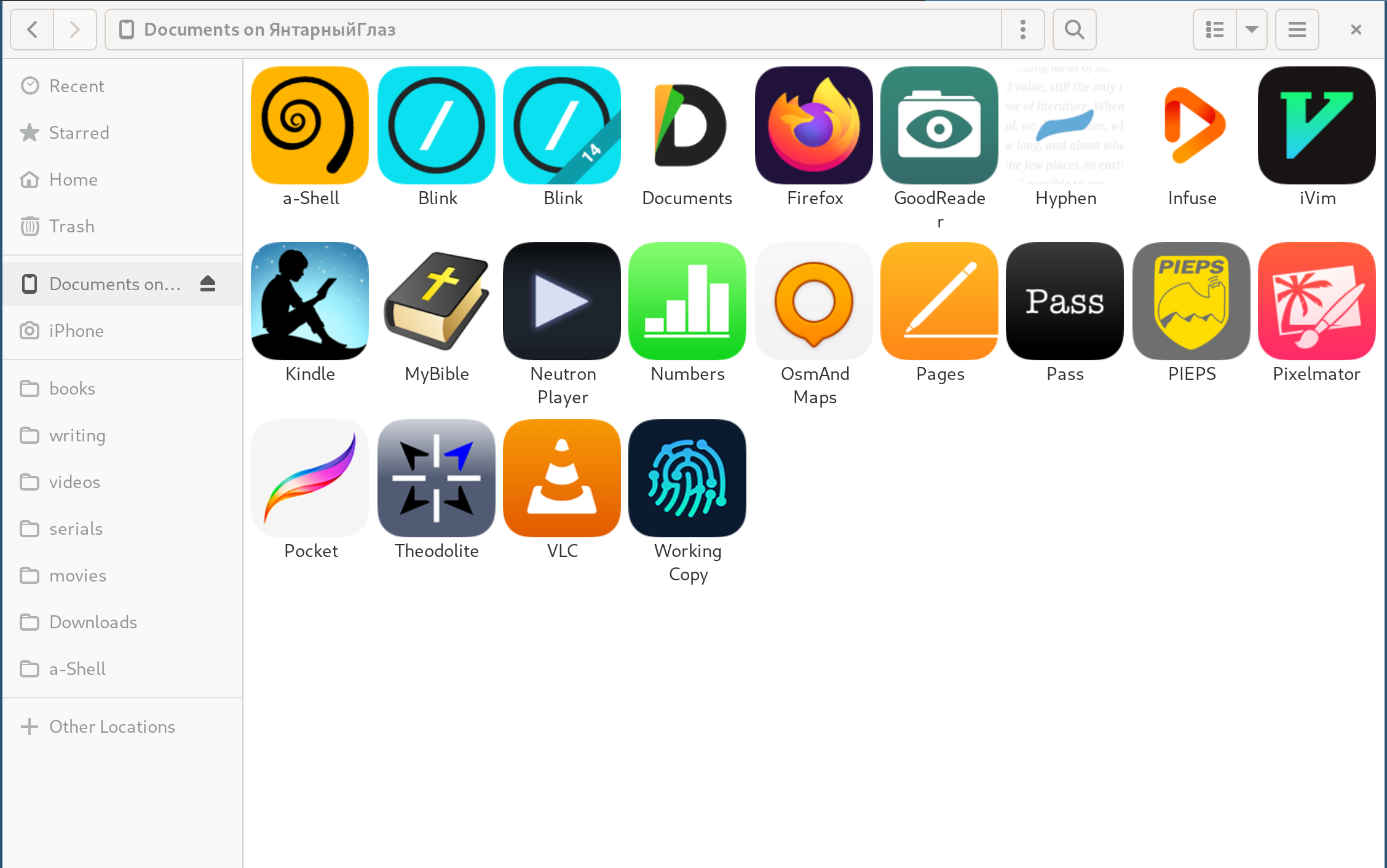
The phone shows up as a camera with photos, as well.
1: https://wiki.gnome.org/Projects/gvfs
2: https://apps.gnome.org/app/org.gnome.Nautilus/
3: https://nexus.armylane.com/files/Gnome-Nautilus-iPhone.png
But as far as I can tell there are no image-related apps in that list you shared in your number 2 link?
I don't think I've plugged an iPhone into my MacBook other than to charge on a trip since the last time I was into jailbreaking and was running checkra1n.
Floppy disks. Java. Disk drives. Headphone jacks. This is Apple’s M.O.
So for Apple to pitch this as "wow, it's a new system where instead of just putting in a sim card you have to grovel to your carrier to set up your phone", it hardly strikes me as better UX.
My partner lost his phone (and SIM) recently and I was able to transfer his T-Mobile line to a different iPhone in a few minutes using eSIM. It was totally automated using the T-Mobile website — enter the IMEI then scan a QR code with iPhone camera.
I saved a trip to the store to get a new SIM card and didn’t have to talk to a human.
Not having to talk to sales reps or go to stores is a big win for customers. Granted, this is mostly hypothetical at this point but it is coming.
another counterpoint: I just got back from a trip in Europe and had to swap my sim card back when we landed. I forgot to ask for the small (and easily losable) tool they give you to pop open the tray, but luckily my SO had an earring that was able to fit.
It's not in their best interests to allow friction free price shopping.
Compelling upgrades would be: another small variant (or smaller than 14 pro at least), something foldable (maybe, if done really really well), significantly improved battery life, bike computer functionality (CarPlay for bikes), or significantly improved performance (in a few years, maybe the 12 mini will be noticeably slow in 2024).
The curse of releasing devices with hardware that’s 3-5 years ahead of the competition in delivered performance (not just feature checklists) is that unless you wait 4+ years, new models don’t always feel like upgrades.
I’m using an iPhone X here in 2022 and honestly other than the battery life being a bit lower than usual, the phone is super snappy, even on these latest iOS releases.
It’s basically 5 years old and it’s still doing amazingly well.
Apple has gotten a lot of flack for releasing “new” hardware and software features that aren’t really new or groundbreaking. I’m starting to see the genius in their planning. The slow trickle of improvements (I like how you call them “S revisions”) are for the sake of momentum, the long term survival of the company. Especially when Apple is already battling the longevity of their own products. I’m rounding off Year Two of my iPhone 12 Pro Max and will likely squeeze out a third year.
I haven't thought about "carplay for bikes" but as e-bikes get more sophisticated, it may make sense.
Wall St demands iPhones. Any trip-up from a supply chain issue would kill the stock. I’m sure the company is being very conservative.
My interest in hardware revisions has only grown in recent years, particularly in mobile devices. I’m not gonna go rush off and buy a new iPhone, I’m quite pleased with my 13 Pro Max and upgrading now would feel horribly wasteful. But I’m continually awed by advancements in mobile camera technology, and whenever I do upgrade it feels as much like magic as when I got my first newer game console (NES -> SNES) as a kid. But to be clear, my interest here is almost completely in the camera, and I pretty much view my phone as a really nice camera with convenient computing and network affordances included for some almost inexplicable reason.
To a lesser extent, recent advances in chips has also had me pining to upgrade a perfectly good laptop which again would feel wasteful to do now, but I expect when the time comes it’ll feel similarly revelatory even if that’s more incremental just because I’ve been upgrading the same sorts of things for much longer.
It’s okay, probably even good, that you don’t feel the same way about the device upgrade treadmill. A slower upgrade cycle would be objectively good for a lot of more important things. I’m not going to try to convince you a new iPhone is something you should want even for “free”. Just offering personal perspective why I find the new one exciting even if I’ll skip it.
All still work great.
The 13 is DRASTICALLY faster. The OLED screen looks far far better than the old LCD, and because the chin and forehead are gone it’s significantly bigger despite the similar case size. The 13‘s battery life is supposed to be significantly better despite more demanding software than the 7’s battery life was when it was brand new. The cameras are barely comparable quality wise.
That’s a top end 2016 phone compared to a medium+ end 2021 phone. And the difference is incredible.
If you go back to 2010 that would’ve been the first retina phone, the iPhone 4. With it’s little 3.5” display. At this point it almost looks like a different device.
I was excited when I got the iPhone 13 Pro because of the LiDAR ToF sensor and being able to utilize Apple’s new object capture API. I was also excited to have a zoom lens, as my old phone (iPhone 7) did not have one. These were all things I had a clear use case for, so it makes sense I was excited for the upgrade.
I think it’s okay to not be excited when you don’t have a reason to be. Don’t assume that means you’re old and jaded.
I have a pal who has a baby coming and I reminded him to make sure he gets his iPhone upgrade program replacement done in time.
My mom's partner, I ask him to keep his updated because these are photos and video of my mom who won't be here forever.
Not only do these devices capture the most consistent, high fidelity data, you almost have to try to screw up having the data automatically backed up.
The cost of keeping the devices updated is relatively low, and the device switch process has improved __every__ year. New devices require new OS's which get the most attention and latest patches, etc.
Still fantastic technology no doubt, but certainly not the wow of 10 years ago.
What’s not to like about the camera on the 13?
The one downfall was that when I broke my screen this year, the replacement was so costly that I ended up switching to a friend's unused older model iPhone for now. I may still repair it at the end of the year...
My understanding is that it's even worse than that, as the 48MP sensor isn't a regular sensor but a Quad Bayer sensor. While there are some benefits over a 12MP sensor, based on what I've read it seems that the image quality is more comparable to a 12MP sensor than to a 48MP sensor. So cropping to 2x would match a 3MP sensor.
That's currently the main reason why I'm planing to keep my 12 Pro a little bit longer. A 2x lens seems more useful than 3x to me and if the assumption above is correct the 2x quality on the 12 Pro should be better than on the 14 Pro. Unfortunately I haven't been able to find a lot of discussions regarding this topic, but there's a YouTube video that comes to a similar conclusion: https://youtu.be/u9sJb_E6h5E?t=588.
Compared to a normal 12MP camera, the 48MP one will collect slightly less light due to there being more gaps, but the bet is that the increased noise from that is less than the noise reduction from the pixel-binning.
Every photodiode has three others around it with the same colour. If they’re all similar, the sensor will average them, and if one of them is way off, it’ll throw that one away and average the rest.
This is better than doing noise reduction on either a 12MP, or a standard 48MP sensor because the space between comparable diodes is reduced, making it less likely to falsely treat small things like stars as noise.
As a bonus, if the user zooms in on a really sunny day, the 48MP might actually be worth using directly.
I'm also thinking the "100x" was not a genuine mathematical assertion
0: https://answers.opencv.org/question/557/face-lifting-on-ios/...
I do wonder what they do if they remove the port completely, how do they fix the phone if it gets truly messed up? Does it become like the watch where they just have to swap it out with a different one and send it back to Apple?
If they only introduced a new phone every 2 to 3 years people might be tempted by the new stuff on other phones. Or you could buy a new phone (to you) that is actually a two year old design.
This way you always get the newest thing, even if it’s not significantly better than what you could’ve bought last year. But it’s a nice upgrade if you’ve waited two years, and for people who wait like 5+ years it’s incredible.
So if there ever was a peak with iPhones, it was with the iPhone 3G, and it just went downhill from there ;)
Please. Do not be too harsh.
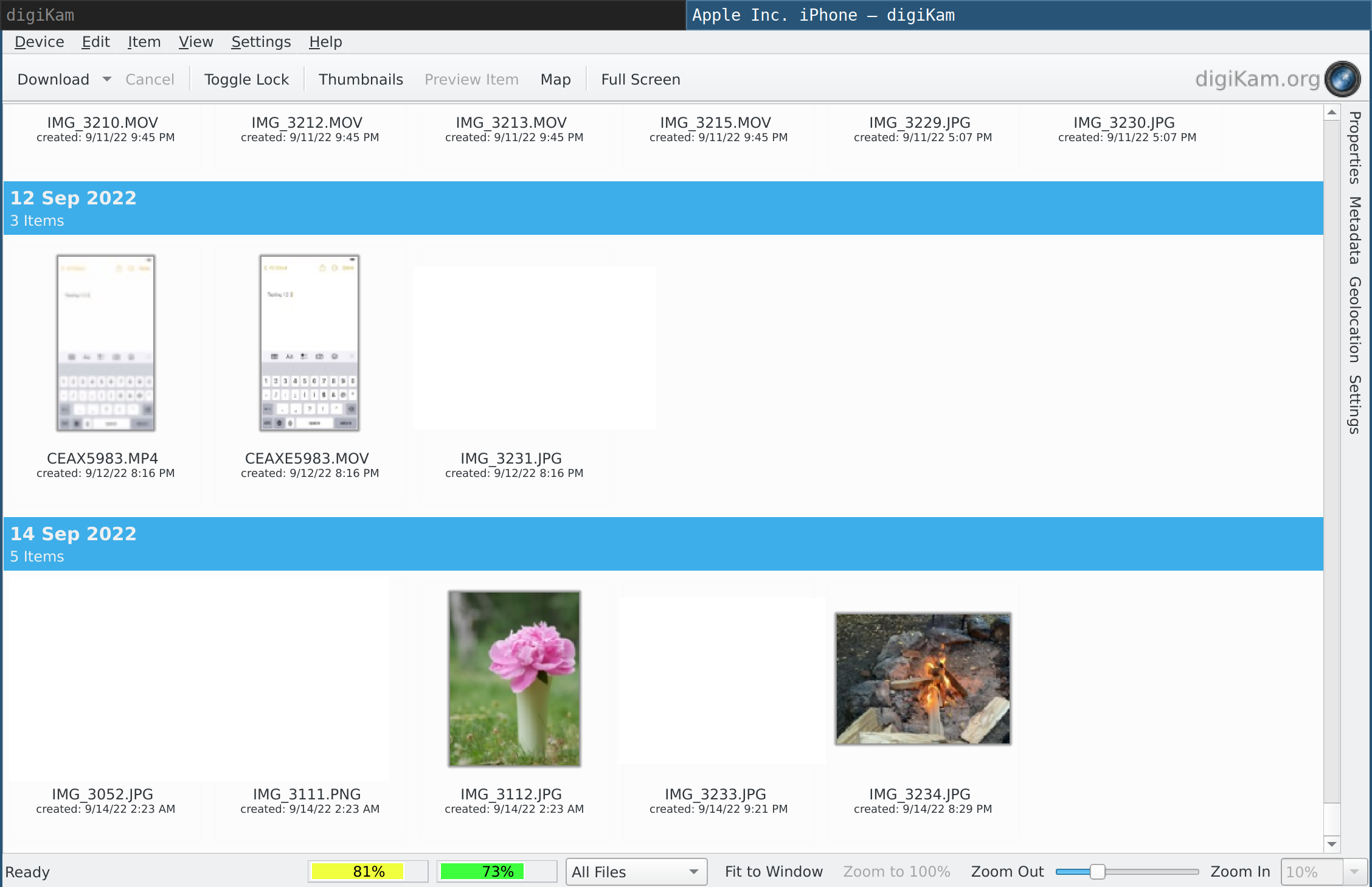
I wouldn't use Nautilus to import photos, though - I'd use something like digiKam (1 - showing my connected iPhone).
The first time you connect your iPhone, it'll ask if you want to 'Trust this computer'. After trusting, you need to run 'idevicepair pair' (2) in the terminal to pair. Then your iPhone (or iPad) will show up in Nautilus.
One use case: Infuse is my iOS video player, and copying movies or serials over is as simple as connecting the iPad or iPhone and copying to Infuse's storage. It copies at 20-30 MBs/sec, which is plenty fast.
1: https://nexus.armylane.com/files/digiKam-iPhone-import.png
2: https://manpages.debian.org/stretch/libimobiledevice-utils/i...
I already use digiKam for my photography workflow. It is really awesome for managing photos, adding tags etc.
For importing photos I actually use Rapid Photo Downloader in order to import photos into "date-ordered" folders. So if I can get Ubuntu to recognise my iPhone then I can probably use the same to import photos from my phone if I ever need that ability.
The device is zippier, and the 13 was no slouch. Using a 12 or as other commenter said XS, there are delays and moments get missed waiting for the device.
I contend it makes horse sense to keep people you care about on the newest iPhone. In all liklihood they spend large amount of time using the device anyway, they might as well have the best display and other features as well.
So yes, they are old and are being phased out in favor of the superior in nearly every way technology of mirrorless.
They didn’t have to manually opt into the 120 Hz smooth scrolling.
It’s still an emissive screen, but it’s better than an emissive screen that is refreshing 60 times a second.
Besides getting jaded, this feeling is maybe the case with any maturing technology. PC developments in the 90s were crazy year to year, and now I don’t bother to follow the scene.
I had to replace the screen twice (first time under the extended warranty/recall, second time I had to pay; it just becomes unresponsive and you get locked out of the phone). To make matters worse, the new one is arriving on Friday and the screen stopped working again last Monday. More than 90 days passed since the previous repair, so nothing to do and I'm locked out of the phone again because you can only unlock iphones through the touchscreen.
The phone is everything but snappy these days. I don't have tons of apps, but it stutters significantly from time to time.
One detail, phone doesn't have one scratch and is in perfect condition outside. Dropped it very few times and it was always inside a good case.
I luckily have only had to replace the battery once for a small cost out of warranty. My storage is 256 GB, so that isn’t an issue yet.
I’m going to go look into unresponsive iPhone X displays now cause I feel like I’m having the starting signs of this issue with mine. It’s not a huge issue, as it rarely happens, but I’m curious now.
Sorry to hear your phone is super slow. I have a slew of apps on mine and it behaves rather well for me. shrug
85mm is great for head shots, detail shots, video b-roll, etc. and limiting for general use, unless your style is all about subject isolation, telephoto, compression, etc.
Photographers often fall into categories of focal length usage. Some prefer the 24-35mm/85mm pair and skip "normal". Some shoot mainly 50mm. Landscape photographers often shoot 16-35mm and then 70mm+.
My sweet spot is 50-100mm, which was well served by the dedicated 2x camera (I'm often fine with digital zoom—the artifacts are part of the style).
So, they've made a reasonable choice, but 50mm lovers are left out.
The small upgrades build over the years, so you would notice a difference. But it’s nothing massive like when they went from LCD to OLED or added the plus size.
There’s nothing wrong with an 11 Pro. If it’s still working for you it’s perfectly reasonable.
They look fine to me though. If you're worried about beating "a DSLR", a medium format film camera from 1920 beats it in every aspect anyway. Read your Ken Rockwell!
I haven’t explored it but I would assume there is also an optional “high security mode” lock — something like requiring account changes to happen in-store with physical ID.
https://www.youtube.com/watch?v=qi1Pu9ez8sI
Some of these photos are just completely damning for the iPhone.
https://youtu.be/qi1Pu9ez8sI?t=79
If you buy a DSLR/Mirrorless camera with a 24MP sensor, there aren’t 24 million R,G,B pixels, but closer to 6 million Red, 12 million Green, and 6 million Blue.
So if that’s how the iPhone is doing their 48MP sensor, then that’s just standard
Instead of something like RGBRGBRGB for the subpixels the subpixels are layed out as RRGGBBRRGGBB (in both dimensions). So while those additional subpixels provide some additional information (either brightness information or a different exposure time for HDR) in terms of color information the sensor would still be pretty much limited to 12MP. Based on the reviews that I read in the past Quad Bayer sensors seem marginally better than comparable regular sensors (48MP Quad Bayer vs 12MP regular), but nowhere near as good as the MP number makes them look like.
> Apple ProRAW combines the information of a standard RAW format along with iPhone image processing to offer additional creative control when you make adjustments to exposure, color, and white balance.
There is a significant difference in cameras between the 11 and 13 - especially during the night photos. To the point where, in our case, I often need to tell my gf to use my camera for a shot when we’re together, because it will be so much better.
If you take a lot of photos then for this reason alone it’s worth to upgrade imho.
That’s the only reason I’m excited for the 14
Not really. There's not really any point taking a smartphone camera out of your pocket at an airshow, or at a zoo, to take a photo of the Moon or a myriad of other scenarios where the lens is the dominant factor.
Sometimes the best choice is not to take the shot.
For example, if you were coming to visit me in Australia, you could get an Optus eSim for the days you are here: https://www.optus.com.au/prepaid/esim
Annoyingly, its not yet perfect. Vodafone for example can do prepaid, but requires the prepaid physical SIM to be activated first then transferred: a Vodafone store can do it of course, but that's a pain.
https://www.vodafone.com.au/support/device/esim?accordion-id...
I imagine this will get better as time goes on, though.
Woolworths can do pure online eSim only prepaid: https://mobile.woolworths.com.au/mobile-phone/esim
I’ve spent time in both the UK and Mexico this year and it would have cost 2-5x as much if I couldn’t get use a physical SIM.
But again I love the app and hope something like that becomes big enough that the big operators will integrate with it.
Wouldn’t it be great if your phone could call 911 automatically when the guy rolling coal on you decides to just run you down?
But bike computers are likely always going to be nicer to use than a phone because part of what makes them good, makes them bad for normal phone usage. Their displays are quite washed out and dull but are extremely visible in direct sunlight while using minimal power.
Sure, you don’t _need_ them but they don’t cost very much compared to your other gear and the minor improvements stack up.
Specifically, the out-of-focus shadow details look like a smoothing or denoising algorithm has been applied. Maybe it's just something about the optics Apple is using (e.g. different lenses can have distinct characteristics in bokeh, softening, color, distortion, etc) vs other dedicated cameras, but it's something I see in almost all photos coming from an iPhone.
[1] https://kirkville.com/apples-new-proraw-photo-format-is-neit...
> Instead, ProRAW stores results of computational photography right inside the RAW. This is another reason they need to store demosaiced data, as these algorithms operate on color, not RAW data. Once you demosaic, there’s no going back. I mean, what would you even call that, remosaic?
> Smart HDR does this in the least destructive way. Apple worked with Adobe to introduce a new type of tag into the DNG standard, called a “Profile Gain Table Map.” This data gives your editor everything it needs to know to tone map your photo image and end up with results identical to the first party camera. Because it’s separate data, you can turn down its strength, or turn it off completely.