Ask HN: What Is Happening in the UK? With recent news about market melt-down, I was wondering what really has happened? Anyone with the knowledge please ELI5? |
Ask HN: What Is Happening in the UK? With recent news about market melt-down, I was wondering what really has happened? Anyone with the knowledge please ELI5? |
I though markets reacted negatively to socialist governments getting into power, not the opposite.
Normally left wing governments are punished because they increase spending without increasing tax revenue - causing unsustainable debt. The UK has done the right wing equivalent - they decreased tax revenue without decreasing spending - causing unsustainable debt.
Truss's administration is giving tax cuts to the wealthy and paying for it by borrowing. The markets know that trickle-down economics is nonsense and these tax cuts won't boost UK's economy enough to cover the enormous amount of debt required to pay for them.
As an investor you always want your investments to yield more than the rate of inflation and when government policy increases inflationary pressures by fuelling growth the market will demand higher interest rates. Of course there is also uncertainty about how the government will pay for the debt which is increasing the risk premium.
It's just dumb fiscal policy to boost growth at a time when central bankers are trying to do the opposite. It would probably work great during a deflationary period. Its just that's not where we are right now.
Usually, the right-wing, and the "markets", agree on what is good for the economy. It is quite unique to see the "markets" disagree so strongly with "the right".
And it is also worth noting that it is quite rare to see left people use the view of Wall Street as an argument ! I remember many cases in Europe where socialists governement almost used it as an electoral argument that they would ignore "the markets" (or rating agencies) and not dictated their policy by what they said
Either there is no realistic plan or the ministers involved have been too incompetent to explain it. Neither explanation inspires confidence.
By fuelling growth in a period of high inflation with debt you basically add to the existing inflationary pressures and increase risk.
As an investor you want your investment to at least yield more than inflation so this is one reason why the market is demanding a higher interest rate (the market now excepts UK inflation could run hotter), but they're also worried about the risk of extra borrowing so are also demanding a higher risk premium because of the uncertainty of their investment.
Also, I'd argue this isn't really a "right-wing" fiscal policy. Cutting taxes might be "right-wing" but borrowing to do so certainly isn't something that's universally popular with those on the right. Most on the right probably want tax cuts to be funded by spending cuts.
If your fiscal plan doesn't make sense market lenders may not be willing to lend to you or will at least expect a higher interest rate to compensate for their risks.
The Conservative party in the UK has just elected a new PM who has announced a fiscal plan which doesn't add up - tax cuts financed with borrowing.
Worse still the PM is doing this in an effort to boost growth which only adds to current inflationary pressures at a time where inflation is far too high.
Given this the market now believes the central bank will need to be much more aggressive in their fight against inflation and raise their base rate much higher.
In addition to this the market is also sceptical of the governments fiscal policy and is demanding a higher risk-premium to lend money.
The result is sky rocketing borrowing costs for UK consumers, businesses and the UK government.
Pension funds are one of the largest holders of government bonds as they're typically seen as very safe investments (especially within developed markets).
But of course every investment still has risks and when those risks are underestimated it can leave a lot of investors on the wrong side of the trade very quickly.
As large holders of government bonds many pension funds found themselves in this position and my understanding is that some have been on the verge of blowing up in recent days.
Obviously were pension funds to blow up on mass this would have all kinds of negative knock-on effects for the economy.
It would also mean many of these funds would become forced sellers of bonds and this forced selling would have added even more volatility and instability to an already volatile market.
Basically the UK was at risk of at risk of a GFC style blow-up so to restore stability the BoE was forced to step in yesterday to buy bonds that no one in the market wants to own right now.
Interestingly today the PM is doubling down on her fiscal policy. But then she has some fairly controversial economic views, including the belief that higher interest rates is a good thing.
In my opinion she's too naive and ideologically driven to understand what she's doing. At the end of the day the BoE can't make a broken fiscal policy work, they can only buy time.
If the government doesn't reverse course the UK economy is probably going to implode, but as I say we have a PM so ideologically driven that she may actually see this as a good thing - it's just free-market capitalism cleaning out the weak-hands, etc.
Although it's probably electoral suicide my guess is the Conservative party will need to step in at some point and force her to back down in one way or another. If they don't it's hard to see the public will forgive them for this anytime soon. Especially considering many vote for the Conservative party because they're seen as the party of fiscal responsibility.
Either way as a mortgage holder who's probably going to default on their mortgage due to all of this I don't expect anyone to step in and help me =) This is my mistake, not the governments. And I'm just a pleb with a family, not a pension fund.
[1] - https://lookingglasseducation.com/whats-a-debt-spiral-and-is...
It’s not the money that’s the issue - that’s an abstract, invented thing. The limits are inflation, natural resources and available labour.
The pound dropped in value a few days ago, but the price has recovered since then.
The media chooses to focus on the drop rather than the recovery, because the drop coincided with a government announcement of some pro-growth economic policies that mainstream pundits disagree with.
If you speak to people in the U.K. many would agree that paying less tax is a positive thing, especially during a global cost of living crisis. But some people on the Left are angry that the wealthiest are also getting tax cuts.
What a lot of those people don’t realise is that the wealthiest 1% are paying 28% of income tax receipts - and this percentage has increased over the last decade.
In my opinion, I’m glad to see government reduce the tax burden on productive workers, as this stifled well-paying jobs, growth and investment.
I speak from personal experience. Due to the insidious tax policy of withdrawing the personal allowance when income reaches £100K, there is a marginal tax rate of over 60% at that income level. For that reason I chose to quit my job as a software team manager in an investment bank and instead went to work as a developer in a startup.
I decided there’s no point in working long hours in a responsible job helping other people advance their careers if I keep less than 40p of every pound I earn at that point. I may as well do less responsible work that I enjoy instead.
As the Fed raises rates in the US it makes the dollar a more attractive place to put money. This devalues other currencies against the dollar.
Because the dollar is the reserve currency a lot of stuff countries like the UK imports is denominated in dollars (oil, food, etc). This means the US actually increases inflation pressures for other countries when they raise their domestic interest rates.
This forces other central banks to raise interest rates in line with the US simply to protect their currencies from the inflationary effects of currency devaluation.
Unfortunately right now Europe can't really afford to do this with an ongoing energy crisis, but we have no choice. The US is literally whacking their allies around the head with the US dollar.
But then from the US perspective what choice do they have? The Fed already has little credibility and to allow inflation to run hot in the US to protect Europe from currency devaluation would be equally risky and unpopular.
We're in very tricky times. We've kicked the can down the road for so long that it's now catching up. We no longer have any good options left. It's all just trade-offs from here.
Many including myself did try to warn this was always the risk of such a reckless response to Covid, but I suppose it's too late for that now.
It's still hard to fully discuss the overreaction to Covid in many forums without getting shouted down for wanting to kill Grandma, but there are people out there who don't seem to fully grasp that actions taken to try and solve problems can have drastically negative consequences. You can't just spend money you don't have indefinitely without paying the piper and screwing yourself down the road.
Personally, I fear that the emotional reaction to Russia/Ukraine is turning the same way, perhaps with far more dangerous long-term consequences.
> I decided there’s no point in working long hours in a responsible job helping other people advance their careers if I keep less than 40p of every pound I earn at that point. I may as well do less responsible work that I enjoy instead.
This is an extremely funny takeaway in that anyone who doesn't agree with your ideological position is likely to see this as the tax working as intended.
Many people on the left see tax as an appropriate punishment for wealth.
In their worldview, wealthy people are demonised and dehumanised. The left are convinced that wealthy people are parasitic on society.
This leftwing ideology seems peculiar to me, having seen the data on who's funding public services, and who's benefiting from public services.
The issue is that most of the economy relies on people (including the lower classes) spending, which they aren't going to do if they already spent all their money on rent/bills. This in turn means businesses may go underwater if they aren't getting enough customers to stay afloat and operate profitably, leading to losses of jobs and less business for the companies that serve those businesses, and so on and so forth in a cascading failure. So even if you are selfish and say "fuck the poor", it's a bad idea because your ability to stay rich relies on there being "poor" people who spend their money at your establishment. Not to mention that with extreme poverty comes crime, something that ultimately costs all of us money.
It's like "tricke-down economics", except it trickles up and unlike the former, this one actually does happen for real and we're already seeing the effects of it.
I say this as someone who otherwise is in favour of tax cuts and sees taxation as theft, but that's a discussion for another day. But if you're going to cut taxes to help with cost of living and can't cut them all, then focus your efforts where it actually helps. The ones who will actually see a non-trivial increase in their income due to this cut are those who already didn't need any help.
I wouldn't say that it's just "some people on the left" - I dont want to place myself on either side of the fence but sky news are doing interviews with cross sections of Conservative / Labor / Swing voters and most of them think that this is Truss's fault.
You are correct that this has coincided with the dollar making gains against most other currencies, and the effects of the mini-budget may be difficult to dis-entangle from that, but from the people I've seen interviewed, most people agree that the mini-budget has at least made things worse for the pound. It's worth pointing out that the pound has fallen significantly against the euro too[0].
[0] - XE dotcom
Without any information on how wealth inequality has increased, and the 1% have more income and assets now than they did last decade, this is misleading at best. If the top 1% are paying more taxes but are also making more money, this hardly seems unfair.
It’s fair enough if you want to work at the startup but this seems like a strange rationalisation. I agree that the 60% marginal rate from the personal allowance reduction is kinda silly.
It doesn't appear recovered to me.
It get you're quoting USDGBP but what you say doesn't make any sense to anyone not sitting at a forex desk.
We're trying to boost the economy by cutting taxes on the group of people who are most likely just to stuff the extra money into investments rather than spending it? Great idea.
Also, this isn't just the left, it's practically anyone with a brain. Any conservatives from David Cameron's administration (not far right ideologues) are horrified by this, as are most of the current MP's who overwhelmingly wanted Rishi Sunak, who is also horrified by this...
I always viewed it as a cynical way to weaken labour.
> "policies that mainstream pundits disagree with"
That the Bank of England have had to scramble to compensate for by bringing back QE in a limited form, that previous governers of the BoE have spoken out against, that the IMF has spoken out against, that previous heads of the US treasury have spoken against, that conservative peers and MPs have spoken against, that the markets responded to by having a fire sale?
Those are a few mainstream pundits? LOL.
> If you speak to people in the U.K. many would agree that paying less tax is a positive thing, especially during a global cost of living crisis
Very few of those people would be paying less tax under these plans, as the major reduction is for people earning over 150k per annum - and those are the people already best placed to weather the cost of living crisis.
It's not that the wealthiest are also getting tax cuts, it's that virtually nobody else is.
I'm a high earner and I like money, but this is some self-interested bull**** right here
And the IMF has consistently got it wrong about the UK economy. In the past it has actually made public apologies for doing so (IMF head: "do I have to go on my knees?" regarding incorrect warnings on UK economy): https://www.telegraph.co.uk/news/politics/10884632/Do-I-have...
We have to be careful to avoid the Argument from Authority fallacy, using the IMF and BoE reaction to judge government policy. https://en.wikipedia.org/wiki/Argument_from_authority
> It's not that the wealthiest are also getting tax cuts, it's that virtually nobody else is.
When the most productive members of society got landed with a 45% tax rate in 2013, it was higher than many G7 nations, and there's no evidence to suggest it actually increased revenue. Have you heard of the Laffer Curve?
The trickle-down maths looks "optimistic". Cutting £45B means that the economy needs to grow by £112.5B for the top rate 40% tax rate take to come out even. That is GDP growth of 4.5%. I.e. far in excess of what the economy has been capable of ever since 1997.
Talking of further tax cuts just pushes the assumed GDP growth further into fantasy land.
Also, despite 10% inflation they’ve frozen the tax bands, so all workers earning above about £12k will have more of their income pulled into higher tax bands.
So they’re left with that artificially high rate which blocks progression, and most workers up to about £150k will pay more.
Can't you just put that in your pension to avoid that effective 60% rate?
> no point in working long hours in a responsible job helping other people advance their careers if I keep less than 40p of every pound I earn at that point
I think the way the UK calculates tax at that level is a stupid way of setting it up, but "only" taking 40% of the 100k to 125k is hardly terrible. If you're in that range, you're incredibly well paid for the UK (or pretty much anywhere in the world).
I would personally like to pay more tax if it meant decent public services instead of people dying waiting for ambulances.
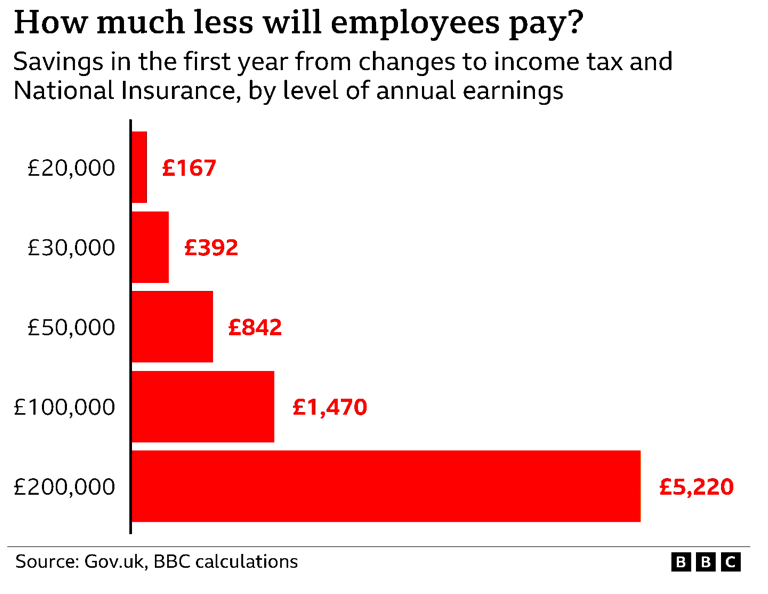
The affect of removing that doesn't seem to be that major, with the figures [1] appearing to work out at almost 1.5% less tax for those on £100k, and a little over 2.5% less tax for those on £200k -- hardly a huge decrease in the tax burden for those people.
[1]: https://blogsmedia.lse.ac.uk/blogs.dir/8/files/2022/09/28sep...
Also, when you are that income level, there are a number of tax benefits you can enjoy - for example the first £40k you put into your pension is before tax - so it effectively reduces your salary (for tax purposes) by £40k. SO if you are doing the sensible thing and putting money into a pension, the threshold you talk of is effectively at a £140k salary.
It also reduces your actual salary by £40k, not just for tax purposes, if you'll never end up using your full pension. Either because you've died before doing so, or because the pension fund can't pay you out (fully) since it is increasingly underfunded due to a rapidly aging society.
Answer this honestly for yourself: if you are fairly young, say 25-35, what are the odds you'll see more money in your lifespan from £40k put into a pension now that may or may not be fully available after retirement, versus £40k minus tax invested into an index fund and accessible/reroutable whenever?
It's not my "privilege" to earn at that level. I was born into an average economic background. I worked really hard at school and university, and then over a period of seventeen years, I worked really hard in responsible jobs.
If all people from average backgrounds took the attitude that only "privileged" people get good careers, then unfortunately it would be a self-fulfilling prophecy. Luckily there are plenty of aspirational people in the UK looking to better their family's situation by advancing their careers.
Ignoring the markets hasn't been possible since Nixon ended the gold peg.
> a pension now that may or may not be fully available after retirement, versus £40k minus tax invested into an index fund and accessible/reroutable whenever?
If we're talking about people putting that 40k into a pension because the tax on going over 100k salary is too much, you've saved 21k straight off by not taking it as salary. So we're talking about 19k in your hand vs 40k in a pension.
The pension fund you contribute to now could just be an index fund (it may be a managed fund though, depends what you pick), and as we have moved away from final salary pensions, there's no danger of underfunding because it's basically just a tax-shielded investment.
So the answer is, assuming you live to retirement (or even to 55, the age where you can take a tax free lump sum from your pension in the UK), that 40k invested in a pension is likely to be a lot better for you than 19k in a similar fund that's not tax-shielded.
And it's more likely to be there when you need it later in life because you won't be able to dip into it during your working years.
> The wealthiest 1% of households hold about 20% of household wealth, the top 5% of hold approximately 40%, and the top 10% hold over 50% of wealth
https://ifs.org.uk/articles/distribution-household-wealth-uk
If you don't tax them they just amass more and more money without contributing more, if anything their wealth is due to the work of the bottom xx% of society that work for these ultra rich families
But yes I do think it's fair for the very richest to pay more tax, and I say that as someone who is a high earner who wants to see more equality.
If we keep current spending the same. We could reduce the % the top 1% bare by reducing inequality and by having the 99% earning and paying more tax.
Or we could reduce taxes for the 1% and reduce spending which would likely increase inequality.
Better is to focus on the benefits gained bu the wealthy from stable legal systems, public health, education etc. If you are Bezos your money is only possible because these expensive services are paid for. You gin more than most, and so must pay a greater share than most.
Then it's not really a 60% marginal tax rate, is it?
> I worked really hard at school and university, and then over a period of seventeen years, I worked really hard in responsible jobs.
Educated by the state, health taken care of by the state, protected by police and emergency services, defended by the military, enjoying the benefits of scientific research, and lots of other things all paid for through taxes.
You did rather luck out having the combination of interest and talent that turned out to pay very well (as did I).
My wife is a nurse and works really hard, literally saving people from cancer, but she gets paid comparatively little because we don't pay enough tax to fund the NHS properly.
> having special rights, advantages, or immunities > Similar: wealthy rich affluent prosperous lucky fortunate special
You took more benefit from the system than others, regardless of whether it's by merit, it still makes sense that you pay more back.
New loans get taken out while that happens.
Non-$0 debt load, but no defaults. The only time the US ever paid off “all its debt” was during 1835-1836. One year out of more than 200.
The best outcome the US can achieve is semantic games where they pretend that giving people back less than was borrowed is somehow reasonable.
Most people in the UK have no idea that there is an effective 60% tax rate either. It's not an official tax band.
But it's the kind of tax raising governments love doing, by stealth. Don't put up the tax band thresholds causing more people to fall into the higher bands over time. They also remove child tax credit as you earn more. And remove your personal tax allowance gradually over 100k.
I agree this is a terrible policy. Marginal tax rates should be a monotonically increasing function.
Indeed, but we also have to be careful of writing off numerous opinions from multiple diverse sources in multiple countries, from politicians, economists, bankers and many other roles, as well as the actual actions of the people on the ground that have born out the criticisms, as the ill educated musings of a few 'pundits'.
> When the most productive members of society...
LOL. Seriously? I'm paid in that bracket (or I was until last year when I left the UK, and I'm now paid in that bracket somewhere else) and I don't believe for a second that we're the most productive members of society, we've just figured out ways to get people to pay us a lot. I look around at some of the unutterably useless arseholes that are on similar money and litter the offices of London, particularly in anything adjacent to city finance, and can only laugh at this ridiculous piece of libertarian orthodoxy. Most productive ... most productive at clumsily and innappropriately flirting with the disinterested secretary, most productive at clearing off for a long lunch somewhere new, most productive at looking busy, passing the buck and collecting the cheque, maybe.
Yes I've heard of the laffer curve, no I'm not a particular believer that it's some sort of cast-iron truism, and neither apparently are the people you're defending, who are forecasting the various tax cuts to cost the treasury multiple billions, at least in the short term, until their miracle of growth happens, if it happens. There's a lot of argument about whether (for instance) the continuation of the lower corporation tax rate is even useful for that.
These decisions are a kick in the pants to the people who actually need a tax break, your man on the street that you mentioned above, who would quite like a bit more money in his pocket due to the spiralling cost of living and energy crisis. He could do with a tax break to keep the family going this winter and deal with the higher mortgage payments that will come about because of the further interest rate rises these new changes will necessitate.
But I guess my highly paid contractor friends will get to stick another few tens of thousands in their pension pots instead.
The best thing that can be said about this budget is that it was done at completely the wrong time.
I fully expect politicians in other countries to HATE the fact that we have a competitive low-tax regime that will attract business and talent. And they'll also hate that we have a devalued currency, which makes our exported goods and services more competitive.
> I don't believe for a second that we're the most productive members of society, we've just figured out ways to get people to pay us a lot
You may well be right about your own situation. We're all different. My employers value what I did and paid me accordingly.
> There's a lot of argument about whether (for instance) the continuation of the lower corporation tax rate is even useful for that.
The case with corporation tax is cut-and-dried. When the Tories reduced it significantly (to 20%), revenue quickly went UP. It took barely any time to prove that we'd moved closer to the revenue-maximising point on the Laffer Curve
https://i.dailymail.co.uk/i/pix/2017/11/21/01/468DEAAA000005...
> These decisions are a kick in the pants to the people who actually need a tax break, your man on the street that you mentioned above
I'm losing count of the free cash grants this Tory govt is handing out to help working class people with their energy bills. And now they're using public money to freeze bills. It's unprecedented.
Most of the politicians comments I'm referring to are from British politicians, even within the conservative party. This isn't jealousy, it's marvelling at incompetence.
You still seek to play down both the comments of a range of people from a range of different viewpoints and the actual market movements. And you're doing it in a very disingenuous fashion. You know as well as I do she's come under criticism from her own party, some from those within her party that supported her leadership bid, as well as luminaries from all over the financial world in multiple countries.
> When the Tories reduced it significantly (to 20%), revenue quickly went UP
In an entirely different economic landscape to the spiraling inflationary one we're in today. I'm not sure a cartoonised graph from the daily mail is evidence of anything very much.
> You may well be right about your own situation. We're all different. My employers value what I did and paid me accordingly.
The point is that labelling high earners as the most productive class is a laugh. Far from all of them are. I like to think I earn my money too, but I've seen a lot of people that don't, who find and cling on to these posts though a combination of connections, grift and luck.
> I'm losing count of the free cash grants this Tory govt is handing out to help working class people with their energy bills. ... It's unprecedented.
Yes, that's the point, it's unprecedented, it's fucking awful for ordinary people on average incomes, huge inflation pushing up the prices of everything, interest rate rises making mortgages more expensive, rocketing energy costs (even if they are capped they are historically very high). In the midst of that, these policies make things worse. More expensive mortgages will knock on to the housing market falling, for example. This is not just "idealogically problematic" in some wishy-washy leftie way, it's not just something to be disagreed with because of your particular economic leaning, it's not just targetting the wrong people (though it certainly seems to be doing that) or the politics of envy - it's actually fucking stupid.
Your citation is the daily mail. You're scornful of experts, and self-satisfied. You're gammon, aren't you?
Well the that’s the thing this thread is all about so that isn’t an additional thing.
$1M in credit card debt would sink me. For Jeff Bezos, it doesn’t even rise to his personal attention.
> Someone has lost a lot of money (presumably China and Japan). How could the US pay them back without resorting to fantasy?
I can’t pay my mortgage in full right now. That doesn’t mean my bank loses money on the loan.
China and Japan are getting paid on their loans, at the agreed upon amounts. They will continue to be paid.
In the middle of a world war, facing a level of emergency that left civilisations of more than one continent shattered and reordered the world as it was known. As an emergency spike that lasted for around 5 years before they started paying people back. And although the debt was staggering and the US economy was in its prime as a global manufacturing superpower.
This is obviously different, the US government has just been spending because they can. If they even try to pay this debt off it'd be stupid. From the US perspective, why even bother? They're basically already committed.
> I can’t pay my mortgage in full right now. That doesn’t mean my bank loses money on the loan.
In that case you've defaulted on your mortgage. You may get on well with the US government.
And the bank may or may not be losing money for all I care, but on net the creditors to the US are clearly losing money. The numbers are too big for any other outcome.
We're just getting out of a world pandemic.
> In that case you've defaulted on your mortgage.
No, I'm making the agreed-upon payments, just like the US is on their debt. I can't pay off the whole loan today, there's twenty years left on it. Similarly, the US can't pay off 108% of GDP today, but they can over the decades-long timespan of those debts.
Think of it like insurance of your status in the system. Your insurance premiums are proportional to the value of the stuff you want to protect. Presumably you own a house. A pension. Various other investments perhaps. All these become worthless if civil society fails and we go back to the Leviathan.
It is right that you should pay a higher premium for that type of insurance than those with no such wealth at stake.
Any perks from the NHS for the wealthy? Or the same service as everyone else?
One thing I know for sure - less public money is allocated to my children (I live in the countryside) than children in urban areas, due to the funding formula.
"Clash of Autonomy and Interdependence" is an interesting somewhat related read on the topic[^1].
[^1]: https://economistsview.typepad.com/economistsview/2009/10/cl...
The thing is, even people who pay $100,000 a year in taxes actually gain far more value than that from a properly functioning society with strong public services and social safety nets. It's hard to put a proper price on personal safety or the opportunity cost of having to spend time, energy and money on securing your family and belongings rather than just being able to generally trust the people around you.
1. Who works harder, an office worker working for 7.5 hours or a nurse who works for 12+ hours?
2. Who works harder, a person who works 37.5 hours in an office, or someone who works 80 hours a week, founding a company?
3. Who has worked harder to get where they are, an office worker who spent 6 months getting an NVQ in Microsoft Office or a nurse who spent 4-5 years getting a degree in nursing?
4. Who takes more risks, a person who works 37.5 hours in an office or a founder who puts their own capital in to try and create a company?
5. Which brings more value to a community, a person who is employed, or a person who employs people?
Inherited capital in every startup I've worked at. And enough of it that they got several runs at success. It wasn't risky at all.
> Which brings more value to a community, a person who is employed, or a person who employs people?
Too vague a generalisation to have any value. What matters is who does the work and the social value of that work.
Also, I love how you glossed over that the founders you idealize are largely already from privileged backgrounds that give them the opportunity to fail. The vast majority of people will never get that chance.
Have you ever been a senior manager before?
If you had, I hope you'd understand that the role involves creating jobs, hiring people, promoting people and generally supporting them, mentoring and advancing their careers? Taking responsibility for any problems they cause, and ensuring they get the glory of any successes. As well as doing my regular job as a developer at the highest level. I'd never worked so hard in my life.
It was exhausting and I'd expect to be compensated richly for it. Few people would stick the job.
The more jobs created, the more competition for employees, and thus the higher wages offered. We all owe a debt of gratitude to job creators.
The obvious incoherency of this then led to the markets losing confidence in the UK economy, crashing the value of the pound, which in turn makes the planned UK debt funded tax cut plan even more expensive than it already needed to, leading to even more loss of confidence.
We are now in cascading crisis, from which there are no good option, only worse and terrible ones.
The thing I am confused about is why this happened at the announcement. The big measures had already been announced, an energy price cap (£60bn or more depending on wholesale gas costs), and reversal of planned tax increases in National Insurance and Corporation tax (about £40bn). The additional unannounced tax cuts were small (for instance the cut in top rate tax was £2bn). So it seems that most of the drop should have happened before.
Apparently the PM wanted the announcement to feel radical to distance her from the previous government, so maybe the markets were responding to the feeling of the announcement, and the implication of future radical ideological action, as much as the numbers.
I'm far from an expert, but to be totally honest I think most people didn't really expect it to happen this way. The media were all talking about how it's not possible and no one knew where the funding would come from. Everyone was mostly expecting it to not happen to be quite different and more complex.
It turns out we overestimated both the PM and the Chancellor.
My understand is that it’s exactly this. So much of the markets comes down to vaguely defined “confidence” and the new leadership simply isn’t inspiring faith from those in charge.
Isn't it more the conflicting policies (BoE and gov) in theory and the perception of them not being in the same page?
This avoidance of accountability is a repeated pattern in British politics recently. Turns out you can bend our political system that way, but the global markets really don't appreciate that behaviour.
One economist said that Britain is now paying the Moron Risk Premium.
Here's potentially a better description: The new government came in and announced a series of policies that made it immediately clear to markets that inflation was not being taken seriously in the UK. This lead to a drastic, and I mean historically drastic, sell off on the long end of their bond market. Basically all capital markets in the UK were on the brink of freezing and probably shortly thereafter this would have become systemic.
This would have basically set the timer started on the UK being maybe a few weeks off from a humanitarian crisis. (if you think this is hyperbole understand that the entire energy storage capacity of UK is about 1% of their yearly use meaning capital financed energy flows are constantly necessary to keep the system running, the food situation is not that severe but still requires flows)
After all of this occurred, the BOE came in did the thing that they had zero other choice but to do which was to inject liquidity back into that segment of the bond market. I think they would be the first to tell you that this policy is a disaster. They had absolutely no choice.
If any of our US friends were wondering what that is in your currency, it's about 100 billion dollars (following our new PM's economic "experiments").
Sure it might be disastrous for Truss, or Government, or The Conservative party. But for the UK as a whole it must be the reasonable way out?
Have you ever seen authority figures backing off? When questioned or face backlash, they only double down. In fact, that's what happened - the official word is "this is the right way", and "the government is not responsible for market movements", "it sends the wrong message to tax windfall profits", "The poor can't pay bills? That's fine, we'll cut tax for the rich - that'll fix it".
#KamiKwasi, as Twitter called it, will continue.
Not to say the tax cut is not a terrible idea - it’s absolute stupidity.
https://www.cnbc.com/2022/09/30/ron-insana-something-big-cou...
Money comes in money goes out, the difference is made up with debt. Tweaking either the income or the outgoing knobs impacts the debt required. So a tax cut requires extra debt to make up the difference.
There's a good article in the Financial Times that explains the mechanics behind it ("LDI: the better mousetrap that almost broke the UK"): https://www.ft.com/content/f4a728a5-0179-48bd-b292-f48e30f86... (archive link: https://archive.ph/vRrGk)
tl;dr from the article:
"Well, the cruel irony is that pensions needed collateral for margin calls on leveraged trades hedging against big moves in . . . UK government bond yields.
So pensions sold bonds (among other things) to raise that cash, pushing yields up, making hedging trades even more expensive, and requiring even more collateral.
If the BoE hadn’t stepped in to arrest the declines, pensions may have defaulted on those contracts, which would have been very bad. That isn’t the same thing as going bust – it’s not like all the investments disappear overnight – but it does risk tying up the pension in a knotty legal fight over settling the default."
The UK central bank, the BoE, is forced to take measures to counteract what Truss and her government are doing !
The market is also strongly reacting against Truss by selling the pound.
I really hoped the new leader would be the one with an economics background instead of the friendly optimist. Navigating out of brexit and covid is difficult and the leader sets the tone for how we're going to approach it.
The market deciding the UK is financially unsound seems a legitimate response to our strategy of copy the wise ostrich. Hopefully the people who chose Truss have made enough of a loss this week to reconsider their priorities.
Except Kwarteng's former boss Crispin Odey is making a killing shorting the pound. https://www.independent.co.uk/news/uk/politics/tory-donor-pr...
It's hard to make more from shorting the pound than the loss across your entire estate from sterling crashing though, unless it's now common for wealthy conservatives to hold most of their assets in dollars instead of UK real estate.
Came as a surprise, in a nonscheduled budget & was the opposite of what was expected.
That got the gilts (uk bonds) to drop, and that got the currency shocked as the gilts were force liquidated. I wouldn't read too much into the currency bit, as every other currency is down against the USD, including the euro, yen and aud.
However, if your currency is NOT the US dollar, then its a catastrophically bad idea.
In short: Truss and Kwarteng are intellectual lightweights whose economic ideas make for funny reading* but in reality are a recipe for disaster. Their line of delusional thinking can be traced directly to Brexit, when the UK lost their collective minds.
"...due to the almost £45 billion a year of tax cuts announced by the Chancellor today" https://ifs.org.uk/articles/mini-budget-response
The FTSE250 is down 7% over 5 days.
2020 was record money printing, causing inflation, so Liz Truss set a plan to reform quantitative easing to try reduce inflation, and the markets reacted bad
The age old question, are banks to big to fail? What will happen to saving, mortgages, pensions etc... if you start restricting bailouts? Maybe some will just take their money to EU where they still have a cushion, in the always win casino
But no doubt reform is needed
Interest rates are now expected to triple to 7% to cope with this fiscal event and as most UK home owners borrow money on revolving short term loans to buy houses many people are looking at a $1,000-$2,000 / month increase in interest payments and a 20% collapse in the value of property.
Most major businesses have gone into crisis mode (hiring freeze, paused expansion plans) which will have its own knock on consequences. If we're very very lucky it won't spread to other countries.
It has solved this problem over the years by borrowing and becoming a haven for investment to cover up the shortfall.
Now we have a bat shit government that says we need to lower taxes and borrow a boat load of money to tide over the energy crisis. The markets don’t see how this borrowing will improve the UKs ability to earn more dollars (or the govt to raise more taxes).
In essence the market realizes that the UK is going to repay its loans by printing money.
Hence the pound tanks in anticipation of it. One way to stop this is to raise interest rates and pull pounds out of circulation but the government is terrified of popping the real estate bubble.
TL;DR - The pound will keep falling and the UK will lose its social services but don’t take this as investment advice.
In effect what is on offer in these auctions is a government promise to pay a certain amount of money at a set time in the future. Bidders say how much money they will pay now for that promise. For example maybe the government wants to pay £105 in 2050, and the auction just settled at £86 and I was a bidder, I pay £86 now, and I get a promise to pay £105 in 2050. The governments gets £86 now which it can spend, but needs to find £105 to pay me in 2050 (Hint: It will just issue more gilts).
Gilts are a bit more complicated because they have index linking and there's a whole coupon mechanism so you get a little bit of the money back periodically, but this gets the basic idea across.
The exchange rate stuff has a more immediate impact because it causes import prices to jump, but the gilt problem is actually what means you shouldn't ever do this. It's like using credit card debt to finance a fun ski holiday versus to buy a car so you can drive to work. One of these things is reasonable, albeit not ideal, the other is just throwing away money. Unfortunately it isn't Liz's money, it's the nation's money, increasingly it's the money of those least able to afford it.
Pension funds require new investors to pay off old investors - pensioners - until the pensioner dies, we have a word for that concept but it derails discussion.
Some large pension funds in the UK had borrowed against their investors capital, specifically for riskier speculation, which is necessary to guarantee the returns to the investors (pensioners).
The volatility in the currency and specifically UK government bonds (GILTs) caused a collateral call on the pensions, which would have first caused forced selling, a cascading pressure on the bonds and currency, and also eventually bankrupted the pension (which could honestly still happen).
Typically these slogans seem to mean that a politically significant number of people are losing their jobs, but simultaneously used as cover to print money and give it to the wealthy. But I don't think that is what is meant right now in the UK.
They're quite obviously doing a smash-and-grab on the country for their remaining time in power.
>How not to run a country - Liz Truss’s new government may already be dead in the water
https://www.economist.com/leaders/2022/09/28/how-not-to-run-... (no paywall: https://archive.is/QWtQW)
The public after Boris went: "thank the gods that idiot's gone, nothing could be worse!"
The conservative party: "we really need to lose the next general election! We don't think Boris managed that."
Truss and Kwarteng holding hands: "hold our beers! LEEROY JEEENKINS!!"
This has been going on for a while, but even Johnson wasn't as directly controlled by this group. They took the opportunity to get rid of him and put Truss to the PM's position, making sure that she will do exactly as they tell her.
In the longer-term, is it the slow accumulation of a thousand cuts?
-- Brexit
-- Stagnating physical output of UK industry (aside from finance + healthcare)?
-- Aging population
-- Expensive living costs + recent inflation
I don't know how much each of these factors has contributed, or if there are other important factors missing above. But for me, having lived there and seen the general situation, the question is, how will the UK renew itself as a country from a long century of gradual decline?
When it became clear that having enormous debt inevitably causes instability when people doubt the government's ability to pay this back, pension funds became responsible for not just funding the government, but also guaranteeing the ability of the government to loan more money. This requires leveraging their investment, and THAT is what's causing the crash here, that leverage. They've effectively guaranteed N times the government_debt, and that N is what became "big". That guarantee doesn't help pension funds, it keeps government debt payments low. The market is saying they don't want to lend to this government, and the government (not the PM, the rules for pension funds that already exist) is trying to force the availability of cheap debt. Of course, not using their own money or budget, but using pension money of ordinary people. This became out to be so incredibly expensive that even pension funds were in danger of not being able to pay for it, so the BoE lowered government funding costs using money printing, against their policy.
Pensions the way they were introduced after WW2 in the majority of places are utterly unsustainable, and the UK is no exception. If you calculate what a person needs to have an acceptable pension at the yields we've seen, you get to about a million pounds per person (2% drawdown, 2% investment yield, for 30 years, giving a person 25k GBP per year after tax = roughly a million. And that's generous, assuming interest rates go up and stay up, on average, above 4% without dropping average stock market returns below 4%, and with dropping inflation to ZERO 0%, because at 2% over 30 years, it's of course more, if you want the standard "parity" investment to work out). Pension funds actually have about 50k per person, not even 2 years worth of pension.
Pension funds are going to crash, obviously, and what Truss and Kwarteng are trying isn't the cause of that. In fact, huge inflation ought to delay the point these funds will crash. It's a matter of when, not if, and not a question "who is in office when it happens". I actually think their odds of preventing a pension fund collapse during their term are pretty good.
The government is back to the 1920s: they've found a way to force the government budget to be money printed by threatening pensioners livelihoods, and thereby can now effectively spend infinite money. This will of course cause massive inflation, but it will as was demonstrated, save pension funds. It won't, of course, help pensioners. They'll lose big in effective purchasing power. And that is exactly the point of this policy.
I have yet to see an exact model that shows this. Obviously it could not be one to one because of residential/commercial credit based on a fractional reserve system.
The tax breaks though, were totally an own goal.
Reading https://www.bruegel.org/dataset/national-policies-shield-con..., the UK allocates about double of what France, Italy and Germany allocate to it.
Secondly, all else being equal, lower taxes certainly would attract talent and business to the UK and overall make people better off. As a simple example, let us consider an extreme case where the UK has a 20% flat tax while maintaining macro/political stability, and that rate is expected to persist. For starters, there will be a huge move in tech from SF and NY to the UK. It will become a very desirable destination for top talent; startups and unicorns will follow. With clever tax incentives, it would not be just London either, but cities all around the country. That influx of talent and capital would benefit the middle class and the poor too. The one bottleneck, as is usually the case, would be housing - if that is also resolved (say, making it really easy to build in/near currently depressing-looking cities), there could be a real boom to the UK economy.
As things are going now, this is unlikely to play out in the UK, unfortunately.
Source: https://www.gov.uk/government/statistics/percentile-points-f...
> but Truss’ announcement came in the middle of the worst bear market in bonds for well over a decade
Yes, and she chose to do that. It was amazingly irresponsible. The market response was entirely predictable.
I'm an economist and this is wrong. I usually see this line on on Reddit and not from any journal.
Rishi Sunak was a better choice in every category, but had two problems:
1. he is not "white"
2. he is not anti-Russian enough
EDIT: By "elected" I meant "elected by her own party".
The former PM resigned due to scandal and Truss is a drop in replacement "elected" by a tiny tiny number of elites isolated from the public at large.
Also, the most popular candidate with the Conservative membership was Kemi Badenoch, who is black, but far more radical than Rishi Sunak, who was forced to defend Treasury orthodoxy.
I’m not convinced it has much to do with race.
The latter course of action wouldn't have been wildly popular with voters (even those outside the 100k party members that made the selection who are a lot more impressed by Thatcherite postures than the average person), but it wouldn't have sparked the present response from forex and financial markets.
I'm pretty sure i'm being naive here but... why?
House ownership has become a huge problem for recent generations in the UK, I still haven't engaged with the market because it's so hard to get a foot in the door unless you have masses of disposable income. Popping the bubble would help a lot of people in the UK to begin a more healthy long term financial life (i.e compared to pouring a huge chunk of your income into the pockets of landlords instead of a house you end up owning).
Is it that at a market scale there would be repercussions outweighing the obvious benefits to citizens? Or are they just protecting the rich who want to maintain the value of their "assets".
> One important effect has been on the interests and aspirations of the electorate: the last thirty years have witnessed an expansion in the number of voters who have a vested interest in the buoyancy of the housing market, and a marked decline in the constituency of voters with an interest in social housing
> This has triggered a shift in political attitudes on issues of housing and resulted in a much greater focus on meeting homeowners’ aspirations. Overall these factors represent a profound shift in the way that land and property has been perceived in British society.
> Whereas 100 years ago houses were mostly regarded as simply somewhere to live, today homeownership is promoted as an investment opportunity which offers long-term financial security in the face of stagnating wages, dwindling pensions and reduced state welfare provision. To politicians and much of the general public alike, houses are no longer perceived as universal consumption goods but rather as vehicles for accumulating wealth.
> Homeownership has become perceived by many as ‘the essential step to obtain membership of an expanding middle class for whom housing equity was pivotal in a broader lifestyle of credit based and housing equity fuelled consumption’ (Forrest et al., 1999). [...] underpinning this has been a deregulation and liberalisation of the financial sector and a rapid increase in income and wealth inequalities.
> This marks the final major shift in land’s economic significance, as high levels of owner-occupation, a deregulated housing finance system and growing inequalities have combined to create a system of ‘residential capitalism’ (Schwartz and Seabrooke, 2008). In turn, the political dominance of homeowners – both in national elections and in local planning decisions – has ensured that their interests have been protected and subsidised by government policy (Keohane and Broughton, 2013).
For the avoidance of doubt, I don't think this is a desirable or sustainable situation. I just thought it was helpful to expand on the contributing factors.
The government doesn’t get to decide this. Interest rates are set by the Bank of England and will rise as a result of the government’s decisions. So it’s more accurate to say that the government doesn’t care about popping the real estate bubble or is delusional about the effects of their policies.
High energy prices due to pound weakening against dollar = Bad
And whilst the fiscal impact of the top rate tax cut (or indeed not introducing energy company windfall taxes) may not have been that huge relative to the energy subsidy, the signal sent by the the triumphal announcements that borrowing to cut taxes would solve problems was that the government wasn't just making emergency funds available to resolve a crisis, but has ceased to care about balancing their budget or inflation and doesn't really know what it's doing.
(But sure, Truss’ announcement did cause a temporary slump even in the GBP/SEK exchange rate.)
Not to mention that a large portion of MPs are also landlords so doing anything about it would not only harm the economy as a whole but would directly hurt their own income streams.
I would say that the internet has actually played a pivotal role in bringing about the situation we’re in now. Before, the rich could keep the information to themselves and rule the game. Now, the information is out there on the net for everyone to find. Now more and more people are trying to join the landlord game which leaves a smaller and smaller group of workers to actually keep the country running.
All of this was made even worse by the fact that Brexit ended up stopping the flow of people at the bottom of the pyramid keeping the whole thing up. The only way out of this situation is for companies to reduce the amount of money they pay out at the top and increase the amount they pay to the bottom, it’s the only way to avoid a housing crash. But companies will never do this voluntarily, they’ll have to be forced by a drastic legal minimum wage hike.
This likely won’t happen until Labour get in power. The problem is that this minimum wage hike, may bide some time, but will also lead to bankrupting many small to medium size businesses.
There really is no solution other than to let the house market crash as it should have done a long time ago, and to rebuild the economy based on actual productive work rather than the essentially fake money being generated through rising property prices which are outpacing wages. The problem is that if this were to happen, we are talking Great Depression scale levels of homelessness. I would say the effects may even be worse because a lot of people have become accustomed to a comfortable, modern existence and aren’t going to know how to survive if it’s taken away in the same way that people in the 1920s might have done. The one thing that might help is that technology has come such a long way with things like insulation and clothing that may lessen the worst of it.
No political party wants to be remembered as the one who caused the Depression because they will be so unpopular they may actually cease to exist. Some Tory MPs have been quoted as saying this is “an extinction level event” for the party. Some polls are showing that if an election were held tomorrow the tories would go from having 350 odd seats today, to somewhere between 3 and 70. And that’s just at the threat of mortgage rates going up to 6%, it hasn’t even happened yet.
If the conservatives went below fifty seats, the SNP would become the official opposition. For the last 100 years, the two main parties have been Labour and The Conservatives. The Tory party have been around in some form since 1834, if this were to happen (and it’s looking increasingly likely) it would be truly monumental in British politics.
The US couldn't pay its debts before COVID either. The pandemic hasn't changed the US's long term prospects for servicing its debt even slightly. The future was default in 2019 and it remains default now in 2022. The only interesting questions are when and what form the default will take.
I mean, are you trying to be serious here? How do you think those debts will be payed down? Who do you think will be involved? What timeline?
What evidence?
> No, I'm making the agreed-upon payments
Oh ok, I thought you meant you weren't making them. Well, assuming you intend to keep that approach up there is no place for you in the halls of government. You are heading for a future where you might pay your debts in full!
The US debt-to-GDP ratio is a bit over 100%.
With my mortgage, mine's higher than that, and I don't have a central bank under my control to tinker with things. No one questions my ability to pay off my thirty year loans; current interest rates on US debt indicate no one seriously believes your assertion that a US default is at all likely, let alone probable.
(Argentina's bond rate is 75.00%, reflecting their history of default and likelihood it'll continue. The US borrows at 2.90% right now.)
When my mortgage is mostly paid down, I'm likely to refinance and take on additional debt, perhaps for home improvements or a newer house. Just like the US does as it makes its debt payments.
Describe to me, in concrete terms, ideally using the names of the politicians you think might be involved, the voting demographics, the years and values, etc, how you think the US is going to make a start on paying down its debts in real terms.
We all know what is going to happen. They're taking in real resources, they're going to give a lot less back and pretend there is a meaningful difference between not paying off all the debt and defaulting on debt. Which there is not.
> Inherited capital in every startup I've worked at. And enough of it that they got several runs at success. It wasn't risky at all.
In the event this was an attempt to answer, I have to say, feels like a non-answer. You do say "worked at" though, which makes me think not as a founder but as an employee, thus the capital risk wasn't yours so much.
> Too vague a generalisation to have any value. What matters is who does the work and the social value of that work.
It is vague, sure, a doctor probably has more value than someone who employs a cleaner to clean their home. So I suppose, a better question would be:
6. Which brings more value to a community, a person who works in an office doing menial admin work for 5 years, or a person who spends 5 years founding a new company that provides medical services to the community, employs 100 people, and produces tax receipts (direct and indirect) of 1000x the person who works in an office doing menial admin work?
If you're thinking "how can I possibly answer that question?" then you're right. You can't. The obvious answer is that the founder ultimately produces more value, and that's okay. You don't have to hate or dislike people for creating value — creating jobs and providing services is crucial to the economies around the world.
There seems to be a knee-jerk reaction to such a question of "well the office worker has value too", yes, nobody is saying people are value-less, but there is an objective reality that some people produce more value than others.
Ultimately, my purposefully crafted questions lead up to one thing: some people deserve to be paid more than others.
> You've not attempted to answer the actual questions
Lol no, this is a transparent plea for validation.
No-one views tax as punitive. The real anger from the nation is directed at:
1. The financial class who has enough wealth to use non-dom status, offshore trusts and similar vehicles to dodge tax, which vehicles are not available to hoi polloi 2. Merely comfortably-rich people who wank off about how they are "job creators"
You DO get paid more. Save your whining for your therapist.
Taxes are punitive when they're greater for some people than others. Not only is the absolute value paid much great, but so too is the relative amount. We're all paying into a pot unevenly and taking out unevenly. It's completely unfair.
You asked "Who takes more risks" not who put more capital at risk. Founders I have known had plenty of capital and risking some of it on startups wasn't nearly as risky to their life as it was for many of their employees for whom this was their only roll of the dice and had no savings.
> 6. Which brings more value to a community, a person who works in an office doing menial admin work for 5 years, or a person who spends 5 years founding a new company that provides medical services to the community, employs 100 people, and produces tax receipts (direct and indirect) of 1000x the person who works in an office doing menial admin work?
I love the way you completely passed over whether or not the founder does any work at all beyond providing the capital. Plenty of founders work hard, but plenty more bring connections and capital and are otherwise a productivity drain.
So again, as before, it depends on the productive work being done by that person. And they shouldn't get to take the credit for the taxes paid by their employees or the profits earned by everyone in the company. That's a shared achievement.
And why define a person just by what they do in their job? The person doing menial admin work could be doing all sorts of other amazing voluntary work that eclipses anything the founder provides in value.
> You don't have to hate or dislike people for creating value — creating jobs and providing services is crucial to the economies around the world.
And yet it's ideologically orthodox to hate governments for doing exactly these things.
> There seems to be a knee-jerk reaction to such a question of "well the office worker has value too", yes, nobody is saying people are value-less, but there is an objective reality that some people produce more value than others.
That is true enough.
> Ultimately, my purposefully crafted questions lead up to one thing: some people deserve to be paid more than others.
Even if it was true that people are paid according to the value they produce (they are not) it does not follow that they deserve to be.
Take a doctor who delivers immense value to their patients. They can only do so thanks to the hospital they work in, thanks to the education they received and the equipment they have access to.
Or consider a founder who starts a company benefitting from the concentration of talent created by a university doing world class research and attracting the best students.
What people deserve to be paid is a social question. When we choose to pay San Francisco founders millions and let thousands of people be homeless, that's a social choice about our shared values.
> Tax policy appears to have little effect at the margin on GDP growth in OECD countries.
This idea did come up repeatedly though, so I assume it is a common-enough belief in economic circles.
Hello from Texas, where electricity providers are free to pass on absurdly-high energy prices to customers, regardless of whether those people can afford to eat or not.
If that is not racism, I don't know what it is.
Rishi Sunak was claiming to be resident in the US while Chancellor of the Exchequer, while his wife was claiming non dom status to avoid paying tax. He was also hated by the supporters of the previous PM because he wielded the knife.
It’s not a shock that elections are not won on competence.
IMHO the problem is that none of these measures actually guarantee (or even promote) economic growth and the realisation that the UK has economic illiterate leaders it's what's freaking the markets.
And I use "leaders" with scornful irony
Now do real estate investing.
The US will continue to carry a debt load. With inflation and a sub-3% borrowing rate, it's essentially free money - we pay $400B a year in interest to access $30T. Again, we've done this for hundreds of years; it's not gonna suddenly stop being a functional bit of monetary policy.
By the end of my loan, my mortgage payments will be worth a lot less in real money, too - $1k ten years ago and $1k twenty years from now aren't the same. Creditors price this in from the beginning, whether it's my mortgage or a trillion dollars in US government bonds.
> pretend there is a meaningful difference between not paying off all the debt and defaulting on debt
This is just a silly statement. I don't think we can have a rational conversation about monetary policy if you think that.
No, no, that part no contest.
How you think the debt load might shrink without the US defaulting. How do you think this will happen? When? Who? Real-world specifics, a plausible scenario that you think might play out. How does the debt get smaller? What is going to change that hasn't been the case since the 70s?
And why will the US not just default in preference to of attempting to do the impossible when those conditions change?
> This is just a silly statement. I don't think we can have a rational conversation about monetary policy if you think that.
Reason it out for me, I'm obviously struggling to understand you. What do you think the difference is between borrowing a large amount, returning a small amount and claiming it isn't a default? Why do we have the word default if that isn't a default?
If that is a better option than a default, why don't all the debtors do that instead of defaulting?
> How you think the debt load might shrink without the US defaulting.
It won't, and it doesn't have to. We pay off a trillion on-time, we borrow another. As long as we make payments as required, no one gives a shit.
> And why will the US not just default...
Because then we stop being able to borrow when we want to, like Argentina.
> What do you think the difference is between borrowing a large amount, returning a small amount and claiming it isn't a default?
We borrow a large amount, and return a small amount lots of times, paying down both some principal and a little interest. Again, just like a mortgage.
(tbh I didn't see much indication she was the 'most popular', but there were definitely plenty of members of the party receptive to her message, doubtless including many of those most likely to espouse racist sentiments)
Fair enough. I don't think it will play out that way, but do admit it is still arguably possible.
There's really no other realistic option.