And yet there are people who prefer working on site and “being observed by management”.
Or that there are jobs where you don't have the choice of WFH so you have to show up to the office whether you like it or not if you want to afford food and rent.
Or lack of silence, space, amenities at home, or the multiple other reasons why some people to go to the office.
Why be judgemental about it? Let people do what they want and you do what you want.
But to say that in tech, which thrives due to remote customers, people must work on site is misguided. People cant afford the “luxuries” you mentioned because they need to be in the proximity of their office. Some are so traumatised by the experience that they cant fathom the notion that it is possible to own a place of your own, moreover, a place that can provide quietness and space. Such people need reminding that yes it is possible. If a company demand remote customers then employees can demand remote work.
Those that despite having the space and the option of working form home yet chose onsite are welcome to do so. But i will remind folks that that is unnatural for human beings. Farming cattle is bad enough let alone people.
So, people not wanting to bring their work inside their homes where they eat, sleep, watch movies, play games, meet friends, have sex and play with their kids is unnatural? Are you gonna tell me next that same sex couples are also unnatural?
I'll tell you what's unnatural: You trying to be the authority on what's unnatural.
Stop trying to enforce your world views on everyone.
https://www.glassdoor.com/Reviews/Chetu-Reviews-E231082.htm
>> Review: “You'll discover during training week that the the company will watch over you all day, even long tenured employees are watched via their WebCam.”
>> “Glassdoor Alert: Attempt to Inflate Reviews — We have evidence that someone has taken steps to artificially inflate the rating for this employer with positive reviews posted in violation of our Community Guidelines. We have removed these reviews. Please exercise your best judgment when evaluating this employer. Learn more about Glassdoor Alerts:
https://help.glassdoor.com/s/article/Glassdoor-Alerts-Badge-...
_________________
From related company’s homepage:
>> “We are proud to employ over 2,800 in-house developers with a variety of software development experience in an array of industries.”
"Less than a week after the plaintiff was fired, the Rijswijk branch of Chetu Inc. was deregistered from the Chamber of Commerce and shut down on 2 September, records show."
Seems fishy, but could an innocent explanation be that he was their only Dutch employee?
This is the sort of name given to processes uses when an employee is already performing below expectations. (Where I work it’s a more euphemistic Performance Improvement). If that’s the case here then his firing was a bit less sudden than it appears. Though the entire monitoring process seems draconian regardless.
I can imagine being in the middle of a critical project, on a tight deadline, and getting the "You've been randomly selected to attend the performance program again." email.
I have seen companies that lack this process and witnessed employees getting very positive feedback from managers even in performance reviews, only to be shell shocked with a termination for poor performance.
Given the option to have a PiP process or not I would rather have one.
I have seen employees go on a PIP and then improve their way out of it. I have seen them be used as a tool to justify termination, and in one case the PIP ended up revealing fraud.
I think the point is, if a company is going to abuse employee, that will happen with or with out a PIP, but even with abusive management having that process IMO is better than not
I started making plans to resign pretty soon after being put on the PIP.
> The telemarketing worker replied back two days later, “I don't feel comfortable being monitored for 9 hours a day by a camera. This is an invasion of my privacy and makes me feel really uncomfortable. that's the reason why my camera isn't on. You can already monitor all activities on my laptop and I am sharing my screen.”
So, it's a fair assumption that no organisation in the Netherlands is going to pay out as a result of this.
What are the chances of the employee being able to enforce this judgment in a Florida court?
See: https://e-justice.europa.eu/379/EN/european_account_preserva...
wtf, was this a job or a prison camp?
Sometimes I feel like it might be good to meet in the middle (i.e. some amount of punishment awarded to the plaintiff, also as compensation for having had to take a corporation to court and presumably spending months in stress), but then I'm not sure where the line should be. Or perhaps a criminal case should be joined onto this, where the same judge (already familiar with all the details) also decides on a punitive amount going to the state.
We couldn't trust them to do anything.
And Chetu doesn't trust its employees. Heh
If I had a company, I'd much rather that my employees generate value, rather than "looking busy" and "working hard"
My last manager was this type and was a big advocate for everyone returning to office, likely for playing this game.
Is this a company where a manager is literally watching over employees for the whole day? I don't think that's normal outside of things like production lines and other blue-collar type environments.
Damn sweet. I wish we had such great employee protection laws in Austria, where the company/employer can terminate your employment relationship without any reason at all.
>Less than a week after the plaintiff was fired, the Rijswijk branch of Chetu Inc. was deregistered from the Chamber of Commerce and shut down on 2 September, records show
So the company knew they were in the wrong for firing him and immediately shut down their Dutch operations to avoid the lawsuit.
One more site to add to the memory hole.
Every company I worked for with foreign employees, hired (or more often acquired) knew the lay of the land.
An employer should be free to use webcam monitoring (no different than if the employee was in person with a supervisor nearby).
That seems unfortunate; the employee's best chance for collecting is if the employer continues to have business operations in the Netherlands.
- 3 Weeks paid vacation (we get 5 by law)
- Health insurance (you know the drill)
- 3 weeks parental leave (we get 1 year for 80% pay, first 6 months full pay, then 5 years protection against dismissal)
- 5 days paid care leave for when your kid is sick (we get 12)
So their benefits which makes them think make them attactive are all below basic EU law that even store clerks get
That is just crazy.... I would hate to be a chidless person in your country, I can not image the extra amount of work that get places on people that do not have children...
As someone that will never have a child I like the fact that the US does not force this kind of parental leave on employers, I know that will be very unpopular hot take
For work related cases, if you are in a union, they will foot the bill in most cases.
There’s so many fun things. Mandatory rest periods, on-call on weekends in some countries requiring additional work, having to actually pay people, needing to provide them with the equipment to be on-call (phone and subscription) and on it goes.
This is the first time I've heard of any US company requiring an employee to keep a camera on themselves 9 hours per day. Obviously, that's not some standard US company practice.
I wouldn't be surprised if these same practices would fail in a US court.
One big difference is the variability of the outcome in the U.S. You might get a result where such a firing is upheld, or you might get several million $ in punitive damages. Most companies don't care to roll the dice.
Last employer did this without the status led turned on. They also recorded, keystrokes, push notifications attached to volume changes and media players, used sslstrip/mitm on web traffic, among other things.
Sadly, wouldn't be surprised if the same has carried over to remote.
I wish Europeans were a bit more business savy and corporate, and not see businesses as just bad things that are part of life, but of course when I’m in US I see the other extreme where businesses want to extract all value from me all the time, and it gets tiring.
The Russia is an actual threat for EU countries. Which is why the biggest hawks in that conflict are EU countries.
This is not a proxy war between the US and Russia. Ukraine nor Russia started this conflict at the behest or instigation of the US. The US (and NATO, the entire western world really) are supportive of Ukraine but it's important to note that Ukraine is not a puppet of the US and that Putin started this conflict.
Seeing how well that worked for the US, no thanks.
The only reason European GDP is going down is because of 10-year-long trade war that was started circa 2005 by the US. It started with tariffs back then, moved onto trying to push NAFTA-like 'trade deals' via TTIP etc, and when all failed, they just blew the pipeline.
Judging from what was done to Japan with 'Plaza Accords', there is no guilt or responsibility of the targeted country and their people in this. Japanese were and still are the most sacrificing, hardworking workers. And yet, after accepting the terms that the US forced on them with those accords, Japanese economy is still in ruins.
I’ve already seen it happen, after legal claims using “lines of code” to assert ownership of the code base.
I've been let go earlier this year in spite of good performance reviews because they thought I'd probably do fine, but weren't 100% sure and they didn't want to take the financial risk of being "stuck" with me.
Coming from the ‘land of the free’ that’s basically anything.
They make 50% less. And they don't have to pay $1000 per head for private insurance, more for other insurance, $3000/month for being able to be a roommate in a 30 m2 apartment. Also they have disability, reasonable retirement, paid vacations and everything that are pretty much nonexistent for American employees.
It takes time and usually isn't worth for small amounts... But for 75k someone will take time.
Their (bad) legal argument was. He refused to follow work instructions, hence he did not perform his work as required, hence we can fire him "op staande voet" which is an on the spot firing that does not require a long process of attempting to improve employee performance. They needed a 'op staande voet' firing because the long process takes months. The justifications for this are limited to things like "theft or fraud", "Threatening or causing Grievous insult", "repeated innebriation" (called out specifically in law), or "refusing a task".
That final cause "Refusing a task" ,or in dutch, quoting from the law: "wanneer de werknemer hardnekkig weigert te voldoen aan redelijke bevelen of opdrachten, hem door of namens de werkgever verstrekt", can be translated to insubordination. A full translation of the dutch phrasing would be: "when the employee persistently refuses to comply with reasonable orders or instructions issued to him by or on behalf of the employer". Hence the company argued that "turn on your webcam all working day" was a "reasonable order or instruction issued by the employer".
Note that the story mentions this was during a "Corrective Action Program". That sounds like they were already in the firing process. Which starts with a process of notifying an employee their performance is not good enough, and requires they are offered a chance to improve. This 'offering a chance to improve' is usually done by putting employees on a 'performance improvement plan'. I believe many US states have similar procedures.
Most US companies follow similar procedures because they are a sensible thing to do. But 49 out of 50 US states have "at will" employment which means that employers can fire any employee at any time for no reason at all.
I will say that it’s typically used in the context of raising children for example, but it’s definitely acceptable to use this word in Dutch in this context.
From what I've read, this employee was indeed insubordinate; but they were entitled to be insubordinate, because the instruction they were given wasn't proper. It would be wrong to court-martial a soldier, for example, if they refused an order to murder PoWs, even though prima facie that would be insubordination.
"Insubordination is the act of willfully disobeying a lawful order of one's superior."
Your boss is your superior, so disobeying what he asks of you is insubordination.
That's why it is not insubordination, the order must be lawful. Your boss is your superior but there are plenty of possible scenarios where disobeying their orders is not insubordination. Besides that, your boss is not in a position to give you orders. It is a work place not a prison or a platoon.
In modern times insubordination is almost always related to military contexts.
Outside of acknowledged overt heirarchy like the military where the strict heirarchy has a defensible purpose (there is always some sort of heirarchy, but only in something like a military is a pathological form of it justified) you are theoretically always equal to anyone else, and your order-taking is merely a very limited commercial transaction. You are not actually subordinate to your boss or anyone else.
There is just this very narrow scope where you have voluntarily agreed to accept some specific kinds of directions in a specific context in return for pay.
Swap subordinate for subservient and I would not consider "insubservience" or "failure to be a servant" a very damning charge and I would look more at anyone who thought it was.
How would you know? That said, I suspect I have not as the first one was out of school and the few other jobs I've had were all from people I knew.
But when comparing overall US & EU working conditions, it's a very lopsided contest. US employees seem to be abused by European standards: at-will employment, no maternity leave, workplace surveillance, unpaid overtime for salaried employees are illegal pretty much everywhere - even Romania.
No. The reason is compensation.
Also historically there have been ways to unlock stolen phones so they can be resold "cleanly" later. I don't know what current iPhones are like, but I wouldn't be surprised if it was possible with Android phones.
See this: https://www.usp.gv.at/mitarbeiter/beendigung-arbeitsverhaelt...
On the flip side, if one day you go in and you’ve just had enough of the hourly retail job and think you can get a better one, you can up and walk out then and there. Usually we flash the double V for Victory sign and say “Peace out!” when that’s the case. It’s fun.
I remember working as a waiter once and the Manager started assigning employees cleaning duties like getting on ladders for ceiling vents. Waiters get paid by tips, salary was $2.13 an hour at the time. When he asked me I told him I wouldn’t do it and would call the Workforce Commission if he wanted to push the issue. Needless to say I was the only front of house person not cleaning shit like a chump that day.
Not true at all what you claim about Austria. There are zero protections in place for workers here unless you're over 50 or work at a place with a union (worker's council) that will fight for you. If you work for a small tech company you have no protections against unfair dismissal. Basically your boss can tell you at any time "in 30 days you won't work here anymore, goodbye" without any reason. Unlike other EU countries where you need to provide a specific legal reason why you're letting an employee go or you can get sued for unfair dismissal like the man in the article did to his former employer.
I spoke to Arbeite Kammer after being dismissed for no reason by a douchebag boss and they told me "your employer doesn't need a reason to dismiss you according to Austrian labor law".
My jaw dropped when I realized that Austria is basically, similar to US in this regard, where you get no protection against unfair dismissal except that here you get about 30-60 day notice period to find another job while you continue to work for your current employer. Austrian employers are even allowed to dismiss you while you're on sick leave. Crazy stuff.
Very backwards employment laws for an EU county.
It was a constrast of Denmark, Germany and the US. In Germany it was hard to fire somebody, so employers were reluctant to hire. Denmark & the US had no such troubles, but the difference between Denmark and the US was that a fired employee in the US loses health care, et cetera. OTOH the fired Danish employee falls into the generous Danish social security. The anecdote was that the Danish rules were the best of both worlds.
It's hearsay, but I found it convincing. Austrian social security isn't as good as Denmark's, IIRC, but it's much better than the US's, so perhaps Austria is close to the optimum of the guy telling me that anecdote?
Or he was their only Dutch employee so there was no point in keeping their Dutch entity open.
//edit: apparently that’s incorrect for the Netherlands. Must have mixed that up.
But in this case, I can't imagine how it would be relevant. Perhaps you know more about Dutch law and piercing the corporate veil, but my training as a US lawyer has me scratching my head on this one.
Tbh, it’s just a cost of doing business in the Netherlands.
The dismissal process for underperformance here (UK) requires the employer to give warnings: one verbal, and two written, I think. The employer is also expected to help the employee meet the performance target. The PIP sounds like a checklist version of that help - it's not meant to help the employee, it's meant to hustle along the dismissal process. I'd take a job flipping burgers, rather than work for a boss that put me on a PIP.
The article also mentioned "commission" as part of his compensation which may be related to a sales function.
I'm not sure why a software development Company would have an employee doing telemarketing, at least not the unsolicited direct to consumer type we use the term for in the US. Maybe this is a connotation issue.
Being in a union pays off in labor court: Unions usually offer sending their legal staff instead of a lawyer that you‘d need to personally retain. This substantially reduces the costs of a court case for the employee.
See https://www.klugo.de/ratgeber/arbeitsgericht-kosten
(1) or shared, on partial wins.
https://en.wikipedia.org/wiki/American_rule_(attorney%27s_fe...
https://twitter.com/CPopeHC/status/1466794872648650752
https://substackcdn.com/image/fetch/f_auto,q_auto:best,fl_pr...
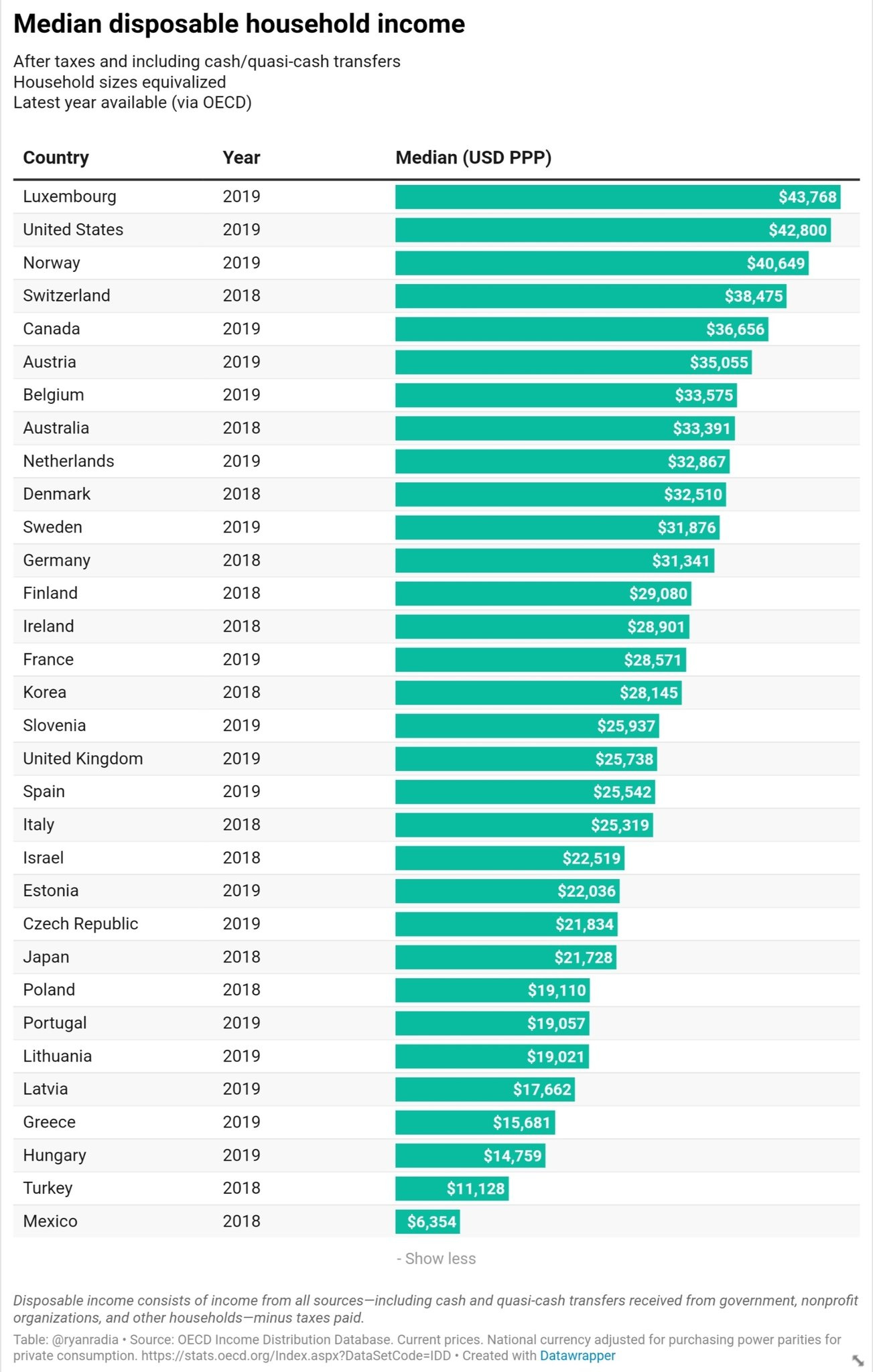
https://en.wikipedia.org/wiki/OECD_Better_Life_Index#2020
I think a more interesting point is that people in the UK and Japan specifically are poorer than you'd think they are. And they don't have working clothes dryers either.
It operates similarly to the European Account Preservation Order, and under the right circumstances it is possible to apply for a freezing order on a _without notice_ basis meaning that the employer would not be aware of the order until it is issued.
Oddly enough, after we 'mutually agreed to terminate my employment' there, I got a call from the director of another department offering me a job in his department and, most surprisingly, a really glowing recommendation on LinkedIn from the very manager that fired me.
I don't claim to understand it. But I do understand why the company had such high turnover, and why the guy I had been hired to replace had gone on mental health leave and just never came back.
If these companies weren't comprised of weasels and wannabe tyrants, I think everyone would be a lot better off. I guess being a manipulative, greedy asshole is just human nature though.
If the court ruled in their favour it would have been insubordination.
In my contract, it says there is a few months' notice period, both when I want to stop working there as well as when they want me to stop working there. When reviewing the contract, it sounded reasonable and I just assumed that when I get the notice, that's how it is.
Later, I learned of these "there must be a valid reason" type of protections.
Does that make this whole clause void? Or even working in my favor, that is: even if there is a valid reason, our contract adds those months of notice period?
The answer is yes.
Stay away from courts! If your case goes before a judge, you're in casino country. Unless you're on the hook for some criminal offence, tell your lawyer to negotiate a settlement. Once a civil case comes before a judge, that usually means that there's a legal issue to be decided that nobody agrees on, which means that you can't predict how the cookie might crumble.
I don't know how much you'd have to pay me to accept to be treated like a child or a slave for eight hours a day, but it's going to be a _multiple_ of what a reasonable boss can get me to work for.
It happens all the time.
Personally I value my "work". That is not to say I value my efforts for my employer which makes this hard to explain.
I do not find value is laying around, vacationing, sports, or any other traditional "leisure" activity. I like to work
So even when I am not "working" for pay for my employer, I am still working. I am going a personal coding project, or working on my home, or working on my car, or working in some other way.
I work... weather it is for pay, for my own personal pleasure.
That's not working, that's having hobbies (and it's a good thing)
I am willing to bet, that if you met many of these people in the 40's and 50;'s (where I am today) they would have the same statements.
I too sometimes regret I am not closer with family, or have more "friends" but at the same time I do not have the desire to change that reality at all...
It is complex psychological problem for me I have always since my teens been a "loner", I do not have the mental stamina to be around people for long periods of time. Once of the reasons I would attracted to computer programming, even when working in a "team" you work alone for large periods of time.
To be clear I am not really a introvert or rather I am both an introvert and an extrovert when the situation requires it, I can carry a conversion, I can be "the life the room" but I find it mentally draining and exhausting to the point where if I am at a conference for example, I need a few days completely alone after to decompress.
So sure I sometimes regret that was not born with the mental gift of being able form these close continual bonds with people... but at the same time I dont have the desire to change that element of myself... if that makes any sense at all.
In the Netherlands court, the legal fees were sub 1k, and the decision happened less than 2 months from the filing.
Regardless, it would certainly be much more expensive in the US, where decent lawyers are hundreds or thousands an hour.
It’s not unlikely the employee from the article used their services, even if just initially.
He spent time himself researching the law and going through the process, but he can't claim for that
Of course, that's an old picture of the country; ~10 years ago when everyone though of Tokyo as a place where kids hung out on the street in cool fashion all day, that's because those kids were unemployed because they weren't willing to become salarymen. And there has been real reform towards productivity since then.
Also, Japan’s Phillips Curve looks like Japan.
It is frozen at the exact size and breadth that US wanted to freeze it. Its a literal economic colony.
> But this is mostly because "sacrificing and hardworking" was a dumb thing to set up the country to be
It worked until 1991.
I very much recommedn reading about the Plaza Accords.
If you are a professor, you are not one of the 'most of us'. For most, things are really that bad.
https://www.cnbc.com/2016/12/13/americas-dirty-little-secret...
There are millions of working families where both parents and even children work and yet they still suffer hunger.
We don’t even make that much by US coastal standards.
My retired grandparents have total monthly expenses of $3k but make $12k/mo from their pensions plus around a million in retirement accounts. Their entire careers they barely made more than the median household income and had kids.
The advantage of making a lot of money in expensive cities is you get an amazing deal when you pay “world rates” for things. But living in cheap medium size cities gives you an absolutely fucktonne of purchasing power. Our total monthly expenses including rent, utilities, internet, food, insurances, gas is less than $2.5k and we live in a nice well appointed flat.
For a software engineer, I’m not sure if the Netherlands makes sense. For everyone else, I’m almost certain it does.
We implemented a coaching system for our support team about a year ago with the explicit purpose that individual coaching does not directly affect KPI, and that as much coaching can and should be done freely without worry of impacting the support team. The system tracks both the person being coached and their team lead who does the coaching. The coaching is directed to be as instructive as possible, that it's not about punishment, but better ways of handling specific technical situations or adherence to the support policy.
Long term reviews consider not just the person being coached, but also the leader as well, as a high number of coaching options across multiple persons on the same team would suggest an issue with the leadership as the root cause, and more qualitative reviews focus on that element as well. The entire point is to ensure that Performance Improvement Plans don't have to be a thing, and that there is constructive feedback flowing into the system.
Adoption was slow, but with strict adherence to what a coaching instruction must include, we've seen exceptionally high improvement and much calmer conversations when mistakes are made since the support persons realize "this isn't a KPI penalty or a PIP; it's just trying to prevent that." Having the system "open", i.e., the support persons can see every entry they have at any time with a few clicks of a button means no secrets.
It's a lot of documenting, but so far we're seeing a ton of success with it and positive feedback to having this process for constructive criticism, and the focus on also considering "this might be a leadership issue" also helps add some comfort.
I get the logic, but as an American I was surprised… I was never PiPed but I too would have assumed it was better than the alternative. Not always!
Case law is a thing in civil law systems too, it is just not binding on the judges except special occasions.
The US has lots of anti-black listing laws in almost every state that would make something like that very very illegal
HR departments have a workaround though - instead of a bad reference, they will simply confirm that yes, you worked there. Nothing else.
I have had very close interactions (details below) with managers who completely fabricated “poor performance” in order to PIP the target out of a job.
In both cases, I had the PIP target secretly work in tandem with a star employee to produce work that was considered top notch work up and down the management chain.
In both cases, the manager took a cursory look at the work and completely dressed down the PIP target verbally and in writing with little or no constructive feedback.
One manager was fired, and the other manager was out to pasture to work on meaningless solo projects (necessary due to organizational reasons).
I am not sure how common this is, but managers who are slightly more intelligent about it can fairly easily set up a PIP target to fail while technically providing constructive feedback.
One of the cultural problems in this org was that pretty much 100% of the managers were bad/inexperienced/untrained, so the unwritten rule was to not monitor the administrative actions of other managers. I was brought in basically to protect them from potential lawsuits that would have had merit — they were incapable of doing this internally.
> I think the point is, if a company is going to abuse employee, that will happen with or with out a PIP
Agreed.
> but even with abusive management having that process IMO is better than not
Sort of, imho. What I always tell people is that they should consider their PIP period as a type of severance and look for another job aggressively while they are on it.
In the handful of orgs that do PIPs well, the folks will usually know that the process is not punitive. I will add that I am fairly certain they every relatively large org I’ve known that does PIPs well also gives folks an opportunity to transfer if the job is not a good fit (assuming the target is not a bad apple, which is a selection problem).
Anyway, I agree that PIPs could and should be an effective tool for remediation. That said, I am not sure it’s any better than undocumented managerial capriciousness and malfeasance since usually all it really does in these situations is slow down the bad behavior slightly.
If anyone gets randomly fired by a bad manager in an org with no PIP, they are probably better off just being out of the org in general rather than suffering for a few months in a sham.
- 4 weeks paid holiday
- 4 months unpaid parental leave, 14 weeks paid for the mother
https://en.wikipedia.org/wiki/European_labour_law is the best overview I can find.
Like, there are insurances and government assistance programs that businesses use to pay for things like parental leave.
US businesses get no such help. So what is often attributed to US business greed is actually political greed, while businesses are just casualties.
>Like, there are insurances and government assistance programs that businesses use to pay for things like parental leave.
>US businesses get no such help. So what is often attributed to US business greed is actually political greed, while businesses are just casualties.
It really depends what are we talking about. In case of paid holiday leave (for example in Poland) everyone in normal employment gets at least 2 uninterrupted weeks by law. However even in my very first job many years ago I got 4 weeks total paid leave. All the pay gets paid by the employer.
However, there are things like maternity leave that can take a year. It is unreasonable to expect an employer (perhaps a small business) to pay an employee for a year of maternity leave. So during this time one is entitled to 80% of their pay, but it is paid not by the employer, but the national insurance. The actual amount taken by people varies. It can be split between parents, voluntary given up etc.
Then there is sick leave. If I remember correctly the usual thing was for the employer to pay for few initial days, the rest was paid for by the local equivalent of national insurance.
In IT 26-28 days are common.
Subordination is a role you opt into. Obedience is something you can't get away from.
You take a job as mailman and then you are a subordinate to the postmaster. Refusing to carry out sensible and appropriate orders (without a valid reason) is insubordination and grounds for being fired (more or less) on the spot, even in Scandinavia.
What counts as an appropriate order and a valid ground for refusal is probably very different in different regions/countries/states, but the basic dynamic is not.
Stigma around being on a corrective performance plan should be removed?
BTW: If anyone finds themselves on any sort of "performance improvement plan", do the BARE MINIMUM to not get fired outright. Ideally go to a therapist, talk about how stressed out you are and how fucked your situation is, and get an official FMLA (legally protected leave of absence). That'll give you some time to relax and look for a new job. Don't let your boss or website trolls gaslight you into thinking you can't find a new job that will treat you better.
When someone is on a PIP, the expectation is “that person is about to get fired”
This is the stigma we’re talking about.
Some people feel degraded when they go through airport security, but it doesn’t carry a stigma. Nobody’s judging you for going through security so you can fly.
Swap the US and Russia and replace "Ukraine" with "North Vietnam" and you have a historical conflict which everyone agrees was a proxy war. How is this different?
You seem to forget Ukraine in this equation entirely, you know, the country that is the victim of Russian aggression including murder of civilians, rape, and theft.
They are constantly begging for help to fight the invaders. Is it remotely possible that's why the US is helping for this reason and to stop Russian aggression?
Any "hurt" Russia receives is entirely self inflicted. This is a war of their choice.
I don't know how people buy such uninformed BS. First, a lot of ex-USSR states are already NATO members. So, no game.
Further, USSR was a political construct. Their whole expansionism was based on that. Russia on the other hand is a nation state. They are not capable of annexing any region where there is no Russian-speaking + Russia-aligned population. Putin knows that very well.
As put by people who probably know better [1]:
One obvious difference between the Soviet Union and Russia is that the Soviet governing elite embraced Marxism-Leninism and its objective of world revolution. Today's Russia is not a messianic power.
And obviously, all actual fighting and dying is done by Ukrainians. They are the ones being tortured and oppressed on occupied territories too. If Russia won, all Ukrainians would be oppressed by Russia.
https://en.m.wikipedia.org/wiki/Right-to-work_law
All the states are At Will, but a number of them have exceptions that provide certain protections (ex. Not being fired for following the law):
Wtf?
No, "right to work" is not the opposite of "at will," they have almost nothing to do with each other. Furthermore, Texas IS a "right to work" state.
"Right-to-work" laws are laws that make joining a union not a requirement for employment.
All states in the US are "at will" employment.
Sounds like a good way to burn bridges. If I'd show up to work one day and tell them to suck it up for the next few months of planned projects, I do know what kind of reference my boss would provide to future employers.
It's not about loyalty or something, but so long as there isn't anything egregious, it does seem reasonable to me that both sides can expect a notice periods.
Two weeks is pretty customary and normal in the US. A few months of planned projects being a reason you "can't" leave really is not. I generally have projects in some stage of planning going out a while. That wouldn't mean I'm effectively tied to an employer for te duration.
After the trial/probation period where this notice period is not in effect, when I know what the employment is like, I'd much rather get a 13% higher salary and, should I choose to quit, wrap things up properly and do the job for 2-3 more months. (The notice period is not as long as we schedule ahead for: with 2 months' notice, we can find a good freelancer and get the paperwork done without time pressure, or the client can still find another firm in the worst case.)
Since I was fine with doing this job for years now, those months seem insignificant for the benefits that go both ways.
Reread my posts
"Yeah, if you disregard all the poor people that struggle to stay alive, us rich people are generally much richer".
I think your exact statement is probably true. Because most European countries tries to distribute wealth in such a way that everyone gets to live, with food, healthcare, education and housing. And naturally that means that the 50% wealthiest in Europe are less wealthy than the 50% wealthiest in the US.
But the 50% poorest in Europe are much wealthier than the 50% poorest in the US.
I know that you Americans use the word 'middle class' in place of 'working class'. No, a professor would not be 'working class'. Its lower upper class at the least. Both in Europe and the US.
Even for the public university case, the Europeans have benefits that you likely don't calculate. From getting state-subsidies per child to rent control to many different things. You shouldnt calculate the difference just over pension, medical and housing.
If I tell you to go buy 10 apples, refusing would be insubordination because it's legal to buy apples.
If I tell you to go steal 10 apples, refusing would not be insubordination because it's legal to buy apples.
Until the court ruled against them, the view of the firm would have been it was legal to require someone to have their camera on. Hence they viewed it as insubordination to refuse.
They are wrong, it's not insubordination, but it's not unfair of them to think it was.
The employer was also found wrong by a court.
Up until recently, it was a given. In the case of Japan, there is some kind of feudal behavior of 'loyalty' that comes from the Zaibatsu culture. Which in itself descended from postwar Yakuza.
> We can't even stop Saudi Arabia from raising gas prices whenever they want to annoy us.
You used to. Until Russia & China built up enough defense industry and also started helping any country against US coups and color revolutions by providing intelligence.
...
There can be no bigger enemy than the country that blew up European pipelines to sink European industry.
https://www.bloomberg.com/news/articles/2022-03-09/european-...
Also, Greece is not staying as away as you may think. First EU country to send military supplies to Ukraine. Supplies were complete junk btw, so you can even call it a lose-lose gesture. Worse, the only external country who has a PM stupid enough to say in an interview "we are at war with Russia" [1].
[1] https://www.tovima.gr/2022/09/22/international/mitsotakis-de...
It definitely is not Germany's war. Various openly-published American think tank papers openly call for German industry's destruction and outline plans for it. One example went viral recently.
> if we had any kind of deal to stop the war tomorrow, they would be more than happy and eager to start discussing (energy) business again.
Yep, after the US literally went ahead and blew up the pipes when things looked like settling down, many German establishment figures seem to have changed their minds. But it may be too late. Even if repairs start tomorrow and both pipelines open, its unlikely that they will complete before the winter is over. And that will likely castrate German industry.
> Also, Greece is not staying as away as you may think. First EU country to send military supplies to Ukraine. Supplies were complete junk
Lol, Spain did the same - first it sent a few thousand rifles that were practically remnant of the Spanish Civil War or early WW2. Then it offered to send Leopard tanks IF Germany gave permission - therefore throwing the ball on Germany's court. Of course Germany couldn't allow it, so the tanks were not sent. Then in the 3rd run, when pressured to send artillery shells, they just sent some 150mm shells which may or may not be usable in the equipment that the US gave Ukraine.
Greece is FAR ahead of Spain: Currently Europe is STILL buying Russian oil. But it is now 'Greek' oil. As long as you have at most 49% Russian-sourced oil, your oil is not Russian oil. So you can sell as much as you want. Greece had been doing crazy business. It may end up as the country that comes ahead of all others in the crisis.
As a very ironic note, Latvia is also selling Russian oil. Shiploads of it. But its 'Latvian oil' since its only 49% Russian.
It looks like business does not follow rhetoric.
And yes, Italy is rather pro-Russia.
And you are wrong in other way too - Germany does everything possible to not deliver arms to Ukraine. They are tempted by that Russian money and did not get off the imperial against east thinking entirely.
> And yes, Italy is rather pro-Russia.
Its not "rather". Entire south Europe wants to avoid this US proxy war.
> They are tempted by that Russian money and did not get off the imperial against east thinking entirely.
Yeah, instead they should drop whatever thinking they have, become an Angloamerican colony, and get into an actual war with Russia on their behalf. Sure makes sense.
1. The act of subordinating, subjecting, or placing in a lower order, rank, or position, or in proper degrees of rank; also, the state of being subordinate or inferior; inferiority of rank or dignity.
2. Degree of lesser rank.
3. The state of being under control of government; subjection to rule; habit of obedience to orders.
4. The act of subordinating, placing in a lower order, or subjecting.
5. The quality or state of being subordinate or inferior to an other; inferiority of rank or dignity; subjection.
6. Place of inferior rank.
7. The process of making something subordinate.
8. The property of being subordinate.
9. The quality of being properly obedient to a superior (as a superior officer).
As you see when you expect your dog to be obedient your are placing yourself on a higher rank, so your dog is your subordinate.
When you expect your employee to be subordinate your are expecting him to obey when something is asked or tasked from ranks higher than their's in your organization. Your are also expecting him to obey to what is written in the subordination contract signed by both.
Wikipedia: obedience, in human behavior, is a form of "social influence in which a person yields to explicit instructions or orders from an authority figure".
What I think to be the main issue is the word "order". IMHO an order is not something that might exist in a workplace, with few exceptions. Your boss gives you tasks and expect you to execute them remaining inside a more or less explicit set of rules, your boss cannot give you orders.
It's not perfect but reasonably strong regulation of consumer insurance means that if you have problems with e.g the decision made, there is an independent organisation who can review the case for you.
You usually have to use a law firm which has an arrangement with the insurer, or one who will accept the lower rates the insurers have negotiated but again if you feel there is an issue with the quality on offer you can make a complaint.
I presume something similar is offered in NL.
We are talking about a Danish person hired by an European company. I fail to see the point of your comment.
Here is some information I could find[1].
Obviously, there is a lot of variability here, and I don't there are blanket agreements to enforce judgements. It is hard to imagine the Netherlands forcing payment for an abortion damages judgement from a Texas court .
https://www.gibsondunn.com/wp-content/uploads/documents/publ...
For most people, multiple months notice wouldn't work well. Either you quit without an offer in hand and spend half your remaining time job hunting or you have an offer but your potential new employer won't wait more than a month. I'd certainly think very hard before entering into such an arrangement as it would make getting a new job riskier.
Then you are forgetting about Georgia where Russia fought a war in 2008 resulting in Russia creating South Ossetia on Georgian land. Exactly the thing they now tried to do with Luhansk and Donetsk.
Then there is Kazakhstan where Russia did a military intervention to support the government in 2022, this year! Although, Kazakhstan seems to want to sever the ties to Russia now.
I have a feeling that you don't know anything about this topic and just read a single article and now feel informed while in reality you were hit by Russian propaganda. The author of the article you posted thinks that NATO made Russia invade Ukraine by expanding to far East, explicitly following Russian talking points.
Thankfully, in Europe, unions have harshly fought for somewhat fair employment laws and this relationship only applies to actual work and not the whimsies of your boss.
Not to mention that the company was already monitoring keystrokes and requiring screen sharing. This indeed is some slavery mindset.
https://www.merriam-webster.com/dictionary/superior
Boss is by definition superior to your position, not in a sense better, but higher.
don’t be hoodwinked by bad analogies, or the arbitrary demands of insecure narcissists
in this particular example, the legal date for termination in austria would have been december 31st (because by default it is 6 weeks notice after august 26, to the nearest quarter) in germany it would have been september 30th.
and for termination without notice
https://www.arbeitnehmer.at/kuendigung/entlassung/
pretty clearly spells out the reasons when someone can be fired, which contradicts your claim that people can be fired for no reason.
I think you are misunderstanding. Unlike Austria, in most others EU countries you can't terminate employees, even with notice, without providing a reason.
it seems that austria really is the bad exception here.
When they're objectively worse than every other EU country, bordering on competing with the US, I can hardly call them "fine".
>If you make rules around dismissals stricter then you greatly harm the ability for a company to hire in the first place.
Please stop parroting the propaganda of the conservative party (ÖVP) who are bought and paid for by the business elite and would gladly tell us working 60h/week is in our best interest. The stricter employee protections in other EU countries haven't harmed the economy or innovations there. Do you see Netherlands or Sweden doing poorly economically because of their better employee protection laws? In fact their innovation and tech sectors are far above Austria's.
Nor did the lack of employee protection laws boost Austria's economic sector. Have you looked at Austrian skilled wages? They earn the lowest wages of all the German speaking countries causing an exodus of doctors and other skilled specialists to Germany and Switzerland, while Austrian devs make Eastern European wages. So how did the lack of worker protections help with this?
Maybe fixing the needlessly complex and conservative bureaucracy and high tax burdens on employers and employees would help improve the Austrian economic sector and make it more competitive and attractive for business, instead of taking away employee rights in a race to the bottom hoping that going the sweatshop route will make it more competitive.
If you think that you will get better wages if it’s harder to dismiss employees I have doubts. The main reason devs don’t earn enough in Austria is that it’s hard and expensive to have a business there and that the country is not appealing for employees. That means that the few good IT companies have a small labor pool and need to relocate developers for whom the country is not appealing.
The reason, I believe, is that there are random checks by the health service to ensure people on sick leave are actually sick. But if you only take a day off due to a headache, by the time it gets registered and checked you could have already got better - so your claim is hard to verify.*
A dishonest employer could easily defraud the system by claiming a lot of individual, unverifiable "sick days" and getting the state to pay for a nice chunk of his payroll expenses.
By contrast, an employer gets alerted sooner of an absence and is in a much better position to guess whether an employee claiming fake sicknesses. In case of suspicion they're legally allowed (at a small fee) to have a physician check on their employee from day 1.
* now that I think about it, with everybody having a camera phone nowadays, this might eventually be solved - a video call might not be enough for a diagnosis, but it can probably tell "yep you're sick" with a reasonable degree of confidence?
When I was there that was how this was done. Basically you would always get a reference letter when ending employment. The reference letter's language always sounds good, as in not giving a bad reference. However, a reference letter that states things like "employee X delivered his tasks on time and to the satisfaction of work standards" basically means that he's a slacker that does mediocre work at best. It has to say something like "We are ultimately saddened for employee X leaving because he always delivered his work early and to the highest standard thinkable". These are bad made-up English language examples to show the difference in language but there's basically template language HR departments use for this.
https://www.arbeitszeugnis.de/presse/geheimcodeliste.pdf (German)
This shows that there's a conflict: law forbids to discriminate someone with a bad review of their capability, motivation or fitness. But people always seem to try to work around this prohibition. Like giving a friendly declaration that someone worked at a company if they weren't impressed and give an enthusiastic recommendation in the other case.
I didn't bother, but if my future plans had included being an employee at a big company in Germany I definitely would have done so.
That's the norm in most places, isn't it? He didn't steal anything, he wasn't sacked, he didn't punch-out the boss, and he didn't shit on the carpet.
Nobody wants to be sued for giving a decent reference.
My dad was a soldier; his retirement reference (age 45) said something like "He is an oustanding officer who will succeed at any enterprise he turns his hand to". That impressed me, until I learned that any officer retiring from the army will get a reference pretty-much the same.
Note that retiring from the army at age 45 is very common. If you get to 45 without getting promoted past colonel, you need a new career, because serious promotion happens when your CO gets killed in combat; and beyond about 45, they won't be sending you into combat.
I never knew in Germany one is expected to obtain actual proper reference letters from past employers. Good to know just in case.
Long time ago (15+ years ago) I had worked in Poland. Back then I did get a written reference from the company I worked for. I can't say if those letters are required these days in PL.
This works in the US as well.
The world just isn’t that limited, thankfully.
Tip: think about why you had to put “superior” in quotes.
The best option is to take the decision from jurisdiction B into a new court proceeding and jurisdiction A and ask them to honor it with a local court order in A.
They may or they may not.
Even within the United States you might have a court order in one state or payment, and another state that refuses to enforce it within their jurisdiction.
Except that that is often not the case, because of things like federalism, treaties and so on. Anyway, you're missing the point; you're now talking about a judgement from jurisdiction B, whereas earlier you were arguing that the rules from jurisdiction A could apply in jurisdiction B.
If a plaintiff goes to jurisdiction A with a judgement from jurisdiction B (eg pursuing the money as you suggested), you wouldn't retry the case under the rules of jurisdiction A. The reason is that the defendant (in this case the company headquartered in Florida qua jurisdiction A) agreed to the rules of the Netherlands (qua jurisdiction B) when it filed to get a business license there.
It would be different if a Dutch worker had sought employment with a company in Florida, and then complained when he didn't like the employment standards he found himself subjected to. It's the fact that the company committed itself to NL/EU law when opening a subsidiary there that subjects them to its judgments. The issue of the business license imposes conditions upon its beneficiary within the scope of its use.
Suppose something is legal your jurisdiction but not in mine. While you are in your jurisdiction, I can't sue or prosecute you for doing The Thing there. But if you come to my jurisdiction, do The Thing, and then return to your own, you can't shake off that liability because you don't get to bring your legal environment with you. The only exception I can think of offhand is with international diplomats, who get quasi-immunity because they are formally representing a different country, and whose embassies/consulates are allowed to operate under the law of their home rather than host countries.
>Juppor is talking about suing in Florida courts. Florida is absolutely at will. He may be able to sue to collect a foreign court judgement instead
So the general taxation situation and the complexities in doing business (lots of notaries needed, slow processes) make it unappealing.
Which companies in Austria pay 100.000 Euro salaries?
Particularly relevant, is that if you want to collect in the US, you have to go to the courts in the US and show them the foreign judgment. There are many circumstances where these are not accepted.
>Juppor is talking about suing in Florida courts. Florida is absolutely at will. He may be able to sue to collect a foreign court judgement instead
If they are trying to avoid payment it will kink any activity in the EU, all over a relatively paltry sum.
The lesson though is that if you're dealing with potential shysters, like NFT promoters and other dodgy stuff this firm is doing (who else pays 70k Euro per year plus commissions to telemarketers??) then make sure they have assets in your jurisdiction that you can put a lien on, and ideally require cash up front.
A company (an employer) rents the time and skills of employees for a particular task. It's not a pool of work that employees must struggle to achieve regardless of circumstances - it's the employer's responsibility to hire enough staff.
For example, my paternity leave (20 days or 40 half days) would not impact my colleagues. Some of them can opt into overtime, but the same labor laws also define how overtime works - as an employer, you can't order someone to work extra hours unless described in their contract (and limited to the maximum specified by law, with mandatory regular breaks). Overtime is also paid at 150% or 200% of your regular pay, depending on the day of the week and hour of the day (e.g., weekends and nights obviously cost more than daytime rates). Very few jobs are even allowed to work on Sundays.
Its like renting yourself out. You don't feel owned, and nobody feels they own you. Its great.
As a person without kids I do sometimes wish childfree people got benefits in ways that have more _immediate_ applications for us as well. But that doesn't mean parents shouldn't keep getting generous leave allowances to care for their children.
There are countless things the State spends money on that I resent having to pay taxes for, but childhood and parenting benefits _definitely_ isn't among them. Go nuts.
maybe I should have added that the parental leave only applies to the mother. Fathers can just take a month off.
And since women can choose to go back to work after 1 year or even 2 years (at reduced pay until then) the kids can already go to the nursery although it's not free until they're 2.5 years old. Then kindergarten is free
That's unfortunate. Where I live parental leave is split between both parents (I think it is 480 days total), I think that works better.
> I can not image the extra amount of work that get places on people that do not have children...
What you're forgetting is the amount of work required to raise children. That's an externality that is only covered through a social contract, where everyone contributes to a next generation. Why should parents put in the extra work to raise children that, god forbid, would ever do something you benefit from?
What you want is someone else doing the work so that you can just reap the benefits. You're a freeloader, plain and simple (other, less favorable words come to mind).
Unless, of course, you will never in your life use the services or inventions of anyone younger than you. But, somehow, I doubt that - am I right? You just expect those cohorts to just appear out od thin air to your benefit.
- have high income so pay a large % into taxes
- not a citizen so don’t enjoy some of the benefits of military protection
- wasn’t raised here so didn’t use any of the earlier year services
- likely won’t retire here so won’t use those either
Most of my tax dollars goes to fund others in the country. But as a society there is no good way to account for all that. To try to do so the tax calculation will be crazy. So I’ll grumble about the taxes I pay, but end of the day I also don’t really have a better solution.
It's called society.
Housing has increased so much in cost that I wouldn't be surprised that just having housing back to 1980s price levels would give most families enough breathing room with just unpaid leave.
Rising tides and boats comes to mind.
I do not plain on retiring, and if I did I do not expect government social security (I am in the US) will be there to fund it so I do have a private retirement account that currently the US Monetary policy and government regulations/spending is doing its level best to destroy
How could income based taxation be theft unless we're considering all profit theft? Either it's immoral for someone with power over you to demand part of the value you produce or it isn't.
Only in the ultra far right US. Where everything works so perfectly because of that belief.
https://www.businessinsider.com/asce-gives-us-infrastructure...
Most of the other replies to this point are not really that helpful. The actual economic point is that since income taxes apply to /everyone/, they do not make you in particular less rich, because your relative amount of money is maintained. In fact, they're one of the main things making the currency valuable by providing demand for it, so you could say they're what make you rich.
VATs are more effective taxes at collecting revenue though, which is why most European countries use them, but only land value taxes avoid deadweight loss. Thanks Henry George.
There are better solutions (teaching individuals to be more financially responsible and kicking overly rich capitalists to the curb, for one) but that's preaching to the choir.
I'm pretty sure that the vast majority of people paying taxes for school have actually enjoyed the benefit of free schooling. It can be helpful to think of things that way... (another example: people complaining about kids being loud in planes, restaurants, etc - remember that you were that kid once too).
as for schools, to the extent I support their funding (which is more limited than I suspect you do) it is generally ethically justified because I too attended schools paid for by taxation, so in that manner I paying off a debt vs paying for others. Granted it is a debt I did not consent to, and had no option to opt out of but still there is that ethical foundation
None of that exist for what we are talking about here
and I absolutely reject the idea of a "social contract"
The problem is that then some people opt out. If enough people do that, it's no longer financially viable to have a fire service.
> I absolutely reject the idea of a "social contract"
Which is fine, but then don't live in the society. As a society, we have decided what is important for the benefit of the society; fire departments, law enforcement, schools, roads, etc. We then attempt to gather money from everyone in that society to pay for those things, because that's the only way it's realistic. Not everyone in the society agrees to all the details, but (in theory) the majority of people agree to them.
It's not all that different than living in an apartment with a few other people. If most of the people agree that everyone has to split the electricity bill, but one person says they don't want to... then it's reasonable to have that person leave, and replace them with someone that is ok with the rules set by the group.
As is quite common in the US, my fire services (as well as part of education costs--the state also contributes) are paid for out of my quarterly property taxes and my town budget is right up on the website to look at. So it's not really obfuscated. And I don't really want to get 20 different bills from my town rather than a quarterly property tax (and water) bill.
That would have to be mandatory service though (remember, firemen can perform inspections, fine people etc. - they're not there just for fighting fires), at which point it's just simpler to pay for that through taxes.
The very definition of a sociopath.
Which the vast majority of America doesn’t do either.
Companies are not charities created to employ people.
So sure if only 1 person is off on leave most likely another person could be hired
But 5 years of protected leave..... What percentage of the work force is going to be out on that? Also since it is very hard to terminate someone in the EU, what happens to the employees that are "filling" the positions of those people out on 5 years of leave? can they be terminate or do you have to keep them employed even after the original employee returns?
If you can be terminated would you take a job knowing the second the parent returns you will be terminated
Parental leave should be measured in weeks, not years. If you want to be a stay at home parent for years, leave the work force and then return...,.
The actual leave time is typically around a year. Which is roughly where you can give children over without them crying. But yeah the workload of that parent will have to be picked up by additional staff
I have no kids, don't plan on having any but it's kind of crazy how 'hail corporate' some cultures are. We're humans after all. Let people spend some time with their newborns instead of forcing them to make more money for somebody 3 weeks after giving birth.
Also in the system I work under, all employees pay a government tax that is used to pay for the parental leave. That is, the money isn't coming out of the companies pocket, but coming out of a national bucket designated for the purpose. The company pays nothing when the employee is taking this time.
And long parental leaves are just normal and common in some countries. A medium to large company has no issues dealing with them. It’s part of the management work to deal with that.
Moreover it’s better for a company that their employees don’t leave.
And employees are not charities for their employers! If you can't afford the staff needed for a given task, perhaps you should pivot to something else.
And employees aren't charities required to do things unpaid because there isn't the budget.
It works both ways
Its the workforce who votes for those laws. The workforce in Europe are not propagandized fools to the extent that they vote against their interests.
And is for things like this that libertarians shouldn't make laws
slavery ended thousands years ago
Aside from the fact that since most homes are covered by a mortgage and mortgage companies would require that as a condition of a loan, no where did I really say to make it optional. I simply said I wanted an itmized bill for the service
I am required to have water service turned on as part of occupancy, I can not turn off the water service to home even if I wanted to live completely on bottled water, it would be against local ordinances. I am required to pay that bill monthly, if I turn it off I would get fined by the city, and at some point they would take my home
I am also required to mow my grass, and other such things, I fail to see why fire services would be any different.
>It's not all that different than living in an apartment with a few other people.
You are correct on that front, I despise apartment living and I also despise HOA which is why I took great care to avoid both in my life.
If star link or a competitor proves to be very successful and gets to be cost effective then Rural living may even be in the cards for me, one the only reasons I moved to where I did was because of the availability of high speed fiber optic service.
Why do you assume I would think it is someone else's duty to provide anything to me? This seems to be a bit of projection.
A good standard of living was possible with a single income 50 years ago (just). It's barely possible today with two average incomes in much of the US.
You'd only want to not work if your job couldn't effectively contribute to the household (you're already rich or your spouse is a super high earner) or else you can't pay for the childcare work you're no longer doing (you're poor). Both of you working is a sign of being middle class.
(Which isn’t to say we should make them work less, but we should get them smaller trucks like other countries have.)
Personal I am supporter of the Henry George Single Tax model to fund society instead of income based taxation
Don't invent stuff to make an argument. Wage slavery is what happens in the 'free market'. The very invention of wage slavery was to make conditions of slavery happen after slavery was abolished so that former slaveowners wouldnt go bankrupt. It was implemented in post civil war US, then it was copied by Brazilian slaveowners when slavery was abolished in Brazil.
Progressive taxation is our most effective tool for ensuring that a few people don't end up owning everything. For those of us who end up wealthier than the rest it's the price you pay for society providing you with a healthy, educated workforce, currency, roads etc.
In fact history shows that government is generally pretty poor at providing any of those things
These are choices I make in a free(ish) market. Companies offer their goods, I choose to buy or not
Similar with labor, I go to the market offer my knowledge and labor for a Wage, if I set my price to high companies will refuse to hire me, if I set my price to low I am missing out on profit.
Income Taxation is in no way voluntary exchange like that, the government with the full authority to initiate violence injects itself with a demand that for every hour of labor I sell I must provide the government with a 10-40% cut of not only my profit from the sell but the gross transaction price. They do so under the threat of violence (aka imprisonment) if I refuse their order.
The fact is that the government, like a common thief, says to a person: Your money, or your life...The government does not, indeed, waylay a person in a lonely place, spring upon him from the road side and, holding a pistol to his head, proceed to rifle his pockets. But the robbery is none the less a robbery on that account; and it is far more dastardly and shameful.
Take a weekend off and calculate how much 'fees' you would have to pay for 'private defense services', infrastructure, judiciary, police and all the other things if they were made private.
> The fact is that the government, like a common thief, says to a person: Your money, or your life
What religious delirium.
> But the robbery is none the less a robbery on that account; and it is far more dastardly and shameful.
The dastarty act of providing military, police, firefighting, law, justice, social services - all the things that make you live in a modern society instead of living in the former late feudal society where you wouldn't even have the social rank in order to be able to talk against your feudal lord in public like this.
There is no magical, divine, extraterrestrial or supernatural force that provides this modern society that you live in, and all the rights and freedoms that you have in that society. We, the people, have managed to make that happen through the mechanisms we invented. And one of those mechanisms is the state that is owned by its people.
If I don't support these things, or wish to take away their funding due to my displeasure with the service received I could do that if they were private. I cannot do that when every year the government puts a gun to my head and tells me to pay them 30% of my gross.
You've fallen into the classic socialist false dichotomy. Either you support taxes or you will be a serf.
The truth is taxes are the payment you're giving your lord (the government). You don't even own your own property. Try not paying your property tax (maybe it's too expensive?) and they take it away. Try not paying your taxes and they will start to take everything you own. This is the definition of theft. Coercing someone to part with their property through threats of violence.
All taxes are evil. A good compromise is the ability to take 5 extra minutes on my 1040 to put percentages where I want my money to go. I dont care if this overcomplicates the situation. We take in trillions in taxes a year and yet the only people who seem to benefit are the Nancy Pelosis. Somehow despite being a public servant is worth more than many top-tier entertainers. If I could put most of my money into school, hospitals, firefighters, and EMTs I would. Why would I fund police who drive around in veritable APCs treating every honest hard working American as a potential "insurgent" in their own land? Why are my tax dollars being shipped overseas to Ukraine when there's uncountable suffering here? Because we don't control it, our money is stolen, and the ill gotten gains are used to do whatever the kings and queens in congress decide. We are serfs, they've just managed to hide it.
Ask yourself do you feel good about where your taxes go?
>What religious delirium.
Like all socialists, you are the delirious one. It's just socialist indoctrination has better tasting koolaid with less assumption of responsibility.
This assumes alot of things, like that I reject all forms of taxation which I dont just income based. You know this because you already replied to a comment where I layout my preferred public finance model which you also ignored in that comment in favor of a semantic logical fallacy debate. so i question if you actually want to have an honest conversation
Also it assumes that the cost to private those services would be the exact same under a more private / direct model then our current system (for which my point of view would the the US model). I find that highly suspect and the few times were we have direct attempts at it has proven the current US model has inherent fraud, corruption, and waste that often raises the cost of providing these services by 2x or more.
>What religious delirium.
That is a bit of projection there. Like an adherent to a theocratic religion proclaiming Atheism is a religion. If anything Statism is more akin to a religion than being anti-state or libertarian.
Individualism is about the rejection of a "higher power", in your case this higher power is "the state" having replaced a god or gods
>ll the things that make you live in a modern society instead of living in the former late feudal society
False dilemma fallacy, as if the only option is a extreme over bearing high taxation state or feudalism...
> force that provides this modern society that you live in
Modern society was build by voluntary exchange of free individuals, not government.
> all the rights and freedoms that you have
neither rights nor freedom is provided by government, the entire US model of government is build on the fact that freedoms and rights need to be protected FROM government, the US Constitution is document to ensure government does not infringe upon the people as our founder knew that a government is like fire, a handy servant, but a dangerous master.
Government is to be subservient to the people, not a master of them. At all times the people need to be suspect of government power, and keep very tight control upon it.
How is paying employees to sit at home not working anything other than charity/
They are not sitting at home doing nothing, they are raising children. Helping them to do that is companies' share of investment into the workforce of tomorrow. Your utilitarian "fair" worldview doesn't account for the fact that having kids is insanely profitable to the economy. In modern economies, every kid is worth at least a million bucks over lifetime.
If you choose not to have kids and not contribute in this way, then who's going to foot the $1M or $2M bill for you?
I live a very frugle life, my expenses are low, I have no kids, I dont take expensive vacations, drive a fancy car, etc...
So should that mean I do not get time off, or high raises, etc simply because my "needs" are not the same as a co-worker?
Why should a co-workers personal life choices (i.e the choice to have 1 or more children) be a factor in the terms of their employment?
I think employment policies should be agnostic to the personal life choices and situations of employee's infact the employer should not even know if you have kids or not, let alone provide you with "extra" because you do
Sounds like you would support a policy of income based on your personal expenses. Should the programmer with 5 kids make more than the programmer with no kids simply because the programmer with kids has more expenses?
To me the obvious flaw in this type of society has always been that it provides no guard against the concentration of wealth and by proxy power. It works with a theoretical amorphous blob of people who have no ties to location and an infinite supply of land and resources. In reality the populace would quickly become slaves, with the only interest of the organisations in control of their food, shelter, and transport being the extraction of ever larger sums of money.
I'm honestly not sure how someone could look at the state of the corporate world and say "I wish these guys controlled more of my life". We've already seen this type of rent seeking become prominent in digital media and it hasn't improved anything for the populace.
The profit motive is functional enough for things that aren't necessities but we know exactly what happens when a profit driven entity has a near or local monopoly on something necessary for life. Look to the early railroads and company towns as an example.
> In fact history shows that government is generally pretty poor at providing any of those things
That's a bold claim without any proof. I'd argue the opposite. The vast majority of the population is now both numerate and literate and most countries have a usable road and rail network that's accessible to everyone. Beyond that government programs have been responsible for the eradication of multiple diseases.
And who does history shows as being better at it?
Yeah, you could just 'take away its funding' and just do away with the military in a private environment. Which brings us to...
> Like all socialists, you are the delirious one
...the delirium of thinking that you would be able to keep your freedom and agency at the moment which you lose that socially-funded, democratically controlled military after you take its funding away in a private market environment. Which will make you immediately a subject of the richest man who did not take away the funding of the military outfit he supports.
> All taxes are evil.
The people from the country that kills its people when they cant pay for healthcare is telling us that all taxes are evil, even as their very infrastructure collapses.
THAT is delirium. Nothing else.
It'd be far more desirable to return to situations where most of the budget is spent on luxury and only a little is spent on any kind of milestone, but that's a campaign most politicians aren't winning votes with.
Ironically politicians "stepping in" is the biggest reason cost of living is going up. Regulations preventing new housing, limiting new housing, etc. Monetary policies and massive debt fueled spending spree's causing massive inflation, draconian lock downs disrupting supply chains, irresponsible "climate" policies preventing farmers from growing food affordably, the 100's of other ways "politicians stepping in " to "solve" a problem in the process making everyone worse off
Neither bad regulations nor the free market are going to solve a lack of foresight. Worse, those regulations are largely devised by politicians in power voted by a majority of homeowners and a few ultra rich lobbyists. You might as well make a "always has been" meme out of it.
Same goes for every other of your points. If free market capitalism would solve it, it already would have.
but how about universal basic income instead?
BUT as society gets more and more wealthy, I'll bet that living on the fringes of it will be more and more viable
We're already at a point where you can work minimum wage for an hour (take home ~$7) and buy a few days' worth of subsistence-quality food if you have access to a kitchen. You can pare down your other living expenses too, and suddenly you have a reasonably comfortable lifestyle that only costs a few hundred bucks a month.
Right now we stigmatize "van dwellers" and couch surfers, but maybe that'll change in the future
But this video explains it well, people would still work, just not for a living.
Instead, it's African countries and then ones with more practicing religious people who do.
Plus, as noted elsewhere, you are getting benefits from the taxes you're paying now, only just on some of it.
Eg if I make a million a year, I might pay 500k in taxes. Someone making 50k a year might pay 10k. I don’t get an extra 450k a year worth of benefit from my taxes. This is intended and is ok. But I think we should also acknowledge that this happens.
I don't know which country you're living in, but surely the money you paid into a pension scheme - be it public or private - doesn't just disappear because you moved to another country?
Spain is famously full of UK pensioners receiving and spending their pounds there. Heck, my father worked for a few years in Belgium in his youth, without even being a citizen, and that still entitled him to a (minuscule) Belgian pension later on, in addition to his more substantial one from his subsequent decades of work in a different country.
Can you explain what you mean by this part?
If non-income based taxation worked, societies would be using it. Every single form of taxation was tried throughout history. This is the one that works.
> That is a bit of projection there.
No. The ones who BELIEVE that things will 'just' be 'okay' if they just leave things to 'the market' are repeating the Christianity's format of faith. That there is a 'good god' that will just make everything 'okay'. That's why it is faith.
> Individualism is about the rejection of a "higher power", in your case this higher power is "the state" having replaced a god or gods
Organized, well equipped and trained authoritarian forces do not give zit about the rejection of their authority by the individual people. The moment you lose the guarantor of your freedom and rights - the democratically owned and controlled society - is the moment you are a subject of the strongest armed bunch nearby.
> Modern society was build by voluntary exchange of free individuals, not government.
The modern society was built by literally the organized French Revolutionaries deposing the aristocracy, making everyone equal and creating a social and legal system that ensured that. There hasn't been any 'voluntary exchange' of power on the side of armed, organized minority tyrants.
Neither the society was formed in American Wild West, where if you were upset with your local environment, you could just kill some more Indians and steal their land and prop yourself up on the stolen land in the most libertarian fashion.
Such philosophy is great while there is free land to take. The moment the free land runs out, things change. Just like how it happened at the end of 19th century in the US.
> the entire US model of government is build on the fact that freedoms and rights need to be protected FROM government
Yes. And that's why the US is in knee-deep sh*t. Becaue large slaveowners who had gigantic amount of land, wanted to protect their land from redistribution like how it was done to the deposed English nobility. Hence you got 'checks and balances' to prevent the democratic majority from asserting their will, with an openly declared intention by the architect of your constitution, John Adams, that the 'opulent' (rich) must be protected from the 'tyranny of the majority' (the people).
And as a result, you are killing your people when they cant pay for healthcare, 42 million working families are suffering hunger, you are still paying the $4 trillion Iraqi war debt that you accrued for the privilege of murdering 1 million Iraqis, and your infrastructure is failing.
But hey - the rich are far richer. So that is 'okay'.
They do, very successfully and most of the government services you and others have aurgued with me about income tax providing are not infact provided for by income taxes in the US. Roads, Schools, Police, Fire, etc almost none of that is funded by Income Taxes, it is funded by Property Taxes, Sales Taxes,and excise taxes.
In the US income Taxation is used for 4 main things. Social programs, National Defense, Science (Nasa, etc) and Administration / regulation
>the democratically owned and controlled society
Ahh the religion of democracy. also known as 2 wolves and a lamb voting for what they will have for dinner. This idea that democracy "provides" rights is laughable for anyone that understands anything about history which clearly you do not
>you are still paying the $4 trillion Iraqi war debt that you accrued for the privilege of murdering 1 million Iraqis, and your infrastructure is failing.
It si very ironic that you defend income based taxation, most likely because your socialist mind believes that is the way to "eat the rich" never realizing that income based taxation is the fuel for the engine of the war machine, and absent income based taxation the government would not have the ability to use the war machine in that manner. You are defending the very tool they use to murder people but you are soo blinded by your jealousy of the rich you believe would get ahead under a non-income based system you fail to understand that the rich WANT an income based system of taxation, that income based taxation is regressive (not progressive like proponents of the so called progressive income tax claim), and that a single tax system could be used to create universal income, and would actually help reduce income inequality
Smash the State, Eat the Rich[1]. The freed market, without all the distortions and giveaways by the state such as price and wage controls, licensing and safety requirements, limited liability, costly regulation, capitalization requirements, quantitative easing, financial regulation, zoning requirements, protectionist trade policy, intellectual property laws, and various other barriers to entry all promote centralization and cartelization, is truly an equalizing force
US police is not an example of anything. They are literally fining people to fill their quotas to support the budget, leave aside their murderous practices. American schools neither are - the quality of American education has gone downhill since state-subsidized education was done for. Your roads are literally disintegrating, brigdges are falling down as people drive on it.
No. Those schemes just do not work. They never worked in history for any society, and they don't seem like working in the US.
> Ahh the religion of democracy. also known as 2 wolves and a lamb voting for what they will have for dinner.
That's your endemic American problem thanks to your two party system due to FPTP and your anti-government indoctrination. Government and democracy pretty much work well anywhere else in the world.
> the rich WANT an income based system of taxation
The rich don't want any taxation. The rich want the late 19th century environment in which they could just buy and own anything. The only way that they were reined in was after T. Roosevelt brought all those pesky antitrust regulations and FDR piled up the taxes and social programs. Otherwise it was a Dickensian world.
> is truly an equalizing force
The free market handed over ENTIRE US to ~12 robber barons to own when it was as free as possible in the late 1800s.
Randian 'free cities' and environments ended up in hellholes.
https://www.gawker.com/ayn-rands-capitalist-paradise-is-now-...
The decline of central state allowed local feudal lords to rise and own everything and everyone toward the end of Roman empire.
Chinese history is full of examples repeating the same, the 'free' market giving way to warlords who stomped down people like you when they had the chance.
We have been there, done that. And yet here you are, still PREACHING the same thing from a country that KILLS its people if they cant pay for healthcare.
That's why it is called a belief, a religion. For there isn't anything other than your faith backing it.
The programmer with 5 kids does make more than the one with no kids because he pays fewer income taxes. So the answer to your question is yes: it's how it already works.
First time in Europe? That's pretty much a given here, more kids = bigger tax break = more netto pay.
For example you decry the " inefficient space usage " of modern housing, and suburbs, however many people clearly prefer to have single family structures on plots of land over living in densely populated area's
I am one of those people, I would never choose to voluntary live in a dense city like NYC or even LA
I can think of nothing more nightmarish then living in a multistory apartment building. I lived in a 3 story building once, and got out of there as fast as I possibly could. Today I live in a typical suburban neighborhood, with homes on 1/2 to 3/4 acre lots and about 40-100 foot separation between home even that is far too tightly packed for me, and would prefer even greater separation.
Governments attempt to control sprawl and force more density is in part what is driving the massive increase in cost for Single Family homes.
So it is not a correct statement to proclaim the free market is not solving problems, it is that people that guide the market reject your proposed problems and the solutions you desire for the problems, in that rejection the only way to do it is to impose government regulations by force.
why is that? bad neighbors?
maybe the problem is our culture of selfishness and lack of tolerance and respect? (and by that i mean your neighbors that are causing you trouble, not asking you to tolerate that trouble)
i have lived in multi story buildings all my life in different countries. and never had issues with neighbors. i hardly ever see them. really, the only difference between an apartment and a single family house to me was access to a garden. and in a single family house i have to deal with neighbors too. so i really don't understand what your problem is there.
people have preferences. sure. my preference is to live close to shopping and culture, and my friends, and access to public transport without needing a car to go anywhere.
if i wanted to get away from neighbors i would move to the countryside where the next neighbor is a mile away. but that is no longer a city. suburban life to me is the worst of both worlds. (and i have lived that too, so i speak from experience on both)
the reason the free market does not solve problems is that the free market is not fair. in a free market the strong have an advantage at the expense of the weak.
slums are caused by a free market. to eliminate poverty, intervention is necessary. if an intervention fails then that's because maybe it is the wrong kind of intervention. and with that we are at the problem of figuring out how to make life better for everyone, which is a question of education, the will to make things better for others, and again respect and tolerance and giving everyone a voice, aka democracy.
The closest I can think of is Tokyo, where the zoning laws are basically set by the national government. In the USA, the local landed gentry can easily block any new development/increase in density, which is a big part of the reason we have so much sprawl*. In Japan, all you can do is shake your fist and write an angry letter to your congressman while developers throw up a 4 story apartment complex next door.
The result is that you can get a job as a janitor in the heart of downtown, and comfortably afford an apartment nearby. A tiny apartment within 10 minutes, or a larger and more spacious one 20-30 minutes away, or a house if you're willing to put up with a 90 minute commute.
* Yes, I know that a lot of the sprawl comes from people wanting houses, but a lot of people just want a place to live close to their job, where they can change out their sink or repaint their walls without asking some rich prick for permission
but look at any city with a growing population.
vienna for example is growing rapidly in the last two decades, after a slow decline of its population for almost a century, and it's interesting how the city addresses that growth with sufficiently dense housing. a whole new suburb is being built on a green field (literally) for 25,000 people and 20,000 jobs (not a bedroom community where everyone is commuting into the city), and that addresses only a fraction of the growth so elsewhere the city must be growing in density too.
Of course, the kinds of apartment buildings allowed in the US aren't that good either, since few cities allow single-stair buildings like Europe does.
Sprawl is a government invention, as is suburbia. Residential zoning isn't a natural concept and didn't exist before post-WW2.