What the Great Inflation (1965-1982) taught us(imgracehuang.medium.com) |
What the Great Inflation (1965-1982) taught us(imgracehuang.medium.com) |
https://www.bundesbank.de/en/tasks/topics/1973-the-end-of-br...
The floating exchange rate helped the USA to hold on to manufacturing jobs, but caused inflation to go higher. This is a big fact to miss.
"What the Great Inflation Taught Us" leans too much on accounts from Paul Volcker and Warren Buffet. It only shares the point of view of the market and investors. It does not include any point of view associated with manufacturing or labor.
The essay doesn't mention the international context, the fact that inflation was often higher in other countries besides the USA. It doesn't attempt to explain some of the anomalies of the era, such as Japan, where inflation peaked at 26% despite the fact that Japan had a strengthening currency.
The inflation of the era was international, and its beginning and end can only be understood in the international context. I made an attempt to look at this era from the point of view of the relationships between the developed and underdeveloped nations, and their currencies:
https://demodexio.substack.com/p/why-did-the-west-deindustri...
Andrew Scott Cooper's The Oil Kings covers that in some detail:
https://www.goodreads.com/book/show/12348743-the-oil-kings
It's very relevant today as the spike in oil prices is fairly similar, and current US tensions with Saudi Arabia are not all that different from similar tensions with the Shah of Iran at the time.
Additionally, I'm a bit skeptical about the author's claim that full employment is the number one cause of inflation.
So what is the real problem with inflation? Is it the economic inequality it brings to those who have to live on fixed income?
I've been following the discussion on US TV and it seems they are saying we need more unemployment. We need economic hard time so that people will not have too much loose money any more. We need more unemployment so that employers don't have to pay bigger wages causing wage-inflation.
To me this sounds counter-intuitive. How can the solution be more unemployment? People will then have even less money after paying the grocery and gas-bills.
https://en.wikipedia.org/wiki/1973_oil_crisis
> "By the end of the embargo in March 1974, the price of oil had risen nearly 300%, from US$3 per barrel to nearly $12 per barrel globally; US prices were significantly higher. The embargo caused an oil crisis, or "shock", with many short- and long-term effects on global politics and the global economy. It was later called the "first oil shock", followed by the 1979 oil crisis, termed the "second oil shock"."
The 1979 oil shock was caused by the steep drop in oil production in Iran, and was only partially mitigated by the petrodollar recycling system that US and Britain had set up with the Gulf Arab states in the latter half of the 1970s (initiated under President Ford's administration). It was later offset by the deepwater oil boom, in the North Sea and Gulf of Mexico, as well as by falling demand to the rise of more energy-efficint vehicles and energy-saving initiatives:
https://en.wikipedia.org/wiki/1980s_oil_glut
By 1983, the inflation rate was back to 3.2%, which seems to match the notion that energy prices were the dominant inflationary factor over the 1972-1985 period.
It's curious that the author of this piece entirely neglects this fundamental dynamic, instead claiming that it was due to a push for full employment (which is something of a neoliberal trope, i.e. it's an argument in favor of decreasing domestic US employment by shifting manufacturing overseas to sweatshop zones).
Just look at the US unemployment rate - it dropped from 10.8% in 1982 (3.8% inflation) to 6.6% in 1986 (1.1% inflation).. i.e. Inflation plunged while employment boomed... doesn't that completely upset that argument?
https://www.thebalancemoney.com/unemployment-rate-by-year-33...
Before 1965, 10, 25 and 50 cent coins made in the US was 90% silver. In 1965 all coins changed to a base metal. So that alone caused prices to rise in the 1960s to early 70s, and all silver coins disappeared from circulation.
As others mention, 1973 and the again 1978(?) the oil shock happened, which put inflation on steroids.
And, not long after, the dollar was convertible to a fixed amount of gold, either. I forget the year for that change.
The USA (especially) and UK (just a bit) have just spent trillions on a war in Iraq and Afghanistan, everyone (I can't think of an exception) has spent trillions on a war against Covid-19. It's not surprising that there is now an inflationary surge. The solution is not to have more wars or pandemics.
Unfortunately this is (to some degree) not a matter of choice for all parties. I don't think for a second that the timing of Putin's war suited the west, which is why Putin went in when he did. The timing of any war in Taiwan will not be chosen to suit all parties either. The war on terror was a matter of choice. History is revealing it to have been a very bad choice indeed. The next pandemic will not be a matter of choice either, whether it's man made or natural no one is going to wake up in the morning and say "wouldn't it be great if we had covid-3?" but if we get covid-3 we will have to react to it.
For me this is the real lesson - one that Putin is learning as well. If a state is presented with the possibility of embarking on a war of choice there is no real choice. The only rational thing is to refuse to embark on that course because the risk of catastrophe is very high and the opportunity costs are higher.
It looks like there were three peaks in overall inflation mountain range, and only one of them was from the oil price shock.
I believe the author might have been using the article she linked as a major source:
https://www.federalreservehistory.org/essays/great-inflation
Keeping inflation low keeps long rates low which keeps money cheap which blows up asset bubbles.
We probably need closer to a 5% inflation target than a 2% inflation target.
But very likely what will happen next is a massive recession and the Fed will once again cut rates to zero.
It is interesting because back then the method used to fight the inflation was a list of interest rate hikes, followed by privatisation of a lot of state property that was sold for peanuts then liquidated(snapped very quickly by various people "with connections"). However, the tax burden was quite low (no VAT at the beginning, and the huge majority of businesses activity was in the "grey market" anyway). It took years and years for the situation to improve. Of course as with everything in economy there were many factors that led to the crash, not just interest rates.
However, it is interesting to see how the current government is taking an opposite path to "fighting inflation". There are some interest rate hikes, but no where near what they should be to quash 20% inflation which we have now. Instead there are various attempts to "buy time". "One time" extra benefits for the pensioners have been quite generous. Laws to help borrowers by forcing 3 months of repayment holidays on mortgages were brought up. VAT for food was taken to 0%, taxes on fuel were lowered. A subsidy for house heating fuel was created, freeze of electricity prices for people and businesses that keep within certain usage limits, direct subsidies to high energy consuming industries. Of course all those things are available as tools, because the country went into this period of time with pretty good finances, but still it is very interesting to see if this "alternative" approach allows the relatively small peripheral economy survive this recession and keep its one of best in EU unemployment rates for long. Especially in light of having to double its military expenses and various expenses connected to the War.
The Great Inflation of 1965 to 1982 came in the second half of the era when the great European empires were coming to an end (1947-1986). The most obvious event of the Great Inflation is the OPEC crisis, which obviously would not have been possible if the MidEast had still been owned by Britain. The independence of the Third World was a necessary pre-condition for the Great Inflation. One possible angle to explore is the extent to which independence allowed the nations of the Third World to demand better prices for their goods -- obviously in the case of oil, but possibly in the case of many other commodities -- and then possibly the way to break the power of the Third World nations wanting better prices for their commodities was for the developed nations to inflict a brutal period of austerity on themselves, cheating themselves so as to cheat the commodity-supplying nations.
This was an era in which the number of nations increased, dramatically, as the world transformed from a few big empires to 212 independent nations. Therefore, there was also a dramatic increase in the number of currencies that existed in the world. And so, there is another avenue of research that needs more exploration: whether the increase in the number of currencies that existed in the world lead to a kind of chaotic interference in the markets for currencies -- a world with just 11 currencies is a world where one can almost model the interactions in one's head, whereas a world with 212 currencies is far too complex for anyone to model it in their head. Did the sudden increase in the total number of independent currencies make it difficult, even temporarily, for the markets to send a rational signal about the value of those currencies?
Given such a complex situation, it is almost impossible to develop a properly multi-variate model, unless one is willing to devote one's life to the study of the subject, but as a method of getting traction on such complex subjects, it can be instructive, and even fun, to go through a single-variable account of the history, to see what impact a single variable might have had, for instance, in this case, the currency valuations of the various nations:
https://demodexio.substack.com/p/why-did-the-west-deindustri...
Such single-variable explanations always need to be taken with a grain of salt, but they do provide a way into a subject, without demanding 10 years of study.
- I wouldn't characterize Volcker as a 'lone hero', Carter appointed Volcker and Reagan reappointed him. there was political support for tight policies and fighting inflation. Volcker did a fantastic job maintaining that support and credibility with money supply targeting, and relaxing money supply targeting when it was leading to excessive tightness and overshooting.
- The Phillips curve may not be wrong in that strong demand leads to acceleration in inflation, however it is hard to measure, and there is a distinction between the short-run tradeoff and a much steeper or vertical long-run tradeoff. You can temporarily get higher GDP by tolerating higher inflation, but then expectations adjust and you need more and more inflation for the same GDP boost.
- there was a lot of weird stuff going on in the 70s with oil, farm prices, petrodollar recycling and emerging markets, loss of confidence in US leadership after Vietnam, extended dollar weakness. sometimes when it rains it pours, inflation expectations become self-fulfilling.
- high and variable inflation is really bad for asset prices. it makes investing more risky. growth stocks like tech are bets about a farther away future, as opposed to present earnings, so it's worst of all for them. beta for stocks is kind of like duration for bonds, anything with a high multiple is a long-term bet on continued growth.
- the Fed really wants to see slightly positive real rates, reasonable wage growth adjusted for productivity. otherwise they think they are behind the curve. with inflation this high, real wages are declining so that's bad for consumers and demand. and yet a Taylor rule means rates still need to go a lot higher, so that's why people think there's a risk Fed will overshoot and tip US into a recession.
see also
- https://www.federalreservehistory.org/essays/great-inflation
- https://www.nber.org/books-and-chapters/great-inflation-rebi...
- https://www.nber.org/books-and-chapters/inflation-causes-and...
> If inflation is caused by people having too much money then it is a self-correcting problem because as prices go up people will no longer have as much money. (...) So what is the real problem with inflation?
Great question. The "real problem" with inflation depends on what type of inflation it is - either demand side, which is what the Fed can control, or supply side, in the form of rising energy or food prices due to external shocks. Right now we actually have both. The latter directly worsens standards of living (it causes prices to rise but wages stay the same), and the former is a bit more subtle; it taxes savings and causes various instabilities through the economy due to the changing value of future money, such as eroding the value of a loan for borrowers. (But in the long term prices and wages do re-adjust, as you point out; the problem is short term.)
> I've been following the discussion on US TV and it seems they are saying we need more unemployment.
The TV is hopelessly confused. We do need a monetary tightening to stop the economy from overheating(demand-side inflation), which will unfortunately worsen unemployment, but that isn't the main mechanism here. The inflation is a consequence of a mistake that has already been made by the Fed - overly expansionary monetary policy since 2021 - and the steps required to fix it will cause unemployment to temporarily rise.
And yes, this is going to suck. But the more the Fed waits, the worse it gets.
Most peeps looking at this situation ignore (or are unaware) of the first level issue. It's it demand side or is it supply side. Demand side can rebalance eventually and is less harmful. Supply side means everyone is now poorer and it's more painful on top of also including a unequal distribution of that pain.
The 1970s was supply side - driven most significantly by the fallout of the oil shocks.
> The inflation is a consequence of a mistake that has already been made by the Fed - overly expansionary monetary policy since 2021
However you miss the next important level of distinction in inflation. Inflation in what? Basic goods and services or investments/ assets?
People have been claiming that the Fed's policy (and QE) would kick off horrible inflation in goods and services now every year since 2009 and it never happened. When did goods and services inflation start? During the supply side shutdowns of Covid when hundreds of economies worldwide began producing less due to people remaining home, getting sick, retiring early, dying and factories and shops closing.
Then goods and services inflation kicked into high gear with yet again the oil spike. Oil price doubled in roughly 18 months, peaking earlier this year. And yet again we see goods and services inflation.
The inflation that's hitting common families is (as usual) supply driven.
Now is you're a crypto investor, or a real estate investor, or looking to buy a house, or own stocks, then yes you have legit complaint about the demand driven asset bubble and subsequent popping due to the Fed's policy of cheap money. But the reason trips to the grocery store, filing up a tank, and every day costs are more expensive now is due to supply side.
Raising interest rates isn’t about causing unemployment (directly at least). It is about causing capital investment to be less lucrative than tying the money up in treasuries, reducing money velocity.
Money isn't tied up in treasuries, money (loosely bank deposits and cash) and treasuries are two distinct concepts. You can trade money in exchange for treasuries, but then the previous holder of the treasuries has the money, and you have the treasuries, it doesn't tie the money up.
The amount of value captured in treasuries is a function of the total government debt outstanding, and a way to increase that value is to issue more Government debt (in which case, the money goes to the Government to then spend, it still isn't tied up), however the Government is actually disincentivised to do this as their cost of borrowing (interest rates) goes up.
> That’s why the last huge injection of money in 2008 didn’t cause inflation.
The "injection of money in 2008" (the creation of central bank reserves) didn't cause inflation because the overall quantity of broad money still fell over that time period (https://fred.stlouisfed.org/series/DDOI07USA648NWDB). This was because of the "credit crunch" occurring at the time, where commercial banks where massively reducing their lending activities. The same is not true now, the creation of additional central bank reserves in the past 2 years has directly translated into more broad money, and we have inflation as a result.
The second is misdirected money supply which steers money towards sweatable assets like property and stock ownership, and away from productive investment, original invention and research, and small business creation.
Effectively this causes an internal supply shock which raises the prices of the sweatable assets for the ownership class and impoverishes everyone else, to the point where essentials like housing become unaffordable and demand starts to seize up. Small businesses are forced to close rather than being encouraged to open.
Inflation has very little to do with money velocity, interest rates, unemployment, wage rises, or any of that other supply side nonsense.
Higher interest rates also lead to less borrowing which reduces the volume of available money. Together with the reduced velocity, this leads to an overall reduced throughput.
That said, why is money velocity, or throughput, reduced when inflation itself is a self-correcting problem?
If money velocity causes inflation forcing people to use less efficient methods of exchanging money should stop it.
in addition to capital investment there's also a lot of impact by manipulating current consumption that responds to interest rates - like the housing market, which is mostly consumption.
A $100 in a drawer can't cause inflation. It's not a stock problem; it's a flow problem.
Inflation is always, everywhere, a lack of effective competition. In situations of excess supply you have very little to no inflation. Firms are too scared to push prices for fear of losing market share.
We don't need hair shirt people going around confiscating assets from people. What we need is more investment to create more capacity to supply, and anti-trust action in any areas where a monopoly has arisen.
We don't need an Office of Budget Responsibility, we need an Office of Price Competition.
The target should be to maintain leptokurtic turnover vs price curves in all markets. Then we'll have stable prices.
It's arguably both a stock problem and a flow problem (MV = PQ). If the stock is constant and the flow increases, you get inflation. If the flow is constant and the stock increases, you get inflation.
> Inflation is always, everywhere, a lack of effective competition. In situations of excess supply you have very little to no inflation.
Excess supply at a given price level almost by definition means prices should trend downwards (it is price that ultimately balances supply and demand, and therefore it is too high a price that causes the relative excess of supply/lack of demand).
The price of commodities around the world is going up, by definition this cannot be due to a lack of competition - there must be something else at play.
1) Humans aren't perfectly rational. A lot of people who don't understand exponential curves will end up going broke - like people who earned money and "saved" it by storing it in a bank account. To put it bluntly, a bunch of old people will be left destitute despite working hard and saving.
This also affects wage earners who aren't keen negotiators. They'll quickly end up with a below-market wage and might not realise what is going on.
2) Price signals take time to propagate because the economic hive mind doesn't move at the speed of light, it moves at the speed of takes-a-few-months. There will be wild mis-allocations as people work out how to measure goods in something reliable that isn't dollars.
3) The new money has to start somewhere, that group will get a massive advantage in allocating resources. They probably aren't good at it, because if they were they wouldn't need free money, so they'll cause massive waste.
4) Triggering high inflation is bad strategy for making things better, so if it is being used the people running the show are probably not the most competent of chaps. They'll be making a lot of mistakes. Eg, usually a high-inflation strategy will get coupled with other tricks to destroy savings - think gold confiscation or wealth taxes - as people try to respond sanely to money printing. If you run the numbers on how capital gains tax interacts with inflation you have a "hey! wait a minute..." moment if you like saving money.
In my view, the main problems with inflation are:
1. It introduces a transaction cost tax. Every time a business raises prices, they need to spend time re-printing menus, marketing materials, websites, etc. They need to spend time renegotiating contracts. They need to re-figure their cost structure, and see if it still makes sense to use the same suppliers.
2. It disincentivizes long-term investment or planning over short-term consumption. If money's going to be worth less later, spend it now, regardless of whether you need what you're spending it on. Any long-range plans or savings will likely be invalidated by changing cost structures anyway.
As a concrete example, in times of high inflation the rational thing for an employee to do is to completely ignore their actual work and spend all their time focusing on getting a new job. Existing employees usually fall behind inflation, because they aren't actively negotiating their labor contracts and usually have no negotiating leverage anyway. The folks who make it up are those who job-hop. There is some employer out there willing to pay more than your current one; go find them, ask for 20% more than your current salary, and reap the windfall.
But if everybody does this, no actual work gets done, exacerbating any supply shortages. People become so incentivized to chase higher dollar values that they don't pay any attention to what those dollars represent.
The first business receiving inflated prices does not really affect what their suppliers are charging them does it? When a business makes more money and if there is competition they can afford to sell at a lower price and still make profit. And they can invest in making production cheaper which will eventually decrease prices, one could think.
Good points about why inflation is bad. I was just wondering if it is self-correcting problem then it can not be very bad. It seems like a complicated problem. Except supply-side inflation is easy to understand.
It’s not as simple as that, and thinking about the second and third order follow-ons is important. History has taught us it goes something like this:
    1. People have more money, so the majority spend it (instead of saving it).

    2. Companies, seeing more demand, but can’t expand supply as quickly, raise prices.

    3. People are feeling good cause their companies are doing well, but wait… we should get a raise and get some of that profit!

    4. see #1.
For example, when companies can produce a good at a rate X, they can up prices at rate 1.05X. But suddenly, they run out of resources and can only produce at constant, instead of rate X, but continue to raise prices due to “projected” demand.
You have to break the cycle somewhere, and it’s painful no matter where you start, from unemployment or raise taxes or add regulations.
The US Fed only has 1 tool out of the 3, as congress is the ones with power to raise taxes or add regulation.
> You have to break the cycle somewhere, and it’s painful no matter where you start, from unemployment or raise taxes or add regulations.
I know your explanation is simplified, but as you describe it, it seems like the obvious solution is to just stop raising the prices? I feel like there must be something more complicated at play, because "we need more unemployment so that the companies don't have to stop raising their prices due to incorrect predictions" is ridiculous.
For me, current inflation is caused by the fact that people have too much money the do not need and they invest it instead of buying goods.
This leads too more speculation on everything, stocks, cryptos, energy, real estate and even staple foods.
In the last 10 years every of those indexes has gone massively up. This has resulted in companies having share prices increasing faster than their performance would have suggested. If there's more demand for company X stocks then the price will go up even if company's performance is not so great.
And here starts the loop for me, company X employees want a slice of this cake. Their are recompensed for the higher stock price (bonuses, wage increases) and not for their "real life" performance. And now those employees have even much more money they didn't need, so what they do? They invest and speculate => loop.
While the upper middle class (and above) has became richer thanks to this (more salary, stellar investment performance, low interest rates to invest even more etc) the bottom class has lost everything, they have pretty much the same salary than 10 years ago but everything is more expensive.
Nevertheless, almost everywhere in the world, we have also seen wealth tax cuts. So those who had money to invest have now even more and those who need to be helped are helped even less because less taxes means a state less able to help them.
All of this have brought us to where we are today. Unfortunately.
The problem is a situation of run-away inflation can arise. This happens because the vast majority of the money supply is created by commercial banks lending activities (not central bank reserves as many seem to believe) - i.e. whenever any commercial bank lends, it creates new money.
When inflation goes up sharply, real interest rates can become sharply negative (as they are presently), and this provides an incentive to borrow money at negative real rates, where you profit by not having to repay as much in the future as you borrowed in real terms. This borrowing/lending activity itself then serves to further increase the money supply, until such time as interest rates are raised sufficiently so as to bring the (expected) real interest rate back into positive territory, thereby removing the profit incentive that drives marginal money creation.
[1] https://www.investopedia.com/terms/b/bank-reserve.asp#citati...
e.g. imagine you negotiate a 13% raise because inflation was 13% last year (btw so did everyone else). congrats - everyone just guaranteed that they will have enough money to create 13% inflation next year, when the cycle will repeat
unemployment solves this because it's a "-100% raise" and takes spending power out of the economy
and inflation is generally considered bad because among other things it distorts markets for savings and loans
Only until expectations catch up with the reality of the money supply. If there isn’t enough money in the business’s account to pay that 13% raise people get fired or the contract gets renegotiated, or the business goes under.
The Federal Reserve Chairman actually said this in a speech several months ago.
Maybe if we sacrifice a lamb, things will get better.
For this unemployment "solution" to work, more people have to be out of work. Sacrificial lambs in 2022.
As things improve, "the rising tide will lift all boats". Except for the sacrificial lambs who will sink like stones.
Yes, that's part of it. Inflation is a race. It's not a problem for whoever gets access to the newly created money first. It's a tax on people who have fixed income (or cash reserves) of some kind, because they will be the last group the new money flows to. It's not about the increase in money supply, which doesn't really matter because the market will adjust prices, it's about how the newly created money flows through the economy.
Precisely. The less money people have the lower prices have to go for sales to be possible so increased unemployment is a downward force on prices but isn’t all that successful right now when there’s also a massive skilled labor shortage in the vicinity of record expansions of the money supply.
But imagine a country that imports 25% of GDP and exports 25% of GDP, so that trade makes up 50% of the GDP. Now it can have an increase in inflation without a change in its monetary policy. For instance, if it buys a critical supply from a country, and that other country has an appreciating currency, then suddenly the imports will be more expensive. This is with no change to domestic monetary policy.
Inflation is anything but self-correcting, as countless episodes of hyperinflation have demonstrated: a thousand percent a year, ten thousand, ten billion percent - we've seen it all [0]. And that is the real problem with inflation: it truly has no upper bound. And above certain levels, it's very hard to bear.
Higher prices reflect a new equilibrium between the quantity of money and the quantity of goods and services being produced. Until that revised equilibrium is reached, you generally suffer from shortages of goods and rising prices.
> It's still very much in the system, the money supply hasn't changed at all.
The money supply doesn't need to decrease for inflation to stop, it just needs to stop increasing on an output-adjusted basis (and even then you need to wait for the equilibrium to be roughly reached before price levels stabilise).
You might be glossing over the fact that perhaps god did the punishing by way of volcano eruption. Just like how god was upset about what the dinosaurs did (the blasphemy of those guys!!) by punishing them with an asteroid.
Currently, energy prices have been going up due to an inadequeate supply of fossil fuels and an excessive supply of money (especially outside the USA, with natural gas prices particularly high). This is a direct consequence of too much money chasing too little supply; it's not possible to set a lower price because more would be purchased at that price than is actually available. However, all the money people are spending doesn't just disappear but ends up as profits for fossil fuel producers, and particularly in Europe there's been a push to fix this by placing windfall taxes on producers and using it to subsidise consumer prices. The problem is that although the money doesn't disappear, the fuels bought with it have gone up in smoke, so if you distribute that money back to consumers you're effectively increasing the amount of money they have to spend chasing the same limited supply of fossil fuels just like if you outright printed money. In a sense, monetary velocity is the supply of money.
Problem is not that people have too much money. Problem is that (some) people have more money than they need.
Take a look at Bay Area home prices & inflation for a consumer example. When only startup founders were making multi-million-$ payouts, the price of homes remained reasonable. When everyone started making multi-millions, the price of homes rose to multi-million-$ levels.
Inflation, by definition, means that everybody or at least a large segment of the population has more money, so it's closer to the second scenario. The non-uniformity of competition dynamics is part of why some people reported 50% raises in 2021 but other people got nothing, though.
You appear to be arguing that an increase in the money supply for "sweatable assets" comes at the cost of a reduction in the money supply for everything else. If this were true, you'd expect inflation in "sweatable assets", and deflation elsewhere, which is not what's observed (we currently have inflation in consumer goods, and if anything, housing & stocks are deflating).
> Inflation has very little to do with money velocity, interest rates, unemployment, wage rises, or any of that other supply side nonsense.
It seems to be a substantial leap to suggest that inflation has little to do with interest rates, given that Central Banks are tasked with managing inflation, and the main lever that they pull on are interest rates. A more typical view is that, in the long run, inflation depends on the quantity of money, and interest rates affect that quantity.
But, inflation is also caused by lack of supply. How do we get more supply? By people starting businesses. But in order for them to do that they must get a cheap loan. But Feds have raised the rates so they can not get a cheap loan and thus do not start a new business and thus supply does not go up.
So Fed increasing rates would seem to help with demand-side inflation, while increasing supply-side problems. But demand-side inflation will fix itself, when things cost more people will spend less. So why is fed raising interest rates?
It's starting to look to me like inflation is a political problem. When things cost more people get angry and are less likely to vote for those currently in power.
It is not like we are sending a dollar bill through the economy and counting how many times it changes hands to estimate the money velocity.
If you could neatly split up the money supply into "medium of exchange" and "store of value". You could actually estimate inflation based on that equation.
https://quickonomics.com/the-costs-of-inflation/#:~:text=The...
there will be enough money in that business's account because they will do the obvious thing and increase prices by 13% - after all, their costs are up and their customers are making more money so they can easily absorb the increase.
here is a simplified illustration of the phenomenon https://archive.nytimes.com/krugman.blogs.nytimes.com/2008/0...
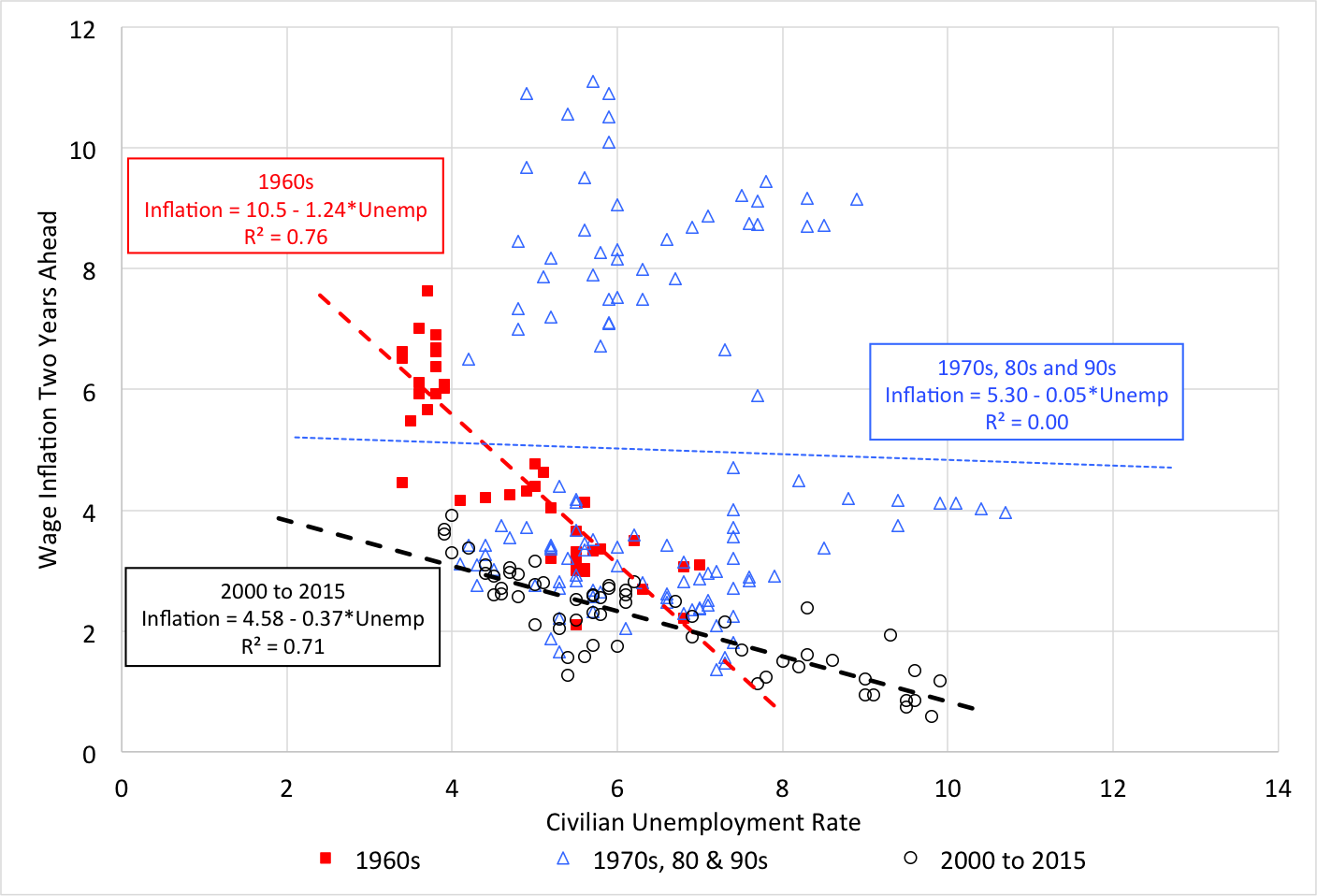
Looking through the data, this doesn't really look like an outlier. The 1950s also had low unemployment and low inflation. (Note also that official unemployment numbers don't count the long-term unemployed, so there's some uncertainty in this data). See the following unemployment vs. inflation table:
https://www.thebalancemoney.com/unemployment-rate-by-year-33...
https://images.squarespace-cdn.com/content/v1/52cdc300e4b012...
the phillips curve can shift, that is of course worthy of study. one interesting thing that happened in that period is oil prices collapsed.
you either believe in supply and demand, or you don't. if you believe in it, then greater than full employment leads to rising wages, and inflation if productivity doesn't follow. if you don't believe in supply and demand, then discussion about a lot of economic theory is pointless.
https://www.moneyandbanking.com/commentary/2017/5/29/the-phi...
Clearly, when energy prices spike, everything else follows (including food, which relies on energy for transport and production). Currently, fossil fuel interests are reaping record profits and share values have jumped over 50% since Dec 2021, an even bigger windfall than the defense contractors are pulling in. Ignoring this reality is hard to justify.
AFAIK, nobody has ever managed to formalize any. Economists either imposed them by definition and let it float freely... Yet, the thing is very clearly highly constrained on practice. So the flow volume (MV) is somehow highly dependent on M, but not completely defined by it.
Excess capacity to supply doesn't mean there is excess supply. Supply is restrained due to lack of demand.
With excess supply capacity, Firms don't generally run at full output unless there are orders to fulfil. But that doesn't mean they can't then ramp up if the orders come in.
It's when capacity to supply is exhausted that we get price inflation.
"The price of commodities around the world is going up, by definition this cannot be due to a lack of competition - there must be something else at play."
If prices are going up there is a lack of capacity to supply, therefore there is insufficient supply which is why prices are going up - to eliminate demand.
At root the shortage of energy feeds into everything else.
There is no competition. No supplier gets a 'no deal' bid to their offer. They can sell everything they can make at the price they set.
That seems like it’s missing a variable to describe when increased supply is spent vs when it is saved.
If stock increases but is not channeled through flow, i.e. i take a loan at 2% to save in my bank’s savings offer of 5.25% then flow stays the same (i still spend on the same things each month) but money supply went up and inflation remained uninfluenced by my activities as supply slowly regresses to almost prior state while i pay off each month. Not quite prior stage because i get to save the extra from interest rate arbitrage.
> i take a loan at 2% to save in my bank’s savings offer of 5.25% then flow stays the same (i still spend on the same things each month) but money supply went up
Arguably the quantity of money the bank has created for you depends on the bank's net lending to you, so if you borrow money but hold it at the same institution, you haven't really increased the money supply at all.
Yeah thats the bit i’m trying to get my ahead around. Specifically:
>> It's arguably both a stock problem and a flow problem
I’m thinking the key variable here is flow
>>> it's a flow problem
You cant have inflation without increased flow, but i’m still wondering about stock because it’s not as simple as just excess money.
Perhaps it is correct enough to just frame it as a flow problem, since that variable is always dominant in every inflation scenario.
> depends on the bank's net lending to you
Yeah that makes sense, so my example should have been a loan from one bank and a savings account at another
When you do that, then you can control inflation simply by controlling the supply of paper currency. Like the monetarists suggested.
I don't know why people twist things in this way, but I've seen people repeatedly do so.
But Fed has another goal too which is preventing unemployment. They are in a twist.
source with video: https://twitter.com/CNBC/status/1563172126945067009
Why? Because you can discount a CoD into a derivative that also then circulates.
Which is essentially what a bank does - but with a much wider selection of assets.
Eventually you realise that the solution is to embrace Full Liquidity and use a powerful buffer stock offset mechanism to create price stability.
The Fed has a job to do by law. Who cares who or what caused the inflation? Powell explains after each FOMC meeting that inflation is bad for the economy, and in order to have a healthy economy the inflation has to be reduced back to reasonable levels, around 2%. And the Fed will raise rates and keep them there until inflation is tamed.
He admits that there's supply side, but he repeatedly said the Fed can only control the demand side, and that's what they are doing.
It also ignores the flip side. COVID relief packages have also helped in many ways, it's unclear what outcome is worse, current inflation or what else would have happened without that assistance.
Finally, I tried to do some fact checking, and what I found is that Trump actually provided even more handouts, 2.2 trillion in COVID handouts through the Cares ACT under Trump, while Biden only provided 1.9 trillion as part of the American Rescue Plan.
And if you look at the direct payments of those plan, Trump totalled 459 billion in direct handouts, and Biden totaled 402 billion.
So Trump actually gave more Covid handouts than Biden did.
Now the argument that COVID handouts might play a role in the inflation is okay, maybe it does a little, but your singling out of Biden seems biased partisanry, and it makes it even harder for me to take you in good faith.
The US dollar's status as the world's reserve currency has strange and counterintuitive effects like this which make their screw-ups everyone else's problem.
There's a competitive aspect to central bank policy: if the U.S. drops rates but other countries don't, their exports become more expensive and hence relatively uncompetitive in the world market, their manufacturing sector loses jobs, and they get thrown out of office. If the U.S. raises rates but other countries don't, their currency drops in value relative to the USD, their imports become more expensive, this fuels inflation in their home country, and they get thrown out of office. Therefore there's a strong impulse to mimic U.S. monetary policy. This also makes the reaction of other countries a constraint on the actions of the Fed; they cannot make changes willy-nilly without causing severe dislocations to the global economy.
You're right that this is not a Biden vs. Trump issue, and that Trump also pursued policies that were highly inflationary. This is a "humans are predictably irrational" issue. They nearly always pursue policies that fix the problems they have now, even at the expense of causing problems that are highly likely to occur later.
The only way to make a price cap work is to set all prices in the economy, which as you observe, is not possible. The much more practical solution to maintaining a stable general price level is to adequately control the quantity of money that exists.
The gas price shock is partly caused by a massive supply shock, but also an unwillingness of the cartel to increase supply, since they are doing just fine with the high prices.
I think we are seeing something similar with (for instance) Amazon. A gross simplification is that Amazon has achieved market dominance in many goods. This has reduced competition from smaller businesses, who can't compete in price. However those local stockholders would have been more resilient in the supply chain crisis than the Amazon ecosystem, because they bulk shipped stock to their warehouse (where they held stock), vs drop shipping it on demand from some distant place. This was costlier at the time, but arguably better for the environment and the resilience of the economy.
Right now Amazon is not the cheapest on anything and doesn't have everything in stock for 24 hour delivery any more. It doesn't fulfil its promise of being cheaper or faster. Government could put various controls on Amazon, but instead let us traditional businesses fight to stay alive against it (or be forced to sell through it!). Personally I think Amazon marketplace should be split from Amazon the store for this reason. You can't be the marketplace and a participant.
If supply is actually restricted (and can't be increased), then capping prices makes sense in certain scenarios, and indeed price caps have been used historically in the U.S., from the 1940s through the 1970s.
We can't define money, we can't define velocity, prices are all relative and what is included as a transaction depends on the definition.
The naive QTM is overly abstract. All we can really do is address the root cause - insufficient supply and competition.
Sounds like a great suggestion.
On the other hand it is also clear that if FED printed out much more money, that would cause prices to go up. BUT that would not really be a bad thing would it, people would have more money.
[edit: I see she discusses this in article as well, now]
It seems highly likely that inflation will remain at its current elevated level for at least another 12 months, beyond that horizon, the trajectory will be determined by what happens between now and then.
Before doing FIRE purchase your own home or sign a really long term lease with upfront payment and no increases, inflation caused by corruption (as in my country's case) wreaks havoc on savings. It is simply not possible to invest in anything that can keep up with the inflation, you get poorer by the day.
Lots of Germans have little savings, don't own their home, and have relatively small margins with their income. The ~10% (or maybe 15, if you exclude some of the wonky things that keep them down) are being felt. I cannot imagine how lots of people would get by with 80% or 100% inflation in a year.
How do Turks do it? Are young people moving back in with their parents or getting more room mates? Are they taking on debt, or selling valuables to pay for rent and food? From afar, it looks surprisingly stable. Germans are said (and correctly so, imo) to submit to authority, but I'd expect a lot more action here with the level of inflation Turkey is seeing. Am I just not hearing about the instability it causes, or are Turks just weathering it but aren't rising up yet?
Young people don't move out in the first place. Lots of people move back in.
We got immensely poorer, it is tough out here. You see beggars everywhere, especially low income families were hit the worst.
We live under Erdogan, if we try to rise up, we get shut down. All public protests are de facto banned, with the new disinformation act I am risking a jail sentence even by writing this comment. You can even go to jail if you like a tweet of a whistleblower for example.
Why not just invest in diversified real estate rather than betting on a single property and its local market? In expectation, the returns should be similar on average but with lower volatility.
I'd rather rent and put capital in a real estate investment fund. I guess something could be said for buying a property if you're very certain that you'll live there for the rest of your life, but if you would ever like to move, you'd be highly exposed to fluctuations in the value of a single asset, your home.
Principally speaking you are right to think that real estate investment funds should bring on par profit with real estate increases but during times of very high inflation as in Turkey, you lose some because funds don't 100% invest in their base asset, a significant part (around usually 20%) stays liquid. From that 20% you lose the ability to cope up with inflation, as the official interest rates are negative. (In Turkey's case above -70% a year).
Obviously, all other things being equal, whether a retiree gets crushed or not by CPI change is going to differ a lot if that change is 7% versus 83%.
We can buy eurobonds of Turkish Republic if we don't care about liquidity in short to mid term.
However usd is another battle. The government utilizes strange tactics (ranging from making it mandatory to convert export proceeds into TL, offering government backed USD adjusted savings accounts in TL, bringing cash from "unknown" sources (it gets listed as "net faults and misses" under Central Banks balance sheet.) So there is inflation but usd doesn't keep up with it always. There are news that the government is highly active in narcotics trade for personal gain of ministers, so I presume we get some black money there as well. The government also gives away any asset the country has in exchange for dollars to foreigners. Most of our national reserves (around 130 billion USD) was sold covertly to unknown purchasers at an unknown price during erdogan regime, so I guess some of that quasi-stolen reserves is also making a comeback. With all that said, they manage to keep usd exchange rate flat for now. So TIPS would only benefit us if we invest for a long term. Look at usd/try to see how crazy it is. Nothing is predictable now. When you lose the rule of law and your democracy, anything is possible.
We can easily invest in Us and European stock markets through funds.
As long as we pay income tax, we can invest in whatever we want, there are no country restrictions.
John T Reed wrote a book on it which has decent amount of research and ideas - https://johntreed.com/collections/john-t-reed-s-book-on-hype...
> The gas price shock is partly caused by a massive supply shock, but also an unwillingness of the cartel to increase supply, since they are doing just fine with the high prices.
I certainly agree with these points.
> I think we are seeing something similar with (for instance) Amazon. A gross simplification is that Amazon has achieved market dominance in many goods. This has reduced competition from smaller businesses, who can't compete in price. However those local stockholders would have been more resilient in the supply chain crisis than the Amazon ecosystem, because they bulk shipped stock to their warehouse (where they held stock), vs drop shipping it on demand from some distant place. This was costlier at the time, but arguably better for the environment and the resilience of the economy.
Retail shopping remains one of the most competitive sectors in the economy. It is true Amazon has raised the bar for service, choice and price, and benefits from economies of scale, which has made it difficult for other businesses to compete, however we’re very far from Amazon having a monopoly on retail shopping (you can also see this in their very slim margin on their retail business - if they were dominating, they’d have a substantially bigger margin.).
> Right now Amazon is not the cheapest on anything ... It doesn't fulfil its promise of being cheaper or faster.
It is somewhat unfair to say that Amazon is bad because smaller businesses cannot compete on price, and also say that Amazon is expensive and other providers are cheaper - both of these statements cannot be true.
If I have Pounds (GBP) and I need to buy Oil and settle in Dollars (USD), I exchange my Pounds for Dollars, and then I exchange my Dollars for Oil. The price of the Oil in Dollars doesn't matter to me, only the overall price of the Oil in Pounds. It has no effect on how many Pounds I spend if the GBP:USD is weaker now than it was 1, 2 or 5 years ago, it only matters what the net GBP:Oil exchange rate is.
The only time strengthening/weakening of the Dollar can have an effect is if the price moves between the two exchanges, but given how short settlement windows are, this is somewhat irrelevant.
In a system of free-floating exchange rates and absent of supply side shocks, inflation is entirely a domestic phenomenon. The reason why the entire G7 have the same problem is because they all experienced the same pandemic, and their respective Central Banks all took the same action (to increase the money supply).
Foot notes:
[1] We have since layered a supply-side shock on top of this, which has pushed up energy prices in many currencies, but this is not because of the strengthening of the Dollar, it is because many nations wish to minimise the amount of Oil & Gas they buy from one of the largest exporters of said Oil & Gas, effectively reducing supply.
[2] A strong Dollar can cause problems when foreign nations borrow in Dollars (i.e. they borrow Dollars rather than their domestic currency). As the Dollar strengthens, this means they have to sacrifice much more of their local currency to repay the debt, which can cause significant problems. (Editors note: try not to borrow in someone else's currency if you can avoid it.)
Fingers crossed that the next elections will bring some change.
"Young people don't move out in the first place. Lots of people move back in."
Sounds like Canada
There's no proof of this it seems, while I agree it's one of many hypothesis, I find it crazy that you can jump from the hypothesis to conclude it's true just like that.
How do you simply dismiss all the other possibilities and compounding factors? There was a never seen before global pandemic, there was major disruptions in production and sourcing of goods, there was a major attrition and rotation of the labor force, there's the conflict with Russia, there were dramatically overvalued stocks, there was a trade war, there was a ton of people that died, etc.
I'd be suspicious of anyone who claims they just know the truth here, follow your guts isn't a proven way to determine what's really happening. I need some more proof, a simulation model, some actual experiments, etc.
The intuition of experts is often more likely correct, but economists are very divided here, to me it still feels like we don't know the cause of the inflation, we don't properly understand why it's happening and how to fix it.
Another aspect that's also been bothering me is that it isn't clear if inflation is a problem or not. Say it was caused by too much money having been injected, ok prices go up, but everybody has extra money, so it evens out, and doesn't really mean anyone is worse off.
Inflation doesn't really seem like it necessarily implies people are worse off, especially from the point of view of: would that person had been worse off if they'd have been evicted from their home during the pandemic and lost their job and not been given out support? Or are they worse off having had that help to make it past that and now have to deal with some inflation?
Especially assuming the inflation is due to increase money supply.
Like I just feel the actual effects of inflation are also not clear.
If inflation is driven by a loss of jobs, lack of goods, and difficulty sourcing materials, that's bad, even ignoring the inflation that's bad. If inflation is caused from too much money but there's still enough jobs, goods, and sourcing is easy and cheap, is that bad?