Why 536 was 'the worst year to be alive' (2018)(science.org) |
Why 536 was 'the worst year to be alive' (2018)(science.org) |
Volcanoes, plague, famine and endless winter: Welcome to 536 - https://news.ycombinator.com/item?id=30621640 - March 2022 (39 comments)
Skies went dark: Historians pinpoint the 'worst year' ever to be alive - https://news.ycombinator.com/item?id=26786838 - April 2021 (117 comments)
536 was ‘the worst year to be alive’ (2018) - https://news.ycombinator.com/item?id=23565762 - June 2020 (356 comments)
Why 536 was ‘the worst year to be alive’ - https://news.ycombinator.com/item?id=18469891 - Nov 2018 (4 comments)
Others?
There’s just a few years where this kind of research will be possible. I hope we can maximize our discoveries before the world loses most of its ice.
Not thousands of years. Centuries probably, but also maybe only decades.
https://en.wikipedia.org/wiki/Toba_catastrophe_theory
See "Genetic bottleneck hypothesis"
How do they know for sure that the ice samples are chronological? What happens if in a given year the top layer of ice melts away?
I am reading "tree story" by valerie trout.
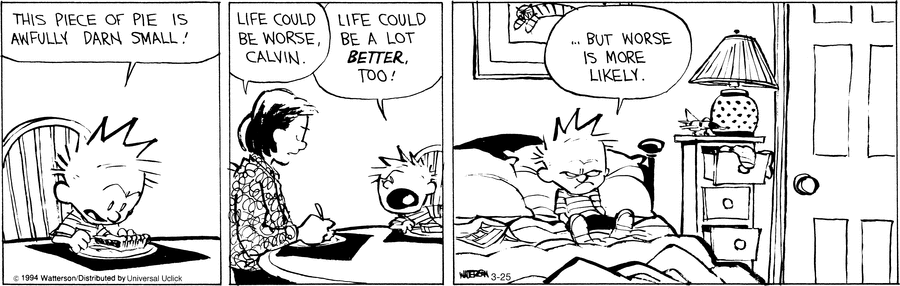
https://www.socomic.gr/wp-content/uploads/2014/03/ch140325.g...
Islam first appeared on 610. I wonder if these events had any effects on that.
I kind of weep for the loss of oral and comprehensible physical histories in the Americas and Africa, since scholarship like this shows that one can combine those with unlikely natural records and scientific analysis to triangulate on remarkable narratives about our past.
536 would have stiff competition from every year of the century following 1492 for the title of "Worst Year to be Alive in the Americas".
https://en.wikipedia.org/wiki/1348
Dying of respiratory or cardiac failure is horrifying enough, I just hope we never experience something like the plague on a large scale again.
It wasn't until the 1800s that hand washing was tied to health (Semmelweis). The 1300s would have been a filthy, filthy existence it's not a great surprise the plague spread like wildfire (past its initial vector). Basic hygiene has helped humanity massively.
> Dying of respiratory or cardiac failure is horrifying enough
That is how you die, regardless of events it's ultimately brain death due to lack of oxygen to the brain - pray your heart stops one day (everything else is worse).
> Dying of respiratory or cardiac failure is horrifying enough
I know you were making a reference to c19. Yes, being kept in solitary confinement while you suffocate to death by order of the state would be a miserable way to go (tax extracted and left in an "exit room").
Here in NZ the state forced an elderly man to watch from the roadside as his wife was buried but politicians were allowed to go swimming during the same lock down... Disgusting.
I’ll take 1977.
Television, Kraftwerk, Eno, Bowie, Iggy Pop, the Clash, Fleetwood Mac, and The Ramones all released great albums
Jimmy Carter pardoned hundreds of thousands of draft dodgers.
Fleetwood Mac released Rumours.
Howard Stern began broadcasting.
Voyager 2 probe was launched.
Elvis Presley, Charlie Chaplin, and Bing Crosby died.
(I'm not sure I have been guilty of 'fulmination' though :) )
Happy New year.
Intentional, careful geoengineering is the only real chance we have of holding back climate change. Human societies simply will not be willing to make the sacrifices necessary to roll back climate change solely by reducing emissions.
A combination of politically acceptable emission cuts, geoengineering, and acceptance of/adaptation to higher temperatures and their consequences is the only possible outcome in the real world. So hold back on the knee-jerk reactions to geoengineering and take it seriously.
Ultimately, we have transport and distribution across the entire globe, so a crop failure in one place doesn't mean a famine there as we can ship food there (unless you're a poor country, in which case the rest of the world doesn't care much).
Annual crop production still varies wildly, we just have much larger buffers and better distribution than our ancestors before starvation kicks in so a 12% drop isn’t noticeable for the average consumer. https://www.indexmundi.com/agriculture/?country=us&commodity...
Ingenuity >>> Chicken Little
I am probably unusual because I bought 90 days dried food supply for my family in an emergency. But almost all the food I have and eat normally was bought in the last month, except for a few canned goods. I think most people in the us would run out of food in a month or two at most.
Im at work right now so cant look it up.
Arguably this was the right choice, as everybody just stayed home during this storm, so real impacts were relatively light. By contrast, Bay Area traffic is a disaster every rush hour, so getting a few folks to take Caltrain instead of driving or avoiding just one collision on the tracks already puts you ahead of the cost of this weekend's storm.
We know how bad things were in Europe and East Asia because written records survive which describe the crop failures etc. We don't have records from that time period from Africa or South America. All we can do is assume that people there suffered as well, due to the global nature of the problem.
Sometimes people get left out of historical narratives because there just aren't any written records. You can make assumptions, or you can try to make stuff up, but an intellectually honest historian is also likely to just say "we can't know."
In contrast, archaeologists will try to make a case for how hierarchical a society was, or whether it was male-dominated, or what kind of religion it had, on the basis of a few tombs belonging to "high-status individuals" and a couple of pieces of pottery. It's always a bit of a stretch. A lot of what archaeologists believed about prehistory. especially migrations of people groups, has been overturned by genetic studies in the past decade. David Reich wrote a good book about it several years ago, which is probably itself outdated now due to the pace of discovery in that field.
I think you're missing my point, which is that the erasure of these regions from the record (which runs through the history of archaeology, up to the publishing of this article) was a purposeful and avoidable tragedy. If we are to talk about the conditions of human life and civilization, we should aspire to do one better than the example of your intellectually-honest historian, and affirm that we simply don't know, not that we could not have.
I asked the question about what would northern countries do because the volcanic eruption impacts seemed to be more focused on the north in the article. But of course the world is connected, and the south is relatively poorer, and we are all connected, and there's not that much excess food. When a huge eruption does occur, or other destructive things like a CME, it will affect the world.
The real sticking point would be that some countries would not want the cooling. Russia, say.
We'll just see how it goes...
Are you serious?
Are YOU serious?
The ice in Greenland is up to 3000 meters thick, and Antarctica is up to almost 5000 meters. Are you suggesting the net melt could average up to half a meter a year?
"Thousands of years" is clearly wrong, so it is at best several centuries.
About "decades": I'm not saying it will, but that it could.
It is completely in the plausible, and scientists have been proven to be too much conservative, to the great surprise of everyone including themselves.
That says that loss over the past 19 years is 5 meters; that's less than a millimeter per day. You're proposing a melt up to 500 times faster.
https://en.wikipedia.org/wiki/Greenland_ice_sheet#Future_ice...
That says that the fastest plausible scenario has the ice sheet melting in 1000 years, while the greater likelihood is 10,000 years. And that's if/after we cross temperature thresholds we're not guaranteed to cross.
Nowhere does it entertain the whole thing going in decades. If you have credible sources that argue for the possibility of decades, or even a century or two, you should add that to the page.
It isn't quite a sweet as, well, sweet corn when boiled/roasted on the cob. But it's no problem at all as a food.
https://www.gardeningknowhow.com/edible/vegetables/corn/dent...
But by far the biggest fallacy in your argument is that you don't recognize that animals are eaten by humans and provide valuable nutrition and essential nutrients. If the livestock is dying off because there's not enough feed, there are humans downstream of that who will not be getting fed. Livestock and crops have symbiotic relationship with humans and with each other. A lot of wasted plant matter that humans would have to discard (not to mention grass that cows, deer and other ruminants eat) can be consumed by farm animals. And animal manure can be used as fertilizer to re-invigorate soil and improve crop yields. In addition, animals upcycle crops into higher quality proteins and essential amino acids.
Needless to say though, if our agricultural systems are producing 73% less crops and livestock there will be ~73% less humans.
1. https://ncsoy.org/wp-content/uploads/11731980513_d53ca2a99e_...
No. That is how it is currently used, but in an emergency you could make soy flour, tofu, etc. The calories are consumable even if it's not what we typically eat.
Or, more relevantly, the land that is used to grow soy could instead be planted with corn (or perhaps winter wheat in a post-volcanic scenario). Right now we're planting out crops to optimize for market value, which is driven by livestock feed use. If we instead optimized for human nutritional value, we could easily double output by mostly eliminating livestock (even accounting for the loss of nutrition provided by the livestock).
>Needless to say though, if our agricultural systems are producing 73% less crops and livestock there will be ~73% less humans.
An incredible oversimplification.
We may change the climate in our entire history as much as a super volcano does, or many times less.
So I would expect bare minimum energy requirements to be near 1.5-2 million watts per person for 12-16 hours a day for indoor food sustainability.
This is of course not accounting for fertilizer which has large energy requirements or anything more than the most simple and basic of climate control.
(Just to preempt some likely replies from other people: I'm sure there is a big difference between "Americans consume" (including livestock grazing, which can't be magic-ed into anything else) and "You can get by on" (measured in hypothetical perfect-acres) - it would take esoteric casuistry to make these really comparable anyway. Nevertheless the gap is so large that AngryData's fundamental point is extremely robust: growlamp-ing everyone's basic needs is fantasy-land. I thought that, but didn't realise the case against it was as strong as I now suspect it might be)
Solar panels produce about 150 watts of energy per square meter since most solar panels operate at 15% efficiency this translates to 15 watts per square foot.
It would be expensive, but the alternative would be burning cities and food riots. I can hardly imagine the USA avoiding a civil war considering how divisive and hostile things already have gotten
You can get hydroponics going fairly quickly, the bottleneck would be the supplies and supply chain — materials to build the with
At any rate, these locations will always be accumulation zones where more snow falls then melts (with the mass balance preserved by diverging flow so as to continuously thin the ice, to approximately compensate), with melt events occuring only rarely. The concern there is that meltwater could contaminate near-surface compacted snow (firn) layers, but even then it wouldn't be enough to do much. As such, stratigraphy will be reasonably preserved even if the ice sheet as a whole draws down significantly (including at divides).
Really extreme climate change (which is in the cards long-term) could eventually change this, especially if the ice sheets reduce enough in height such that a significant ice sheet-elevation feetback occurs. However, we'd have much bigger things to worry about at that point.
Apart from the fact that all of this relies only on the data we have (we'll discover many more chaotic systems and tipping points, amplifying feedback etc), it also says nothing about what happens at 3.5°C or 4°C warming for Greenland (important precision, as Greenland itself is warming at a much larger rate than the planet globally).
And no, I have no reference to add, only to be cautious and reminding that everybody has been way too much optimistic.
I don't think that Antarctica will lose its ice cover. Only probably its ice shelves, and also some glaciers will shrink, but overall it'll stay white.
Ya'know what... go right ahead and try to terraform the Earth to whatever you think is... best.
Your doomsday prediction may then come true actually. Self fulfilling prophecy and all that.
God speed in making your artificial ice age.
Oh good grief. Are you getting your position here from Snowpiercer?
Your position is to try to simulate a volcano to cool the Earth and "let's just see how it goes".
Ignoring the fact if we do that, then a natural volcano could go off as well and set us over the edge, causing an ice age.
Sure you can hand wave away the repercussions pointing to a movie, but it's still your stupid suggestion.
And what retarded logic that is, just because Armageddon is a movie doesn't mean asteroids aren't a threat.