You can get a complete set of snow tires, mounted and balanced on rims, delivered to your door by Tire Rack (no relationship, just a happy customer). If you don't want to change the tires yourself, there are shops that will change them out and store them for you.
A less understood aspect of snow tires is their flexibility in cold. A summer tire will stiffen up below -30. Park it overnight and it will have a flat spot the next morning. It will bounce the car until enough heat builds up in the tire for it to soften. The higher silicon content of proper winter tires prevents this.
This type of driving, except whitehorse is much warmer than where i am (our rivers/lakes remain frozen): https://youtu.be/a_hmPxBUZvc
All wheel drive helps zero with winter conditions, except for going uphill or some other acceleration-equivalent action. Quite the opposite really - many people have experienced how with 4x4 you don't get a warning before you just lose your grip and off the road you go. For the record I'm driving a 4x4, but using summer tires in the winter, with or without engaging 4x4, the car will simply be like Bambi on the ice. Going downhill would mean that I wouldn't stop before hitting something or ending up in the sea. 4x4 doesn't matter for that.
The first thing I do when getting a new car (I always by second hand cars - not that I buy them often, but I'm old enough to have gone through a few) is to buy the best possible summer and winter tires I can get, particularly the latter. That goes before any other investment in the car. I had enough of bad tires when I was very young and without any money.
EditAdd: Many people comment about ice and studded tires. Yes, studded tires are better, not just on ice, but on many kinds of packed snow conditions as well. For some conditions they are the only good option (interestingly enough, this does not always mean that they're better than studless tires on all kinds of ice - it depends on the ice). However, if there's a lot of bare asphalt around, as is often the case when there's a lot of traffic, then studs aren't particularly popular (road wear etc), and in some countries in Europe with lots of bare roads in the winter they're illegal (e.g. Germany IIRC).
As for winter tires without studs, on ice, be aware that there are great differences between brands and types. My father's car had stud-less winter tires while my car had studded tires, and I drove both cars on the same roads and his car behaved well, even on ice or "glassy" snow. But then the tires got old and he replaced with brand new tires, but a different type - much newer, so should be better, right? Not so. Very different to drive. Dangerous I would say, and in fact he got into an accident because of that. I checked that place with my own car afterwards, and no doubt his old tires would have held up just fine.
If you are driving with summer tyres on ice, then of course you are going to be skittering all over the place.
When going downhill on ice, again your tyres are going to make ALL the difference. You shouldnt be trying to stop going downhill on ice anyway. You should be descending at a constant and controlled speed.
What are you on about? Living in Montana, AWD is dramatically better than 4WD. And winter tires are great. We never used them on one of our AWDs because the AWD is so dang good. Snow tires were absolutely required on our 4WD and 2WD cars. AWD or snow tires, I am mindful of stopping distance.
I will always choose AWD for the snow. Then add snow tires if needed.
That said, I strongly disagree with you about AWD. It makes a tremendous difference for control in general in all winter conditions. Adding snow tires to AWD and things are just excellent and way more predictable.
https://toptirereview.com/michelin-x-ice-snow-vs-michelin-cr...
In this test, the CrossClimate all seasons were within 10% of the snow performance of the X-Ice snow tires.
Ya. They are the bare minimum to qualify for that label. They are essentially the worse snow tires that can still be called snow tires. It's all marketing hype, which becomes dangerous when stupid people rely upon it to make safety decisions.
> So called "all season" tires are not snow tires.
Fun fact: US "all season" tyres are sold in EU as summer tyres.
You want to look into "all weather" tyres. The good one are rough equivalent to cheap winter tyre and decent summer tyre. It's still not worth it IMO if you're driving a lot but after COVID I drive little enough that I wouldn't get thru 2 sets of tyres before they rot away.
Hope-springs-eternal denial. And quite a few people don't figure that they'll stay with the same car (and/or live in the same climate) long enough for the "interchangeably so they last longer" thing to pay off.
The former is probably the biggest factor, with the latter taking care of the rest. All-season tires might be less-than-optimal tires in either summer or winter (though the higher-end ones have gotten much better), but the perceived convenience factor is a big enough selling point for most. And when their performance isn't sufficient in winter, people probably aren't going to immediately blame their all-season tires for a loss of traction. They'll just blame the weather and assume that "it is what it is," even with AWD.
If you've never driven on proper winter tires when the weather goes to shit, you don't even know what you're missing. But more than that, I think there's a huge segment of the car-buying public that doesn't give their tires any thought beyond "are they still good?"
Hell, my sister bought a Mercedes a couple years ago that happened to come from the factory with high-performance summer tires and no mention of that fact on the build sheet or window sticker (nor was it spec'd with large wheels with low-profile tires, where it'd at least some sense). Had I not looked at the sidewall when I was with her after the tire pressure sensor went off, she'd have been in for one hell of a dangerous surprise when the first winter storms hit a couple weeks later. Even the dealer was surprised by it.
Ever since then, I've always wondered just how many cars drive around in winter weather with the wrong tires and a blissfully unaware driver.
That seems obvious. AWD means you can use the traction of all tyres to move. But without snow tyres you have no traction, so AWD does nothing.
> So called "all season" tires are not snow tires.
Not quite true, there are 3PMSF all-season tyres, and unrated ASTs might behave well on snow, it depends on the compromises the manufacturer decided on, as the point of an ASF is to balance dry, wet, and snow. But where the manufacturer decides to put the balance is very relevant. That a tyre is all-season doesn't mean it's all-of-your-location-seasons.
In fact, you can have ASTs which are excellent in the snow and absolute shit on dry and wet, that's what "tyre reviews" found with the Tomket Allyear 3 (https://www.tyrereviews.com/Tyre/Tomket/Allyear-3.htm) for instance.
Also technically unrated "winter tyres" may not be suitable for snow either, they might be using better winterised compounds and deeper thread patterns but not sufficiently so to behave well on snow.
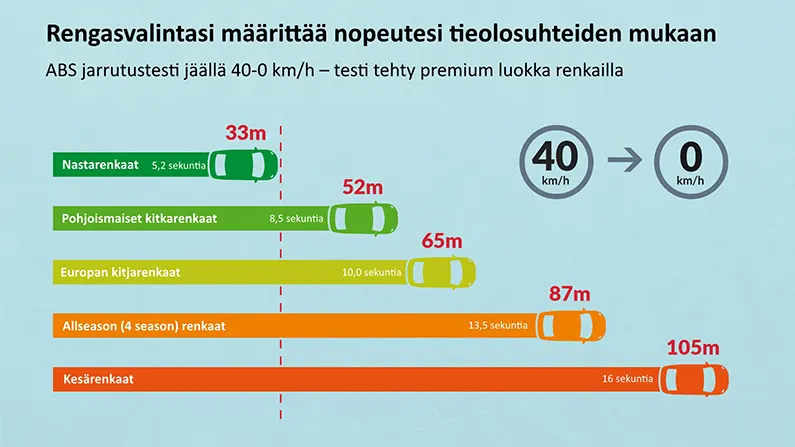
https://www.rengas24.com/images/breaking-distance/breaking-d...
It won’t help with wet ice, but nothing really does. I’ve watched a truck in chains slide on that mess.
I drive pretty well, and getting snow tires made a huge difference in predictability. Braking is more consistent, acceleration is more consistent, and most importantly the point at which I lose traction when cornering is fairly consistent and predictable.
Yes, there's the overhead cost of a second set of wheels and TPMS sensors (because after a few years it's break-even with having the tires themselves swapped, and this way I can swap them myself when winter hits), but overall the cost isn't that significant because it offsets wear on my all-seasons. And it's so, so, so much better when it does snow. Or is icy. Or even is quite cold and just wet, because the tires are still flexible at temps when all seasons get quite hard and plasticky.
AWD + Winter > AWD + All-Season > FWD + Winter > FWD + All-Season
There are plenty of videos[1] showing the above. I guess it should come as no surprise that it comes down to the vehicle, the tires, the conditions, and the driver.
At least for me driving in the PNW (temps usually not too much below freezing), Kumho Crugens (all-season) on my AWD SUV are way superior to Michelin X-Ice (winter) on my FWD minivan. Braking is longer on snow and ice with all-seasons, so I leave 8 car lengths of distance minimum when following other cars. The SUV has superior ESC and traction control that way out perform the minivan.
Several times in my FWD minivan with winter tires, I have been unable to go uphill on icy roads and had to put on chains. Whereas the AWD has no issues at all.
> Braking is longer on snow and ice with all-seasons
I think braking performance is more important. I would choose FWD but on "proper" winter tires. It's better to risk not making up the icy hill, rather than to risk crashing into a front car or even injuring a pedestrian.
By the way, the video doesn't explore braking performance.
(For the unfamiliar with these TLAs: AWD - all-wheel drive, FWD - forward-wheel drive.)
Snow tires are much more effective than all wheel drive, but having both is (obviously) better.
Handy because you don't have to stop/get out/interrupt service - just flip a switch and you've got improved traction!
Seems like a great solution for light snow/mild ice but I would not want to trust my life to these in harsh conditions.
AWD has the characteristic of improving driving traction while doing very little for braking or steering, as demonstrated by the guy who passed us and then rear-ended the mail delivery van.
However, AWD in vehicles without traction control recovery from a slide is more difficult due to there being two different thrust vectors.
Aren't real snow chains more like 300% more traction in the right conditions, since regular tyres offer basically no traction?
On the other hand, chances are it would make cars stay a safe distance away.
Can slow a lot by “simply” letting the jake engage.
We use them on our fire trucks, engines, tankers, etc, here in New England. Some of these apparatus way upwards of 30ton.
Most people I know who have snow tires opt for a second set of (typically cheap) rims, and the wheel set comes mounted and balanced. In my case, I change them out when needed, otherwise if I'm scheduled for something like an oil change, I just toss them in the car and have the shop do it.
They are always marked with chalk for which one is which (i.e., right, left, front, back).
But I’ve driven across a frozen Lake Erie with no snow (we used do that sometimes to get to the islands when the ice is thick enough) and it’s just pure ice. Nothing but chains makes much difference then.
But outside of rare stuff like that you’re not often on just ice, so OPs comment, while I agree with it in fact, it’s kind of an “aaaaaactually”.
That said snow tires are still spectacular and necessary in snow. I buy and use snow tires every winter season. They are invaluable. I just am saying don't drive with them on ice and expect to have any better traction.
In real ice events/situations the tire chains come out or you just stay off the road, it's that simple. No amount of perceived driver skill, AWD techno buzzwords, etc. will save you on ice--you need hardened steel cutting into the ice.
But as the temperature warms to freezing and the ice gets softer, the studs really come into their own. The studded tires have an even shorter stopping distance than they did at 0F/-20C, but the unstudded start sliding and almost never stop. In the worst case, the stopping distance can be almost 3x longer than the studded!
Here's an accurate (although biased) summary of a Russian study about this: http://www.skstuds.ca/2015/10/04/the-studless-tire-deception.... Clicking through to the Google translate of the original gives even more info.
I live in Vermont, and use studless winter tires for the winter months. On snow they are great. On cold clear roads, they are much better than All Seasons. But if you hit black ice on a thawing road, you need to know that they will not stop you the way a studded tire would.
Now, I love my carbide studded bicycle tires. Those definitely do work on ice. But once again, staying upright on ice involves a combination of those tires and other precautions such as slowing down.
I live in an area of Sweden that has ice and snow at least 4 months per year. Still thinking of buying studded tires for the fatbike but want to see how I'm doing with these, the rubber is nice and soft even at -20 degrees so I think I might be good enough with this solution.
You don't brake better with an AWD car.
Well, except if you have learned to drive using 4 wheel slides like a rally driver. Then I sincerely hope you lose your license before your endangerment of others lead to an accident.
I helped an AWD SUV/crossover thing ten feet off the road a couple weeks ago. It was in very deep fluffy/dry snow, half on its side, sitting its weight on the snow rather than the tires. Only one wheel actually turned (front left). The AWD/TC system was literally out of its depth. 4WD, potentially with locking diffs, would not have had that problem. Once we pulled it enough to get some weight on the wheels, the AWD system kicked in and helped drive it back onto the road.
The guy had what he thought were snow tires (snowflake mountain symbol) but looking at the treads myself I didn't see the small grooves that imho are typical of proper snow tires. They looked like all seasons perhaps with some extra silicon to qualify for the badge.
Is my opinion from living in Michigan i.e. AWD is always a step up but rarely better than having the right tires. It depends a bit on the conditions too - are you looking out the window and wondering if your car will get stuck/make it up an incline or are you looking out the window wondering if your car is going to slide into a into a ditch/the car in front of you or is it an equal mix? AWD adds the most value when there was a heavy snow, unplowed roads, and relatively low traffic since. In any other case it’s really not all that helpful, except maybe a slippery uphill intersection but even then good tires help there and the inverse situation whereas AWD only helps in the one direction.
Further many manufacturers have names like “AWD” (volvo and others) or “4matic” (MB) or “4motion” (VW) to label their take on more-than-2wd, whether or not their variant is awd or 4WD (or both) in the traditional sense. Some "AWD" models will be electric with 1 motor per axle, or 3 motors (1 front 2 rear) etc. Some others are ICE with traditional drive shaft to the rear wheel axle, which in some cases will drive 50/50 and in some cases variable. Others still are hybrids wth no prop shaft but instead a rear electric motor etc.
This is the exact reason people dont like 4x4 on ice. AWD (usually) lessens the problem - which is why i said they absolutely help with the correct tyres.
And again - DONT SLOW DOWN when going down hill. Your brakes WILL lock a wheel and you WILL slide. Slow down BEFORE you go downhill. If you havent experienced this truth, then you havent driven downhill on ice (which is preferable).
But losing control because of ice can happen no matter how many driven or traction control wheels you have. And all wheels are basically skis when you’re skidding at 90° to the direction of travel. In fact, in some skids front wheel drive will be the best as at least you have a chance of powersteering out.
The real trick is to not start the skid at all. Sloooooooow down before you’re driving sideways.
Too late buddy. The way manufacturers abused AWD, 4WD and 4x4 terms they can mean anything now
Yep, this is actually why AWD is (usually) better than 4WD, because it can drive the single axle, treating it as a 2WD.
Perhaps those vehicles that use 4x4 in the tradtional sense are such that you have to engage it and that effectively cuts also any traction control - and then you disengage for normal driving?
Traction control on a 4WD can only consist of power management and braking, because there is no way to vary the distribution (otherwise it would be AWD, not 4WD).
There are some systems that under certain conditions will switch from 2WD to 4WD. Those systems are NOT considered AWD and dont have the benefits thereof.
FYI, ESP (Electronic Stability Program) is just a brand term for an ESC (Electronic Stability Control) which covers both TCS and ABS. When people talk about "traction control" they usually mean the entire ESC subsystem.
That same 4x4 with limited slip diffs on front and/or rear is just like other AWD implementations.
And that same 4x4 with locked front and/or rear diffs is just like yet other AWD implementations.
Thats simply not true. It wouldnt be AWD if it cant adjust the power supplied to each axle. Thats the primary distinction.
Which cars have motors on each wheel? That is maybe 0.01% of vehicles on the road. (Electric busses?) And even then, AWD/FWD distinctions can matter in how those motors interact. Electric or IC, so long as power is delivered through four wheels there will be different styles and techniques for balancing that power for whatever reasons occur at a particular time.
https://newsroom.porsche.com/en/2019/technology/porsche-engi...
The primary distinction is that AWD is full time, while 4WD is part time and vehicles run in 2WD until the transfer case connects the second diff/axle.
Actual torque vectoring AWD systems are fairly rare and expensive compared to the AWD that has existed for 50 years, though they are becoming more common.
Here’s a good illustration of the different AWD implementations; I think you’ll find that a simple open center diff is still considered AWD and is still pretty common: https://www.caranddriver.com/features/a15102281/best-all-whe...
All the differentials mentioned in your link allow for variable power distribution to each axle. Thats the whole purpose of a center differential.
Of course, not all AWD are created equal. Some apply equal torque to all wheels (i.e. open), some prefer a single axle (e.g. limited slip), some aren't controlled by the wheels but by the ESC (e.g. electronically actuated clutch packs). I suppose in electric cars where each axle is driven independently they dont even need a center differential (but I have no knowledge there).
But its an interesting link nonetheless - it was certainly educational - so thanks!
I do agree, however, that a full-time 4WD (which have a central diff, unlike part-time 4WD which generally do not) are effectively indistinguishable from an AWD with a simple open center diff. Of course, those are the least effective types of AWD - but the 4WD at least has the ability to lock that diff and likely has a multi-speed transfer case :)
But thats not your typical SUV, no.