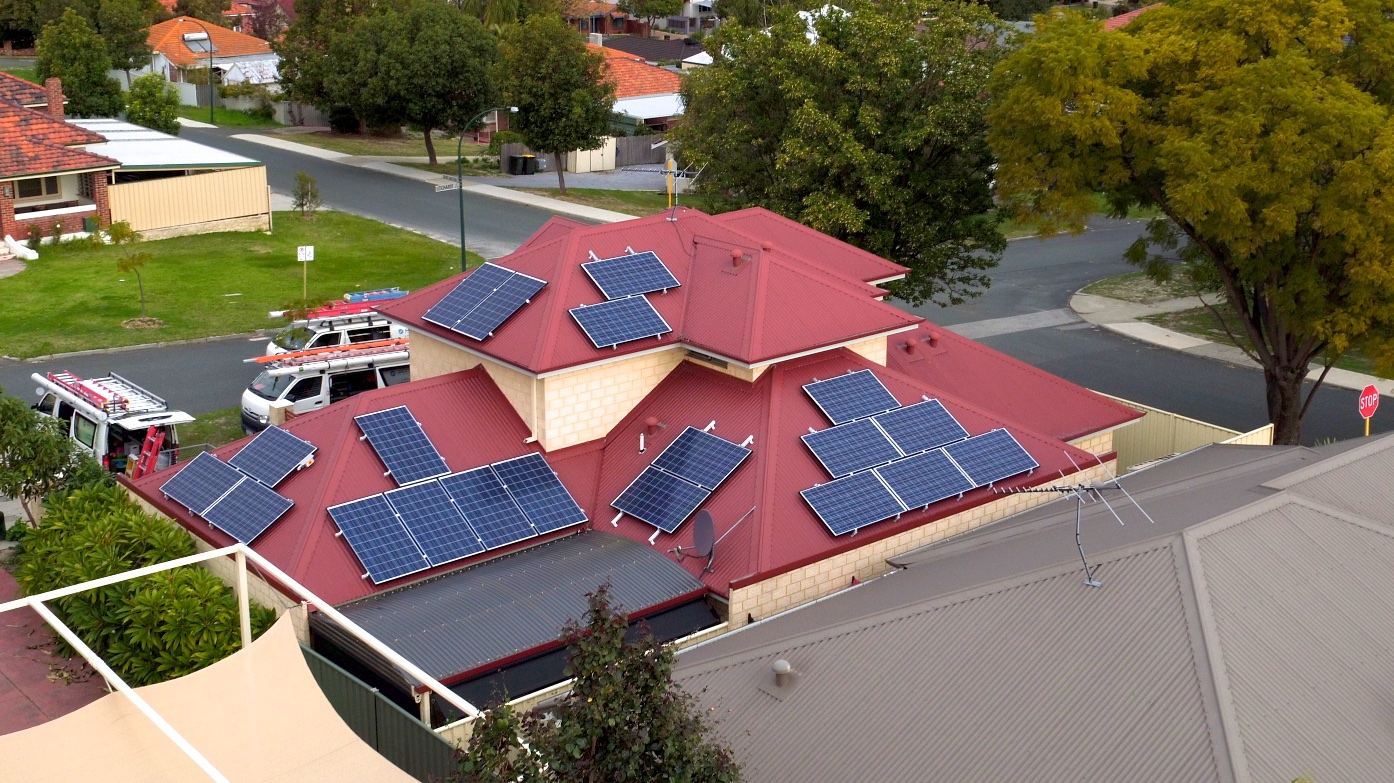
Solar panels reduced my electric bill in 2022(mattbruenig.com) |
Solar panels reduced my electric bill in 2022(mattbruenig.com) |
Yes, but with an 8% discount rate, the PV is $26,283. It's true that the cost of electricity will probably rise over time, as he notes. But current interest rates make this a much less attractive proposition from a financial perspective (that is, assuming you don't care about solar generation for environmental reasons). The homeowner takes on significant risk, and the gain is not all that great. Your panels can be destroyed by hurricane, earthquake, or falling trees, rendering them worthless, for example.
I'm not saying this isn't worth doing, just that the financial calculations seem a bit flawed in today's economic environment.
That’s what homeowners insurance is for.
I've also heard that one way to get booted from your homeowner's insurance is to ever file a claim. I know several people who lost coverage after their first claim (decades after becoming a customer).
So far 10kW gas generator was able to power most of the house's essentials before resistive heater kicks in in HVAC system (two heatpump units, each has a 7.5kw resistive heater as a backup when outside temperature drops too much.) But I would feel better if I did not have to rely on availability of propane/gas and clean roads during periods like 2021 blizzard in Texas.
30kwh of batteries is about $10k wholesale, and inverters run about $1500, although most of the time you need 2 if you want to supply 240v.
Sample system: https://signaturesolar.com/off-grid-eg4-system-13kw-120-240v...
So residential solar really doesn't make a lot of sense to me on a societal level, assuming blackouts are rare.
Of course the tech for this is a real threat for utilities, so it wouldn't surprise me if they would go to any length to stop such and effort. Same could be said for any deflationary tech like micro reactors.
its a 5kwp set of panels and a 13kwhr battery. From mid march to late November, we only drew from the grid once (that was because we had a portable hottub setup, which took ~28kwhr to heat up.)
Its raining and january and december are shit months for solar, well mostly because of the short days. December we were 45% independent from the grid.
Currently we do not have heating or cooling from electricity. If that were the case we'd need 10kwp plus more storage.
https://www.chooseenergy.com/electricity-rates-by-state/
Not sure how accurate it is, but what is up with New Hampshire at $0.32?!
Hawaii seems like it could knock it out of the park with wind and solar, but they're at 45cents. Ouch.
Unfortunately our new house doesn't have a roof configuration that allows for solar panels. I wonder if new home architecture and alignment will change to make solar panels work better?
I'm curious, was your heat and stove electric or natural gas (or other)?
You can buy panels off Amazon at about £0.73/W. Add in the various bits that you need to go along with it, and that probably pushes it up to around £1.10/W, if you're doing it yourself.
I noticed (by following the solar sub-reddit) that almost every single US install has either Enphase or Solaredge inverters (which happen to be on the pricier side). I am not sure if that's an indication for the lack of competition but surely this seems like an industry where disruption is possible?
Will either pay off well or be an expensive lesson
How much did you pay for the installed kwh?
I’m not sure if you were serious with this comment, but for the sake of other readers I wanted to point out this is a legitimate strategy. Many people tend to pair solar with installing mini splits, EV chargers, or some other home upgrade that will offer value at the expense or a higher electric bill. This can make the solar investment make sense where it previously didn’t.
No thanks.
Also: the big trick to running of renewables is conservation comes first, solar second and finally the grid as a fallback for the remainder.
Here's an article about it with a few vendors, including Tesla, that might help: https://www.forbes.com/home-improvement/solar/solar-shingles...
Are they insured?
Do they get damaged? Does the inverter/batteries get damaged or is there likely a circuit breaker?
You are better off if you add them to your already existing coverage for your roof. So probably yes.
> Do they get damaged?
You typically don't expect trees to fall onto your solar panels. So where should any damage come from?
> My residential-scale solar installation in New England
I can't think of any other commodity for which this is possible. You couldn't make your own steel, bread or printer paper at home and beat manufacturing at scale.
Why is electricity different?
With panels on your house the grid is still providing you a key service, providing you with any power you need in excess of what you produce, and sinking any extra for you. But with net metering you only pay in proportion to your net usage, effectively compensating you at retail rates for the power you supply to the grid.
And bread is a bad example, you can easily make that cheaper than retail price at home.
Also about half your bill is distribution fees.
And, BTW, making bread at home is cheaper than buying it. Get a bread machine, put in ingredients, wait a bit, and you have bread.
My loan payments are less than $140/mo and I plan to completely pay off the system in the next year or so. Living off the sun is great.
Battert/Powerwalls let the solar work when the power goes out. (the dc to ac converters use the 60hz out of the grid to sync. There is no shutoff to the grid so for safety reasons her system shuts down when the power is out).
But at that point your question isn't "what would be the payback period if I got solar" but "how much is it worth to me to have power when the grid is down". And so not surprisingly many people get solar but don't install a battery.
(Systems that provide a small amount of best-effort when-the-sun-is-shining emergency power when the grid is down seem like they should be a sweet spot here, because they can be implemented very efficiently. Unfortunately a combination of consumers not wanting it, the NEC not prioritizing it, and the shift to microinverters means that instead of adding ~$200 like it did when I got solar several years ago it's now more like $7k)
PG&E will find a way to keep their profit margin.
https://www.npr.org/2022/12/15/1142927418/california-plans-t...
Subsidizing solar is a perfectly good policy choice, but net metering is ultimately an unsustainable way to implement it.
Net metering does create stranded assets if everyone does it. But not everyone does. Further, the idea that the utility gains NO benefit from net metering is wrong.
The corresponding view that rate payers are subsidizing solar by paying additional grid costs is wrong. Solar reduces grid demand. This reduces required generation capacity. Capacity is very expensive.
I joked with my neighbour that we should wire up our homes and sell my excess to him at mid point and we would both be better off.
What would seem logical to me would be a base charge, they net meter you to zero, but then you sell power at the wholesaler rate. If that wipes out your connect charge you still have them the value that they would have paid for the power you made.
Maybe the base charge would have to be higher for net metered houses, it might have some subsidy built into it based on expectations of selling power to the client.
Net metering is as good a subsidy for green energy which we DIRELY need as any.
Making perfect the enemy of the good is bad enough as a general principle but is 100x worse when the future of the planet is at stake.
In a typical grid-tied system, the setup is such that any demand is fulfilled first by solar capacity, and second from the grid. If your array can fulfill 100% (or more) of your demand, then you pull nothing from the grid.
If you don't have a net metering arrangement and you regularly produce more than 100% of your local demand, then your options are to simply throw away the excess, or use a battery system to store it for later use.
If you have a net metering agreement, then the grid acts like a giant battery, which may or may not have input and output fees (think of it very roughly like Amazon S3 pricing). Ideally you have a 1:1 arrangement, where you can feed energy into the grid for free, and pull back up to whatever you supplied at parity pricing (eg: for free). But, there is no reason a utility company has to offer that arrangement, they could charge you some fee to supply energy if they wanted, and they could charge you some fee to pull energy back.
For the most part, the most cost effective solar systems will supply about 75-80% of your average monthly demand. It almost never a good investment to overbuild your solar system on the premise of making money off of net metering, as the rate you are paid for production is essentially a wholesale price, making you a micro power plant, which is not a very profitable business. Covering the bulk of your energy usage with your own solar supply, and then pulling a minimum amount of power from the grid to fill the gaps will tend to keep you at the best supply pricing tier.
I am not so sure that is true. Seemingly a large percentage of new installation costs are fixed (paperwork, labor, inverters, etc) with only a smaller portion for the panels themselves. For a minor incremental cost, you can fully provision your house.
An alternate way to look at the CA rule change is that CA needs more installed storage to shore up the shitty grid, and incentivizing people to install solar alone via net metering isn’t a great idea anymore. Remember that peak power demand is right around and just after sunset.
https://www.ewg.org/news-insights/news-release/2022/10/ratep...
This is the trade-off you take when you become a quasi-government company. You get a low, but nearly guaranteed profit. Executives still get their bonuses, employees get paid, etc.
If they want more variable rates of return then they can drop the public protections and go full private like any other regular company.
Profit margin is after deducting all expenses. A lot of corrupt spending can be included in expenses to reduce the profit margin at will while still raking in the cash. So yes, that's absurdly high given how they operate.
What we should do is pay a large flat monthly fee for the grid connection, then a lower rate for generation/usage, rather than bundling the delivery costs in. This is how many other utilities (Gas, Water, etc.) are billed, and it makes much more sense. This would also line up better for people with solar panels, as those who choose to leverage a grid connection would lay in line with their utility, or could choose to go off-grid, if they didn't want to pay for the availability of the grid.
1) it increases resilience in disaster scenarios and a lot of high usage scenarios. I especially think back to Puerto Rico getting hit by the Hurricane, or the Texas icestorms or things like that. Having a lot of homes semi-independent of the grid would help people mitigate impacts, because you can rely on neighbors for certain things while the grid is down.
2) BEVs are going to introduce a huge additional burden on the grid. But if we couple it with a lot of home solar installations, it will reduce the impact to the grid and the grid can focus on more industrial tasks like highway supercharging for semis and those big challenges.
3) aside from the solar panels, home solar means a distributed storage for the grid too.
Net metering is flawed, but there's the baby with the bathwater argument. Let's introduce better incentives before chucking the flawed ones that are working, and I don't see that happening.
And it's hard to price the incentives. Home solar panels are going to change a lot with forthcoming perovskites, and home storage is going to drastically change with production Sodium Ion, high density LFP/LFMP in the next few years, and Sulfur beyond that.
What I think is ridiculous is the pricing of home solar+storage versus what the grid buyers get. If home solar programs could have their panels bulk-purchased along with grid solar purchases and then the grid providers have to get them installed to homes, it would swap the grid providers from opposing home solar to being incented to finding people to allow the installation.
I think the real issue is that the pricing is almost completely divorced from the actual cost structure, so the whole rate system is a kludge that gives everyone the wrong incentives.
Have the power fee set realtime by a market. The price might go to zero if there is excess generation.
Have the transmission fee capped by a regulator - and charge it for any kilowatt hours that enter the power network.
Allow third parties to arbitrage and offer 'fixed rate' deals, so consumers aren't at the whims of an electricity market with occasional sky high prices.
No, it doesn't.
I have solar+battery with net metering. I buy from the electric company at ~11.5c/kWh and sell our excess to them at ~2.7c/kWh for a difference of ~4.3x
As the sole entity that you can sell to - short of regulators being involved - they set the rate. And yes, there's already a monthly connection fee.
With net metering, wealthier home owners are essentially paid the retail rate for the electricity they sell to the grid which causes higher electricity bills for those who can't afford to put panels on their roof - sort of a reverse Robinhood scheme. I recall reading that with net-metering, non-solar households in CA pay an estimated extra $115 to $245 per year to cover the subsidies given to their wealthier neighbors.
This makes the false assumption that those “fungible” dollars are somehow earmarked for solar and the homeowners wouldn’t just spend them on some other, non-solar, goods.
And you can perfectly well size your solar appropriately so that you aren't net-positive pushing electricity back to the grid at all (or only a little).
As an individual with a solar install, I think this also encourages people to use the energy they produce directly, which also seems beneficial. For example, if your house is well-insulated, you can probably pre-cool it a few degrees while your solar is producing so that you don't need as much cooling during the peak times. If you can be home during the day time, you could set your car to only charge during peak times.
NEM3.0 incentivizes exactly that. It prices exported electricity at the avoided cost rate. During the late summer and early fall, between 7-9PM that can be more than $1/kWh, or 3x the average NEM2.0 rate [1]. Of course to maximize that rate you need to store energy and sell it back at the optimal time.
The average rate with NEM3.0, however, is much lower.
1. https://www.cpuc.ca.gov/-/media/cpuc-website/divisions/energ...
What will you do when it has been raining/cloudy for weeks straight like it has recently in California? For this period, wind has dramatically outproduced solar [1]. Even in the summer/fall, when there was severe wildfire smoke in the area, my solar+battery barely produced anything.
Sure, you can set up a propane generator (very expensive at the size needed for a full house backup), but then you are dependent on the propane-distribution grid. The dirty secret of "no-sacrifice off-grid" lifestyles is how much they are dependent on propane for heating and electricity.
Also, the grid's up-time is going to be better than your home battery setup up-time both because it is constantly maintained and it has access to a greater diversity of energy sources (wind, nuclear, fossil, large-scale storage) that are firmer than anything you can attach to your house.
The fact is that modern living standards (cars, TVs, comfortable temperatures) require a much larger amount of energy and energy-availability than most people can produce on their properties with solar. The additional energy has to be imported somehow, either from the electric grid or as liquid or gaseous fuels.
1. See Renewables Trend at http://www.caiso.com/TodaysOutlook/Pages/supply.html
This is exactly my sentiment and is the reason that we have made ourselves independent from the grid.[1]
However the math gets very difficult if you need to charge an electric car ... it's a tremendous amount of electricity to keep one, not to mention two, cars topped up after daily use.
The extra panel and battery requirements for cars are such that it really does make sense to be grid-tied and arrange your charging on off-peak hours, etc. That is what makes this so frustrating for typical homeowners - there's an obvious and sensible symbiosis here that would work well for (most people).
[1] That, and the fact that I hate PG&E with the burning fire of 1000 suns.
Theoretically, the grid is supervised by the California Public Utilities Commission, which has wide latitude to set standards and regulations for PG&E and others. The Public Utility Code is the highest law in the state of California[2], so IMHO a large part of the blame for PG&E's failures fall on CPUC's failed oversight[3][4]
[1]: https://www.eia.gov/todayinenergy/detail.php?id=40913
[2]: https://en.wikipedia.org/wiki/California_Public_Utilities_Co...
[3]: http://www.sfgate.com/bayarea/article/CPUC-head-Michael-Peev...
[4]: https://www.nbcbayarea.com/investigations/pge-probation-lift...
Of course, in 1896 an Edison company merged with the derivative of the original San Francisco Gas, to become San Francisco Gas and Electric. By 1905, that merged with something else to become PG&E.
[1] https://en.wikipedia.org/wiki/Pacific_Gas_and_Electric_Compa...
The wider "grid" is managed by CAISO - the independent system operator.
LA's utility is municipally run, in contrast to the big 3 IOUs in the state - PGE, SDGE, SCE.
SDGE had a 50 year exclusive franchise agreement with the city of San Diego that recently renewed under slightly different terms. Notably, and I'm paraphrasing: the city has the option after 10 years to terminate under certain conditions. [1]
Enron lobbied for, contributed to, and profited off of utility deregulation over 20 years ago. [2]
[1] https://www.kpbs.org/news/midday-edition/2020/07/27/sdges-50...
[2] https://www.consumerwatchdog.org/newsrelease/lesson-enron-el...
How does that work with new homes being required to have solar installed? Is it just a net giant win for pg&e?
I’ll also second one of the main points of the author: do NOT get a solar lease. Either finance it through a solar loan or pay cash. A good solar company will not push you into a lease. If they try, talk to someone else.
Would I do it that way again? Probably not. But I have more wiggle room now.
He never reveals actual use, only savings. Still, at 0.25$ per kwh charged and an average monthly saving of 210$, we can work out that 860 kwh/month was saved, which amounts to 10,320 kwh per year. Actual use may be (far) higher, but we don't know.
Just these savings alone is triple my total electricity consumption (in the Netherlands) in a fairly similar weather pattern. And I'm not exactly frugal with electricity: big TV, washer, dryer, powerful oven, multiple PCs, and even a few small power hungry electrical heaters (due to very high gas prices).
I'm not exactly projecting a personal situation. Our government has established that median/typical use of a dutch household is 2,900 kwh/year in order to qualify for the new price ceiling, a temporary measure to keep energy affordable.
So here we're talking about 3 times more than an above average consumer (me), and what might be a factor of 4-6 more than our median. Yet the person is unlikely to live in a mansion as he can't afford to pay for the panels in cash. I don't mean that in a judgemental way.
Large scale permanent electrical heating/cooling in every room? EV car? What would cause such enormous usage?
Again, I don't ask this to justify usage, only to understand it.
Looks like a 7 year return on investment after subsidies, 10 years without.
I’m based out of California, and generate excess energy. My electric bill is now just ~$100/year.
We have panels on our roof, a two story house, also in Austin Texas, not so lucky as my parents. With the area maxed out we still have to pay for about 25% of the electricity we use.
One of my biggest questions about solar is, what happens when it snows? Do you have to get up on the roof and clean them off by hand? Or do they have built-in defrosters?
Warranted by who exactly? A 30-year warranty from a company that’s been in existence for 2-3 years doesn’t quite have the same weight.
She had them installed when my parents were still running a GP practice together in a small village. That was only a few years before they retired though, so now half of the building is basically storage space that's barely used and unheated (also no sterilizing equipment in autoclaves, fewer fridges needed, etc). She also has a solar water heater, she cooks with gas, and her house is very well insulated. As a result of all this she ended up producing more electricity than she uses.
However, she's also still on an "old" contract with her energy provider that is quite beneficial towards her because they didn't anticipate this scenario - this will likely change soon when she has to renew it.
This is in the Netherlands, can't speak for other countries.
Net output was 10,894 kWh, inline with a 20 year estimate of 193,545 kWh. If we just divide $6200/193545kWh (ignoring additional costs!!) that'd be $0.032/kWh.
One other data-point: daily output averaged to 29.8 kWh, from this 7.56kWh array.
This is useful information that is surprisingly hard to find: if I install panels with a nameplate rating of x kW, how many kWh will I generate per day? In Bruenig's case the multiplier is just less than 4x.
The linked page provides a widely available map for "Peak Sun Hours" (defined as average hours per day greater than 1000 W/m^2 of sunlight), but it's not immediately clear how this relates to the multiple. In theory, you could figure out the efficiency of the panels and their area, but this still doesn't account for the actual curve of sunlight intensity.
Bruenig is (I think) in Connecticut, which according to the map has 4.2 Peak Sun Hours, which is only a little greater the the measured rated kW to kWh multiplier. Is it safe to assume that the "Peak Sun Hours" is always slightly more than the multiplier? Or is there a more better map somewhere that shows this conversion directly?
> I ended up getting a 7.56 kW solar panel system consisting of 21 LONGi panels[1] and 1 Solar Edge inverter[2].
[1] https://www.solaris-shop.com/longi-solar-lr4-60hph-360m-360w...
[2] http://www.solardesigntool.com/components/distributeddcinver...
(At the very end of the article, some hint is given as to where the author is located.)
Those numbers - for USA, and for 2022 - seem very high.
Author obtained 7.56 kW of panels with a single phase inverter for a list price of USD$26k - which was reduced via subsidies down to USD$19k actual.
Here in Australia, 24 months ago I had 12kW of panels with a 10kW three-phase inverter installed for an on-paper price of AUD$13k (USD$9k), similarly subsidised with government incentives down to AUD$8k (USD$5k).
I'm about 200km north-west of Sydney ('regional' by any definition), and installation involved 3 guys for one full day (presumably they were a multi-day loop to customers in the area, as we're 3h from their base).
In any case, ignoring post-subsidy delta, why are the list prices so savagely different? I know all these panels and inverters come out of China, but I'd have expected stateside pricing to be much more competitive a year ago than rural Straya pricing two years ago.
In terms of finances / payback - author seems to overlook one (mostly positive) feature, which is the behavioural changes of 'free' power. It's summer here now which means regular 40C+ temperatures, and so the air conditioners (3 x 500W max draw) go on daily, automatically, for 10:00/17:00. This obviously improves QoL but also some non-obvious benefits - extends shelf life of food, takes a significant load off the fridge, etc.
Basically, a raw comparison of before/after often won't be as compelling as it assumes no changes to how you consumer power. I've got $0.33 export / $0.07 per kWh, so the trade-off is slightly simpler to calculate -- along with the installation of an $80 timer switch for the 1800W HWS (only draws power during the middle of the day) I calculate effective payback for me is in the order of 3-4 years.
Seems pretty unethical tbh. The solar company delivered, but now this guy is going to refuse to pay? Sure he did later, but not without blackmailing them for $5k discount.
I like thinking about it as a near guaranteed, medium return long term investment that's good for the environment. Each year is roughly 13% returns and I should get that for at least 20 years or so.
https://www.eia.gov/electricity/data/browser/#/topic/7?agg=0...
In Australia it's ~$7000AU (~$4000 US) for a system like this, unsubsidized - then we have a 400$/kWh subsidy.
Our 10kW solar system was $4000AU installed, and the payback period is 2-3 years...
Our little solar plant operates a small coffee plantation, 4 houses, 8 cabins, and several outbuildings , parks, and community spaces. When we do tie in we probably won’t sell power or do net metering. Instead we focus on robotic or mechanised industry where we can generate saleable goods using the excess power. (Computing power, 3d printing, dry ice manufacturing, foamed concrete block manufacturing, etc)
We also manage our utility loads like bullk water production and large scale refrigeration so that they occur during excess production periods and are normally suspended while we are operating on stored power. I’m thinking of implementing an anydrous ammonia plant and distribution system so that we can store more energy useful in air conditioning and refrigeration, which are some of our largest loads. It’s getting hard to find ways to store energy that work out cheaper than just buying more batteries though.
I’m really stoked about LiTo batteries coming down in price eventually (or similar tech not yet released) because they last 30 years + / 30,000 cycles…. And they can take a charge at a ridiculous rate, which solves other challenges.
You can walk into any major retailer, buy a space heater, and plug it into any outlet in your home. Keep in mind that your gas furnace is turned on/off using a thermostat and temperature setting, so if you reduce the set-point e.g. 1 degree, and then either locate the coldest parts of your home or areas you want to prioritize (e.g. livingrooms/bedrooms), you can then target space heaters into that location to offset the savings from gas.
In terms of deployment heating or cooling, electric heat is the cheapest and easiest. You're just thinking that it must be whole-home or nothing, which isn't the case, you can reduce your whole-home and spot-heat as needed.
This sounds like the total price of electricity, including distribution. However my understanding of net-metering means that you have to pay distribution fees to put your power on the grid, so you don't get back the full 25 cents, only around half that (the generation portion).
If the author of this post is on here, could you please clarify?
They must be in a really large home.
In Australia a 6.6kw system with 5kw inverter runs about 3500-4500AUD installed and grid connected.
The rebates in WA are fairly low for exported power (about 5c/kwh) but you can fully offset your usage during the sunny parts of the day running aircon/washing machine.
But that said, Western Power's inflexible blanket ban on any feed-in above 5kW (single phase) has had a wonderful side benefit of enabling solar companies to be ultra competitive with the 6.6/5 kW system installs because basically everybody wants the same equipment, allowing much greater standardisation.
Electricity is still dirt cheap in WA (30c/kWh) but that will soon change.
Interestingly, solar has penetrated so far in WA that there's almost no value to the grid operator of putting more daytime solar onto the grid.
Yeah it makes sense that a limitation like that forces competition, along with cheaper import costs from China I imagine not hurting.
30c/kWh is not really cheap by most countries standards, especially when you really need aircon during summer and from this year can't build a new home with gas heating or cooking in WA.
Going to be an interesting few years I think as grids start to move away from coal base loads en-mass
*after subsidies.
When we moved in the electric consumption per year was way higher, 35 000 kWh. We have gone through and made the house more effective, better white goods, windows, better ventilation etc. We also sold about 2 000 kWh of excess production from our solar panels.
Definitely could be the case. Your situation is interesting in that it is opposite to the order of transitioning towards a heat pump over here. Perhaps a heat pump was your starting point as there was no gas connection?
Over here we start with gas heating (almost every house) after which we try to transition towards a heat pump. They say you should first insulate your house to the maximum possible before even considering a heat pump. Fail to do this and the heat pump won't even be able to produce enough. This calculation is of course locally specific, unlikely to apply to you.
In fact, many houses will never be able to transition and will end up with a hybrid pump as the maximum achievable.
Relating to our solar panel install (refer another comment of mine in this thread) we went through with one of those plug in power meters and identified about spot and average power draw for about 80 different devices, spreadsheeted those data up to try to get a feel for where our power was being consumed -- as often times we would hit 40-50kWh/ day consumption.
Predictably (in retrospect) the biggest culprit by far was the hot water system. While we couldn't conveniently plug a meter in-line, it was fortunately wired up on its own phase (we're on 3-phase), and with the solar system install came a smart meter, which then provided some hour-by-hour insights.
A timer in the circuit-breaker box for the HWS, along with an element change (replacing the 2k4 with a 1k8 element) massively reduced consumption there -- I expect very many people have inefficient, and/or poorly configured, and/or poorly serviced electric hot water systems that are chewing through vast quantities of power.
TFA seems pretty savvy, so you'd hope this kind of low-hanging fruit isn't their problem, but OTOH you're right that those figures are very high, and you'd expect someone looking in this much detail at their power profile would be off-peaking all the high-draw systems they could.
I would recommend anyone to do such tour of the house. You're very likely to learn a lot and be in for a shock here and there. Totally agree with you that most people are far away from a state of micro managing energy, there's big wins to be had with little sacrifices in convenience.
And yes, that was the background of my question: If I'd save 210$ in electricity per month, my very first question would be why I even use that much in the first place. Could be valid reasons for it, of course.
The answer is probably that you live 5-10 degrees north of him and don’t use as much air conditioning.
It frankly worries me. Heat pumps and EVs are going to spike consumption dramatically, where even smallish price and taxation movements will have an outsized impact. Not to mention the grid being able to handle it at all, as most people can't ever generate anything close to that level.
This is happening, in a big way: https://emp.lbl.gov/utility-scale-solar/
The main limitation AIUI is grid interconnections, i.e. there are a lot of projects in the backlog that can't be built until the utility approves and prepares for it.
> The lists of projects in this process are known as “interconnection queues”. The amount of new electric capacity in these queues is growing dramatically, with over 1,400 gigawatts (GW) of total generation and storage capacity now seeking connection to the grid (over 90% of which is for zero-carbon resources like solar, wind, and battery storage).
If you look at a system-cost ROI analysis, the difference between residential and grid-scale is that the latter requires more transmission lines and provides fewer jobs (which is a key part of the political economics), but residential solar comes out looking very bad.
Explicit subsidies -- which pay a part of residential solar capital costs -- are a much smaller force.
> Utility-scale solar power generation in the U.S. is surging. This year, almost half the 46.1 gigawatts (GW) of generating capacity added to the grid will be solar, according to the U.S. Energy Information Administration, and solar has contributed more than 30% of all new capacity in five of the last six years.
https://news.sap.com/2022/11/the-take-utility-scale-solar-su...
Residential solar has no complexity for siting, transmission infrastructure, takes different skills to install, and let's relatively wealthy people move fast.
Considering that power generation depends on the cosine of the angle between the sun and the panel - angle matters a LOT. Efficiency falls off fast if your angle is bad.
1) The money spent on panel rotators can be invested into having more solar panels.
2) Affixed solar panels are significantly more storm and hurricane proof. If there’s one bad storm with rotating panels, your investment principal is gone.
3) Maintenance costs increase when these moving parts eventually break. Fixed panels have no moving parts.
During the run-up on housing prices over the last couple of years, there was a belief that an owned solar system would raise your house's sale price in much the same way that a kitchen or bathroom renovation would.
Couple that with the supply and labor constraints, which made it hard to get the panels, battery, and installers you wanted in a timely basis - that raised the perceived home value yet again, because if you wanted to add your own solar later, it wasn't seen as easily doable.
I don't know that the ROI was ever great, but with both of those factors gone today, it's worse than it ever was. (Source: shopped for homes in 2020-2021, bought in 2022, tried to get solar installed, ROI made no sense.)
Even the wiring is DIY. Most people think this requires a lot of skill, but you are just adding an input to your panel board on your house.
Also, be sure to do your own roof measurements when you look over their proposals. For my project, they used fairly inaccurate aerial/sat photos, which got the shape of my roof entirely wrong. Had I accepted their offer, I'd have ~33% too many panels / racking that wouldn't fit on the roof.
I ended up sourcing all the materials myself. I got much nicer inverters (1:1 Enphase IQ8+) and PV modules (455W LG bifacial) than what they were offering (2:1 APSystems inverters, 355W Bluesun panels).
The real kicker: I had enough budget left over to have a professional solar installer install all the panels for me, so I'm not the one that has to get on my steep roof, plus I have a warranty on the worksmanship of the installation. Pre-incentive, I'll have spent about $24k on my self-sourced version.
At some point I'll write up a blog post about the whole process - parts selection and sourcing, finding an installer, permitting, etc. It's really not that hard.
I understand that there are reasons for this, but as someone with the qualifications but not the certification, I hate that I have to pay someone else to do things like this.
In my opinion, a good DIY solar company site would have transparent pricing and ability to buy components. I understand there are variations in installations and pricing may be different, but they should have a pricing catalog.
There are so many ways a rooftop solar installation investment can turn against you. If regulations change, your net metering goes away. If electricity prices drop, your ROI goes negative.
Rooftop solar is a fun enthusiast project, but it's a lousy use of solar panels. Community solar or utility solar projects are far better for homeowners. And for the environment.
The only reason people do it is that there are artificial incentives; it's not actually efficient in reality.
Roof leaks that are accidental are covered by insurance, and the work to remove or replace the panels is part of that. Typically you adjust your home insurance coverage by the value of the panels when you install them to make sure everything's covered.
That just leaves the chance that the installer work will be good enough to make it ten years but not twenty, and the insurance won't cover the damage. I don't know the odds of that. It seems like it would be infrequent, but what numbers do you use?
Price of electricity more than tripled in some EU countries in the last few years. Prices going up and OP reducing consumption will work towards reducing ROI period.
Also, “subsidies” are really just a quaint term for “made the working and lower middle class that can’t pay for such exorbitant luxuries pay for it through taxes and inflation”.
I’m always a bit confused if seemingly otherwise smart people simply don’t understand something so basic, or if they simply just ignore and don’t want to acknowledge it as if that changes the fact.
Guess who else gets subsidies; someone who buys goods out of the truck of a car … wow, such a great deal.
Would anyone like to subsidize my next restaurant visit by paying for my entree? No? But making someone unknown working class person pay for my $25,000 solar install through inflation is ok?
How about we all just pay for the things we want I stead of making others pay for it? It’s immoral and evil, whether you call it subsidies or something else.
It's amazing how ignorant people can be to the world around them. Let's assume you live in the US, since the article is dealing with those subsidies.
The food you're eating - c. 20% of US farm income is subsidies [0]
The employees of the restaurant - probably, at least one of them is on a government support program to augment their wages [1]
The car you drove to the restaurant in - the US Federal government subsidized your gas (ever wonder why US gas is cheaper than Canada/EU?) [2]
So maybe instead of spending your time looking down your nose and 'not understanding why people don't understand economics,' why don't you do research on the world around you?
[0] https://perc.tamu.edu/PERC-Blog/PERC-Blog/U-S-Farm-Subsidies...
[1] https://www.gao.gov/products/gao-21-45
[2] https://www.eesi.org/papers/view/fact-sheet-fossil-fuel-subs...
Are you surprised, truly? All right, I’ll play along.
We have a progressive tax system. So the majority of the costs are born by the wealthy and the well-off, rather than the working class. Some of the well-to-do got that way by grit and hard work; others by luck; and at least a few by fraud and worse. They’re the winners of a somewhat-arbitrary game, and I don’t see anything wrong with tweaking the rules in pursuit of a collective good, like wider solar panel deployment.
Meanwhile! We know that most industries have quite dramatic learning-by-doing and returns to scale. And yet in this fallen world transaction costs and imperfect information can prevent new technologies from getting enough scale practice to become economically viable. So temporary subsidies in the early stage have a good chance of bringing costs down for everyone.
I’m very glad to be the first to introduce you to these arguments, if I am. You don’t have to agree: I left my mind-control goggles in my other coat. But please, don’t play dumb.
Yes, it obviously is ok? Your next restaurant meal doesn't have a broad impact on the world we live in, whereas the deployment of solar panels does.
And nobody pays for anything with inflation. That's not how inflation works.
Assuming you have batteries, you discharge and charge them on a daily cycle, not a yearly cycle, to make the most money/have the most benefit. There are predictable time of day based troughs and peaks in the price that you can take advantage of.
https://hackaday.com/2021/10/08/power-your-home-with-a-water...
so OP's number of 12MWh checks out for a whole year
Though, https://www.eia.gov/electricity/state/ makes me wonder how you are getting 25c/kWh prices, as author estimates. Maybe higher price tiers due to usage.
Does it, though? We don't know how much of the generated power was actually used instead of sold back into the grid, or if this is even a grid tied installation, and what the return sales rate would be.
The only way to actually compare this is to look at the actual bills. What did you pay last year, what did you pay this year? That's _actual_ savings. This is calculated plausible savings. It's not at all clear they're the same thing in this scenario.
Finally.. if you're in a position to even say you're _saving_ $233/mo, then how inefficient is your home in the first place? How many people live there to generate this large of a bill? How much of a difference would it have made to make that house more thermally or electrically efficient instead?
Additionally, if you live in a place where power is $0.20-$0.30/kWh, then $233/mo is not a particularly large amount of electricity, especially for a single-family house. At $0.30/kWh, that's only ~775kWh of electricity.
https://www.pec.coop/your-service/distributed-generation/int...
This has changed the payback equation quite a bit. I'm now incentivized to do everything I can to use the power I generate rather than returning it to the grid, whether running more A/C during daylight, running laundry during the day, or storing it on my Powerwalls for using off hours.
Although the payback equation doesn't really make sense anymore, we're still happy with our decision to install solar + powerwalls because we can run the A/C as much as we want without feeling guilty, and also get a solid backup in case of major storm events like the 2021 winter storms. We both work from home and have an infant so keeping the house comfortable is important.
This would likely incentivize storage, and could be extremely valuable with V2G technologies that are incoming.
Not making an argument either way, I just hadn't really considered if this was a factor until I read your comment.
Nothing.
In northern climates rooftops usually have more of a pitch to them so snow doesn't accumulate (because you don't want the roof to collapse). The panels, because they are black, will generally collect enough heat to melt the snow in a day or 2 after a snowstorm.
If you want to clean the panels, you risk damaging them. So the common advice is don't do anything and let the sun do the work.
It's true though that the snow will melt or fall off quickly when it's not that cold anymore.
Doesn't seem like that would matter once covered by a few inches of snow. But otherwise your points seem solid.
My brother's panels in Saskatchewan don't self-clear. But that's for an average temperature of -20C.
https://www.youtube.com/c/ambitionstrikes
My issue with New England (I live there) is there that only 50 to 60% of the days are sunny - we get a lot of overcast skies. That, combined with the lack of available roof space on our Four Square style house, has kept me from thinking about installing panels.
https://www.currentresults.com/Weather/Massachusetts/sunshin...
Had someone been standing underneath when it happens they would have been seriously injured.
Edit: There are "reverse" shovels called roof rakes[1] that can help remove snow before it builds up.
Another point is that certain solar panel imports are tariffed as much as 30% in the US in order to protect the (non-existent?) domestic solar panel manufacturering industry. But it appears Biden temporarily suspended it about 6 months ago. Unclear whether this added to his purchase price.
I'm 33 degrees south, so obviously 'better' in terms of solar potential. We probably also have fewer cloudy days (though much hotter days during summer, I'm not sure how that compares out over the year).
My panels are not optimally installed, at least not optimally for capture - but definitely optimally for installation cost. I have a gable-roof shed facing roughly NW, with 22 panels on the NW side, and 11 on the SE side. Roof slope is about 9 degrees.
I just start to flat-line my 10kW inverter, fed from 12kW panels, about 3 weeks (on the winter side) of the equinoxes - so there's definitely room to improve the configuration there. FYI in summer I generate average ~70kWh a day, and in winter about 30.
It sounds like author put these panels on in late 2021 --which should post-date the worst of the COVID-induced shipping/trade bumps, and pre-date the Ukraine / Russia induced effects.
EDIT: You mentioned "... tariffed as much as 30% in the US ..." -- I agree that kind of figure could be explained by duties, tariffs, etc, but the difference here is actually 3x (26k vs 9k) for a system that's only about 60% the capacity of mine. A like-for-like system, extrapolating from TFA's numbers, would be US$35k, or nearly 4x difference.
The solar company messed up by not getting a new confirmation of loan approval prior to installation, and the author then leveraged that into a fat discount.
As a way to curb any thought about undue wait time, the company made a contract guaranteeing installation between 6 month after signing. They didn't comply and the loan lapsed. Now the company needed to negotiate a new contract with OP or go for the legal route. There is nothing unethical about this.
The company had everything to lose going the the legal option, with all the long terms procedures, paying money for a pay back that may never come. They are probably grateful that OP just asked for a discount instead.
I dont consider strong arming someone due to your now advantageous position against something you previously agreed upon and reasonably similarly delivered (7 months instead of 6, we're not talking about multiple years later here).
A similar ethical framework would allow someone in marriage say "I quit my job, can get alimony from you, better do as I say or I'm filing for divorce" -- It's all legal. Still unethical.
The discount was to offset that rate change.
> my non-payment would not be a default because default is defined by a breach of contract and no such contract existed. Indeed, if anyone breached the contract, it was the solar company by not installing in the six-month period.
Or, the California grid when Enron was doing market manipulations like paying power companies to shut down and induce a brown/blackout.
Most solar companies that I've spoken to won't (or will strongly recommend against) installing solar on roofs with less than 10 years of useful life remaining.
That being said, roofs typically have a 30 to 50 year lifespan. Depending on the material, location, etc. Most quality solar panels have a warrantied life of at least 25 years. So if you're like me and had an old roof, that gets replaced first before solar gets installed.
And by the time the solar panels are EOL, the roof will be close to it as well. So they'll both get replaced again. Assuming I'm still in the same house in 30 years time.
I might not have been clear enough. I am saying that it is incredibly wasteful for the government to directly subsidize consumer solar when installed and then later forcing less wealthy consumers to subsidize their wealthier neighbors. If the government wants to encourage the development of solar power, those subsidies should have gone to encouraging grid based solar which costs a small fraction of the cost of one off consumer solar panel installations. A dollar tied up in building a one-off consumer solar installation is exactly a dollar unavailable for building out utility grade solar.
Without knowing anything about this or any context... that does not seem unreasonable to me.
Note that OP didn't even require net negative at all to have it still totally be a great investment. He only offest a portion of his actual usage. So net negative paid only at wholesale rate seems like it should still be functional economically and leave plenty of incentive. Wouldn't have effected OP at all, for those who do go net negative and it effects, it seems like it shouldn't tip the scales.
AFAIK, most home solar is not set up this way. You don't use the energy from your solar panels. The solar panels feed directly into the grid, and your usage comes directly out of the grid.
So if you use 100kwh, and generate 100kwh, then you will pay 100kwh at retail rate, and receive 100kwh at wholesale rate.
I've been looking at this but not as a joke and you run into some fairly interesting problems when you start paralleling after the meter. Long story short: don't do this unless you have a lot of electrical engineering chops or you might end up create a liability in case of a leak to ground or an overcurrent situation. This needs some special handling. The best way would be to just create an extra circuit and use a waterproof extension cord to power it, that way all GFPs see their real current and not a fraction of it and you can't accidentally feed into a distribution panel at more current than the breakers see, which is an excellent way to start a fire.
Absolutely no clue about legal issues though.
I used them in the past, and they were fine to work with. I still ended up sourcing all my own equipment (saved an additional 50% from what they were quoting me, for a better system), but they're not secretive about what they'll send you.
Basic things like:
What is the physical size of the quoted panels?
The KW rating they give, is that actual power delivered, or rated power?
If rated power, how much actual power would they expect given my geographical location, and angle of roof.
How much of the roof are they covering?
They want $100 for the next step - presumably I would get those answers then, but I'm not willing to risk $100 without knowing more.
And lately the fixed rates have been quite variable going from 4 cents to 40 cents. The action by European countries caused some uncertainty. So timing has great effect.
Bill is split into market and (local) grid parts. Many consumers have now moved the market parts to realtime pricing, since fixed-price arbitraging has become so expensive.
His usage is high by the standards of the region, so it probably is also something like an electric car or crypto mining.
(For what it’s worth, a swamp is far harder to cool than a desert - five of the top six states in the US by energy usage are on the Gulf coast. The average Floridian household uses ~13700 kWh/year whereas New Mexico is ~8000 kWh/year. On the other hand, the household average in Canada is higher than in the US, so…)
Yes, if it helps the implementation of the policy.
Our entire power system lacks proper carbon taxation. So I won't cry over minor things like power companies making a bit less money when the effect is a major avenue to mitigating carbon emissions.
Arguably incenting the grid to switch over from coal/natural gas to wind/solar/storage is more important, but lets try multiple approaches and not stop what is working.
The question is whether specific customers should benefit more than others, when the activity they are doing probably adds costs for the others.
The "supply" value of the electricity being generated is going to vary widely, it's not at all obvious that fixing it at the average cost of supplying residential electricity is going to benefit everyone buying the electricity (which as the volume of electricity involved becomes larger sort of becomes a requirement).
I just wanna chime in and add: PG&E got rid of the third tier (unsure when) and, in the Bay Area, we're looking at around $0.35-$0.40/kWh at the upper end of the rate schedule (plus an explosion in natural gas prices on the West Coast). $350+ electric bills are pretty much now the norm for anyone who wants to heat their house up much past 60°F.
SDG&E provides electricity in San Diego
Right.. but that's not his total cost, that's his total savings. So, with those factors; which make sense for New England, he's got a 7kW system getting light for about 3 hours a day on average to net that 775kWh to earn the $233 savings in a month. Would that be right?
https://austinenergy.com/about/reports-and-data-library/data...
> (7 months instead of 6, we're not talking about multiple years later here)
Maybe this is a disagreement based on past experiences, but the most infuriating thing when working with home contractors is chasing them around so they do they finish their job. I get if this were business to business transaction that are used to year long delays, but as a person I find having a half finished ceiling to by a big disruption in my daily life. Being fair OP didn't say anything about having to fix their roof before installing the solar panels, but having to put up with business delays in your home projects isn't the most pleasant experience.
If we go to the ethical side of things, in this case the company installed something without doing proper diligence in their part. This could have been solved if they presented a new contract in OP home when they went to install the panels. Paying without a loan would have been foolish from OP side, same if he paid it at the more expensive 2022 prices. In fact OP would probably be forced to do if they asked him about it before installing the panels. This would be unethical from the company side: delaying 6+ months the installation and proposing a more expensive loan before installation.
Let's not skip the company trying to swindle OP to pay without a proper contract by scaring him. Some of us may be used to this kind of threats. Doesn't mean they are ethical at all. They should have been upfront with the problem from the beginning, not bullying people with scary letters.
If I understand correctly those only came after OP refused to pay their bill.
So? Do you seriously think the solar company was ignorant of the loan terms? Was this their first job and they just didn't realize it?
Citation: [1] https://fred.stlouisfed.org/series/FEDFUNDSLa
Unfortunately, billing departments run the world.
https://aurorasolar.com/blog/what-to-know-about-dtes-net-met...
https://www.michigan.gov/mpsc/consumer/electricity/distribut...
The "net metering" policy being changed isn't regarding "saving the grid the money by reducing the amount delivered to a customer." If you don't use the power from them, you don't pay for it. But this is about the utility paying the customer the retail rate for excess generation - aka paying retail rate for something that would offset a cost they'd otherwise pay wholesale rate to generate. This is about the current (not the new) system: https://news.energysage.com/net-metering-2-0-in-california-e...
It's not clear to me at all that it makes sense to compel the utility to purchase your excess power at the retail rate, if you're generating more than you can use. It also seems to gives weird incentives to size and spend on your home setup.
(I say “essentially” because there is some tiny loss in the system, but that’s maybe 2%, not 70%.)
This is true for non-solar customers too. It may be more true for solar, but unexpectedly high residential loads happen for all kinds of reasons. (A big one is heat on a very cold day, and that tends to be a correlated load.)
To be clear I think solar panels can be a great idea, but it’s misleading to present only a single upfront cost when determining the years to break even
When you do net metering, the utility has to pay on top: They have to sell the power that you produce on the spot market, but the price they get for it is less than what they have to pay to you.
It's not a scalable approach.
There’s many ways to do net metering, but regulations are setup to maintain profitable local utilities. Utilities hate it because they make less money by selling less electricity not because it’s ever going to drive them to unprofitability.
But that's not true in how PG&E prices power. The very highest rates start when the day is just past warmest and sunniest (3pm) when there's tons of solar power available to feed into the grid. The cheapest rates start at midnight when solar contribution is obviously zero.
- when you use power, the grid is forced to produce it for you at that specific moment.
- on the other hand, solar panels produce energy at random times, regardless of whether it's needed or not.
Net metering forces symmetric pricing into a fundamentally asymmetric situation, which is not scalable.
You could think of similar asymmetries in other contexts where the unfairness is obvious. Imagine making a deal with a restaurant for them to deliver pizzas to you whenever you order them, and in exchange you'll give them back the same number of pizzas at a time of your choosing (or at random times). This is obviously not a fair deal for the restaurant.
Imagine if you will there’s a peak demand for pizzas (dunno maybe Super Bowl?) and the pizza company is struggling to deliver enough pizzas. You come in and say hey Mr Pizza Company I’ll help out with that demand and make pizza for you, and so will my other neighbors and we’ll help you supply pizza. Mr Pizza Company takes your pizza and sells it but only pays you a fraction of what they charged their customers. And on top of that charges you for making pizza for them. This is what you get in return. Except you’re making pizza everyday and giving it to the pizza company so they can sell your pizza out in the market first before they sell theirs. The greatest trick played.
~$135 1190kWh (charged at ~$0.114 / kWh) ~$10.50 tax
~15.50 other fees/riders which can not be recouped with panels
OP is somehow paying ~25c/kWh, though I have to believe they are counting the connections fees etc in their estimate, based on natl averages they would be an outlier for most states. https://www.eia.gov/electricity/state/
I don't have A/C, do have net metering and do have solar panels, so I intentionally picked the plan with the highest costs during the day in the summers and I pay 24c/kWh only in peak hours during the summer.
Author may be a high energy user and on a tiered monthly-usage plan rather than a TOU plan; if that is the case than the solar panels may be saving energy billed at the highest marginal rate which might be 25c/kWh. My previous house had in-ceiling electrical resistive heating only and I accidentally got a 4-figure electric bill the first January I lived there because one thermostat was broken. IIRC everything after the first NkWh (where N was a crazy high number) was billed at around 25c.
Do you have a particularly small or recently-built, well-insulated house?
There are roof designs where even on a large house 21 panels won't fit, but looking around my neigborhood most houses could easily do that many.
https://www.infiniteenergy.com.au/wp-content/uploads/2016/06...
Batteries a great for powering your house for a few days. Not really beyond that. Unless you buy a ridiculous amount of batteries.
Your replacement inverter should only cost $1-3k in present money, depending on its size. You probably have a warranty on it for the first half of your panels’ life.
You also don’t need to pay for an expensive extensive cleaning unless something goes really wrong or you live under an HOA that is hostile to solar.
By far, the biggest factor in ROI is your generation relative to your initial installation cost minus tax credits and SRECs.
It's certainly possible to have a solar installation that does let you disconnect from the grid, but it requires extra hardware (including a battery backup).
To become grid-independent adds substantial expense. Having your own battery adds another $10-20k, along with whatever costs are associated with switching the grid.
Also, being off-grid is actually illegal in some places.
Then again, we regularly have huge rolling blackouts here so we need the inverter to be a giant UPS for the house and be able to use solar and grid at the same time.
US gas is cheaper than elsewhere in the developed world because a) the US is self-sufficient in terms of supply and, more importantly, b) US fuel taxes are less.
If you actually read the EESI paper you cited, you see that the "subsidies", whether direct or indirect, are actually varying accounting treatments; basically, the same amount of taxes are collected but over a longer period of time. In any case, even if you were to remove all the direct "subsidies", the paper does not claim that tax revenue would rise more than about $40 billion over about a decade. $4 billion a year is a pittance for a federal government that collected $4.9 trillion in 2022.
Let's go through your argument (would you believe I did both read and understand the document I linked!?), but before we do that, let's look at some more traditional subsidies that O&G gets in America: [0]
The GAO has reported extensively that taxpayers have not received a fair rate of return due to outdated fiscal terms. For example, Federal onshore oil and gas royalty rates are consistently lower than on State-issued leases and Federal offshore leases (see Tables 1 and 2); in fact, onshore royalty rates have never been raised. Likewise, bonding levels have not been raised for 60 years, and minimum bids and rents have been the same for over 30 years. If a lease is not sold competitively at auction, for two years it can be sold non-competitively for a modest administrative fee, with no bonus bid required. These noncompetitive leases are frequently less diligently developed as competitively issued leases. From 2013 to 2019, average revenues from competitive leases were nearly three times greater than revenues from noncompetitive leases.
Underpriced use of public land sure sounds like a subsidy to me!
Ok back to your comment, let's cherry-pick some arguments you made then get into accounting.
>US gas is cheaper than elsewhere in the developed world because a) the US is self-sufficient in terms of supply
Oh, I was unaware that the cheap gas phenomenon started in 2008 when we started approaching energy independence. Thanks Obama, I guess.
>b) US fuel taxes are less.
You're getting dangerously close to agreeing with me on the subsidy point, but I know we won't agree on the politics of pricing externalities, so I'll just move on.
> the paper does not claim that tax revenue would rise more than about $40 billion over about a decade. $4 billion a year is a pittance for a federal government that collected $4.9 trillion in 2022.
It's an amazing logical fallacy to say "one number is smaller than another unrelated number, so the smaller number is unimportant," but even ignoring that, its still a subsidy and that's my entire point. Subsidies big and small are everywhere and this is one of them. I nowhere made an argument that O&G subsidies are going to bankrupt the US, just wanted to make OP aware of the fact that their gas is subsidized.
OK, now on to my favorite topic: why GAAP and cashflow accounting are different and why that actually matters, especially in CAPEX-driven balance sheet businesses.
1) The Intangible Drilling Costs Deduction - You are 100% wrong here. Depreciation and Amortization schedules exist for a reason, it's not just made up to keep EY busy footing 3-statement models. Let's run with this hypothetical: a business looks to build a well when prices are $100/barrel. In that first year of pumping, they successfully discover that the well is wet and they pay way less tax than they otherwise would because they got to amortize everything all at once. Now in year 2, that wet well is still producing but oil prices fall and it no longer makes sense to keep pumping. So now they have a known wet well (a balance sheet asset that they can restart at any time) and all the retained earnings from year 1 that the government never gets to claw back.
Compare this to a world without this subsidy where those expenses are amortized on expected useful life of the well. In this case, not only does the driller have incentive to keep producing even if prices fall, they absorb some of the pricing risk that the US government currently takes on.
If the US government intentionally absorbing pricing risk (arguably free insurance for O&G companies) is not a subsidy to you then again, we just disagree.
2) Percentage Depletion - In contrast, percentage depletion allows firms to deduct a set percentage from their taxable income. Because percentage depletion is not based on capital costs, total deductions can exceed capital costs. << Enough said
3) Foreign tax - Instead of claiming royalty payments as deductions, oil and gas companies are able to treat them as fully deductible foreign income tax. << Again, maybe you're not following the language here, but this is not "basically, the same amount of taxes are collected but over a longer period of time" it's "less taxes vs. other industries" (if you actually don't follow, tax paid to foreign governments isn't treated as a normal expense, it's usually covered in treaty agreements and is treated as tax already paid)
So yeah, not only are these real honest to goodness subsidies, they amount to billions of dollars a year!
[0]https://www.doi.gov/sites/doi.gov/files/report-on-the-federa...
I have no problem with raising lease rates for Federal land to market rates.
>>US gas is cheaper than elsewhere in the developed world because a) the US is self-sufficient in terms of supply
>Oh, I was unaware that the cheap gas phenomenon started in 2008 when we started approaching energy independence. Thanks Obama, I guess.
Oh, come now. It is a fact that, both historically and today, part (not all, but part) of the reason why US gas prices are lower than in the rest of the developed world is because the US is relatively self-sufficient. (And before you bring up Canada, Canada significantly lacks domestic refining capability, as well as ability to deliver its own gas to the eastern half of the country.)
2008 to now isn't the first time the US reached energy independence; the US had this status into the 1960s, and if it really needed to it could have always reached this, especially when including Canadian supply. The Gulf War was fought to maintain oil supply to Europe, not to the US.
>>b) US fuel taxes are less.
>You're getting dangerously close to agreeing with me on the subsidy point, but I know we won't agree on the politics of pricing externalities, so I'll just move on.
You and I both know that when people here and on Reddit claim that "the US subsidizes gas and that's why it's so cheap", 99% of the time it's meant to convey the claim "US gas companies get zillions in handouts from the government" (in the sort of bags with dollar signs that Mayor Quimby receives his bribes in), as opposed to "gas is taxed less in the US than elsewhere" (much less "US gas isn't appropriately pricing in externalities"), and 99% of the time that's the message that's taken away by the reader.
We indeed would not agree on the politics of pricing externalities (more precisely, whether such counts as "subsidies"). Your statement, however, implies that other countries' gax taxes are higher because they are more appropriately pricing said externalities. We both know that Canada or Belgium or Portugal's gax taxes are not higher than in the US because their governments have duly, nobly, and wisely calculated the impact of climate change and have set the tax rates accordingly. (Maybe Norway.) Said taxes are higher because their governments believe they are acceptable to the public, and are spent accordingly as part of general funds as opposed to being all (or even part) sent to a "global warming lockbox", or somesuch.
>> the paper does not claim that tax revenue would rise more than about $40 billion over about a decade. $4 billion a year is a pittance for a federal government that collected $4.9 trillion in 2022.
>It's an amazing logical fallacy to say "one number is smaller than another unrelated number, so the smaller number is unimportant," but even ignoring that, its still a subsidy and that's my entire point.
First, both the degree and kind matter. Unless you rush to correct everyone who says that public schools/toll-less highways/police services are "free" with "Ackshually, they aren't free", you also agree.
Second, EIA says (<https://www.eia.gov/tools/faqs/faq.php?id=23&t=10>) that in 2021 135 billion gallons of gas were consumed in the US. We'll simplisticly say that every cent of of the $4 billion a year in "subsidies", which the EESI is presumably citing as a worst-case figure, can be assigned to gas. So each gallon is being "subsidized" by about $0.34. Not nothing (and, again, this is a worst-case figure), but relatively small versus the massive swing we saw in 2022 in the price per gallon (<https://www.cnn.com/2022/12/29/energy/oil-gas-prices-2022/in...>). More importantly, said amount is absolutely not the explanation for the difference in price per gallon/liter between the US and other developed countries, either.
Governments want utilities to continue working at reasonable prices, so they regulate utilities heavily. In exchange, utilities get protection against competition. This is true in many countries.
Specifically around solar, there's a concept called "utility death spiral" where more and more people opt out of the grid, causing the grid to be unmaintainably expensive. This the dream that solar conpanies tell their investors.
Power companies would of course want protection from the utility death spiral, and can often get it.
Disconnection isn't always illegal. Another form this can take is "all houses have to pay a grid fee, whether or not they are connected".
Not only do you have to match voltage on re-connection, but you have to match frequency AND phase.
Its "doable" but to do so reliably without a stable reference can be challenging. That's why the DC requirement is there. They want some form of reliable power to well tested electronics to match phase and frequency when the grid comes back up.
A heavily loaded AC line will drift in voltage and frequency stability (say when your AC kicks on and browns out your solar panels).
What if, when the grid goes out the inverter keeps powering the house (and disconnects from the grid).
Then when the grid comes back on, kill the output of inverter (which results in outage to the house), reconnect to grid, then power up the inverter again, which skirts all the sync issues.
The house will see a few second outage... but it will have been "on" for the entire grid outage, which I think is much preferable.
They work better in the summer, but provide most of the house power. Doesn't help much with the EV she got since except in the summer. She got a electric water heater as well.
But once it’s deep enough it stops.
IDK if you live in a place that sees significant snow, if so, just drive around a neighborhood and notice what the snow looks like on the rooftops. Generally none on the top and some on the bottom. That's by design.
While the bottom of the panels aren't doing anything to melt the snow, the top portions are, and that accelerates as the snow melts.
This is definitely not how snow on roofs work. Here is an example with a roof with lots of snow on it:
https://millworksconstructionservices.com/wp-content/uploads...
Roofs in cold climates are designed to hold the weight of snow on top of them.
ETA:
The no snow on top but some on the bottom is because their attic isn't insulated well enough. Ideally you lose no heat through the ceiling into the attic. But without enough insulation you will lose a significant amount and the hotter air will rise to the highest point and melt the peak first. You don't want this because the melted snow can run down your roof and freeze again on the colder parts.
https://www.atozroofingdenver.com/how-does-roof-pitch-affect...
The Solar out actually runs your meter backwards, so does actually reduce the amount the meter shows you owing to charge you at the retail rate. There is no metering present to make it possible to charge you for the 100kwh you used at one rate, but then you pay you for the 100kwh you generated at a different rate. The electricity you generate runs the meter backwards, and reduces what you are charged for consumption -- which monetarily means you are "being paid" for it at the retail rate.
But if your meter goes negative in a given time period, they can tell at the meter you actually generated more than consumed, and could pay you out a different rate for that. (Or as OP notices, in some places, they allow you offset your use, but don't actually pay out for net negative at all. )
This is why the metering is called "net", it's your "net" use, consumption minus generation. I believe that's how it works for my friends here in Baltimore who have solar panels.
Are there other places in the USA where they install more sophisticated metering capable of separately metering out and in, and charge different rates for it?
Or, anyway, since we're talking about California, if anyone wants to clarify how it actually is going to work in CA, rather than speaking in hypotheticals based on our theoretical understanding of how things work, that would be even better!
But I agree with the message several posts up. The old net metering was a subsidy and I understand it going away. It makes sense to me at a technical level that you would be billed your fine-grained net usage, so if your solar supports your daytime load then you didn't consume power, but you can't expect daytime excess to 1:1 cancel your nightime grid load, unless you install local batteries to time-shift your own power.
The old net metering did that. People generate excess during the day and consume power at night from the grid and expect it to all cancel out.
Do you have details on how home solar is or will be metered in California, with regard to credits for power generated, and if it will be different depending on whether it's "net negative" or not?
However, that’s ignoring the home actually uses electricity during that period it’s demand simply isn’t something the utility can make money from.
Similarly, transmission losses increase as temperatures rise which requires more production to offset those losses. From the perspective of a natural gas power plant that load is just as real as actual customer demands because utilities need to pay for it.
Finally, time zone boundaries and suburbs being on the east or west of cities on the coast make a noticeable difference. https://www.dailymail.co.uk/sciencetech/article-2572317/Are-...
Industrial and commercial customers often engage in Demand/Response programs though (primarily for building HVAC), so if there's a likely residential spike, they can shed some of their load.
And what is the right share that the wealthy should pay, and how wealthy should one be to be paying that amount? I'm assuming it's some level of wealth above yours.
About half of the US doesn't pay any federal income tax, and a little over a quarter pays no net federal taxes at all, including payroll taxes. The labor force participation rate hit its peak in the 90s and has been steadily decreasing since then, with the last reading at 62.1%. Perhaps you should ask why two-fifths of adults aren't doing their share of the labor?
Careful that you don't cut yourself with all those edgy takes.
Otherwise, I ask that you keep empty comments out of the forum.
How is that not paying their share?
[1] https://taxfoundation.org/publications/latest-federal-income...
https://en.wikipedia.org/wiki/Wealth_inequality_in_the_Unite...
Particularly since you carefully ignore that income is typically small fraction of the wealth of the 1%, most of which is capital and which largely escapes taxation.
Capital gains tax is a thing, and in most cases that capital is taxed multiple times through its "lifecycle". The reason capital gains are taxed at a lower rate is because we want to encourage capital investment. It's what makes things. Food. Jobs.
You're also following a flawed premise (many people do this) that wealth is a finite pool, or a zero-sum game.
It isn't.
There's no upper bound to wealth creation. It's not a limited pool. It's unlimited.
Wealth is created when a person, or group of people, create a product or service that other people desire. That's it. Anyone can do it, and successful people do - through a combination of work, opportunity identification and luck.
The ideology I see behind "wealth inequality" in the U.S. typically boils down to some derivative of envy.
The solution to "wealth inequality" isn't taxation - that only has the power to destroy.
The solution is individual, different for each person, their life goals and what sorts of things are important to them, but rests in creation and innovation.
That's what's created wealth through human history, and it's what will continue to do so, if we allow it.
Taxing others and giving it away is lots of fun until you run out of people to tax, and you've managed to disincentivize and destroy what wealth remains.
Take a look at Prodrazvyorstka [1] to see how that works out.
It's the "top 1 percent of taxpayers". So the people who paid the most taxes, paid the most taxes. They also made 20% of the total income. Or roughly 2 trillion dollars.
So if you managed to make a lot of money but also managed to avoid paying taxes on that money, you would not be included in "the top 1 percent of taxpayers".
The bottom 50% of taxpayers only made 11.1% of the income.
And that's the problem with all of this, there are ways to slice the data to try and gloss over the very real problem of wealth inequality we have right now.
other than inflation canceling the debt of the rich/government by moving to all of us.
Ah, I see what you mean now. Sure, I can't absolutely confirm that, from a physical point of view, all locally-generated power is sent out and comingled with grid power. Rather, from an _administrative_ perspective, it's the case that I don't have any "exclusive claim" on the power that I generate, and my house's power is not independent of grid outages. It's quite possible - likely, I agree! - that the power that I generate is locally consumed; but, from an administrative and practical perspective (esp. lack of independence from the grid), the system "behaves as if" that is not the case.
So - yes, you're probably right!
> would seem to be a terrible deal for homeowners now that net metering is being phased out
Whether you're right or not from a physical perspective, this is absolutely the case from a numerical perspective - which is why I'm extremely glad that I got mine installed in the grace period during which NEM 2.0 pricing is still in effect despite NEM 3.0 being approved (and becoming active in April).
With the right kind of grid-tie, you should be able to consume your own solar on-premises and have effectively no grid consumption charges during productive hours. If you had a net excess to supply back to the grid, that net would be credited at the applicable wholesale rate. If your solar was insufficient for your load, your net load on the grid would be billed at the applicable retail rate.
Think of all of this as "instantaneous" net metering. If you want to time shift your production and consumption, you need your own on-premises battery and accept your own charge/discharge efficiency losses. Your 1 kWh of excess solar will end up giving you less than 1 kWh of overnight power due to losses in the converters and battery chemistry. The old net metering rules allowed people to act like the grid was their perfectly efficient battery and consume 1 kWh of nighttime load for 1 kWh of daytime solar excess.
Another proposed rules change was rejected. It would have placed an additional fixed grid connection fee only on solar homes. It was an attempt to add a connection fee for homes that might hit net zero consumption, without restructuring the rest of the non-solar rate plans where the infrastructure costs are tacked onto the marginal energy price.
The other thing to understand about PG&E billing is that some of the new time-of-use rate plans have a "baseline allowance". In a recent bill, we were charged $0.37 or 0.39 for 1 off-peak or peak kWh. But, there is an offset of $0.09 per kWh for the first 281 kWh used in the month. This effectively gives you tiered pricing but without calling it out as such. I don't know why they did this instead of publishing tiered, time-of-use rate schedules.
The degradation is about 0.25%/yr. Assuming no exponential drop-off it would take >50 years to hit 80%.
Essentially no one has had to replace their panels due to degradation losses as of yet (since the vast majority of panels have been installed in the past ~30 years).
I don't care what your opinion is. Again, just pointing out that it is a subsidy.
>Oh, come now. It is a fact that, both historically and today, part (not all, but part) of the reason why US gas prices are lower than in the rest of the developed world is because the US is relatively self-sufficient.
That's simply not true! 2008 was the beginning of the trend toward energy self sufficiency; please look at the data [0]. The US was far from self-sufficient for most of the 20th Century.
>You and I both know that when people here and on Reddit claim that "the US subsidizes gas and that's why it's so cheap", 99% of the time it's meant to convey the claim "US gas companies get zillions in handouts from the government" (in the sort of bags with dollar signs that Mayor Quimby receives his bribes in), as opposed to "gas is taxed less in the US than elsewhere" (much less "US gas isn't appropriately pricing in externalities"), and 99% of the time that's the message that's taken away by the reader.
This is hard to follow, but we do not agree there. I am just making the point that subsidies are poorly understood by you and the people on Reddit, yet no one seems to want to learn more about them.
>Your statement, however, implies that other countries' gax taxes are higher because they are more appropriately pricing said externalities. We both know that Canada or Belgium or Portugal's gax taxes are not higher than in the US because their governments have duly, nobly, and wisely calculated the impact of climate change and have set the tax rates accordingly. (Maybe Norway.) Said taxes are higher because their governments believe they are acceptable to the public, and are spent accordingly as part of general funds as opposed to being all (or even part) sent to a "global warming lockbox", or somesuch.
Again, pricing externalities does not work that way. It's not a "pay to solve the problems" thing, it's a "make the true cost apparent to the consumer" thing. Politicians often use the funds to solve the problem because that's a popular thing to do, but it's usually not the best use of funds anyway (receipts and expenditures, in general, should not be tied because then you're just randomly skewing markets rather than rationally governing).
>First, both the degree and kind matter.
Agreed, but again, what does the US Federal government receipts have to do with how much these subsidies skew the market?
>Second, EIA says (<https://www.eia.gov/tools/faqs/faq.php?id=23&t=10>) that in 2021 135 billion gallons of gas were consumed in the US. We'll simplisticly say that every cent of of the $4 billion a year in "subsidies", which the EESI is presumably citing as a worst-case figure, can be assigned to gas. So each gallon is being "subsidized" by about $0.34. Not nothing (and, again, this is a worst-case figure), but relatively small versus the massive swing we saw in 2022 in the price per gallon (<https://www.cnn.com/2022/12/29/energy/oil-gas-prices-2022/in...>). More importantly, said amount is absolutely not the explanation for the difference in price per gallon/liter between the US and other developed countries, either.
This is the most wildly incorrect part of your comment. Subsidies skew supply/demand curves, both of which have slopes. If it were as easy as you make it seem, we'd all be Economics PhDs.
The government does not give Exxon $0.34 per gallon it sells, it gives them incentives to do things they wouldn't otherwise do, and given supply and demand dynamics that has complex effects on the market.
And again, circling back here, all I'm trying to say is that the US meaningfully subsidizes energy, which they do. I honestly think it's a good thing! It's been the economic engine of growth for the US. I don't think we should stop! (notice how you assumed I had an agenda just by trying to state facts, maybe examine that a little...)
If you go up to my top comment, you'll see the GP was trying to imply that it's somehow unfair to subsidize solar and I was pointing out that they were ignoring all the other subsidies that we've gotten used to/take for granted.
[0]https://www.eia.gov/energyexplained/us-energy-facts/imports-...
Oh, good grief. The second sentence of your cite is "Up to the early 1950s, the United States produced most of the energy in consumed."
Let me repeat:
* The US was self-sufficient in oil until the 1960s.
* The US could always have been self-sufficient, or reasonably close to it, especially with Canadian supply. It would have been difficult/very expensive at times, but it could have been done.
* This is not true of the rest of the developed world. The Gulf War was fought to maintain supply to Europe, not the US (although the US benefited from the overall lower global prices as a result).
* Since 2008 or so fracking has brought about a second period of US self-sufficiency without most of the difficulties that would have been necessary in the second half of the 20th century.
>This is hard to follow
You know exactly what I meant.
You wrote:
>the US Federal government subsidized your gas (ever wonder why US gas is cheaper than Canada/EU?)
Even if you weren't trying to insinuate with the word "subsides" that the US wasn't actually giving out huge handouts to oil companies, that's what 99% of readers would take away from your statement.
>Again, pricing externalities does not work that way. It's not a "pay to solve the problems" thing, it's a "make the true cost apparent to the consumer" thing.
"Pricing externalities" implies that there is some sort of closer relationship in other countries between the price of gas and its "actual" cost (in terms of long-term environmental impact), including solutions for same. As I said, we both know that this is almost never the case.
As for affecting behavior in the here and now, higher gas taxes in, say, rural France or Ireland does not mean that French or Irish farmers are less willing to use gas-fueled trucks to carry produce to markets, because they have no alternative (at least right now; maybe this will change in the future with EV trucks). It means that they pay more per gallon to do so than their American counterparts. Period.
>This is the most wildly incorrect part of your comment. Subsidies skew supply/demand curves, both of which have slopes.
I would never deny that subsidies skew behavior. My point was that said "subsidies" were, even in the EESI paper you initially cited, relatively small compared to price per gallon or the overall petroleum market's size and behavior. This was true with the $0.34/gallon figure I initially erroneously calculated, and is certainly true for the correct ~$0.03/gallon figure (again, a "worst case scenario") I provided later! Feel free to tell people about how the US government distorts the gas market at three cents a gallon. I fear that the scale of their reaction will disappoint you.
>And again, circling back here, all I'm trying to say is that the US meaningfully subsidizes energy, which they do. I honestly think it's a good thing! It's been the economic engine of growth for the US. I don't think we should stop! (notice how you assumed I had an agenda just by trying to state facts, maybe examine that a little...)
This is you rapidly beating a retreat.
You began your first reply to me with
>Oh fun! I love when people Dunning-Kruger themselves on accounting (I literally just sat up straight in my chair!)
Basically, you saw the chance to unleash your superior accounting skills. Nothing wrong with that; I've certainly enjoyed doing so many times for things I know more about than other people.
You then said
>Let's go through your argument (would you believe I did both read and understand the document I linked!?),
Based on your missing the second sentence of the EIA document you cited above, the answer remains "No, I do not believe that you actually read the EESI paper before citing it the first time".
You are, of course, by now realizing that although you know more about accounting than me, all you have done is to "prove" that US gas is "subsidized" by the munificent sum of three cents per gallon. I thank you for doing so.
Good Greif to me?!?! You're saying that America making enough oil for the 70mn registered cars in 1960 [0] is evidence that it could make enough oil for the 225mn cars registered in 1999? [1] Don't even get me started on miles driven!
Aramco began Saudi nationalizion in 1950, and you claim that the US chose to up its reliance on them during that period? You have a very interesting understanding of O&G, my friend.
>You know exactly what I meant.
Lol. Ok. I guess I do, then.
>Even if you weren't trying to insinuate with the word "subsides" that the US wasn't actually giving out huge handouts to oil companies, that's what 99% of readers would take away from your statement.
Lol. Ok. I guess that's true, then.
>"Pricing externalities" implies that there is some sort of closer relationship in other countries between the price of gas and its "actual" cost (in terms of long-term environmental impact), including solutions for same.
Again, my entire point is you have no idea what you're talking about here. All that consumption taxes do is disincentive consumption. Per my last comment, often to make the taxes more popular, proceeds are used to "address" the underlying problem, but that's theater/bad governance that ignores the fungibility of tax revenue.
>As for affecting behavior in the here and now, higher gas taxes in, say, rural France or Ireland does not mean that French or Irish farmers are less willing to use gas-fueled trucks to carry produce to markets, because they have no alternative (at least right now; maybe this will change in the future with EV trucks). It means that they pay more per gallon to do so than their American counterparts. Period.
Boy I love a good binary. You don't think higher fuel costs encourage them to sell to more local distributors with lower transportation costs? I mean, we ship roses on airplanes from Ecuador en masse because of cheap fuel! [2]
>Feel free to tell people about how the US government distorts the gas market at three cents a gallon. I fear that the scale of their reaction will disappoint you.
Again, it's amazing to me that you think that these subsidies are direct consumer-facing price supports and I don't know how to explain more clearly that they are not.
>This is you rapidly beating a retreat.
What? Where's the contradiction? I don't care about your politics, I just want you to understand the situation better.
>You began your first reply to me with
Oh fun! I love when people Dunning-Kruger themselves on accounting (I literally just sat up straight in my chair!)
Yeah, because you made false claims about accounting? Are we just entering the "who is going to win" mode? Because then, by all means you've won if that's important to you, but please don't let it cloud your ability to incorporate new information (even if that new information goes against claims you made earlier. That's OK! That's learning!)
>Based on your missing the second sentence of the EIA document you cited above, the answer remains "No, I do not believe that you actually read the EESI paper before citing it the first time". You are, of course, by now realizing that although you know more about accounting than me, all you have done is to "prove" that US gas is "subsidized" by the munificent sum of three cents per gallon. I thank you for doing so.
This is tough to follow too, but again, small brain over here. I guess once I see the light about how (in your opinion) small subsidies aren't subsidies and subsidies to suppliers are best understood in consumer-facing terms, then I'll understand.
BTW, if corn is subsidized by like $5bn/year in the US, what's that per kernel? I bet a really small number!
[0] https://www.fhwa.dot.gov/ohim/summary95/mv200.pdf [1] https://www.bts.gov/content/number-us-aircraft-vehicles-vess... [2] https://www.routesonline.com/airports/7699/corporacion-quipo...
How do you explain that picture with ~1 foot of snow on the roof's peak?
Also, if you read the article I linked, you'll know that pitch isn't perfect (pun intended), but it does go a long way in preventing snow buildup. A major snow storm with wind blowing snow in the right direction can twart a high pitched roof. But that sort of condition is a lot more rare.
When you’re trying to solve public policy problems especially where conservation is concerned the notion of math gets complicated very quickly.
Water is different in that we really only have usage concerns about water, AFAIK there is never any issue with the water pressure drops at peak times (perhaps thanks to water towers). With electricity the concerns are mostly about the peak usage, and not so much the overall usage.
$0.15/kWh seems like enough to begin the dis-incentivizing of usage, and that can certainly be pushed up more.
So you’re asking for a regressive rate in electricity.
If your solution to a public policy issue is “why don’t we just” then you don’t understand the issue. I’m just pointing out externalities that you guys aren’t thinking about when shooting the shit about upcharging low income families and allowing the rich to get richer. You are contributing to the problems we complain about.
Note: the most recent English document still describes this as "planned", but it has been approved and has gone into effect with the start of 2023.
The difference is though that the state subsidies the "cheaper" rate. When a customer has consumed the subsidized amount of electricity or gas, they pay the full market price.
Also I thought PG&E still had the reverse situation, of people voluntarily paying more for green power.
Also, the companies for infrastructure and that provide the actual energy are separate but the energy supplier charges for the infrastructure provider. The infrastructure provider is semi privatised while the energy supplier is fully privatised.
It kind of works, except that we need like everyone else, to upgrade the power grids to deal with increased consumption and we haven’t invested in that.
That's...not a lot of power. O_o Is it common to get that little amount of power?
I have 200 amps going to my house, but the master breaker on my panel is 160 amps. My car charger alone is 48 amps. When I had an electric stove, that was on a 40 amp breaker.
Only recently, with the introduction of climate goals and ditching gas, houses are getting heavier connections. Electric ovens are typically 16A, although induction cooking stoves are getting 32A or 3phases.
The 22kW car charger is by far the most power hungry device and needs 3x32A.
This is the absolutely worst way to bill. It enourages wasteful use and hits very hard the poorest people who can't afford the flat fee.
I do agree there should be a connection fee, like an Internet connection, that covers fixed costs. Watts cost more than bytes, so a usage fee makes sense too.
Good question! The more power you generate locally, the less you need to transmit along expensive infrastructure, so it is actually in the interest of utilities to utilize and pay for all of the generation capacity they can as close to the consumer as possible. You can't get any closer to the consumer than paying their neighbor to power their house!
This is true, but I don't think the savings on infrastructure scales linearly with the distributed power generated. For example, if you generate 1 MW of distributed power, that reduces the load on wires, transformers and towers across the grid, and may even mean you can eventually use cheaper gear at your next replacement, but it's not going to eliminate the baseline costs (towers, wires, transformer sites, etc.) of serving any particular customer or region.
Increasing capacity is really expensive.
It’s cheaper for them to do stuff like buy every customer a more efficient refrigerator or insulate their attic than build a new power plant so they go for schemes like that.
First you pay for the electricity itself, can be from anyone, as on the level of the country in question electricity is entirely fungible.
Next is the connection or standing fee. Make sense, eventually you have to pay for the transformer and cabling to your home, even if in some location this is rather high.
And final piece is taxes + transfer fee paid by kWh. Again, you have pay for the local grid and charging by use makes some sense.
There is two prices that vary per use and one that doesn't. And reasonably so. Maintaining existing lines have a cost.
Using usage as a proxy for value-received from the grid worked fine when there was a monopoly provider, but with distributed solar being a thing, we have to move off of the model, or we end up with an even more regressive system. As I noted before, we use these systems for water, gas, and other utilities, so we have methods for addressing their natural regressiveness.
Alternately, if you feel (and this is reasonable) that power should be a ubiquitous service provided to everyone, take over the grid, pay for maintenance and development of the grid with tax dollars, and bill only for generation/usage after a reasonable base allocation.
I work in the industry, and my vision for the future is less about realtime power transmission and more about pooling energy in smaller grid cells, predicting the usage of the pooled energy in the future, and moving energy to the pools which will need more energy sometime in the future at a trickle rate based on predictions. The ideal situation is to reduce energy transfer to zero over time by distributing the energy generation densely amongst the most dense users of the energy. I don't think the industry is ready for such a step-change in thought yet, but someday electricity will be treated more like water than like it is today.
Composition roofs need to be replaced when they are worn out and not before that. Good materials competently installed could last 50 years, more in mild climates. If you have the kind of weather that will wear down a roof in 10 years you probably cannot have solar panels.