Friday night’s near-disaster at JFK airport(viewfromthewing.com) |
Friday night’s near-disaster at JFK airport(viewfromthewing.com) |
"Too expensive"
WAAT? Even a 7-11 had an always on camera.
"Too expensive. How would you get it to withstand the weather? How would you run power to it?"
Me: install it in the control tower, point it at the taxiways, and plug it in.
"That will never work"
Me: Sigh.
I still don't know if they have cameras monitoring the ground ops.
I can’t say for American airports but I have been involved in European air traffic control research and I can say that using algorithms isn’t very very well received by air traffic controllers.
Computers tend to do better than humans in optimal situations, but can also completely fail in other situations. One example is the sun magnetic waves disturbing the radars. For cameras I can think of many things that can fail, rabbits eating the cables, snow of the lense, or the local cloud provider having a downtime.
So because computers can fail and humans are the backup, humans must be always present and have the best situation awareness. And to have the best situation awareness, you can’t let algorithms do the work.
Wouldn't the line up and wait call for American 185 mean that they were departing from both 4L and 31L?
They were landing 4R and 4L, departing 4L and 31L at KE. American 106 ended up departing 31L full length since that's where they had decided to taxi to and it was probably easier to just get rid of them that way rather than have them cross 4L again to depart where everyone else was departing from.
Did the B777-200 Pilots assumed the should takeoff from 4R with 2.560m length? Should be enough for a B777-200?
[0] https://avherald.com/ (may be hugged to death right now between this event and the turboprop crash in Nepal)
If the people in the tower can see the operations, then a camera in the tower can see them, too. Don't need a local cloud provider.
> So because computers can fail and humans are the backup, humans must be always present and have the best situation awareness
Think of the video system as the backup. It's like the system in the car that will hit the breaks automatically if you're about to hit a wall.
BTW, I infer from your post that there STILL are no cameras pointed at the taxiways. Heck, a good chunk of homes have an always-on camera in their doorbell. This is not rocket science, and is not expensive.
Remember when that SST caught fire taking off? No video of it. The accident investigation had to do a lot of investigation to figure out when it caught fire. Because of the lack of a simple, cheap camera like you'd find in convenience store.
P.S. There are plenty of wabbits in my yard. So far, none of them have eaten through the power or phone cables. I must be just lucky :-/
Maybe we will eventually bring more automation in this domain.
Cameras are far cheaper than radar.
The simplest is placing a row of red lights in the ground at all intersections to runways. When an airplane is cleared for takeoff and until it is airborne the controller presses a button and turns all these lights red. Pilots are instructed that regardless of clearance, a red light over-rides that, and to never cross it. These lights are installed at JFK, but apparently NOT at the intersection inquisition. (https://en.wikipedia.org/wiki/Runway_status_lights).
JFK also has Airport Surface Detection Equipment (ASDE). Which is essentially ground radar including transponder/ADS-B replies. Many have automated alerts when it detects a potential runway incursion. Not known if any such system alerted the controller.
There is obviously room for more to be done in this space.
Edit: thank you for correcting my damages estimate, I was off by at least an order of magnitude.
"Airport officials also inspected lights meant to indicate when it isn’t safe for planes to venture across runways and verified they were working at that particular runway, according to the summary."
If the root error of the pilot here happened not at the runway crossing, but earlier, when confusing the K and J taxiways, then that's the location where possible preventative solutions should be considered.
Because once a pilot has subconsciously convinced herself that she's at another runway, it becomes increasingly impossible to override that mental block, no matter how many lights and sirens you use.
But still, if pilots internalize via training that "if you are about to cross a line of red lights, you are entering an active runway without having permission to do so, so don't do it", that should be one more layer of safety to prevent situations like this. Of course, none of these layers are 100% foolproof, but taken together...
Traditionally every taxiway and every possible path on each intersection will be painted with a yellow line and illuminated with yellow lights.
Follow the Greens replaces that with green lights which are controllable at a very high resolution. The result is that every plane will have a path of green lights to follow, greatly reducing everyone's workload.
https://www.faa.gov/air_traffic/technology/rwsl/media/JFK.pd...
According to https://www.faa.gov/air_traffic/technology/rwsl/pet/ the lights don't illuminate until departing aircraft are at 30 knots, so it's possible Delta 1943 was just beginning the takeoff roll and the lights weren't on yet when American 106 decided to cross 4L.
I'm not aware of the costs to install it but I really wish it was everywhere. It's an incredibly handy confirmation for clearances given by ATC.
If nothing else they need to hold up in every weather and temperature big airports exist (-80ºF to +150ºF) and get run over by airplanes all day. Already that's a non-trivial problem.
To put it into some relatable context, a simple electrical switch that you might grab for a few bucks at your local Home Depot would cost at least several hundreds of dollars because of all the red tape that must be satisfied for safety reasons.
Safety isn't cheap.
You could do it a lot cheaper if you could accept them not working correctly sometimes. Like occasionally all the lights at an intersection would be green or something.
So the next logical question is 'why didn't the pilot know where they were?', and there are a lot of possible answers to that question, which could conceivably be linked to communication (e.g.: not enough signage, they were told incorrectly, their maps were written in Klingon), but the primary problem was that the pilot believed they were crossing a different runway to the one they were actually crossing.
That's... a street light.[1] When street lights become "very expensive of course" it's time to revisit our priors about how we regulate. And I say this as someone not normally inclined to libertarian rhetoric.
[1] To be clear: a proven and effective technology deployed successfully literally millions of times over the past century of traffic control!
You aren’t going to have poles or hanging lights on a runway.
It is embedded lights.
That have to work without fail in extreme temps, all weathers, with planes rolling over them all day.
They have to have certain visibility at different angles, they have to fail gracefully.
These things are rarely ‘that’s just…’
I'm just an amateur enthusiast who listens to a lot of ATC, so take this assessment with that grain of salt:
JFK has long had a unique subculture with respect to ATC (embodied most famously by the flourish and wit of Kennedy Steve, but often apparent from the entire ATC corps on both ground and tower during busy times), and strange as it sounds, it might be a part of what averted this disaster. At other airports, it seems to me that it's totally possible that this goes far worse.
The controller did a few things that are unusual in ATC, but not totally unheard of at JFK in particular:
* Completely changed tone of voice. He yelled into the mic. That doesn't happen often in ATC.
* Yelled "SHIT!" to open his transmission.
* Spoke in a way that emphasized speed and urgency even if it cost a little clarity (eg, some news outlets have transcribed "cancel takeoff clearance" as "cancel takeoff plans" because of how intense and fast the controller is yelling)
Assuming the aircraft were on a collision course (something we'll probably know for sure only when the FAA report comes out), this was less than 1.5 seconds (perhaps less than 1 second) from an impact.
A different transmission, like you might hear at say LHR or LAX, where the controller keeps a monotone and simply says, "Delta 1943 cancel takeoff clearance" might not have gotten the attention so quickly and helped the Delta pilot initiate the reject so rapidly.
I think that this incident is an example of a) how JFK's unique ATC swagger may not be just for show, but may actually be a part of the safety culture of that airport, and b) how effective voice contact with ATC is at achieving rapid response from pilots.
Ideally, this investigation prompts some study into what might seem like a silly topic: whether the "New York attitude" of JFK controllers has a positive safety impact that isn't felt elsewhere.
In that case, the pilot of a plane misread the taxiway number (he confused R5 with R6 [1]) and entered the runway while another plane was taking off.
[0] https://en.wikipedia.org/wiki/Linate_Airport_disaster
[1] This is what the junction between R5 and R6 looked like that day: https://it.wikipedia.org/wiki/File:Disastro_Linate-02.png
Can't agree more
ATC: "Delta 1943, are you able to taxi or do you need a couple of minutes to run checks?"
DELTA1943: "Yeah, we can get off the runway" but they're all going to need a change of underwear!!
And I thought the Brits were known for understatement!
"Ladies and gentlemen, this is your captain speaking. We have a small problem. All four engines have stopped. We are doing our damnedest to get them going again. I trust you are not in too much distress."
https://avherald.com/h?article=503c9620
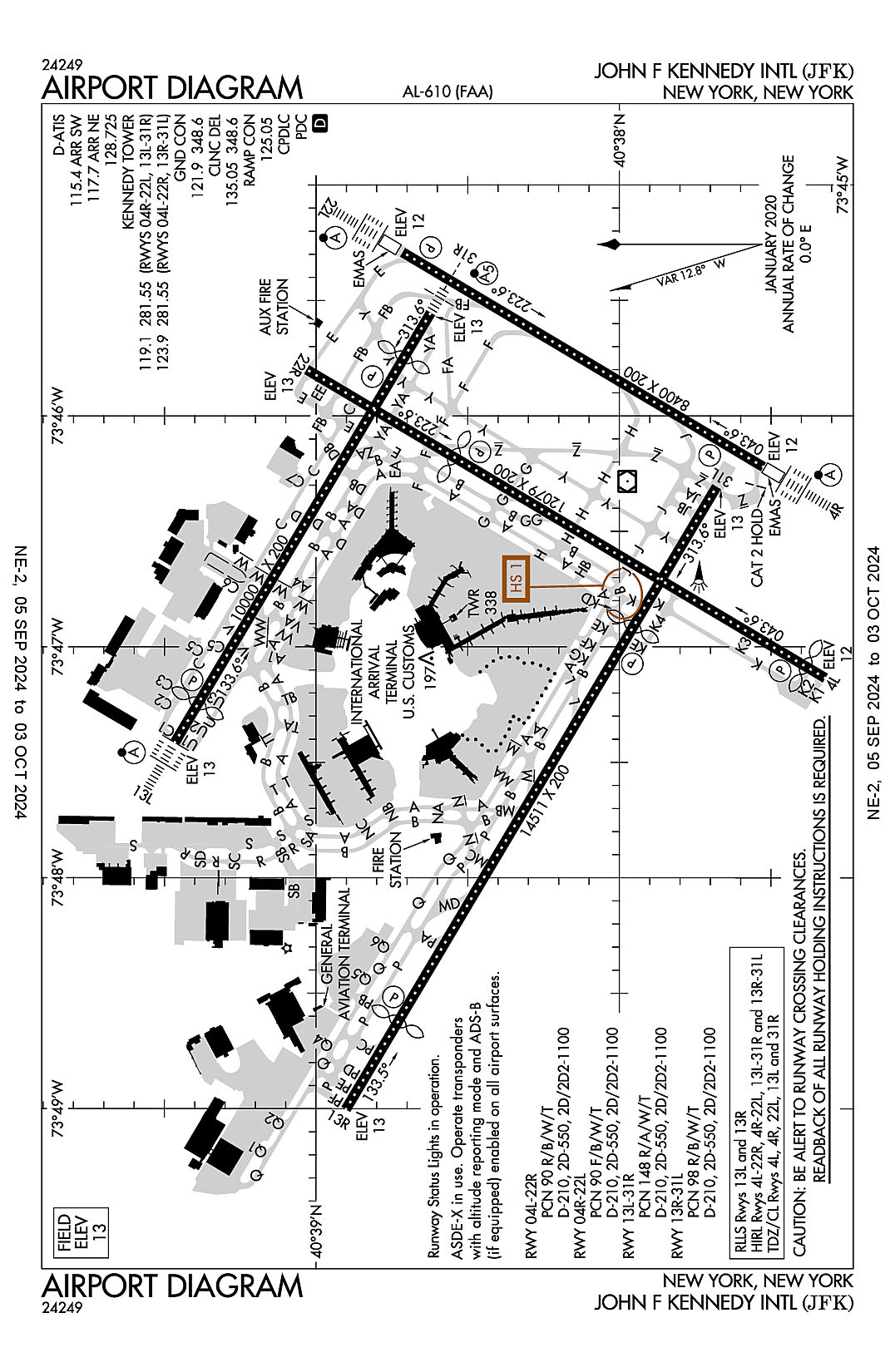
- "Excerpt of Aerodrome Chart, red: actual taxi path, green: cleared taxi path (Graphics: AVH/FAA):"
Two alternatives that I would think would be fairly easy to implement.
1) Google maps style directions input by air traffic control showing as well as telling the pilot what runway/path to runway to take.
2) Coloured lighting directing the pilot to the right runway via the correct path. Then the pilot only needs to know that they are following blue, and when it's time for them to move, blue comes up.
I understand this would be more work on the part of ATC, where right now they can verbally communicate, but a system such as this may also help ATC relieve some of the mental load.
Is this already happening? I can't find any links to suggest it is.
This isn't a real quote, is it? I was surprised to read ATC losing their composure like that, but in the linked video/audio there is no utterance of Shit! that I can hear.
Standard when the aircraft is already moving: "Delta 1943 stop immediately, Delta 1943 stop immediately".
The "cancel takeoff clearance" call is supposed to be only used when the aircraft has not moved yet. Like: "Delta 1943, hold position, cancel takeoff clearance, due to xxxx"
It was very very close so monetary lapse in composure isn’t entirely unexpected
vs https://twitter.com/RossFeinstein/status/1614613794470100995
Totally. The instructions were "taxi Bravo hold short of Kilo" and "cross 31L at Kilo"; read back was correct but instead of turning right at Kilo and crossing 31L, the pilot turned left, then right, and crossed 4L at Juliet.
Edit: I figured it out, sorry for the noise. For anyone confused as me, you have to click the timestamp to see the `flag` link on the comment.
(I've done so here.)
I counted six other path conflicts in the space of 25 seconds, in this tiny section of the airport. With conflicts happening every few seconds, it's incredible to me that crashes don't happen more often.
Why are paths planned this way? Is capacity pressure so extreme that airplanes have to be crammed together this tightly? Is it not possible for airplanes to travel along taxi-only paths that minimize runway crossings, or wait in orderly queues and achieve nearly the same rate of takeoffs?
Doesn't help on the ground though.
It basically uses radar data to figure out whether it's safe to enter and safe to take-off on a runway. If it's not it will show red lights at the take-off position and entry points, pilots are trained not to cross those lights when red even if ATC says to do so.
There's no advantage having a predictive tool over a binary "runway clear/not clear"
https://www.reuters.com/business/aerospace-defense/ita-airwa...
This stuff is happening a bit too often in JFK as of lately...
From the article: > The Italian airline, noting it fully respects all safety regulations, said in Thursday's statement that "collisions during taxiing manoeuvres are an increasing phenomenon ... especially in highly congested airports like JFK."
https://www.statista.com/statistics/639826/leading-airports-...
I remember flying from Michigan to Newark once and the ticket said “2 hours 45min” and I thought that was nuts, it’s like an hour flight.
Turns out they tack on an hour leaving and coming for taxing and waiting in line.
At least that’s how it was a decade ago.
Do yourself a favor and do a youtube search for "kennedy steve." He's famous for managing this chaos with a commanding voice and prompt instruction while maintaining a good sense of humor.
> * Completely changed tone of voice. He yelled into the mic. That doesn't happen often in ATC.
> * Yelled "SHIT!" to open his transmission.
> * Spoke in a way that emphasized speed and urgency even if it cost a little clarity (eg, some news outlets have transcribed "cancel takeoff clearance" as "cancel takeoff plans" because of how intense and fast the controller is yelling)
I think this was actually relatively subdued. There was a similar incident at Chicago Midway in 2015 where the ATC command was "Delta 1328 STOP STOP STOP": https://youtu.be/b26NcJCLZl4?t=82
Sp. leaving aside whether or not it's more "subdued" (they're both unusual in tone, I'm sure we can agree), the JFK controller did something that the Midway controller didn't: repeated the entire transmission including callsign, in case his first tx had been stepped on, unbeknownst to him.
He was able to do this in such a quick timeframe because he was employing the phenomenon I'm describing. Dialing deep into it: the way he allowed his full NY accent to come out ("cleh-ance" instead of "clearance", for example) delivered the full message at a very high signal to the ear _twice_ in about the same span as the Midway controller (while yes, using a louder volume) got a less clear message across only once.
I dream of being an ATC. It's something I'll do later in life in the context of a multiplayer game, I think.
So it's hard to make any kind of comparison.
It will be more telling to see how things settled after the construction is finished.
Something I realized growing up, and perhaps this is a bias for others too: I always perceived of airline accidents as being crashes where everyone dies. Hence all the conspiracy silliness of “they just want to know what seat you were in to identify the body.”
But my goodness there’s so many ways to be badly hurt without a big crash.
In a way this feels akin to the highway bias: highways are far safer than city streets but a lot of people perceive them as being so dangerous.
I remember an incident involving a private jet about a decade ago. The jet was at cruising altitude when suddenly it hit an air pocket and precipitously lost altitude. This being a private jet the occupants (some Greek businessmen) were drinking champagne or whatever, fact is they weren't wearing their seatbelts. A few of them died right on the spot as the result of them violently hitting the plane's roof.
Many passengers (including me) instinctively put their hands on the seat in front to steady themselves. You could easily slide around if the seat belt were loose.
It was it worst for children whose legs didn't reach the floor, but there were none seated near me.
People really don't like it when you do that, by the way.
I never found out the reason. I thought they would have to report it and I could read it in av herald.
[1]: https://en.wikipedia.org/wiki/Tenerife_airport_disaster
We are relying on checklists, procedures, surveillance tech, simulation training, certification, re-certification etc. etc. No other industry has put in as much thought into these problems. Except for maybe the military.
Source: I had the opportunity to meet and participate in crisis resource management training for surgeons held by a trainer from pilot training industry. Everyone’s mind was blown because surgery is comparatively in the Middle Ages.
Based on seeing and hearing about it I believe that more ideas have been studied and tested than you’d expect. Cognitive overload in crisis situations is a well researched problem. Probably hard finding links on the subject though.
Now you've added one more thing for the pilot to look at instead of actually looking out the windows.
https://en.wikipedia.org/wiki/Airport_Collaborative_Decision...
These are more about timing and throughput in airports, and less about safety critical stuff, and certainly there are new fancy navigation and runway lighting systems to help with that. But what I’ll say is that airports involve a huge number of different organisations, operating huge numbers of systems from different vendors, and until about 15 years ago there wasn’t much joining it all up end to end. To the point that a killer demo early on was merely putting the airport and all the planes on a real-time map. So, it doesn’t surprise me that a lot of the responsibility still falls on humans and processes.
While taxiing, you're supposed to have the taxiway map up (https://flightaware.com/resources/airport/JFK/APD/AIRPORT+DI...), and something like ForeFlight (which many pilots, GA and commercial, use) will alert you when you're approaching a runway as well as once you enter it. Not sure what the instruments in a 20+ year old 777 will have to help with this (likely the taxiway map, unsure if they'll alert on runway entrance).
On communication: most modern flight computers do support getting your IFR clearance from the FAA (see CPDLC: https://en.wikipedia.org/wiki/Controller%E2%80%93pilot_data_... and Tower Data Link System: https://www.faa.gov/air_traffic/flight_info/aeronav/acf/medi...). This doesn't include taxi clearance.
Looks like ForeFlight and MITRE are working on bridging the gap (take the audio taxi clearance and overlay it on the map): https://www.mitre.org/news-insights/impact-story/runway-safe...
EDIT: here's a video of the feature in action: https://www.youtube.com/watch?v=9p5-7jVg8fE; looks like it's only on the most expensive plan though :/
https://www.faa.gov/air_traffic/technology/rwsl/media/JFK.pd...
ETA: another comment suggests that while JFK has RWSL, it was not installed at the intersection where this occurred.
Or this one, showing how it works in foggy condition: https://www.youtube.com/watch?v=2W2ak94xTXM
And an explanation of the system: https://www.youtube.com/watch?v=zAn1mfBDDkc
With how much can be going on at major airports, probably. If ATC routed you on one taxiway the last 10 flights, then switched it up, you could easy repeat back what they told you while still thinking of the old route. Commercial aviation's safety record disagrees with me, though.
I'm sure the outcome of this event will probably be a technical mitigation of some variety to attempt to stop it happening again.
Although there were certainly many "systems factors" that contributed to the incident, the followup treatment of the pilots is in fact remarkable. The Wikipedia summary of the incident is "near miss attributed to pilot error". This pilot error nearly killed a thousand people. The pilots failed to report the incident (even flying the return flight the next day) and thus overwrote the cockpit voice recorder for the flight.
And despite all that, the names of the pilots are not included in the NTSB's report and Wikipedia editors/moderators think they shouldn't be included in that article. Impressive job security.
ATC: United 232 Heavy, Roger, Sir. Wind 010 at 11. You are cleared to land on any runway. Al Haynes : [chuckles] You want to be particular in making a runway? [staff at the control tower laugh nervously]
Airports are in-effect giant malls. They rent out space to shops, and airlines. Ostensibly the airport authority has set the pricing to maximize net income. For example DIA's authority is the city and county of Denver. JFK's is the Port Authority, which includes EWR and LGA, but also much of other transit in the area including LIRR, and MTA, but includes seaports, bridges and tunnels, and ... real estate.
ATC is run by the FAA whose budget is set by Congress. Everything is paid for. There are no per use fees. Landing fees are not federal, they're imposed by (local) airport authorities. The weather, flight service, ATC, national airspace system, navaids, all of that stuff is provided by the federal government.
ATC and FAA don't want to be in the business of collecting fees. And airport authorities don't want them to because it would necessarily cut into their take, and it would also mean they lack exclusive control to set pricing and thus demand and thus limit their ability to maximize income. It's a shopping mall.
A lot of people benefit from keeping JFK full. Airlines, pax wanting direct flights to other destinations etc.
Currently ~20% of New York passengers are connecting passengers, you could route them through other airports and free up capacity with much less disruption then making the New York local passengers have an extra connection on the way out.
Based on the animation https://twitter.com/CaseWade/status/1614342894248394752 at 00:14, I'm pretty sure AA 106 was no longer in visual contact with REL lighting by the time DL 1943 reached 30 kts.
But it is technically possible to take a child on a plane in a car seat, if you can find a suitable plane, suitable car seat, and suitable child.
Surgery is not a public performance. How do you even find out about the mistakes that occur? Fatal mistakes, sure, maybe...
You have a better bet of your dash cam showing what happened when your car is hit by another car, if something happens to you.
I think nobody's really going to know what mistakes were made while you were on the table. Certainly not in a near miss like this case.
Very interesting reference on improving healthcare and getting honest measurements: a 2004 article by Gawande on the treatment of cystic fibrosis. [1]
[1] Atul Gawande, https://www.newyorker.com/magazine/2004/12/06/the-bell-curve
There is some discussion on implementing black box style recording into the OR. I’ve met surgeons enthusiastic for this idea as an opportunity to geek out even more. But this enthusiasm depends on how authoritarian culture is in a given country. The OR is also often a place where people are in a corrupted power structure. I have been to countries where dangerous surgeons are covered by younger surgeons - that’s where recording in the OR is less popular.
On the other hand I have heard arguments against such recording as well. Anatomies differ, shit gets ugly to unqualified bystanders. Insurance keeps an eye on everything. Surgeons can become so careful that they prefer not to help so as not to endanger their career.
You also have to wonder how many deaths from surgery are officially classified as "Doctors messed up" vs something else that partially or fully absolves them from responsibility...
Pilots have a lot of info coming in at any given time, and there has been a move to reduce the amount of info, so they can focus on the more important items. The answer isn't always more warning lights or alarms.
Edit: By "This is a good example..." I am referring to the hypothetical situation, I am not confirming this actually happened.
https://en.wikipedia.org/wiki/Sully_Sullenberger#List_of_awa...
The Detroit airport looks amazing next to them.
https://thepointsguy.com/news/first-look-delta-new-laguardia...
"In Western countries and other liberal democracies, estimates for the value of a statistical life typically range from US$1 million—US$10 million; for example, the United States FEMA estimated the value of a statistical life at US$7.5 million in 2020." [1]
That's also not the meaning of Value of Life, which is a statistical evaluation. On a commercial plane there are almost certainly multiple people whose individual Value of Life projections exceed $10 million.
In many other cases, the value of life calculation for the very pilots of a commercial flight is less than $10 million.
This all goes to show that this calculation is not for what "each human life is worth". This is a statistical evaluation for determining what would need to be paid to an individual to engage in a dangerous activity or to be paid to a survivor after a person dies from an activity. When someone decides to work at a 7-11 in a crime-ridden area for a greater pay compared to a 7-11 in a safe family area, they perform a type of Value of Life calculation.
[1] From the first section of https://en.wikipedia.org/wiki/Value_of_life
But the key takeaway is that, for government policy purposes in the US, all lives are treated as having the same value and that value is about $10 million.
[0]: https://www.transportation.gov/office-policy/transportation-...
[1]: How this VSL was calculated: https://www.faa.gov/regulations_policies/policy_guidance/ben...
[2]: General VSL calculation methods: https://law.vanderbilt.edu/phd/faculty/w-kip-viscusi/368_Val...
ChatGPT says: I'm sorry, I don't have an exact number for the number of road intersections in the US. However, I can provide you with some information that may help you arrive at an estimate. According to the Federal Highway Administration, as of 2020, there were approximately 4 million miles of public roads in the US. If you assume that each mile of road has an average of four intersections (which would include cross streets, driveways, and other points where roads connect), that would result in an estimated 16 million road intersections in the US. However, this is just an estimate and the actual number may vary depending on factors such as population density, urbanization, and road infrastructure.
Good video of the test conditions for a 747-8 here https://youtube.com/watch?v=qc_v6tXsv6g
https://m.youtube.com/watch?v=qew09gao3S8
In short, the whole brake assembly catches fire- and continues to operate.
I do think it even though it’s a better brake mechanism video it’s not quite as visually impressive as watching a 747-8 just about to nose up suddenly nosing down as it slams on the brakes and they come to a stop in a dissipating cloud of smoking revealing the red hot brakes glowing in the wheels.
The carriers don't make this easy: they have conflicting rules on carseats for in-cabin use, especially if you're flying between the US and Europe, both of which have stringent carseat regulations, but absolutely no models that are approved for use in both. In practice, United allowed the EU carseat (used, bought specifically for the trip) and Lufthansa allowed a US carseat (more compact, bought for car use in the US), but both of their sites stated that they only allowed carseated approved by the airlines' local authorities: NHTSA (United) or TÜV (Lufthansa).
In case anyone is curious, this source does claim that "lap infants" are more likely to be injured than other passengers. But the article defines "lap infant" as anyone under 2 years old, regardless of whether they were in fact in someone's lap. (In particular, some of these "lap infants" fell from the cot!)
Potentially worth quoting as well: "Scalding burns from hot beverages or soups spilled over a child during hot meal service were the most commonly identified mechanism of injury".
> For the purpose of this study, the term in-flight injury was used to denote medical events caused by injuries (ie, trauma or burns) that occurred or manifested themselves during flight. Lap infants were defined as passengers younger than 24 months, the age until which a child is allowed to travel while sharing a seat with an adult passenger.
If you're seated in an airplane please make sure you've got your seatbelt on. You can have it a bit loose and it'll still protect you from this sort of nonsense much better than no seatbelt at all.
"Runway 4L was being used for takeoffs. The American Airlines aircraft did not follow air traffic control instructions. ATC audio shows they were told to “”cross runway 31 Left at Kilo” and instead crossed runway 4 Left at Juliet, in front of the accelerating Delta Boeing 737."
Crossing a runway, which you're not cleared to cross is a pretty bad case of miscommunication in my book.
What is lacking (to your point) is the ability to automatically compare ATC’s verbal instruction to the aircraft to its actual position.
Very curious if/when they'll add speach to text/clearance. The syntax is fairly standard, so should be easy to parse, I'm just curious how tolerant folks would be of some % failure.
If you follow your link to the actual VSL guidance, you will see that. [1] There is even discussion regarding how advances in data science can be used for subgroup evaluation of VSLs.
[1] https://www.transportation.gov/sites/dot.gov/files/2021-03/D...
“Prevention of an expected fatality is assigned a single, nationwide value in each year, regardless of the age, income, or other distinct characteristics of the affected population, the mode of travel, or the nature of the risk.”
I think reasonable people can disagree on whether it ever makes sense to use multiple different VSLs for different types of person. I happen to think that those kind of adjustments do more harm than good. But it’s all (literally) academic — actual policy is set based on a single VSL.
I don't know what the corresponding term would be for taxiways, though I expect the reply here will be spelled 'not practical'.
[1] https://www.aopa.org/news-and-media/all-news/2011/february/0...
> Captain Mark Radloff was thus faced with an almost unprecedented situation: having already accelerated well past V1, he suddenly realized that his airplane would not become airborne. At that point he faced a choice — keep trying to force it into the air and risk failing, running off the runway at well beyond takeoff speed, or try to stop, and guarantee a lower-speed overrun?
https://admiralcloudberg.medium.com/lesser-of-two-evils-the-...
Basically you'd be unlikely to get the airplane to stop before the end of the runway because brakes are not designed to handle breaking at such speed (keep in mind that an airplane lands at a slower speed than it takes off thanks to the flaps).
It meets these constraints:
1. Low enough such that if you try to stop from that speed you will stop before the end of the runway
2. High enough such that if you have an engine failure at that speed, you will make it airborne on the other engine before the end of the runway
3. Not higher than rotation speed (you can't decide to abort after pitching the nose up and getting the aircraft airborne)
4. Not lower then minimum control speed (you can't keep directional control in case of an engine failure below minimum control speed, so your only option is to abort)
If there is no speed that meets all conditions, then your runway is too short and you can't go. Reducing weight helps, since you'll accelerate faster, stop easier, and take-off at a lower speed. So that's usually the solution if your runway isn't long enough.
Constraint 1 is why you're committed to takeoff above V1. If you would try to stop above V1 there is no guarantee that you'll stop before the end of the runway. While you are guaranteed to be able to take-off above that speed, even after an engine failure. So you take the problem into the air, run checks, and return.
There aren’t a ton of reasons one might think that but a few come to mind like total engine failure or lack of elevator control or similar.
This was the case with Ameristar Charters 9363, which aborted after V1:
> [T]he jammed elevator could only be detected once aerodynamic forces came into play — something which would only happen once the plane was already speeding down the runway. The NTSB was forced to come to an incredible conclusion: that there was no way for the pilots to have detected the problem until they attempted to rotate for takeoff.
https://admiralcloudberg.medium.com/lesser-of-two-evils-the-...
Good overview: https://www.youtube.com/watch?v=lpGl2_fVr2Y
Right now, private spaceflight is basically regulated in a manner similar to Part 91 (GA) operations. The customer signs a waiver saying that the vehicle is not certified and that they've checked it out to ensure it's safe. Early days, of course.
Honeywell et al all have huge catalogues with all kinds of aerodrome lights. Here's Hughey & Phillips: https://www.hugheyandphillips.com/wp-content/uploads/2022/06...
As you can see, embedded lights are also represented from pg 23 onwards and red "stop bar" lights can be found on pg 38. Here's a picture of them installed: https://i.imgur.com/ThNIQaw.jpg
This compliant seems to me akin to me not backing up my computer's internal drive to this external drive I have sitting on my desk, until I can make a little RAIDed setup to address the small probability that the backup drive will fail. Having no backup at all is worse than requiring a high standard to the point that the backup may not be implemented.
It's not like if they break, nobody will notice. Install them, have a process to verify they're working regularly, fix them if they break. Any downtime whilst they're being fixed is just as risky as every day the project is delayed to to this high standard of reliability.
If even one indecent like this happens hundreds of people die in a horrible all consuming fire, travel for the entire seaboard would be halted, hundreds of thousands of passenger would be dealt with for not being where they are supposed to be, and that's before the extraordinarily expensive repair to the tarmac and the scrapping of the planes. There is, quite literally, zero margin of error.
99% is absolutely reasonable for one layer of defense among many! That is one of the best methods to achieve truly high reliability, as is needed in this case: stack many reliable systems in such a way that they all must fail to get an overall failure. It is not perfect, of course, and things can always cascade, but it is a powerful technique.
So it’s very strange you’re passionately arguing to keep the riskier current setup that almost had a massive accident — rather than improve it.
Perfect is the enemy of better.
The first gas turbine was invented in 1791
Are they cheap? Can you buy them for next day delivery?
Yes. They are consumables comparable to bulbs and light fixtures at home, just good LEDs on a PCB in a metal/plastic case. It's sheer insanity to pretent that aerodrome lights are some magic technology.
Seems like most of those problems would be more caused by the power cables than the light itself.
The costs add up quickly.
The US doesn't have horizontal directional drilling rigs that go under a runway and pull cable?
Even then, things occasionally go awry.
<https://en.wikipedia.org/wiki/Lake_Peigneur#Drilling_disaste...>
For an airport, the precision required both to not hit extant underground infrastructure and to know precisely where your newly deployed infrastructure is (for the next guy/gal to worry about) is probably a salient concern.
I'm not sure that horizontal drilling offers that degree of precision and assurance as opposed to rip-and-dig methods.
787 wingspan is 200ft (60m). Planes don't turn on a dime either, but the larger ones do have steering linked to the rear wheels, so their turn radius can be surprising.
The non invasive solution would be to require some kind of ground control computer link that can directly draw their controlled path for them on their displays and give them a nice loud master caution or warning if they're about to break their assignment.
Then we can start thinking about ground autopilot systems.
And no one chooses when or where that is
As opposed to the alternative described, where you close down the runway, dig out a full trench, lay a cable in a conduit, and attempt to compact every thing back to how it used to be?
You think that's a better alternative than just drill core'ing the conduit through?
Interesting.
Back in the days of the Exxon Valdez tanker incident, I wondered if the technology did not exist to positively track such major asset positions/directions, and dispatch an alarm from one or more authorities at a distance.
In terms of powering lights/signals, perhaps solar, batteries and a generator for each patch, and if there is no flashing of light visible (indicating power-loss or stuck-at failure), tower clearance must be given?
The lights don't need to be tall enough that the wings would be able to hit them.
> because of all the red tape that must be
to
because of all the rigoy testing and precise engineering that has to be
Nobody is saying you can't pour theoretically meaningful pork into a traffic light in the form of QA and whatnot and get an indestructible traffic light that operates for a century without being touched in return. People are questioning whether that's actually necessary for a system that's already the Nth layer of redundancy.
All those inspections, certifications, and other requirements exist for very good reasons. Reasons that more likely than not cost us blood and tears to realize their need.
Maybe it's worth having a worse system that actually is there.
When I was an intern I got to help change the blinking red light on top of a 50 story building. It’s a big deal that was scheduled weeks in advance and probably involved two dozen people, a special lightbulb and a bunch of coordination.
Even among the team working it plenty of “how many X does it take to change a light bulb” jokes were told.
But consider than a pilot depends on certain things being there when things go wrong. If the weather is bad and there’s issues with instruments, seeing that red light is the difference between life and death. There are potentially dozens or hundreds of people on a plane and if I recall correctly up to 4,000 people in the building.
When life is at risk, the standard for engineering must be higher.
If/when it happens the professionals who deal in this stuff will say something mundane like "this system prevented ten close calls before we actually had one slip through, that's pretty great". And they'll replace the $5 lightbulb and move the "check the bulbs" from the monthly maintenance checklist to the weekly checklist. And you'll complain much like you're complaining now.
Any references / sources on that?
They did fix it and then eventually we took off. In a way that's "not going wrong". On the other hand, they didn't cancel it and send the plane to be disassembled for failure analysis. That'd certainly be safer.
Everything involved in aviation is designed to be extremely reliable, but parts are still expected to break. Airplanes have a list of parts which are allowed to be broken without grounding the airplane. Every part has a well-documented procedure for inspection, maintenance, and replacement.
Investigations happen when, despite following the documented procedures, stuff somehow still goes wrong. They are done to improve the procedures so that it can never happen again.
Inspection and maintenance is a significant source of errors, though. Nobody wants to disassemble an entire plane when a single part develops a well-isolated failure.
Air Transat Flight 236 had its engine swapped out with a spare during routine maintenance. However, the engines had a different "patch level", leading to them installing a hydraulic hose with the wrong length. This hose rubbed on the fuel line leading it to develop a leak. The subsequent flight ran out of fuel halfway over the Atlantic, and they narrowly avoided having to ditch it into the ocean.
American Airlines Flight 4439 was done on an aircraft with a faulty trim switch. Prior to the flight, maintenance engineers wanted to replace it, but this was cancelled mid-process due to the time required to acquire a replacement part. They re-installed the switch and marked it as inoperable - which is not an issue as - despite the switch being safety-critical - there are two other trim switches available. However, the faulty trim switch was reinstalled backwards, and the pilot still tried to use it due to muscle memory. This nearly lead to a pilot-induced stall.
There are literally dozens of stories like that. In aviation, there is no room for error.
More accurately though, safety critical things are not allowed to go wrong. If they do, they get investigated. What is and isn’t deemed safety critical is a document written in blood, unfortunately.
Nobody's debating that those processes work. People are questioning whether or to what degree this system should be subject to them. Just because something touches aviation somehow is not a blank ticket to pour red tape at it to satisfy some ideological lust for the "perfectly safe" system. For example, the facility lighting around an airport is just normal lighting used on any other large commercial facility, off the shelf sodium bulbs, LEDs, halogens in off the shelf fixtures, the kind of stuff you buy from all myriad of online supply houses and local suppliers. The runway lights are subject to much more specific requirements (but still very relaxed compared to the lighting on actual aircraft). Where do the traffic lights fall on that spectrum? IDK, but seeing as the system is never gonna leave the ground I'm pretty inclined to ignore whatever the people who think it needs to be designed like an aircraft have to say.
> Reasons that more likely than not cost us blood and tears to realize their need.
If/when they mandate a traffic light system at JFK will that rule be "written in blood" as you people often like to say?
If the norm becomes (radio clearance and no red lights), I suspect pilots will become conditioned to equate no-red-lights with landing clearance. Not 100%, but maybe at least 1% of the time. So if that happens and the red lights stopped working, you have a problem that wouldn't have existed if the red lights were never introduced.
Perhaps a more resilient system would use green lights to indicate landing clearance. Then if the lights failed, the default would be radioing ATC for guidance?
(I have no qualifications on this topic. I'm just guessing based on a bunch of Mentour videos I've watched.)
How did you prove that?
If its more often, does an outage need to be detected? How do you detect that lightbulb went out?
How much does that cost?
Doesn't matter; that's not a comparison that's relevant to any decision here.
How many additional crashes per year are prevented by the high-cost bulbs, and how many additional dollars per year does it cost to install them on every building?
Maybe the 10 $10 light bulbs need to be replaced once a year and they cost $150 / year. Maybe the one $10,000 bulb needs to be replaced every 15 years and costs $900 / year. Once you've gotten to that point, at least you know what the cost difference is.
Then you can either ask "how many planes would crash into the Chrysler building every year if it was using 10 bulbs from Home Depot, compared to the one bulb it's currently using?", and compare that to $750. In that case you'd get an answer that told you whether the Chrysler building should use a special bulb. Or you could ask "how many planes would crash into buildings anywhere in the world every year if they all used 10 bulbs from Home Depot instead of what they currently use?", compare that to $750 multiplied by the number of tall buildings in the world, and you'd get an answer that would tell you whether it'd be better for every building in the world to use commodity bulbs or for all of them to use the bespoke bulbs.
But you'd never ask "which costs more, one fancy lightbulb or one crashing plane?". That won't tell you anything.
So you decide, scre the airplane, a will save my life, and jump out. Only it fails to open, it was an unreliable parachite, bought by someone like you. They thought,'better a 50/50 parachite then no parachute?
So now you are plummeting to you death, thinking, that if you did not have the confidence of 'I have a parachute' you woupd have never attemped the barrel roll in the first place. And you would have done your utmost to steady the plane, and probably would succeed. And you would not waste time packing it and fuel carrying it around with you.
Your entire hypothetical is unlike the actual scenario, where this is being recommended.
Of course you have different solutions to a completely different problem — but what you haven’t addressed is why this is a bad solution to this particular problem.
The presence of a backup option affects your decision making. Human brain assumes the backup is reliable. If you install some 50/50 backup, you put more people at risk
If there's a safety mechanism that may or may not work, coming to rely on it is suicidal.
If there is no safety mechanism in the first place, you (hopefully!) never become complacent in the first place.
So it's better to either have a safety mechanism that will absolutely work every single time or nothing at all, than one that may or may not work and invite complacency.
The irony is that the reason the safety numbers are that good is because aerospace is one of the only 5+ sigma quality/safety industries.
The fact that the absolute numbers are low does not change any calculations that follow from that ratio.
If your point is that close calls will always outnumber the actual accidents, that’s like saying the number of doctor visits will outnumber the number of cancer diagnoses. Safety incidents are always a subset of a larger set that also contains close calls. By their nature, most safety incidents require multiple things to go wrong, which means there will be more times that some, but not all, things will go wrong to create a close call. It’s almost such a trivial point that it’s hardly salient enough to mention.
Why is imagining something completely different useful?