New Mac Mini(apple.com) |
New Mac Mini(apple.com) |
When you start pricing the Mini toward where you're concerned about the 32gb memory limit, you're approaching the Mac Studio pricing tier, anyway.
Apple is still doing its old tricks, though. Out of curiosity, I put my $13K Mac Pro in as a trade-in to see what it'd contribute (and to be clear, my expectations, I thought, were reasonable... was thinking $3K). 12 core Xeon, 192GB, 8TB, W5700X 16GB.
$3K? No, $1,050. Ouch.
Double ouch when you go to the Mac Pro store and find that exact same configuration is still being sold by Apple today for $12K.
You've specced it up with every customisation possible, that 999.999999% of buyers won't do and won't need and then complain at the cost in an effort to bash Apple,
I just find it humorous that you can spend several thousand dollars on a Mac mini, Mac Pro, or Mac Studio. It seems like there's a lot of product overlap to me.
That the Mac mini can cost either X or ~10X is more like saying "a car starts at $15k and can cost $150k". Throw in that it clearly overlaps with the Mac Pro and Mac Studio and I can only ask "why would I pick X, Y or Z?" It seems like the Studio is the way to go vs a mini configured above or around $2000, unless Apple is simply peddling to datacenter customers with Mac mini server racks (which hey, maybe).
Too bad I can never put it in one of the industrial machines my startup builds, as these Apple computers are completely oriented towards end-consumers, locked with an AppleID, etc. in summary totally useless from a builders perspective.
It is quite sad that top tech companies nowadays produce mostly consumer electronics.
You can't argue that XPS is "premium lifestyle", that's what Dell says it is, but that's not what it ends up being in reality. I will say XPS/Optiplex are both the "pro" stuff (pro as in MacBook Pro, not necessarily Pro as in "used in corporate IT most often").
For most of the folks on HN, that's probably true. We're an edge case.
For my parents? A Mac mini is gonna be more than enough. There are folks happilly using Chromebooks with a tenth of the power.
Still haven't maxed out the M1 mini. Except when Zoom or Discord start taking weird amounts of CPU for literally no reason :D
It's like a faith amongst some people that this is bad, but the idea seems to lack evidence.
There will always be some non-zero number of people who either want or are genuinely best-served by something like the entry-level Mac mini, but that doesn't equate to it being a generally-good option.
lol
I don't see what iPads have to do with this at all. Surely tablet vs desktop is an entirely different decision.
As I'm sure you know, there are many articles, threads, et. al. out there about whether 8GB is enough for a Mac. We can link articles back and forth all day, but here's what it comes down to: with only 8GB of RAM, even light use will see the Mac offload to swap much more often than if it had 16GB to work with, and one of the first "scandals" that arose from the M1 Macs was that bytes written to the internal SSD was much, much higher than it should have been, because of that swap usage.
They stopped providing font anti-aliasing (default on Windows) few years ago in MacOS to make retina displays more relevant.
It also requires you to know the pixel geometry, so may not work correctly on OLED or TVs or other display technology.
I now use a 27" 1440p monitor and I'm always struck by how bad text looks on it compared to my 2009 MBP that's stuck on Mavericks until it dies (not due to text reasons, it's just slow as hell/no benefits to upgrading).
They did something that was relevant to 1x displays, because it used to be better.
The problem is my alternatives are a 4K display with non-integer scaling on macOS, or a 5K Studio Display that my Windows work laptop can’t drive which costs almost as much as my MacBook again[0]. So I guess I’ll stick with what I’ve got.
[0] I’m intrigued by the recently announced 5K Samsung ViewFinity S9, but I’m not expecting it to be meaningfully cheaper than the Studio Display considering it’s a captive market.
See "The subtle death of subpixel antialiasing"
https://arstechnica.com/features/2018/09/macos-10-14-mojave-...
https://cdn.arstechnica.net/wp-content/uploads/2018/09/Scree...
The one thing I appreciate about windows is that you can completely disable cleartype/anti-aliasing, if you'd like. As far as I know of, it's not possible to do that in any version of macOS (including Ventura).
In fact Checking "Antialias text" in the Terminal.app settings profile just didn't do anything on a non-retina external monitor for 2+ years.
https://i.imgur.com/nRLReww.gif
https://i.imgur.com/fu08mPa.gif
rdar://FB8901170
It's unusable with text that blurry. I thought something was broken at first.
I guess they want to force us to buy a Pro Display XDR. No thanks, instead I'll buy a new computer and run Linux.
EDIT: My mistake, they now have the Studio Display for "only" 1500£
That said, the Mac mini and Mac Studio are reasonable to consider here, since they're sold without displays and I'd be shocked if the majority of them aren't used with regular 4k displays. (We're less than a year out from Apple having a first-party retina monitor at a vaguely reasonable price-point, still.)
Upgrading to 24GB is a whopping $400, and to 1TB is another $400. The $700 baseline seems reasonable. $1500 for a minimum usable machine seems more than a little excessive.
- I do not like the laptop form factor for doing actual work at my desk; I strongly prefer a bigger and better positioned screen, an ergonomic keyboard, etc
- 10Gig ethernet
- HDMI (wasn't available on Macbooks at the time, also couldn't plug in two external displays)
- If your computer is docked close to 24x7 (as was the case with most of my previous laptops), the battery becomes a liability
- Better cooling (I know these barely ever get hot... until you actually try to push them)
Plus also any kind of headless application, like a server rack where you also want the box to be a bit more more rugged.
Could you tell me more about the liability it creates? Is it a fire hazard? Decaying battery performance?
I just priced out a 24GB RAM/2TB storage M2 mini, and it's still $1kCAD cheaper than the equivalent Air.
There is definitely a large "screen and keyboard" upgrade tax if you're actually considering it.
January the 24th? January 2024?
I wish the US would start writing dates in a sensible way!
Looks like standard big-endian notation to me.
It's not even standard for the US! Did they decide "/" wasn't Apple-y enough so they had to use "."?
edit: the ad says up to 24/32GB of ram, but seems like 8gb/16gb models are the only ones available for pre-order at the moment.
Even my thunderbolt 4 hub / dock … has another hubs for “lesser” devices.
How many AA multiplayer games are available on Mac? Not streaming, no VM, no Wine/CrossOver. Legit playable games. I know Minecraft, WoW, Civ6, and CSGO. Probably there is more but clearly not the target of Apple and the devs either
I'd argue Apple shot themselves in the foot by depreciating 32-bit libraries as fast as they did. If they had Proton, the Macbooks could be enjoying the same surge in gaming popularity the Steam Deck has.
Remember that all iOS games work on Macs, too. Here's a list of AAA iOS games from last year, for example.
https://www.reddit.com/r/iosgaming/comments/t1iqlh/a_list_of...
$1999 for the Mac Studio vs
$1699 for the Mac Mini M2 Pro 32GB.
Indeed that's a tough sell for the Mac Mini. It shows how much Apple is charging extra for those capacity upgrades.
And remember that eBay charges a selling fee of 12.9%, and you have to go through all of the time and effort of photographing, listing, selling, packaging, shipping, and dealing with a (small) risk of buyer fraud.
On the other hand, Apple takes it off of your hands hassle-free, risk-free, and you pay no sales tax on the trade-in value (which in NYC is 8.875%, for example).
There's nothing insulting about it.
It's like a plumber saying they are totally fine using a $2 Walmart wrench. I just don't get it.
Memory compression is a thing, and these SSDs are fast, but I still don't understand how this is working so well. I was fully expecting to exchange this for a higher memory model, since it's supposed to be a temporary computer. I'm keeping it, for now.
"One display with up to 8K resolution at 60Hz or 4K resolution at 240Hz over HDMI"
Battery life is great, the laptop is fast enough for everything I need. TB 3 hubs allow me to use external peripherals, two 4k 27" monitors, plenty of real estate.
Update: I just saw a couple other comments – camera for sure. A much better camera than the garbage they include nowadays.
I was waiting for the Mini refresh but now I think I'll just wait for the Studio refresh and get one with M2 Max.
Mini = M2 and M2 Pro | Studio = M2 Max and M2 Ultra. | Mac Pro = M2 Ultra and ??? (or maybe 2x Ultra)
If they've fixed that, I would consider using this as an HTPC (as Otpimus and Movist are the only desktop video players I've found that seem to actually fully support HDR, my windows box isn't cutting it).
Catalina on my cheesegrater Mac Pro would happily drive 2 4K 10-bit screens at 144Hz (via TB3)
Big Sur? Not so much. Had to downgrade DSC from 1.4 to 1.2 on my monitors, and even then I could only get 120Hz at 8 bit, 95Hz at 10bit, IIRC. Still not "shabby" but annoying. Really seems like it was broken as something to do with the Pro Display XDR.
I am looking at the rear ports of the M2 pro and I see 4x TB4 ports and 1x HDMI ... can't this drive 5x displays ?
If not, why not ?
There's hacky third party solutions to this, but they all involve giving questionable applications permission to record all your screens.
You'll note that, for example, on the Macbook Air (both M1 and M2 versions), Apple labels the ports "Thunderbolt / USB 4," which is confusing and IMHO downright misleading. Either way, the reason they do that is that those ports don't support dual displays, so they only meet the Thunderbolt 3 spec, which doesn't mandate dual displays.
A better label for the Macbook Air might be just "USB 4," or "USB 4 with Thunderbolt 3 support" (though TB3 is part of the USB 4 spec, so that's technically redundant).
USB/Thunderbolt standards are fun.
https://www.apple.com/mac-mini/specs/
And up to three monitors for certain models.
An $800 box with a power cord. Spend the same and get a therma-throttled cpu with iOS and display (iPad); a little more and get a monitor (MBA). Spend double and get a larger monitor with a keyboard and mouse (iMac).
Maybe the primary question is if the user is cloud first (minimal storage) or classic filesystem packrat (better buy big).
     12-core M2 Pro processor
     19-core GPU
     16-core Neural Engine
     32GB memory
     8TB storage
     10Gb ethernet
     4 Thunderbolt ports
     20-core M1 Ultra processor
     48-core GPU
     32-core Neural Engine
     64GB memory
     1TB storage
     10Gb ethernet
     6 Thunderbolt ports
     10-core M1 Max processor
     24-core GPU
     16-core Neural Engine
     32GB memory
     512TB storage
     10Gb ethernet
     4 Thunderbolt ports
On the other hand, maybe there should be pushback against shitty inefficient software?
I remember a decade ago being able to have a dozen browser tabs and instant messaging clients on 4GB of RAM just fine, and neither the web nor instant messaging experience has changed significantly enough to warrant the extra memory consumption (the majority of today's day-to-day browser-based tasks have been done just fine in 2010 on that era's hardware).
How would that work? You whine on an online forum over how bloated a software is, and in the process opt to be deprived of it's usage? Or would you continue to complain about bloated software while using it? Because none of those scenarios offer a compelling reason for the software maintainers to rearchitect their whole application.
Meanwhile, a 8GB stick of RAM can be bought for what? 40€?
I remember a decade ago buying a 16GB Mac Book Pro, and listening to people complain that 8GB wasn’t enough, so I’m not sure what world 4GB was enough.
That same 16GB laptop still works great today.
Cut out webapps/Electron and it was entirely fine, though. Like if we'd just used XMPP or something instead of Slack I might even have been able to make it work without serious issues
I think that war has been lost. Apple should just allow more RAM to be put in.
Agreed. Some might say "RAM is cheap" but that line of thinking is why one day 64GB RAM won't be enough for a dozen browser tabs.
Its sad for me that my initial reaction to this is where previously a corp Windows laptop was for email and MS Office, and the Mac was for "actual work", now Mac's are headed to the "email and Office" role, and a halfway decent machine running Linux is where "real work" happens.
Apparently Mini RAM hasn't been user upgradable since the 2014 model
I think 8gb is still the sweet spot for casual users.
Usually I see that term used when the thing being considered is a pricey upgrade, and you need to strike a compromise between price and performance.
In this case, we're talking about an extra 8GB of memory, which would add perhaps $10 in cost to the bill of materials for the machine (or maybe less in sufficient volume). Given that Apple is also overcharging by at least 3x current standard retail price for SSD upgrades, my guess is that there's some room to bump up the wholesale cost a bit.
Not doing so is, IMHO, insulting to users, and given the non-upgradable nature of these machines, bad for the environment, counter to all of Apple's talk about being environmentally friendly.
I've had games running with full on tab-hoarded browsers and IDEs open among with any other crap I haven't bothered to shut down.
So the macmini essentially for free after a few years compared to your windows machine
I see both 24GB and 32GB configurations on the Apple Store configurator. Not sure what you're looking at.
Also, starting last month, Chrome aggressively unloads tabs in the background with its new "memory saver" feature [1]. So if you were having issues with 8 GB before because of your tabs, you might not anymore.
[1] https://blog.google/products/chrome/new-chrome-features-to-s...
The thing to be careful of is if your custom config breaks then the turnaround to fix it can be a couple of months. Ergo only buy stock configs. That makes the market somewhat less friendly.
Also worth mention that 64G is pretty cheap on desktop and that's what the Mac Mini should be compared to.
I ended up getting the 16 GB machine (my RAM usage was around 12 GB most times, and never north of 15 GB), but I would be fine recommending an 8 GB machine to my parents. Even from a future-proofing perspective, their use is so lightweight (some photo editing, web browsing, and email) that they would never need more than this.
I could see a case for offering the new version with 16 GB and up, but keeping around an old M1 version with just 8 GB. But I don't think it's necessarily in everyone's interest to pay more for that much RAM.
I can assure you that the shareholders are not disappointed. The premium you pay for more RAM (and SSD) is insane.
Besides that fact that no one is making a computer for the ordinary user anymore. Hardly anyone needs that much power in a computer.
I have a triple monitor setup, and there's essentially a 117% surcharge to add support for the third display.
https://www.macworld.com/article/675869/how-to-connect-two-o...
Of course why would they do this if they don't have to...
This is absolutely not normal...
I don't know what a discord is though.
They really should be upping this to 16GB RAM. There's just no reason not to.
Safari has twelve tabs open across two windows, and Arc has sixteen tabs open.
Checking "memory pressure," I'm in the yellow zone, so I definitely agree that 8GB is not enough. But perhaps you should look at alternatives to Chrome in the meantime.
Doesn't Microsoft still sell laptops with 4 GB of RAM?
I'm perfectly happy with 8GB on my M1 and it was fine on my 2016 13" Pro.
$200 to add 8GB of memory is _insane_, and framing it as "consumer choice" is bad when consumers are being gouged so badly. It's literally at least a 20x markup on the wholesale cost. You can buy 8GB of DDR4 at retail for $20 or less.
2. New RAM is not like old RAM.
Macs are dramatically more optimized than they used to be.
I have a MacBook Air (M1) with 16GB of RAM and it runs more smoothly than older systems that had twice that much.
8GB of RAM today feels like what 32GB of RAM used to. 8GB of RAM can handle very process-heavy tasks, like... running Chrome ;)
Tell that to Apple so they can do that out of the box.
> 8GB of RAM today feels like what 32GB of RAM used to
No. I think you're confusing memory speed with capacity. Making ram faster doesn't mean it can magically store more.
However the parent is right, it's disgusting how much memory capacity is needed to run a basic environment.
Maybe having exceptionally fast machines with limited ram will cause people to actually think about their resource usage.
I think the Mac Pro will be announced months before it releases, announcement at WWDC then fall release.
It usually doesn't look as good, but it's not like distractingly bad.
To add to that, my 8GB "late 2014" Mac Mini is very performant with (the modern) Linux on it. (It was barely usable running a recent MacOS.)
Personally I think 8GiB should be more than enough for any normal end user though the Electronification is taking a real toll these days. However, this is the M2 Pro, labeled for professionals, and professionals generally need more resources. Capping the machine at 32GiB means I can't even comfortably run my current stack without swapping. I can only imagine what this will do do professional video/photo editing.
Like always, it depends on your usecase. For some 4GB will be enough, for some it wont.
I’m not talking about laptops. I specifically said that.
Regardless, USB-C has the springs in the cable, not the port (unlike Lightning), so the port should never fail with regular use anyways, but you may need to replace the cable at some point. You may need to clean the port out eventually, since gunk build up could make the connection feel looser with enough cycles, but then it should be fine again after cleaning. But again, I’m not talking about a laptop where you would be removing and reattaching the drive constantly, so this is completely off topic.
1,500 connect/disconnect cycles for A
5,000 for the Mini
10,000 for micro and type-c
I also have over 200 PDFs loaded in preview in the background, related to a law suit I’m researching. Still no issues.
ETA: I’m likely to replace my m1 with the m2 since the m2 gets +30% scores in common web benchmarks and heavy JavaScript hacks are my main thing. That should bring it up to par with my Linux box that has the top of the line Intel CPU.
I had FF open with a ton of tabs, Capture One open, and I was stacking 400 frames in PixInsight.
The fact I had to push that hard was immensely impressive.
The Mac mini M1 requires a displaylink driver to support a third display, which in all cases requires uninterrupted screen recording permissions to function. M1 laptops require the same to support more than ONE external display, regardless of whether or not the laptop is in clamshell mode.
The previous Macs supported so many 5k/8k display at once, they arguably should be able to drive a single 8k display, technically.
Example, Mac Studio supports up to 4 x 6k displays AND 1 4k at once. So that is 4 x 18M pixels + 8M pixels = 80M pixels
8k displays are 32M pixels, so Mac Studio is arguably already able to push 2x that many pixels...
Or maybe it's related to the HDMI chipset they chose specifically until now.
Now they support HDMI 2.1, based on this announcement, so they're finally catching up to everyone else. It would have been dumb for them to fall further and further behind on a display connector regardless of what monitors Apple has in the pipeline.
My relatively anemic "Mac compatible" list of games, in my Steam library, went from about 20 to 3.
8GB is probably enough for most users in most cases currently (not necessarily in a couple of years, which means they'd update earlier) but the cost for adding 8GB would be pretty low for Apple.
"Is it realistic to have an external drive for photos that integrates seamlessly with the native Photos app?"
If that person actually did use a hard drive (not an NVMe SSD), then yes, the experience would probably be janky. I don't think modern Apple Photos is built to handle slow spinning rust very well.
If someone uses an external SSD with equal or greater performance to the internal SSD, then it would naturally perform as well or better than the internal photo library would have. Apple was putting a ~3GB/s SSD inside the M1 Mac Mini, which is hardly cutting edge and can be matched by an external thunderbolt NVMe enclosure. $120 for the enclosure + $70 for the SSD is still way less than the $400 that Apple is charging, and it can actually be upgraded down the line. Or someone could get a 2TB SSD for $130 (+ $120 for the enclosure). Apple wants $800 for 2TB of storage!
Even if Apple upgraded to faster SSDs for the new M2 Mac Mini (which is not clear at all), 3GB/s would still perform exactly as well as it did on the M1 Mac mini's internal SSD, which is to say... it would perform plenty well.
>> Nope, soldered.
> Nope, in the same package as the CPU and GPU.
The SSD certainly isn't in the same package as the CPU and GPU, so your comment is simply wrong, given the question that was actually asked. Whether the RAM is on-package or not is irrelevant to the question asked further upthread. It is soldered. Neither the RAM nor the SSD can realistically be upgraded after the fact. That's the answer to the question.
I don't understand the purpose of your comment.
Something as huge as the Mac mini could easily have a regular m.2 NVMe socket. Apple could presumably still do their proprietary thing with direct NAND access through the same physical socket, while still letting you swap in your own SSD that brings its own controller... but this would interfere with their goal of profiting from crazy upgrade pricing.
For Mac Studio, the NAND actually was socketed; it just used a proprietary connector instead of letting you bring your own SSD, so it still offered no aftermarket upgrade path to extend the life of these machines.
In the US that's 235 working days per year at around $0.20 (13 - 25ct), so about $50 per year.
For real. This myth that "Unified RAM" doesn't need as much capacity as "regular RAM" needs to stop being perpetuated. Intel-based Macs already had memory compression and SSD swap.
My M1 MBA with 16GB of RAM was definitely limited by the amount of RAM a number of times throughout its life, and my 24GB M2 MBA has a much better balance due to the additional RAM.
8GB is fine for someone who doesn't do anything but basic web browsing and word documents, but I'm not comfortable recommending 8GB of RAM to anyone who intends on doing more than that. I'm honestly a bit uncomfortable with 16GB these days, but it is tremendously nicer than 8GB.
If Apple hadn't just lowered prices by $100 on Mac mini, I would say that 16GB should be the minimum, but for $599... I think 8GB is probably fine for what you're getting.
My understanding is that at least for the lower-end machines, there are no additional DRAM chips in the 8GB vs. 16GB machines, they just use chips that have double the density, so the power consumption remains the same.
Even if I'm completely wrong on the above, I seriously doubt that adding 8GB of memory to a machine that consumes 7W at idle in total[1] would add "several watts of mandatory 24x7 idle power consumption."
[1] https://9to5mac.com/2021/01/28/m1-mac-mini-power-consumption...
A top-spec M2 Pro Mini on CPU and RAM (12-core CPU, 19-core GPU, 32GB unified RAM) is $1,999.
A bottom-spec M1 Max Mac Studio (10-core CPU, 24-core GPU, 32GB unified RAM) is $1,999.
Since the low-end Studio has 10Gb Ethernet and four Thunderbolt ports at the same price, and neither has upgradable RAM, there's no reason to buy the high-end Mini.
The Mac mini with M2 Pro includes four Thunderbolt ports too, just FYI.
Same RAM, same performance, slower built-in LAN, less storage expansion, same price. Is the smaller form factor really worth it? If not, why would anyone who'd consider that spec not get a Studio (or wait for an M2 Studio bump to get a M2 Max)?
https://www.reviewgeek.com/75284/everything-you-need-to-run-...
The DisplayLink driver requires your admin password to install, and installs itself as a background process that records the screen constantly in order to software render the extra display. There are other similar products, they all work this way.
From DisplayLink’s own website:
https://support.displaylink.com/knowledgebase/articles/19509...
Not the best reason but it's there. Thunderbolt 4 is fast enough to attach external flash anyway.
That has nothing to do with the SSD controller. The OS never has to send unencrypted data to the SSD in the first place. Offloading encryption to SEDs (self encrypting drives) is probably more helpful in server environments where you have dozens of disks and mind-bogglingly large amounts of data flowing around, but SEDs are completely uninteresting for consumer applications, and if Apple is integrating the SSD controller directly into their SoC, then it's effectively no different from using an integrated crypto accelerator prior to sending data to an external SSD controller.
But, I agree. I don't understand the purpose of the M2 Pro Mac mini very well.
Apple is charging way too much for the M2 Pro upgrade, which makes it a confusing option. Is the fully enabled M2 Pro chip really worth $600 more than the base M2 chip by itself? That's the cost of an entire base Mac mini! I don't understand why Apple is charging this much. I think $200 for the base M2 Pro chip and $400 for the fully enabled variant would have been a more sensible price structure. Still a bit expensive, but less confusing.
But if that makes you uncomfortable, well you're going to have to pay$$$...
There is simply no need for more than 8GB for those use cases.
> There is simply no need for more than 8GB
I don't really agree. But let's say that the case. Will it still be the same in 2-4 years? Possibly not? Great Apple can just sell another mac.
In other words, I think I'm well beyond what you're even describing. And while I do wish I had bought the one with more RAM, but usually I don't notice it. The swapping is that good.
There's the problem.
Dedicated NVidia and AMD GPUs are the cause of a solid 50% of issues or instability with laptops. Including for Apple.
I get that some people really need them, but having one built-in to your laptop is just begging to have way more problems than if you left it out. If you want/need a high-reliability machine and can afford not to have a dedicated GPU, leaving it out is a really great way to instantly improve your odds a ton. Integrated GPUs used to be so bad they were a liability even if you weren't a gamer, but that hasn't been true in a long time. Hell, my base-model-with-a-little-extra-memory 2014 MBP could play Minecraft at high settings and Kerbal Space Program just fine on the integrated Intel GPU, plus a bunch of other Unity games. I know those games don't exactly represent the cutting edge of graphics (and didn't back then, either) but it was surprisingly capable.
Actually, now that I think about it, at least for me personally, GPUs are probably the cause of about half my problems on desktops, too.
Is this still true if the lid is closed?
My old 2017 MBP met that fate after mere couple of years, these machines tend to run annoyingly hot (I can hear it right now from the other room - partner is still using it). When it was mine, I kept using it with the lid closed (because the internal screen+keyboard were useless to me). I totally wasn't expecting the battery to suddenly become a spicy pillow! The Apple tech was a little bit scared to touch it, said it's gonna take a while to repair, I guess they can't open this sort of thing on site.
Of course some things changed with M1 (less hot) and later macOS updates (smarter/delayed charging), but the general advice applies to literally any device with a battery.
Some relevant links for Macbook and Thinkpad owners: https://github.com/davidwernhart/AlDente-Charge-Limiter https://www.thinkwiki.org/wiki/tp_smapi
So the battery stays about 80% charged and gets topped up to 80% intermittently when it naturally discharges. Is that not basically they optimum case for battery longevity?
Regardless, all of my MacBooks eventually have battery problems whether they were plugged in all the time or not: it is extremely common for MacBook batteries to eventually get so damaged they start to swell and either need to be replaced or crack the case (and that's ignoring the fire hazard).
For UPS applications you can use 3rd party software to force the battery to stay at 80% charge and lose less capacity per year.
RAM is dirt cheap these days. Bloated apps are bad, but 8GB really is simply a joke that punishes many people for the sake of product categories, at least until RAM is indistinguishable from storage.
Not it's not. Gnome or KDE can have 2x if not 3x memory overhead.
> with limited ram will cause people to actually think about their resource usage
Why? Memory is cheaper than designing new CPUs. 8GB in the base model is just a way for Apple to upsell upgrades and improve margins through market segmentation. If they shipped 16GB in the base model they'd have to cut prices or lose customers. It's a simple as that.
Linux (probably the operating system you mean) performs terribly when there is no available memory. Solaris run (ran?) GNOME and was also excellent when there was low memory
Why force people to build software more efficiently? Because I have a desktop with 64G of ram and it is doing the same thing my desktop from 2008 was doing, only a few more pixels, a few less animations and a whole bunch of people thinking that hardware can pick up the slack from development companies externalising their costs (since devs cost money, right!?).
well. hardware costs money for us. fix your software.
I assumed you were talking about system with low amounts of memory rather than well almost all available memory is already used. You might be right about the second case (of course why would anyone have a new Linux PC with just 8GB of memory. Linux laptop OEMs charge the same for an upgrade to 64GB as Apple does for 16GB)
Why do you need to buy the latest macbook with a very fast CPU? Well you wouldn't, if software was more efficient. It's exactly the same argument as with memory.
> doing the same thing my desktop from 2008
Similarly to how your desktop from 2008 was doing the "same" job as a Windows 98 machine? Except it's not really doing the same job, expectations consumers have on software have changed dramatically over the last 15 years.
> well. hardware costs money for us. fix your software.
Yes it does cost money. Because Apple charges extremely high margins on memory upgrades. If you could update your own RAM or if Apple's upgrades had the same margin as the base model itself additional 8GB wouldn't be more than extra $50 (maybe a $100 at most if the memory Apple uses is so 'advanced' AFAIK it's not..).
Apple's software is garbage so I'm sure you're correct, but modern hard drives can do several hundred MB/s of throughput. How is that not fast enough for a freaking photo application? For Apple not to test/support this use case is inexcusable.
Scanning and accessing a photo library is extremely random I/O and has nothing to do with the peak sequential throughput. Hard drives are awful at random I/O.
If Apple kept proper indexes and thumbnails somewhere (especially somewhere fast, like on an SSD), maybe it would be fine, but I have heard some bad things about Apple Photos on hard drives, so they might not be doing things optimally.
1. https://discussions.apple.com/thread/251365140 And many, many like it.
Yup. I just checked Newegg, and laptop form factor DDR4 (not DDR5ᵃ) RAM is selling for $126 for 64 GB (2 x 32 GB).
So market price for 1 GB of DDR4 small form factor RAM is $1.96 per GB.
ᵃ DDR5 is almost twice the cost.
Apple is charging 200/8 = $25 per GB.
Apple charges 12 times the retail price of DDR4, and about 6 times the retail price of DDR5.
It's crazy, but they get away with it by soldering these chips down.
If we could legislate a working effective Right to Repair bill, we might be able to fix this predicament.
This would be really horrible, and I hope it never happens. I was just readin up on CAMMᵃᵇ, and to me, CAM looks really promising. It solves the challenges with SODIMM, and the article says:
> We mentioned the faster DDR5 speeds above, but it is thought that CAMM could really take off when DDR6 arrives. Another appealing variation might be for adding LPDDR(6) memory to laptops. Traditionally LPDDR memory is soldered, so the new spring contact fitting modules might mean much better upgradability for the thinnest and lightest devices which tend to use LPDDR memory.
I'd like to see legislation passed (even if at the state/regional/provincial level) that forces laptop (and other device) manufacturers to use user-replaceable CAMM memory modules instead of solder-on modules (unless solder-on memory is absolutely needed/justified by a high technical need for it – and the bar for this should be high). Similar legislation for batteries, device screens, etc. – mandate standard interfaces and easy replacibility.
This will likely increase BOM, but it shouldn't add more than $10 to the overall average retail price of various devices.
ᵃ https://www.tomshardware.com/news/camm-to-usurp-so-dimm-lapt...
ᵇ https://www.pcworld.com/article/693366/dell-defends-its-cont...
The issue is that Apple is integrating the RAM in the SoC. Personally, I'm not really a fan of "smart-phonification" of my desktop computers.
I get that the mini is in a bit of a weird spot, since it's still got fairly challenging size constraints, but still... not my cup of tea.
Aren't there legitimate technical reasons for including the RAM in the SoC such as better bandwidth?
The higher speed "may" cause lower latency, but it's likely secondary at best.
Ha! Not if you want to get it in your MacMini. 8GB will set you back $200!
The Apple Cult has gone all in...
I think the M2 chips use on-chip LPDDR5. is it a 6400MT/s LPDDR5 stick for that price or a 2133 MT/s SO-DIMM?
If you decouple your UI from your business logic, then you only have to re-write the UI. If you must use a web-based UI, then consider using the platforms native browser control rather than bundling electron.
Also Slack, Discord etc. are not really using React Native (but rather normal web react if they are not using another framework). You don't really need Chromium for React Native which significantly reduces memory footpring (in fact a react native app can be close to indistinguishable from a "normal" native app in most ways). You can probably reduce React Native overhead to not much more than 100-200MB compared to purely native apps which seems reasonable.
When I first started using react I loved it compared to what existed at the time, the ease of composing everything and the fact that it just used JS instead of a DSL for templating and it didn't mandate all these cargo-culted framework patterns.
But the warts are really starting to show up, writing React today with useEffect hooks everywhere reminds me of writing VHDL in college to simulate an automated train controller and now I'm reaching for things like XState to handle almost all state management (I have a feeling this complexity ends up appearing for all complex UI interactions though).
Also we are taking on a type system (which is good) but not seeing any of the performance benefits that could bring. Why is golang more than 100% faster than typescript? Both are statically typed languages but TS doesn't get any compiler optimizations because of the JS baggage.
That being said, I'll take JS with React + React Native if it means I can write apps once and ship to all three major platforms. It's exciting that ui frameworks like Tamagui allow for close to 90% code sharing.
When has there ever been a performant cross platform framework?
As a developer you will always have applications that are behind and have to wait on the third party.
This has been the case with every cross platform framework ever. See also JNI.
The pricing structure Apple charges for more memory and storage is F'd up... I was just making a point that one doesn't need as much as you might think depending on the bandwidth and workflow.
There will always be laptops with DIMM slots in the future just as there are laptops that have CPU sockets today. But the bulkiness and performance gap will only increase every year. CAMM has about the same thickness as a single SODIMM slot so it only saves space if you need 2 sticks worth of RAM. Also compare 2 slot vs 4 slot DDR5 overclocks on desktop to see the impact of signal integrity.
What happens when it isn’t just an inconsistency. But a feature doesn’t exist at all? They have different number of parameters?
How do you handle the different permission models?
The apps are never as good. You still will have just as many shitty half assed apps as you have today with Electron.
Both Google and Facebook have both decided that cross platform apps weren’t good enough.
https://blog.xojo.com/2021/10/12/google-switches-to-native-o...
8GB of ram is more hardware cost than 16,32,64- thats just how it goes.
Now, I dont want to make it sound like I am an apple fanboy, but iPhones have less ram than android phones, and for some time this had a material impact on size and battery life: the reason they got away with this is because in order to make software for iPhone, you had to deal with what you were given.
the situation today is: “everyone has 16GiB of ram, why would I spend company resources prematurely optimising”, and since every fucking company has this same mentality it leads to slack, teams, asana, jira - fucking everything basically, using more RAM each than my first computers had disk space.
The state of hardware progress has slowed, for most of the last decade you could barely buy a laptop with more than 16GiB of memory, I had to buy some godforesaken workstation laptop to get 32G in 2017- It is not OK to externalise this cost on people, and some downward pressure is needed.
I’m not really defending Apple like you think I am, I’m saying 8G is enough for doing most things, but our apps have become bloated as fuck and make us think that 8G is nothing.
My last linux laptop used 300MiB (not including filesystem caches) for everything, including mail, chat, development (but that bursted during compilation); until I opened discord, teams, a web-browser with all of its integrated product suite, or slack.
then I was up to 12 or even 15GiB of resident memory.
I wont apologise for that and force my hardware vendors to give me more ram at a lower price because of that.
The better performance of the CPU helps everything, battery life (race to idle) included.
More RAM helps people who don't close tabs; and people making software that does not even attempt to constrain its resources.
All of that can be technically accomplished on Windows 98 machine with 128MB of RAM can't it?
Why shouldn't 4GB be more than enough for most things (maybe even 2GB? That would have been a huge hard-rive several decades ago). I mean I do agree with your main point, but the cost of additional 8GB at this points is not really significant compared to the cost of the entire (~$1000+) device which alone is IMHO a pretty good argument to ship 16GB in the base model.
> The state of hardware progress has slowed, for most of the last decade you could barely buy a laptop with more than 16GiB of memory
Through most of that decade you could upgrade most laptops yourself. Even macbooks until ~2012, I had a 17" MBP from 2011 and I had no issues installing 16GB RAM myself back then.
But yeah I agree that there is no good reasons for Slack, Discord etc. to use 1GB+ memory. The web apps use a bit less I think and they doe pretty much everything (including notifications) though, Safari and Firefox also seem to be much more memory efficient than Chromium.
> The better performance of the CPU helps everything, battery life (race to idle) included.
> More RAM helps people who don't close tabs; and people making software that does not even attempt to constrain its resources.
Well you have different preferences than some other people. Also there are perfectly legitimate reasons to need more than 8/16GB RAM besides more open tabs (what's wrong about wanting to open more tabs though?) or using Electron Apps.
Also I can both agree with you that software could and should be more efficient and think that Apple charging this much for memory and storage upgrades is objectively outrageous. They can only get away with it because they purposefully made their HW non upgradeable and because people who use macOS simply have no choice than to pay that much.
as a developer myself I can justify the extra cost of RAM, I can make use of it (IDEs for example need a lot of RAM) but the company I work for should really pay for this. With that in mind: $200 is almost nothing.
Overall, I think we agree, mostly I’m absolutely pissed off about runaway hardware requirements for running basic software, leaving no room for me to run my specialist tools; even with top of the line laptops. (leading to me buying an absolutely overjacked desktop, which apparently is not enough soon?)
As mentioned, most of the 2010s I ran with the most RAM you could reasonably get in a laptop, but still felt the slowness because of these “productivity” programs which are often completely proprietary.
My main argument here is that I don't think we should all be running 256GiB of RAM, but it feels like the consensus is that “we need more RAM” and that continues to be an argument, because “we cant do much with 16G”.
I say we agree, because as you say “why is 4GB enough” I am saying “when is it ever enough?”
However, yes, you can: https://support.apple.com/en-us/HT201517
I'm asking because of the following:
Let's say your laptop is 1TB, but everything except photos and for example dropbox is under 512gb.
If you then need to restore, your new laptop has to be able to contain the full restore (1TB, or whatever is used). This also means you can't just run to the store an get a standard model (instead of built-to-order) and restore, unless you buy something that has enough storage.
Having multiple apfs volumes helps here, and I'd love to have all cloud storage off of my main one.
When I owned a Mac mini it moved all the time: I took it on the bus with me to and from my girlfriend's house 100s of times.
(Although it died faster than it would have if I had left it in one place, it did last almost 9 years.)
Here is one random $115 option for a thunderbolt external NVMe enclosure with seemingly good reviews: https://www.amazon.com/dp/B0BB74BQVN
Realistically, you probably don't even need a thunderbolt enclosure to have a good experience with an external Apple Photos library, but this option is still way cheaper than the prices Apple charges.
At this point I don't need it, and I prefer USB, because I don't like the idea of hot swapping something directly on the PCI bus
So yes, arguably there are fewer parts (just one), but in the event of e.g. some bad RAM during manufacture, it's far more costly to throw out the chip containing that bad RAM.
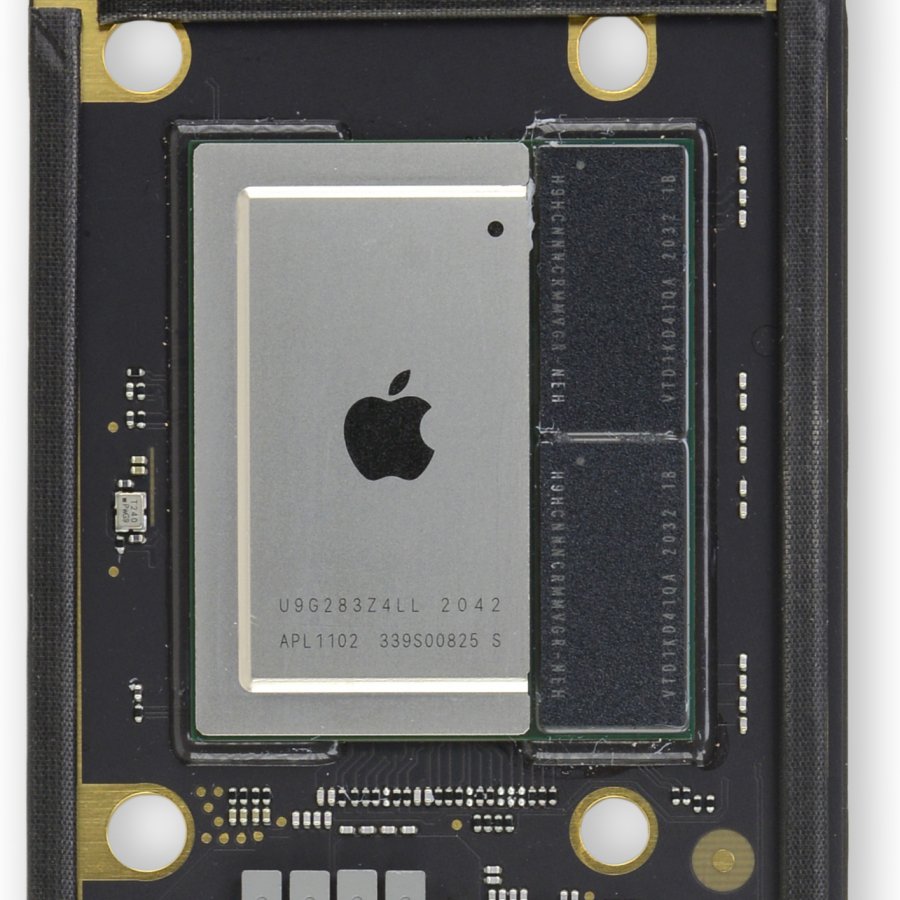
https://www.macobserver.com/analysis/understanding-apples-un... is an article which describes the architecture. It's not on-die, it's next to the CPU, basically as close as it could physically possibly be without being on the die.
Here's a photo of an M1 CPU:
https://www.techinreal.com/wp-content/uploads/2021/05/2feddf...
Those chips on the right side are LPDDR4x chips (which you can verify by googling the part numbers visible on them). They are "off-the-shelf" so to speak, not custom on-die memory.
What I'm trying to say is that even with decent margins extra 8GB does not cost anywhere near $200. Apple is just price gouging their customers cause they are a monopoly in the macOS market.
> I am saying “when is it ever enough?”
I'd say as long as it's relatively cheap. Most people buying $700-1000 machine would be willing to spend $50 for 8GB of RAM. That's pretty reasonable. So the "minimum" amount should be based on what's generally affordable to 80-90% of consumers buying new hardware. Anyone buying a laptop (or a screen less device based on laptop components like the mini) in the price range I mentioned would afford 16GB of memory if they could install it themselves or if Apple sold upgrades at with margin similar to that it puts on the the base device (and not 200% they charge now).
Anyone who is using an old device should be able to upgrade it's memory without having to buy a new one. The fact that Apple is selling computers that could be obsolete in a couple of years is deplorable from the perspective of the environment (obviously great for Apple's shareholders).
That developers are writing inefficient software doesn't really justify this in any way.
We don't yet know how fast the SSDs are in the new Mac mini, but the M1 Mac mini was using ~3GB/s SSDs, which is the same speed you get from PCIe 3.0, and realistically.. that's plenty fast for this discussion regardless.
If the external drive won’t be connected 100% of the time, there are all sorts of headaches that can occur because Apple doesn’t really design their software to handle intermittently available disks, in my experience, except (for obvious reasons) for Time Machine.