Black holes as the source of dark energy(aasnova.org) |
Black holes as the source of dark energy(aasnova.org) |
I.e. put a black hole with solar mass 1 in a black box. Put a star with solar mass 1 in another black box. From a gravitational point of view, you couldn't tell the difference, yes?
But this result implies that the black box with the black hole will gain mass over time, even without adding any mass into the black box? So you could distinguish it from another mass?
Or do I have that wrong? My understanding is as someone who is interested but has no real education on these topics.
Yes, that's what the standard theory of black holes says.
> this result implies that the black box with the black hole will gain mass over time, even without adding any mass into the black box?
Sort of. First, it's important to note that the paper is talking about a special type of "black hole", an object that has "vacuum energy" inside it (which means something that acts like a cosmological constant in the Einstein Field Equation)--which isn't a standard black hole (those have zero stress-energy inside). The claim is basically that the total vacuum energy inside such an object can increase as the universe expands.
However, this does not mean that the ordinary "mass" of the black hole would increase. Vacuum energy doesn't work like ordinary mass. The effect that this model is claimed to account for is the accelerated expansion of the universe due to dark energy; basically this model is supposed to provide a mechanism for how dark energy could come into existence as a result of black hole formation (but, again, it's a special kind of "black hole", not the ordinary kind).
[1] https://iopscience.iop.org/article/10.3847/2041-8213/acb704/...
I only point this out because we haven't been inside a black hole, so we don't really know what an 'ordinary' one looks like.
The article confuses me on something else. It mentions a link between black hole mass and the expansion of the universe, but then it seems to imply that the expansion causes the black holes to gain mass which in turn causes the expansion to accelerate. It doesn't seem to address why the universe is expanding in the first place. But I guess dark energy was proposed as the thing that was doing the expansion acceleration, and not the expansion cause.
This is believed to be true, but the time scale is something like 60 or more orders of magnitude longer than the age of the universe, so (a) no evidence for this effect exists or is likely to be found any time soon, and (b) it's irrelevant for the dynamics of our current universe anyway.
My interpretation of this theory is that spacetime beyond the event horizon is also expanding. This expansion increases vacuum space, which contains vacuum energy.
This either correlates or is coupled with vacuum energy in our observable universe.
If a black hole is perturbed (for example, by merging with another black hole or swallowing a star), it will temporarily be more complicated, but then it quickly goes back to having only above three properties. The extra properties (such as the gravitational quadrupole moment) asymptomatically decay, over a relatively short timespan.
Attempts to try to model it with some quantum mechanics thrown in show a tremendous amount of additional state that scales with the surface area of the black hole.
This work suggests even more complications to that picture. That it looks very different from the classical theory.
All of this should come with disclaimers and fudge factors because of our lack of a real theory reconciling GR with QM.
AFAIK:
On the contrary it will lose mass over time due to Hawking Radiation and evaporate eventually (though that might take literally forever).
Also spacetime curvature will be slightly different for point mass vs distributed mass.
« However, this common black hole model is in tension with the overall expansion of the universe »
...why would those have anything to do with each other, a priori?
Unfortunately, yes. The black holes in question are not the textbook ones, they need to be full of something which acts like dark energy.
https://www.youtube.com/@SabineHossenfelder
She's a theoretical physicist, and covers topics such as this from the point of view of a real expert, and doesn't "talk down" to the audience at all. (Though I must say, she does engage in clickbait-style video titles and thumbnails, but the video content is much better than that implies)
I guarantee she will have something to say about this topic in her next video :)
I find that most physicists in educational roles shy away from interjecting with opinions and even mild speculation more than they should but she tends to overcorrect in the other direction. This tends to attract a particular type of fan as well, the kind that likes to feel like they're in on the secret knowledge and loudly have opinions about things they don't truly understand
That's probably the best description of her style of argument I've read, and it's honestly why I can't stand reading/watching her anymore. Much too much of it comes off to me as "What the physics establishment doesn't want you to know!!" type of stuff, so it then attracts the "yeah, she's speaking truth to power, I knew it was a conspiracy!" crowd.
I mean, there are plenty of folks that have expressed a ton of skepticism about string theory without the semi-conspiratorial angle.
- as the universe expands black holes gain mass because of the expansion.
- as black holes gain mass, they create more repulsive force.
- that repulsive force expands the universe even more at an accelerated rate.
I would think about this differently. What if the actual space inside these black holes does not stretch as the Universe itself does? The density relative to that of the Universe would increase, but they just maintained the density they originally had.
Thinking about a piece of fabric stretched with a mass on, as you drag the corners out, the curve (gravity) on the fabric (space) caused by the mass increases. If you locked the mass depth, it would look like it has gotten heavier.
I didn't get a sense of how near or far from the black hole that the expansion variations were present.
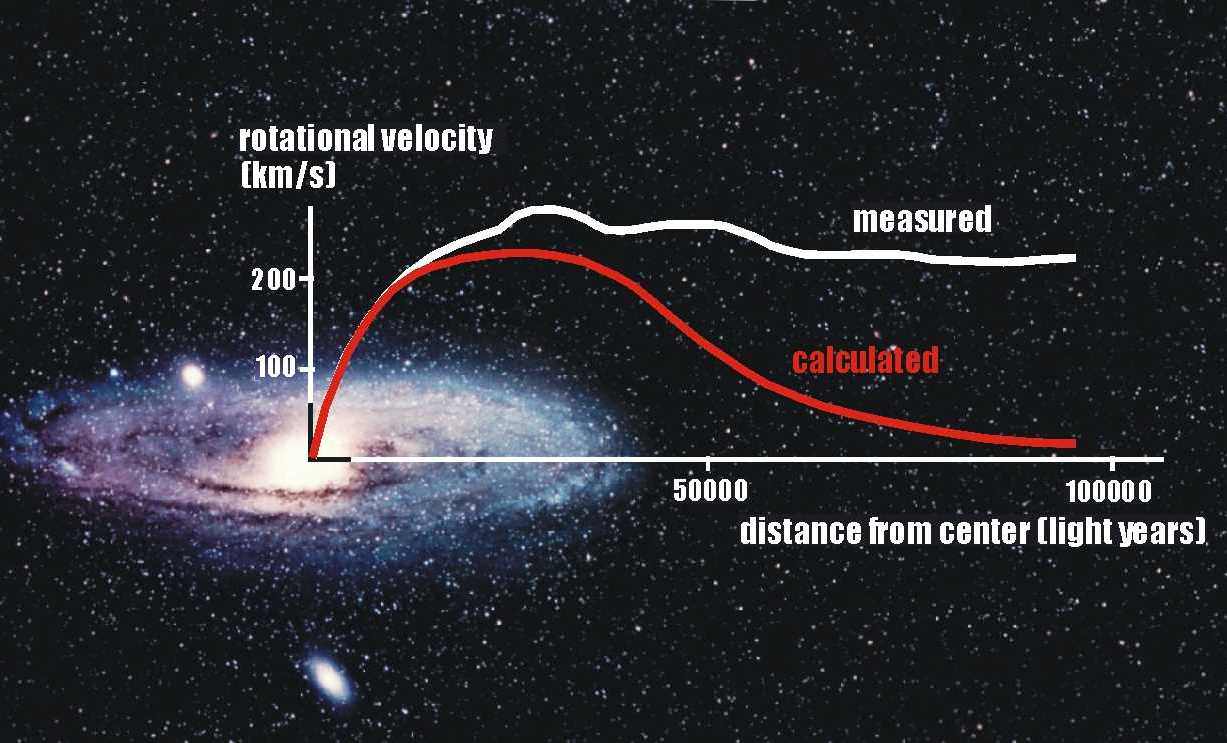
https://www.universetoday.com/wp-content/uploads/2011/12/Rot...
It’s analogous to the situation with dark matter. Again we hypothesise some additional factor that causes behaviour we wouldn't otherwise expect. We attach the terms energy and matter to them, because those are the things that generally cause the kind of effects we observe, but they’re placeholder terms and it’s always possible the observations or our theories are incorrect or incomplete.
I'm fine with wild speculations like there are new universes inside blackholes that look like white holes to the people inside (or "Big Bangs") and I love to think about all of it, and higher dimensions, and all of that, but I'm just a nerd. I'm not putting it in a journal or a press release or trying to justify funding on the basis of it.
-------- Reading the paper, this is the best summary I can make. Note that I'm an engineer, not an astrophysicist.
The basic thought is that in 1963, a guy named Kerr seems to have come up with the best approximation of black holes. Many observations have been made of various black holes, and they seem to line up with his proposals. The issue is that this solution has a nasty singularity in it, which is very very extreme and doesn't really "match" the rest of nature. However, it's the only plausible explanation for the behavior seen in black holes.
People have been trying to solve this for ages. A bunch of people have different ideas for how we can resolve the singularity issue - maybe the event horizon is moving with the universe's expansion, or something funky happens to physics at high density (like how quantum mechanics gets weirder as you get smaller), or maybe the mass is somehow moved forward/backward in time and this merely appears to be a singularity from our vantage point.
However, all these are flawed because they don't take into account the fact that black holes are spinning. When you make the black hole spin, these theories all fail in one way or the other - they give the wrong results in short timescales, or they give the wrong results in long timescales.
In 2019, 2 guys named Kevin Croker and Joel Weiner demonstrated that the universe's expansion rate varies based how heavy the space next to it is. (That is a link to a summary of the paper.) This 2019 paper basically solved some questions about Einstein's equations, and importantly it also possibly answers some of the questions around singularities - even spinning ones. However, it didn't delve too deep into those questions, saying they should have a follow-up study.
This new paper is the follow-up study of that paper. It basically holds that "yes, that theory does solve the issue of singularities." They go on to say that the stress that a black hole puts on an object (its gravitational pull) can vary based on how quickly the space near the black hole is expanding.
Because the space near the black hole is expanding at different rates relative to seemingly "minor" (on the scale of the black hole) sizes, you get fluctuations to the gravitational pull that appear to be shifted through time. The paper's authors liken this to how redshift works with light; further away objects are more red than closer objects just because the light's wavelength increases with distance. The difference is that the change in gravitational pull is shifted based on time instead of distance (remembering that time is intrinsically linked to space and that we already know black holes distort time).
The paper claims that the necessary outcome of this is that you now have a physical object ("relativistic material" in science words) that must be intrinsically linked to the universe's expansion rate - as the expansion rate changes, that material also changes (or perhaps vice versa). They call this a "cosmological coupling" between everyday physics and the universe's expansion rate.
You can use the strength of this coupling (i.e. how intensely some mass is tied to the universe expansion rate) and plug it into the old 1963 Kerr equations and suddenly they work without needing weird singularities. You still get a singularity at 0 (i.e. no relation between universe expansion rate and mass), but since we know that there is a link we know that it should always be > 0 (i.e. no singularity).
They predict that for black holes you can expect that number to be about equal to 3, give or take, and such a result lines up with the 2019 paper.
Now that they have an idea of a mechanism, they can use the scientific method to see if they can experimentally replicate their hypothesis. There should be a detectable difference between the "classic" singularity approach and a "not a singularity but pretty close" approach, and they are trying to detect this by looking at how black holes gain mass.
Specifically, they're looking at supermassive black holes which seem to grow in mass as they age, even though there shouldn't be a link between time and black hole mass. Because these old galaxies are "dead", the black holes have no way to gain mass by "eating" the stuff around them, and so science currently doesn't know why these black holes appear to be growing with time - they must be growing because of some other mechanism.
The paper goes on to say they're going to do an experiment to see if that "cosmological coupling" factor actually ties in to the size of the black hole, and if the expansion of spacetime local to the black hole may explain why the black hole appears to be gaining mass when it shouldn't.
They do some experiments, blah blah blah, traditionally if there was no link between expansion and ages they "should" get the number 0 according to the 1963 model. Instead they got a value of about 3, consistently, no matter how bad the redshift was. There's a graph, it's probably closer to 2.96 than 3.14 so don't get your hopes up for some weird cosmological coincidence. They can say with 99.98% confidence that the number is not 0 like the 1963 model assumes.
They go on and say this validates their hypothesis, that a singularity explanation is not needed, and that black holes will always grow at a constant rate of about 3, using the equation a3.
They say this means black holes are made of "vacuum energy" and because of the law of conservation of energy black holes cause spacetime to dilute at a-3 , meaning this constant growth rate is causing the universe to expand (or maybe vice versa - but they appear to be related).
They do more math to prove this also holds with everything we know about universe expansion so far and that the rate of universe expansion matches what we should expect with the number of black holes we think there are.
They are careful to say this doesn't prove anything, it just demonstrates a probable link with high confidence. They give examples of further experiments that could potentially disprove their theory:
Checking the cosmic microwave background radiation to see if the numbers still line up
Checking to see if black holes reduce the energy of gamma ray bursts by an amount predicted by their theory
Checking that when two supermassive black holes collide, the result appears to gain more mass than what traditional science would expect (but would be in line with this theory, i.e. a factor of 3)
Stare at a pulsar orbiting a black hole for a decade or so and see if you can see the pulsar's orbit change according to their theory
Their theory implies that there are more massive black holes than what we observe, so someone should check to see if there's a reason why black holes aren't getting as big as this theory suggests (is there some constraint that blocks black holes from growing?)
They don't have the exact formula, only that an exact formula should exist. Someone should work it out. There is a competing theory that solves issues with quantum mechanics that may not line up with this theory; someone should check
Take more measurements and replicate this experiment to verify the numbers are correct with a larger sample size
Check quasars with a redshift of 6 and see if the math still maths
And then they say thank you and do more math. Again, I'm not an expert here so maybe I misunderstood some things, but hopefully that makes things easier to understand. It seems like the 2019 study was more impactful, and this mostly affirms the 2019 study.
https://bigthink.com/starts-with-a-bang/black-holes-dark-ene...
I think the requirement for coupling from spin is due to frame-dragging, where there's basically a shear force to accommodate conservation of momentum on the stress-energy tensor.. or smth, a lot over my head. This coupling in theory goes out to infinity, but wouldn't be significant for small gravitational objects. Very large BHs spinning near lightspeed would couple very far.
From there, the intuition that helps me went like "imagine a rubber band, being pulled apart. Then imagine a pinched point somewhere along its length. As you continue to pull the whole thing, the interior pressure on the pinched part will increase." That's why the interior energy of the BH increases in connexion with the expanding space.
This could be Nobel Prize research if it holds up in the coming years.
Here's (the two biggest parts of) the firehose. Have a long drink. React with curiosity to all of them:
https://arxiv.org/list/astro-ph.CO/recent
https://arxiv.org/list/gr-qc/recent
> I wish she would ... actually dig into it a little!
You don't have to just wish.
https://backreaction.blogspot.com/p/talk-to-physicist_27.htm...
I appreciate someone challenging commonly held beliefs - science needs that. But I've grown accustomed to expecting her popular science output to present her point of view as the only valid one, and her the one sane person in physics. It has gone far beyond adding much-needed nuance, and has basically become contrarian-for-contrarian's-sake.
Which is a pity, because challenge to existing beliefs is valuable. But when someone mentions that she has a take on an exciting new physics result, I find myself able to predict the general direction (negative) and the tone (derisive) with high enough accuracy not to have to read it anymore.
The theory paper they quote is here: https://iopscience.iop.org/article/10.3847/1538-4357/ab32da
Its main claim is that a convergent perturbation series representation of metric and Einstein tensor (assuming that one exists) requires "all pressures, everywhere, including the interiors of compact objects" to be averaged over. So if there are compact objects with dark energy interiors, they contribute negative pressure to the overall average. But the construction of a realistic GEODE (GEneric Objects of Dark Energy) "is an open question that is beyond the scope of this paper."
Generally speaking, you can't get negative pressure "purely out of GR". It's a job for the non-gravitational "stuff" on the right-hand side of Einstein's equations; either exotic configurations of known fields or new, hypothetical ones with intrinsic exotic properties. In cosmology it's typically the latter.
> better boundary conditions
Ok, what's the curvature scalars about one AU from the one solar mass? How about at about 50 AU (Pluto)? Or about 1000 AU (Sedna)? Or at about 0.8 light years (50 000 AU, in the Oort cloud)?
At what point do we decide that the roughly Schwarzschild metric is no longer useful at predicting the trajectories of things near that central mass? Do we care about the exact contribution of our sun to the invariants in our galaxy's central mass, or Andromeda's? Does a (were-)wolf's baying cause the moon's orbit to change such that it becomes full at a convenient time? The baying does participate in the generation of the 'true' metric, in principle.
[Black holes whose metrics aren't]
> asymptotically flat
means that the scalars drop to the point where we can use a procedure like Israel-Darmois to knit our solar system into the local neighbourhood within the Milky way. Or, if you prefer, that post-Newtonian corrections fall away in the weak field limit. And so we can hierarchically assemble bigger and bigger Schwarzschild or Lemaître-Tolman-Bondi or the like metrics and see that they useful in describing trajectories sufficiently close to the dominant non-relativistically-moving masses, and that Newton's gravitation is a very good approximation at a distance from them.
We do have several lines of evidence supporting this hierarchical approach, e.g the proper motion of galaxies within clusters <https://en.wikipedia.org/wiki/Proper_motion>.
[black holes with]
> dark energy inside them
[a] understates the proposed evolution of the non-cosmological-constant energy
[b] conflicts with strong evidence that our solar system is not expanding despite the also strong evidence of the large-scale expansion history of the universe
Roughly, under the contemplated model (thinking generously about how they approach McVittie-like model in light of their paper's §4.6's admission that there is no known solution to the Einstein Field Equations which couples interior vacuum energy, spin, adaptability into the expanding Robertson-Walker metric (like asymptotic flatness gives you), and the evolution from initial formation to growth via accretion)): when approximately a solar mass collapses into a black hole the matter less than a light year from it should expand in a way that does not match the behaviour of the Oort cloud or objects closer in.
In the same section they raise the hope that they can find such a model, and make reference to an existing paper which floated the idea of a gradient and dynamics to the expansion that could be modelled as particualrly relevant around collapsed stars (as opposed to not-yet-collapsed stars of similar mass). This is really deliberately heaping general-relativistic effects in, through, and around an already inherently general-relativistic compact object, followed by hunting for any observational support for that approach (and finding at best weak evidence). It's certainly not KISS.
A while back there were concerns (notably not from physicists) about the LHC forming black holes. I remember the response being that tiny black holes frequently form in the upper atmosphere due to high energy particle collisions, but black holes emit more radiation the smaller they are(!), so these tiny black holes evaporate nearly instantly. (Thus the same would happen if the LHC made any.) A tiny black hole that didn't evaporate would be scary because it could grow larger but not smaller.
No matter what the mechanism for protection from cosmogenic-collision black holes, if they were problematic, the Sun would have been destroyed long ago through a black-hole creation, black-hole capture, solar-collapse process with cosmic rays much higher in energy than anything humans will ever generate. So, as long as you can look outside and see the sun, you need not ever sweat the particle-collision destroys the world hypothesis, no matter whence the particles are generated.
There were concerns, but they were not well founded in actual physics.
> I remember the response being that tiny black holes frequently form in the upper atmosphere due to high energy particle collisions
I'm not aware of any such response. The response I'm aware of was that events with higher energy than the LHC is capable of creating happen routinely in cosmic ray collisions, and no black hole formation has ever been observed in such collisions, so black hole formation is not going to happen at the LHC either. That is consistent with our best current theoretical prediction, which is that you would need an accelerator capable of reaching the Planck scale, many orders of magnitude higher energy than the LHC, for black hole production to be possible.
A tiny black hole would not have enough mass to pull in a significant amount of matter and would just pass through the earth if it were coming from space. If the black hole were created on earth it would need a lot more mass than a collider could give it to do anything funky.
Is this true? I don’t think a faraway object accelerates faster than a near one.
More precisely, theoretically, we can construct models of compact objects that look like standard black holes, but don't have a singularity (and also don't have an event horizon, they only have apparent horizons). Any such compact object must contain "vacuum energy" or something equivalent, i.e., something that looks similar to a cosmological constant in the Einstein Field Equation--that is the only way to evade the conclusions of the various singularity theorems that apply to standard black holes. That type of compact object is what is being hypothesized in the paper under discussion.
Do you mean "not all black holes contain a singularity"?
The singularity existing in the math suggests that our theories are incomplete, and I would say it’s not surprising that new theories of black holes would do away with the singularity.
No, it's a feature of a mathematically complete model (the Schwarzschild solution) that crops up in extensions (with angular momentum; with electric charge; formed through gravitational collapse rather than eternal) pretty reliably. There is no incompleteness in the Schwarzschild, Kerr, etc. exact solutions. They may not correspond well with things in our universe though, and do not correspond fully to them because our universe (or at least its population of stellar-black-hole-generating galaxies) as far as we can tell is not already infinity years old or full of only vacuum.
(Further efforts which describe somewhat more physically plausible compact objects which grow as matter falls inwards and which are well behaved in deep inter-galaxy-cluster space where expansion is relevant also tend to have singularities if they form by gravitational collapse. Some of these only non-exactly solve the Einstein Field Equations (see the weak <https://en.wikipedia.org/wiki/Non-exact_solutions_in_general...> or the numrel link further below)).
The problem with the singularity is that given a 3d hypervolume (e.g. a set of every point where one would measure an identical average temperature of the cosmic microwave background) which contains all the positions and momenta and other values at every point in the 3d space, one cannot recover the whole set of values from earlier slices, and in particular not the whole set from before the singularity arose.
There was some hope that a collapsed star's singularity would last into the infinite future, or that (since that may not be the case) Hawking radiation would not be thermal noise, so that one could recover all the values of an arbitrary 3d volume after the singularity arose, or at least excise/not-care about the relevant values (see <https://en.wikipedia.org/wiki/Numerical_relativity#Excision> for example). However, now a merely extremely long-lived singularity means that one cannot recover a whole values surface in the far future either.
This causes problems when using the very handy <https://en.wikipedia.org/wiki/Initial_value_formulation_(gen...>.
It is in that sense a model with an evolving black hole is incomplete if it has a singularity. But we know that because General Relativity is a mathematically complete theory, with basically the only open-ended questions living in the mechanisms that generate the stress-energy tensor (i.e. the microscopic behaviour of matter).
The discussion's topic article P.R.s the latest installment in a programme that hopes nature will always generate stress-energy in the interior of a collapsed star in a way that evades the formation of a singularity while (the authors and fellow-travellers hope) preserving the external features of a more standard singularity-containing collapsar. Their model isn't mathematically complete in that they do not have an exact solution to the Einstein Field Equations (§4.6, <https://iopscience.iop.org/article/10.3847/2041-8213/acb704>).
Another mathematically complete theory which may admit non-eternal singularities which frustrate everywhere-determined values is Navier-Stokes. And it's the microscopic behaviour of the fluid matter which may let one recover the missing values.
Mathematical completeness, everywhere-uniquely-determined values, and reasonable physical relevance are three different things.
It’s kind of like that, starting from where we are, black holes have no “inside”, since it takes an infinite amount of time to cross the event horizon.
It is the observer at infinity that never sees you fall into the black hole, but real physics is local, you have to use the coordinate system of the person falling into the black hole to determine what happens to them.
We don't even need an observer to be at infinity, thanks to the expansion of the universe. With some future telescope our descendants may observe something on a trajectory to enter a black hole in an early-universe galaxy that is just crossing that observer's (cosmological) horizon.
I think it's relevant to raise this since the article at the top is about embedding black-hole-like collapsed stars in an expanding universe and the research which directly discusses the observable consequences.
> real physics is local
Yes, absolutely. You still get spaghettified if you fly into a black hole which is the only other appreciable mass left in the far far future of our universe. Nobody needs to see your last moments.
> you have to use the coordinate system of the person falling into the black hole to determine what happens to them
No, you can use any coordinates you want (or no coordinates at all), but you have to be aware that there are quantities which are invariant under changes of coordinates (e.g. the curvature scalars) and quantities which are coordinate-dependent, and that some systems of coordinates make the latter difficult or even impossible to calculate.
Indeed the infaller can use any set of coordinates she or he wants. Some time coordinate (wristwatch? distant pulsars?) and spatial spherical coordinates with the infaller always at the spatial orgin, East-North-Up coordinates originating on the (spinning) black hole, etc. are all (pardon the pun) attractive in these circumstances.
Also, defining exactly where "falling in" happens is tricky, even for the infaller. Visser 2014 on horizons: <https://arxiv.org/abs/1407.7295>, second sentence third paragraph of the Introduction section ("These distinctions even make a difference when precisely defining what a "black hole" is -- the usual definition in terms of an event horizon is mathematically clean, leading to many lovely theorems [20], but bears little to no resemblance to anything a physicist could actually measure.")
However, to an extremely good approximation, they'll still look like objects with just three properties.
See the table on this page for the categories:
Croker, Weiner et al. (the authors of the topic paper) are keen first and foremost on their spinning black hole interior solution, which is wholly classical and found at <https://arxiv.org/abs/2107.06643>. In the more recent topic paper they argue that they can make the exterior solution well-behaved too, following the path McVittie paved in 1933 in embedding massive objects in an expanding classical spacetime.
They don't come to the end of the path though. As they say in <https://iopscience.iop.org/article/10.3847/2041-8213/acb704> §4.6, their desired combination of interior solution, initial formation, infall/merger, arbitrary angular momentum, and being easy to embed in an expanding Robertson-Walker universe is far from complete (There are "known exact solutions with each [property] ... there is no known solution that possesses all [of them]"), they're just hoping to find one.
It is not at all clear to me that they have a strong idea about no-hair in their compact objects' causal structure. (I guess totally wildly that it will sensitively depend on the details of the embedding. See Visser 2014 <https://arxiv.org/abs/1407.7295>).
Also, it strikes me that their entire idea is to avoid strong gravity in the interior of collapsed stars and in particular avoid the singularity, so one should really think of this as an anti-quantum-gravity approach to black holes, or at least an approach that might evade perturbative non-renormalizability.
No extra dimensions, no boundaries, nothing special in the stress-energy tensor, mute on the subject of entropy (which in any case should be thought about in comparison with the huuuuuuuge entropy from the expanding space. Expansion is after all the focus of the topic paper, and so it's rather distant from anti-de Sitter ideas).
The crossing is not at a straightforward conception of "the end of time" in an expanding universe, since most possible observers are carried away from the final fall-in by the expansion of the universe, so there's nobody orbiting "at infinity" who could in principle see the infall take "an infinite time".
Horizons are part of the causal structure of the entire universe, black holes, planets, toads, warts, and all. The horizon is dominated by the central mass and spin, but not fully determined by it. The horizon in a close black hole binary (or triple) gets very complicated. ("The horizon" is not even necessarily physically measurable, and with black hole evaporation might not even exist, although there are other features which can be indicative of the point of no return for an infaller).
Preliminaries done, there is the "no drama" conjecture. Given a large enough black hole in a quiet enough setting a freely-falling infaller will not know she or he has passed the point of no return, perhaps for several minutes according to his or her wristwatch.
That's because the tidal curvature at the point of no return gets very small as we take the mass of a slowly-spinning black hole above millions of stellar masses, and that's the curvature that's relevant in spaghettification, the leading cause of death of astronauts entering isolated black holes.
Of course, most of the black holes we have found are far from isolated (otherwise we probably wouldn't see them with current equipment), so an infaller is likely to be blasted apart by hard X-rays and superhot gas instead of falling straight in.
The observables for something strongly accelerating into a black hole for a faraway orbiting observer can be quite different; unlike for speed there is no maximum acceleration in relativity. One would have to find a limit to acceleration in the behaviour of matter. An astronaut is not going to survive anything like the acceleration needed to make much difference to the distant orbiting observer though.
The distant observer in the not-really-our-universe Schwarzschild model and seeing the infinitely-prolonged final infall is at rest with respect to the central mass. Different observers, e.g. ones shooting themselves into the same black hole, or hovering just above a different black hole, can see qualitatively different things.
Generically, outside observers will see a dimming and shrinking of (practically) any infaller closer to the black hole than the observer. Many such observers will lose sight of the infaller before the infaller has truly hit a point of no return. Consequently some observers could find themselves seeing a presumed-lost astronaut grow brighter and bigger again, and leave the vincinity of the black hole. (Substitute gas, dust, and parts of stars for astronaut in the previous sentence, and that is what the Event Horizon Telescope collaboration, among others, searches for.)
I just know the basic argument that if black holes are simple, then going from a complex thermodynamic arrangement without a black hole to one with a black hole would represent a spontaneous reduction in entropy. And therefore theories where black holes have a lot of entropy are of interest. While this was originally an argument for string theory, it can be used to argue for other theories as well.
I can't opine on your wild guess that how much hair their model of a not-quite black hole is depends on the embedding. But if it is true, I would expect that embeddings that give it a lot of hair are going to be of more interest than the ones that give it no hair exactly for the thermodynamic reason that I gave.
The formation of a black hole surface around ordinary matter is an increase in entropy if "no hair" is correct. All the individual masses and linear and angular momenta (and electric charge) are hidden behind the trapping surface. By examining that surface you can't tell how many bits and pieces there were inside when it formed initially or which fell in later; only the aggregate values are available. And all of those bits and pieces are crushed into a very small configuration (up to an outright singularity) compared to the volume of the interior. So the interior is mostly vacuum and vacuum is maximum entropy (details for the curious about how this works with a quantum rather than classical vacuum and black hole complementarity: <https://arxiv.org/abs/1310.7564v2>).
No-hair might not be correct though. Cf. Hawking's final interests in (<https://en.wikipedia.org/wiki/Bondi%E2%80%93Metzner%E2%80%93...>) superrotation and supertranslation "soft" (as in ~zero energy) hair.
> theories where black where black holes have a lot of entropy
Textbook black holes have a lot of entropy.
If "no hair" and a thermal Hawking spectrum up to final evaporation are both correct then low-entropy systems (like a chicken egg or a brain) become hopelessly scrambled and ultimately turned into greybody radiation from which one cannot even in principle determine the antecedent configurations.
That information loss is the upsetting thing, not the balding away of whatever bumps are raised on a black hole as the egg is thrown in balding away in ~ light-crossing time. The then more massive balded black hole (i.e., relaxed back into a "no hair" state) can be entirely represented by a tiny handful of numbers compared to the matter that formed it or fell into it later. Barring something like "soft hair" the numbers required to represent a star like our sun (and an egg) is much much higher than that of an egg thrown into a stellar mass black hole.
That's fine if the egg and all the rest of that stellar mass stays hidden inside the black hole forever. But with Hawking evaporation the shrinking black hole gives us no details of what was thrown in: ultimately, at final evaporation, we would have a stellar mass (and an egg mass) worth of almost entirely photons back. That wrecks unitarity, which is important to particle physicists.
The BMS-group supertranslation and superrotation idea is that the horizon wiggles a bit as the egg is thrown in, and that wiggle emits gravitational radiation with enough complexity in the waves to encode all the microscopic information in the egg (notably lepton number, baryon number, and strangeness).
> black holes have a lot of entropy
So does the infinite empty space surrounding them in a Schwarzschild or Kerr universe. Think like Boltzmann: take a volume of the totally empty space far from a black hole and swap it with a volume of totally empty space somewhere else outside the black hole. Does that make a non-negligible difference to the spacetime? Like, does it light something up, or does it change the geodesic equation? (A: No, not for these vacuum solutions. But it does make a difference if we swap some near-horizon relatively-Hawking-quanta filled space with some emptier far-from-horizon space (n.b., not a vacuum solution).)
Finally, the interior of vacuum-solution black holes (or Lemaître-Tolman-Bondi black holes formed by dust collapse, or other types of dynamical/evolving black holes surrounded by infinite vacuum) is a tiny volume compared to the exterior.
The most relevant volume outside black holes in our universe is the observable volume (set by the cosmic particle horizon), which will not be infinite at times in which there are black holes. There are many ~ billion-solar mass black holes inside the present ~ 10^{80} m^3 observable universe. In the future that volume will be larger, but so will the number of black holes in it, and almost certainly the masses of the largest black holes will be much bigger.
(In the even farther future, if total evaporation happens, there will be no black holes in the big-but-not-infinite observable volume centred on what was our galaxy cluster).
But I'll follow as an interested amateur.