Meta plans to lay off 10k employees(about.fb.com) |
Meta plans to lay off 10k employees(about.fb.com) |
> The blog post does not explicitly state that Mark Zuckerberg takes full responsibility for the layoffs.
That's either a lie, or Mark has a serious misunderstanding of what "better" means.
But how do you manage to have so many people that you can fire 10k ?! If I googled well, they appear to have 72k employees. Where did you find the management that thought having 72k employees is reasonable to operate a bunch of websites and apps ?!
Only the best managers will survive this.
And many will be happy for the opportunity
Translation: We weren't efficient at all
They're IBM now.
I am curious what people think about this.
What kind of sociopath one has to be not to realize there's something very wrong about writing a piece like this?
It's almost like Mark or whoever put it together enjoyed doing it.
What do any of these people even do? Facebook hasn't changed in the last 10 years. Instagram etc are all finished products. How can you have hundreds of thousands of people in a company when you don't make anything?
You have to give them something to do so you get them to make a new UI because everyone always needs a new UI. But then oh no we need new servers for development so we need a new server team. And then we need a testing team for testing the UI and then we need HR for managing the new teams and accountants for managing the expanded payroll... And yet none of them actually achieve anything because it's a made-up project.
Confirms my theory that most companies are just bloat 80:20 rule.
Get rid of everyones whos not a nerd or directly sells product.
The company is fine.
Maybe they need to rehire the button engineer to fix the button code! /s
She's still employed there though. I can't imagine she'll ever be fired, too much legal risk.
Great title.
https://www.mcsweeneys.net/articles/macroeconomic-changes-ha...
"Our early analysis of performance data suggests that engineers who either joined Meta in-person and then transferred to remote or remained in-person performed better on average than people who joined remotely. This analysis also shows that engineers earlier in their career perform better on average when they work in-person with teammates at least three days a week."
So in total this means about 16% reduction from what Facebook was aiming to scale to in December 2022 (86k staff). I wish the investors had put Zuck in his place and killed the Metaverse concept early, but it looks like these cuts are across the board and not impacting any particular project.
Mark Zuckerberg has 55% of the company's voting shares, giving him majority power.
So basically more rounds of layoffs to come?
> This analysis also shows that engineers earlier in their career perform better on average when they work in-person with teammates at least three days a week.
Sounds like they pulling the plug on remote work
Has Meta been found out as a company?
Wow, that's a pretty long timeline from announcement to execution. Being told you might be laid off some time in the next 10 months. I guess they're hoping people quit?
We always used to joke that layoffs always come in threes. The first one never cuts deep enough. People do the bare minimum.
The second one comes when everyone realises that the business actually is in trouble and does need saving.
The third one is needed as the business has been so badly damaged by the layoffs and is now bleeding cash.
I found this interesting, I wonder what the optimal ratio is. If the ratio is too high then eng is going to be hit hard, if it is too low then other roles are going to be hit hard.
https://1fish2.github.io/buzzword-bingo/corp-bingo.html
and still nothing! I think we need a new set of buzzwords.
I do believe problems about their talent pipeline or how they utilise it lays deeper than these hiring/firing sprees can solve.
Linked story indicates that Apple is laying off contractors.
These are not the same.
Maybe we can start a discussion on the content rather than our emotions from the headline?
Some of the best parts here:
> Today many of our managers have only a few direct reports. That made sense to optimize for ramping up new managers and maintaining buffer capacity when we were growing our organization faster, but now that we don’t expect to grow headcount as quickly, it makes more sense to fully utilize each manager’s capacity and defragment layers as much as possible.
> A leaner org will execute its highest priorities faster.
> we’re focusing on returning to a more optimal ratio of engineers to other roles.
> I think we should prepare ourselves for the possibility that this new economic reality will continue for many years. Higher interest rates lead to the economy running leaner, more geopolitical instability leads to more volatility, and increased regulation leads to slower growth and increased costs of innovation.
I would love to understand how you see this as inspirational.
Managers with small amount of reports will be converted to ICs and strong managers will be given more reports. The org will be more lean and will have less overhead per manager of converting work between layers.
I’m summarizing above but in the article are specific goals to address this and I didn’t pick up on any signs that employees should overwork themselves.
Are you a venture capitalist? Most of us are rank and file employees.
Wait so does that mean they'll end up with 10K less after hiring 5K folks? Which might imply that they'll be firing 15K people.
People tend to forget that through all the layers of different companies and funds, the average person who owns Facebook shares is less well off than an average Facebook employee.
Weird.
I understand your perspective though. layoff announcements trigger an emotional response esp. in an uncertain economic condition.
To answer the question, I think it’s worth explaining my perspective first. My company did “hidden layoffs” where an entire org was cut without any leadership announcement. Everyone freaked out, and we got no response from company. We found out about increased PIP quotas from blind. We have a mountain of technical debt hindering developer experience with no priority to address it.
Zuckerberg in this article, is the exact opposite of the horrible leadership that I have dealt with on my job. This is why I feel inspired to see specific reasons for restructuring, with multi month transparent plans, and pre-determined goals. When execs preach of transparency, point them to this article from Zuck which is entirely public. This content shows a proactive culture, and is so so refreshing when my experience has been as an employee of reactive leadership.
Mr Zuckerberg, what is the future of social connection?
Thing is, I don't think that people trust FB/"meta" with the concept. Most of the feedback I've heard from people IRL has been to the effect of, "it could be cool, but not if Facebook is behind it."
Looks like the age of pure remote work is done for big corporates!
> I encourage all of you to find more opportunities to work with your colleagues in person
...I wonder if these layoffs will be an opportunity for managers to get rid of some of those pesky employees who insist on working remotely - with the welcome side effect of "encouraging" the remaining ones to "embrace" the return to old ways of working with more enthusiasm?
Yeah, to me that also looks like a thinly veiled threat "get back to the office or prepare to be laid off".
How should this be interpreted? They're getting rid of all the Agile Coaches?
The whole in office is better thing is a farce, but how can you buy into a 'vision' when they don't believe it themselves.
Realizing that this is an unpopular opinion, in person work is better for the business. Business decisions are being made around encouraging in person work, because relationships help at work.
I'm not sure if anyone at Meta understand that very few humans, outside of Meta stakeholders, want this company to continue to exist.
Is it total reduction now of 21K of 86K approximately? 24.4%
It's just not clear how the metaverse becomes something at the scale meta needs it to be to justify the R&D or to make an impact on its business.
To me it looks like a technology really takes off when it gives people a lighter-weight way to communicate and connect. The telephone takes off compared to writing letters because it is a much easier, more immediate way to tell people about things. Messaging takes off relative to calling people on the telephone because it's an easier, more immediate way to tell people about things. Social media, including Facebook take off relative to hanging out because it an easier more immediate way to tell people about things.
The new thing doesn't necessarily need to replace the old thing, it just needs to open up a new, easier, more immediate way for people to tell people about things.
The best I see is if meta can make itself the gatekeeper of the de facto standard platform for VR games/entertainment. That's potentially a pretty big business -- because maybe VR can take over AAA content and shows. But is it really big enough to sustain meta? (It seems far from certain they would end up in such an advantageous position, but Oculus is a good start.)
Wow, I would not have guessed that Buck2 would be mentioned by name, and the only project done so.
The moment they find a way to replace you and cut costs they will.
This means, don't bother working more than you have to, after all you are not working towards your own private jet, but you are building wealth of people who don't have your best interest in mind.
I don't even have a FB account but every second line here is full of the type of gaslighting and bizspeak BS that absolutely nobody appreciates.
> We do this with AI to help you creatively express yourself and discover new content.
You mean destroy adolescent growing minds with more and more addictive short burst content from advertisers.
> but with many new teams it takes intentional focus to make sure our company remains primarily technologists.
So goodbye ethics councils, any semblance of internal discussion over our impact on the world.
> Profitability enables innovation.
Because investors LOVE taking risks on `innovation` during a downturn. /s
More like they will push harder the methods which make their bonus'.
Facebook/Meta has provided nothing beneficial long term, to the world. Let it burn.
While today everybody wants to integrate GPT-4 into a customer facing app to increase community interaction and value to the customer, the company famous for its social graph has nothing to offer to foster integration or community building.
Even bing, the somewhat competitor now finally is the new shiny object and a direct thread to Google.
While Meta still wants to build its Metaverse, people immerse into everything that gets connected to GPT-4. GPT-4 is the real metaverse.
Ironic. Somewhat.
This is just a move to justify massive commercial real estate portfolios because by all accounts they’re plummeting in value.
If they'd "hired correctly", then even contractors wouldn't be getting laid off in large numbers.
Why would you bother predicting labor demand in the future? That is the contracted entity’s problem.
Here in Australia, when you're a contractor you have a fixed employment term. That can be extended, depending upon the contract.
If an employer decides to cut short the contract (without real cause), that can be an actual problem for the employer.
"During her senior year at UCLA, Riley Rojas decided to pursue a career in Big Tech — and she wanted to work for the best ... This week in #KeepingtheBalance, Rojas shares how she landed her job at Meta with a political science background. Spoiler: It took a whole lot of studying and manifestation."
I worked my ass off in Engineering school, and as an engineer, to get into FAANG. She manifested with a background in Poli Sci. There's going to be anger about those optics. It's not surprising to see PMs decimated right now, based on the poor growth numbers, declining user engagement, and said optics.
People who go out and make things happen are rare. Regardless of major.
I think the better question is what if the PM has a coherent vision and is helping engagement/metrics. Is delivering on the outcomes that leadership wants. And can do it all by 2pm?
Our culture has become so obsessed with working for the sake of working. We talk about being outcome focused, rather than just doing busy work. But when someone is actually outcome focused then we want them to stay busy.
I agree that if the person isn't delivering results then they shouldn't do the job. But if they are delivering results then why do I care what they do with their afternoons?
And this applies doubly so for a junior product manager. I was not long ago VP of Engineering and if my team built stuff, using best practices and on time, but what we built didn't matter -- I couldn't blame them. It's my fault. It's my job to make sure what we build matters.
But if I can give a set of OKRs and you can drive to make those happen -- those people are gold. Now you can argue with me that the OKRs were bad. That's fine. Fire me. But the person that delivered it -- those people are worth their weight...
You don't need to write a novel with these. Also, writing an email about how you're going to can a bunch of people over the coming year and then droning on about how the results of that are going to be so much better (and insinuate that the current setup, which is 100% a management failure, was a poor setup) is insulting.
Also, this is a 2nd round barely 6 months after the first and it's going to happen over months. This will be great for morale and will likely only cause your A players (who are probably still very much in demand) to look elsewhere.
I was so happy when that company got acquired and the new company CEO showed up and announced that first level managers and below were all safe from layoffs, everyone above that was on a case by case basis, and "all executive staff were let go this morning, I saw no reason to keep those jokers around".
He was so right. Scored a lot of points there, never heard an executive of a large company say that so bluntly before.
I have been told that one FANG which recently underwent a firing round barely took a break from their hiring rounds, and already started sending emails asking for volunteers for interviews even to teams which have just been decimated.
One more story for the absurdity bucket.
Needless to say that didn't go over well.
A year later they were all gone. And him as well.
¯\_(ツ)_/¯
If the emails are succinctly composed then people would complain that the announcements were too curt and don't try to assuage people enough.
So they might as well write what they want.
Didn't the executives employ any anti-takeover measures?
Or you can do the opposite, like Boeing did: import all the managers of the firm you acquired (McDonnell-Douglas) into your own organization.
New CEO was Australian?
You are being manipulated. No. The previous executives are not "jokers" - they made massive profits selling shares. They are being let go because, after taking their massive profits, the new company will soon fire the rest of staff - and that is hard.
If I were there I’d be seriously considering a less volatile environment. If I were an A player, I’d be able to do so even easier and potentially find more meaningful work. This seems like a bad move for Meta, just leaving the axe up in the air ready to strike like this.
With numbers in the thousands, it gives me the sense that it might not always matter what you do or how good you are.
That may be intentional. I could see a scenario where voluntary attrition helps them get reduce size more organically and with lower cost than a layoff. Meta is still huge and pays good money. They can handle a huge level of attrition and still have enough "A players" left over to work on the thing that truly require that level of operation.
> With numbers in the thousands, it gives me the sense that it might not always matter what you do or how good you are.
Fully agree on this. At that scope, it's broad cuts with a lot of meat going with the fat.
What is AE? Meta has a program for their top ~1% or so (who knows really) where they dump a pile of RSUs on your head, "additional equity", to retain you and bet on your future at the company. For most it's 2-4x your annual stock refresher, though I don't know exactly how it varies.
If you're E7+, this is another 1M+ stock grant on a 4 year vest on top of your 600k+ refresher grant. Stock is up from their internal refresher pricing. Their "A players" all just got ~5% bump on their 1.5M+ RSU grant.
G and other FAANG struggle to compete with Meta on comp for the actual A players. We'll see if they budgeted enough for AE to keep the people that matter.
I'm an AI research engineer who was recently laid off and this was my experience.
They have been involved in so many shady things and have had such a "throw everything at the wall and see what sticks" approach it sounds maddening.
I think a lot of people working there just made the calculated decision that Meta being at the very high end of the compensation scale made it worth it.
Even if you are in the ML/AI stuff. You have to balance out that they were funding at a very high rate versus that they were funding the work for less than stellar reasons.
Are they going to sully themselves and work as “enterprise developers” (note sarcasm)?
I'm not sure how many A players have left meta, but I'm sure A players never want to work in a low morale company. The damage is much higher than layoff number.
I'm Danish, but we have laws and regulations about mass-layoffs which means companies have to give employees an advance notice of 30-60-90 days, depending on company and layoff size.
I imagine California might have something similar.
I don't know how to break this to HN, but the Zuck isn't the sharpest tool in the shed. He may be gambling, but Hanlon's Razor says otherwise.
You're right in that language doesn't matter. Hell even the delivery of the message doesn't matter. The only thing that matters is the severance or layoff package. That's the real meat. There should be a mandatory law that publishes all layoff packages so that everyone can see if they're getting a fair deal or not.
It is true that these messages can be overwrought and whatever else, but it literally doesn’t matter what the content is besides the fact that a layoff is happening. If you tell me I’m laid off with a smile or with a middle finger makes no difference, I’m still laid off.
It is not that rare for critical employees to get grants as part of the layoff execution in a pre-emotive action, and now that I’m older I will note that I’ve been on the planning side of layoffs and this is fairly commonplace.
I imagine the vast majority of their ultra top-tier talent has left already unless Meta gave them gigantic bonuses.
The stock is down ~40% from where a lot of their RSUs were granted - more than 50% of their pay comes from those grants.
They've had a year of time to go somewhere else and make way more money - most of them probably took that unless Meta gave them a gigantic bonus to keep them whole.
But other FAANGS are not hiring. So where it's somewhere unless they planned to start their own businesses?
If the stock tanks that vaporizes really quickly.
Letter 1: Blame previous management.
Letter 2: Announce a reorg/layoffs.
Letter 3: Tell your successor to write three letters...
Vast majority won't find jobs that are as well paying as facebook. FB is a leader in tech salaries which gives them the leverage to announce such a thing without losing people. People don't want to take paycuts and go somewhere thats also doing layoffs.
And changing your availability and answering a call or chat from time to time does not cost much. It is not like there is any downside to it.
And if an A player starts looking around great things sometimes happen. He may get hired at much higher position that would justify the salary. Or he may have already earned a lot at FB and may decide this is the time to invest in building a startup, etc.
At my previous company I got in an argument with my boss and just changed my availability on LI. Just out of spite. This led me to an offer that changed my life. And there is a lot of people so much better at their job than I am.
If you joined from 9/2020 to 1/2022, you’ve taken a serious pay cut versus your nominal offer.
Unless there have been adjustments that I haven’t read about?
Employees ask for transparency. This is what transparency looks like...
Specifically the sections "Leaner is better", and "Flatter is faster". Other sections are quite relevant and well written IMO.
Also, reading between the lines, Metaverse gets mentioned just twice. I guess they are going to go slow on that? And Oh, "In-person time helps build relationships and get more done" tells me WFH at Meta will be a thing of the past.
Edit: More content.
Honest question, but are they? And, just as important, is anyone other than a FAANG company willing to pay them the same high comps right at this moment?
I can see a high-need-for-people/high-comp scenario still possible in some parts of finance, but with these recent events I'm not so sure anymore. I'm also sure that right now there's a high demand for people in anything related to MIC/the war industry, but I don't think they can provide the same high comps as FAANGs do, unless one choose to go the contractor route (which also comes with its pluses and minuses).
I really don't believe that it's a given that Meta still needs them: the entire org was designed for "innovation", and that has certainly been the right call back in the day. E.g. back when they were still on the edge between buying and competing with whatsapp and instagramm on the product level.
But Meta products have been beyond "salvation by innovation" for almost a decade now, what they need to maximize shareholder value is the cheapest setup to keep value extraction up and running for as long as the brands still do their thing. The innovation game is over for them, because the same brand effect that saves the platforms from dying immediately also taints anything Meta buys or starts. Even if Meta had a "Toktik" that had feature equivalency with Tiktok without even a microsecond latency, it would still be stillborn because people just don't want yet another Meta product in their lives (even to the point where they'd rather have a CCP product in their lives, brand awareness isn't exactly a field where logic applies).
These days Meta is in the position comparable to that of a single-field oil extraction company that has no hope for getting claims on any other fields and that has its existing field already fully prospected and tapped. That field is far from empty yet, but they only need people to keep the pumps running, no prospectors, no drillers, no acquisition strategists. Those Meta employees that have been traditionally considered "A players" they wouldn't want to lose and that might actually have been paid absurd sums only to keep them from innovating for the competition are all in the "prospectors, drillers, strategists" group and those have exactly zero value for the janitorial task of keeping the pumps running (edit: more likely negative value, not zero).
(I know, this almost sounds as if I was saying that Musk's Twitter strategy of burning down the house and then trying to macguyver something useful from the rubble was smart, I'm a bit surprised myself. I guess I do think that the aggressive downsizing would have been the rational thing for Twitter to do, but certainly not as a "step 2" after "step 1: throw 44 billion at previous owners". In hindsight, waiting for 44 billion to show up has certainly been much better for previous Twitter owners than doing the downsizing themselves)
I mean we also hear the traditional rationale for why you can't announce layoffs in advance but it doesn't seem absurd to try it since there seems to be remarkably little data on the subject. Further, if you're considering letting 10k people go, I don't see how it's bad to have the loose ones leave of their own volition. I actually liked the tone and detail of this post. It certainly seems Meta is preparing to fix more than "100% a management failure"...
Something similar happened when Steve Jobs returned to Apple. He cancelled ~70% of the product roadmap and the engineers were thrilled that the company finally returned to a coherent vision.
The market isn't good right now. Not many places that are hiring can give an offer that matches a FAANG
HN seems to think it is the birthright of a good dev to get a $450k salary...just "because"
look at it from the other side of the table...you have 300 great resumes for a position...why do you have to offer a premium salary?
counterpoint: these salaries were a blip and will never return in nominal form (let alone inflation adjusted) for many devs ever again
Part of the plan is that lots of people leave on their own along with the 10k. For me, the real question is, how many of the A players can afford to leave? Salaries have to be declining many of the top payers have hiring freezes. It seems like even though they're in high demand will they be able to demand the same pay? And if they can't how many are willing to take the jump and leave for less money? They're called golden handcuffs for a reason.
If Facebook can turn things around then that would be truly impressive. Right now it’s on a slow march to the sidelines of has-been tech. I don’t think anyone is buying the whole metaverse thing, which just smells like someone missed the memo on Second Life. Facebook bet the farm there and the crops and livestock are looking rather ill.
I just can't tell a story in which I would end up being a person who does that. It's too alien.
If you need to fire 13% of staff to get a 1.5-2.5% bump in price - that doesn't look great to me.
Almost seems like the market is signaling that they don't see any growth potential for FB outside of canceling the Metaverse.
So Zuckerberg, to prevent this, has the right strategy - the pirates inside the organisation strategy. Jobs did this with the Mac project. The question mark really is whether the Metaverse can deliver to take over from the Social Media platforms it has. Even if you accept the promise of Metaverse, according to Carmack the execution has been poor. Normally you just buy your way out with promising startups when execution is poor but the regulators will be heavy with Meta nowadays.
Meta has star power with AI/ML. But on Metaverse there isn't much consumer data to process (yet). So its innovation vector can't be realised.
This effectively means the stars of AI/ML won't help Meta into the future. If they leave, it could be a good thing (if we are taking the value-fuelled hypothesis as their future).
Meta I think will switch to a MBA-led approach to maximise existing value, shed its research aspirations, and switch to hiring the best mechanical/devices/hardware talent it can to improve execution on Metaverse.
Under this appraisal of Meta, broad and wide layoffs, letting the superstars go is the right thing for the company. Unlocked from Meta, those engineers will forge the next great wave of tech companies. The future will be made over the next few months as those start-up fevered ideas will actually get a footing. So I am most hopeful despite the bitter pill of current economic realities. In the short term there is real pain, particularly those relying on visas or the generous healthcare provisions from the company.
"In 2020, Meta added over 13,000 employees, a 30% increase, and the biggest year of hiring in the company’s history. In 2021, it added another 13,000 workers. By total worker numbers, it was the two biggest years of expansion in Facebook’s short history."
https://www.cnbc.com/2023/01/18/apple-had-slower-headcount-g...
These are not the words of someone who has learned lessons or who is interested in telling the truth.
So here's a hypothesis: Facebook is not a "technology company," it's an advertising company. And spending on advertising has cratered as businesses everywhere have pulled in their horns in response to their own falling revenues. Facebook lived large during the fake boom. It hired way too many people and a built a bloated, middle-heavy organization that is poorly-suited to the task ahead: taking back territory it's lost to smaller, nimbler competitors. Facebook management bought the economic lies being told hook, line, and sinker.
The party's now over and Facebook faces major headwinds, including savage competition, declining revenue, and the aftermath of a hiring orgy gone wrong.
I think you need to RTFA ... it covers all those areas in great detail ... it's is one of the most detailed such posts I've ever seen like this.
I’m betting on Zuck here, and wish I could get this same level of specificity at my company.
When your team got spun up to work on this project, interest rates were low and it was a sound investment to try this project out. If it was successful, it might have made/saved a moderate amount of money. It made sense to invest in it, compared to all the other options available at the time.
But alas, inflation soared and interest rates rose faster than predicted, so now the bonds are a better bet than you and your team doing whatever it was you were doing. According to this spreadsheet, it wasn't nearly as profitable as the bonds.
Focusing on Metaverse while TikTok is continuing to increase user engagement is senseless. If I were Zuck, I would do three things:
0) Wind down Metaverse investment. Throw it back into research. Kill the product. Take the loss. He has controlling interest in the stock so he probably gets a few mulligans. So long as he presents a competent forward looking strategy, I think the investor base will still give him a few more chances.
1) Narcissism 2.0 or really, Instagram 2.0 - Merge Instagram with Reels. This is hard. The experience/monetization/product has to be just right to not cannibalize existing instagram advertising revenue or user traction. It would be easy to fall down the multiple message app mess at Google. The benefit of merging is to own the best global platform for every narcissistic creator on the planet - from movie stars to your dog. Advertisers want eyeballs. Narcissists want eyeballs, some want money. Truly understand why creators are on TikTok and entice them back to a better Facebook property.
2) Lobby to get TikTok banned. If Zuck can't defeat TikTok on product development then he can get it banned. Spend dollars lobbying politicians and demand results.
I think Zuck still has a number of winning plays available to him.
3/14: Zuck posts that they're making their orgs "flatter", in other words laying off a bunch of managers & directors
"In person work is more effective"
> Our early analysis of performance data suggests that engineers who either joined Meta in-person and then transferred to remote or remained in-person performed better on average than people who joined remotely
"To remain a company that values tech we must lower the influence of people who don't value it"
> As we’ve grown, we’ve hired many leading experts in areas outside engineering. This helps us build better products, but with many new teams it takes intentional focus to make sure our company remains primarily technologists.
It seems like the real issue may be the hiring process between remote and in-person engineers, or biases in evaluating in-person vs. remote engineers.
So even though people aren't willing to strap bricks to their faces now, once they understand there's no other Next Big Thing coming, they'll shrug and pick up a VR headset.
Then after a month of ChatGPT hype he wakes up and fires everybody. What a clown.
> Our early analysis of performance data suggests that engineers who either joined Meta in-person and then transferred to remote or remained in-person performed better on average than people who joined remotely. This analysis also shows that engineers earlier in their career perform better on average when they work in-person with teammates at least three days a week. This requires further study, but our hypothesis is that it is still easier to build trust in person and that those relationships help us work more effectively.
> As part of our Year of Efficiency, we’re focusing on understanding this further and finding ways to make sure people build the necessary connections to work effectively. In the meantime, I encourage all of you to find more opportunities to work with your colleagues in person.
I may be wrong and he may be actually referring to optimizing garbage collection on their servers, but this sounds like a callous and heartless way to refer to firing 10k people.
Hmmm, wonder what the next step of "threads" will look like? ;)
I've had to make some hard decisions, to fire ten thousand of you. But don't worry I take full responsibility for this failure.
All the tools in the world but you can't have a quiet office
He has lost the trust of his users and someone new needs to focus on restoring that as a precondition for anything else they do being successful. Facebook isn't Civ 5 (one of his favorite games) but he operates it like it is, and if he keeps treating FB like a video game full of NPCs he'll have plenty of time for the next Civ game.
Flagged of course, "no way this is true" etc
(Strongly reminiscent of the Cortex podcast’s “yearly themes”. Which I like! But… I’m not running one of the world’s largest companies, am I?)
Where? Just FAANGS are giving that level of salary and FAANGS are not hiring.
If you're ever in a situation where you need to lay off or otherwise end your relationship with employees, contractors, etc., avoid using terms like "garbage collect[ion]" in the press release, even if you think it's in a section that's not directly about the people you're letting go.
That may be the plan. There are two benefits of this: more than 10000 people leave your company, but you don’t have to pay severance to them. And second, A players are compensated well and a layoff forces you to pay them hefty severances. If you think your A players do not contribute as much as they are getting paid, this is a way to push them out without paying that extra cash.
* People who have built companies from 0 to $Trillion (making a lot of employees incredibly wealthy)
* ^^ People who give free advice on the internet ^^
As other have said: is there such a high demand right now ? And if you know and feel that you are an "A" player; and so far you have seen "C" players getting laid off, you might actually feel that the average level of the people you interact with increases which makes you want to stay more.
So while FB certainly intended to fire underperformers and increase average performance, I doubt they were able to identify the right people for that.
https://www.statista.com/statistics/277229/facebooks-annual-...
Facebook doesn't dominate social any more like it once did. It did so with Facebook itself then with instagram but TikTok is grabbing the current generation of new users.
It can't grow like it once did and usage of its existing services will gradually decline.
It's betting that the metaverse is the next social medium after TikTok's short form video. Personally I doubt that but that's the bet they're making.
What is the latest cool Meta product which promises a bright future for the company? Well, llama is cool but it's not product and today's greatest social media sensation is TikTok.
I'm sure meta does have some great tech, in fact some of the work they did on VR with all these tens of billions of dollars is groundbreaking but that also failed as a product.
Why would they keep the workforce configuration the same if their current state is probably not what they want to be tomorrow?
https://www.cnbc.com/2023/03/14/club-meeting-recap-cramer-sa...
This completely overlooks the changes that happened in that one year of not insane growth.
Apple cut Meta's legs off and Meta has no indication on how they're going to regrow them. The Metaverse is flopping, FB is seen as a place for hate, youths don't have accounts, etc, etc, etc.
Facebook is not the future of social media and Meta has not come up with a viable alternative.
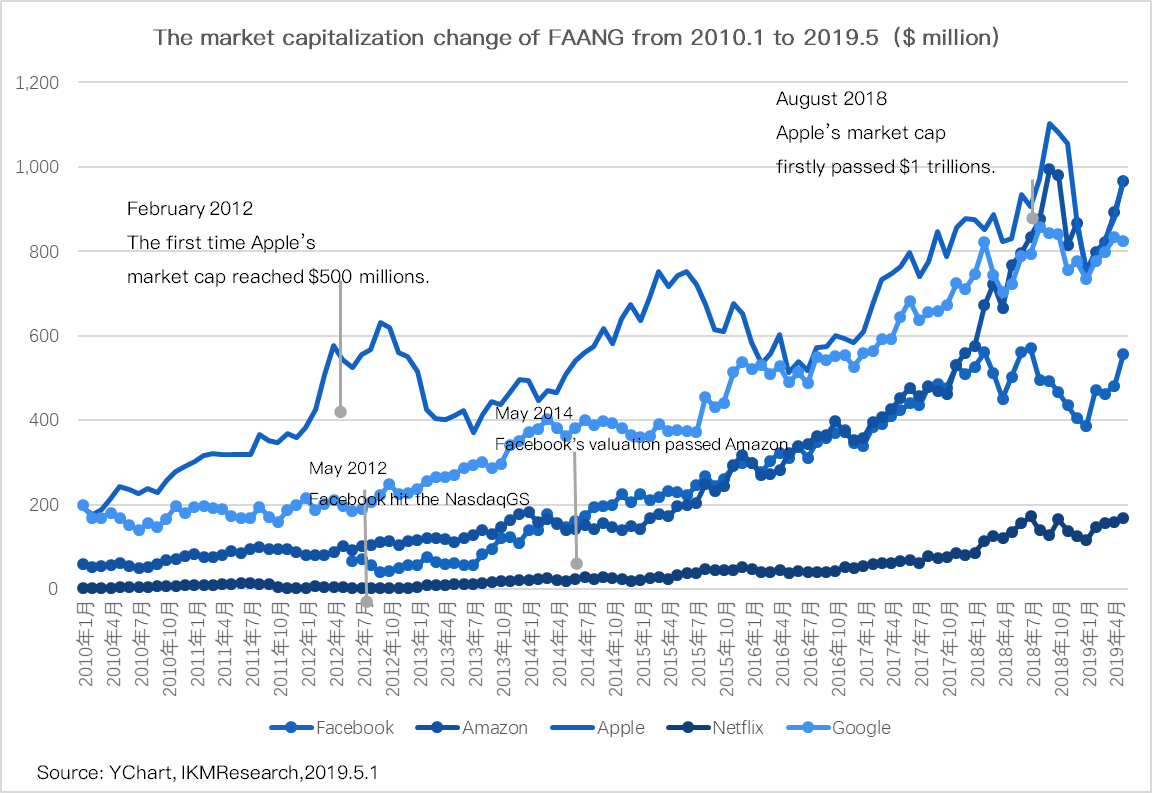
The market has separated these 5 pretty clearly now, with Meta trailing by quite a bit, Alphabet and Amazon in the middle, and Microsoft and Apple with a decent lead.
Investors will tend to tolerate other faltering metrics for high revenue growth in startups, but that’s not Meta.
Public sentiment is terrible and if that's a reliable leading indicator, the company will be in trouble if it doesnt continually diversify into products that distance themselves from the core brand.
His acquisition of instagram and whatsapp were good moves.
Rarely if ever do they true novel inventors dominate the market because when the market doesn’t exist they have to create it, and also they’re inventors not necessarily business men.
Ironically apple entering AR/VR may be the best thing to happen to Meta if it helps bolster the ecosystem. Meta may not be #1 in the space for a long time, if ever, but they may be able to ride the wave to a strong #2
-- Zuck probably.
I feel like 10K people are taking a hit because Zuck ruined VR for another decade with his very boomer like imagination and monetization strategy.
Anyway, it's rough out there.
What do you mean?
how is that any different than most of Silicon Valley?
Silicon Valley is what people thought the future looked like in 1994
It has taken Silicon Valley a long time to realize there is a limit to what you can do with websites and computers
Through robots in there and I'm not convinced there really is a limit, it just becomes difficult
When you run a business, you look towards the future and what profit you're forecasting. You don't want to see decline in profits, you don't want to use your cash reserves to compensate for less profit.
Facebook reported $23.1 billion net profit in 2022, a decline on the $39.3 billion made in 2021.
Once again, Meta's death has been greatly exaggerated on this site.
What changed were the expectations of what their profit will be in 5, 10, 20 years.
> On February 4, 2004, Zuckerberg launched "TheFacebook", originally located at thefacebook.com.
If true, that’s a pretty crazy coincidence.
> whole metaverse thing
pick one
I chuckled a bit. This is coming from a Social Media Company whose product is about connecting online. What does it say about the trust between users of its platforms?
Blanket statements like this are trying to make a multifaceted problem into a single problem. I don't understand why we are always so quick to say underperforming remote junior engineers are underperforming because of remote work. Maybe the problem was Meta went half in on supporting remote as an onboarding ramp and teams did not put the work in to make sure Juniors thrived in a remote environment.
Speaking from experience, If you are truly trying to be a remote company, you adjust as needed to support new employees, junior or not.
I've worked in the industry for 10 years now, and I don't agree "it's been known". Any measurable source of such claims?
It most certainly is not "known". I've managed remote teams, I've managed in-office teams and I've managed the same people in both scenarios. At no time was the office advantageous to innovation. Quite the opposite, it's a soul suck and once you free people to work how they are comfortable, their creativity will skyrocket.
It certainly takes discipline but I treat working from home the same as if I was in an office.
I am at my desk during business hours. People can Slack me, email me, call me on Teams, whatever. Besides, everything is logged. Every line of code, pull request, login time, email sent, all of it. They know what I'm up to.
That actually makes perfect sense to me from a practical perspective.
Nothing builds trust like callously laying off tens of thousands of people over multiple rounds of layoffs! Want a trustworthy environment? Earn it. Really though when he says "build trust" what he means is that he (Zuck) does not trust his employees unless he can see them.
You know that's not true. Facebook has offices around the world. No single person can "see" 80,000 people in any meaningful way.
I worked at Nokia through their transition from being the largest smart phone manufacturer in the world to shortly before they sold off what remained of their phone unit to MS, who shut it down completely less than two years later. Basically, that probably affected many tens of thousands of people. I heard all the cliches and was on the receiving end of them. Two points here: 1) this is not personal even if it deeply effects you. 2) if you are not part of the solution, you are part of the problem. The last point here doesn't mean you are the problem, or the cause of the problem. But simply that your presence is no longer part of any solution to whatever the problem is. Whether you agree with that or not is beside the point. The fact is that, once companies get to this stage, there is only one way forward: let go of a lot of people.
IMHO, Facebook is being to cautious here. They need to cut much more deeply than this and re-focus on their core products and modernize those. Facebook has been dead in the water for years. Whatsapp has an aging user group as well. Instagram seems past its glory. Messenger seems like a failed product at this point. Time to take it out the back and kill that. Revitalizing Facebook and Instagram will require some drastic changes. It's not going to magically start turning around without that. It's either continued gradual decline or finding some way to become relevant again.
The trouble here though, is very few VC's have an appetite to fund now, especially seed / series A. They are too busy dealing with the overpriced and soon to fail cohort from 2020/2021
I spoke with a VC just last week from one if the top five, they are yet to fund anyone new this year.
So here's the thing. Who is doing better at this than Meta? Who could they buy? Regulation is a secondary issue.
At this point, the Quests are pretty good gaming machines. Its the software that's lacking. MMAAAN has traditionally struggled with content creation. It took a long time for the streaming studios to get any decent shows. Apple, Google, Netflix and Amazon don't really have a good game portfolio to this day.
They could possibly buy or spin up a bunch of game studios to crank out content but on the hardware side I think they actually are best in class here.
This is the outcome of that.
FB stock in 2020: 234 Today: 190
FB revenue in 2020: $86 billion 2022: $117 billion
Safe to say that the web3 hypetrain is over.
Back then interest rates were low and money was cheap. It was growth over profit and when money is cheap you can afford to run in the red as long as you're getting bigger. The minute interest rates went up companies had to rethink how they're going to spend money. We haven't seen the type of corp consolidation yet that we saw back then but it's still early days.
There was also a lot of duplicative and overlapping work, which is mentioned as well.
Hypothesis? They've been an ad company for a long time.
The 'efficiency' here is slashing operational expenses to boost earnings per share. That is a temporary boost, but one that can be repeated a few times.
Increased interest rates suck up this money because now there is something better to do with that money. Why "Do Stuff" when the returns on doing stuff is less than the ultra high savings yield you are now being offered.
It's virtuous when the stuff being done actually is destructive due to easy access to capital (e.g. 100 Ramen shops driving each other into further and further debt) but it's also a ham-fisted solution. It disrupts long term planning, even relatively conservative ones like "buy government bonds", and also just punts the problem b/c it's reducing demand by... promising more money in the future.
Meta is supposed to be a Tech company and invest the capital they have in technology plays
Also, FB isn't buying treasuries...
That's their only realistic hope of seeing out the next five years. Get TikTok banned in the States, Europe and parts of Asia, then clone their app and launch in those markets to capture market share.
It's an underhand business tactic, but there's nothing too low for Zuck I guess.
"Year of Efficiency" immediately following "Year of Metaverse" succinctly captures how things went lol
This happened in India, though it is not clear if it was Meta who lobbied or combination of other factors.
Are reels not already integrated into instagram?
Changing course when you realize you were wrong has nothing to do with being a clown. Not defending Zuckerberg or the lay off, but for large companies it's always been one of the hardest tasks to predict trends. And many that go under do so because they hold on to old technologies and refuse to admit the world has changed.
If Zuckerberg really changed the whole strategy because he saw VR won't go anywhere and ChatGPT has such potential, changing course drastically would be much better than holding on to old projects due to sunk costs.
I’m here for one reason and one reason alone. I’m here to guess what the music is going to do a week, a month, a year from now. Nothing more. That’s it.”
They've been developing LLaMA for some time now presumably. Seems odd to imply they somehow missed this.
Despite appearances, if the metaverse gambit in the current episode made any sense it was mostly as a defensive move: To obtain control over a device so that you can datamine at will and perpetuate your business model irrespective of what other major actors might come up with.
Think about it. If stars (you have little control over) align, device owners can flip a privacy switch here, introduce a policy there and annihilate your business.
To paraphrase Ballmer: Devices, devices, devices
Elon: Satellite phones
Samsung: The Moon
Apple: Sat + VR
Microsoft: GPT
Is how I see it.
It seems like that's what Facebook employees wanted, so that's what they get. I'm no fan of Facebook in general, but at least it seems like the guy is listening to the employees on something.
From the press release:
> I recognize that sharing plans for restructuring and layoffs months in advance creates a challenging period. But last fall, we heard feedback that you wanted more transparency sooner into any restructuring plans, so that’s what I’m trying to provide here.
how much more performance can you squeeze from an individual that:
i) is not intrinsic to who they are (hence visible when you hire them - if its not the right profile just don't hire them)
ii) is not tied to your own bloated structure, toxic culture and messed up processes and hence none of their fault
is that 10%, 20% extra performance? is that sufficient to satisfy the "markets"? when its your vision and business model is what is really the problem.
Their employees wanted that
Do you take those claims as seriously as you do "Meta is building the future of human connection", "Year of Efficiency", and "Meta builds new ways for people to feel closer"?
This is a PR fluff message about layoffs. I wouldn't take any claims in it at raw face value.
  1. Work at Meta
  2. Be top performer
  3. Get promoted to manager
  4. Manage <5 people as a newbie manager
  5. Get fired because you don't manage enough people
  1. Work at Meta
  2. Be top performer
  3. Never get promoted
I’ve worked at a few places that thought they were lean and flat as well, but they aren’t. Someone in leadership likes the idea and goes on and on about it, but the actual structure and legacy of past structures creates a complete mess. The only thing that gets done is talking about how great the team is and how much awesome stuff is getting done. Then everyone gets laid off again.
Ive never heard that and I’ve seen short emails and nothing at all.
I didn't call them jokers, someone else did.
I called them human garbage.
Most companies choose to lay you off, then give you 'severance' package/pay that is equal or more to those days.
When I was younger I was shocked to learn that during an LR companies would “over” cut in order to fund retention for critical people. You’re laying off 7%? This is a good time to free up some additional opex, so just add a few heads above target in order to free opex to comp important people. You won’t get that 7% back but overage you do, usually.
You are wrong. During the last round of layoffs, employees asked to hear about upcoming plans before they happen. Mark Zuckerberg is literally responding to that request.
I think most would choose a).
Everyone who still has a job with them is still getting 'megabucks'.
They, for the most part, aren't hiring, though.
There is always a chance you can lose your job. There has never been a day since I started working over 25 years ago (well actually I spent my first year saving so it would have hurt then) that I haven’t been ready to change jobs at the drop of a dime.
> And changing your availability and answering a call or chat from time to time does not cost much. It is not like there is any downside to it
You should be doing that all the time regardless.
> And if an A player starts looking around great things sometimes happen. He may get hired at much higher position
That happens most of the time anyway because of salary compression and inversion even if you are just a journeyman “full stack developer”.
They weren't skeptical that layoffs were coming aimed at a flattening, which makes sense since this was already announced by Zuckerberg over a month ago.
Ahh, no. As I mentioned it didn't go over well. They had been mobbing me before and it intensified after. They were also blissfully unaware of what is legal and what is not, so pushing me out proved to be rather expensive.
I agree with this regarding their first product. Google wasn't the first ad network, Slack wasn't the first team chat, etc.
Very few of them seem to have ever had a follow-up hit product (whether original or copied). Apple and Microsoft are the only ones I can think of that did it.
Meta and Alphabet have only ever created profitable businesses by acquiring other companies. I'm not even sure anything is profitable at Alphabet other than their ad business (which I would now include with YouTube) and G-Suite.
When the President of the United States gives a speech, you don't analyze the speech as if it were the views of the speechwriter(s). Of course the POTUS is just reading from a teleprompter, but the writers are hired by the POTUS to write for him, as is the case with Zuckerberg too.
yields dropped almost 1 point after depositor bailouts for SVB. the running belief is that the fed will slow down in response to fixed-income positions held by banks.
Sure, Iceland has a small population but their GDP per capita is almost 5x that of Romania.
I'm not denying at all that the psychological well-being of young people is intertwined with social media and corporate interests in complex ways that deserve critique. But it's not ok to post snarky drive-by attacks on HN. Those are two separate things and it's the commenter's job to distinguish them.
* https://news.ycombinator.com/item?id=33340849 (Oct 2022)
https://news.ycombinator.com/item?id=30630713 (March 2022)
https://news.ycombinator.com/item?id=27401192 (June 2021)
https://news.ycombinator.com/item?id=19534285 (March 2019)
https://news.ycombinator.com/item?id=17734563 (Aug 2018)
It was funny as when I met him a few times he responded the same way.
"You're from Minnesota? Can I talk to you about hunting? They told me I shouldn't do that in California ..."
I didn't hunt but I let the man tell his story ;)
I usually feel pretty disconnected from executive types and so on but I liked that guy. I liked him so much I was suspicious all over again as that's not how I feel about those guys usually. He was actually fun to be around.
Sometimes there are actually great leaders in the sea of self-serving assholes that populate the business world.
These companies could take a more twitter like "print out your code" or global stack ranking to lay people off but i don't think it dodge the problem people describe. The "A Player" could still be mad that all their coworkers got fired and/or the "pointless project" they enjoyed working on got axed and still leave. You just get the add cost, drama, and blow-back (see twitter) that a performance based firing would entail and probably open yourself up to lawsuits (IANAL) if you don't have an adequate paper trail for those performance based filings.
So yes, it's a serious pay cut, but it's still amazing pay. Now, if they were bullish on the market, then it might make sense to try to move to another company that can come up with a 7-figure joining bonus and ride that appreciation to new stock heights.
Just wanted to clarify that it’s not quite what it was. Thanks for adding numbers.
Or maybe you're not as good of a judge of these things as you think?
Don't know much about Meta's HR department, maybe they're really good at that. But in the end we're all humans and never unbiased when we make those decisions.
Not to mention that the remaining "A" players may each be saddled with the work of ten laid-off "C" players because, as far as management is concerned, programmers are fungible. Why not have their 10x programmer take care of it?
(obviously, the analysis is more complicated than this, but you can see why investors may not think things are going gang-busters over at Meta)
[1] https://www.macrotrends.net/stocks/charts/META/meta-platform...
Acquiring your competitors to kill competition isn't a "good move," it's an obvious strategy that has existed for hundreds of years and is (rightly) illegal.
We unfortunately forgot the lessons of the Gilded Age in this country, and incredibly anti-competitive acquisitions like that have been tolerated on too many occasions.
It's easy to make "good moves" if regulators are ignoring you and you're comfortable with being immoral, as Zuckerberg always has been.
Having an enormous cash pile is what allowed Apple to keep paying its employees when COVID shut everything down.
Every good company has a cash reserve. The one I work for has a policy of maintaining enough cash reserves to operate for 18 months with zero income. It saved our bacon when the virus came around.
Firing 10k people on the back of other layoffs just obscures that for a while.
This latest round is a re-run.
VR was talked up like crazy then and fizzled.
Zuckerberg is old enough to have been an impressionable kid when that was going on. I remember being very excited about it all.
Sure. I'm just not sure I understand how the current focus/hype by Mark Zuckerberg/Meta can be THE cause for VR to fail (which is what was asserted by the person I was responding to).
I mean, are there literally nobody younger who is hyped about VR? Maybe not!
Convenience and familiarity trumps other issues, even massive issues like privacy etc. You might be over estimating public's interest in giving their money only to honest, decent businesses - public gives their money to whoever entertains them cheaply and caters to their laziness.
Nothing is going to change, unless we all vote with our wallets. But we have already voted, we knowingly support monster companies like Amazon.
  1. Work at Meta
  2. Be top performer
  3. Remain in your role for too many years
4. Get fired because you're expensive with no growth trajectoryThey are if you’re talented enough.
If you define talent as the criteria by which FAANG selects from a pool of employees - then you're by definition correct.
If you don't - then you disagree.
If FAANG is paying top dollar and selecting for trash - you have to wonder why, though.
Makes me wonder if the opposite could become fashionable: "I trust myself to fly without the golden parachute, you might want to make that part of your consideration". At first glance that sounds quite compelling to me, but on the other hand, would I feel safer or would I feel less safe with a Taxi driver who does not bother putting on the seat belt? I think my answer would be less safe, event though a part of me wishes to be one who'd feel safer.
So over a period (FB has been around for like 15 years now) an org accumulates extremely risk averse execs.
if the execs are pilots, and the employees are passengers, then having parachutes for the pilots but not the employees constitutes a moral hazard.
I think more likely the new CEO's comment stemmed from that fact that 1. The old executive staff were in fact horrible at face value. 2. In between the time of the offer to buy the company and the closing the old CEO visited several locations presumably under the idea that he was there to keep everyone around / soothe the typical nerves about being acquired. But something else happened:
Instead he took snide shots at the acquiring CEO. He noted that he was surprised the new CEO hadn't visited our site yet.... when at that point the deal hadn't closed, they were still technically competitors. New CEO straight up couldn't visit.
I think old CEO was just a horrible person and salty he lost (mostly due to his own missteps) to his competitor.
But that was par for the course with old company executives. They seemed to operate thinking they were so smart and really were as transparent as could be, almost childish.
I generally feel disconnected / suspicious of executive staff... but these guys, they were human garbage as far as I was concerned, and I don't use that term lightly.
My Fav examples:
HR at one point sent out a series of long emails about a big change upcoming, but they didn't / would not say what the change was, it put a lot of people on edge. Then finally after the 5th or so email they announced that after HR spent thousands of hours in meetings and off site meetings ... they were renaming HR... that was it... it was like a joke, but they were serious. CEO and all the other executives of course had to reply all to congratulate them.
One of the last meetings with the OLD CEO had an open forum where people could ask questions about the acquisition. Old CEO seemed to give the impression he had some idea what he combined company would look like / could do. Someone asked where he saw the new company in six months/ what it might look like. He responded "I'll be in Banff sking." That was it, that was his response....
Sounds like something else was planned, and they pulled out last minute.
Or they were trying to spook 5% into leaving -- and did -- so they make some trivial change that means nothing and can be undone later.
I don't really understand why we are comparing a company who develops social media applications and generates advertising revenue against Apple who generates most of it's revenue from selling Hardware, or Microsoft who generates most of it's revenue from licencing software.
If we are saying that Meta are trailing Apple, we might as well say that Microsoft are trailing Saudi Aramco.
http://www.innovationkm.com/wp-content/uploads/2019/05/image...
http://www.innovationkm.com/the-market-cap-of-faang-changes-...
Another way to think of it is in the 2010s, a potential employee may have ranked a job at any of those companies as having similar security, but there is probably a different feeling about that now.
I get comparing Meta against Google, but why would we compare Meta against Apple? They are fundamentally different businesses.
The funny thing is, that's a bad bet. Large tech company profits can last for years and decades. The archetypal example is IBM. They've had some years or record losses, but overall, look at their yearly profits:
https://companiesmarketcap.com/ibm/earnings/
We're talking about probably more than $250bn of profits over 20 years.
I had six juniors join my team remotely and three are amazing, two are ok (do useful work but need handholding), but one is pretty bad. However I don’t know how that compares to non-remote hires so it could be that it’s worse.
We know many companies want to push for back to office work and commercial landlords are bag-holding hard…
Some food for thought.
If you want a real assessment of the problem, you will need to think about sampling, be careful about what you test, have a good amount of respect for the factors you don't know.
Nobody on this thread has done any of this, but one is a huge company messing with the lives of many people and claiming they know exactly what they are doing.
You said your team hired multiple junior devs, I am gonna assume its less than 10 hope that is fair assumption. Meta has hired almost 40,000 people since 2019. Even a conservative estimate of how many were engineers, and distribution of junior and senior roles. I think it is fair to say they probably had enough people to draw meaningful conclusions.
Perhaps individual teams, with careful hiring practices and team fit interviews can make sure juniors thrive even in a remote position. But on average, larger companies cannot be only staffed by super teams, and sometimes that means some people suffer to make sure the median employee has the best chance to succeed.
Its not too far from having junior limited to some staging environments instead of production. Some juniors might be ready for the big leagues, but giving the keys of prod to any junior will probably cause some headaches on companies with 80,000 employees like Meta.
But it's harder to onboard at a company like Facebook than at a startup. Every company could have better processes - but when it takes months for even top-tier talent to be able to do basically anything - it can be extremely helpful to be in person during that time...
And, sure, everyone is different. I'm sure some special snowflake will reply - but it isn't for me!! I'm speaking in general - as Facebook is...
https://dqydj.com/stock-return-calculator/
IBM has objectively been a terrible investment for many, many years.
Looking at numbers, BTC went up 15.8% in the last 24h, up 16% in the last 7 days. Global marketcap of cryptocurrencies went from 804B USD in November 2022 to 1,121B USD today (~32% increase). If anything, it seems to slowly recover.
Although I agree that NFTs are trash and should be forgotten about. But the cryptocurrency market as a whole seems to be more resilient than many think.
Crypto, however, will remain popular as long as governments don't ban it.
1. Public cryptocurrencies will remain there as a sort of niche investment (betting?) vehicle. Something like "VWOB - Emerging Markets Government Bond ETF". Did you know about that one? Neither did I.
2. Private permissioned blockchains will be used in specific niches. Think Corda and some finance applications, whatever the commodities thing is called, I forgot its name.
But the long tail of Bladogelitecoin and the likes will go poof once line stops going up.
Neither are most other coins.
It's not an actual drug so you can't just keep upping the dosage. I don't have the internal metrics and I'm sure they are still making gains, but I think their wave is going to be much smaller than Facebooks.
It's still very popular of course but just judging by the number of times phones have been shoved in my face to watch a tiktok at social events recently vs a year ago I have to feel their is some level of decline. I also notice that even the younger crowd isn't using it as much.
It seems to me that right now the most popular thing is sharing videos, both 3rd party and original within various group chats.
I think there is social media platform overload, and the best way to keep in touch with people that actually matter to you and be sure they see your content is having group chats where you share things and then talk about it. Just my anecdotal observation, I'm probably wrong.
It seems similar to the resurgence of piracy now that there are 50+ different streaming apps.
I’m aware of the Chinese thing and how it makes some people feel but IMHO TikTok is healthy in in comparison with the Instagram or Reddit for example. You still can spend hours once in though.
After years of stagnation with Meta, TikTok is a step forward.
Well, "addictive" literally means "cannot easily stop doing it"
Hum... Did the executives of all those large companies just happen to discover they aren't innovative at the same time? Or are they trying to prop-up their stock so they have time to exit on the prices created by the low-interest market?
One of those is way more likely than the other.
(But yeah, those companies have stopped innovating long ago.)
Luck had very little to do with facebook's success.
Identifying threats? Please. EVERYONE knows who the threats to FB were and are. It’s just that not all of us has the money to buy them.
Mark Zuckerberg is average.
His one big “innovation” is taking legs out of Second Life.
These layoffs don't happen in a really hot market.
As much as people like to think that developers are just cogs on wheels, companies still want experienced devs (experienced senior and above), and they are still difficult to hire.
Arguably python is so easy that junior devs aren't that far off from senior devs.
People who can actually engineer in python is becoming more and more common place.
This is indeed what is happening right now.
WhatsApp famously had ~50 employees for ~$16 billion in acquisition price.
Quick brainstormings, pair programming. I mean its not up to discussion, real world on site is more efficient. Now from perspective of senior always bothered by those pesky juniors with their stupid questions, loud environment etc. its a different story. Company can set itself up to be much more open to fully remote, but its a conscious and continuous process that needs to be accepted by all seniors, people tend to revert to previous way of working.
Personally, I can see this also for seniors who are also onsite. In truly global teams, you are constantly chasing people and teams to do their work, approve processes, deliver stuff etc. Compared to person X who will respond to your email/chat in 4 hours it takes 1 minute including walking to get feedback, understand problem, manage expectations, push things further etc.
In my experience coaching many young engineers in person and remote, the problem is not so much that it's easier for them to ask questions, is that they don't ask questions, like, at all. They are too worried to sound/appear dumb, even when all the senior/staff engineers are super nice. And in a way I understand that, they are unproven, they have to show their worth to everyone else.
My theory is that the idea that early career people don't do well remote is that it's easier for the senior people to forget about them and not check up on them regularly to make sure they're progressing. If a person is sitting close to you and not making progress it's a lot harder to miss. Also the casual "hey everything OK with your problem?" is a lot easier in person than online. That being said, with some adjustments it really doesn't take too much effort on the Tl/Manager side to make sure junior folks don't get stuck.
I've lead a few teams remotely now and the most successful ones were the ones where I started checking up on the most junior ones often, as often as every day, just asking low-key questions like "hey do you have any questions for me? are you stuck anywhere?" for a bit, just to make sure they were feeling OK asking me when they had a problem, and re-routing them to the right person as needed. After a while they feel safe and start doing it on their own, but it might take a while depending on the person.
As an experienced person, I can chat with anybody at the company within minutes, it's so much more productive than chasing somebody in the office (which could be easily 10~20min walk away).
In person is way better for socializing, creating team bonds, etc. but you don't need that every day, a yearly/quarterly team/company offsite is sufficient.
This is my perspective working at companies that are big enough that they would be global anyway. For a smaller company I can see the argument of having everyone in the same office, but even then your giving up a lot to make up for that (commuting, walking around finding the right person) and I don't think that scales well beyond the 1000 people mark.
Your 20s are a critical time for your career to make connections and friendships - in person. You need to be around people, making friends over beers and community lunches, and learning social skills in a professional environment.
Are we that spoiled that the excuse is "I don't like public transportation"?
Do companies take a productivity hit when people are in the office? Probably. And many openly acknowledge that, but asking people to come to the office two times a week is not some sort of wage slavery.
the adjustments may not be possible. People tend to build rapport easier when physically close by, and this rapport is how trust gets built up over time, and only by having this trust do knowledge and institutional culture gets transmitted.
I do believe that junior/new grads who come into a fully remote work place would have a harder time to build trust with existing employees, get less mentorship, and/or find it hard to "gel" properly.
I've been managed by truly brilliant coders who just wished they could go back to sitting in their office and code. No one was happy with that situation.
As for motivation (I know no one asked): I genuinely enjoy the human aspect of the job and thinking further out into the future with product and engineering leaders. Plus I learned that I really enjoy programming when it's a hobby without the corporate overhead, and that it's less fun (to me) in a company.
Not to discredit your experience - but it's not a universal truth.
Cases where managers are appointed to oversee dev teams without having any engineering experience at all are more common in non-tech companies. Those situations can still work, but rarely work well.
This is a terrible idea, though. It's always the desirable employees that have options that leave an environment like this, and it's always the less competent employees that hold on for dear life and stay.
I've seen this so many times in my career. The A players will stay because they're attached to the things they've created, but the B players will leave and you're left with lots of C players.
In the long run its cheaper to lay off people.
Okay, sure. But why does this need to happen in the workplace?
And more importantly, why are you advocating for employers to unilaterally declare that this needs to happen in the workplace?
No one is saying you don't need to be around people, but a job can be just a job. I don't need to make a ton of friends at work to do my job, and the idea that that should be a requirement/expectation needs to stop. It enables the chance for too many unhealthy boundaries to be created young workers that don't know any better. If you start in your early 20's and are made to see everyone as friends, family, etc. Then when someone tries to push you into a 12 hour day, it doesn't seem that bad. You can forge working/professional relationships virtually just as well, if you put the effort in.
Now sure it doesn't work for everyone, but again my argument isn't that one is worse than the other, it is just that we make too many blanket statements. What works for you might not work for me, and these organizations trying to force one or the other is harmful in the end. You can have co-existence, especially in a company the size of Meta, you can have a plenty successful office presence and remote presence.
> Are we that spoiled that the excuse is "I don't like public transportation"?
I don't think anyone said that in this thread... That being said, it shouldn't be a surprising fact that people in US cities dislike public transportation. In a previous job of mine, it was quicker to sit in 45 minutes of traffic outside of Washington DC then take the metro, and I was in an area with supposedly great access to public transit. Maybe if all these companies were serious about their workers' best interests they would do more to help invest in and lobby local governments to support public transportation.
> And many openly acknowledge that, but asking people to come to the office two times a week is not some sort of wage slavery.
If you were hired with the expectation to come into the office x number of days, that is fine. A lot of people were hired with the promise of being able to work remote, so changing that is where it tends to be a bit of a bad situation.
In general this animosity between office work and remote work advocates has gotten out of hand. These can co-exist.
Working remote lets me make connections and friendships where I live, and have more time to do so than when I was spending hours each day commuting.
It should be MAAAM by now- Microsoft is famous for the IC rest-and-vest to ‘55 lifestyle.
The former does not follow from the latter.
> Yet, one of these people have a fast pass to FAANG.
Citation? I haven't seen anything like that in the industry at all.
I worked at FB and Amazon for six years total and the vast majority of my fellow engineers were from random mediocre schools (including myself, from the U. of Arizona).
They won't.
> I'm an AI research engineer who was recently laid off and this was my experience.
But not from Facebook? They are very well compensated right now; they aren't just going to drop into a better paying role.
Skillset is almost identical, biggest difference is having research experience.
Meta's hiring bar is pretty high, though. Plenty of desirable people will stay because there's nowhere else to go that pays as well, and the "less competent" ones are likely still more competent than the industry average.
These elite companies have now laid off hundreds of thousands of people. The idea that there's enough "low performers" to throw in the garbage should be obsolete now, and reveals a sort of wishful thinking "all those other people who lost their jobs deserve it, but not me, it will never happen to me"
I'm not making any comments or judgements whatsoever on employees there, but doesn't Meta use the same terrible hiring practices that values so-called "leet" code style interviews? Such interviewing practices are bound to produce poor results, especially at the scale that Meta, Amazon, etc. do them at. (This is also not a comment in support of the layoffs. I think layoffs are a failure of management and executives.)
> it's always the less competent employees that hold on for dear life and stay.
Meh. People stay for many reasons. It is not always "not having options". It is fairly often "I actually want to stay despite layoff". And again, there is no way to force people to stay. Confident people will be leaving either way.
If so, yes, they do. But it's incredibly hard to decide on causality there, because companies are only expected to do mass-layoffs when the management believes it can't grow anymore.
The problem is A, B, and C are not at birth positions. People in these buckets rotate across the buckets at various phases in their careers. And the participants in the A buckets are basically people with good leadership- who can train, motivate and get them good products/projects to work on. That given anybody can leave the company and if you have good managers it wouldn't matter.
The real problem happens when you go meta to this. How do you get A level managers. That's a very hard problem to solve and often it also depends of the boss at the very top. The CEO. Many times the revolving door, golden parachute CEOs don't even care. The founder CEO's are tired in most cases. Performing at unicorn level can be brutal on your body and mind on the longer run. And they'd rather semi retire after a few years than continue with that lifestyle. This is where the real problems begin.
In cases where the top most boss gives a damn about the company, the company tends to be A player generation factory. Look at Ford under Henry Ford, Apple under Jobs. Microsoft under Bill G. The boss at the top just needs to get this right else its over.
After giving legs to avatars, is there really much work left?
This is exceptionally hard on immigrants on a visa, who have limited options to leave voluntarily.
a) the technical challenges at these large tech companies are probably way more interesting
b) compensation is very likely better
c) you are working with many many more peers who are super talented
Not really, if I come up with a novel algorithm or a different architecture to do a task better at Google then they will give me the chance to implement it even if it takes months or years. Small companies doesn't care about your ideas, they just want a cog that can give them a basic website because that is all they need, novel things doesn't help them.
If you mean "novel product ideas" then sure, but we aren't product managers we are programmers so our ideas would mostly be related to architecture or algorithms.
They don't, and they aren't. They work for, and answer to the owners.
(you are right though, the term "moral hazard" is surprisingly well defined and basically has nothing to do at all with the sum of its parts)
Or if they want to keep pissing away their money, they can keep hiring clowns that ruin their companies, and then pull the ripcord. It's their money on the line, not mine.
2010 Meta 'Potential' vs 2010 Google 'Potential' - c$50bn vs c$200bn
2022 Meta 'Potential' vs 2022 Google 'Potential' - c580bn vs c$800bn
Meta grew >10x across the period, while Google grew c4x
I don't personally buy that Market Cap = Potential, but you would be twice as rich if you invested in Meta according to that graph than if you invested in Google, and you would have also done better investing in Meta across that period than Apple according to the graph you sent across.
https://watch.dqydj.com/timeseries/stock-calculator/
From May 21, 2012 (when META went public) to now, here are the annual returns:
MSFT - 24.53%
AAPL - 22.99%
AMZN - 22.07%
GOOGL - 18.09%
META - 14.36%
It's not that way everywhere but man when you run into it, crazy.
Say you’ve been working somewhere for 5 years and have the opportunity to move to a company - and you know both companies are laying people off at some point soon.
In your current company, maintaining your position requires no training and negligible HR resource. The question of your capability to perform the job you’re given would hopefully not be under question (otherwise good going for keeping that gig up for 5 years). Your team is not a blue sky project (otherwise shame on management for keeping that gig up for 5 years). Making you redundant will cost the company severance, and if it’s a structural issue you could be moved into another team. Dropping you would be a genuinely hard decision.
The new company barely know you and have to expend resources just to integrate you, and expend nothing to drop you.
I know which one I’d pick.
Granted, it’s a false premise: perhaps the new company is more resilient than your current company, for example. However, if the odds are unknown - and in most cases they aren’t known in any reliable way - then I may as well treat them as if the odds are balanced.
It's a failure of management to hire correctly and/or manage and develop people. Management is broken and incompetent and relentlessly scapegoats those below them.
People are rarely ever dead weight. Products and services most certainly are. Products/Projects etc fail for a variety of reasons, and it can often be hard to anticipate if they will. When you are building them you need the top people to build it for you. If the product fails, you now have people you have to pay for running the product that doesn't earn you money. Now you make a loss.
While you did hire the top people, the product failed and now you don't need them. Keeping them around costs lots of money and, their work, even if high quality hasn't given much profits.
It is then you have to let go people.
That wasn't my experience with the current layoffs at big tech. There was no effort to find positions for the engineers who performed well in the previous year(s). They just cut some orgs by the hundreds (I was in a call with 350+ other devs, many of whom are far smarter and more experienced devs than myself).
They just started cutting "weight" at some point, the "dead" adjective was dropped during the previous rounds of layoffs.
Nothing absurd here.
Maybe top paid management is simpler to replace?
I wonder if the managers who will become individual contributors again, will be paid the same or less
The show Silicon Valley has a great parody of this fact: https://www.youtube.com/watch?v=YZFTaEenaHM
I really don't worry about this stuff until it starts looking like the dot-com bomb again. I survived that, I'll survive this.
Revenue in 2022: 32,165 M USD
FTEs in 2021: 71,970
FTEs in 2022: 86,482
Revenue-per-FTE in 2021: $467,847
Revenue-per-FTE in 2022: $371,927
That's 21% less revenue per FTE.
[1] 2022 results https://investor.fb.com/investor-news/press-release-details/...
[2] 2021 results https://investor.fb.com/investor-news/press-release-details/...
that is how the Soviet Union worked...they just cut to the chase and had the state employ everyone directly
strange how an economy can fail with full employment...
As opposed to some dystopia where an exceptionally efficient and low employee organisation makes all the money and there is no/limited distribution of that wealth.
In real life the goal will be to build automation so that the few owners of the robots can buy more 200m long yachts.
Yes, just not challenges that requires ideas to solve. They are mostly just following the same path every other tech company went, re implementing the same systems. To them it doesn't matter if the system is better or worse, they just want a system since going from 0 to 1 is huge, meaning that they wont give you time or resources to implement your idea, they just want a cheap idea.
These two statements do not follow, why would "such interviewing practices [be] bound to produce poor results, especially at the scale that Meta, Amazon, etc. do them at?"
Thus, it is only natural that you may have many people in the organization and on teams who are poor fits, either technically, culturally, etc., because almost all of the "leet" code stuff is irrelevant to most real-world work. If it is relevant, then it is usually only a small portion of the job. This isn't a judgement on anything other than the hiring practice.
But like I said, I don't really know much about Meta's hiring process. It's possible that I'm misapplying this style of interview to them and misunderstood about if they actually use it. Amazon does, and I can confirm it was a miserable interview experience.
This is a very strange point-of-view.
I've worked in "small" (~100 employees or fewer) business my entire career, and not once was it strictly CRUD stuff in C#.
The freedom is debatable, I guess, since I have no experience at larger companies, but I certainly never found that my freedom is confined. Most often there is opportunity to contribute anywhere and everywhere, and management is happy to have the help.
Similarly, most of the devs I've worked with that are obsessed with "exciting" work still turn out pretty questionable stuff, and their careers would probably be better served if the built out a "simple" CRUD app, took it really seriously, and then examined the effects of their design on other teams.
That is, their capability to manage.
Ok.
All of the replies you are getting are trying to tell you that there’s no deep thinking involved. There’s no “hey I considered it and the comp overcame my concerns” etc. Most of the leetcode-into-fang people are not doing a moral calculus or even spending thirty seconds thinking about the ethical aspects.
There are no concerns. There are no ethics for most of the people in our industry. It is an employer who pays well so they work there.
Your comment implies that, yes, it came down to comp, but also implies that for Facebook employees, on average, there is any thought process beyond economic maximization. There isn’t.
I know a ton of facebook and ex-facebook engineers. They also worked for famously ethical companies like Zynga and Uber. Now and then they’ll do the pretend performative handwringing or whatever but their decisions are consistent.
There is just money.
The former approach means you can’t do anything with clear conscience: do you take that vacation or donate the money? Do you punish yourself if your work on databases eventually was used for a scam?
I find it paralyzing to operate in the former way: so I take the traditional stem person approach. I just ensure what I do is good (obviously for the highest bidder). I won’t work for an explicitly criminal organization - but as long as the government approves, am in. I am going to let them do the policy making and governing because frankly I am tired and probably incompetent at that since I don’t sink much time thinking about it.
There is nothing tricky about it. No one works at Meta thinking they are feeding starving children.
It’s also “difficult to get a man to understand something, when his salary depends on his not understanding it”
I’m not making any moral stand either way.
Engineers in Meta have advanced technology in so many ways (buck / react / so many contributions to distributed software / leveldb …). I think it is very reductionist to discount all that work.
There’s nothing about salary depending on it here: there’s a ton about your work contributing to the global good irrespective of who’s funding it (and whatever ways they end up utilizing it).
Maybe because, I don’t know, Meta pays well? I don’t go to work for self fulfillment. I work to exchange labor for money to support my addiction to food and shelter.
No I don’t work for Meta nor have I ever.
> I think a lot of people working there just made the calculated decision that Meta being at the very high end of the compensation scale made it worth it.
Is this our level of laziness now? To read the first sentence and base our snarky replies entirely off it, ignoring the fact that it’s a rhetorical question that was answered immediately after?
That didn’t help. It’s like saying “I don’t know why the guy died. Maybe it’s because he got shot in the head at point blank range”?
Of course people work at Meta because of the money. No one works for Meta to make the world a better place
Largely because much of the company is a great place to work. Actually working there, I don't find this hard to see at all.
Hire them and if you can't get the performance you need, then you due them. Alternatively, hire them as contract-to-hire if your head of HR has conditioned you to be terrified of doing what you're allowed to do in the US.
1 in 4 people on earth is using FB every day. They simply can't grow more too much.
Google: 20:1 Amazon: 100:1 Netflix: 30:1 Apple: 22:1 Meta: 18:1
(For the financially illiterate like me who wanted to see what various ratios looked like. Meta (Facebook at the time) used to have a 7:1 ratio when they printed money before they doubled headcount while revenue flagged. If it weren’t for that hiring spree, they would be under 10:1 and not in the same class of “tech” multiples.
Apparently that's no longer the case: "Mark Zuckerberg Quietly Buries the Metaverse"[1]. Company name looks just silly at this point.
Also the display ad market is only useful if you've got people to advertise to. The more Facebook continues to turn into 'social networking for boomers' the less and less they'll make.
Like, I left FB five years ago (after staying there for 5 years), and literally HN has been telling me that FB were doomed for all of that time.
I totally agree that TikTok is a very strong competitor, unlike what they've seen before, but writing FB off right now is probably not the wisest long-term decision.
https://www.youtube.com/shorts
already here
and not a chinese company
if Im gonna brainrot Ill use youtube
Is Meta really a tech company? It takes a lot of technology to do what they do, just like Netflix. But their core business isn't technology pre se, it's social media and advertising. I don't think they're the same class of businesses as Microsoft or Apple. Google is closer to Meta in terms of their revenue sources, but they have a much more diverse technology offering.
They are trying to become a hardware company with their VR line, but it feels more like a hobby in the Apple sense of the term. I.e., a division with small revenues and without a clear growth path.
We've seen the entire gambit of layoff messages in the past year. No matter how empathic they're written, people complain.
Edit:
That being said, after actually reading it, the Meta letter is relatively classy. The HN comments made it seem worse than it was.
For C++ it takes probably 4 or 5 years.
This is not nonsense. This is real.
Start asking questions about Linux, or networking, or security, you won’t find many that can answer.
Sounds like capitalism to me. Better get to work developing new projects and products to stem that loss.
Yes.
The road to progress in any system involves being known as someone who initiates new order of things. And always remember this. Its the new projects, and initiatives that get most of the resources because people want to see them win.
So that “dystopia” can already be considered to be here.
Everything has trade-offs.
just last month https://www.npr.org/2023/02/14/1156726845/indian-tax-authori...
USA is different
If you yourself are a bad engineer or terrible at hiring, you might mistake the chaff for the wheat, but then you're doomed anyway.
I think you're not talking from experience.
The same thing happened with JS when that was peaky, and it'll happen in other languages too.
What is old is new again.
I've been hiring roughly the same amount for 10 years. I'm actually really extremely good at modern python. My skills with python syntax are so good that I can do in 1 line exclusively with generators what a junior programmer probably needs 10 lines and twice as much mutating state to pull off. My code is also likely more modular and neater then a junior but you have to realize none of this matters that much. My skill level with python is beyond the curve of what is necessary and so is any other developer that goes beyond 2 years with python.
In the end every programmer I ever hired exclusively for python will hit this tier within 1 or 2 years, very few exceptions. Roughly half of the junior programmers I hire are actually already within this tier upon getting hired. Literally before hitting there first job. After two years the only thing left to pick up are some more unique patterns and tricks but that's it.
I am 100% talking from experience.
It isn't unique to Python.
"Of what is necessary" is subjective. Regardless of the language or framework I'm hiring within they must have the same level of engineering skill. I've hired people for Python projects who were outstanding Go or Java programmers who never touched Python commercially.
My point is the language isn't relevant to your arguments.
That's why you're wrong.
There's also plenty of Python developers two years in (that I've interviewed and rejected) who couldn't write me a decorator or explain MRO.
There's plenty of 2-year Go programmers who can't deal with goroutines well.
There's still a deficit of talent, even in Python. I don't see anyone denying this reality.
But to your point, there is a flood of bad candidates.
How would you know did you hire these candidates to find out? Or did you dismiss them as bad because they didn't pass some brain teaser algorithm interview?
Those candidates go on to get hired at companies with a lower bar for lower salaries and those lower salaries do influence the market.
Yes.
We'll still interview them, but they're usually pretty bad. I'm struggling to remember one who wasn't. The one's we've hired have been disasters.
Yeah, hire and then show actual managerial skill. If you still can't get the performance you need, then fire them. Tech hiring culture has become completely bananas and it wastes insane amounts of resources.
Tech management in the US 1) can't hire competently, 2) can't lead, 3) can't develop those under them and 4) can't man up and fire the employees they mistakenly hired and failed to lead.
It's _really_ hard to hire good people consistently.
Not sure whether this is more common in the US these days. I know for a fact that a lot of buildings in China are constructed this way.
It seems we've made amazing progress on the "software" side of AI, but are still very far behind on the "hardware" side, ie robots.
The main disadvantage about physical objects vs software is that physical objects are not as easily scalable and matter is generally more expensive than bits... so the economy of scale is harder to exploit. But give it some years once the marginal utility of software decreases to a point, I think people will divert more focus (and more importantly capital) on automating hardware stuff.
Yeah I realize progress or morality isn’t a given - I think I mentioned the offroads. But if things keep going in this direction we are heading now, I suspect we might actually get there.
Once the data doesn't leave America this is going to go away.
This is not that much different than just complying with the type of regulations the EU has. The American version is just involving a lot more chest pounding and fluff because there's no existing laws to enforce to make them do this. So they just have to do it through threats and relatively minor policy changes (like banning on government phones).
I’m not judging anyone for making an outsized salary for working at Facebook. Just be honest that you’re there for the money and not some high minded ideals.
Because your comment indicates that you clearly don’t understand that people sometimes ask questions not because they want an answer but for emphasis or dramatic effect.
This was, clearly, such a case.
https://en.m.wikipedia.org/wiki/Rhetorical_question
Digging down on your snark when you’re called out is a bold play that doesn’t generally work. Most people have this thing called humbleness but I guess you left it with the rhetorical questions.
The original post was no more insightful than “I wonder why he got wet when he jumped into the wster”
First off both MRO and decorators can be learned in 1 week max by anyone. And one week is REALLY forgiving. Literally. You have to be mentally deficient not to be able to learn it. They simply didn't encounter the python feature in their experience. You would just reject them for not knowing about those features?
Second off decorators are syntactical tricks. You can get around python without ever using them. If you encounter them in libraries you just need to know what they do at a high level, you don't need to know how to implement them. If you ever do need to implement one just look it up. I don't judge people for not knowing syntactic tricks.
Third, MRO is something that should be not heavily used at all. You should avoid inheritance as much as possible. Additionally you should avoid double inheritance all together. The MRO/inheritance concept is a left over thing from an outdated programming style. At most you should know inheritance, and at most have one level of it if you must and try to use interfaces instead. Nowadays I expect only to see inheritance in existing libraries/tech debt and not newly written code from senior programmers. If someone encounters MRO issues, again, I just expect them to look it up.
I'll actually judge someone who expects others to know MRO given how outdated it is. I won't think they're stupid, or I won't not hire them or anything like that. I just know they aren't up to date with the current methodology but they can easily learn it if needed.
Overall, you're just setting a high bar artificially. It's like hiring janitors who only have phds in chemistry to know what's in the cleaning chemicals.
> Yes but the same timeline can be done for C, C#, Java or anything else.
No Java and C# languages are complex enough that it can be done in a 2 year timeline but these languages are hard enough that they are in a different class then python. C with memory management is harder then both java and C#. Memory management simply isn't intuitive.
Isn't all programming just syntactical tricks?
We have a fundamentally different view of these things. Mine is serving me well. Yours isn't challenging mine.
Let's agree to disagree.
No. The decorator is really just a syntactic shortcut. There are other facilities in python to do the same thing. The decorator is just a convenient way of doing it. The concept at hand is a function that takes a function and returns a new function. Nothing crazy here.
  decorator: Callable[[Callable[[Any]. Any]], Callable[[Any], Any]] = lambda x: (lambda y: x(y)) #does nothing
  g: Callable[[Any], Any] = lambda x: x #identity func
  decorated_g: Callable[[Any], Any] = decorator(g) #decorator that does nothing to identity returns identity func
>We have a fundamentally different view of these things. Mine is serving me well. Yours isn't challenging mine.
Exactly see. Just because my view is "better" or more "modern" you still function fine within your role which is my point. Someone could have knowledge far superior to a person with 2 years of experience, functionally speaking, it doesn't matter too much. You still do "fine" at your role. Your view serves you well in the capacity of a "senior" engineer" even though your view points are ultimately wrong and inferior they still work well enough.
Also it isn't a viewpoint. Two of the newest languages to hit the mainstream have eschewed inheritance completely from their syntax. Neither Golang or Rust have the concept. Both use interfaces exclusively to promote the concept of similar types. No inheritance anywhere. I have tons of evidence on this even papers, quotations from prominent people. It's a well known fact inheritance is outdated.
We can agree to disagree, but it's like agreeing to disagree with a child who doesn't know any better. Sure.
You have to give them some take home exercise. That's the best way to determine if they're not a false negative. Unfortunately many good devs just don't have the time to do a takehome.
Did you hire a candidate who say... didn't know what MRO was, but created a stellar result for a take home project?
What I'm saying is that the market is flooded with these false negatives.
Agreed, but that's not how we interview.
>Did you hire a candidate who say... didn't know what MRO was, but created a stellar result for a take home project?
Do you have me confused with the other guy?
>What I'm saying is that the market is flooded with these false negatives.
Understood. The market is also flooded with incompetent devs, capable of talking at length about Python syntax (and sometimes even the computational model, e.g. MRO, etc.), but who aren't actually able to put that knowledge to use in engineering systems. These are systematically catastrophic hires, by which I mean, the engineering team is significantly better off hiring no-one, than hiring them.
May I ask, why does this seem to matter so much to you? If you are a bootcamp graduate yourself, that doesn't preclude you from being a good engineer. I am more than happy to believe you are the one-in-a-thousand counter-example.
I'm not a bootcamp graduate engineer. I'm actually quite good at what I do, interviewing (from both sides) and engineering. This topic matters to me because I like to argue online and I have strong opinions.
It's common for people to manipulate their perception of reality to justify their own situation, I assure you I am not doing that here, however I think you are doing this.
>>What I'm saying is that the market is flooded with these false negatives.
>Understood.
A false negative is someone who is GOOD, but appears bad. He is a negative but that assignment is false. I am saying the market is flooded with capable engineers that are good but appear bad due to interview processes and biases. Hence the term false negative.
>Do you have me confused with the other guy?
Nope you guys touched on similar points. You never mentioned syntax, but you're likely testing on algorithms so it's the same result. You get a ton of false negatives. You pay a premium for the guy who does better at the interview when you can get someone who's just as capable at a much lower cost.
The point is someone will hire those false negatives at a cheaper price and that effects the whole market. Companies hire the best they can get.
>Agreed, but that's not how we interview.
That's why a certain segment of the market looks like there's a dearth of people. It's because the interview clouds your perception. You interview the wrong way, you agree. The contradiction here is that although most people like you agree, you still reject people based off the SAME results as the WRONG interview AND you think the rejection is accurate.
That's how the psychology works. Everyone I talk to agrees interviewing is wrong overall but when they use it to judge on individual candidates they think it's accurate.
The contradiction exists even in your own reply. You agree the interview process you use is screwed yet you're really confident about your judgement of the market even though your measurement methodology is SELF admitted to be wrong. It renders your entire argument into question.
That being said, Palantir's business with the US government dwarfs any they might have with the Ukrainian army. And last I checked the US is in the business of murdering brown people.