If you want to rename your account, we can do that, but in the meantime I've banned this one.
Also, please don't use HN for ideological or political battle—it's against HN's rules: https://news.ycombinator.com/newsguidelines.html.
Tagline is kinda weird... isn't murder kinda indicative of a law enforcement failure?
If that isn't the case in SF I'd say then that they have obviously failed on all levels at enforcing the law. Not to mention, punishment is definitely not the job of law enforcement.
I realize this topic has been fraught with it from the beginning, but even by that relative standard the comment was particularly bad.
I assume (and hope) the police have more solid evidence like a fingerprint on that knife or Nima's own blood/DNA at the scene or on the knife as is common with stabbings.
You cease to be "a person of interest" and become the suspect right about when the cops drive across the Bay Bridge to pick you up and bring you to jail.
> We are told that police today were dispatched to Emeryville with a warrant to arrest a man named Nima Momeni.
When you put a violent criminal to death, the crime rate is permanently and instantly lowered. If you lock them in a cage for 20 years we all pay the bills and they end up coming out and murdering again on the first day out. Total insanity.
This is known as a false dichotomy. Perhaps, instead, we can think of other things which are more agreeable than either of these.
No:
>But Krista Lee emphasized that her ex-husband, with whom they have two children, loved San Francisco and moved to Florida to live with his father after his mom died, not because he was scared to live in the city.
https://www.ktvu.com/news/emeryville-man-arrested-in-connect...
He’s more likely to say this was a coverup by the deep state than admit it wasn’t a random crime.
He was in the car with suspect yet he says "someone stabbed me" ??
https://www.foxnews.com/us/cash-app-founder-bob-lee-died-ple...
edit: it still doesn't make sense to me. If someone I know stabs me and I assume I have few minutes to live and call 911, I would say "help, Joe Doe stabbed me". I wouldn't say "someone", because that implies a stranger.
In real life you're in shock and what you do is completely disconnected from what you think you would do. The "watch people die" video collections show that, someone can be obviously dying (massive gunshot wounds, etc) and they carry on like nothing happened until they fall over dead.
Again, it doesn't seem normal to say "someone shot me", if you know WHO shot you.
He's reporting his status and begging for help. He's thinking about survival.
What do you expect to have said in his situation?
I would be thinking about my family, my legacy.
Not some biblical sense of justice.
Also, I’m not following, people are fleeing SF because bandyaboot on hn thinks precogs are required to prevent “any level” of crime? I didn’t know I had that much clout! And my clout transcends temporal cause and effect!
Of course this is all assuming the arrested individual did it.
https://www.kron4.com/news/bay-area/bob-lee-was-confronted-b...
[0]: https://www.findlaw.com/legalblogs/law-and-life/do-the-polic...
Not sure how that is relevant
That isn’t what the law has determined though. The law has only determined that police can’t be sued or imprisoned for failing to assist. It can be my job to pick up trash, but that doesn’t make it my legal obligation even under threat to my own life.
Even in SF, murders by strangers are really, really rare.
As Bob Lee was bleeding out, he went to driver for aid who ignored him and fled the scene. Shouldn't they be arrested and charged for failure to render aid? Perhaps he would've had a chance if he had arrived at a trauma ER but it's now an unknowable.
It'll be interesting when more details come out.
All the "SF is going downhill!" stuff that came out... seems pretty irrelevant given this wasn't a random act of violence.
Part of me felt this was personal. A stabbing you have to get fairly close. Bob Lee could know his killer. And I don’t know him well enough to know who he hung out with.
Terrible prediction. This is why I never gamble.
https://www.nytimes.com/2023/04/13/us/bob-lee-cash-app-killi...
https://www.ktvu.com/news/what-we-know-about-nima-momeni-sus...
https://www.forbes.com/sites/sarahemerson/2023/04/13/bob-lee...
https://www.sfchronicle.com/sf/article/bob-lee-san-francisco...
https://www.thedailybeast.com/bob-lee-murder-san-francisco-p...
https://www.forbes.com/sites/brianbushard/2023/04/13/who-is-...
https://www.sfchronicle.com/crime/article/nima-momeni-san-fr...
https://www.independent.co.uk/news/world/americas/crime/nima...
https://abc7news.com/bob-lee-arrest-nima-momeni-cash-app-fou...
https://www.sfchronicle.com/bayarea/article/arrest-in-bob-le...
https://www.dailymail.co.uk/news/article-11969477/San-Franci...
https://www.theguardian.com/us-news/2023/apr/13/bob-lee-kill...
https://www.washingtonpost.com/business/2023/04/13/bob-lee-m...
https://nytimas.com/nima-momeni-5-quick-facts-you-need-to-kn...
https://fortune.com/2023/04/13/san-francisco-police-reported...
More on Block/Cash App:
https://hindenburgresearch.com/block/
More on MobileCoin:
https://www.wired.com/story/signal-mobilecoin-payments-messa...
We find the crime narrative so appealing though. It’s those dirty homeless. That’s why crime has gone up (homicides in SF at historic lows). And it’s exceedingly hard to overcome emotionally. I get it. But HN is supposed to be a logical community, not one where emotions are allowed to run rampant.
When I walked up to my car with broken windows, my initial reaction was to blame the homeless guy next to our on the street. But realistically, who would stay by the site of a crime? Maybe that’s what he wanted me to think, but seems unlikely and he was very afraid I’d tear into him about it because that’s probably happened to him more than once in the past. They know how other people look at them and that takes a serious mental toll on you. How could it not if the vast majority of people around you treat you like shit. I had to remember that the factual reporting on the topic seems to point that SF’s car breakins problem is an organized crime. A crime ring the SF police can’t or won’t get a handle on. Maybe an explicit deal to keep homicide rates low? It came out Toronto police had been doing that and following that violent crimes started going up quite rapidly. Drug dealers and organized crime organizations aren’t sleeping on the streets. Heck, I’m pretty sure one tried to approach me to be a mule and he was dressed upscale and definitely not homeless. Most violence is reliably either someone you know or more organized crime (eg gang initiations).
Sure. SF does have a really bad homeless problem. And they do cause problems but it’s mostly around there being messes everywhere which is unpleasant and is uncomfortable being around unpredictable people with mental illnesses. But I wouldn’t want to be in their shoes mostly because of how society treats them, so I at least try to have some compassion and engage with them from time to time. I know how to distinguish discomfort from feeling unsafe. I know logically and factually even crazy people walking around on the street are not going to turn into a problem (I’m surrounded by them daily in the part of the city I live). But it’s still uncomfortable to be around and even my dog is wary of people like that which speaks to the base lizard brain reacting. I accept that’s my reaction but it fundamentally is not the other person’s problem. I’m responsible for my reaction to uncomfortable feelings.
That’s why I made the comment I did here: https://news.ycombinator.com/item?id=35448899&p=8#35454676. I’m not surprised I was right. I’m sad at how strong and prevalent the “it’s gotta be the homeless” crowd was, facts be dammed.
People really need to understand homelessness and react to it with compassion rather than treating it like a dirty thing they might infect you with if they come near and the source of societies problems. Homelessness is ultimately a reflection of the failing of our society, not a reflection of the failings of the individuals impacted by it.
PS: the homeless don’t get any protection on the streets from the police. Most homeless crime is homeless on homeless because the police refuse to keep them safe or because the homeless district the police / governments due to repeated cycles of abuse and victimization. Not sure what the story is in SF per se, but I can’t imagine that part is better.
Worth keeping in mind next time something comes along that might confirm your priors.
(Edit: notable that the thread linked above had _2600+_ comments on it, most of them hysterical about SF crime [of course, completely divorced from actual stats, i.e. that SF has fewer homicides per capita than almost every other American city, including current faves Austin and Miami]. I wonder how likely it is that the same population will comment here to say, "I was wrong"? )
I loved the Tenderloin back then, even though it was terrifying. It was full of weirdos and loonies and junkies and poverty stricken artsy types like me, who had no power or desire in gentrification - we were just poor too. But we embraced where we were and didn't try to change it. The loin changed me far more than my presence changed it - for the better. It taught me compassion and empathy and how to avoid getting knifed by a junkie in the alleyway.
Y'all colonized the poorest parts of the city and gave the poorest folks nowhere to go, and you still complain when they dare to pop up where you are. I hope all that authenticity and exposed brick in your offices and apartments are worth it.
I commented below but the IT consulting LLC in the bio is inactive (both in the division of corp website and online). Is that the only evidence here for the statement above?
Rather, Lee and Momeni were portrayed by police as being familiar with one another. In the wee hours of April 4, they were purportedly driving together through downtown San Francisco in a car registered to the suspect.
This is from "multiple police sources" from the article.
In this case the GP contained a link to the suspect's linkedin page.
Edit: after thinking about it, I think we probably don't need to redact. If it were a random person caught up in the story it would be different, but once a person has been arrested for a crime they arguably become a public figure, even though innocent-until-proven-guilty is fortunately a thing.
It's a borderline case and I'm not sure, but anyway have restored the original comment for now.
Edit 2: plus the same link appears in the article itself.
I try to keep that tidbit in mind.
I lived in SF for ~15 years, experienced multiple car breakins (when I had a car) and one weird guy who walked up to me on the street and said "I have a gun and I'm going to shoot you" (which I somehow calmly ignored). For the record, I didn't comment in that thread and I generally don't feel the need to bash SF in public - I just simply moved out.
I'm sure everyone here appreciates the update on your locale, and your own stories of property crime and/or non-criminal (yet perhaps unnerving?) personal interactions. Alas, none of that appears to be relevant to either the submitted story, or homicide or any other violent crime.
Steven Pinker has made a career out of this. Ironically a lot of his adherents are quick to jump on the "this is the safest time in human history" statistical warbling when discussing an issue they feel doesn't personally affect them.
"You can be mad but I guess I don’t personally view my car as an extension of myself and I’ve never really felt violated any of the 15 or so times my car was broken in to. Once a guy accidentally left a cool knife in my car so if it keeps happening you might get a little treat." --Seth Rogen
You are making the poster's exact point for them. Take a step back, breathe, think.
It's just wrong. You're wrong. Any narrative to the effect of "SF is unsafe because of ..." is wrong, because SF is not unsafe in any measurable way.
And more to the point: those very (wrong) narratives are simply out of control among the prevailing demographic here on HN. And frankly it's getting kinda toxic.
Thank you!
Austin has 2.57 murders and nonnegligent manslaughters per 100K. Same year, SF has 6.35 per 100K. So SF is twice as bad as Austin. Your right about Miami though.
But 6.35 isn't bad. The murder rate in St Louis (for comparision to the US city with the worst) is 66.07 per 100K. And Colima Mexico (worst in the world maybe) is 182 murders per 100K.
https://en.wikipedia.org/wiki/List_of_United_States_cities_b...
https://en.wikipedia.org/wiki/List_of_cities_by_homicide_rat...
I know they’re in the linked table, just wanted to mention that even the best city in the US is still relatively bad.
That said moving to the west coast people freak out all the time about yearly murder rates that are a weekend in STL.
I once saw a crime map of the boroughs in a city where I lived. It showed the downtown as way higher than others per-capita, but it's because few live there as it's mostly commercial, more than higher absolute numbers. Lots of effects like this skew the numbers.
https://www.macrotrends.net/countries/SWE/sweden/murder-homi...
According to this[1], Sweden had 116 murders in 2022, less than the peak in 2020, which was 124. Basic maths tells me that' around 1.104 murders per 100K people (current population is 10.5 million).
[1] https://www.statista.com/statistics/533917/sweden-number-of-...
Puts thing into perspective.
https://abc7news.com/san-francisco-crime-rate-bob-lee-sf-vio...
2021 numbers put Austin slightly ahead of SF.
On this list of homicides per capita [1], San Francisco ranks far higher than Austin in incidents per capita of "Murder and nonnegligent manslaughter": 2.57 per 100,000 people in Austin, vs. 6.35 per 100,000 in SF.
It also ranks higher than New York, Portland, San Diego, San Jose, and Seattle.
[1] https://en.wikipedia.org/wiki/List_of_United_States_cities_b...
[0] https://en.wikipedia.org/wiki/List_of_United_States_cities_b...
SF is different. Within my first year there i had already seen someone shot in front my building (i didn’t witness it but the aftermath). An asian friend was slapped and her phone taken - she’d have given the phone anyway so the slap felt unnecessary. You fear parking your car - not trembling in your pants fear but a dread that you’ll have to deal with that shit again (now the breakins happen while you’re still in the car). You don’t know when someone is yelling on the street whether they are harmless or gonna attack you - doesn’t have to be a weapon just yelling at your face with saliva splattering all over you would traumatise you enough - yup, that happened too. My girlfriend and I used to try to help them. We’d give them leftover food - bakery items mostly. We’d see that all tossed on sidewalk when we walk that way again. There was always glass on the sidewalk. There’d be random tents you’ll have to get around. This is daily and adds up.
Like I said, I grew up in a violent town. So avoiding travel at night or going around the house locking windows or being aware of the approaching blind dark spot is something I’m used to. Most everyone around me was not. Even those from the Bay Area haven’t seen. I used to think they were weak but the truth is no one has to put up with it and I think people have the right to “feel” safe as well.
(Again, none if this will show up in a statistic and I’m not saying these people should be locked up in the name of tough on crime either. These are absolutely property crimes and quality of life crimes but you do feel fear and dread almost everyday)
Portland might not have a lot of gang violence (which is what really gets numbers up), but not violent isn't how I would describe the city.
Did you look at your own source? SF is 37 out of 100 for violent crime. That's comfortably above average, not "average or less"
There was a comment that was on that initial thread where the commenter said that they heard from "very well placed sources in the US Intelligence community this is probably a hit", and the commenter still went on to blame San Francisco for being a "crime ridden shithole". I responded with this, https://news.ycombinator.com/item?id=35456746 , it was just bizarre to me.
Is it time now to maybe take a deep breath and think about maybe calling a truce? The hippies can be rough to live with but really they aren't so bad. I know a bunch.
What political beliefs are you referring to? The one about SF's crime wave sounds precisely on topic, for example.
Edit: those downvotes were very quick.
Agree that it's gross but we do it all the time, and I think too often it only feels horrible to people when the political beliefs aren't align with one's own. If the loudest voices in this incident had been pushing for increased funding for supportive housing or mental health services, would Joe Eskenazi have written an article titled "Bob Lee deserved better than to be killed — and then co-opted in death"? I kind of doubt it...
I think a part of it is people are fed up with how the city has deteriorated and no amount of gaslighting will change that fact. So, when he was killed it seemed like just another thing in the decline of the city.
Post any story - tech, biotech, engineering, finance, war - and half the comments are people confident they know “the real story” and how everyone is wrong.
Why would this story be any different?
I hope this news brings his family and friends some closure.
> San Francisco’s other homicide victims in 2023 are Gavin Boston, 40; Irving Sanchez-Morales, 28; Carlos Romero Flores, 29; Maxwell Maltzman, 18; Demario Lockett, 44; Maxwell Mason, 29; Humberto Avila, 46; Gregory McFarland Jr, 36; Kareem Sims, 43; Debra Lynn Hord, 57; and Jermaine Reeves, 52.
SF has 3-5x the property crime of most major cities in the United States. I imagine most violent crime is targeted (i.e. the victim is not a random person walking down the street), but property crime is scary because it can happen to the best of us, our friends and our family, in even the "safest" neighborhoods. We all know friends whose cars have been broken into. And it's easy to imagine --- what if my kids were at home during one of these home break-ins? (Note that burglaries are not classified as violent crime in SF)
I don't look down on people complaining about property crime, I'd just like them to be honest about what they are complaining about.
SF is 55 out of the biggest 100 cities on burglary rates, by the way.
(It's interesting how all this is apparently a controversial take.)
However, property crime is absolutely irrelevant when presented with the news of someone's murder, yet so many people here are quick to conflate them as somehow equivalent vis a vis personal safety, etc.
(Sidenote: I personally don't understand anyone thinking that property crime is "scary". Your car is not your kid. Your wallet is not your body. Your house is not your family. These things are not in the same class, and a loss in one category is not the same as a loss in the other. I'm not sure how one could argue otherwise, but it's apparently a widely-held worldview.)
Are there forums with better user moderation systems that boost ranking of quality comments and decrease ranking of comment noise? Something where I can systematically increase the ranking of comments of users I respect (or I transitively respect), and decrease the ranking of comments for users that I see write crap. Ideally tagged (e.g. I want to uprank a particular users opinions on programming languages, but I want to strongly downrank their economic opinions)
It seems like you want a personalized filter bubble to confirm your pre-existing views and hide comments from anyone who even votes the same way as someone who contradicts your views. This is generally considered an anti-feature in public discussions, especially on HN. Calling all posts that you disagree with "crap" and ignoring them does a disservice to the conversation and to yourself.
The actual "crap" does get filtered out pretty well: the spam, slurs, trolling, low-effort jokes, and other things that derail the conversation. What you are calling "crap" are people's genuinely-held beliefs, some more coherently expressed than others, but which resonated with many others here. It is much better to engage than to ignore. I see that you didn't comment in that thread, which is a shame. Substantive disagreements are what move us all forward.
You might want to try Facebook, they do a really good job at keeping you in your preferred group's information cocoon.
My guess was drug deal gone wrong. But tech deal gone wrong makes sense too, I guess.
edit: my drug guess was before the person was named, not implying anything, just know drugs are a popular hobby in SF
The problem with the discourse was that everyone forgot that people basically never get randomly murdered. There's almost always a reason for a murder - number 1 is domestic disputes, number 2 is gang-related, and the list goes on, but almost nobody gets murdered randomly. Assaults and thefts are a different story, and SF's problem with those crimes got conflated with a murder (which is a rare crime in SF).
At the same time though I’ve spent many late nights in the area and never had any negative encounters.
How is one story really highlighting something? This is just one anecdote where it wasn't what people expected, it's not proof they're wrong.
(I have no idea if they are, it's just a bad argument)
I saw this most extremely during COVID, and I usually hate "both side-ing" things, but I did see this pretty extremely on both sides. "MASKS DON'T WORK!!", "YES THEY DO!!", "IT WAS A LAB LEAK!!", "IT WAS ANIMALS FROM THE WET MARKET!!", "KIDS ARE FINE!!", "KIDS ARE AT SERIOUS RISK!!". It's like at some point I just wanted to scream "Maybe we just don't know yet."
I get a lot out of the things shared here and the discourse, but sometimes we get those threads and I just can't believe so many otherwise smart, intelligent people would believe and say such horrible things.
The only submission about Rob Lee’s death that stayed at the top of the page was one that didn’t mention that he was murdered in the headline, and where dang came in and told everyone to keep politics out of it and avoid flamewar stuff.
People said it was reasonable that people mass flagged any submission that mentioned the murder in its headline, because it was flamewar stuff.
But now we have this submission. I looked through all of the top comments, and they’re _all_ using this to talk about the larger “is San Francisco safe?” debate. About half of them are specifically complaining about other people’s views, including complaining about other Hacker News comments.
But as you can see from that link and the vote counts, it was definitely (pretty quickly) unflagged, and then you can see in the top comments that dang just split the threads into 2 separate posts, one for rememberances of Bob Lee and the other one remained for political discussion.
The flip side is that people have zero interest in statistics-based discussions. Even supposedly data-driven engineers. If you find that property-crime has increased by X%, of which Y% can be attributed to specific public policy decisions, you will get zero traction if you frame this as a data-driven discussion. People grok stories. They may somewhat understand statistics and numbers, but they don't grok it. Hence why almost all discussions revolve around anecdotes with some statistics provided as supporting evidence.
Ironically, for-profit companies are far better at having data-driven discussions and decisions. I have little hope that this will ever be the case in public discourse.
From the looks of your replies, more than a few are back to comment here to say "Actually I am still right."
Which, frankly, seems to me more evidence I should just not bother to browse threads about this kind of inflammatory subject. Even on HN where discussion quality tends to be better, there's plenty of people who just show up to shout, and not listen.
My first instinct was it was related to tech.
When i heard about it at first i thought maybe it had something to do with MobileCoin… maybe someone lost a lot of money or was afraid to lose market share.
Then when I commented I was really trying to figure out the mechanics of how it went down if it really were a robbery.
You’re doing the same thing in this thread, where the very article we are discussing shows that murders have been on the rise in the past 5 years.
Your comment was good, then you used the edit to spew your confirmation bias.
They caught her because they found traces of fish tank algaecide in the pill bottles. She reused the same mortar and pestle to do both. The local fish supply store had records of her buying the same algaecide.
1. Why was he out by himself? At 2 AM? 2. It didn't seem "random" at all, and in fact seemed like a targeted homicide.
Turns out both of these suspicions were valid. /shrug
[1] https://en.wikipedia.org/wiki/List_of_United_States_cities_b...
It would be wrong to insist Chicago doesn't have a problem with violence just because I have much better than Vegas odds of not dying today. SF has different parameter inputs than Chicago, but my point applies.
Go walk through O Block / West Garfield tonight and report back.
Many of us mentioned this (I did in my comment), which is why we are so surprised about this murder. Now it makes more sense, although still tragic. We still get to gripe about property crime, which has been higher than average for awhile now and only seems to be getting worse.
There are many legitimate problems in Portland. If you go on any online discussion you'll see residents showcasing them. Those threads get barraged by liberals and conservatives that don't live here either defending or attacking the issue at hand. None of this is helpful.
I wish you could hear the frustration in my voice. Frustration at the Progressive Party for picking ideology over the health of the city, frustration at the right for turning our local issues into national showcases, frustration with the people in the comments who think commenting on the goings on of a city they don't live in is anything but a bad faith take.
I am tired. I want Progressives and Republicans gone, and from what I can see I'm part of a growing group in this city. We'll solve our own problems in due time, extremists can get lost.
So this particular murder was a personal thing, ok.
But that doesnt change the fact crime has gotten worse in SF.
Sure, people were wrong in their assumption that the murder was random. At least that's how it looks now. We haven't heard the suspects side, but....
But wrong that SF has become a dangerous and mismanaged city? Murder isn't the only violent crime and a lot of crime goes unreported. People don't feel safe walking around and you can't just dismiss that. It's their "lived experience". The fact that everyone assumed that Bob Lee was murdered randomly says something about the state of the city.
SF has a lot of issues and it has a lot of crime and other issues. It has been mismanaged for years now and things need to change.
Saying stuff like "a lot of [violent] crime goes unreported" is straight up fanciful thinking, and leads one to make claims that aren't falsifiable. People aren't reporting assaults? Sounds completely absurd.
Hmmm. This is kind of an interesting question. If people are safe, but don't feel safe, is it the city government's responsibility to fix that?
It definitely says something about the people that made that assumption. But this is just tautologic - it's unsafe because I feel unsafe, and I feel unsafe because it is unsafe. As a NY'er, this seems like a ton of whining by people that never actually encountered any actual threatening, so they make these whiny, dramatic, histrionic arguments about how the city is "beyond" saving, using all sorts of overhyped rhetoric.
When I first visited Shanghai I was surprised how safe it felt.
Walking around at 3 AM and I didn't feel nervous at all.
To those of us with mental models constructed from data, this case is proceeding as expected. If Momeni is guilty I hope he admits his guilt.
But that in no way changes the point that SF is a toxic environment. Here's the SF fire commissioner being brained by a violent homeless man this past week...
https://www.kron4.com/news/bay-area/video-shows-ex-sf-fire-c...
Here is another article, just so everyone stays informed.
https://www.sfchronicle.com/sf/article/fire-commissioner-ass...
If you'd please review https://news.ycombinator.com/newsguidelines.html and stick to the rules when posting here, we'd appreciate it. Note this one: "Edit out swipes."
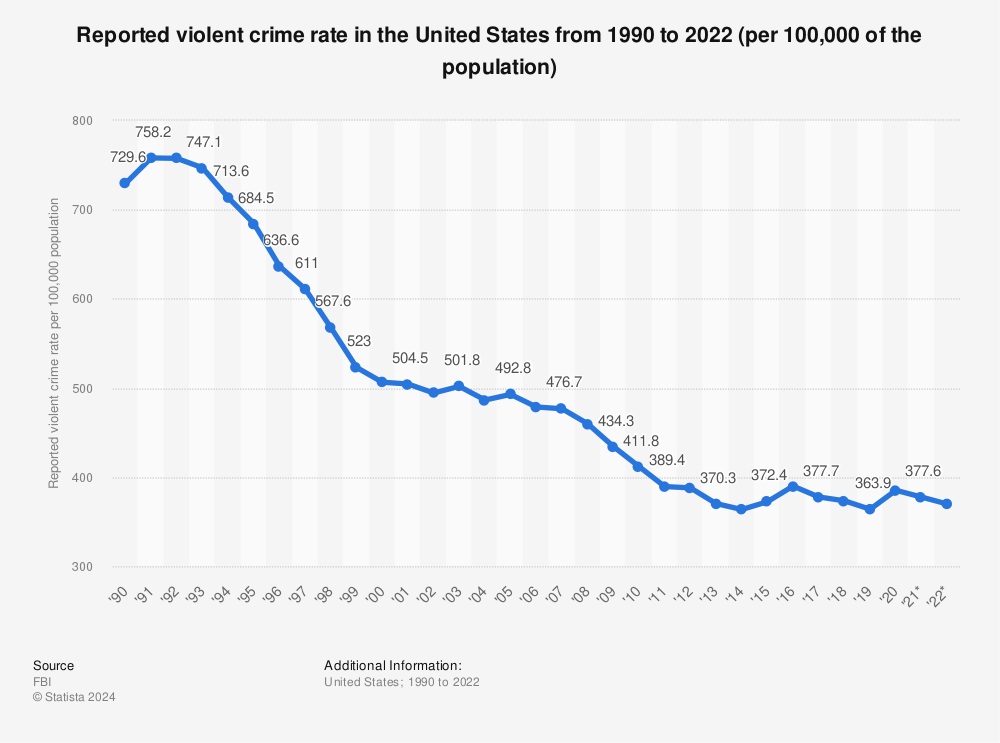
The subject is violent crime. Don't cite a page that lumps property crimes in. Might want to look at some relevant data; https://abc7news.com/san-francisco-crime-rate-bob-lee-sf-vio... has a handy chart halfway down, if you're not interested in reading.
https://en.wikipedia.org/wiki/List_of_United_States_cities_b...
However, homicide stats don't tell the whole story about a city. There are many areas in SF where a resident would never go at night (or often during the day) because of the large numbers of drug addicts and homeless people. This means businesses in those areas have a hard time surviving. In terms of property crimes (in which violent assault is not involved) SF is leading the pack, at least in the top five. The lower rate of homicide is probably also linked to California's stricter gun laws compared to Texas and Florida, and also, many homicide victims are homeless, see LA:
https://xtown.la/2022/06/08/murders-people-experiencing-home...
The only plausible long-term solution is improved housing, more jobs, public health care, better education etc. This would require expenditure of public funds on a national scale (you can't fix this city by city, or state by state, because people migrate), i.e. increased taxes on the wealthy and a redistribution of military-industrial spending to domestic infrastructure of various sorts.
Comments demonizing other people and/or other groups of people are the scourge of internet forums. If you make it "y'all", that's worse yet, as now the demonized group gets to select itself and feel personally attacked.
1.) I grew up in the rural South, and was literally harassed for most of my career for saying "y'all" and "folks" but glad to see it's trendy to speak that way amongst the exact kind of people who used to assume I was ignorant for speaking that way.
2.) Your statement could just as easily be, on a different day: "Y'all abandoned the city for the suburbs and deprived the city of a tax base to help the poor." Between "white flight" and "colonizer/gentrifier", you're damned if you do and damned if you don't. Same applies to livability: If you demand quality of life crimes be dealt with to make a city cleaner, you are guilty of not "embracing where we were and not trying to change it".
Your entire statement to me seems driven by emotion and nostalgia without thinking about the fact that there are low income children who have to grow up in these places. Maybe parents aren't thrilled with having their 10 year olds learn the valuable life lessons of "how to not get knifed by a junkie in an alleyway".
Sorry, but the whole comment reeks of luxury beliefs. I've personally (in DC) been mugged at gunpoint (they threw me onto the pavement in the process) and had a random guy jump out of his car to assault me because I walked in front of his car in heavy traffic (all cars stopped) to cross a street, and he viewed it as "disrespecting him".
Real, actual victims of violent crime don't think it's cute or have this nostalgia for squalor. Beliefs like that are luxuries for certain kinds of people who are insulated from the worst of it, one way or another. It's easy for a childless bohemian to have no problem with needles in parks, but for those of us raising future citizens, it's not fun.
Poverty and crime are not married.
My wife and I both grew up poor and working class. Living in trailers are in our life stories. You can be dog poor and still not be a junkie, still not mug others, still not assault people. This was understood widely in our upbringing and those we dealt with. People _did_ misbehave, but it was not "just what happens".
Presumption that poor areas must mean getting to deal with junkies, means dealing with violence, well, that is a morally bankrupt view. People don't have to do that. That is their choice. Improvement is possible.
> Your entire statement to me seems driven by emotion
> Sorry, but the whole comment reeks of luxury beliefs.
C'mon man. You don't know the person you are responding to and included multiple personal attacks in your response. There's a way to make your argument without making the person you are responding to your own personal hate-object.
Sadly, I think there is enough evidence that the game plan is to build classes of people that are constantly holding each other down. That is literally the point. :(
That's a different situation from this one, so, sure, if that's something that happened and then you're complaining about the place you don't live anymore, sure, that's also a statement that could be made.
> Between "white flight" and "colonizer/gentrifier", you're damned if you do and damned if you don't
Not surprisingly, those aren't the only two options.
> Real, actual victims of violent crime don't think it's cute or have this nostalgia for squalor
I think you're confused if you think the GP's comment "It taught me compassion and empathy and how to avoid getting knifed by a junkie in the alleyway" was nostalgic for the getting knifed part.
So you think that "flee the black people" and "drive the black people out" are the only two options here? There are more things, Horatio.
I worked in the Warfield building from 2014 to 2017. It wasn't deep in the TL, but it still numbed me to things. Crossing police tape to get into the office? NBD. Coworkers getting assaulted? Happens every few months.
> Y'all colonized the poorest parts of the city and gave the poorest folks nowhere to go
If you said something like this about The Mission, I'd agree, but the TL wasn't even close to gentrifying. People tried to make it happen, but it never got to a point where people wanted to be there, and that was only at its periphery.
The people who "gave the poorest folks nowhere to go" were the ones who voted to prohibit the construction of anything but single-family houses[2] in 76% of the city[3].
[1] https://www.sfdph.org/dph/files/MCHdocs/Epi/Birth-Data-Summa...
[2] https://sbuss.substack.com/p/when-did-things-go-wrong-in-san....
What leads you to conflate poverty with criminal activity, and proceed to victim-blame those who dare complain about criminal activity?
I think part of this is not realizing that a lot of the locals (the previous colonizers) are part of the problem. I can guarantee that the colonizers would love for more housing to be built in SF because they don't want to pay $2m for a 2bd townhouse either.
A huge portion of the SF "colonizer" demographic can't even fucking vote. They're all on visas.
https://sfist.com/2017/02/28/the_10_most_infamous_san_franci...
Nope. One of the wealthiest cities in the world fails to look after its inhabitants. A failure of government
The government isn't some distant third party. It's people from the community who are elected by their neighbors to run things in a certain way.
But really, if you took Stockholm out of Sweden and plunked it down into the middle of the US, how long do you think the social safety net would last before it went bankrupt? And this is assuming you retain the european willingness to be coercive about mandatory rehab and confinement (something US based progressives are reluctant to note is a feature of the european social safety programs they otherwise praise).
>One of the wealthiest cities in the world fails to look after its inhabitants...
These are the same thing.
I'm curious who you think you're referring to when you make a statement like this. (Hint: You're probably wrong).
Now it feels more like it can happen to anyone. I spent a few years in SF as a child 89-92. Have visited several times a year, every year, since 1992. It's definitely the most run down, dirty, and unpleasant it has ever been IMO. I have luckily never had anything stolen, but I for sure see more broken glass and more broken car windows too.
I 100% agree. I lived 5 blocks uphill from the Tenderloin and would walk though the loin to go to Bourbon & Branch or while coming back from the theater late at night. I learned all three of those lessons as well. It was rare that I was scared but I was always hyper alert.
Its great nothing traumatic happened to you, but I’ve seen how much more of a target for harassment some of my friends are and I don’t blame them for being afraid.
First and foremost, avoid alleyways, avoid junkies. It seems like simple advice and it is.
What I learned as a nerdy white kid living in TL was that there is a largely non-verbal communication system, a kind of thieves' cant (although, as I mentioned, it's largely non-verbal, almost like a sign language but with subtle facial expressions and body postures rather than specific signs. (Actual gangs do use specific hand signs to recognize each other.))
If you "know the score" you can just tell someone, e.g. "Hey, don't mug me." using this communication system and they will leave you alone. This happened to me. I was walking through the 'loin when a dude comes up off the wall and starts to fall in behind me. I caught the motion out of the corner of my eye, and I gave him the slightest shake of my head, "nah", and that was it. He fell back and posted up on the wall again, and it was over.
Just being aware of what's going on differentiates you from the clueless "mark". That's the main thing: you're part of the "in-group". You have heard of "woke"? This level of awareness of the nature of life on the street is part of what one is woke to, or not, eh? This cant would seem like telepathy to an unaware outsider.
So, I was able to tell my would-be mugger that, although I look and walk like a clueless tech nerd, I'm actually a resident who knows what's up, so please mug someone else? And, as neighbors do, he kindly preferred to look for someone wandering in from the nicer parts of downtown. A tech worker or tourist, eh?
(I saw those interactions too: Three "gentlemen" corner a fellow up against a wall, one of them displays an empty 40oz bottle, and an agreement of sorts quickly emerges to the effect that it would be much preferable for the victim to give up his wallet rather than receive the bottle to the head. They even gave him his wallet back afterwards. The whole thing took thirty seconds.)
There's also an element of stotting involved in what I'm saying, "an honest signal to predators that the stotting animal would be difficult to catch" ( https://en.wikipedia.org/wiki/Stotting ) Since I "know the score" I'm not going to panic or freeze up if this guy tries to rob me. There's a way to say with your body language, "I'm not going to be easy to rob."
If you don't have that naturally, for whatever reason, there is something called "adrenaline re-imprinting" self-defense courses. Without going into a long tangent about it, the essence is to re-program your adrenaline response to be coherent and defensive. If you haven't seen it, it's hard to imagine the intensity of a controlled adrenaline response. Even small, weak people can be extremely dangerous under the influence of adrenaline. Adrenaline is a hellofa drug. (I mean, in the course I took the instructor at one point has on one of those bear-proof suits, and it still seems like he's gonna get hurt. And the other people in my class were small women! They were destroying this guy.) Basically, the attacker would have to be literally psychotic to continue trying to attack someone in the throes of a controlled adrenaline response. Trying to approach someone in that state... it's like a force-field. There's something deep within you that is like "nope" when confronted with such a fury, and the effect gets stronger as you try to approach. It literally feels like a force-field. I have only had to use the training once, Thank God, and it stopped three guys in their tracks, literally. They were running up behind me, and I stopped and the adrenaline triggered and I spun around and did the thing (there's a posture and you shout "back off!") and they stopped in their tracks. I started a conversation with them and they were scared of me. As in I made a gesture and one of them jumped back a little. Anyway, the thing to search for is "adrenaline re-imprinting".
I like you Kragen, I hope it's not too weird to say that, so I hope this was helpful or at least interesting. Cheers!
https://www.numbeo.com/crime/compare_cities.jsp?country1=Uni...
there is no reason that SF has to be a lot less safe than Zurich. Zurich is not populated by aliens, people live in both places
It's political choices that make it the way it is.
>I loved the Tenderloin back then, even though it was terrifying. It was full of weirdos and loonies and junkies and poverty stricken artsy types like me, who had no power or desire in gentrification - we were just poor too. But we embraced where we were and didn't try to change it. The loin changed me far more than my presence changed it - for the better. It taught me compassion and empathy and how to avoid getting knifed by a junkie in the alleyway.
>But we embraced where we were and didn't try to change it.
Poor is fine. It's a hard life, but it's a state of being. Even being artsy and a little crazy; that's great. The rest of it though...? Why romanticize this? It's bad. We shouldn't romanticize bad. Learn your lessons, but let's want something better.
The "mentality" here is one appropriate for the person and the circumstance. As you say, his neighbors weren't aliens, they were people. Compassion and understanding were worthwhile efforts. And they remain so.
It’s not reasonable even for the nouveaux riches of tech to expect to flip a city’s character in a decade.
Lack of Nazi gold to prop up a social net, which can later be defended tooth and nail with strong anti immigration policies while newer streams of illegal money such as mexican cartels are adquiered.
Maybe SF does not want money laundering for some of the worst people on the planet, to be its identity. But hey I guess the rolex watches and chocolate are pretty good.
~38k people died in USA [1] from car crashes. Thats pretty violent but doesn't necessarily count as murder or suicide.
[1]: https://crashstats.nhtsa.dot.gov/Api/Public/Publication/8132....
But the overriding, horrendous issue is how threads and discussions are hijacked for the sake of every other guy's soapbox, and this thread in question is particularly exemplary here.
I have certainly accepted at this point that, e.g., some people see homeless people or drug addicted people as essentially subhuman. And the mechanics of free speech and discourse dictate that I see such views as having a place in some discussions (especially on this particular website it seems), however much it contradicts what I see as fundamental humanity or whatever.
But, to me, it didn't really feel like the right time or context in that thread. But I maybe I am wrong!
Like, I definitely accept that I personally have to stomach a lot if I want to see the discourse on this site in general, and I agree I don't necessarily want the bubble. And indeed, this is just what "living in a society" is all about. But so much in that particular thread just really felt misplaced and fundamentally insensitive, however essentially valid they were themselves as views. And I think that thread is just a good example not a one off thing.
I seek learning through intelligent and insightful rebuttal. HN is a good forum to learn from others directly, and indirectly by reading other people’s threads. I want a forum that does this better, via network effects of judgements about comment quality.
Your comment contains many baseless assumptions about my motivations. Is there irony in that this thread is not on Facebook, that you are attempting to disagree with my point but I am engaging with you, and that your comment likely breaks multiple guidelines? https://news.ycombinator.com/newsguidelines.html
As have I. One of the most serious was at the bus station in the huge metropolis of Santa Cruz, CA[0] (population ~63,000 in 2020).
As I've said elsewhere many, many times: There are assholes everywhere.
That doesn't mean cities like SF aren't outliers, of course. But it really is the safest period of US history
I'm 56 years old and have lived in NYC for most of my life. And I can tell you (and provide appropriate statistics if you're unwilling or unable to look for that easily available data) that NYC (I can't speak to SF, although my brother and his family lived there for many years -- including in the Tenderloin -- and I found it a delightful place) is enormously safer and cleaner than it was for the first 35 or so years of my life.
When I was a child, there were street gangs in most neighborhoods, people would put signs on their car windows noting the lack of valuables inside in hopes of not having their windows smashed (In one case, circa 1978-80 I saw a car with its window smashed and the little sign that had been on the window saying "no radio, nothing of value, and the perpetrator of the vandalism wrote "just checking" on the sign). You almost never see that any more.
Streetwalkers were in most neighborhoods (even the nice neighborhoods), leaving used condoms to litter the streets every morning, Times Square was a shithole. No Disney store -- mostly just porn shops and peep shows, and with con artists, robbers and other miscreants.
Cocaine (crack, mostly) was openly sold on street corners even in wealthy neighborhoods.
Homicides in 2020 were less than 1/3 what they were in 1980[0] (and while that number increased significantly in 1987, that was because of a change in classification when "cause of death" was "unknown", the death being classed as "homicide" whereas previously, those were not included in "homicides" previously[1].
So, no. Large cities (and SF among them -- although NYC is, on a per-capita basis even safer than SF) in the US are, for the most part, enormously safer than they were even 15 years ago.
And since you don't seem to have much of an idea of what's really going on (and maybe don't care if it doesn't fit your trained-in prejudices?), I'll give you a tl;dr: You're talking out of your ass and it smells that way too. Yuck!
[0] https://criminaljustice.cityofnewyork.us/wp-content/uploads/...
[1] I searched around a bit, but couldn't find anything online, but that's true for a lot of news from before 2005 or so. But it was big news, because (see graph in [0] above) "homicides" increased significantly due to this change.
Edit: Fixed typo.
This NYT article has some numbers comparing "metro areas" rather than cities, and it knocks Saint Louis down a few slots (while still leaving it amongst the worst in the nation, for sure): https://www.nytimes.com/2019/12/17/upshot/crime-statistics-s...
The list of counties with the highest rates of violence listed on that article are all southern and rural and not known to be associated with gang activity that I am aware of.
https://www.kxan.com/investigations/homicides-on-the-rise-ho...
That's what a lot of the replies here seem to be missing. Sure, I think SF has a pretty bad crime problem that needs to be addressed. What deserves opprobrium is all the tech elite who immediately spouted on Twitter and elsewhere that the government of SF had "blood on their hands", again specifically blaming SF government and SF's overall crime environment for Bob Lee's death.
Do you have evidence to the contrary? You can't just claim everything is fine and discard all evidence you disagree with.
[1] https://sfgov.org/scorecards/public-safety/violent-crime-rat...
[2] https://www.census.gov/quickfacts/sanfranciscocountycaliforn...
Especially since feeling safe is not the only thing government gets evaluated on. I don't feel threatened by feces on the street, and yet I'd want government to fix that too.
Not once did we ever feel unsafe in the 10 years we have made trips out there. But read the news and you'll think it was a lawless warzone.
It doesn't mean you can say "You're wrong, there isn't rampant violence because this incident had a back-story"
Again, I haven't visited.
One reason this explanation falls flat is that reported and recorded property crimes have risen more. If the city were exceptionally underreporting crimes compared to the past or other cities, you'd see those disappear from the statistics more than e.g. homicides; it's much easier to ignore a stolen phone than it is a dead body.
There might be a good reason people would report some crimes over others for reasons over and above simply for the sake of reporting them/having them solved.
https://news.ycombinator.com/item?id=35531439
In that comment I didn’t even get to the new stories about a brick being thrown, creeps following her, or last night’s gun falling out of the pants of a meth head at the bus stop. I would feel unsafe as well, not like I’m immune to bullets.
Minimizing this stuff just because it was mentioned in the wrong thread is ignoring real problems. Two things can be true at once.
https://www.sfgate.com/crime/article/San-Francisco-crime-Che...
> Rapes, robberies and assaults are still well below pre-pandemic levels, and because violent crime is generally less likely to go unreported than property crimes, it would not be inaccurate to say that general levels of violent crime are lower now than they were a few years ago.
Seriously what sort of weird ideological rant are you on in this thread? You have some really bizarre thinking regarding this issue.
Remember: If it smells like fraud, it's just eccentricity!
It has been interesting to consider but after decades of observation I don't think it's a political thing-- I think tech attracts a disproportionate number of textbook Narcissists.
Those fuckers crave power. We have absolute control over entire ecosystems. At first it's freedom for all, but then we turn into dictators regarding our governance of it.
In the end it becomes Domain Admin rights for me, principle of least privilege for thee.
I suspect there is a subset of us that really enjoys that in a not completely healthy way.
https://www.sanfranciscopolice.org/stay-safe/crime-data/crim...
I also didn't say anything about flipping a city's character in a decade. Whether it takes 1 decade, 2, 3 or 4 -- there is no reason to accept the idea that city just has to be unsafe and nothing can be done about it
The OC has either survivor ship bias or a bad memory. I've never lived in SF but I've lived in Portland and work adjacent to mental health professionals and the stories that they have of people being victimized in the camps and shanty towns are tragic.
For everyone who learned to 'not get stabbed' (whatever that means), there are people who DO get stabbed, or sexually assaulted, or robbed of the little money they had.
San Francisco’s old guard in a nutshell.
It's couched in 'the woke are ruining everything letting murderhobos run rampart' rhetoric. Sometimes with a helping of 'the police are completely unable to function if we subject them to any oversight, or hold them accountable to the rule of law.'
You see this take very frequently on <your local city subreddit>.
Ultimately, random acts of violence are scary but even in the "most dangerous cities" statistically rare. The politicization of city violence "What about Chicago? What about SF?" is an instant red flag that whomever you're speaking with is making a bad faith argument.
[1]: https://hudsonvalleypost.com/hudson-valley-city-among-most-d...
If it has a high murder rate, that obviously is not true for all values of “you”.
Data clearly shows a correlation between crime levels and average income in an area. Are we not mostly engineers used to working with data here? In fact, needing to "survive" is a common excuse used to justify the crimes committed in impoverished areas. Note that I said correlation, not causation. If someone has data that says otherwise, please provide it because I would be genuinely intrigued.
Isn't "correlation does not imply causality" already a household expression? If we are engineers why are we insisting in specious reasoning?
Radicalization happens to everyone, even the rationalists. Maybe it's just time to cool off.
Well, no. SF is not unsafe in any measured way. You can easily observe from this thread, anecdotally, the police routinely ignore people shouting threats and other crimes. It's entirely possible that if we actually measured all of those, and counted them as the crimes that they are, that SF would look remarkably worse.
Blunt counter-hypothesis: Tech bros are a bunch of suburban snowflakes who never lived in a dense urban environment before and are addressing their culture clash with hate instead of understanding. This is anecdotally true in my experience, which means I'm right by your logic, no?
There are actual laws against threatening people I'm not inventing anything. I grew up in a major city with plenty of crime problems, and I still absolutely expected police to respond to someone who had a knife and was threatening to kill people. Clearly things have gotten worse if they're now ignoring such crimes.
> Isn't the Occam explanation here that... you're just wrong?
First, I never claimed SF was the worse - I simply said we don't have enough information to make reasonable conclusions in either direction.
Second, Occam's razor says that if the crime statistics are the same in two cities, but we have a ton of anecdotal evidence that one city is ignoring certain crimes, then that latter city probably has a higher crime rate.
If we had page after page of anecdotes that SF techies are just snowflakes and what they're responding to is totally normal, that would obviously change the equation.
Of course, keep in mind, if you're right, we've simply established that EVERY major urban center has a huge problem of "crazy people threatening people on a regular basis", and that's still an incredibly undesirable situation that we want to fix.
I'd also be curious why I don't hear about people from New York, London, Seattle, etc. reporting that it's totally normal for crazy people to threaten them with a knife. Surely there are techbro snowflakes in Seattle, at a minimum?
The point I made in the sibling point stands, though. At 55th in the nation, SF does not have a high burglary rate. It has a high larceny (stealing from stores, cars, etc) rate.
Luckily, this isn't a real thing that happens.
Most other cities aren't wallowing in it the same way, and aren't holier than thou despite their polices clearly having caused the issue. But you're right, it's not just SF. LA and Seattle are pretty much right there too.
The crime cities like SF are worth calling out in a way that other violent cities aren't though because there's a giant epidemic of what we're pressured to call "non-violent crime" like shoplifting and car theft that gets violent instantly whenever the criminal doesn't get their way. I've personally seen people get shoved out of the way of a fleeing thief, and videos of people being attacked when they come back at the wrong time and discover their car being robbed. To say SF isn't violent ignores that the residents are on the edge of violence constantly.
> SF is 55 out of the biggest 100 cities on burglary rates, by the way.
These crime rates are what's reported by the police and they refuse to take reports of anything that hasn't escalated so they ignore most of what the everyday person suffers. These statistics should be seen more as evidence of collusion in the SFPD, not used to prove the safety of the city.
That's a strange way of spelling Cleveland, Memphis, Baton Rouge, Tulsa, Baltimore, Albuquerque, Detroit, Mobile, Cincinnati, Toledo, Des Moines, Seattle, Indianapolis, Spokane, St. Louis, San Bernadino, Bakersfield, Kansas City, Oklahoma City, Milwaukee, Buffalo, Minneapolis, Durham, Orlando, Wichita... And I can't be bothered to list the next 30, all of whom also have more burglaries per capita than SF, and most of which also have more assaults, murders, and rapes.
LA is #73 on the burglary index, by the way.
You're making a lot of claims, and providing zero data for them.
> These crime rates are what's reported by the police and they refuse to take reports of anything that hasn't escalated
Please provide a shred of evidence that this doesn't happen in any of the other other cities listed in https://en.wikipedia.org/wiki/List_of_United_States_cities_b...
Why even bother arguing this question, if all you have is anecdotes, speculation and just-so stories?
I live in two of the drug cities and visit others, and pay taxes that support many of these policies specifically. Do you live in one of the west-coast cities in question, or is this an abstract political battle for you? If you live here, do you feel you're a representative resident?
> if all you have is anecdotes, speculation and just-so stories?
Well, there's the crux of it, these are anecdotes that have happened to me personally. Over decades of experience and watching things change. And there's tons of data collected by victims but as has been pointed out, the news often chooses to report on acknowledged crime where a police officer has been sent out and taken a report. FB groups where people log violent street interactions or businesses' windows being broken show a definite uptick that government statistics don't. I know it's true because I walk past enough of those broken windows and stabbing sites to provide a reality check for what I'm seeing published.
We know that there are vastly more actual rapes than reported rapes and punished rapes. Why it is so unreasonable that there are vastly more actual attacks and robberies than reported?
> [other cities] all of whom also have more burglaries per capita than SF, and most of which also have more assaults, murders, and rapes.
Perception of livability despite violent crime has a lot to do with the localization of that crime. If only certain areas, at certain times, are dangerous - and if those areas are ones that can be avoided - then you can generally just go elsewhere with your family and be fine. That's the liberal way SF and such used to work. Sure, there were sleezy places but the street people would even helpfully and quietly warn tourists - "Hey bud, there's a lot of drugs down here, you should really take your kids a few blocks that way."
But once it spills over into random attacks outside that area, such that you can be killed at the busiest coffee shop in the city, the entire veneer of safety goes away.
We're saying two main things: that it got bad really quickly and predictably, and it's being officially downplayed.
> Please provide a shred of evidence that this doesn't happen in any of the other other cities listed in
It's somewhat annoying that what should be an issue of local policy ends up being purity-checked by people trying to decide if we're too partisan in national politics. We're talking about our policies, not trying to claim that other cities can't fail just as hard as we are but with a different set of errors.
People often think that if we moderate comment X, we must care less about or even be endorsing comment Y, but that's not the case. We just see a more-or-less random sample of the comments. If you see a post that ought to have been moderated but hasn't been, the likeliest explanation is that we didn't see it. You can help by flagging it or emailing us at hn@ycombinator.com.
https://hn.algolia.com/?dateRange=all&page=0&prefix=false&qu...
People always feel like the mods must be against them (and are depraved to boot) when their comments get moderated. It's a routine reaction and it's completely illusory. Comments that express this reaction are all pretty similar, no doubt because they have the same mechanism underlying them.
https://hn.algolia.com/?dateRange=all&page=0&prefix=true&que...
https://hn.algolia.com/?dateRange=all&page=0&prefix=true&que...
> Not surprisingly, those aren't the only two options.
"white flight" == moving out of the area
"colonizer/gentrifier" == moving in to the area
The only remaining option is to never move.
white flight = moving out of city because of fear, cost, crappy schools, etc. is flight. A white person moving to the boondocks because they want to homestead or live off grid is not "flight".
gentrifier = higher income person/family moving into a city or neighborhood, raising the housing costs by doing so, causing the long time residents to leave because of said costs and changing the culture of said area because the old families don't live there anymore.
Schelling’s segregation model comes to mind in these moments but I never see that mentioned, strangely. Oh, the inconvenience of maths that explains things better than divisive and ignorant rhetoric!
It was shockingly bad. Crazy, violent people "everywhere". Tents covering the sidewalks. There wasn't a parking garage around where there weren't piles of human excrement.
Portland has a ton of gang violence.
>but not violent isn't how I would describe the city.
It depends on where you are in the city. I live in Portland and I don't think I've someone get attacked in the entire time I've lived here. But I also live in an area that is less popular with the mentally ill and drug addicted
It provided the original funding for many fo Zurich's public services.
> San Francisco is just as wealthy as Zurich
Kinda, but in a very different way. It requieres way more people, so it imports way more people. This makes the city more dynamic but also makes it harder to do sensible long term urban planning for example.
Also many services grew organically and are disfunctional such as the healthcare system in the US. That alone could fix many of SF problems, related to drug abuse (which is a healthcare problem not a crime one), medical related poverty and homelessness and mental illeness. With that alone, ignoring other solutions you would see a massive improvement in QoL in SF.
To your point, Ulaanbaatar felt like one of the more dangerous cities I've been in because people would rob foreigners in broad daylight on crowded streets, but I don't think there was much homicide at all.
This was my experience living in Chicago. While violent crime was much higher than on the West Coast, it was highly localized and it remained true that if you didn’t go looking for trouble, it usually wouldn’t find you. There is affordable housing and the social safety net hasn’t completely collapsed so there are many fewer cases of out of control mentally ill folks on the streets.
Meanwhile, petty property crime felt like it was much lower. Car break-ins definitely happened but it was not at all endemic like it seems to be in LA or SF. Although I’ve heard this has changed if you own a Hyundai or Kia due to a security vulnerability in many of those cars permitting easy hot-wiring. The new security patches rolling out will fix that problem, I hope.
Very disagree. It is not immoral or prejudicial to note the simple reality that, in aggregate, poverty and crime are correlated[0], and in part because poverty creates conditions where crime is more likely[1].
That doesn't mean that any particular person is doomed to crime because they're poor, or can't improve. Of course they can, and of course nobody should assume that a particular person is a criminal based on membership in a socioeconomic class (or any other class).
But it's just true that poverty and crime are correlated. There are confounding factors (police are more likely to arrest a poor person, and more likely to merely warn a rich person), but nothing suggests that crime is merely equally prevalent among poor and non-poor populations.
I applaud the compassion, and I agree that individuals bear the moral weight of doing the right thing, but let's not deny facts in service of those principles.
0. https://academic.oup.com/edited-volume/28019/chapter/2118222... 1. https://www.nature.com/articles/s41598-020-80897-8
They 100% are.
The plural of anecdote is not data. Your story is nice, but the reality is poverty is heavily correlated with crime. And social nets address both at once.
letting poor people suffer because some poor people can improve their station in life through luck, hard work and a number of other extrenous factors is unethical.
Portugal has lower gdp than the US but it isn't poor internally. People spend less % on housing food etc than in the US.
Also having no guns means a lot of crime is less violent, not that there is less of it.
The idea that if comment X says one thing and Y says another and we reply to X but not Y, that means we're endorsing "violent police responses to the homeless", is... not valid. It's not possible for us to see everything, even in the same thread, let alone all threads.
If you see particularly egregious comments that haven't been moderated, you're welcome to point them out to us and we can take a look. hn@ycombinator.com is the best way to do that.
The thread was full of people blaming the homeless for the murder before any facts were known and calling for a response. Not one or two comments, a thread full of them.
If that wasn't what you were saying, I'm sorry for misinterpreting you!
Your parent didn't mention the "best city in the US" though? Per the linked table it seems to be Irvine CA at 0.72 per 100k, which would be below average in the UK or France.
By comparison, there were 93 murders in 2022 in the West Midlands (the UK region encompassing Birmingham, UK). That's a rate of 1.56 per 100,000 population, which I agree is pretty bad - but it's almost 50x less than the equivalent for the US city.
(source: https://www.statista.com/statistics/288221/number-of-homicid...)
Of course you are now more likely to die from lack of medical care than a murder, so it may not matter too much.
It seems impossible that people don't even have to lock their bikes in a lot of Asian cities coming from the states.
(yes, it gets cold sometimes, but you can always take some of that money you saved by moving and get on a plane somewhere warm)
Go find me a city that has people that are super happy and nice to each other and also has a high murder rate. Wait, I bet you can't.
Talking about the petty crime and the "vibe" is absolutely on topic for this, because that sort of laissez-faire attitude leads to murders like the one we're discussing.
... you mean the murder in question that, as we've found out in this article/thread, has nothing to do with the "petty crime" and "vibe" that you're referring to?
Huh? A crime must take place for... a crime to have taken place. It's tautological.
Threatening people is not usually a crime, but that depends. If it's a problem in SF, they could probably make it a crime.
Many Mexican and Brazilian cities have much higher murder rates and people are still generally happier and nicer than in the US, especially if SF is the basis for comparison.
If you are confronted by a mentally ill person screaming threats at you, is your first thought to seek comfort in the violent crime stats? You must be some kind of robot, if so.
Property crime is a different story. That has indeed been a problem.
--
Sorry Dang, you're right.
If you'd please review https://news.ycombinator.com/newsguidelines.html and stick to the rules when posting here, we'd appreciate it.
But the article here is how this was some conflict between friends, so the city doesn’t really matter. All the fearful people should be reassured by this outcome. Manage your domestic life well for good safety outcomes.
If you want to get a good feel for San Francisco ghetto logic, or ghetto logic in general, I recommend the excellent, but hard to get a hold of documentary, "Straight Outta Hunter's Point" (2003).
Give me the risk any day.
It's not surprising it ranks so low in murders - it's hard to get killed when you're only outside for the time it takes to walk from your parking spot to the shop.
Police in big cities go after big crimes like murders, but tend to ignore "lesser" crimes, so as a result, gangsters and other career criminals stick to those lesser crimes, and generally do a lot more of them.
People in this thread are specifically talking about violent crimes, not all crimes, which murder rate seems to be one of the good metrics to use, no?
/s lived in NYC for almost 40 years.
As to the ignoring crimes, here you go: https://www.cnn.com/2022/01/06/us/alvin-bragg-manhattan-dist...
It means you do not have homeless camps in hollywood boulevard next to million dollar penthouses. The income inequality is smaller therefore the variance in income levels is smaller and therefore all prices are down.
Let me give you an example.
Country A is rich. The poorest person has 10$ the richest has 100000$
Country B is poor the poorest person has 1$ the richest person has 5$.
In both country Nestle sells water bottles, they use a formula to maximise profit based on average earnings. On country A a water bottle is 20$ in country B is 0.2$.
Despite the proportional poverty, a poor person in country B can buy 5 water bottles while a poor person on country A can buy 0.
> Source for "spend less % on housing, food" ?
https://www.numbeo.com/cost-of-living/compare_cities.jsp?cou...
On the most expensive city in Portugal and the only thing cheaper in SF is gasoline, something most people in portugal don't use as much as they walk everywhere.
> Poor in the US get food stamps
Getting vouchers for milk and beans is not helping people. Portugal for example does not have millions of people in jail for minor drug offenses. Portugal does not have medical bankruptcy. Portugal does not have homeless camps in every mayor city.
Also food banks are common everywhere, the only difference is they are usually much broaders and healthier than food stamps and come on top of unemplyment payments, health benefits, and council housing.
> I've been to Portugal
I was born in Spain a few decades ago, I am gonna take my 18 years there over your weekend abroad.
you realize salaries in SF are astronomically higher than in Portugal, right?
the income inequality is indeed smaller in Portugal, but that is a different issue, absolute numbers wise Portugal is clearly a lot poorer than US
US doesn't have millions of people in jail for minor drug offenses, where did you get this nonsense from?
Let's just let the homeless and the mentally deranged do whatever they want in SF. That's definitely a good way to run a modern city. Better than hurting their feelings! /s
If that's the takeaway you're getting from this comment chain, I really don't know what else to tell you.
And before you go to the stats, just remember something: lies, damned lies and statistics. If the police don’t get involved, there’s no police report. If the DA doesn’t charge a crime, there’s no “crime” even if there actually is. Homicides and property crimes tend to leave the most evidence behind, but those aren’t the only crimes that matter and even the criminal amounts of piss and shit around just the MUNI and BART stations probably isn’t generating any police reports either. Verbal harassment and threats also don’t tend to generate enough of the right kind of paperwork to make it into the stats, but it doesn’t make it less real.
To say that “constant threats of murder” does not accurately describe SF.
Let me put it this way: needing to counter an anecdote with your own comes across as unsympathetic at worst and apathetic at best. “Yeah that happened to you, so what? It doesn’t happen to me!” kinda vibes.
It happens enough that too many people have these stories about San Francisco. They’re the kinds of things that can happen anywhere, but San Francisco is one of the places where it is talked about as happening a lot.
> marijuana misdemeanors, including selling more than three ounces; not paying public transportation fare; trespassing except a fourth degree stalking charge, resisting arrest, obstructing governmental administration in certain cases, and prostitution
Literally nothing you insinuated. Please stop peddling lazy lies and ideas.
By the way, the full list of crimes that are not getting prosecuted is very long (covering a lot of misdemeanors and a few felonies), and CNN wanted to write an uplifitng story, so they chose the crimes that I presume are popular to not prosecute. It's not that complicated to understand the bias, and I'm not suggesting that anyone has done anything malicious. I only said that they were "peddling 'lazy lies'" because that source did exactly what you accused me of (misrepresenting what they will and won't prosecute).
A lot of people (particularly on this forum) try this form of lazy argumentation where they ask for sources for any claim they don't like so they can go try to poke holes in one source or another without actually doing any research. If you want to argue about something, go do some research and stop accusing other people of "lying" and "irrationality." What you are doing here is a textbook example of arguing in bad faith.
I think what gets me is the underlying classism that oozes out of these conversations everywhere I turn. People here (in SFBA) are oh so liberal and progressive ... as long as the undesirables aren't in _their_ neighborhood. Then suddenly everyone's pearl clutching.
For the most part they mean you no harm. Just because people are poor, doesn't mean they're dangerous.
One of the dumbest examples was when a neighbor asked me to stop putting cardboard boxes in recycling because "it attracts the bad element and then they camp in our street". Ffs man they're homeless, let them have a damn box.
If there were more being done about the people threatening violence, intentionally urinating on passersby, molesting women, accosting people in the streets, your neighbor would likely be less concerned about the cardboard box people.
I hope this brings some measure of peace and closure for his family and friends.
I had to read scores of tech bros in the professional-managerial class whinge about the poor, about black lives matter and how this was due to "progressivism".
Turns out the suspected murderer is a guy who describes himself as an "entrepreneur" on Linkedin and has a Crunchbase listing where he is described as being in executive management. Maybe we should have law enforcement target entrepreneurs as opposed to people made homeless by the enormous wealth disparity on display in San Francisco.
There’s a tiny possibility that feckless bureaucrats, billions of dollars spent with no oversight, mental illness, and drug addiction share just a sliver of the responsibility
>I had to read scores of tech bros [...]
Did you though? I can't recommend enough cutting out reading people's comments that you don't want to read. If other people's comments stress you out and make you angry, there are typically actions you can take to expose yourself less to them.
https://news.ycombinator.com/item?id=35451394
Another reply - "I'll have you know, my ivory tower is devoid of any riffraff!"
While some, including me, think this drug problem is an example of the hypocrisy of NeoLiberalism...I also think it's a centuries old playbook of wreaking havoc on whole populations of people by introducing vices such as drugs. The Opium Wars & what lead to the Opium Wars is an example.
Side note, I would like there to be a graph based form of communication that can better express the context of statements. It's too easy to take a couple of sentences on a forum out of context.
I remember reading blog after blog on HN about people moving out of SF specifically for what the city had become.
Always important to reflect on whether stances like "SF is degenerating" are based on a rational analysis of what is actually happening, versus a more emotional response to stories that might be more like the topic of this post, just with less visibility into the exact circumstances of what happened.
Not saying that's likely happening here, but the clear response to the original news was that this was the perfect example of what SF is becoming. How often does that assumption happen?
But all the comments, tweets, etc immediately came out blaming SF government and SF's general crime problem specifically for Bob Lee's death. Like they couldn't just wait a teeny bit before forming an opinion after more facts were known? Especially from the crowd that prides itself on "logic" and "data driven" decisions.
You point out the falsity and people call you naive and say it's the crime stats that are wrong, not their take. Their version is reality.
As a San Francisco resident, I don't want us wasting time, energy and resources going after the wrong problems.
https://sfstandard.com/perspectives/perspective-why-your-cha...
It seems equally weird to me that so many people are taking this anecdote as a sort of proof that San Francisco does not have a crime problem.
Focusing on individual anecdotes and swinging from one conclusion to another is the real problem. The source of this unfortunate murder shouldn’t dictate your entire view of a city’s crime problem.
Same here - techies shocked, _shocked_ that one of "their own" could commit a crime like this. Easier for them to talk about crime in general than lay blame at the feet on one of "their own".
Then like you said - the minute I found out he was in crypto I was 100% convinced he was murdered by someone he knew. Not in any conspiracy view like the feds did it because his company was "too dangerous" to FedNow or something. But because a significant portion of people in crypto are unhinged.
I think more generally, people are mob parrots at heart. We go with the crowd. If we see a guy killed and someone yells, "Crime Wave!!!" Well, then we all start chanting "Crime Wave!!!" The average person, even on HN as we saw, can really not be trusted to give dispassionate analysis. In the vast majority of instances, we just parrot whatever narrative or world view we feel most emotionally comfortable with.
I struggle mightily against it and still fall into that cesspool of intellectual laziness from time to time. It's just human. But you're right. We need to do better.
Much better.
In 2011, in incidents of murder for which the relationships of murder victims and offenders were known, 54.3 percent were killed by someone they knew (acquaintance, neighbor, friend, boyfriend, etc.); 24.8 percent of victims were slain by family members. The relationship of murder victims and offenders was unknown in 44.1 percent of murder and nonnegligent manslaughter incidents in 2011.
In short, people were killed by strangers 11.7% of the time. For 88.3% of murders (where the relationship between the killer and the victim was known), it was someone the victim knew.
The statistics are similar for sexual violence.
For juveniles and children who experience sexual violence, it is a family member of acquaintance 93% of the time. This percentage drops for adults to ~80%, i.e. in 80% of cases the victim will know the perpetrator.
https://www.rainn.org/statistics/perpetrators-sexual-violenc...
These crimes are very different from a mugging or robbery. It is easy to imagine why if you replay the situation in your mind — looking someone in the eyes as you stab them, up close takes a lot emotionally. It is a very intense situation. Almost everyone — if driven to it — will steal out of desperation and hunger, but very few can look people in the eye, walk up to them and stick a knife in them. There is a strong psychological aversion to hurting other human beings built into most of us and it's what keeps society mostly safe.
(Confirmed with the pie chart in your first link.)
Former fire commissioner, not outside his house (actually a parent's home), and what makes you so sure it was random? A man was arrested for that, who alleges that the victim initiated the confrontation by pepper spraying him. I'm quite interested in that case as I have relevant personal knowledge about people involved, but for that reason I'm reluctant to draw any conclusions about it for now.
Had there not been the entrenched environment of lawlessness in SF the perpetrator would not have even attempted his attack. And had the victim not been a prominent person the SF police would not have bothered to keep looking.
The only mistake the murderer made here is he underestimated the public outcry that forced the police and the DA to keep investigating in fear of theirs and the city's reputation.
Maybe it's time to wake up.
One can only imagine what these two "tech industry" people were arguing about before one killed the other. The media reports make them sound like such wonderfully nice people, drinking and driving around SF at 2am on a Tuesday, one of them liking stay out to the wee hours on weeknights the other liking to keep butterfly and switch blades in his car. One of them apparently believed an "emotional narrative" about SF being in decline; that's allegedly why he moved to Miami.
Here is the Expand IT Inc. website, listing the survivor's colleagues.
https://web.archive.org/web/20230413142515if_/https://www.ex...
All these references to "Cash App" in the articles about this crime yet none explaining its main use has been amongst criminals.
It's doubtful moving to Miami could have much to do with safety as Miami has higher crime rates than SF. More likely the reason was political.
https://ucr.fbi.gov/crime-in-the-u.s/2019/crime-in-the-u.s.-...
His first and only response was "well, how do you know that's even related? Most people get killed by somebody they know." and I was like "well, yeah, but San Francisco is bad right now" and the conversation moved on.
Edit: Added "violent," to preempt diversions about non-violent crimes.
This suspect is innocent until proven guilty and we will all still be here when the trial finishes. There is no reason to rush out to come up with a viewpoint that might be shown false with later revelations. If we've learned something from the people who jumped straight to total confidence that it was caused by homelessness, then let's apply it.
I hope that we can extend the same fundamental legal skepticism to society's most needy.
Not saying that's related, but you would have to investigate that angle in a murder.
It's way more common to ignore/forget/never mention again anything bad someone who died did.
Also the crypto world seems to be getting a bit stabby in various ways, as things come crashing down there may be repercussions. Unlikely in this case, probably. Much more likely to be domestic of some sort.
Source?
But when I suggested it in an earlier thread I was criticized and downvoted for “spreading conspiracy theories.”
I know we shouldn’t speculate but everyone else was speculating that it was random!
There's comments is this thread of amazing journalism but the LLC shows as inactive on the Division of CA website (entity 201008110204) and the Expand IT website itself is dead. For all we know, this is a Lyft or Uber driver. Unless I'm missing some SFPD statement known to the journalist?
EDIT: got an old filling; see njstraub608's comment. My mistake
Could it be an uber driver or lyft driver? Sure. But it seems like someone who has run a consulting business for many years in the tech space.
https://missionlocal.org/2023/04/bob-lee-killing-arrest-made...
The murder rate in San Francisco is preposterously low.
Chicago deals with the same.
I feel pretty confident that some of this is astroturfing from people with political ideologies trying to score points on blue states, but it seems to be quite effective however it is accomplished. People can be quick to scare, and appeals to their sense of personal safety are quite powerful.
Because there is no coherent strategy to deal with housing in North America, this will continue to get worse. For whatever reason, reactionary public opinion is fine spending inordinate sums of money on policing, but freaks out when it is directed toward public housing, which in the long term is a much cheaper solution.
The article has a link to a LinkedIn profile. The writer indicates that the name and city of the LI profile matches the information on the person they were "told" was arrested this morning. Even the name of the company of the person indicated is explicitly referenced in the article.
My professional world doesn't allow for ambiguity. As a journalist, how sure do you need to be about the accuracy of this information before going public?
[1] https://somafm.com/scanner/ [2] https://data.sfgov.org/Public-Safety/Police-Department-Incid... [3] https://www.sfsheriff.com/find-person-jail
What I find interesting is indicating a LinkedIn profile, unless of course this reporter has access to investigation documents that also identify the LinkedIn profile.
It could very well be a different person with the same name in the same town. Why take the risk? Just so you can have the juicy headline "alleged killer also worked in tech."
https://www.twitter.com/crazybob/status/1181668744247930880/...
But if you decide to dismiss the concerns about the excesses of the far left by pointing to racist responses to a tweet somewhere, you aren't being honest about a real problem.
I avoid the term "woke", but when James Carville (famous democratic strategist) said "wokeness is a problem and everyone knows it" (in regards to the far left harming mainstream democrats in elections), I'm not sitting around scratching my head bewildered as to what he's talking about.
Anyways, really sad story, that touched a lot of us close to home. (We still don't know what happened, these are still allegations.)
P.S. The other sad part for me was that passersby sped away instead of helping immediately. Moments count in these cases.
I had family ask me about it, concerned for my welfare, and I told them I was confused why this was getting national media coverage other violent crimes in SF hadn't received, and mentioned my initial thoughts that it might have been motivate by sketchy cryptocurrency crap.
Yet when I saw the popular narrative that it was some random stabbing in SF I didn't really have a reason to doubt it: I've personally been chased by a crazy person with a knife in the city.
Glad they got their man!
The linked article contains the full name, age, and city of residency.
Name, age, city is pretty common; especially name and age of someone arrested. I'd imagine it public records.
Some quick googling for recent examples. I just looked for news articles, not sure what if the police release has more residency info on the ones that aren't listed in the articles.
https://www.latimes.com/california/story/2023-02-17/suspect-... - name and age
https://www.fox32chicago.com/news/2-chicago-men-charged-in-d... - names, ages, city
https://apnews.com/article/entertainment-music-shootings-arr... - name and age
And no, BuzzFeed News is as trash as BuzzFeed.
Bob Lee's murder wasn't a random crime. Crime is out of control in SF
That's why we call them scapegoats right? That's what people who scapegoat others do.
Logic, Rational Thought, Dispassionate Analysis, these are all good. And one day, all humans will hopefully practice these disciplines as a matter of course. But right now, the vast majority of people are controlled by their emotions. What do they want to be true? What do they wish to be true?
Well, that's what becomes "true". At least, true to them.
Swathes of homeless living in tents is not a crime. So is being screamed at by a drugged maniac. You also won‘t see people openly shooting up or defecating on the street in these stats.
Honestly they’re doing the job regulators should be doing.
> who alleges that the victim initiated the confrontation by pepper spraying him.
The reports I have seen state that the attacker claims the victim sprayed him with bear mace, not pepper spray. Regardless of this - and other minute points that don't matter - the subsequent footage of the attack shows the commissioner turning his back to and running away from the attacker, who quickly gives chase. It doesn't matter who started it; there's no justification for continuing the assault in such a situation.
- narrative A (looking "up"): where the upper-class technologists are the reason for the social precarity-based hellscape experienced by the lower-class residents
- narrative B (looking "down"): where the crime of the lower-class is the cause of the fearful crime-based hellscape experienced by the upper-class technologists
The reality is probably a little bit of both. But in typing this, I'm realizing that I should probably try to avoid sensationalizing the topic with references to "hell" (though I realize you were using that phrase to dismantle the sensationalism, not escalate it)
So, the ratio is somewhere between 10% stranger to 90% family and acquaintance and 60% stranger to 40% family and acquaintance.
- 1,622 homicides
- 1,246 where (known vs. stranger) relationships were established
- 354 of that 1,246 attributed to strangers
Today's clearance rate is lower [1], but it's not really apples-to-apples comparison for a lot of reasons relating to recordkeeping conventions. But clearance rate for white homicide victims in NYC is still around ~85%. The past few years, the % of overall victims that were killed by strangers is around 5% [2].
So yes, there is still some uncertainty in the exact ratio of stranger/friend/unknown suspects. But still not rational to automatically assume that Lee was the victim of random crime.
[0] https://www.nytimes.com/1977/04/20/archives/murders-by-stran...
[1] https://www.cbsnews.com/newyork/news/crime-without-punishmen...
[2] https://www.nydailynews.com/new-york/nyc-crime/ny-stranger-o...
IIRC it was at least partly getting lead out of gasoline in the '70s: https://www.brookings.edu/blog/up-front/2017/06/01/new-evide...
Mission Local seems to serve their local bureaucratic masters over the basic public safety needs of the people. [0]
This is gaslighting. You should be ashamed. [1]
In this case they are “independent” of a sort [2]
In all fairness, he did retweet this article a couple hours ago.
[0] https://twitter.com/garrytan/status/1644520924828540929?s=20
[1] https://twitter.com/garrytan/status/1644510807060021249?s=20
[2] https://twitter.com/garrytan/status/1644535178856124418?s=20
Eskenazi is a well-connected journalist, but he is also arrogant and often presents only one side of issues. For example, virtually nothing that he wrote in this article (anonymously sourced from disgruntled politicians) about the magnet school Lowell High school ended up being true (magnet schools do not violate state code as claimed, and the school did return to test-based admission which he claimed would not happen) https://missionlocal.org/2022/02/lowells-old-merit-based-adm.... So while his reporting is mostly good, you have to be aware of his bias.
Yes, street crime is itself a taking of rights and freedom of the people living and working in a place, and it is more important to contain it than to maximize the criminals' rights.
But this shows that the reputation of the tech industry is pretty much underwater, and premature postings like that don't help.
Lots of little papers like this seem healthy and then unceremoniously go out of business because they don't make enough money in ad revenue to pay their journalists like 45k/yr. That's not a typo: that's how much Bay Area reporters make.
Support local journalism!
Beyond that, it's nor clear to me that revealing the actual name or other personal details of the suspect serves a legitimate purpose of advancing justice or society; however, it is not out of keeping with journalistic practice in other criminal cases in California. Suspects' names get printed in newspapers for far lower profile crimes all the time.
The police arresting people in secret has historically been .. problematic at best.
Jumping to the conclusion that some homeless guy or street thug did it, without any evidence, is also something that people with axes to grind do on a regular basis.
If it's all made up, that would be amazing. Doubtful.
But do I feel less safe? Absolutely not! The neighborhoods (where most people live) are just fine. I regularly walk home from the bars at midnight without a care. It's simply not a problem.
Compare back to the mid-90's, when there was active gun/gang violence in the Mission corridor ... quite frankly, I feel far safer today than I used to.
But if you equate homeless people near me = unsafe, then that's a different discussion.
That‘s not entirely fair.
I don't understand why it has to be "SF is perfectly safe" or "SF is a dystopian hellhole". Why not pick a middle ground?
Also, why do we never factor gun violence into these conversations about safety? In SF there are relatively few people walking around strapped. I looked it up, and in my hometown of Louisville, KY (which is no Detroit or Baltimore), there were about 130 gun injuries/deaths per 100k in a recent year -- in SF, about 30! Which is worse, getting shot, or avoiding poop on the sidewalk?
But also, for what it's worth, I'm a reasonably tall white guy. I think that affects how many unsafe situations I'm likely to encounter A LOT.
San Francisco is number 23 for violent crime in the list of cities on wikipedia.
Your options are not "get shot in another city Vs avoiding poop on the sidewalk in San Francisco", it's "don't get hurt or killed in the average city Vs get hurt or killed in San Francisco".
You're equivocating "lack of gun crime" to safety, which is as incorrect as you can get while still misleading the audience
1) substitution effects. As a hypothetical example, we could have one city that has 30 gun murders per 100k and another that has 130 per 100k, but both have the same murder rate (because you can murder with things other than guns). IMHO the important rate is the murder rate, and how much of it is with guns vs. other stuff is an aside.
2) Make sure your numbers don't include suicides. If they include suicides, they're not informative.
Because it doesn't particularly matter if you are robbed, hurt, or killed by a gun, knife, bat, or fists.
(And when looking at stats, remember: over half of gun deaths in the U.S. are self-inflicted. Which is still tragic, but different than assault.)
Therefore the need to rely on data to find more objectivity when debating public policies. Yes data can be twisted and most of the time is poorly reported and interpreted by people, but it's better than relying on personal anecdotes.
I'm sure parents with young children or elderly have a different experience but that's not different for any other larger US city.
With this said, the topic of the city turning a blind eye to property crime and "extreme", visible destitution is a whole different story.
Also, we should differentiate between the feeling of comfort / safety (which is what most people care about), and actual crime statistics (which are themselves fraught, I don't think people in SF even report car break-ins these days since the police and justice systems don't work any more).
> Brousseau was walking home from Dolores Park at 8:22 p.m. Friday when 50 to 60 shots were fired at the intersection of Rosa Parks Lane and Guerrero Street, according to San Francisco police. The gunfire left him critically wounded and caused non-life-threatening injuries to an 18-year-old victim https://www.sfchronicle.com/crime/article/Twitter-employee-t...
And if you'd rather have the tl;dr version: https://www.sfgate.com/news/bayarea/article/22-Year-Old-Suff...
Rosa Parks Lane & Guerrero Street is one block away from Valencia Street.
I used to live in the area around the same time. I walked Guerrero frequently to go grocery shopping and get to my gym, usually between 7:00pm and 10:00pm. That easily could have been me. Needless to say I don't live there anymore.
Black Cat, Emperor Norton's, Zombie Village, Bar 888, Tempest, the EndUp...Maybe one reason the "SF is a hellhole" crowd are so negative about this town are because they shut themselves out of so many great places!
I'm very comfortable with cities, but as a visitor to SF seeing someone break into a vehicle on a busy street, 8 pm on a Saturday night is pretty bad.
That sort of crime matters too.
This is simply a narrative that certain people are trying to portray to prove that certain policy doesn’t work. It’s nonsense.
Completely agree, I was downvoted into oblivion last week for claiming it was possibly somebody in his circle rather than a random stanger. The assumptions made about the inhumanity of the homeless/poor is worrying.
I wonder the same about Seattle. How many commenters are speaking from Redmond or Kirkland or Bellevue etc instead of the city?
Meanwhile people with less income are exposed daily to an epidemic of drug addiction, homeless, theft, mental illness, all problems with straightforward solutions that the residents are screaming for.
Its not one or the other, its both. Just because you live in a safe neighborhood does not mean that everyone that doesn’t isn’t being “data driven” or “logical” enough.
It actually says a lot about SF that people would jump to that conclusion. SF is not in a good place. It has deteriorated over the past 2 decades. But it's not why Bob Lee is dead.
But it’s not all culture war. I like to think that in HN it’s all legitimate viewpoints.
First, you apparently missed this paragraph:
Rather, Lee and Momeni were portrayed by police as being familiar with one another. In the wee hours of April 4, they were purportedly driving together through downtown San Francisco in a car registered to the suspect.
Doesn't sound to me like the reporter is just speculating based on the LinkedIn profile.
Secondly, I'm pretty sure you have the wrong filing. The LinkedIn profile says "Inc", not "LLC", so I think it's probably file #4776106, which is still active, and registered with an address in Emeryville, which is where police were headed to arrest Momeni.
you're living in the past, my friend. no such professional standard exists today.
People want to talk about crime, drugs & homelessness all the time. It is only in high profile cases where the issues seem topical, that HN can't discourage discussion around them.
> quasi-apocalyptic worldview re: some American cities
I don't see why speaking out about lack of police enforcement is seen as 'quasi-apocalyptic'.
> despite all available data contradicting that worldview
All available data is in favor of those speaking out about crime & drugs in west coast cities. Additionally, the eye test seems to portray a situation that's more dire than even the data might suggest. (underreporting, catch & release).
Indeed, because that's not what this forum is for. There's ten thousand fora online for general, local, or city-policy political discussion; those topics are only germane in this forum when they relate to tech or the processes of tech.
When the CEO of YCombinator blocks people on Twitter for disagreeing with him online on SF politics[0], it tells me I don't want HN to be a haven for that.
I get that people need to protect their feeds for their mental health, but I'd expect a public figure to have thicker skin and not default to hitting the scorched-earth-mega-auto-block button so often.
I think we all live in our own bubbles, because I see so much discussion of SF crime.
I also think it's important to note that there is a huge difference between "should we prevent random street killings?" and "how much effort should SFPD exert to protect cars when the majority of actual SF residents don't even own one?"
EDIT: Just to cite my sources: [0] shows 397k registered cars in SF [1] shows 810k residents.
[0] https://www.dmv.ca.gov/portal/dmv-research-reports/research-...
[1] https://www.census.gov/quickfacts/fact/table/sanfranciscocit...
> I think we all live in our own bubbles, because I see so much discussion of SF crime.
As a European on this platform it's ceaseless whinging about the state of SF and how the "woke mob" are ruining San Francisco and the state of the Tenderloin versus Mission or Market or whatever and I don't particularly care to know.
Like I've started to learn the parts of a city I have no particular interest in visiting from repeated stories about how someone shouted and pooped in the street because of boogeyman de jour.
Definitely feels like maybe YC could make a "local HN" to save the rest of us from these circular discussions.
Even the very most popular stories get perceived as being suppressed—for a striking example see https://news.ycombinator.com/item?id=35296170.
Hmm, the vast majority of tourists in Orlando aren't Orlando residents, but if I got murdered back in my hotel on a Disneyworld trip, I would hope they'd be willing to at least poke into it.
397k for 664k adults means a 59.8% car ownership rate.
The quickest path to karma at HN is to post anything about BA housing.
While we should use data, we should also understand where there may be issues with the data that we're using.
Jumping to conclusions and pushing narratives isn't the exclusive purview of any particular group, especially not in 2023.
For those interested in the topic, I recommend Loewen's "Sundown Towns". My copy's on loan, but I think it's in Ch 11, "The Effects of Sundown Towns on Whites" that he talks about the culture among descendants of white-flight suburbanites, their low-to-no-experience views on the horrors of the city, where Those People run rampant. Many are terrified of even going to cities. To people who actually live in the cities, their view is almost unrecognizable.
As an example from something in my feed reader today [1], take Theo Wold, a former Deputy Assistant to the President for Policy (under Trump) and current Idaho Solicitor General. He quote-tweeted a photo of a white woman hugging two Black men. They were the Tennessee Three, the state legislators who were under threat of expulsion for protest.
His comment: "Every Red State will have to wrestle with the fetid, urban Leftist vote sinks. That begins with asking the question: why does the GOP continue to push the annexation/development of rural land that only grows the size and power of Leftist strongholds?"
Fetid stronghold sinks! Sounds pretty bad. In our favor, at least we have taco trucks on every corner.
It reminds me of nothing so much as this bit from Chairman Mao: "It is very necessary for the educated youth to go to the countryside to be reeducated by the poor and lower-middle peasants. Cadres and other people in the cities should be persuaded to send their sons and daughters who have completed junior or senior middle school, college or university, to the countryside. Let us mobilize."
[1] https://balloon-juice.com/2023/04/13/late-night-open-thread-...
I would say that the comparison is apt - since we compare the tech/science successes of SF with the rest of the world, we should also compare the crime rates with it.
Brandishing a weapon is legally different from open carry, and is already a crime. Brandishing means to draw or exhibit the weapon in a threatening manner, or to use it in a fight, other than in lawful self-defense.
SF is a dangerous city. That seems to be the main point of concern here.
"In industrialised societies, the prevalence of exploitation, in the form of crime, is related to the distribution of economic resources: more unequal societies tend to have higher crime, as well as lower social trust."
1. Police secretly arrest people and toss them in jail never to be heard of again
2. People are erroneously arrested, there name is publicly attached to a crime through a bunch of reporting, then they're released before trial or found not guilty
The first is fairly clear, the 2nd is a problem because being released is generally not news, so google search or whatever forever links the persons name to a crime they didn't do. Then you have a bunch of humanisms: the person the lawyered there way out of the crime, or "they must have been involved otherwise why would they be arrested", etc. So there is a permanent cost to being publicly arrested for something you didn't do even if justice happens and you don't ever see court. That's why you some times see people in the judicial system releasing "this person is absolutely innocent" type press releases.
Unsafe is the current Baltimore or south side of Chicago.
The Tenderloin isn't anything remotely like that. Sure there are dealers on the street and people hawking stolen goods at the bus stops, but there doesn't seem to be violent unsafety.
Sure, I mean if you're able to afford to live in those neighborhoods, then you're doing OK. But it's a bit rich to call them "hyper-gentrifed".
straightforward solutions
Hmm
The guy was stabbed in Rincon Hill. I don't consider that a crime ridden area.
> Assault is generally defined as an intentional act that puts another person in reasonable apprehension of imminent harmful or offensive contact. No physical injury is required, but the actor must have intended to cause a harmful or offensive contact with the victim and the victim must have thereby been put in immediate apprehension of such a contact.
Calmly ignoring the threat is evidence that the person was not "in immediate apprehension of such a contact".
I only bring this up because i think it's interesting, and the underlying point you are making is 100% correct. This kind of thing is not normal nor innocent and not to be tolerated.
More details: Fairly normal-looking dude walked up next to me and kept pace for a couple minutes, threatening me and calling me "faggot" (which seemed odd, since I was walking with my girlfriend at the time). I didn't see an actual gun so I figured that the safest course of action was to simply ignore him until he presented more of a threat or walked away. I guess I bored him so he walked away.
The calm took some willpower.
This is actually an interesting point of semantics to me. I guess it'd really hinge on how you define "calmly" here - if you saw me walking my dog while a homeless person screamed that he was going to kill me, I would certainly appear calm. Even internally, I suspect my heart rate would increase but not enormously. Still, I would be very alert and mentally prepared for the possibility that this person is going to attack me, because I very much believe that to be possible. Given that, I would say that I have a reasonable apprehension of imminent harm (and I expect a lot of San Franciscans are similar in that regard).
- Keep an eye on their hands.
- Attempt to de-escalate the person.
- If they brandish a weapon in extreme close proximity to yourself, use both your hands to firmly grab onto the hand/wrist that's holding the weapon and extend your arms fully (using your skeleton to maintain that distance and provide added strength). Your focus should be on controlling that hand so they don't stab or shoot you. Yes, you may incur injury regardless, this is what's colloquially known as a "shit sandwich".
- Increase distance and vacate the area as soon as possible. If they have a gun, run in a zig zag pattern and seek cover (blocks bullets) or concealment (hides you, but doesn't stop bullets).
- Once you are safe, then report the incident to law enforcement (if they'll do anything).
Arms extended gives you the least possible leverage. Like when cops in movies run around with gun drawn at arms' length (the Weaver stance is for target shooting). To disarm a gun-wielding opponent, you want to get in close, grab the weapon from both sides securely (hug it) and do a dead drop. Unless you're fighting The Rock, they can't hold both you and the weapon. Unless you are The Rock, you'll probably get killed grappling with them any other way.
Don't do this for knives. Just stay the length of two arms + 1 beer bottle away from them.
I don't have any advice for swords but anyone who comes at you with one isn't playing by conventional rules, so run like hell.
The zig zag thing is a myth. It works in Counter-Strike, but you'll just end up dying an embarrassing death in reality. The only zig zagging you should be doing is from cover to cover. Get to cover as directly as possible. This isn't The OA...interpretive dance won't save you.
PROTIP: As cover goes, cars are made of the same stuff as beer cans and glass. The IC engine block is the only part that will actually stop a bullet. EVs are explosive.
You don't attempt to de-escalate. You completely ignore. You do not try to grab their wrist. If they brandish a weapon, you run.
You don't report the incident to law enforcement, because they do not care and will do nothing.
Guns are clearly more deadly than knives, so I am not intending to equate them, but mass casualty knife attacks also happen.
10 dead, 15 hospitalized in Canada mass stabbing attacks, police say:
https://www.cbsnews.com/news/canada-stabbing-saskatchewan-de...
Six people were killed and 14 injured after a knife-wielding man stabbed passersby on a pedestrian shopping street in the eastern Chinese city of Anqing:
https://www.cnn.com/2021/06/09/china/china-knife-attacks-mic...
At least 15 killed, dozens injured in knifing near Tokyo
https://www.jacksonville.com/story/news/nation-world/2016/07...
Do you have a citation on that?
I am not fully researched on this topic, but as a lay observer it appear that the gun rights side basically categorizes anyone who is willing to commit a mass shooting as mentally ill, and hence every mass shooting is a result of mental illness by definition. But it does not follow that mass shooters are mentally ill by any professional standards.
If this is a valid premise, then you know you are doing something wrong as a society. Mass shootings are common place in the US (with currently 177 mass shootings this year so far). This is not normal.
If you use the FBI's active shooting definition, there's closer to 15-20 per year on a 20 year average.
https://www.fbi.gov/file-repository/active-shooter-incidents...
If you use the GVA definition, which includes a whole lot of other things, then yes. But the GVA's dataset is somewhat suspect.
For example this qualifies as a mass shooting in the GVA:
https://www.atlantapd.org/Home/Components/News/News/4031/631
But not by much. The fact that the murder rate in the US is 7X the murder rate in Europe is a much more relevant statistic.
It doesn't help to make it stop being a problem though. This is basically the definition of privilege.
"Wow, Lee was likely killed by someone who knew him, another tech entrepreneur."
"Yeah, and San Francisco sure has a lot of problems with homeless people."
Huh? Discussions about SF's homeless problem are pretty irrelevant to the case at hand. And it's really showing of people's biases that, when we first heard of Lee's death, the evidence-free, go-to narrative was that he obviously was killed by a random mentally-ill homeless person.
It’s like predicting the price of a stock that didn’t come true. Not every incorrect prediction is due to selection bias.
Now a textbook case of bias is not bias!! The world is crazy?
The problem is that just like violent crime rates don't fully explain feelings of safety, things that make one feel unsafe don't fully explain all violent crime. Since Bob Lee's murder did not seem to be a result of either drug-induced psychosis or a mugging gone wrong, Joe made the correct call that the murder was likely unrelated to either of those issues.
That all being said, it appears that you have issues with him based on unrelated reporting on an issue you seem to care deeply about. A good of a time as any to examine any potential biases you might have when receiving new information so you don't accidentally embarrass yourself on Twitter!
From the article:
> But the city’s violent crime rate is at a near-historic low, and is lower than most mid-to-large-sized cities.
> Lee’s death, however, was packaged in the media and on social media into a highlight reel of recent San Francisco misfortunes and crimes: large groups of young people brawling at Stonestown; the abrupt closure of the mid-market Whole Foods, leaving San Franciscans just eight other Whole Foods within city limits; the severe beating of former fire commissioner Don Carmignani in the Marina District, allegedly by belligerent homeless people — it all adds up to a feeling of a city coming undone.
> This manner of coverage, however, does not capture the actual lived experience of the vast majority of San Franciscans.
I'm reading his article again.. where is his argument that feeling safe is important?
He states that violent crime is low, and that newspapers shouldn't be cherry-picking and sensationalizing how bad it is, and that he knows this is not the actual experience for the vast majority of San Franciscans.
I’ll set aside his smear that opponents of crime come from suburbs and his strawman that those who oppose crime only want “more cops, stiffer sentences and a return to the Gov. Reagan-era incarceration of the mentally ill”.
His main argument is that by “objective” measures, San Francisco is safe and any increase in danger is only subjective “feelings”, but that “feelings” still affect tourism and politics. The first part (which is the same party line we have seen in the SF Chronicle) is the gaslighting. I want to distinguish between psychological feelings, and risk which can be real but not fully measurable. I hypothesize that for many residents, actual risk of injury, not just feelings, has increased over the past 5 years. There are many mechanisms by which risk may not show up in the citywide violence statistics. Crimes may shift from one neighborhood to another (e.g. to touristy places) or from one demographic to another (e.g. against Asians) while staying steady citywide. Armed robbers may primarily target wealthier people who give them what they want, but victims who have less to lose and resist are more likely to be attacked. Underage thieves may injure you through reckless driving instead of attacks. With fewer pedestrians commuting after COVID-19, a street that is more dangerous may get fewer violent incidents. Or victims may underreport crimes. The point is, when there are so many changes in behavior among commuters, thieves, and addicts, I don’t believe a couple citywide metrics give the whole picture.
> you have issues with him based on unrelated reporting on an issue you seem to care deeply about
That’s just the most egregious example. I learned to read Eskenazi’s articles skeptically because I often read him pushing one lazy narrative but not getting the details right or not getting the other side of the argument. Another example is this article on Proposition 22 https://missionlocal.org/2020/09/prop-22-chronicle-uber-lyft.... In it, he claims that “Airbnb and its ilk skirted paying hotel taxes for years… And they kept their money”, which is not true; Airbnb settled with the city to pay all the 15% hotel back taxes which exceeded their own 6% revenue during that time. And notice how overtly one-sided that article is; it makes no attempt to get the other side of the delivery issue and whether paying drivers who are are waiting at home with their app open makes any business sense for Uber or for taxi dispatch companies for that matter. Another example I recall is the reporting on HubHaus https://missionlocal.org/2019/08/san-francisco-rental-platfo... which claimed without evidence that the room share company was “exacerbating the already onerous cost of housing” and showed very little interest in what it would take to actually follow the definition of family, and whether the definition of family itself is what is exacerbating the housing crisis. He is good at ferreting out a certain kind of bureaucratic corruption (e.g. DBI), but he turns a blind eye to other kinds of corrupt rules that benefit incumbents that politicians like Arron Peskin (coincidentally one of his favorite sources) specialize in. In other words, he’s biased, and you often get only one side from his articles.
> I'm not sitting around scratching my head bewildered as to what he's talking about.
Strange, because despite the extra paragraph that you spent dancing up to the subject, I have no idea what you're referring to. Or rather, I do, but I know why you wouldn't (try to) spell it out here.
But I'll give an example. Again, I want to point out that I don't use the term "woke", which I consider to be unhelpful. But here's an example of what I would view as the self-defeating behavior of the far left.
Let's take Judge Duncan's talk at Stanford. Now, I probably don't need to convince you to be concerned about the 5th circuit court or Duncan's judicial record. That much, at least, we already agree about. And anyway, there are far better people than me to explain it.
Unfortunately, those better people didn't get a chance to do so. I would say that the behavior from the Stanford Law school students who chose to disrupt the speech was an example of harmful behavior from the radical left that represents a pretty serious setback for moderate liberals. Duncan won this round, and there really was no need to hand him such a victory. Stanford looked bad, DEI admins looked bad, the student protestors looked bad. They provided a right wing judge with an an opportunity to obfuscate, avoid getting questioned and pressed on important points where he's genuinely vulnerable, and they took from the left the opportunity to raise awareness of really serious implications of what I consider to be a radical court. Worst, they gave him the opportunity to paint his opponents the worst possible light. I think they gave the right wing a real gift that day.
So yeah, I think that everyone on the moderate left knows this is becoming a problem.
I mostly thought he was just... wrong. In retrospect it's interesting that his intuition was completely different than mine (and a lot of ours here).
Now consider yourself versus the average bike rider you see. Are they wearing a helmet? Following traffic rules? Using lights? Taking the entire lane? Signalling? Making left turns from the perpendicular street instead of merging into the turn lane for cars? Chances are they might only be doing one or two of those things, but probably none of those things on average based on my own anecdata of what I see cyclists looking like in my city. If you consider riders who do all of these things, whats the fatality rate then? I'd bet its effectively zero a year.
Crime works accordingly. We hear people say how they think the murder rate is a good proxy for crime you'd experience in a city, since you can't really hide a body and fudge the stats like other crimes that might go unreported. However, the murder rate is also a case of a small number of occurances happening over a massive population, and probably subject to a lot of variation. Likewise, it probably disproportionately affects people in domestic violence altercations who already own a gun that they keep in the home and know their victim, then secondly people involved with organized crime. Avoiding these factors that put you at outsized risk might make the murder rate effectively zero for someone like you.
This isn’t true.
The idea that cities must inherently have crime problems is a form of learned helplessness. You think they must have crime problems because it’s all you’ve ever experienced. Try visiting a city that has low crime, like Singapore or Tokyo.
Singapore's lower crime rate is achieved by having a nanny-state government run by an autocrat, with cruel, harsh punishments for fairly low-level offenses and little care for due process. If that's what is required to get us low crime, then I will reluctantly accept higher crime rates.
Tokyo is absolutely not a low-crime city. The Japanese authorities try to paint it as such, and deal with problems quietly. News outlets don't report on much of the crime that goes on; I'm not sure why, but a reasonable guess might be due to pressure from authorities. But I assure you there's plenty of crime (especially organized crime) to go around in Tokyo; it's just not very visible.
Japan also has a near-100% conviction rate, not because they're always right, but because they value clearing cases off their books more than ensuring justice is served. The US justice system is far from perfect, but I prefer what we have here over Japan's.
tldr; I lived in SF but now happily live in New York.
This doesn't excuse the crime in the Tenderloin, but when people talk about the SF crime problem being overblown, they mean to say that there is an expected level of crime in most cities, and SF's level of crime is no worse than many others, despite what some people would like to believe.
That doesn't mean the crime in the Tenderloin is ok! But it's important to put things in context, and decide if SF is doing better or worse than other comparable cities in dealing with crime. Stats seem to point to the idea that SF is doing ok in that regard. That doesn't mean they can't and shouldn't do better, but it does mean that the sky is not falling, and there's no reason for extreme panic over SF's crime rate.
As someone who has lived in moderate-to-high crime areas for more of my life than not, most people who express a fear of crime are even less willing to listen to data-informed analyses supplemented with first hand experience, often behaving as if they're worried it might be contagious.
tldr; I lived in SF but now happily live in New York.
It seems like it might be instructive to compare your current happiness with the rhetoric of Marjorie Taylor Greene who visited recently to show support for Donal Trump and followed up with an online tirade about how 'repulsive' she found NYC.
I can tell you that if you took these 3 maps and overlaid them you'd have an SF sketchiness map.
Flat-land -> easy walking, access for transients
Transit -> access for transients
Zoned for density -> lower civic engagement, more likely to end up losing out and getting navigation centers and needle exchanges.
https://sites.google.com/site/sloanestopolesson/_/rsrc/14449... https://assets.bwbx.io/images/users/iqjWHBFdfxIU/imumv8YZu7u... https://uploads-ssl.webflow.com/5eaf1365b8d39c82c3777a8b/5eb...
Cool maps btw.
The Saskatchewan stabbings were attacks at 13 separate locations across a sparsely populated reservation rather than a single mass casualty event.
The Sagamihara stabbings were attacks on sleeping disabled patients inside a care home. It reminds me more of Angel of Death type mass killings (by nurses / doctors). He considered it to be euthanasia and the weapon could have been a pillow - the mass killing was not down to the deadliness of the weapon but the passivity of the victims.
The Anqing attack is a better example - a single event against conscious victims. Nevertheless, mass stabbings across the whole globe are rarer than the daily mass shootings in the US.
"A person with a few full magazines and a semiauto rifle in a crowded place, and not much concern about surviving, can kill dozens of people in a couple minutes before there's any chance of someone else with a gun being able to stop them. I'm not aware of someone doing this with a knife.
The Canadian incident took place over days and 13 different locations. The other two incidents don't say how long they took but it just takes way longer to kill people with a knife than a gun.
The person who published the DNC leaks said it was an inside source and that it wasn't a foreign government. No one seems to believe this despite no evidence to the contrary (and other groups having access to the same information is not evidence, since it was proven that multiple groups did)
Anyway it's too much to cover here and is off topic and I'm not going to change any minds, so i'll leave it there
> Rather, Lee and Momeni were portrayed by police as being familiar with one another. In the wee hours of April 4, they were purportedly driving together through downtown San Francisco in a car registered to the suspect.
Definitely has dispatch audio on: https://somafm.com/player/#/now-playing/scanner
At most he used a radius for the 911 call to check possible names, and had a contact at SFPD or the courts to confirm once he had a name.
Homicide. Homicide is overwhelmingly committed by people known to their victims.
Violent Crime includes armed robbery, aggravated assault, forcible rape and murder. Not all of these crimes share that statistic.
As a category, “violent crimes” are overwhelmingly intimate.
This statement appears to be false, according to the linked DOJ report below (despite the claims made by the comment).
The report indicates violence committed by strangers is 2-3 times that of violence committed by known individuals.
Most violent crimes are committed by someone known to the victim (defined as an acquaintance, friend, family member, or intimate partner) and of the ones you listed, robbery is the only exception (62% committed by strangers, 32% committed by someone known, and 6% is unknown).
The linked report seems to indicate, in every year of every chart, "stranger violence" to be 2-3 times that of "domestic violence" (depending on the specific measurement).
Perhaps you were citing reporting percentages?
Domestic Violence is defined in the report as "includ[ing] the subset of violent victimizations that were committed by current or former intimate partners or family members, spouses, boyfriends, or girlfriends."
Stranger Violence is not defined in the report, but seems fairly clear non-the-less.
The report also states homicide statistics are not included in the figures.
Have we learned nothing from Reddit's Boston bomber witch hunt?
https://missionlocal.org/2023/04/bob-lee-killing-arrest-made...
It's an expression of appreciation for the author's saracastic humor, reporting on the thinness of evidence for anti-SF commentary, a major theme of the OP article.
Austin TX has 964K, is where Whole Foods was founded, and has 5 according to the locator on their website.
Los Angeles has almost 4M people and has 7. (As well as ones in various other cities that are intertwined with the weird geographic footprint, but also 4 times as many people in the "official" city limits for those 7.)
Some more great places in my local riding area: Midtown Market in Dogpatch (pricey but really good produce), and Glen Canyon Market, which was recently acquired by Gus. A cute small grocery store with a butcher counter just opened near Portrero, and there's also Avedano's butcher on Cortland Ave (near a Good Life) and Olivier's in Dogpatch.
Swiping my hand over a mystery panel to pay for my groceries is very cool at WF, but there's no shortage of great places to restock the fridge and pantry all over SF, and where the money you spend is going more to local places and locals.
Andronico’s was much better than both before safeway took over
I should probably get off hacker news and stop supporting this guy's company.
https://www.sfexaminer.com/news/cocaine-buffets-and-meth-poo...
Enough to displace the lobbying pressure imposed by the affluent side of it's population? I wouldn't hold my breath...
In the same way that being served with a lawsuit means likely to spending some time with lawyers or in court, a low-level criminal being shot indicates that his coworkers in the enterprise are likely to spend some time in shootouts.
The pilot had a homicide reduction of 30% iirc but we will see over time as it expands to whole city how it plays out
I don't know about you but I don't know anyone who fell into drug use and homelessness who had happy lives. I think people who are homeless and or addicted to drugs are addicted to drugs because there lives are not good. If you improve economic and social conditions for people, drug abuse becomes less of a problem because people do not need to cope with difficulty in their life in the same way.
The problem & solution space involves more than just enforcement. A root cause is the ineffectiveness & corruption in social safety net programs including housing, drug treatment, & other domains. Not saying we should not have any programs but the ineffectiveness with increasing budgets speaks for itself. Effective & efficient programs should be rewarded while ineffective & inefficient programs should be discontinued.
Government agencies which engage in harmful activities such as drug trafficking should be reformed or disbanded. I don't expect the status quo to change, as we didn't get into this mess with rational institutions, but its worthwhile to have a sober view of root causes to at least put pressure on the institutions to be more rational.
Of course fentanyl is a society destroying thing, the impact of that and things like heroin lead to me not knowing what to do personally to stop this. Media reports claim fentanyl components are coming from China. So now what?
There are some good contributors to the Chronicle, but they skew fairly conservative for SF and have for a long time.
Is the SF/Bay Area really having an "imagined" crime epidemic? Serious question. Seems the crime rate is very high
It's really quite sad.
I live in the city, and travel through all parts -- including the less desirable parts. I ride down Market every day. I go to the central library at Civic Center. I do bike loops through Candlestick. I frequent bars in the Tenderloin.
So no, it's not just because I can avoid "crime-ridden areas". It's because I don't find those areas fundamentally unsafe.
One of these days the sheer weight and remaining shelter of class consciousness will break through the cognitive dissonance. One of these days.
But once you're affluent, you're almost by definition privileged, surely?
No. It's number 37. It's number 23 with the default sort, which is alphabetical order. (California is early in the alphabet).
It's number 66 when you sort by homicides per 100k.
I checked, you're correct, but my point that it is more dangerous than the average city is still correct, even at #37.
> It's number 66 when you sort by homicides per 100k.
So? We're talking about safety here, not fatality. When people talk about safety, which is what I was responding to[1], they literally talking about violence, not "only violence that results in death".
I specifically addressed the posters dishonest equivocation that in other cities he is likely to be shot, while in SF all he has to do is step over poop.
The clear fact is that you're, on average, less safe in San Francisco than elsewhere; the gun argument doesn't factor into this so using it to show how "safe" SF is, is pointless ideology that is both irrelevant and dishonest.
[1] This is verbatim from the post I responded to:
> I generally haven't felt nearly as unsafe as people always play up.
It's actually probably 41st, but Durham, Toledo, Greensboro and Charlotte don't report rape numbers, but their murder, and aggravated assault numbers are notably higher than SF's, and their burglary numbers are similar.
> The clear fact is that you're, on average, less safe in San Francisco than elsewhere;
Among the top 20 cities, SF is basically smack dab in the middle in terms of safety, I didn't want to spend the time normalizing by crime rate and population (and that gives the opportunity to debate what to do with NYC, who is both a massive outlier by crime and size), but I think a reasonable summary is that SF is about average in terms of violence on a city by city basis or resident-by-resident basis. And is probably safer than average on a resident-by-resident basis if you exclude NYC.
That's a different conclusion than what you're coming to.
So? Not all violent crime is equally severe. Being forced to hand over your money is not the same as being killed.
> I specifically addressed the posters dishonest equivocation that in other cities he is likely to be shot,
Your odds of being shot seems to be significantly less in SF.
If you sort by total in the violent crime section, it's well out of the top fifty.
It's number four in property crime, which is awful, but not a measure of safety.
As the other poster said, it's #37.
“ A privilege is a certain entitlement to immunity granted by the state or another authority to a restricted group, either by birth or on a conditional basis”
All I'm saying is that the results speak for themselves. The drugs come from somewhere. The drugs are allowed in somehow. Repeat violent criminals are somehow let out of prison.
Also, there is a history of collusion of governments, government agencies, NGOs, & drug trafficking. This spans over hundreds of years & there are recent cases. Watch a documentary of how Compton, CA was once a working class neighborhood with industrious people, then the CIA trafficked drugs in that neighborhood (note Freeway Rick Ross), & it quickly devolved into violent gang warfare. Now the land is being bought on the cheap. Note Sofi Statium, which is built on the ground of what were once homes.
All I'm doing is contending the OP's claim that he is safer in SF while at the same time he is not living in a city that is noticeably less violent.
Even if you do the legwork to find that SF has average violence, the OP's delusional assertion is still incorrect, because he is not safer than the average person in the average city.
However, this comment is falling into the exact situation that OP was trying to warn about. You are using an anecdote to dismiss statistics because the anecdote is a powerful emotional narrative that feels true. It is after all your own personal experience. However, that experience might not be an accurate representation of reality. OP warned to keep that in mind. Your response is effectively saying "no, my emotional narrative feels true so I'm sticking with it."
Maybe you are right and your emotional narrative is true. As I said, I don't know. But I'll tell you if one side of a debate has statistics and the other side has feelings, I think it is smart to side with the side that has statistics.
Statistics can be useful, not useful, or misleading. Nothing about them is inherently meaningful or valuable--it depends entirely on the question and process generating the data and statistic. GIGO applies.
Despite the meme that an anecdote isn't data, it actually is no different from data from the Bayesian point of view. It is an n=1 posterior with a prior of one's past life experiences. And many anecdotes together can be thought of as a multi-level model (if you don't believe this, just see what the methodology of many behavioral/observational studies looks like--it's collating anecdotes into "data"--including the crime statistics that you are after).
> the anecdote is a powerful emotional narrative that feels true
And researchers can absolutely be emotional! A study biased by the emotions and beliefs of a researcher will produce biased results. Statistics isn't an escape hatch from human bias; it actually compounds whatever bias exists in the first place.
Have you ever made friends with a homeless person? Do you know anyone who has been homeless in the past?
In my ~20y in SF, I have seen the exact same issues and political divides repeat over and over. There are certainly issues which need to be addressed, but the constant insistence that there is some short-term degeneration constantly leads to the reimplementation of solutions that do not work, particularly homeless sweeps and policing of nonviolent property crime.
Real solutions take time, commitment, dedication, and engagement from and with the community, not just shouting at a handful of politicians. That isn’t gratifying enough for most people, who want to see some overnight transformation, which is what leads to homeless people being shifted around from block to block based on who most loudly demands that seeing the poor on a daily basis makes them unsafe.
Further, this strategy prolongs and ingrains people being stuck on the street. Having access to the resources that help people get off the street, heal from addiction, and not be so desperate as to engage in petty property crime for survival makes everyone safer, including the folks currently living on the street. Being able to establish semi-stable communities (“encampments”) where they can rely on each other to watch their property, often including medications, identifying paperwork, treasured possessions like family photo albums which keep them tethered to reality, is key to seeing them improve.
This is the strategy upon which navigation centers are built, and while not perfect, it works for a lot of people.
The, “tough on crime, I don’t want to see the homeless”, strategy which has continually failed for decades actually, counterintuitively to many people - esp newcomers’ - perception, makes us all less safe. If there has been a decline in SF since you’ve moved here, it is almost certainly because of these wasteful, costly, and dangerous approaches to public safety and health.
It doesn’t matter how many condo towers are built, SF is never going to be a gated community. If you want to live in a gated community, I suggest you move to one.
I go back and forth on feelings of safety: I think in some ways I do feel less safe now than I did when I moved here, but part of that are the differences between my attitudes and lifestyle at ages 30 and 40. Logically, my risk level is probably much lower now than it was 10 years ago.
But there's also just general fear, especially when walking near someone who is screaming at the moon. Maybe that fear isn't entirely rational, but I think the fear more comes from unpredictability than anything else. A few years ago, my partner was standing on the Folsom/Embarcadero Muni platform, with 15 or so other people waiting for a train. A mentally-ill person came up onto the platform, occasionally ranting, walking past people standing there, when he, completely randomly and unpredictably, turned to someone waiting and punched him, hard, in the face (he doubled over, in pain, bleeding, his nose probably broken).
For better or worse, that incident comes to mind most of the time whenever I walk past a homeless person who seems to have mental health or addiction issues, no matter how likely or unlikely it is that they might attack me. Add on top of that the fact that police will do essentially nothing when an attack occurs, even when they witness it happen, and people know this and don't feel like they have somewhere to turn if something happens.
Anyhow, I'm rambling a bit, but I think my point is that people are afraid because they see a lot of weird, potentially dangerous things that don't fit into their view of what day-to-day life should be like, and they don't know what's going to happen to them in those situations. They hear stories -- even of isolated incidents -- like mine above, and that scares them.
I completely agree that police sweeps of tent encampments are not the answer. But I also think you're putting too nice a face on these encampments (not sure why you use scare quotes; that is literally what they are). You are almost certainly correct in what you see as the good aspects of these areas, but they also have significant downsides, as breeding grounds for drug use and other health issues.
For some out on the street, I truly believe involuntary commitment to some kind of mental health or addiction treatment center is the only real start to a solution. It can't stop there, of course: supportive housing, job training and placement, etc. is an absolute necessity. Getting someone clean and then throwing them back on the street is going to lead them right back where they were. But I'm tired of this idea that we're only allowed to help people who accept it. Refusing treatment or housing should not be an allowed option. "Tough on crime" is not the answer, but maybe some form of "tough love" is. I know California has a complicated (to put it mildly) history with forced mental health treatment, but that seems to be trotted out as an excuse to do nothing, and that's not ok either. To be clear, there are many who do want help, and accept it when offered, to varying degrees of success. But the most visible are those who have mental health and/or drug addiction issues, and asking or offering nicely often does not get us anywhere.
Define "short term". I have first met San Francisco in 2006. I have never actually lived there (first because I couldn't afford it, then because I didn't want to) but I visited it fairly regularly, at some periods of my life almost daily. At the beginning, is was a very nice place to visit. And then at some point I realized I don't actually want to go there anymore. At which precise point over the 17 years of this history that happened is hard for me to describe, but I can clearly see the contrast between where we started and where we ended up. It may be that living there all the time feels differently - I only have my perspective to it.
> seeing the poor on a daily basis makes them unsafe.
This is really an unfair take, designed to shame the complainer rather than address the complaint. You are fully aware that the problems with SF go way beyond "seeing the poor" and that people that complain do not complain about "seeing the poor". Yes, people that cause these complaints are often poor - nobody would complain much about seeing a billionaire strolling through Market street - but pretending like them being "poor" is the sole basis of all the complaints is clearly not taking any of it seriously and just trying to blame the messenger. I guess it worked so well the last 15 years, keep doing it.
> is key to seeing them improve.
How has it been improving lately?
> strategy which has continually failed for decades actually
Yeah, true socialism has never been tried yet. Except SF didn't do anything like that for "decades" - the visible homelessness has been steadily increasing, and the enforcement of property crime has been steadily decreasing, to the point that it has been effectively legalized now.
> If you want to live in a gated community, I suggest you move to one.
Well, that's pretty much what I did. Except where I live there's no need for gates - it's safe enough without them. And also clean enough. I hope one day it will be the same way in SF, at least as it was where I first met it 17 years ago, or better - but it's a hope beyond hope, because right now I witness people of SF doubling down hard on "how dare you to complain, you snobby rich fuck? Just smell the poop and shut up!" and "we need to legalize even more crime and do even less enforcement and then it surely will all work". Well, I guess we'll see how it will work out for you.
I've lived in SF for 13 years, which I know is not as long as many others, but I agree that quality of life has declined, at least in the time I've been here. But quality of life and crime rates are not the same thing. Certainly, increasing crime -- especially violent crime, but also property crime -- can decrease quality of life. But quality of life can be hurt by things that you can't easily qualify as worse crime: increased homelessness and drug use, especially when those things are much more visible and in-your-face, as they have been here. The smell of urine and having to step over human poop is a quality-of-life issue, not a crime issue.
And yes, while I assume peeing and pooping on sidewalks is at least a misdemeanor, drawing a direct line from that to "I'm gonna get assaulted or murdered" is the stretchiest of stretches.
But still, I totally get why all this stuff makes people feel less safe, even though the city (aside from a few neighborhoods that people should avoid, just like in nearly every other city in the world) on the whole is actually pretty safe, including when compared with decades ago.
But let's not conflate quality-of-life issues with crime. They are certainly intertwined in many ways, but they are not the same thing.
True. But if you say "shoplifting is not a crime anymore" and then citizens say "I am not going to report my car getting broken into because what's the use?" - then yes, crime rate statistics on these drops like a stone, but did we really improve anything here?
Interestingly, there's strong correlative evidence that wealth inequality is linked to increased crime in developed nations. So that's a fun fact!
A blog post about a guy who didn't like the dog poo in the Mission is not nearly enough data to draw the conclusions most of us were drawing. That includes myself. But after the glaring intellectual lapses I engaged in subsequent to the Asian mass shootings and the killing of the crypto exec, the inner me is attempting to reassert rational order by demanding intellectual honesty and logic. All of which is now firmly demonstrating to me that facts don't care about feelings, and will gleefully bite you in the ass if they don't align with the world view or narrative that you're emotionally comfortable with.
Exactly. And it turns out we know the answer: California has been hemorrhaging residents for 30 years and they are overwhelmingly lower-income, albeit with a recent surge in higher-income departures which correlates with the shift to remote work.
https://www.ppic.org/blog/whos-leaving-california-and-whos-m... https://calmatters.org/california-divide/2020/01/not-the-gol...
It's the housing, y'all.
All of it.
The homelessness vastly out of proportion to the area's drug-addiction and mental-illness rates. The property crime. The exodus.
All of it. It's all the housing.
The man's only crime was being the first person to find a live bomb and help people escape it before it then detonated and killed 100+ others. The fucker was a literal goddamn hero.
But then the media implied he was a sad loser rent-a-cop who planted a bomb so he could find it and pretend to be someone important for a day. It was absolutely depraved, and that's before the FBI started harassing him.
But hey, all's fair for anyone named as a suspect by law enforcement. They always get it right the first time around. Everyone who gets arrested is later convicted. They always kick down the right door before sending the SWAT team in.
Fuck internet vigilantes, and the FBI.
Honestly, it’s time to let this idea die. It’s not only completely wrong but it’s not making you look very bright.
> Your odds of being shot seems to be significantly less in SF.
Irrelevant to his point that all he has to worry about in a less-safe-than-average city is to step over poop.
If you're living in a city that has more violent crime than average, it's dishonest to claim that all you have to worry about is non-violent crime because "guns bad, m'kay?"
It's not really clear to me this is the case. The average violent crime rate for the top 25 cities, excluding Charlotte (because they don't report most crimes to the feds) is 702/100,000; SF's is 715, which is a statistical tie. And then, the murder rate is way below the average.
You also need to consider demographics; e.g. a young city with an active club scene probably has a higher incidence of robberies.
I'd also appreciate you to cut the aggressive language in talking about this. If we're talking about fallacies, ranking cities in alphabetical order to determine their crime rates is not awesome. People in glass houses shouldn't throw stones, so perhaps reduce the amount of scorn you're piling on other people?
There's plenty to complain about in SF. My considered opinion is:
* SF is somewhat safer than the average large US city (violent crime rate is comparable; severe crimes are at a lower rate)
* Quality of life crime is really bad; #4 in your list of 100 for property crime, at a rate that is a high multiple of the average.
Urban decay is happening all across this country and it needs to be addressed aggressively before you or someone you know gets stabbed to death.
https://www.cnn.com/2023/04/06/us/san-francisco-crime-bob-le...
Anyway I agree we need to get aggressive, but a lot of folks thinks that means more cops. We spend a hell of a lot on police, but police don't address the root causes of most crimes.
We need to aggressively invest in urban areas with new housing, job opportunities, drug treatment, gang disruption, violence interruption, mental health care, and other meaningful interventions in the cycles and circumstances that lead people to commit crime.
I agree with you that crime stats can be politicized, but it's equally sketchy to consider n=1 anecdotes as more reliable indicators. Certainly if you yourself experience or are the victim of crime at some particular rate and intensity, then that's suggestive to you, personally. It's entirely logical to make decisions about your own life -- like moving to a safer neighborhood, or avoiding areas in the city where you've experienced crime -- but it's not particularly useful when talking about the city as a whole, or in making general recommendations to residents on how to be safe.
Ok, here's my not cherrypicked experience: The issue is massively overblown. It's nowhere near as bad as the sour-grapes living elsewhere would have you believe.
I was really hoping the grandparent was being tongue-in-cheek but, the lie-to-myself kind of hope.
Has nothing to do with shit on the streets, etc. etc.
You can delve into the data but but the format isn't the same for every year so it might be some work to normalize: https://www.fbi.gov/how-we-can-help-you/more-fbi-services-an...
This is exactly why the reactionary push for police in response to the murder spike in 2020 and 2021 made no sense. The issue wasn't that people were going out and murdering more — it was that they were locked down in their homes with the people most likely to murder them. You can't fix that by adding more beat cops.
I’m not a violent guy, and I’ve never had a drug encourage me to act violently. Yes, even ‘those’ drugs.
I am however a lazy guy, and I’ve often had drugs encourage me to indulge my laziness.
Not for nothing, the mentally ill and/or drug addicts are no more likely to commit violent crime than you, i.e. the general population. It's amazing how with every suspect of violent crime, the first thing everyone wonders is about their mental health. Here's something to consider: everyone is mentally ill, and the majority of everyone is addicted to something or other. Let's stop demonizing mental illness and drug addiction, which are both medical conditions; stop looking for explanations there, and focus on one thing: the actual crime, the actual behavior, what happened, not what they where thinking and not if they were high. And fuck all else, especially the Goddamn bigotry. If you want a reason for violent crime, money's usually got everything to do with it. Use money as a lens, not personal biases. Because in my experience, the greatest individuals that have ever lived, that have contributed the most to humanity, were severely mentally ill, and the greatest artists, that contributed the most and most amazing pieces, paintings, music, film, that have survived the test of time, were drug addicts.
If you mean "What percentage of crimes are committed by," it's probably the second population. Probably. I'm actually pretty weak on that narrative right now.
If you mean "What percentage of the population described is committing violent crimes that should result in jail time," I'm even weaker on it. Because the homeless population is way, way larger than the tech-entrepreneur population, so by percentage of population I think it's a toss-up without hard numbers.
It doesn't take many dead executives on a yacht or strangled estranged wives to tilt the numbers when the population is small.
Never really met anyone that described themselves as an 'entrepreneur' that actually was one though. Lots of people that wanted to desperately identify as one and they'd spend all their time telling anyone who'd listen that's what they were.
In contrast, the actual entrepreneurs are too busy actually going out there and building things. I think it's a label that only makes sense when it's applied by someone else.
This would imply that Tech entrepreneurs were 12 times more likely to kill you than any other SF local, an astonishing 1100% higher murder likelihood than average!
Given that this is a forum frequented by a lot of SF Tech entrepreneurs, the FBI should monitor this forum or perhaps shut it down all together.
If a homeless person walks up to you and aggressively threatens you as you are passing by, no crime has occurred. But if you're an SF native, you've learned to shrug it off as a commonplace occurrence. You've learned to become thick skinned towards these incidences. And when a real crime has happened, you'd likely assign more gravitas to it.
This is why there is a disconnect between numbers and quoted statistics and how people feel.
Depending on what they say, isn't that still technically "assault"? Or "disturbing the peace"?
Also, if there's poop all over the sidewalks, those are all crimes too.
The problem is that all these petty crimes are generally never reported, and certainly not acted upon by police. So they never show up in the crime statistics.
There's a disconnect between the numbers and quoted statistics and reality, because the statistics come from the police, and their reporting isn't accurate. It isn't accurate anywhere of course, because police aren't perfect and many crimes go unreported for various reasons, but to SF natives, it may seem that this is worse in SF than other places, or in SF in earlier times.
Some guy / lady yelled at you for 10 seconds aggressively. Are you now going to call the cops / file a police report?
I think a majority of people would just move on with their day. So yes, to your point, this wouldn't show up in any statistics.
Interestingly, San Francisco's population declined from 775,000 in 1950 to 679,000 in 1980.
Sources:
Homicide in San Francisco, 1849-2003 (https://cjrc.osu.edu/research/interdisciplinary/hvd/united-s...)
Historical population of San Francisco (https://en.wikipedia.org/wiki/Demographics_of_San_Francisco) plus some linear interpolation
As to ease when you "start extremely high" -- SF is now safer, when it comes to violent crime, than most major cities in the US. What it does have is an extremely high rate of quality of life crime.
Conversely it’s also had a consistently higher property crime rate.
An undesirable place that washed up people ended up, riddled with crime and violence.
I think I might be getting the story wrong, but I recall hearing there used to be much more crime.
In America, the stigma of an arrest follows you for the rest of your life.
It's done like this: https://www.dw.com/en/german-police-arrest-25-suspects-over-...
(*There are definitely significant ways each is less free than the other and there's no rigorous way to say which is worse)
- If a government arrests someone, it should be forced to acknowledge both that it happened AND give the reason for arrest
- Media should have the right to report on arrests, without interference from the government.
This protects from abuses of power against for example political opponents. Of course, these same laws make arrests for common crimes problematic for the people being arrested. And I don't think it is feasible to codify an objective line between the two.
A reasoned discussion begins with an acknowledgment that the public has a right to monitor its government, and that individuals have a right to privacy. Unfortunately, the USA PATRIOT Act substantially dimmed the sunlight on government law-enforcement activity, and the Dobbs decision severely weakened privacy as an emergent constitutional right.
Edit: As I was writing this reply, I came up with an interesting legal theory. The right to publicity is traditionally understood as a celebrity's right to control the commercialization of his or her image. Might we say that the modern attention economy has turned everyone into a potential celebrity, and thus that everyone should be allowed to control the commercial publicity of their persona? This would draw a potentially meaningful line between the public's right to know (which I expect is popular) and the media's right to commercially exploit the salacious details of an accused's crime (which is, sadly, extremely popular; otherwise, it wouldn't be as prevalent as it is today). I'm sure attorneys and legal scholars have already explored this idea.
People get arrested, their name smeared, presumed guilty, and then go to trial and it wasn't them. Lives get ruined over for crimes not committed.
IIRC, Israel doesn't publish arrests, just convictions. So it's not a new idea.
Florida's "sunshine law" mandates arrests be public record, and it's lead everyone to believe there's more crazy people in Florida than anywhere else, which just isn't true.
Sure we shouldn't have black sites where people just get nabbed and disappeared either, but "guilty until proven innocent" is just a fancy idea if your life gets ruined before the trial. Look at what happened to Rittenhouse. Kicked out of his college and then "not guilty on all counts" at trial. It's a miscarriage of justice.
Edit: typos.
So there could be a 50% decrease in violent crime in the most dangerous part of a city, along with a 500% increase in non-violent or petty crimes everywhere else: shoplifting, parked car smash-and-grabs, urinating in the train stations, pooping on the sidewalks, etc. So the tech crowd isn't going to notice fewer people getting murdered in the worst section of town, but they'll definitely see the other stuff.
While stepping over poop or smelling urine on the street doesn't hurt me, it doesn't exactly make me happy to live here either.
(Fortunately I moved out of SoMa and into a nicer neighborhood a few years ago, so I don't have to deal with sidewalk piss and shit on a daily basis anymore.)
Statistics also don't collect how many annoying people are blasting shitty music on subways or how many morons are rolling coal in lifted trucks. There are unpleasant people everywhere.
Minor crimes like murder?
In that case, statistics should still be useful to observe trends, if they can't be used to determine accurate absolute numbers. We should expect the same percentage of people to not report crime when there are 1,000 car break-ins per month as when there are 100. Say that's 20%; seeing that number change from 200 to 20 is still teaches you about how crime rates change.
Besides, we're talking about murder, here, and I would suspect that pretty much every murder ends up accounted for in the statistics. Contrary to what mafia movies would like us to believe, it's not that easy to hide a body indefinitely.
> The problem is that official statistics are worse than useless because most victims of minor crimes never file police reports.
While urine smells certainly affect quality of life, I'm not convinced this particular statistic is all that relevant when talking about crime or public safety.
This ignores changes in police enforcement and prosecution of crimes. If there is very little overall crime and the police have the time to find the perpetrator, and the prosecutor agrees to bring charges, you're more likely to report the crime. If there is high crime, police are too swamped to deal with yet another break-in, and the DA is too busy dropping felonies to misdemeanors or not bringing charges at all, then people aren't going to bother reporting crime as much anymore.
That's definitely not true for car break-ins. In California pretty much every one I knew who lived there experienced some form of car break-in, and of course nobody got their stuff back. If I experienced one there I'd just shrug it off as a fact of life since the process of filing a police report takes time and effort, and the reward is expected to be zero.
In other places with fewer break-ins, I will most likely respond differently.
I think where to draw the line is this "undesirable place" business. That's highly subjective, judgemental, and can cause you to lose sight of a lot.
I wouldn't put too much weight in those kinds of comments.
I really don't understand what you're talking about.
There is not any evidence what so ever that a person who might commit a murder with a gun would just use the next available option to them such as a knife. That was something that was just introduced to the discussion as a fact when in reality it’s something you have made up.
In fact it’s immediately clear that to most people they are two very different things precisely because one of them is literally just pushing a button.
There is a reason why the murder rate is 7x higher because the access to guns requires a much lower buy in to commit the act in the first place.
Hence why people argue for stricter gun control laws. Mass access is precisely the problem.
you do know when they don't have access to guns in prison they then shank people with whatever they can sharpen, right?
The argument isn’t that all murder stops. It’s that it goes down, dramatically when you remove guns from the equation.
What point do you think I'm making? Because I think you're trying to reiterate the same point.
Summing total homicides gives 13,927. Summing total firearm homicides gives 10,258. 10,258/13,927 = 77.15%. I admit I did not do initially do that work and instead summed percentages from this infographic[2], arriving at 26.3% non-firearm homicide. I can't explain the discrepancy, as they point to the same data. The total homicide count is 5 higher on the FBI site, so possibly the page was updated later on. I point this out to clarify that I rounded the percentage down, which is why I felt comfortable with .25 * 7 ~= 2, though the answer with the new percentage is 1.59. I'd round to 1.5 if I did it again.
If you want a source for Europe's homicide rate being 1/7 that of the US, you'll have to ask the person I was replying to. Wikipedia[3] says Europe's murder rate is 3.0 and the US is 6.5, but I expect the person here was restricting it to the EU or something else along those lines (also various sources differ, and it's something that changes over time). I don't think the restriction changes either of our points, as long as the 7x number does really exist.
I can't recall ever having seen an NRA ad but I don't imagine my comment sounds anything like one. If the NRA really does say in their ads that they're not making a case against gun control and that it could save 15,000 lives a year, I don't have a problem sounding like them.
[1] https://ucr.fbi.gov/crime-in-the-u.s/2019/crime-in-the-u.s.-...
[2] https://infographicjournal.com/wp-content/uploads/2021/05/we...
[3] https://en.wikipedia.org/wiki/List_of_countries_by_intention...
https://ucr.fbi.gov/crime-in-the-u.s/2019/crime-in-the-u.s.-...
It's about 28-35% of homicides without guns
focus on getting rid of gangs, your gun murder rate will plummet.
noone seems to care about the 20-60 shootings per day in gun-free Chicago.
all of those criminals don't seem to respect the gun laws...
the only thing that happens when you restrict guns in the US is you take away the ability for law-abiding citizens to defend themselves.
Especially if you're physically weaker.
But I think the belief/feelings that this translates to much worse crime is just not correct. I can sympathize and agree with the idea that homeless and drug problems makes SF less desirable, but I don't think it moves the needle that much on safety and crime.
The only reason I said this, is because I was there for Miami Music Week, and they had multiple shootings two years in a row. It also has a bit of a reputation from the "cocaine cowboys" years. Honestly, the city had a bit of a "feel" to it, but it also seemed to have a great amount of character.
I'm not really passing judgement myself. I live in a place that many people would call "undesirable", and it does hurt... it's also not really fair, because it's a beautiful city with rich culture heritage, and continuing culture.
However, we have lots of shootings here too, and I understand why people are a little apprehensive.
This isn't just some media driven hysteria.
2. If you had the ability to remove illegal guns from society you would have had the ability to remove the criminals in the first place.
3. Even if you did remove the millions of guns and prevent manufacturing / imports (even though you can't for drugs) you don't know for certain murders will go down. These people are ruthless. Jumping people with machetes is always an option. It may be worse since guns are an equalizer and let people defend themselves. You're a lot less likely to run up on someone when you know they have a gun.
That's the part you should be most worried about, because a mob so empowered could just as easily turn its gaze to you. Good luck trying to be a nuisance to that prominent person once the mob gets a taste for blood. Before participating in doxxing frenzies or lynch mobs, nobody ever stops and thinks "what if this guy didn't actually do it?"
No expansion of the carceral state required, we'll just deputize an angry mob to play the part of Executioner.
So yes, vigilante justice is bad, mobs are bad. But crime is also a social construct. We literally decide what is and is not illegal - aka what is and is not “vigilante justice” — and I don’t think it’s necessarily worse to find yourself in the crosshairs of an angry mob than the crosshairs of a cabal of bloodthirsty tech execs aiming the state’s monopoly on violence at you.
We don't.
If you're serious about this, you're also responsible for not pushing for doxing of random suspects. You can't argue that there are good witch hunts and bad witch hunts.
Many “crimes of passion” have had inebriation as a root cause of the lashing out.
Yes, it's a tough deal, but let's be honest here: it's nothing compared to what they do to their victims. And there's really very few cases per decade that will make you a nation-wide celebrity. For the most part, moving 50km away will for all intents and purposes make you "a new man".
You can often attain forgiveness by showing regret. Many don't, which is why they aren't forgiven, and aren't happily accepted by society when they get released. Who could blame them? And why should we help them wash away their sins and treat it as a secret?
I also don't buy the excuse that recidivism is significantly driven by rejection from society. It's the easy way to explain your behavior when truth and reflection would paint a different picture, but one that's harder to accept: that we're responsible for our deeds, and (yes, with some super specific exceptions) nobody made us do them.
Sure, people don't have to forgive you. But why stop at murder? Why not publish every bad thing a person does, so everyone can freely choose whether to forgive you or not? How do we decide what to publish, and what not?
> Yes, it's a tough deal, but let's be honest here: it's nothing compared to what they do to their victims.
Definitely, we don't have to compare "damage" or anything, the victims are obviously the worst off. But the question is: what is the purpose of life-long punishment? Just to make us feel warm and fuzzy that the bad people have it bad, without any consideration for the effect this has on them and consequently us?
> And there's really very few cases per decade that will make you a nation-wide celebrity. For the most part, moving 50km away will for all intents and purposes make you "a new man".
That doesn't matter in the slightest in our digital age. No matter where you go, no matter what you do, everyone around you can quickly find out what you've done if it's public information. Literally, if you told me your name, I could tell you in a couple of minutes. And this happens regularly, and is spread throughout social circles, meaning that once "the lid is off" you'll have to move another 50km to have another calm couple of weeks.
> You can often attain forgiveness by showing regret. Many don't, which is why they aren't forgiven, and aren't happily accepted by society when they get released.
How many? Is this based on statistics, or on a feeling?
> I also don't buy the excuse that recidivism is significantly driven by rejection from society. It's the easy way to explain your behavior when truth and reflection would paint a different picture, but one that's harder to accept: that we're responsible for our deeds, and (yes, with some super specific exceptions) nobody made us do them.
Actually, you're taking the easy route. Putting everything on personal responsibility removes any responsibility from you for the decision to punish them for life, and consequently the actions they take due to your decision. It's nice that you don't buy the excuse, but studies show time and time again that this is a big factor, especially if you compare the American legal system with more developed nations.
So you're making decisions for which we know there will be bad consequences, but your hands are clean, since you didn't do it directly! But usually people develop past this view of morality and recognize that you're not just responsible for what you do directly, but also for what your decisions lead to.
so I guess it's a figleaf? good for them, I guess?
https://www.cdc.gov/mmwr/volumes/71/wr/mm7126a1.htm
https://www.iihs.org/topics/fatality-statistics/detail/state...
Lies, damned lies, and statistics. We're all afraid of all the wrong things.
Isn't really the gotcha you might think.
We know who uses guns to kill people, we know who they kill. You don't see those on the news because no one wants to talk about it.
Of the 10,000 murders or so per year with firearms, over 66% are drug and gang related.
It's the type of gangs in America, it's not about "gang membership" or whatever metric you're trying to throw out.
They shank people with tooth brushes in prison. MS-13 decapitates people with axes. It's the gangs, not the guns.
Chicago and many cities in America would be safer with more legal guns, less gangsters.
It’s just so all over the place responding to arguments that no one ever made with a series of facts you seem to have taken from who knows where.