EDIT: This wasn't meant to disrespect the ESA mission. I'm just sad that the outer planets are years away, rather than the hours, days, weeks or months of science fiction.
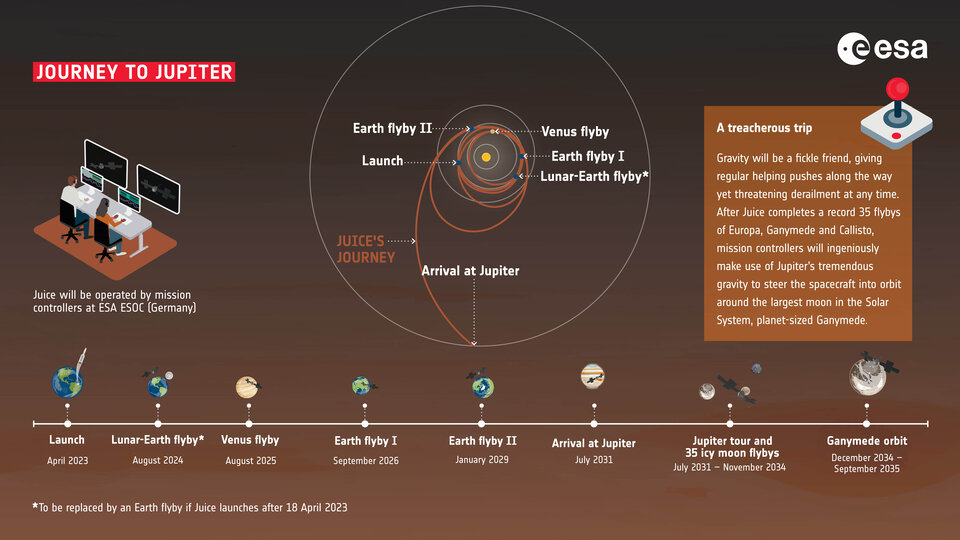
> Arrival at Jupiter - July 2031
https://www.esa.int/var/esa/storage/images/esa_multimedia/im...
I'm just hoping we find evidence of extraterrestrial life in my lifetime, and at this rate, we'll be cutting it close..
Really disappointing that this is top comment tbh.
[1] https://sci.esa.int/web/juice/-/58815-juices-journey-to-jupi...
Even with those gigantic solar arrays, energy management on Juice is extremely challenging. Once in the vicinity of Jupiter, the spacecraft will be powered by less than 4% of the solar flux it receives in earth orbit.
Starship test hopefully this Monday. :-)
Let's see, Juice is 2.4t dry and 6t fuelled, so 3.6t fuel. Starship has a planned capacity of 150t to LEO, and there supposedly will be a tanker.
So a probe that's 60t fuelled instead of 6t seems not entirely unreasonable. Distribute between "go faster" and "even more science" to taste.
And/or add a Vasimir, once on station use the electricity to power the instruments. Nuclear power or humongous array of panels.
Or, even better, fly a science payload + 2nd stage and a 1st stage and have them dock in LEO and have a rocket with some 100t of propellant from LEO + some 20t of payload
Sounds fun
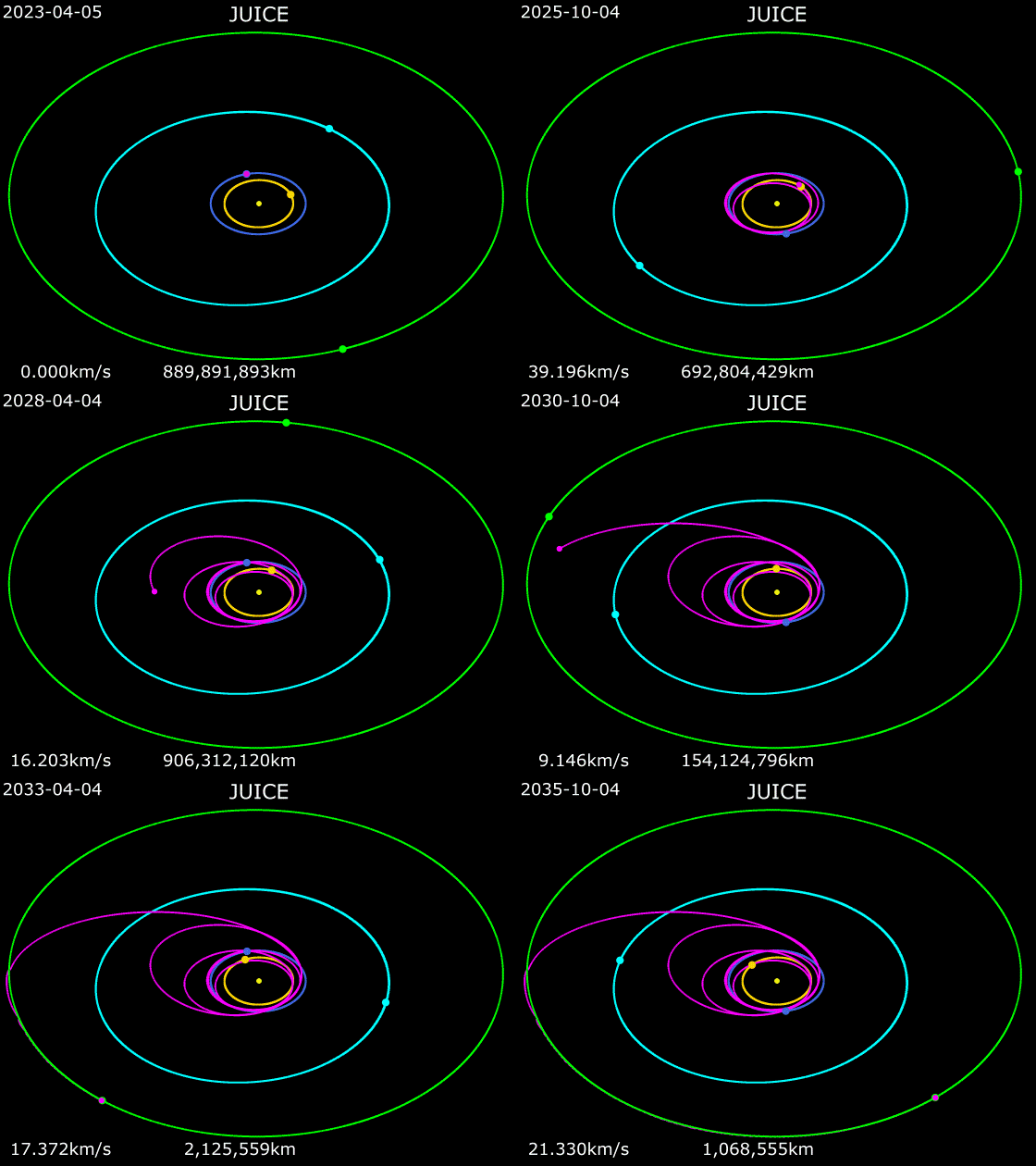
https://upload.wikimedia.org/wikipedia/commons/b/bf/Animatio...
At least once the spacecraft arrives, it will (assuming everything goes well) do some very interesting exploring. So something to look forward to, even if it takes a long time.
Maybe inequality will breed a billionaire with a hard-on for nuclear propulsion?
I still hope to see probes enter orbit around Uranus and Neptune in my lifetime. Neptune in particular would be a massive challenge with an expected flight time of ~30 years IIRC so I don't see that happening anytime soon.
The last (and only!) time we've been to Uranus and Neptune is with Voyager 2 in flybys in 1986 and 1989 (respectively). Imagine what we can do with current technology. I guess a flyby is the most we can hope for. Still, I can dream.
I was listening to the huge list of gear they put on this thing by a project lead and the years of hard work by scientists and it would have been heartbreaking if it failed catastrophically.
Juice launch to Jupiter – Live [video] - https://news.ycombinator.com/item?id=35568388 - April 2023 (29 comments)
ESA – Jupiter Icy Moons Explorer: Live Launch - https://news.ycombinator.com/item?id=35551870 - April 2023 (70 comments)
If it was other RF or heat, maybe not. I wonder if a Stirling engine could work alternating shade and Jupiter's direct radiation?
I also wondered if lowering a long tail could acquire electrostatic energy greater than its coefficient of drag. As above, cute but .. no.
The proof by example answer is "if it had been viable they'd have done it"
> First, here's a general rule of thumb: You can't use lenses and mirrors to make something hotter than the surface of the light source itself. In other words, you can't use sunlight to make something hotter than the surface of the Sun.
...
> The Sun is about 5,000°C, so our rule says you can't focus sunlight with lenses and mirrors to get something any hotter than 5,000°C. The Moon's sunlit surface is a little over 100°C, so you can't focus moonlight to make something hotter than about 100°C.
The cloud tops of Jupiter are estimated to be -280 degrees F.
Or, is it purely economics at play?
ESA get your social media presence in gear !
The orbiting carbon observatory (OCO) failed to reach orbit in 2009 [1]. It got a replacement (a good thing, given how important these measurements are.
Glory [2] would have had a really cool polarimiter (measuring light polariasation as well as radiance, in a range of different directions, but it failed in 2011 for the same reason as OCO. Unfortunately, it didn't get a replacement.
[1] - https://en.wikipedia.org/wiki/Orbiting_Carbon_Observatory
https://www.youtube.com/playlist?list=PLTiv_XWHnOZqFnWQs393R...
The mass of the fuel spent on breaking could be spent on other things, like extra instruments, or fuel for thrusters so you can orient more often and stay in orbit longer. For example, the Galileo[1], Cassini[2] and Dawn[3] missions ended primarily due to the probes running out of fuel. Perhaps not the best examples since they all had quite long runs, but still, more thruster fuel would probably have meant even longer missions.
[1]: https://solarsystem.nasa.gov/missions/galileo/timeline/#jour...
[2]: https://solarsystem.nasa.gov/missions/cassini/mission/grand-...
[3]: https://www.jpl.nasa.gov/news/nasas-dawn-mission-to-asteroid...
Mass. Small payload fast. Or large payload slower. (Also flyby vs. orbital insertion. If you’re going fast, you don’t get to loiter.)
https://en.wikipedia.org/wiki/Europa_Clipper#Launch_and_traj...
Ariane 5 is not particularly powerful as interplanetary launchers go.
https://medium.com/@ToryBrunoULA/the-secrets-of-rocket-desig...
The current international agreement is (best I can tell) UNITED NATlONS: GENERAL ASSEMBLY RESOLUTION AND PRINCIPLES RELEVANT TO THE USE OF NUCLEAR POWER SOURCES IN OUTER SPACE [December 14, 1992]
https://csps.aerospace.org/sites/default/files/2021-08/Princ...
I only skimmed, but it says this:
> In order to mlnlmlze the quantity of radioactLve materzal in space and the risks Involved, the use of nuclear power sources in outer space shall be restrxcted to those space mLssions which cannot be operated by non-nuclear energy sources in a reasonable way.
and
> (a) Nuclear reactors may be operated: (i) On interplanetary missions; (ii) In sufficiently high orbits as defined in paragraph 2 (h); (iii) In low-Earth orbits if they are stored in sufficiently high orbits after the operational part of their mission.
So it seems like nuclear reactors are restricted, but not completely banned. For an interplanetary mission to Jupiter, it would probably be allowed.
ICBMs can be detected at launch, so you have 15 minutes to react. Not much, but better than orbital nukes hanging over your head.