It follows the exact same format of FUD, JAQ-ing, denial, illogic, intentional misunderstanding and avoidance of factual information.
Fool me once, shame on you.
Start what is effectively a religion to defend the financial interests of those burning fossil fuels at the expense of everyone else, shame on you even more.
Also, moving the pan off of the center of the burner and cooking parts at different temperatures is required for some dishes.
These were techniques I was trained to use.
I haven’t worked in a kitchen in over 20 years so maybe the technology has improved to the point where this is possible with induction pans.
This will have zero impact on climate change and will only mean people can't feed themselves when the power goes out.
That's good if you want to see more housing built.
How many new housing units are built in the State of NY per year?
I'll call it 20K.
https://furmancenter.org/news/press-release/new-york-built-1...
Let's go with the moonshot proposal of 50K per year (good luck):
https://www.bdcnetwork.com/new-york-city-advances-plan-build...
How many housing units in NY State?
Approximately 8 million.
https://www.infoplease.com/us/census/new-york/housing-statis...
How many housing units in the entire nation?
Approximately 140 million.
What percentage of CO2 does the US contribute to the planet?
Approximately 14%.
Look for the pie-chart about half-way down.
https://www.ucsusa.org/resources/each-countrys-share-co2-emi...
First conclusion:
    If the US evaporated from the planet tomorrow,
    CO2 production would only decrease by 14%.

    Global CO2 would continue to increase at the same rate.

    The net effect on climate would be zero.
    The proposal is to force 0.6% of NY State housing
    units to use electric stoves.

    The proposal is to force 0.04% of US housing units
    to use electric stoves.

    Electric stoves are NOT zero-emission devices.
    Less, yes, not zero.

    Even assuming zero emissions, the net effect on US CO2
    contribution will effectively be zero.
    This proposal is empty and ridiculous.

    It has no foundation in evidence of any kind.

    It does, however, serve to garner votes from those
    who believe in this stuff blindly and follow politicians
    like they actually know and care about any of this stuff.
    Wait a minute!  You are only considering one year?
    How about 50 years?
What do you want to bet that the act of constructing 50K new housing units per year will generate far more CO2 than those 50K gas stoves will generate for their entire useful lifetimes?
Seriously! Is anyone even interested in science and evidence any more?
But, but, health?
This thing has become a blind belief system, not a subject people can discuss based on facts-based hypothesis that allow anyone to reproduce the results and confirm the conclusions.
A couple of potential definitions of the term:
    Believing something in spite of overwhelming evidence to the contrary.

    or...

    A strong belief in a supernatural power in support of a conclusion.

    or...

    Magic.
Yet, this isn't a rational society. It is a tribalized society based on blind beliefs of all kinds promoted through social media and mercilessly used by politicians to get the unthinking masses to vote for them.
Blind belief is a powerful tool.
With help, it seems to be a LOT easier to get the masses to believe in absolute nonsense than to actually work hard and deliver tangible results that actually benefit society. This is particularly true when the politician can take advantage of complicit actors in society who also stand to benefit from the nonsense they want to sell or the power they aim to acquire.
People, companies, are making money and gaining power with this belief system hand-over-fist. It is amazing to watch this happen as an objective observer. It is frustrating to yell out loud "The emperor has no clothes" only to be met with blind belief and ignorance of facts, as if it were a virtue.
This proposal is like claiming that banning birthday candles and fireworks will save the planet. It's ridiculous, idiotic, demonstrably false and anyone who can add 1 + 1 and get 2 should see it as such.
Hold on. Here come the attacks...
The monoculture could come and bite hard NYC. A city already a hot target for terrorism... now exposed to the unknown (tiny ?) probability, of 1 EMP, one solar flare, one major blackout via hack or mechanical failure....and its millions without basic heating, and who knows for how long ? an entire winter ?
Like, this is why people in rural areas hate big cities. This is completely fair for NYC. Not for the rest of NY. Not without a lot of investment from the government.
You’re effectively left with oil, wood, and electric heat. All three have a lot of their own problems and difficulties.
This change is being promoted as a critical step in the fight against climate change. (See most news articles over the past two years covering this.)
But when you dig into the details, it seems like the regulation may not have much effect on climate change at all.
When you point this out to advocates, you'll get an entirely different argument, this time about personal health. I don't think the personal health justification stands up to scrutiny, for two reasons:
1. If you buy a home and want it to have a gas stove, why is it the state government's place to say that you can't do so, for your own health?
2. According to research I've seen, vented fume hoods seem to mitigate any health effects; if that's true and a state government really wants to intervene, why not spread awareness or perhaps mandate that newly constructed buildings with gas lines also have venting for fume hoods? (Incidentally, requiring venting for fume hoods would be a nice baseline for New York.)
I haven't seen any well-reasoned debate on this topic, possibly because the rationale for the regulation is, in fact, incoherent.
27 years from now, when we're supposedly going to be "net zero", do we really want to be supporting a bunch of natural gas infrastructure?
Or should we start making that expensive infrastructure not necessary?
1. Most homes built now will be around in 27 years, and still in good shape.
2. Building and maintaining natural gas infrastructure to homes is expensive.
3. Gas heating is easily replaced by heat pumps, even in cold climates. It should be difficult to justify any gas heat installs in new homes. (Though, more support should be provided in terms of power redundancy in very cold climates.)
4. It's just not worth it to support gas infrastructure just for gas stoves.
If you look at the big picture, and the medium to long term is just doesn't make sense to build out gas-dependent housing. And it really doesn't make sense to build out all of that infrastructure just for gas stoves.
My oven/cooktop is gas, along with my on-demand hot water heater, and fire place. I also have a connection outside that I use for my grill. I think my heatpump has gas backup for when it's really cold.
Gas powers a lot more than just stoves.
This claim has been contested a few times in this thread below.
> Building and maintaining natural gas infrastructure to homes is expensive
Can you quantify this? How does this compare with the cost of replacing it all and powering it all with zero emissions power sources?
Yet nobody seems to talk about real solutions and we’re content to focus on stupidly useless things instead. I find it frustrating. Are we really in a crises? If yes, then fucking act like it and let’s see some ambitious solutions.
In the movies and books you see something threaten the survival of the human race and the whole world comes together and engineers something impossibly amazing to save the world. I think in reality we’d argue about plastic straws, or who pays for it, or gas stoves until the apocalypse kills the species too dumb to save itself.
Because the same climate activists who keep harping on the "climate crisis" and successfully push policies like in OP, are also irrationally opposed to nuclear energy.
Since these folks are calling the shots, we're heading into an energy crisis in which:
1. More and more demand is placed on our power grid due to moves like banning natural gas for heating.
2. This same power grid is rendered less and less capable and reliable due to being increasingly based on unreliable energy sources like wind and solar.
I couldn't find the source but I think there actually might be a carve out to continue to allow for natural gas for cooking, but in practice, no one but the foolish super rich (or perhaps some professional commissary kitchens) is going to go to the bother of doing a nat gas hookup for for a stove, so gas stoves are going to become deprecated as a side effect of the more impactful change around home heating.
The full half of new yorkers who rent - almost 20 million people - mostly get whatever theirlandlord picked. So when I read posts like this, decrying government overreach, I wonder if you've ever been poor? Have you ever lived here? Do you know what youre talking about at at all? Because the government has never been my problem. It's always a person a few rungs on the economic ladder above me. A boss, a landlord, making my life just a little worse in order to make theirs a little wealthier.
This whole argument that “you oppose a forced choice so you must hate poor people” is just a straw-man. Just because you prefer things one way doesn’t mean govt has a business telling me how I should cook my food.
This is the same kind of "green"-feeling hypocrisy as the plastic bag bans. After Australia banned plastic bags, they found an increased amount of plastic in their landfills. Why? Because people used to re-use them as trash bags and were now buying much thicker dedicated plastic bags for the purpose.
Also, the poster is correct that it's not the function of government to tell people what type of kitchen appliances they can use in their own home. We would typically consider that governmental overreach. It's telling that society is becoming so accepting of being told by the government what they can and cannot do in so many areas of life.
What's the purpose of an outright ban then? Why not just ban it from rental properties?
> I wonder if you've ever been poor?
What do you think the median income for home ownsership is? I'm sure you make plenty of money more than most homeowners if you're renting in New York.
Just subjective opinion.
Anyway, yes I'm a New Yorker and also rent.
Plus, many residents don’t own their own property. This helps protect renters.
This isn’t even on the same planet as lead paint.
All this does is saddle folks with shittier, more expensive options in the name of ‘green’.
the power will go out and usually we also have a boil water notice
for those days it is extremely helpful to have a gas stove, we can still cook and get clean water rather than just eating cold cans and hoping we have enough bottles
Climate change is one. Induction stove powered by the latest generation of gas plants are actually more efficient than gas stoves. Of course, they can run off renewable or nuclear energy too.
For health, it is not great, and not all building are equipped with proper ventilation. And yes, it matters to the government, because even the US government will spend money to keep you alive if you are sick, and in the case of gas stoves, it is not just you, it will impact everyone who lives with you, possibly including your children.
And the last one is safety. I don't know the relative fire hazard of electric devices over open flames, but I'd go with the open flame. And sometimes entire buildings blow up because of (sometimes voluntary) gas leaks.
All these may be small effects, but they are real. And electric stoves are good now, especially induction. Gas stoves still have a few advantages, but not as much as they once had. I've even seen clever battery powered stoves, the batteries allowing them to have greater burst power than what the electrical installation can supply, they can even be used as a backup power supply.
Note that I have a gas stove, and I like it very much. But the reason I have it is that we already had gas. If they banned gas for the entire building, I would have no problem switching to something else (induction).
There have been many unintended consequences to what this experience taught me including dehumidifiers, indoor plants, air filters, ventilation schedules, and yes, eliminating natural gas.
NO2, CO2, CO, PM2.5, and VOC would go up to unhealthy levels even with a hood vent and windows open. It would persist for hours even if I opened 5-6 windows, and would permeate the entire house even though I use a Japanese door hanger to keep air in the kitchen isolated. There was simply no choice other than to go electric.
As an aside, i switched from a high end $3k American gas stove to a $80 Japanese induction unit and $500 Toshiba steam/convection oven with automatic recipes and infrared sensors and my control over cooking and cooking speed have both been so much better.
The gas lobby has been working for decades to trick Americans into thinking gas is somehow better. Idk how these people sleep at night knowing they are unnecessarily subjecting people to greater expense, greater pollution, and an inferior cooking experience.
But maybe most gas company employees drank the koolaide
The truth is that when you dig into the details, nothing is going to have much effect on climate change at all.
People alive today with any ability to affect change aren’t bothered enough by climate change to make any meaningful changes.
2. Burning methane in your house is going to cause some pollution. Methane isn't pure, so other stuff is likely getting burned too. I mean, just logically lighting a fire in your house is probably not going to be good for your health in general.
As for "should we regulate this". It depends on perspective. The gas lobby has worked hard and spent a lot of money to trick people like you into to thinking gas stoves can compete with induction ranges. They cannot. Induction ranges are cheaper, more energy efficient, safer, and healthier than gas stoves. Installing a gas stove in 2023 is using an inferior technology either because of ignorance or Nostalgia.
Now, you could argue that it's the right of each citizen to choose to make bad decisions. In this case, however, that bad decision perpetuates an unsustainable energy apparatus. So I would argue the public good outweighs the homeowner's (or more likely, corporate landlord's) ability to make bad decisions.
2. Would you consider spreading awareness a suitable solution to knife crime? No? I wonder why.
2. There is a relevant difference between doing something bad for you (like smoking - legal but the government tries hard to let you know it's bad) and murdering others with a knife.
i also dont understand why we can't have legislation that says "you can only have a stove cooktop if its properly vented"..
In the winter, when i lose electricity, i can run my house on a small amount of power because i have natural gas heat, cooktop, clothes dryer, and two natural gas fireplaces. I'm not particularly interested in giving up that safety or luxury.
Also, personal health is not something that's generally regulated by the government, despite the potential to cause additional state spending.
When Vancouver banned natural gas hookups in new buildings in 2022 the justification was that they pointed to the fact that 54% of CO2 emissions in the city came from home heating. The next biggest source was transportation, I think 39%ish.
It's a clear reasonable move, as just like when you're trying to improve performance of a computer program, you start with the biggest numbers and see if you can make it smaller.
Presumably other cities in areas that use natural gas for home heating as much as Vancouver are also seeing home heating be a very large percentage of their CO2 emissions.
If we can trivially, simply through some minor regulations cut over time the emissions of every city in NA by 50% that's clearly a massive improvement and well worth doing?
If this is not worth doing in an effort to tackle the climate change problem I do not know what is.
To me this feels like one of the easiest low hanging fruit things we can do there is.
I'd rather people install heat pumps in new construction, and I'd agree that you should discourage use of natural gas for heating, I think there are ways to do that with market incentives, not by bans.
This is the wrong question to be made. You should ask what should be the safety standards you need to adhere to ensure health risks are mitigated.
The reason why this sort of thing must at all times be regulated, without any exception, is that the personal interest of a corporation investing in real estate by selling it off right away are not aligned with the interests of those who actually have to be exposed to the health risks created by said corporation.
To put it more broadly, just because you are ok with your home causing health problems to its occupants, that doesn't grant you the right to subject everyone around you to them, or even whoever will live in that house after you live.
To make it clear, let's consider doors. You might feel you have no use for a wide corridor and you're ok with custom narrow, submarine like doorways. Except that a wheelchair or a stretcher can't go through. Therefore thanks to your shortsighted and ignorant "why should the government tell me how to be safe" point of view, you needlessly screw over your future self and/or everyone that may possibly live there.
Regulation is not a conspiracy. Regulation reflects hard lessons learned with pain and suffering, and ensures that easily avoidable problems can be avoided easily. We learned lessons from fires and mobility constraints, and thus we have regulation ensuring each and every utility in your home is safe. Instead of having to reinvent the wheel each time anyone needs to build something, we only need to check what's the regulation and what are the constraints.
Air quality is starting to be noticed as a major health problem, specially with higher occupation densities, and thus we have safety lessons that need to be learned to avoid these issues. And no clueless naive spur of the moment bootstrappy individual has a clue about them. Hence the need to impose regulation, because these arrogant morons think they know best when they know nothing. I mean, does it make sense to risk our health just because an amateur didn't even wanted to bother doing his homework?
It seems to me you are switching to a third argument, which is societal (rather than personal) health risks, along the lines of second-hand smoke. I haven't seen this argument made in a serious journal, but maybe I've missed it. Can you point me to a rigorous analysis of this?
I will also point out that, as I mentioned above, it seems fine to me to require vented fume hoods in new buildings with gas stove lines. I'm hoping that addresses at least some of your argument.
Second, none of this is an argument to ban natural gas appliances. what is the harm? Is the harm acceptable? Should a person be allowed to except the harm? Can the harm be mitigated by education or change in behavior? And who has the jurisdiction to implement these regulations even if natural gas stoves are in unreasonably dangerous to the occupants who are you to tell me that I can’t do that to myself?
I don't see this policy as having much of an effect against climate change but it is another step in making people aware of climate issues. Congress does not have the ability - right now - to ban cow meat or eating fish, but this would be a much better policy to aim for.
On one hand, for those pushing for a ban, this seems largely performative, a la banning plastic straws. Gas is used for 2 main reasons: for cooking, where it represents a miniscule amount of overall energy use, and for heating, where, if what all the heat pump folks say is true, gas should fall out of favor vs. heat pumps eventually anyway. On the other side, I'm tired of the constant cries of "Muh Freedom!!!" in the face of any regulation that ignores the collective impact of not having any regulations.
Still, even for those who are gravely concerned about global warming, this feels like it will lead to a pyrrhic victory at best by making your average Joe more skeptical of government overreach. It seems like there could have been umpteen different types of government responses (e.g. support for heat pumps) that would have been better received by most folks compared to "we're banning something that a lot of people find useful and convenient".
California's electric grid is in horrendous shape. We can barely keep the power on in the summertime, especially when wildfires happen. When the power is out, am I expected to start a fire in my yard to cook food? Fire up my JetBoil? My BBQ?
If you are curious about your state's ratio of gas to electric stoves, you can check here [PDF warning]: https://www.eia.gov/consumption/residential/data/2020/state/...
Unfortunately it's not a replicable model for the rest of the country.
Having a backup method of ensuring my pipes don't freeze and my family is (mostly) comfortable is great. But if you're an electricity purist who hates cheap, available natural gas for some reason, enjoy sitting in the cold while your house destroys itself. Or spend thousands of dollars more on a device that BURNS GAS to run your electric furnace anyway
https://www.currentresults.com/Yearly-Weather/USA/WA/Seattle...
https://patch.com/washington/seattle/monday-was-seattles-col...
Although, it did boggle the mind how my luxury 2br apt (built in 2018) had a gas stove with only a small "suck" vent (return air of sorts that just vents to the roof)in each bathroom. If I ran the stove too long I'd set the fire alarm off from carbon monoxide and particulate in the air. So I'm actually a big proponent of doing this for indoor air quality.
They can’t even imagine a world where gas does not come in pipes, when arguably that’s how the vast majority of the world lives.
You want a gas stove? Buy a gas stove, and get a cylinder. No one is stopping you from doing that.
Just don’t expect everyone else to subsidize running that gas in a pipe up to your gas stove.
So while all this is going on we have the bullshit with straws, our printers turning themselves off constantly, and now this, as if people in their homes are the lever that needs to be pulled to fix the environment. It’s a farce and a diversion from the corruption that’s actually contributing to environmental damage.
Electric and gas stoves are not analogs, at all. Bet your ass the politicians pushing this for optics will NOT be using an electric stove at home.
There aren't any advantages to gas at all. The gas industry has, however, put many billions into lobbying and marketing to convince you otherwise. And it seems they have succeeded.
For your education https://youtu.be/hX2aZUav-54
That's false. Gas means you can instantly adjust the heat level. Electric is nice if you don't actually cook or don't know how. You don't find electric in any restaurant ever and there's a reason for that. Again, the people pushing this legislation 100% do not have electric ranges in their house. This is performative politics that has nothing to do with actually caring about the environment.
While moving house across the country, our Viking gas range preceding us, I installed a moderately high end induction stove (~$1600) and cooked on it for three weeks before I completely gave up. I even bought "induction ready" pots and pans! No doubt it improved the resale value of the kitchen but for people with competent technique, an induction cook top is a culinary disaster.
Far superior? Yeah, I don't think so.
I really wanted to love that induction stove, it's why I paid extra for one to sell the house. But I was duped. Ah well there is theory and there is practice, and I remind myself yet again to always stick to practice.
Spending a day walking around NYC is probably worse for my health than years of gas stove usage. Every time I leave the city I feel like I need a shower from all the grime and who knows what I feel caked on me.
We need to be building zero emissions homes. (Or as close to it as we can.) The heating technology already exists to replace most single family home gas heating. That begs the question: Why invest in gas infrastructure just for a gas stove? That, frankly, seems shortsighted.
This isn't just about individual choices, or even individual homes. This is about transitioning away from government supported infrastructure that brings gas to homes, which is a society-wide issues. 20 years from now, gas pipes to homes should be seen as unnecessary.
I love my induction stove though. But I’ll admit it’s more expensive than a gas stove and you need to make sure all your cookware works with induction. It definitely wasn’t cheap to make the switch.
Is this step from N.Y. a leap too far? definitely. Is it in the right direction, as opposed to drill baby drill? Also definitely. However in actual climate impact, it is more sustainable to ban petrol car, but our battery tech does not allow everyone to buy EV. Either to public transportation or go junk traffic. Those petrol car (and SUV, "light truck") causes a lot more harm than natural gas which burns into water and carbon dioxide, from asthma to smog. Domestic use of natural gas is terribly effective to be ignored.
I don't know right now but I think they should mandate heat pump in every new houses so minimal energy can result in great heat in winter, instead of relying on AC and failed on grid. Also, N.Y. does not have tons of renewables?
Of course, new government regulations (not outright bans) are a lot of what drives the need for our software.
Also - this is going to be a miniscule amount of difference in the lives of us all. If you're so concerned - buy an old home. Good thing we basically don't ever build anything new. This is a non-issue.
While gas stoves are nicer for cooking then simple electrical stoves, induction stoves have become comparatively cheap and can be roughly as good as gas stoves.
At the same time having gas stoves is associated with a non small number of health risk especially with subpar ventilation and also associated with a non small risk for pretty bad accidents of all kinds.
So a ban on gas stoves is IMHO overdue.
Any of you electronauts interested in a ~5000sqft home in the middle of a picturesque village with no crime? You'll have to call the gas company about removing the hookup after you move in.
Natural gas plumbing is not some magical, amazing thing that magically delivers a much-maligned but otherwise perfect product. It’s an explosive gas that’s piped through underground pipes with fancy pressure regulators and hopefully ends up somewhere useful. Those pipes are expensive, the regulators are complex and can leak or fail, sometimes spectacularly, and the final product is not that useful when delivered to houses. (And it’s not practical to make your own combustible gas at home, whereas making your own electricity can be done in several ways.)
If I were developing a new community from scratch, I would not install gas plumbing. The utilities would be fiber, electricity, water, sewage, and possibly district heating of some sort. This has nothing to do with regulations, just practicality.
Much of my opinion on electric stoves was based on “folklore” passed down from my parents and on using ancient resistive stoves.
Get an induction hob - you will not look back.
This is ultimately performative, as it doesn't really help reach carbon targets, and politically it seems like suicide with something like 70% of homes having a gas appliance. Even weirder, the governor is from Buffalo. I'm not sure that this is the hill to die on in the northeast. But I guess it would be good for property values of previous construction.
This ordinance will just probably just push electrification from exclusively at the high-end out to the entire new housing stock.
This is a very common argumentation tactic, and it usually exposes that the first argument(s) are just a front for our actual axiomatic belief (which hasn't been disclosed). The core principle is often something that we know is much more controversial.
Yes! This would probably raise the air quality in buildings in general. I've seen studies showing that air quality has a direct correlation to test scores in school buildings. Imagine the benefits across a large city like NYC...
Regulating ventilation is far less effective than simply making ventilation no longer an issue (by disallowing gas stoves in the first place).
If people want the natural gas debate to be about climate change but it’s really about personal health and a city’s right to govern risk in that place, that itself doesn’t change because other people are saying, or blogging, “climate change” for this given thing.
[Citation needed]
This thread has a relevant discussion and citations: https://news.ycombinator.com/item?id=35758192
[1] https://unearthed.greenpeace.org/2021/10/21/leaked-climate-l...
[2] https://medium.com/@CollapseSurvival/overshoot-why-its-alrea...
Are you saying that if we got rid of all gas burning appliances in homes, that would not have much effect on climate change?
The heat transfer and energy loss of electrical appliances generally makes them less efficient than natural gas appliances, thus actually increasing the amount of natural gas that will need to be burned to accommodate this policy. This is literally going to increase the amount of natural gas that needs to be burned to maintain existing cooking patterns.
This policy and ones like it are why people can't take environmentalists seriously.
Yes. (Also, I welcome strong evidence to the contrary.)
2. Gas stoves leak when turned off. These leaks equaled 76% of their total methane gas emissions. These are pollutants that are harmful to humans and the atmosphere. Many fume hoods just recirculate air into the living space.
I'm not libertarian or even conservative and am surprised at an ad-hominem attack like this.
When you say "dig into the details", do you mean read some libertarian propaganda funded by fossil fuel interests that can barely acknowledge the existence of climate change and hate every single policy ever proposed to deal with it?
We are phasing out fossil fuels.
Some, like airplane fuel are hard to phase out, and we're still going to do it.
Phasing out gas for cooking and heating is a no brainer.
So you’re going to handwave away the justification for the main crux of your argument.
In fact, the most anyone has come up with in this thread is the number 0.0028 (or about 0.3%):
https://news.ycombinator.com/item?id=35757522
If you have more compelling data, please share it.
Now it’s less important than saving money and improving the electric grid.
Sooner or later this is going away. If you announce you're not doing new installations, that starts a timer on the existing users. In 2028 everything in use is at least 5 years old. In summer 2035 everything in use is at least 12 years old. Politically that makes it a lot easier to sell an actual prohibition on supply than it will be for places where that's a sudden overnight change from "Sure, you can use gas" to "No, we're ripping that out".
My country has begun gradually getting rid of POTS copper wire telephone provision. You can still have it, for a little while at least, but we know it has limited lifespan, if you're an outfit who somehow didn't spot the signs and were shipping devices that expect a physical copper line to work, you've had your notice, in a couple of years stuff like that will drop dead. When it's gone, with it goes a bunch of expenses that most people don't benefit from at all. And yes, also some relatively modest benefits are gone too, but mostly it's a burden, we have better things to spend resources on. But you need to give people a heads up first, and that's what this legislation seems to do.
In summer 2035, you won’t have any buildings than less than 12 years old with gas available, But, as I understand it from the article, someone could replace their stove or heating system in a building that has pre-ban gas, no problem at any point in the intervening 12 years. Even the winter of 2035.
There's the fact that you are actually burning fuel, which released noxious fumes into the home [1]. There's mounting evidence that this sort of exposure has pretty negative health implications [2]
Gas is also inherently dangerous, more-so than electricity. There's been more than a few examples of exploded homes/buildings due to gas leaks [3]. All it takes is for someone to accidentally leave a burner on unstarted (or for a kid to do it while playing around the home).
But as for cooking, heat pumps won't work there. What you're more likely to see is either homes coming standard with thick enough lines to power everything or stoves with batteries (think about it, a stove is off 90% of the time, so why not slowly charge a battery during that time for the times when you need to cook fast?)
[1] https://pubs.acs.org/doi/10.1021/acs.est.1c04707
Regarding heat pumps phasing out gas heat, in NY it isn’t feasible. It gets too cold. In more temperate climates, sure, but in the northern US and further, there will be a need for on-demand heat for a long time to come. The heat pump is being oversold as the answer to everything, but there are use cases it doesn’t account for.
The path forward to carbon neutrality is electrification. Electrify new construction, use steam to heat them, etc. Something which addresses heat will dwarf any of the benefits from coming after people’s stovetops, at a fraction of the lifestyle cost.
It almost feels like this is something designed to turn heads; a political act focused on banning something quite popular, that everyone knows about, for very marginal benefit. It’s almost certainly not to help with “climate change”; if it were, the legislation would target non-negligible emissions sources.
Not true, heat pumps are widely used as primary heat sources in environments as cold or colder than NY, like in Montreal and other parts of Canada. The take that heat pump tech only works in very moderate temperatures is stale at this point.
Induction is fantastic and even superior to gas in some ways (even faster for boiling water, for example). While some may still prefer gas, given that induction gives instant power and is more powerful, I have a hard time believing that it results in a "large cost to lifestyle".
Besides, gas stoves actually cause a significant amount of indoor air pollution, which may be more relevant than the climate change impact. They are quite literally bad for you: https://www.health.harvard.edu/blog/have-a-gas-stove-how-to-...
> Children living in households that use gas stoves for cooking are 42% more likely to have asthma
I live in MA and heat my whole house with a heat pump. It works fine. I have an electric strip for backup.
My house (and heat pump) are five years old. The newer ones are better; Lennox's new model can work in Upstate New York without a backup heat source: https://www.energy.gov/articles/doe-announces-breakthrough-r...
(I will admit that I have a gas stove in my basement to handle power outages, a gas stove, and a gas grill. I will also admit that I really, really regret installing a gas stove and will switch to an induction stove when it's time to replace the stove.)
For the obvious reason that it’s much cheaper.
Ban cooking gas as well, and they save a ton of money running gas pipes, and utility companies having to maintain that gas pipe.
Also, “serious cooks” can still use their gas stoves. They just need to hook it up to a cylinder like most of the world manages just fine, but apparently the people in the richest country in the world can’t figure out.
Scandinavia here. Heat pumps work just fine down to -20C
Induction is a far better choice for residential use.
Total bans on products people use and can enjoy responsibility due to potential health risks is nearly always a bad idea in my opinion. Just look at smoking in the US, for example, which recently hit an all time low. We could have gone the prohibition route (and we can guess how that would turn out), but instead we clamped down on advertising, increased taxes, and helped usher in a societal change where smoking is largely seen as unacceptable behavior by huge swaths of people now.
This one doctor (whom I probably trust the most of online doctors) disagrees.
https://peterattiamd.com/putting-out-the-fire-on-the-gas-sto...
> For example, the analysis included multiple studies that found an association between gas cooking and respiratory disease in children but variously failed to evaluate parental smoking habits, indoor smoke, pet ownership, or outdoor pollution as other possible factors which might underlie the observed associations. In other words, we must interpret these conclusions with a high degree of caution.
TLDR: it’s a function of ventilation
This is exactly what governmental action is meant to put a stop to. We have a case where due to inertia, consumer preferences, market failures w.r.t. externalities, etc. residential gas use would, if left to the market, make up a significant proportion of heating energy.
Maybe "eventually anyway" gas would "fall out of favor", but what needs to happen is for it to no longer be in use (along with 1000 other such changes). The market cannot achieve this for us.
If you use gas and your neighbours use electricity, and there's suddenly a power outage, you can help your neighbors and heat/cook their food too,... or in case of a gas system outage, they can help with yours. If you heat with gas, you don't freeze even with a power outage, and can still buy a cheap electric heater with a gas outage... if you heat with electricity, you can atleast try to find someone with gas heat to let you sleep over and not freeze.
Banning everything except electricity is just calling for a catastrophy.
(yes yes, i know, old heaters will stay, this applies only to new construction, but in 30 years, most old devices will be replaced too)
edit: i don't know why the downvotes... probably not many people from texas here... or anywhere else in the world... or maybe people think that NY is somehow immune to such outages
But FWIW, as someone who is from Texas who lost power for 5 days during Uri and nearly a week for the latest freeze this winter, I wholeheartedly agree. Not sure how I would have made it during Uri without gas - even with gas, we couldn't run our heater (system still needs electricity to run the fans, thermostats, etc.) but we could run a gas fireplace, which kept our house temp just high enough to keep our pipes from bursting. I still shudder from all the pics of people with icicles dripping from their ceiling fans.
I had an annoying experience with this during a multi-day outage in Alaska last year. We did have other options including a generator, but I'm not a fan of being patronized by an appliance.
Gas systems could make a backup, but don't unless they're designed to, and even if they do, you're gonna have a cheaper time installing just the one system than multiple. A generator, or a community generator with rollover practice is the right answer.
You don't see hospitals making every other room gas so they can survive a power outage. Instead, they have a generator
I got solar, a powerwall, and a wood stove.
(I also have a gas stove, but I wish I put the money into buying an extra powerwall.)
I also have a gas grill and a camping stove for emergencies (and for camping).
A man should have the freedom to damage the environment so long as he pay for it, and that money can then be used to undo his damage.
Of course, it's always quite inconsistent how these things are applied based on cultural reasons. I've been in favor for a long time for higher taxes on paper. The production of paper is apparently 1/5 of deforestation and there really is not much justification for it now with alternatives with less of an environmental footprint, but too many people, even those who supposedly stand for the environment, are too emotionally attached to paper for cultural reasons to see this ever pass.
Gas cooking makes sense when the infrastructure costs can be amortized with that of heating. One of these costs is the 2-3% of gas that leaks, and this loss will occur even if you heat your home with heat pumps so long as you're connected to the gas grid. If your only use of gas is cooking, it makes much more sense to simply buy cans of propane.
This is basically how all climate regulations are perceived at the end of the day, and it’s the primary fuel for my most doompilled opinions for sure.
For example, here in Canada, we recently banned a wide range of window blinds including the very popular top-down bottom-up style (a personal favourite). Why? To save the kids of course. One Canadian child a year was killed, on average, over 30 years.[0] So it's a performative win and, let's be honest, who's going to defend our right to buy and install blinds?
[0] https://science.gc.ca/site/science/en/blogs/science-health/k...
No one is banning gas. You can go ahead and buy a gas stove and use it.
What you cannot do is expect buildings to install piping throughout the building, the gas provider to provide infrastructure to supply that building with gas, and get the gas out of a tap.
The vast majority of the world in fact does not have gas coming out of a tap because it’s not profitable. The U.S. has it almost entirely because of regulation thst requires it to be provided, which has now baked in expectation among homeowners that it will be there. This expectation leads to buildings paying extra to supply gas at exorbitant costs so their homes don’t feel less luxury than an equivalent competitor.
If this is true, then why is the New York Times calling it a ban? Wouldn't it be more accurate to call it a repeal of whatever legislation that was requiring it?
Do you have a source on this regulation?
https://www.bendbulletin.com/business/eugene-s-natural-gas-b...
The community has since generated enough signatures to put the ban to a public vote that will be voted on in November. Anecdotally, I'd say, most my neighbors are against the ban, judging from the names on the petition that I signed when they dropped through.
Personally, I believe folks should have the liberty to choose the best solution for their energy needs. I do a bit of home brewing, and I can say, without question, gas is superior for heating a large quantity of water quickly and keeping it at temp throughout the process. I even looked into electric brew kettles and >10G vessels require a dedicated 240V circuit.
Taking this all into account, I'm not sure I'll be buying / building within city limits. That or I'll just move to using my own methane composting biogas bladder. I'd love to see the greenies tell me I can't make my own gas in my back yard via composting.
Since the NY ban is for new construction, wouldn't the obvious thing be to install more 240V circuits in the new buildings?
I heard President Biden wears one, at the request of his wife.
I have a gas range and it doesn't work when the electricity is off. If that's your contingency plan, check that a safety valve doesn't close when power is lost.
  Continuous-flow electric water heater: 20 kW
  Heat pump or central air, big home: 12-15 kW
  EV charger: 7 kW
  Electric tanked water heater or hybrid water heater in electric mode: 7.2 kW
  Clothes dryer with heating element on: 5 kW
  Heat pump or central air, small home: 3-4 kW
  Electric oven: 3-5 kW
  Induction range: 1.8 kW
  Instapot: ~1.5 kW
  Toaster oven: 1-1.5 kW
  Electric kettle: 1 kW
  Microwave: 1.2 kW
  Dishwasher: ~500-1000 W
  Heat pump water heater: ~600W
  Washing machine: 500 W
  Vacuum cleaner: 200-300 W
  Home server or desktop: 100-200 W
  Box fan or air purifier: 100 W
  Laptop on fast charge: 65W
  Laptop on slow charge: 30W
  LED light bulb: 12-15W
  Cell phone charger: 6W
Individually coordinating appliance loads or including a battery with each appliance seems like an inefficient, expensive and unnecessary extra step. Basically, all you need to do is a.) charge your EVs at night when nothing else is running b.) don't use electric water heaters unless they're heat pumps and c.) insulate your home if you're using heat pump HVAC. All of which you should be doing anyway. The kitchen appliances are easily manageable if the EV and HVAC are not running at the same time, and everything else is rounding error.
There might be some benefit to grid-coordinating EV charging and heat pump HVAC operation, particularly since these are the cases where naive loads all hit the grid at the same time, and they already come with batteries included (literal ones for EVs, thermal batteries for HVAC). For smaller appliances it's totally unnecessary though.
When they pass these laws, they should come with an SLA for the utility provider to approve “engineering” plans for the utility hookup and whatever transformer upgrades are required utility-side.
There should be a ~ $250 per day fine, payable in cash to the homeowner once the SLA is exceeded. That’s roughly 2x normal homeowner costs due to delay of construction approvals (and therefore financing / alternative housing costs for those days) and using gas generators to power the site.
And for good reason. Gas cookers require ventilation, to prevent carbon monoxide build up. An electric extractor fan won't work during a power cut.
This wasn’t on my radar as being a thing. What type of service is typical out there? Where I am, 200A is fairly normal and I haven’t really perceived of the concept of not having enough electricity to run a family as a thing.
Do people trip the main breaker more than “almost never” out there?
Electric hot water heater = 20 amps
Electric stove = 50 amps all burners on and oven
Washing machine = 15 amps
Car charger = 50 amps
Total = 135 amps
Standard residential service in the US = 200 amps split phase @ 240v
Whats the problem?
Granted, once the propane rationing started, a few of our neighbors lost power for extended periods of time (weeks). The phone company doesn’t maintain internet if the power is out, but there is starlink, and fiber co-ops are starting to spring up.
This is the SF Bay Area, so it’s pretty much a third world country if you measure things by quality of government services. I assume this isn’t typical for most other parts of the country.
And yet Californians pay enormous taxes.
You’ve been without utility power for two full weeks in 2023?!
This is a surprising assertion to me. How can “most people” afford batteries and generators?
You would assume wrong. California's grid reliability statistics are actually better than the national average:
Electric Utility Performance: A State-By-State Data Review https://www.citizensutilityboard.org/wp-content/uploads/2021...
The only statistic where it falls last is "AVERAGE AMOUNT OF TIME TO RESTORE POWER PER CUSTOMER, IN MINUTES (CAIDI) WITH MAJOR EVENT DAYS"
Compare the California's power reliability with West Virginia's before making any assumptions.
There is a legal difference between a state banning it and a city. States have far more powers that cities don't (unless the state delegates that power which they often do)
I tried this and a neighbor called CalFire on me since its illegal when its not a "burn day".
It seems the solutions are to have:
- a 5 gallon propane tank in the garage
- a BBQ in the back yard
- your own batteries
- a generator (also useful for refrigeration)
I have about 20 gallons of gas in my garage that is good for my generator. I use the gas for my motorcycle so they get refreshed regularly.
> I have about 20 gallons of gas in my garage
I'm with your neighbor on this one
You can't assume that gas supply works in a power outage. Some modern gas stoves depend on external electricity for active power regulation or flame surveillance, and the compressors along the line require electricity as well to function - which was one of the problems in the Texas power outage IIRC, as the gas peaker plants couldn't get powered on because the gas grid compressors were offline.
Keep a camping stove for emergency scenarios, way more reliable and if you're running out of gas you can always walk to the next open hardware store.
Fortunately, pg&e has enough regulatory capture and marketing to trick regulators into letting them rob taxpayers and trick taxpayers into docility.
The issue lies not with a natural gas ban. The issue lies with having a for-profit monopoly in charge of all energy production and supply.
https://www.eia.gov/consumption/residential/data/2020/state/...
How about a little butane stove? They work great at hotel omelette bars! Or a Coleman stove? It's not that big a deal to cook when the power is out, really.
Plus, I'm paying over $0.50/kWh when I hit Tier 3, which I hit after 2 charges of my EV. Everything is untenable. There is no strategy at all. It's just a mess of ideology and dogma but no science or logic, it's infuriating!
Depending on two different grid's is better whether the second one is gas or your own electricity generation
Just like with Texas and wind turbines that lacked basic winterization, implementation details matter.
That one huge fire a few years ago was caused when a thick piece of iron WORE THROUGH from 100 years of wear and tear.
But the laws have specific exceptions for oil and gas pipelines (one permit and the land owners have to dealwithit), for new electric lines everyone who can even theoretically see them can (and will) complain.
Regarding power generation, gas is cheap and plentiful and gas power plants are much easier to build than nuclear. Nuclear takes years to get regulatory approval. Anyway, no one’s building nuclear. Germany closed down their last three nuclear plants, for some reason, and California would love to close their last nuclear plant but simply can’t.
The electric stuff works if you provide electricity to it. That doesn't have to be grid elecetricity
I can generate electricity at home with off the shelf parts. I can also store respectable amounts of it with stuff I can buy off the shelf.
Electricity generation can also be distributed easily, you can have multiple small power plants around the grid.
Gas needs to be centrally pumped out of the ground, processed, pressurised and fed into pipes. There is no practical way for a normal home to make enough of it at home.
If you can cook and keep warm on both gas and electricity, then an outage of one or the other is much less of an issue.
Energy technology is so weirdly unevenly distributed. This debate could have taken place in 1940 - with the exact same arguments.
That sounds pretty fragile to me.
https://en.wikipedia.org/wiki/District_heating#Market_penetr...
But I agree it is easy to do it yourself with propane with one proviso: propane(like butane) has the somewhat insidious property that it is heavier than air so it flows downhill as it dissipates. If it flows to a spark or fire then a flame will spread from the point of first ignition to the propane source.
So if you decide to build a home with a propane(or butane) tank you might consider locating your home on or near a hilltop (that you also own) so that any propane fumes roll away from your property:
https://propanehq.com/do-propane-fumes-rise-or-fall/
Natural gas is much lighter than air and rises quickly up and out of structures. b/c it dissipates so rapidly it is far, far safer than propane. But it is not as easily compressed as is propane so natgas is usually transported to the user in pipes at low pressure.
https://www.thenakedscientists.com/articles/questions/why-st...
A state-sanctioned monopoly is hardly a private company. They can set any price they want and force you to pay. That's not capitalism, that's extortion.
So yes, gas infra is highly, highly subsidized. In a competitive market direct gas would have died out decades ago.
I understand the gas lobby has spent billions convincing you otherwise, but the fact is that direct natural gas is far inferior to electricity at this point.
Some education for you:
Imagine how little water waste there would be if you had to haul it yourself.
Having that gas hookup saves me a ton of hassle during the winter months when, inevitably, power goes out and I need to keep my place warm for a day or two (or more, though rarely) while I wait for service to be restored. My neighbors appreciate it as well, as they can come get warm in front of my gas fireplace and cook on my gas range.
I have yet to see a downside of having gas as an option, it's only helped ESPECIALLY given the geographic realities of where I live (feet of snow overnight, subzero temps for weeks/months). Ironically the pushbacks against people who are PRO gas proves how insular the anti-gas crowd is, because apparently they can't imagine a reason someone would NEED that as an option
Heat pumps are used all over Scandinavia and well into the arctic circle, including rural areas in the parts of Scandinavia (i.e. the polar circle) that see extreme temperatures far more regularly and for far longer periods than NY. Of course relative to NY, they do have a more reliable power grid and excellent building standards. Triple (not double) glazing is the norm there, for example.
And of course more rural places would also feature wood stoves as a backup. There is mostly no gas network there; especially not in rural areas. Before heat pumps became popular about thirty years ago they would have used that or oil based systems.
Well except…
> Of course relative to NY, they do have a more reliable power grid
Okay, yeah. That would pretty much be my concern.
Having been without power for over two weeks in the past 12 months the propane tanks and propane stove / furnace / water heater have been a lifesaver.
Powering the control boards / fans with a generator (or even UPS in a pinch) is a lot simpler proposition than trying to generate enough power to heat my house, water, and food with resistive heating.
I'm so glad I swapped out my heat pump for gas heat. My power bill went down and the house is much more comfortable.
Sure. When we’re talking about the temperature band they work in. Once it hits 0C the efficiency is very low, and by -10C is almost doing nothing at all. At that point you have two things happening…
1. You are using electricity to warm your coils outside to keep frost and snow off them.
2. You are using drastically inefficient heat for your home.
200-300% in their band under ideal conditions, maybe. Seems like cherry picking.
Sure, but that’s worse than natural gas
For those relatively few people living in places which get even colder than that, there's the option of either ground loop heat pumps, or more pragmatically propane burners for the very few nights of the year that are super-cold.
[1] https://www.prnewswire.com/news-releases/rheem-heat-pump-sur...
Our leaders have lost their minds pursuing green purity. It's a religion at this point.
They're not talking about taxing gas - they're talking about banning it.
I'm glad to pay the premium for silent heating.
You can run the blower and electronics of a natural gas furnace or boiler off a little camping generator for a week or even better a natural gas whole house unit in perpetuity.
So you don't, you know, freeze to death.
Burning gas is inherently more complex to transfer heat, and has more losses as a result.
Lots of houses burn oil in NY. That will still be possible.
Also, I know you likely didn’t mean to exclude this, but in cases where gas service might be cheaper in the short term that’s only because it’s effectively heavily subsidized and many of the costs are externalized.
How can people arguing for the merits of banning gas and also pretend they don’t want the government to do it?
Republicans Mocked Over Outraged Claims Government 'Coming for' Gas Stoves https://www.newsweek.com/republicans-mocked-over-outraged-cl...
"... the rightwing immolation at the mere suggestion of a gas stove ban is just one more line on a long list of rightwing lies made for political gain." https://www.theguardian.com/commentisfree/2023/jan/18/how-di...
As usual, "That's not going to happen!" gives way in short order to "It's a good thing that it is going to happen!"
No they didn't.
> MARTÍNEZ: Look, Jeff and Lisa, I don't know what's going to happen with gas stoves.
Also NPR was talking about the Federal government. While the article above is talking about the New York _State_ government.
> The facts and strategy behind the outrage over rumors of a ban on gas stoves
> The conservative media was in uproar last week over speculation that the federal government planned to ban gas cooking stoves and possibly seize them.
The aim is clearly to dismiss the concern as manufactured outrage—note the words “strategy,” “speculation,” and “outrage”—rather than a concern about something that may happen because it’s an aim liberals definitely have.
> Well, the risk for the environment, it's more about what gas stoves have come to represent. And that's the practice of burning natural gas in homes.
Fossil fuel use for energy (in the long term) should be centralized, then replaced. Building gas lines to new buildings should therefore be less preferred than running all-electric. Then of course, there is the reason gas stoves got brought up recently, which is concern with interior air quality and its long term impact on families.
The reality is that eventually, gas appliances will probably be restricted/phased out of use in new installations for several reasons. This shouldn't be surprising, sensational or controversial. The fiction is that they will be forcefully removed from existing installations. See electric vehicles, where my Fox-ian father thinks all gas cars will be banned in 2025 or some shit, when in reality new sales won't even be meaningfully restricted for another 12 years.
Did they actually say that, cause that sounds pretty hyperbolic to what their narrative actually was, which is that 87k agents were being hired which would effectively be targeting middle class and small businesses, instead of big corps.
I have friends who were were wrongfully audited, and it’s a huge costly, stressful burden.
I don’t think it’s wrong to question how the IRS is managing its budget.
"This shouldn't be surprising, sensational or controversial."
By the way, I don't know if you actually read or listened to that segment, but it makes clear that there is a real possibility that this could be regulated. Calling it "fake outrage" is not to say "they're making up the possibility that it could be regulated", but "they're blowing this (real) possibility out of proportion, ignoring the reasons it might be a good idea, and instead making up vague and manipulative reasons to object to it".
Well if the federal government’s opinion on gas is operative, and not your own, how is that not coming for your freedom?
You may think they have good cause, but that doesn’t change the nature of a law that bans you from doing or having something.
Induction cooktops can be nice, but they are more expensive last I checked, and impose lots of limitations on what cookware you can use, including making it infeasible to use high end copper bottom French sauté pans, which also happen to be very hard to match the performance of.
It is absolutely a burden, and meddlesome, and a reduction in freedom of choice, and gas stoves use minuscule amounts of gas.
And where to send the check.
That being said, backup power is still vital in extreme climates.
I believe that Vancouver banned gas for home heating but left the door open to allow gas for cooking, but when I read articles about this at the time of the change, contractors quoted said it would be really silly to go to all the effort to create a gas hookup just for cooking. Likely would be very little uptake, and only by super wealthy enthusiast cooks who demand gas for some reason.
Or maybe they've been poor, and now they're not, so they're speaking from prior experience. Or they have friends or family or acquaintances that are poor. It's not like a wealthy person can't have contact with folks less wealthy.
Read the newspiece before posting questions that you would have the answer to if you had read the first paragraph.
IMO the real problems with district heating are a lack of large-scale standardization (you can’t go to your local HVAC installer and ask for an off-the-shelf heater to pair with a district heating system) and that heat pumps are good enough and cheap enough that they erase some of the benefit.
That being said, a district heating system can inexpensively store heat for later use, whereas electric systems cannot easily do this. (Gas can be stored inexpensively on a large scale, too, which I think is really the major remaining current benefit of natural gas over electricity.)
I can imagine a modern system for a cold-but-mostly-sunny climate: a big PV (and optionally wind) installation produces electricity. When electricity is cheap (sunny / windy conditions), heat pumps heat a thermal reservoir sized to hold a few weeks of heat (this could be a large container of water or even just a bunch of earth insulated on the sides). During cold conditions with less power, heat from the reservoir is used for district heat.
I don’t know whether this would be economical compared to batteries, pumped hydro, gas peaking plants, etc.
[0] District heating with steam is a thing, but it requires higher temperatures, which is not so great if the heat source is a heat pump or waste heat from a lowish-temperature process. It’s not even great if the source is a dedicated boiler, since more energy is available from the same amount of fuel if the flue gas can be cooled below its condensation temperature. (Old systems did not do that, since the materials they were made of would be rapidly corroded by condensate.)
My point is, that this is really unnecessary. Shoehorning the general public into electrification isn’t the answer here. And it goes far beyond just my small needs as a residential subscriber. Commercial breweries, restauranteurs, and everything in-between, use gas because it is far more efficient, cheaper, and suitable for their individual applications.
Choice, is the essential thing here. Let the market sort it out. If the market can make a compelling argument for electrification, that’s the way people will go. But for now, I’m unconvinced.
(btw — I lived in Berkeley for years, and houses that were gas grandfathered were especially sought after. Government diktats just create perverse incentives.)
But, for when they come for your natural gas line — https://www.homebiogas.com/
https://www.ucsusa.org/resources/climate-risks-natural-gas
Granted, much of that is due to power plants, but residential + commercial is over 10%.
I fail to see how B is better?
https://m.youtube.com/watch?v=hNV6C7u9ipE&pp=ygUTQmVuIGZhbGs...
...But I'm the crazy one since I refuse to run around like a chicken without a head.
The church of climatology and latter day taxes is full of shit. It has always been full of shit. It was always and shall always be a power play.
I know for sure that earth's climate changes, but also know for sure that taxes and economic ham-stringing isn't going to influence it in any way, shape, or form.
the problem with nanny-state types is they're just terrible at convincing anyone of anything, which is why they're always so upset at everyone else for being so dumb and ignorant.
"i didn't call you dumb, i said this is a dumb take!"
the problem with nanny-state types is ...
anyway, i'm going to go cook some factory farmed pork bacon on my gas range and then hop into my pickup truck and drive about an hour to go visit my parents in the suburbs, catch you later.
I guess it depends on where you live! But to me it's certainly iffy to ask people to just be ok with being helpless if unpredictable stuff happens.
Two decades and a half ago, the Quebec grid was completely fubar* for the most part of January due to freezing rains too so it's not super uncommon.
*worse than Texas 2 years ago as the electricity infrastructure physically collapsed, literally.
In my country, we had a strange mix of humid air hitting a cold air front, so one side of the country had rain, the other had snowfall, and in between you had frozen rain...
The result? This: https://www.youtube.com/watch?v=A2Gr_RKN4Os (ignore the weird music).
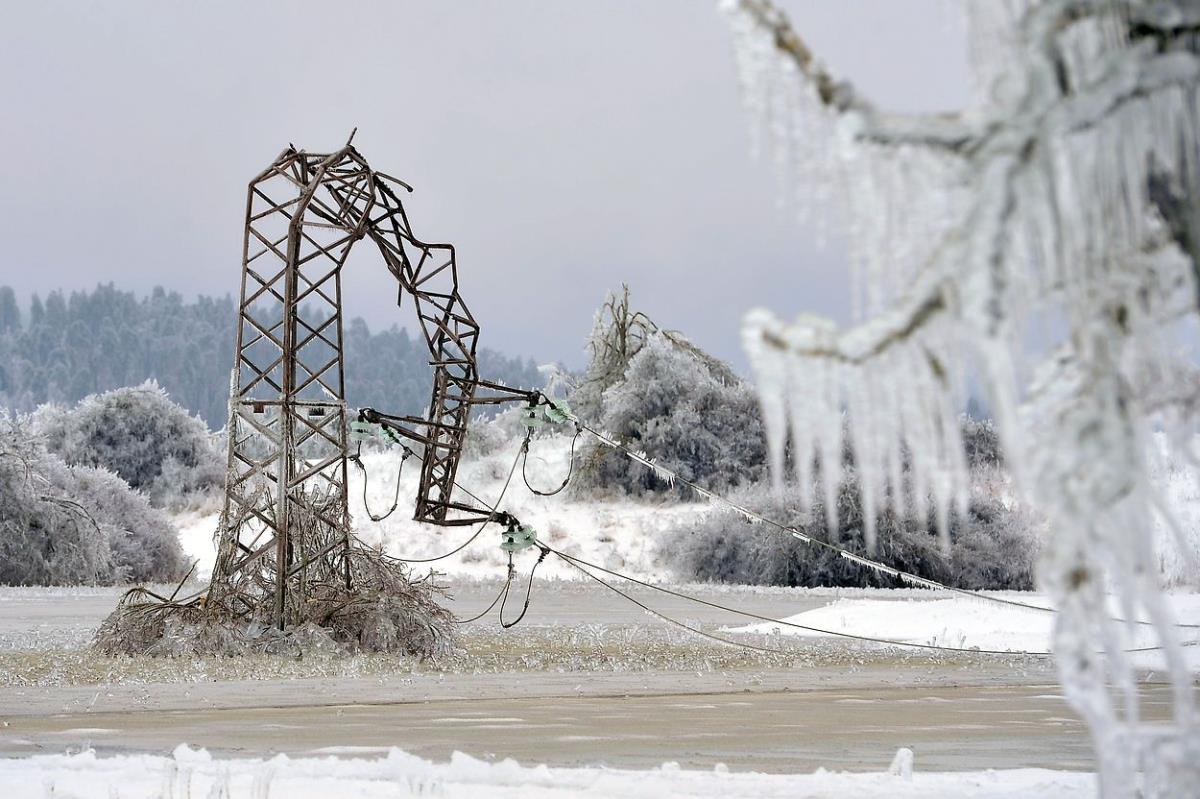
This is what the power lines looked like: https://www.postojna.si/Datoteke/Slike/Novice/123958/l_12395...
Was it a problem? Sure. But not a huge once, since everyone in the rural area was familiar with power issues even from the yugoslav era, wood furnaces are still common, even in houses with central heating (most nowadays), and well.. the country of ~2mio pop. has ~162k voulonteer firefighters, and fallen trees were removed, roads were cleared, and due to a lot of shitty wood, the toilet paper was cheap :)
Now we're looking at this (article here), and germany banning gas, oil and wood heating, and many other countries following, and even a localized event or just some operator fuckup can cause a huge catastrophy. (also, I might have a slight bias, since I know how the infrastructure works and many people who operate it, and it's a miracly we don't have more outages.... same for the internet itself... the core of the internet is based on routers saying "This is me, i own this IP block, just send me the traffic" and all the other routers believing it and doing what it's said... so yeah)
When the grid goes down for an extended period, people can and do freeze, or suffer the effects of poisoning or fire, from less safe forms of heat used out of desperation. (BBQ grill or wood/trash fire indoors, etc.) The Quebec/New England region grid collapse during the 1998 ice storm was particularly bad with dozens dead. An atypical event, but many do plan for that kind of eventuality in some way, whether by having backup heat or hopefully knowing someone who does.
I’m not saying the power going out is no big deal. I’m saying he’s not being overly dramatic.
Companies that are planning new nuclear units are currently indicating that the total costs (including escalation and financing costs) will be in the range of $5,500/kW to $8,100/kW or between $6 billion and $9 billion for each 1,100 MW plant.
Installing a solar farms will cost about $0.80 to $1.36 per watt. Solar farm costs can be estimated by energy output (megawatts) or size (acres). One megawatt is the power equal to 1 million watts, and one megawatt will power about 164 homes. ~$800-$1360/kw
Battery: $152/kWh Now, BNEF expects the volume-weighted average battery pack price to rise to $152/kWh in 2023
I've long maintained here on HN, however, that under-investment in nuclear has made it not cost effective compared to renewables + storage (remember you don't need 100% storage.) At current market prices, nuclear doesn't make much sense. It could have really helped if we'd started earlier with it though, before renewables were in the picture.
rayiner's comment is that NPR told him "the possibility of gas stoves being banned was fake outrage".
Whether or not gas stoves _should_ be banned is irrelevant. NPR clearly stated that they could become banned and that they don't know if they will.
https://homeinspectioninsider.com/are-all-heat-pumps-noisy-1...
Burning stuff is also loud, but resistive heating is mostly quiet other than fan noise and metal containers creaking as they heat up/cool down
Induction is better but nothing really beats gas for speed to reach the desired heat level.
Europe found itself in a huge conundrum last year when Russia cut off the gas supply, highlighting our dependency on cheap Russian gas. It meant households went cold and lost their primary means of hot water and cooking - not so much because there was no gas, but because it was unaffordable.
But in my neck of the woods, removing dependency on gas had been ongoing for a while already for various motivations. One reason to do more with electricity, for example, is because people have cheap solar panels on their roofs now, using that to heat their house is (seems?) more self-reliant, cheaper, and less environmentally impactful in the long run.
And sure, one house won't make a difference, neither will a thousand. But it'll start to make an impact at scale.
There is no one fix for climate change, it will take tens of thousands of small changes and legislation over the span of decades.
Monoculture is risky in all domains. Heating is not exempt
Have you seen construction codes?
This stuff happens all over the world and in places with solid democracies. Turns out safety and efficiency need to be mandated because the free market will kill people with 0 remorse and the average person has ~0 market power.
Progress is many people working together, through ever more complex communal initiatives such as corporations, NGOs and yes, government.
In a solid democracy making real progress, the onus is on the one introducing the regulation to prove that safety and efficiency will in fact be advanced via said regulation. I don't think that bar is passed here.
my guess is most people in this comment section aren't from NYC
Your comment goes way beyond being wrong. You clearly do not know a) what a conspiracy is, b) how standards and regulations are specified and adopted. You clearly are trying to comment on subjects you're entirely oblivious about.
> Second, none of this is an argument to ban natural gas appliances.
Except it does. Again, you seem completely oblivious to what regulations and standards accomplish. You're trying to reject well established concepts and mechanisms that you know nothing about, and filling in your ignorance with conspiratorial make-believe.
For your information, builders are also forced to comply with regulation on thermal insulation in particular and climate confort in general. Why? For the very same reason NY banned natural gas in new buildings: mitigate the environmental and economic impact of climatizing ineficcient, sub-standard homes.
> what is the harm? Is the harm acceptable?
I invite you to read the regulation. You are clearly commenting on stuff out of ignorance.
You're going to be quite shocked when you learn about building codes and building inspections that you already get the benefits of.
Today I found out that the following are conspiracies:
- corporations
- NGOs
- all government activity
- sports teams
- most human hobbies
- ...
:-))
You can heat faster and also adjust heat faster with induction than with gas. Many restaurants are moving to induction. People pushing for this legislation have induction ranges in their house... in fact, most serious people with concerns about air quality have already switched.
The reason why this topic as so controversial is that the vast majority of people don't understand how powerful modern induction ranges are. It's effectively as great a change as geothermal heat pumps will be in our lifetime. They are a total win on every aspect except aesthetics.
https://www.theguardian.com/environment/2023/jan/29/why-elec...
Not that any of this matters to the conversation about gas, my points still stand. Last winter we hit -10F, and there were power outages, so having gas meant having heat when it was extremely cold.
Ultimately you need to be ready to be self-sufficient. I live in a cold climate and run my house on a heat pump, with an oil furnace backup, AND a wood stove with plenty of wood as a third layer.
"Power equipment in Texas was not winterized, leaving it vulnerable to extended periods of cold weather.[44][45] Natural gas power generating facilities had equipment freeze up and faced shortages of fuel. Texas Governor Greg Abbott and some other politicians initially said renewable energy sources were the cause for the power outages, citing frozen wind turbines as an example of their unreliability.[46] Viral images of a helicopter de-icing a wind turbine said to be in Texas were actually taken in 2015 in Sweden.[47] However, wind energy accounts for only 23% of Texas power output;[47] moreover, equipment for other energy sources such as natural gas power generating facilities either freezing up or having mechanical failures were also responsible.[46] "
Texas also screwed up with their turbines
> Powering the control boards / fans with a generator (or even UPS in a pinch) is a lot simpler proposition than trying to generate enough power to heat my house, water, and food with resistive heating.
My furnace runs on 120V power pulling ~8A when running. That's ~1kW. Comparable sized resistive heating would use about 9kW.
1kW for a few hours a day is easy to provide through a cheap generator, a couple small solar panels and a single marine battery, or apparently a ~$220 wind turbine I can order on Amazon that can output up to 1200W. 9kW is a whole different ball game.
And that's just heating. My stove uses in the order of single-digit watts for seconds at a time. It can also just be lit with a match without power. My water heater does run a small exhaust fan while it's heating, but again... we're talking hundreds of watts instead of kilowatts.
Yes, all these options pretty much still need power, but the smaller power requirements are a hell of a lot easier to provide than the power needed for resistive electric heating. I could run my water heater off of a desktop UPS.
California has had a grand total of four nuclear power plant, three are decommissioned, the fourth has is scheduled to have its two reactors be decommissioned in 2029 and 2030.
The “on hold” description for the 5-year extension (the schedule used to be 2024/2025) is inaccurate: it was contingent on replacements being identified and operational, those have been identified but were delayed by factors including a temporary tariff on relevant components, but are expected to be operational well before the 2029 date.
We could nationalize those assholes today.
https://www.eia.gov/electricity/monthly/epm_table_grapher.ph...
Did you read my comment before replying? I already addressed this. Yes I am talking about well below zero F.
> They're not talking about taxing gas - they're talking about banning it.
Yes and they should ban it. Electric heating is way more efficient, doesn't poison the occupants and can be powered from renwable sources.
I think this ban is too bold and will result in political backlash that will end up doing worse than if something less drastic was proposed.
Hochul was 10pts away from losing the last race to a complete RW zealot.
Also, if the power plant is integrated into a CHP system to heat nearby households then generation gets back some percent.
Methane leaks are much more environmentally damaging than often appreciated because methane is such a potent greenhouse gas.
Converting gas heat to heat pumps, even if they have a gas heat backup for worst case days in northern latitudes, would still be a big win in the net environmentally.
At some point that will happen, or else it will simply be so inconvenient to use gas it will be impractical for anything except remote places with propane tanks.
Why is that shocking? Are you also upset that you no longer have easy access to whale oil for your lighting, or a market for steam-powered sedans? Yes, someday in the relatively far future (decades) gas stoves will be a novelty, something small kids look at like they look at CRT televisions or ham radios today.
Who cares? My point is that the outrage on conservative media was built on lies and exaggerations about the now, as if in 2024 gas stoves would be banned. You You moved the goalpost in your comment.
Whale oil was replaced because of cheaper and superior synthetic alternatives. CRT Television were replaced because of more practical flat panels.
There are no advantages to electrical stoves compared to gas stoves. Gas stoves are far superior to electrical for cooking, and for operating both electrical and gas are equivalently practical. The energy cost of gas vs electrical is unimportant for home use, and in professional use you will use gas stoves.
Both electricity and gas (in general) are equally modern (or old) technologies, being a couple of hundred years old. Replacing gas with electricity is in no sense progression, it's just different tech.
Induction stoves are much better than conventional electric, but they are a far cry from gas stoves, which have all the benefits of induction and none of the drawbacks.
Your comment would be fine without that last bit.
If you want to achieve carbon neutrality in 20 years it's ambitious and you need a plan. Phasing out the gas-infrastructure is one of them. And housing and its infrastructure is so permanent, our gas heating is as old than I am, at least it looks this way.
Nobody has explained to me sufficiently in plain language how carbon dioxide is bad for the environment. I've heard plenty of good explanations for water control, but my limited biology understanding has me presuming that more carbon emissions is advantageous to plants.
The IPCC reports have it all. Their models include plant growth already. Google it.
24,000 for all electrical fires. [2]
I wasn't able to find specifically fires caused by electric stoves. Most are caused by faulty wiring, lights, and space heaters.
My assumption, stoves are not often involved in electric fires. They have isolated, grounded circuits that you aren't frequently plugging and unplugging into. The thinker cables usually have thicker insulation on top of that.
[1] https://www.millerweisbrod.com/preventing-gas-explosions#:~:....
[2] https://www.firerescue1.com/fire-products/firefightingtools/...
Older construction leaks a lot more air than newer construction, primarily due to changes in code. More specifically, the air in an older home, from the 1980s, might change over every four hours or so. In a newer home built to modern building codes, it's eight or ten hours.
My apartment has a gas stove, which I was was induction. The gas stove plus the lack of a hood that vents to the outside means the indoor air quality gets pretty messed up. I usually have to open some windows when cooking, which is not great in winter.
https://pubs.acs.org/doi/suppl/10.1021/acs.est.1c04707/suppl...
See the last page.
What you need is a real vent that vents outside. Or a stove that doesn’t emit NOx (and carbon monoxide, etc).
Frankly this whole thing is a bit absurd. Everyone ought to know that flue gas from a furnace or water heater is extremely dangerous when it ends up indoors. Why are gas stoves ever considered okay?
Practically speaking how would a building do this, without costing thousands. Who do you think the land-lord will pass that cost to?
I grew up in Canada with electric stoves (in multiple rentals). Never once did I have an issue cooking.
This is very much the same as Mac vs. PC debate.
It's 100% preference. The average Mac user will go insane if made to switch to windows, and vice versa. The reasons why are almost entirely personal preference, and a quite strong preference at that.
But we are talking about new construction here like the title says, no?
Read the article. Health concerns are an issue, buy they are not the reason why New York is banning natural gas in new constructions.
Look at it this way, even is CO2 levels are primarily anthropogenic, most of the world isn't willing to do anything about it substantial (i.e. Global South). In which case the Western economies martyring themselves isn't going to change anything.
OTOH, if climate change is not primarily anthropogenic the West martyring itself with expensive green energy decisions is a disastrous mistake.
What is the game theoretical optimal move here?
> OTOH, if climate change is not primarily anthropogenic the West martyring itself with expensive green energy decisions is a disastrous mistake
Yikes
No comment
Russia has proven mineral reserves of $75T, most in the world by a fat margin. If they stop selling their oil they're done, and so are China, India, Japan, and parts of Europe. BRICS don't have the ability to drop oil without catastrophic impacts on their food and energy systems.
>Yikes
Climate science is hard. The margins of error are wide. They already have a track record of being overly aggressive on predictions.
Also, just because searing protein produces bad indoor pollution, doesn't mean that any other pollution should therefore be automatically ignored. It is purely optional whether you want to use your stove to sear protein (e.g., you won't find any vegans using it for that purpose), but you don't really have an option if the only thing installed is a gas stove to heat your tea water or saute your onions...
A cheap electric kettle or standalone burner is an option, isn't it?
And doesn't the research indicate that fume hoods help regardless?
And what about when you want to bake or broil something?
& yes, fume hoods do help, with "help" doing a lot of heavy lifting in that sentence. They also need to be turned on to work (not likely every time you heat a pot of tea), and are noisy, and waste even more heat, blowing out cubic meters of already heated/cooled air to exhaust milligrams of pollutants. Always better to never generate the pollutants in the first place.
And for the societal-level goals of reducing climate change and improving public health, it is best to do it at a societal scale, not making every individual go and spend resources to redo and workaround the work that has already been done. Far better to just not install the polluting infrastructure in the first place.
There is plenty of evidence that a 100% phase out of natural gas is necessary but not sufficient.
Banning something at construction time has by far the least regulatory impact of any intervention.
If anyone was proposing turning off existing methane infrastructure, that would be quite different.
Why?
We HAVE to run the fan when we turn on the stove or oven. That's not the case with electric / induction.
Given your concerns, I wouldn’t cook using electric/induction without the fan on either.
https://i.imgur.com/rHDaZxm.png <- something like this was standard, also back in the time the colors were browner ( eg. https://i.imgur.com/RJkq5GK.png ) :)
The modern variants look more like this: https://i.imgur.com/iJvKQjy.png or with inductive heat instead of resistive: https://i.imgur.com/BOetXJz.png
I remember only one gas outage (some repair work done somewhere and they closed the valves) but there were quite a few power outages, where you had to use a lighter.
Things that don't work without electric power:
* Refrigeration. For a 6-12 hour power outage, leaving the doors closed is sufficient. For 1-3 days, fridge temperatures may be maintained by buying bags of ice, but not a freezer.
* Emergency communication. Landline phones might still function, depending on exactly where the breakage occurred. Cell phones have 24-48 hours of battery power at the most.
* Central heating. Even a gas furnace requires electricity for its controller.
* Kitchen ranges (conditional). For a gas range, this depends on whether you have a lighter or matches.
A power outage disrupts normal life. During a power outage, you cannot cook food, cannot preserve food, and cannot heat your home. Depending on the duration, sheltering away from home may be the less disruptive option.
Add in the 80% rule and 200amps doesn't go as far as one might hope in a gas free-house.
None of those devices pull the rated amount continuous except may the car charger which can be adjusted for less draw / longer charge time if needed.
Simply scheduling car charing for overnight would eliminate any issue, even so there is plenty of headroom on a typical residential system.
Requiring new builds to have even more electrical capacity and more robust incoming infrastructure is a win-win-win situation and hopefully that is what code & consumers demand.
Its not like its year 10'000 and we polished technology, infrastructure and everything to the max physics allow. For example you can easily break whole internet if significant portion of its users decide to download something relatively big at the same time.
If you can stick to plugin hybrids and go without AC during a power outage...
Electric hot water heater = 20 amps
Electric stove = 50 amps all burners on and oven
Internet, Misc = 1 amps
Total < 75 amps
Amazingly this is not the worst US utility company. They are all pretty horrible.
There was an eight day outage, a four day outage, and a couple ~24 hour outages.
Surprisingly very few short outages or brownouts or anything.
I’m sitting at having utility power ~95% of the time over the past 12 months. I’d have no problem believing two weeks… or more.
But now a lot more people run AC and electric car charging, among other things like induction ranges. The infrastructure is struggling to keep up. A lot of it is super old and it’s not uncommon to come across 50 year old transformers, etc.
Brownouts and blackouts have become rather common.
But the gas always works. Where I live a lot of people have installed natural gas generators.
And for the other 99.99% of the time the heat pump is so much cheaper to run it’s not funny - and in the long run you save even more when you’re not paying for all that gas infrastructure to be installed and maintained.
Rationally speaking we can only turn the ship as fast as it can turn. Rushing and forcing things to happen that do not have a solid foundation (i.e. a suitable large and reliable grid) are just going to cause problems.
Repalce heat pumps with gas furnaces and you have an equally true sentence, if "the grid" is the gas grid.
Gas usage also spikes on those cold days. You know what people do to prevent this being an issue? Storage. Nothing you couldn't also do with electric power.
It ignored the fact that most of those employees were actually customer service representatives, and you can see this year the huge increase in number of tax filers who were able to actually speak to someone from the IRS on the phone.
Yes. You and the people you are criticizing.
You are right that most people in new york have gas, but new york is an outlier in that -- one of only five states that are majority gas. Most of Tucker Carlson's audience have electric stoves.
Electric is way worse than gas. It’s not even up for reasonable debate.
... we do all of those things on our mid/low-range induction stove? Our primary cookware is random cast iron, the pasta water boils over all the time with no ill effect, we make popcorn, we make stocks, toss things in a pan by lifting it from the surface all the time. I don't know what range you had but something is wrong with it.
Everything your gas burner can do, a proper induction range can do better. Mine has a dedicated 240V 60A line and can boil water faster than anything but a restaurant-grade gas line (which isn’t even an option in most neighborhoods).
I don’t use woks at all, but I can’t see why one wouldn’t work.
Induction stoves can warp carbon steel pans. https://www.youtube.com/watch?v=Ub-ADtsGo5s
I suppose we can always in the glorious future buy electric table candelabras with solar powered rechargeable batteries that we can place into the window light on the annoited day and be sure our dinner date at our table works out... well?
I choose the firebug spouse of mine who runs the campfires on outings and isn't afraid of a (controlled) spontaneous combustion.
The rest of the responses, hoo boy, I think I live on a different planet.
Overselling my competence... amusing, because my view of my own skills is that after 40 years of building on what appears to in hindsight have been an extraordinarily well chosen set of parents I might just now begin to understand how the best kitchens work.
> In 1960, New York City prohibited the sale of paint with high levels of lead for residential use, New York state imposed a state-wide ban in 1970, and the federal government banned lead in paint in 1978.
You seem to think the danger from lead was obvious to all yet NYC was decades ahead of other places where the paint industry prevented or repealed actions to even label lead paint as poisonous.
See also PFOA and similar. Health impacts were known for 20+ years but it was too profitable so those reports were buried and lobbied against. And consumers weren't eager to acknowledge their amazingly convenient non-stick pans were directly poisoning hundreds of people and causing long-term issues in thousands more.
Now gas stoves are a little bit more unique in that the proponents aren't profit hungry corporations doing shadowy bribery but instead countless chefs who prefer it and will demand it, consequences to themselves be damned.
This specific case was worse, it was intentionally introduced to increase and maintain long term profits, despite it was inconvenient to manufacture.
There's no comparable mitigation option for gas stoves. Installing a fune hood involves cutting a hole in the wall, no chance your landlord will ok they in a cheap place.
> Agreed that 1% of the United States' 28% of global CO2 emissions is negligible in the grand global scheme.
This is incredibly ignorant of the "death by 1000 cuts" issue of climate change. 1% or 28% of global CO2 emissions, if this statistic is even true, is huge. Very few climate change interventions are this effective.
The more effective climate change interventions include strict supersets of this, like "banning all new fossil fuel construction", which, if implemented in the US, still only gets you a few percentage points on the larger problem, and would get much greater pushback from people who don't care about climate change and will always cite government overreach for any regulation.
What do you think would be a non-negligible difference? Do you even believe in human-caused climate change? I'll be happy to provide more, real citations, but it's hard to tell what level of burden of proof I should be taking on if I don't know what you think I need to prove.
1% of 28%. If we trust that number, that means that the best we can hope for from this change is 0.0028 (0.3%, rounding up) of global emissions. That number is a ceiling: it assumes that not only do new buildings not have gas stoves, but that all old gas stoves in the United States are removed as well.
This negligible (IMO) improvement comes at the cost of 1) being vulnerable during power outages, 2) having a far worse cooking experience on a daily basis, according to many, and 3) generating significant political backlash that will hinder changes that will actually make a difference.
One of my favorite climate change books is How to Avoid a Climate Disaster, by Bill Gates, in which he outlines where the biggest opportunities lie. His approach seems far more practical and likely to make a dent in the problem.
This is one of your favorite books, and it literally, explicitly disagrees with what you're saying?
One of the core points of that book is that reducing emissions is not enough--we have to eliminate emissions, not reduce them, and investing in reduction solutions may in fact prevent eliminating emissions. Natural gas is literally the example he gives of this. He notes that natural gas is a minor carbon emitter compared to other fossil fuels, but continued investment in natural gas means that we'll still be emitting carbon in 2050, which is his target date for eliminating carbon emissions. That reduction won't be enough--elimination is the only solution.
I mean, dude, it's in the Wikipedia summary. Why would you cite this without at least putting in 30 seconds to investigate whether it supports what you're saying?
gas ranges: $949, $848, $676. boujee model is $1199
induction ranges: $1198 starting, $4138, $1848, $1598, $2498
plus i can't use my nice copper diffuser with them :(
nah, imma stick to gas :)
It’s like if your a top basketball player but you come last in movement speed.
Should California utilities be better at restoring power in these situations? Absolutely, and we shouldn't cut them much slack in that regard. But that doesn't mean it's a "3rd world country" situation with respect to power reliability like the GP described. The typical power problems faced in developing countries are daily power reliability problems that are due to poor grid management in normal conditions, not exceptional conditions.
To give you context our place in SA was having a couple hours loadshedding a day, and here in one of the wealthiest neighborhoods our power was gone for three fucking weeks, and just yesterday was in and out three times.
It’s absolutely third world country level when the weather is anything but exactly 70 degrees. You have zero idea what you’re talking about, the original guy is correct.
I'd love to have a real setup. Unfortunately I've not been given that option and it is the same for many others.
It also has the added bonus that gas infrastructure can realistically be retooled for green hydrogen, and related products.
[0] https://www.iea.org/reports/the-role-of-gas-in-todays-energy...
Additionally to these environmental problems, it's one of most expensive infrastructure-wise and suffers from its storage problems, the list of potential providers is also an issue in Europe as seen during the Ukraine war (and it's not like Qatar, Algeria or Azerbaijan are better than Russia)
This ain't about investments for the long term, it's about having a transition fuel into fully renewable, and that is needed for any realistic approach to the problem.
As the fossil fuel reliance doesn't only extend to the energy sector, but also manufacturing industries, where hydrocarbons, as a resource, are responsible for pretty much everything that defines modern life. [0]
> Additionally to these environmental problems, it's one of most expensive infrastructure-wise
The infrastructure is expensive, but it's also the only existing energy infrastructure which can realistically be retooled for renewable replacement through green hydrogen.
Now you can point out how hydrogen has also expensive infrastructure and even worse storage problems, which is true. But as of right now, green hydrogen is the only plausible way to wean ourselves off our fossil fuel dependence as a manufacturing resource [1].
It's a dimension to this way too few people have on their radar, as most of the public debate is solely centered on electricity generation from fossil fuels, when that's actually the easiest problem to fix with renewables.
But the dependencies on fossil fuels as manufacturing resource, fixing those is a much bigger and involved task than making electricity grids green and renewable.
[0] https://www.energy.gov/sites/prod/files/2019/11/f68/Products...
[1] https://www.fraunhofer.de/content/dam/zv/de/ueber-fraunhofer...
Ironically the best combo is a heat pump + natural gas furnace as a backup. Best of both worlds. But here we are making those illegal so we can pretend to save the planet.
I know what you mean but it is actually nearly 100% efficient. The inefficient part is converting high entropy heat to low entropy electricity.
How does this work in practice though? The natural gas distribution lines don't pay for themselves. If they're only gonna be used in emergencies then they'll be crazy expensive. You have a lot of money by not having to run natural gas through a neighborhood at all.
A more realistic backup in these types of places (which is used widely in the northeast) is heating fuel oil in a tank.
Yes, which is why it only kicks in when the heat pump isn't enough. Which is not most of the year!
A household battery made out of old Tesla batteries sounds like a good idea, but I think someone has thought of it.
Especially when why would you need such a thing anyway when you have 220v+ just itching to get the job done directly from the grid? The grid needs power storage, yes, but there's all sorts of solutions to that beyond lithium ion batteries including water & stone gravity storage systems. Or just centralized batteries.
A battery bank at home can be a good solution to grid balancing, eg if power is cheaper during the day or night, or if you have solar. Water storage systems aren’t very efficient and need lots of space, but there are people who do it. You can also compress air into a cave. Batteries are just something that are cheaper and more space efficient than other solutions.
Centralized batteries work as well, though they don’t do anything if you have lots of grid failures.
This year, most people with just batteries lost power due to no sun, and people with just generators lost power due to no propane delivery service/supply.
Must have been a while ago because in 2021 they charged me $0 (not a typo) to go from 100A to 200A. It took just a month or so to arrange.
Part of this is because California is the most populous state with a high average personal income.
When talking about actual tax burden averages the best way to calculate is by dividing the total state and local taxes by the total income in the state.
https://www.taxpolicycenter.org/statistics/state-and-local-t...
In 2020 the total tax rate in California was 10.01% of total personal income. This put it at 37th place among the US states, and 0.52% above the US average.
For the other most populous states, Texas was at 8.56%, Florida at 7.21%, and New York at 13.92%.
The cheapest state was Alaska at 7.13% (with Florida the second cheapest), and the most expensive state was New York (with Hawaii the second most expensive at 13.16%).
Some of this data is confounded by state revenues not being solely from taxes (or especially from personal taxes). Regardless though, California isn't that much above average, and is one of 30 states with a graduated state income tax that hits higher earners harder than lower earners, whereas 11 states have a flat tax structure.
Also, my power in San Francisco has probably been out for no more than 6 hours over the last 10 years. I don't know how many 9s that is, but it's more than 1.
My 10 year old apartment has a heat pump rated for a CoP of 2.3 at a temperature of 17°F/-8°C, which is actually below the record low outdoor temperature for this area. This isn't some exotic new equipment or a model designed for cold climates; it's what was cheap and mainstream a decade ago.
And as for the question about colder climates: it's not a matter of whether an area can occasionally experience temperatures below eg. 17°F. What matters is whether you'll ever experience daily highs that are cold enough to prevent heating the house.
The data wasn't terribly correlated to temperature, though he didn't have a mini-shed for the outside unit to protect it from snow, so it probably had to defrost more often during the less-cold, snowy days.
FWIW here in Oslo, we've been using a mini split as the main heat in our home, where it's often -15C for long stretches during winter, and can get down to -25C. It's in the main livingroom, and we do supplement the upstairs bedroom with resistive foil floor heating during the coldest periods. Other than that it's doing great, and comparing the electricity bills with friends and colleagues who don't have a heat pump it's definitely helping a lot.
You are talking about air source heat pumps. There are actually variants of that technology that work fine at -20 and below. -20 is actually quite far above absolute zero. The challenge is not that there isn't enough energy but finding and pumping liquids around that can absorb that "heat" and actually stay liquid. Efficiency indeed drops below zero. But it still works.
However, ground source heat pumps are not dependent on the air temperature at all and work anywhere you can get a decent temperature gradient from the ground. Which is pretty much anywhere except maybe on top of the arctic ice sheet in e.g. Antarctica.. Stick a few pipes in the ground and get them deep enough and you can have an nice cozy house pretty much anywhere that is not located on a few miles of ice. NY is perfect for that. No permafrost there and stable temperatures below ground throughout the year.
And again, they have been doing this for decades in places like Finland, Sweden, Norway, Greenland, etc. That's because this stuff works and is reliable and efficient enough. This is not some new kind of science fiction technology. Millions of households depend on this when it gets to minus 40C and below (about the same in C and F). And having lived in Sweden and Finland, I can tell you that they like their houses heated properly there and it really gets that cold up north. They don't use gas in houses there at all and never have. There are no gas distribution networks there. Oil based heating has been phased out in most places there a long time ago. But people forget that that stuff has to be trucked in and trucking anything in gets tricky when there's a few meters of snow on the roads. Heatpumps, resistive heating, district heating, and wood based stoves is pretty much all they use there. District heating is not common outside the more populated areas (i.e. most of the Arctic region) with the exception of the larger towns and villages.
https://www.prudential.com/financial-education/tax-burden-by...
To critique your link based on its footnotes:
> 1 Calculated based on “State Individual Income Tax Rates and Brackets for 2020” from the Tax Foundation and “Median Household Income by State: 2018 and 2019” according to the U.S. Census Bureau.
What is the distribution of households in each state by marital and dependent status?
> 2 Calculated based on “Property Taxes by State” from WalletHub and “Median Home Values Across the U.S.” from Experian.
Various propositions in California affect actual property taxes. In the chart in your link the property tax tax burden is shown the same for California and Texas based on Median income, but the actual property tax rate in Texas is almost double that in California (at least last I checked, a couple of years ago). Housing in California has just been more expensive compared to income, which is a con in affordabilty, but a pro in net worth for property owners (especially those who have owned for a long time, and thus pay lower taxes on their primary residence).
I've got nothing to say about the sales tax burden, except to wonder how much of the "per capita personal consumption expenditures" are taxable transactions, and how much aren't. I've got no clue here though.
https://wallethub.com/edu/states-with-highest-lowest-tax-bur...
A typical natural gas stove burner uses around 7,000 to 10,000 BTUs per hour, which translates to about 0.8 to 1.2 pounds of CO2 emissions per hour of use. This doesn't even qualify as a blip on the radar of the global emissions problem. It's completely irrelevant to the problem you claim is prompting your antisocial outbursts.
At some point, you'll have to decide whether it's more about the climate or more about you. Hopefully you'll choose the climate eventually.
And it turns out there are a lot of leaks and incomplete combustion in the overall methane supply chain. Residential hookups are a significant source of slow leaks.
So completely avoiding a hookup in the first place may have a larger climate impact than your napkin math suggests.
https://www.nytimes.com/2020/03/20/nyregion/coal-energy-ny.h...
So while yes water storage systems need lots of space, that's really only a problem if you're trying to distribute it. But you don't need to, you can centralize power storage to alleviate time of day spikes. Which many power grids already do.
Immigration helps offset those numbers a bit, because like you said people see NY(C) as the capital and plenty of people still want to live there.
Deterioration happens slowly and builds up over time. Humans are very resilient and adaptive to things getting worse (as every war has shown). When things happen slowly you don't notice how bad it is and forget what is lost. The older (usually conservative) people who notice the deterioration are often dismissed as cranks, boomers, out of touch, etc. So immigrants/young college kids still flock to NY and start building a life there before noticing that living there as an adult is way harder than it should be.
Moving states typically requires things to get really bad and people often don't understand the cause/effect of shitty gov and deteriorating cultures.
This means starting with high-impact changes that people will buy into, and prove to them that the change is worth it. Removing gas stoves is a terrible move at this stage.
It is almost like talking about 400HP cars/suvs, my 3 cylinder car is doing just fine at 84 kW max.
Am I being pedantic?
The unit of billing - kW/h - however remains the same.
European houses have had two or three decades of efficiency improvements made to everything, so we don't have the 5kW clothes dryers mentioned above.
For older constructions however, it can be more involved - the line from the main line to your home might need an upgrade, the main line might need an upgrade or in the worst case the transformer might need an upgrade. The further up in the grid you go, the more expensive it gets for the utility - and some measures might even require significant work involving construction permits.
Still the drops make a full bucket in the end
Maybe it's something they only add in luxury homes.
(Note: I'm a New Yorker but not an expert in building code.)
I would believe it's different in CA, though. CA's public health regulations are famously stricter than elsewhere in the country.
Thinking back so did my home in VA, DC and my last two homes in TX. I wonder what is different about our scenarios
On top of that I’m not sure if anyone has studied what percentage of people actually turn their fume hoods on, because I bet that is low too.
A true fume hood overhangs the front of the stove and can be heard when turned on, and requires makeup air.
https://www.youtube.com/watch?v=rSIqKGsF2ZA
(Note that a proper ventilation system is recommended for ANY stove/cooking besides maybe a microwave/pressure cooker, but especially needed for gas)
1. Ground source heat pump -- which can work pretty much anywhere people live, but costs a lot more and people don't necessarily know about them.
2. Failover to resistive heating when it gets too cold outside. It's fine to do this in Montreal, because electricity is relatively inexpensive there. It's fine to do this in New York City, or even somewhere a little cooler like Boston, because you're doing it for max like 2 days a year even in an outlier year. Not sure if it's fine to do this in Buffalo.
As the owner of a 5 year old heat pump in a milder climate in Indiana, I can tell you this:
* When it is under 10°F, my heat pump switches to emergency heat... forced air electric and is very expensive to run. * Often the temperature swings are pretty wild... 40-50 degrees and that also can force emergency heat.
Oh, and since the electric company is usually using gas to generate the electricity, isn't the environmental impact somewhat of a wash?
And a heat pump is superior to gas even if the grid consists 100% out of gas.
Further, you don't build a building built for gas when have to switch to electricity in the future anyway when the grid is even cleaner.
The 2nd figure accounts for carbon footprint of electricity generation used in the home as well as gas combusted in the home. The 4th chart from [1] suggests this is about a 50/50 split (if we bring grid emissions to 0 but don’t exchange these natural gas devices, carbon intensity remains at half of what it is today). Therefore, we can conclude that these 4 appliances in residential properties account for 10% of US carbon footprint.
You could potentially make an argument that stoves are not the lions share of those emissions - but even if they only represent 10% of residential building emissions, that’s still 1% of US carbon emissions annually (which is a huge number when expressed in tons of CO2)
[1] https://www.rewiringamerica.org/policy/bringing-infrastructu... - Chart 4 [2] https://www.pnas.org/doi/10.1073/pnas.1922205117
This is true and entirely misses the point.
A gas stove emits NOx. Cooking some foods at high temperature emits particulates. Different cause, different poison. Also, an air filter can easily remove particulates, but getting rid of NOx with anything other than outright replacement of the air is not so easy.
edit: NOx is for real, and calling it a “green” issue is disingenuous. As far as I know, NOx emissions from stoves are not a particular threat to neighbors or overall outdoor air quality. But they are substantial when concentrated in a house:
https://pubs.acs.org/doi/10.1021/acs.est.1c04707
(Seriously, look at the last graph in the supplementary material. Admittedly it’s an oven, not a stove, but those levels are no joke and the operating time needed to hit them is low. Baking a pie or cooking a big pot of pasta with a gas oven or stove in a kitchen without proper ventilation is quite unhealthy. And those recirculating carbon filter vents won’t help.
The studies on this are questionable at best regarding the health effects, and it is disingenuous to say that the science on this is anywhere near settled - plenty of refutations exist out there. If you're worried, open a window.
> A corrected version of Figure 3 is below, where in Panel A r2 = 0.59 is changed to r2 = 0.58.
Really depends on how you cook. If you're not frying, this isn't really a problem.
> This is the same kind of "green"-feeling hypocrisy as the plastic bag bans. After Australia banned plastic bags, they found an increased amount of plastic in their landfills.
But a big part of this was to reduce plastic litter. Plastic in landfill isn't really a problem (oil being dug from the ground being put back into the ground). But putting a (small) price on plastics makes people a little less careless with them.
Motte, meet bailey. There is more plastic polluting the environment in Australia thanks to plastic bag bans, and they have been replaced by paper bags which emit 10x more CO2 per bag (or reusable bags that break even on CO2 after a few hundred to a thousand uses). This should be considered a huge L for the "environmentalists" who pushed it, on all fronts.
Do you have a source for this? Specifically, plastic litter (not in landfill)? Preferably attributable to plastic bag bans and not just following a pre-existing trend?
> they have been replaced by paper bags which emit 10x more CO2
First up, who is giving you paper bags? I haven't come across one store that has replaced plastic bags with paper. Second, this argument was never about atmospheric CO2.
I know we're supposed to, but I've not changed one bit because of these new bags. A typical shop is now 1$ more expensive with the bags, that's where I stop thinking about it.
When I'm out, and my wife calls me to ask me to pick up something at the shop, I don't have my plastic bag with me, so I buy another one. And it ends up in the bin. Now instead of a thin bit of plastic, I've got a bag that's easily 5 times thicker, and took way more to produce.
It's performative.
They are really thick, almost as nice as hardware store bags, but they all get thrown away.
They should have require a standardized bag/crate with deposit that you would use instead, make it durable enough and people would bring it back or just throw it on the sidewalk and enterprising youths could collect them for the deposit.
Do you have a citation for this?
Ventilation prevents it from reaching hazardous levels from a gas stove; induction does not produce it.
They should ban teflon. It leaches estrogen analogues into food, and is an endocrine disrupter. Also, teflon pans last 2-5% as long as cheaper cast iron / stainless steel equivalents (or most more expensive options).
So you can simmer a stock for a couple hours without needing to run the fan (and cook most anything under 300 degrees or so), and with the fan off you don’t lose nice conditioned air from inside.
tho i admit it kinda sucks ass when it's 100 degrees
Ventilation depends partly on individual behaviour, eg I open windows in good weather and close them in winter.
Based on the one ~ 3 day outage I had, my whole house generator's tank is good for probably close to two weeks, although if it were very hot or very cold, that might change. I have a portable generator for my well, that one runs on gasoline and doesn't sip fuel, I'd probably just run it for a few minutes twice a day (did not have that generator during the 3 day outage... we were just stinky)
I.need to replace my 50 year old furnace, modern ones don't work that way because it isn't compatible with high efficiency.
But duh, I am realizing that shorting the contact won’t do anything so you’re right.
But I have a small solar generator and could probably make it work from that, because it requires very little electricity, as opposed to say, a heat pump.
I can also purchase a propane heater from Home Depot or Lowes which can run off the same gas tanks for less than $200USD.
The propane heater from Home Depot either has the same problem or it uses electricity for the air induction system.
If your goal is to be prepared, a generator and a heat pump will last longer, it will be cheaper for you and society in the long run, it will have more utility, and we have far more gasoline stockpiled and ready for emergencies than we have natural gas.
Gas spoils & does not store for very long. Diesel & propane are both better at storage.
You can even run generators off propane, though at less power than gas. There's even dual fuel (Gas & Propane) generators you can purchase for < $300 USD. It won't power your house, but it will at least be something which can charge batteries & run small appliances. They are loud though. If you own a house, getting a proper generator is the better choice. If you need something off grid or in an apartment (running on the balcony for ventilation), a single smaller generator or 2 in parallel will work. Smaller generators also save on fuel.
At the end of the day, multiple fuel sources will probably work. Wood/coal/propane/kerosene for heat, solar/diesel/propane/gas for electricity, etc. Most grid down scenarios last less than a few days.
Being able to boil water is important as well. There are often boil alerts when there are brown outs.
By stove I mean the cooktop and oven in one package. That is what my house needs so I haven't looked at the other options.
This is the more common arrangement where I am and the price difference are much smaller.
Dunno what kind of pricing y'all have on that side of the Atlantic.
Abatement of tank leaks can run into the millions as you have to dig up all soil contaminated by heating oil when the tank is retired, and tank retirement is a cost that holds up many property sales and redevelopment here in the Pacific Northwest.
What changes with it not being political suicide? Government subsidies paying to add oil infrastructure to houses and to pay for unused pipelines?
https://www.prolinerangehoods.com/blog/is-a-range-hood-requi....
Interesting reading: https://www.worldatlas.com/articles/countries-least-dependen...
However you need to look more at the average scenario to draw a complete picture. When your heat pump isn't in emergency heating then it's more efficient to burn the gas for electricity to power that heat pump than it is to burn the gas for heat (moving heat is substantially cheaper than making heat). So how often is your heat pump in regular heating vs. emergency heat? And then is it in emergency heating often enough to justify having a secondary piece of infrastructure to get gas to your house where you then also need a gas furnace which is more expensive than some resistive heat strips are?
This is something that can be improved.
I don't know who told you this. Can you point to any large city that is running on purely wind & solar right now? As far as I'm aware, there's not even a large regional city that has demonstrated this can work with current battery technology. I would be really happy to be wrong on this, but as of right now, it's not an option and we need to be realistic about that.
"The US Energy Information Administration (EIA) says nuclear power plants had a capacity factor of 92.6% in the US during 2022. This compares to 36.1% for wind energy and just 24.8% for solar photovoltaic technology. To a rough approximation, it takes three times as much wind capacity and four times as much solar to produce the same amount of electricity as a nuclear power plant over a given period. This is complicated by seasonality. Solar, for example, is particularly ineffective during the winter months when energy needs in the northern portion of the country are highest."
[0] https://www.eia.gov/electricity/monthly/epm_table_grapher.ph...
That wasn’t their claim at all, so it seems questionable to demand they prove this.
It’s like if someone said “cheerios are good for the heart”, and you asked someone to demonstrate that nobody ever had a heart attack while eating cheerios. You’re challenging an exaggerated version of the claim that was made, not the actual claim.
Regarding seasons: in our country wind is strong when solar is weak and vice versa
But major cities are getting close.
Adelaide, Australia went from 100% carbon energy in 2007 to ~30% today, and looks to hit at a net 0% by 2028.
Even in the furnace case you need fairly ideal numbers for the heat pump to overtake the loss of 50% you're taking just in the generation step.
And I don't know what's up with your claim about solar and wind energy.
[1] https://www.scientificamerican.com/article/methane-leaks-era...
This go-nowhere attitude and is why people can’t take fossil fuel apologists seriously.
If nothing would make you happier, make that point in your comment. “Maybe this will make a difference in 20 years” or “nuclear advancement is what we need” would completely change the tone.
If you're telling me that fully eliminating gas stoves in the U.S. (something that will not happen in our lifetimes and will come at great political and personal cost) is going to reduce U.S.-specific emissions by just 1%, I think I'm even more convinced that this regulation should not have been passed.
What am I missing?
Not sure where you’re coming up with this - the average modern gas stove is expected to last 13-15 years [1]. Obviously there are exceptions but we can expect 95%+ of this infra to be replaced in 20 years just due to equipment failure. Seems reasonable to expect that effectively all gas stoves in the US will be replaced at least once in the next 50 years.
> great political and personal cost
This assumes that installing new gas infra has no cost. It also ignores the long term health impacts (and costs) of burning natural gas indoors. Additionally, IRA subsidies partially cover the cost of stove replacement in the US. Upfront cost may be higher with induction today, but lifetime cost is lower due to the lower cost of electricity.
This frame also ignores the climate impacts, which I would argue have both significantly greater political and economic costs than not allowing gas infra in new buildings.
> What am I missing?
I agree that it is not viable to say “we must replace all gas infra today.” However, by allowing it to be built in new buildings, we’re locking ourselves into at least 15 years of additional CO2 production from this hardware at a time when we need to be reducing CO2 emissions as much as possible. CO2 not produced today is CO2 that we won’t have to draw down from the atmosphere in the future - something that also costs money. Not installing infra that produces CO2 is the easiest way to ensure we stop producing CO2
Beyond that - I’m not quite sure what your argument is. Is it just that 1% is too small to make a difference (or be regulated) - I’d ask you what is the cutoff at which it is viable for you? And what is the strategy for addressing emissions that don’t meet your cutoff?
[1] https://www.hrblock.com/tax-center/lifestyle/how-long-do-app...
Meanwhile, you seem to be using different definitions of household emissions. Your first source about 95% seems to be talking about direct emissions, ignoring the impact of electricity generation. Your second source about the size of the problem (20%) seems to include electric production.
> The 2nd figure accounts for carbon footprint of electricity generation used in the home as well as gas combusted in the home. The 4th chart from [1] suggests this is about a 50/50 split (if we bring grid emissions to 0 but don’t exchange these natural gas devices, carbon intensity remains at half of what it is today). Therefore, we can conclude that these 4 appliances in residential properties account for 10% of US carbon footprint.
To your first question - the answer is yes; replacing gas appliances with modern electric appliances is less carbon intensive, even if the electricity is produced by fossil fuel combustion. This will become increasingly true as the grid gets greener over time and the carbon intensity of electricity production continues to drop
They aren't going to force the gas to be removed from current kitchens and heaters any time soon.
There is a prohibition on smoking, kids aren't allowed to buy cigarettes
These are both rounding errors vs. a year of energy bills. If you want something even cheaper (for instance, because you hate your tenants, and they are paying the power bill), resistive ones are still available.
• 40% of cancer deaths are related to smoking • 80% of lung cancer deaths are related to smoking • 33% of heart disease deaths are related to smoking
There's over half a million deaths a year from smoking and 10% are second hand smoking related.
I’m not quite sure we can call this a win yet.
the plain packaging stuff is moving past people taking informed risks (even if i think they're stupid ones) and towards overt control of behavior for technocratic reasons. which explains why there's way more uptake for it in europe and australia than here
It was a long time ago though.
also, opioid epidemic is not helping things. this is really reaching and not sourced but i wonder if less smoking means more people reach for pills?
numbers are higher now. but nobody was counting e-cig before. some were even getting money to buy them as they were spined as a quiting smoke path.
It also seems like a bit of a weird reason to me as a big reason. But maybe you get a lot more power outages than I do. (I would imagine somewhere with a gas main, where gas heating can be economical, would not have very frequent or problematic blackouts. With no gas main, you use butane/propane which is not so economical). Plenty of people have camping stoves lying around which can be used in a pinch.
My gas furnace will not ignite without power and the power necessary to run the blower is 15 amps or so, wiring in a portable generator would be simple.
The water heater works without any power whatsoever.
The stove has electric ignition but you can light it without power. The oven needs power (I think? never tried it).
Gas is also often more reliable than electricity as gas is practically always buried while electricity has many overhead lines in the mix.
Yes. The gas stove does not need any electricity, same for the gas water heater. It's nice to be able to cook and have hot water showers during blackouts.
The gas furnace does require electricity to run the fan, but it's not much. So running the furnace to heat the house during a blackout is easy to do with a small generator to power the fan while all the heating BTUs come from gas.
Here in PG&E land (might be the most expensive electricity in the country, but at least it's the most unreliable!) these are nice advantages.
My water heater does, but the little recirculation pump on it doesn't so it takes longer to get hot water at a distant faucet.
My central heat does not.
Practically all of the US has some renewable mix, so all the US already away from fossil fuels generating "all" the electricity (renewables + nuclear being 0%).
Over 30% of the electricity in my home is from wind and solar alone.
You also really shouldn't be using your stove to provide warmth in your home since you're probably not venting out the NOx, CO2, and CO emissions. CO poisoning kills a lot of people doing what you're claiming is a benefit.
So while I fully believe your lived experiences and preferences, a relevant question is: why are your electricity supplies so unreliable that having gas as well is even an important concern?
Might be different in the UK.
I have never lived anywhere where blackouts weren't fairly regular. Currently in the backwaters of silicon valley and blackouts are the norm every time it rains, or there's any wind. Or forecast of wind or fear of rain. Thanks PG&E.
Probably depends where you are, as this is very much not the case for everyone.
We can't build new stuff which is practically obsolete on day 1 and a burden just 10 years from now.
Your comment reads like someone swearing smoking has no health impact because they never felt ill or victimized for smoking.
Meanwhile, even the World Health Organization produces reports on health risks of household air pollution, where stoves are the primary pollution source.
https://www.who.int/news-room/fact-sheets/detail/household-a...
You’ve either misunderstood or deliberately linked an article that doesn’t support your claim about using natural gas cooking.
“Around 2.4 billion people worldwide (around a third of the global population) cook using open fires or inefficient stoves fuelled by kerosene, biomass (wood, animal dung and crop waste) and coal, which generates harmful household air pollution.”
Open fire/stove cooking is the primary cause of COPD in the developing world, in the developed world its smoking. The WHO is not worried about US homes with gas stoves. This article is not about natural gas stoves. The article is about open fire/stove cooking.
I hope others aren’t misled by you. What a shame.
"It is essential to expand use of clean fuels and technologies to reduce household air pollution and protect health. These include solar, electricity, biogas, liquefied petroleum gas (LPG), natural gas, alcohol fuels, as well as biomass stoves that meet the emission targets in the WHO Guidelines."
This article discusses people in developing nations cooking indoors with indoors burning wood and dung. It isn't clear that this also applies to the amateur chef using natural gas in a mini-mansion.
Also, as the other commenter said, these are apartment buildings. If you burn your apartment down it's gonna affect your neighbors. If you mess up your indoor air quality it's gonna affect your neighbors.
This is where it stops being "personal responsibility"
Also you personally can still have gas anyway, you just don't get government subsidized gas infrastructure anymore. Go get your own propane tank or whatever. Go be "personally independent"
https://americacomesalive.com/the-invention-of-the-fire-esca...
Best of all, the total investment and maintenance actually decreases.
Likewise for a heat pump, right?
Does this "power out for days after a winter storm" thing actually happen very often? I am from Manitoba and my worst-ever experience was 10-11 hours when it was very, very cold out in 35+ years.
No one is an island.
Doesn’t make it wrong.
At -10C you are hardly pulling anything from the air, but you are spending electricity to keep your coils free of frost, as inefficiently as possible.
Do you not know how a heat pump works in cold weather?
Assuming I run the generator for 12 hours a day at half load (powering my whole house, still firing my equipment up and working remotely…) and the furnace runs for three hours a day throughout that time… I can keep going for a couple of weeks. If I _can_ get gas to fuel the generator with that can be extended pretty substantially—the generator is really what’s using up all my propane.
So in the realm of the kind of power outages where you reasonably expect society to recover and continue… works pretty well for me.
But yeah, in the future I would love to move over to a heat pump and solar generation / local storage. That extends your potential runtime pretty near indefinitely. (We’re talking lifetime of batteries and solar panels at that point instead of “when the propane truck can come by next”.)
Near Ottawa—in the past 12 months I’ve had an eight day outage, a four day outage, and a few day long outages.
We don’t need to survive the -40 or -50 of the prairies, but even with good insulation a -10 day in the spring makes the house pretty cold after a couple of days.
An average gas furnace blower motor draws around 7A at 120V.
A heat pump can require between 20A-40A at *240V* PLUS the air handler which is the same as above. A heat pump air handler is just a furnace without burners. If supplemental heat strips are needed they can be on a 50A breaker at 240V.
Source: I used a little gas generator many times to power the gas furnace when the electric grid was down.
Gas cannot be considered for a transition because of it's very high emissions, diplomatic issues and high infrastructure costs. It's a very polluting tech which should stay back in the 20th century along petrol. The stability problems of renewables must be solved first to be adopted, in a better way, burning fossil fuels when they do not work ain't one.
> Now you can point out how hydrogen has also expensive infrastructure and even worse storage problems, which is true. But as of right now, green hydrogen is the only plausible way to wean ourselves off our fossil fuel dependence as a manufacturing resource [1].
The whole cycle has disastrous efficiency with 70% loss, as it is now, hydrogen storage isn't that useful until we invent some better tech. There's some use for it of course but that's not a large scale solution by any means.
Once we said that, how you judge this very high losses depends of your personal opinion.
> This becomes much more obvious once you realize that you need energy storage for electrification to work, but this part is conveniently left out of the calculation.
Unless some better hydrogen tech is invented, that won't be useful towards this goal.
That is a fair criticism.
[1] https://electronics.stackexchange.com/questions/487836/how-d...
I was already confused with the 240 being mentioned somewhere in this thread... it becomes a bit clearer now.
In the breaker panels the phase alternates as you go down the rows of breakers. So you can install a dual breaker for 240V. Typically only large appliances like stoves, water heater, driers, and air conditioners are 240V. Everything else is 120V.
If you think about it, there is still plenty of room for optimizing our energy consumption.
The trend seems to be, replace the gasoline car not with a more fuel efficient one but rather with a car weighing almost double because it has to drag along a huge battery. Then replace all copper wires with double the section (copper mining, plastic production, tearing open perfect roads, ...)
Some ideas, not very far fetched I would say, combine a few of these will get us a long way:
Car pooling.
Electric bicycles.
Insulate your house better?
Taking turns with neighbours to do grocery shopping or bringing kids to school.
Try to repair stuff in stead of bying new.
Drying clothes with renewable wind energy. (a hanging rack)
> Electric bicycles
> Insulate your house better?
> Taking turns with neighbours to do grocery shopping or bringing kids to school.
> Try to repair stuff in stead of bying new.
> Drying clothes with renewable wind energy. (a hanging rack)
People do these things anyways with the right incentives, just to save time and money.
But we still need to get off of fossil fuels for transportation and electricity generation if we want to avoid the worst climate change scenarios.
The reality is that people really value convenience, and we have to find sustainable ways of delivering that. That might mean a great electric bus system, EVs, community thrift exchanges, etc
> Electric bicycles
I only ride bicycles for exercise or as an activity but never to go somewhere. I’m no longer 12.
> Insulate your house better?
If the government wants to use my tax dollars for this instead of SNAP/TANF then I’m all for them paying for it but it’s not going to be me paying.
> Taking turns with neighbours to do grocery shopping or bringing kids to school.
See point #1
> Try to repair stuff in stead of bying new.
I do this where possible because I’m cheap but I doubt it is any kind of significant savings of energy.
> Drying clothes with renewable wind energy. (a hanging rack)
Now I’ve got clean clothes covered in dust and pollen. Thanks.
I don't understand the claimed causal relationship.
FWIW, I'm paying rent for my current apartment, we don't have a gas supply, and I've never had a power cut.
Indeed, while I am rich and do own an apartment back in the UK, roughly three quarters of the 16.5 years since I've last experienced a power cut was in property I pay rent for, and only about 4 years were in the flat I own and began collecting rent on when I left the country. Which, ah, also doesn't have a gas supply.
In any case, not sure what this is suppressed to have to do with reliably of the electricity supply — it's not like landlords get free shares in local power grid companies (or if we do, I missed the memo).
Sorry but this is nonsense. Your local power utility monopoly is what it is, completely unrelated to whether you rent or own.
Also, if you want to see some well-cited posts on the tenuous evidence of health effects of NOx, other posts in this comments section have plenty of sources. Even the link to asthma is pretty tenuous, apparently.
But NO2 is certainly toxic, and it looks like stoves product about 1/4 as much NO2 as total NOx.
(I also recall reading that stoves, with no pot or pan on them, produce minimal CO, but that gas ovens produce lots of CO. Also, residential gas ovens are IMO really quite bad at cooking.)
And yeah, the cheap residential gas ovens really suck, and likely put out a lot more of the bad stuff (both CH4 and CO, but also probably the NOx compounds too) than stovetops. Mixed fuel is now the hot thing in ranges: gas burners and electric ovens.
It isn't, and you clearly failed to read the paper because you're oblivious to its context. The "alternative" was open-flame coal and wood stoves, as well as querosene stoves, which cause extreme levels of indoor pollution and health hazard and are in widespread use in underdeveloped nations.
Natural gas stoves pollute less than open-flame coal and wood stoves, yes, and are therefore a preferable alternative. However, unlike your clueless claim, this does not mean that gas stoves do not lose a health hazard, or that electrical stoves are not far preferable. The WHO report refutes the bullshit claim that gas stoves don't present a health hazard due to the type and levels of indoor air pollution they create.
I am stuck using an electric stovetop, and will replace it with an induction one soon, but I would switch to gas in a heartbeat if it were available.
Ceramic ones suck a bit less, induction is pretty damn good.
> You have zero idea what you’re talking about
Same here. I've endured the sweltering tropical heat in a polluted developing-country city during power cuts, so I well understand what I'm talking about.
> To give you context our place in SA was having a couple hours loadshedding a day, and here in one of the wealthiest neighborhoods our power was gone for three fucking weeks, and just yesterday was in and out three times.
In my Bay Area neighborhood there have been no outages for the last 3 years, but that anecdote is no more or less valid than yours when generalizing about California at large. It's a huge state with incredible variability in nearly every dimension.
Hyper-local conditions matter greatly to reliability. I'm in a dense urban environment, near hospitals and fire stations. That's probably why our power is more reliable. We have friends who live in a wealthy wooded and hilly area of the Peninsula who have lost power for days this past winter, because those repeated winter storms made so many trees fall on power lines. Similarly, extremely fire-prone neighborhoods just 10 miles from me experience public-safety-power-shutoffs frequently in the summer while I don't.
Your power problems sound highly localized, and you are right to be upset about it, but it's on your utility, not the overall grid.
Highly localized across the entire bay for the atmospheric river a couple weeks ago.
Again, you don’t know what you’re talking about.
They are not on a different grid at all. Most of California, and definitely the entire Bay Area is part of the same grid managed by CAISO:
https://www.caiso.com/Pages/default.aspx
Palo Alto has its own municipal utility. There is a huge difference. A municipal utility is only responsible for retail electric sales and distribution infrastructure in a specific area. That includes local substations and power lines, which are the likely source of your electricity reliability problems.
Palo Alto doesn't manage supply and demand in real time, maintaining 60Hz AC, or run the wholesale electricity markets. CAISO does those, along with transmission and regional interconnects, all of which are functions of the electric grid. The meanings of words matter when discussing these things.
> Again, you don’t know what you’re talking about.
Thank you for the pleasant feedback.
Energy storage will require hydrogen energy storage. This is the fundamental problem of direct electrification strategies. They will need vast amounts of energy storage that cannot be solved except using hydrogen.
My point in this discussion thread is, i saw 200 Amps at 240 V per household being mentioned, i want to show this should not be the norm or trend. Imo this way of thinking is not leading to an efficient system.
If you have an electric car, you probably don't need to charge it most of the times at the highest current. And when you do, you won't turn on all electric devices with high amperage.
The other examples are just examples, not everyone needs to apply them all. I advocate for the culture shift, the more-is-not-better mentality. This needs to go hand in hand with cleaner technologies and government policies.
Meanwhile, the obvious consequences for nuclear reactors on shipping vessels will be radioactive debris spreading terrorist attacks.
Also, you may need to learn more about modern nuclear technology. Shipboard nuclear reactors these days are very safe, and there are plenty of available reactor technologies out there that are impossible to turn into bombs.
That does not suggest that anyone is taking the environmental effects of their choices very seriously, and that they just want to lower peoples' standard of living and intrude on our lives. If that's what this is really about, then how about none of it?
I'm sure you understand that if people continue getting inconvenienced in the name of climate change while governments and big corporations go on pumping CO2 into the atmosphere at industrial scale, that's what's going to happen: instead of everyone making the changes they need to make, the vast majority of people will do nothing. The hypocrisy is not lost on anyone.
What more would you like explained here?
Live with PG&E and live with PAU and then talk about it. Semantics are totally irrelevant.
Meanwhile, shipboard nuclear reactors have radioactive material. They can be cut open, so the radioactive material can be taken out. It can then be distributed throughout NYC by a terrorist with conventional explosives, killing millions.
They clearly over-generalized. I didn't say they "overstated." They didn't say "in some parts of Seattle" they said "in Seattle."
I'm sure there have been edge cases in every state of the country where the power has been 10 days at someone's house because of unique circumstances. That doesn't meaningfully change the risk profile of a heat pump over gas furnaces.
I know you'll disagree, but my take is that the upside (<1% savings over the course of, say, 30 years) is outweighed by the downside (lack of ability to cook or boil water during a power outage, far worse cooking experience).
Additionally, the energy cost of creating new stoves with significantly more complex internals (both due to the constant march of technology and the relative complexity of electric or induction cooktops versus gas) can't be overnighted.
Just keep in mind, things aren't always always that simple. E.g. Russia stopped shipping Germany gas, because they helped defending Ukraine which Russia started a war on. At the same time Germany relied on that Gas, and hat to quickly move to alternatives to keep the country running.
As to Germany, why did they rely on gas? Oh right, because they shut down their nuclear plants. So in the span of 3 years, Germany has gone from getting its base load from nuclear to gas to coal. If you really believe that atmospheric CO2 is an imminent threat to civilization, the tradeoffs are obvious and clearly biased in favor of ramping your nuclear industry significantly rather than hoping for a future breakthrough in battery technology that can allow you to run your base load off solar and wind.
Like solar panels before they reached scale, this will start off as an incredibly expensive proposition, but it will get cheaper with scale. France seems to get it - they are building 50 new plants - but nobody else does.
Instead of lobbying for impactful changes at this scale, we have plenty of activists going after ersatz plastic items, gas stoves, and gas-powered cars (all of which emit less CO2 than the top 20 biggest shipping vessels). It's not clear to me that these stupid little inconveniences actually take less political capital than anything else, but they certainly do wear down public tolerance for the program, which is fatal in the long run.
Nuclear was phased out because of the potentially catastrophic risk as well as the unwillingness go provide permanent storage for nuclear waste.
Further, traditional nuclear power plants don't scale well, see the costs in France (even though it's not represented in electricity prices and this although France is already heavily invested in nuclear power plants), problems with heat waves/dry climate, as well as the fact that economic uranium sources are limited.
France is building new plants, planning close to 50, however the long term trend will be a reduced share of nuclear power in the grid, because old reactors will have to shut down as well, and renewable energy build out will shadow everything else.
This is in terms with the estimates in the IPCC report that cover cost and potential avoidance in CO2 emissions.
Personally, I see activists mainly going after the government's to implement a strategy to reduce emissions, but surely almost everyone doing this will call out plastic items and fossil fuel usage where avoidable. Rightly so, if this reduces tolerance for whatever program (doing what? Reduce emissions?), I don't see the problem there, but rather at NIMBYism, mis information and green washing. There's nothing wrong with going after these things.
I feel like you are more interested in preventing actions from being taken than shedding light on things that are missed - I hope I am wrong though and calling out hypocrisy of climate activists isn't the primary part.
Most gas appliances also require electricity to run, and in addition the broader gas infrastructure itself requires electricity to compress the gas so that it reaches the consumer. There's no getting around the need for reliable electric infrastructure; centralized gas infrastructure won't save you from unreliable electricity.
It absolutely will and the gas infrastructure is far more reliable than the electricity one.
My gas fired boiler can heat my house for days running off my Yeti battery pack.
That same Yeti couldn't put a dent in the cold weather we had this year.
Running my generator (on LP or NG or Gasoline) would allow me to keep my boiler running effectively indefinitely. Heating my home directly would be way more dangerous.
While you're correct that it's possible that NG supply can be disrupted, it's far less vulnerable to disruption than electricity. The natural gas supply is entirely underground and the natural gas infrastructure you're talking about that requires compression to pump to consumers has a built-in supply of fuel for running generators to generate electricity to run those compressors in an emergency.
There were innumerable electricity disruptions where I live in the almost 40 years I've lived here. Mostly short ones (under one hour) but several much longer ones (12+ hours). Without NG heat in my home I would have been forced to evacuate on a number of occasions. I've had one, single, disruption to my NG supply in 40 years. PSE&G found a leak in the gas lines in our street, this didn't cause a supply disruption however but put us (and a lot of our town somehow) on an expedited list to have all of our NG lines replaced. PSE&G came around and trenched in new high-pressure gas lines along the streets (still not disrupting our supply) and then a few weeks later they individually came and swapped each home to utilize the new high-pressure gas by fishing a smaller HP PEX pipe down the old gas pipe from our old service. No new trench from street-house, just a pit in the street and a pit alongside our foundation and a new exterior meter and pressure regulator. Exceedingly well done process and incredibly smooth. They even had a cool soft-tracked excavator so it didn't damage our lawn! Total outage was about 2 hours. How many nines of reliability is two hours of outage in 40 years?
Gas heat and hot water may be cheaper or more expensive than heat pumps depending on utility rates and climate. Too bad residential gas-fires cogeneration isn’t really a thing.
That's because when gas lines fail, which they obviously do, they leak instead. And leaking natural gas into the air of densely populated areas is of course a bad idea.
And since those leaks are just small pressure drops and everything keeps "working" there's much less urgency or incentive to fix it. Unlike circuit breakers & other protective circuits that cut power which prompts immediate action to correct.
This is not something that should happen in urban/sub-urban environment often in a first world country. In rural areas building up the infrastructure to that point can be too expensive but not in built up areas.
In the last ~15 years of living in cities/suburbs in Finland I have not had a single power outage that lasted more then 5 minutes. And even those have been super rare.
If that really is a problem in a first world country (and you are not riving in a really remote area) talk to your politicians as your system is seriously broken and needs fixing.
It's not clear to me that this legislation would do anything to stop you from throwing a 250gallon tank on your house to run a generator in upstate NY.
On the US east coast it does not. Very rare occurrence, to the point where a major blackout is a noteworthy event.
The price of gas is going up, and the price of electricity is plummeting thanks to renewables.
Also, the efficiency of electric ranges has doubled in recent years. Heatpumps are something like 3-10x more efficient than older systems.
Our electric dryer greatly outperforms any old gas dryers we had, and it wasn’t significantly more expensive.
Not according to sources I can find. EIA forecasts for the long term project continued increases through 2050 [1] Maybe in locations elsewhere in the world? Or specific states in the US? Certainly not where I live, which is aggressively pursuing renewables and despite this prices continue to increase, and were doing so before the spike in natural gas prices.
[1] https://www.eia.gov/outlooks/aeo/data/browser/#/?id=1-AEO202...
Have you tried a heat-pump dryer?
Using gas to drive a clothes dryer is the most American thing in a good while =)
> Plus electric goes out often.
Where do you live when you have a 100% reliable gas hookup but electricity is down "often"?
That kind of personifies the eco-hypocrisy I have mentioned: The Germans want what they want, but they want other people to bear the cost and the risks of it. If they aren't willing to pay the costs for cutting carbon emissions, do they really want to do it? I think they have revealed that the answer is "no."
> Further, traditional nuclear power plants don't scale well, see the costs in France (even though it's not represented in electricity prices and this although France is already heavily invested in nuclear power plants), problems with heat waves/dry climate, as well as the fact that economic uranium sources are limited.
The people who say this have no clue whether it is actually true. Since Chernobyl, there hasn't been a serious effort to build out nuclear power plants at scale. Previously, the Soviets did a pretty good job demonstrating the scaling laws here, but they also cut too many corners.
As to the whole idea that renewable energy will overshadow other sources of power, renewables are not dispatchabale on-demand without several significant advances in power storage technology (which will come from batteries before anything else - nothing else scales well enough right now).
Alright, that's so rare it's hardly a data point.
>I live in the middle of the Seattle metropolitan area, not out in the country.
Wait, so you aren't even talking about the city of Seattle? Never mind...
> that's so rare it's hardly a data point.
I never expected a 10 day power failure in the middle of a metropolitan city.
E.g. Seattle City Light has a better reputation for uptime than Puget Sound Energy.
I hope they will plummet, I just don’t see much pointing in that direction right now.
Banning gas stoves would be a huge blow to all the immigrants who rely on cooking techniques (like woks) that don’t work well on resistance coils, and require expensive special equipment to work on induction.
I'd assume nobody would install a resistance stove in a new apartment (since this only applies to those)
Cant you just put a steel plate under any pan, and then it’s induction compatible?
Ideally you’d have compatible pans, but you don’t have to.
I still like looking on gas a lot better.
Resistive is just fine. No way I'm throwing out my 20 years old stove to save 2 minutes boiling water. Once the coil is red hot there's virtually no time difference with induction.
That said, upgrading for this reason would be very silly.
A normal electric stove isn't even going to be two minutes slower to boil. Depending on the stoves in question, the resistive stove might even be faster to a boil than the gas stove, even if the gas stove is rated for more BTUs.
New Zealand is ludicrous marked up in terms of consumer goods, and I’ve just checked pricing. The cheapest is resistive electric. Then fractionally more is gas. Induction costs approximately double for 4 hobs (for 2 hobs it’s about 50% more than resistive).
If you count installation, both electric options are going to be less expensive than gas. If the big cable needs running for induction, the cost might be similar to gas.
Not factored in, cleaning. My god is induction nice to maintain.
When I was in college, I bought a portable induction cooker off Amazon for $60. It was the best. I could boil a large pot of water in about the same time as the gas stove I had at home. (I never timed it, but it felt basically the same.)
I could have bought four of those induction cookers for less than $250. If I ever built a house (I currently rent an apartment and am stuck with gas), I would at least be tempted to literally do that, instead of spending the money on a "real" cooking range.
Why are full ranges so expensive?
I generally prefer induction to gas, but there is one disadvantage - uneven heating of large thin pans. On induction, a part of pan directly above coils can be > 50 degC hotter than its border. This can be mitigated by using pans with thick bottom with good heat conductivity, but then you get higher thermal inertia.
eg : https://www.alamy.com/preparingindian-rotifulkachapati-puffe...
I have lived with induction cooktop (in Europe) for 3 yrs and resistive cooktops (in US) for ~3yrs as well.
Just because you theoretically have more choice in a free market doesn’t mean you actually do, depending on how desperate you are.
But those would be too good of solutions and spoil the current sneaky plan. Too many goal posts are shifting for justifying a performative-feel-good-climate fight (the point the top-level comment is trying to make).
There is no pure free-market anywhere (and it's a good thing). Let's not justify govt overreach in the garb of imperfect market-capitalism.
Yeah, but not many more relevant ones to the actual cooking.
> I bet if you did a blind tasting you'd not be able to tell the difference.
You can't do a blind cooking. How often do you cook food on the stove yourself? If you do cook quite often and still insist that gas and electric stoves are equivalent, I'd be very surprised.
Now I definitely don't want to say that I definitely can't do without gas stoves — if they have a negative health and environmental impact, I could be easily convinced to switch to induction stoves, for example. But electric really don't cut it in my experience.
Please let me know what you’re willing to bet and we’ll take this forward.
And that's setting aside all the other possibilities a torch opens up, like flan or crusting cheese, which are best done from the top.
I assume they exist somewhere, but I've yet to see one.
The main thing that makes electric stoves hard for a professional kitchen is ultimately speed and space. You need every single burner during a rush, and you need to be reacting quick, and there is usually very limited space. If I need to stop the heat on my pan, I need to stop it now. An electric top requires you to actually move the pan off the burner to somewhere else, but good luck finding a spot without butting in on the garde manger or grill guy. A gas stove offers the flexibility of being able to leave food there until its ready to plate.
I understand not everyone wants to buy or can afford new cookware, but cast iron pans are very cheap. Also see brands such as t-fal that make affordable non-stick aluminum cookware with a small steel bottom to make them induction compatible.
Gas indoors is now considered a health hazard even with range hood, and while you can still buy gas cooktops, I haven't seen a new build with gas in a long time.
From a climate perspective and also from a safety and health perspective.
Gas should be opt-in, not opt-out.
And I'm perfectly fine with this being regulated because the free market sold us leaded gasoline 60+ years after they introduced it maliciously, themselves, for example.
Is this true of induction? I've never used induction for anything more complicated than pasta, but I would have thought that since the surface (basically) doesn't get hot, turning it off would function the same way as a gas stove.
If the goal is to fight health risks there’s way to mitigate those risks scientifically in other ways that allows people to keep their preferences. Just saying “science” in a sentence doesn’t make your point scientifically valid, we don’t need to turn science into religion.
Or too take cigarettes example; ban cigarette sales completely instead of banning smoking indoors.
I hope you see the nuance now.
Maybe try to cook first?
If we talk about say poppadoms. Doing that without an open flame produces… it produces something…
All of north India eats rotis made this way as their staple.
and the butane torch isnt gonna put in harmful chemicals more than my gas flame?
I haven't made baba ganoush this way so take it with a grain of salt, but the way I've approached fruits with similar water content (i.e. squash or apples) is to bake for an amount of time (which is going to give you a more consistent cook all the way through than roasting anyway) and then finish with the butane torch, for a crispy roasted exterior. If you're using a toaster oven without covering, that will already give you some crispiness on the exterior, so you'll likely be able to get the exterior you want with under a minute of active torching.
The sources I can find seem to indicate that butane actually burns at a lower temperature than natural gas, but you make up for this by putting the flame directly on the food, so I'd guess that the food gets hotter (I wouldn't trust sources that say this confidently, as I can't think of a good way to experimentally verify this). It seems like this gives a higher temperature contrast which gives a higher texture contrast between the interior/exterior of the food. It's subjective whether that's a good thing but I personally think it's better.
> and the butane torch isnt gonna put in harmful chemicals more than my gas flame?
I don't know, and I would distrust most sources that claim to know. Natural gas is used for a lot of things besides cooking, so I'm not sure how much effort is put into the purity of the natural gas mixture, and that's putting aside all the piping between source and destination which could introduce all sorts of stuff from molds to plastics. I'm not aware of anyone making claims about the safety of natural gas flames and food. In contrast, butane torch fuels are often explicitly intended for culinary use, and advertising makes lots of claims such as "Near zero impurities" and "No residual oders"[1] (the misspelling is theirs). Without any credible independent verification, I personally don't think these claims are worth anything.
That said, natural gas is a much more complicated mix of stuff than butane, and the chemical reaction of combustion is much more complicated. Butane, in a perfect combustion, should produce CO2 and water, while natural gas, in a perfect combustion, will produce CO2, CO (carbon monoxide), water, NOx and SOx compounds (the latter mostly due to additives to give it an odor). Perfect combustion is a hypothetical reaction that doesn't exist in real life, however, so I can't say how well that hypothetical reaction translates to practical reality.
[1] https://www.amazon.com/Culinary-Universal-Cocktails-Charcute...
"You don't need it, so you can't have it" is a dangerous argument.
My point is that you need to weigh the advantages and disadvantages. Some individuals wanting baba-ganoush in NY should not be the reason to avoid electrification for the others.
I appreciate that forced illegalisation is off-putting, but like others have said, renters don’t get a choice and landlords will avoid all expenditures. We need a way to help the majority wean off gas.
What stops the others from having an electric stove, while natural gas infrastructure is still available? Are there living units in NY that have natural gas, but no electricity?
> renters don’t get a choice
Electric stovetops are about 30 dollars for two-plate solutions, if you decide for yourself that natural gas is not for you.
Yes but not the teflon coating.
Also induction stoves are quite cheap nowadays (in relation to the overall cost) so it would seem absurd for me to get a resistive one even if you could save $100-200
But if it were 30 apartment units, then the cost difference on paper would amount to $3000-$6000 (and it would probably be judged in this way, rather than the cost difference per unit).
The price difference between a resistive 4 element resistive and a inductive cooktop is like 20€ maybe 30€ tops. So a cheap one will cost you between 200€ to 250€
(maybe the pricing in US is totally different but that is what you pay for the cheap stuff here in Finland)
So then I asked my Indian co-workers who said they do sometimes use the gas stove to do some stuff but they avoid it as it’s not healthy. They said never finish things like roti on gas stove but they do things with eggplants (and some other vegetable) and peel them after. They said it’s better to use a fire and it tastes better.
As for those who claim that gas stoves are needed for wok cooking w/ specific techniques, most people who I've actually asked about what they cook on the wok is basically "fried rice", or even worse, they don't actually have a wok at all, and are using the issue as a strawman to complain about government overreach.
What's clearly the case is that homes in China do not generally have the ultra-powered gas wok burners that restaurants do, which is what people are talking about when they talk about what's distinctive about cooking on a wok.
I thought it meant both. I'm not entering in an useless argument, bye!
In Hong Kong, it was really down to personal preference. My first apartment came with a normal resistive stove that the landlord swapped to an induction cooktop at my request, and that building (on HK island) didn't even have plumbed gas. It'd been disconnected during a renovation years before I moved in.
> But they are far from ubiquitous and common in the country overall, of that I can assure you.
I actually agree with you here, I was just making a point about the precariousness of using personal anecdata to support a position as broad as "people in China rarely have electric stoves." In a country that big, even the outliers make for an enormous group.
Before I moved to the UK I had literally never seen an electric stove in my life, much less used one, as gas was ubiquitous in the Netherlands. I'm sure you could find it, but it was rare. In the last few years things changed rapidly though, and when I moved back last year there were a number of apartments that had electric or induction) stoves.