Rarbg Is No More(web.archive.org) |
Rarbg Is No More(web.archive.org) |
Well, i recently got myself a videoprojector with an android tv included, and since i happen to have an amazon prime account, i installed the app, which is quite good.
And yes, it's true, since i've done that, my torrentz usage has dramatically dropped..
So yeah, I went back to torrents after that. All of my problems disappeared when I just had an MP4 file I could play anywhere. I'm still paying my subscription but they can take my 1080p video from my cold dead hands.
But that doesn't really disprove my point : when the legal streaming service is working fine, then it does have an immediate effect on pirated content consumption.
I thought that not being able to have access to all the content in the world would be a no-go, but i'm surprising myself preferring to watch legal content directly in two taps of the remote than having to search for the torrentz, the subtitles, download it, plug the computer to my projector, etc.
This came as a surprise to me.
legal streaming is horrible at the moment.
To be able to battle at least some of the reasons to pirate media they need to fix a couple of things (and this is just my shortlist, there's 1000+ more reasons) - allow indexing and playback outside of the official app so 1 app could be used for multiple platform subscriptions - allow access to content no matter where the viewer is on the world. Not only the video, but audio and subtitle languages as well - allow subscriptions for specific content, not a 'one subscription fits all'. I dont want to watch nor pay for yet another Walking Dead something, but I do want to watch See - allow to buy content, and provide that DRM free in high quality (not the streaming quality)
These are the "bad legal streaming services" that OP is mentioning.
If you treat streaming like old cable television; you turn it on then decide what you want to watch from what is available, I guess it might seem fine to you. But if you try to decide what you want to watch first, treating streaming as a means to an end rather than the end itself, then streaming is unmitigated trash.
Ease of use and guaranteed video & subtitles quality can compensate to some degree to not having access to all the content in the world.
Long COVID is having a real impact on technical people.
There's a reason Google buys COVID rapid testing kits in bulk for any of their onsite events. One of my friends working behind the scenes was gifted a grocery bag full of leftover tests.
Governments around the world have largely abandoned us to a disabling virus.
I loved VXT stuff on rarbg, and would love to find them again.
Also movie makers don't care to push the issue with law enforcement anymore. They (unfortunately for law abiding folks) just inflate the price to make up for lost, just like stores do to combat shoplifting.
Not that I use bittorrent very much personally, I gave that up many years ago.
RIP, I suppose.
It was a good site.
Hopefully the industry gets its shit together so I can legally watch shows and movies without waiting a week and so I don't need to consult two different "look up where you can stream something please don't pirate" websites to watch shows anymore. Until that magical day comes, I'll keep pirating.
We would like to inform you that we have decided to shut down our site. The past 2 years have been very difficult for us - some of the people in our team died due to covid complications, others still suffer the side effects of it - not being able to work at all. Some are also fighting the war in Europe - ON BOTH SIDES. Also, the power price increase in data centers in Europe hit us pretty hard. Inflation makes our daily expenses impossible to bare. Therefore we can no longer run this site without massive expenses that we can no longer cover out of pocket. After an unanimous vote we've decided that we can no longer do it.
We are sorry :(
Bye
Edit: This isn't me BTW. I just copy-pasted the text from the site.
Archived link: https://web.archive.org/web/20230531105653/https://rarbg.to/...
Your efforts did not go unnoticed and you will be greatly missed.
I hope the circumstances of your lives improve and that you can find normality in these difficult times.
How much would it have helped to have 1% of users chip in 10 USD/year? (1% is probably optimistic, but still...)?
Not one person playing both sides (but that probably happens, too).
Is there a successful tracker founded after 2010? With all these old sites and their experienced crew quitting, things are not looking good for the long term of warez. The only one that comes to mind is the .si reboot of nyaa.se.
The honeypot isn't the torrent site. You can use any site in the world or no site at all and still get busted. It's a peer to peer network, and the people busting you are seeding the torrents themselves. They catch you when you peer with them.
Use a VPN, and read more.
In a way, they are helping us with better download speeds.
I do the same, minus the logging.
RARBG magnet link archive:
https://torrentfreak.com/rarbg-over-267000-movie-tv-show-mag...
https://github.com/2004content/rarbg
( released 5 hours ago )
Out of the box Jackett supports many popular public trackers like 1337x and you can configure private trackers too.
Well it took rarbg going down for me to see that they actually started caching results for rarbg in the latest release... Too bad.
[0] https://torrentfreak.com/bulgaria-approves-draft-law-that-tu...
Iconic Torrent Site RARBG Shuts Down, All Content Releases Stop
https://torrentfreak.com/iconic-torrent-site-rarbg-shuts-dow...
    RARBG, one of the world's largest torrent sites, has said "farewell" to millions of users. The site, which was a prominent and stable source of new movie and TV show releases, cited a variety of reasons behind its decision to cease operations. The surprise shutdown marks the end of an era.

    Founded in 2008, RARBG evolved to become a key player in the torrent ecosystem.

    The site didn’t only attract millions of monthly visitors from all over the globe, it was also a major release hub, bridging the gap between the Scene and the broader pirate public.

... etc.Guess I'll have to subscribe to a USENET after all.
RARBG was amazing because it had everything, but still curated the releases for minimum standards of quality. Is there an alternative out there?
Not as convenient but you do get decent download speeds and if parts are broken you can normally repair with PAR2 which itself is alien tech.
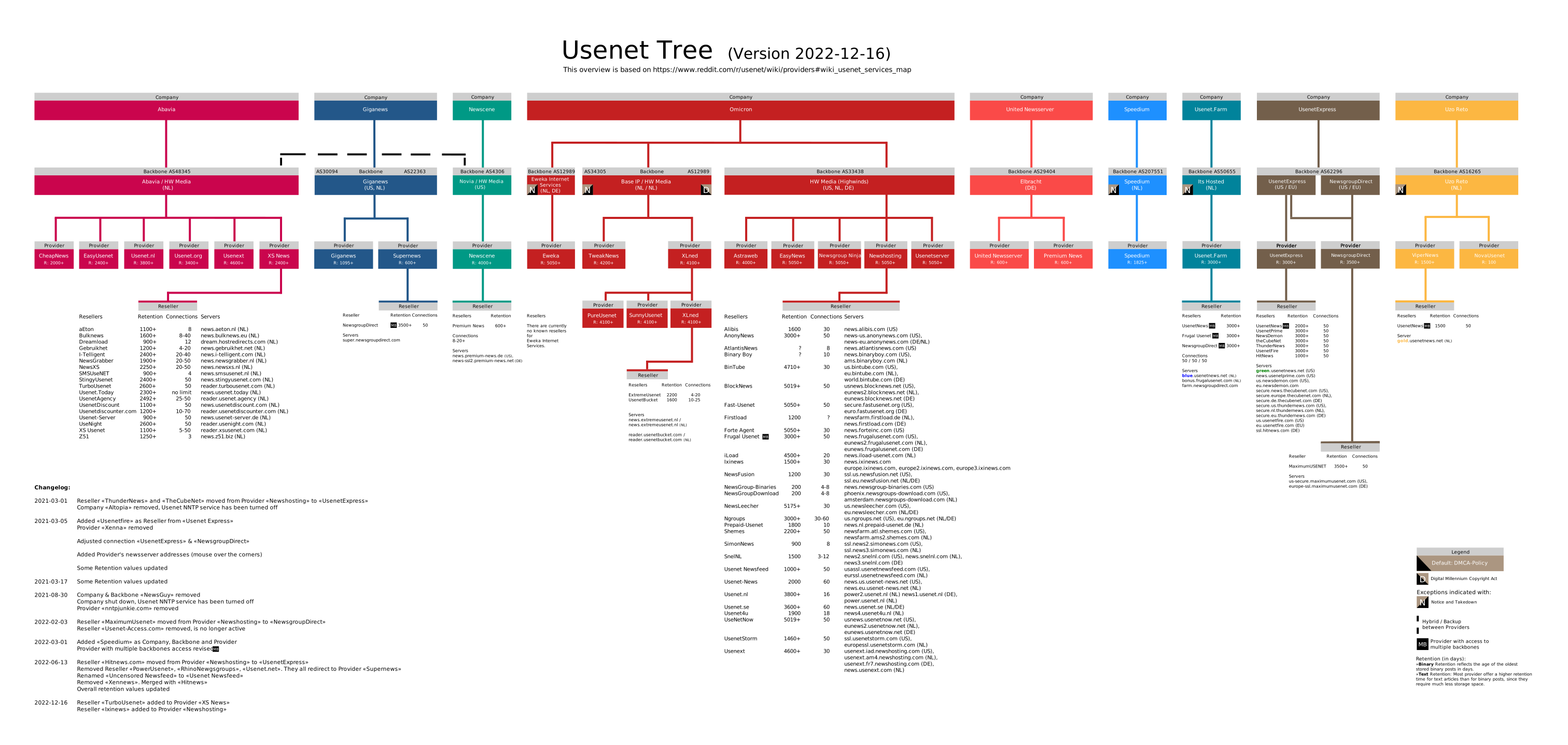
Provider backbone/list: https://svgshare.com/i/oti.svg
Seriously, a huge part of the internet is down because the team was taken out by Covid (both death and complications), and no one even mentions this? All the evidence points to the covid complication rate compounding with each infection. Rarbg is only the start of where we can all expect to be in 5-10 years without more serious long-term mitigations (universal indoor air filtration).
https://www.nytimes.com/2023/05/28/opinion/last-pandemic.htm...
https://github.com/iordic/qbittorrent-search-plugins/blob/ma...
seems like rutracker.org (ex torrents.ru) is gonna outlive everybody
Deeply sad about this. Nothing lasts forever.
[1] https://torrentfreak.com/rarbg-over-267000-movie-tv-show-mag...
Also, if I was the MPA, I would almost look into attrition tactics now, if that were legal. Create dozens and dozens and dozens of junk piracy websites with borked videos. Maybe the first half the movie in 720p, then the audio switches to Spanish and 240p black and white with flickering. Flood the market on every pirate website with the world's worst remuxes. Overwhelm them with junk so that nobody knows what tracker to trust for anything. Maybe even (with permission from rights holders) run some pirate websites with high-quality rips, then burn them to the ground after a year or two just to demoralize.
They will be missed!
I'm sad to see them go but I support their desire to spend time and energy/resources on something else after all they've done
I'm still curious how it's possible to run such global illegal operations without being exposed or caught.
How is it still possible to remain anonymous on the Internet, considering in this age the thing is very mature and well commercialised?
You can get away with quite a bit just by being silent, and for longer than you'd think. A big way that people get away with things for so long is just by not answering questions. Someone says, "Is this [illegal thing] yours" and you say nothing. Now you've got to burn hours and dollars trying to prove someone owns something so that you can go after them.
You'll find domains, web hosts, countries, and employees who are all onboard with the same philosophy. When everything requires a subpoena at the highest level to move something forward, it can easily take years for anything to happen at all. Some countries are known for having slow legal systems. Stack jurisdictions with slow court systems and you can start with an 18 month window before anything can happen.
You've got a domain in Tonga registered to a company in another country, owned by a large company in another country owned by a trust in a third country. Often small countries with limited resources and archaic or corrupt bureaucracies. And where is it hosted? That's probably another connect the dots. And the site can change hands and then you have to start all over again. Are you going to refocus on the new owner or are you going to spend even more resources trying to track down the former owner?
And any of these entities may lead to nothing more than a mule, fake person, or dead person. Sure, it's someone's fault for having inaccurate records—but who? How long has this been going on? Did they know? Was it intentional? It shouldn't be like this, but it is… what do you do now? Are you going to go after the recordkeeper too?
You can do illegal shit for years or even decades if you just say nothing and respond to no one.
The opposite is the German approach. Shower the cuntiest lawyers with money, lobby for laws allowing to easily pick a victim, bully the victim senseless. Lobby even more and if someone uses the word "corruption" in context of copyrights, bully the shit out of them as well. I'm so glad Anglosphere and German copyrights predators have been perfectly impotent for so many years. They know how to create faceless enemies.
A lot of people will be surprised by knowing what kind of businesses is ran from that shabby house in the corner by visibly low life mate driving 30yo celica.
Most of the time, these services aren't done in direct exchange for money or from people who have a lot of money in the first place.
So what ends up happening is even if they can avoid the shallow legal issues by remaining private, they then run into the problem that nobody can pay for the service (not many options for providing that transaction privately). You might think "just run ads" but the problem there is multifaceted, most are likely going to be using adblockers, on top of that to remain private they'll be locked out of most paying ads and only get the most spammy garbage incentivizing more to use adblocker to visit the site.
Because it is not obviously illegal. A tracker just points to the content, not the content itself. That may seem meaningless, but then so are the arbitrary demands of copyright holders. They want to have their cake and eat it too. So the system works as intended.
Because at the core, identity on the internet is not well defined. Authentication is a hard problem. You might wonder why it's hard, why better more secure protocols haven't emerged. Answer: that makes end to end encryption easy, among other things that give individuals too much power.
-
deep-fake assassinations are going to be a thing...
PHKahler
Worst case if they had enough money they could rent somewhere and pay for a decent internet connection and not actually live there, so only the equipment would be seized.
Is there a main reason why there isn't (AFAIK, even though I haven't really researched) a distributed search that wouldn't have these problems? Is it a tech problem that literally can't be solved? Or it just hasn't been done? It seems like search is the obvious weak link, since the websites keep disappearing or taken down or blocked by governments and ISPs, etc.
I hope somebody picks up the flag. Illegal and copyright-protected piracy aside, there were tons of royalty-free and non-copyright-enforced works of art there and it would be a big hit on humanity's culture at large for all that to be lost.
- js.
Where one piracy site dies, a thousand spawn from its corpse.
Maybe the media companies will eventually pull their heads out of their collective arses and quit their cartel, allowing the existence of legal, paid streaming sites a-la-Spotify with access to 99% of the repertoire. Until then, torrent is how we protest while they create more and more insular streaming services to milk people $9/mo at a time.
"Piracy is almost always a service problem." — Gabe Newell
(If you need a semi-private tracker that's easy to get into, try TorrentLeech. Also /r/opensignups)
They could either self-update the torrent [1] or just release the new torrent via forums/groups/chats etc. Would bring the costs down to zero.
Do they also search private indexers?
> Some are also fighting the war in Europe - ON BOTH SIDES
What an absurd tragedy this is. I think it bears mention between all this conversation about sharing torrents.
Such a tragedy. Fuck Putin
Anyone have any solid private tracker recommendations for movies and TV shows?
After taking advantage of public trackers like RARBG, I feel like it's my time to give back.
Unless you know someone already on the tracker and they are willing to vouch for you.
If you want a list head over to /r/trackers and use the search function.
also watch entry level trackers for open invites. speed, iptorrents, torrentleech, etc
The irony that I used to run a UUCP node on the original version of Usenet does not escape me :-)
That's how quality service looks like. Glad I pulled (here legally) all the movies I wanted in my private collection. RIP.
I read that Rarbg was like thepiratebay but safer. I guess that's due to moderation to check which torrents are safe, right?
This people had a website that offered a nice UI to find torrents. Did they had ads to make money? So they offered their services to maintain healthy piracy in exchange of money and also to pay servers. (I am not criticize or judging I just want to understand how it worked)
Would It be possible to share the same website using a torrent file? Like shipping and actualizing the website and sending to users trough torrent so they can search it locally? Or send a sql database and then create a UI for users to search trough it? Or would be complications because torrenting exposes our ip?
However, there was an update to the protocol, BEP44, that did allow you to update the already-in-progress torrent.
Furthermore, there is a protocol called WebTorrent that swaps out some of the other base protocols for WebRTC, allowing a web browser to participate in the torrents. You could just include a link to the library via CDN. The trouble of course is that bittorrent now relies on DHT more and more (you wouldn't want to have to run a tracker, if you did it'd just be a target of legal attacks)... and WebTorrent can't do DHT (of any variety) well. There was a proposal to allow browsers to be able to do native network sockets, but I think that got turned down by Mozilla (maybe they were more concerned with doing VPN ads or something).
But if you had that, then yes, it might be possible to have something like a "swarmsite" that didn't need to be hosted.
The main/original author disappeared but there are somewhat maintained community forks.
While we are at it, an honest question: Why should _anyone_ undertake the legal risk, monetary cost and development time burden for maintaining a public tracker?
What would release teams gain from setting up encoding pipelines and upholding their networking infrastructure?
Try a more extreme example: why should anyone undertake the legal risk, monetary cost and logistical hassle of hiding Jews from the SS? It's not some psychopathic business decision; it's because some people stubbornly insist on doing the right thing despite it being unpopular, illegal, and clearly a bad idea.
If someone does manage to turn a profit doing it that's (all else being equal) great, but it's not the point.
I wonder if The Scene is still remotely accurate by modern standards — https://www.youtube.com/watch?v=xIs_5nfJKu4
So said poor person learned programming and other skills to get a tracker working so that they could give back to others who are in the same boat.
This way the poor kid (who’s family can’t afford lunch, let alone a 10€ /month Disney + subscription) can chat with their rich friends at the lunch table about the latest marvel film the week it releases and god forbid, fit in for once.
Maybe it will come back in the future when things settle down or a new backer comes in.
When downloading from "reputable torrent tracker XYZ" you can trust the quality of the torrent, that it is virus free, etc ... It is also usually make searching for particular torrent easier (less like searching for a nail in a hay stack) and you avoid spreading the seeding potential to hundreds of similar torrents.
As a extreme example, BakaBT (a private torrent for anime/manga related torrent) has a strict "no duplicate torrent" policy. This means that if you are searching for the OST of a specific show, you will have usually only one result and it's the most up-to-date, highest quality version. Since it is the only option, everyone seed this one. It really diminish the issue of abandoned torrents. To "replace" and existing torrent, you have to provide a strictly better version.
A decentralized torrent search engine could not do that. The real value of torrent tracker are the community.
That is also why decentralized software like eMule/eDonkey lost a lot of popularity to torrent tracker: Lots of duplication, very dodgy download, no curation, virus, ....
Couldn't some form of blockchain work here? Like couldn't some form of distributed/democratized community curation and moderation happen by using the blockchain to manage the arbitration of new torrents (and their successors, like when the community decides New Random Anime X encoding to be a superior copy)? Plus you have proof of stake or whatever the leading mechanism is to help combat and filter out fakes/illegal activity (etc)?
Then you'd have blockchain managing the trackers and torrents managing the file sharing.
I once visited RarBG with uBlock Origin turned off by accident. The intensity of the shitstorm of fake links, transparent GIFs on top of the content and other stuff like that was overwhelming. I believe that it is universally stupid to trust torrent sites with anything.
This is also the problem with all distributed social networks. In the end, your options are formal centralization, and informal centralization, because absolutely nobody wants to live in true decentralization.
Here is straw man proposal, similar to cert chains and webs of trust: Say I'm a "curator". I say on HN/Reddit/Discord "here is my key hash 'p2pcuration:185da2bc59167692f596404fd83235f9bcb4e107b041f2e6e8d972da6dba00b7'". Any user that clicks the link or copies it into the search app adds the key to the trusted user list. With my private key I can sign torrents after I download them myself, which would mark the torrent as "good". When anyone who has added my key searches, the system searches for a corresponding signature from me as well. If a signature is found, the UI can chose to elevate that result.
The system could be extended so that signers could also sign other keys, expanding the trust network.
This system doesn't need to be run or maintained by each user. It could be served through a webui that can be run locally or shared with a small community. Migrating the interface to a new host would just require moving the config and keys.
oh, some ppl do indeed want to.
thanks to encryption they can. but i agree that the likes of kazaa, edk and freenet are not for most ppl.
Mastodon is big in Japan, and the reason why is uncomfortable ["child porn"]
https://news.ycombinator.com/item?id=15053064
Mastodon and the challenges of abuse in a federated system
https://news.ycombinator.com/item?id=17894684
How the biggest decentralized social network is dealing with its ["]Nazi["] problem
https://news.ycombinator.com/item?id=20429465
Trump’s new social media platform found using Mastodon code
The problem then will be, how do you make sure your content is legit? There's no magic way here, the best thing you can do is compare the number of seeders and aim for the highest. If a torrent is fake, people will delete it and it won't be seeded. I have a thingy for that: https://sr.ht/~rakoo/magneticos/
The problem then becomes, number of seeders naturally selects towards popular content. It doesn't ensure viability of content. But I don't think there's a technical answer to that.
DC++ is a bit more decentralized than BitTorrent. There still are central servers ("hubs"), but they don't even host any metadata. Search works by the hub broadcasting all search queries to all online peers and them replying with results if they have any. The file transfers themselves are p2p.
I have an idea that's kind of more decentralized. Initially envisioned as a missing global search feature for the fediverse, but can be adapter for anything that has a similar network structure. A server has a number of peers already established because of the ActivityPub federation. Each server would send to its peers some kind of bloom filter that determines the tags or keywords that this server has results for. Then, when searching, your server would find the peers who are likely to have what you want, and only send your search query to them. If there aren't any, then it would send your query to the peers that have most users (with some random bias for load balancing purposes) because they're likely to have more connectivity, and they would point you where to look based on their own peers and their bloom filters. There would also need to be some kind of reputation system (centralized server lists? p2p exchange of scores/reports?) so that servers that return spam or intentionally wrong results would get punished.
This could probably be made to work in a fully-decentralized p2p network, but I imagine it would be too easy to abuse. Getting a new domain costs money, yet getting a new IP or public key is free and easy.
For example, here is a personal DHT monitor where you can view what’s being announced on the DHT: https://github.com/retrohacker/taboo
Edit: found mentions of https://btdig.com and https://bt4g.org. I wasn't aware of the latter. A problem with the former is that it doesn't track number of peers.
It didn’t happen though
10-15 years ago, before Spotify/Netflix, people used to say: "As long as it's easier to acquire things illegally, people will continue doing so," and I think that has really been shown to be true.
And even if you look at popularity instead, Minecraft (so far as the more open Java version is still popular at least) single-handedly skews the results enough for them not being a clear win for the locked down games.
2 - Rarbg was a margin note in torrent community. There are others very much alive and better.
It was the 4th largest according to TorrentFreak: https://torrentfreak.com/top-torrent-sites/
https://torrentfreak.com/top-torrent-sites/
Of those most popular sites, I think it was by far the best. It offered consistently good encodes, with about the best achievable quality for a given file size, in a variety of formats and resolutions. Its files were well-organized with a user-friendly browser and a wealth of metadata. It was possible to quickly find a good version of anything not too obscure.
Compare to TPB, where searches just vomit a page of often-mislabeled files the user must comb through manually. Compare to YIFY/YTS, which uploads bitrate-starved "HD" schlock that looks worse than rarbg's 480p.
really?
i very much preferred it over pb or kat
Can you please tell me which ones or point me to a place that does?
1. Too expensive. This encompasses several varieties, like the media in question being literally priced more than the person is willing to pay, or the pricing is acceptable, but the person can buy only one of several choices and wants to evaluate all before giving one their money.
2. The product is not offered for sale. This is sometimes literally that the product isn't available for sale in your country, or the product is not available in a useful form, e.g. it doesn't come with subtitles in your language, it won't work on your device, it requires a stable internet connection, which you don't have, etc.
3. For political reasons, to avoid supporting DRM.
This is very much a practical reason as well, though this overlaps with "not available in a usable form". DRM is the reason I can't watch movies at the highest bitrates and resolutions on my device from Netflix or Amazon. It's the reason I can't trust that things I purchase will be available to me indefinitely. It's the reason I can't build a collection of media (e.g. with Kodi) that is playable on my TV with one click with a single unifying interface.
> The product is not offered for sale.
This extends to some other cases as well. For instance, where the only available version is a crappy remaster (Terminator 2), and the original is much superior. Or if you want to watch the film with a director's commentary.
There's also, very broadly, a 4th reason - convenience. This encompasses both ease of use (if I know what movie I want to watch, I don't have to search to see where it's streaming), and discoverability (a good torrent site will easily let you see all the movies by a director or actor, and provide recommendations). Or if you're looking for a particular special feature, it's much more convenient to be able to download it than to go looking for a physical media copy and wait for it to be shipped to your door.
pirating is in this case the best solution as I can pick the quality I want, with the audio and subtitle languages I need.
Then the Netflix catalog shrunk to originals, there's now 6 different streaming services I have to juggle to watch the usual content my family likes, and we're constantly using third-party services just to figure out what's available where. I hate having to switch from Netflix to Hulu to finish out a show because the last season is only on Hulu. Or things like Warner and Disney cutting shows because they don't want to pay residuals or whatever dumb accounting BS they feel like pulling.
If you make it more convenient to torrent and shove everything into Plex, why would I pay to get a worse experience.
Disney holding back the second half of the final season of Amphibia. Released in the US but not here for unexplained reasons. For 6 months piracy was the only way to get a conclusion.
Our Flag Means Death, even though it had a large section of its cast from Britain it wasn't available to watch for far too long here.
I could go on, but you get the point. Any distribution rules are a creation of their own making in the first place.
I have been hearing people make this same basic argument since the 90s. (I'm sure it's older than that.) During that time the price of video and audio entertainment has decreased while availability and quality have vastly improved. Despite this, piracy is still going strong. The ideological goalposts used to justify it keep moving, but the desire for free stuff is timeless. (Not judging here -- I've certainly done my share.)
Adjusting for inflation: Twenty years ago, a DVD with one recent movie cost ~$30, or you could rent one for $5-8. One album on CD cost ~$20. Buying individual songs for the then-unheard of price of $1.65 (99 cents at the time) on iTunes was brand new. They had limited bit rate and DRM, and you had to buy an expensive iPod if you wanted to use them conveniently. If you wanted good TV shows, you paid something like $60-80/month for cable TV (more if you wanted to watch The Sopranos) and had to watch on a schedule, with lots of ads.
If you compare that to today's world of cheap streaming services, high-quality DRM-free music, and even cheaper physical media, it's not even a contest.
And cable TV or films at the cinema are as expensive as ever.
Which is why Spotify has had an incredible success worldwide and music piracy has reduced dramatically: their repertoire is very comprehensive and mostly the same everywhere in the world.
People really want to believe it is a money issue, and they are just terribly misguided. Gabe Newell is absolutely right here, and he knows piracy, as he deals with the demographic with expensive needs (gamers wanting the latest $70 game) and the least money (as young gamers don't have a job, or don't earn a lot)
It is not a money problem.
Once again; the media companies are absolutely doing everything in their power to drive even casual media consumers into piracy. I wouldn't be surprised if piracy was already more rampant than it's ever been - but it's only getting worse, due to ludicrous streaming fragmentation.
It'll never happen, but the only thing that can save piracy is an aggregate all-inclusive monthly subscription platform where all the films/shows from all services are available, just like Apple Music or Spotify. I pay $30-40/mo and I have access to all the stuff on Netflix, Prime, Max, Disney...
When you stream a movie from Netflix, they get the credit. Disney? The same.
Nobody is going to pay for all these services, and more and more are ditching them altogether. The response of the streaming services is to increase prices and reduce content. It's hilariously embarrassing. They are asking us to pirate.
Maybe that's a bad thing. Having one central site rather than many is better for searching and availability of uploads.
I find this an odd argument in favor of pirating movies, because everything that steam offers for games, amazon prime or itunes offers for most tv shows and movies. In fact with amazon prime you can buy content and watch it on pretty much any kind of device out there.
Netflix was killing pirating when it had "everything", pirating is seeing a resurgence as the landscape becomes more fractured.
If the supply of torrented content dries up, it seems like many Plex shares will start to become very stale.
It goes both ways. There are no Saints to be found on either side.
I don't care one bit about the pocketbooks of our corporate overlords, and neither should you.
Providers are companies and servers where the data is actually stored, as opposed to peers in torrenting. Since they are for-profit, you need to purchase a subscription to have access to these servers. r/usenet has some nice deals on those[2]. Frugal is usually the most recommended for beginners since it’s pretty cheap and has most files you’ll want.
Indexers are similar to what rarbg was. They make it easy to search for files stored in the providers. They usually require a subscription as well, and some require invites, but are really cheap and easy to get [3]. nzbgeek doesn’t require an invite and is pretty complete. nzbplanet and drunkenslug have more content, but require invites. You can get invites for those on r/UsenetInvites
Finally, you need something to download the files. There are many options available for that, but I find that the best one is sabnzb [4]. It is pretty complete and has a lot of moving parts, so I recommend following the trash-guides article on it to get started[5]
[1]: https://www.reddit.com/r/Usenet/wiki/faq/
[2]: https://www.reddit.com/r/usenet/wiki/providerdeals/
[3]: https://www.reddit.com/r/Usenet/wiki/indexers/
[4]: https://sabnzbd.org/
[5]: https://trash-guides.info/Downloaders/SABnzbd/Basic-Setup/
Usenet is a lot of effort.
Plus. most of these are setup once and forget. Automation & not having to seed is what makes Usenet worth it IMHO.
And of course, torrents still have benefits and their place as well.
I have since switched to SABnzbd from NZBget. I saw a comment regarding hard to find things, I am subbed to two indexers and either I am not looking for obscure things or I am letting the other tools I listed do most of the heavy work. Prowlarr is doing most of the heavy lifting doing the searches for me.
I also wonder if Forte' Agent still works? Does Newsguy still exist? /s
edit: found the answer to my question
Running a website doesn't require that many people.
I've worked at companies with 4 developers and 30+ "other stuff". The company would not be profitable and we would not get paid without them, but the actual product would work just fine if we wanted it to.
Wow. You think legal, marketing, investor relations are all bullshit jobs...?
Just wow.
Seems their jobs aren't bullshit, then, are they?
No, and I didn't say that.
The model is that as users become more comfortable on the site, they eventually browse to the more dangerous categories and download programs/games/cracks/etc...
I wrote a blog post about a deep dive I did on one site, and showed that the admins were seeding malware in program downloads.
Suffice to say, when I reported the admins, other admins banned my account on the site and IP blocked me.
I actually ended up taking the blog post down because they started attacking my domain, and even Google blacklisted my domain because I had snippets of the malware code posted (I guess I should have used images instead of code). I was younger and just tinkering with security research anyway.
But it wasn't this site, was it? The most salient feature of Rarbg was that they verified uploads.
Some private trackers do not set the "disallow DHT" flag, so those will be indexed as well. Most do, however, and it's impossible to scrape those without an account, yes
A law firm would be useful in (a) applying to remove illegal content, (b) seize any profit generated by illegal use of clents' content, (c) (if the client requests) horrify users identified of such illegal services, (d) pressure the authorities to crack down on the operation.
Most lawyers do not understand the technical details. We do a hell of a good job of understanding experts' findings and put them in a clear legal structure though.
Most of the boring but billable job I ever made was searching through company registries, google searches, sanctions searches, panama papers searches, reviewing countless pdfs to either (i) mark them as privileged so they cannot be used as evidence, (ii) scan whether there are any documents that may directly implicate the client and if so try to find a way to legally claim it is unusable.
I believe law firms do provide decent service. Billables are there, but no lawyer I know would willingly generate busywork that does not lead anywhere to charge more. OTOH, I HAVE seen instances where a work got reviewed multiple times by different lawyers, because the client was willing to pay more. But even in these edge cases, multiple reviews did benefit the client and they received a better work product.
My advice would be establish a good working relationship with a lawyer in the firm that you trust, continuously send work. Ask estimates if you are on a tight budget. But do not be cheap and try to get things done with less budget. Law firms provide a service you need, if you pay them decently you'll receive your money's worth. Lawyers will literally take a bullet for you to make things happen when you need them.
Apologies for the long rant :).
What’s the order of magnitude here? There have been times in my life where I would have found having a lawyer on standby to be incredibly helpful (e.g. car purchase gone bad, property usage rights dispute, etc.), but at the same time spending $100k a year to have a lawyer on standby to resolve an issue of $5-10k in magnitude is foolish.
I am also talking about corporate law work. Maintaining corporate records, lease agreements, employment agremeents, director changes et.
The problem is that since it became decentralised lots of good actors and bad actors have setup mirrors making it impossible to know which mirror is good or not.
Ive been using 1337x for a few years now and it pretty much has everything I need
> o7 thank you for your service
(o7 would be a salute)
> Where one piracy site dies, a thousand spawn from its corpse.
False and nonsense, especially in 2023.
> Maybe the media companies will eventually pull their heads out of their collective arses and quit their cartel...
Okay, I'll stop here.
I'm fine with piracy, personally. I'd prefer we just admit that you're mostly using it to download movies, music, and television shows for free. This isn't some noble fight for freedom. We're talking about watching mindless bullshit content like Star Wars, without paying for it. Piracy proponents, and comments like the one starting this thread, make it seem like we're entitled to this content. We're not. But I'll admit, I don't watch much in the way of tv or movies any more anyway, so the whole debate is lost on me.
I just rolled my eyes at the ridiculous tone of that comment, like they're freedom fighters. It's self-important bullshit.
They even had to go through one level of indirection to make people believe what they made up.
They couldn't just say, watching digital copy witout paying for it is a theft because people would just laugh at them, no it's not.
They had to do a two step process through obsure old crime to confuse people. Using a digital copy without paying for it is piracy. And piracy is theft.
Consuming didgital content on your own terms has as much to do with theft as it has with actual piracy that got some resurgence around Africa in recent years.
maybe the p2p groups should copyright the encodings
I will say though that from what I hear, RARGB did do some nice value-add work though. For example, once HEVC/H.265 decoding began to become widespread, and its file size savings became very clear, someone on the RARGB side of things went through many hundreds of the most popular movies and re-encoded existing high-quality releases into very tiny (and thus very popular) ~1.5GB 1080p versions then started seeding them back up. They did this in a relatively short period starting in ~2019, and you can tell that it was a single person/group because all these encodes of movies include metadata about when they were encoded and the software used to do the encoding; all those movies had the same metadata and encoding timestamps that were pretty close together.
Funny anecdote; apparently the encoding settings they used caused problems for many people, leading to many complaints saying "why do only movies from RARGB stutter?":
https://www.reddit.com/r/Piracy/comments/n1497q/anyone_else_...
https://www.reddit.com/r/Tdarr/comments/13rv6j7/automatic_ra...
This doesn't count the issues with a site that is very popular, from bandwidth to even simple database search overhead. If I were to guess, it's that RarBG probably spent in excess of $10k/month, which isn't much if you're a startup with a runway of VC capital or a revenue stream, it's a lot more if you're in a smaller country or don't have an excess of revenue.
I had a what.cd (and waffles.fm) account in very good standing, but I never got on to RED, because I never really did the interview on account of having to idle on IRC for a long time.
YES. I have always wondered why YTS is popular, as the quality is always overstated and always garbage. sorry but 1 MBPS is not "HD", no matter what codec you are using.
For example, Nintendo consoles have been unavailable since the 90s — which is why we've been using these clones:
https://en.wikipedia.org/wiki/Dendy_(console)
and are still unavailable now unless you're willing to buy consoles and games on ebay, overpriced and without warranty (which is what some of my friends have been doing, but I refuse to support publishers that consider my American dollars second class to those coming from actual Americans).
So torrents it is, then. 'Fuck you' can go both ways.
I still don't understand how the communists managed to convince people that Marx saw things exactly in the opposite way.
Even now, you hear left leaning parties telling that "stocks are evil, one can lose complete retirements on the stock market" and in the same time "rich are rich because they earned everything in the stock market".
Putting retirement money into "balanced portfolio" of stocks also destroys competition and pits corporations against their employees in a fight to get them more money after they retire minus the profits of the bookkeepers or how are those managers called.
> "rich are rich because they earned everything in the stock market"
Insider trading. :] And also just buying index funds, with the save issue as above.
"Sir, is it time for us to claim to have corporate values?"
"Not yet, m'boy, we are still swimming in our private ocean of profits!"
On Steam, the offline title with the highest concurrent player count is Civ 6 on place 18, with 1/30 the amount of players of CS:GO.
On Twitch, Minecraft, which almost all streamers seem to be playing on multiplayer servers, is in 20th place, behind 19 exclusively online games.
I would estimate more than 99% of all playtime is spent on online games.
I can remember the online game thing starting way back when I was still playing. Quake had an ethernet option, and I remember something called "Unreal Tournament" spreading like wildfire around dorms when I was in school. My first though was "it's really fun shooting at real kids instead of barrels!" immediately followed by "this is going to be really hard to crack!" I figured every developer would move online by now just to kill cracking.
Legal is very useful in the general case, but if you're an anonymous torrent site operator who fully intends to ignore the law anyway it's a waste of time.
If you build a system for resilience, it should not take significant effort to maintain. You should be able to keep the lights on with 10-20% of the engineering team. The rest is growth.
Growth may be making the product better, creating new product lines, or improving the scalability - for example, allowing larger numbers of users or entries. However, you can make the choice to make a well constrained product that serves a valuable use but doesn't need growth. Consider Bingo Card Creator, for example.
After 10+ years you always see the operational demand increase because of all the necessary edge conditions you build up (backcompat and whatever else).
Yes, the cost of change by definition increases with the complexity. I don't think that is in contention. Why is it changing for any other reason that you're growing (or trying to stave off decline?) For internal tools, change may be a function of external business pressures (like a supplier going out of business, requiring changes in an internal tool), but that is asking for new software.
As you add libraries, the cost of maintenance increases because the surface area of security increases. However, short of major changes (React, Rails, Etc), this feels like it's not moving outside the 10-20% range.
Then, there's the cost of keeping it on.
Sure, they're necessary if you have an actual company, but the point is that you can run a website without a company.
A lot of seriously dense replies to my comment, seemingly wilfully misunderstanding.
_Obviously_ the legal department at an actual company is not bullshit.
In this case, the reason is that being it in a sensible position, they must have chosen to close rather than to involve more staff.
Radical notion these days. Everybody has an ulterior motive, probably one you find offensive, and you have to read between the lines and make uncharitable assumptions about their motives to find them out.
am 100% okay moving the risk to the operation/operator
Perhaps because copyright infringement is not really a criminal issue but more of a civil law one. Without a private party starting lawsuits on behalf of the copyright owners there is nothing happening. It could be they don't have one.
What about the right of the privacy of communication? Oh, right, it's the state-owned postal services that have to respect that right, and only with regards to the paper letters, not the privately operated ISPs that can (and obliged to) wiretap at the slightest suspicion of crime.
Lobbying is always happening to require ISPs to cooperate though.
- Germany sends letters and fines
- Czech Republic doesn’t send letters or fines
- The Netherlands doesn’t send letters or fines (unless you share an absolutely ludicrous amount)
- Belgium doesn’t send letters or fines
- UK sends letters and fines
- France sends letters (tiny chance of a fine)
- Switzerland doesn’t send letters or fines
Maybe it's changed in very recent times, I wouldn't know.
https://torrentfreak.com/vietnam-could-kill-several-major-pi...
Potential Impact on Major Pirate Sites as Vietnam ISPs Face New Responsibilities, May 12, 2023.
> “Most Voluminous” Copyright Decree Ever Issued in Vietnam
> Global IP services firm Rouse reports that with 8 chapters and 116 articles, Decree 17 is the most voluminous copyright decree ever issued in Vietnam.
> “[T]he Copyright Decree provides significantly detailed guidance on copyright enforcement, especially which disputes can be classified as a copyright dispute, how to establish acts of copyright infringement, and how to calculate damages caused by infringements,” the company reports.
> “The long, detailed section in copyright assessment is also expected to pave the way for the growth of the currently limited copyright assessment services in Vietnam.”
https://torrentfreak.com/potential-impact-on-major-pirate-si...
That all said, I'm always amazed that these sites don't just move to i2p/tor. The torrents themselves have been decentralized with DHT and magnet links for awhile. At the end of the day it seems like they've just been hanging on trying to avoid being so in the shadows that they get less traffic as a result.
https://www.domstol.se/patent--och-marknadsdomstolen/om-pate...
I see 100 (!) results for that movie's name. 49 of them have zero seeders at all. I don't know what even is the point. 29 of the results have one seeder. So already, 78% of the results are pure crap.
Let's look at the top result with 338 seeders: File is 3GB, H.264 video, 1080p, but with a crappy stereo AAC audio encoding... arrggh why??
Number 2 result with 84 seeders: 1.43GB, H.264 video, 720p, no word on the quality of the audio encoding. Even more worthless.
Number 3 result with 17 seeders: HEVC format, 2160p, audio streams include TrueHD Atmos 7.1, DTS-HD, Dolby Digital 5.1, stereo, and three non-English language streams. But, with an eye-watering download size of 61GB. Holy shit! Nice, but wow, what a download.
You have to go a few more down the list to find a good balance of high quality video and audio encoding, but with a reasonable file size. By that point you're in the single digit number of seeders.
Don't get me wrong, it's great to have a few choices and quality trade-offs. I guess there's someone out there who doesn't care about the stereo audio because they watch their movies with laptop speakers. But 100 results, with the vast majority of them either unseeded, poorly-seeded, or flawed in some way. I agree with OP: You definitely want some curation, not just search!
Because you are vastly overestimating how much most people actually notice or care about this.
Stereo doesn't imply low fidelity. Just as 7.1 Dolby Unobtainium doesn't imply high fidelity speakers.
0 seeders now doesn't mean forever. Some seeders only hook to the network once in a while, long enough for a few leechers to fetch it all. If the content is in demand enough then a few seeders may be left and suddenly a 0 seeder search result becomes an attractive one. Even curating is complicated for the human eye, so good luck automating that.
Sometimes disconnect from site seeder count is bigger, and say 1 seeder mentioned is actually 15. But that was never rarbg's case, it was reliable and dependable like no other similar service. It also had IMBD rating so I could quickly weed out not so great stuff and focus on well rated ones, it generated maybe 60-80 movies a day with my filter applied, so quite a stream. After 2 week vacation, catching up took some time.
I used to, including today, to just go there every day or two and check whats new with my predefined filter. Often great movies that I never heard about before, old and new alike, took 2 mins to get 1080p x265 variant. Glad I've still managed to download that highly rated turkish movie this morning.
But this couldn't be easier to game. All you have to do to be a seed is to report that you are a seed. You don't even have to send any data.
But indeed it means that you are very exposed if the site ever gets taken down. And what we've seen in the netherlands: The site owners often hand everything over when they're caught because they're threatened with huge fines.
Initially the plan was to ban those people from internet for a period of that but it got removed since it was anticonstitutional.
They are paid. If they're not paid enough then that's on the companies behind the production of those shows and movies.
These corporations make billions. Piracy isn't hurting them. However, these corporations are causing harm to society. It doesn't make sense to white knight for them.
I'll add, since I'm not the person you were replying to, I don't care about who gets paid what. I don't care if the actors get paid or not. All I care about is some basic consistency if we're going to have morals about anything. Is it wrong to steal? Yes? Then piracy is wrong. (Or, no? Then let's skip this conversation entirely, you are my enemy.) Yeah, piracy is pretty easy. Yeah, it feels harmless when we do it. Should individuals get fined tens of thousands of dollars for infractions? No. But I'd say it's about as wrong as stealing a loaf of bread from a grocery store. To pretend it's a noble cause is transparent garbage, and unless you can pose an argument that doesn't complain about how much corporations make, I'm not interested.
There appears to be nothing underpinning your worldview for why the industry you work in ought not allow open thievery, but this one should. Yes, their corporations make billions of dollars, just like in every other industry where theft is not tolerated. Or perhaps you support open thievery everywhere at any time, in which case, like I said, you are my enemy.
Using open source software is stealing because in fairness somebody has to pay software developers.
Also watching ads and not buying the product is stealing because somebody has to pay the actors in those ads and people who make those ads.
I take my kids to the movies. I subscribe to services like Apple Music and TV+, and HBO Max. We watch YouTube videos where there's sponsored content in them. We buy officially licensed merchandise like clothing and toys. We buy books, both physical and digital.
And, frankly, it doesn't matter what I do personally. Millions, hell billions, of people around the world do as well.
If artists are struggling it's because they're not getting paid properly by the corporations they work for, like Disney, Netflix, and others. It's not because of individuals like you or me or the people that run piracy sites.
This is false. Artists get paid residuals, meaning, per sale, so every non-sale due to piracy is literally coming out of artists' pockets.
We're so instructed we've gotta wear ad-blockers.
For smaller players, they'd have to think really carefully about whether they want to engage in multi-year litigation with them.
Google has paid something like 10 billions dollars of fines in the EU during the last decade. I don’t think they are giving the run around to anyone.
Google does not store files it should not.
Like saying a site mentioning that you should look for “cannabis” if you want to get high is illegal. Selling the substance is illegal, telling you how it’s called isn’t.
It is surprising to hear because as a user they _seem_ like a link. Copy the link into something and get the (illegal) files.
Here's a random RARBG magnet link that may or may not work
magnet:?xt=urn:btih:468043aa374080fed5ff65e4cd8d4fed002986b5&dn=Rizzoli.And.Isles.S05.1080p.WEBRip.x265-RARBG
It doesn't link to a file or embed any tracker names but it does name a 1080p HEVC (x265) encoded season pack of season 5 of a US police procedural drama (which is excess and unrequired but humans do like readable names)
What it does provide is a unique hash code that matches the exact torrent ... should you find it.
When you add that magnet link to your torrent client it triggers the act of polling any public trackers your client knows about and any peers that have "hit me up about magnets" enabled.
Ideally word spreads and eventually some other client | tracker hits you back with word of other peers that at least have some cannabis .. (err, bits of Rizzoli&Isles Season 5 HEVC pack).
To actually find the content in question you take the link, go on a peer to peer network, and basically ask machines if they have the content in question available or know where it is. There's various ways to do that, in some cases your torrent app might know the location of some centralized "tracker" servers, and ask those servers whether they know locations for those files. Some torrents are "trackerless" and use a DHT, a type of distributed database that keeps information about where to find files.
ISPs do that, but it's a lot worse if you consider your mobile provider to be an ISP.
https://www.forbes.com/sites/adamtanner/2013/07/10/data-brok...
https://www.vice.com/en/article/nepxbz/i-gave-a-bounty-hunte...
I wonder if they ‘stand up in court’ and/or have ever been tested too.
Meanwhile, Google will just keep on Googling...
Even if it is theoretically possible, it create a huge barrier for entry, a lot of user friction, issue with governance and distribution of power, exploit, etc. And it is extremely hard to put in place for something that can be replaced by a generic phpBB forum in an afternoon. It is like trying to make a ICBM to kill a fly.
And cryptocurrency is usually used for illegal stuff, so it is not necessarily desirable.
In the Bitcoin world, Ordinals have started to make waves as they are a creative use of unintended consequences. This will likely spur other innovations.
In the EVM world, DeFi is still used all the time. It lost a lot of steam from the last bull run, but trading, be your own bank, interest arbitrage, options, perps, all of that is still going on quite a bit. New sites are popping up all the time. LybraFinance LUSD/eUSD is one of the more recent ones.
Downloading happened over usenet, but curation and discussion on a centralised website. The site got seized and the community moved to a new forum that runs on usenet itself.
Blockchain is overkill here - don't need a coin or stake or whatever
True, it worked really well for a while but lately it's been pretty terrible due to local copyright representatives suing major uploaders and others stopping because they just got old.
Also the notice & takedown has really killed usenet a bit. Private trackers are hard to get into just like with torrents.
My best guess is most bittorrent enthusiasts (and myself) would like to see a more natural solution to the decentralization problem. "Natural" being incentives which arise around sharing / not sharing and similar, vs straight up money incentives.
A reputation system could work but again, Sybil attacks could happen. So some how the network needs to figure out a way to make certain actions more expensive in the large.
Blockchain sounds lile experimental engineering
The network of sharing software and movies is much older than the internet. Eventually you just purchase a preloaded data carrier from your local pot dealer. The drives are so large, the formula would go dramatically faster than BitTorrent. Shipping [say] 10 kg worth of data carriers is amazingly cheap.
Looking at some random portable drive 10 kg box / 0.265 kg = 37 drives and 37 * 5 TB = 185 TB ? Something like 100 000 to 400 000 hours of film. Good for a maximum fine in "lost revenue" of $ 1 000 000 000 000 for the single box.
There is a lengthy therapeutic treatment program between that stage and the torrent websites.
Eventually some bean counter will discover crowd sourcing Police Academy 8 and people will just give them money provided they desire to see it. Star citizen raised over $569 million. On the most profitable movies list nr 191 is Fifty Shades of Grey with $569 million from a budget of 40 million. I can see the problem, with crowd sourcing it would be like normal work. That extra 500 million would be unlikely. They would have to make 10 movies.
IPFS might be a more modern alternative but it has similar issues. It's used for fairly small files such as books (libgen) but not really for movies.
Edit: Or do you man the torrent files only? That might work but they really are just links, it might be a bit overkill for them.
Seriously, screw Germany here. The way they oppressively Gestapo your internet traffic just to catch you downloading an mp3 to treat you like criminal menace, is unheard of in the rest of Europe.
Can't believe the so called "privacy conscious" German public are okay with this invasiveness of their internet privacy when they're the only EU country as hardcore on this "issue".
If only they would invest as much resources in digital innovation as they do in catching people download a DVD rip, Germany would rule the tech world.
I don't think it's expensive, once you've the software: 1- regularly pull the torrent IDs from the latest releases on most popular torrenting website 2- download and stream the movies 3- wait for German IPs to connect 4- filter out IPs behind a VPN 5- identify the IP provider 6- send the request, probably by Email 7- profit
Not sure how advanced the software, but I don't see much manual input needed, it must be actually very lucrative
> Can't believe the so called "privacy conscious" German public are okay with this invasiveness
Nothing against Germans but there is a lot of hypocrisy in their society: - Energiewende vs. shutting down Nuclear Plants and turning on Coal - Green cars vs. 300km/h on the Autobahn - Go to a restaurant in a big German city, guys tell you they don't accept cards, then hand write the bill on a napkin (...) vs. Greece where restaurants are legally obliged to accept cards and if they don't, then you can just walk out without paying (!..) (all this since the EU driven by Germany bailed Greece out)
They got rid of the laws that targeted people by race and background, but they never bothered to dispose of the jack boots.
Sometimes I pirate it, sometimes I buy it. Sometimes I consume something free instead. Sometimes I pay for the stuff I don't consume at all. But the substitution is always in the direction of cheaper, more available solution. Never in the direction of buying something.
There were cases however when me pirating something eventually turned into a sale or even few sales.
It's truly bizarre that so many techies complain about the "cost" of artistic works while they sip their $20 lattes and go to their six-figure jobs with ergonomic chairs and free snacks.
https://arstechnica.com/gaming/2017/09/eu-study-finds-piracy...
What's bizzare is that some of those rich people you mention actually internalized corporate made morality toward "intelectual property" and proselytize it as if that was their full time job.
To them piracy is and always has been theft, the way that Santa is wearing and has always been wearing red.
On the flip side, these corporations take from society and refuse to give back thanks to ridiculously long copyright protection terms.
They take advantage of their workers, paying a fraction of a penny to them that they make.
They screw artists over with bad contracts or lousy residuals.
They defraud investors by purposely producing works they know won't perform well.
They use things like the DMCA to bankrupt anyone that tries to write software that gets around DRM.
They threaten to sue people into oblivion that use P2P software to download something they "own."
They cover up the crimes of pedophiles and other sexual predators because they make them money.
So, again, I don't care about the pocketbooks of these corporations. I don't care that someone can download a movie without paying for it. I don't care that groups like rarbg or TPB exist.
> you are my enemy
This is exactly the type of thing an internet white knight would write. You're ridiculous.
> This is exactly the type of thing an internet white knight would write. You're ridiculous.
I'm responding to a comment that is defending another comment that said:
> o7 thank you for your service
> Where one piracy site dies, a thousand spawn from its corpse.
Et cetera. Have a nice day, enemy.
Cool. Brushing off what I wrote instead of addressing it. Good job.
> I'm responding to a comment that is defending another comment
Then perhaps you should respond to that comment instead.
> Have a nice day, enemy.
Ah, never mind, you were in fact responding to me.
Farewell, Ser White Knight.
Ridiculous.
Sorry to be picky, but I think it's important to remember that intellectual "property" rights are a legal construct that societies create in an attempt to make society as a whole richer by encouraging creativity. I worry that overuse of metaphors like "property" and "theft" elevate IP to a god-given commandment (thou shalt not steal), obscuring the fact that we should design our intellectually property rights to ensure they're doing what we want. Enriching creators is not an end goal in itself.
And I find it hard to believe that the spirit of these laws was intended to target end-users who copy something to watch for their own personal enjoyment, rather than to target people who copied works in an attempt to earn a profit personally. The only way the punishment fits the crime is in the latter situation, IMO. Yet I assume the laws are applied more frequently to the former situation.
The Dutch ISPs fought this in court but they lost in some cases.
How I can take out a collateralized loan, anywhere in the world, without having to ask for approval?
On the person 'supplying trust & owned property and getting a stablecoin loan', the other side of some Dai loans, there is real value being created there as they can use cheaper credit to invest in their business.
Most of the value goes to people in places like Argentina & Nigeria facing massive inflation who are now able to hold an asset that is backed to the dollar and overcollaterized by crypto, western bonds, & real properties held in the West, which is a better option than pretty much anything they can get in their home country.
What you do with the borrowed funds is up to you and there are an endless stream of possibilities. One example is to re-lend out again for additional interest. Interest arbitrage is a way to make your existing capital, work for you.
Lend BTC +1%, Borrow ETH -3%, Stake ETH +5%. 2% profit on the ETH and 1% on the BTC. Of course, you could then sell the profits for say, USDC, which you can then lend out again (~4%) or use to pay your bills or drug habit or whatever...
At the end of the day, this is what banks do with your funds. But instead of giving them the vast majority of the interest, why not take the interest yourself?
Larger picture, I personally see this as the opposite of credit cards, which are a blight on society [0]. People go into debt that they may or may not be able to pay off in the future. Why not reverse that and teach people to not spend more than they can pay off (collateralized loans)? You're punished with liquidations instead of stupid high interest rates.
[0] https://www.cnet.com/personal-finance/credit-cards/americans...
I have 1 BTC, worth $27,000 today.
I lend that 1 BTC. I'm getting 1% on it. This is better than the pet rock that it otherwise is.
I can then borrow safely 50% of the value of that BTC, so $13,500 worth of goods. Now, I've magically given myself an additional $13,500, that I didn't have before.
The price of BTC would have to drop 50% before I'd be liquidated (some of my BTC would be automatically sold to cove the loan). Certainly, BTC can drop 50% in value... but if you are paying attention, you should have more than enough time to pay back that loan or add more BTC. In practice, BTC drops that much slowly over time (like a month or two), not in one go. It also works the other way, if BTC gains in value, you have less to worry about.
Let's say I pick to borrow ETH ($1800). I can now borrow 7.5 ETH at 3%. I can then lend that 7.5 ETH at 5%. I can then take those 5% earnings and sell those or even restake them.
Money legos. None of this requires permission or credit reports, just transactions on a blockchain. If you use a chain that has far lower fees (like Polygon, Arbitrium, Avalanche), then the fees are a rounding error in the cost of operations.
No. If you pay attention there can be a message at the bottom of the search results telling you how many results were removed due to takedown requests. IIRC, they used to even link directly to the request, but now I think you have to jump through hoops to see it.
The "loophole" is that a takedown request has to be for a specific URL, so it requires a lot of constant effort to even try to get them all. Pirate Bay always had dupes and a million mirrors.
but in the case of Google linking to the pirate bay, isn't the pirate bay the one linking to the pirated content? Google is 1 step removed in that node graph because they are just linking to the pirate bay.
I guess if they directly linked to a pirate bay page that had a magent link on it .... maybe (?)
Instead of removing, they just remove links by request.
Sources: https://torrentfreak.com/google-opposes-whole-site-removal-o... and https://www.scribd.com/document/286275022/TorrentFreak-Googl...
-
However they did ban Pirate Bay in the Netherlands after a Dutch court ordered them.
https://www.makeuseof.com/why-google-removed-pirate-bay-from...
Also, Google's takedown request handling in Google Search is not a matter of DMCA or a legal matter at all - instead, it's like Content ID, where they have their own system for evaluating takedown requests separate from any law. Rights-holders can still send Google legal requests, but it's easier to go through the expedited processes Google provides that also won't increase rights-holders' liability if they happen to submit a false takedown.
While I don't doubt that a torrent link shows up once in awhile, Google no longer usefully searches for such things. Or really anything, legal or not. It's more like a purchase recommendation system pretending to be a search engine.
Bing and Yandex will get you most everything you want.
At the bottom there is a message that says "In response to a legal request submitted to Google, we have removed 4 result(s) from this page. If you wish, you may read more about the request at LumenDatabase.org" and links to https://lumendatabase.org/notices/27615507
I'm in Canada though. But I did use Google.com.
Here's a guide to the legal status of torrents here with broad categories, from most lenient to most strict (caution VPN spam): https://www.vpnmentor.com/blog/torrents-illegal-update-count...
Interesting to note that downloading copyrighted content for personal use is explicitly legal (not just overlooked) in Spain, Switzerland, and Poland.
edit: it's also for a "proxy" site. I don't really use torrents or follow TPB happenings and don't know how that is/isn't affiliated.
indeed. as it should, if it's relevant for the search.
I do see the distinction you're trying to make though. That's why I qualified it with the word "collaterlized".
Let me also correct you: "Let's say you have one bitcoin. Your funds available for spending are $27,000".
No, we're not talking about selling the bitcoin. There is no 'spending' here. What you're doing is borrowing against the value of the bitcoin that you're holding. You don't need to sell it, you're using it as collateral. The system can liquidate you.
But there's also another fundamental difference: even if there's the expectation of removing all copies of the same exact file, it is "trivial" for MegaUpload to know, by using hashes. They do have access to all files, as it is in their servers.
For Google to delete all pirate links to movie X it would be much more complicated, and would put them on a position of being forced to be the internet police.
not if they have the encrypted content only, and the decode key is only in the hash portion of a url, which never goes to a server.
But i guess crafting a technocal "solution" to a legal problem doesn't work, since the law works off intentions, and how much money you pay lawyers...
1. There is no restriction that the asset being borrowed and the collateral are in the same asset class - loans can be extended based on whatever criteria the DAO in charge of the Dai votes on. There are a number of loans backed by real property investments in the US, see [0] under RWA. There are a number of loans also backed by large holdings in US bonds.
2. Dai is pegged to the dollar. It can be instantly exchanged with the dollar at a number of onramps. It is not equivalent to holding volatile crypto like ethereum.
[0]: daistats.com
> How I can take out a collateralized loan, anywhere in the world, without having to ask for approval?
I agree that the overcollateralized loans backed by crypto are less useful unless you want to be investing crypto, which is what I mentioned at the beginning of my comment. I am not the commentator who said the thing about anywhere in the world without approval.
Huh? That confused the heck out of me. How would you get the same car that you're renting in a different color?
Just like people invest in a house and take equity out on it. Or they buy gold because they think it'll go up in value over time.
Regardless, you're being pedantic at this point. Back to the original discussion, there is utility to crypto now, and I've proven a way.
The point is that, unlike consumer loans, such loans require that the borrower has savings before they can take the loan. For example, most people who take a mortgage do so because they don't want to save money for 30 years before they can buy a house. They want to buy a house now, and save later. A mortgage loan allows them to do precisely that.
These other loans don't, and so they're less useful. They aren't completely useless. It's just that in most circumstances they aren't useful.
Loans in decentralised finance use smart contracts, instead of relying on the legal system.
Code over law.
EXACTLY my point. If we actually turned lending and borrowing around so that you had to have collateral first (1), that could actually transform an entire economy, as well as people's minds away from spending what they don't have.
Credit card debt is at all time highs and they are raping people with high APY's on those funds.
(1) In SE Asia, they don't have the concept of credit reporting agencies and thus their 'credit cards' are all collateralized (what we refer to as debt cards). Living there is what turned me onto this concept and how it is a better way to do things. You can't spend more than what you've already deposited and you actually earn interest on it too!