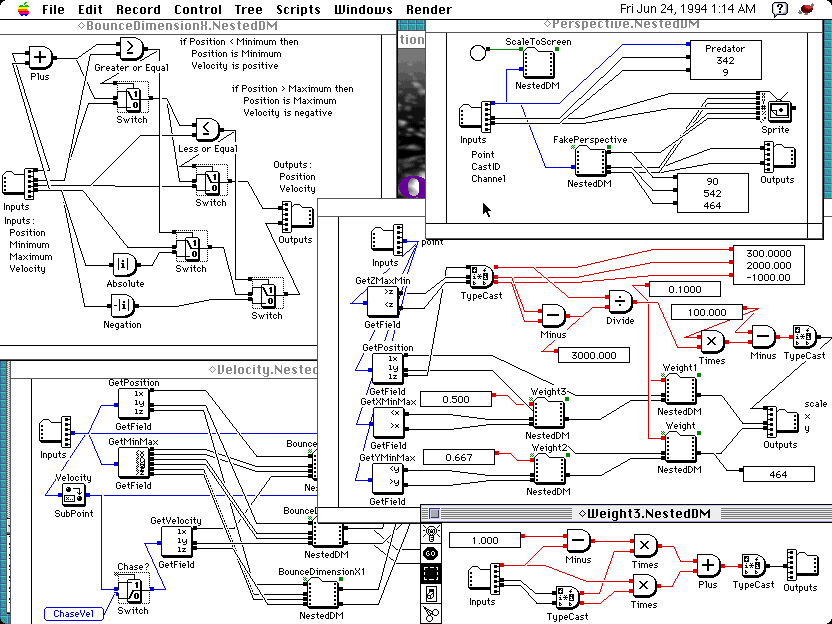
I do have several large high-resolution monitors (8K, 4K, 4K, 4K, and a small 3K), and I have a workflow that relies on that.
But that setup definitely doesn't fit in a backpack. So the idea of duplicating this inside a spatial computing environment is really exciting, even though everything released so far doesn't quite cut it.
But aside from the portability angle, another way to leverage the possibilities would be make the OS, probably using applied statistics trained-model techniques, really good at helping move the 2D planes through space (basically, re-arranging the windows or "screens"). 4 monitors is really all I can get on my desk. In theory I could like, ceiling-mount a row of three more above the main row of left-center-right but IRL that would be way too much work and too low-benefit to be worth doing.
But in a virtual, spatial-compute environment, all kinds of things might be worth doing. Maybe I have 40 or 50 2D planes for editors, debuggers, design schematics, and a team of flying robot ninjas with jetpacks who can instantly move them in and out of position.
The main rationale for a multi-monitor setup like mine is to "see everything at once". I do know how to press Alt-Tab and use virtual desktops, and I understand some people even prefer that workflow.
But for me the ability to keep the main work front and center, but everything in my field of view and glanceable, eliminates hundreds of instances of what would otherwise be window/desktop switching, every day.
If I had Jedi powers, would I just fling a few more monitors to hover in the corner of my room near the ceiling? Sure I would. Why do I need btop taking up space on my main screens? Or my chat thing that I will only use a couple times?
The only reason is that I only have these monitors, right on my desk. In theory I could like, wall-mount more displays for those things I don't really care about, but the effort and time investment to do that is totally not worth it.
But in theory a spatial compute environment could go hog-wild putting less relevant info farther away, but still in view, using space in the room that we just can't practically make use of today. All my screens are 60cm or so from my face.
I suspect we will see novel ideas around how to position these 2D planes, and use applied statistics/trained-model techniques to make the OS better at helping manage them (in a useful, but perhaps also delightful, way) before we transcend the 2D-plane "window" metaphor.
I also don't see avoiding keyboard, for programming or other text-input-heavy tasks. The mouse, though... I mean, we'll see how the eye tracking works once they really ship it. I could see the mouse becoming obsolete on computers that are 20mm away from your eyeballs and know exactly what you are looking at....