Cheap things mean there are made disposable.
We have way more options today to make cheap disposable goods than what existed 70 years ago.
>> "capitalism breeds innovation" haha
Indeed, in many areas, 'capitalism' has not produced innovation that benefits anyone using the products, but merely increases the ratio of cash extracted from buyers in return for reduced value provided by sellers.
The idea of a "free market" is an absolute fallacy.
Every market has some set of rules and regulations. At the definitional level, it is irrelevant whether the regs are written, spoken, or tacitly understood, or whether they are enforced by law or self-imposed limits. Without regulation, no market lasts.
The question is what regulations exist and how they are enforced.
With very little regulation, markets coalesce to monopolies; the strong/wealthy get stronger & wealthier, and buy out or force out the smaller players. Even without explicit collusion among large players, they have the ability to sustain predatory practices to kill upstarts or buy out any promising ones. With collusion, they can enforce predatory low quality and high pricing on entire nations.
Which is what we see here. The barriers to entry are high and the competition is so little that the entire appliance market has been massively enshittified — there is literally only crap available (unless you want to go full professional restaurant or hotel equipment). Even multiple different brands are literally made to the same specs in the same factories. I don't recall the details, but this was the case over a decade ago when we last looked for appliances, when it was bad enough that we found a couple new-old-stock from a previous mfg year of some units we knew were good. And I repair them when they need maintenance b/c it's only worse.
This is only one of many industries, and tech is even worse, where incumbent positions and insane piles of capital effectively kill off any upstarts.
Anti-trust needs to be a LOT stronger, more clear, and rapidly enforced.
The complete version is "Capitalism breeds innovation for getting consumers' money out of their hands".
This idea proved to be a nice one, but unfortunately it includes humans.
In a more broader sense, we needs checks and balances. A better version of this idea is a "bigger government", where government not only regulates, but builds the baseline products which pushes other companies to compete to build better goods.
But this generates tons of brouhaha. It's called "communism", "non-free markets", "government intervention", etc.
In reality, private companies hate and despise real competition, because a corporation is (or has become) an establishment for generating shareholder value, not make customers happy beyond the level required to keep the company afloat.
If you want a fair comparison, go spend $20k+ on big fancy commercial refrigerator. I guarantee it will be better than the '50s model.
Just to throw one more comparison. It is not shocking to say that a Rolex watch or a Leica camera from decades ago is better than a Swatch or a cheap point+shoot today.
TL;DR: It's not true that they were better at making things in the olden times. It's true that luxury high end goods are superior to mass produced goods.
The old ideal of "make really good, quality products and you'll prosper" has given way to "make really shitty products that people will pay for anyway, and you'll prosper more"
Just some thoughts
New equivalent fridges didn't even had a door for spreadable butter, so I didn't buy any without continuing searching bot the best one.
Then I realized the lamp never turns off when I close the door. The door sensor isn't easy to replace, I just removed the bulb and bought a rechargeable closet lamp with a movement sensor online. 12 euros. Problem solved.
Btw I read here I should check the power consumption, we have a rather easy way to do it in France.
The process didn't change all that much, neither did engines used in compressor so it is mostly "how well isolated the fridge is"
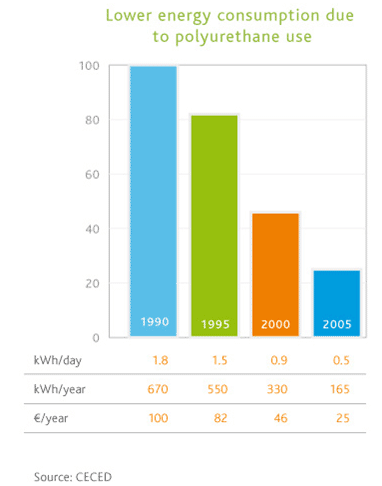
I doubt the refrigerator from 70 years ago had blown foam insulation (polyurethane insulation was introduced in refrigerators in the mid 80s), so it probably had terrible efficiency. It may have clawed some of that back by lacking automatic defrosting.
https://dura-foam.com/assets/images/2-0/energy-consumption.p...
It's cost me $400 to replace both drawers -- 1/3 the cost of a new refrigerator.
I wish I had one of these refrigerators; they look virtually unbreakable! And even if it did break, I could hammer it back into shape or weld it back together at home.
[1] She's bent both her house key and her car key, and broken the car's shifter twice!
If you think about that last sentence, what they can sell is not "what customers want". And therein lies the problem and the question. Why is it that those two things are not equivalent? The ratio of things that are what I want to buy compared to what I buy is surprisingly low. That ratio is probably highest at Ikea.
I use Amazon a lot and searching for "things as I want them" is surprisingly hard. I often search for something then try to find the best lowest price ones that have the highest ratings. Like which refrigerator has the most stars and the most reviews at the lowest price. Amazon does not want you to shop that way, because it would affect their bottom line. (thanks a lot amazon!).
So my take is that how we shop determines what companies can sell and that - in turn - determines what kind of things we can buy.
The stupidest example of the problem that I can think of is a dish rack for washing dishes. The number of really bad/over priced products is enormous at both Amazon and IRL Walmart. One day (out of many) Walmart actually had a FUNCTIONAL REASONABLY PRICED DISH RACK. I bought it. Best dish rack ever. Best price (and yes it did come with a drain tray and eating utensil holder).
In my opinion it is stupid that it is so hard to find and pay a reasonable price for a simple functional item.
Why is the ice ejector in the cold space at all? That should be a countertop tool, it's just wasting space.
Slide-out shelves increase the chance of knocking things off and they're almost certainly not adjustable.
I see *one* good feature--everything in the door has covers which means it doesn't warm up as much when you open the door. I'd like to see that in the whole fridge--everything is behind doors to minimize air spill and make it clear exactly where the load limit is.
First, the sliding shelves. I can see a package get stuck in the upper shelf, and then when the shelf moves, fall down behind, onto the lower shelf, making it impossible to push the moved shelf back and close the fridge. And it's not something rare -- sometimes I have plastic bags freeze to the back wall. Or something sticking up into the upper shelf. With still shelves nothing wrong happens to these, but with moving one it does and would annoy consumer.
Second, the box in the door on hinges... As soon as someone lets it drop-open, they'll have it break both the hinges and stopping points, and get feet injure. I had a similar thing happen with a piece of furniture. This will require a big repair of the entire door.
The ice cubes feature is interesting. But you have those in your fridges today with some bottle dispenser, etc. I mostly saw these features being idle.
So, as usual the featured fridge has nice features that failed the test of life.
My current fridge of choice is Liebherr brand, which makes them simple (no digital stuff), with very convenient shelves, and very quiet.
I hope old tech gets a comeback. I hope it creates more local jobs for phone repairs and software customizations. But it's probably just me being stupid.
But does that still work out if it's a crappy fridge that fails every few years?
However, it does seem to me like _lots_ of things are getting worse over time, through a combination of removal of features (phones: IR blaster, FM radio, headphone jack, etc), addition of features (kitchen appliances: wifi connectivity, touchscreens, etc.), or lack of repairability (everything).
Surely an app that can be cobbled together from some no code framework that we will stop maintaining in 18 months (but you can’t defrost or adjust your temperature without it) will add just as much value, but at zero marginal cost!
Plus, we can’t harvest data from useful physical features!
Bits > bolts!
But the worst part is , bits>bolts is actually very applicable in many cases.
It’s just universal enshitification that has made that axiom in to a sad joke.
Built like a tank. Imagine Indiana Jones getting onto a fridge from now and try to survive a nuclear blast.
- that removable veggie holder in the door looks crazy heavy and super awkward to put back in place (lining up at a sharp angle while gripping likely slick sides)
- you have to open the refrigerator door to get at the freezer
- the door compartments are narrow and probably can't handle odd sized containers
- the shelves have holes in them so anything that drips off that uncovered plate of food gets all over everything below it
- the ice ejector is completely unnecessary in our current world of ice makers. I doubt that fridge has a water line coming into it
- the shelves don't look like they have adjustable height so you're stuck with 3 shelves that can't fit a gallon of milk
I've got no idea why you'd really want the removable bin for vegetables. Carry all my veggies over to the sink first and then pick out the ones I want? And look at how small that thing is.
Pull out shelves seem nice I guess, but they'd only be useful on lower shelves. My fridge seems to be about a foot taller than the one in the video. This person wouldn't be tall enough to see all the stuff on the top shelf if it were pulled out.
Pull-out shelves not so much (all the fridges I've had, had adjustable but "locked" glass shelving, I would assume for hygiene as a glass shelf is much easier to clean regularly or after a spill, plus they don't block light so much), but they are available on expensive or professional fridges.
They say in the video that it's for when you bring a bunch of fresh vegetables home. You put the bin next to the sink and then load the vegetables into the bin as you wash them.
How much gunk can get into shelves rails.
I clean fridge twice a year and would like not to do it more often.
Modern fridges are optimized for easy cleaning.
Not to mention that this freezer is likely: 1. Not self-defrosting, and likely to build up ice since you open the door each time you open the fridge. 2. Definitely less convenient. I have a fairly cheap, small refrigerator - one that fits in my attic apartment - and the freezer has pull-out drawers. Since it sits under the fridge, this is usually nice.
Sliding shelves -- I see stuff sticking to the upper shelf and falling behind onto the lower one, making it impossible to draw this one back and close the fridge. (Occasionally you have to stuff things in plastic bags onto each other, because of lack of space, and they push onto the upper shelf; or sometimes bags get pushed to the back wall and freeze to it -- and it's no problem on still shelves.)
This reminds me of cellphone Sony J70, with a scrolling wheel. I wanted one badly in 2002, bought one -- and turned out it wasn't much more convenient (the wheel wasn't smooth) and it broke the very first time I dropped the phone on the floor. Repair was costy. That's how I learned that seemingly cool features have downsides to them.
And you get can similar sized, simple fridges (that are still probably vastly cheaper) for like the same price as that one, but minimum wage is like 8x higher today.
[0]: https://www.ebay.com/itm/256058911098
[1]: https://www.thekitchn.com/refrigerators-under-500-23525115
My childhood fridge had wire shelves. The most common problem was when mom's sourdough starter would get frisky and blow the lid off its plastic container, spreading starter goo to all sorts of things. Seemed to happen at least once a year.
This gas oven is so heavy that light in the kitchen gravitationally lenses around it, but it's still going strong and the best oven I ever used.
So, really I don't understand what this post is referencing. The fridges from today are vastly better than that thing, especially when you consider things like temperature control, power usage, space, and usability.
Can you buy worse fridges? Sure. You can spend substantially less and get something more barebones.
That looks right. Here's the start of the fridge section in the 1950 Sears spring/summer catalog to give an idea of what it was like then [1]. Here's the start of the freezer section [2].
[1] https://christmas.musetechnical.com/ShowCatalogPage/1950-Sea...
[2] https://christmas.musetechnical.com/ShowCatalogPage/1950-Sea...
Point is, the needs of a fridge barely changed in 70 years, the only real expectation we had was that they would become cheaper to buy and run and easier to operate and maintain, all things modern fridges achieved to do.
I would also argue that the ice cube breaker is a non-feature and that shelves being so easily removable is a minus rather than a pro. The ones on the door would easily break and the other ones could be easily pulled (sending every other thing on that shelf on the floor) if something got stuck.
The door shelves also having all of those compartments lead to much poorer local cooling and are arguably worse for hygiene.
In other words: there's reason why we moved from these designs, they had pros and cons and the focus was price and power efficiency.
As it stands now it's a heat pump that pumps the heat from your refrigerator into your home. Wouldn't it be possible to create way more energy efficient model that has an outside body? Or even better connects to the AC body you already have outside? Like in the summer it would "help" the AC by being another AC itself, and in the winter it would effectively be "free" as it got its cold from the outside.
I'm sure there's a reason nobody has attempted this (complexity / price) but was just wondering what the data point on something like this would be? Presumably with modern buildings this could be reduced accommodated, especially with geothermal AC being on the rise right now, would be cool to have all your heat pump systems connected to a single loop, sharing efficiency.
Every couple years there's a HN link to a blog post about how those appliances were built better in the day. Couple highlights I remember were:
- Parts were dipped in paint rather than sprayed leading to fuller and thicker paint coverage
- Motors had some changes so were actually built to last
Got to imagine fewer electrical/mechanical parts that can fail as well.
[1] https://carolinasantiqueappliances.com/Web/index.php/restore...
My personal, completely-unsupported theory is it was a combination of 3 qualities.
(1) New types of things, while unlike anything that came before, were still simple and understandable enough that someone without formal engineering training could understand their use and offer improvements.
(2) Engineering was still seen as something that was approachable by anyone, and so more people availed themselves of the design tools it presented.
(3) Manufacturing was physically colocated with design, increasing agility to implement improvements.
Since then, we've moved into geographically disparate manufacturing of such optimized and tightly-packaged systems that as simple of an ask as "Could that light be red instead of green?" requires overwhelming machinations to design and implement, resulting in "Let's just leave it green." (Repeat for every UX component of a system)
The Antique Toaster that's Better than Yours - https://youtu.be/1OfxlSG6q5Y
and
How to design an actually good toaster with lessons from the 1940's - https://youtu.be/bLk1cjZ4ll0
It's not a fridge... but similar design thoughts. There is a recent video about a fridge...
This goofy fridge has a really clever design. It's also kinda terrible. - https://youtu.be/8PTjPzw9VhY
https://commission.europa.eu/energy-climate-change-environme...
You can argue that the law is well intentioned and even necessary.
The end result is the same, my old cheapo Scarlett 1500W vacuum from 20 years ago does a better job that, AEG, Electrolux and even my new Miele. All of them are hard limited to 900W.
Then again is it really saving power if you spend 2x time using 900W vacuum instead of 1500W one?
In demonstration, this fridge full of drawers and runners looks great. In practice, as soon as those metal slides, bearings, runners, etc get cold, normal household air will condense on them. They get wet, they rust, they're suddenly the worst and need replacing. Bearing runners in fridges are just the absolute worst idea.
In the opposite vector, this is why older laundry machines were great: they were simple, powerful machines that never failed because they were just a motor and a rubber band.
Things now are cheaper, of course. But I'm far from convinced that's a good thing. It means that the things are disposable, and it's one of the things that is advancing ecological destruction.
My kitchen is overdue for a remodel. I'm going to end up breaking the bank on a full set of Bosch appliances or something, these American-Chinesium products are clownshoes.
https://twitter.com/search?q=fridge%2070%20years&src=typed_q...
What I don't understand is, you have done the development, the cost of the rest of things is marginal. Why don't keep giving those features into all microwaves manufactured by the same company?
$350 in 1950 is equivalent in purchasing power to about $4,431.04 today.
My last Samsung fridge freezer was £250 and had a 10 year warranty. Was plenty big enough and did everything I wanted it to (keep food cold and fresh).
This idea that 50s devices lasted decades seems odd to someone that grew up in the 70/80s, and everyone seemed to have new devices then (or 10 year old at best). But hey if I spend $4k on a device you bet I'll be fixing it if it breaks!
I've still got the fridge I bought after I moved out of Uni halls >10 years ago for £120, so price wise it's probably cheaper to buy fridges every ten years, but terrible for the waste.
The other thing is the freezer section was not a separate compartment from the fridge. This meant that if you stored anything on the top shelf it would freeze just like the stuff in your freezer, not to mention all the cold you lost every time you opened the door (and speaking of the door, it was effing heavy).
The ice machine looks annoying and inferior (mine automatically drops ice and dispenses it through the door, no touching or work required). Mine also dispenses purified water through the door, a major feature missing here.
Over-use of door space for temperature sensitive goods is a classic refrigerator mistake as it's the warmest section. Combined with the inability to control humidity for fruits vs veg, it's clearly an inferior produce storage system.
I do also have a removable container for fruit/veg, but mine is much better designed for real world use. I can't imagine what a huge and thin door-cage-system would offer you. Total gimmick.
What we don't get to see is how well the temperature is controlled ESPECIALLY between the fridge and freezer. This isn't easy to pull off (and we have degree-accurate settings today) and it's likely that this model runs a lot warmer than we are used to today, especially in the freezer compartment. There's also questions about frost-free operation as many classic units required manual defrost cycles (taking all your food out) while my unit has automatic defrost cycles and guaranteed frost-free operation.
Finally this fridge would have cost $5000+ in todays money. Mine is better in basically every way I can think of and I paid 1/5 the price. I bet mine will last twice as long, use a fraction of the electricity (cost significantly less to operate), and have a fraction of the environmental impact, too.
- vegetable shelf is in door
- veg shelf is hard to handle
- ice makers beat ice scraper
- fixed height shelves
- Freezer shelf pull out feature is how they are today, but you need to open this fridge to access them
- much lower capacity
Essentially, this fridge is worse than present day fridge but you could build it today if you wanted and have a failed fridge company that made shitty fridges.
This summarizes it quite well for me.
If I could get a modern inverter based microwave oven with a two-dial interface I would love it. I just want the basic power and time controls to be fast and tactile. I'll happily give up sensor based cooking and the other extras in exchange for that.
All the manual tells me is there are 10 power settings, 10 is full power, and 3 is best for defrosting. It would be nice if it said something like "When following instructions written for an 800, 1000, 1100, or 1200 watt over use power level 7, 8, 9, or 10 respectively".
I did some measurements of heating water on my Panasonic inverter microwave, and based on that it looks like the power levels 1-10 are roughly 140, 230, 300, 380, 620, 720, 800, 960, 1140, and 1250 watts.
I don't even have to think about how far to turn the dial.
No touch screen but the controls are capacitive which is a bummer. The ice maker isn't plumbed, you fill up an internal container so no water line to worry about. Little details I like about it like how the ice draw is lined with foam to dampen the noise when the ice drops in. It has this weird "super cooling" metal-lined draw, intended for storing leftovers without freezing them. I never used it until I realised it's really good at chilling beer. Made in Japan for what that's worth. Time will tell if it craps out early but I have a good feeling about it.
Interesting thing about LG and Samsung is that they wouldn't accept returns. So if we delivered a brand new $4500 fridge but the fan didn't work when we plugged it in, then we took it back, talked to LG or Samsung, they told us to scrap it. So many easily and cheaply repairable Samsung and LG fridges went to scrap.
https://m.youtube.com/watch?v=1OfxlSG6q5Y
They used a shielded bimetalic thermostat to measure the radiant heat coming from the toast surface, instead of a timer, to establish doneness (consistently toasting despite heating element variance) and implemented the mechanical lowering & raising of toast without a single motor (which is why 60+ year old examples still work).
The toast slot is too narrow. You can't heat a bagel - well, technically you can force it in there, but it won't come back out with some help from a utensil.
They get flakey and you end up bouncing the toast a dozen times to get it to lower. Yes, I know there's an adjustment, but it's finicky and annoying. It's a toaster for crying out loud.
Yes, the design is ingenious, but there's a good reason they aren't made anymore.
s/visible/noticeable
s/noticeable/noticeable with a naked eye
s/lensing/gravitational lensing
α = 4GM/((c^2)b), where b is the impact parameter[0].
Apparently human visual acuity is 0.3 milli-radians, so if b = 1 meter, that's approximately "the moon" (in at most a 1 meter radius volume)…
…assuming I didn't mix up my units in this formula I never used before, though it feels about right given the Schwarzschild radius of the Earth is ~ centimetres.
[0] never heard of this before just now; I think it's the shortest distance between the central point and the path the light would have taken if it hadn't been deflected?
22 grams. That is how heavy my glasses are.
>The angle of deflection (theta) is:
theta = (4GM)/(cr^2)
toward the mass M at a distance r from the affected radiation, where G is the universal constant of gravitation and c is the speed of light in vacuum.[0]
The best resolution our eyes can offer is about one arcminute (1/21600 of a turn). Depending on your distance from the object, just plug in some numbers.
Say at the earth-moon distance 384400 km the object must be about 24x the mass of the sun to bend the incoming light at one arcminute (~0,0002909rad).
The sun actually bends light at about 2 arcseconds as seen from Earth; the focal point would be about 542x the distance Sun-Earth. [1]
Alternatively the object of say 1m^3 volume at a distance of 10 meters will bend light by 1 arcminute if it weighs 3.27x10^16 kg, the density of about 1/10th of a neutron star.
To conclude: one will be instantly overwhelmed by the gravitational forces before being able to see an object bend light with one own eyes. That's why this kind of extreme bending/lending is reserved for galaxy clusters.
[0]https://en.wikipedia.org/wiki/Gravitational_lens#Explanation...
- The big pile of fruits and veggies is a good way to pressure-bruise them, and also to trap ethylene, and you can usually get the crisper drawers out so not sure I see the difference.
- Special compartments for butter and cheese are a completely unnecessary lack of flexibility.
- Metal roll-out trays / drawers exist in high-end fridges, there are also drawer fridges and freezers for some use cases (mostly compact kitchens / appartments where you don't have the space for swing doors).
- The ice cube thing seems like a complete mis-feature, there are 4 ice cube trays integrated which seems fine, why would you move those to a bucket of ice cubes losing 1/3rd the freezer space and congealing the cubes together? If you regularly need industrial quantities of ice cubes, getting a quarter-size (100L) chest freezer seems like a better idea. Or an upright if you have a lot of frozen stuff which you need regular access to (or you don't have a cellar to put a half or full-size chest in).
I use a portion of my freezer space for ice cubes. I make a batch of ice in the ice machine, and then freeze it until it gets low and/or used. My fridge doesn't have an ice machine and this uses less freezer space than ice cube trays.
I use the ice to make delicious alcoholic drinks, and would happily make more ice than I ever though I'd need just to avoid having to make it when inconvenient.
The drawer is in the middle above the freezer in a French style fridge. You can set the temp to things like fruit, meat, or cheese but we prefer a dedicated produce area.
I expect there's some survivorship bias at play here.
The only one that’s survived longer than a few years for me? The new one. Going 6 years strong.
Not everything on my new one is perfect—I managed to break the built in water jug—but I feel a lot of the replies here need to take into account survivorship bias.
I've got a fridge that uses 1Kwhr/day whihc places it near the bottom of the current energy start guidelines and it's about 15 years old.
I expect the sealing and ethylene scrubbing will keep veggies fresh linger.
My fridge does have a veggie section but I use that for beer.
Washing machines whose outer clading is the only thing that holds it together, so they strongly flex as they run, wearing the barrings and belts out.
the water sensing tech that is required by law is built with so many easy to fail parts that it probably has caused more waste than has ever saved water.
And, it's labeled as a premium, major new feature.
But if you zoom out, is it globally more efficient to trash the whole fridge every 5 years, or use an "inefficient" fridge with replaceable parts for 40 years?
Modern appliances are all slowly heading in the same direction.
It starts with DRM on replaceable items like water filters. Then un-mutable advertisements playing on the screen. Then subscription fees for "options". Then subscription fees for things like being able to open the doors. Then fridge-as-a-service where you rent the entire fridge and the fridge vendor resells your personal information to anyone and everyone.
There will be a "vintage replica" premium market for rich hipsters to enjoy the luxury of a fridge without any of these features. But this market will be short-lived. The vintage fridges are just modern fridges dressed up in vintage sheet metal. They buy their critical components from the same wholesalers as the DRM vendors, so eventually they'll be compelled to put in the same features. Maybe they'll be permitted to use an old-timey font on a round touchscreen with a chrome bezel, to maintain the vintage vibe.
I picture the execs of these companies studying Black Mirror episodes in darkened boardrooms... "Are you writing this down, Dave? This show is a gold mine!"
It's like with electric bikes. You can buy VanMoof (bling) or Gazelle (quality).
Can you, though?
Or has the maker of that high-end $1500 fridge been brought out by the maker of $500 fridges? Are the two brands made in the same factory, to the same quality standards, while the owners laugh at those chumps who are paying 3x the price just to have a different sticker on the front?
I've brought high-end white goods in the past and found the performance unimpressive. In my case, a high-end washing machine with poor rinse performance.
Heuristic: If you can buy it at Lowe's/Home Depot, it probably isn't high end.
The huge difference compared to banck then is TSA, for cultural reasons I don't think many people would complain about not being able to smoke on board or the fact that planes are a tad slower.
Air travel completely changed because for some reason ill intentioned people decided to bring their ill intentions to fruition on a plane instead of a train.
As a matter of fact the same group targeted trains in Madrid and London as well as malls, but the assumption is that since trains and malls cannot be defended fatalism is not only authorized, but it's the only game in town. Stark comparison to the process you have to undertake to catch a plane, where you have to provide an x-ray of your bowels before being allowed to board.
In the 50s and 60s where you could board first and then purchase the ticket on board....can you imagine something like this today?
Double decker airframes, a standing lounge, smoking on board, unrestrained pets at the lounge…
Nothing compares to the removal of these standards on all domestic flights. No industry did the consumer as dirty.
Air travel in the 1950s was done in slow propeller planes like a DC-6, which were very loud, had a low service ceiling, had a low range, weren't particularly safe, and were unattainably expensive for most people to use.
The 747 was only put in to service in 1970, the 737 in 1968.
Smoking on board? Yeah, as a non-smoker, that change was a major improvement. It may have done dirty to the smokers, but those are not the majority...
Thus, what I would like to see is a system where the refrigerator has two air pipes to the outside and a concept of heating/cooling load. It would have an ambient temperature thermostat that would say to reject heat indoors if it's below X degrees in the room, otherwise reject it to the outdoors. It would also have the concept of using outdoor air in lieu of it's compressor if it was cold enough.
(And I would like to see an integrated HVAC temperature control, also--you set the minimum, ideal and maximum temperatures. If ambient air can be used in lieu of power it does so--and stops at the ideal temperature rather than the limit temperature. Instead of heat/cool/off settings you have on/vacation/off, in vacation mode it only enforces the minimum and maximum and ignores the ideal and it has different settings for minimum and maximum. And, yes, I want a maximum when on vacation--I don't want to bake the insides at the 110F that could easily happen in the summer here.)
Lots of shops (think mostly of butchers, charcuterie or take-away restaurants) here in Argentina do this, I think mostly to avoid all that heat and noise being trapped in the premises.
Even if your matching one to one you have the added cost of running all the lines associated with that including having a trades person coming out to install and charge the extra piping between the two units and installing the exterior unit that will need power. It's just massively simpler to have a complete unit you can drop down and optionally connect to water.
Essentially: electric motors from the 50s were vastly over designed, which meant they were extremely robust to physical failures
The larger point about stuff now vs then is likely the use of capacitors. And specifically, cheap capacitors in consumer electronics.
Absent electronics, you're talking an order of magnitude longer lifespan.
Bought a Sony receiver around June 2021. The thing has barely had time to get dusty and its never been over ~20W. It's already dead, or dying at least. The power supply caps are bad and it power cycles itself when it tries to drive the speakers.
It's not a high end model; I'm not an audiophile trying to get 0.001% THD at 10KWs. But lunching itself 25 months into a 24 month warranty... wtf.
Speaking of reliability, I just replaced the start capacitor in my 20 year-old garage door opener. The replacement failed in less than 3 weeks!
This doesn't sound right to me... You can apply powdercoats much thicker than wet paint because the lack of an evaporating liquid carrier means much less worry about runs and sags. Modern powdercoats can also be much harder than traditional wet paints, and often more chemical resistant. They're also better for the environment, since you're not filling the air with evaporating solvents.
More seriously, if I find the time I’ll try to link to it.
I’m sure there’s a better way to paint things now but I think we often don’t for appliances.
Hopefully not lead paint?
It’s funny that one reason CPI hasn’t increased as fast as nominal prices in some cases is because it also factors in the quality of goods.
e.g. modern cars are more expensive but also significantly better (they both have more features and last longer) I think this applies to a whole bunch of other products too.. I don’t know how accurate it is though, guess it depends on user preferences.
Most companies don't do grand designs or long-standing flagship products meant to be advertised for years, but that may actually be on the consumer by constantly choosing the new thing. I don't think any car manufacturer has left a car design completely unchanged for longer than 10 years, for instance. Same for computer or laptop manufacturers.
{vendor power decrease} led to {fierce competition on unit price} led to {consolidation of vendors and manufacturing cost minimization / volume maximization} led to {offshore lower cost manufacturing} led to {decreased design agility}
Consequently, there's less appetite for the type of wild experiments that characterized 1950s and 1960s design.
Low volume = not interested
It used to be that tech was insulated from the phenomenon, but I think Google shows the same progression playing out. It just took tech longer to consolidate.
* Strong regulation on energy use by appliances (modern fridges are much, much more efficient than ones from 70 years ago)
* Extreme competition from companies all over the world
* Consumers who care more about convenience and cost above all else, and reliability basically not at all
These 3 are why modern appliances are not as reliable. It is not a conspiracy. It is not lazy manufacturers. It is pressure from consumers and government that made things this way.
Take HVAC, which is a great example. Regulations have required far greater efficiency. So what happens? You get things like variable-frequency drives. These can slow down the fans in low-load scenarios. However, they also add another failure point. And speaking of fans, many evaporators now use plastic fans instead of metal ones. And guess what? They crack a lot more than the metal ones ever did. But they're lighter and thus more efficient.
It's like that with everything. Just take a look at modern clothes washer agitators compared to the old ones.
The other problem is really with consumers. All (the vast majority of) consumers care about is convenience, cost, and looks. They want a fridge that has the ice maker and the water dispenser, stainless steel, french double door, etc. They don't care about the reputation of the brand - they just buy the cheapest one that fits those checkboxes. That leads manufacturers to cut cost as much as possible - especially since they now have to compete with companies all over the world with cheap labor, which 70 years ago was not nearly as true.
Don't blame the consumer for this. It's just The Market For Lemons at work.
https://en.wikipedia.org/wiki/The_Market_for_Lemons
If you really need someone to blame, then blame the MBAs who buy up quality brands and then sell junk until the reputation is all ground up.
Nobody ever wants to admit that they make bad choices, but this is the most important explanation for why a lot of stuff sucks. If people were willing to pay more for a reliable refrigerator, that's what would get made. In empirical fact, their actual priority is cheapness, so that's what they get.
Huh? Good modern clothes washers don’t have agitators. Agitators clean well, but they are terrible for clothing. A good modern front loader cleans almost as well and damages your clothing much less in the process.
I'd happily pay more for something well made, but, unless it's like commercial kitchen quality, it's still not "great"
I don't think you're wrong, but I think the why is the crux of the issue, as in why are consumers so cheap? IMO, it's the same reason businesses are happy to cut corners to make them as cheap as possible as well. Turns out it's a negative feedback cycle.
Some consumers pay less, so businesses charge less, so businesses pay less, so their employees (customers by another name) have less to spend, etc.
I found a bland-looking Liebherr at a discount (still pricey compared to mentioned brands), and I'm happy for now. It looks like reliability and serviceability are considered a premium these days.
Googling says the average cost of a refrigerator in 1950 was $250 to $400 (for 10 cubic feet -- a fridge today is 20 to 30 ft^3), which would be $3K to $5K in 2023 dollars.
If you pay $3K to $5K for a fridge today (for a fridge 2-3x as big as the 1950 fridge), do you get a better longer-lasting one? I'm not sure.
One of the difficulties is it's become very hard to know if an item is more expensive because:
- it's better quality
- it's full of bullshit
- it's marketing
However 3-5k for a fridge is well into "professional kitchen commercial refrigerator / refrigerated cabinet" range. At that price you can get a triple glass-door adjustable shelves wheeled model e.g. https://www.saro-kitchenequipment.com/refrigerators-commerci...
When clearing out my grandmother's house a few years ago, my uncle and I almost broke our backs trying to get the freezer out. It felt like it weighed a ton, even empty.
My grandmother told us it had been a wedding present, and that they had been totally awestruck at the time at the generous present from her parents-in-law.
After all, a decent freezer cost at least 2,000 kroner! (At this time, the average yearly gross pay was just in excess of 7,000 kroner.)
My grandparents married in 1950. Since then, monetary value has been reduced twenty-fold. You can still buy a top-loading freezer for 2,000 kroner; I just checked.
So - in 1950, you had to work for five months to earn money for a freezer (after taxes.)
In 2023, I have to work five hours for a freezer (after taxes.)
(2,000kr is slightly less than US$200)
Or perhaps more accurately, to stop poking a giant hole in the ozone layer.
For $5k you could buy 6.7 of them.
Lowe's extended warranty appears to be 5 years, so I'm guessing these things are designed to last 6 years.
6 * 6.7 = 40.2 years.
My own estimation is that a $5k fridge today will last perhaps 10. And most of that money is going toward smart features that add complexity, which adds to the risk of having to pay for repairs. And it's not like those companies stop using cheapo plastic and styrofoam in their more expensive fridges.
Still, I'd like to know how much it would cost per year in electricity to run one of the old models like in the ad.
Today, a TV is basically a throwaway item. Nobody really repairs them, if you have a problem under warranty you exchange it, or if it's out of warranty you replace it. Refrigerators, laundry machines, are not far behind.
If you wanted a repairable appliance built solidly enough to last a couple of decades, you'd be paying the inflation-adjusted 1950s price. Instead you're paying much less, for something that you will probably want to replace anyway due to changing standards, changing styles, better efficency, more features, etc. (Who would still be interested in using their 19" CRT television in a heavy wood console cabinet in 2023?)
I've found that you usually have to go to high-end brands and/or "commercial grade" to get quality anything in the appliance space. A decent heuristic is also where it's made. For high-end brands some have certain models made in places like the USA and Germany and others made in China. The ones not made in China are usually the good models that will last.
Things like Wifi and especially anything with a 'cloud' component are massive anti-features that should be avoided. Not only are these things privacy problems or ways for them to push ads at you, but they're also often indicative of cheap gimmick-encrusted crap.
They still make models that aren't like that[1]. In fact last time I bought a fridge I specifically looked for a model without those features because they're known points of failure and I don't use them.
[1] https://www.bestbuy.com/site/samsung-25-cu-ft-33-3-door-fren...
We can make appliances that last for 20 years or more, sure, but then when 20 years pass you have an appliance that is 20 years old and doesn't have any of that new stuff that came out in the last 20 years.
Sure it could be slightly more efficient but even 20 years old ones are pretty efficient, and I'd rather just slap an extra solar panel or two on the roof rather than replace whole fridge and junk the old one.
There isn’t really that much of this. Let’s consider an oven:
Good temperature control: accurate, precise and reliable temperature sensors (e.g. thermocouples) have been around for a long time, as have switching devices that are plenty high speed to make an excellent oven. PID control would be easy with 1980 technology or current technology. Ovens with good temperature control are nonetheless rare.
Forced convection (aka a fan): no new technology required. And they’ve been around for years.
Direct outdoor exhaust: this was available in the 80s and 90s. Not sure where it went.
Good insulation: nothing fancy here. Mineral wool and fiberglass have been around for a long time. Even silicone rubber gaskets that tolerate oven temperature are not particularly new.
Touch screens: most of them are still worse than the old analogue controls.
Steam with good controls: this is pretty new and very rare.
I suspect most of what’s going on is that fancy appliance makers try to keep BOM cost very low and that helps and whistles sell appliances. (Compare a $1500 induction cooktop to a $7k fancy brand gas cooktop. I suspect the BOM cost on the induction unit is rather higher. The gas unit has some cheap brass or bronze castings (I think I read somewhere that those burners cost under $20), a potentially shiny piece of stainless steel sheet, and really cheap controls. The obvious safety mechanism to turn off the gas if the burner isn’t lit? Nonexistent. The only thing $7k buys you is a nice brand name and maybe slightly more solid construction than a much cheaper unit.)
See the difference between the normal[1] and top of the line[2] friges.
[1]: https://www.automatice.org/cgi-bin/index.cgi?showdoc~1275~Fr...
[2]: https://www.automatice.org/cgi-bin/index.cgi?showdoc~1595~Fr...
However it strikes me as a necessity for deep and rather badly organised fridges so while I can see the value (it’s pretty much the only not-useless thing I can see in the ad) it seems limited unless you’re at a pretty high level of use e.g. you use a literal ton of fridge space or you commonly need to swap entire shelves of e.g. desserts in and out.
Unsurprisingly slide out racks and trays seem pretty common on professional fridges.
I brew beer and a lot of people make keezer or kegerators (fridges or freezers to serve kegged beer from).
So often someone will find an old fridge or freezer and want to use that 'as it is basically free' - ignoring the fact that even a 10 year old fridge can use more than £150 a year in electricity (maybe more at current rates?).
I got a brand new chest freezer for £179 and when run as a fridge is uses £35 a year at current prices - so I'm saving money after the first year.
1. that's your choice and you have the flexibility to do that
2. you don't have 4 ice cube trays as a fixed feature of the freezer plus a separate ice bucket, half the space of which is a quick release system for the cubes from the trays
Since they only use a thermostat on one side, you do need to use a particular side for single toast.
It's not just about the queues. Even with first class you still need to get body-scans, pat-downs, get your hand luggage searched, perhaps take off shoes and belt, and throw away the water bottle you just purchased inside the airport and the toothpaste you forgot to move from hand luggage to checked-in.
That has become so normalized that most people just shrug, but it's a quite humiliating treatment and most of it is meaningless beyond the mere appearance of security.
In that scenario, there's little reason to make the flying experience great.
That's the price equivalent of a $500 fridge from the 50s.
Because consumers have limited time and effort available. I enjoy spending some time getting good products, but even I admit it takes a lot of time and effort to really research and understand what makes a product good. Looking at a multitude of reviews (avoiding the ones that are bought out), looking over recommendations from repair people with many years in the field, looking at online discussion forums for people really interested in X product, etc. Really starting to understand the different parts and pieces, and manufacturing approaches. You need to actually learn how the product works internally to an extent.
It can take weeks of back and forth discussion and research.
Most people have very busy lives with children and work and sports and whatever else. They don't have the time or energy to spend weeks finding the PERFECT refrigerator. They just buy one that works and move on with their lives.
Price is easy. Smaller number better. Don't need to think about that one much.
My father used to replace the control thermostat in our refrigerator about every 5 years and the compressor somewhere between every 10-15 years.
Now, figuring out this limit is left as an exercise for the reader as it's way beyond my abilities.
As the elements cool, your bread returns to you, unharmed.
harmed to a degree that is proportional to the toast-decision-making latency of the operator
The problem is that those are mostly targeting professional kitchens and generally aren't what people want in their home kitchen. Finding something that will perform and last like a professional grade piece of kit, while still work and look good in your designer home kitchen is very hard.
I don't know how fast the radius of curvature drops off as a function of the Schwarzschild radius, but I'd imagine it's at least R^-1. So assuming a spherical cow^H^H^H oven with gravitational lensing dying out at ~100x the event horizon, we need a Schwarzschild radius the size of a tennis ball in order to still see the curvature a few metres out. The oven needs to weigh ~4x the Earth's mass for that.
https://dcmovies.fandom.com/wiki/Fortress_Key_(All-Star_Supe...
Last I tried to calculate (poorly), if you were to touch it. You liquify and be sucked into it just before contact.
Assuming "dwarf star material" means "neutronium" (which is unstable at any level less than a neutron star) and the "half million tons" mass quote for the key…
That's about the energy content of all the world's fossil fuel reserves being released in a 10 minute half-life.
Have you tried bringing it back to where you bought it? Depending on where you live, failing after 25 months may not be okay, regardless of what the warranty says.
No. And the thought of having to deal with them, whoever they are, makes my skin crawl. I'd rather eat the entire cost of it twice than do that.
On the other side, I'm really itchy to get into IoT security if I had more time. I'm sure security is not the first concern of fridge makers (or whatever "modernized" appliances) so it might not be difficult for an amateur to break into them.
I have a GE side-by-side refrigerator that's probably 10 years old. It still works, at least as a refrigerator/freezer. The icemaker and water dispenser never worked well and don't work at all now, and at one point started leaking which ruined the laminate floor in the hallway behind the kitchen before it was noticed.
I have replaced the control circuit board, and the freezer defrost heating element. These parts are available and pretty easy to install if you are even slightly skilled as a home handyman, and in the time I've owned it, the need for these repairs doesn't seem unreasonable. The board likely got fried due to a power surge in a thunderstorm, a reminder that most modern appliances should get power through a surge supressor. The defrost heater failure is typical of any frost-free freezer.
I think putting water and icemaker in the freezer is a mistake and won't buy another one like that. If you need more ice than you can make with ice trays, get a standalone ice maker.
But this is dwarfed by the massive improvements in refrigerator efficiency over the last 70 years. A modern refrigerator uses less than a third of the energy of a 1960's-era fridge while also having considerably more space for food.
I would probably estimate that those additional components consume about as much power as a typical low-powered laptop, or about ~20W. You're likely not going to be paying more than $1/month for that, electricity wise.
Are you sure you had to work 5 months for a freezer at median work in 1950? Seems nobody would buy them then.
Domestic appliances really have gotten dramatically cheaper relative to earning power, pretty much everywhere. Have a look at some old prices and compare to median wages; it's really fairly dramatic for most stuff.
As for the cost in 1950, I have no idea except what my grandmother told me - but the 7,000kr average annual pay I looked up at the bureau of statistics.
My paternal grandmother, though, upon hearing my maternal grandmother had a freezer already in 1950, was green with envy - they had not got one until the end of that decade.
I guess being an early adopter came at a price back then, too.
Interestingly, I found another couple of historical prices on consumer electronics:
A 21" black-and-white TV set in 1960: NOK 2,200 (two months' gross wages)
Tandberg 1/4" reel-to-reel tape deck (Also 1960): NOK 880 (Just shy of a month's wages)
'Cheap' 26" colour TV, 1993: Three weeks' wages
VHS recorder, also 1993: Another three weeks' wages.
Sony Walkman, also 1993: A week and a half of wages.
It is ridiculous how prices have come down in later decades.
[0] https://forskning.no/forbruk-hus-og-hjem-moderne-historie/dy...
2000 Norwegian kr (NOK) = 198 USD
2000 Swedish kr (SEK) = 191 USD
2000 Danish kr (DKK) = 296 USD
2000 Icelandic kr (ISK) = 15 USD
Part of that is it's also more efficient, iirc.
https://www.consumerreports.org/top-load-he-washer/things-to...
This thread makes it clear most people think all models are unreliable or that a consumer can’t search based on reliability.
If you accept everything is equally unreliable or unreliability is equally unknown, what else but price and features would you use to make a decision?
If not, spend weeks researching. Cross reference text and video reviews from many sources, look into the technologies manufacturers use, look at feedback from people working in the repair industry, etc.
Then, maybe you can get something a bit better than average. At the very least you'll avoid the true lemons.
And despite being a leading IoT innovator for decades, myself (I designed and manufactured the world's first embedded web-enabled wireless and PoE sensors), there is almost nothing useful in having WiFi/Net-connected appliances, especially if they require an app or cloud services of any kind. (Seriously, what kind of state do you really care about even for monitoring, much less control, in your appliances? Unless you're a wack job, pretty much zero...)
The problem isn't China intrinsically but the fact that a lot of companies in the US and EU outsource to China purely to save money. That's usually done on lower-end models or when pivoting from a quality product to a low-quality product sold on marketing.
Apple makes quality stuff in China because they're trying to make quality stuff. They work closely with their Chinese manufacturers. Of course they're also trying to move some things away from China but that's for geopolitical diversification reasons not quality reasons.
>Sound pressure level: approximately 65 dB [presumably dBA]
That's much louder than domestic fridges. I would find it unacceptably annoying.
If a seller had a product good enough to offer a 25 year warranty, and they could sell it for 5x cheaper than a product with a 5 year warranty, they would not have stopped selling it, because people would not have stopped buying it.
If true, that is at least interesting.
Who are the high-end ones that are really that much more reliable??
Even low-end toasters from the '60s outperform high-end toasters these days.
[1] https://www.sageappliances.com/eu/en/products/toasters/bta82...
I'm not so sure. You could probably make the slot wider, but it's still a 100% analog device that operates via heat expansion of metals. The adjustment is going to be finicky. People expect toasters to "just work" without maintenance.
As soon as you add digital electronics to automate the analog adjustment... why bother with the complicated analog part?
The only major advantage this toaster has over a spring/timer device is that the toast (usually, but not always) goes down by itself. Pushing down on a toaster spring just doesn't seem like that much of an inconvenience.
Have you ever owned one of these things? Did you genuinely like it?
Ovens and toaster ovens are where bagels "belong" - otherwise, you just end up with a sloppy toast-hole that may or may be great at cooking toast!
(I even had a nice salmon meal on my last business flight between Austin to LAX, in fact, which seemed opulent, but I wasn't complaining!)
You can use price as some kind of signal, but it's only loosely correlated. Manufacturers use a dizzying array of different model numbers that change constantly, so it's impossible to buy a model that's been in the field long enough to have a meaningful track record.
You can probably figure out that some brands are basically always junk, but even the brands that do make higher quality products also sometimes make junk, so good luck...
The fact that basically all manufacturers offer the same fairly pathetic warranties (and that extended ones cost absurd amounts) should give you some idea that basically all products out there are made with similar expectations as to how long they'll last before something breaks.
This has long been the case for cars, where Japanese brands focused on reliability and were able to outcompete less reliable brands when new, and command higher prices in the used car market. Many Japanese brands are now no more reliable than their domestic counterparts, but that doesn't mean they're unreliable, and consumers are still voting with their wallets based on their past experience.
Bringing this back to home appliances, when my parents purchased their home, it came with a fancy-looking Samsung fridge, which broke shortly after the warranty period. That meant that when it came time to purchase my own fridge, I wrote off Samsung completely. Additionally, my parents purchased a nice LG washing machine, which has been running great for well over a decade now, and again when it came time to purchase my own, I went with LG. None of these were the cheapest, and I as a consumer voted with my wallet.
I don't think so. First of all, there are lots of quality improvements that could make life longer, at almost zero additional cost per unit. Also, repairability could be improved.
Second, there is an ecconomic problem with information asymetry - while I know the pricetag, I have no idea what the life expectancy is. So you get https://en.m.wikipedia.org/wiki/The_Market_for_Lemons ; that's not the customer's preference.
The latter could be possible to fix if we mandated producers to publish "expected usage per lifetime" (MTBF) numbers and also show price/usage ratio to customers.
I don't entirely disagree, but there's always going to be a weakest link when you're targeting a low price point. It doesn't seem to take a whole lot of research to find that better fridges with those issues fixed _are_ available if you're willing to spend a bit more, people commenting on this article even linked to some.
> The latter could be possible to fix if we mandated producers to publish "expected usage per lifetime" (MTBF) numbers and also show price/usage ratio to customers.
I support this idea, but I'd also say the numbers presumably would not be significantly different from the warranty already offered on these things. I feel like it's not much of a secret that the warranty is intended to last the minimum lifetime of the product and not more. If they were confident in their product lasting longer, they'd sell you a longer warranty.
I think there's also an unmentioned detail here, which is that many people probably won't own the same fridge for 20 or 30 years anyway - when you move, you commonly leave your fridge behind. There's not a huge incentive to buy an expensive fridge that could last a long time if you think it's likely you'll move before then anyway.
I have a large 60s/70s vintage chest freezer I bought on Craigslist a few years ago. I worried that it was power-hungry, so I got a Kill-A-Watt and monitored it. I don't remember the exact figures I came up with, but it was pretty negligible: Even in my non air conditioned (but attached) garage in Austin (with the highest electric rates in the state, by far), it costs me only about a dollar a month to run. So we're saving a ton of money by being able to buy and store as much frozen food as we want, at a cost of $45 up front to buy the freezer, plus a buck a month to run it - that's a deal to me.
All appliances, back when they were made here in the USA, lasted for decades. I have a cousin who had a (admitttedly expensive at the time) KitchenAid dishwasher from circa 1960! (In very cool copper color!) It still ran perfectly when she sold her ranch house several years ago.
Plus choosing a $1000 for a 10-year warranty would be a very bad deal, since $500 guarantees you 5-year product, additional working time or ability to sell and repurchase of an improved version of a product. Minus could be inflation or less reliable product in the future.
2. Inconvenience of going to a grocery store every day.
3. Unavailability of non-basic ingredients within a short distance of one's home. I can walk to a nearby store to get some carrots or cabbage, but if I want bitter melons, black radishes, or oyster mushrooms, I have to drive to a different neighborhood. And once at a store there, may as well load up and buy in bulk to reduce the number of trips.
3a. Unavailability of affordable ingredients within a short distance. Buying in bulk at a big store gets very tempting when one notices how much cheaper it is per pound. (Alas, one forgets that some of those bulk pounds will wilt.)
4. Unpredictability of consumption. Maybe the toddler really doesn't want tomatoes on the table today. Maybe there is a production outage at work, so you don't have time to cook.
I live in a city flat where there is no risk of ants or cockroaches, and even fruit flies are only around in the summer months. So I guess I just don't have the same problems as others.
We spent about $12,000 on our fridge 15 years ago when we first renod our house and its still going just fine. Never once has it had to be serviced.
The low end Frigidaires are estimated at $56 a year, perhaps $8 less per year for an Energy Star one.
I don't know anything about chest freezers, but there's no way a general purpose 1960s/70s fridge that one opens multiple times a day gets anything close to that.
I would love to see energy efficiency regulations take the item's expected lifespan into consideration instead of being a mere "energy per hour" measurement.
One simple/naive way to do it would be to divide (energy per hour) by the number of years on the warranty. Your warranty is for twice as long as the other guy? Then your device can use 2x the energy.
Obv, this would require the warranty to be a "full" warranty, and not something manufacturers can too easily weasel out of.
The only way I see it working is to hold some large portion of the revenue in a trust and relinquish it to the company over the warrantied lifespan. The company would have to operate at a loss for a while to books those reserves, so there would have top be something like a zero interest government loan to cover the cost, which can't be escaped through bankruptcy.
Or maybe a contract like the shitty cell phone plans in the US. Buyer agrees to pay for the full price of the appliance over the warrantied lifetime in installments. If you want to sell it or trade it in early, you either have to finish off the payment or transfer the contract. The company would have to service the product (within reason), or the contract is voided, releasing the buyer from payment obligations. Again, this system can be easily gamed, too, in today's market, but I just can't imagine a scenario that doesn't require a major paradigm shift.
I do a decent amount of 3d printing and I cannot count the number of random letter Amazon brands for filament that have popped up over the last year. Most are simply rebranded waste from larger manufacturers. Once the product gets below 3.5 stars, the brand disappears and a suspiciously similar new brand pops up with the same spool design and 20 5-star reviews overnight.
> in Austin (with the highest electric rates in the state, by far)
This is tangential to your point, but this isn't remotely true
You kinda proved my point too - your suggested steps to follow take weeks, and end in a “maybe you’ll get something a bit better than average”. That truly sounds like “don’t bother even if you want it”.
Cities, especially metro stations, malls and stadiums are much more dense and packed than planes are and yet we are much more confident about getting in there than we are about planes
Doesn’t make any logical sense
For an oven and hob, the basics haven't changed, but my previous flat had a $600 oven that was silent, leaked practically no heat, preheated in a couple of minutes and came with nest features like an auto switch off. My new home has a range from about 15 years ago that cost 3x that, takes 20 minutes to preheat, has massive cool spots in the oven, and is noisier than my dishwasher.
For TV's, 20 years ago we were using CRT's to drive 480 vertical lines for the most part. Nowadays, you can get a 1080p HDR led TV for $200 that used 1/3 of the power of the CRT.
I'm sure my 35 y.o. Freon refrigerator is pretty much identically efficient to a modern one. The biggest difference is that mine is still running beautifully halfway through its 4th decade, while all the latest Chinese-sht-tech refrigerators will be unfixably dead in about five years at the outside. People should consider that* environmental and efficiency advantage!
15-20 year old fridges are about 35% less energy efficient than the best modern fridges, not 100x. We just haven't made that much progress in refrigerants, compressors, nor insulation.
It looks like very efficient fridges today use about 400kWh per year. Those are the best (not the average).
In the late 90s, the overall average (not best) figure was ~850 kWh/yr and from the early 2000s (20 years ago), it was ~550kWh/yr.
A 15-20 year old average fridge is about 35% less energy efficient (550/400 - 1) than the best modern fridges.
I apologise that you took orders of magnitude literally. I'll settle for an entire order of magnitude really. I think it's _way_ more than 35%, though.
> It looks like very efficient fridges today use about 400kWh per year. Those are the best (not the average).
Where did you get that number from? Here's [0] a $220 fridge that advertises at 90 kWh. I found another that claims 61 kWh, but it's $1800 so I left it. 20 years ago is a very specific timeframe, if you go back 25 years you're also likely talking about removing a bunch of horriffic CFC's which were widespread at the time. I'm finding it hard to find numbers for that time frame though, the only ones I can find are early 90's claims of 1700+kWh/year.
But yes, I concede, we have not had a 100x improvement in energy efficiency in 20 years. The entire rest of my post stands, and I think we've seen a 10x improvement in efficiency. At today's electricity price in the UK, the savings from a 550 kWh fridge to the one I linked above would pay for the fridge in a little over a year. Said fridge is under guarantee for 2 years in the EU/UK, so it's a _guaranteed_ cost saving over that time period.
[0] https://ao.com/product/rl170d4bwe-hisense-fridge-white-80358...
You watch network TV ??? In 2023 ???
They can be easily fixed, and parts are still available - unlike my Mom's 5-8 year-old Samsung and LG appliances, which will have to be thrown away and replaced soon, because parts are NOT available. As for efficiency - they're not really much less efficient than new ones, especially when you figure that each of them has outlasted a half-dozen or more modern appliances.
When the washing machine tub cracked a couple of years ago, I asked the local parts shop if it was worth getting our old Kenmore(Whirlpool) machine fixed, and when he found out it was from 1987, the manager said, "Don't ever get rid of it! You can't buy anything made that well today at any price!" So I spent $80 on a new tub (plus $75 for labor, since installing it is a pain). That's one of only two major repairs it's ever needed (I swapped out the synchronous clock driven cycle controller myself 15 years ago) - it still runs just like it did when new.
It's certainly possible that all my appliances could outlive me...
You had to manually defrost it for it to keep working. Modern ones have automatic defrosters and other such features.
Yes, the old one "kept working", but at worse-and-worse reliability as the frost built up, until you manually removed everything from the freezer and ran a proper defrost cycle (aka: turn it off, wait for everything to melt, sponge out the water).
I think I'll stick with my "less reliable" heater-inside-a-freezer with an escape hole to automatically siphon + pump the water out. More moving parts means less reliability, but these features are absolutely worth the loss in reliability.
My current kitchen has a microwave that's from the early 2000s, it works fine and has exceptional even heating and top notch auto sensor modes. The 1980s one we had was a total hunk of junk that constantly had failures, wasn't as powerful, didn't have any sensor cooking modes, and performed very poorly at cooking evenly. The other microwave from the 90s ate fuses for breakfast and had massively unreliable sensor cooking modes.
So for me, practically all my newer appliances are way better than the old ones and have still often lasted >10yrs. Anecdotes are anecdotes.
Sure, if you only consider all the older appliances that have survived this long.
Are you kidding? You must not live in the US.
People buy new phones despite the old one working. My phone is almost 6 years old. No one I know keeps phones around that long. Becoming rare to see anyone keep one for even 4 years.
I lived on cheap, used furniture. There's a glut of it, because people buy new furniture despite their old ones being just fine.[1]
People often change their cars even though they're not even 10 years old.
They change their shirts even though the old ones are not worn out.
And so on. There are not that many things people keep till they break down.
[1] They cost about 10% of a new one. Heck, do this experiment: Buy an expensive table/bed. Don't even assemble it. Immediately put it on the used market. Note how know one will buy it for even half the price. I have one that I can't sell for 20% of the price. Unless it's some fad item or office chair.
Do you think other cultures don't have consumerism? (they do). Or maybe other countries have old stuff more often?
I like cheap, used furniture. But I also understand that furniture wears out. I've had legs break, arms split, cushions lose comfort. Beds get lumpy. Finishes wear off. Drawers come apart and dovetail joints break. Some of it becomes unreliable or unsuited for daily use. Fine, keep your linens in that old dresser, but using it daily will hasten its end - that one drawer is barely together, after all.
Not to mention that some of these things are just not usable in modern society. An old desk might be pretty, but it wasn't designed with a computer in mind. Good luck fitting your great-grandmother's dining room table in your small dining room. It was made for 8, and you have a family of three. Beds with a metal boxspring built into the frame aren't as comfortable to sleep on as you might imagine and can be quite squeaky. Some old furniture just won't fit in your abode either - and boy, oh boy is some of it absolutely filthy.
Sometimes you can fix this stuff, if you have the time and space and equipment to do so. Many folks don't.
And of course lots of folks replace cars. In most places in the US, you can't survive without a vehicle. A vehicle that breaks down is a vehicle that can get you fired. It is much easier to keep up with an older car if you don't have to rely on it. And again, you still have issues with having to be able to have the time, space, and tools to work on it - and you might need to have enough strength.
And so on.
I don't necessarily think that's why people aren't buying this fridge but those are reasons why new products can still be successful even when they're worse than the old ones.
How much energy is used by upright 60s/70s vintage fridges? If anyone has data I'd like to know it.
Issue closed.
The lack of bagel-width is annoying, but widening the slot on a redesign shouldn't impact any other components.
The fridge in the kitchen, however, has various features, some of which would cause me to throw it away even if it was still functioning as a fridge/freezer - for example, if the ice maker died, I might just replace the whole thing, instead of spending $300 to replace the ice maker, especially if it's a metric pain in the ass to do so.
I try to take a look at repair prices and parts now before buying, because a $500 appliance where the likely breaking parts cost $500 is unlikely to be something that lasts long-term.
Something seriously wrong with your houses electrical supply is the obvious explanation but it’s far from the only possibility.
Nothing statistically strange about that.
Luckily most were either “came with the place” ones or cheap 2nd hand ones. The point being: old fridges also fail, in fact they’re more likely to as they get older!
You might get something that lasts for a few years. It might last 8 months.
It might have roaches, too.
Never had a "modern" fridge except as a kid. All looked like low budget fridges from the 80's or 90's.
The newer apartments and house I’ve lived in as an adult have been decent in that regard, probably because they’re closer to being up to spec electrically and have newer lines running to them thanks to being in urban areas, but one of my childhood homes out in the countryside which is now approaching a century in age had a “habit” of killing computers every so often.
IMO, most "failures" are from failure to replace relays and door seals.
I've had one fridge fail on me in my life. The compressor (I think) failed and no longer cooled the fridge. The difference in replacing the compressor or getting a new fridge was negligible.
Other than that, I've only changed fridges when I moved. The house we bought didn't come with a fridge, so we had to buy one.
One the compressor died & would have cost about 5 times the value of the fridge to replace. One a coolant line cracked (guessing just age). One the seals on the doors failed. One actually started HEATING things… that was ODD. One just… stopped, no idea what was wrong but nothing obvious.
Old stuff breaks.
EDIT: Ah, misunderstood.
> all from this supposedly better age
is in reference to _old_ fridges; I'd read it as being a complaint about _new_ fridges. All these failures were old fridges.
If that was true, manufacturers would have been advertising 25, or least 10, 15, 20 year warranties to win customers.
Nobody putting their money where their mouth is is a better signal than anecdotal data.
As rule my Grandparents had stuff that was out of warranty, but having repairs done was cheaper than replacement. By my parents time things got replaced every 5-10 years.
In that time, I've replaced the dishwasher in 2014, a spring on the door of the dishwasher in 2022, and a heating element in the defrost circuit of the 1993 fridge. That's an oven, a cooktop, a fridge, a trash compactor, and a garbage disposal that all have 30 years of service, with only the dishwasher having failed and two repairs. Their older fridge in the basement is still chugging along as well. That's 5/7 perfect, 1/7 with one minor repair, and 1/7 failed inside of 30 years. My parents built their place in 1999; of the kitchen appliances, only the microwave has been repaired. Their place before that, built in 1974, only the dishwasher replaced between 1974 and 1998 when they moved.
My conclusion is that dishwashers sucked and still suck, but that old appliances generally chug along for decades.
I also think it's common sense that companies go out of business when there's no repeat buyers because their products last a lifetime.
:) Well I guess today is the day you learn that everyone has different interests and tastes. We like to cook and a fridge the size of the one we have means we can hold a few weeks worth of food that we prepare.
it also means we can stock up on fridge food so we don't need to buy it every day and the large freezer means we can keep food for longer.
You could also consider that we just may have alot more money than you and us spending $14,000 on a fridge is the equivalent amount of our income or net worth as you spending $400 on a fridge.
> The obvious safety mechanism to turn off the gas if the burner isn’t lit? Nonexistent.
... Wait, surely these are mandatory ~everywhere by now?
EDIT: Huh. Apparently they are _not_ required in the US (except maybe in apartment buildings) and are not common there. Weird; they're not very expensive.
Maybe it's an American Rugged Individualism thing. While I find the flame failure devices in my gas stove extremely irritating (they're particularly conservative, and won't reliably acknowledge that there's a flame until about 5 seconds after it's lit) I recognise that they are for my own good; this is probably very European thinking, though :)
I’ve seen them on gas fired ovens with pilot lights. (Don’t get a gas fired oven with a pilot light. As far as I can tell, they have no redeeming features unless you like the broiler hidden under some of them. They make for pretty bad ovens, and they suck for indoor air quality.)
Didn't realise they were still a thing in the US, though it makes _sense_, I suppose; on a 110V system an electric oven is going to be a more expensive wiring job than on a 230V one.
Over a long enough period of time, a sufficiently sensitive raw temperature sensor is probably good enough, but that's not likely to be cheap nor reliable/long-lasting.
Typically you also get: more BTUs, better simmer control, easier repairability (due to construction design).
I'm not arguing it's worth the money (which is why I got my $15k stove from craigslist for $2k :)
better simmer control: even a lot of expensive gas stoves have fairly bad simmer
repairability: I regrettably own a fancy Thermador stove that is hard to repair — extracting the crappy ignition units requires a special tool that has been discontinued.
If you want excellent temperature control, get a Breville Control Freak. It outperforms everything else (generally by far), it’s offensively expensive at $1500, and it’s also cheap at $1500 if you think of it as the best stove that just happens to have only one burner.
You’ll also discover that 1800W (~6100 BTU/hr) is about right for most purposes with pans up to 12-14" at near 100% efficiency. You do not want 15000 BTU/hr delivered to your pan for any purpose other than boiling water or maybe reducing a big stock if you are stirring actively.
Wok afficionados may differ with you here. I get by on 10k BTU/hr.
I then Googled "refrigerator annual energy consumption 2000" and landed on https://blog.arcadia.com/much-electricity-refrigerator-uses/
BTW, your link [0] is to a mini-fridge (without a freezer section), not a full-size fridge. It claims 132 liter capacity, while a full-size fridge tends to be 550 to 700 liters (4 to 5 times the size). If you're going to compare a mini-fridge to a full-size fridge/freezer in order to try to win an internet argument, enjoy your trophy.
[0] - https://ao.com/product/rl170d4bwe-hisense-fridge-white-80358...
It looks like all of the major manufacturers have a "sealed system" warranty for five years:
A refrigerator’s sealed system typically refers to the compressor, evaporator, condenser, dryer, and connection tubing. Most companies cover both parts and labor for this system for five years. Miele and KitchenAid extend this sealed system warranty for an extra five years. Note that years six through 10 cover parts only.
The entire premise of TFA is essentially that you're wrong.
That amusing typo sounds absolutely disgusting.
boxes with different humidity levels.
shelves: slideout, adjustable height, rotating
humidity control/air circulation
lighting
door panel-only opening (saves energy)
utility of door-back shelf space
It's a lot more than "a box full of cold stuff".
And if you have appliances/computers die, you should get your electricity monitored to see if it's out of bounds.
In fact, anytime an appliance dies you should do a post-mortem to try to identify if something about the house may have contributed to it (hard water, electrical spikes, etc).
Now, my Bosch dishwasher has been solid. No issues.
Seconded, and also confirmed by an appliance repair tech when I asked him about his opinion of the reliability of our various kitchen appliances.
The Panasonic microwave/combo ovens, though, last about 3 years before expiring.
But he doesn't care because he thinks they are really quiet (so what) and he often gets them cheap and "it's a cheap part and an easy fix" (for you it is)
I had not considered this, but I guess it would be a deterrent to offering long warranties.
And same in experience. At large, the doors that are getting opened and closed repeatedly by my kids are far far more likely to get broken than any others. Which leads to door seals that are not up to where they should be. And will not surprise me that we run those compressors harder than we would otherwise. Which will lead to those failing.
The impact of surprises… bad components, variances in operational conditions, etc can have a big impact. Also, the quality improvements that emissions controls had on cars didn’t happen for white goods. Cars were hit with emissions AND safety standards, which raised prices.
For appliances instead they incentivize things like all electronic controls (more prone to failure with rough service or high heat), and undersizing components. Old appliances were all mechanical and easily fixed, the electronics tend to turnover quickly and are difficult or impossible to get from a 3rd party.
But "they don't clean as well" is a bit of a myth. More water requires more soap, and as it turns out, shuffling clothes around with *proportionally more soap* and *less water* leads to better cleanliness for the vast majority of stains.
------------
Think about it: if my washer only uses 1 gallon of water, but yours uses 5 gallons of water, your soap is 5x less effective than my same soap.
Its not the "water" that cleans, its the soap after all. With one exception: caked on mud prefers water over all other solvents.
But with regards to blood, sweat, grapes, tomatoes, and "typical" stains, its not the "water" that does anything. Its the soap. See ConsumerReports.org testing (ketchup tests and whatnot), as well as efficiency numbers that they've tested.
And #2 and #3 are the oils in food (chocolate, grease, wine, and other food products) and then the oils from grass / outdoors.
Literally the only thing that water helps with is soil / dirt. Outside of that, the washing machine should be designed to use the minimum amount of water needed to activate the soap, the actual cleaner.
An airline which I can't recall, found the same: people say the want more leg room or other comfort, but when it's the time to pay, most end up choosing the cheapest ticket.
That's unfair for many people. Not only do robust appliances cost significantly more, you also need to figure out which significantly more expensive model is also robust. You can't easily sample and replace a fridge when it's not the ideal one.
> found the same: people say the want more leg room or other comfort, but when it's the time to pay, most end up choosing the cheapest ticket.
There's nothing weird about it. Premium economy on the flight to my family is 2-3x the price on an already expensive flight. For my parents that's effectively equivalent to choosing: "visit once a year, or every 3 years".
This view of customers are the problem, they don't spend enough feels really bad - a disconnect of what people can realistically spend money on. There's many who need to consciously save for a few months to buy the $199 appliance.
I remember buying a washer-dryer a while back and the sales person was like, "this is kind of the Cadillac model." To which I responded, "what do you have in a Buick?"
It just sucks pretty much knowing that the "X-year" warranty won't actually cover the control board that changes every model year that is the most likely thing to break just outside of warranty anyway, or even if sooner, you won't be able to get replaced.
The main burner went out in my range (top cracked) and I'm pulling my hair out on picking a replacement oven/range... There are too many options, and quality is all over the map, even in the same brand/model from year to year. These things should have lifetimes measured in decades.
If you want a fridge that lasts 50 years, go to the commercial segment instead. It'll cost a lot and likely isn't great for day-to-day use, but that's the best you'll get.
Voters do not know that politician X worked for company Y before getting into politics and do not know that politician X will work again for Y or for Z after his mandate is over.
Consumers can only buy what is available. And quality is gone for good in military industrially capitalism.
One can be happy if the product lives the live it was designed to.
There's a lot of effort in the grassroots of both major parties, and in third parties to displace the establishment. It takes effort and local involvement. Most simply aren't and don't care.
It's not, really. Information about brand reliability is widely available. People just value different things.
What you can do is read as much as possible, and make a guess. Most of what you have read will probably have been indirectly sponsored by the manufacturer, or one of its competitors. None of it will be rigorous - in fact, the most honest information you get will be anecdotes from people whose purchases have failed, and who are as likely as not outliers.
Nope. The information made available is usually laughably sparse. And often you only learn about the model’s reliability when it isn’t in the market anymore. Models change faster than reliability can be assessed.
Beyond this, is the brand white labelling and the same or differing parts for varying lines of appliances from different brands even.
I too see this information everywhere but I have no idea what to trust on this anymore and what information is paid for and gamed by the companies themselves. Brand reputation is its own business these days with its own products and markets.
I'm halfway convinced that selling a brand is just sort of illegitimate - a brand is just a reputation (ie. built-up trust), and selling out your reputation for money on your way out the door is cleanly, obviously immoral.
I'm sure there are arguments for it (like "well surely my son can inherit the family business" and "well surely I can sell the business to someone who I trust to maintain reputation"), but overall those arguments don't change what actually happens: the business is sold to someone who wants the profit from abusing the trust that's been built up.
Information from reputable sources on large appliance purchases is incredibly hard to find since most people don’t buy appliances often, so even consumers used to doing online research will be hard pressed to know which sites to trust. I know that I wouldn’t have a clue.
If there is a place besides consumer reports, which is a paid service, where you can. Heck these things I would be very interested in hearing about it.
Modern fridges are pretty terrible as an entire category, at all price points.
Information that you can trust, however, is harder to find.
Where? If you Google for it, you're only ging to find SEO'd info-free sites. If I take a look at what people tall about in only forums, they haven't a clue either.
I just see no evidence of this.
I've found using the recommended rinse agent and putting them away within an hour of the wash cycle finishing helps tremendously. Since the thing runs at only 41dB, I don't mind running it any time of day.
EDIT: typos
For example, commercial equipment is often bullet-proof and long-lived, but it can be louder than you'd want in a home kitchen. Commercial dish washers have no noise insulation, get hot, but can wash dishes so fast they can crack them from the temperature changes.
Commercial ovens have no or minimal heat insulation, so when you fire them up you can really warm up a room fast, and they have to be installed away from flammable materials.
And people need to be honest about it, too - whenever you buy an appliance new, write the purchase date in indelible ink or spray paint on the back of the unit, because I've had appliances I was sure "lasted barely more than the warranty" and then I realized I'd purchased it 15 years ago.
This seems counter intuitive to me. Why would I not want more insulation in an oven that's going to be used a lot more? Seems like the cost of the insulation would be amortized more quickly than in a home kitchen, since a commercial oven is presumably being used a lot more?
Houses aren't built for that.
See https://deqonline.com/blog/post/7-reasons-not-to-use-a-comme... for some example issues that you might not be aware of if you blindly ran in with "commercial better".
If you fully understand them (you worked as a line cook for awhile, etc) and compensate for them, it might be a fine option.
If you need 500,000 BTU.
Insulation is only effective with intermittent use.
Primarily different regulations. Everyone interacting with a commercial oven is a trained professional getting paid to be there and the space is designed to a certified standard. This means you can focus more on pure performance and less on liability stuff.
And commercial equipment, because it needs to last long, is optimized for maintenance. I imagine insulation makes it harder to access and clean (or fix) the internals of an oven. Not to mention how often you’d have to change the insulation to keep your kitchen up to health standards.
Whereas home dishwashers are designed to run all night slowly recirculating water and removing caked-on grime (with more or less success).
There are at least 7 different simple top freezers at Costco, and at least 3 French door freezers without even water dispensers.
Not sure what else people want, other than to complain.
And without any of those features, it has the most internal space too. All that add-on crap takes up space that could be used for food.
I have 2 of these in my home and after 6 years, there is zero noise, zero complaints. Just have to vacuum behind it every now and then to make sure air flow is happening.
Decompose is probably not the right word, but it loses whatever property makes plastic usually last a long time.
A commercial oven runs all day when it is being used, so it will eventually get hot no matter how much insulation you have unless it's somehow cooled or can send waste heat elsewhere.
One can also actively cool the exterior surface by forcing air through a gap in a double wall oven. Many residential ovens do this.
As far as I know, the actual material difference with residential ovens is that most of them are mean to be installed in cabinets, which severely restricts the amount of heat that can be safely dissipated through the walls.
Insulation slows heat flow and thus means the hot side rises to closer to the temperature of the heat source and thus there is less energy transfer.
Water heaters are not running 24/7.
The entire point of water heater insulation is that you run them to heat up the water in the tank, then the water sits there at temperature, and when needed it has a fast response time (and also actually provides hot water as the heating loops generally don't have the heating capacity to bring the water up from ambient or sometimes just above freezing to sanitary at the flow rates users ask for).
Hey, if your taps are emitting a stream of hot water 24/7 then you should call a plumber. Expect your water bill to drop massively.
A well insulated oven cools much more slowly with the door closed, so a control algorithm can’t recover as quickly if it overshoots the set temperature.
Admittedly, the ducted exhaust fan is not nearly as useful in a commercial setting where the oven is under a hood.