Toyota’s advanced battery technology roadmap(newsroom.toyota.eu) |
Toyota’s advanced battery technology roadmap(newsroom.toyota.eu) |
https://electrek.co/2023/10/12/toyota-joins-race-to-try-and-...
Maybe we'll get in-car cold fusion first.
how is the actual progress and its rate, though?
every time the comments section decends into a combination of bitter laments about the state of journalism, random topic-adjacent bloviating, meta-commentary about the industry/market context (american's chattin about cars!), tangential speculation about other battery tech.
its so purely content free. you never learn something. why does HN work this way?
There seems to be a lot of noise, confusion and FUD coming from Toyota lately.
Not really? The old CEO with his irrational hate of all-electric cars left, and Toyota is now free to catch up with the rest of the industry. And the best way to catch up has always been to leapfrog a tech generation ahead, rather than trying to copy what the competition designed last year.
What? It seems to be there is a lot of irrational hate on Toyota for its pragmatic approach. There's going to be a need for ICE vehicles for decades to come. As far as I'm aware, the people most likely unable to switch to EVs are likely already Toyota customers. It's not like they've relying on gas guzzling monsters like Ford/GM/etc. They've had hybrids and plug-in hybrids for how long? And in case you did not know, they do have an EV which is available to purchase. I guess they snuck that under the old bat's nose.
> Toyota is now free to catch up with the rest of the industry.
Toyota has been out in front with their hybrids. It's the rest of the industry that's catching up with Toyota. Whom do you think is actually ahead of Toyota?
While some of these improvements rely on a switch to electric, I would love to see as many of these implemented in a much shorter term.
https://i.kym-cdn.com/photos/images/newsfeed/002/546/187/fb1...
This produced an “exact” number out of consumption averages. The public doesn’t yet know what “250 kWh” means.
It's just an open invitation for abuse (and has already been abused by battery makers like CATL who recently announced a new improved LFP with 4C charging and 750 miles range??).
When did this become a metric that mattered to any normal person? Do you even know the 0-60 of your car? Do you realize how quick 5 second is to 60mph? Most sports cars of a generation ago couldn't touch that. Why do you feel it needs to be faster? It's plain dangerous to inexperienced drivers.
Previously I had only had crappy used ICE vehicles, and the acceleration was so bad it had never occurred to me how much better driving could be with good acceleration. I probably wouldn't include it in my calculus for an ICE vehicle, but I'll probably never purchase another ICE vehicle either.
1946 it seems:
https://www.motortrend.com/vehicle-genres/c12-0603-icons-unc...
Because there's nothing I hate more than a car that doesn't respond when I try to accelerate.
The more important questions (for me) are how well it handles on curves, how efficient it is and what the range is.
The energy efficiency and weight (in American metrics) are 5.32 mi/kwh (extremely good), and a bit over 4000 lbs (pretty heavy; makes me wonder about handling), with well under 300 miles of range, depending on conditions.
So... It looks like it'd appeal to the people I know that buy Lexus cars. That's not me, but I hope they sell a lot of them.
Torque is generally what you need when you need that. Beat the person off the line because you didn't merge into the right turn lane early enough acceleration onto the highway and two lane highway passing.
Horsepower is largely a metric for top speed of the vehicle, and if we're talking about in a relative statistic for road cars, top speed is far more useless than 0-60
For the rest of the world: I have no idea.
I have seen car commercials my entire life stating the car's 0-60. EV's I think are especially good for this though because it's fun to accelerate in an EV. Fun does sell cars, see the Miata, S2000, every convertible, etc There are tons of examples.
I, personally, as an average Joe, definitely would consider acceleration when buying a brand new car, I think it can be a good differentiator.
It's fair to point out that, eg, a Corvette from 1960 was slower than 5 seconds for 0-60, but you don't have to be a total gearhead to want to be the fastest off the light.
Are you seriously going to try gaslight us that nobody cares about 0-60 times?
I'll be charitable and assume you're confusing max speed with 0-60. Most people care about 0-60 performance as it's what they experience after.every.single.stop. They may not know the documented 0-60 time, but they generally know and appreciate better acceleration.
But I do doubt most people know the actual top speed of their vehicles, and relatively few have ever operated their vehicles near or at vmax.
No need to be a sour puss, let car people love their cars
Toyota has been completely asleep at the switch for EVs which is baffling since they pioneered the hybrid electric vehicle.
What's really strange is after having such a huge lead and hybrid electric vehicle, they have really crawled behind other manufacturers and producing plug-in hybrid electric vehicles which are really just a plug adder onto the vehicle.
It really is mystifying
Keep in mind they're basically isn't a single car manufacturer outside of China and maybe Tesla that are actually doing original battery research. They are all partnering with actual battery manufacturers like Panasonic, Samsung, etc
People really need to let go of their EV fanboyism (and likely that includes Tesla fanboyism). In reality, if EVs were the future, Toyota would start making vast numbers of them in just a few years.
The real issue is that BEVs are not cost effective right now, and show no sign of that happening anytime soon. Until then, PHEVs and hybrids make a lot of sense.
PS: A lot of these Chinese EV makers are scam companies propped up by the Chinese government. They have no ability beyond shoving giant batteries into generic chassis.
Don't buy our competitors EVs, something much better is coming soon we promise...
There are people who have driven cars for 40-50 years and every car has been a Toyota. These are the people they're trying to keep.
"Our Super Great EV is just around the corner, but here's a new Toyota Corolla Hybrid for you for the mean time"
[IBM salesman's wife]: All my husband does is sit on the end of the bed and tell me how great it's going to be.
However, this exists, and kind of looks like a tall Corolla:
Oof size "La Grande".
*So, Japan imports most of the energy their electrical grid comes from, largely in the form of LNG. If Japan wants to move away from fossil fuels, then that new energy source needs to come in some form; importing liquid hydrogen has seemed an obvious prospect for years now.
This is important because if Japan's future electrical grid will run on hydrogen anyway, then a BEV's energy chain will be (imported hydrogen)->electricity->battery->car, whereas a hydrogen FCEV will just be (imported hydrogen)->electricity->car. Thus, hydrogen stands to be more efficient than BEVs in the specific context of future Japanese logistics.
But where does ammonia come into this? Simple: Ammonia, being NH4, has been considered as a better method of transporting hydrogen instead of liquid hydrogen (hydrogen has great specific energy (energy-per-weight) but literally the worst energy density (energy-per-volume), and ammonia could fix that. If so, then a car engine that uses ammonia directly could be more efficient than a hydrogen engine that's fed from ammonia anyway.
932 “must” come from a lazy performance calculation because they came in assuming it is wrong and that is the first error they think of
They're the cars of old conservative rich people that don't buy American and primarily considered reliability
They're not really related. There are cars with good 0-60 times that have terrible fast-secondary/highway acceleration; cars with big turbos, for example, and overly aggressive throttle-input smoothing (for mileage.)
The competition has optimized air and rolling resistance, battery chemistry, and battery cooling/management software.
Making affordable EVs with a good range and fast charging is hard. Toyota' EVs are relatively expensive, and their batteries and drivetrain are mediocre.
Toyota's revenue is up 24.2% since last year [1].
I think Tesla would love to be a zombie corporation with those numbers.
[1] https://pressroom.toyota.com/tmc-announces-april-through-jun...
Many a large corporation had revenue growth even when the writing was on the wall for their business model.
Which ever way you look at it Toyota is hardly struggling as a company.
That must come as quite a surprise to all of the people who’ve already found them to be cost effective. Did you mean something like “gargantuan e-SUVs and trucks”?
Gas over here is currently 2€/litre. Looking at my current market rate electricity price, it's 1.15c/kWh.
Let's pretend your $25k hybrid uses 3l/100km. That's 6€/100km.
And let's take the most power hungry hunk of metal they attached an EV drivetrain into and it needs 25kWh/100km. That's about 0.30€/100km.
The electricity price would have to go up 25-30x permanently for an hybrid to be cost effective per driven km.
I didn't even take into account the fact that for many EV brands the required maintenance to keep the manufacturer warranty is "swap air filter, update software, maybe fill up the window washing fluid if it's low"
in, what, 2010? So ... no. Hybrids aren't necessarily more expensive, they were really only substantially expensive because Toyota dealers price gouged so much for them. If the US Government (Bush was in power, so not a chance of it happening) or California had mandated Hybrid/PHEV for all consumer cars by 2015 back in year 2000, the world would have been in a much better place today.
If hybrids had been mandated earlier, we would probably see a semi-electric car with 50-100 miles of all electric range and a compact charging rotary motor range extender. BMW was close but they were also too incompetent to close the gap from their whacko i3 to a really useful long range PHEV.
Tesla's per vehicle margin is allegedly the highest in the business, and their cars, while once priced in the "low luxury" segement, are pretty much the same or less than the average cost of a new car, which is at $48,000 right now.
Maintenance costs are theoretically much better, you may be right they aren't practically since Tesla build quality is still suspect.
These figures are all for previous generation battery economics. High density LFP/LMFP and Sodium Ion batteries will place EV drivetrains fundamentally under the cost of an ICE. These cells, already in mass production, will be half to 1/3 the cost of Nickel Cobalt cells, and essentially the same density at pack level since they don't require extensive cooling/safety systems due to inherent safety.
Solid state batteries may be like fusion at this point. The true economic victory for EVs is LFP/Sodium Ion (especially if the roadmap for 250wh/kg LFP and 200 wh/kg sodium ion bears fruit in a couple of years) which are the path to affordable city transportation with no cobalt, nickel, or even lithium. If fusion became "viable" in a sustained manner, it probably couldn't beat nuclear for LCOE cost. Likewise a mass produced solid state battery probably won't be more economical than the new LFP/Sodium Ion batteries for mass market cars. Will be very significant for trucks, short planes, etc though.
Of course why hasn't this trickled down yet? Apparently car manufacturers can't as effortlessly switch over as you suggest.
You seem very pro-Toyota. I would be very concerned about Toyota because they are 10 years behind and have dinosaurs for executive leadership. Kia/Hyundai have loads of fairly competitive EVs available, but still, crickets from Toyota and split mind syndrome over hydrogen. It's sad that the world leader in car manufacturing and the jewel of the Japanese economy is so asleep at the switch. There's still time, Toyota's engineers are no joke, and they can probably just buy / steal some Chinese EV company's tech and designs, or partner with Nissan.
Gas is inherently subsidized. First, nobody pays for the carbon, but I get the impression you aren't a global warming guy. Fine. The IMF says that fossil fuel subsidies were 7 trillion dollars last year. If one was honest, they'd realize that the US Navy and Marines exist as power projection to ensure oil resource access and shipping. Taxation in the US is for road construction, and has nothing to do with any environmental externalities and damage that fossil fuels are causing.
Im looking at some small crossover so far I found tons of used bz4x marked as lemon/deal buybacks, Hyundai kona has a multitude of issues and also has buybacks. Mustang Mach-E seems the best deal and Tesla is hit/miss.
btw are you the hypx from the /r/Realtesla Tesla skeptics subreddit?
In practice you are not:
- you need an entirely new software stack (the S-word makes car manufacturers break into sweat)
- you need an entirely new supply chain, or even worse for OEM-integration-addicted carmakers, build your own supply chain
- you need to secure a competitive priced volume battery source
- you can't just slap motors and batteries into an ICE frame. You NEED that last 50-100 miles that total system integration and design gets you in EV range
The rest of your post is just a giant rant. It touches on way too many points for me to address and it is just mostly just wishful thinking. Case in point, you talk about na-ion batteries as if it was real. I remember people from last year talking about how they already exist, and yet they still don't exist. A classic example of "I'll believe it when I see it." The only thing that seems based in reality is the part where you admit Tesla's build quality is suspect.
Normal ICE cars are in the 12-18s range, sometimes <10s but you’d look like a mad man revving your engine high enough to achieve that.
5s is ridiculously fast and that kind of acceleration should _never_ be used in the middle of traffic or city roads.
I'm not flooring it, but when I make a speed adjustment, it happens 'right away'. There is no delay. Its immediate.
This is easily achievable by many ICE cars. You can get a Toyota Corolla that matches this (and I’m not talking about the GR Corolla).
Now nearly every mainstream sedan or minivan with a V6 will do that, often better.
Even my older model Ioniq is fast enough off the lights to trigger people with German ICE cars into thinking I'm trying to "beat" them somehow. Even though I just pressed down the accelerator to get up to speed in a prompt manner.
It's easy to win a race when nobody else is racing.
Re: maintenance costs every reputable analyst says that EVs are significantly cheaper throughout the entire lifetime of the vehicle, even when you factor in the higher tire wear and tear. That doesn’t factor in the disruption cost of having to get service, either, which adds up with every extra visit unless you live next to the repair shop.
Finally, yes, insurance covers some costs but you’re paying money into that pool. Everyone I know has been complaining about premiums going up due to thefts disproportionately affecting ICE vehicles and a lot of people have been paying money out of pocket trying to harden popular targets like Priuses because parts were in short supply.
Maintenance costs are just marketing. The moment you factor in battery replacement costs, the advantage collapses. BEV companies just pretend this never happens.
Catalytic convertor theft is not that common. This is more wishful thinking.
Very very few EV batteries actually need replacing. We have statistics from Nissan and Tesla from over a decade ago and even those ancient batteries have performed better than expected, retaining 80%+ of capacity.
Newer batteries are better.
Insurance cost data doesn't seem to bore this out. BEVs have pretty decent maintenance costs.
The dual-mass flywheel broke, that was 1k€. Had to do a clutch repair at the same time, 700€. The turbo started acting up, that was around a grand with all the labour. When the turbo was fixed, it clogged the already close to full diesel particulate filter. That would've been 2000€ to replace, but I knew a guy who just emptied the casing and modded the software on the car to think it was still there.
Finally a tiny hexagonal thing at the bottom of the engine broke, which prevented any oil from circulating in the engine. That would've been a 2000€ operation. Had my guy do a quick patch job with some bonding agent, sold the car.
...and that's on top of the normal wear and tear + yearly oil changes etc.
The car was under 10 years old at the time and 90% of the problems were issues with the overly complex drivetrain with thousands of moving parts, instead of just one like with electric engines.
On the hybrids I owned all the issues were in the combustion engine. On my current EV all the problems are unrelated to the drivetrain - currently the AC can't hold its coolant for more than 6 months, haven't found the leak yet.
Once you deal with the eventuality of a dead battery, it will easily trump all repair costs of ICE cars. People are just pretending it won't happen to them.
Also, an FCEV is an electric car too, and doesn't have that many mechanical parts either. It also lacks a giant battery. Basic engineering suggests it will be the cheapest type of car of all to maintain once they hit critical mass.
This 'news' has been pushed about every month in the last ~6 months, and even before in 2021 there have been similar 'stories'.
But there is no battery. But they are near.
Here is one from 2021 : https://www.motortrend.com/news/toyota-battery-bev-hev-solid...
Enter the rabbit hole : https://hn.algolia.com/?q=toyota+battery
Japanese carmakers are really good and well-disciplined on building it with quality and also cheaply, I'm really excited about what they'll bring.
I've always enjoyed Toyotas, I have one. Toyotas are always cheaper than the alternative and extremely reliable.
Also no surprise that they have nothing to show except a "just wait 5 years!".
A grave of irrelevance so deep that they are the world's largest automaker and their net margins just hit an all-time high. Sometimes I do wonder from which planet these HN remarks are sent.
However I am sure that there are at least a few execs at toyota with your line of thinking: "Our ICE cars are selling better than ever, why are we wasting money on EV development?"
https://www.drive.com.au/news/toyota-develops-more-efficient...
>If the Japanese automaker does decide to put it into a production car, don't expect it to arrive on the scene until sometime after 2015.
>reportedly uses single crystals of lithium cobalt oxide
Would anyone like to guess why this one didn't catch on?
Anyway, practically all modern solid-state batteries are based on a phosphorus sulfide electrolyte system (P2S5, but also related PxSy phases), which was tested in batteries as early as 1988 by Eveready:
https://www.sciencedirect.com/science/article/abs/pii/S01672...
The material was discovered in France in around 1980:
https://www.sciencedirect.com/science/article/abs/pii/016727...
So this is not just a one-off technology; the challenge is mostly efficient production.
He has no background in car manufacturing, battery research etc or unique insight into Toyota's roadmap. With all due respect to him I don't think his opinion is worth all that much.
[0] https://www.researchgate.net/figure/Evolution-of-the-battery...
We're talking megawatts here, and (at least over here) getting a grid connection of more than a couple of hundred kilowatts means serious talks with the grid operators. Because larger max loads mean larger potential impact on the grid when your load suddenly switches on, there is a progressive fee where a 0.1 MW versus a 1 MW rated connection is not simply 10x cheaper.
Absent huge investments in the grid, I think the only thing you could do is put these on prem with power production, or put up a big battery near the charger that you fill up at a lower rate?
Not an expert, but I wrote simulation code for "virtual power plants" so industrial sites with electricity producers, consumers and storage could simulate their loads to help spec the grid connections to their sites... this is what I vaguely remember from the business end of things.
"At a news conference last week, Toyota president Koji Sato also admitted that production volumes of solid-state batteries were likely to be small when the company rolls them out in electric vehicles as early as 2027."
and in fact Toyota may actually be late to the game:
"Other companies have also made progress recently. Chinese battery maker CATL revealed it was preparing to mass-produce its semi-solid batteries before the year’s end, while South Korea’s Samsung SDI has completed a fully automated pilot line for solid-state batteries."
For passenger BEVs, maybe. For many reasons, none of them related to batteries.
For batteries? No way. Demand far exceeds supply. Every battery made for the next 10 years will be bought by some one.
Battery technology is mapped out for 10-15 years. Every battery startup (cathodes, anodes, minerals, process, etc, etc) has a general plan to "skate to where the puck will be", and hopefully get there before competitors. Any one starting a gigafactory today knows what kind of batteries they'll be making (at scale) in 5 years and what their market share will be.
The trick is being profitable. And Toyota has a pretty good chance. Mostly because they have access to (cheaper) capital. And maybe because they can lean on their long relationships with Panasonic and the like.
I'm suspicious for many reasons. If they can't build their prime hybrids — or even supply gas Siennas in Canada — I'm not very confident about their manufacturing in the mid-term.
I hope I'm wrong.
I get range anxiety is a thing. But no one needs that kind of range in a car.
Why not make it 400mi/650km and save a ton of weight? The battery here gives double the range of an Accord. Who needs that?
Less battery is less weight. That’s better for tires, roads, charge times, brakes, accidents, acceleration, drivability, cost, and probably more.
250mi is plenty. For most even less. But there’s a psychological factor, I get that. Outside something like a truck that’s going to get a very low mi/kwh when towing no one needs that much battery.
Toyota is the biggest auto manufacturer on the planet. They don't make wild bets or predictions that they don't believe to be fully achievable.
From my last time shopping they weren't the cheaper at purchase time, but I do agree that they're reliable and I haven't spent a lot of money for repair so far, and when I do the parts aren't very expensive nor difficult to find.
So I'd say the total cost of ownership is likely cheaper than the alternative, and they also hold their value well compared to other brands.
Rather around the early-mid 2020s which has been impacted by COVID.
I am always reluctant to bet against Toyota since they have a long history of delivering.
First source link I could find on google. https://www.whichcar.com.au/news/byd-may-launch-first-sodium...
I like the fact that they show their intent without making you pay for it
The same thing goes for the Acura / Honda distinction.
Internationally a bunch of cars that have a Lexus badge in America have a Toyota badge on them.
https://thedriven.io/2023/05/11/toyota-under-fire-for-anti-c...
Regardless, we'll see what happens in 5 years. The best outcome is that they are truthful about this development.
I think for cars it isn’t the most convenient. But at the same time hydrogen would be cool if it works because it’s so abundant. And it’s pretty cool that the hydrogen cars exhaust water.
Having said this, I have seen quite a few Toyota Mirai taxis in Berlin. I am wondering if they ever have range anxiety or problems finding a fuel station.
You also have to remember even 10-80 throttles SIGNIFICANTLY over that window as the battery fills. The higher speeds will run for longer on a larger battery assuming it is designed with sufficient cooling - one of the features of solid state batteries is supposed to be the ability to charge at higher rates for longer duration.
Supposedly, V4 chargers are still currently capped at 250kW output (same as current L3 chargers), but are capable of upwards of 615 amps once more cars are capable of charging at 800 volts.
I don't know what building 100,000 of them will take, but it'll be a lot of metal for sure.
Then the calculation you're looking for looks something like this:
300 miles range * 1/5 kWH/mile = 60 kWH of power
We need to deliver that power in 10 mins, so:
60 kWH * 6 = 360 kW.
You need a 360 kW power feed in order to charge this battery in 10 minutes. Keep in mind the average modern household in the US has a 24kW feed, so it would take all the power available to 15 modern US households to charge this car. But it's only need for 10 minutes. Put another way, if people were continually using this commercial charging point all day long - let's say 16 hours for the day - then for the peak power consumption of 15 US households you could charge 96 cars using this fast charge.
Getting 1MW to a commercial fast charging station is not crazy. Plenty of fast charging stations have that kind of connection. But distributed over multiple chargers of course.
What you see these days is, say, 150kW shared with t who cables. If you’re the only one charging you get 150kW. If there’s another car you get 75kW. If we ever get to 1MW I think that’ll be the model. Should still be quite beneficial since if people finish their charging faster you’ll also have more instances where you’re not sharing capacity with others.
As batteries get cheaper we’ll also see more stations with battery packs to provide peak power to those super fast charging cars.
240kWh in 10 minutes translates into 1,44MW - for charging one car! (Assuming 100% efficiency.)
The bottleneck when installing EV charging stations in many parts of Norway at the moment is simply getting the AC oomph needed to the right place. Our electrical ferries (much bigger load than an EV) sidestep this issue by having huge battery banks shoreside, which are being charged at a uniform rate, then once the ferry connects to the shore terminal, it charges off the batteries shoreside rather than the grid as such. Presumably something similar will have to be thought out to take full advantage of solid state batteries.
no price listed, alas.
edit: did find a fuel consumption number; 50% load for a 3MW model should be 45-50gal for 10min (quotes 467gal/hr).
so ~14 miles/gallon or 6 km/liter
Since battery life like this might be a step change, it will leave most EV manufacturers behind if they don’t have an answer.
EV buyers may want to consider a used EV until new tech comes out, since old or current tech is not always worth paying new prices for.
It might also be a factor in the relationship between Toyota and Tesla growing in the last week.
I'm not basing my purchase decisions on pie-in-the-sky press releases from Toyota and wild-ass guesses from some random person on the Internet. Build a car, Toyota, then we'll talk. Or maybe I'll just buy a Tesla instead, I've heard that their "Full Self-Driving" is just a few months away.
Sounds like exactly what Toyota is hoping for with regular press releases like this. Shutting down competitors electric sales while consumers wait for this someday-tech would be fantastic for Toyota.
Until you can buy it, it's meaningless at best.
I have no confidence they will successfully produce an EV with the classic Toyota reliability because of the software piece.
It's completely wrong to call them the tortise, they are the hare. They took their nap, and now have a very different field to race on; one in which Hyundai is suddenly a strong competitor with years of practical experience - without domestic politics restricting them to daydreaming about Hydrogen.
I hope they surprise me, because I still love my 2016 Sienna.
On a related note, before I bought my Model 3, I went for a test drive at the Subaru dealership. The dealer specifically told me that, if I really wanted an electric car, I should go with Tesla because "Toyota will never get an equivalent charging network going here".
Conservatism and playing it safe resulting in overbuilding and longevity? Yes.
Management? Disaster!
Here is one of their more recent ~$1B blunders "How Japan's Greatest Supercar Flourished and Failed" https://www.youtube.com/watch?v=sdVWKpqZaXg LFA was delayed by at least 5 years and released just as Toyota announced pulling out of F1 in December 2009 after spending $1.6B there with no wins. Probably the reason they stopped developing sports cars altogether and resigned to reselling repackaged Subarus and BMW.
If I only drove 400 miles a day, it’d have taken me 2 weeks to drive there and back. I have better things to do with my time and paid vacation than spend two weeks driving. No, this is not an every day/week/month journey for most people. I get that 250 miles is plenty for most people, but failing to account for all use cases is poor planning and inconsiderate to those left out.
The correct thing to do is segment the market for all use cases, not just the ones that are convenient for MBCook. Don’t forget that HN is a bubble just like every other social network. People need more than 250 miles.
You charge your car at night, just like your phone. So it effectively takes zero time to charge, and you always get a full day out of it. It's different from gas cars, the same way smartphones required new charging habits compared to a Nokia 3310 with its two-week battery life.
(And yes, if you live in an apartment or don't have a parking space, this sucks and it doesn't work for you. Same as if you used to charge your 3310 only at your girlfriend's house on weekends because you lost your charger a year before, and then you switched to a smartphone and needed to figure something else out. Conceded.)
It would make owning an EV less tedious.
With this sort of range it might actually make EV pickups useful. You can now probably tow an RV 400-500 miles in cold weather with this. If this is legit, it’s going to revolutionize everything.
0 EV infrastructure in Argentina, but they could sell that car tomorrow, they have dealerships everywhere here.
I could make the trip I normally do to visit my parents on my ICE car and still have some margin for emergencies.
why don't you take a plane you say? there are no inter-state flights here sadly so traveling by car here is the normal thing.
Freight Carries?
Locomotives with battery cars for energy recovery (braking, downhill, etc)
That article shared in this comment thread announces the start of development of a new battery technology, with the author sharing their opinion on the possible delivery date - not Toyota.
But regardless of whether Toyota succeeds according to their schedule, holding your breath for 5 years or more is not recommended.
I shall keep my fingers crossed that it does happen, but with no "They're actively being manufactured right now" news articles, I'm not hopeful that they'll be available to buy in the next two months.
Does Toyota have cars with battery packs this battery could be swapped into? That run only on electric for some of the time (Prime).
Maybe it's closer than it seems.
Fall asleep in your van, car recharges every 300 miles via robot, 3 days later you are on the other coast.
It's why my recommendation is to actually go look at Toyota's tech. It's not hypothetical or in development. Their solid state batteries are known to exist and be ready to go.
"I think I found Toyota's battery" https://news.ycombinator.com/item?id=36980630
Which refers to " https://www.nature.com/articles/s41563-022-01421-z"
Maybe some patenting stuff under way? I don't know.
Toyota did predict this for a few years ago but things were shut down for the pandemic.
Fun reads: https://hn.algolia.com/?q=toyota+battery
Older teslas driving features are more reliable than the current ones. It sounds like training the AI driving systems with synthetic data is helping speed up progress. Another fn area to read.
Hence, segment the market.
>there‘s convenient public transport for long distances.
Public transportation has good use cases, but also terrible use cases. It is good if you don't have stuff and are going to an urban center,which covers a lot of needs. If you want to clean out your mom's house, or go camping with friends,it sucks
I'm curious if there is any difference within the company other than branding.
Are they built at the same factories, or are there separate factories for Lexus?
Are there separate engineering and/or design organizations for Lexus and Toyota that independently hire engineers and/or designers, or are engineers and/or designers hired by the company and work on whatever mix of Lexus and Toyota projects that the company wants to assign them to?
Friend of my had a Lexus IS220 (in Europe). His rear bumper got torn off.
Next day he arrive at work. We all go and look at the damage. And indeed, no bumper. You could see the frame rails.
And what was stamped on the frame rails? That's right. Toyota.
On top of that they're lobbying hard spending a lot of money against government incentives against fossil fuels and pollution standards.
https://cleantechnica.com/2023/06/14/toyota-shareholder-revo....
> Toyota has lobbied against strict fuel efficiency standards in Australia and worldwide and is one of the top three funders of lobbyists against 100% battery electric vehicles (BEVs). Various Toyota executives have sent mixed messages about the future ascendency of hydrogen-powered cars, the efficacy of mild hybrids vs. BEVs, and a future BEV strategy based on solid-state batteries. None of these technologies have proven their worth yet, and I wonder if these messages are merely a ploy for Toyota to maintain its current hybrid vehicle (HEV) dominance and profit margins.
Mark Twain
I think this is somewhat unfair, though: that $10k is for a software unlock. Battery tech is hardware. Toyota can't charge extra for advanced batteries before said batteries are ready for mass production, for obvious reasons -- so they didn't really have the opportunity to engage in this kind of broken promise.
I don't disagree Toyota drags their feet updating their existing cars, let alone new ones.
One big move is they did sign that deal with Tesla to adopt the supercharging standard for electric. Hopefully that speeds things up.
When limited at a pretty common 40A, this delivers up to 16kW.
Tesla Superchargers routinely charge at 150kW.
I'd say they are well above 800V.
Workable with a battery swap station next to a substation.
Surely not an issue if you can have multiple cars. One can just have a diesel car for longer trips and have a small electric city car for everyday trips.
Will be amazing for trucks and aircraft though. Truck stations on highways could potentially each have massive hookups or even their own solar and battery plants.
Hydrogen vehicles have the advantage of being refillable in minutes, much like petrol based vehicles - yet the only byproduct is water vapor, making them completely environmentally friendly.
Hydrogen is also hugely abundant, and renewable in the sense that the water vapor could theoretically be split again via some other process.
I would really like to know more about why Hydrogen vehicles did not take off as much as electric. They seem superior in many ways.
My guess would be the chicken and egg problem - few Hydrogen refilling stations nation-wide vs. you can plug in at home and charge for 18 hours or whatever.
1: https://www.toyota.com/mirai/
2: https://en.wikipedia.org/wiki/Toyota_Mirai#High-pressure_hyd...
Hydrogen fuel cell vs combustion isn’t a settled issue. Combustion is more familiar but Carnot Efficiency is going to reduce range (even further). Fuel cells are more efficient but more expensive. Anything with hydrogen needs to worry about embrittlement. It’s also very difficult to contain so the GWP of 11.6 shouldn’t be overlooked; methane is much easier to manage and still our natural gas infrastructure leaks all over the place.
The electrification of industrial processes have allowed for increasingly-cheaper electric motors to operate efficiently at any size, from toy RC cars to massive (diesel) electric trains.
Even barring any energy density breakthroughs, electrification with batteries for light duty applications seems inevitable. Having a gigantic battery (compared to residential electrical use) as backup is quite useful. Virtual power plants [2] and stationary deployment of secondhand battery cells should lessen the substantial cost of vehicle batteries — we’re at least a decade away from EV trade-ins being common outside of Norway (and maybe China).
For heavy duty applications, we have an existing solution that works fairly well. We’re just going to end up reinventing catenaries for this era [2]. The operational challenges of maintaining catenary wire systems (especially with shared electric right of ways) is just easier than overcoming the chemistry. That is of course, unless we get in our own way [4].
—-
[1] https://www.thechemicalengineer.com/features/the-unbearable-....
[2] https://liftoff.energy.gov/vpp/
[3] https://www.carscoops.com/2021/10/germany-is-already-testing...
https://news.ycombinator.com/item?id=28818305
Lots of reasons. So, here's some off the top of my head.
* Infrastructure - There's no hydrogen distribution system in place. Further, hydrogen is trickier to distribute/store. It's not like gas where you can just have a big empty metal drum that you fill and discharge. Consider, for example, that as gases expand they cool down and as they compress they heat up (Boyle's law). Now consider the danger of refilling, go too fast (with any sort of oxygen present) and you run the real risk of explosion. Without oxygen, you still have to deal with the heat generated. On the flip side, pulling hydrogen out of a tanker will cause the tanker and the stored hydrogen to freeze, forcing you to wait for a defrost if you go too fast.
* Hydrogen is not green. I know everyone THINKS that hydrogen production would primarily come from electrolysis, but that's not how commercial hydrogen is produced [1]. Instead, hydrogen primarily comes from fossil fuels (methane, natural gas).
* Related to the first point, charging a hydrogen vehicle would require all the same headaches the current EV connectors have gone through. You can't just specify a diameter and go from there. You must create a seal to prevent hydrogen from leaking from the pump. It's doable, but also dangerous if you get it wrong. Hydrogen is far more flammable than gas which is really super risky if someone is smoking while recharging.
* Electricity is already distributed. The fact that you are writing here on hacker news means you have a source of electricity that could potentially power your car. The EV charge station distribution is largely just a factor of setting up stations. Further, for relatively little money existing gas stations can easily be converted to support EVs. That's not so with Hydrogen. Another reason for the popularity of EVs is home charging is really fantastic. If you own a home and install a charger you'll almost never need any public fueling infrastructure. (also, with an EV charger refueling at home from 0 to 100 takes about 7 hours. Refueling for daily road trips generally takes more along the lines of 1 hour. Most cars are idle for more than an hour).
[1] https://www.eia.gov/energyexplained/hydrogen/production-of-h...
However, toyota is not great at making EVs and only now is releasing their first (very mediocre) EV. Probably because a hybrid and EV are very different under the hood.
The fact remains that they can't sell me a new car and deliveries are years out - so I'm a brainwashed person who tried to buy a gas minivan and was told that it wasn't available. Or did I just imagine that?
If you'd like, you can contact Stampede Toyota (https://www.toyota.ca/toyota/en/dealer/14058) and have a discussion with them if you feel I'm lying to you
The problem with BEVs is that they are a very limited solution that does not work for everyone. Toyota is likely aware that it is going to be a transitional technology, and is making the decision to not waste too much resources pursuing this market. All of the cars companies that have will likely go through bitter process where they scale back or abandon their BEV investments. We've seen this happen with diesel. And if/when it happens again with batteries, it will just represent another example of Toyota being ahead of the curve rather than being stuck in short-term thinking.
Now please address their sales of EVs.
The main point is that hydrogen is vastly cheaper and less resource demanding than batteries. You can expect hydrogen cars to be as cheap as ICE cars. Something BEVs can never hope to achieve outside of short-ranged vehicles.
A very plausible scenario is that efficiency of fuel cells and electrolyzers improve to the point where BEVs become obsolete. It's arguable we've already reached that point, and this conversation is just the "solar/wind power is impossible" phase of the conversation.
Contrast that with hydrogen, which is only barely out of prototype stage with extremely limited availability. The Toyota Mirai is the most successful with around 21k units sold total since 2014 - 3 full orders of magnitude lower than Toyota’s annual sales count, or the total BEV sales.
Now, it’s possible that things will pick up if there are some big improvements in cost and availability but that’s a huge if since it requires major advances in multiple areas just to become competitive with BEVs: it’s not just price but especially fueling - batteries are slower to charge but electricity is available almost everywhere so your plan B is a lot better than needing a tow if anything goes wrong with the one station you were planning to refuel at in the few regions which have any stations at all. Again, that’s not intractable but it’s a much harder chicken-and-egg problem, especially as long as it relies on customers choosing to lock in higher costs and significant restrictions. Environmentalists care about the result, not the technology, so they’re just going to buy an BEV if they aren’t riding an e-bike.
In reality, the moment hydrogen becomes comparably as cheap and available as gasoline or diesel, it is likely the end of the BEV. It is the availability of fuel that is the fundamental problem right now.
Toyota wants hydrogen vehicles to happen, so they've sat around hoping someone else solves the refueling network problem for them.
So far this strategy hasn't worked out. Are there any signs of that changing?
Everything I come across seems to imply they are using high pressure (10,000 PSI) but no talk about insulation or refrigerant. I could be missing it somewhere...
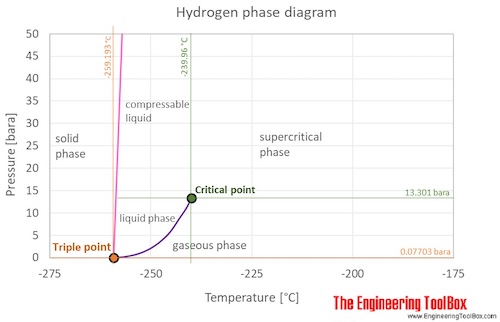
The physics: https://www.engineeringtoolbox.com/docs/documents/1419/Hydro...
Some photos: https://www.thedrive.com/news/37872/now-with-three-hydrogen-...
Regarding the tanks - they appear to be high pressure, but non-refrigerated and non-insulated. It would seem pressure alone keeps the Hydrogen in liquid state - if that's how it works.
Imagine the amount of people who mess up refueling an ICE vehicle. Now extrapolate that to H2 refuelling where we're dealing with a highly flammable gas in extremely high pressures.
> Electricity is already distributed. The fact that you are writing here on hacker news means you have a source of electricity that could potentially power your car.
Exactly. The BEV doubters seem to think that everyone in the world drives 600 miles without stopping for over 30 seconds every single day.
When in fact the average person could charge from a normal power outlet overnight all they need for the next day and ever a little surplus. Effectively keeping the battery full at all times, making that weekend road trip a breeze.
The problem isn't that you can't live with a BEV, it's that you don't have to. People are "fighting the last war." There is a way of making an EV that has zero compromises compared to ICE cars. BEVs in that context are coming obsolete or perhaps niche cars.
Could Grandma Jones from two houses over, who just turned 80 do it?
Methane will ignite when in concentrations of 4% - 17% in air, but with hydrogen the range is 4% to 75%. Hydrogen also has a higher flame speed than methane. (Boom!, not Whoosh!)
Given hydrogen's propensity to escape from containers these properties make it unsuitable for domestic uses.
The EU has mandated that every "major highway" must have a H2 depot every 2-300km, can't remember exactly.
But still you need to get it made somewhere, preferably not from natural gas, because that's just stupid. It needs to be transported to a station, by truck, on a regular schedule or it'll stop working.
Compared to EV chargers which are, in essence, glorified power outlets.
The problem with "power outlets" is that they're heavily dependent on fossil fuel power plants. Since it is an unpredictable variable load, even more so than you think. Which is why it is really a transitional solution. From the beginning, it was about replacing distributed emissions with centralized ones, usually far away from cities. At some point, it became this green fantasy that could seriously replace fossil fuels. It is highly unlikely to do so in reality. Even BEVs will need hydrogen power plants to solve variable grid load problems. Eventually, you'll realize that hydrogen is a mandatory part of the problem, and the battery becomes redundant if not a negative.
Currently the grid over here is producing 17g of CO2/kWh, pretty much 90-95% is either nuclear or renewables. We're also exporting a portion of our excess to neighbouring countries.
The fact that Americans can't modernise their grid doesn't apply to the whole world, you see.
https://www.hydrogeninsight.com/transport/two-of-londons-thr...
Hydrogen in the US feels destined for trucking and heavy industry if it sees success anywhere, but hydrogen filling stations at truck stops aren't going to sell a lot of Mirais.
People really need to stop thinking about current market position and start thinking about the conclusion of each technology. Just like how diesel ultimately led to another fossil fuel burning ICE car, BEVs only lead to heavy and expensive vehicles that are highly dependent on exotic metals. What is the solution to that last problem? It has to be a vehicle that is both zero emissions and doesn’t have weight and resource dependency problems. If you think in that way, you pretty much always end up with a hydrogen powered car of some sort.
https://www.thestreet.com/travel/a-1-5-trillion-discovery-wa...
My position is mostly from the direction of fact checking. People are blatantly BSing about BEVs, and talk about it with zero understanding of real automotive issues. The facts in favor of FCEVs speak for themselves. It is mainly awareness that is the problem.
Awareness and the 30 hour drive to the closest hydrogen fuel station
In reality, hydrogen is much cheaper than expanding the grid. You are basically dismissing basic physics with nationalism. Whichever country you're from, it too will find out that is cheaper to build a hydrogen network rather than massive grid expansion.
As for "hydrogen network", we have pretty much zero infrastructure bringing natural gas or any kind of gas to residential homes. I think the capital city used to have a gas pipeline, but it got dismantled and people just use portable CNG tanks.
Hydrogen is a lot cheaper to move around than electricity. Regardless of where you are now, it is more logical to build the hydrogen network rather than expand the grid: https://www.brinknews.com/could-hydrogen-replace-the-need-fo...
According to him transporting H2 is THE biggest problem. There are too many conversion losses in the process.