America's advanced manufacturing problem and how to fix it(americanaffairsjournal.org) |
America's advanced manufacturing problem and how to fix it(americanaffairsjournal.org) |
Major wars might be far less likely if America's ruling classes felt that they had some real skin in the game, and people they cared about could easily get killed.
That might be changing with smart weapons. 15 Russian generals have died in Ukraine, enough to have Wikipedia page.
That would seem to be simpler
In other news - treating your oxen wonderfully will not transmute a wooden moldboard into an iron plow.
> "Mass production technologies and the division of labor created a workforce consisting of relatively unskilled employees on the line combined with a smaller group of highly skilled workers and the engineering teams that designed it."
> "Japanese producers pursued precision production, just-in-time production, quality built into all production stages (not just at the end), continuous improvements by the entire workforce, and collaborative labor practices, all of which led to dramatically increased efficiencies and quality."
One (Ford) seeks to deskill its workforce in the name of efficiency because they see their opinions as irrelevant because they are not the capital class. One (Toyota) seeks their input as valuable specifically because they are the ones doing the work.
I've worked in both types of factories as an engineer. BOTH sought to apply the principles of lean manufacturing to build efficiency. It only worked in one of them, the one with a culture of treating factory staff with respect. In the one where management and engineering looked down on the employees they didn't listen for efficiency opportunities they only looked for them themselves, they presumed the unskilled workforce provided nothing. Funny enough - that plant couldn't attract better quality employees.
The articles has an entire section dedicated to workforce education...great! but as with all post secondary education in our modern society, the participants are (in large part) motivated by the economic potential of that pursuit. If I can make the same working at starbucks (with benefits because employer scale) as I can as an electrical tradesperson (yes, there are levels but not all are union) why would I pick the one that destroys my body? Why bother with workforce education if your leaders don't respect their work and will seek to Taylorize them instead of partner with them. Apprenticeship and training works in Germany and Japan because the jobs are not awful. It works because of the culture of work. I would argue this is actually the same reason we lag in another marker the article talks about - robots per worker.
I feel I seldom hear in tech circles (on the internet at least) the empirical evidence around the Toyota Production System. Maybe I didn't either until I read "The machine that changed the world" by Womack, Jones, and Roos.
It is a historical fact that Toyota produced higher quality with lower cost all through the 1980s vs their American competitors. In the same era at General Motors, CEO Roger Smith said he would build a lights-out factory 100% run by robots. It never worked and they had to abandoned the concept.
When I listen to those Toyota people talk about their system, the concept of mutual respect is the basic foundation. The engineers at Toyota have to spend time working on the line. Exactly what you are describing, partnership vs Taylorization.
Sometimes I feel like this explains Tesla quality issues. When I look at how some people at Tesla think about line workers, they literally call them "Button Pushers" or even use racial slurs. Elon when he described the "machine that makes the machine" was echoing what Roger Smith said in the 80s about a "lights out factory". And here we are ten years later and Tesla does not have a lights out factory and their quality is still very low.
Where I work in the US, it is a service business but some of the concepts still apply. Some of our tools and processes were built from the top down with little user input. It is a struggle to do Poke Yoke or Kaizen, and part of that I think may be the grapevine knowledge to "keep your head down and your mouth shut".
I appreciate it but no need - the people doing that (typically) are as much victims of this propaganda. They aren't malicious, they have been learned the same culture we're talking about.
Funny enough, the first place I ever interned had attempted to do a lights out factory in the 1980s. Short term, it was a disaster - in part because they literally had not installed sufficient lighting to trouble shoot problems, push automated transfer vehicles back onto control strips, and pry parts apart. The machining centers of the era could do the quality but required experts to operate, monitor, and adjust. When things went wrong they weren't small anymore, they were destructive and shut down production for 12+ hours. The shift had been made in part to leverage concessions from the workforce, and (IMHO) as a result it disregarded all the tacit skills those employees used to keep the place running. Long term, They ended up with higher quality, faster throughput, but more employees. But, it cost them a lot and they needed more employees to move stuff around the factory because they had built this huge space to do lights out and the irredeemable piece of lights out was material movement and handling. What I learned was that robots and machines can't tell you what went wrong - no matter how much you log.
I've got a ton of other examples. Every factory I've worked in I've learned how much of a myth 'low skilled labor' is. On the floor, in every factory, new hires were useless - which is a pretty definitive marker of 'skilled labor'. Same thing in the military - senior NCOs are often critical mentors to new LTs. As an engineer I've typically learned as much from the technicians and operators as from the other engineers. At each, I've also worked with really smart engineers who were terrible at their job because they had been socialized that their intelligence was all they needed and there was no need to learn from the 'floor guys'. Roger Smith (and Elon) thought engineers could make the transition to lights out with their knowledge alone because they had bought into the same narrative about blue collar work be low skill and low intelligence. The result was concerns about air friction on robots but not tolerance stack up of stampings or repairable castings.
The problem is, until you really engage with it, the narrative descriptions of certain work we get from the media and economists become a lens for making sense of reality. I'm not immune from that, I just had it beaten out of me. Oxen aren't stupid either, they're still really useful in situations where tractors struggle.
i really feel like alot of this same stuff could apply to jobs inside service / data processing industry. It reminds me of "Gladys the L6", the person six levels down in a bureaucracy who is the only one who actually knows how things are actually working with the spaghetti of multiple legacy systems and arcane rules. Michael Lewis wrote about this case at Athena Health
My sense from talking to the previous generation is that financialization of the US has started (finally) failing the American people.
The previous generation cashed in on major profits by off shoring (Kodak), but we overdid it.
In a round about way our company is run by pension funds, and I work on projects that would get 8-9 figure investments if we were doing this in APEC, but we would rather have stock buybacks, so we end up getting 6 figures and puttering along.
Meanwhile the higher ups wonder ‘what happened to R&D?!’
You can look at how Boeing gutted it's highly skilled Pacific North West operations to move lower skilled, lower paid areas elsewhere and generalize this to a multitude of similar industries.
Prioritizing next quarter’s growth at all costs really did a number on our long-term stability
>The assessment of author David Gelles, in his critical biography of Welch, The Man Who Broke Capitalism, is that “instead of trying to fix American manufacturing, he effectively abandoned it, and would soon start shuttering factories around the country and shipping jobs overseas.” Welch once stated, “Ideally, you’d have every plant you own on a barge to move with currencies and changes in the economy.”
Arguably, the article discusses financialization as a cause.
It's the same in universities, where more and more time and money is spent on "management" (extracting value) and less and less is spent on actually teaching stuff (creating value).
Unsurprisingly, when a (somewhat large) portion of the population in a high productivity society realizes they can just skim off the top without doing any actually useful work, bad things happen.
https://ourworldindata.org/extreme-poverty-in-brief
Even with recent globalization, Americans are still far richer than most people in other countries. I believe those people matter just as much as Americans do.
I’d also argue that it’s perfectly fine for the US and any other nation to think in terms of putting their domestic economy first, regardless of anything else
I work on projects that would get 8-9 figure investments if we were doing this in APEC
Because the US thinks of industry as ‘dirty’ we’ve lost touch with how valuable these jobs can be. In the US the returns would have longer duration and would not be viewed as ‘important’ bc the business isn’t suitable for a FANG exit.
It would be interesting if there was a breakdown by technology sector. Ie manufacturing R&D vs. software development R&D.
You are close to realising the problem. Financialization is a consequence not a cause.
The cause is demographic. Why and how did pension funds grew so much need to own everything and get money?
Spoiler: this happened in steps with Boomers investing in their retirement. Because they were so numerous it flooded everything.
Second Spoiler: they also had (and still have) the political power by sheer number, which warped the regulatory environment.
I think the root problem is political: recognizing that USA's extraordinarily successful mid-century economic model was the result of a compromise by the ruling capitalists to avoid facing a European-style revolution (e.g. Bolshevism) at home.
As the Cold War reached its heights in the early 60s, that delicate equilibrium was destroyed, and the capitalists had a new mandate. State regulation, labor unions went from "necessary evil to avoid revolution" to "evil", and the robber barons could return to their early 20th century form. Thus we got the 70s and endless financialization.
* A tax on financial transactions. This is sometimes called a "Tobin tax". The US financial services sector has doubled in size as a fraction of the economy. It's currently around 12%. That's an overhead cost, and a big one. Could be half that.
* A tax on advertising. The tax deductiblity of advertising as a business expense should be limited. No more than a few percent of the cost of a good or service should be advertising. Domestic US advertising is almost zero sum, anyway, because Americans are spent out. All advertising does is move consumption around a bit.
* Standards for imports. If it plugs into AC power, it has to have UL certification. No more fires from power supplies, including small electric vehicles. Anything medical has to be sample tested after import. Criminalize willful violations. Hold resellers (i.e. Amazon) criminally responsible.
1) Improve the [government sponsored] Manufacturing Institutes
2) [federally] Back R&D for manufacturing technologies
3) Provide scale-up financing [by the government]
4) Use government procurement power to promote new manufacturing technologies
5) Direct production support [to sectors deemed critical]
6) Provide both “top-down” [gov picks a tech and supports development of it] and “bottom-up” [broad incentives like IRA] support
7) Build a manufacturing focus into existing industrial policy programs
8) Map and fill gaps in supply chains
9) Fix workforce education [by refocusing on legitimate vocational tracks]
10) Put someone in charge [of coordinating agencies, budgets, and efforts]
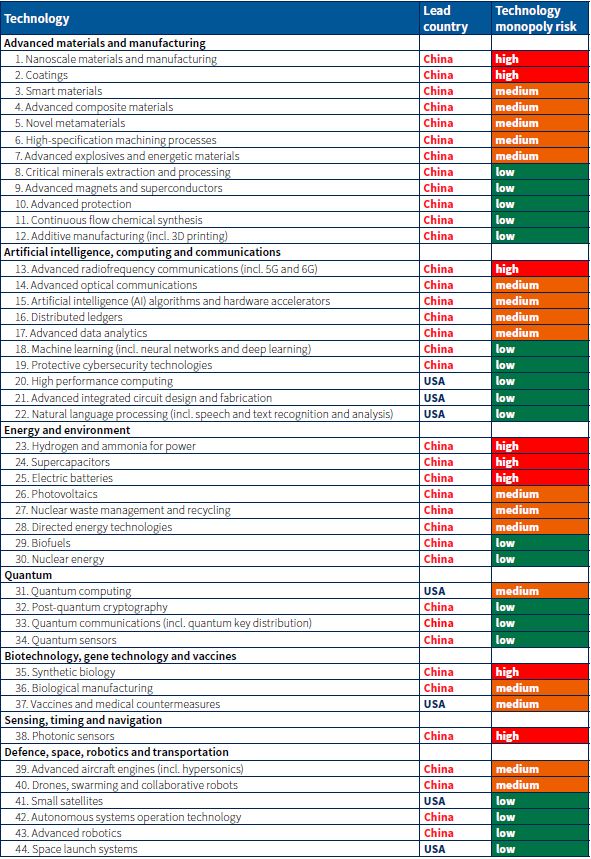
This is all effectively trying to copy large segments of the China playbook, but in my opinion it misses some rather important points. Namely, protectionism and implicit incentives. On the first point, you can't really compete with China when it is actively hostile to foreign companies and de facto encourages outright theft of knowledge and expertise in exchange for access to its market. As long as we have a significant portion of people yelling about "trade wars don't solve anything" any time someone proposes leveling the playing field, competition is a nonstarter.
On the second point, the elephant in the room is that smart people in the US can make 2-3X as much in software or finance as they can in manufacturing, so what do you think they're going to pick? Which company is private investment going to fund - the SaaS co. with 40% margins and rapid growth or the manufacturing co. scraping 10% margins and 5% CAGR? It's hard to see where the skilled labor and private investment side of the equation is supposed to come from when the incentives are so mismatched - you almost have to find a way to decrease incentives in the currently lucrative pools first.
Take this for example: >China dominates the production of full electric vehicles
And put it in context with the recent revelations of hectares of abandoned new EVs rotting in many locations in China. Why? The financial policy gave incentives to making more EVs, some enterprising individuals managed to manufacture very low quality cars while funding it with "shared car startup model". Then when these car sharing schemes went bankrupt (because many cars wouldn't complete a single trip without malfunction) they had enormous profits regardless. How? The cost of manufacturing was funded by investors in these startups(a third party, or a client from the manufacturer's point of view). After they went bankrupt there would be no warranty claims etc. While the per car gov subsidy was pure profit.
I cannot understand why anyone in the West would believe any economic statistic or number coming out of China. The country is known for fudging numbers at all levels. The corruption is endemic to the point one actually pays for government positions with cash (as a bribe to higher ups) and considers it an investment to recoup in own bribes in future.
It's Soviet Union all over again. Back then The West to the last moment had many prominent authors praising Soviet advancements in many fields until the very end and the collapse that was a complete surprise to many.
Rent seeking behaviour is so deeply entrenched in US-led business culture, that any time potential advances are figured out they are viewed through the lens of "can we patent this?".
If the answer is "No", then funds for developing that potential advance - eg concept dev, prototyping, potential field testing - just don't exist.
It's not about being able to improve manufacturing. It's become "what's the greatest ROI on spending these dollars? Can we lock in a monopoly around it somehow too?".
While that short sighted foot gun approach remains prevalent, "fixing" the advanced manufacturing problem is going to proceed pretty damn slowly.
Outright abolishing all patents might get things going in the right direction, but the heart attacks that would cause in business circles makes that impractical. ;)
I don't really see a way to reverse everything. It is not about investing more in education or patching up policies. We are talking about a whole generation, maybe two, of elites and (some of the) people who profit from globalization. You simply cannot rely on the hands to chop themselves off. This is going to be a violent, bloody process because changing tides in politics is always bloody, literally. This is also going to touch the cake of numerous upper-middle class interest groups: landlords, bankers, you name it, anyone who prosper from the last 40 or so years, especially last 10 years since the first QE. Why? Because you are basically saying, OK I'm going to create a new group of middle class people but hey the cake is just that big so I need to cut someone else's piece.
Of course, everything has a cheat. The cheat, which I believe was already chosen by the American elites, is to instill conflicts globally and create mass exodus of highly skilled workers from other countries to the United of States.
My son joined a non-union shop last year, recruited by his instructor while in a training program for machinists. They had an "assembly department" that was under extremely arbitrary and shifty requirement metrics. They had long time machinists who worked there and if they got hurt (after getting back from medical leave) they were thrown into the assembly department until they quit.
That was the tip of the iceberg in that place. Asking for PPE to mitigate cancerous fumes from various chemicals got my son fired. He suffered chemical burns during his short time there and witnessed several serious random safety events involving 400amp 220v live electrical wires making contact with carts and shelving.
This was not a small rinky dink shop. They have multiple large facilities in the US.
I think a big, poorly understood part of these stories is "advanced games" or "long term degeneration."
Take government procurement, like fighter jets or new hospitals. Post-war, the way this worked was "cost-plus." Companies accounted for their costs and were promised a fixed profit. The obvious flaw is that companies lose interest in efficiency. But... it did work during the war and resulted in more tanks, ships and jets than anyone thought possible. It also worked post war.
But, such games mature. Under "cost-plus" a company increases profits by spending. That's an incentive that will bite eventually. So... they move to competitive bidding. This degenerates into a lawyers-only game, etc.
That's the administrative layer, but game maturation also exists at the political layer. Rooseveltism was a thing for a while, and then anti-rooseveltism became it's competition. During the neoliberal era, industrial policy was the devil. Half the international institutions (trade deals, imf, wb) exist mostly to enforce bans and limits on industrial policy.
During this era, when governments' job was to "get out of the way," the alternative to (now evil) industrial policy was either big trade deals, or tax policies. Tax breaks and tax complexity counted as "getting out of the way" while trade deals structured markets (eg auto-manufacturing) with more detailed rules than a Soviet five year plan.
Anyway.... the statement about making economics a defence job... it feels like an attempt to declare bankruptcy on the "trade-deals and tax breaks" era, and move to an weirder and more awkward model. A bad idea that hasn't played out might be better than a better one that has.
Sorta a 'do not pass go, do not collect $200, until {x} is solved' situation.
If a city still has parking minimums on the books, I evaluate all involved parties as utterly unserious, pseudo-scientific religious zealots.
Do you think the American south, in the era of chattel slavery, could solve 'advanced manufacturing problems'? NO! of course not! So why does anyone think 'america' could solve an advanced problem?
Meh. I shouldn't be surprised by the article, though. The authors probably think the USA isn't a backwater country that is 'on top' only via a willingness to use economic and actual violence to achieve all aims.
You speak the truth here...
The rest I could take or leave. It's not completely wrong but I think it's a more nuanced situation. I'd summarize it more along the lines of "America has become too classist to respect manufacturing. See Britain."
The US uses violence and coercion as a matter of fact, continuously, in every way, shape, and form.
If you tried to 'play' with the US from a position of mutuality and co-creation... you get colonized and cleansed and westernized.
In the 40 years that the US has offshored manufacturing, all of those guys that used to know what's what have retired or died. There's nobody left. It's going to take another 30-40 years to replace them. The US doesn't have the luxury of having those 30-40 years.
Almost there.
They commonly keep employees using the simplest heuristics that someone at some point in the past developed which worked then, so why break it? And they push this mediocrity throughout the entire organization and industry. Then they swap out one failed CEO for the same person with a different name like a pair of gloves, wondering what ever happened as there was nothing more that could be done. Meanwhile their ageist management policies block out the insights of the young, all but ensuring that no new ideas are brought into the mix—all until it’s time for another bailout.
Incumbents benefit from economies of scale and newcomers face dis-economies of scale. Which we know takes time from the economies Growing new competitors becomes hard and requires some cleverness to get around. Just look at electric cars and how they choose luxury/sports cars as their first models for a reason, so that the higher costs can be hidden in the high luxury margins. They need to be able to grow past that awkward point.
The same economies of scale which made the industrial revolution possible essentially props up "gigantic idiots" (companies which perform poorly but are sizable enough that their economies of scale made up for bad habits) until their "stupidity" (bad decisions) becomes great enough a disadvantage that others can compete with them.
The type of disruption that the manufacturing companies seem to engender is funding outsourcing to some remote cheap locale, and then wake up wondering where all of their competitors came from after they taught people enmasse how to build their product.
The plains of nebraska for example are an excellent place (again, opinionated) for an assembly plant like foxconn but american. Mainly because a crapton of freight via railways passes through there and plenty of undeveloped cheap land. Such factories have high shipping/receiving volume and new towns with new cheap housing for potential workers is feasible.
Yuma is another great location because of it's stable (sunniest in US) climate, proximity to mexico boarder and like with TSMC and Tuscon it is very disaster safe, right on I10 and close to CA (the US might starve if Yuma was destroyed! A lot of food processing there for these reasons).
Manufacturing at old towns and factories will have minimal competitive advantage.
Lastly, the US does not have a "success at any cost" mindset towards manufacturing as the fuel for economic success. It is very much an afterthought. A lot of this and many other issues are a result of political divisions.
Edit: He did have something interesting to say about the "idiot index" which is the price of a component over the cost of the raw materials. If that's very high, it means there are serious problems at that manufacturing organization.
https://officechai.com/stories/elon-musk-idiot-index/
There's so much inefficiency in American manufacturing. It cost SF $1 billion a mile to extend the subway for example.
This ushered the era of Japan (where Japan almost "overtook" the US as the first economy). You can draw lots of parallels to what's happening with China now.
I am afraid, given the size of China, that it'll not "just" reach US GDP but will skyrocket beyond it to the stars. The era of Western/US dominance might be over and it's inevitable.
DC politicians redistributing money to advanced manufacturing will generate wealth for transnational corporations that siphon wealth out of the source economy. It will serve as a grift for those with political connections more than it will repair our industries. The playing field is not level because of regulatory capture and inefficient regulation, and the talent pool that can fill the roles has both dwindled in number and chosen other career paths.
A piece like this is not a self contained textbook. It's a hot topic with 100 years of history near the centre of political and economic discourse. Contentious claims are inevitable.
The reverse claim also gets made, and whether or not the claim is "supported," it's never sufficiently supported. The reality is that there's a whole debate with vountermoves behind either claim.
One side looks at employment, tonnage, plant construction, anecdote and common sense. The other looks at accounting.
Accounting says that "manufacturing" has increased. Skeptics consider this an accounting fiction. The reality is that "manufacturing" in 2023 is not quantifiable in the way that it was in 1923. Accounting semantics are abstract and past a point turn into a matter of accountants' naming convention.
A 1923 ford factory represented most of the "manufacturing" represented by the cars that they produced. As the industry splits into OEMs, T1s, T2s, toolers and whatnot^ we move into more abstract definitions. Has one of Ford's industrial engineering teams ceased to be "manufacturing," because they now design processes for a Mexican subsidiary? How about the US-based management/overherheads for the subsidiary? Irl, accountants can represent these any way that the tax man, board or market prefers. The same physical change can represent 20% or 5% decrease in manufacturing.
There's just a point where quantifications fail, and can't be used to decide such debates conclusively.
Where we're at now, imo, requires us to keep purpose in mind, and forget about a single, neutral quantification. If you're quantifying manufacturing for maximum military potential, employment or resilience to trade problems... You probably need different definitions/quantifications of "manufacturing."
^These specific conventions were created to structure trade deals and regulate tarrifs.
Most of this was dismantled after the Raegan era, when they decided to move all production to other countries with the goal of running everything from Wall Street, through the power of dollar-based financialization. They wanted to control everybody else as modern colonies, where developing countries would perform the role of workers and the US the role of a business owner. It just happened that some countries never really wanted to play by these rules, that's why the US is threatening to dismantle the globalization system.
What reason is there to believe that this is an overhead cost?
As I mentioned in another comment, over the past ~10 years or so, US median earnings have grown remarkably fast compared with other large countries: https://news.ycombinator.com/threads?id=0xDEAFBEAD Hard to argue with results.
Taxing financial transactions intuitively seems like the sort of thing which would put a drag on economic growth. And manufacturers need to transact just like any other sort of business; I don't see how taxing transactions encourages manufacturers relative to other firms.
I like the tax on advertising though. I would tweak it so the tax only kicks in once your spending on ads exceeds, say, $10 million per year. That way innovative new products can advertise to customers tax-free. This method also encourages big monopolies to spin-off individual product lines, which could reduce monopoly power.
I would say that eliminating tax deduction for advertising expenses is the wrong way to go about things as well. Adverting is a bona fide business expense, so it makes sense as a deduction. Rather, a direct tax should be levied on advertising, to account for the externalities of us all having to suffer the cacophony. This could even be done state-by-state rather than federally (a la sales tax).
Wholeheartedly agree on the certification. It blows my mind how cavalier people are about plugging Amazon's gensym branded products into mains power - especially given how shoddy even NRTL-tested products seem to be built!
I own a 100 shares of Apple. Tim Cook goes on CNBC and says he’s all in on printers. So I want to sell my Apple shares and buy Microsoft, where Satya Nadella is pushing Cloud and AI.
I’m being a smart investor, moving a small bit of capital allocation intelligently.
Taxing this decision discourages making it—even if only marginally—and makes capital markets dumber and less efficient.
No, you’re being a schmuck.
The market moved on that information well before you saw it on the news, loaded up your web browser, and executed the transaction.
Time and time and time again it has been demonstrated that actively trading is negatively correlated with performance. The more frequent you trade, the statistically worse you do.
Besides being empirically true, it makes intuitive sense. Every time you trade you’re engaging with a counter party on the other side of the transaction. With overwhelming likelihood, that counterparty has disproportionately greater (and timelier) access to information and market analysis than you. So every time you trade, you do so at a steep disadvantage.
Invest in the market. Buy and hold. Sell to finance your retirement. Save the gambling for your Vegas fund, not your life savings.
Or it encourages making longer term investment decisions rather than trading like a jittery cocaine addict (which by no small amount of irony a nonnegligible number of traders are already.)
It’s criminal how the people who trade stocks for a living get away with paying less taxes as a percentage than their janitors.
This is a tax on the middle class. Plenty of countries have stamp taxes on trades, for example. The wealthy structure to avoid a books-and-records trade. The average person can’t do that and so pays.
If you’re upset about the size of finance, just tax that directly.
This is only true when productivity between firms is constant. Advertising helps direct consumption toward more productive firms.
https://en.wikipedia.org/wiki/Triffin_dilemma
This is going to be hella difficult to unwind, especially given the current state of macro awareness in the US: if I had a penny for every time someone in an export industry panicked over the possibility of a declining dollar, even though this would be in their best interest, I'd have too many to carry. Arguably worse, we have an otherwise respectable top 10 list that doesn't include macro anywhere, which is like teleporting onto the Titanic only to hear that the conversation is all about how to best duct-tape the doors. Sigh.
2 of the most valuable companies started in the last 20 years in the US are SpaceX and Tesla. You can still build a huge amount of value with non-SaaS margins.
I think part of the problem here is how structurally unfit VCs are to fund such companies (ie investment horizon and fund lifecycle is 5-7 yrs). THat’s where scale-up financing by the government can make a huge impact.
My point is, if you want manufacturing to return, we need American FoxConns, and that means literally 2% margins [1]. We can't rebuild onshore manufacturing with overhyped companies alone.
[1] https://www.foxconn.com/en-us/investor-relations/financial-i...
I oversee a portfolio of industrial products that no VC would touch. Now, some long view PE groups do things like this - the margins can be great, growth can be fast.
Make unions stronger and kill off all of Wall Street finance shenanigans that's purely devoted to creating money out of thin air or skimming (especially HFT). That house of cards is going to crash hard anyway, so best tear it down in a controlled fashion than risk yet another 2008-style uncontrolled implosion.
Do you have any favored proposals for preventing "finance shenanigans"? Given the amount of money involved, I expect any government-driven reformation will be corrupted to serve private interests.
People deciding to kill things in domains they haven’t the vaguest conception about is how we wound up in this situation. (Killing HFTs would be a major boon to Wall Street. You’re mandating an increase in transaction costs.)
Creating money out of thin air has literally been the primary economic function of banks since the Renaissance. You have some people willing to provide useful goods and services, but there aren't enough standardized IOUs to pay them, so you issue new standardized IOUs.
Society is so damn lucky that techbros are politically irrelevant.
Ooh, this one's easy. Make software companies give back some of the money they make data-brokering and administering platforms where the vast majority of the advertiser-attracting content is provided, for free, by users. That's where the margin is coming from: users being scammed out of the true value of their contributions. Tax or regulation, pick your poison.
Someone brought up Tesla and SpaceX in another reply. The Tesla whose market share growth was driven largely by EV tax incentives, of course. The SpaceX that built heavily on gifted NASA research and expertise, of course.
is it a scam? Or are the users willingly trade their data for features?
> The SpaceX that built heavily on gifted NASA research and expertise
i think you're discounting their own hardwork. NASA research is available to any other company - it isn't an exclusive transfer.
> ... smart people in the US can make 2-3X as much in software or finance as they can in manufacturing...
Sounds like the price of manufactured goods is unsustainably low. Prices will need to go up or a new source of cheap labour be found outside the US.
It isn't that hard, really. They had a massive population in relative destitute poverty that was willing to work very hard for a small, but significant, increase in their quality of life, starting with Deng Xiaoping's market reforms through fairly recently.
The surplus of cheap labor is shrinking, and the current "made in China 2025" plan is intended to drive the growth further by shifting more portions of their economy away from foreign services and goods.
The tactics are largely the same, though: massive subsidies to local companies that disadvantages foreign ones, tacit acceptance if not outright approval of theft of trade secrets from those foreign companies that do business in China, and until recently anyway, kept the yuan pegged to the USD, meaning that it is far cheaper to buy Chinese goods than elsewhere. Now, it is tied to a basket of currencies, but held in a fixed range, so it remains intentionally undervalued.
All of this put together ensures that foreign countries will buy Chinese goods and services, and that Chinese people will also prefer to buy locally.
Think of it as a "cold" trade war. Why they were allowed in the WTO with such policies I'll never know.
China itself may not, but the production groups within China have a pretty exhaustive recent history of largely ignoring IP regulations whenever profitable, and the market response has been widely happy-to-consume.
For a single example look at the history of composite bicycle manufacturing from the 60s onward, with specific detail on the emergence of China produced composite bicycles in the 90s -- it wouldn't have gotten off the ground at all without blatant IP theft spurring the first half.
Running the reserve currency requires running a deficit (others want to export their savings, so you need to import their savings). This pumps assets and dumps exports.
I hear you. But I am not worried about whatever economic modellers say, or what prominent authors write. What I am worried is when huge companies, predominantly preceived as western ones, spread their arms and swear there is no way they can make their gizmos in the USA.
Look at Apple for example, most valuable company on the whole world and 44-47% of their production sites is in china. Did we had anything like that in the Soviet block?
Yes, you make a very valid point.
>Look at Apple for example, most valuable company on the whole world and 44-47% of their production sites is in china. Did we had anything like that in the Soviet block?
No, definitely not, there is a difference in how Soviets couldn't overtly accept western investments without it looking like a failure of their central planning. Also the relationship between both blocks(USSR vs the West) was much more openly antagonistic. China is different in these ways. One could write a book about the differences and similarities of both countries.
As for large companies doing that I blame the lawmakers (and people voting for them). A share based company is supposed to act in the best interest of shareholders. How long or short the time horizon to prioritise is decided by the shareholders when they hire the board of directors. It is not a surprise a bunch of shareholders will want to prioritize short term gains. It is the lawmakers job to ensure its citizens don't fund enemy regimes. That leads to another point, for a life of me I do not understand how the Chinese Communist Party regime is not officially considered an enemy of the USA and all other deocratic countries. For some countries with very corrupt political scene (like Germany, Austria etc) it is obvious why, but the US? Perhaps the political elite in US has awoken to the fact current China is their biggest enemy, they just don't see any benefit in communicating it clearly at this stage.
I agree that his naysayers are making a grave mistake of calling him universally stupid. He’s a vile selfish person, who makes a lot of bigoted stupid statements and actions, but ignoring him would be the end of us.
A Tamil saying I like translates (by ChatGPT) in English as, “Regardless of the speaker’s guise, Seek the truth that in the statement lies.”
How so? That's an extraordinary claim that you haven't remotely justified.
While it's possible for anyone to say something smart, Elon Musk is no more likely to have clever insight than the average janitor.
He makes a bunch of insightful-sounding claims that only make sense if you don't have a clue on the subject he's talking about - like when he stack-ranked by lines of code, at Twitter.
It might be socially acceptable to put the domestic economy first, but that doesn't mean it is right. Ultimately, it's basically the same as the "looking out for #1" philosophy that rich people allegedly have, which is being condemned in this thread -- but at the rich country level rather than the rich individual level.
Try this calculator: https://howrichami.givingwhatwecan.org/how-rich-am-i
However not every situation is like this. For instance, offshoring was used to artificially suppress wages of IT workers. That’s not mutually beneficial in the slightest. It’s abusing one cost advantage over another without a clear benefit to both sides, it only served to enrich shareholders
That is exactly what you need to do though, blow up the dam now and release the water instead of waiting for it to build up and destroy the entire city. They do that small scale by increasing interest rates already, but sometimes you maybe need to do more.
Is it a scam if I buy a $1 million painting off you for $50, knowing that I'm aware of its value and that you aren't? It's at best unfair and disingenuous. But what's more important to consider is how the scale of this imbalance has warped our economy: as mentioned above, a large portion of our most educated workers are getting paid to build addictive social media platforms instead of things that are useful and sellable, because tech companies are capitalizing on an arbitrage opportunity that is so massive as to probably be unfair, if not criminal, somehow.
>NASA research is available to any other company
But not NASA grants and personnel contacts.
And these massive subsidies - what evidence do we really have? Massive subsidies have not worked well outside of China. What magic is happening in there that makes them effective? Pre-1970 we had a series of superpowers that were effective because they avoided massive subsidies and let failures fail. China can't even afford massive subsidies for most of the period that mattered. The US government's spending might have been bigger than the Chinese economy for a lot of that period, and the companies the US has been subsidising aren't showing any of the vigour that the Chinese ones are.
> ... theft of trade secrets...
People have been screaming from the rooftops for years that the IP edifice is going to reduce innovation in the West. The question is why we subject ourselves to that madness. The amount of cultural destruction in not allowing 1900s works to spread freely is a tragedy, let alone the impact on science and technology. So certainly in theory I agree that the Chinese are getting a leg up here, but it'd be nice to see some analysis. And the problem isn't the Chinese attitudes to IP; that is the solution.
But to emphasis "it isn't that hard" to gloss over decades of highly successful economic policy is just not true. It isn't a serious attitude. If people in leadership positions hold that attitude the situation will worsen.
[0] China's average wage is above the world average, by the way. It crossed the line recently to much rejoycing. I think that is PPP adjusted. https://ourworldindata.org/grapher/gdp-per-capita-worldbank?...
A financial transaction tax makes me much worse off in the former case. It disincentivizes trading volume by raising transaction costs, which have been on a long-term trend downward as markets have adopted technology and brokers have engaged in cutthroat competition. I believe that trend has been positive for markets, investors, and the economy as a whole.
It's a gap they're losing a bit by other companies adopting their plug choice but there's still the integration to the car infotainment system.
China is not "ignoring IP regulations"; they have different regulations. Both the US and China are parties to the WTO and Berne Convention and cases can and have been tried. The US has won many cases against China in the WTO; it hasn't done as well making cases for IP theft and protectionism, which is notable as this is a (relatively) neutral forum.
If the differences and consequences are the same as if China was outright ignoring IP ownership*, why does it matter that you call the ignoring "different standards"?
*- not that they aren't already
The issue is that IP is a legal creation, so it can only be stolen if it is recognized in the first place. That said, it does not seem like differences in IP law are usually what people are referring to when talking about IP theft. That is why I brought up the WTO, which is a forum in which the US has sued China for encouraging IP theft--but most of these cases have not been won.
Neuralink is at best replicating decades-old research, all while horrifically violating scientific codes of ethics,
Boring is just a tunnel digging company (tunnel-boring is a very often unavoidable construction technique and thus is a very mature technology, he's not going to magically find an order-of-magnitude technical breakthrough) whose basic premise is that you can increase throughput per dollar by digging lots of slightly-smaller tunnels for cars instead of a single subway-sized car; a premise that is objectively false.
Solarcity might have been an interesting idea but was handled poorly and went bankrupt, at which point Musk forced Tesla to buy it so he personally could avoid the bad PR of "Musk's company goes bankrupt!", which is quite illegal and an abuse of his power as CEO of Tesla.
Starlink flat-out makes a loss per satellite launched, and scaling its userbase up won't fix that; it's dead once it runs out of investor money.
There's this weird situation were Musk has N different ventures, and each venture looks alright on the surface but is rotten when you take a closer look - but everyone thinks "well sure, but the other (N-1) ventures are doing fine, so maybe I'm missing something about this one?", not realizing that all the other ventures are just the same.
Please, please do the following exercise: ignore all the PR you've heard about Musk, and pick one of his companies that's not Tesla and look closely at it. Evaluate if that company makes sense on its own merits, without Musk.
Insert list of subsequent wars.
Like the Mexican–American War? OP's explanation of why US is the top-dog can't be whole story, but there's something to it. For example, it's hard to imagine the US would be half as powerful without the territorial gains made as a result of the conflicts surrounding the Mexican–American War (for example, by far the most economically important states are California & Texas!), yet at the same time virtually everyone agrees that the War was completely indefensible (Grant in a diary called it "one of the most unjust [war] ever waged by a stronger against a weaker nation").
It’d be as if the US claimed to own Antartica, the moon, or mars. Perhaps there may have been a few people there, but it was never a serious enough population that anyone could think their claim of ownership was competitive. I mean, they had a stronger claim than Spain, but that’s not saying much.
The same is true of all crimes, they are all legal creations. And from what I can tell, China has the concept of IP. They're protective of their own, for example.
It sounds, then, like you're now agreeing that the IP is being ignored, just saying it's okay because China don't want to recognize it.
If not, I will ask again:
Suppose we have 2 IP owners, and 1 has their IP ignored by China and copied, the other has their IP "considered a different standard/not recognized" by China and copied.
_What differences do the two IP owners experience?_
This is the key question I asked before, and I am asking now. What's the difference for the IP owner? I ask because it seems like you're playing with words, not substance.
That said, there are treaties covering IP that both the US and China are a party to which require certain mutual recognition. The US has sued China in the WTO for violating the IP provisions, but has not won most of those cases (AFAIK).
US companies can also sue Chinese companies in China for IP infringement and some of those cases have been won. Chinese courts tend to award much more limited damages than US courts, so US companies don't find this satisfactory. But again, that is a difference of law.
I'm not arguing anything, I'm asking you a simple question. I'm not sure why you are trying to avoid answering. Here is that question again, I highlighted it below:
Suppose we have 2 different IP owners. 1 has their IP ignored by China and copied, and the other has their IP "considered a different standard/not recognized" by China and copied.
---> _What differences do the two IP owners experience?_ <---
You are trying to argue that "not recognizing" IP and thus ignoring it, or "having different standards for IP" that lets you ignore it, is somehow different from just ignoring it. You have not explained how that makes a difference in outcome. Why should business owners care what excuse is given for ignoring IP? If it wasn't one excuse, it would be another, and ignored is ignored.
I wonder if he will still say that, after learning Brin divorced his wife for likely cheating with Musk.
This seems like a perfect encapsulation of this person (and the snobbery of everyone involved of course).
I deny this. He provides money and hype, and hires the best engineers in the industry who then get results. In some cases things gets things built, but that doesn't mean Elon Musk was personally useful to any given project besides providing hype and money.
https://ourworldindata.org/grapher/daily-median-income?tab=t...
As of ~2019, the US had the world's 4th highest median income, even adjusted for cost of living -- easily the highest median income of any large country.
And the median income in the United States has been growing rapidly. Sort the table by "Absolute Change" and you'll see that in absolute terms, the US median income grew the 5th most over the period from 2009-2019. Again, the US is comfortably ahead of other large countries when measured according to this statistic. (For example, US workers saw over 2x as much wage growth as Canadian workers did over the same time period.)
Speaking as an American here, it frustrates me when Americans fail to realize how good they have it compared with people from developing countries. Americans are some of the world's richest people, yet they still insist on hoarding as many good jobs for themselves as possible. When Americans talk of "reducing inequality" it often seems hypocritical.
I genuinely don't understand why it is that the people who are best off also complain the loudest.
Housing, healthcare, education and other living expenses are astronomical. We can't just look at the high incomes.
Successful for the elite, yes. Not for the median American.
People who earn the median income are hardly elite.
Taking national wealth or GDP and implying it's shared equally amongst its citizens would be an absurdly disingenuous argument.
You're not doing that, are you?
There really was a vast right-wing conspiracy. It started with this memo.[1]
Here's the background: [2]
Understand that, before this, businesses rarely had lobbyists or engaged in political action. That totally changed in the 1970s.
[1] https://www.greenpeace.org/usa/wp-content/uploads/2021/08/Po...
[2] https://billmoyers.com/content/the-powell-memo-a-call-to-arm...
Yes. Communism was a competitor which kept capitalism from acting like a monopoly. Once communism was no longer taken seriously, capitalism was unrestrained. When the USSR finally ran down, there was no stopping the push to plutocracy.
It's not that communism was a better system. It was that the existence of an alternative kept capitalism from getting out of control.
I do think physical capitalism exhausted itself, but it was more in the 90s and 00s that we see more psychological capitalism arriving with the first internet products that have no physicality associated with them - social media and networks. Then we have a real (or apparent) exhaustion of physical capitalism.
It makes me recall one of my favorite cars that was never built, the Norwegian Troll. The government decided not to expend their limited capital to the company as they could trade fish for Ladas to get cars.
Markets that are less efficient in that task hurt long-term retirement investors and day-traders alike.
On some level this is true, but the insane quantities being siphoned out of the economy through the financial system is wildly disproportionate to the increasingly-infinitesimal gains in “price efficiency”.
As a long-term investor in the market as a whole, whether Apple’s true per-share value today is 175.01 and not 175.07 is almost completely irrelevant. Even less so the difference between 175.008913 and 175.008916.
We have long since passed a point where there is sufficient liquidity and sufficient price discovery for the purpose of buy-and-hold investment, and every extra dollar that goes to financial services in the name of more accurately determining prices is just a transfer of money from people who provide value to the economy to a class of leeches who provide nearly nothing.
Btw., no-one is forced to trade incessantly, either.
A spring only suspension system responds quickly to a bump in the road. If that’s your only metric, it’s good. But a car without a damper is going to be hella uncomfortable. The shock makes it respond slower - it doesn’t mean it doesn’t respond.
Sounds like insider trading to me.
Second, even in a magical world where this doesn’t happen, institutional investors have literal teams of analysts working for them. They have bots responding to news reports and public filings, and the lowest latency possible connections to trading platforms.
You have none of this.
The only people who had a legitimate claim to any of the land taken by the US in that war were the natives, but they weren't a party to it.
As for Hawaii, that wasn't attacked; that was basically swindled by business interests.
Then 50 years later they stopped giving the British the influence they wanted and the British openly exerted their rule for a few years…
The domestic population - then a mix of narives and others - overthrew the British and invited the US.
No wrongdoing by the US, with the possible exception of a few random individuals.
https://www.astralcodexten.com/p/book-review-elon-musk#%C2%A...
Feel free to point me to people actually around him that thinks he doesn't know physics or engineering.
"What's really remarkable to me is the breadth of his knowledge. I mean I've met a lot of super super smart people but they're usually super super smart on one thing and he's able to have conversations with our top engineers about the software, and the most arcane aspects of that and then he'll turn to our manufacturing engineers and have discussions about some really esoteric welding process for some crazy alloy and he'll just go back and forth and his ability to do that across the different technologies that go into rockets cars and everything else he does." - Garret Reisman, former SpaceX director and USC Professor
Objectively, at present he's stoking a fire comprised of $44 billion dollars, committing anti trust crimes, and endangering a besieged foreign nation.
Judge him by his actions, not by what his blowhards say about him.
What do any of those have to do with his engineering skills? Do you think good engineers can't make bad investments, or are inherently moral people incapable of antitrust violations?
Oh come on. If it were this simple, everyone would be doing it. Why aren't you "watching where the money is flowing and sticking your hand out"?
> Elon has certainly mastered that, but I don't have to ascribe "genius" to it.
Musk is vastly overhyped by some, but that's really selling him short. SpaceX and Tesla have real products providing real value, they aren't just leeching off money flows.
As for the real value of SpaceX and Tesla. I think there is value there, but probably less than most and I don't buy into "great man theory", so I would probably ascribe the success to the actual engineers and designers that did a majority of the work. He is a good leader for what he is trying to accomplish with those two companies as far as I can tell.
no one says he is a great engineer, but oh boy he sure does well in finding those great engineers and funding them to work on large scale projects.
he hires people greater than him in other fields, no doubt.
His "choices on what to focus on" are at best extremely vague and at worst extremely wrong - when he insisted the Tesla Roadster be made out of carbon fibre, resulting in the car costing over $100k, that was the wrong thing to focus on. When he focused on "let's bore small underground tunnels for cars", that was still wrong. When he decided "let's build electric cars" (and then bought a preexisting electric car company, whose starters presumably were also focused on electric cars), that isn't all that impressive.
So in case it wasn't clear: I'm calling Musk a celebrity figurehead, whose personal talent is fully displayed in his management of X.com.
If there is no mutual recognition then the US business must sue in the US, and the judgement may not be recognized in China, making it difficult for the US business to collect.
The other difference is that if IP is recognized in both the US and China as a matter of treaty (like the WTO or Berne Convention) and a Chinese company copies the IP of a US company then the US can sue China in the WTO to enforce compliance.
The point of governance to some extent is dealing with the tension between what competing groups of people say they want and actually need
Median income earners will never own a home in current conditions. That's a significant downgrade from past generations. We are not better off.
House prices in the US are high, but not remarkably so. (E.g. Canada's house prices are higher.) I'd argue that expensive US houses have more to do with NIMBYism than the overall health of the US economy.
Focusing on housing in particular is itself a form of cherry-picking a single statistic. The median income data I linked is adjusted for cost of living, which includes housing and other stuff.
The last 3-4 years have been awful for the median American. The "prosperity" of 201X-2019 was funded by loose financial conditions: it's basically just debt. Purely debt-driven "growth" should not be mistaken for a healthy economy. And we are feeling the consequences of that debt-driven growth now, with high inflation, recession conditions, and a global sidle away from the dollar.
No, in the best world we do both.
The economy has essentially been ruined by looting. People finding ways to strip out assets from companies.
Variations on this include private equity racking up debt and bankrupting companies. Executives doing stock buybacks to boost their options while hollowing out the company's resources. Hedge fund management fees. It's everywhere.
PMs loot products by throwing in needless features to game some metric, or cutting features that users want but are "too expensive".
Engineers loot by burning resilience and multi-dimensional reliability to eek out 5% more straight line speed.
Sales folks loot by offering huge discounts to get huge deals signed, etc.
They look like heros, then they move on, leaving the place worse than they found it.
Hedge funds working with consultant buddies (BCG) to take over the board/leadership of a victim company.
The consultants then deliberately destroy the company from the inside while their hedge-fund buddies (naked) short it into literal bankruptcy.
It's a very easy game, it's tax-free (because the short position is technically never closed? or something) and it only very very rarely fails and backfires (GME).
Hard to imagine the delightful people involved leaving money on the table by missing an opportunity to profit from shorting.
Given the above, isn’t the optimal strategy to maximize profit extraction in order to invest in new industries?
The US corporate right evangelised this culture as "freedom", and now it's being eaten from the inside out by it.
My understanding, possibly biased by my Britishness, is that Jim Goldsmith was one of the earliest raiders who took over companies and asset-stripped them.
If those people don't own the company, what is the owner doing by allowing this to happen?
If those people _are_ the owners, then there shouldn't be a problem, since it's their own company, and they ought to be allowed to do anything they wish. Including short term reward for long term loss (if it is worth it in their eyes).
So i dont think it's "looting" (implying it's being stolen without knowledge of the owner).
Also viewing a company as just a collection of assets owned by capital can be somewhat limiting. Companies are generally made up of human employees, and many schools of thought treat employees as one of several stakeholders in a company and assign various rights to them and various responsibilities to the company for them.
Looking at it this way, the “owner” of a company can easily be described as looting the company if they are destroying a lot of value in the company for marginal benefit for themselves.
anyway in this case the term "looting" is meant to do things that will be of benefit to the people to the company that will in the short term maybe benefit the company but in the long term destroy it. The short term benefit often aligns with what benefits the looter, but this alignment is not hard and fast.
I'm confused about how your model of the economy works. It sounds like you believe CEOs are selfish and greedy when it comes to workers, but when it comes to pension funds, they keep stock prices high out of the goodness of their hearts?
If liquidpele's thesis is true, and executives are looking to "get rich and dip", "company be damned in the long run", then we would expect this to be reflected in the company's stock price in the long run. The stock price is essentially the fair market value of the company. And the American stock market has been performing very well for a good long while.
This entire comment thread strikes me as populist pitchfork-waving with little grounding in economic reality. Here's a question: If you're truly pessimistic about American companies, do you hold any short positions or put options? At the very least, are you overweighting non-American countries in your portfolio? And if so, which ones?
And they happen to have large influence on choice of CEO and who said CEO is going to try to please.
That is something some people choose to believe to be true. The same way some people choose to believe that God (or a number of Gods) exist.
The vast majority of us are working class.
Maybe the tech was to far out, or maybe we would have had vastly more advanced industrial robots.
Also, front running is already illegal.
However, stealing money is still stealing money.
> Also, front running is already illegal.
Great! Which means there are sometimes legitimate reasons to clamp down on "hyper-efficient" but socially negative actors.
I'm curious to understand why China is to be blamed, exclusively? Correct me if I am misunderstanding your premise.
Not "almost all", but that bucket is quite leaky.
only agents acting on behalf of the owners have fiduciary duty. Of course, if you are a majority owner, but there exists minority owners, you cannot screw the minority owners to profit yourself - i guess this is a form of fiduciary duty.
But if you own it outright 100%, then you don't have such a fiduciary duty to yourself.
A company has no legal responsibility to maintain the livelihood of their employees at the cost of the business' profit margins.
This problem is solved using the court system, and then legislation system. Things which _should_ be unacceptable needs to be made illegal. And over time, this has indeed been the case. Things like environmental regulations etc are the examples.
> various responsibilities to the company for them
i think the employees are reading too much into this responsibility, because the only responsibility the company has for the employees are the legals ones: such as OSHA, timely payment of wages, safety from harassment etc.
Longevity of the job, social responsibilities (such as improving the community etc), are all secondary to the financial success for the shareholders.
I think you're describing the way things are, while dwalling is talking about how things ought to be. There's no law of nature saying that companies can't or shouldn't behave socially responsibly.
Edit: I'm not advocating for socialism, not at all. There's a wide spectrum between pure laissez-faire capitalism and nationalization of all private property.
putting financial success for the shareholders above all is the reason for so many things wrong right now,
I 100% agree with you, but isn’t this how capitalism works?
I do notice similar sentiments to use more frequently on HN lately. Feels like people are actually aware there are problems now but unsure what’s to be done?
The model is that you can buy your way out of this slavery if you're talented (ruthless) and well-connected enough.
Otherwise you die, and no one - at least no one who matters - cares.
Can feel Lenin spinning in his tomb from here.
Gee I’m wondering what we should all be thinking and doing about those pension funds and who that would actually serve.
Y’all get that most of us don’t have pension funds, right? They’ve been gutted long time ago. Defined benefit to defined contribution ring any bells?
But yes, let’s fight against the other plebs that have things we don’t, let’s blame pension funds and not the plethora of other issues.
I tell ya, we’re funding pensions alright but it ain’t the teachers kind.
Take a look at this, re institutional ownership: https://money.cnn.com/quote/shareholders/shareholders.html?s.... 95% of outstanding stock is owned institutionally, which is pretty normal in manufacturing. For decades, this has been a core investment sector for pensions and other institutional funds, and remains so, even if it's just to balance investments in tech, biotech/pharma, retail/CPG, financial services, the military industrial complex and transportation. Moreover, if you attend quarterly results calls, you typically end up with a few analysts from banks and at least one from some pension fund, who ask questions. We young people may not care about pensions as almost none of us will have one, but they still exist and still influence large pieces of our economy.
But look at any big corporation, take the CEO's total compensation and divide it by the number of employees. The CEO of IBM earns an obscene $16.5 million per year - but divide that by IBM's 288,300 employees and it's $60 per employee per year. Wal-mart's CEO makes $25.31 million, but it's only $12 per employee per year.
Even if we redistributed the CEO's entire salary to workers, $60/year isn't going to do much to close the gap between rich and poor.
Sure.
This is exactly the same playbook as with private equity - the point is to make the shareholders richer as fast as possible, and long-term strategies do not pay out as fast while possibly introducing longer term risks.
https://www.npr.org/2022/06/01/1101505691/short-term-profits...
https://en.wikipedia.org/wiki/United_States_involvement_in_r...
It helps address the question: wouldn't the company perform better if we did other things with that excess money?
Of course. That's not what CEO pay/employee does, though; it trivializes the massive (over)compensation by putting it in seemingly-small terms. What we need to be analyzing CEO pay in terms of is 1) How much a person needs in order to live decently and with dignity in one's particular area, and 2) How much better than the "average" CEO any give one performs (to determine incentive pay). Certain entities, institutions, and groups have cartel-ized executive positions as a class and bid up their compensation, decoupled from real value.
Another view: $60/employee doesn't seem like a lot, but if you remove the employees making over the median, or $100k, or some other resaonable cut-off, something tells me that the lowest-paid employees would see a meaningful increase in their take-home. GGP is purposely being reductive in a way that makes rethinking the issue more silly than it actually is.