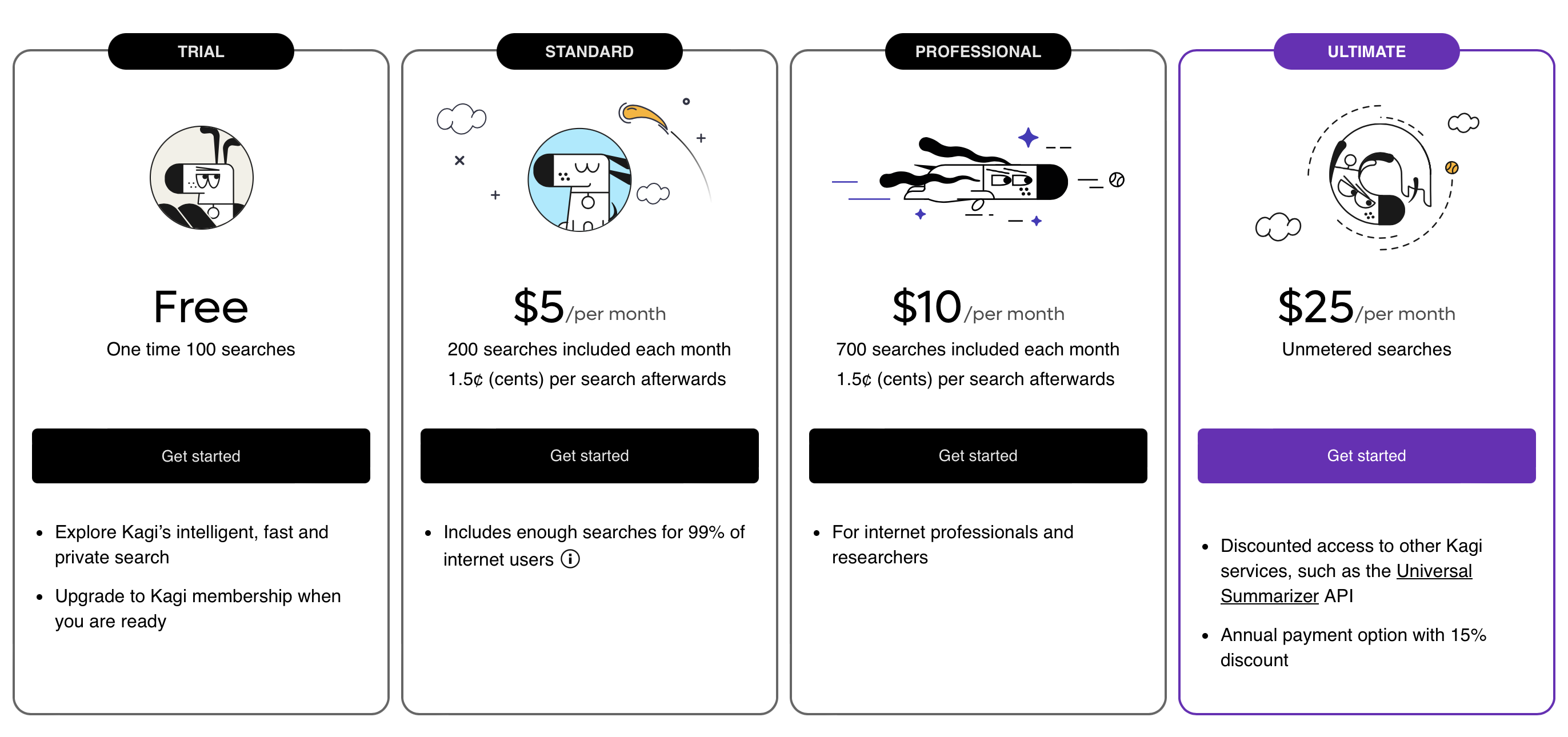
Unlimited Kagi searches for $10 per month(blog.kagi.com) |
Unlimited Kagi searches for $10 per month(blog.kagi.com) |
I love seeing the success of kagi! I’m an early adopter and the search results quality plus the hidden gems plus the ability to customize them is just fantastic!
A example of customization that I’ve been experimenting is lowering a bit the results from stackoverflow to see official documentation first, it’s been working like a charm!
Thanks again for making kagi in spite of all the naysayers!
This change will make a lot of other people like myself a lot more comfortable with signing up I bet.
Firefox fans need to know that by using Kagi you're hurting Firefox (and Mozilla) as they are completely dependent and need to beg for Google's millions for being the default search engine.
Unlimited Kagi searches at $10 is still unsustainable vs free Google searches. By default, Kagi will either (eventually) raise prices or reduce them to compete in the race to zero on search with Google already at the finish line.
So please continue the 'celebrations'.
and yet I am not understanding WHY :)
You can even create your own goggle and narrow down searches to whatever you want. I wish Kagi supported that as well.
With goggles, you can build and maintain custom lists of _thousands_ on github.
You can also pay for it with Bitcoin/Lightning to achieve full anonymity if this is desired.
I can't do a long demo like I did with DDG because of the free limits, and $5-10 is a lot of money for me right now. So I ask here.
Quality search is priceless.
thanks for the discount
I only did that for the unlimited searches!
I don't feel like I'm a heavy user, but after nearly 4 days of usage, seems like I typically do ~30 searches per day, but hit 60 searches on one of the days.
It's still early days, but I'm enjoying Kagi so far. I think the biggest problem I'm having is a sort of psychological block that when I run a search I expect to see Google.
"Example search results:" click one of them and it takes you to
https://kagi.com/search?q=python+exceptions
Although tbh I'm not liking these results. One of the top results for Python Exceptions is "Python exceptions considered an anti-pattern" which is an opinoin boost rather than documentation.
Specially in programming, when the right article or stack overflow can save you an afternoon, the “I wonder if I would get better results if I was using Google” feeling is hard to shake.
Too many decades, I guess. I’m rooting for something like Kagi, though. I’m glad to pay $10 for such an essencial tool. And I’ll eventually be over that hump if it proves to be as good or better consistently.
Edit: also, looks like you have to be in the 'Team' plan for access. But who knows, if there is demand I'm sure they'd open this up, so maybe just ping them.
Anyone knows why the API would be so much more expensive? With Google I can understand because with the API you miss a lot of the tracking, targeting and advertising, but if you don't have any of that, why would it cost so much more than normal searching?
I understand unlimited is off the table for an API, but 1000 for $25 is quite a bit.
It also introduces adoption friction for users who are used to things being "free" on the internet, which hurts the hypergrowth shareholders want to see.
However I experimented last week by running all my searches (work and personal) in DDG (my default) and then also in Kagi. And basically they either both had the best result first, or sometimes second or third. Definitely not a $10/month difference for me.
The mental gymnastic of having to decide if a search is worth using Kagi for, ended up in my not really using Kagi..
This unlimited (and reasonably priced) solves this, thanks!
> How to Handle Exceptions in Python: A Detailed Visual...
A search on DuckDuckGo displays the complete title.
I've kept it thus far because I believe in the mission but man... I get why other promising search engines have fallen to Google.
Care to elaborate on how it gets in your way? And what, in your opinion, Google does better? I use Kagi myself and I am very happy with it.
I'd guess there are more people willing to pay a little than maintain the FOSS alternatives themselves. I ran my own mailserver for a couple decades, then found myself at a place where I have more pocket change than free time and started paying someone else to manage the hassle for me. That's where I am here, too. It's worth it for me to pay $10 per month to get Kagi's benefits without having to do it myself.
Apparently they believe there are enough people in that boat to make it a worthwhile business plan.
however, i'd like to point out that in my understanding, most of my $10 will go to google, in kagi's payment for their search service, rather than support kagi or their mission.
please correct me if that's not the case.
Vlad has addressed this several times; it’s a planned use case. They offer it because though they don’t keep logs they don’t expect everyone to trust that.
I can’t find the comment but he just addressed it a couple days ago here on HN.
Also, do you really think google doesn’t know who you are?
One would have to go to extraordinary lengths to hide your real name nowadays from even a talented curious searcher never mind google itself.
Even Ross Ulnricht couldn’t do it. And that boy had a LOT to lose.
and only those with means can afford to not be sold.
And e.g. get high-quality search results.
Ugh.
For comparison, I pay $5 a month for my phone carrier with unlimited everything.
The example (https://kagi.com/search?q=steve+jobs) doesn't seem to respect my system theme on macOS.
Here is Kagi's quick answer [0], where its AI "extracts and summarizes the important content from the search results including links to the source material":
"Kagi supports dark mode functionality to reduce eye strain.[1][2] Users can select between the Royal Blue or Moon Dark default themes in their appearance settings. Additionally, the Orion browser powered by Kagi includes dark mode that can be toggled on websites.[3]"
[0] https://help.kagi.com/kagi/getting-started/#summarize-result...
[1] https://help.kagi.com/kagi/settings/appearance.html
[2] https://help.kagi.com/kagi/support-and-community/open-source...
When I logged in with my Google account, it detected the system setting.
* the regular wikipedia as the first result, and the mobile version of the same page as fourth one
* Links to https://steveblank.com/2009/06/18/epitaph-for-an-entrepreneu..., which never mentions Steve Jobs
* the above link also has the wrong date attached (Kagi thinks it was published Jul 17, 2023)
Any plans to let you paste in text or a PDF yet? It's quite annoying to have to upload the audio files somewhere to get a summary.
For example: https://www.youtube.com/watch?v=vlmr9NzxjUA just says
"Sorry, a problem occurred while processing your request. Please try again later."
I already have too many subscription services. $10 for some occasional weekend web searches won't do.
A recurring subscription plan for something like this makes no sense to me personally.
- search results are greats !
- the speed isn't that great (results can take more than 1s to show) : does it become faster once you pay for it ? Or maybe it has to do with the access from europe.
I’d say local searches are a little rough still but otherwise have rarely needed the g! bang
1. Family Plans: I prefer managing things for the family
2. Unlimited: Usage-based risk was too high even if I wouldn't have used it to the high end.
Is this going to change as well?
I’m happy to pay for it.
DDG 6/10
Brave Search 7/10
Google 8/10
Kagi 9/10
Basically all I want is a search engine that does what I tell it to do, and doesn't try to be smarter than me, because it is not. My killer Kagi feature is the forum search. The only way to get real human opinions on things, rather than regurgitated blogspam that's pervasive on Google and even more on DDG and other smaller engines.
Occasionally, I'm on someone else's computer where I'm not signed in to Kagi, and I try DDG first, but I frequently resort to pulling out my phone and just searching there.
Overall, i'm very happy with my starter subscription.
Also gpt gets expensive real fast if any of the linked result is long enough, and no search augmented result over the search engine snippet is often not enough to answer the question. And you are not accounting for the cost of where langchain or similar tooling runs.
That said I haven't tested yet fastgpt searches, so quality is still unknown. It is useful however to have a real api with a real tos, a clear pricing model and good enough is great to have in the toolbox, compared to a library that may or may not work for unknown stretches of times.
I still think though that in many countries it's still high.
At least from my friend group, <5$/mo is the price where most would stop "thinking about it" and just subscribe to try the service after a friend recommendation. You would probably retain most users that would otherwise never have tried it in the first place. I rely on search for work daily, and I want to support non-ad-supported business, so I'm biased. If most users don't really reach the original 1000q/mo, then more regular "non-power" users could offset the cost. Or maybe that's already factored in the current pricing.
Either way, I did enjoy kagi quite a bit on the first beta, so I knew exactly what I was in for. But if I would have subscribed as a test with the 100 initial queries I don't think I would have got attached to it. It took me a while to trust the result and compare it with other search engines to get a feeling for the service.
Also, if anyone finds it substantially better, could you give some example queries on which it does better?
I am fast and good at searching, but I ain’t that good. I’m going to give Kagi a try for this reason, plus ability to prefer or ban specific sites.
Do you have any basis for this assumption?
I consider myself as a heavy search engine user but, based on Kagi stats, I was surprised how much less I actually searched compared to my estimate. My actual range is about 500-800 queries a month when I originally estimated upwards 1500 queries a month.
Same thing with my friends.
Any chance of some bonuses for the early adopter people ? Totally get that you want to keep "Ultimate" it's own higher tier thing but maybe there's an in between ?
> Are you affiliated with the legendary Kagi shareware platform?
> No. That Kagi went bankrupt in an unfortunate turn of events. We liked the name and acquired it when we got the chance.
[0] https://help.kagi.com/kagi/company/faqs.html#are-you-affilia...
> Kagi.com was an e-commerce micropayment platform often used for shareware and e-book purchases, operating from Sept 1994 to July 2016.
edit: You can switch pro-rated, nice.
and it seems to be working fine?
When I'm writing code I tend to search a lot, and I'd resigned myself to not using kagi because I didn't really want to bump up to the $25 plan.
Also what specific features are in the mysterious Ultimate plan?
And what was the domain before it was a search engine?
https://news.ycombinator.com/item?id=12200972
Thanks!
Ultimate used to be unlimited searches.
Now that the Professional plan is unlimited, this seems like a quick attempt to provide some value to those with Ultimate. My bet is that many will move to Professional, those who stay will mainly do it for the support, and the mystery is just a cherry on top. I'm guessing extended API and AI features are among the coming features.
The search UI seems broken on my Firefox due to some absolute styling. I had to set this in my Stylus config to fix
.auto_suggestions { padding: 0; top: unset; }
The auto suggestions were appearing over the top of the search bar due to unruly top css.
When I hit Advanced search, and then click Podcasts (or any) without a search query, it gives a "tab switch" like behaviour.
Given that behaviour, When I enter a search term and hit enter Then as a user, I expect the search term to search based on the category I'd selected.
What I get Given I've selected podcasts without a search term entered When I enter a search term and press "Search" button Then I get sent to the generic search page for that search term, not the expected category I'd selected on the prior page.
I don't use any of the other features.
If you get results that don't match your search term and try to filter them you actually get more of the bad results.
That's a product that flat out doesn't work in my opinion.
What are you offering me that is worth $10 more than just using DDG?
This couldn’t have come at a better time as I was a bit hesitant to add another subscription while still keeping in mind the additional searches I might have to pay on top. Signed up for a year!
It's also not clear if there are device/location limits for an account. I use a lot of devices and travel quite a bit.
The search limits are per account. As long as you’re signed in, you’ll be fine.
Edit: Also, the browser is WebKit, not Chromium. That’s why it’s Apple-only.
I'd love to see a upvote/downvote system per query/result, as another ranking metric. Especially if it can cluster recommendations by "users like me", similar to how Netflix recommendations used to work.
Maybe don't apply it to political searches, lol, but for everyday queries I'd find that really useful.
>NOTE: The Search API is currently only available to customers of the Kagi Teams plan. Please reach out to vlad@kagi.com for invite.
https://help.kagi.com/kagi/api/search.html
It sounds like an excellent product, but I don't want to be forced to use their client/interface; I want to be able to make my own.
It seems a little weird that there would be searches where users fallback on a Google search, when Kagi fails... Shouldn't Kagi get those same results?
There's also some double standards at play. On every article on DuckDuckGo you'll have people comment: "It's just Bing". Well, if that's the case, then Kagi is just Google. Basically the two search engines do the same thing, but with different business models, and with different levels of success.
Personally I feel like Google and Bing are on par. Bing has improved a lot, and Google simply hasn't.
They could optimize their results for best results, but they don't want to, as that would reduce ad revenue.
While it sounds very conspiratorial, I don't think many teams in big ad/search companies are being measured by the lack of use of the product. For search, customer satisfaction is likely a first page answer resulting in no more searches on the topic (i.e. less use). For a company hosting ads in search results pages, that's a negative outcome. But it's what users want!
I believe if minds were put to it, and commercial drivers put aside, Google or bing or anyone else could very quickly deal with the scourge of poor results and SEO spam. But when you get revenue from search results page impressions, ad clicks, and impressions on the junk sites in listings, the incentives just don't align with the user.
Have you done a formal price optimization? There are no priced competitors to pressure you to stick to a price point so you have leeway to experiment.
$10/month can get you terabytes of media on streaming platforms.
$1-2/month is what I would pay.
I think it's a fair price if you live in the US. I'd pay it, except I don't live in the US and our currency isn't great at the moment, and I don't exactly get overpaid at my job, and the cost of everything is rising, so I personally can't afford it ATM. But it seems reasonable to me.
For the average person, there's no real difference between $2/mo and $10/mo. They're both in that "more expensive than free, but not expensive enough to think about" category.
I can buy potatoes that last me for a week for the same price as for what I'd pay to just get a coffee, but if I've already bought my potatoes and have money to spare, why couldn't I buy also the coffee?
Well... I do, but not the broad internet. I search the places that have the information I want -- Ansible docs, VCS, etc.
I've solved this 'problem' completely for free
This is a change in good direction, and I’ll happily check it once again.
Nothing to complain about here, just overall very pleased.
The anonymous payment options are cumbersome. Why not do something like Mullvad with scratch-off vouchers sold on Amazon?
If you’re asking how you know whether you can trust them when they say that, I don’t think there’s any way they can conclusively prove it.
For comparison, I pay $3/month for mightytext. Which is a tool for Android that lets me send/view/search text messages on my phone from any browser. I'd pay $10/month for it, but kagi doesn't give me nearly that much value
EDIT: I just signed up for Kagi. Youre out of your mind if this isnt worth $10, holy crap this is awesome. The amount of configurations and settings is out of this world. Unless you use google 5 times per month this far exceeds its cost.
Note: currently Kagi doesn't track search history; I hope they find a way to enable it in the future.
I live in San Francisco, and if I type "sf weather" into Google, I get a weather forecast for San Francisco. If I type "sf weather" into Kagi, I get a weather forecast for Santa Fe, which, while technically a valid result for those search terms, is useless to me. Similarly, it's easy to search for restaurants and get search results for other restaurants of the same name in different cities.
But most of my searches aren't location-sensitive, and Kagi does a great job the rest of the time.
Genuinely curious. Have tried Kagi and found results to be mediocre at best compared to DDG.
For me, if it is related to my job, I am usually going straight to the docs, language forums, and sometimes stack overflow. It's only if I am looking up a specific error that I do a general search (although that is getting harder and harder as more words are ignored).
Personally, I rarely search. Music related? Straight to Metal Archives. Tv/Movie related? straight to tmdb.org. General Reference? Wikipedia. Stats/Facts? WolframAlpha.
I'd say I use a general search engine only a few times a week total.
My two main complaints:
- It's not very good with conversions. Say searching '120mph in kmh' doesn't work. Or the little widget with conversions that do work like '120cm in m' doesn't allow to change the input and change values on the fly.
- The image search is super slow for whatever reason. It takes about 5 seconds before images show when doing a search.
120 mph in km/h does work, though. I don't think "kmh" is a normal abbreviation. This is the first time I see it.
Admittedly $10 still seems kinda steep for something I get for free already. But maybe I should just try it out for a month and my mind might change.
And this is why surveillance capitalism is so effective.
If it helps, think about it in yearly terms. They offer a small discount for annual payments. Is $108 per year an amount you are really going to miss, for something that gives you daily (even hourly) value?
(I get that for many many many people in the world, $108 is a significant sum, even yearly, but I expect that most of us here are luck enough to not be in that boat.)
It would be interesting where the "language barrier" drops in.
I’m eager to see where Kagi goes from here. I’m skeptical that it’ll expand beyond people in the tech industry and their close relatives, but maybe that’s not a bad thing if it’s sustainable for them long term.
On the cybersecurity front there are so many research articles, conference videos, and news articles just constantly flooding your feeds. There was an article on HN recently about the importance of "Critical Ignoring", to know what to ignore.
This has been a key tool in speeding that process up. Especially conference materials and news articles. They have such clickbait titles, it can be hard to determine what is legit and what is obvious. For news you can get a use the source as a fairly decent gauge on what the articles will be (quality wise). But for conference materials it is so hard. Summarization with the "Key Moments" lets you quickly determine if I should dig in more or not.
The Discuss option is super helpful on huge framework/audit documents to help you figure out is this the standard that requires xyz vs the other one. Once i know i'm in the right doc then i can zero in on what I was looking for.
Presenting Kagi as a tool for use in our larger Principal/Architect team next week. Will be very interested in Enterprise/Corporate plans once they are a thing.
Thanks for all the work Vlad (and team)!
Good job Kagi, seriously!
So, I would take these promises with a few grains of salt. For the purpose of improving their product they actually need to know how people are using it. So, they have to balance quality of their product with privacy. More privacy means their engineers are not getting all the information they need to do the best that they can. And they are competing with companies that are not holding back on that front. So, there's a bit of tension there.
Of course the fact that it's a paid product, allows them to make some stronger guarantees and build in business friendly wording into their terms of use beyond just promising that it's all fine. The flip side is that you have to sign in to use the product and prove that you paid for it. So, you can't use it anonymously.
IMHO, they should target the SAAS market and offer to make stronger guarantees to companies that are legitimately worried about their intellectual property leaking via search queries. Having people happily dump whatever in a Google query actually potentially gives Google a lot of insight into what these companies are doing. Including their direct competitors. And I'm sure they solemnly swear that they'd be doing no such thing but the temptation to tap into that is probably enormous for them. I can imagine a few companies that would pay a premium to cut off that particular flow of information. Those per seat deals that get sold by the dozens/hundreds are potentially worth a lot. B2C sales is a lot harder than B2B. And of course access to services like this is also a nice perk for employees.
- dutch baby pancake - dave hughes - albert park sailing lessons - <nameredacted> paediatrician - LNC patient cables pinout - 23FBQ connector masimo - state’s powers australian constitution - digital ID ACCC - Woman dies due to bushfire smoke canberra - <local council area> babytime library - bellroy - what does ammonia smell like - herschel infrared heater home assistant
And also, nothing I said literally changes at all, whether its $7, 10, or $12.
When I first started using Kagi a year ago or so, I compared results with Google every now and then.
Now? Never.
10 bucks a month for a tool that I use multiple times every single day is more than reasonable. The results hit home virtually every time.
There are variety of features to customize your searches but truthfully, I never found the need for them. I've only blocked/deprioritized some domains, that's it. The results are just so good.
Does Kagi give a similar impression as Google did then?
For example searching for "current time on JavaScript" on Google, I get SO, MDN, and basically a lot of SEO spam sites. Same thing on Kagi https://kagi.com/search?q=current+time+in+JavaScript&r=au&sh... ends with an actually interesting blog on position 5, link to moment.js on GH, further down posts about accuracy and about the Temporal API proposal, etc.
In four ways for me:
- it actually respects my search. If I search for "<some word or phrase that doesn't exist>" I get no result. It doesn't silently twist my search until it gets something it can show me a million utterly irrelevant results for. This is a huge time saver for me.
- there are no ads. I usually didn't notice ads in the search results anyway as they were always irrelevant, but recently there has been so many of them that it took away space from the search results. Going back now feels weird.
- as others have already mentioned a lot of low quality pages just doesn't show up, leaving room for other, more relevant and/or high quality pages.
- built in tooling to deal with pages I don't care about and that Kagi hasn't already dealt with.
I don't know if they're putting a finger on the scale, or maybe they're just doing the original Google thing of ranking sites that seem to be where the search terminates higher, but it's good.
Encourage you to try it. I've repeated Scott Galloway's mantra that advertisement is a tax on America's poor and stupid. But I never quite clocked the cost of search ads. It might be solely due to that lack of scrolling through crud that makes Kagi seem much, much faster than Google or DuckDuckGo.
I’m a huge fan of the lenses feature. Specifically for technical searches… I can filter for forums only or PDFs only or academic stuff only.
The biggest difference for me is that on Kagi, the first results are always relevant instead of clutter/ads that you see on Google.
I have replaced Google completely with DDG for most searches, ChatGPT for some things, GitHub Copilot for mundane code questions, phind or code.you.com for things requiring more search, and Kagi for things requiring much more searching.
I use Google only now for nearby searches like "gas stations near me", etc.
I never really thought that this day would come. I love Kagi for being able to block Pinterest from everywhere, GeeksforGeeks, etc.
Very happy customer here.
https://en.wikipedia.org/wiki/Evaluation_measures_(informati...
It feels like turning on your ad blocker. It's what web search was supposed to be all along. It isn't that it's better than Google, Google is just so much worse now.
I'm extremely happy with it. Just the ability to block Pinterest from my results forever is worth the price.
That's my major problem with google. Sometimes I need to search info on a symbol, and I don't know what it's called yet, so I have to perform another search, just to perform the one I actually care about.
This number really varies based on where you live, and there is no pricing model that accounts for this. I suppose it is mostly just aimed at Americans.
No, it varies based on who you are. Even poor countries are full of rich people. They are usually part of the reason why their countries are poor.
Have you ever used Perplexity? How does Kagi compare with it?
I switched to DuckDuckGo a while back but I’m not a heavy searcher. I would be curious to know your typical use cases!
The downside is things like Sports and other knowledge items which shows a widget I’ve never understood in my life.
My experience trying switching with duckduckgo (repeatedly) always failed; checking google, unhappy with ddg results. Kagi, not so.
If I search for "Elac 6.2 speakers amazon" it comes up with a .com link. I have to search for "Elac 6.2 speakers amazon uk" for it to go to .co.uk.
This was an option with Google that I liked.
*Weirdly now if I search for "elac debut 6.2 amazon" it comes up with a UK link :S
Same. I still do attempt a Google fallback if I don't easily find what I want on Kagi, but every single time, the Google results aren't what I'm looking for either.
- it combines the top 10 this or that list into listicles that are aggregated into their own section and I find to often be full of spam - it lets you block or deprioritize any site you want like quora, medium, Forbes, that often give me useless or incorrect info or are just their to boost so - it lets you prioritize sites you like in the search ranking - it doesn’t have blocked or censored keywords - it lets you specify by date or time quickly and easily which I find to be beneficial and google seems to hide it constantly move around in news
It’s weaker for like looking up a phone number or hours for a local eatery, but in general I like it better.
The results are good by default. But you can change the ranking of sites in your results, so every search is custom to you.
I pin documentation sites like MDN and pkg.go.dev and penalize SEO span sites.
My results are custom to me and my workflows, it's pretty hard to go back at this point.
Kagi is one of the stickiest subscription services I have.
But also, because you're the customer not the product, you don't have to contend with Google's ad-driven search results and their privacy violating bs. Totally worth the money.
(Kagi user since the beta, paying user since they started offering subscriptions.)
Two years ago, I found out that my favorite Youtube creators were all on Nebula.
One year ago, I switched my phone to LineageOS to get security updates a little longer.
A month ago, I installed OpenStreetMaps because Google Maps got really bad at showing points-of-interest.
And today, Kagi removed the only obstacle that kept me on Google Search. I'm looking forward to building my filter list.
After accidentally de-googlifying myself, I might ditch Windows next. It feels really nice using products that respect me, as opposed to services that are actively hostile because of advertisers.
For the past three or so years I have tried half a dozen times to leave Google Search. Tried DDG, Brave Search and some others I can't remember now. But the "poor" quality of results had me going to Google for half of my searches, and after a while, just Google again, for convenience.
Now, I'm at 44/100 trial searches and I already know I'm going to pay for this. It's like using Google on 2008 plus without ads. It just work wonders, and I haven't even started to play with the filter to raise/lower certain domains, which I think it's a fantastic tool to have.
Great work Kagi Team!
I don’t search that much. I don’t want another monthly service fee. But I love the idea of paying for search.
Id happily pay $5 for 300 searches, but don’t want to do that every month.
This seems like the buffet or gym model where they want people just mindlessly paying and then not using it that much.
Previous discussion about the prior change: https://news.ycombinator.com/item?id=35078392 (226 Comments)
How does search quality really change my life?
Entrenched behavior is tough to overcome especially ostensibly free products.
I don't think web search is still important enough for me to pay for. A year ago it would have been. I originally signed up with kagi but I wasn't too impressed and then they came with the limited plans and that was it. Not sure if I'll go back now.
And yeah like the article says it was priced for "silicon valley bros". Even $10 is a lot on a Spanish salary still. But it's doable and 300 for $5 is a decent deal IMO. I wouldn't do that many.
I've thought about it several times, enough that I did track my searches for a week. Between work, hobbies, and just life I searched (overwhelmingly DDG and Bing) over a thousand times in a week. (A evening of prep for my tabletop RPG racked up over a hundred all by itself.)
I've bailed on Google - wading though the flood of SEO'd garbage just stopped being worth it. Bing and DDG have been mostly working, but I definitely feel like they're missing something. $10 a month is definitely worth it to try it out, and if it works for me, worth it to keep paying. I'd been hesitating because worrying about my search count seemed like a substantial negative for me.
That's a lot!
I perform 500-900 searches a month.
I really enjoy Kagi's caching image search; it often lets me avoid visiting websites when I'm just looking for graphics. Going on Kagi and reading summaries and viewing cached material gives me the "I don't feel like going out" vibe, but on the Internet. One step closer to offline.
It’s not that I am involved in shady business, but I do look up strange things from time to time.
How do others feel about this?
(I feel like there is a need for a private, maybe even local, search?)
There needs to be a healthy decentralized, open source approach to search. If people can hope to train and infer with LLM's locally why not the relatively "low IQ" search index that doesnt even violate copyright? The two are increasingly facets of the same thing.
Btw you should try recoll for local search.
Open source business models are not the easiest but a team could easily fund things with corporate oriented customizations.
Maybe Kagi itself should try this path.
In any case the next phase of AI enabled computing will require some bold thinking and acting, but above all, having a moral compass.
I've dabbled with a multitude of search engines recently and that is one thing badly missing from Bing.
Kagi has done a much better job of respecting where I live, though it has had a few minor misses that Google produced (maybe after wading through some crap).
For example, searches about news, public holidays, or certain statistics should default to the user’s home country (however that is determined, which is admittedly a whole other can of worms that even Google doesn’t always handle well).
I'm very happy with this service. Worth every cent and then some.
I prefer to pay for the services that I use with money rather than with my personal data, which may be used against mine or my fellow citizen‘s interest.
I don't search very often for stuff to buy, so… definitely not 10$.
Even paying for Kagi, I still go back to Google for any really open-ended searches where the search engine's ML can actually be helpful. For known-item searches ("fandango showtimes Seattle"), or simple searches ("pumpkin bread recipe") which are fully 90%+ of what I search for, Kagi is just fine, and they aren't after my identity (just my money).
Core Front-end Team
Passion for creating delightful and swift user interfaces.
Proficiency in HTML, CSS, and _an understanding that JavaScript can be used sparingly to enhance, not create, product experiences._
Ability to prototype rapidly.
Fun fact: At Kagi, we prioritize speed, to the point where *all functionalities of Kagi Search (except Stripe checkout and Maps) work perfectly without JavaScript*. We see JavaScript as a tool to enhance the UX, not create it.
When the prices hiked with very short notice, they were potentially going to lose money on every search, until they figured out their next move. I believe at the time they said they wanted to bring unlimited back when they could make it work financially. And it's nice to see a company do what they say on that front, for a change :)
As another commenter said, it's unusual to see a company reduce prices as it becomes successful, but I think that will help to deliver even more user growth by reducing the friction to adoption, and also showing that they're true to their word even when it comes to reducing pricing.
Kagi is basically now my daily use search engine apart from Startpage.
The bangs feature, where you can use a quick command to search popular sites like Wikipedia, reddit, Youtube, etc is great, and doesn't count towards your search limit.
And I'm really looking forward to using the Universal Summarizer feature which is included with these new $10 rate.
Keep up the great work lads & lasses!
Kagi users, how good is Kagi for non-English searches?
Admittedly, I haven't said anywhere that I prefer Danish results when the query is the same in two languages. My operating system and browser are not configured to reveal my nationality. The only way Kagi would know is if they factored in my IP address. Which I can deduce that they don't. I prefer it that way.
There is a discussion[1] on this topic on the forum.
The last thing I've still been using Google for was looking up which Dutch retailers sold the product I was looking for. But now I see that was unnecessary.
My biggest complaint with Kagi is not their fault - it's the inability to set custom search engines on Safari (and no, I'm not interested in installing a custom browser extension).
It's not a 100% clone of Safari, but it's now matured far beyond a "scratching their own itch" project to enable custom search engines - it gives you the performance and power efficiency of safari, with the option to run most Firefox or Chrome extensions (by implementing the extension APIs in WebKit).
The iOS version isn't quite as mature as the Mac version (which is definitely usable as your main browser), but it's getting there.
A lot of times the results are better on Kagi than Google, but not by much. It makes sense they're similar since Kagi uses Google's index (among others).
Not in my experience, and what about user tracking and pervasive advertising? You don't seem to include that in your comparison.
You can use Google anonymously but you have to log in and leave your payment data with Kagi.
EDIT: apparently they accept crypto
- no ads
- one click to permablock SEO spam sites from appearing in searches
- minimal user tracking (not logged into a google account)
Kagi would likely have a better value proposition if I did more searching on mobile though.
With that in mind I wonder if Kagi would be worth having ads for a free version but be super clear what the ads are based on. E.g purely based on 1) search KW and 2) IP location of the search. Nothing more and nothing additional stored.
I wonder if privacy minded people would be happy with that as it's very limited data in today's ad world, a massive improvement on anything else, plus you can turn if off if you want to pay.
I also suspect it would be ~80% as good for advertisers as so much of the rich segmenting advertisers like to pitch has limited to zero effect and KW/location are the big 2 variables.
We are kinda priced out when keeping the PPP in mind.
Say $1-$2 for 100-200 queries?
To put things into perspective:
- YouTube premium is $1.30/month
- Amazon Prime is $1.50/month ($0.75 if you are <25)
- Spotify premium is $1.44/month
- Netflix (1080p, no-ads, 2 devices) is $6/month
$5 is decent home-cooked lunch for eight days in India.
Maybe Kagi's target customer base isn't India, and that's okay. But to do business in India, a company has to do, what I call- "India pricing". Maybe there are better terms for it.
Here is Stripe (used by Kagi):
2.9% + 30¢ per successful card charge + 0.5% for manually entered cards + 1.5% for international cards + 1% if currency conversion is required
So if you pay $1, Kagi gets something like $0.65, meaning it just lost 35% on the payment processing fee. There is no way this can be profitable to serve the service.
I have previously donated to fCC and sent Super Thanks via UPI. It's seamless experience.
Now the question is whether it will be worth it to Kagi to maintain all these- I think- yes! Once these are set-up, these are low maintenance and you don't need to babysit it. Setting these up, catching up with local tax laws sound like a big barrier, but it really isn't.
I know what I am asking is a bit much. :/
Don't get me wrong, I think Lineage is great and I use it too, but I think too many people are fooling themselves on how much extra security they're getting using it.
LineageOS will be using the exact same baseband that came with Android 9 on hardware they're deploying Android 12 to, if the phone's actual support stopped at 9. Yes with the new "Play System Updates" there's better security coverage, but it's still a gap compared to supported hardware.
In other words, LineageOS provides the latest Android and baseband updates available; it's just that for the baseband, "latest" can be a lot older than for Android, if your phone hardware is no longer supported by the OEM.
(Of course, the thing about the baseband still remains, but Google now offers 5 years of security updates, which are immediately ported by GrapheneOS.)
It's a commercial operating system, for Christ's sake, stop pushing sleazy features. They are quickly burning through all the trust acquired over decades.
Hot take, but IMO Windows has far more respect for the user than Linux does.
Everything is far more QA'd (and designed to be QA-able) and at least tries to minimise user frustration. There are exceptions to this, like "suggestions" in the Start menu, but outside of this it's designed in a user-first way.
(Desktop) Linux, on the other hand, seems to be more of an intellectual experiment designed to please the people who are writing it rather than a consumer-focused product. Performing basic tasks are unnecessarily complex, entire design paradigms are thrown out on a whim and compatibility issues continually arise because there's no single dominant standard.
Respect for the user…
While it forces a reboot
While it tries to trick you in to upgrading to 11
While it sends huge amounts of telemetry to Microsoft
When it forces you to sign up for an non-local account
When it use dark patterns to get you to use Edge and upgrade to Windows 10
When it forces updates on Home users
…
Honestly can't tell if you're joking, but I guess yes. Linux is the most stable OS I've ever used. There's a reason most mission critical and online services that require constant uptime run almost exclusively on Linux.
Windows used to have a nice GUI attached to a mostly unstable system. That was 20 years ago. Now Windows feels like a predatory product that's borderline unusable.
You need to be more specific about what desktop Linux flavours aren't holding up in your eyes because window managers like XFCE and Cinnamon are bulletproof as far as I'm concerned and I've never had issues with them. Especially XFCE.
> there's no single dominant standard.
This is a common criticism and I totally get you here. Not knowing what's going to work for you is annoying and truthfully, no one really wants to shop around for window managers and the only reason I know what's good in the first place is because I spent weeks in my youth test driving everything available, something I no longer have the energy for.
I feel like windows is deliberate about being user hostile. Just because they're very slick about being user hostile doesn't make it any different.
Linux feels like someone with my best interests at heart made a good attempt and half succeeded.
then I just downloaded a program that let me disable it, and I also disabled the firewall
but without the firewall service, I can't get updates (why is that service a pre-requisite for updates?), and I forgot how to re-enable it because I don't remember what program I used to disable it since it's some hack anyway
so now my Windows partition is not really usable, and I'm typing this on Linux where I can just change stuff without breaking everything
There is no such thing as a single Linux experience, each distribution targets different personas and goals.
If you want a curated Linux desktop experience, then try Elementary OS. It is very aligned to a Mac experience.
The creator that convinced me to come over was Jacob Geller. His video essays were amazing, and I wanted to find a way to support him.
what?
I went from Windows to Pop!_OS, and was surprised how it just worked flawlessly on all my hardware right after installing, the UI is nice too.
Just like if Microsoft renamed Windows 11 "Win!! Win(ners ONLY) OS whooOOO!!" you would still just call it "Windows".
is it usable again?
I remember using LineageOS for a couple of years, but ditching it about 3 years ago. The for me dealbreaking was when banking apps stopped working
Anyone else struggled to leave google photos?
Some massaging was needed of the takeout data to remove some dupes but uploading was smooth and the UI is pretty good.
And a shout-out to StreetComplete, that gamifies contributing to OSM.
Tryout FreeBSD. Works fantastically for daily driver / desktop.
By making it feel a finite resource, some percentage of the users will start to ration their use of your service and/or do some deliberation before using it ("I kinda want to look that up, but I don't know if I want to spend one of my searches"), and introducing that kind of usage friction can even lead to a subtle resentment of your service.
One of the reasons I decided to skip Kagi for now.
Amazon doesn’t make me subscribe and I can buy 100 hours and use them over 10 years for all they care. I’ve had monthly bills that are a penny from glacier.
I don’t think this pricing is because it’s hard on Kagi. I think it’s a dark pattern that once people subscribe they just autopay forever. My dad subscribed to dial up aol until last year. He hasn’t had a phone line for 15 years.
You think kagi is going to not charge people if they do zero searches?
They’ve already made it a finite resource by charging $5/month for 300 searches. I’m already rationing. They’re just saying it’s $5 if you do 1 or 300. There’s already friction. But friction to dark pattern you into paying more.
I mean it’s their prerogative and they can charge whatever they want.
I just don’t want another monthly fee. I’d rather just pay once and be done. Sell search tokens or something.
Exactly to a T how I feel about Khanmigo. I pay for it because I love the idea of a maths tutor in my pocket that wont make me feel stupid, even if by accident, for forgetting something simple.
But there's a "battery" that resets every day and it just makes me anxious. I'd easily pay 50-100$/m instead of 10/m I already pay if I could get unlimited access but there's just no option for that.
If anyone has any recommendations for something like Khanmigo with unlimited access please please let me know. I'd pay so much for a good personal private tutor in my pocket. For maths if that helps.
I have this same unavoidable urge to optimize with other limited plans, such as cell phone plans (for voice , before everyone went unlimited anyway) and have found I'm much happier with an unlimited plan. It costs more and I value the saved mental energy more than the trivial amount of money.
I see this as the point to any subscription model. Of course they want you paying for more than you use/consume.
Id rather buy things.
I don’t want a car subscription. I want to buy a car.
I don’t want a book subscription. I want to buy a car.
I don’t a compute subscription. I want to buy compute hours.
Etc etc
Just like you can go to the gym every day - if everyone with the membership did that they would not be able to function. But it doesn't mean you can't.
This whole post feels dirty, how it's a direct link to a blog post that just reads like a press release, and there's a ton of sus responses promoting it in this thread.
Tin foil hat, are we having a reddit bot moment on HN?
It doesn't make sense when your consumption is spread between many vendors - like news sites or streaming services or substacks. There should be option - done one time to someone on substack. There are authors I would like to send some money, but they just don't create enough value.
search engines and gpt chat bots are something in the middle - you usually have 1 + 1/2 backup. Goodle, then bing (google filter way too much some stuff), then yandex (since there torrents are not nuked). In this spot subscribing for each is too much money, but just limiting for one has real quality of life costs. Kagi seems to be somewhere here. I wish them luck - search space begs for disruption, but my hunch is that 10$/month is on the high side. On the other hand having those kind of people is valuable. A search engine for the rich will have easier time pitching value adding service.
https://blog.kagi.com/status-update-first-three-months#finan...
This was a comment about their financials last year. This isn't a high profit business making hand over fist and exploiting users.
I'm happy to pay monthly to get a service I see as valuable, especially if it ensures that this service is sustainable long-term and doesn't disappear because of money.
How much do you think it would be reasonable for them to charge for 10,000 searches? I assume this fee is supposed to sustain the company and fund all development and growth with a 100% ad-free business model, forever!
Given that they allow unlimited for $10 per month, that would mean it's the equivalent revenue of 16.67 months, which seems pretty comparable to your numbers.
I think you're being unreasonable toward GP.
A lot. I make dozens and dozens of searches on an average day.
I'm also somewhat cheap when it comes to subscriptions.
Throwing $10/mo. for something I can get "for free" is not a light choice. But...
  1) I don't like Google's philosophy, I don't like being the product, I like being a customer
  2) Google Search results have gradually gotten worse, mostly because of SEO spam
  3) I don't really trust DuckDuckGo or Startpage, their model is essentially also advertising
I prefer to not go to the mall for recreation or work either.
There are lucrative bundling opportunities.
I am waiting fora corporate product; it's notable that Google Workspace still subjects you to ads in search. That's not only a data leak. It's also a constant attention tax on your knowledge workers.
Oh, do you mean if you do a Google Search even though your company pays for Workspace?
There are tons of information workers who are dependent on search in their work – or if they're not, could work much better with good quality search.
The examples are really too many to list, but it really depends on the person. When it comes to not spending a dollar, people will create the most incredible and reality-defying reasons. So I'd expect 99% of Google users to keep using Google, or maybe even stop using web search when Google becomes completely unusable. Then they'll say "I have no need to search for things anyway".
Would you pay $10/mo to fix that problem?
For me, the answer has been yes. I don't think that is true of everyone (but maybe some people can live in the free plan limits!)
I started with the free plan, made it my default search engine and then tried to measure how often I felt like I had "lost something" once my free tier was up. And yeah, having to go back to Google or DuckDuckGo felt like I lost a really good tool and was using a mediocre replacement.
When the free plan was 50 searches, that lasted me less than a day.
Now that the free plan is 300 searches, it'd last me a few days.
It was enough for me to get hooked.
I switched away from Gmail years ago; the risk of getting locked out of my digital identity with no recourse is worth more than $5/mo. Not having my electronics receipts, plane tickets and newsletters datamined for an improved ad experience is just a perk.
Ask this to someone who remembers when Google first appeared.
I am not a Kagi user, but am seriously considering it after a number of months having to dig through at least 8 results of paywalled or possibly AI-generated pages for almost every Google query; seriously, I just did a search for 'python concatenate list' on google and it was worse than I expected - the official docs weren't even on the first two pages and even the helpful Stack Overflow answers were the 5th result down - give it a go, the results are trash.
I google things at least 20 times a day, and probably so do you. I would pay for something that can cut out the bollocks - if Kagi can follow through, they'll have a customer.
The first result is an info box from Stack Overflow showing use of the + operator to join two lists (with a link to source).
Then 4 more relevant SO posts (which are more nuanced and specific than the generic query, like concatenating into a single string, or concatenating without creating a copy.
Then a small inset box as a "blast from the past" with 4 older blog posts, at least 2 of which look pretty relevant here just from the title.
Then 5 more SO posts (again more nuanced and specific variants of the underlying question), and a digital ocean post on 6 ways to concatenate a list in Python.
And on free duckduckgo I get "instant answer" example from SO http://stackoverflow.com/questions/1720421 Though the official docs are also not on the first few pages
(Btw, you could also use an extension to 1-click filter garbage out from search if it has a high impact on life)
[0] https://github.com/npiv/chatblade
Why is it better? More integration capabilities. You're not limited to the webpage and app, you can use it anywhere you want. Not constantly kicking me out to log in again every few days (their web does this). The ability to select the model and temperature (a measure of how creative the LLM is). Also the default model seems to be much more recent.
And the price. If you use it sparingly you might be paying as little as 20 cents a month instead of 20 dollars. Not exaggerating but it depends on the size of questions and responses. But really to make it cost as much as that 20$ per month with the API you really have to go hell for leather with it.
One that I remember from a couple months ago was that I was trying to recall the name of an exercise they used to do (and may still) in design schools. In the exercise, students are given a problem and a short period of time to work on it, everybody working at the same time. At the end, they get together and critique each other's solutions.
My search terms in both Google and Kagi would have been something like "design exercise with simultaneous work and followup review".
If I run that search now, Kagi gives me articles about psychological studies that combine exercise with learning to test whether you retain more information. It interprets "exercise" as being physical exercise, which is the wrong sense of the word in this case. I think it interprets "design" as being the design of the study, which is also the wrong domain. It does give some articles about graphic design a little way down the page.
With the same terms, Google at least gives me articles about design related activities involving teams. At a glance (and in my memory of the original experiment) none of the articles give me the word I was looking for, but at least it knows the domain I'm searching in.
I remember this example because this was the first time I successfully used ChatGPT to ask about something, and it actually gave me the perfect response, with no fuss, and completely blew all the other systems out of the water. I gave it a natural language version of the same search as above, and it instantly told me the answer ("charrette") along with an accurate description.
So, maybe a bad example, because neither search engine was correct. But, Google definitely got me closer, and I suppose that if I did not have a very specific word in mind, it might have helped me by giving me examples of similar things. Kagi, frustratingly, seemed to have zero idea what I was asking about, and I could not even get it in the ballpark. I wish I could remember (or conjure up) a better example, but that's all I've got at the moment!
[1]: https://kagi.com/html/search?q=what+is+%25&r=no_region&sh=Qd...
But this… they might be winning my heart.
This doesn’t matter to me at all. When will people quit trying to hold the web back for their own self served interests?
If supporting Kagi means supporting this idea that javascript should die, I doubt I’ll sign up.
They're just talking about using progressive enhancement, which is a common recommendation for making web applications faster, more reliable, more accessible and less fragile.
If you think not making the entire UI and replicating browser functionality with custom JS code is "holding the web back", sorry to inform you but you might be holding the web back.
Today’s web is overflowing with unnecessary complication from trying to fit absolutely every type of content through a React shaped hole. It leads to a worse experience for everyone except the developer making the site, who gets to marvel at how fast they’re shipping new features.
If you think my opinion wasn’t born out of experience with the supposed future of the web, but rather some unjustified bias against the language or something, I dunno what to tell you.
The current state of web development has been ruined by putting developer experience over user experience. A great example that was shared on HN a few days ago: https://ericwbailey.website/published/modern-health-framewor...
This person couldn't use the site. But at least the developer got to see red squiggles when they didn't format their object properly!
If you see "not using JS as much" as knee-capping your hiring, then you are putting your personal preferences ahead of what is good for the users.
Advertising is a lot of work, and introduces a lot of tension into the business model. Spotify premium showed me "promoted content" last week (but they promise it's not an ad). They also accept payola for placement in discover weekly playlists, which means their features are useless to me. There's no reason to encourage Kagi to go down that route. They have a good business model that they and their customers are happy with.
1) To make the business viable and profitable. I searched a bit more and saw a post where the founder said they do expect to be profitable with 50,000 users. That still seems a tight budget if people are paying $10/20 amounts. Also I believe Kagi use google results currently so there has to be a big risk google limit what they can do if they ever become a threat of a business or generally remain beholdent to their main competitors via access and pricing rather than have independent infrastructure.
2) I would love to see a real challenger to Google. A paid model will not likely be that.
I completely understand the responses and there is also value in staying ad free, but there is also value in doing ads a better way rather than all or nothing and hopefully not going down the supply slope type arguments by setting clear and transparent rules at the beginning so that tension doesn't exist or is limited.
If advertisers become their customers, then the incentives might start to break just a little at a time. As long as you’re the (only) one paying them, you’re the customer. It’s a big part of why I trust them so much.
That argument only applies to servers. Places where you don't need to wrangle x11, the audio stack, gpu drivers for less common cards, conflicting gtk and qt versions for different apps you might use on a whim, hidpi support in old apps, theming issues... I've no idea how many of these are still a plague these days, but they certainly have been for long.
Servers are way more predictable linux configurations.
For desktop, win32 is as solid as it gets (too bad it's shipped within a desktop filled with increasingly many dark patterns).
I can't remember the last time I had a problem with linux as a desktop, everything just works. Of course, framework makes sure it does, just like every other manufacturer of laptops does with windows.
EDIT: multi-monitor support, bluetooth headset, printing, various audio devices, etc: this is all just plug and play in my experience, feels much smoother than on windows.
That’s not to say it’s not still Linux, there will be some tinkering. But compared to a decade ago there’s way less banging my head against the wall.
If you’re already competent in administration Linux you might find it’s time to revisit the desktop.
What year is this post from?
You’re talking about servers, while the comment you’re responding to is about desktop usage.
Well the whole point is to pay for the product instead of being the product. I am very happy with Kagi, but I mostly pay to show that there is a market for that business model.
It took me a while to get good results with it, as I was so used to skipping the first 4-5 hits as those are always adverts.
They aren’t with Kagi.
As someone who's sick and tired of the way Google tries and fails to guess what I want—to the point of now ignoring me when I try to tell it what I want with search operators—I appreciate this philosophy!
How could a challanger to Google use the same business model that Google has? That is certainly destined to have the same end game/degradation as Google has.
These ! prefixes are nice "visually", but the ergonomics haven't been thought through
Basically, customization is the solution to such design mistakes, but lack of customizatin is another design mistake :(
Unlimited isn’t real, especially for something like search where it’s not like I need unlimited searches.
The best gyms are pay per session. Gyms are also special because people who buy memberships and never use them subsidize real gym goers who would have to pay more for 20 sessions per month.
Sure, most gyms let you buy a day pass but compared to the monthly membership it’s very expensive.
My current gym is £40 a month which gives you access to every gym in the country as well) or £10 for a day pass just for that single gym for that single day.
The fanciest gym I’ve ever been to was the equivalent of £30 for a day pass and like £300 for a monthly membership.
Also you example of gyms being special isn’t specific to gyms, that’s also how insurance works, spread the cost out over a lot of people and everyone pays less.
I agree Unlimited PTO is a con though, just give everyone an allocation and let them choose how much they use (most will use the maximum)
There would be many customers buying on different schedules and that would aggregate into a predictable cash flow.
This is a solved problem as companies have sold software for 50 years.
Subscriptions are more profitable, that’s why companies do it. Not because there’s any realistic business reason (other than wanting more money for less work).
Using dark patterns like subscriptions at this point seems to me that kagi doesn't trust their product or its users.
I'd argue that in many cases - including this one - the issue with subscriptions is simply that they are overpriced from the customer's perspective. Reasons for this could be greed, a desire to get to a self-sufficient revenue point too early, worrying about the handful of users that will abuse any sort of unlimited plan. From the customer's perspective, if the cost-vs-benefits don't feel right, then they'll complain about a subscription, but it's not /really/ the main problem in most cases.
The most "fair" plan for e.g. Netflix would be if I paid for each thing I watch, but that is effectively a "tax" on usage and negatively affects my usage patterns (from both my perspective and theirs). For example, I'd be super hesitant to browse and try out stuff I might not like. On the flip side, Netflix has now passed 15USD/mo and while it's not a huge chunk of change, I don't feel like I get 15 dollars of value out of it, so I'm thinking of cancelling. If the subscription was an absurdly low 1USD/mo, I wouldn't care about the subscription at all.
Kagi's situation is unfortunate for them because they are trying to get people to pay for something that we normally think of as free, so they probably need to lower the price point, at least for now.
> Amazon doesn’t make me subscribe and I can buy 100 hours and use them over 10 years for all they care
Well, sure, getting a customer's money up front for something intangible that they may never use and whose cost to you trends towards zero anyway is something they're happy to sell you. :)
If I search five times a month, charge me $0.05 a search. If I search 2000 times, charge me $10. If I search 2001 times, just charge me ten dollars.
Still no need to think about it, no need to lock into a subscription, but you also don’t have to worry about blowing your credit card up if you have a research paper due or something.
Of course, no one does this because you’re right, it’s purely a dark pattern.
I guess you can bake that into the credits price. But if you say, purchased 100 credits today and don't use it for a year...well, who is paying for that year? Adding a small monthly fee, oddly enough, keeps the customer engaged.
Airline miles are a perk.
You might want the blog to prominently link back to https://kagi.com. "Home" took me to https://blog.kagi.com, I tried clicking on the pricing table image, etc. but nothing got me to the actual product.
I had to manually enter https://kagi.com to see the product behind the blog.
HOME -- links to your homepage
BLOG -- links to your blog
So, even on your blog sub-domain/folder (blog.domain.com or domain.com/blog), have both the links (HOME | BLOG) that links to the right URL.
At work we're always told to use the Azure one because our CIO is elbow deep in Microsoft's ass.
But I wonder.. one funny thing is that everyone at Microsoft is referring to OpenAI as an 'acquisition' whereas as far as I know they only have a <50% interest?
The cost of the GPT-4 API is ballpark around $0.05 / 1000 tokens. If you want to include a rolling context window, you will easily hit 1000+ tokens if not a huge amount more.
ChatGPT pro gives you 50 GPT-4 queries every three hours. If you're using it all day you might average about 100 daily queries. Using a dedicated GPT4 API would run you approximately five dollars a day for the same thing - that's $150 a month as opposed to flat cost of $20.
How hard is it to hit 100 queries in a day? Pretty damn easy when you realize that most queries aren't usually standalone - instead they involve a back and forth approach which necessitates a rolling context window and you explore the problem space.
When a query (plus back and forth) might cost as much as $0.25, paying for GPT-4 via the API would only net you a whopping 80-100 queries per month before you exceeded the cost of a pro subscription.
The API certainly has its advantages over the web based ChatGPT, but price is definitely not one of them.
I really hate the web interface also. It's constantly kicking me out, so I have to log back in and rewrite my query. And it keeps switching back to GPT-3 which is one of the reasons I ended up using that. Using it with my own tooling is just so much better.
And I don't really use it that much. I just don't have a lot that I need it for yet. I definitely don't even get to the 100 a month :)
Also I don't use it as hard every day. On the weekend I don't tend to even touch it. But you're right, your mileage may vary wildly here.
Good point though I should revisit GPT-4 again. See if it's improved.
I don't even bother using GPT-3.. it's not good enough for my use.
Now? I haven't even thought about compatibility in months. I don't even look at the user tweaks anymore, when it used to be a constant factor. Granted, I don't play multiplayer games with anticheat, which last I heard was still a lingering issue. Your mileage may vary, but I completely removed my Windows partition a while ago, and haven't even thought about since.
Just saying, if you have the HDD space, I'd say give dual booting a shot. you'll probably be surprised how usable Linux is for gaming these days.
I'll be the first to say it's not perfect, but it's 100x better than it was 5 years ago. I'd say at least 70% of steam games just work when you hit play, 25% require a bit of configuring to get working, and only around 5% refuse to work at all.
I haven’t gotten a machine with a proper graphics card in years and I wanted one to experiment with LLMs locally, so I got a gaming PC setup.
There's a tiny gap in the early windows 9x days that I've been thinking of filling by upgrading my Dosbox Win 3.11 to Win 98. Overall though, it runs a greater percentage of dos/windows games than any dos/windows machine I've ever had access to.
(I'm considering moving to FreeBSD though. Dosbox runs fine, and Steam + Proton sort of works there, apparently. Checking it out in more depth soon.)
Google represented a huge step up in search result quality generally. But in recent years, the quality has really slid – even while tuning results using more advanced Google features.
I don't think Google cares much about search result quality these days, except insofar as they have to keep a minimum threshold just to drive their ad and analytics revenue.
There is a lot of opportunity for other search engines to make strides forward in quality relative to Google these days.
Another is that they tried to get too helpful and it backfired. There used to be a bunch of search operators that you could use to be specific and most of them don't work anymore. Because that was too complicated for most people. So now instead Google just ignores what you searched for and tries to guess what you actually meant, and ends up showing a lot of irrelevant results, some of which don't match what you searched for at all.
The third is that nowadays almost always, Google tries to spin it into a commercial request. The top results are usually for e-commerce sites or something selling products or services, no matter what you search for. It always assumes you're trying to buy something, not trying to find information.
I switched to duckduckgo years ago, and it generally gives much better results, but even it seems to be slipping a bit now. Still way better than the modernized Google, but for how long?
By this logic they should increase their prices to $1,000,000/mo. They are not a charity, right? Why would they sell it for a measly $10?
The point is, pricing is adjusted to maximise profitability. If lowering the price for a specific market increases your profitability, you would go for it. There is a sweet spot, but it is not the same for every customer. You need segmentation to fully utilise the potential.
I remember I could see my usage which was about 700 searches per month and which costed ~8$ I think. My subscription was 10$ so 2$ would go to pay their devs and to R&D. So they can't really go lower then 10$ for specific markets.
I didn't list boutique companies in India. Their pricing is much lower.
You ignore the part about the lunch expense. The pricing is just too high.
The comment is not made with an argumentative spirit. It's just that I am priced out and shared my concerns.
Perhaps the nature of the cost structure allows other services to do so, but one search costs the same whether done from a beach in Goa or in San Francisco.
Yeah no. You often need to install extensions to get icons on the desktop etc., which break when you upgrade Gnome. Talk about user-hostile design.
If a better search engine makes employees more productive, the target customer is the business, not the employee.
With chairs it's also less of a benefit in regards to productivity but health and comfort. I'm also still rocking a 150€ chair from IKEA, totally viable and comfortable, but I do see the benefit in a chair that has a lot of configuration options because I am slightly too large for mine. Still means one needs to know how to configure it properly (which is 90% of the health change)
Hard to quantify comfortability since it really indirectly affects mentality.
Then again, I'm not really using search a lot when working so Kagi is obviously also nothing for me
I find the ability to search for faces and objects a key element. Otherwise my photos just collect dust (figuratively).
I used their free trial - 1Gb of storage available for a year iirc - to try out a few things but then ran in parallel for a while and now have stopped syncing my new photos to Google. Good luck with whatever you decide!
'This will enable on-device machine learning and face search which will start analyzing your uploaded photos locally.
For the first run after login or enabling this feature, it will download all images on local device to analyze them. So please only enable this if you are ok with bandwidth and local processing of all images in your photo library.
If this is the first time you're enabling this, we'll also ask your permission to process face data.'
Part of the difficulty in doing this at early stage (without VC) is that your costs often don't scale in proportion to customer ability to pay.
A big chunk of the costs of running Kagi will come from external search indexes - their founder is active here and was pretty open about the impacts on costs when Bing raised their API pricing significantly. That's just one player in the market, but when Bing raises their prices, they don't offer discounts to make it cheaper for developing countries for users downstream.
With investment or a significant customer base in full-price countries, it's easier to subsidize a lower price model for developing markets. Trouble is, businesses like Kagi aren't in the business of getting eyeballs today for future monetization (which works fine as justification to grow user stats if someone else is footing the server bills, and is willing to buy future growth).
It's certainly an imperfect setup, but regional pricing seems an interesting challenge to make work without relying on external investment.
https://www.oecd.org/sdd/purchasingpowerparities-frequentlya...
It does seem people's opinions on this are cultural and situational, though. Like many people do not feel particularly upset by a veteran or senior discount. But for textbooks, I think most people feel like the massive margins publishers push are already unreasonable and thus the existence of asymmetric pricing is actually evidence that the margins are larger than necessary.
Not sure, though. Most practices that involve some form of discrimination are bound to be controversial in some way. (Even describing them using the term 'discrimination' is sometimes controversial due to the connotations that the word carries, but alas.)
Top Blocked (from most blocked):
pinterest.com/.co.uk/.ca/.de/.fr/.com.au/.es facebook.com foxnews.com tiktok.com quora.com w3schools.com breitbart.com dailymail.co.uk appsloveworld.com instagram.com githubplus.com geeksforgeeks.org libhunt.com twitter.com msn.com healthline.com solveforum.com 9to5answer.com alternativeto.net giters.com wikihow.com nypost.com codegrepper.com issuehint.com cnn.com educba.com coder.social linkedin.com geekrepos.com kknews.cc bleepcoder.com amazon.com programcreek.com forbes.com newbedev.com drivereasy.com medium.com lightrun.com you.com reddit.com webmd.com blog.csdn.net nytimes.com washingtonpost.com
Is there a replacement for them that fills the same gap for web reference / tutorials?
Yet.
Google did the same originally. Super clean, just delivered whatever was searched for; no more, no less.
When Kagi gets a taste of how much money is available for tracking and profiling users. and theyll start small. And since you have to be logged in to do searches, everything is already pre-tracked. Then its only a matter of recording and selling (on the sly) to data brokers.
I used not to be this jaded. But its watching the same thing again and again is why I wait for it this time around. All good things do indeed come to an end.
Anyway, you or someone else will probably start a new search engine, and we will start again. It's best to enjoy it until that happens.
I Do Not Want anything or anyone deciding what is good for me, what I should be seeing, or making it difficult for me to find things I'm searching for, regardless of the content.
A search engine should be like the phone company - providing a pipe to content and allowing me to decide what I want to see / block.
If I want to search for Nazi propaganda because I want to understand why people believe the things they do - I don't want the safety rails. I want the most raw, worst of it. I'm an adult with critical thinking skills, I don't need to be directed to the "safe" content.
Or covid vaccines.
Or anything.
If kagi has guarantees around this, your paying user base will be +1 tonight.
“Kagi it” feels clunky to me. “Google it” while I’ve heard many instances of people using the phrase even when Google isn’t involved has a ring to it that’s easy to say and tools out well.
Have you given thought to whet the Kagi equivalent would be?
But I think we’re in a different situation when people are willing to pay monthly for search.
There is also exactly 0 risk involved here for a consumer. If this product stops being worth your time and money, just stop using it?
It’s not comparable to say, buying a service or product that you build on top of. No lock-in in that sense.
And I don't care if it is Russian. Tells me that the US government wont be buying search history from them, or cooperating in any capacity. Thats actually a double-good.
Here's their current list of offices:
https://yandex.com/jobs/locations/
So, maybe? (Better than "definitely", though...)
- Both have google branding -> competitor wins
- Neither has google branding -> competitor wins
- One (chosen randomly) has google branding -> google branding wins
Yahoo search consistently beat them for a few years before Microsoft bought it and turned it into Bing. It doesn't surprise me at all that Yandex is also producing better results.
(Then again Google results today are so abysmal that it wouldn’t surprise me if Bing is now dramatically better.)
This of course was quite annoying because we still had many applications at the time that (unfortunately) required Internet Explorer. It was even more annoying because when attempting to get to "Internet Options" or "File Explorer", it automatically replaced those with Edge, which is not at all helpful.
This effort was also completely undone by the fact that if you misspelled Internet Explorer it would still come right up as the first option.
I'm still upset that they've removed most Control Panel results from the start menu search as well, because after all these years the Settings app is still incomplete.
Was this before or after they actually removed iexplore.exe?
I'm not actually sure they even fully removed it. It seems pretty impossible to open, but as one of our users showed me if they open one of our HTA files and clicked a link in it, Internet Explorer happily opens up despite even being blocked with Group Policy.
I'm always surprised when I see things like this on HN. Also complaints about it auto-rebooting to install updates, requiring an MSN account, etc.
I turn all that stuff off when I first install it, so I see none of those problems. I just kind of assume any tech-savvy person or power-user would also do so.
And we might think the defaults suck. Rightfully, they would for us. But for granny or a gen-Z kid with no computer knowledge? Somebody who isn't going to know to make backups, run scheduled updates, or know the difference between local search and internet search? Those defaults probably make sense.
For me, it works great because I turn that stuff off and I know how to manage a computer. For people who don't, it also probably mostly works great, because they don't have to know how to do that.
Seems like there's just this one odd slice of people caught in the middle who know enough to get irritated by the defaults, but not enough to configure their system the way they want it. If you're in that group, then you're tech-savvy enough to look up how to change the settings to make it work the way you want. I encourage you to do so and make those changes to save yourself some stress and irritation.
I saw ente on a Reddit post somewhere. I like it's a mostly paid product with what seems to be a sustainable free/trial tier which is unlikely to drive them out of business. I like the e2ee, and their clients being opensource and they provide an easy way to keep an offline mirror (through the desktop client). It ticks my boxes.
And that’s going to be the challenge going forward. For non destination queries, that’s those that are not about finding a specific website, ai search is just so much better.
Kagi had a summerize search results at the top of their results page for a long time.
I also find x is better than y for some things. I switched to DDG a couple of years and seldom have to revert to Google but, to be fair, results tend to be about the same for most queries, save a few nuances.
Kagi are getting a lot of love around here, likely because they block a few annoying domains and boost some others.
The real problem is the quality of free to access sites generally available and this is a problem that's not so simple to solve.
Anyway, I switched mostly at a joke at first. I had tried replacing Google with DuckDuckGo a few times, and it’s just not good enough. At least not for my searches (and I am Danish, with a work VPN in Holland, so there is that issue to confuse it). Anyway Ecoasia has turned out to be great. I do still use the !g feature once in a while, but far, far, less often than I did on the Duck. It’s actually mostly for when I want to buy stuff since Google is better at listing Danish shops.
The defaults might make sense from a usability perspective, but are predatory and plainly spy on the user, with the majority of users not even aware of it.
While your list of changes is impressive, I noticed it took you years. So maybe you're a little like me: I find change hard, a cognitive burden that needs a good-enough reason above a certain pain threshold.
I was lucky enough to have been forced to work with Linux in Uni, and when I first set it up myself (trying out two or three distros because I actually managed to bork the first installation somehow), it was in an environment that embraced discovery and I wasn't on my own. Now at work, it's an uphill battle you don't use Windows. Confidence is a must.
Seriously though wtf is up with this? So actively hostile to user experience
"does it warn about mispellings"
(Note the intentional misspelling above.)
And here is the result:
  We haven’t found anything.
  There are no results that match all your keywords exactly.
  Check your spelling, try different keywords, or try without quotes:
  does it warn about mispellings
When I came as far as "mixspeling" however it came back with the same result as the one I pasted in above.
And the suggestion shouldn't only show when you've found nothing, it should be a basic spellcheck correction suggestion - since the web also has misspelled words you might not even notice the mistake since you see some results and think it's ok
https://kagi.com/search?q=%22casues+of+the+civil+war%22&r=us...
I imagine most often (like 90%+ of cases) when one searches for phrases they would be a result of copy-pasting from another source, so handling this case in a special way would just not be worth the effort.
And if you get 100s results instead of 0?
And what if it's not 90%, but 50%? It's definitely wrong for me, I most often use it to exclude irrelevant results, and I'd imagine it's also wrong in general case for such a targeted search engine
The "effort" is using the same typo detection algorithm you use for non-quoted search to display the same warning
Also the benefit of a warning is that you can press a correction link to automatically fix and restart search, which is better UI
I'd like to pay a reasonable monthly subscription with a small fee per mile once I go over some minimum for my tier.
Once autonomous vehicles are stable, I'm presuming I'll be able to hail a car in 5 or 10 mins via app. I guess the only question is what to do in full-on emergencies. For example, when the zombie apocalypse begins, or the aliens final attack. How do I get out of town?
If you look at a car as an investment, "you're holding it wrong" is the best I can come up with as to how I feel about it. To me, a car is just a really specialized tool. I don't expect my wrenches and socket sets to appreciate in value the longer I hold them. Cars are made by the thousands every day/week/month/year. We don't expect our mobile devices/laptops/desktops to appreciate either. This whole depreciating argument confuses me. Maybe some people just have a hard time equating something with that kind of price tag as simply a tool?
There are very few cars that are investment worthy, and if that's the kind of car you're after, then so be it. But to the 99.99999% of people looking for a car, it is simply something to serve a purpose.
Forecasts give days of notice, so I guess an autonomous vehicle ride-hailing service could have a million extra cars drives themselves in overnight. But refueling them would be a challenge. It's already a challenge for normal cars today (without using more fuel by rearranging fleets of cars between cities).
Also, sometimes they change traffic flow for evacuations, like contraflow lane reversal (https://en.wikipedia.org/wiki/Contraflow_lane_reversal) or using the shoulders as extra lanes. I wonder how well autonomous vehicle software handles that.
I use a car that it’s more efficient to buy it. Not because I love buying cars. Cars are just an expense and having a fixed cost is nice.
Id love to live in a city that doesn’t require a car. Maybe one day again.
You can live without a car. You can't live without food.
You can take raw food goods. Prepare it. And charge more than the cost of the goods. Restaurants do it all the time. Or even if you prepare it for yourself, you saved money.
I think we can do better that car v food :)
Car on demand would mean less cars per person. Perhaps the UAW sees this coming?
Or a computER.
I barely know 'er.
:-)
I still find /r/cooking gives good recommendations, despite the fact that the world of recipes is filled with spam and low quality content. Maybe the unit economics of astroturfing just don't work out for it.
One could also argue that google is a pretty nice word for the English language since it evokes words like "look", "oggle", "oodles", implying looking through a lot of stuff and having a playful tone. Sounds silly but when someone says words sound like they mean something, it is a real phenomenon due to the way we interpret various sounds. In most languages, B sounds sound like big and round things and K sounds sound like sharp things. There have been studies on this. You can then get more specific in the subconscious patterns people recognise when you narrow it down to a certain language. This is why I say, Google is a great word for its function in the English language.
I don’t think it really matters as long as meaning is there.
Though ‘Google’ is starting to mean ‘ad infested trash’, so maybe the word will lose favour.
At a certain point though, I’d say forcing users to install critical security updates is the user-centered option.
So, in conclusion, no, an OS taking control off my hands forcefully is not user-centered, no matter how much in programming circles updates are seen as "crucial". Nothing is more crucial than the computer being predictable to its owner.
However, the forced reboots are trivial to disable in Group Policy.
it's Home edition because that's what came with the laptop's Windows 8, it was never an issue on Windows 8 because you could disable stuff on Windows 8 without using Group Policy
This Windows computer doesn't force reboots (though it does nag me), it hasn't tried to trick me to upgrade to 11, it isn't sending telemetry to MS, it has never forced me to sign up for a non-local account.
I think it does force security updates on me, which I think is clearly pro-user, though arguably not respectful.
I also decided to use Edge to access my job's shitty Outlook stuff, and every ten minutes Edge tries to trick me into doing something, including but not restricted to making itself the default (you can pry my Firefox from my cold dead...). Until I decided to try Edge, it has not ever done anything to try to get me to use Edge.
That said, I'm not agreeing with GP that Windows "has more respect for the user than Linux does", that just seems confused to me. But I also think that I read a lot of criticism of Windows that seems laughable.
Recently though, I had to reinstall Windows to do something, and I could not find a way to create a local account at all. AFAIK they removed the option now, or made it much harder to find.
How? Literally even LTSC builds have some amounts of telemetry. Are you running some nonstandard build of Windows?
On Linux, I have to spend days to months figuring out how to port code to the latest snowflake distro flavor dependency. And that's something that takes an software skilled individual, imagine how disrespected your average user is in this process.
In the case of Radio Shack, they too made a promise never to sell or give the data to other entities. The CEO even fought for that in bankruptcy court.
The judge deemed that the user data was worth a significant sum, and the judge screwed everyone over for the debtors.
Once you capture the data, it's a toxic but valuable asset. And there's always someone willing to go to any end and use it, regardless the promises. And it may full well be someone who has power over you, and you'd never know until it's too late.
(I've done my share of medical and sensitive queries. The really sensitive ones go through I2P or Tor in a VM. I'm not willing to give that knowledge to anyone.)
That is the thing, Kagi does not capture the data. Not only we do not need it, but it would just be a liability for us, with no benefit.
Please refer to our privacy policy for more details: https://kagi.com/privacy
Oh, don't get me wrong. I believe them, too. My point was if they ever sell the company, the buyer might change the privacy statement and start collecting/selling information from that point on. I didn't mean the new owners would necessarily have access to the data collected previously.
> * Searches are anonymous and private to you. Kagi does not log and associate searches with an account.
Additionally the search page itself displays this notice:
> Your searches are always private. We do not see them and they are not associated with your account
The "captured" user data you seem to be concerned about doesn't appear to actually exist in this case; the data is quite explicitly not being captured.
If you were a paying customer you could submit this idea in the forums and someone will actually look into it. I have sent in a few ideas and I think most have been accepted and fixed/implemented within a few weeks.
> Searches are anonymous and private to you. Kagi does not log and associate searches with an account.
They also double down on this in their FAQ: https://help.kagi.com/kagi/company/faqs.html#i-am-still-worr...
I find their reasoning solid and choose to believe them (for now).
I mean anyone can write anything into a privacy policy and who will enforce they are sticking to them really? Usually we only see what actually happens in the background when there is a breach.
For financial systems we have regular audits so rules like PCI DSS are enforced, but do we have these for search systems?
Dunno, but a "decent" chunk of my time went into vetting our privacy policy for my company because it is something we could be sued over.
So at least lawyers are taking it very seriously.
“Searches are anonymous and private to you. Kagi does not log and associate searches with an account.”
> Am I supposed to believe that if their backend crashes after a user query, that can’t tell what has been queried?
I'm sure they'll know the query. They just won't know which user made the query.
Thanks for the info nonetheless. I think I'll give it a shot and maybe don't look up how to get rid of bodies - for a friend. Oh, damn, did it again.
I literally looked at Kagi like a week or two ago from a link here. I really liked it, and I've really been hating Google search more and more each day. But I concluded that 1000 searches felt too limiting, and $25 felt too expensive, so I passed hoping a price change would come at some point in the future.
And voila! Just signed up for $10 unlimited. Probably won't even use 1000/month, but psychologically it just feels so much better.
But as soon as "unlimited" became something I could reasonably buy, I was in :D
what is GP?
(sorry, I am new to hackernews and don't yet know all the acronyms)
That's a bit misleading. If the search engine really is that good, you should use it more, and then all of a sudden you'll hit the cap. I probably don't search that much now but that's because it's not worth the trouble.
And I don’t want to think about how much I search.
Comically, the biggest problem I have with signing up since $10 isn’t that much is that I don’t want to have to log into kagi to prove my account. I search on my phone, work computers, random terminals, etc etc. Having to userid and password to all these places disrupts my current UX of 1) open browser, 2) type search (maybe go to ddg.com first).
Changing to 1) open browser, 2) log into kagi, 3) search increases my time by 100x
I usually use the same browser, but I use incognito or fresh browsers at least once or twice a day.
FWIW, I searched less with Kagi, mostly because I needed fewer tries ;)
In practice the opposite happens. Because Kagi is presumeably so good, people use it less, because they find stuff faster. Something that would require 2-3 searches on Google is just one search on Kagi.
Anecdotal evidence: https://news.ycombinator.com/item?id=37008132
But seriously, I've seen this comment so many times now, that I'm curious: What is it that you worry about exactly?
Obviously you can also use an ad blocker, but I think DuckDuckGo deserves more credit for making it a first-party option.
So, I guess it is not just a tax on the poor and stupid. Everyone has to pay, company A buys ads, company B burns an equally large pile of money to cancel it out, and we’re just back where we started.
Your attention is valuable. Your data, your preferences, your identity--these are valuable. (They may be the only thing about humans that, economically, is.)
When you see an ad, your brain deploys coping mechanisms [1]. The tax isn't paid with money, but with time and neurology.
[1] https://www.researchgate.net/publication/363287602_Coping_wi...
Disclosure: I work for Google, but not on ads.
I go to Vegas and gamble sometimes, which is not all that different. I don't gamble because I expect to win money; I gamble because the experience (especially with more social games like craps) is fun to me, even when I lose. Certainly it's not fun to everyone, but roller coasters aren't fun to everyone either, and that's fine.
If you only gamble or play the lottery because you genuinely think you have a reasonable shot of coming out ahead (vs. other uses for that money), then you may have a problem. Or if you have an addiction to gambling and it's actually hurting your finances.
The other bit is that if you're poor, and playing the lottery is a way for you to build a little hope into your life (even if, deep down, you know you're unlikely to win), that's... questionable, maybe? Not an indictment of yourself, but it calls into question societal structures that essentially profit off your low-level financial despair, in return for lessening that despair a little, but only with a placebo. When instead society should instead be helping you, to, y'know, not be poor.
But hey, if someone allocates $5 in their budget to buy scratch-offs every day, I'd say that's probably better for their health than eating a $5 ice cream sundae every day.
What happens when you have $5, but you win the scratchcard, and now you have $10?
A person buying ice cream every day, probably isn't going to want to be buy 2 on the same day. Can the same be said for lotto patrons?
Playing the lottery must be an action that has a negative expected value (otherwise they’d go out of business). But if, rather than expected value, you are optimizing for “probability of having a hundred million dollars” or whatever, your options are: keep the money you would have spent on the ticket (0% chance of success) or buy the ticket (very small chance of success).
So, I can see why people go for it. Especially if the ticket cost won’t make an actual difference to their life circumstances, and the winning money would.
But what I can't stand is the self perceived moral superiority of people who are like "haha, lottery is for idiots!"
Plus... Building a PiHole was downright fun and easy.
And like the other poster my gateway didn’t work with a a pihole so I had to change each clients’ DNS (which reverting for the housemate was a solution).
It was worth it but ultimately I needed more than just a pihole, sideloading my iPhone every week with custom YouTube apps, trying to find a custom twitch app to sideload, having to use Yewtu.be on mobile, etc. None of the apps like Adguard blocked ads in other apps well enough from what I experienced.
But at least it only takes 30 seconds to install ublock origin, and no extra hardware.
“OP” aka “Original Poster” is usually the first in a thread.
“PSA” aka “Please See Attached” references a link or attachment to the original post, and is used in the title of the first post, i.e, please look at this webpage I’ve linked to and let’s discuss it.
“TFA” aka “The Featured Article” is often used in the discussions and is the same object as the original poster referenced via PSA
What part of "Does it warn you about typos" is about "fixing quotes"???
That or it'll be a cat and mouse chase like cname cloaking/proxying rendering those harder to statically detect.
We buy lots of depreciating assets because we need them. That’s not bad, necessarily. But don’t buy a car as an investment.
I brought up food because it’s a depreciating asset. You buy it, you eat it, its value depreciated to zero. It’s not cute, just pointing out that “don’t buy depreciating assets isn’t a very useful life choice.”
An given society that's based on personal transportation (e.g., USA) at any given moment has a significant amount of resources sitting around doing nothing. In a world now based on not-so-infinite resources less cars (via, car on demand) is more than just a biz model. It's good for the world we live in.
Arguably, they'd be better off having had 3X the entertainment for their dollar.
This has some of the context https://web.archive.org/web/20110412103745/http://w3fools.co...
But looks like w3schools has cleaned up their act in the past decade.
They went from being bad compared to everything else to now feeling good compared to everything else.
Basically they stayed static and the rest of the internet worsened around them and our perspectives are now skewed.
What used to feel like a spammy content farm is actually not that bad now that we have seen real spammy content farms, like the SO clones that just take SO posts, rip out important css elements so it is harder to read, and slap as many ads as the ad networks allow them around it and then throw up exit intent banners and crypto-mining javascript.
Now just a normal content farm feels like a breath of fresh air when we deal with those garbage sites as alternatives.
With ads the big company gets 99% of the mindshare and the small one gets 1%.
Just plug whatever ISP router directly into your own, more capable, router and your home network will look identical, no matter where you move to or how many times you change ISP.
That said, running Pi-hole on a Raspberry pi is a treat!
The Unifi line solves this, and while it has some rough edges, it is so great. 9/10.
My point isn't that my paycheck doesn't come from ads or that I've washed my hands from that dirty ad business. What I meant was that I don't really have internal knowledge about ads, I'm not an authority, and also I don't speak for Google's ad business.
However, after I posted my comment I realized my statement, while true literally, was misleading, because I did intern in ads in 2015, which I had forgotten about when I posted my previous comment. So I'm sorry for that mistake.
I may have simply misread the GP and picked the wrong meaning, but I was going with this definition https://www.merriam-webster.com/wordplay/whitewashing-words-...
W3schools is refreshing specifically because its content is all tutorial-based, they aren't any paywalls or dickbars insisting you subscribe by email.
Again, this is why I asked how it was the race-based version of whitewashing rather than immediately going into a debate. I wanted to clarify my understanding and see if I missed anything before jumping down someone's throat, would have been nice to get the same courtesy here.
I fail so see how providing you with the correct meaning is "jumping down your throat".
Friendly reminder that google had this feature a decade ago then removed it. Hopefully someone in the C-Suite got a few back pats for that decision.
https://searchengineland.com/google-brings-back-blocking-sit...
Pinterest is a scourge on the modern web, worse than any other.
(I don't have a pinterest account, if that makes a difference.)
I wonder what possible logic there could be to not allow it? The only one I can think of is they don't want bridgading to create a wider system block but that seems easily enough to resolve.
At that point they would be bleeding ad revenue as all the nasty, fake, abusive, spammy websites would be insta blocked.
Imagine being able to add a list and all of a sudden half the SEO blogs are excluded from results. Assuming Google even allows it, they would then have to work even harder to find relevant content to your search query. They can't rely on throwing a huge wall of semi-relevant results that you have to wade through, generating ad impressions as you go along.
OMG. Why doesn't Google filter out the likes of geeksforgeeks for instance? How is it possible that it always come before the genuine SO answer?
Even without offering the possibility to filter out a domain (which they had, and later removed), how does the ranking algorithm not see those horrible, zero value clones??
I can't tell you what they are, but there are probably internal Google incentives to filter and internal Google incentives to not filter, and the ones to not filter are probably stronger.
Almost all the interesting factual websites are not ad-monetized. The SO spam etc are all scraps of the factual websites with ads injected. If google simply deprioritized ad-supported websites the search results would be much cleaner, but the part of google that sells the ads on sites instead of in search results would throw a fit.
I run uBlock origin (of course), am extremely aware that geeksforgeeks exist and is utter shit, and yet I get fooled now and again, which makes me very angry at that website, Google, myself, and the world in general...
Also the ability to promote high quality domains helps even more with this (though i have found one needs to be careful with pinning domains, as it can lead to irrelevant results being shown first because they have some if the same keywords).
I never got why these even ever appear in Google search results (or any search results, really). It feels like it would be super trivial to identify sites that are scraped copies of other sites. Granted, without foreknowledge, the engine doesn't know which is the original. But at the very least this can be determined by a human once, and then the problem goes away forever for that particular site.
> Time is an important part of our life and we cannot avoid it. In our daily routine, we need to know the current date or time frequently.
and
> Time, a measure of the passing of moments.
I get the same in Kagi clicking your link above.
Both the 1st and 3rd result is SO. 2nd result is MDM.
I’m confused, so what’s different between paid Kagi and free Google search then?
(Note: I’m not hating on Kagi, I’m just genuinely wanting to understand)
I get those in Google as well. But tbh, I don't care. If I'm looking for "current time in JavaScript", I don't care if the answer comes from stackoverflow or any of it's clones. It's not like I want to interact with that site somehow. I just want answers. If I want interaction, I obviously go to stackoverflow directly.
It might matter that I'm using Ad-blockers, so maybe if I didn't, those sites would feed me obnoxious popups and malware, but as it stands, I don't see any difference...
[0] - https://tecadmin.net/get-current-date-time-javascript/#:~:te...
I can't believe some people actually use the internet like that all the time.
Btw, can you hide text preview on Kagi instead of removing the domain completely (in case you're not certain the website is garbage and sometimes want to check the results, but just want them less visible)?
The best kind of search engine is the kind that can read your mind (by inferring your intention or something)
Sure, I'd like Booleans to work again, and intitle:.
That said, Google could probably make an inferred search interpretation work well if they wanted to return results that were good for the user rather than return results that optimise their ad revenue.
Same thing with those displays that rotate earthporn with no info on the location. So annoying to see spectacular things and not know what they are.
100% Google who are destroying this part of the internet.
You can do it with uBlacklist [1]. See also [2].
[1]: https://chrome.google.com/webstore/detail/ublacklist/pncfbmi...
Without too much conjecture I think the problem is search-related web crawlers and users have very different experiences with pinterest. To the web crawler, the information is there and easily accesible. To a user, it might be behind a login, or part of an image description, or a sidenote, or whatever. The page doesn't exactly load with what you are looking for front and center
Additionally, I don't use it through a browser, I use it in an app, so im not logged in on my browser.
yes, obviously.
but also: Selection Bias Is A Fact Of Life
https://www.astralcodexten.com/p/selection-bias-is-a-fact-of...
I don’t use the site itself but the irritating thing is a first page full of useless Pinterest links when searching for something.
They are working hard to trick people into clicking on their links, but won’t most people who click those links be running an ad blocker? Are unsophisticated web users searching for questions answered on stack overflow?
(When we steal from French, we don't translate it to English, it becomes English).
Interestingly, Bing almost doesn’t display search ads, and the search results are becoming even better than Google. I haven’t had a need to use google for a few months now.
How can you be ethically opposed to something that ruins your experience? It’s obviously their choice, I just can’t imaging browsing without adblock, I’m ethically opposed to the pages filled with crap I guess.
I block them anyway because ads also have an ethical contract with me that they have broken. They need to not take up too many resources on my computer, not make noise when the website otherwise has no noise content, not install malware, and be for legitimate products not scams. Probably more as well, but the above are things I regularly caught ads doing before I got an ad blocker.
We'd need to get some humans in to rank the results, but that's not a big problem. "How well does this web page answer this query, on a scale of 1-10?"
With a collection of ranked pages, we can answer other questions as well. I'd be interested in running the same test but for google analytics, not google ads, as I think there might be a misaligned incentive there too.
It's worth bearing in mind that the stackoverflow clones may actually answer the query just as well as the original site - that is, it might be our definition of "a good result" that's out of whack (because we have an unnecessary bias towards the original source). I doubt this, but again it's something that's testable.
(Or, as I said, it's our idea of what constitutes a good result that's wrong).
But the same websites show up in e.g. DDG (through Bing), as far as I know neither DDG nor Microsoft make a dime from ad-supported websites like Google would, why are these results not nuked similarly to what Kagi is doing?
:path: /pagead/viewthroughconversion/796001856/?random=1695374589838&cv=11&fst=1695374589838&bg=ffffff&guid=ON&async=1>m=45be39k0&u_w=2704&u_h=1756&url=https%3A%2F%2Fwww.geeksforgeeks.org%2Fc-plus-plus%2F &ref=https%3A%2F%2Fduckduckgo.com%2F. <<<< What does this do? &hn=www.googleadservices.com&frm=0&tiba=C%2B%2B%20Programming%20Language%20-%20GeeksforGeeks&auid=68284397.1695374483&data=event%3Dgtag.config&rfmt=3&fmt=4
Hence providing the same incentives to keep shitty sites like geeksforgeeks in the results.
I guess also geeksforgeeks is incentivized to report these references, so that search engines and other linking services will continue to show their links.
To reproduce: 1. Go to duckduckgo.com and do a search that will turn up a geekforgeeks website 2. click on the link 3. watch the network tab as requests are made to googleads.g.doubleclick.net and check the path.
If true however, it does go to show that Google is really a monopolist in the search space as well... and to substantiate this claim would go a long way into proving that.
then I'm not exactly sure when, but definitely by 2018, every answer I ever see on Google is either incorrect, answering the wrong question, or in broken English. commonly all three at once
I don't recall ever seeing a product placement, although admittedly I stopped clicking a long time ago
my educated guess is that due to some likely seo-related concern they deleted/archived/unlisted their old good quality answers in favour of newer more seo-friendly answers
it may not even be their fault, it's possible that Google's algorithm just doesn't drag up older answers from their website, but given my experience with the decision-making in the brief time I was a user there (e.g. removing the ability to add a description to questions) I suspect not
Or did it just have to perform a non-cached search and thus not only excluded said domains, but could also reorder the other results based on the current relevance, rather than cached relevance from the past that is being served to everyone else who doesn't exclude said domains?
PS: I'm blocking all ads.