Microsoft SEC 8-K: IRS is seeking an additional tax payment of $29B(microsoft.gcs-web.com) |
Microsoft SEC 8-K: IRS is seeking an additional tax payment of $29B(microsoft.gcs-web.com) |
I'm told I owe low five figures from three of the last ten years.
California has no limit on how far they can go back.
I file taxes with common software. No crazy deductions and mostly W2.
I made someone mad or "they" are feeling the capital flight and looking to fill the treasury.
California has 4 years from the date you filed your return to issue an assessment. The only exceptions are for substantially underreported liability, which is considered fraud, or where a tax return was not filed. In such cases the statute of limitations is indefinite.
The part where you say "mostly W2" indicates that you had a number of non-W2 sources of income, which is probably where the underreporting arose. (A lot of people fail to properly report 1099 income. A lot of crypto traders fail to properly report crypto sales.)
> Not reflected in the proposed adjustments are taxes paid by Microsoft under the Tax Cuts and Jobs Act (TCJA), which could decrease the final tax owed under the audit by up to $10 billion.
I 100% believe that it was a good faith mistake, and it still is.
>As of September 30, 2023, we believe our allowances for income tax contingencies are adequate. We disagree with the proposed adjustments and will vigorously contest the NOPAs through the IRS’s administrative appeals office and, if necessary, judicial proceedings. We do not expect a final resolution of these issues in the next 12 months. Based on the information currently available, we do not anticipate a significant increase or decrease to our tax contingencies for these issues within the next 12 months.
Maybe it's because they won't face the music for at least a year.
It’s very simple, the market doesn’t expect that MSFT will have to pay $28.9B in back taxes.
The announcement of back taxed for the years 2004-2013 at least places an upper bound on those past years. So this means that Microsoft investors now only have to worry about accounting failures over the years 2014-present! Less uncertainty = good news!
In this case Microsoft is saying that some amount of their IP was developed by their overseas subsidiary and thus doesn't need to be included in the transfer pricing calculation, so in their process of making up imaginary amounts of money to charge themselves for their own products they also need to deduct that. If e.g. most of the Windows networking stack was created in Germany they need to figure out what percentage of the value of the overall Windows IP is added by the ability to connect to the internet.
Understandably, it's possible for reasonable observers to disagree on the values chosen here, this is not a case of black and white corporate misconduct (tax issues essentially never are).
there are nearly infinite permutations on how to form your business entities, what combinations of jurisdictions you use
and then you can structure which one does what operations where
additionally, all the countries compete for your business so are really competing against each other
most recognize that volume of transactions within their economy to many entities is more important than their passive taxation to one governmental entity, so they incentive the former
> Today, we’re sharing an update about our ongoing audit with the U.S. Internal Revenue Service (IRS), [… which has been investigating] how we allocated our income and expenses for tax years beginning as far back as 2004. […] The IRS says Microsoft owes an additional $28.9 billion in tax for 2004 to 2013, plus penalties and interest.
A comparable example might be Apple, where sales of my (american) app being sold from (american) servers somehow curiously involves the Republic of Ireland and their low corporate tax rates…
Microsoft’s operating income in fiscal year 2005 was about $15B and in 2013 almost $27B. So you can kind see where the IRS is getting this number: if they believe that Microsoft evaded tax worth about 10-15% of its earnings before taxes, that’s how it would add up to this whopping sum.
It seems like Microsoft believes they can settle for something much lower. The stock price doesn’t seem to be hurting pre-market at all.
"Microsoft on the Issues Blog – An update on our IRS tax audit"
Or:
Microsoft SEC 8-K: "IRS is seeking an additional tax payment of $28.9 billion"
(I've emailed mods to suggest these.)
No wonder why they’re talking about charging for windows 12 features, has to come from somewhere!
Um...
It's a Western problem, not a Europe problem. It's more so in Europe but this contagion that big corporations are evil and governments are good is growing more and more in the US too.
But wait til you hear of Ugland House (https://en.wikipedia.org/wiki/Ugland_House) in the Caymans - 10,000 sq ft, 5 stories...
... and registered offices of 42,000 companies.
If EU doesn't like one country has too low tax rates, that's an EU matter.
All they have to do is find the agreement
Would love to see them
https://www.sec.gov/Archives/edgar/data/789019/0001193125232...
https://hn.algolia.com/?dateRange=last24h&page=0&prefix=true...
well i need to talk to my accountant. btw, i see we have a detailed and exhaustive license audit scheduled for the IRS tomorrow...
[1] https://blogs.microsoft.com/on-the-issues/2023/10/11/update-...
2004 is 19 years...
So MS income for 2023 was 211 BN, EBIT on that was 88BN. So being asked to give back 28.9BN is a big hit on anyone's scale, but it's "just" 3BN a year (2004-13) on annual profits of ~88BN - so it's not like it's their whole business model.
Intra-company transfers are a tricky way to move assets and liability around inside a firm - because it's not "really" selling there can be a lot of creativity. For example Starbucks was accused over many years of having foreign subsidiaries "purchase" coffee beans from Seattle at a price that co-incidentally matched the foreign subsidiaries operating profit - essentially meaning only the seattle firm made a profit and so only they had to pay tax.
Something similar is being suggested here. It's not clear what.
However it's worth noting that some years ago Biden announced major new funding for IRS to go after big firms. If this is part of that and if this comes to some agreement in a few years it will pay for that whole initiative several times over.
Interesting
(2020) https://www.propublica.org/article/the-irs-decided-to-get-to...
I really don't know why they do this though.
[1] https://www.cnbc.com/2019/11/07/microsoft-apple-and-alphabet...
[2] https://www.macrotrends.net/stocks/charts/MSFT/microsoft/cas...
(They could also get around this by taking a loan out and using the cash held outside the US as collateral).
-Companies that operate internationally make revenue and incur costs in many different countries.
-As a result, they owe taxes to many different national authorities.
-Each national authority has rules for how costs and revenues are accounted across borders.
-These rules are necessarily complex, because it’s often not clear how costs and asset transfers should be accounted from simple first principles.
-This is particularly important when accounting costs across countries, because taxable income is often based on your costs.
-For example in the US, Federal taxable income equals gross income MINUS the cost of goods sold.
-In a multinational, one critical question in figuring out costs is how to value transfer prices of goods, intangibles, and services among enterprises under common ownership.
-That is, if the U.S. division of company A and a division of company A in another country exchange assets or services, the question of how they price those goods to one another becomes important for tax reasons.
-Typically there’s a lot of accountants with spreadsheets or a software system where all this is calculated, monitored, invoiced, booked, and reconciled.
-Accounting and services for this is typically called “transfer pricing.”
-To determine how to account for these costs, each national regulator has very specific rules.
-The question is whether Microsoft adhered to these rules in how it accounted for costs and revenues between its U.S. and international entities.
-These disputes go through a very long back and forth process that often culminates in litigation, which itself can last years, or settlement.
-Microsoft says, “Because our subsidiaries shared in the costs of developing certain intellectual property, under those IRS cost-sharing regulations, the subsidiaries were also entitled to the related profits.”
-So it looks like the dispute centers around how to account for “the costs of developing intellectual property”, which can be hard if you’re developing software globally.
-Finally, there’s one aspect to consider when you see these $XXB figures. At the size of certain very big corporations like Microsoft or Apple, money does not behave like it does for you, or me, or even Sequoia Capital.
-Microsoft’s market cap is $2.4T. At that scale, money enters a kind of different state of matter.
-Money’s purpose is primarily to coordinate economic activity, especially when you’re talking about non-negligible amounts for multinationals.
-So payments among the revenue agencies of various countries and their very large private multinationals are in kind of a closed loop where they mainly have complex macroeconomic effects.
-For example, the effect of increasing taxes via heightened transfer pricing scrutiny mostly moves production from one sector to another (e.g. from consumer tech to health and defense.)
-The policy and finance folks pulling the levers understand how that works, and often have their own complex set of motives.
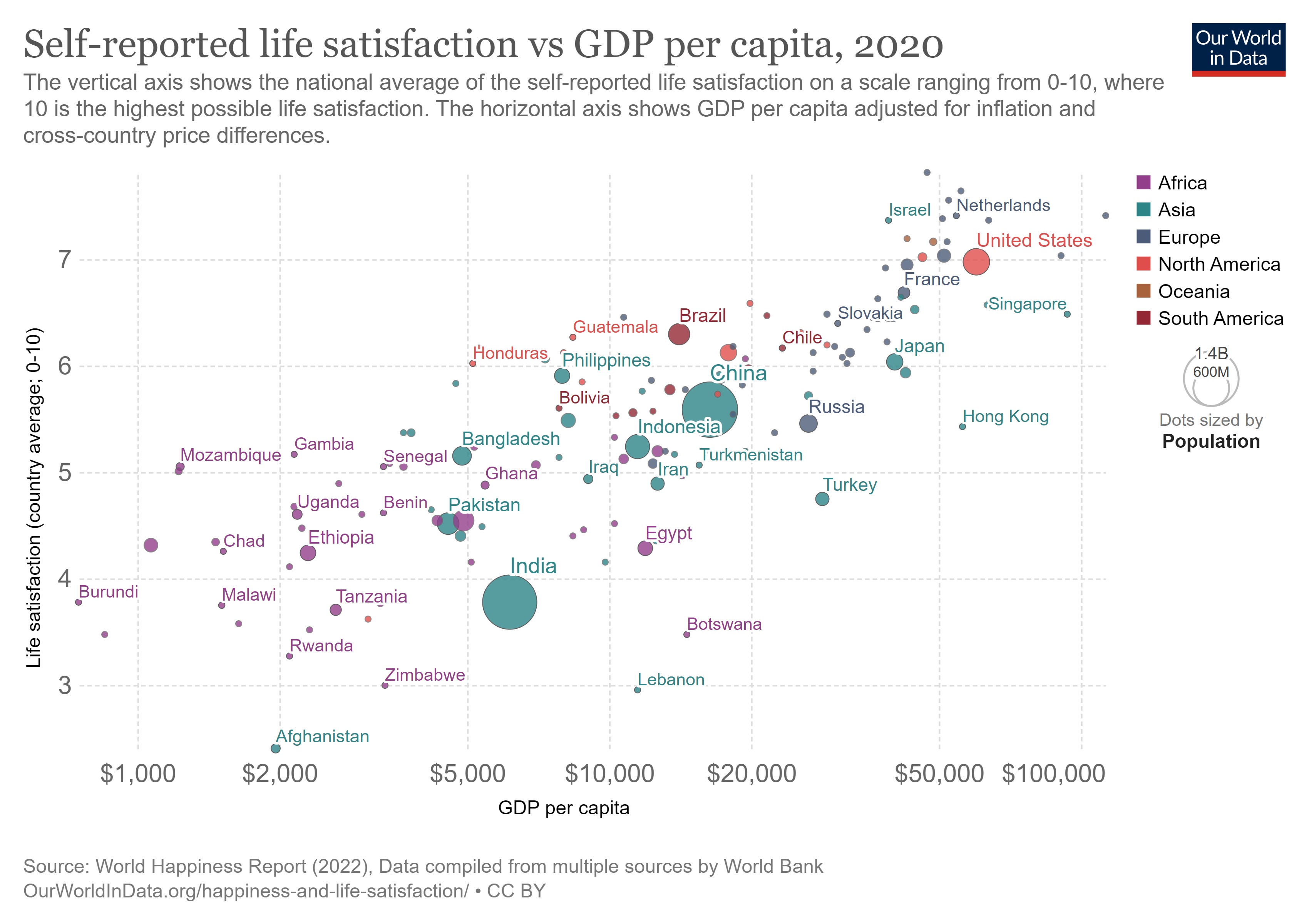
As an example, here's self-reported life satisfaction vs GDP per capita: https://substackcdn.com/image/fetch/f_auto,q_auto:good,fl_pr.... Similar graphs exist for life expectancy, years of education, calorie consumption, literacy rates, and so on.
If we want to increase government revenues we should focus on efficient taxes that minimize economic disruption.
https://www.washingtonpost.com/business/2020/12/23/tax-cuts-...
The IRS has been begging for the resources to go after big baddies for decades, but the Feds have been gun-shy at going after any large company since Enron.
Are there enough gamers on the planet for this?
How much is the sub for Windows 12 going to cost us now, and will that be enough to pay the IRS-piper?
https://fortune.com/2017/10/31/trump-tax-reform-apple-multin...
There are other possible criticisms on corporate tax and Apple, but this isn't a valid one.
The only way it can be claimed to be invalid is by conflating legal with moral.
If Apple sells a copy of your app to an American customer the revenue from their royalty is booked to Apple Inc. (the U.S. company) and they would pay U.S. income tax on that sale.
The only time the sale would be booked to their Irish subsidiary is if the customer was located in Europe, or it would go to one of their other international subsidiaries depending on the specific location of the customer.
Also, the books for taxes and the books for securities regulators aren't precisely equivalent per jurisdiction based on how things are counted or not counted. For example, in general, Norwegian and US accounting practices tended to be/are vastly different in some areas... hence a need for local external auditors.
Corporate Inversions: Stanley Works and the Lure of Tax Havens (2002) https://www.hbs.edu/faculty/Pages/item.aspx?num=29288
(It also carries on these some of these functions in Ireland, as it happens, and pays a ton of tax at the relatively high income tax rates there.)
It's frankly curious to me when a multinational chooses to base itself anywhere less favourable.
Firstly, that's not Apple paying income tax, that's their employees.
Secondly, they don't pay much in the way of corporation or other taxes that usually apply because of a sweetheart deal (Google also has one IIRC), which is why much of the EU is up in arms about the Irish government's behaviour here, that effectively allows these multinationals to operate across the EU without paying the usual expected taxes, giving them an advantage over local businesses and depriving governments of income, and there have been various court cases about it.
Big investors will have eyes and ears inside the IRS, so will have known for years about this already.
Sorry, just so I'm clear, you are claiming that major hedge funds have "moles" in the IRS that illegally funnel them the private tax information of major public companies?
What possible source do you have for this?
https://www.seattletimes.com/business/microsoft/microsoft-ir...
This has been going on since 2007. The IRS sued Microsoft in 2015 [1] and been publicly targeting them since 2020 [2].
[1] https://www.seattletimes.com/business/microsoft/microsoft-ir...
[2] https://www.propublica.org/article/the-irs-decided-to-get-to...
They could hire the best lawyers, accountants, lobbyists, etc in the world. Unless someone at microsoft did something criminal, it's likely they could knock a significant portion off the tax bill.
> The stock price doesn’t seem to be hurting pre-market at all.
Microsoft's market cap is $2.5 Trillion. The one-time tax bill amounts to about 1% of its 'total value'. It's like a one time $1000 special property tax on your $100K rental property. It sucks but it's not the end of the world. Besides, even if they had to pay $30 billion in back taxes, MSFT's customers are utlimately going to pay for it, not microsoft. It doesn't affect microsoft's market share in OS, Office, Servers, etc.
> Microsoft owes the Internal Revenue Service (IRS) $28.9 billion in back taxes, not including penalties and interest
This is almost CERTAINLY true. MSFT will be able to tie this up in court, and has tremendous motivation to do so.
Given the Stock Markets inability to predict the Twitter buyout despite public documents stating Elon Musk's contract to buy at $54.20/share throughout 2022, I'm pretty sure that stock market investors are literally illiterate, unable to read public documents.
Anyone who bought Twitter at $35/share after the contracts public disclosure knows what I'm talking about.
---------
AMC / APE for another example. Anyone who short sold AMC and bought long APE made bank this past year (before the AMC/APE stock ticker merge there were public documents in December 2022 stating AMCs intention to merge the two one-for-one)
I believe I saw an opportunity as wide as $8 for AMC and $1.50 for a legally equivalent APE a few months ago.
Literally public documents with public court signatures and everything, but so many people remaining ignorant for months, providing anyone 'who can read' an opportunity to make tons of nearly risk free money.
Start putting your money in the market and you won't be talking about easy money for "anyone who can read" for very long.
This is called "pairs trading", right? Is there any way it can blow up? Remember that this is AMC, which could be out of business in six months or could go up 3000% in another idiotic bubble.
I made a fair bit of money off Twitter because it was as simple as buying stock at the market rate. Anyone who reads the papers knew the price of Twitter to the penny and could have bought in with a phone call. The sort of trade you're talking about sounds harder to pull off safely. That's no excuse for the hedge funds, of course.
That doesn't make them "literally illiterate" though.
https://finance.yahoo.com/quote/MSFT/cash-flow?p=MSFT
They could in effect write a check today for it.
It is not about how much money they make but about about a third party appropriating what a company that provides such a big value does because, hey, you are "stealing me because I exist"...
Now people will vote me negative, I know...
Losing a quarter of your cash reserves for no gain isn’t going to ruin today’s business but it sure will frustrate existing strategies for the future.
1. Apple not paying US tax rates on products sold outside of the US because that money is kept offshore instead of being repatriated, and
2. Apple paying low Irish tax rates on products sold outside the US instead of the specific tax rate of the country where the product was sold.
(1) I don’t find all that controversial because they would technically owe US taxes on the money if it was ever brought home, but (2) is understandably more controversial. Nonetheless given that Apple won their appeal against the European Commission it might not actually be illegal under EU law to do what they did.
Their point was something along the lines of "it doesn't take a genius to buy low and sell high".
My counter point, to which I don't believe I ever got a response, was "oh? try it then"
Markets are easy to read in hindsight. Most folks are predicting a housing market correction over the next 12 months. But, they've been doing that for the past 12 months too, and it hasn't really happened yet (very mild).
So, when to buy? The answer is that it's quite complicated, and the work is in the individual deal - it requires a lot of research, understanding neighborhoods, WFH trends, how to spot "lipstick on a pig" house flips, regulatory issues, flood zones, insurance rates, mortgage rates, warrantable vs non-warrantable loans and what properties qualify, hurricane standards, wiring, electrical service, plumbing, STR income, occupancy rates, management fees, cleaning fees and quality, long term rental income, renter risk profiles and a million other things that go into understanding whether a deal will make money.
No, it doesn't take a genius, but it does take a lot of hard work.
They accumulate that much cash because there are no acquisitions to be had in the current economic climate. I can't imagine a $30B+ company that Microsoft could acquire without massive regulatory scrutiny.
Because you're looking at absolute numbers and not percentages/relative values. That much cash on hand sounds absurd when you're only looking at the absolute number of it, but the amount it represents is "just" 6 months of revenue. And any good financial advisor will tell you it's a good idea to keep 6 months of earnings as savings.
Note, this is a very simplistic explanation of complex global accounting regulations (eg the money is likely "physically" in New York even though it is "legally" in Europe)
They have $35 billion in Cash & Cash Equivalents.
Well, since this is Ireland tax rates we're talking about, this is almost the same thing…
It is interesting that the last news about this is the EU saying they are going to appeal, three years ago.
I find the use of such schemes pretty awful regardless of whether they technically fall inside of the law.
At some point you are making enough money that it makes sense for you to hire experts to "optimise" your tax liabilities, just like you'd hire someone to improve your IT infrastructure or your heating bill. If they didn't base their corporate structure around Ireland then it might have been Jersey or Malta or something else that got them 90% of what they had.
It sucks when the outcome is that big companies end up paying less than they're expected to and have lower effective rates than small companies. I see it not as a moral failing so much as a law of nature, like flood waters taking the path of least resistance and destroying slums before bank buildings. Reasonably people certainly differ though.
The GP correctly and idiomatically described a tax deal between RoI and Apple as a 'sweetheart' deal. This is not a legal term of art. The fact that Ireland won its court case and is facing an appeal does not change the fact that something took place which exactly meets the commonly understood definition of a sweetheart deal.
The IRS says Microsoft owes an additional $28.9 billion -- in tax for 2004 to 2013 plus penalties and interest
For an SEC filing they really should be declaring the actual value of their liability - the interest on the bill is going to be $10bn+
https://www.irs.gov/newsroom/interest-rates-increase-for-the...
Better yet, the IRS and Microsoft are working together on a secret AI tax scheme and this is a cover-up for transferring large amounts of funds to the IRS or to Microsoft for the program to work.
There are tons of "Expert networks" companies where they tap key personnel for market info. I have received these sort of inquiries many times in the past. Hedge Funds are major users of these.
I can easily see the line of inquiry not breaking the law but getting close enough to extrapolate information on the companies being targeted (IRS personnel, for example), without outright naming them.
This is kind of digital fingerprinting, but for companies. You don't may never get the name of the company, but at some point the questions become so specific that shoe will only fit 1-2 companies.
How many companies have personnel primarily in the US, HQ in Ireland, have revenues >1B, and sell operating systems as a primary source of revenue ?
I'm also a part of a few expert netowrks and I probably get to take phone calls a dozen times a year to help people who need information on my area of expertice.
What specific person would someone contact to findout that Microsoft has unannounced tax liabilities that wouldn't' in anyway break insider trading rules?
Who possibly could attest to this type of information and would freely offer it up? No serious expert network member would ever do this as it would be the end of their career and expose them to serious jail time.
Perhpas you could fleshout your explanation some more here.
What are confidential, ongoing tax cases at the IRS is not something expert networks provide.
This was my first search on Google, but there were many, many, many documents of this nature.
Is this doc sufficient? Or are you looking for something else? I'm aware of earlier docs but it gets more legalize and arcane the further back you go.
By the time the trials started, the argument from Twitter was incredibly strong and well documented. But the stock price of Twitter was still like $40 so you'd have lots of opportunity to make money on the trade (Musk promised to buy at $54.20 after all)
All of that contributes to a completely different picture for me, compared to your statements. Sure, I can read documents like that (if I can find them, if I think of searching for them, ...), but I am not at all confident that my literal interpretation is sound. Thus my perceived risk of an investment would be much higher than yours.
So, maybe literacy is not the point here, but rather confidence in interpreting legal texts correctly, a good grasp of contract law and optimism/experience regarding external factors.
You DO NOT need to be a lawyer to get the arguments. By the time the discussion reaches this stage, the arcane bits are stripped out and referenced explicitly.
In fact, the jury are laypeople, just average Joe's and Jane's. All arguments must be simplified to a point that average people can understand. So it's a good point to pickup info.
---------
Here's a few key events to note on this particular trial:
1. Strong opening argument from Twitter over the contract. My opinion of course, but just read the document and get a gist of the argument yourself.
2. Weak opening arguments from Musk's lawyers.
3. Repeated reprimands from the trial judge for various mistakes the Musk lawyer team were committing
4. Inconsistency between what Elon Musk was saying in public / in the media and what his lawyers were saying in the trial.
-------
Note that in this special case, a judge decided the case instead of a jury. But the argument style at this late stage is simplified to the point where ordinary people / a jury can understand in any case.
Why would IRS agree to this? Would the IRS agree to lower your taxes if you pretty-pleased them?
Microsoft should not be an exception.
Obviously if MS don't have anything that won't get laughed out of court, they shouldn't get much of a reduction. If your challenge to your tax bill doesn't involve anything where the rules are hard to interpret and precedent has not been set, you also won't. (If it does, your tax affairs are probably much more complicated than the average citizen. Which is obviously true for Microsoft.)
Worth bearing in mind too that the number might be an optimistic headline figure which has been rounded up in various ways by the IRS, to make themselves look tough, and to encourage MS to settle.
Even with 30B cash in the bank, MS will do everything it can to lower that bill. First they will fight it, and take all the little wins they can get. Then whenever it's pretty clear what parts they can't win, they will then start negotiating with the IRS to try and pay 50 cents on the dollar or something.
Part of the tactic is delaying, the longer they can put off actually writing the check, the better, as money today is worth more than money tomorrow(inflation and time value of money).
I mean... I agree, they shouldn't, but I think we all know how this will turn out.
That clause was clearly for things outside of Elon (or former Twitter)'s control. Like if a government stepped in to stop the purchase.
Elon never had a good counter argument. So it was simply a case of those who were able to read the public court documents vs the ones who believed Elons out-of-court media blitz.
Alas, the only arguments that matter in court are the arguments that are filled in court. None of the discussion points you talked about even made it to the case, they were laughed out long before Elon gave up and bought Twitter.
------
Reading. It's a superpower. That's what the past year has taught me. A surpring number of people cannot read and will believe falsehoods even if they contradict written and agreed upon documents.
He couldn't have. That clause protected Twitter, not him. It ensured Twitter would still get something in case outside forces, like government regulators or financing falling through, prevented the deal. It did not give Musk the right to pay a penalty and back out.
Twitter explicitly reserved the right to sue for specific performance, i.e. to force the deal through rather than merely getting damages. Musk explicitly signed away any rights to investigate or back out. Twitter was honest and forthright so any fraud claims were nonsense. Musk didn't have a leg to stand on, legally or factually.
The most he could have done was tie things up in court. But the courts can throw out bad-faith lawsuits pretty quickly.
https://www.nytimes.com/2022/07/11/business/dealbook/elon-mu...
The other guy you're talking to is being a dick. There was a concerted disinformation campaign from Musk and friends, and the papers were not willing enough to call "bullshit" on the front page. The truth was out there but hardly staring you in the face.
But hedge funds have teams of lawyers reading this stuff all day long. They have no excuse for not seeing through Musk's chicanery.
It kinda was, though. A bunch of lawyer-reacts at the time basically were "this isn't financial advice, but lol Musk is fucked and the Delaware court doesn't screw around or delay"
Unfortunately, they got the verb wrong: software is eating _not_ drinking the world.
Accordingly the price might not move because of similar assumptions.
To be clear that’s just how I read that comment. I know nothing about this situation with Microsoft.
Until then, not going to happen IMHO. Ireland, Luxembourg, and the Netherlands benefit outrageously from this and since they can veto stuff it's really hard to plug these holes. I think Ireland gave up some ground in this regard since its position was starting to really annoy other EU members.
> Plaintiff Twitter, Inc. (“Twitter”), by and through its undersigned counsel, as and for its complaint against defendants Elon R. Musk, X Holdings I, Inc. (“Parent”), and X Holdings II, Inc. (“Acquisition Sub”), alleges as follows:
If you are trying to say this is 'difficult to read', maybe don't pick things that are answered in the first paragraph.
But let us stop here. It is obvious that you are very confident in interpreting documents like that. So I hope you are enjoying great gains from your investments based on your interpretations in similar cases.
You see Elons side and evaluate their followup. You follow the back and forth and evaluate who has the stronger argument.
When it gets to the point that the judge is literally reprimanding Elon Musk's council for breaking rules and shenanigans, you start buying TWTR and short selling TSLA.
You're grossly overcomplicating this. You don't come up with arguments in a trial, that's the lawyers jobs. Your job as a reader is simply to pick out the side with the better argument.
-------
If you are worried about form, that's not your job. That's the judges job. And if you are worried about not understanding the complete argument, that's not even your job. That's the opposing lawyers job to make a cohesive and full argument.
At this stage of the trial, it's simply reading.
Have you ever seen one of those machines in restaurants that from a hopper full of oranges, automatically slices, squeezes the juice into a glass and puts the rind etc into a composting bag? They do that to deliver a fresh glass of juice that people believe has a material difference from a can of frozen concentrate. Juicero was that but simplified and expanded to more than just oranges.
Consider the factory process of making different juices. Might use heat, introduce other molecules, etc. By performing part of the task in the factory and the final extraction onprem, there may be some meaningful differences in the consumable.
But sure, let’s all poke fun at something without considering the operational context.
https://www.ticomachine.com/faq/how-is-orange-juice-made.htm...
Apparently the founders and investors had not.
Big market actors are just institutionalized corrupt people working for private companies. Change my mind.
I'm writing a long form article about this idea, how in America we do stuff like private prisons, allow pollution, the "family" court system and social media for kids even though some countries can easily fix these problems we refuse to address them because just TOO much money is being made (at least that's how the divorce industry was explained to me).
- Syriana
This is incorrect. https://www.natlawreview.com/article/sec-secures-largest-eve...
> they can break the SEC rules to artificially reduce the share price
No, stock manipulation with falsification of bad information is also heavily prosecuted.
Can you give specific examples where you think this happened? You might not be using the correct definition of “inside information” or “artificially reduce”.
Pfizer top-people bought a huge amount of shares before their vaccine was publicly approved and they sold it the moment the public was made aware that there was a vaccine for COVID-19 approved by the FDA
Microsoft bought a lot of Activision Blizzard shares a few days before they announced they would buy the company.
Having this thin line separating what's allowed and what isn't is not ideal. If you have privileged information, for example, that your product will be approved, something that isn't public knowledge, it should be considered insider trading.
Also, sharing "insider information" isn't illegal. In some narrow cases profiting off of "insider information" is illegal, but in most cases it's not.
It all depends how you come to know the thing, no? If you can infer something from public information others haven't, then bully for you.
I'm pretty sure that if that information is not public, then you're liable. IANAL though so I may be wrong.
If you make inferences from non-public information (e.g. talking to the CEO) you can freely trade on that, provided the CEO hasn't shared MNPI with you directly.
Every public company has an Investor Relations department that talks to institutional investors every day. Investors wouldn't bother talking to IR if they could get the same information somewhere else. And these communications are not made public and shared with other investors.
For example, when Hindenburg Research did a ton of research and discovered that Nikola was basically totally fraudulent, they traded extremely relevant information that wasn’t publicly available. Not insider trading.
Similarly, if Warren Buffet invests in a company, he knows that its stock is very likely to go up (just as a result of the halo effect around him). He doesn’t have to disclose that he plans to buy, though.
If you're an institutional investor you can just call the CEO or investor relations and ask them tough questions about their business. Sometimes you can figure out within minutes that the CEO is a bozo.
You can visit their offices and talk to the employees. Are they smart and passionate and hard-working, or demoralized and looking to jump ship?
You can also derive material information for instance through freedom of information requests. Is a business being investigated by the SEC? If you write the right letter you can find out based on the kind of form letter you get in response. This information is clearly material (would move the stock if made public) and non-public (the SEC hasn't disclosed its investigation yet) and yet you're free to trade on this information because you derived it and because any investor would have gotten the same response if they had known exactly which magic words to use in their letter to the SEC.
If the CFO leaks the numbers of the quarter and you trade based on that you risk jail time. If you watch the company parking lot and notice that the finance department and CFO stay at work until 11pm in the week leading up to their earnings report you are free to short the stock based on this info.
This might not be the most authoritative website but it lines up with what is in wikipedia: https://www.yourdictionary.com/articles/martha-stewart-jail-...
The public record is quite public.
Criminal trials carefully lay out how the state believes the actions of the accused meet each required element of the crime. They don’t get to say “Foo definitely killed Bar. The law intends for people to not kill each other, and Foo meant to, therefore Foo is guilty of 1st degree murder.” Rather, they have to prove Foo’s actions met all required elements of the charge.
If you rear-end me while I’m stopped at a light, your intent doesn’t matter, only your actions. If you fail to stop for a school bus displaying red stop lights, your intent doesn’t matter.
I think the IRS step doctrine is relatively rare in legal interpretations, but at a minimum, it’s not “every other law is interpreted that way”.
I don’t take a position on Microsoft’s actions here, other than “if it can be shown to be plainly compliant with the law as written, I’m uncomfortable with the law being changed during interpretation such that it’s deemed to be non-compliant.”
In both cases it is up to the judiciary to make the trade-off/judgement.
You know things are nuts when one corporate accountant gets his own wiki article
I'd love to see the government of Bermuda nationalize that piece of intellectial property and claim all of Google's global income. They've made such a careful, vigorous legal argument that it's responsible for 100% of their revenue, surely they would acknowledge the things they've been claiming for years and continue to pay 100% of their profits to Bermuda.
And, more importantly, nationalize it while compensating the owner for it's declared value, which was zero (or near to).
If the government says it is a fiction, it is a fiction.
It had to be an already scheduled sale or he will get busted. That doesn’t fly with the SEC.
> Pfizer top-people bought a huge amount of shares before their vaccine was publicly approved and they sold it the moment the public was made aware that there was a vaccine for COVID-19 approved by the FDA
By shares with expectation of approval is fine. They didn’t know it was approved.
> Microsoft bought a lot of Activision Blizzard shares a few days before they announced they would buy the company.
Do you realize how stupid this statement is? You buy a company by buying shares. Building up a stake before tendering an offer is the normal process.
> If you have privileged information, for example, that your product will be approved, something that isn't public knowledge, it should be considered insider trading.
That is insider trading and would be prosecuted if that’s what happened.
Huh? In both of these examples, intent 100% matters. If I rear ended you because I had a medical emergency vs I was texting on my phone vs I had a bout of road rage and wanted to kill you vs I know who you are and you’re sleeping with my wife so I followed you from work to try to kill you:
All VERY different levels of potential punishment based entirely on my intent.
You're absolutely right that overt intentional assault is different than an accidental collision.
Bullshit. If you intended to do it, it’s something like assault or attempted murder. If you didn’t, it’s likely a civil traffic ticket and an insurance claim.
SCOTUS precedent permits use of legislative intent to resolve ambiguously worded legislation, too.
<https://en.wikipedia.org/wiki/Johnson_v._Southern_Pacific_Co...>
> The rule that penal statutes are to be construed strictly does not permit such a construction as defeats the obvious intention of the legislature.
What do you think a legal test is?
https://en.wikipedia.org/wiki/Test_(law)
The canonical example of this is a restauraunt banning all head coverings. Despite the fact that technically everyone must adhere to it, since it disproportionally affects those who wear hijabs, it's considered a violation of civil rights.
These tests are created to help lower courts navigate grey areas, negligence is an area where this is applied a lot.
The facts do matter when you are judged, laws aren't code. The only reason taxes are the single exclusion to this rule is because there's a massive amount of money to be made. You are not bound to the same justice system as them.
While it discourages long research projects, it really incentivises fast execution and building on other companies designs.
Abbreviating that is so misleading, it's incredibly hard to not see it as bad faith! MNPI means "material non-public information". You're saying "non-public information is fine but material non-public information is not", without making it as obvious.
Yes, it has to be material. "Owes $30b in taxes" is ABSOLUTELY material. If on top of that you learn about it from IRS insider contacts, enjoy your time in prison.
Please do read the Wikipedia article; it has a section on the US. https://en.wikipedia.org/wiki/Insider_trading
> SEC regulation FD ("Fair Disclosure") requires that if a company intentionally discloses material non-public information to one person, it must simultaneously disclose that information to the public at large.
You're making the exact mistake that I've repeatedly tried to correct. There is no bad faith on my part.
It's a "legal concept" in the same way that every word used in a lawbook is a legal concept; the US is based on case law, and there is a large amount of precedent for this definition in particular. Again, refer to the Wikipedia for some examples.
I see this mistake a lot among programmers (also myself at some point). They (we) naturally think law is like a rulebook where you go through a decision tree and then arrive at a perfect conclusion, but the truth is that it's up to the courts to decide on the specifics. And they might disagree on those things with you, and with each other, but in the egregious cases disagreements are rare.
This is pretty much the literal definition of insider trading, but feel free to follow this advice if you plan on having a long discussion with the SEC while they audit all of your trades for the past decade.
And these communications are not made public and shared with other investors.
This is false. IR departments will only discuss information that is already made available to investors, through press releases or public compliance filings (such as SEC filings). They absolutely will not provide nonpublic material information just because someone asks, and in the event they do so, it's literally their job to provide an investor communication so that the information is publicly available.
That's just a fig leaf.
Sometimes people screw up on their taxes, etc.
Intent, and communication, do matter.
Material does not mean "would move the market." It means there is a substantial likelihood that a reasonable shareholder would consider it important" in making an investment decision". https://www.sec.gov/rules/2000/08/selective-disclosure-and-i...
You can visit their offices and talk to the employees.
If an employee tells you something that is nonpublic information, and you act on it, that would likely be considering insider trading by the SEC. There is a fair amount of case law supporting this point. Indeed, the fact that you acted on the employee's information is generally sufficient proof that the information was material; and this is in fact the most common insider trading scenario.
You can also derive material information for instance through freedom of information requests. Is a business being investigated by the SEC?
If the target of the SEC is not aware of the investigation, the SEC will not disclose that information in response to a FOIA request. On the flipside, if a company is being investigated by the SEC, and knows it, that is material information that must be disclosed to the market.
If you watch the company parking lot and notice that the finance department and CFO stay at work until 11pm in the week leading up to their earnings report you are free to short the stock based on this info.
Such behavior would provide no useful information about the state of a company's financials. In the week leading up to earnings reports, the CFO and finance departments generally stay late making sure the financials are in proper shape, whether or not those financials are good or bad. This is standard practice at all publicly traded companies with proper controls, because there is a very short window of time between the end of the financial period and the time it must be reported for regulatory purposes.
In 2016 the SDNY ruled that issuers do not have a general duty to disclose the existence of an SEC investigation or a Wells Notice. Because "the securities laws do not impose an obligation on a company to predict the outcome of investigations".
https://www2.law.temple.edu/10q/sec-investigations-disclose-...
> the SEC will not disclose that information in response to a FOIA request
Not /intentionally/, of course.
> Such behavior would provide no useful information about the state of a company's financials
Some hedge funds have done very very well for themselves by making inferences from parking lot data. You don't need to be right 100% or 75% of the time for the strategy to work, you know.
Remember that agencies like the IRS, FDA, SEC must not leak a single bit of information (investigation/no investigation). Because that single bit is sufficient to profitably trade on. A hedge fund doesn't need to know the specifics or the exact date of an enforcement announcement in order to make out like a bandit. A tiny amount of signal is sufficient. In fact, a tiny amount of signal is preferred. If a firm knows for a fact that MSFT is in trouble with the IRS they can't trade on it. But if a little bit of information leaks from an agency, that's gold.
It's because insider trading is a generally stupid crime. If you're on Wall Street, there are better ways to make money. The people who insider trade are largely those who think Wall Street is constantly doing it--it's an old joke in finance.