Trucking startup Convoy closes operations with no buyer(bloomberg.com) |
Trucking startup Convoy closes operations with no buyer(bloomberg.com) |
That's a recipe for disaster if prices move...
Exec's can probably be faulted to waiting until the last minute/dollar to close up shop to see if they could pull a rabbit out of the hat - but it seems there were about 500 employees also hoping against all hope that said rabbit would be pulled.
Advice for employees - when the writing is on the wall, read it, and plan/act accordingly - best to start interviewing for a new job before everyone else from the same company, in the same area, is doing the same thing.
A possible brokerage opportunity would be to inquire with Carvana or Carmax if you can buy slots on their cross country shipments as capacity allows, and sell those to customers. You'll be at the mercy of their schedules and capacity, but could be a service tier along with other more "white glove" services (dedicated driver "hot shot", semi shipment, etc). You could also buy capacity on freight rail cars shipping back empty to factories (depending on destination and routing). High touch biz, beware, there be dragons.
I think the fact of the matter is, shipping cars is not going to be cost effective for an individual. Trucks are expensive, putting fuel in them is expensive, paying a trained person to drive one is expensive.
Maybe a company like Carvana could offer this as a side service, drop your car off at a local Carvana, and eventually pick it up at another location. Even then, I think the costs are going to be order of thousands of dollars.
Just need to use a direct carrier like Intercity, NOT a broker. Brokers have infested Google SEO.
So because you mentioned it I just called them for transporting by enclosed carrier on the east coast between 2 cities. High end car enclosed carrier.
Intercity wanted $1995 for the same transport that the car dealer (a high end car dealer well established no less) want $1600 dollars for.
Intercity essentially said 'busy time of year etc etc'. Didn't give remarkable reasons why they would be better than anyone else. Picked up the phone right away and was otherwise business like.
https://intercitylines.com/request-a-quote/
Also their website to get a quote they want an 'auction' number. That made me call them (which I would normally never do.)
Additionally their price was higher than other brokers I had checked including the one that just moved a car for me (same route) not enclosed who quoted both enclosed and not enclosed.
Would like to point out that the job of a broker is not to match you with anyone but match you with people who they know and trust and have used. And specifically the broker I used (for the last open move) made a total of about $250 the rest paid to the driver on delivery.
As a consumer I'd assume there are hotshot truckers/services that would be used for this? People have mentioned similar "agent oriented" experiences with moving services and how it's opaque and unreliable.
My local dealer somehow got a lead that I want a very specific year and trim GTI and twice now they have offered to bring one in for me.
You place anything you need shipped on there and various shippers can bid without having to go through a broker.
Do you want to foot the bill?
A wage labourer should be able to expect to know if they will be able to feed their families the next month.
But the job is very high revenue (thousands of dollars per cargo depending on the distance) but low profit (5%-10%) in these times.
The worst part though is when you're in that spot you should jump ship, unfortunately, there are sunk cost fallacies involved and sometimes a fair amount of equity that makes you want to try to hold on for just one more month. Who knows, maybe a miracle will happen or a deal will be closed.
I did not appreciate in my scenario that the founder REJECTED a buy offer for what would have been a life changing amount of money for me, because he thought it was too low. We were gone less than a year later, and in the final 4 months, we didn't receive paychecks and were told if we left it'd ruin an acquisition and we'd screw all of our coworkers over. So that wasn't fun. We never got bought and were peddled around the country like prized cattle to disinterested companies that didn't want or understand our tech. Very miserable.
Same scenario for me - so I left - and then shortly after they did sell. Argh.
So they WeWorked it. Instead of focusing on long-term growth strategy for a very good and sustainable business, the top management decided to get rich quickly, destroying the company. But I am sure they did get rich quickly.
Also see: Bed Bath & Beyond
"Please respond to the strongest plausible interpretation of what someone says, not a weaker one that's easier to criticize. Assume good faith."
"Please don't post shallow dismissals, especially of other people's work. A good critical comment teaches us something."
https://news.ycombinator.com/newsguidelines.html
Of course, if you have specific information about fraud or other bad behavior in specific cases, that could be relevant to a discussion. But quoting something generic and then using it as an internet cynicism trampoline is quite a bit below the quality bar for what we're looking for in this forum. It just leads to repetitive, tedious, and ultimately ugly threads.
It’s grown pretty normal over the last ~10 years for investors to enable founders to sell some of their own shares, thus taking some of the round directly into their pockets. Normally called “taking money off the table” the idea behind it is that a founder with a successful company should be able to participate in the success without forcing an early exit that might not be best for the investors.
Is this why BBB failed? My perception is that the retailer was stuck in 2000. The stores always felt stuffy.
And in the end, what do we expect? The executive classes show up, buy their way into these firms that are struggling but have some intellectual/data/brand assets, and the executives slam them into the ground, sell the valuable pieces that fall out, and then sail away to buy their way into other businesses. I was always told growing up that if you failed in business you lost money but it seems once you get to a certain size of business, you can count on either free money from the Government to keep the ponzi-scheme that is our economy these days from toppling over dead, or at the very least, sell the scrap components of a business you didn't build for other companies to hoard until they too collapse.
The ones carrying cars across the country for moves are quite rare, unscheduled, and harder to find. They also can't carry anything else besides cars on the transporters - you might almost have better luck driving your car into the back of a box semi and letting them load other LTL loads behind it.
Lol, lose more money than invested.
> A wage labourer should be able to expect to know if they will be able to feed their families the next month.
A wage laborer should make $1,000,000 per year.
Wage labourers lose a lot of time and money invested as well, when their livelihood is taken away from them, do they not count?
Creditors are ranked by seniority and get paid out in order by seniority. Equity is below every creditor and has been completely wiped out. Companies are not allowed to take cash or sell the furniture to pay out employees. That money is legally owed to creditors and attempting to stiff them is theft. I'm sorry to those affected at Convoy, but that is the reality of working at a startup that goes through a hasty liquidation. Convoy is not being "cheap" about this, as some are suggesting. Any "retention bonuses" are to keep executives around for long enough to unwind the company in an orderly fashion. Nobody is getting rich off failure; if everyone were to walk away there'd be nothing left and therefore nothing to recover and distribute. It's bad for everyone, but the alternative is worse.
As for the larger situation: Convoy were a digital freight brokerage. They acted as intermediaries between shippers and carriers and make money on the spread between the two. They got into trouble because the entire freight sector has been suffering a double whammy of cost increases due to inflation (ie. diesel costs) and a slowdown in demand. This has caused a number of carriers and brokerages to go bust. Freight brokerage has some other properties that make Convoy's situation particularly serious. In particular, carriers typically securitize their accounts receivable. In freight, this is known as "factoring." Convoy got stuck holding the bag after their partner carriers went under, having already paid them for their service, but still waiting for payment from the shipper.
Worst of all, Convoy had no exits because their only potential acquirers are in the same industry and are also getting completely crushed.
https://usbankruptcycode.org/chapter-5-creditors-the-debtor-...
Wages are fourth priority, but only up to $12,850 per person (one month's salary at ~150k a year).
The three priorities above wages are child support (not really applicable to corporate bankruptcy i assume), liquidator's expenses, and some mildly complex case i don't really understand. Taxes are eighth, two behind grain farmers and fishermen (lol America).
IDK if Shone did things the most intelligent way, but the general story is not uncommon.
Shareholders/creditors have a mess if the CEO and CFO walk out the door for their new job; it is financially beneficial for them to liquidate assets and shut the door.
Shareholders/creditors don't have a mess when the engineer and a product manager walk out the door to their new job.
That's how the logic works.
Many companies are open with employees about the state of the business.
If you have less than 3 months runway and little prospect of any fundraising, tell your employees. You don’t need to steal money from creditors (?) to pay severance, you just gotta do your best to not blindside people who have rent to pay.
Some great insights here and you clearly know the business. I’m curious about this last statement however. Just how badly are other players doing?
Uber Freight just announced a major overhaul on a foundation apparently provided by their acquisition of Transplace [1]. There seem to be a number of synergies between Convoy and Uber Freight although I may be naive about that. In any case, I’m curious about your view on Uber Freight and whether they are viable or simply playing the long game based on deep capital reserves, and why you think they didn’t acquire Convoy (if that even makes sense as a possibility).
1: https://www.freightwaves.com/news/uber-freights-new-solution...
Unfortunately I had to learn this the hard way (as in I was lied to and assumed they were still going to pay us, and then the payroll money went poof)
This doesn't make any sense. What you're describing is normal course of business. Shipper pay terms are usually longer than when the carrier get's paid from broker. "Carrier's went under", doesn't make any difference. If the shipper doesn't pay, than that's a problem. But to say paying carriers that "went under" contributed to Convoy going out of business just isn't accurate.
Correct.
I can only assume "companies are not allowed to pay out employees" refers to suggestions of severance, health care, etc. in this thread.
Not earned wages, which have high legal priority.
Unless, of course, Convoy had to because all their carriers insisted on upfront payments for reasons. In which case Convoy was propably already screwed any way.
"Nobody is getting rich off failure; if everyone were to walk away there'd be nothing left and therefore nothing to recover and distribute. It's bad for everyone, but the alternative is worse."
Here's one such game. Executives, who enjoy information asymetry, and leverage can parlay this into one final earning event. Threaten to leave the company in disarray, unless they're paid. Coordinated, it's hard to say no to.
Imagine if the top 5-10 execs at an otherwise ok startup coordinated a demand to double their pay/stock or everyone walks tomorrow. They time the move using inside knowledge of cash flow, making the demand irresistible.
I'm not suggesting an alternative, but that doesn't mean a corpse isnt a feast for some.
It should work that way everywhere. Executives need to be incentivized to do layoffs while there’s still cash for it. Defrauding employees is a terrible evil.
Most (good) employers do that when employees quit but they don’t have to.
Could you help me understand where the line is drawn?
The US staff had to just go. I got my last month's pay + about 6 to 8 weeks.
Yes, what happens in an acquisition vs a insolvency are different.
Detailed the shutdown on a call at 8:30am Pacific this morning. CEO said there'll be no severance or healthcare.
Lot of talented folks in Seattle and beyond who'll be looking for new gigs.
1. the entire ecomm supply chain got way ahead of their skis during the pandemic thinking boom times would never end
2. no matter how good your software is, supply chain is cutthroat — a motivated low-tech salesperson can always undercut you
3. margins are razor thin, so if you're subsidizing prices with VC money to buy growth you can easily rug yourself
4. when the storm comes to supply chain, the ones who stay alive are those with the biggest balance sheet and diversified business (e.g. Amazon)
Nothing else matters beyond that and the price. And it's entirely fungible - nobody cares if it's UPS or FedEx or some random truck that delivers stuff to Walmart or whatever.
The only way they had a chance was getting their APIs so ingrained in companies they couldn't switch, and companies are rightly suspicious of that.
The company is shutting down. I'd bet you a lot of money nobody gets anything.
Even Elon Musk famously claims that Tesla got dangerously low at times.
I've been through two acquisitions that could have gone this way. (But didn't.) It's really "par for the course" in the startup world.
The Freight business is collapsing after an unrealistic high during the pandemic. Since April 2022, revenue per load has decreased to about 70%, this means less ways to generate a profit under the same headcount.
We also saw a decrease in volume as companies overstocked and consumer spending has shrunk to less than 50% of what it used to be. Just add it all up and you see why so many companies are collapsing, carriers and brokers alike.
Though market.
A bunch of talented employees? Cool, they are all on the market anyway.
A bunch of tiny commodity contracts? Why?
A pile of code? Is it particularly hard to recreate?
Valuations are having a big wake-up call across the industry. While a company can be more than the sum of its parts, VC-backed tech companies have really struggled in industries where unit-economics rule.
> A pile of code? Is it particularly hard to recreate?
I think you are buying time. Yes, code could be written, but would probably take at least a year.
Additionally, money-wise what matters is net, even if something is overpriced, all that matters in the end, can you make more than you've spent.
p.s. thanks for the interesting question to ponder and discuss
Incumbents are also leveraging decades (or centuries) of investment in land, people, technologies to win in some cases.
https://www.freightwaves.com/news/freight-brokerage-bubble-b...
Great deep dive into how drastically the freight market has shifted the last 12 months and the likelihood that Convoy will be the first of many more to fall in coming months.
Fascinating explainer of a market I didn’t know much about, especially the terms (covenants) laid out by banks that float the money on shipping accounts receivables.
Dozens of platforms like this exist in Europe, not sure why everybody makes a fuss about it.
https://news.ycombinator.com/item?id=37931893
https://news.ycombinator.com/item?id=37937165
https://news.ycombinator.com/item?id=37935804
https://news.ycombinator.com/item?id=37946017
https://news.ycombinator.com/item?id=37945817
(dang: feel free to macroexpand and replace my comment with yours if you happen upon)
Big layoffs coming at Convoy, a logistics startup backed by Bezos and Gates - https://news.ycombinator.com/item?id=37937165 - Oct 2023 (3 comments)
Convoy cancels all shipments, load board is empty, announcement upcoming - https://news.ycombinator.com/item?id=37931893 - Oct 2023 (6 comments)
That’s kinda disgusting imo. People deserve severances.
How you go from "hyper growth mode" (according to the recruiter email) to closed operations within 13 months?
I'd definitely want to know more about how things came to be like this.
Convoy effectively got into the factoring business and extended short term (30/60/90 days) loans to the trucking companies. Now, they don't hold these loans on their balance sheet but rather package them and sell them to lenders as asset-backed lending portfolio.
The thing with these is that typically the originator (in this case Convoy) will need to take the first tranche of losses. (This is where the $240M debt facility came in). As the freight market deteriorated, Convoy was effectively margin called by the lenders and could not come up with the money.
Any acquirer would then have to take up this debt. Even though Convoy may have a valuable asset, UPS is not in the business of managing a debt portfolio. Any acquirer would be dissuade by this baggage.
They raised $260m in April 2022.
"Between the lines: The shipping and logistics markets have turned south since the pandemic era's boomtimes."
I think what you mean is this business makes no sense when interest rates aren't zero and investors aren't looking for places to stuff money.
>The trucking marketplace gained a lot of buzz a few years ago, raising over $670 million from top investors like Jeff Bezos, Bill Gates, Capital G, Greylock, Y Combinator, and Fidelity.
It is really hard to get the kind of exponential efficiency gains in this space that a 'blitzscale'-focused startup needs in order to really succeed.
Trucking is an industry that relies heavily on relationships (trucker <-> broker, broker <-> shipper, broker <-> facility, etc), and you're not going to change that (required for true automation) without already being at an absurdly large scale.
Convoy spent too much effort on chasing things that had the potential to give the company those exponential gains without addressing the high-touch nature of the industry (but were just not a good fit, and ultimately fell flat).
And Convoy—conversely—had very little incentive to spend most of its effort on iterative improvements to the core brokerage (which would have probably led to profitability, but not the kind of returns that VCs ultimately want)
You gotta offer more than just a rate...
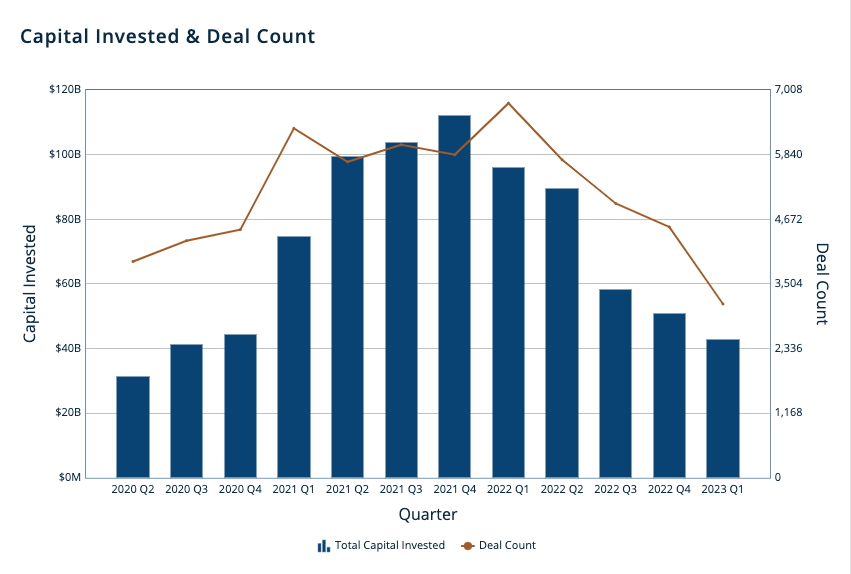
The capital constriction really started in Q3 2022. Here's a graph: https://techcrunch.com/wp-content/uploads/2023/03/Screenshot...
If I had to guess, bankruptcies like this peak sometime next year since many of these companies will find a way to last 24 months on their last fundraise.
Another recent example is Clutter, a moving company that raised $300m, who was forced into a fire sale for $30m.
Cynics would call it fake it until you make it, but for many businesses if they don’t look secure they will find it harder to get new customers in order to survive.
Oftentimes, the founders just grew too fast or flew too close to the sun.
So, there’s an opportunity to pick up the pieces and rebuild, or start from scratch with the learnings.
In most cases, the firm handling liquidation auctions off the firm’s assets, so if you have the motivation to pick up the pieces and grind out a sustainable business, you can usually purchase the tech and customer lists for six or low seven figures (varies based on size of business of course). If you actually pursue this, my advice is to make your offer as simple as possible (don’t ask for a bunch of diligence) and set an expiration on your offer so they don’t shop around. The liquidators are often not incentivized to maximize value - they just want to finish the project as painlessly as possible.
Not sure why this was valued at $3.8B. Wall Street investment bankers smoking crack while evaluating this one.
Well that puts you in a perfect position to value it.
VCs today go after shiny baubles, like “27 innovators under 27” nonsense, and have forgotten they’re mainly looking for high talent very resilient technical weirdos and any other characteristics are bonus.
We don't often talk about how everyone involved in a business takes on risk. This is a great example of all the employees risking being cut off from funds and health care.
Those employees won't be lionized for "learning from their mistakes" when they get a new (better paying?) job, will they?
Those employees also didn't get a say in how the company was run despite the fact that they were taking a serious risk, too. Probably a more serious risk than a founder, given that most founders are wealthy or backed by wealth.
Convoy closing sucks. But it does not suck at all as an illustration of the problems in startup culture . . .
Back that up
The California version of the WARN Act explicitly covers terminating business operations.
I mean there must be something functional anyway at this point no matter how lean and mean.
I'll start the bidding at $1
You were paid a salary for your services while you were employed. You didn't give more, they didn't pay less. Now you're not - that's the end of the contract.
Yes, it's a nice thing some companies do when they lay people off but that can't be an expectation.
Employees do much more than they are contractually obligated to.
There's a reason why "work to rule", meticulously doing exactly and only what one is required to, is functionally a strike. Same with why there was all the uproar over "quiet quitting", where a worker only did their minimum job duties. So this is as acceptable as "quiet quitting" is.
In an industry where it's normal to do more than the bare minimum legally required, someone who does no more than the minimum required is blackballing themselves. These c-levels will never start a successful company again.
When NCC Group fired me, they gave me zero days notice and no severance.
They did emphasize that my healthcare would stay good through the end of the month, but they didn't seem to have realized that I would be unlikely to find that useful after being fired on October 31.
I would hope most employees know that is a significant risk of working at a startup?!
But yes, harsh, regardless of how predictable.
"Convoy, which raised $260 million in a funding round last year that valued the business at $3.8 billion, on Wednesday told employees in an email that it would stop accepting shipments until further notice and that it was rescheduling or canceling existing loads." (wsj)
Price per shipment cratered -> Revenue cratered. (They make a % of each shipment) -> Losses spiked up. (Because they had fixed cost)
Flexport had a burn run rate of $600M a year. Convoy had less burn but also less in the bank.
https://www.theinformation.com/briefings/flexport-revenue-dr...
No one else thought it important to try and get developers using our product to reduce our reliance on big players and well, here we are. My last check was paid out from the CEO's personal bank account.
Certain spaces are exciting to work in because you can clearly see a need but sometimes the stars don't align for you. I hope the Convoy team (sans leadership) lands on their feet. Q4 is the worst time to find jobs.
Was it largely spot rates, a bid board, and lots of small carriers?
Customers easily could just get rates / carriers elsewhere and walk from Convoy?
No other services making income keeping customers around?
Rates are pretty fluid in logistics, very strange that they would rely on that alone if that was the case.
Convoy could interface with large companies as though they had a large fleet of drivers and trucks. That "fleet" wouldn't require paying for benefits to employees, maintenance or fuel on the truck, and could scale up or down based on demand.
I would have guessed that the network effects of getting this kind of marketplace going would be the hard part. It makes me think that a big mistake in leadership was made.
Just not enough to offer any severance or healthcare. #TruckYeah!
That should be illegal.
How much are the executives making from this?
I'm really sorry you're in the middle of this. I hope you can find a better job soon.
If there are no more company operations and no current employees, there is also no plan and no COBRA.
This could also be an issue if a company restructured so it didn't have to offer employees health care because of size or everyone being part time or whatever: COBRA doesn't guarantee that there is a plan from your former employer, it just gives you a right to pay for it yourself if there is, for a certain period of time.
…if the company still exists (see comments above and below)
Classy. Learning a lot about how certain people treat their employees during these last couple of admittedly insane years. Good for future reference, I guess - though not much solace now. I feel for the employees.
Edit: Wow, more responses than I thought! I admit that the tone of my comment was too reactionary, but my opinion stands. I won't modify the original comment but instead will add this quote from Dalton Caldwell, YC Partner:
"So what happens if you have less than three months of cash? It's important to face the issue head on and account for your liabilities and the scenario of shutting down your company.
In many cases, <2 months is the point of no return. If you are in this state it is immediately necessary to lay off your employees and give them severance, pay down your obligations, and use your remaining cash for shutdown costs. If you don't do this and instead end up with zero cash and outstanding payroll, tax or other obligations, things will get Very Bad." [1]
Convoy raised $1.1b including a $260mm Series E almost exactly a year ago.
[1] https://www.ycombinator.com/library/3Z-advice-for-companies-...
If you want to be coddled and showered with benefits, go join a Fortune 500. Startups are not for you.
and you're in a position to be concerned with the accuracy of your numbers, i assume.
CNN Tuesday: "US retail sales rose in September for the sixth-straight month"
https://www.cnn.com/2023/10/17/economy/retail-sales-septembe...
... id be interested in your thoughts on the apparent conflict of viewpoint there.
During the pandemic and boom consumer spending was at X ("what it used to be")
Then it dropped a ton, though in recent months it's been increasing month over month. In fact, it's all the way back up to 50% of what it used to be!
But what we saw during the peak was crazy, and some investors and execs thought it would last.
At least in regards to what pertains FTL freight, we saw a drop of tougjly 50% in volumes as consumer spending is down when compared to pandemic height. I am pretry sure there will be a seasonal trend upwards, but no where in the way it was before.
If you are in the industry, you can easily check how much cargo is moving around. Maybe by November-December it will be less than a 50% drop, but expect it to return by kid January-February.
Especially hybrid or PHEV
Part of the reason being that workers have been ordered back to offices, meaning a significant portion of their income is spent on commute and eating out. Crazy how damaging rto is to everything around us.
I think that this list might be talking about unsecured claims though. I think that secured claims might be separate. So, for example, if an individual declares bankruptcy and they owe $500k on their house, that claim would come before child support payments. I am definitely not a lawyer and bankruptcy law strikes me as particularly complex.
The third priority is tough to parse. From looking over it quickly, it seems like this might be claims from doing business between when i file bankruptcy and when i go into foreclosure. Again, not a lawyer, but my guess here is that if I'm a store and I file bankruptcy on Monday, but don't have a trustee until Wednesday, and I put in an order for a palette of water bottles on Tuesday, then the distributor of the water bottles might have a priority claim.
Why should employees be prioritized below a property speculator?
Let's define a lot and then I'll take this bet.
https://www.dol.gov/sites/dolgov/files/ETA/Layoff/pdfs/Worke...
The logistics industry is really old, backwards at times, and lots of penny pinches.
But supply and demand for carriers and capacity is pretty dang fluid too... market forces are already REALLY at play in logistics lands.
If covid showed anything it was that while there would be hiccups if people can't get to work ... stuff still flows through the system pretty efficiently.
If you want to be a 3PL you gotta manage your relationships with your customers / give them a reason to stick with you.
Don't these sentences tend to contradict each other? What do you mean by "saturated"?
But yes this grandparent post is mostly correct. If severance was not built in to any loan contact (it never is). Then creditors are paid first.
It would be interesting to know how much debt they have vs remaining cash and when did it dip below.
Paying severance is extremely low probably even below equity since there's no legal requirement to pay severance.
[Edit] Legally how is it. Not just because it's commonly measured in months of wages
They look really similar, but legally entirely different.
In "gardening leave" you're still an employee and on payroll until the last day. Whereas severance you're not an employee and typically paid lump-sum (but doesn't matter for this discussion). So in this specific situation, yes, that would be wages and would be paid out first before creditors because you are _legally_ entitled to those wages.
The problem of course you cannot hope to put a whole company on "gardening leave" in hopes that it can "act as severance" for everyone. Your creditors will sue you and easily win. They'd probably put an emergency injunction on the company and remaining funds before the first month was even completed once they learned of "creditors hate this one little trick!"
I am not a lawyer but I believe that in this case the owner can be found personally liable to the employees.
Cooperation of board/executives is not required but it is immensely helpful.
"The easy way" vs "the hard way."
If a regular individual declares bankruptcy and then doesn't bother doing any of the required paperwork and legal stuff, saying the court needs to pay them top dollar for their time, things will not go well for them.
On moral side: business in general (and startups especially) requires navigation between things many of which are unpredictable, and plenty are beyond your control. Also I've seen startups failing because of software bugs, and technical limitations. In this particular case, do you know about any obvious wrongdoing? If not you probably shouldn't auto-assigning blame on "them".
Because we decided ages ago that compelled labor is a bad idea.
In fact, bankruptcy is a process that, if you follow the rules, is beneficial to you: you get protection from your creditors so that your loss is minimized. If you refuse to do the labor to follow this process, you won't have any protection and things will go badly for you. I don't see why it should be different for the owners and executives of a corporation. These people are not employees.
To be real, if the executives at a company do commit crimes that lead to the failure of the company, I think they should be on the hook for that.
another point, though, is the c-suite probably had more information as to how precarious the situation had gotten that the rest of the employees might not
Also, healthcare shouldn't be employer provided.
Running concern businesses don't have quite the same incentives nor the same risks of failure.
"No idea at all!"
normally piercing the corporate veil requires serious executive misconduct.
a probably relevant article: https://www.severino-law.com/blog/oqz4dx2ivdnzt7aqqrvbk9et11...
> The case therefore would up presenting a clear question of law: Where the workers are employed by a corporation, can an individual be held liable for penalties associated with statutory violations in the payment of wages where there was no allegation or finding that the corporate laws had been misused or abused for a wrongful or inequitable purpose? In other words, do sections 558 and 1197.1 allow workers to recover civil penalties for nonpayment of wages from individuals even when there are no other grounds for piercing the corporate veil under the doctrine of alter ego?
> The court of appeal concluded that under the clear language of sections 558 and 1197.1, the State of California, through the Labor and Workforce Development Agency (“LWDA”), can recover penalties associated with unpaid wages from individuals. Furthermore, PAGA allows employees to stand in the shoes of the LWDA and recover those penalties. Accordingly, employees are also permitted to recover those penalties from individuals.
https://hunterpylelaw.com/2021/02/individual-liability-for-w...
See also the actual decision:
https://law.justia.com/cases/california/court-of-appeal/2018...
The only ambiguity to me in reading this is whether the court considered it different because the wages went unpaid for a while before bankruptcy.
Yes, e.g. Theranos.
But the majority of failed businesses fail for reasons that have nothing to do with crime.
Why shouldn't a business consider itself at 0 operating dollars but still have a full account for healthcare or equivalent severance?
Most startups fail. And everyone involved should know that going into it.
To operate a startup protecting against all risk will likely guarantee failure in almost all cases.
Bank accounts, contacts, loans, real estate, equipment, IP, etc.
For a (once) multi-billion 1500-employee logistics business, it's more involved than you give credit for.
HN is wild :/
Way more commonly, severance is part of a termination contract, and thus it would not be here.
Are you European? Maybe it's different there.
My assumption was that we would not be talking about "unpaid severance" if there was no severance defined in the first place.
> Are you European? Maybe it's different there.
Generally severance is not legally mandated, but can be mandated under some specific circumstances, e.g. no-notice termination. Usually it is similar to US: either defined in collective (union) agreement or part of termination contract.
Usually severance is consideration for agreeing not to sue the company, not taking trade secrets, etc.
You have X months notice ie the company has to tell you X months before yoir severance date.
Often the company will want somone they let go out of the office ASAP. Thus you spend your X months on gardening leave paid as normal wages.
On your severance date you get your redundancy package - in the UK there is a defined minimum but in some markets e.g. finance they pay more as they do want to keep current employees happy so they see that they just don't get thrown out.
As much of the US is at will employment I doubt this scenario will occur often
But a startup that raises a billion dollars and fails to set a cut-off that gets everyone out the door with their last paycheques is one that people will jump out of earlier.
versus a CEO who may be making double or triple that, and knew the end might be coming and started saving up extra
Going through a perfectly legal bankruptcy procedure is very different than working your severs 72 hours a week for years without overtime then refusing to show up at court.
This comports with my understanding that piercing the veil usually requires illegal behavior.
Again IANAL, and ymmv based on specific circumstances, but piercing for unpaid wages is very much a thing in (at least) California law.
[0]an obviously illegal activity?
>Because claims for unpaid wages due to insolvency do not fall under the Fair Labor Standards Act (FLSA) unless the employer willfully failed to pay wages owed and filed for bankruptcy as an attempt to avoid paying wages, the U.S. Department of Labor has no jurisdiction in this area and will not accept claims.
https://www.shrm.org/resourcesandtools/tools-and-samples/hr-...
If your CEO is looking at records of individual office chairs when unwinding a billion dollar company someone has seriously fucked up. They don’t and shouldn’t know the details by memory.
However, the details are either available so everyone ‘knows’ them as soon as they become relevant, or the executive officers have been committing serious financial crimes.
This is my entire point.
If you go into chapter 7 bankruptcy, and a judge prioritizes senior creditors above unpaid wadges, you are clearly in different territory than if the corporation was neglecting wages before bankruptcy.
Everyone keeps linking cases for pre-bankruptcy cases, or ones without bankruptcy at all.
Meanwhile, There laws on the books about the prioritization or creditors, and where labors stands, and how much labor gets paid out before, and how much after other creditors.
> That is what happened to plaintiff Brett Voris (“Voris”) in Voris v. Lampert.
https://www.gmsr.com/wp-content/uploads/2021/07/Kuang-Too-Ma...
...which is the same case I linked above. So the whole issue is how long wages can be delayed. If you're arguing that "Convoy management is unlikely to be personally liable assuming they didn't delay any wage payments whatsoever and their wage payment intervals are found to be reasonable by the court", then I agree. But it's rather common for some of these conditions to not hold, so the potential for piercing the veil is very real.
(Perhaps you are arguing against other people who think that unpaid wages are always considered theft, in which case I would agree with you. I was respondsing to the comment "you cant prosecute a dead entity for theft"; often you can, and it depends on the details, which I presume are not yet public for Convoy.)
This is exactly what I am auguring. Convoy isnt even delaying any wage payments. They are not paying severance or providing transition healthcare/COBRA.
It seems like Voris v. Lampert case had a much longer delay, and the court still decided against the the plaintiff.
I did learn that there is more case law on piercing the vale for wage than I realized, but everything I read still suggests that a legitimate bankruptcy without serious/illegal executive misconduct will not lead to piercing of the veil.
(have co-owned a business where we made folks whole for pay the owner skipped out on during the failure, asset acquisition, and their onboarding with us; plan ahead and you can do the right thing, fail to plan and people will experience pain; you're not saving the business while burning through the severance allocation, you're just lying to yourself that the business isn't already dead)
So 46 days of gap between job 1 and job 2? Don't get cobra, just tough it out. If medical bills are >= 3k, then go ahead and sign up for cobra and get a chunk covered.
If your employer was paying $3,000/mo for your insurance, it's going to be $3,060 for you.
Fuck whichever lobbyists made sure that was allowable.
Edit: corrected per the reply.
It's not mandatory and its capped at 2%, not 5%, but, yes, there is a potential additional charge beyond just the full cost (what would be the employer + employee share, for a current employee) of coverage.
NO, the entire point of plane safety is that you are prepared for the VAST MAJORITY OF FAILURES, through extensive planning, testing, regulations that force certain choices, redundancy, backups, etc.
Maybe companies should stop trying to play check kiting as SOP for business operation, and be willing to admit that they sucked at business, burned a billion dollars, and didn't even keep any of it to help any of the people who did the work survive for the next few months as they adjust.
Startups on the other hand, (normally) must accept some risk of failure in order to have any chance of success.
Given Convoy's margins and operational leverage, I'm not sure it was this simple. Legacy freight brokers who have been doing this a long time are being caught surprised. They may have thought they had months of runway that rapidly collapsed to weeks.
We need stronger unemployment benefits. Barring a public solution, severance ensconced in employment contracts is next best. Convoy had nine figures of debt. Depending on the covenants, it may not have been able to hadn't over cash at windows to employees in the form of a novel severance package.
There's at least one major US freight forwarder who has been in business for over 40 years and who has never done a layoff, not in 2008, not in COVID, and not now. They're not perfect and have other flaws (like every other company everywhere), but still.
So it's a (common) choice. They are balancing the +/- against other uses of the last bits of cash. To some degree they do it because the employee pool accepts and expects it, no better reason. If the representational damage was more acute, they might choose someone else to disappoint.
The more common problem is a "hail mary" play, where the management team is perhaps fooling themselves about the probability of success.
I think the ethical thing to do there is discuss it with employees, but that's just me.
https://www.google.com/amp/s/www.businessinsider.com/fedex-s...
If you look only at people who won the lottery, you'd have to be an idiot not to spend all your money on lottery tickets. How many times has someone done this and lost all their money, screwed over thousands of people, and never been heard of again? We don't know, because they aren't famous, but my suspicion is it's a much more common outcome.
What if they did and lost it all 6 weeks ago? What would that signal instead?
FedEx was already shafting their pilots for months before this. Bounced paychecks, pilots paying for jet fuel on personal credit cards, and more.
If I was a pilot there, I'd have said "Fuck you, Fred", even though he won. How sociopathic do you have to be to gamble company money (sorry, isn't that a felony?) while bouncing paychecks?
And yet you'll still have people here applauding your hustler mentality, apparently.
That's an extremely short horizon. Normally it's more than a quarter out, at least.
Medicaid and CHIP: 85,614,581 people enrolled [1]
Military: 9.5 million people covered [2]
The US has not one but two of the largest single payer health insurance programs in the world.
Medicare alone has more people enrolled than any European country's single payer programs other than Germany (pop 83,294,633) and the UK (pop 67,736,802).
[0] https://medicareadvocacy.org/medicare-enrollment-numbers/ [1] https://www.medicaid.gov/medicaid/program-information/medica... [2] https://www.health.mil/Military-Health-Topics/MHS-Toolkits/M...
Neither Medicare as a whole nor Medicaid is single-payer. (Individual state Medicaid plans may be single payer plans, but very often they aren't, either.)
Traditional Medicare is single-payer, but the majority (as of this year) of Medicare beneficiaries use partially-subsidized private insurance (Medicare Advantage) plans, not traditional Medicare.
As they said, it is bizarre the lengths the US will go to to maintain its layered system. It seems purpose built to screw people over.
Re: medicare, I think a reasonable way towards universal single payer (or whatever you call medicare advantage plans, as a sibling notes) would be to drop the eligibility age over many years, and eventually get full coverage; and at the same time, add all kids to medicaid. Ex: years 1-10, reduce medicare eligibity age by 1, have medicaid cover kids less than year number; after ten years, medicare covers you at 55, medicaid covers kids less than 10. Years 11-20, reduce medicare eligibity age by 2, still increase kids by one year per year; after twenty years, medicare covers you at 35, and medicaid covers until 18. Years 21-28?, add medicare one year from both ends, and I think at year 28, everyone is covered. Congress should adjust the rollout schedule regularly, as scaling problems emerge, or don't; if after a couple years it becomes obvious that it's too slow or too fast, it can be adjusted; it'd also work, but be more complicated, to do it on a % basis --- once a year, determine what age (years + months even?) would result in a 1% enrollment increase, and do that, you'll finish before 100 years, but I'm not doing the math to figure out how much sooner.
When a business close, if there is no money to pay the insurance company, the plan will be terminated by the insurance company, and correct, there will be no COBRA. Bad situation.
Also, COBRA and medical insurance in general used to be a much smaller fraction of middle-class take home pay, so it was a lot more realistic to elect to pay it out of savings even if you weren't concerned about all the above.
You really don't seem to. The allowed recourse, under contention, for unpaid wages due to bankruptcy isn't via the FLSA, its a lawsuit against the company's owners. If you run a taco stand, don't pay your employee, and then declare bankrupcy - validly or not - you will plausibly be held liable, as person, not an LLC, in civil court for those wages. To be paid from your personal assets and or garnished from future income.
Also your quote literally says 'unless declaring bankruptcy to avoid paying wages.'
I am not talking about the case of of declaring bankruptcy to avoid paying wages.
What am I going to do with one more year of pay. Absolute pittance. People who are going to do this should be upfront that they are ball-less.
This is bad.
> How sociopathic do you have to be to gamble company money (sorry, isn't that a felony?) while bouncing paychecks?
It sounds like he was about to bounce a lot more paychecks. Going all or nothing instead isn't something I would call sociopathic. What makes you call it that?
Normally "gambling company money" implies embezzlement, which is not what happened here.
Huh, what?
"In one instance, after a crucial business loan was denied, he took the company's last $5,000 to Las Vegas and won $27,000 gambling on blackjack to cover the company's $24,000 fuel bill."
"Embezzlement is the fraudulent taking of property by someone to whom it was entrusted, usually involving theft from a business or employer."
I mean I suppose you could try to make some argument that it was an officially sanctioned company act, but that's definitely some post facto rationalization.
"’The meeting with the General Dynamics board was a bust and I knew we needed money for Monday, so I took a plane to Las Vegas and won $27,000.’ I said, ‘You mean you took our last $5,000-- how could you do that?’ He shrugged his shoulders"
Sounds both unsanctioned and sociopathic to me.
And not Fred's first or last brush with financial malfeasance, indicted for forgery over a $2 million loan from his family's trust fund.
I'm inclined to think 'selfish' much more than 'plucky startup founder'.
This is not embezzlement. It's reckless, not theft.
> Sounds both unsanctioned and sociopathic to me.
Very unsanctioned, but I don't see how you get sociopathic from that quote.
Please explain what's sociopathic about it like I'm stupid.
The lack of funding is already there. This act shifts the odds but doesn't really make them worse. And if the company doesn't run out of money that seems like a good thing.
The first quote I saw here was that payroll was going to fail if he didn't do this. I don't think a guarantee of only paying half the employees is better than a 50% chance of paying everyone or paying no one, for example.
If this wasn't affecting payroll then sociopathy is even less of a worry.
Only if this was going to risk payroll with no benefit to payroll do I see a serious moral issue.
If you have an example of a country with a single program that has more effective outcomes for a population of similar makeup and size, that would be a useful comparison.
With multiple “single-payer” systems in the same population (often serving overlapping populations with each other and private health insurance) you've negated that benefit.
You’ve also negated the market power advantage of monopsony purchasing by having multiple of them, and again having them coexist with private health insurance.
(And that's even before considering that while Medicare and some state Medicaid plans have single payer components, Medicare is not a single-payer plan covering the listed number of beneficiaries, but instead just under half are in the single-payer traditional Medicare, and that Medicaid isn't a single payer plan, or even a plan, at all, its a funding mechanism for state-operated plans, each of which may or may not operate entirely as a state-level single-payer plan.)
Turkey's system used to have that exact flaw (three single-payers, to be precise) until 2008. All merged thereafter.
Accrue the money, bankrupt one month earlier. Pay the money.
Of course this means companies think twice before hiring anyone.
So yeah, if one thinks this is wrong, they need to take it up with their lawmakers. This is not something private companies can change on their own, otherwise all the well behaved companies would be much more likely to go out of business and only the poorly behaved ones would remain.
They used to have 1,500, before they laid off 1,000 of them.
It may not be that clear cut ...
From the article: The startup, valued by investors last year at $3.8 billion, had already whittled its staff down to about 500 people from a peak of 1,500, and was on track to run out of money in a matter of weeks
If there are any outstanding debt obligations (which I expect there are), then those would be senior to voluntary severance even if the company hadn't spent its literal last dollar.
I appreciate you were focused on the exec compensation part of the dialogue. Just noting that the money was not yet all gone.
As such, spending your last cent to try to find a lifeline makes far more sense than calling it quits early. It's also certainly not in the interests of investors to just call things off.
Convoy knows their situation very well, and it hasn't changed for 6 months.
As investors and founders you can make the call and be responsible to your employees, maintaining a good reputation for yourself (as founders), and enabling future deal flow (as investors) or this situation where they get 0 help transitioning.
This wasn't an early stage company. They're a late stage (series D iirc?) company that was valued at 1 billion+ with 5000 employees. It's not fair to characterize this with the same risk profile as an early stage co., and the expectations here should be higher in terms of severance and help.
And of course, we should prioritize a class of people who BY DEFINITION have significantly more resources available to keep themselves alive and safe and happy over the well being of 500 normal people.
Indeed.
"We hoped this day would never come. We spent over 4 months exhausting all viable strategic options for the business."
If the CEO was still speaking for the company then he's being paid.
If it's not certain they are getting paid even while things are still working, how can you say he is getting paid after running out of money? Unless you mean "paid with worthless stock" in which case I would say "you can't fund severance and health care with worthless stock."
Because the executives (almost) always make sure that they are compensated before the fall.
This is not normal behavior for any company, and you should run away from anyone trying to convince you otherwise. The people responsible should be treated like pariahs.
Think for a moment how far $260 million gets you when you have 1500 tech employee salaries in Seattle to pay. Plus operating expenses. Don't forget to add 15.3% for payroll tax. Median software engineer compensation in Seattle is 219k. Infrastructure and office space isn't free either. Seattle office space averages $43/sqft and the average employee space is 150-175 sqft.
That. Money. Is. Long. Gone. It's not a bad take, you just won't do basic math.
Raising $260M doesn't mean you're rich. The investors expect you to spend that money and otherwise why are you raising that much?
They spent 4 months looking for a buyer and had already shed 1000 employees before shutting down operations. It's not like current employees were clueless about what was going on.
Functionally there's little difference between operating up until now or giving 500 "chosen, lucky" people severance 3 months ago.
I'm sure very few of the people whose continued work they were depending on for a sale would have stayed this long if they realized they were going to be treated like this.
Actions and comments like this are how you kill an ecosystem.
Now healthcare shouldn't be tied to employment, and it's not in my country. But this is the political choices of Americans in America. Not the fault of the individual companies who are subject to the system.
And you aren't being "let go" - the entire company is going under. If you are laid off and the company stays healthy, it makes sense to have some concessions. But if the entire business ceases to exist. I don't know why would you expect anything from it.
So you could work for Bezos, or you could work for these guys. I've made my choice.
They want to be able to hire good people tomorrow so they pay you severance today.
The company in question here is dead. There is no more money coming in and no business to operate.
The business (Convoy) should have shut down in e.g. August of 2023 when it was clear that they still had enough cash to pay out severance and still cover the expenses of winding down the business. They did not take this option, choosing to instead risk it all that they could bring in an infusion of cash without firing folks.
This is not "boilerplate vapid moralizing nonsense"; to take such a risk when you have a company of 500+ employees is a poor business choice.
A lot of even large companies never leave the startup phase.
He took company funds and gambled them. That he won and was able to replace them is immaterial. Martin Shkreli was convicted for misusing company funds even though he made his investors money. It's not "not theft" because you can or do put the money back.
I can't understand how you can't see that.
That $5,000 ($40,000 in today's money) might not have gone very far, but you are very eager to whitewash it because he ended up winning on his gamble, and FedEx has gone on to success. He easily could have lost that bet, and that money could have reimbursed credit card bills for his employees. How that isn't reckless and malfeasance, I don't understand. "We're screwed. I can use the last of this money to try to do something right, or fuck it, I'm going to Vegas!" isn't leadership.
And Shkreli was moving money between companies and lying to investors, neither of which is relevant here.
More importantly, none of that explains what is sociopathic here.
> He easily could have lost that bet, and that money could have reimbursed credit card bills for his employees.
But would it have been used that way? Or would it have kept propping the company up for a bit longer until total collapse?
> How that isn't reckless and malfeasance, I don't understand. "We're screwed. I can use the last of this money to try to do something right, or fuck it, I'm going to Vegas!" isn't leadership.
I never said it wasn't reckless. But he got the business out of being screwed. If he failed, the business would have gone from screwed to... also screwed. What "do something right" do you have in mind that was so important it becomes sociopathic if he doesn't do it? And it has to be something that would have happened if he didn't gamble, but wouldn't have happened if he lost.
In other words, if your claim is right then there has to be a big human-impacting difference between the "he does nothing" outcome and the "he loses the gamble" outcome. And I'm not really seeing that difference. If both scenarios involve total shutdown and the only difference is a few days, that ain't it.
See, the law very much disagrees with you here. It went into his pocket, and from there on a card table at Vegas. The moment he had decided to use company money like this, it was taken from its rightful owner.
Smart business choices rarely align with choices that I benefit employees.
The fact that they continued to operate for 4 months with no new investment is the same as if they had shut things down then and offered severance.
There was no gamble here like your comment implies.
Companies are allowed to make bets on things. And he was high up enough to be able to make that decision.
It went in his pocket, but it would have gone in his pocket if he was going to the office supply store too. That's not an issue.
But none of this explains why it's sociopathic. Most crimes don't rise to that bar. For example, embezzling money from a company that's already guaranteed to collapse and unable to make payroll is generally not sociopathic. Especially if it's some kind of technical embezzlement where you have no personal gain whatsoever.
Just because you remained does not mean that your job is secure. This is strictly common sense.
Also I've had a pretty long career and I don't know of any company in this situation who paid 500 employees severance after ceasing operations.
https://www.hollywoodreporter.com/business/digital/inside-qu...
They absolutely cratered within six months of launch.
I wouldn't use them as an example of how to competently operate a business. They literally gave all of the investors' money away. They operated more like a charity than a business and if I were one of their investors I'd have been suing.
As if a month or two of severance, which I'd wager your average critic in this thread would promote as laudable, would do much of anything in the grand scheme of job security.
Given the upside of a company surviving, or even ultimately succeeding, as an employee, I'd rather try to help a good/fair company ride it out and survive than folding early to pay out a few months.
Are these thousands of successful companies? Or failed companies?
> Actions and comments like this are how you kill an ecosystem.
Sorry.
This might be true, but personally I'd rather the company try to remain a going concern.
You could refuse the severance as an employee if you wish to go down swinging.
Edit: Knowing the company is doomed in a month or 2 and not employees offering severance is not a good thing yo do, in my book.
It's pretty easy to say "oh you should have done this differently" with almost zero actual knowledge of the situation or experience.
Not surprising though, that Elon would be in the same camp as this Convoy CEO, not likely to shed too many tears over worker concerns.
Elon has said several variations of this have happened on several occasions.
And yet this fragility never really made it into IR reports or SEC filings or annual reports.
So either he exaggerates (shocking concept from a man whose company has on multiple occasions had to follow him around and say "his claims of Tesla doing X, or doing it by Y date, are visionary, and not statements of fact"), or there's some hinky accounting going on.
FedEx famously (allegedly) came down to a hand of blackjack in Vegas to make payroll & avoid bankruptcy.
(I'm just trying to nail down the timeline of full truths/no cap from Elon.)
It’s nothing like a layoff. For example, imagine that you are a supplier to company A and now your contract is both unpaid and cancelled and you’re going to have to lay off some of your own staff. Do you recover the contract money from company A, to give your staff severance? Or can company A stiff you and use it to give their own staff severance? (No, they can’t.)
Usually it is the reverse.
A whole two people who claim to be ex-convoy employees have chimed in from what I have seen. Hardly representative of what the average ex-employee thinks. Certainly not enough to form a conclusion either way.
If the CEO wanted to continue operations for another month to allow folks to find new work, they could have.
A statement that's just verifiably untrue. Companies that shut down provide severance all the time. It's just a matter of priority.
The directors had reduced expenses, had been seeking further investment, to increase revenue, and finally to sell the assets of the business, before voluntarily ceasing to trade. They executed their power and duties in good faith, with the care and diligence a reasonable person in their situation would have. It's not a crime to have a business fail.
Not really true. The company is owned by its shareholders, and they may choose to use funds belonging to the company (after paying outstanding obligations) to pay severance, or they may divide the funds among themselves. If there are no funds, they can choose to invest more to pay severance. Obviously they're unlikely to want to do that, but it's not a case of "can't" but rather "won't".
It's a choice.
I shut down a VC backed startup over a decade ago and yes we did provide severance.
Parent is basically saying they gambled you sift landing and lost, as most psychopaths would.
Talk about insult on injury. Gotta love the lobbying that allows that.
If they can do this, they can pay salaries another month. Making a go/no go call at the edge is difficult. It sounds like Convoy thought it was getting a loan that didn’t come through.
Put another way: if the CEO shut down the company while loan negotiations were in place, it would have zeroed out the common stock while giving preferred investors a pay-out (in addition to everyone some severance).
If leadership decides to use the remaining funds on salaries rather than severance - then they should be judged on that! What good is buying one extra month for a doomed company? That month is more valuable to individual employees who can use it to look for new jobs
Deploying capital into something that literally has no return just doesn't make sense. You're also ignoring the reality that most capital comes in at the start. It doesn't come in at the end. That's an irrational investment. Would you buy a house that's burning down in the interest of the current homeowners?
Could a company receive funds at the end? Legally, sure, maybe (maybe not given fiduciary duties to LPs).
Investors would have to say to their limited partners: we're going to take your money, and hand it over to employees, and those employees will do no work for us and the company is shutting down anyway. That's a very ineffective use of capital and those types of decisions are worse in the end for the economy, I would argue, which does impact everyone.
Startups are risky for investors. They're risky for employees too. I think a better solution might be to bolster unemployment insurance. After all, investors often have downside protection (usually in the form of preferred shares or preferences). Employees need downside protection too. But let's not perverse how capital should work.
Disagree - it frees those employees to begin working for more productive companies sooner rather than drag them through "you are fired with no provisions for healthcare. Good luck and don't get sick during the donut period."
- yes, it's an special qualifying trigger for the exchanges but you are asking someone navigate this in short order(likely end of the month or less than two weeks)
People should remember the board and CEO for screwing over employees.
After people are let go, severance and continuation of healthcare beyond some term mandated by law (maybe state, maybe federal, maybe varies by state, don't know) are not considered employee claims in this sense.
CEO and the board didn't follow the YC guidance mentioned above, and it's on them.
This is important if you're staying in more or less the same field - many specialties are smaller worlds than you may think.
I am somewhat bad with names, so I've learned to take notes. I have a list of people I'd love to work with again, and another of people whose presence will stop me from accepting an offer.
This is not a thing that happens in reality.
Severance for companies with an ROI are one thing. Severance for a failed company is quite another.
That being said if you're burning $30M+ every month in the current financial market I really hope you cancelled all your catering contracts a long time ago.
If no one was picking up their calls and it was obvious, then sure.
Not much is really that clear though.
In my tiny case a while back, I wiped my liquid savings to get me employees some time. Can't do that with over a thousand employees though!
I've heard it said that every boss of a failed company will tell you that they almost got a last minute investment, or almost made a big sale, or almost got acquired, if they'd only had an extra week or two it'd have all been different.
Of course that could be wishful thinking - or a sign that in the final days they were offering fire sale prices.
Manic founders who insist that a rescue will come right up until the last second often leave people feeling burned and don't get as many second chances when things don't go well.
There is a big difference between a less than 1% chance and an 80% chance here. Part of the job is knowing that difference, and how to handle/communicate it.
Startups are risky and even though you work at one, I don't think they're for you. There's plenty of other union labor jobs with pensions out there that seem to be more your speed. Your position isn't a reasonable one.
You want to have your cake and eat it to. All the rewards of being an early stage startup employee without any of the risk or skin in the game.
The risk to an employee at a company that got $250 million should only be accepting options that could be worthless in lieu of a portion of salary. There absolutely does not need to be any risk of losing healthcare, lacking severance, or any other loss of benefits. Founders want you to believe this but it doesn't have to be true.
This is constantly looming over your head and used to be something understood by startup employees before the era of zero interest free money and "startups are kewl".
Any money raised got spent, otherwise they didn't need to raise it.
The trade off to take on the risk of being underpaid and possibly soon-to-be-unemployed by a startup are the potential equity payoff, the work environment and the human-networking. And it's usually worth it because you're buoyed by the local startup community and the high chance you get another job with people you know tomorrow if things don't work out.
The problem here is that our industry is flooded with the types of people who would otherwise have become lawyers or finance people because they chase comfort and status as opposed to a desire to work on cool shit with cool people. It kind of makes me hope these conditions extend for a while to weed out the people who don't belong and we can get things back to relatively-normal.
"why it is a requirement" has nothing to do with the law, the whims of "the founders", etc.
why it is a requirement is an economic truth - if there are enough players that believe that a gamble on working for an early stage startup is worth taking on some substantial, but perhaps not ruinous, risk, then that sets the bar.
> Founders want you to believe this but it doesn't have to be true.
Whether that is true, or "has to be true" depends only on the market. It certainly seems that it was true very true and probably still is. But neither you, the law, nor the founders have any control over whether it is worth it at the moment in your situation.
Fortunately, there are many startups whose leadership is prosocial enough to try to offset some of the risk to its employees.
Since you seem like a Chicago School kinda guy, I'll put it in terms I think you can understand: employment is a market, and I am fortunate enough to have a optionality. It's bizarre that you fail to recognize that; it's pretty critical to your own analysis.
They're shitty coworkers too.
https://www.businesstoday.in/amp/technology/news/story/elon-...
Also where were you during 2017, 2018 period when the doomsayers (aka TESLAQ) predicted the same so often? So much so that this tweet became famous?
https://x.com/elonmusk/status/980566116614291456?s=46&t=yN2X...
In spirit though, I agree. Social healthcare not tied to employer would allow for more labor mobility. These transitions should not abrupt or catastrophic ideally.
But that's a bad thing - because once your employment tied healthcare abruptly ends, you scramble to get something to restore it.
This may include settling or taking less optimal jobs or accepting a lower paying job.
Has anyone at Convoy claimed this?
Separate questions. You said the company knew it was "doomed in a month or 2 and [did] not [alert] employees." I've seen them messaging pain since their multiple rounds of layoffs last year and this [1], as well as in August [2]. Moreover, I haven't seen claims of employees being blindsided (as Yellow drivers were).
[1] https://www.geekwire.com/2023/trucking-marketplace-convoy-ma...
[2] https://www.theinformation.com/articles/digital-trucking-com...
The only people who insist this must be true are founders that want to unload as much of the risk on their investors and employees as possible so that they themselves carry little to "skin in the game"
The only things that matter are cash on hand, burn rate and your ability to raise new money. Convoy's cash on hand was tiny, its burn rate was enormous and its ability to fundraise was zero.
I just picked my best option in an open market...
These are the same types of people who think tech workers are treated so poorly that they need to unionize and should be free to spend their work time doing political things that have no contribution to the company bottom line.
It has nothing to do with negotiating the best deal for yourself. Severance is voluntary and is rarely negotiated up front. Especially at the level of employment for the 99% we're talking about where the company going out of business really matters -- negotiating severance up front is like negotiating a prenup. It's requires leverage and people in these income brackets don't have it.
You don't know it's doomed. Plenty of companies have turned around while running on fumes. This is fundamental to start-ups.
> month is more valuable to individual employees who can use it to look for new jobs
Everyone who lost their jobs at Convoy is eligible for unemployment. The same unemployment most workers get when they're fired. Perhaps the discussion should be around improving this benefit for everyone?
It's swell when people gamble with employees well-being on the miniscule odds of a miracle. And even better idea is to offer severance, and those employees with the same appetite for risk can get additional options from the folks who leave. That'd be a win/win, except for the leadership who would rather gamble using other peoples chips but keep most of the winnings.
> Everyone who lost their jobs at Convoy is eligible for unemployment
Unemployment benefits don't come anywhere close to tech salaries! They take time to process.
> Perhaps the discussion should be around improving this benefit for everyone?
We can multitask. What is in my power to control is to avoid working with anyone associated with this decision and encourage everyone else to do the same - board-members and the entire C-Suite. We have a - let's call it poor culture fit
You don't know the odds ex ante! Again, they would have been roundly criticized if they'd prioritized severance (which means more for the highly paid) and preferred stockholders over their rank-and-file common holders.
> Unemployment benefits don't come anywhere close to tech salaries! They take time to process
You're arguing for special treatment of well-paid tech workers over e.g. truck drivers [1].
> What is in my power to control is to avoid working with anyone associated with this decision and encourage everyone else to do the same
The solution is to not work for a start-up. That, or gain empathy for the tens of millions of Americans who work for a restaurant or with variable hours or on contracts that provide them with zero heads up when business conditions change or their employer goes under.
[1] https://www.wsws.org/en/articles/2023/08/09/51c3-a09.html
If you want employment stability join a profitable company or the federal government.
> That'd be a win/win, except for the leadership who would rather gamble using other peoples chips but keep most of the winnings.
It’s a startup! You’re there to try to make the options work out as an employee as well. I would 100% rather ride to the end with any chance that it will take off.
They failed to get a loan in time, it’s not like they knew it was a fantasy that could never work out. They had a viable business and got caught in counter-party risk.
I think you can take out private unemployment insurance, if you are worried about that? (Or just have savings.)
Red herring
You're participating in mental gymnastics to validate what is essentially poor leadership. Why?
We don't have enough information to know if it was reckless leadership. If the CEO had an email from a reputable lender saying we'll have funds in your bank account in two weeks, it would have been irresponsible for him to shut down the company to pay off creditors, preferred shareholders and severances.
I'm not advocating for the CEO. Just against condemning him while in the maelstrom. More fundamentally, there is a thread through this discussion which essentially holds that tech workers--we're highly paid!--should have post-termination benefits others don't.
I think the big question is how well communicated the risks are. In our case I believe everyone knew, and there'd have been no hard feelings if people had chosen to look for new jobs once funds got tight.
In other countries they would have to pay the salaries.
There’s no perfect set point and the trade offs will always have downsides.
Given the risks of working for a company in the stage Convoy was in I’m not exactly sure this is a bad outcome.
Then you’ve thrown in another red herring claiming this thread argues that tech workers should have more options. Nobody said anything close. Rather, the argument is that letting your company run down to zero is irresponsible.
Convoy wasn't a pure software business. It didn't operate on massive gross margins; it was operationally (and financially) levered. Decades-old trucking companies are going down unexpectedly; I'm not sure why HN's armchair executives figure they could have called this cleaner.
Handwaving away things like you have doesn't add value - many of us have worked at startups, and the warning signs are common and repeated. A handwaving dismissal along the lines of "plenty of companies have turned things around at the last moment, running on fumes, so it would have been irresponsible for Convoy to do anything but run it to zero!" is disingenuous, fatuous or both.
They were laying people off every few months for over a year. There is a difference, however, between a material chance of default and being completely fucked.
> it would have been irresponsible for Convoy to do anything but run it it zero!"
They should have put severance terms into their original employment contracts. Providing employees with de novo severance after you know it's going under guarantees creditor lawsuits. (Remember: Convoy was heavily indebted.) One thing worse than getting shafted like these guys would be receiving a subpoena months later clawing back severance.
If there is a non-civic action item from this, it's to put good severance terms into your employment agreements before shit hits the fan. (Counterpoint: it could accelerate your demise.)
Citation needed. Providing executive suite with bonuses and parachutes does. Indeed, even law firms talk about this:
> Severance payments to “insiders” (generally defined under the Bankruptcy Code as officers, directors, persons in control of the business, and relatives of such individual(s)) could be subject to lawsuits to avoid or clawback the severance payments.
Fraudulent conveyance, there. No mention is made of creditors issuing lawsuits against rank and file employees.
Indeed, even for severance payments that were never in employment contracts, courts place them at/near the front of the line in bankruptcy proceedings, witness Toys R Us.
But I'd be very curious to see any cases where creditors have been able to block severance payments that are not to the C suite.
TL; DR The moment you find the business insolvent, it belongs to your creditors. Many commenters are treating Convoy like a run-of-the-mill equity-funded start-up.
> No mention is made of creditors issuing lawsuits against rank and file employees
Most likely, the creditors would file an injunction and put the company into bankruptcy on the basis of management having essentially said that it’s insolvent.
> even for severance payments that were never in employment contracts, courts place them at/near the front of the line in bankruptcy proceedings
Closer to the middle [3]. With Toys ‘R’ Us, the creditors voluntarily provided the severance [4]. No court forced it. And it wasn’t provided by management or shareholders.
[1] https://www.americanbar.org/groups/litigation/resources/news...
[2] https://www.jonesday.com/en/insights/2010/09/fifth-circuit-a...
[3] https://sgp.fas.org/crs/misc/LSB10288.pdf
[4] https://www.vox.com/the-goods/2018/11/21/18106545/toys-r-us-...
Also tired of the “other people in poverty are exploited even worse! You asking for basic labor protections shows your lack of empathy for them!”
I’m seriously having a hard time imagining any of this was written in good faith.
The real solution is, and always will be, collective bargaining. These VCs aren’t going to make sure you have healthcare. They could give it to you directly, or they could use their wealth and power to make sure the government gives it to you.
People ask “what can a union do? My office already has free kombucha”. Imagine if all the SWEs at all these VCs backed companies went on strike unless the laid off Convoy employees got six months of healthcare (it would have been in the initial employment contract). The money for this stuff would magically materialize. It doesn’t materialize because there’s no organization to advocate for it, it’s that simple.
But they are one! If those wealthy people were getting perks in this failure, the way e.g. workers at Good got screwed, I'd agree with you. But if you're running with massive fixed costs and volatile revenue, knowing whether you're weeks or months from shutdown is difficult.
And again, people are assuming if he shut down six months ago everyone could have gotten severance. Convoy is $100+ million in debt. Wages are privileged; new severance obligations are not.
> real solution is, and always will be, collective bargaining
The closer solution is civic participation. How many people in Silicon Valley have written to their state elected to raise unemployment benefits? (Note: I'm not saying anyone deserves what's happening. But union participation in America is stubborn and dropping. We need another drum to beat.)
tech is fundamentally incompatible with unions for several reasons:
  1. it will drive down the wages and give power to just another bureacracy
  2. Union participation does not differentiate between highly skilled (and sought after) tech worker, from mediocre tech worker who gets by using copilot and chatgpt
  3. I dont need union to negotiate with company on my behalf - I can negotiate by myself just fine
  4. If startup goes bust - I can easily find a job at another startup, probably will even get a pay raise - just because my skills are highly sought after and in demand. There is literally zero upside for me that union can do
  5. I dont want to share my specialist employee's power with faceless union burearacy
  1. Hollywood unions disprove this
  2. Hollywood unions (SAG, DGA) disprove this
  3. Unions don't mean you can no longer negotiate. DiCaprio still does
  4. One upside: Unions represent members who are no longer able to work
  5. Hollywood unions have some pretty specialized folk and it works well for them
The things you can negotiate for are capped at the value of your work. You can't forbid your employer from replacing you/your teammates with AI foe instance, but unions can, because the collective value of their output is beyond what the employers may gain from ML models. Not so on the individual level.
Software development is a trade skill, like any other. We're in a very brief window of time where it's a very lucrative skill to have. Don't expect that to last forever. When that stops being the case you'll want something between you and the harder facts of life that you might have had the privilege of ignoring for a while. There's a reason people bled and died to make these organizations. The moment it's possible the capital class will grind you into a fine paste and sell you in tubes to make a few extra percent on the quarterly financials.
As long as I can opt-out of your collective bargaining (both as a worker and as a founder), I don't care what you bargain for.
Raising millions doesn’t mean making millions either. If you took a bunch of investor money and just paid it all out to your employees and closed up shop that’s a misappropriation of funds.
> Imagine if all the SWEs at all these VCs backed companies went on strike unless the laid off Convoy employees got six months of healthcare
Why would they do that? I’m not going to go on strike because other employees are incapable of understanding the risks of joining an unprofitable company that is default dead. If you want 6 months of paid healthcare, quote it and demand it as a signing bonus before you start.
Startups blow up. It’s your responsibility to prepare for it. Established companies blow up too. Sometimes you even just get fired because you suck.
SWEs have zero excuse to not have saved enough money to pay for cobra for six months if things fall apart.
Congress made secondary strikes illegal a long time ago. Maybe it would still be OK since that wouldn't technically be cross-industry; I'm not sure.
No, you can simply choose your cut off time for a hail-mary at 2 months of runway, rather than 0 months of runway. Leaders don't have to rundown the clock (and bank balance) to 0 - they may choose to, like they did in this instance.
> You're arguing for special treatment of well-paid tech workers over e.g. truck drivers
Again, no. I'm arguing against your suggestion that the Convoy folks without severance are going to be alright because they have unemployment. I hope none of them are on H-1B visas as they just lost all control to when their clock starts ticking.
> The solution is to not work for a start-up
This is a false dichotomy. There are plenty of startups led by people who do right by their employees; I have worked with some before of them, and I will not hesitate to work with them again in the future because I trust them not to screw me over like this.
I'm saying it isn't that simple to project runway in some businesses.
> arguing against your suggestion that the employees without severance are going to be alright because they have severance
Sorry, we agree on this. This will suck for everyone involved. If it was preventable, that's on management.
> plenty if startups led by people who do right by their employees
When push comes to shove, constraints apply. Shutting down a start-up with cash in the bank isn't something that happens without a fight. There will be lawyers, possibly lawsuits, and delays. Convoy had $100+ million in debt; the employees would have had to fight claims of wrongful conveyance.
Put another another way: the CEO paid employees another few months' salary instead of handing that cash to its lenders.
wouldn't you consider your statement itself to be a giant heads up, right now? Heads up! save some money, don't spend everything you earn. And don't tell me you didn't get a heads up.
No, I'm saying it's fucked this is the status quo across the country. Making severance--particularly in cases of business failure--the private obligation of the employer is recapitulating employer-funded healthcare.
(That said, yes. If you work at a start-up you should maintain a cash cushion if possible. That, and check your contract's severance terms and ask for them to be proper before the company enters shitsville.)
Your reference in [2] refers to an executive, an "insider", which is exactly what I said - that there is precedent against allowing such payments to insiders (hence the one-year clawback window).
I still can't find any cases where unsecured creditors have successfully injuncted a bankrupt company from making severance payments to non-executive employees.
> With Toys ‘R’ Us, the creditors voluntarily provided the severance [4].
The creditors did no such thing. From your source, emphasis mine:
> Two of the private equity firms that used to own the defunct toy store have allocated $20 million to a severance fund that will be distributed in the coming months."
The mediators who were handling part of the bankruptcy proceedings agreed to administrate the disbursement of funds.
Typically in exchange for value and in Chapter 11, where you’re trying to preserve asset values.
> can't find any cases where unsecured creditors have successfully injuncted a bankrupt company from making severance payments
Senior unsecured. Higher priority than employee claims.
> mediators who were handling part of the bankruptcy proceedings
Mediation is voluntary. In the Toys ‘r’ Us bankruptcy, the original equity was wiped and creditors took over. They may have owned both debt and equity. But they were acting qua former creditors.
I’m not going to argue who would win. What I will say is the creditors would sue. There would be months of litigation, not a smooth transition to handing the firm’s last cash to employees. (Different picture had they never issued debt.)
Cost of hiring increases and there are fewer gigs around. Unionisation adds nontrivial transaction costs, so there will be fewer opportunities for new entrants, and fierce competition among existing workers for shrinking number of gigs.
For example look at how women actors get their cast roles with harvey weinstein studio - did union protect them from sexual predators?
Look at average unionized actor - very few are making big bucks, most are just surviving and have other day jobs.
UAW workers are still at the mercy of their employers, and are only dragging their companies down, while non-unionized automakers are taking over market share.
I am totally fine that my bargaining chip is my ability to work - it is the only austainable way. Otherwise there will be a lot of useless dead weights who dont contribute to the topline, and leech off of bottomline. (There is already unemployment for this use case).
Look at NYC MTA - all unionized and completely inefficient, unionisation can only work in monopoly situation.
Tech in the other hand is high growth particularly because all monopolies are being attacked by more flexible and lean startups.
Hollywood is not growing at all, while big tech is carrying the whole world
Well this certainly isn't true. Hollywood has grown hugely over the last 20 years (with a massive crash during COVID):
https://www.statista.com/statistics/271856/global-box-office...
It looks like it is on track to recover completely this year:
just look at labor data: it is not pretty. $28/hr mean pay in Hollywood! Much less in other areas.
There is a reason why successful actors prefer to become producers/directors: because it pays better to be your own boss, rather than be at a mercy of union. and you don't have to engage in high end prostituion and literally sell your ass to people like Weinstein and Epstein, just to get a role at a high profile movie.
No, but that's not required for the argument. Do you think any amount of unionisation would have forced society to keep lots of well paid blacksmiths and cobblers around?
(And if the answer to that is Yes, isn't that an argument against tolerating unions?)
And I will be the first one to automate my job and reap the benefits of automation myself.
This is the way of life - if you cannot adapt - those more flexible, more adaptable, smarter, younger, hungrier - will eat your lunch.
There is no way any tech union can enforce monopoly, because there will always be new entrants ( ew grads) and offshore workers and immigrants willing to take the job, if union workers decide to strike.
In fact, I will be the first one to create outsourcing and offshoring consulting company to help companies fight unionisation.
This is the way of capitalism, the way of life. Smarter, faster, nimbler will get larger piece of the pie.
If union is willing to get $xxx mln in labor costs from a company, I will happily help this company fight unionisation for a fraction of that - to drive unions out of business while pocketing the profits by myself
Human augmented+automation will always be more superior/flexible/valuable and large corporations with a lot of capital will never be able to be as flexible and nimble for all customers and all their use cases, as a small player like myself can be
Physicians and Lawyers have been around forever and they don’t unionize.
the reason why healthcare is such a mess and so expensive - is because Medical Board artificially limits supply of doctors to the market, by allowing very very few Medical Residencies perspecialty. This severely limits supply of doctors, keeps their pay high and leads to ever increasing cost of medical care for patients
> In economics, a normal good is a type of a good which experiences an increase in demand due to an increase in income, unlike inferior goods, for which the opposite is observed. When there is an increase in a person's income, for example due to a wage rise, a good for which the demand rises due to the wage increase, is referred as a normal good. Conversely, the demand for normal goods declines when the income decreases, for example due to a wage decrease or layoffs.
It's entirely expected that people will want to consume more comfort and safety at their income increases.
If you compare different countries, you will find that these kinds of things track with income much more than with history of union activism.
For a striking example see https://pseudoerasmus.com/2017/10/02/ijd/ which is an article on the divergence between Japan and India. Japan has a long history of labour repression, especially compared to India. But by and large Japanese workers have a it a lot better today than workers in India, especially if you go by what's happening in reality and not just by what's promised on paper.
And that difference tracks with the difference in incomes between the two countries, but stands in stark contrast to what we would expect from your sketched theory of union activism driving these things.
It took decades from the demand was there until it became normalised to offer it, with concession after concession won as direct and explicit outcomes of industrial action.
That good conditions are offered far more easily when a working population is in a financial position to walk if it's not offered is entirely unsurprising and irrelevant. That you can't possibly win the same level of outcomes when the financial position of employers doesn't allow it is also entirely unsurprising and irrelevant.
Nobody expects magic. Nor does anyone suggest that there aren't other factors also at play.
History of union activism is an explanatory variable that doesn't add much to the mix, and if anything is rather contradictory and noisy in the end.
Someone with more income might exchange more money for time/comfort, if all things are held equal including the price.
I think the inverse is true when you consider exchanging things other than money for more comforts.
That is to say, people will pay more money because they have more of it the higher their income (because the marginal value of each dollar goes down)
Asking would you be willing to risk your life for more comfort, that answer changes. The higher your income/comfort/happiness, the less willing you are to risk your life for more comfort.
The less people have to work, the less they are willing to risk their lives for more free time.
Who would risk death protesting for more leisure: someone working 80, 40, 20, or 2 hours?
And indeed both the level of union membership and the militancy of union actions supports that. Union membership cratered in developed countries and conditions have improved, and labour conflicts have gone from being outright armed in some cases in the past to being mostly relatively tame and regulated affairs.
> it shows that you have zero experience in automation, because no high value job is fully automatable.
That's sort-of a tautology. What used to be a high value job can become a lower value job with some automation, and then be automated completely later.
Up to about a hundred years ago, many reasonably well-off people in the US and Europe used to have domestic servants. Those jobs could go to fairly high levels of skills and value. Nimbleness was rewarded. (But to be fair, they also could go down to pretty menial labour.)
Nowadays even really well-off people barely have any domestic servants. Instead they have dishwashers and vacuum cleaners and order their food delivered to their doorstep, and perhaps hire a part time cleaner for a few hours a week.
Google search or chatgpt wont gonna cut it.
Same with tech - if you create a startup with big ambitions - copilot and chatgpt wont gonna cut it for your product.
and I see no mechanism for union to provide any value to tech workers. Hell, there is no even a category of tech workers: thousands of different specializations. I would never wanna be in a union with grandpas coding in COBOL for example
I have no doubt you're right that it correlates neatly with different income levels, but I find it comical that you think that addresses the issue.
I also note that you claimed working hours as a normal good whose demand would rise with income but ignored the point that the demand far preceded the economic ability to bargain for it with money, and that the demand was not constrained by lack of money. The notion that it fits your description at all is bizarre.
EDIT: I'll also note that after having had time to skim the article you linked, it does not appear to even attempt to make an argument aligned with yours. The author very specifically points out significant confounding factors, such as whether or not unions resistance in the specific given conditions affected productivity negatively or hindered productivity improvements.
A union certainly can make a wrong tradeoff - Indian unions prioritised keeping the intensity of the work down, at the cost of reducing their then-future ability to demand higher incomes. But they were only able to have that negative effect on future wages because their activism had a substantial effect on working conditions and by extension productivity.
That their goal was short sighted does not change that if anything it is a demonstration of the substantial impact unions do have.
That there is a risk that a too successful union can end up having an adverse effect by accident is nothing new either - it's if anything one of the historical conflicts within the labour movement in terms of outlook on the approach between seeing it as about conditions at individual workplaces or tied to local concerns vs. inherently a political and society-wide and international concern.
No, leisure is the normal good. And so is safe food and clean air etc.
> Given we can look back at history and see direct causal links [...]
How do 'see' direct causal links? Just because people work to achieve X, and then X happens, is not a direct causal link. Eg praying for winter to be over, doesn't mean that there is a direct causal link with spring coming eventually. And fans cheering for their sports team to win, don't have much of an influence on whether their team actually wins.
Or to give an example from history: the assassination of Franz Ferdinand is often seen as the event that triggered the Great War; but few people assign it much importance as an underlying cause.
> I have no doubt you're right that it correlates neatly with different income levels, but I find it comical that you think that addresses the issue.
If income levels explain all the variation between countries, and levels of union activism are just noise, I am not sure why you need to appeal to union activism as a cause?
It's like looking at the correlation between taking antibiotics and recovery from infection, but then adding fervent prayer as a causal explanation for some reason.
The tide eventually receded from King Canute, but that's not because of anything he did.
EDIT: I mostly agree with your edit. A parasite should be careful not to kill the host.
You got what I meant unless you're being obtuse. The point remains that the demand preceded the financial ability to bargain for it. It was independent of income.
> How do 'see' direct causal links?
By looking at when employers offered concessions in order to end strikes etc. Now you are being obtuse. Go back and look at newspaper archives from major labour conflicts and the concessions negotiated with the union actions as the direct and immediate reason cited by employers themselves, even at times after having spent fortunes on people like Pinkerton to try to intimidate and harm workers to get them back to work first.
> If income levels explain all the variation between countries, and levels of union activism are just noise, I am not sure why you need to appeal to union activism as a cause?
I've seen no evidence that they explain all the variation. I've agreed they likely correlate with much of it. Now consider that income-differences do not just magically spring into existence either, and while there are certainly multiple factors again we have extensive examples of direct cause and effect in terms of negotiation and subsequent agreements.
> A parasite should be careful not to kill the host.
When you describe workers as parasites, that is utterly vile and explains a lot. And so we are done here.
You don’t know what demand means in an economic context here. Ops point is that as wages increase, people aren’t going to accept 70 hour workweeks if they can get by on 40.
> Given we can look back at history and see direct causal links between industrial action and subsequent improvements, there is no way to take this seriously.
Feel free to point them out and show how unions were required in every country to get the same thing. Things happening around the same time does not imply causation.
Union members were likely emboldened as pay increased because they could ride out strikes. At the same time, people could just get by on fewer shifts because pay increased. This creates downward pressure on required weekly hours (because many people to value their time), regardless of the union activities.
“The 8 hour work day was paid for in blood” is a great signal that you’re already very pro union (it’s literally union propaganda), so I don’t expect your view to shift much here. But consider that many professions flourished without unions (tech, law, banks, engineering, etc).
They are by no means requisite for improvements.
Which misses the point that when these changes started being demanded and won people couldn't afford to walk away.
> Feel free to point them out and show how unions were required in every country to get the same thing.
Nice try, but that was not the claim I made, nor one I even agree with. The 8 hour working day was largely won by US unions, after which it became substantially easier to win elsewhere as the doom and gloom predicted by employers didn't materialise and reduced the perceived need to resist it.
With respect to US unions, there is plenty of material you can easily google, but you can start by looking at e.g. the 1835 Paterson textile strike, which was one of the first major ones, and which "failed" when employers only offered about half the reduction in working hours employers demanded, but it nevertheless gained them a significant reduction as a direct result of the strike.
> Union members were likely emboldened as pay increased because they could ride out strikes.
History largely shows the opposite. Workers coming to the cities facing lack of employment opportunities were relentlessly exploited, and were a major factor in the growth of labour unions. In the US you also saw major effects of actual salary drops in some cases, e.g. the Great Railroad Strike of 1877.
Union members risked life and limb and imprisonment early on because the conditions they were working in were horrific. Unions have softened and their membership has cratered as pay then increased because if anything better paid workers are less interested in disrupting what they already have and tend to be less interested in putting effort into it.
> At the same time, people could just get by on fewer shifts because pay increased. This creates downward pressure on required weekly hours (because many people to value their time), regardless of the union activities.
This is just entirely counterfactual. Taking fewer shifts wasn't generally an option on offer, and didn't become an option until decades into the fight to lower working hours.
> (it’s literally union propaganda)
It's literally true, whether you're pro union or not.
See e.g. the Bay View Massacre, when the Wisconsin National Guard fired at strikers demanding an 8 hour working day and 7 people died as a result. It is by no means the only incidence of US government or Pinkerton agents and others firing directly at strikers.
The reason May 1st is the international day for labour demonstrations are incidentally a direct after-effect of the Chicago Haymarket Massacre, also an outcome of the eight hour working day demonstrations. I gave the Bay View Massacre because it's a simpler one - not nearly as murky. Preceding the Haymarket massacre police murdered workers the day before. During the demonstrations at Haymarket, someone - who is unknown - threw a bomb, and so while the police ended up killing multiple murders, it's unclear how to assign blame. Several union organizers were then executed without any evidence they had anything to do with the bomb.
> But consider that many professions flourished without unions (tech, law, banks, engineering, etc). > > They are by no means requisite for improvements.
Yes, in roles that are either highly regulated and/or high skilled so there is a reasonable balance of supply and demand people can do well, yes. Nobody has claimed no improvement can happen without them, nor that there are no groups who won't do well without them, so that is irrelevant to the claims I've made.
You are putting words in my mouth. I am talking about unions, not workers.
And governments also claim to be of the people.
Unions are bureaucracies and have an organisational life of their own. You can't just equate them with workers. (In addition, there are also non-unionised workers.)