A trip to see Chicagoland Sears houses(searshouseseeker.com) |
A trip to see Chicagoland Sears houses(searshouseseeker.com) |
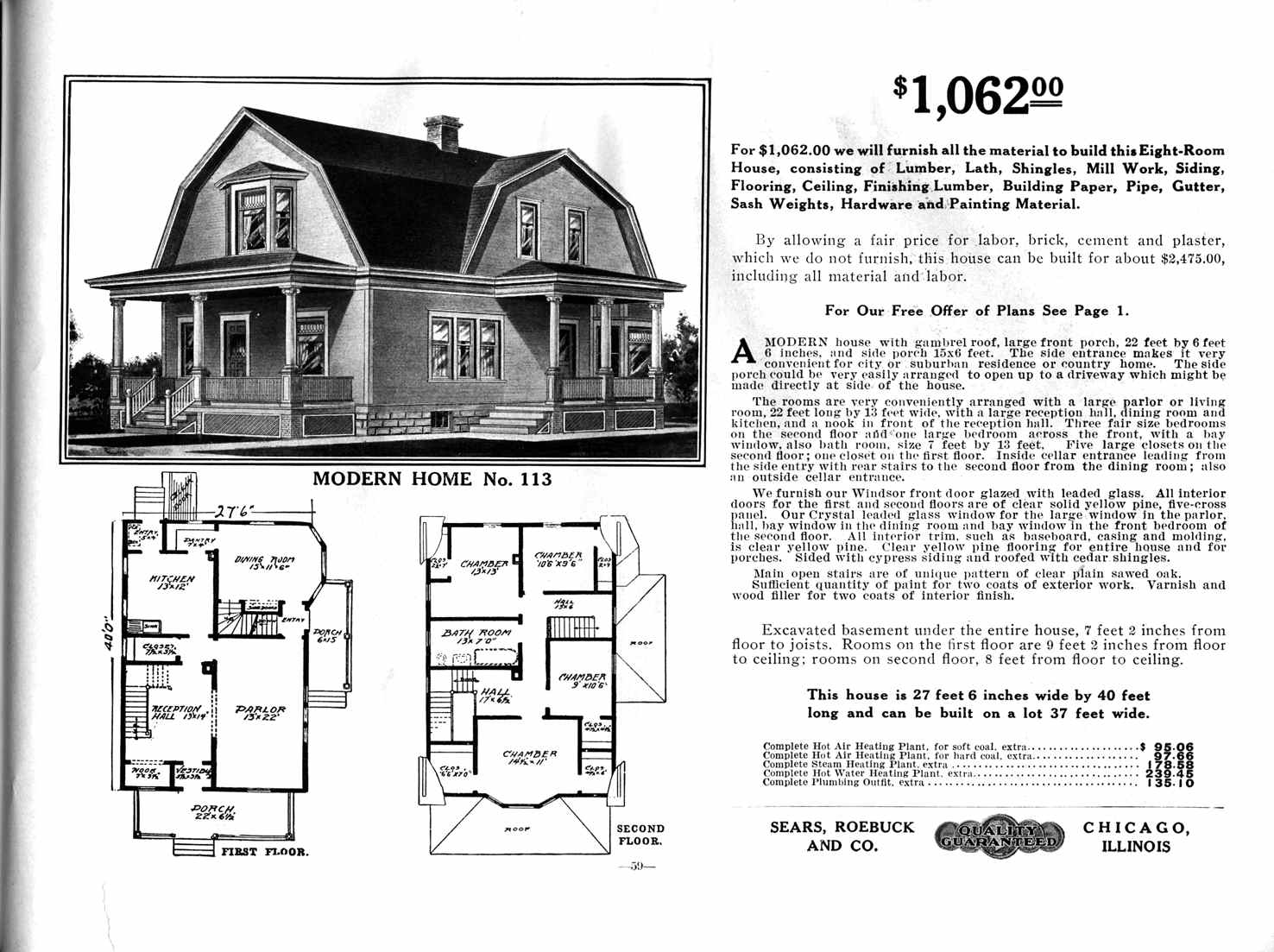
You can click on the pictures to see the original home ads in the Sears catalog, with prices (e.g. http://www.searsarchives.com/homes/images/1908-1914/1911_011...) $1062 for the parts to a beautiful American Craftsman style bungalow ($34,394.38 adjusted for inflation)! Some assembly required :)
On a tangential note: Sears killed the mail order catalog in 1993, just as the Internet was starting to take off. They could have been Amazon. Now, even their landmark highrise, the Sears Tower, has been unceremoniously renamed Willis Tower.
I still like the idea of mail order house parts & plans though. Someone should start a startup to make and build them.
They adopted digital tech earlier than most other companies.
Sears co-founded the Prodigy dialup service eons before "The Internet" was a household name, and they were selling hardgoods on the web (for delivery or free in-store pickup) when Amazon was still mostly a cheeky book store.
Sears died mostly because of corporate raider tactics that made it impossible for them to survive.
Home Depot also has some prefab units but they're all very small.
That's like saying Ford could have been Tesla, they just needed to make an electric car in 2012.
Here are my values:
Google ... online news Reader ... social media ... Global Media Inc.
I don't know how to stress Google's dominance and ability in literally crushing the entire media world. Google News, Google Reader, Blogger, Read-it-Later, Google Books, Google Podcast, YouTube ... were all part of a big conglomerate of information extraction + information production.
Of course, the curse of antimonopolistic eyes, M+FAANG competition, and media envy would have followed.
land value =/=house price
But...
> Do we share our national database? We largely keep our database private, for the use of our research team, but will certainly answer questions from homeowners, historical societies, press, or the general public, about specific information we have collected.
I wonder why?
I would very much love to see a map of Sears houses in the SF Bay Area.
Here's a guess: maybe they're worried about people bothering the residents of those homes? It might be that people who talk to their researchers specifically ask them not to share their addresses, and not publishing a list is the best way to get homeowners to voluntarily talk to them.
In the town where I live we also have the Hobart Steel Houses[1] that were a quirky proof-of-concept by a local manufacturer. My daughter's first school is located in one of these houses. Being able to stick magnets in nearly any surface in the house is bizarre and cool. The school uses this property to great effect. I don't see how they would have ever been economical, though.
[0] https://en.wikipedia.org/wiki/Lustron_house
[1] https://en.wikipedia.org/wiki/Hobart_Welded_Steel_House_Comp...
Why are kit homes not a thing today ? What replaced them ?
I love seeing all the small variations and modifications people have made, either when they were building them or later owners.
This is very cool, I did not realize how common they are.
Even dumber is "Chicagoland area."
My copyediting professor (who worked at the Chicago Tribune) loved to mock this dumb term, pointing out that nobody says "Detroitland" or "New Yorkland" or "Indianapolisland."
When I was growing up in Southern California, “the Southland” was used in the same way to mean the Los Angeles area. I heard the term only in the mass media, never directly from a person in conversation.
A little googling turned up this list of media-only geographical terms:
https://www.cyburbia.org/forums/threads/nicknames-for-metrop...
I noticed this phenomenon when I moved to Chicago in 1978. I liked the city, but I thought that “Chicagoland” sounded stupid.
No?
1. Most of northwest Indiana (Lake County) is considered part of Chicagoland, but is a different state. For example: Growing up there, I remember my parents crossing the state line on Sundays to buy alcohol, which was not legal to sell on that day in IN. But NWI had all the same radio and TV as Chicago.
2. Outside of of said Chicagoland, Illinois and Indiana are very different, especially the more south you go in both states.
https://www.theeastsideagent.com/history-hollywoodland-story...
This is our strategy to hide from real estate speculators and homeless millionaires from California.
Construction permits and significantly increased regulation have made them difficult though. You get economies of scale not just in construction, but more importantly in permitting, electrical and sewer connections etc. Then consider than desirable urban areas are already built up leading to land costing much more than the structure.
Example: https://www.palmatin.com/
I honestly think a lot of the problem comes down to having people in positions of power who view affordable, commoditized housing as a threat.
One of my grandfathers, and both of my wife's grandfathers built their own home at least once in their life.
Re-modeling a bathroom is about the limit of my abilities, plus I work an 8-5 so I'm not sure when I'd have time to build a house.
See: d.r. Horton
Another WTF is "the inland empire," also used for some nebulous part of the L.A. area by newscasters only, as far as I can tell.
But then CA absolutely loves meaningless names for stuff, like the perennial "red flag warnings." So... we're being menaced by red flags? Why do we fear them?
And "sigalert." Whatever, man.
Also no.
It just typically makes more sense in 2023 for a home buyer not looking for a custom build to get a piece of land with a house on it where they can walk in and turn on the lights and faucets than to buy a parcel of land, order a container full of lumber, and start individually dealing with permits, construction financing, grid interconnections, contractors, etc.
B. The fact the houses are identical is less the issue than sub-par materials and most importantly, as you'll find in all of the DR Horton lawsuits, sub-par construction. They're not just pumping out 100 houses, they're doing it as fast as humanly possible with crews of questionable experience.
I'd MUCH rather have a mail-order Sears house put together by a crew that actually cares about what they're doing than a company that just hires any crew they can find to pump out houses as fast as possible so they can move on to the next development.
When you’re hiring a crew to build one house, what’s their incentive to do a great job? You’re not likely to build another house soon.
I don’t understand why people romanticize Sears houses like this.
It’s like saying ‘I’d rather have an IKEA table assembled by a person who cares than a piece of furniture made by a craftsman who makes the same table design again and again’.
I can name three GCs off the top of my head who have reliable crews. If you have never had any construction work done, you pull up google or your search engine of choice and look for GCs in your area then ask for some references - or just ask a friend?
>When you’re hiring a crew to build one house, what’s their incentive to do a great job? You’re not likely to build another house soon.
Some people just take pride in their work? Referrals? Future work on upgrades to the house they just built? The money to build the house in the first place? It's not like you give them payment on the entire project up front... What's your incentive to put out effort day to day?
>It’s like saying ‘I’d rather have an IKEA table assembled by a person who cares than a piece of furniture made by a craftsman who makes the same table design again and again’.
No, it's like saying I'd rather have an IKEA table assembled by a person who cares, than a pre-assembled piece of garbage from China made of even less actual wood put together by someone working 18 hour shifts in a sweatshop.
I don't know on what planet you think DR Horton is equivalent to a "craftsman who makes the same table design again and again" but that's very much NOT the case with 90% of "big builders" - it's cut as many costs as possible, use the cheapest components possible, and move on to the next one as quickly as possible. Because the average person has no idea that yes, they should be able to plug in a vacuum and a blender at the same time without popping a breaker because it was cheaper to run half the main floor off a single circuit.