Half-Life: 25th Anniversary Documentary [video](youtube.com) |
Half-Life: 25th Anniversary Documentary [video](youtube.com) |
It was literally people that often didn't even have a CS or let alone gaming background and yet so many of them proved to be relentlessly resourceful, creative and hard working.
The guy who wrote most of the HL code wasn't even a developer and at the time was studying to become a lawyer or accountant iirc.
I can't but think that timing, founders but also straight up luck played an absolutely crucial factor.
I don't see that happening today, to be honest, in "AAA" titles at least. Budgets have gone through the roof, and the publisher won't give you a plan B, they will force the developer to duct-tape what they have and ship it no matter what. And the game can always be patched later, right?
Thanks for adding that caveat; it's an unfair comparison IMO to compare the well-selling games of 25 years ago with AAA games of today. Half-Life was built by a team of about 80 people according to a quick Google, and there wasn't the ecosystem of tooling, resources and outsourcing that we have today, versus hundreds if not thousands of people (if you include outsourcing / engines / etc) for AAA titles today. And the modern day game devs will have enjoyed a relevant education, whereas back then those educations didn't exist yet. Notably, John Carmack did a lot of ground work in translating math into 3D video game engines; he was behind Wolfenstein, then Doom, then Quake, and the Quake engine was used as the basis for Half-Life's.
Anyway, 80 people is pretty substantial even at the time; for comparison, indie hits like Hades had ~20 people working on it, Hollow Knight's Team Cherry has just 3 employees (but they used Unity so they didn't have to do much engine programming, and the ports to various consoles was outsourced); Wube (Factorio) has had a few dozen people working on it. "indie" hit Kingdom Come: Deliverance had like 240 people working on it.
You could likely do the same today, but the key would be finding someone (like Gabe) to fund it whilst it got off the ground.
Another interesting story is when Ken Williams (Roberta Williams husband, the other co-owner of the company) hired middle-aged retired police officer Jim Walls to design the Police Quest adventure games (he designed the first three). Ken apparently was talking to his hairdresser about his idea for a police adventure game, when she mentioned that Walls, her husband, might be an interesting person to talk to.
Specific job skills can be taught or learned. If you have the right attitude, positive outlook, and are inherently someone who learns things, you can be very successful in most jobs.
Too often, hiring filters for specific job skills/credentials. Because these are supposed to be a proxy for the softer skills. It's not as effective, but much easier to deploy at scale, I think.
Sometimes it really helps who you know, and there is always some element of luck in making it. Having a great team certainly made that game what it was. It was interesting how they balance realism and fun.
Its always interesting how things get made.
DYKG recently did a video about Ken Sugimori (the Pokemon guy). He is an overly harsh critic of his own skills, but I think there is a kernel of truth in this insight:
"It's kind of embarrassing to admit actually - but [video games were] a brand new industry back then, and standards were lower than in other fields..."
That doesn't take away from a bunch of inexperienced people making an awesome game though. That was hard to do I'm sure. I couldn't even dream of accomplishing that.
The struggle for them to move on from qwtf to 'tf2' was probably for the best as a lot of the lessons they learned in the wilderness there helped when they were taken on by value and worked on HL2.
Also find it somewhat amusing was that TF2 was originally going to be a much more 'realistic' modern miltary shooter before the scope creep killed it.
Instead we got Counterstrike. I'm not complaining as CS:Source is one of those games that I spent hours upon hours honing my skill.
As a long time JavaScript developer I honestly believe, and I really mean this, that maybe 4% of the people employed primarily doing JavaScript work actually know what they are doing. Just 4%.
It seems at the beginning many of the early Valve team had a lot of passion but almost no real experience in that kind of code or product. They got a massive springboard with the Quake code and then figured out the rest. They didn't stagnate on the Quake code, but wildly modified it to fit their needs. Most JavaScript people are not capable of this. They just stagnate at their favorite framework and then just spin around code style and process.
What differentiates that early Valve team from all these various JavaScript teams? It clearly isn't education or professional maturity.
Also demystify how it's done, almost none of the HL goodness where there at the beginning: the intro, gman, xen, crabs, music, etc. And were just made up along the way.
Also FYI, Half-Life and HL2 are currently both very playable in VR. Half-Life even runs natively on the Quest 2.
In a way, studios have hyper-focused on pre-ordering in order to get around this. Games are now investments that eventually get fixed and "live up to" their cost, instead of a polished finished product. Studios and publishers now focus on pre-ordering over finishing.
- (Paulie) "You're late!"
- (Ralphie) "Well, tomorrow I can be on-time, but you'll be stupid forever"
The conclusion was a dumpster fire for so many issues, and it wasn't for lack of original content to derive from I'd argue.
This is produced by same crew as the Half-Life doc. SecretTape who produced HL doc is the for-hire arm of NoClip.
Half-Life 25th Anniversary Update - https://news.ycombinator.com/item?id=38307889 - Nov 2023 (258 comments)
Couldn't you just move the mouse slower so the turning is slower? Or lower the mouse sensitivity?
To me, the biggest factors to (worse) sickness are
1. Narrow FOV: usually the bigger the FOV, the better. But when it starts to have too much of "fisheye" effect, it can be detrimental.
2. How "fluent" your character moves -- if you have to stop/decelerate constantly (for any reason: interact with objects, clash with walls, sharp turns), it induces sickness very quickly.
Third perspective games are typically much better, but if it's in a confined space (like in a room) for extended time, it's as bad as FPS.
The best FPS I've played in term of having close to no motion sickness is Overwatch. Apex Legends is pretty good in this regard too.
Any Valve title is a vomit festa.
Have you ever tried playing a competitive multiplayer game? There's people that will play games for thousands of hours without ever improving.
Sometimes I think people encounter bottlenecks and they're not sure how to overcome them.
Bingo. I got a release coming up, I just need to ship this -- ain't got no time for fancy stuff, and higher-ups don't want fancy or flourish, just make it work. And even if there is room for trying something new, it probably doesn't matter if the users DGAF about the new feature.
Keep in mind that building video game levels, models, animations and such back then was dramatically simpler than it is now.
One person did all the texture work for the whole game. One person did all the sound effects and music, and also coded the DSP engine to add real-time sound manipulation based on the environment.
You can do a lot with a few very talented people who are willing to guide a whole bunch of smart, eager and motivated folks.. which I think is what happened at Valve.
More experienced devs may have thrown out a lot of the ideas the Half Life team ended up implementing as "too time consuming" or "practically impossible". Valve's devs at the time weren't experienced enough to make those assumptions, so they just worked their asses off to figure out how to do it.
Here's a more detailed article on the cabal process (starting on page 2):
https://web.archive.org/web/20210823181232/https://www.gamas...
From 1999 and much more detailed than the video.
Now, game development is inherently waterfall. You work for years and built up to this huge release. Nowadays you might have some agile processes embedded into milestones, etc. But fundamentally it's all leading to a huge waterfall.
That's important. Because what agile does, today, is that it turns autonomous developers into cogs of a large machine. But Valve's "cabal" was entirely free to do whatever they felt best. Gabe Newell probably had final say and input, but ultimately the group had flexibility. The developers had full system awareness. They weren't pulling Jira tickets off a board like a blind man in the elephant parable[1]. They knew how the pieces fit because they put them there. And if the pieces weren't fitting, they had the authority to make them fit.
Perhaps more interesting is how the story of Half-life can be viewed through The Mythical Man-Month[2]
> When designing a new kind of system, a team will design a throw-away system (whether it intends to or not). This system acts as a "pilot plan" that reveals techniques that will subsequently cause a complete redesign of the system.
Their cabal has a bit of overlap with the "surgical team" concept and usage of formal documents. The rest of the employees did nothing while this group operated. Thus, they reduced manpower that actually allowed them to move forward. Slow is Smooth, Smooth is Fast (from the US Navy Seals). Most companies do the opposite. They crank up the number of employees to hit deadlines, which creates more bugs and more work.
Because it's JavaScript. It's a language specifically designed for people who don't care about how anything actually works.
1. Hacker-tinkerer culture, where you want to build new things that haven't been built on new hardware for fundamentally non-commercial reasons. This could be called Carmack-style hacker culture in my mind, which produced Quake.
2. Genuinely extensive programming expertise.
3. Not partaking in the current and quite toxic VC-funded game development culture, where funding dictates rushed deliverables (through schedules, and the constant race to attract funding with demos). It's feature factory or die in a lot of VC-funded scale-ups.
4. Lucky circumstances - knowing someone who could get you Quake source on "just have it, we'll work something out eventually" terms back then was exceptionally lucky. Quake was very far ahead of it's time. Most companies that produce such work now would work very hard to make sure no one else gets it. And that goes back to the hacker culture of just building cool things to share with people that was more common in games then.
5. Time - the games industry was young, before Quake there were no proper 6 DoF generalist 3D game engines, so it was an auspicious time for game development.
I'm a game developer and I am a bit old school, so I'm not the best person to speculate on why JavaScript programmers seem less able to build cool tech. But I have seen many young people approach programming differently now, probably because it has become a lot more commodified. The mindset of a "clock-in clock-out" programmer wasn't common in game circles in the 90s and 00s. Also, there was much less focus on using "correct" idioms and beautiful code as the end goal in hacker circles, and a lot more focus on building something that others haven't built before and working out the details later. Moreover, business viability was rarely the first thing you would think about and work backwards from when you worked on a game project. Business success was a byproduct of building cool games.
If you would remember game trailers from early 00s, like Half-Life 2 (since we are talking about Valve), you would pick up that they show off cool tech like physics simulation, which is quite janky and imperfect. Carmack also has spoken many times about how in his early games (pre-Quake) the graphics would initially be quite bad and he would be worried about getting everything fixed in time. Cool over safe, cool over perfect, and showing off cool things that were not polished was normal.
Nowadays, things are different in some ways. The game development has become methodical and focused on the exploitation of passion for money in a repeatable way. You get as many features as you can for marketing (you only need to have them, they can be whatever quality, it's only for the Steam page and trailer). You cut all the awesome new things as they are a risky waste of money, you instead funnel all the passion into velocity for delivering that bundle of features as quickly as possible for as cheap as possible, and that's it. If you can strike a deal with a nice IP, that will make the game sell a lot more. So will striking a deal with a publisher with deep pockets for marketing. But the "do cool things" hacker culture is gone in AAA and blockbuster games. It's now relegated to indies where quite a lot of janky but incredibly cool games are made. But they have a funding access problem as their business is too risky for most publishers and VCs. And that's probably why we don't see many new and big id and Valve-type companies anymore.
Although with VR, there are some companies that I believe could be like that. And they attract senior talent quite well. With the right management and timing, I think we could see another Valve in VR. Even Carmack played a big role in VR until recently, before he moved on to the next new thing in tech. Being on the precipice of new tech is important for people of that culture.
As a testament to their (the original id software team that had both Johns) great efforts and legacy, they pretty much invented the concept of a game engine to start with. At that time, most games were written as a one and done type of a package deal.
Given that the team wanted to push the technical edge with the games consistently, they wanted to have some reusable/modifiable core that they could use across multiple projects, have visual level editors, etc., they converged on “accidentally” creating a game engine and coining that term. I forgot which game was the one that led to the creation of it for them, iirc it was one of the earlier Commander Keen games, but my memory might be failing me here. They didn’t even have the goal of creating a game engine, they just ended up getting there and then realizing what they did as they were trying to build their reusable “toolset.”
Their skill in honing the game and becoming a respected game development company are what are in question, and while not an AAA studio, they are recognized as a company that knows how to highly optimize their game.
They deserve as much respect as any other game developer, in my mind. Their approach is different than other game studios, and that alone is testament to their abilities to both make a game and run a business. They're doing things their own way, focusing on the one game (at least as far as we know) and they are still simply "killing it" and I mean that in the very best way.
(well, Icefrog isn't burdened by the need for monetization.)
So if Sierra is the only company really willing to hire female game designers, they really get to take all the best.
On the flip-side, there are a lot of people dealing with trauma of one kind of another. Outwardly, they may seem to be negative or acerbic or closed-minded, when, internally, they are trying mightily to get their passion and earnestness to break through a wall of their own bitterness or anxiety.
I don't know that recruiting or management have reliable methods of dealing with either pro-socially.
Very true -- You can create an amazing game engine (carmack) but it wont sell unless you have talented people pushing it capabilities (romero)
From memory, referring to Doom and Quake 1, Romero built the level editor for said games. Quake, I believe, was created on NextStep machines. Romero (and others) were also the ideas of creating the world.
I wouldn’t call Hades an indie hit in the classic sense. Bastion was an indie hit, but by Hades supergiant had releases 3 acclaimed games.
That’s not to detract from the well deserved success of Hades, but SG was damn well established by then.
I recalled correctly, he provided the showrunners with context, but they went largely ignored.
https://www.forbes.com/sites/paultassi/2019/05/11/george-rr-...
https://youtu.be/3AEvEIYzMbU?si=S5NDh1874vsE72Kl?t=8m28s
This is video is a wider retrospective about the game that I think is worth watching, but I linked to a clip in it from a GDC talk given by the games director. Where he states himself that only he and one other goldeneye 007 team member “had ever made a game before”
Here's his GDC postmortem presentation: https://www.youtube.com/watch?v=Z1Fx18cppZk
Building games today is a different beast, comparable to making a movie.
I think this is the benefit of not being a public company. They’ve pivoted over and over and over. They’re still in the same space (video games) and the breadth of the areas they’re in are immense!
Back to HL2 - it's the 2nd game I've ever finished twice (FF VII being the other), still love the story, the very cool physics gun, the incredible dystopian narrative and setting, and it holds up today wonderfully 19 years later.
It's a shame we'll likely never see an HL3. There are so many talented development firms they could outsource it to, with current engines like UE5, it would be fantastic with the proper writers. Maybe even the original ones. Alright, done gushing here.
Or is that maybe why? The weight of expectation is too great to live up to
And the leaked storyline for Episode Three looking really strong as well.
I hold out hope that the Crowbar Collective (the group that remade Half-Life with the Source engine and called it Black Mesa) have been secretly working on implementing the Episode Three storyline in Source. Though, now that Source2 is out who knows? This is all my speculation anyway.
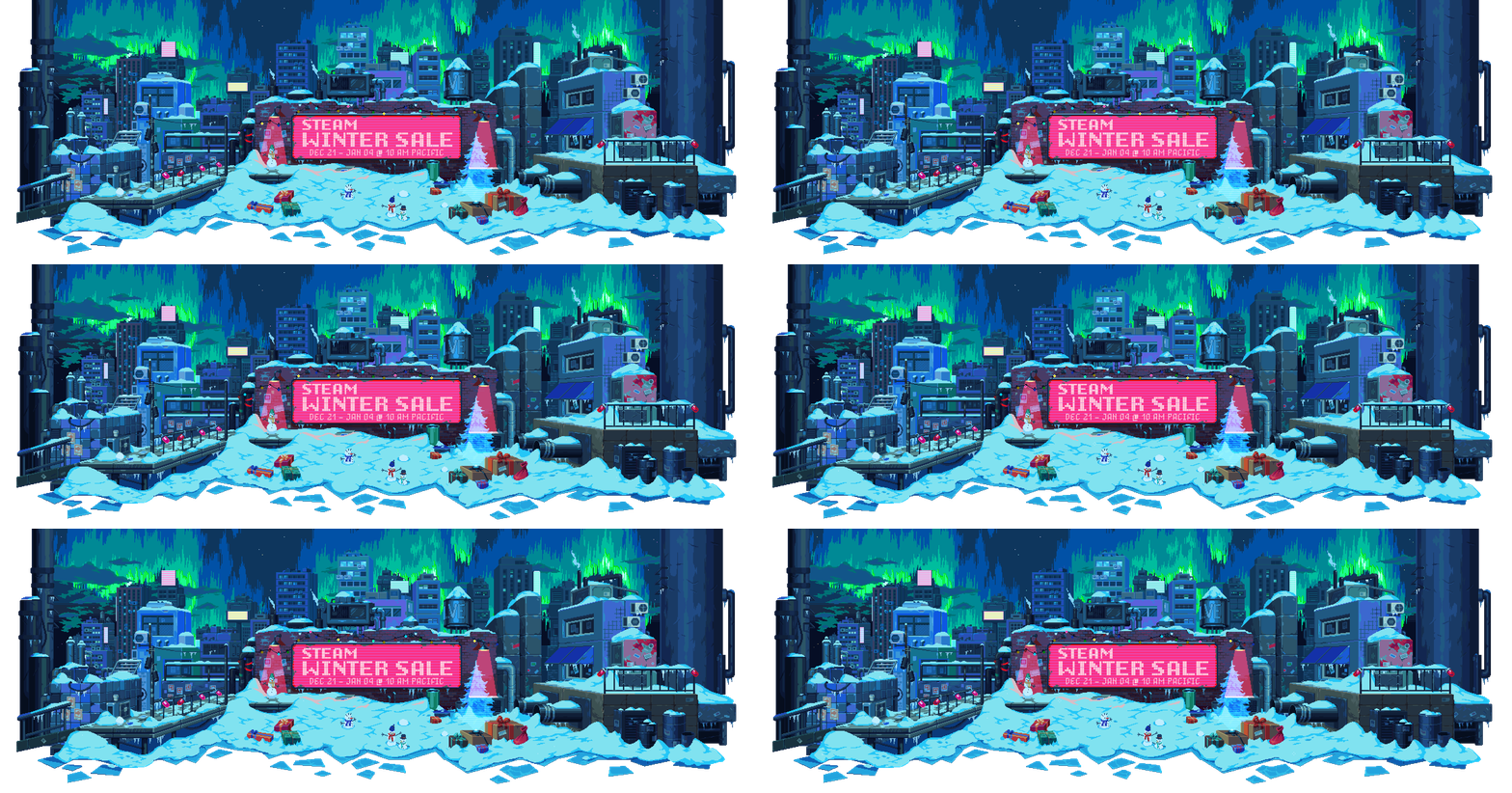
[0] https://cdn.akamai.steamstatic.com/steam/clusters/sale_autum...
I’m not convinced this 3/E means anything. If they’re making HL3 or HL2:Ep3 then we’ll find out soon enough. Many people have tried to read the tea leaves by scouring textures and images in GTA V over the years, and every time they’ve been made to look stupid. If there’s an announcement to be made around HL, Valve won’t hide it in a Steam sale banner
The modern AAA mentality has stripped too much of it down to formulas they consider working or "best practices" (e.g the "UbiSoft Towers" phenomenon) or they're literally shaping the whole game to try and force a specific business model that is more important than shipping good content (Bungie Destiny 2).
Difference is when a game built with that ideology doesn't hit the mark it ends up just being insanely dull and has no spark to keep you going or win you over. Instead of Flawed But Fun you get Competent But Boring.
But it was a different time, mainly in terms of what was available, how much time you had, and how much time a game took.
Most games we had were copied shareware games from diskettes; on occasion a CD with loads of shareware games, and on rare occasions someone had a copy of the full version of a game like Doom.
But nowadays a lot of games - AAA and indie both - are at least 40 hour games, if not (a lot) more; Assassin's Creed Valhalla takes 123 hours to "do everything" (platinum); I've got over 300 hours in Factorio and about half that in Kerbal Space Program; FFXVI took me 60 hours to finish, I still have outstanding sidequests, and that one doesn't even have that many side activities or time sinks.
And then there's the "live services" (or MMOs if they have a multiplayer aspect, or MMORPGs if it's WoW or FFXIV) which are designed to have great / tight gameplay loops but effectively infinite game. I've got a lot of hours in FFXIV and they keep adding Stuff to it. If I had infinite time there's a few side activities in it that cost just as much time to "finish" as the base game's stories.
- Ocarina of Time
- Final Fantasy VII
- Baldur's Gate
- Starcraft
- Metal Gear Solid
- Resident Evil 2
- Pokemon Yellow
If only it was as competitive as 2023, in which some of the top games were:
- A Zelda game
- A Final Fantasy game
- A Resident Evil remake
- A Baldur's Gate game
If you had a taste for a certain kind of game in the late 90s you didn't have many choices that were done by a full studio and polished. Most of the games you listed had the same "problem" of being unparalleled at the time.
Now you have a lot of clones of the same idea, plus so many of the classics are still replayable or remastered and rereleased. A good-but-not-great game has many substitutes with a similar scope and feel.
There are a lot of 5/10 games that are successful on Steam because the devs set the right expectations for the experience.
Recently Vampire Survivors comes to mind. Definitely a 6/10, but something about the balance of no-effort art and masterful game tuning makes it VERY sticky.
That's fighting talk round my way!
There's something they've got incredibly right between the no-thinking gameplay and the gradual progression through the various secrets and unlocks. I thought I'd grown tired of it after finishing the base game and not being bothered about gold farming, but I bought the DLC the other week and I was instantly hooked again.
I get that the art was a no-effort import, but everything else about that damn game is a good illustration of something that only seems simple because it's exceedingly well done.
In fairness, isn't is specifically meant to look like a ported Italian game with laughably incorrect translations?
One of the most enjoyable games this year for me, and it says a lot (given how many amazing games of all kinds we got this year). And yet, it isn’t overly ambitious. Just overall, that’s pretty much the exact type of a game that you are talking about, which I’ve noticed we had an almost complete drought of over the past decade.