Mozilla expands extension support for Firefox for Android(blog.mozilla.org) |
Mozilla expands extension support for Firefox for Android(blog.mozilla.org) |
I've been daily driving FF Android for a few years now and I've had the opposite experience: the vast majority of pages work and render fine (including HN) and it's an extremely rare occasion that I switch to Chrome to use a website. Even then, I often find that Chrome isn't any better and the underlying issue was the website's mobile handling in general (e.g. touch events working differently than mouse events, or just a completely broken mobile-only component swaps)
You seen this pattern again and again in Firefox news threads.
You mean "we reluctantly unbroke what we previously deliberatly broke".
What are you going on about?
HN is a basic site, Lynx on MS DOS could render it.
People b***h about Firefox's (lack of) market share, Mozilla doing stupid things (fair criticism), Firefox not having X (extension support on Mobile, moving from legacy extensions to standard manifest format)
Then people will still bring up this baggage even when something good happens, will refuse to move away from the browser monoculture/monopoly, s**t on Firefox devs
FFS, something good happened. No other browser has this. Yet people will find a way to lessen it. For what? What benefit?
Sadly, the browser world has almost become something of a mono culture with the majority of offerings using Chromium as their base. I liked Opera for years. Original engine. Tabbed. Now Vivaldi is the Opera successor, but sadly uses Chromium as the base. Vivaldi have said they are not going to allow the changes to affect them.
Again, sadly, I doubt that in the near term, anyone will try and offer up a new browser. Even Edge is nothing more than Chromium with MS's tech-nasty Kabuki makeup and overly-complicated proprietary plumbing. Is it too much to ask for a browser that just browses the web without all the garbage tie-ins? Tabs, ad blocking that I control, not add-ins. Like a Pi-hole, where I can add lists. I realize some browsers do this, but the tie-ins, notes, skins, email, political activism, it's all too much.
The nerd rage is targeted at Mozilla's dishonest and incompetent managers, no? The actual dev work is top notch.
Trolling used to be an amateur sport, but these days it's largely a professional endeavour. Astroturfing is an everyday occurrence on any decently-sized social media site, including this very one.
So, I'm glad they are expanding the extensions available. I just hope that this isn't tied to creating an account still. [EDIT] I was overjoyed to see that I was able to add an extension without creating an account. Yay!
This is one of the reasons it's so troubling when some techies latch onto some very closed platform (sometimes by a known-underhanded company) and start making it more attractive to others, by making open source software specific to it, making tutorials on hot employability topics that implicitly use the platform, etc. When open platforms exist, and could also benefit from this contribution and promotion.
At first it was "Jeebus, I wonder what's going on with that one person, who normally uses open source, stabbing themself in the back like that." Then it became "Jeebus, are we losing open platform ground with the majority of an entire generation of techies, after we'd finally won." (I have good guesses about why, and I also know at least a couple early maneuvers that I can't talk about, but it's still dismaying how vapid the collective behavior can be.)
Firefox's loss of market share in general is a direct consequence of its loss in market share among web developers, because web developers stopped testing their websites in Firefox.
Any time Firefox does something good for power users, it's a good thing for the whole web ecosystem.
I didn't say it was sh*t. I'm saying it's not newsworthy.
Clap for the devs. And install all the extensions. But we don't need a hundred posts about it. This isn't the big story Firefox marketing might think it is.
The fact news about Firefox gets upvoted clearly indicates it is newsworthy. You don't get to decide. The users of HN and their votes do.
We could downvote all that stuff to oblivion. Instead, comments like it are voted to the top comment on almost every page.
Thank you for your work!
HN should have an annual Appreciation Day, with no enshittification of threads.
Even if it is, that kind of language doesn't help. These are all people you're talking about, trying their best to do a job they care about. Nothing gets better by your being a jerk.
I would not take that as a given for Mozilla's upper management. Many of their decisions seem to ignore what users want in deference to Google or other motivations.
Power users aren't happy that Firefox has been doing nothing but trailing Chrome for years, actively making the browser worse for power users by weakening extensions, baking ads into the browser, wilfully refusing to permit opt-out of telemetry, and lying about revenue-sharing with Pocket. [0][1][2][3][4][5][6]
Mozilla gave its CEO a raise of over $1m/year, from a starting point that was already over $1m/year, at a time when Firefox was losing usage share, while laying off engineers. Mozilla did all this while congratulating itself for putting people before profits! [7][8][9][10]
I still use Firefox as my primary desktop browser, and I really want to like Mozilla, but here we are.
(As an aside, I see Pocket is finally going to be made Free and Open Source Software, which is good news. [11])
[0] https://news.ycombinator.com/item?id=36841567
[1] https://news.ycombinator.com/item?id=24144137
[2] https://news.ycombinator.com/item?id=23391659
[3] https://news.ycombinator.com/item?id=14754740
[4] https://news.ycombinator.com/item?id=22616740
[5] https://news.ycombinator.com/item?id=10680925
[6] https://techcrunch.com/2022/11/17/mozilla-looks-to-its-next-...
[7] https://news.ycombinator.com/item?id=24569464
[8] https://news.ycombinator.com/item?id=30723971
[9] https://calpaterson.com/mozilla.html
[10] https://en.wikipedia.org/wiki/Mitchell_Baker#Negative_salary...
I would also note that "managers" runs quite a wide gamut and my experience with engineering managers at Mozilla was generally positive; upper management was not so great.
If that ever really meant something, it has been so overused in the last few years that it's impossible to pick out any needles of serious use from the general default trendy grain silos of despair.
I'm not trying to get all of humanity to give up sex. I believe we can do better, here on HN, in this one regard. I am that insanely optimistic!
Wether there is a formalized contract or not Mozilla makes choicses in the interest of Google over (especially power) users all the time. And in general its absurd to think that taking money (not to mention almost your entire funding) from someone isn't going to make you biased towards that person. As has been pointed out many times in discussions about this, you don't need any explicit deals for conflicts of interest to emerge. Having the wealth of Mozilla's leadership depend on Google's good graces is going to encourage them to make decisions that will keep Google happy.
Attacking users users that bring up grievances is not going to help your case here.
> There are some things Mozilla is disallowed from doing to Google Search results that Firefox displays, but that's basically it.
What exactly are those things? Is that why Firefox does not come with ad blocking by default?
What choices did they make in Google's interest?
The baffling thing is why this took so damn long. FF for Android supported add-ons from the beginning. That's the best thing about Firefox for Android! They decided to rewrite the UI in 2020, and there were fair reasons to do that. Obviously this required some reimplementation time for extension support.
But they then launched the rewrite of FF for Android with extension support... but hidden. Only a small set of recommended extensions were enabled, and a few were drip-fed over time (that is, added to the list). Thankfully, this included the single most important extension, uBlock Origin, from the very beginning. (The lack of uBO why Chrome for Android is borderline unusable for me!)
But from almost the very beginning, we've also had the ability to activate custom extension collections in Nightly (and in Fennec F-Droid, which is a rebuild of stable Firefox). The vast majority of extensions worked fine for... well, years now.
So why in the world was this delayed the whole time?
Proud of the team to have finally gotten to this point. Miss you all.
Lord knows there's enough money floating around that place.
What a shame - but thank you. Hopefully plugins come to Firefox for iOS some time.
I'm surprised it's baffling in a community of developers and other IT professionals.
It's not baffling to me that two significantly (wholly?) different applications on different platforms and form factors would require quite a bit of work to both be generally compatible with the same third-party software via the same API - and all while maintaining the same compatibility with another application, made by another company, completely outside Mozilla's control.
And it needs to work reliably enough to release to a world of developers - of every skill level, motivation, writing every kind of software (within the domain of browser add-ons) - with confidence that it will work for them and users.
And you need a way to maintain all that over the long term.
I'm impressed Mozilla!
It was more complicated than that. Yes, GeckoView needed a separate WebExtension implementation, but that work was pretty much at parity with Fennec (the previous Firefox for Android that supported more extensions) when I left in 2021.
It was a product management decision that held off on more complete WebExtension parity with desktop, as well as any artificial limits as to which extensions were supported in release.
I won’t be surprised if at some point in the future we learn that Google had a discreet veto over any aspect of Mozilla’s software roadmap, as a condition of the money faucet continuing to flow.
Google is known to make underhanded deals (just Google “Epic v Google” for details); they provide the funding that allows Mozilla to exist; and a Firefox with a capable extension model is indeed a serious threat to Chrome’s marketability and Google’s strategic interests.
Given all that, it’s difficult to believe that a key differentiating feature was legitimately starved of resources for a decade.
1. they wanted an Apple-level of verified review process for AMO, because the Chrome store and even Android app store have problems with malicious content.
2. This costs money.
3. They didn't want to open a free for all because they didn't know exactly how to go about solving 2. yet, and if they introduced some payment system then it would be easier to do from a clean slate, without an AMO full of existing extensions to somehow grandfather through.
As said before, this is fully unfounded and probably unfair speculation. I like it more than the 'google conspiracy against adblockers' though because Mozilla's motivations in this case are quite reasonable and can be taken in good faith. Keeping credit card skimmers out of AMO at the cost of restricting access to 'Firefox Pro'/'AMO Pro'/author-pays would honestly be quite a good thing for Mozilla to consider imo.
In any case it's great to see them allowing things now!
I wish I could switch to FF, but I still need PWA support + rich media notifications for a web based music player I wrote.
https://play.google.com/store/apps/details?id=com.kiwibrowse...
The Einkbro browser, optimised for e-ink devices (as the name suggests) is one. I believe Brave does as well.
As much as I'm a fan of Firefox (using it now on desktop), on my mobile e-ink device, Einkbro's optimisations make for a vastly superior browsing experience.
Firefox browser share is like 2-3%. Please consider using it, the internet will be a lot shittier without Firefox as an option, and it is the best option for privacy and ad-blocking.
[0] https://addons.mozilla.org/firefox/addon/hn-comments-owl/
But EU is pushing for sideloading
If Firefox goes back to being THE browser of choice for tech savvy people, I'll stop thinking I made a bad choice supporting it everyday since it came out.
Sometimes a joy.
The problem is that many extensions have been incompatible with Android. And of those compatible, many have poor UX. For example, LeechBlock has been compatible and listed as available for some time, but its settings page isn't mobile-friendly. And LeechBlock can't restore settings from “sync storage”, you have to load them from a local file (on mobile, having local files is a challenge in itself). Many people may have a bad experience.
On the other hand, extensions are the primary reason to use Firefox on Android. Therefore, I'm glad about this news.
This would enable proper isolation between browsing contexts, and therefore make progressive web apps truly usable and a good alternative to native apps. Currently PWAs leak cookies to the browser, therefore you cannot login on the PWA while browsing "anonymously" in the browser.
Uhm, Kiwi browser is Chrome-based and supports Chrome-extensions on Android and has for years. It's pretty great.
[0]: https://addons.mozilla.org/en-US/firefox/addon/rudolf-fernan...
For me, the most important add-on that has been removed from AMO is Bypass Paywalls Clean, which is the easiest way to bypass paywalls on popular news sites. In April of this year, a French website filed a DMCA copyright takedown notice, causing Mozilla to remove the extension from AMO.[3] The add-on developer (magnolia1234) did not want to challenge the DMCA notice, probably because it would require them to break anonymity and be subject to legal liability.[4]
Fortunately, in September, another developer (dbmiller) was willing to reupload the add-on to AMO as "Bypass Paywalls Clean (D)" with no changes.[5] The hope is that dbmiller will keep this add-on up to date with the source and challenge any DMCA notices filed against this new upload.
However, the fact remains that Bypass Paywalls Clean was unavailable on Firefox for Android for 5 months because the browser did not allow sideloading. In the announcement, Mozilla says their mission is to maintain "an open and accessible internet for all" and that extensions are meant to help users obtain "more personal agency out of their online experience". To achieve this mission and better distinguish Firefox from browsers that gate add-ons through app stores (Safari on iOS), Mozilla should allow users to enable sideloading on Firefox for Android as an option.
[1] Iceraven: https://github.com/fork-maintainers/iceraven-browser
[2] SmartCookieWeb-Preview: https://github.com/CookieJarApps/SmartCookieWeb-preview
[3] https://www.ghacks.net/2023/04/20/mozilla-removes-bypass-pay...
[4] https://gitlab.com/magnolia1234/bypass-paywalls-firefox-clea...
[5] Bypass Paywalls Clean (D): https://addons.mozilla.org/en-US/firefox/addon/bypass-paywal...
Then again, Firefox could easily be said to not be a major Android browser either!
[1] https://gs.statcounter.com/browser-market-share/mobile/world...
I even tried creating my own collection to include Violentmonkey and it didn't work but I don't this second recall why
We should have listened to Hyatt back in 2003-ish when he basically said of XUL, "it's never gonna be great on *nix or Mac but it's good enough on Windows." Because of solid desktop horsepower growth over the 2000s, we were able to make XUL go for the three desktop platforms pretty well but it should never have gone to mobile and replacing it with a native front end was absolutely the right thing to do, despite the pain.
https://www.theguardian.com/technology/2016/nov/01/firefox-d...
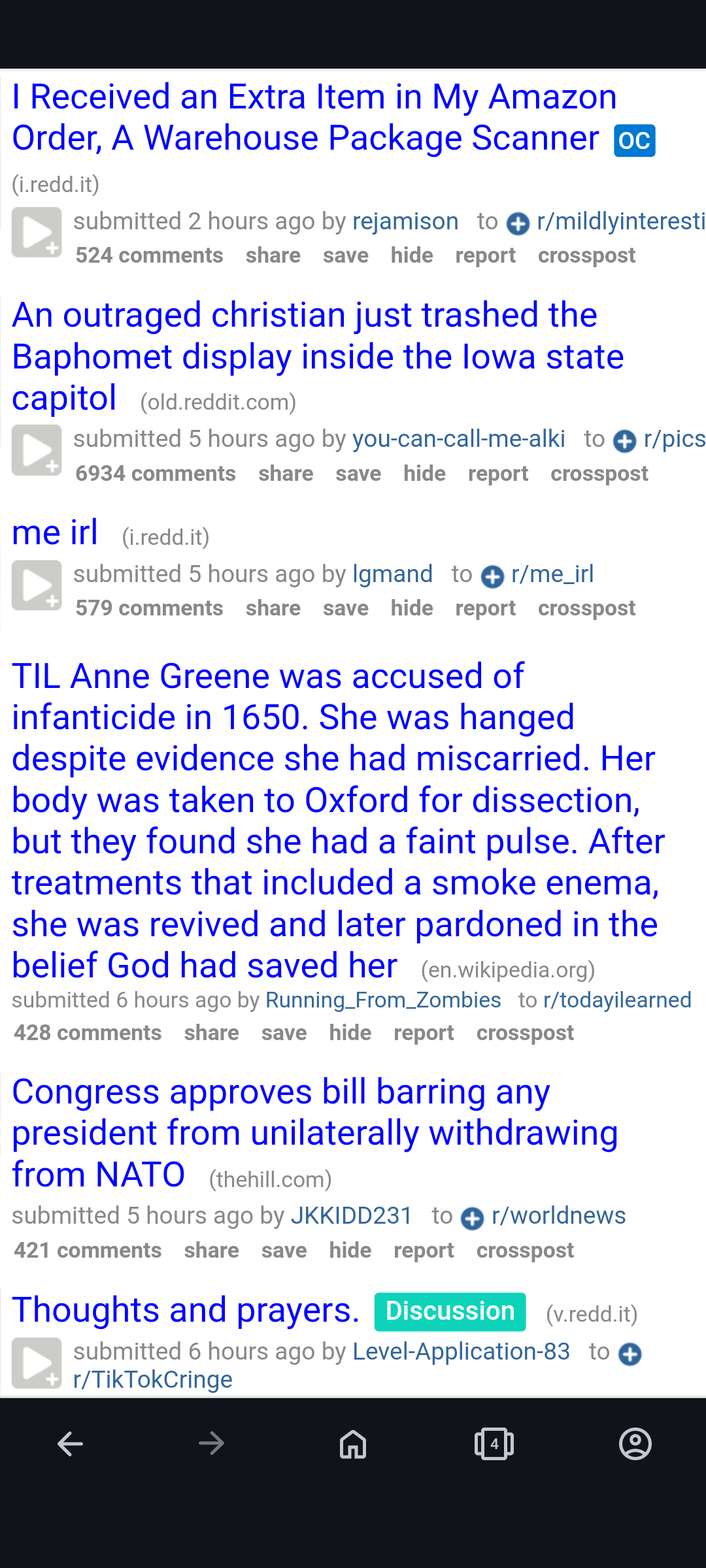
It's a screenshot of today's old.reddit.com/r/all. You can see how you're able to read all of the text vertically, without having to scroll sideways, because it wraps perfectly to the current pinched zoom level. No other browser works this good on Android, and reading stuff is my main internet use case. Try seeing how that website looks on any other browser, it's ridiculous how unusable they are.
Edit: Nightly gained the ability to sideload add-ons 2 weeks ago from the pull request at https://github.com/mozilla-mobile/firefox-android/pull/4568. Also, a Mozilla employee has confirmed that sideloading is going to make it to the release channel of Firefox for Android!* Firefox is having an incredible month. It took time, but I'm extremely glad Mozilla is taking user feedback seriously.
* "We do want this feature in Release." https://github.com/mozilla-mobile/firefox-android/pull/4568#...
Maybe Cookie Auto-Delete is coming soon for Firefox Android.
Here is the repository of Add-ons for Firefox Android https://addons.mozilla.org/en-US/android/
mpv uses youtube-dl (or yt-dlp) to fetch the stream URLs and that supports many sites.
[0] https://addons.mozilla.org/de/firefox/addon/send-to-mpv-play...
If it was just an experience issue because like 5% failed weirdly or had bad performance but they couldn't validate them all: that's basically fine! Hide it behind an about:config flag! The AMO requirement was a privacy-invading piece of nonsense that had no business existing.
Hmmmmmmm, now what major Mozilla sugar daddy would be interested in that /s
If mozilla cared about the open web they would immediately distance themselves from Google and reallocate funding from their CEO's family to things that actually matter for their mission.
Before Bypass Paywalls Clean (D) existed, I was able to install Violentmonkey on Firefox for Android through the add-on collections workaround to use the Bypass Paywalls Clean userscript. You need to enable desktop mode when assembling the add-on collection (or do it from a computer) for Violentmonkey to show up as an option in the search.
uh-huh
> You need to enable desktop mode when assembling the add-on collection (or do it from a computer) for Violentmonkey to show up as an option in the search.
And people say "Firefox not popular, why?"
what a tire fire, for no damn good reason
[0] https://www.theverge.com/23994174/epic-google-trial-jury-ver...
It seems to me projects like Iceraven demonstrated years ago that a great many extensions were usable without any changes. Why not just slap a "here there be dragons" warning on untested extensions and let users have at it?
To be clear, I'm not asking you to justify decisions you didn't make, just to provide some visibility into the process if you can. Mozilla was pretty opaque about it.
We essentially had that as part of pre-release builds. Same with about:config.
The argument we'd then hear from people is, "but I want the stable channel with the 'here be dragons'" stuff. The reality is, though, that the "here be dragons" stuff probably affects stability more than running beta does anyway; people who shat on us for that wanted to have their cake and eat it too, and it just doesn't work that way.
Also I wonder where do those decision makers work now.
- Google pays Mozilla more than 400m per year.
- Its in Google's interests to not have good Firefox add-ons. (For both Ads and Chrome's market share).
Google's negotiator could easily added some incentive for Mozilla's management to set the focus somewhere else.
In fact, given what Google's team is likely earning, they wouldn't be doing a good job if Firefox's mobile strategy wasn't discussed before signing such deals.
There is a much simpler potential explanation for such a product management decision. Suppose Mozilla determines that 90% (made-up number) of users want addons because they want uBlock Origin. It then seems sensible to prioritize that addon and not others when determining how to spend limited engineering resources. Reasonable people can of course disagree with that decision, but there's no need to bring conspiracies into it.
(NB: Even though I worked at Mozilla I have zero insight into this particular issue; it's entirely speculation.)
I suggest using https://www.kimovil.com/ to compare smartphones. Using it I was able to find smaller phones with long battery life which were my two main requirements.
I wouldn't use an iPhone again. My last iPhone was an iPhone 4S. Not missing anything.
I'm guessing we'd have to know what you're looking for personally to find it :)
>I'm guessing we'd have to know what you're looking for personally to find it :)
Like I said in the post, a screen about 5" big. iPhone Mini is the only phone on the market that even gets close (and it's still a little too big IMO), so I'm stuck here on iOS with no access to (real) Firefox :(
Ok. I didn't realise that was your only requirement. There are a ton of phones out there.
https://www.gsmarena.com/results.php3?nYearMin=2021&fDisplay... here's everything with a screen of 5.1" or smaller. 30 android phones produced in last couple of years with that size.
Feel free to adjust the phone finder search to your preferences.
For example, here's the 14 phones with a screen size of 4.7" or smaller since you said your iphone was too big.
https://www.gsmarena.com/results.php3?nYearMin=2021&fDisplay...
I.e. having unlock origin available at launch might have been a conspiracy.
E.g. the yes men types tried to sabotage it, while the unsung heroes did it anyway.
While I definitely prefer FF and Android, I can support the notion of Mozilla integrating extension support into WebKit on their iOS version of FF. But it would take a lot of effort to do that, and Firefox for iOS is ultimately just totally separate from any other Firefox (whereas Android and Desktop Firefox share the same innards).
I guess they could take the approach of drawing the whole screen themselves but that’s going to make Gecko-based Firefox for iOS feel noticeably worse than the current WebKit/UIKit version in terms of responsiveness and such and might require some legwork to properly support VRR on 120hz iPhones (which is critical for battery life on those models).
At this point it's just a polite fiction, maintained jointly by Apple and app developers, that allows Apple to maintain a somewhat straight face when saying things like "you can't download third-party code at all" or "all code extending app functionality must be downloaded through our designated mechanism".
iSH is one such app, this blog post is very interesting: https://ish.app/blog/default-repository-update
Given the current regulatory scrutiny of their app store, I believe they just don't want to open yet another can of worms by rejecting "browsers" (which are really WebKit wrappers) for injecting third-party JavaScript into all web pages displayed within them, even though by their own rules, they arguably totally should.
Back in the day, they were removing stuff like scripting apps. They sent warnings to the devs of Pythonista, forcing them to do things like [remove file-opening support](https://mygeekdaddy.net/2014/06/17/working-around-apple/). And they infamously removed iDOS (a DOSBOX port).
Now they're much more loose and allow things like iSH and so on. It is still a little bit of a gray area for arbitrary decisions by Apple, though.
I do love those rugged looking designs, but I'm going to stick with my xcover :)
That idea is supported by recent disclosures revealing that Google paid or attempted to pay Activision, Aniplex, Bandai Namco, Bethesda, Blizzard, Com2uS, EA, King, Mixl, Niantic, NCSoft, NetMarble, NetEase, Nexon, Nintendo, Pearl Abyss, The Pokemon Company, Riot, Square Enix, Supercell, Tencent, and Ubisoft to influence each company’s product roadmap. [1]
I think it makes sense that they would attempt to exert similar influence over an entity whose continued existence is entirely dependent on revenue received from Google and (ostensibly) competes with one of their of their strategic initiatives.
Sure, it’s speculation, but it’s not wild speculation.
[1] https://www.theverge.com/2023/11/9/23954107/here-is-the-full...
I already know the answer; it would have to whitelist Google or Google would stop paying Firefox to be the default search engine. And if it whitelisted Google, that would only confirm what people say about Firefox being a pet on Google's leash. All the denials of this are laughably unconvincing, people know how the money flows.
Even if what you're saying is true, businesses that can't afford a ban from the App Store, can't afford to bend the rules. If Mozilla developed Firefox for iOS, with its engine, and Apple banned it from the App Store, the consequence would be millions of dollars going down the drain. And Mozilla would let their current users down, too, since the current Firefox for iOS is somewhat useful.
aShell [1] is very similar. It takes another approach – it compiles POSIX C source code to WASM and runs that using iOS's JIT-enabled web engine, which gives it much better performance than x86 software emulation. There's another one that uses lldb to interpret LLVM IR. In other words, if Apple doesn't want that type of app, they sure have been explicitly enabling the use case for a long time now.
> And the restrictions are mostly in place; otherwise, for example, there would be apps that allowed you to download torrents, or do other forbidden activities.
App store reviews don't exist to "prevent forbidden activities" in the legal sense; they are there to maintain their walled garden ecosystem financially, as well as protect their platform and products from reputational or legal harm.
The issue of legality and passing the App Store review process are largely orthogonal: Just like you can already do plenty of illegal things using stock iOS (e.g. writing threatening emails, downloading copyrighted material using WebTorrent etc.), you can do infinitely many legal things using Turing-complete computing as enabled by first and third party apps on iOS.
Now if you start offering an app that features a big button labeled "click here to dynamically load software facilitating copyright infringement", and Apple distributes it in their App Store after having reviewed it, that could get them into a tricky situation; offering a full-featured browser or OS emulator very likely doesn't, given that Google has been allowing these types of apps in their Play Store for more than a decade now.
Gecko is not just a web engine; it is in many ways an entire application framework. Gecko inverts control such that it implements the entire main event loop of the application. Desktop Firefox is essentially one big privileged HTML+JS application that happens to embed a non-privileged browser iframe within it. about:config governs settings around everything in this framework.
Now let's look at Android: the modern architecture of Firefox for Android is that of a native Android app that embeds Gecko similarly to a WebView, albeit a much more powerful one (GeckoView)[1]. Many parts of GeckoView's implementation need to deal with reconciling the "Gecko as app framework that controls the universe" paradigm with the "Gecko as a lowly Android View rendering into a graphics surface" paradigm. about:config is still important, but it only affects the Gecko part, not the native app part.
For GeckoView to work correctly, many about:config settings must be set to very specific values -- the free-for-all that is about:config on desktop could actually break an instance of Firefox on Android. This is particularly fatal to an app when run on a non-rooted phone.
Yes, people have come to accept shitty software. You'd think that software developed for the public good would try to be better though and at least retain the old standards for power user tools.
I don't think it's unfair to say that that's basically correct.
See my comment at https://news.ycombinator.com/item?id=38657971