Norwegian: Bokmål vs. Nynorsk(sprakradet.no) |
Norwegian: Bokmål vs. Nynorsk(sprakradet.no) |
Starting after World War Two, the government made an attempt at _merging_ the two written languages. The imagined outcome was named “Samnorsk” (unified Norwegian), led by Språknemnda (The Language committee).
The work mainly consisted of changing the grammar of certain words in the bokmål. School textbooks would be rewritten with only the new grammar. Sometimes with comical results, as rhyming words in children’s would no lenger rhyme («Mons er pen./ Han er ren -> rein.»)
The attempt ultimately failed, and in 1972 Språknemda became Språkrådet (The language council), who maintain the official rules for written Norwegian and who published this article. Merging the two written languages was part of the council’s long term goals until 2002, when it was removed from its mandate.
What the government did succeed at was changing the pronunciation of numbers from 20 to 99. It was changed from how the Germans do it (“two and forty”) to how the English do (“forty two”). This was architected by the head of the telephone bureau in 1949, as an error reduction mechanism: When the phone number length increased from 5 to 6 digits, the number of wrongly dialed numbers increased along with it. Internal research at the bureau showed that people would make fewer errors when digits were consistently read from right to left.
Further reading (in Norwegian): - https://snl.no/samnorsk - https://snl.no/den_nye_tellemåten
I find it fascinating that the telephone bureau was powerful enough to initiate such language change. Imagine happening this today.
But this reminds me of the fact that in Czech we have both counting systems as well. The forward (english) counting is the standard, but the backward (german) is quite commonly used informally as well (it also has a certain poetic quality).
Learning German was for me a revelation of how much influence German had on the Czech language. There are of course loanwords (mostly in the dying dialects), but there's also a less obvious structural influence.
My favorite demonstration of this is the verb "vorstellen" - it has several meanings (physically put sth. forward, introduce, present, imagine). It turns out Czech has a fully native word (not a loanword) "představit" with an identical set of meanings and identical structure - "vor" is "před", "stellen" is "stavit". There are many words like that, and the counting system is likely another such "structural" influence.
I'm fully convinced that German is easier to learn for Czech speakers as opposed to English speakers, even though it's across language families. It's a language continuum after all ...
In Sweden we had the "du"-reform where we stopped referring to people either by their title or surname and the plural-you ("ni"). Instead we started using singular you ("du") and first name. This was started at a government agency and spread quickly through society.
There was actually a gender neutral pronoun introduced recently that is getting used more often. In addition to "han" and "hon" (he and she) we now have "hen". Depending on language situation it is actually very handy, and you can actually see it used in large newspapers or semi-official documents.
English also had the backward numbers, but they are only used poetically nowadays. [1] is a nursery rhyme. [2] says English switched in the 16th century. (Except 13-19, which are still backwards.)
English also used to count in twenties ("three score and five" = 65), like modern Danish ("femogtres") which is clearer if written in slightly old Danish "femogtresindstyve", "fem og tre-sinds-tyve" → "five and three-times-twenty".
[1] https://en.wikipedia.org/wiki/Sing_a_Song_of_Sixpence
[2] https://german.stackexchange.com/questions/5009/what-is-the-...
What makes you think this is an example of an infuence of German over Czech, rather than a common verb construction mechanism across indo-european languages?
Russian (and probably other slavic languages) has представить, which is virtually the same but in cyrillic, French/English has introduire/introduce (from latin intro [into] and ducere [drive, lead]), etc.
"Present" also shares a similar etymology; from latin: prae (before) + esse (be), with a similar palette of meanings as the Germanic and Slavic forms
> I find it fascinating that the telephone bureau was powerful enough to initiate such language change. Imagine happening this today.
The thought is terrifying.
You will get a chuckle out of the film The President's Analyst.
(If anyone here wonders if this is the same "Samnorsk" as in Vernor Vinge's "A Fire Upon the Deep": It is. For people who know Norwegian, Vinge's books have several Norwegian-inspired terms. E.g. "Nyjora" is "new earth".)
50 years is hardly "slow" on a scale of language reform.
The number-systems stem from at least proto-germanic languages, millenia of small changes.
Around high school I figured out that because of it, a shocking amount of Nynorsk grammar was secretly optional and the Bokmål version was very often valid Nynorsk.
So I started just writing my essays in Bokmål and then fixing the errors in post, so to speak. Initially my teacher tried to fail me for this, but she lost that battle.
I vehemently hate Nynorsk, or at least the fact that it's supposed to be "equal" to bokmål. It was a neat idea and all, but I honestly think it should only be seen as an archaic language used for poetry and literature. And only taught to students who want to delve deeper into that, not forced onto you starting in 8th grade.
Danish still use a somewhat complex infix system for reading numbers (five and half fours is 75), and I find that very confusing as a Swede who didn’t grow up with it.
75 femoghalvfjerds used to be spoken as femoghalffjerdsindstyve, fem og half-fjerd-sinds-tyve¹, five and half-fourth-times-twenty.
The longer form is still used for ordinal numbers. 75th is femoghalffjerdsindstyvende.
French speakers will also recognise this system for numbers 80-99. 85 is quatre-vingt-cinq, four-twenties-five.
¹ People not used to compound words, like English speakers, will appreciate me writing it like this.
It's easier to add 30 and 40 in your head for children, than it is to add 13 and 2! Because it's "3 ten and 4 ten" vs "<special word> and 2". The special word being "thirteen". The language is irregular for numbers up to 29 as 20 has a special word.
We should change 10, 20, 30, 40 to "etti, tvåti, treti, fyrti". It would be so much better!
Anecdotally, Japanese children learn to do arithmetic quicker than children from (e.g.) Sweden. But I've been unable to find real scientific confirmation of this.
Some languages have it much worse... I think Hindi is pretty irregular up to 100 .
Yet almost every single person I speak with every day here outside of people from the Oslo region say it the "two and forty" way.
Though, that probably still means most people say it the "forty two" way.
Reminds me of other countries: Austrians (I think) have settled on calling their language "German" (which it is, of course). In Moldova, the question of whether to call the language "Romanian" (supported by those who want closer ties to Romania) or "Moldavian" (supported by those who favor independence or closer ties to Russia) has become a pretty divisive issue.
I think that I'm still at the A level (A1/A2). My auditory processing disorder adds an extra variable that I'm still learning how to work with as an adult. If anyone (in Norway) knows of someone who has or is interested in APD (https://www.statped.no/horsel/andre-utfordringer/auditive-pr...), please reach out to me.
Anyways, always happy to see Norwegian related news in HN.
It won't be such a mystery forever - at least not for reading. I struggle with many of the dialects down there (but then again... I'm listening to folks around Trondheim and I know others think that dialect is weird, too)
It absolutely felt as a political box ticking exercise, and a complete waste of time - I readily observed that people were struggling enough with bokmål as it was.
Never had a single use for it after leaving school.
As for the dialects, 100% agree - they are very very different indeed.
Another similarity is that Cantonese, like Nynorsk, is considered higher status where it’s spoken, and like Nynorsk it’s under somewhat of a threat so the communities know they have to keep it strong.
What makes it more interesting is that the non-phonetic, semi-ideographic nature of the writing system means no direct unambiguous translation between sound and written symbols—so that you may actually struggle to write down certain turns of spoken Cantonese, even if you are a native speaker!
Another difference is that, unlike Nynorsk (which began as “New Norwegian”), Cantonese is old—at least on par with or arguably older compared to languages used for writing in the same area.
Nynorsk, or "New Norwegian", is really just used by a people on the south-western part of Norway. Other than that, it is merely a formality.
You'll have to take the obligatory classes in Jr. HS and HS, but that's it for most people.
A certain percentage of texts published by state agencies have to be in Nynorsk. The vast majority of Norwegians will never use it.
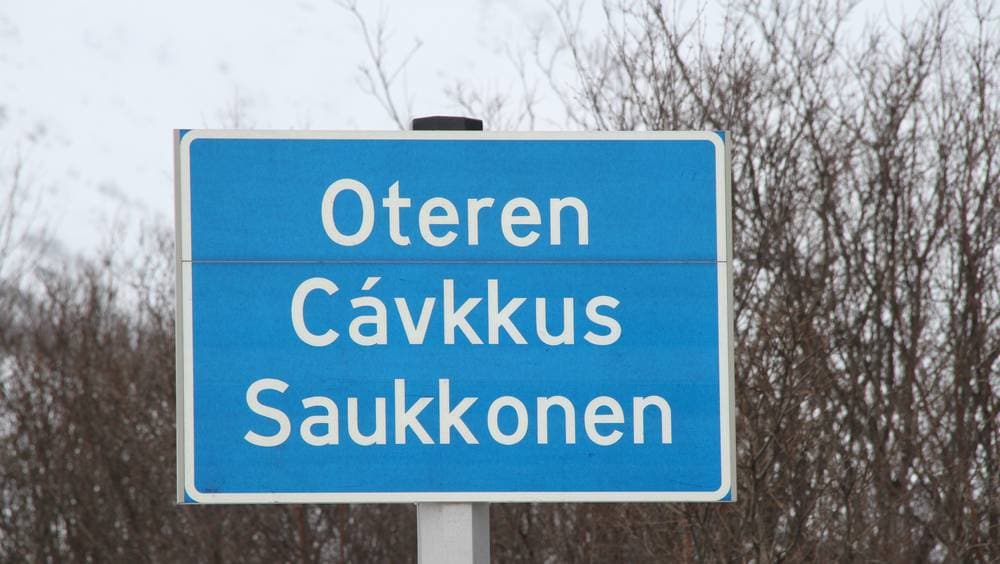
We also have two other languages used here - Sámi, which is the language of the Sámi people - the indigenous people in Norway, and Kven, which is used by Kven people. A Finnish dialect/language use by a small number of people in Northern Norway. That is why you can sometimes see three different signs when traveling up North (example: https://gfx.nrk.no/zDih8cbMibUfJJo4xiPqRQvkcy07eBhmSISFaS0Sc... )
EDIT: And if you travel far enough north-east, to Kirkenes, you will also find some Russian/Cyrillic signs
I think it's a bit of a double standard to praise the Sami language and lament the fact that most Sami stopped speaking it to their children a couple of generations ago, and yet cheer on the death of Nynorsk.
As for Nynorsk - it was more common in the past. My mother had Nynorsk as main writing language, and she's from Senja (in the north). That wasn't really a bad choice. It's not entirely similar to how she spoke (but parts of it was), but then again Bokmål is also vastly different from how she spoke. It's compromises and problems whatever you do. For myself, when I write (I write bokmål) it's just a different language. I write completely differently from how I speak, both for vocabulary and to a certain extent grammar.
Nynorsk is a perfectly fine written language. After I came over my hatred for it (which was 100% caused by my teacher in middle school) I've learned to appreciate it for what it is. Whatever you say about Bokmål it isn't exactly poetic.
What happened to you is probably that your friends, for your sake, tried to "speak" Bokmål to you (Bokmål is a written, not normally spoken language), as in practice that's how you have to teach Norwegian to foreigners. You have to come up with something where the writing and the speech actually matches. Where my wife was taught they did it that way - a teacher explained to me that it was their only choice, even if it's awkward. And (as told to me by foreign co-workers who did that program) followed by a shock when they've learned "Norwegian" and find out that the people around them speak totally differently, with different grammar even!
So yes, I also spoke a kind of "bokmål"-rinsed Norwegian to my wife when we were just switching to speaking Norwegian. But now I don't. It was a bit weird (had to remember to change the word order now and then, in addition to vocabulary), but I got used to it. It's also a trap though, if you keep up "sanitizing" the language for too long the other party (the one who's learning Norwegian) will not learn enough real vocabulary and may way too long be unable to understand random old people from the district visiting town. Which is something you need to do if you're working in a shop, say.
Not entirely sure why they switch. Was it to "be cool" with friends? Or to suck it a bit up to authority figures?
https://www.ntnu.edu/now/1/ken
I think it's a better way to pick up some Norwegian (compared with existed Apps) if you are interested.
It does to Dutch ears too. Just a few weeks ago, I passed through some tourist-infested area in Amsterdam. "Are these Swedish tourists drunk at this hour in morning already? Oh, wait, they are sober Danes."
Edit to add: see also the "postcode file" post about Windows 11 from a few months back.
"The King has been baptised so all the citizens are now Christian" happened many times. Along with Christianity came fancy verb forms and leather bound books. It is not a complete story the way it is told in this article, which implies that one Kingdom turned into another one.. not tribal raiding groups merging for military protection, and bringing Christianity in for international political purposes.
"even today the spoken language in Norway can vary quite a lot" - well, "duh".. it is local groups maintaining their local identity..
The article here restates history from the modern view - everyone is in a Country, and that Country has such a language and writing. I stopped reading and wrote this when the discussion of the "dominant Latins" said some clumsy and misrepresentative thing. Latin (and French)_knowledge was not widespread at all.. so how is it "dominant" ? It is because of the international military trade and treaties that came with it.. local people may or may not have a lot to do with that.
source: Conversion of Scandinavia to Christianity , Masters thesis by some lowly grad student; various Wikipedia.. never got further North than Copenhagen..
Thus, sloka (stanza) is from Sanskrit, vzduch (air) from Russian, okres (county/region) from Polish, zeměpis (geography) a calque from Ancient Greek, and duchapřítomný (quick-witted) a calque from German geistesgegenwärtig.
I am not sure if vorstellen / představit is his calque as well.
It's half of the fourth twenty — meaning all of the first, second and third twenties, but only half of the fourth one. 20 + 20 + 20 + ½×20 = 70.
And for the 75, it's just "five and" before all that.
Many native Danish speakers learn the abbreviated words as young children, and don't generally think about their numbers this way, if they're even aware of it. (Much as a native English speaker might not think of 'thirteen' as 'three-ten'.)
For 60 and 80, the normal, abbreviated form is very short: "tres" and "firs" (full form: "tresindstyve", "firsindstyve"). For foreigners, these sound rather like something to do with three and four — as they are! — which causes much more difficulty than expected when learning basic numbers.
("Much more difficulty than expected" is the general experience when learning Danish as a second language: https://www.youtube.com/watch?v=eI5DPt3Ge_s)
In many germanic languages we say half-four when the time is half past three, where brits these days sometimes say half-three, to make it maximally confusing. I.e. we have an implied "half [to]" and they "half [past]". This way of counting is what the Danes do. "Half-four times twenty" is "a half before four, times twenty" is "3.5 x 20" is 70 is "halvfjerdsindtyve" is "halvfjerds".
But it is only confusing to think of it that way, to speak Danish you have to just learn it as an opaque pointer to 70, or you'll get stuck doing mental arithmetic every time they say a number.
Ouch. Just absolutely horrible. Swedish is amazingly regular compared to that.
I think what goes for "German" has even more internal differences.
I recommend "Cantonese as Written Language: The Growth of a Written Chinese Vernacular" by Don Snow.
That aside, “cultural elite” or “status” are always relative, of course…
A crucial difference is that there is no standardized form of written Cantonese. There is a common set of characters used in advertising, sometimes newspapers, or in court transcripts, but that's it. For anything official, Modern Standard Written Chinese is used.
People write Cantonese in private of course, but that usage is not uniform at all since there is a lot of slang (especially swearing words) for which more than one popular way to write it down exists. Quite often the characters chosen for that purpose had different meanings originally. Some particularly novel or distinctive words and idioms are even partly written in Latin letters, like 快-D.
Depends on who you ask. What’s the region in question? What counts as a standard? Is Nynorsk codified by ISO? Et cetera.
> People write Cantonese in private of course
It‘s used plenty in public in Cantonese-native areas!
> that usage is not uniform
Yes, there is a disconnect and different ways of writing down a turn of spoken phrase. Sometimes people wouldn’t know offhand how they would even do it about a purely spoken turn of phrase.
Neither nynorsk or bokmål are spoken languages.
My impression, only based on this article, is that Nynorsk and Bokmål are both spoken as well as written, just more or less so depending on context and region. Just as English is both a written and a spoken language, and Cantonese is both a written and a spoken language.
These exact same words results in completely different search results. It so annoying when you trying to find something, you have to search multiple times. This is also relevant for many other languages. I absolutely belive you if spend some time implementing a smart synonyms-mapper, you could absolutely take web search 5 steps forward.
Also, Nynorsk really is a minority (spoken by only about half a million people), which makes it harder to create a corpus for automatic translation.
If I remember correctly from Norwegian classes growing up, Bokmål is heavily influenced by written Danish. Nynorsk was based on dialects people spoke outside of the bigger cities. Nynorsk however is more of an amalgamation of dialects, and can not be said to be spoken by anyone. Your estimation is in the neighborhood of native writers of Nynorsk I believe.
Probably they had that one Norwegian employee who struggled with it in school and came to hate it as a result (you'll find plenty of them in this thread).
But the difference in common use has steadily diminished. When I grew up in the 1970s and 1980s many of the most conservative forms of Bokmål were already falling out of favour, and my teachers were constantly pushing for us to use the forms matching our dialects, which for most people (I grew up near Oslo) meant a greater overlap with Nynorsk even then.
So while "Samnorsk" isn't being talked about much any more, in practice the gap is steadily diminishing.
What I think is quite remarkable is that this gradual merging has seen Bokmål, partially due to politics, change at least as much as Nynorsk. (For two languages so close together, language has been extremely political in Norway, though "peak language politics" was probably reached in the 1970s.)
Many "Danishisms" like "reverse numerals" ("fem og tredve" - "five and thirty" - instead of "trettifem" - "thirty five") that were widespread still in my childhood are now firmly old-fashioned, for example.
Of the very little Norwegian that I speak, I do so in the Vestlandet dialect, meaning I would pronounce "I am going to church" (Nynorsk: "Eg skal i kyrkja", bokmal: "Jeg skal i kirken") as "eg", "skaw" "e" "kerken", whereas in Oslo they would say "yai" "skaw" "e" "shirken". And this doesn't cover Bergensk, whatever is going on in Stavanger, Haugesund, et al!
FWIW, my mother is from Austevoll, my American sister married someone from Austevoll and moved to Bergen and technically Norwegian was my first language, at least before the age of three.
I can barely understand anyone from Eastern Norway! It sounds like sing-songy Swedish to me. I can follow most of a conversation in the Vestlandet dialect. A few ($15 at the grocers) beers in and I'll even try to speak it myself!
There's an entire coastal dialect that runs up and down parts of the country where those people's dialect is closer to each other's than it is to their neighbors just a few miles inland.
At school we had an exchange student from Germany one year who quickly learnt to speak the local dialect, not too far from your rendition of Oslo dialect, but more -a endings, e.g. "kirka" rather than "kirken", but she struggled to understand me, because of those differences.
Those dialects are a 15 minute train ride apart.
People who grow up in Norway will understand multiple of these variants without necessarily being entirely aware of how different they can seem to foreigners, exacerbated by the fact we tone down the differences a lot in writing - in particular spoken Norwegian merges a lot of words. E.g. you can find people saying "skarru bli med?" ("are you coming?") while writing "skal du bli med?". But even those speaking forms of Norwegian close to conservative Bokmål like me will have pauses that are surprisingly short between some words - e.g. I have a gap between "bli" and "med" in my example sentence, but it's short enough that it's not a given it's clear for non-native speakers that I'm saying two words.
And despite the destigmatisation of dialect use in recent decades, a lot of the spoken Norwegian dialects that today deviate from both Nynorsk and Bokmål are rarely written down except in dialogue in novels, and even then it's politics - it's more common for more radical Norwegian writers to write dialogue in dialects (ironically, several of the most radical older Norwegian writers promoted Riksmål / conservative Bokmål - e.g. Arnulf Øverland was both a member of the communist Mot Dag - "Towards Dawn - and a president of the Riksmåls-association), making it even harder for foreign learners to get exposure to them during study.
To your issue of understanding people from Eastern Norway, in a reversal I still recall an embarrassing moment on holiday in Denmark as a child. I mostly understood spoken Danish (the article is polite and say they sound "blurred", while the old common joke is that Danish sounds like Norwegian spoken with a potato in your mouth), but at one point some kid was trying to talk to me at the beach, and I apologised to him, telling him I didn't understand his Danish very well.
That afternoon I learned my mum had talked to his parents, and the family was Norwegian, from Bergen, and most certainly not speaking Danish. I wouldn't mistake those two today, but he spoke differently enough to me that as a child guessing he spoke Danish was not a big leap.
For the most part your comment is largely tangential to the article, where the rough sketch of older Norwegian history just sets the scene for why there was a growing conflict between spoken Norwegian and the imposed Danish written language, and the written language used by the church and the state were a large part of that - hence e.g the still extant but increasingly meaningless term "Riksmål" ("state/national language") used for conservative Bokmål.
I think you have that backwards. Old norse had more complex grammar. The grammar have simplified over time.
Icelandic still have more complex grammar than other Scandinavian languages because it have changed less.
For me, the reason I was never allowed to set foot in a university was German, PE, and Norwegian literature. I was suffering from severe health issues and I didn't have the energy to do all the subjects I had no interest in. So I poured my focus into the subjects I enjoyed and/or were relevant to my future plans(biology, calc, English, physics, history). I generally nailed those subjects. But because I failed German, and almost never showed up for PE, I was denied the opportunity to follow my dream and study biology.
Part of the problem is also the very inflexible admission requirements for Norwegian universities.
Hard sciences degrees were really hard to get into in Norway too. Some times the best way to win is by not playing their game.
I am however lucky in that I taught myself programming since I was 14, so by the time they kicked me out of HS, I was capable of doing it professionally. But it took me years of networking to get to the point of even getting interviews for such jobs without having a HS degree. I did eventually get to where I can find somewhat intellectually rewarding work for a few months a year, when I'm healthy enough to do so. Whenever I try to do more I always crash and burn, so now I just try to work little as possible to stay sane.
And about Japanese: you forgot about counters for men, animals, flat things and so on.
You have ichi-ippiku-ippon-hitory - issai And absolutely fascinating "system" for "years old" - everything starts with -sai but 20 years is "hatachi"!
As soon as you're starting to count it's different.
But.. it's not. Japanese is not. Just because it's not metric with grouping doesn't mean it's irregular.
But this is a welcome trade for the regularity and simplicity of the rest of the number system. Although the flexibility available in European languages as described elsewhere in this thread does allow for texturizing things in a poetic or evocative way. being able to get two or three jobs done with one set of words is sometimes nice even if it does make things complicated when all you want is the most common usage of those words.
A government regulating it by teaching it in school and actively using it in public would be a strong criteria. Alternatively, an established body of literature that serves as a model (that's how written Italian evolved).
> It‘s used plenty in public in Cantonese-native areas
Yes, that's also what I said. However, any official announcements or documents are quite unlikely to use it.
But conversely, you'll if anything be more likely to find people with negative attitudes to Nynorsk, with at least some proportion of people who resent having to deal with a language only used by 10%.
I know it's still seeing some use, but the steady reduction in use was very noticeable already during my school years in the 80's and 90's, and appears to have continued. Some use will still certainly persist for a long time.
The fun thing is we can easily quantify the relative rise and decline in written use at least by searching the national library (nb.no) for newspapers. I've only done the search for one set of numbers, so a major caveat that maybe there's large variance between different numbers, but a search for "fem og tredve" combined with "femogtredve"
* 2000-2024: 412 newspaper hits
* 1950-1999: 3112 (caution, different bucket sizes)
* 1900-1949: 4303 (before the reform)
(the "halfway point" og "fem og tretti" is also in use; 42 between 2000-2024, but never very widespread)
vs. "trettifem":
* 2000-2024: 2587
* 1950-1999: 5728
* 1900-1949: 69 (before the reform)
(You can break down the search results in finer chunks too, but I think this gives enough of an indication)
My grandfather, who lived at the coast, could meet people up and down the coastline as much as he wished. But there could be people living just a few kilometers away, as the crow flies, who he would never meet.. because there was a mountain in between.
Thus, dialects along the coast have much more in common with each other for much longer distances than inland dialects which can vary greatly even over relatively short distances.
Also, in television and radio, you may hear people trying to speak nynorsk pretty much as it is written, especially if their personal dialect is much closer to bokmål. (So-called “NRK-nynorsk” :-) )
Since the majority speak some dialect of bokmål, and most courses teach it, that's what you end up with.
I watch some series in Norwegian, e.g. Ragnarok. I understood most of it, though some of the dialects were kinda hard to understand.
But it seems a moot point, basically nobody in any language speaks the "high" language, but some kind of dialect version of it.
When teaching Norwegian to foreigners there's really only one practical way of doing that - use an artificial "spoken" bokmål so that the students can actually match speech to written words. That's just a crutch in order to learn the language (after you're done the real learning starts). That doesn't mean that "spoken" bokmål (or nynorsk for that matter) is real outside the learning institution.
English, say, also has many spoken forms but more or less one written form.
If you learn written English and then move to the Highlands or Australia you are also in for some heavy learning.
19th century scholars were happy to declare that the Sami were the original inhabitants of the north, but that had more with the fact that they preferred seeing themselves as the superior, colonizing culture, than with archeological and linguistic evidence. Being a native was not cool at all. It was awkward for these scholars to become gradually aware of Sami's relationship to Hungarian and languages from further east, and even more such things as the -anger names core Sami areas Porsanger, Varanger, Malangen etc.
Angr is a proto-Nordic word that means bay. -Angr names are common all over Norway. We know that the word went out of use before 800 though, because around that time Icleand got settled, and there are no -angr names in Iceland.
There are even proto-Norse words preserved in Sami place names such as Máhkarávju - Avju is a proto-Nordic/proto-Germanic word for island. Máhkarávju is quite clearly related to the modern Norwegian name for the island, Magerøya, but that means they must have borrowed the name more than thousand years ago.
It may seem that the many proto-Norse borrowings in Sami may come from that in at least some parts of the country some of the time, it wasn't Norse culture and language that supplanted the Sami, but vice versa! Very awkward for scholars who would rather stake their nationalistic claims on manifest destiny than being first.
Now, Sami activists say any of this doesn't matter, because the Sami were a minority people with their own established culture and languages who were around when the formal borders of Norway were drawn up (as late as 1750 in Finnmark). And that's the ILO 169 definition.
This is completely true. It's also true that Sami activists were actively involved in writing that definition so that it would include them. I totally respect why they did that piece of lobbying work - the Sami certainly have legitimate interest to defend, and for that purpose being classed with native Americans is much more useful than to be seen as just another quarrelsome European linguistic minority like Welsh, Basque or Catalan people - or, say, people who use Nynorsk! (just see the hate they get in this very thread).
This prompts questions on the linguistic fallout of infrastructural development.
Presumably the train line is more direct and faster than any previous land (or sea) connection. In what year was the train line built ? And, how far apart in travel time were the dialects before then ? And, has there perhaps been an academic study of the effect over time of the train line on the relationship between the dialects ?
It'd certainly have been a long trek before then (a day maybe?), but I think a lot of the distinction there is also socioeconomic - the West Oslo dialect is very much associated with the wealthiest part of town and the wealthy suburbs, and where there certainly were expectations around what was long seen as more cultured and educated language.
The line is actually very sharp in Oslo between the Eastern and Western parts of the city, and that initial gap is at least usually seen as socioeconomic , but the gap then gets even larger once you get further East and North.
What you will find though is that there are a couple of scenarios where people will kind of speak the written form. One is, or at least used to be, newscasters on TV. They used to have rules which limited the kind of speech used, for reasons. And, as the news were essentially read from a script.. you speak it like it's written. Be that Bokmål or Nynorsk. And that's where you will find spoken Bokmål (or Nynorsk).. when reading aloud. And, as I mentioned in another comment.. when teaching people Norwegian. In the beginning you kind of speak the written form, otherwise the student would be totally confused.
I don’t have any first-hand knowledge, but according to Wikipedia on Bokmål it looks like it can be spoken as well (Wikipedia uses a phrase “spoken Bokmål”), but without a universally agreed-upon and regulated pronunciation. Isn’t it similar to English in this sense?
I believe /u/Tor3's point is that Norwegians would read and pronounce nynorsk and bokmål the same regardless of the differences in the writing.
> Isn’t it similar to English in this sense?
It is. I don't pronounce English words differently when they're written with e.g. British or American spellings.
Nynorsk is a mix of lots of various spoken dialects. No one really "speaks" nynorsk, but for many it's closer to how they speak than bokmål would be, but it's still not 1:1 for them. The only way you really would "speak" nynorsk if you're reading a play or something written in it.
That almost certainly means "a moderate Oslo dialect, neither Stovner or Frogner", and it's probably not nearly as close to written Bokmål as you think (unless you learned Norwegian as a second language).
That's why I hate reading it so much. I swear every time i read an article or something in Nynorsk, there's at least one word in there I've never seen in my life, that sounds like something a Sunnmøring spat out during a stroke.
The numbers (as in one, two, three..) are actually generally from Chinese, with exceptions (particularly where there are two options, as for four and seven), but counters (for smaller values) are generally from native Japanese and therefore sound different from numbers, and also changes somewhat with whatever it is you're counting. Japanese is so logical and well-structured that it appears that to compensate for that ease, you have counters.. (though we could blame Chinese for that as well, pre-contact there were only a very limited number of counter types (counter types are flat items, round items, long thin items, people, years..), post-contact there are hundreds (but fortunately it's possible to ignore a lot of them).