If you suddenly drop the licensing requirements for teaching, you'd now have a new job available to anyone in the job market that would start attracting different profiles of people than you will get when emergency hiring teachers. Also emergency hired teachers probably come in via social networks of existing teachers, parents, etc.
We were a pretty laid-back home schooling family. My kids didn't spend all day nose-in-books, watching documentaries in the afternoon between violin, piano and Spanish lessons. Up until this year it was a closely guarded secret how much time my kids spent "in home school." Had I let my family or non-homeschooling friends know how much actual formal class time there was, I would have probably been derided as a terrible parent. Now that they're sailing through school -- not just doing well, but generally underwhelmed by the difficulty of the material -- I'm not so shy.
They had, on a really good day about 2 hours of actual, formal, class-time with homework. The vast majority of the time, it was under an hour of mom-led learning followed by under an hour of homework, done in one room, alternating kids between homework/study but often times with both kids participating in each other's lessons (why not?). Aside from having to be single-income, and except for the "they're your kids so they aren't as easy to teach" problems[0], it wasn't difficult at all. Hell, the vast majority of the time -- especially since I work remotely -- it was downright awesome.
The above paragraphs might make it sound like I'm saying "Screw Teachers, their job is easy, any idiot could do it!" Obviously, it's much easier to teach two children than it is twenty-ish. Obviously, being that they're your own children, you have lack the complexity of dealing with parents, administration and politics. The reason "it worked for us so easily" is almost entirely due to these factors. I think about how, one year, we decided to ditch the math curriculum we were using for my son -- he was struggling, we found something better for him and within a week he was enjoying learning it. Having just the two kids meant we could make sure they were enjoying learning. When kids want to learn something, all you really have to do is point them toward "how." You're not going to get 25 kids -- some who come from tough home situations -- to all enjoy learning.
That said, I've never understood why (at least in the past) substitute teachers[1] never required degrees and were plenty effective, homeschooling is allowed without restriction, registration, or any requirement to prove you are actually home schooling to teach from a book basic things that every adult -- at one point -- learned. That sounds dismissive -- I'd imagine the vast majority of the job isn't that, and I have no interest in becoming a teacher because of those factors (difficult children, parents, administration, government) but I'd be willing to bet there are a lot of very qualified adults who would, but can't, because of degree requirements.
[0] My daughter was famous for breakdowns during math lessons. She can be emotional, but trust me, she's not breaking down in front of her Math teacher at school, today. Incidentally, despite her claiming to hate math all throughout home-schooling days, now that she's past Arithmetic, it's her favorite subject.
[1] Yes, most of the time, that's a single-day activity. We had one for three months, once.
I did not even spend two hours a day teaching. They mostly taught themselves. It was fun for them, and rewarding for me. I also work remotely (self-employed) at that was vital.
So far both have done well academically.The older had offers of places at multiple good universities (Durham, York...) but decided to do a degree apprenticeship (govt funded, employer funded, degree + work) with Jaguar LandRover (and uni of Warwick, which is good for engineering) instead so dad's wallet is off the hook!
I am really glad we did it, and my kids are too.
I had two families who led me to the decision, myself. If people really knew what a typical "I don't have an axe to grind, I just want to direct my child's education" home-schooled parenting life was like, everyone would choose it if their life situation allowed. I understand that I was blessed to have circumstances that allowed us to do this for our children[1].
[0] Many in the homeschooling community find themselves having to explain their choices, often, to outsiders so they tend to over-compensate with their kids out of a desire to not have others' think of their children as "weird". I tell my kids to be as weird as they want.
[1] Well ... my circumstances were anything but ideal despite how it sounds. We just made it work.
The summers off are basically the only notable perk, too. At least in my state. Healthcare’s expensive and bad and gets worse every year. Pay’s bad. Work environment is usually bad. Retirement’s ok-ish but doesn’t close the gap on the poor pay.
Instead of one teacher teaching a class/subject (like math) 5 days a week, two teachers will rotate, one teaching math 3 days per week, and the other teaching 2 days per week.
But then, that would require them to double their supply of teachers, which seems unlikely to happen.
I don't think teachers pay is all that low (at least in my state), when you factor in they only work 50% as many hours - on an hourly basis, teachers (except perhaps the brand new ones) make pretty good hourly rate, full benefits, and are usually able to retire a lot earlier than regular folks, and with a defined-benefit pension and full healthcare.
Make them work even less? No thanks.
https://truthout.org/articles/campbell-brown-the-new-leader-...
FTA: “New Jersey’s waiver policy was similar. Candidates could earn a temporary credential before passing the normal licensure exams or completing a teacher preparation program. The licenses were good for one year, at which point candidates would need to go back, pass the tests and complete their training”
So, those people would have a job for a year, but in that time also would study to pass “the normal licensure exams”?
I would think that strongly selects for people motivated to teach.
Also, did they really have to _earn_ a temporary credential? The answer to that question seems to be “yes”. Google gives me https://www.nj.gov/education/covid19/teacherresources/instru..., which says:
“Candidates who have met all requirements for a CE or Certificate of Eligibility with Advanced Standing (CEAS) but have not yet passed the basic skills test and/or test of subject matter knowledge are eligible for the Temporary CE”
Doesn’t that mean people who got that waiver are educated as teachers, but haven’t managed to pass all exams (most of them likely not because they can’t pass them but because there wasn’t any opportunity to do them)?
I couldn’t find the regulation for Massachusetts, so I couldn’t check whether it had similar provisions (https://www.doe.mass.edu/licensure/emergency/ Probably comes close, but it mentions a program extension, and becomes confusing to me because of that)
Also FTA: “Starting June 2020, Massachusetts began temporarily letting anyone with a bachelor’s degree teach”
So, it’s not “without degrees”, but “without teaching degrees”, at least in Massachusetts (the article isn’t clear as to whether New Jersey had a similar restriction, but it had. See the link above)
> Because most did not teach tested grades and subjects, the researchers also looked at evaluation ratings. Both groups of teachers received similar marks from their supervisors.
(Borrowing reasthenotes1’s quote elsewhere in the thread)
What you wrote may or may not be true, but this study doesn’t do much to support it.
The story supports the idea that many people could be childhood educators based on the fact that the program was not scrapped, the degreeless teachers weren’t sacked, and the customers were apparently satisfied.
Again, you may be right, but this study doesn’t really support what you’re claiming.
Are you making a mistake to confuse hours spent teaching in class with working hours? Teachers have a lot of other duties outside the classroom, preparing the lesson plans and grading papers being the most obvious examples.
Unfortunately, I don't have many good things to say about my masters program. The majority of my classes have been interesting but useless in a real classroom. Teaching is just one of those things that you largely learn by doing.
Teaching does take a lot of skill and practice—I am surrounded at work by more experienced colleagues, and watching them always leaves me impressed—but I don't think it's something you can learn from a textbook.
Similarly, the licensure exams are just awful, at least in New York. I will leave you with a real practice test question from the official preparation materials. This is for the content knowledge test on "Science and Technology".
----------
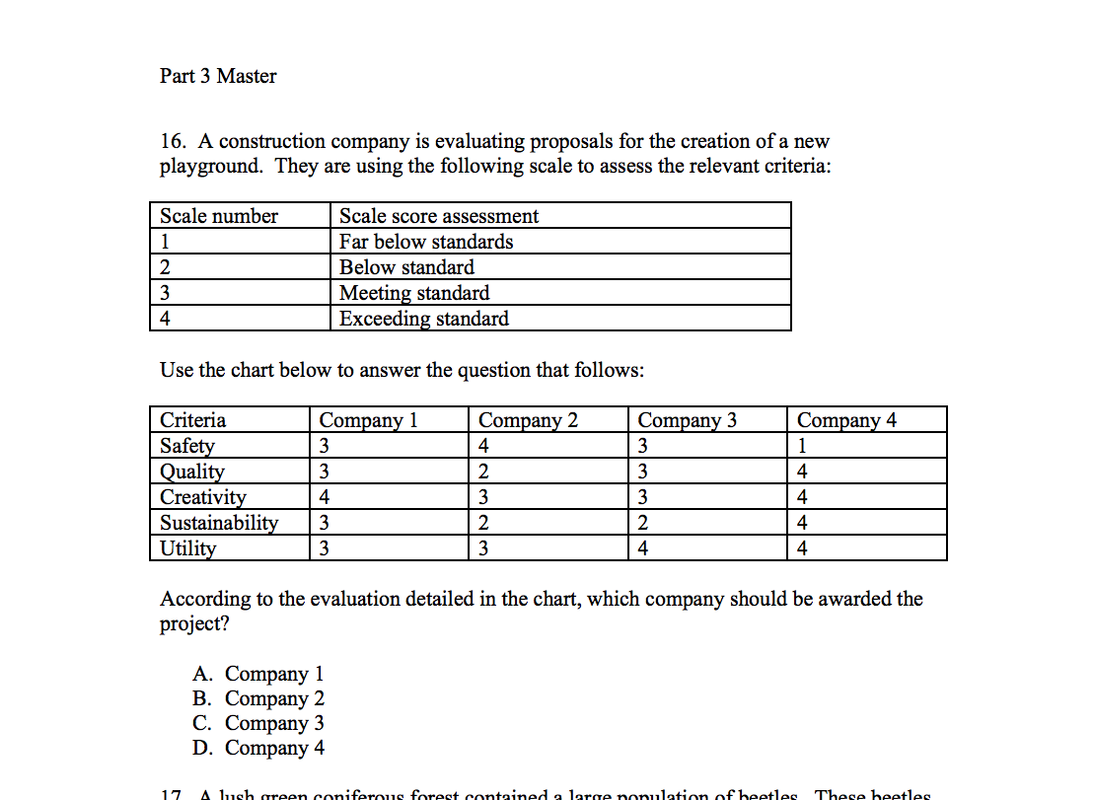
A construction company is evaluating proposals for the creation of a new playground. They are using the following scale to assess the relevant criteria:
    +--------------+------------------------+
    | Scale number | Scale score assessment |
    +--------------+------------------------+
    | 1            | Far below standards    |
    | 2            | Below Standard         |
    | 3            | Meeting standard       |
    | 4            | Exceeding standard     |
    +--------------+------------------------+
    +----------------+-----------+-----------+-----------+-----------+
    | Criteria       | Company 1 | Company 2 | Company 3 | Company 4 |
    +----------------+-----------+-----------+-----------+-----------+
    | Safety         | 3         | 4         | 3         | 1         |
    | Quality        | 3         | 2         | 3         | 4         |
    | Creativity     | 4         | 3         | 3         | 4         |
    | Sustainability | 3         | 2         | 2         | 4         |
    | Utility        | 3         | 3         | 4         | 4         |
    +----------------+-----------+-----------+-----------+-----------+
----------
Ready for the answer? Take a moment to think about it before looking...
The answer key says it's company four, because they have "the highest overall score. We are not told any information about categories being weighted and therefore we cannot pay special attention to the low safety score."
I agree with another commenter, you should name and shame, this is beyond stupid and deserves to be called out as the idiocy it is.
You do you want me to name, exactly?
The tests are made by Pearson Education. The website for the certification tests is https://www.nystce.nesinc.com/.
In the above example the last company is clearly sacrificing lives to get work done.
The company even optimised the number of children who can experience it! A child in the hospital is one who got to use the playground, _and_ one who isn't hogging it, stopping others from experiencing it.
I absolutely love this! xD
"standard" usually implies that it's an outside rule from a regulatory body/certification agency that you need to conform to.
It's such a weird question to ask in the first place.
It this example, outside law or regulation on standard creativity and utility seem pretty unlikely.
There is also a pretty big difference between standard (singular) and standards (plural), where the latter is more likely to imply a set of minimum requirements.
Maybe company 4 is the best, but I don't see why no information on weights implies equal weights.
Edit:
After thinking about this phenomenon for a while, I think there is an argument for testing implied or unstated prompts. It is frustrating to have to read minds, and quess what expectations are in different contexts. However, building a mental models of other people is an important skill.
I dont know that I would want to hire someone entirely incapable of it, who routinely required complete and explicit instruction.
That said, I dont think this kind of cognitive test is what they were going for
This is extra hilarious because, if you don’t know the weighting (or even that each score is linear), then adding the scores in the first place is an invalid operation.
“Company 4 might be the best in terms of naive computer-calculated average, but anything that doesn't meet a particular standard generally should not be allowed by law to be used/built. So Company 1 is the only choice, and perhaps the best, subjectively.”
I think this is a good question for discussion, because a child might answer “Company 4” at first just by looking at it and averaging it as anyone without any context would, but then you could say something more about it. But, I don't think it was intended to be analysed or answered this way. Either way, dumb question to ask for a qualification exam IMO.
And this is why we have debacles like the 737max.
Practice tests can be purchased from this site https://www.nystce.nesinc.com but I can't find the page for this specific test (and don't really want to spend time looking). You're looking for the practice test for CST 245. This is the Arts & Sciences section of the Multi-Subject test for Teachers of Childhood, Grade 1 - Grade 6.
Although you do sometimes get weights… the important part is explaining that you evaluate some weighted sum and take the best result.
How much impact would this question have on the final result for the licensure exam?
IIRC during my own IHK examination this was worth around 5pp, which is almost enough to drop you an entire grade.
Fun fact: I have no idea!
Basically all I know is that (1) tests are scored on a scale from 400 – 600, (2) the minimum passing score is 520, and (3) the test is not graded on a curve. But I don't know why they even bother sharing these numbers, because they don't divulge any information on how they're calculated.
https://www.nystce.nesinc.com/content/docs/NYSTCE_ISR_Back_M...
> Although you do sometimes get weights… the important part is explaining that you evaluate some weighted sum and take the best result.
To be clear, this is a multiple choice question. You need to select (A) Company 1, (B) Company 2, (C) Company 3, or (D) Company 4.
To filter out people with the capacity and inclination to engage in critical thinking, because those people will not last as teachers.
https://www.lesswrong.com/posts/NMoLJuDJEms7Ku9XS/guessing-t...
That’s not the question the article is asking, but I’m skeptical that making it easier for professionals to career switch into teaching is going to cause any meaningful number of them to do so.
Way back in the olden times, 5 to 10% of people went to school, and it worked really well for them. Now everyone goes to school, and it works really well for about 5% of us.
The majority of people here are incredibly average (like me!), just fortunate to be born at the right time, be exposed to technology at the right time, get a few other lucky breaks, and of course put some work in.
It’s super easy to convince yourself that because you’re successful you must be special. Remember that people tend to ascribe their successes to themselves and their failures to someone else.
There's only so much you can do to make a subject interesting when the students care so little about their education. It starts at a young age and just compounds. By the time you see them as students in high school, they're already years behind in motivation and education.
In college I interacted with a strange life form called a "homeschooler". Almost without exception they were smarter, better read, and had a desire to learn. Educating children seems to be far more than degrees, licenses, and CE credits.
I paid particular attention in school when a teacher would explain why they were trying to teach us something. I noticed the same patterns of teaching among different teachers in the same school system, and how it all worked together to reinforce the skills we needed. (Note: many of my peers experienced the "extra" work as pointless, because they didn't understand the long-term implications).
Teachers who don't understand educational theory can't work as part of an educational system without additional training. In the meantime, their students miss out on long-term skill building.
This situation makes me think of technical debt. A short-term fix with long-term, ambiguous problems that are difficult to unravel.
There 2 other plausible hypothesis that the article ignores:
1. What if untrained teachers are effective because they learn on the job from trained teachers? Which means that you have to have certain % of trained teachers to keep the system alive.
2. What if trained teachers become less effective because they drop their standards looking at how untrained ones work? This is a common phenomenon at workplaces, and I've seen it happen in software development many times.
There is a keyword I am forgetting which would make this comment easier to answer in detail. If I remember it I will post again.
> One preliminary explanation from the New Jersey study was that the emergency licensed teachers were working in schools that had a record of helping students make strong academic gains. It’s possible that the schools had supports in place, such as teacher coaching, a strong curriculum or something else that compensated for less training... Another recent study, out of Oakland, California, backs up this theory.
> There’s some evidence that teacher licensure tests are mildly accurate predictors of who will be a good educator. All else equal, a school would be better off selecting candidates with a higher test score, especially if they’re going to be teaching math or science. But that general rule would mischaracterize a lot of teachers — some test well but don’t have great classroom management or interpersonal skills, while others may not test well but are effective at working with children.
I'm not an expert, but my impression of modern classrooms is that teachers don't have as much leeway to choose what or how they teach, compared to, say 50 years ago. They have a strictly defined curriculum to get through, and they're generally spending a lot of their classroom hours teaching to standardized tests. Might the difference in "classroom management" skill, which is evidently untested in teacher licensing, be the most significant thing left that can make one teacher better than another? That is, if we make teachers (essentially) read from the same script, maybe it's all in the delivery?
And if this is untested in teacher licensing, maybe it's somewhat evenly distributed between licensed and unlicensed teachers?
Speaking with them, their experience has been the core driver of a successful teacher is primarily whether they want to be there and care about the students success.
Of course, when they were first hired they spent all of their free time crafting lessons plans for a subject they basically failed in high school. Studying the textbook and relevant material so they could teach it.
Let's face it, those who are willing to teach, and are probably leaving decent careers to do so, have a decent chance of being an okay teacher, because they probably have an idea of what they're getting into, and are willing to work hard. ie they WANT to be teachers.
Of course, if we just paid teachers more, you'd probably have a higher number of qualified candidates, but that seems like that's too hard of a thing to do?
Connecting schools with a university system could be a more viable option. Make it easy to teach in a nearby school, pay reasonably for tuition and a university can be a source of PhD students and postdocs that could get some easy pocket money as guest lecturers. I think, it's also refreshing for PhD students and postdocs to give classes to younger kids.
I don't think my state required the masters degree, but pay scales definitely were weighed in favor of it. It certainly didn't make for better teachers.
https://wheelockpolicycenter.org/wp-content/uploads/2023/11/...
In every category, emergency/provisional licensed median values were lower than licensed teachers, including performance evaluations, although these results didn't reach 95% statistical significance of rejecting the null hypothesis. Even if they didn't reach P < 0.05, when all of the results point in one direction, I am not so sure I would completely agree with the top-level headline as it is stated.
I'm mostly going on the stories from a teacher relative; I'm 99% speculating.
Today, parents routinely teach their kids things like reading and arithmetic.
The best teachers I had were professors at university, and they never had a day of teacher training. They simply knew the subject material.
What skills a masters degree in education confers is a mystery to me.
That is, they cannot speak to how effective the teachers were as educators, only how disruptive they were as employees.
But requirements are set individually by the states and vary widely.
This shifts the burden on to the employer to make a reliable assessment of the applicant. This would have two, imv, favourable effects: 1) a university education would compete on its merits as education with all alternatives; 2) breaking the rent-seeking monopolies universities have on entrance to the jobs market.
The law would have to be carefully crafted -- but we're long past the era when a degree was predictive of anything. It was always a positional good, and if 50% of the next generation have one there's no signal within the noise anymore.
And of course, it was always as much about 'keeping the rifraff out' as it was in selecting good candidates.
For certain professions, eg., teaching/drs/etc., i think it makes more sense for the state to have 'licence to practice' certifications/exams -- rather than assume that a degree is such a licence.
This misses the point. To go along with your terminology, the problem is that the norm of the vector isn't large enough.
But calling it a vector in the first place is pretentious and unnecessary.
But I think the article is suggesting something different: that teachers could and should be hired fresh out of high school, when they don’t yet have any of those other professional skills — or the debt involved in acquiring them — and then simply given on-the-job training. Quote:
> Another recent study, out of Oakland, California, backs up this theory. Parents with high school diplomas who were given 10 weeks of training on a structured literacy program helped students produce strong early literacy gains, roughly on par with those made under fully credentialed teachers.
I have some guesses in my head for something like ‘high school teacher in moderately wealthy Chicago suburb’ (I haven’t written the number here because I don’t want to anchor you) though I don’t have a great sense for how many jobs like that there are in the US. Above base pay there can also be more for helping with extracurriculars, potentially a defined benefit pension, and after settling in teachers will have a lot of free time/vacation not spent planning lessons. The amount of pay may not excite you if you’re a professional software developer at a well-paying company in the US, but I’m not sure that a more typical professional job would be “much better-paid”.
I volunteered to step in until they could find a qualified replacement. It ended up working out, but it was a pretty big problem to have an unlicensed teacher in the school. They ultimately had me enroll as a substitute who just happened to get assigned to the same classes every day, but they said if I wanted to come back the following year I'd need to become officially licensed.
I could see myself teaching high school in retirement. Helps the community, keeps you busy, and your summers are open. But not if I have to jump through a bunch of make-work hoops for the privilege of helping out.
My calc & discrete math teacher in HS was a retired guy from bell labs, apparently knew claude shannon. He had made a bunch of money doing that and was just teaching at the HS as a philanthropic service in old age. He wrote & printed the textbooks we used. Practically every other teacher seemed inadequate afterwards. Oddly enough I had a professor in college who was from bell labs too, absolutely brilliant too and taught in the same, in some way brutal, style too.
What I really want is to be able to teach the kind of CS courses that I took in high school—they were optional classes that kids chose to be in because they were interested, and the teacher had full discretion on what to teach.
Unfortunately, that's not the typical high school class, and most teachers have to teach at least a few mandatory classes with curricula dictated at the state level. Props to the teachers who are willing to deal with reluctant students and enabling parents, but I would go crazy in that environment, and I've had bad experiences trying to teach curricula handed down from on high.
I have a BA in economics and a 20+ year career in software. As best we can tell, in order to teach middle or high school in VA (I’d want to teach CS/IT) I need to obtain a Masters in Education to do so. Spending $30k+ on a post-graduate degree for a career with starting pay 1/4 of my current income doesn’t make any sense.
If there was an on-job path to certification it would be viable. But the expense of taking a year off work to get a Masters pretty well kills it.
I also did not spend much time teaching as such: when they were young, lots of learning through play (even things like learning to read can be turned into games) and as they got older they taught them selves more. We have used tutors a bit for exams (GCSEs - British exams taken at 16 in schools though my kids sat most younger) but even then very little (two to three hours a week at most, and even that for just one year).
Home educating is a lot more flexible so kids can follow their interests. You can do a vast range of subjects (my younger daughter did Astronomy GCSE and is doing Latin, did Physics but not Biology). That combined with the study skills and self-discipline from teaching themselves more leaves them more motivated and better prepared for further study (and work too).
another issue is that teachers get promoted based on years in the system or by getting more useless degrees, rather than on how well they actually teach their students
Though the entire set is probably more useful and practical.
>Like other first-year teachers, those granted emergency credentials were disproportionately assigned to work with children with disabilities, English learners and low-income students.
AKA: the jobs with the highest turnover rate of qualified professional teachers.
>The law would have to be carefully crafted -- but we're long past the era when a degree was predictive of anything. It was always a positional good, and if 50% of the next generation have one there's no signal within the noise anymore.
The point of a degree was to get you to think critically as much as it is about teaching you how to do the job the degree will lead to. Teachers need that skill as much as anyone when they're working with impressionable youth.
You have to pass the same rigorous tests. Degree can be substituted for relevant work experience.
The biomedical engineers designing your artificial heart and gene therapy have no professional licensing requirements whatsoever. A professional license to do medical engineering doesn't even exist.
A person who had studied mathematics and physics until 18 could then over two or three years easily, consume the relevant engineering curriculum from MIT/stanford/etc. if they wanted to avoid the fee's of a university education.
A business will never let some jnr hire actually design a bridge to be actually built. Most of the relevant education comes from years on the job, in almost all jobs.
All that applicants need have is enough prior conceptual foundations to cope during that on-the-job training.
You do need that validation step somewhere, though, and it feels quite reasonable to have stringent standards for that.
One way to work around not knowing if something is structurally sound subject to the pressures it will be under is to over build (this is what we did before we had super accurate computer simulations)
Anyway, I found this episode of 99 percent invisible to be great, especially "Escarping Imprisonment by Kurt Kohlstedt"
https://99percentinvisible.org/episode/mini-stories-volume-1...
Eg., if you want to be a graphic designer, apply, perform the "graphic designer assessment by AssessCorpX" as required by IndustryX and so on.
Basically just taking the examiniation function away from universities into the market, and making it industry specific. I think these are the 'natural incentives' businesses have, and these are distorted by the gov monopoly granted to universtiites (ie., their degree awarding powers).
Prior to the era of mass university education people were hired based on a judgement of their suitability for the role, and then trained to do it over a period of years. That's still how things work.
It shifts the burden on the employer to make an alternative assessment of the applicant. If what they're using now isn't reliable, but convenient, why would any alternative be?
In a hypothetical future where there is no degree requirement, whatever they’re doing now to assess applicants is not relevant. In that scenario, the system has fundamentally changed, and I think this strongly implies that employers will now need to look for ways to screen candidates other than “has degree”.
As things stand now, there is an expectation that holding a degree is in itself valuable and that the holder has already been assessed by the educational institution that granted the degree.
Put another way, the lack of a reliable process now is the point. If I’m an employer, the reliability of the signal that is the degree the applicant holds is as variable as the standards of the various institutions granting those degrees. In a world where the degree is no longer a primary signal, employers must by necessity establish some other assessment criteria, and since that criteria is set by the employer, it’s at least more reliable than making decisions based on various other organization’s assessment criteria.
Take something fairly complex like game development, say. Now: do some linear algebra, geometry, programming, etc. assessment in a wholistic way. Maybe a quick quiz for initial filter, then a hackathon with applicants (or w/e).
People filtered by the quiz can be directed to the now many resources for self-study (you can easily do an entire degree via MIT lectures, etc. -- i know i did, i barely attended lectures and just watched stanford/MIT classes; gilbert strang's LA course several times).
If you really want to be a game dev, and can't self-study after a failed attempt and a year or so of reflection then go to university. Now you know it's for you, that it really will help, etc. They're providing a service you actually need.
I don’t want ANOTHER elementary school in my district known as the “Google” school. Let’s just have Google in our lives from 1st grade onward!
The proposal moves this phase to the university system, like it used to be.
Question: https://i.postimg.cc/wvn7tRf8/Screen-Shot-2024-01-20-at-7-00...
Answer Key: https://i.postimg.cc/90TzyXK4/Screen-Shot-2024-01-20-at-7-02...
She left teaching for WFH, a ~40% total-comp increase, and a far better work environment. Turns out the skills and experiences a good teacher tends to accumulate are really valuable to companies.
One of my mentors told me about his first year of teaching in a rough area where, as he put it, "I knew what I was in for when the principal was more interested by my law-enforcement background than anything I might know about math". He spent the first two months gaining compliance with one rule: come to class with two pencils and your notebook, and nothing else. Literally nothing else was accomplished. Once he got them there, however, he had a chance to teach, and his classes ended with some of the best scores in the district (admittedly not a high bar).
When I worked as a supply / substitute teacher in primary and secondary schools my theatre training was infinitely more valuable than any education class I ever took.
The number of applicants who succeed in such cases, at getting through without formal education, will be very small. And i'd be 90% of those cases, that applicant is way above their peers in performance -- ie., worth having let it
It did not do badly in past. But less resources and more non-natives have taken a toll on results.
The problem with the system is that the political leaders are spending other peoples money and they'll make decisions that don't always line up with the bridges staying up.
The advantage of degree programs is that they add another layer of bureaucracy to mix. Yeah, that's a pain but it might be necessary with the political system.
Second part, there can forsure be many “losers” here but it’s quite ignorant to think there’s the same percentage struggling in math classes as the general population. Think about it. If you took 100 HN’ers where do you think they skew on succeeding on math tests or even taking classes like Calculus compared to gen pop? The average person even in the US doesn’t have a Bachelors degree. Do you think that applies to HN? Or that it’s not correlative with educational success?
I said that HN is mostly average students and I haven’t heard anything that changes my mind, regardless of whether you think a lot of people here are good at calculus. How do you think HN readers fared in art/literature/English classes?
I'm more concerned about how universities have positioned themselves gatekeepers to the employment market backed by state-granted degree awarding powers.
I think this is an extremely artifical situation with extremely negative social concequences. Vast amounts of money are being funnelled into universities for little gain.
They are, if you like, the App Store of the jobs market. Taking a 30% cut on just getting hired. It's insane, unsustainable, economic madness, and social madness.
I think the answer is in the question, and boils down to: the proposal is to change the status quo. Changing the status quo here means that organizations not doing these assessments are responsible for doing so going forward.
It’s reasonable to think that an organization in the current environment is not focused on such assessments because the system is supposed to be handling this (I’m not saying this should be considered sufficient). A change that involves shifting the burden necessarily means a change in the status quo of hiring organizations regardless of their past practices around assessing candidates.
To your point, setting the expectation that the hiring organization is responsible for assessing incoming candidates is part and parcel to the broader idea. The operating environment would no longer look like the current one, and would necessitate additional steps by hiring organizations. Not taking those steps would result in poorer and poorer quality hires.
Bringing this full circle, I think it’s worth pointing out that the place this started from is: teachers who did not complete a specific training requirement are as effective as those who did. At the very least, this seems to indicate that completing the specific training requirement is not a sufficient assessment criteria, and is presumably not helping organizations bring in better people. At the same time, the requirement does reduce the pool of available candidates, with seemingly no positive effect.
At least for this particular school example, in a worst case scenario, organizations that change nothing are no worse off than they already are. The training requirement isn’t acting as a differentiating criteria, which means that the organization is already the most impactful decision maker. The proposed change just formalizes the idea that completing a specific curriculum is not by itself a good indicator of future success. Organizations relying on this signal are not worse off if it’s taken away because it never indicated much to begin with, if the data are to be believed.
What’s weird about the market for teaching master’s degrees, at least (idk about PhDs) is that this generates a ton of demand for them, but it makes no difference how good the program is. Teachers don’t care because they don’t really matter that much for improving teaching skill. Schools don’t care—pay bump is the same no matter what.
This has all the effects one might guess on the quality of these programs—almost all are very easy, because nobody involved cares how rigorous they are, and one party would generally prefer they not be very difficult. Whole thing’s a joke, total waste of money and teachers’ time.
I'm glad you had a good experience, and I am sure there are a lot of people who do when their relatively well adjusted parents commit to homeschooling their children. I just suspect most homeschooling experiences aren't like yours. I've met several families from very different backgrounds with a similar outcome to mine.
I might be a college-educated autodidact who made an entire career out of self-taught tech skills but that was despite a parent trying to raise me as a young earth creationist and despite all kinds of still un- and underdiagnosed trauma and disorders. Didn't get my ADHD diagnosis until my late thirties and still haven't been diagnosed as autistic, among other things, all of which likely would have been glaringly obvious to public school staff.
Parents are increasingly opting for home schooling to get away from bad or ineffective schools, rather than for purely religious or psychological syndromes.
The trick is that it will take me 16 years to get to the top of the pay scale and make what I made as a software developer last year ($115K). When the union asks what I want, that is what I tell them. Top pay is fine, but it takes too long to get there.
I like the job a lot more and its only about three times as much work.
Lane III (bachelor's degree) CPS teacher entry comp --- year 1 --- is over $80k/yr, including benefits (a defined-benefit pension) and 10 weeks vacation.
Interestingly, during the height of the pandemic everyone seemed to come around to the fact that teachers didn't get paid enough for the amount of work that they do. This was because parents and caregivers got first hand experience in what teachers go through on a day-to-day basis. However, that sentiment has faded with time and with it the value of a good teacher.
A lot of teachers (my wife being one as well) truly thought that people had been woken up to the incredible crisis in our education system, but 2-3 years later, we know better; they just wanted teachers to stay on long enough for their life situations to stabilize, so they could go back to ignoring them.
I’d give you a B- or so if you turned in your comment as an essay, given the easy-to-spot sloppy error and other issues.
• Bachelor shouldn’t be capitalized unless it’s the full degree title like Bachelor of Arts
• Copius writing doesn’t mean good writing
• ACX should be explained the first time you use it
Back when this started, much of the alure of teachers with master's degrees was that they were highly educated in the subject matter they were teaching. It was implied that the chemistry teacher would have an MS in Chemistry. But now all the teachers I know have their MA in either Elementary Education or Secondary Education but none of them are teaching how to be teachers. It's a strange situation and recently one of them was ranting about the pay difference between having a master's degree and just a bachelor's degree had shrunk to nearly nothing. This is probably because the MA in Education has become so ubiquitous that it has little value. What school brags about the percentage of teachers with a master's degree anymore now that almost every school is over 80%-90%?
And I did typo copius on purpose to get you to reply. Just a fun thing for me too do.
Homeschool outcomes are as diverse as parents are—in public schools we at least try to standardize, but not so for homeschool. And since emotions surrounding our parents are some of the strongest that we have, everyone who's been homeschooled has strong opinions of some sort about how it turned out.
I'd be happy for the conversation to happen if there were data, but the big problem is that for every study that leans one way there's another that goes the opposite, because the outcomes are so incredibly diverse and the numbers involved are so small.
A very smart student has the opportunity to get much farther ahead whereas a poorly crafted education plan and/or an unmotivated student has the potential for negative outcomes.
It is also more motivating.
It is possible to mess it up, but schools mess up too. On the whole kids seem to usually do better than comparable kids at school (at least in the UK) and there are studies that back that up.
The data is biased by many things that need to be corrected for. For example (at least in the UK) a lot of kids with SEN or mental health problems are home educated because in many areas schools do not have adequate provision. On the other hand if you have a home that encourages academic achievement (i.e. the sort background that leads kids to do better in school) they will probably do a lot better than at school