New 13- and 15‑inch MacBook Air with M3 chip(apple.com) |
New 13- and 15‑inch MacBook Air with M3 chip(apple.com) |
how about we make them thicker, so there's enough room to keep the screen from eventually touching the keys when closed and permanently marring it after a few years. I guess, its only been happening since 2007, probably not enough time to come up with a solution.
/rant
At which point you might as well spring for the Pro.
I can't fault the business logic but as someone who'd only use a Mac for occasional iOS development, this nudging upward dissuades me from pursuing that idea altogether.
The Air with 16GB is not too bad, especially if you get the discounts that are everywhere.
Wow. Until they support CUDA or more ML/AI implementations on their chips, this is just marketing speak.
But "supports cloud-based solutions" is a pretty lame way to sell it.
I purchased an M1 Mac Mini and I regret it, I should have gotten a laptop because I often find myself wanting to use my computer outside of my office. I am not doing anything crazy with this thing, just photo editing and light coding.
Is there any reason why I should choose a Pro over an Air at this point?
But I also rarely do much on it aside from web browse and write small Flutter and Golang apps.
I'm disappointed with the low ram and storage specs, but you also get a laptop that'll last until the unreplaceable battery dies.
I opted for a M2 Air in October seeing small differences in M2 pro vs M3 pro, so I guess I was right - the difference must be so small that Apple can't stomach the difference.
I'd rant about how they try to market new models with more and more stupid marketing when they don't have anything to show, but I guess this only means I don't need to upgrade for a while since they are all out of proper innovation...
Imagine being a fanboy for Apple this days. Nothing to look for. They are so blatant in extracting value and not bringing anything new to the table, probably best compared to Nokia in it's heyday.
There's a big server rack at home with multiple servers, so the Linux server part isn't a draw in my case.
It looks like they have had the laptops for 3.5 years now, and I've never heard a single complaint about performance or compatibility. One reports the battery life has dropped tremendously. But frankly, these things are basically reliable appliances. I was expecting both to be completely broken by now and have been very pleased.
USB-C Alt-Mode and Thunderbolt always trump DisplayLink. So it's best to figure out first what displays you want to connect and then buy the Mac that supports that configuration. But if you already have a Mac that doesn't support the number of displays that you want to hook up, DisplayLink is a solution.
Luckily, these new MacBook Air models support two external 5K@60Hz displays with the lid closed.
I was cautious about this issue before buying the device, but the fears turned out to be unfounded. Sure it won't be good enough for competitive gaming or something like that, but watching youtube is pretty good, and text rendering is indistinguishable from regular display. The only issue is that refresh rate seems to be about 30fps but for many tasks it is acceptable.
> USB-C Alt-Mode and Thunderbolt always trump DisplayLink.
Yes, but does it allow you to connect 3 displays to your notebook? I actually wanted just 2 external displays, but the DisplayLink device had 2 ports, and I have many HDMI displays laying around, so I connected 3 because I can.
I've used both and while Displaylink works, native support is definitely snappier. Not by much, but just enough to be able to notice.
It's awful design... It would had been forgivable if it was just a small circular camera cutout, but I'm guessing they didn't do that purely because they wanted to be different. Plus to go with a circular camera cutout on their Macbooks would suggest that it's not a great design choice on the iPhone either.
It's the only thing I genuinely hate about my M3 Macbook. Almost everything else is great.
This time, it supports for up to two external displays with the lid closed.
The Macbook Air with M1 is already discontinued. [0].
Can't wait for the Mac mini with M3 Max or Mac Studio with M3 Ultra.
[0] https://www.macrumors.com/2024/03/04/apple-discontinues-m1-m...
I like M1 Pro so far with models up to 30-70b parameters, but the memory bandwidth is my current limit.
With a large jump in unified memory and bandwidth we could see 120b parameter models running on a laptop.
As a side note, why does Apple continue to reference the Intel MacBook Air... It's over 6 years old now, no shit this new CPU is 16x faster...
These kind of comparisons are still valid for me. There are plenty of others less technical than me that want these too. The youngest intel Airs only just aged out of applecare coverage last year, and for most casual users getting 4 years out of an Apple computer is totally expected.
I wouldn't be surprised if they could double performance.
I know Apple is pushing MLX, and MLC-LLM is fast too, but in practice most Mac users (I think) are using llama.cpp based stacks.
I can even develop and run Apple MLX code while I'm streaming. (I lose a few frames when generating images with Stable Diffusion or load big LLMs like Gemma 7B.)
My MacBook Pro M1 wasn't there for streaming and recording at the same time. But even an M1 Max could do the job as well.
The quality of the 16" MacBook Pro (Liquid Retina XDR?) is way ahead of the MacBook Air... which is a shame, because my dream form factor is the 15" MacBook Air. The 16" is so bulky and heavy.
(On the other hand, most of the time I hook my 16 up to Apple's Studio Display, which is definitely not ProMotion or anything exceptional!)
Is this really a benchmark someone would diffrenatiate buying options?
I avoid the MS Office suite wherever I can. Recently went through some lengths to deactive Microsofts intrusive updating background service (nearly as bad in slowing down my system as Adobes).
I would be interested to find out how many individuals and families pay for Microsoft’s software, when apple and google provide free alternatives. (Maybe constrained to families that use mac / iphone, Microsoft might be more popular for Windows families?)
ie: For most people, if you’re not getting free access through work or school, is it actually worth paying for?
All data was lost because the storage is not removable.
Replaced it with a Framework which will more repairable and has removable storage.
Basics matter.
I have removable disks in my workstation but that has never saved me from data loss. The most common cause of data loss is an errant "rm -rf" or "git checkout" or whatever. The second most common cause is the storage media failing (bad sectors, flash wear, etc.). On portable devices, I imagine one of the most common causes of data loss is losing the device itself.
The only way to prevent these classes of data loss is with backups. "One is none."
Is it only this one with HDMI from Apple? https://www.apple.com/shop/product/MUF82AM/A/usb-c-digital-a...
are there others with USB-A with Displayport or USB-C Display connection?
Frankly, Apple is an amazing organization and I am extremely thankful that they've empowered product designers to bring us these amazing creations.
Apple is one reason that I love existing in this era. Sure, there are others. But having Apple... enables me to bring a laptop + a backup battery (anker 737) practically anywhere and work all day without needing a direct electricity connection.
Laptop + Phone + external battery packs = work all day
The light weight, stay-cool-ness ... makes it so easy to work from.
I love you Apple. So glad to not have to use Windows. Sure, Linux desktops distros are decent (despite bugs), but Apple "just works".
They can get away with it because other manufacturers are lazy.
If you didn't know anything about laptops and wanted to buy your first one, it would be a nightmare to figure out what all those seemingly random numbers mean on most non-Apple laptops.
Apple continues to simplify the laptop naming scheme, we're at a point where it's simply:
Air OR Pro
Small screen OR big screen
All other details can be configured in the buying flow but there's not much to think about if you just want a simple laptop.
It's not even close to a competition. Macbooks are just so far ahead of everyone else that you can't even compare them.
Most Windows laptops have abysmal batteries, to the point that you can barely call them laptops. The trackpads are downright unusable. The keyboards are a hit or a miss. And for some reason, so many companies are still shipping laptops with 1080p screens in 2024.
Anything even remotely within Macbook vicinity costs the same as a Macbook anyway.
Increasingly feels like most manufacturers have given up on the laptop as an innovation center and are happy to just scrape up the consumers who can't or won't buy Apple.
I picked my daughter up an m1 macbook air about a year ago. It was an absolute delight of a machine to use. Light weight, no fans, no hot bits during general usage, long battery life, a screen that didn't upset my eyes, and importantly the OS just got out of the way during general usage.
I wound up buying myself an m1 air about 6 months later.
My only gripe is that I wish it had more RAM, but even then the unified memory approach has made my expected ram usage vs actual ram usage a bit of an odd thing. It consistently uses less ram than I'd normally anticipate. That said, more ram by default would help fill in those times when I do load it up.
It also has imo better ports and a track point.
The problem is that Windows sucks more and more with every iteration and there is nothing Lenovo or other manufacturers can do about it. Lenovo also keeps shipping hot and loud Intel CPUs which hurt reputation of the ThinkPad line and may confuse new buyers. Still if you know what to choose you will get more for your money with P14 than Macbook air imo.
They are awesome, but not perfect.
Way over-priced storage and RAM upgrades, can't connect multiple monitors unless you pay up, and you're stuck with MacOS. Any one of these could be reason enough for people to look elsewhere.
The plateau of 6 hours is less Microsoft's fault here and more a combination of stinginess by OEMs and their willingness to reduce cost by taking money to have extra installed software out of the gate.
> The trackpads are downright unusable.
This varies wildly by OEM and price point. Below some weird gulf, this is the truth. Above some arbitrary shore, there is a plateau of goodness, of which some rival the historic best from macs.
> The keyboards are a hit or a miss.
Again this comes down to the choices made by the OEM during their costing. I recently picked up a Chromebook from Acer just to have something that was not "very Computer" when I found myself needing An Computer to look something up with. It had surprisingly little flex to the chassis, and I found myself quite enjoying the deck, minus...
well
> And for some reason, so many companies are still shipping laptops with 1080p screens in 2024.
Or 1366x768, the Devil's Resolution. The reasons for this are weird and varied but the short form is that economies of scale have yet to make it more profitable for companies to standardize on higher density panels. It actually makes me insanely mad that the laptop I started college with (a dell c600 hand-me-down I'd been tinkering with since high school) had a better resolution at 1400x1050 and that the 2560x1600 beast that I carried after that... that in 2012 would define the lower side of "retina".
It is disturbing it didn't sink the Macbooks. It speaks volumes of how little people care about their own data. About their own privacy. There should've been zero sold. It truly is dismal and a very large systemic problem a laptop like this is sold.
Because when it breaks, are you going to wipe it and restore from backup? No. You will just hand it over to a repair person and even an ethical shop much less Apple doesn't even have a chance to hand the disk back before handling it. An unknown amount of complete strangers will access your everything. Your medical records, your banking, your private photos, everything.
And people pay real world money for this, money they worked hard for. It's unfathomable to me.
The opposite ("macs are overpriced") is something I've never been able to understand. Back in 2013 when I bought my current laptop, the mac book air was the thinnest, lightest, longest battery life, nicest keyboard, and a bunch of superlatives I don't remember, and it was somewhat over £1000. The closest non-mac "ultrabooks" I could find in shops at the time cost the same, and felt like cheap rubbish. And this laptop just refuses to die, and handles my workload just fine after all these years. I'm dreading the day I have to replace it.
To your point, then comes the lower end ("just give me something cheap"), the corporate middle ("the same laptop as at work"), and the super high end (gaming, CAD, anything needing special software or a discrete GPU), with the outliers (linux etc)
IMHO windows laptop nowadays are for people who either don't really care, or have already a very specific target or limitation.
For instance Lenovo or Asus definitely care about pushing laptops' limits and design. A lot. IMHO more than Apple.
[0] resistance to abuse isn't there. A macbook's screen will be dead pretty quick if not handled with appropriate care. A Lenovo Flex for instance will take it a lot longer.
It is not correct, unless you select minimal amount of ram and SSD. Select versions with proper amount of memory and MacBook becomes much more expensive than comparable windows machine.
I am in the group of people who go for Full HD. It's enough for me, my eyesight is relatively bad. Then again, I use 3 monitors.
Until you want more memory or a larger SSD then the Macbook is all of a sudden double the price of the equivalent PC laptop.
>Increasingly feels like most manufacturers have given up on the laptop as an innovation center and are happy to just scrape up the consumers who can't or won't buy Apple.
That's basically true, but with Apple becoming more and more expensive that does leave a very large low-end market for them to play in.
Plus, on my laptop I just simply upgraded the RAM with another 16GB of RAM which will give me some breathing room for at least another year.
For me, a windows computer "just works". Everything I connect I know will work as expected. Not looking forward to learn some new quirks. Even the top left action buttons just irk me to death.
I have a MacBook Pro M1, which is pure fluid bliss. It cost less, it's faster, and the battery lasts for days.
I've been positively delighted by my two Intel Alder Lake laptops I use during travel for play (ASUS Vivobook S 14X OLED, 12700H CPU) and work (Lenovo V14 G3, 1255U CPU) respectively. I can get 4 to 8 hours off of them depending on use with the charge limited to 80% for longer overall life, and as I just mentioned the hardware are quite powerful in their own right.
>The trackpads are downright unusable.
Both of my laptops I just mentioned have wonderful touchpads. Frankly though, this absolutely will vary by several country miles depending on manufacturer and even model. I suppose I got lucky here.
>And for some reason, so many companies are still shipping laptops with 1080p screens in 2024.
I'm gonna be honest: I fucking hate screens bigger than 1920x1080 (or x1200 for 16:10 screen ratios). My laptop for play has a 2880x1800 screen, but I've got it rendering at 1920x1200 because so many programs just assume pixel densities around that area and either can't or won't handle scaling.
I also have to still do some scaling up even at 1920x1200 or 1920x1080 at laptop screen sizes anyway because everything is so small, but it's still less compatibility headaches compared to physically denser pixels.
The weird part of that argument to me: to arrive to that point you've already made a ton of choices that need to be educated.
You decided on the form factor: you don't want a convertible (neither a Surface like tablet + keyboard, nor something like a Yoga).
You decided to forgo touch.
You decided you don't really want to game. You also evaluated you don't need anything Windows or x86 only.
Then sure there's about 10 models. But at that point is it much complicated than say, choose from the DELL XPS line ?
I was talking with my dad recently, and he wanted a new computer that could handle email, a little Excel, Facebook, and some other light web browsing that didn’t get stuck in an infinite reboot loop for system updates (which somehow his Windows got stuck somehow). There are a bagillion options for Windows laptops that fit those needs. He ended up not being able to make a decision and is still using his same old laptop.
Whereas my son wanted a desktop computer that would support playing Valorant at 60fps at 1440. That narrowed things down substantially and ended up building one to his specs.
If a Mac fits your requirements, then you have far fewer decisions. And that’s part of the point. For the a long time, Apple has stuck to a restricted set of SKUs. This is by design. It’s not that they couldn’t offer a touchscreen, or a convertible, or a xMac. It’s that they’ve been there… had many form factors and SKUs and it almost killed the company.
Even if you say you want a Dell laptop — have you ever tried to browse their site? If you say you want a laptop you’re presented with 68 options (I just did this). 68.
Although I heard many complaints about the Yoga. Never owned one, but if I had a laptop with a touch screen, that seems like the route to go. The Surface too, but I've also heard those stop feeling snappy pretty quick and tons of thermal issues.
Yes. A thousand times more complicated. I usually get Apple gear for myself, but am always asked to help friends and relatives with PC laptop buying decisions...
The average punter buys whatever crap they have on sale at Target or Best Buy.
The MacBook Air used to have a multiple USB-A ports plus video, now it 2 ports that have to handle everything. So now the dongle/no dongle question has to become considered as well.
And the crazy thing is, despite Dell having 170+ laptop SKUs they don't use that fact to actually have a wide range of products.
You'd think with 170 different SKUs they could produce an ultrabook with ports, wouldn't you? A modernised version of the E7270? Apparently not, though.
The problem with this tactic is that there's a lot of SKUs that give people a terrible experience and they jump to another brand.
Apple's solution to this is to instead have 50 SKUs, organize them by a few very easily understandable categories, and then price every SKU exactly within $50-$75 of one another so that there's always a meaningful upgrade for slightly more money. This is also why Apple is very stingy with storage and RAM. They use the cost of upgrades to pull you to higher priced SKUs, which then need their own upgrades, and OH LOOK there's an even nicer base model for just a little more!
[0] The amount of money you save when the thing you want to buy turns out to be cheaper than what you were willing to pay.
With such bloated webapps now a days, those 8G of RAM are going to cook too fast...
Newegg's feature selector is pretty good at sorting through this. Just uncheck all the bad screen resolutions and CPU models and see what's left. Bonus: Require at least 32GB of memory in an exact power of two, excluding all the junk that solders 8GB to the system board.
Dell has XPS 13, XPS 15, and XPS 17 and now the plus designation. It's pretty easy.
- XPS 13 Laptop
or
- XPS 13 Laptop
https://i.imgur.com/2SHL91Y.png
I gather that one of these is a newer revision than the other, but it's a lot more confusing than "M2" and "M3". I need to know whether I want (up to) a Core Ultra 7 155H vs a Core i7-1250U, and whether (up to) Intel Arc Graphics is better than Intel Iris Xe graphics.
Scrolling down further adds the XPS 13 Plus and XPS 13 2-in-1 Laptop. How does XPS 13 Plus compared to XPS 13 Laptop? What about to the other XPS 13 Laptop, is it better than both? Or is this a weird side-grade where you get a different form factor which is in some ways nicer, but then also comes with all the dumb parts of the Apple's "Touch Bar" and none of the good parts? (that's my 10 second interpretation of the product, but more clueless customers will have absolutely no idea)
Yes, Apple changed to a randomized serial number format in 2021. https://www.macrumors.com/2021/04/14/apple-preapres-for-rand...
So, if you have a device made after that transition and Apple doesn't already know the details (e.g. because you didn't buy it direct), they'll also need to know how much RAM and SSD space it has.
They ask for serial which you can copy and paste from the "About this Mac" dialog box that is in MacOS.
From there it asks you the year of your laptop which is also in the same dialog box.
From there it asks you which CPU version and core count you have (for M series laptops with multiple options.) To get this info, you click on "More Info" on the same dialog box(In Sonoma you also click System Report and it is all there).
Afterwards it just asks the condition of the laptop (ie, does it turn on, screen cracked etc.)
I don't see why you would need MacRumors for this.
I have seen that serial number prompt before though, I don’t know what makes it ask for a serial number versus prompting to use the current device’s serial number. I’m not even sure how it knew what device I was on to be honest.
It's also available inside of the about this mac screen.
Multiple orders of magnitude easier than the PC laptop space.
If you remember back in the day, Nokia also had a crazy number of SKUs for their phones. Nokia is no longer the power it used to be. Could it mean many SKUS means a lack of focus ? Thinking you can out market / out segment your competition rather than try to concentrate more on the product ?
I find AMD also has less SKUs than Intel. Here, as a challenger you can't really afford to segment the market as much as the leader. You need to concentrate your offerings in a few potent products.
Having suffered through many Dell laptops (flagships) I'd rather flush the money down the pan than buy one machine from them.
What Dell is selling in comparison to Apple is legacy technology with shoddy workmanship.
I don't get it. What's so great about Apple's lack of choice?
Er, no. You still need something. You just don't know what.
All those numbers try to hide that they basically sell all the same.
I had to return a decently spec-ced M3 Macbook PRO 14" because it only supported 1 display (base M3) and pay more for M3 pro even though I don't need the extra horsepower.
And now the base M3 Air's support 2 displays? This is wild
$999 for an 13-inch M2 Air is just bonkers. You can easily pay $1500, even $2000 for Windows laptops that are hotter, heavier, AND slower.
If it wasn't intentional they should incorporate it into their marketing -- "exactly the same weight as air!"
Apple has a serious anti consumer practices and we should not be supporting this company. The EU fine is just a start and hopefully there is a serious crack down to force them to open their hardware and software. Cheers to EU and its wonderful policies, let's hope the rest of the world follows through!
In any case, encouraging their behavior by constantly purchasing their services and computers should be discouraged.
Their hardware maybe good but we should cease to support this company until their attitude changes.
> Support for up to two external displays: MacBook Air with M3 now supports up to two external displays when the laptop lid is closed …
https://9to5mac.com/2024/03/04/14-inch-m3-macbook-pro-multi-...
vs £2,299 (from Costco) for 14" MBP M3 Pro (11/14/16), 36GB RAM, 512GB
I'm unsure if £600 extra is worth it for average dev use? The main points I know are: better screen, speakers, fans, 12GB extra ram. But not sure about valuing those at £600. Hm
(I'm making this specific comparison because I've just ordered the MBP, but could return it, and get the MBA :D)
My personal machine is a 16GB M1 Air. I never wish I had more horsepower. It's simply never an issue.
My work machine is a 16GB M1 Pro. Ditto. Really, I'd probably be fine on an M1 Air for that, too.
[EDIT] Yes I run local docker containers, though not with huge production datasets or for load testing or whatever—all that works fine. And, hell, they run faster than the shitty oversubscribed VMs our K8S cluster hands out anyway—I see way worse performance in prod.
[EDIT EDIT] Oh and I used to compile a fairly big C++ program on my Air pretty regularly, and use it to test/develop a big 3D application. Worked fine. Took a damn beefy server to compile that project much faster than my Air did.
> M3 takes MacBook Air performance even further:
> Game titles like No Man’s Sky run up to 60 percent faster than the 13-inch MacBook Air with the M1 chip.
> Enhancing an image with AI using Photomator’s Super Resolution feature is up to 40 percent faster than the 13-inch model with the M1 chip, and up to 15x faster for customers who haven’t upgraded to a Mac with Apple silicon.
> Working in Excel spreadsheets is up to 35 percent faster than the 13-inch model with the M1 chip, and up to 3x faster for customers who haven’t upgraded to a Mac with Apple silicon.
> Video editing in Final Cut Pro is up to 60 percent faster than the 13-inch model with the M1 chip, and up to 13x faster for customers who haven’t upgraded to a Mac with Apple silicon.
> Compared to a PC laptop with an Intel Core i7 processor, MacBook Air delivers up to 2x faster performance, up to 50 percent faster web browsing, and up to 40 percent longer battery life.
Combining the two datapoints 15x faster than Mac with non-Apple-silicon and 2x faster than PC with i7 makes it seem like Intel parts have improved a lot since Apple stopped using them.
Also, make the modifier keys symmetrical. Add a control key to the right side of the keyboard! Yeah, the keyboard is a big deal for blind people like me. I do know a few blind people that use Macs sometimes, but I don't know if they just hook up an external keyboard as much as possible like I do, or just use the built in one without a nampad and such.
I was legally blind for 15 years. Apple has been there for me with their screen zoom since Powerbook G4 12" on OSX 10.3. I've since had surgery on my eyes, and I still find myself relying heavily on the screen zoom. It's probably my all time favourite feature of OSX/MacOS.
Thankfully I haven't had a need for VoiceOver or NVDA, so I wouldn't know how to compare those. But I think it's great that Apple actually puts in internal effort on accessibility unlike Microsoft/Linux.
If so, knowing those configurations would be useful. I have a friend I recently told to wait for the M3 models (and for reviews of same and for the initial bugs, etc. shakeout to subside).
I'm also wondering about the reported/speculated internal bus width and bandwidth differences between the M2 and M3. Supposedly, the M3 is/would be a bit narrower, hopefully making up the resulting impact upon performance through other improvements.
I'm not quite sure why the comparisons on the marketing page are against the M1 Air.
For a desktop (which does the Docker things) I use a maxed out Mac Mini M2 Pro. Still, it's painful to see an upgraded Air which I do not own, but also a little bit warming that they don't seem to pushing a comparison with the M2 equivalent. Crazy times.
12" MacBook despiste its CPU flaws was the perfect size.
Not talking about screen sizes obviously, but I really don't have an intuition for what 'less than half an inch' thickness is and I'm sure there are a _lot_ of people who use English as their interface language outside of the US.
so just a word of advice to fellow devs - go for the MBP. if you're on here you need it.
Everything just loads instantly. Like literally instantly, and I can easily work a whole workday on it with some battery to spare.
In any case, if these ARM-based macbook pros can run linux native with minimal fuss, I'd buy one -- but AFAIK, they're not there yet.
Its pretty easy to do a compatibility check on forums before purchasing. My IdeaPad Gaming works flawlessly with Manjaro, even supports the charging settings and performance modes.
I still prefer the ~2017 ThinkPad X1 Carbon, despite the much slower CPU, half the memory, worse screen, and the coating peeling off. Not sure why I prefer it, perhaps some combination of it being lighter, quieter, and the screen opening 180°
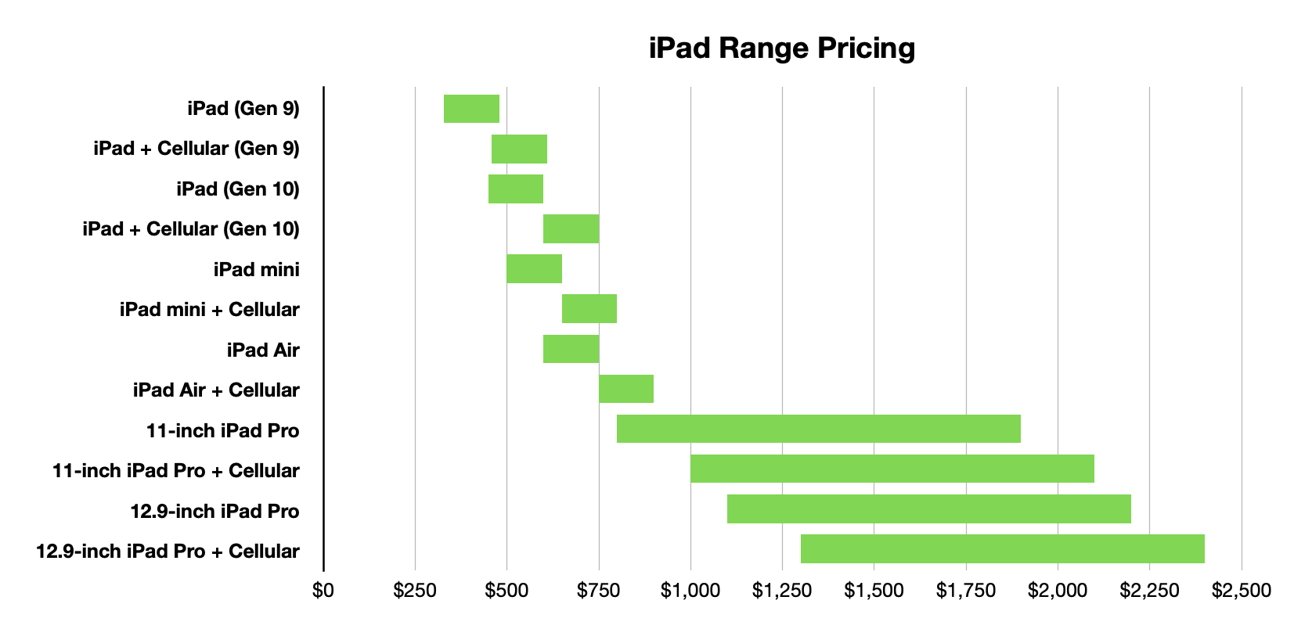
Apple has some of the most amazing Price Laddering I've ever seen.
Folks complain about only 1 external monitor support, etc.
This is all part of Apple's price laddering strategy.
MKBHD does a good job describing it.
https://www.youtube.com/watch?v=XeDPwpIFs-I
Here it's visualized (for iPad)
https://photos5.appleinsider.com/gallery/50966-100692-nov-20...
They are marginally more expensive, but they also very easy to sell second-hand. I'm speculating that the monthly cost is on par with a PC.
- The software is worse. Linux is better. Windows has much broader options. I run both.
- I game.
- Ideology? Yes, Apple is an awful company.
- Familiarity? I have used it enough to know it cannot do a lot of things I need, want, like, etc.
- Budget? Yes, but not because it is too expensive, but because it cannot do anywhere near what Linux and Windows can do (for me) for way less.
>I'm speculating that the monthly cost is on par with a PC.
What is the monthly cost of a Mac that can run games, run old software I require for work and hobbies and (importantly) isn't locked down in either hardware or software so I can use it for something completely different later in life?
They aren't marginally more expensive. I'm writing this on a Chromebook I bought for $300 before the pandemic. Including electricity, cables, etc., I figure it has cost me about $6.50/month.
Just to point out one fact -- people buy $289 Gateway laptops from Walmart and use it as their daily driver.
1. Better choice of desktop environment (KDE/GNOME vs OS X)
2. Wider/better selection of applications
3. Better development environment
4. Ease of deployment of your own apps
5. Better fit for your budget (why spend 3000 Euros on a limited set of features, when you can spend the same amount and get huge number of features/better features)
6. Capability to connect upto 3 external displays (which Macbook has got only recently)
The picky one is the death of Rosetta 1
Then they killed 32 bit binaries. This is the main reason the little Mac icon on steam is useless.
Then Arm processors and yet another recompile that was probably more than a recompile.
If you buy a windows machine, the last 30 or so years of gaming are available to you. And everything older can be emulated.
For me personally, it's a few things I dislike. I do computer graphics for fun. I like using OpenGL and Vulkan because it's the most accessible both in terms of audience and material available. Apple doesn't support either (OpenGL is deprecated, Vulkan only available via translation layer).
Additionally, and this is probably more problematic because I actually like Metal as an API, I don't live in the high income region of the US. I know I won't be happy with the default SSD. I know I want at least 16GB of RAM (can't run integration tests locally at work with 8). For a Windows laptop I go for 1TB SSD and 32GB RAM. But the added premium makes this really difficult. I'm in Germany so it's not like a Mac would eat up a year of my net wage but it's enough that I'd maybe rather go for the thinkpad.
And if I actually tried to get a bit more beef in my GPU and by a larger model because I think the 13 inch are a bit small, I'd probably spend 3k or 3.5k. That's a maxed out gaming laptop. Really hard to justify the price.
For my wife though? Base MBA all the way.
(And with more and more Electron apps, might struggle even with that once you hop onto a video call.)
I must be doing something wrong then. I've got one of those measly models and I do quite a bit more than just basic browsing without any problem. Video calls are the least of that, and they work fine.
Runs everything I throw at it development wise, while a good few other things are open and it has never felt slow. Compare that to any Windows laptops with the same spec and it would be chugging along with just Chrome open.
For the record, on my base M1 Air, I generally have Safari, Spotify, and Alacritty open at any given time. I can also run Docker Desktop if necessary, although I prefer colima since I don’t need any of the bloat.
And there isn't a trend towards more Electron apps. Increasingly developers are using Tauri which is Rust based and extremely lightweight.
When the original iMac came out, it was by far the #1 computer SKU. It was way better than competing products at the price range because of those economies of scale.
> All other details can be configured in the buying flow but there's not much to think about if you just want a simple laptop.
You would think so, but unfortunately not. Apple is quite good at upselling and their price gating for screens, ram etc. is very opaque. In other words: whether you want the air with non-sabotaged specs or the pro or the pro pro or the pro max is not simple.
Anyone who says this has never used an 8/256 Air post-M1, and is complaining about them hypothetically. They're fine. They're fantastic computers.
You can upgrade to 16/512, which puts the machine at $1500. This is $200 cheaper than a Dell XPS 14 16/512. "But the Dell has dedicated graphics" no it doesn't. "But, well, the Dell has a higher resolution display" no, its actually 1080p, the Air is higher resolution. "But, but, the dell, its, uh, no wait never mind don't buy Dell, buy a (insert some other brand)" the thing a lot of people really don't want to accept about Macs, right now, is that they're actually so extremely obviously the best computer money can buy that its irresponsible to buy anything else at $1000 and above (unless you're gaming or doing AI, but get a desktop at that point).
It’s incredibly stingy. For a while you could make the argument that a lot of Air purchasers wouldn’t need it, but I don’t think that’s the case any more. My wife has an M1 Air with 8GB and between Office, Chrome, Teams, and Slack she quite regularly gets beachballs and weird performance hitches.
The vast majority of their market would not fit into the developer, content creator, or just plain power-user category. There's people who just log on to do internet banking and email when they're not on Reddit or Facebook.
For some anecdata, 16/512+ would be a waste on my parents, in-laws and my whole extended family for that matter. They would benefit from it, but they're not screaming at spinning wheels, and are probably a bit more patient and accustomed to 'slowness', which is pretty subjective.
Think of an alternate universe where Apple does the opposite: every new model they push the envelope and double the baseline RAM compared to the previous year. In that world you’d have all the software growing in memory use without bound. Consumers would be forced into a treadmill of computer upgrades like we haven’t seen since the 90’s when CPUs were skyrocketing in performance every year.
For anyone who forgets what the 90’s was like, here’s an example with Mac models:
1990 saw the launch of the Mac LC which had a 16 MHz Motorola 68020
1999 brought the Power Mac G4 at up to 500 MHz
That’s a 31-fold increase in clock rate (and several times that in overall performance) in the same timespan we’re discussing. Software that was written for the G4 had no chance of running on the LC (ignoring CPU architecture differences).
MacBook Airs are the mainline consumer machine these days. Apple does not want users to feel like they need to upgrade them every year (despite what people say).
I looked at the price for m3 and if it would have 16gig it would literally be perfect for just 1k but nope 8 more gigs cost you an arm and a leg
Have a crate with about 40+ of those machines at work, essentially useless from the era where the person in charge of buying laptops just bought the bottom end for every employee and considered it a job done.
Even worse, if one plots the (price, unified memory amount, chip type), and looks at it from right-to-left, then the dollars per system capability is disgusting when you order a lesser system. You get the most value for your money when you buy the maximum unified memory configuration (on those three points).
Better yet, with a maxed out unified memory configuration, one can further save on SSD writes by using (and loading/storing) RAM disks for their projects!
Most people buying a MacBook for work are likely getting a higher unified memory, so their workstations live longer. Meanwhile consumers will have to keep consuming as they fry their internal SSD's on their airs...
I was also wondering if a 1TB apple fabric device is simply an 8TB fabric device with 8x the write life...
I have a great M2 pro machine, but officially it can only support 2 external monitors. I should be able to close my screen and power 3. I can do this with a dock so it's not a resources problem.
I am curious what is different between the Air and the Pro that the Air can power 2 external monitors (it does say when the lid is closed) and the Pro can only power 1 regardless. Or is this a software update and the Pro page just has not been updated.
I keep hoping that this is a problem that is only temporary and eventually it will be removed or as time goes on each series can run 1 more monitor or something.
I've been running three for a while. 2 Thunderbolt 3 + 1 Thunderbolt 2 daisy chained. They work. There are a couple glitches, but they work.
I'm on my work machine now but I believe it also works with the laptop open.
https://9to5mac.com/2024/03/04/14-inch-m3-macbook-pro-multi-...
But nevertheless, Apple's hardware strategy sucks ...
[1] https://www.bestbuy.com/site/samsung-odyssey-49-1000r-curved...
[2] https://old.reddit.com/r/ultrawidemasterrace/comments/mb9vnv...
I use Asahi Linux on M2 now, and the USBC display support isn’t done yet, but I am hoping it would be better than MacOS.
More-than-one-display is pretty much the standard on regular (non-apple) computers: you can drive as much as your system can sustain.
If it can identify something people will pay more for, while not quite putting off most people, it'll do it, no matter how mad.
So if most people think 8GB is fine for a laptop, they'll buy it, and everyone else pays through the nose for more.
Most people only want one extra screen? That's what you get on the base machine and you must pay (alot) for more. If one day most people need two, then you'll get two.
Apple seem to spend a lot of design time on how to extract the most money out of those willing to pay, no matter how annoying it is.
I don't want to waste time migrating to a new system, only to find out I need to return/resell it, or later down the road find out another arbitrary/artificial limitation Apple has set that I either have to find a work around for or suck up until I can switch machines again if none exist.
This is unfortunate since there are some features that have made it very tempting to switch.
But just in general, Intel has always prioritized lots of I/O flexibility on its chips. If you look at the datasheets there have always been dozens and dozens of units on every SKU that are never plumbed out to ports on the device. Three or four display outputs, six or eight USB controllers, stuff like that. Apple is the opposite: they won't include something if they aren't absolutely sure they need it. So after the shift from x86 to Apple silicon, laptop users are feeling a squeeze on I/O that used to seem "free".
Apart from the initial M1 MacBook Pro release, it feels like most products Apple has released in the last few years has always been missing one or two features, and the next release happens to have that feature. E.g. the first M1 Air did not have MagSafe even though the Pros did, and then Apple included MagSafe in M2 Air, but it didn't support multiple displays; now Apple is including multiple displays in M3 Air.
It feels awfully convenient that each generation conveniently has a nontrivial feature upgrade.... Apple has less incentive to make each generation "complete" -- by delaying features (more) consumers will feel obligated to upgrade per generation.
Edit: Better wording, I suppose, that the non-PRO supports two external monitors with the lid closed, the PRO supports 1. Still an odd overall offering/branding.
The M3 Pro has more space and is more ... pro?
I had a 2019 cheesegrater Mac Pro. With Catalina, I was able to drive two 4K screens at 144Hz in HDR10, because Catalina apparently supported DSC 1.4.
Then they introduced the ProDisplay XDR with Big Sur which had people agog at "how were they able to drive this 6K display given the bandwidth limitations?"
Well, the answer is because they absolutely nerfed/bastardized DSC 1.4 from Big Sur (and it's maybe only been updated in Monterey? Unsure, I no longer have the screens - ironically I bought an XDR) to make it happen with some proprietary magic: those same screens could now only be driven at 60Hz in HDR10 or 95Hz in SDR.
Proof in the pudding was that my monitors (LG27GN950-B) actually allowed you to change the advertised/supported DSC version, and when I "downgraded" the monitors to DSC 1.2, performance actually improved, and allowed 120Hz SDR and 95Hz HDR.
This happened with many many users, across many screen types.
Apple studiously ignored it, and may still be. They simply don't care if you're not using an Apple display.
The main problem with the non-Apple laptop market is that there is a mind-boggling number of confusing models, SKUs, processor/gpu variants, etc., and wildly variable physical quality control that confuse consumers and leave them unhappy. This is the flip side of choice in prioritizing, say, gaming performance over battery life while optimizing price or vice-versa.
Also my personal opinion is that 90% of consumer frustration comes from the extremely subpar implementation of Hybrid Sleep between Windows, Intel/AMD, and OEMs. Consumers expect to be able to close their laptop and for it to preserve battery instead of becoming hot or dying the bag. That really needs a solution.
People love to say this without linking to a model. That's because the models in this price range are obviously not in the same weight class as a MacBook.
Edit: Weight class and weight-of-laptop are not the same thing. I don't know how to explain the idiom "weight class" so that the more... literal-minded Hacker News commenters will understand what I mean, but let's start there.
Please link to a model, just one in the 500-600 range that is comparable to a 1K Apple model.
I have owned half a dozen Windows laptops in the past, in all kinds of price ranges, cheaper and far more expensive than a Macbook Air.
None were even remotely comparable to the build quality and practicality of a Macbook Air. This was true even in the Intel CPU era. In the M processor era, the gap only increased.
You cannot even do research on a good Windows laptop because the makers constantly change the model numbers to confuse the customer and hide the flaws of these systems.
You buy a Windows laptop then either the screen, the battery life, the touchpad or the keyboard will suck ... maybe all four.
The sole reason to buy a Windows laptop and put up with all these flaws is playing games. If you need that you will put up with all that crap.
I would kill for a version of ThinkPad X1 Nano or X1 Carbon for example that had the battery life, silence, and unplugged performance of a Macbook Air for example, but no such machine exists even if I were to spend twice as much as the cost of a MacBook Air.
This is 100% it, Lenovo has been killing it lately with their Yoga/Slim series, but for every laptop they have that competes with a MacBook, they also have a myriad of other options that are just e-waste. At the end of the day, the average consumer is not going to do the same kind of research that a tech enthusiast might do, and Apple has a somewhat simple catalog (although incredibly overpriced once you step out of the entry configs).
The display... is not comparable. Sure, it's 144hz compared to the Mac's 60hz... but it's only 74% NTSC at 250 nits with 1080p, so the color accuracy and dim picture is distractingly bad.
And as for sleep, it's just useless. You close it with 70% at night and it's dead by morning. Supposedly the battery is the same size, but even when it's awake, the battery never makes it last more than ~2 hours. Also, that's two hours... when I'm not gaming, as I painfully learned when trying to download a Windows ISO. When I'm gaming, well, then it's shorter.
I might as well mention the thick, heavy, completely plastic construction. Feels like it will shatter from one drop. On the upside I managed to upgrade it from 8GB to 16GB... but then I'm wondering why this laptop even shipped with 8GB in the first place.
Ultimately though, it runs Windows with a basic GPU. Desktop Parametric CAD isn't coming to Mac anytime soon.
Things that matter to me and that all Windows laptops in the same price range or lower as the MBA have shittier speakers, camera, monitor (both brightness and color accuracy). The trackpad feels entirely wrong on those plastic devices and often you have loud fans turning on at random times. Furthermore they're usually heavier despite being made out of plastic rather than metal.
I would pay more for an acceptable alternative - no fan, Windows 11, good battery life, top quality screen, no gimmick features (touchscreen! detachable screen! whatever).
No such thing exists, as far as I can tell.
Another way to look at that is "MacOS vs non-MacOS" laptop market.
There is only one manufacturer of MacOS laptops. That helps keeping the number of models down. Same thing for the iOS vs non-iOS phone and tablets market. If you want MacOS or iOS you must buy Apple. Hackintoshes do exist but are a rounding error compared to the number of machines Apple sells. And if you want Apple, you must get MacOS and iOS. You can run something else on that hardware, but again we are writing about rounding errors.
There are non-MacOS laptop manufacturers with even less models than Apple have. Maybe it's very niche but the Framework laptop has been popular on HN lately and it has only two models.
On the other side if you want to buy non-MacOS, then HP, Lenovo or Dell have a zillion of laptops each, ranging from the very low end to the very high end. Some people pick features and look at which models are left with those features (that's me.) Some people pick a price tag instead. Probably the laptop is a commodity to the price tag people, much like gas. Who really cares about the gas company? If you need to fill the tank everything will do.
And about
> the extremely subpar implementation of Hybrid Sleep
this is something that Microsoft throw at us and we can't dodge it much. My laptop runs Linux and it's from the pre Hybrid Sleep era. I didn't investigate if Linux sleep works well with new laptops.
It really doesn't make me want to reward them with more money, only to find out what exciting new issues will be present and trivially reproducible for the entire next revision of the hardware.
I don't think this true, unless you have extremely low standards for "acceptable". I've tried a number of $400 laptops and in every single case got fed up with the shittiness within minutes.
Mind boggling that so many smart people at Microsoft/AMD/Intel/HP/Dell have not been able to figure this out yet.
Can you show me just one of those, please?
I would buy it today.
Anecdotally, my Framework 13 AMD ran me 1500 and I ended up with 64 GB of ram, 2 TB of storage, and an AMD 7840U. I bought my RAM and storage separately to get that end cost, to be fair.
I wouldn't be surprised if the M3 actually outperforms my processor by a bit, but having way more RAM matters a lot to me. All that on top of being able to repair my own machine is a no brainer to me.
I know most laptop users wouldn't care about this stuff, but I really hope Framework does well and helps bring repairability back to laptops.
HN used to say that System76 were the best laptops ever, so I bought two of them. They’re an incredible pile of shit, in addition to the battery life or the clunky build, the fans turn on and off like my gamer boyfriend’s PC back in 2001.
System76 said they won’t take them back, after I tried to give it to every intern.
I’m absolutely flaggerblasted at what Linux or Windows users tolerate, it seems fine for them, since all of their laptops is like this! The problem is having low standards, and compared to this, they think their laptop is great.
* Framework is philosophically best, and they make solid machiness. * Macbook Air has just insane battery life and is so small.
I would love if I could run macOS on a Framework.
Just out of curiosity, why? I have ~200 tabs open in chrome, and have ~10 different apps open. Mac could handle it perfectly well due to reliance on swap and compressed memory. My swap used is 20 gb but really can't say that even when switching apps fast.
Just recently there was a Thinkpad P14S on sale for $999 that blows the Macbooks out of the water in terms of ram and storage, while having a high quality OLED display and a Ryzen CPU that can easily trade blows with Apple silicon. It is hotter and heavier and has very bad battery life, though.
In $999 13" M2 Air you get 8GB Unified RAM and 256GB memory. Intel ARC seems to be better than M2 graphics. Weight is exactly the same. Usual downsides remain - fan and smaller battery life, although still pretty good.
No one matches Apple's build and screen quality. But their base models are pretty underpowered, and it's not until you're spending closer to $2k that you get specs that feel appropriate for 2024. On the Windows side, there are lots of cheaper options, many of which have beefier specs, but the build quality pales in comparison.
The right tradeoff depends on your budget and what you really need out of a device.
Please post links to benchmarks of a windows laptop that costs the same as a base model Apple laptop but is faster, while being similar in weight, battery life and heat.
For $1700 you can get a sub-1kg Asus ExpertBook B9 with 32GB RAM and a 2TB disk and a decent 12th 12 core Gen Intel CPU.
https://www.amazon.com/ASUS-ExpertBook-i7-1255U-Military-B94...
Not saying it is better in all respects, but definitely in some, meaning there are definitely alternatives.
And the screen is 1080p from 15 years ago.
No thanks.
That will be a great little machine to use until it starts throttling. You'll need an MBP to keep consistent peformance.
But yeah, there's still a real lack of Windows laptop competition these days, especially if you want a GPU. 'Gaming laptops' tend to come with severe heat/noise/weight/battery problems.
(And why are competitors touchpads still shit-tier compared to Apple? Even on those bulkier gaming laptops where space isn't at a premium and the price is on the premium side)
It boggles my mind people still buy 1080p laptops.
Abandoning the (clearly lacking) Mac Store is not these same as abandoning the macOS platform.
Its Unix-like under the hood, with mostly same syntax for the terminal, but linux and MacOS are very fundamentally different.
With the size difference between the MBA and MBP almost eliminated, the M2 MBA was a superfluous SKU at launch, much less now.
It's nuts that the entire rest of the industry basically has own-goaled Apple into a dominant position. Apple's playbook:
1. Model-year build stability over faster go-to-market on new components. 2. Better build quality. 3. Better battery life. 4. Better display, especially in value models.
I'm leaving OS and UI out of the discussion.
e.g. $1,899.00 for 15'' 16GB ram + 1TB SSD
i just bot a similar aluminum HP with Oled , Ryzen 7, 16GB , 1TB SSD for $700
the build quality is good, just a tick below apple. the fan is mild, not as good as apple.
but $1200 premium for apple ? I had to say no
My 5 year old Lenovo Carbon X1 14" is 2560x1440 while I can't buy a current X1 with anything above 1920x1200 for any price. WTF?
When I was looking at Thinkpads there was never any better options than 1920x1200 but if I switched to the US site I could order with the HiDPI OLED screen.
With that said, the specs on a Mac air are extremely modest when you really look at them. Apple is simply optimizing to do more with less.
I don't know why you bought a new one. You can have two ways to look at this, one way is your ultra pessimistic view, my view is I don't need to upgrade my laptop ever 2 years anymore.
Before the M1 Max I was upgrading so often because intel macbooks sucked so much. Now I can comfortably say I'm keeping my M1 Max for a decade.
As for being "exploited" by ads, just don't be, stop mindless consumption...
I’m doing most of my daily driving on whatever computer work gives me anyway, this is just the personal dev/audio machine. I do the same with a gaming computer too though, my gaming laptop from like 7 years ago is still going strong. I turn down shiny graphics settings to get good FPS anyway, I care way more about gameplay than visuals.
That's a nice thought but the computer will probably lose security updates in the next 10 years.
And that really annoys me. The press release says that the new computer is "built to last" and I'm sure that's true, physically. I have a 2015 Macbook Pro which works fine (obv. slower than a modern computer but fine for everything I need to do), it does still get security updates (it's two OSs behind the current macOS at the moment), but I think the time until it doesn't is probably measured in months.
As I say, it works perfectly, was indeed "built to last", but I guess I'm going to have to throw it away (bad for the environment) and buy a new one soon?
That also makes me less enthusiastic about dropping huge amounts of money when I do finally buy a new laptop.
If Apple releases on-device AI, this will be an effective way of getting people to upgrade like they used to, but haven't had to recently. For example, I bought Pro-level computers in my younger years, but now would only consider an MBA, mini, or iMac. But they could get me to go for a Pro if it were the only way to get more RAM for better AI performance. It will also likely shorten upgrade cycles since newer computers would have the latest and greatest performance. When I bought my M2 MBA years ago I suspected it would last me a long time. Now I'm not so sure since I don't have a ton of RAM.
These "pro" machines have always been known for work and productivity, and 8GB just sounds like a piss poor product decision
However, you quickly hit throttling if you push for more than a couple minutes at a time (like when you export in Handbrake, it will slow down and only run marginally faster than the M1, in my experience).
I suspect mine would be green almost all the time, even on this almost three year old M1 Max.
Eg: The M3 Max is a substantial improvement over the M2 Max in both CPU and GPU. But the M3 Pro is a moderate improvement at best compared to the M2 Pro.
It's also why you should understand your personal use case and do research. I think this is on you, not Apple. Corpos gonna corpo -- you have to do the research to figure out whether the gains from new chips will actually impact your workflow.
If you bought a M3 Max just to fuck around on Facebook and Hacker News then of course you won't notice a difference. If you are running workloads that actually require that level of performance then you will notice a significant difference. M3 Max is twice as fast at rendering 3D scenes in Cinebench.
For most real-world users, the M3 really is about 30% faster in single-core and 100% faster in multicore. That is really significant for a lot of us, especially software engineers. But the really big speedups mentioned in Apple's marketing are more niche and it takes some savvy to recognize that.
(I'm plenty content with my M1 Max for now and I expect I'll continue to happily use it for a few more years)
I wouldn't exactly just avoid them, though most are useless, so it's not a bad idea. You just want to understand what they are... even honest ones will only present information that is a reason to buy.
E.g., when I saw the iPhone 15 ads and the best thing they could say about was that it had some titanium, I knew it was a product I could ignore. (Not that I have an iPhone 14 either, but I already knew that one wasn't worth an upgrade to me).
In the Windows world, I rarely if ever come across a laptop where the speakers weren't clearly last in precedence for engineering and BOM consideration. Just astoundingly bad sound quality accepted as normal in the Windows laptop world, even in supposedly premium machines.
In comparison, even the least impressive MacBook Air speakers are good.
But if you were coming from another MacBook Pro when evaluating the Air I can see why you would have come away wanting better. The Pro machines are indeed a clear step up, and the larger 16" models are even better given the extra space they have to work with.
Sometimes I hear her watching some movie or show a few rooms away, and I can never know if she's watching it on the TV or on the Pro just by the audio alone. Those speakers do fill the room, and them some.
I have never really watched more than short content on that form factor. I like a bigger screen and a remote, watching anything like a movie on a laptop feels klunky.
A 4K monitor I use works perfectly fine on Linux, but with Macbook Pro, even though resolution perfectly matches, it still has blurred font (the filter they apply completely changes the look of the font, even though I use the same one), everything just remains blurry and again, watching video disables it.
That's one of the things that pushed me to Mac from Linux: fonts finally looked nice. (This was around 2010.) I tried everything I could to get Linux to render decently but eventually gave up. I recognize that this is so much down to personal taste. If you prefer Windows-style ClearType to Mac's rendering, Mac (especially on a non-Retina screen) will look awful. If you like Mac's rendering, Windows tends to look awful at any resolution.
Edit: nvm, looks like the Air supports two external displays but the Pro only supports one.
yeah, the fact that such basics are still broken is the biggest scandal to me in these premium machines with so much tech progress otherwise
Perhaps more to the point, you're right -- Apple doesn't deserve to be lauded for removing something that was a dumb restriction in the first place. But it is interesting considering this is the most popular laptop in the world.
Comparing the port count/capabilities of the two isn't a fully fair comparison though. The Apple Silicon Macbook Air models are likely 1) much faster than that corporate-issued laptop (even if it's workstation class), and 2) much smaller and quieter (no fan noise even under load).
Though I'm not sure why all the griping about how many monitors an Air can support; users can buy a Macbook Pro if they want more monitors? I don't understand the logic behind buying a tiny, thin laptop only to dock it as a workstation.
The restriction I am most annoyed with these days is the lack of external GPU passthrough. I’m not even sure the asahi Linux folks have gotten that working yet.
So folks are probably just happy they’re not having to deal with as many compromises and tradeoffs (they get to have their PC that works almost just like a smartphone but does more things their intel machine could now). That’s totally understandable.
The M3 MacBook Air relaxes this restriction by allowing two external displays.
It's easy to deduce that it's a big deal for macbook air users because it wasn't possible before.
It's easy to deduce both from the article and from other comments here, which presumably you read if you're going through the trouble of responding to someone else's comment.
I typically despise this type of question, where you're obviously trying to make a point but playing dumb and playing it off as if you have no clue what you're talking about.
This type of question is used all over the place and super obnoxious.
I'm not American, genuine question, why is it a big deal that you're getting free healthcare? I've had free healthcare my whole life, shrug.
As a European, genuine question. Why is it a big deal that Biden wants to forgive student loan? I've gotten free education my whole life, shrug.
As an apple user, why is it a big deal that Dell is extending it's warranty to 2 years? My apple device gets updates 4 years later, shrug.
Something between "editing an .html file" and "recompiling huge C++ projects every hour"
A few docker containers, IntelliJ, etc
Half the reason I'm getting is a Mac is because they're so nice to look at, so I think I really want the better screen. And the extra RAM is always nice. And I know I'll appreciate the decent speakers.
Plus it'll arrive way quicker. I think I'm happy with the MBP...
The MBP arrived. What a machine!
I'm biased that my current laptop is a 2015 MBP (never owned an Air). But I'm still tempted to return it and get a 15" M3 MBA and save £600.
I think I underestimate battery life and over-emphasised performance. I've been running some npm & maven tasks every 1 minute, run a docker container, playing music on the speakers, set battery to power saver, set brightness to 50%. And after 4.5 hours I'm down to 72%, so I think I'm happy with that.
Regarding your last point, it’s because of the video accelerators on the M series chips which is why they mention Final Cut. The latter comparison to Intel laptops also has to take into account that it’s been ~4 years since Apple shipped that.
I am kind of interested in the M3 Air. I generally prefer MacBook Air over MacBook Pro, since it's lighter and more compact than the Pro, but I am currently still using a MacBook Pro with M1 Pro due to the limitations of the earlier Airs. It seems that these limitations are getting lifted slowly, with the M2 supporting up to 24GB RAM and the M3 supporting two external displays in clamshell. If the MacBook Air M3 supported 32GB RAM, it would pretty much be a no-brainer to go from the M1 Pro to Air M3.
Gosh having started program on 286s in the 1980s, my M1 air feels blazingly opulently fast. What sort of local development are people doing that requires heavier compute than an M1 air, but doesn't require a full on cluster?
Apple's "Pro" branding has become increasingly meaningless but in the MacBook category, which I believe is where it originated, it's meant to suggest "media professional", a demographic which has reason to care about all of these things.
There are even shades of this in the iPhone and iPads Pro, which have a few features which are mainly of interest to professional media types. For AirPods it just means "the expensive ones", and for Vision Pro it means "this is expensive". That's the main signal for phones and tablets as well, realistically.
The Air is also way overkill. I had a 12" MacBook before that. It ran the software that I wrote. I write markdown in Sublime Text and run python scripts.
There just isn't a reason to get something beefier.
Go to other local websites and the specs will be in the local units (most likely metric), but even in Europe, display sizes or car wheels are almost always denominated in inches.
This is totally fine for companies targeting US domestic markets I guess but I suspect Apple sees itself as an international company and they should have the budget for proper internationalization.
Maybe they just don't care for people to know how thin the Air is, but the number of search results for 'thin' on the page let's me think otherwise.
It's the total spending dollars that's important. By using US customary units, you get 25% of the world GDP in one easy-to-do-business-with entity.
This is just FUD. Even my kids 2017 laptop doesn't "chug along with just Chrome open". It can run chrome and a game too just fine.
If they lost you eight years ago, then you haven't been an Apple user for the last 20 years.
Also, 2016 was eight years ago. Get over it. Or at least find an axe to grind from this decade.
Considering minor Macbook upgrades can get you into >$1500 price territory pretty easily I think this a fantastic value. If you wanted to buy my full setup right now it would be $849 + $749 + $145 = $1745 but you're getting “dual” monitors and dock that can be reused with any modern machine, making it easy to switch between work and play. I can even plug my Steam Deck into it. :) (No affiliation with any of these products!)
One thing you should be aware of is that having two seperate monitors can be an advantage for Window management on macOS. With two monitors, I can swap spaces on one of them and keep everything as is on the other. With only one it's not that easy.
Weird flex
Modern machines also have a nefarious failure mode. It used to be that you needed more memory to cache the hard drive, but SSDs are pretty fast and that doesn't matter as much anymore. So now you have the opposite problem -- if you're out of memory and start swapping you don't notice as much, because SSDs are pretty fast. Except that now you're silently wearing out your SSD. Which in the Macs, is soldered.
Haven't had an issue with mine, except a bit noisy fan that was fixed with a recent firmware update.
Battery life is stellar as well and I can easily go on for the work day and more with it, from what I've seen.
And it would specifically have to be an M2 since they upped it to 256GB minimum. I have the lowest end M1, and the tiny SSD is a constant pain when combined with the lack of RAM.
#2 is untrue unless you're installing Windows. #3, well somehow there's no iTerm2 equivalent on Linux, and the terminal emu is one thing you'll always use even when SSHing elsewhere. #6 is a serious point, though.
Yeah, the Mac model for long term use is that you sell it later in life so you can get whatever it is that you need later in life. (Not saying that it is a good thing nor a bad thing).
https://support.apple.com/guide/security/volume-encryption-w...
Soldered-in components make for higher quality, lower cost production. Anecdotally, every Windows machine I've had has failed. Every MacBook machine I have replaced after 4-5 years when I wanted to upgrade to the latest technology.
Pretty fathomable.
Additionally, data in the flash chips are always encrypted by the unique key burned in the M chip (previously T2 secure enclave).
Are you sure about this...? Every System76 convo I've ever seen on here has plenty of people chiming in to note that they're simply junk Clevo shells. It's a known issue with them.
Ideologically I love System76 (and I would buy one of their desktops, if I was still a desktop man). I would never buy one of their current laptops.
It's pure ewaste that it exists.
as if $500 isn't money to you. Maybe it indeed isn't, but that is a lot of money to many people.
FYI Intel Macbook Air has supported dual external monitors 2018-2020, and same for base Macbook Pro 2012 (Retina) - 2020.
My prior experiences with older hardware have been barely an hour or two, which is impractically retarded.
I also have an M2 Macbook Air and find its battery life even more impressive (literally days between charging), but I don't really use it because it doesn't satisfy my requirements which include games (for play) and clean interoperability with other Windows machines at home (for both play and work).
I had a Macbook Pro 2015 with 256GB SSD. (Base model was 128GB). It was a very painful experience even back then. Yet almost ten years later, we are here, still paying $200 to upgrade to 512GB, when almost every Windows laptop comes with 512GB. FYI a 1TB NVMe gen 4 drive costs less than $100.
That's what OP said? Because now you have already decided you don't want to game, etc.
>Even if you say you want a Dell laptop — have you ever tried to browse their site?
This is the iPhone versus Android discussion all over again. Yes, many will be happy with the iPhone, but they also often didn't know they had the option to buy an Android phone that could do something the iPhone couldn't that they'd like to be able to do (like copy&paste or whatever). Ignorance is bliss for some. Others want the choices, and Apple have nothing for those buyers.
it is amazing how much the android crowd loves to shit on apple "brainless sheeple" etc given how little they clearly know about the products themselves.
I keep bringing it up over and over and it's never not true, the android crowd is just so utterly uncivil and it's completely normalized and accepted as public discourse. The AMD fanbase has the exact same problem. It's constant "brainless sheep" and "the ONLY reason anyone buys [not my brand] is [infantilizing and insulting remark goes here]".
If anyone on the other side did anything remotely like that they'd be slapped with a mod comment etc. But if you point it out, that people are misbehaving and acting out, you're the bad guy, because acknowledging the constant microaggressions is the greatest crime of all.
That’s exactly what I’m not saying. If you want to play games (with Windows only games), then a Mac won’t work for you. If you get a Mac, that means that gaming likely wasn’t part of your decision tree.
Think of the choices as a positive selection. I want to do X, does computer A allow me to do that? People make decisions based on positive selections… not negatives. If gaming isn’t on your requirements list — you aren’t actively rejecting gaming… you just don’t care one way or the other. The post I was replying to asserted that if you chose a Mac, then you’ve already decided not to do X and not to do Y and that you don’t want form factor Z. But that’s not it… decisions are made based on what you DO want. They aren’t made based upon what you don’t want.
Some people just prefer one ecosystem over the other… it doesn’t mean that they don’t know that other options exist. It’s not ignorance, it’s just a different choice than you made.
Then you have to pay real money and you might as well buy a Mac.
- MacBook Pro with M3 Pro chip = two external displays
- MacBook Pro with M3 Max chip = four external displays
Given that I would personally go for the M3 Pro with 18GB memory, but it depends on your needs of course.
Restriction implies they made the deliberate decision to withhold or break functionally. Limitation is probably more accurate, because they didn't put the extra work to make it work properly.
Limitation is probably more accurate
I don't think there is anything interesting
From a consumer standpoint? Apple sells about six million Macs per year and the Air is their best-selling computer and anecdotally it is popular with the HN crowd. So it is objectively impactful. I would call that therefore "interesting" but at that point we're splitting semantic hairs so whatever.
Next you're going to tell me the new I6 turbo engines are "underpowered" compared to the V8s they're replacing, even though they have more power, more torque and in the same vehicle produce faster 0-60 and 1/4 mile times.
Your definition of "underpowered" is interesting to say the least.
Which mould though? I'd say most fit the Windows mould, but I'm guessing you mean the Apple mould.
E.g. transit routing software.
My 2007 MBP went through a battery every 11 months for about 3 cycles before I finally missed the boat on getting that 4th battery replaced under warranty.
My 2013 MBA still has a perfectly healthy battery today, though it doesn't see much use and its disk just died yesterday.
My 2017 MBP's battery degraded significantly after about 300 or 400 cycles (within spec, I think). A few keys on the keyboard partially failed due to dust or whatever (common in this vintage). The screen had some sort of damage that gave a subtle color cast to parts of the image. The USB-C ports wear out after like 20 insertions and won't hold a cable in place anymore. A year or two ago I replaced the screen and bottom case (keyboard, battery) and it's still doing fine.
Personally for home use I buy pre-owned Thinkpads and then put Linux on them. They're fine for normal use - Internet, Email and light to moderate SW Development. The screens are mediocre, but I pay £300-£400 (UK). Oh and I don't care about battery age because replacements are inexpensive and require sliding one catch to make the replacement.
Yes, for work I want something more performant and I'm considering pushing work to get me a Macbook (instead of the high-spec Thinkpad I currently have), but that's a different use case.
The other day I bought a 30 dollar phone,
https://www.walmart.com/ip/Walmart-Family-Mobile-BLU-View-4-...
it has all the functionality that you might need it has map, a browser, runs facebook and twitter apps, tiktok what else do you need
can I use that as an argument that why buy an iPhone for 1K if you can get a great phone for $30 - no because when you talk about phones or laptop you are talking about comparable products
what I was saying that you cannot buy the same value you get with a Macbook in any laptop product
This isn't theoretical, it happens all the time. I worked with a person who had a 10 year old MacBook Air - it still worked and held a charge! They got their money's worth.
But at the same time, I've never seen non-techies complain that they can't open a few tabs, reply to a few emails, watch youtube, listen to music, and study on their base laptops. They're amazing for that.
If we need more memory to accomplish the above tasks any time soon, we're in a sad state of software development and bloat.
A web browser adds a significant amount of memory usage to any task, even with basic static webpages, and then almost every other app you use is secretly also a web browser but none of the RAM usage from it can be shared with the web browser you're already running.
Again, I'm personally not happy about shelling out $400 for 24GB of memory on my next Macbook, but I gave away one of my base machines with 8GB to a family member, and they simply did not notice.
Of course, it does not have high-DPI mini LED screen, great speakers or 18 hours of battery life, but none of that really matters, and I'd choose this any day over a similarly speced Macbook Pro 14 that would cost me $2,399.
It's a bit more nuanced. Lenovo/Asus seem to be experimenting a lot more, but more like by throwing (relatively) easy-to-build variations at the wall to see what sticks, then release a few more polished SKUs. Apple doesn't really do that, but they do attack those limits and design aspects they care about very aggressively and with a ton of resources (e.g. battery life pre-M1, manufacturing tolerances).
We've seen that with the touchbar: it got a first release, and basically no improvements, no bug fixes, no better support from there. A laptop only feature gets no love from today's Apple.
Even the iPad saw little to no progress in recent years, outside of sharing specs with the mac.
I posit we'd see a foldable/bendable phone from Apple before we ever see something significant form factor change in laptops.
I doubt this is much of a constraint in the real world. Most people plug power in, perhaps an external mouse, and that's it. (They should be plugging in external storage for backups, which might require an extra port, but I doubt most people do in practice).
> So now the dongle/no dongle question has to become considered as well.
I'm pretty much USB-C only at this point, but even before then I never understood the fixation on "dongles".
You start with the idea of cheap model, then start going the ladders up.
But I'm a heavy user, and that 2015 baseline MBP is still fine.
Though it’s not a big issue in practice. When at home or the office, I just plug into a display with a USB or Thunderbolt hub. On-the-go, the Apple adapter works great.
Having to plug more than one cable is annoying anyway when you move between desks.
Compared to what? Linux? Windows?
Are there any published benchmarks anywhere, otherwise this just proves my point above.
> Apple tends to have faster RAM (way more bandwidth), faster SSDs
Yes, sure, due to its integrated nature, but that does not reduce the RAM requirement. My 8GB M1 MBA, which is used as a home browsing-only laptop, is almost always in yellow on memory pressure once we have a few tabs open.
The RAM or SSD are specifically not faster because of its “integrated nature”. The RAM is faster because Apple engineered an actually wide bus + multiple channels for memory access. The fatter Macs have the equivalent of up to 8-channel memory, which not even server CPUs of the competition provide. The SSD gets easily 7 GB/s reads in my testing. Both Windows and Mac have a working memory compression algorithm and a sister post claims that it works better due to hardware acceleration, which I’m inclined to believe. Memory compression on Linux is a mess as you cannot keep compressed memory pages in physical RAM, instead forcing you to partition the memory and manually handling how much and what to put in compressed zram.
Low memory situations are thus handled better than on other operating systems. Memory and memory pressure are neglected concepts in the competition, both the hardware providers and operating system providers.
I am sick of people making claims without quoting any numbers about real-life performance.
Ditto on the Nano. I wind up looking at it every few months and then begrudgingly walking away because it just doesn't make any sense to buy.
The newer gens are even more confusing because they don’t offer the cooler, more efficient U CPU variants, only the hotter more power hungry P variants, which exacerbates heat and battery life issues.
is there really anything stopping you from setting a lower cTDP if that’s really what you want?
A consumable component designed to be excessively hard to replace, to encourage you to upgrade sooner than necessary. (Not everyone lives near an Apple store, and nobody wants to mail the laptop off for what should be such a basic service, being without it for who-knows-how-long)
I have a 12th gen Framework 13", 13" M1 Air, and a 15" M2 Air. I use the Framework laptop for work because I need to use Linux.
The Framework laptop is mediocre just like pretty much all PC laptops. The hinges are awful, if you pick up the laptop upright, about 50% of the time the screen falls flat 180 degrees.
The trackpad is arse in Linux.
If you're lucky you can probably get 5 hours battery life, but on a realistic workload you're looking at 2-3 hours.
The keyboard is pretty nice, but I wish ctrl/fn is swapped like Apple and it has the inverted mini-T keyboard arrows (or at least I wish someone would make a swappable keyboard for the Framework).
The speakers are bloody awful.
Display/Webcam/Mic are fine.
I would like more ports over modular ports, but I appreciate the design that went into the modular ports.
Speaking of modular ports, sometimes they abruptly stop working and require removing and reseating.
All these small nits really add up and it just feels like a mediocre experience. It is my work laptop, but I try my best to avoid using it over my PC with WSL2 or either Air laptop, but I try my best not to mix work and personal.
Both the 13" M1 Air and 15" M2 Air are just amazing compared to the Framework, and I suspect PC laptops in general. They have their drawbacks, price (gouging in some ways), less ports, can't drive dual displays, but their trackpad, finish, speakers, etc. are just amazing. I personally prefer MacOS to Linux for a desktop experience as well.
Edit:
For one C++ project I work on I need 32GB of memory to compile as sometimes the oom-killer will kill the compiler. That's one of the only reasons I use my WSL2 desktop or Framework laptop since memory is cheap.
The run time Apple’s ARM systems get is very noticeably better - I don’t even bother packing a charger even knowing that I’ll have a full development environment, containers, etc. running all day because I’ll still arrive home at 60%.
I imaagine that the lubricant in the fan will still age, but that is also going to be less of an issue because of less dust contamination.
They are what Apple calls "Retina" displays.
A 13"-15" 1080p screen is pretty similar PPI to a 27" 4K display. This is pretty nice because if you have both at the scaling level elements are the same size on both.
Edit: I had a brainfart and forgot that both ports are routable. It's market segmentation or stupidity like with the M2 MBA.
A TB4 dock fixes most problems, but I have to hack the EDID to disable YCbCr and force RGB, or the colors look like absolute shit. The external monitors still look significantly worse under macOS than either Windows or Linux, and I have no idea why.
External display handling is easily the worst part of using a Mac for me.
Using more than is explicitly mentioned that is supported, you mean? I mean yeah, duh.
I then just have to buy any laptop that: 1) doesn't weigh much; 2) doesn't have a fan (this is so much more difficult than it should be it is insane); and 3) has a good enough monitor... I care a lot about resolution and brightness but it might be I don't care enough about color accuracy as I am a software developer and so honestly barely have much use for more than 16 colors and mostly look at photos, again, on my phone (which is also my camera and my media device in general as it is simply better at that so this makes sense). If you are a graphics designer, though, I get it... but weren't they always Apple's core market?
Just for clarity, it's so far from novel in the world of windows laptops that it's genuinely confusing why that would be an advertised feature.
I must have struck a nerve with you after my objection to the format of the question.
My only mistake here was not saying those were oversimplified made up examples, thought it was obvious but apparently not.
It's replacing a 2015 MBP I bought used in 2019, which replaced a 2011 MBA I bought used in about 2013.
Those who scale up, and aren't photographers... What's the use ?
The addition is the ability to have two external when closed; likely this could have mainly been done in software if they cared.
(You can get more than one external on a laptop with the screen open if you go up to the Max or Pro or whatever.)
By any chance, do you have the display preferences to use a different resolution than the hardware's native dimensions?
... so? Total spending is the key factor; Apple gets exposure to 25% of the total human economy by catering to one polity which is also the easiest one to do business in. That's a no-brainer if I've ever heard one.
By contrast, India's economy is only 3% of the world total. [0]
It's interesting to note that this understates US dominance in luxury products - due to being rich-person-friendly, they actually have far more than 25% of the world's rich people - 38% according to page 28 of [1]
Which market would you rather target?
[0] https://data.worldbank.org/indicator/NY.GDP.MKTP.CD?most_rec...
[1] https://www.ubs.com/global/en/family-office-uhnw/reports/glo...
'less than an inch (11.5mm)' would still be a better specification if you want to have a version where you rather err towards US customers.
I'm not offended by seeing inches, just irritated that you wouldn't cater to the rest of the world.
If you check these specs in a month, it'll probably tell you the size in mm. I just checked the iPhone page from here in Canada and it says this: 5.77 inches (146.6 mm)
But then there are all the variations with different amounts of RAM, SSD, processors (M3, M3 Pro, M3 Max)
And every little upgrade costs you 10X compared to a PC laptop.
Then within each of these the configurable parts vary, but you're potentially picking processor, RAM, GPU, SSD, and even display resolution. It's not any simpler than the options within one of Apple's laptops, except Apple has a total of four laptops in all sizes.
If you wanted a 15" laptop from Dell, you have 1 XPS, 2 Latitudes, 4 Inspirons, 2 Vostros, and 2 G Series. All of which are an ambiguous mix of actually different models or new/old revisions of the "same" models.
Looking at pricing on the XPS 15, 64 GB RAM adds $450, the RTX 4070 is $1200, upgrade from i7-13700H to i9-13900H is $450, you can option Windows 11 Pro for $50, there's a higher resolution screen for $300 (or $800 if you didn't option the fancy GPU), it's not cheap over here either.
The one place where it really feels like Apple is screwing you compared to Dell is SSD pricing.
The most confusing laptop lineup Apple ever had that I remember was early 2015: MacBook, MacBook Air, Macbook Pro, and the old non-retina MBP from 2012 that they were still selling.
8 channels has been standard in Epyc chips since they released in 2017, the latest Epyc Genoa does 12 channels. They're also not splitting that memory bandwidth with a bandwidth hungry GPU.
I was working on getting issued a MacBook within a week. Right back to battery/outlet anxiety that I had escaped years and years ago by switching to Mac. Goddamn thing was losing over half its power over night. Six hours of useful time before you'll be hunting for an outlet at best from a full battery. WTF.
My MacBook that I've been using on battery almost three hours this morning and that hasn't been plugged in since about 5PM Friday is still over 70% charge. I didn't even think about or check the battery level when I opened it this morning, because there's no way it'd be a problem. Ahhh. Relaxing.
If you want an ultrabook experience, get ultrabook hardware.
I had no problems with Fusion360 running under Rosetta 2 and Autodesk recently released an Apple Silicon version of Fusion360.
Regardless, a default TDP above that of a U chip in a Nano is still an odd choice given that machine’s lack of cooling and battery capacity resulting from its size. It means that a lot of buyers who have no idea how to reduce it are going to have a subpar experience.
Electron Framework alone on macOS is 356MB.
And this is reflected in memory usage as well.
You can tell Windows laptops are general computers, the hardware fires off the gesture recognition and gives the command to the OS, so you swipe, it's recognized, then you get the action.
On Mac, the gesture is registered as it's happening, you can pull the screen, cancel, flick it, etc.
Not to mention the convenience of taking it to any Apple store and the battery life.
I game on Windows, host on Linux, and travel with Apple.
Versus macOS being fully integrated and effectively generating `GestureProgress(0.31)` events.
Can't test on Windows right now but I would expect it to have even less problems than Linux.
Last time I checked on Windows, swiping will result in basically an alt-tab after the swipe.
It was not a fluid motion that could be cancelled.
App binaries, sure. But most of what is stored in memory is content, video, image, file cache. These will not differ much from OS to OS, the only difference would be baseline memory usage before I start opening YouTube tabs.
But my MacBook only has an issue because the SSD is pathetically small. If I had the next tier up, it would be no issue.
The $20/month subscription is going to give you access to commercial models, but generally you have to run the open weight models yourself. With the unified RAM you can trivially run the larger 70B+ models.
AI researchers generally have to use CUDA due to how the ecosystem is still mostly CUDA-only for training and fine tuning, but those who need to occasionally use custom/local models for inference will likely find high end Macs being a good fit for their use cases.
Personally, I’m reasonably happy with GPT4 and Github Copilot, and I’ve sometimes used Midjourney, though I cancelled my subscription since I’m not currently generating any images. Are there important apps that I’m missing?
I personally use it mostly to keep tabs on the latest models released on huggingface. There has been a lot of interesting developments since last year, and models have become more and more powerful.
Ah, yes, "poor Apple couldn't find a way".
Except it did for the more pricey models.
Nonsense, Celeron 600, 1c/1t CPU from 25 years ago could drive multiple monitors just fine.
> more gpus
Nonsense, you just need more VRAM and guess what? DVMT was a thing 15 years ago.
> and more IO hardware on chip.
If you can use the external monitor with the either USB port then you have all the IO needed. Nonsense.
The 2023 version is made from magnesium alloy with plastic at the back while the macbook is unibody aluminium.
The 2024 version is aluminium unibody like the macbook and the new speakers are nearly as good as macbook ones from the reviews I have read. However I have only been able to find the 4070 model which is much more expensive than the macbook. There is also the XPS 14 but it is also more expensive than the macbook
Edit :- Found a 4060 model of the g14 https://www.bestbuy.com/site/asus-rog-zephyrus-g14-2024-14-o...
If you get the m3 air with 16gb ram and 512gb ssd the g14 is 100 dollars more expensive but the price will probably drop to lower than the macbook in sales
Maybe look at some high-end Lenovo or Dell laptops.
I'll pick the second to the top tier models, since that's what the Air is for Apple:
Dell Latitude 5440 - i5-1345U, 8 GB DDR4, 256 GB PCIe NVMe - $1,099.00
https://www.dell.com/en-us/shop/dell-laptops/latitude-5440-l...
ThinkPad X13 Gen 4 - i5-1335U, 8 GB LPDDR5, 256 GB SSD M.2 2280 PCIe, $959.40 after coupon
https://www.lenovo.com/us/en/configurator/cto/index.html?bun...
Prices for premium laptops... are premium, and the strip-down models start with modest specs.
I generally have between 4-10 tabs at any given time; how many do you have?
Again, I think a lot of people on here have this bubble-sense that laptops are cheaper than they actually are, because its been so long since we've bought laptops. Or something. Laptops are crazy expensive, all of them. And the degree to which Windows OEMs have fallen behind Apple in both pricing and performance is deeply concerning.
[1] https://www.hp.com/us-en/shop/mlp/laptops/elite-352503--1
It's night-and-day compared to the Intel MBPs.
It takes a long operation e.g. compilation for 10-20 mins before it really starts to fall behind the Pro models.
where I measured tokens in my requests before sending things to openai API to ballpark the cost
There are other browsers that are far more memory efficient.
What about colima vm for docker? Intellij, gradle daemon, android studio, xcode, electron apps, android virtual device, slack, spring boot apps, iMovie, Davinci Resolve, python notebooks?
Phones now have more than 8gb of RAM
The limiting factor won't be the memory but the thermal throttling.
It is exactly why I haven't bought anything from Apple since the ipod.
Everything sounds amazing/wonderful and then one mind boggling deal breaker that doesn't even seem to make economic sense but just feels petty.
As for the screen, I think "gimped" is not doing it justice. I regularly use both, the Air's is a very nice screen in its own right and while there is a difference, it feels more like a relatively small increment on something already very solid, at least to me (I don't do any pro photo/video work). Same for the other differences, the Air's speakers are already pretty good, connectivity is fine (for me), I like not having a fan, it's way powerful enough for what I do.
The Air is noticeably lighter and much easier to throw in a bag without thinking about managing weight. The Pro is a fine weight for commuting, but for traveling longer distances, the weight definitely makes a difference. To the point where I'm seriously considering setting up a work partition on my personal machine so I don't need to lug the pro around on an upcoming trip.
The only thing I really like about MacBooks are their displays. If notebook manufacturers would get their houses in order, they could have more attractive devices again. Perhaps their management suffers from bad eyesight.
Although one strength of Apple is also that Windows is so incredibly terrible right now. And I don't see that improving in the near term, their strategy is anti-user for decades. Apples strategy is too, but to a lesser degree and I don't see Windows getting anything right.
No calendar included in taskbar in OS like Windows has, only a calendar app that you have to launch
Per folder sorting in finder doesn't work in the file dialogue, finder never remembers which folders I want by date, alphabetised, etc.
Everything hidden away and abstracted, finding out what's actually consuming memory and swap can be much more difficult than it should, esp for ppl that got 8gb model bc AAPL want to make 99999% profit on ram and ssd upgrades.
Lots of features that are only available when your other devices are also in the Apple ecosystem. If they could get away with making MBs only connect to special "Apple AirTalk™" (WiFi) APs then they absolutely would.
This is an area where I think part of the solution should be regulatory: require manufacturers to take back defective devices within a much longer period of time after the initial sale, for example, or requiring them to cash out advertised features which don’t work reliably.
Follow the money. How much demand is there for it, Who's incentivized to fix it, how much does it cost to R&D, and will that feature increase profit margins?
The sad workaround is simply SSD's having faster boot times and setting a computer to hibernate instead of sleep when closed (and not on battery). It gets "close enough" for many.
That is not a workaround since, as far as I know, only MacBooks have a sufficiently good reputation that when you close the lid, it won’t still be on in your bag.
I assume if this hibernate option was viable, then people would be slamming their Windows laptop shut and stuffing it in their bag at a moment’s notice.
it's viable for me. sleep has never been consistent on any of the 10 devices I had, no matter the cost or build of the laptop. But that's the default settings when you receive a new Windows device and changing this means going deep into the settings (Control Panel\Hardware and Sound\Power Options\System Settings in case you're curious). So most people won't ever have that configured. It's probably at best what pops up if you google "how to fix windows sleep issue" or "my laptop not turning off when lid closed" kinds of stuff.
That's one mantra Apple usually lives up to: "it just works". i.e. most of their defauls align with what a consumer expects, and is consistent with behavior. Windows/Linux can do almost everything a mac does, but you may have to spend days figuring out the settings and how they interact with your specific machine.
If you follow the money, you can see it flowing in to Apple's bank account from consumers.
But I don't think every other OEM would have the same success even if it ended up being higher quality.
If you had said "the fast SSDs make these tiny amounts of RAM not feel as bad" I would've agreed
But it’s the only way to keep pushing bandwidth forward, especially for graphics/iGPU, and keep pushing power down. Socketed memory inherently is much slower and less efficient, same reason consoles don’t come with ram sticks.
AMD’s solution is a package with cache instead, to try and reduce the amount of data they have to push around. But that adds a bunch of cost and still isn’t as efficient - but it lets you keep scaling socketed memory a little farther. Can’t help but feel like the days are numbered though, there isn’t an infinite amount of runway left for socketed memory.
And if we re-address the "999 for a laptop with 8 gbs of ram in 2024" comment above, it is worth noting that the Framework 13 also starts with 8GB of RAM at $1049.
For most of my Linux friends they claim it's because they prefer the customization, but in practice it really seems more like they just dislike the Apple ecosystem in principle. I have yet to find a workflow they have that I can't do more easily and faster in MacOS. Similar experience with working in git in the terminal vs GUI apps. So many devs swear the terminal is "faster and more powerful for git" but in practice I am doing basic git functions faster and with fewer errors than they are just using the GitHub desktop app.
I would very much like to be proven wrong, I think OS competition is a good thing, I just want to see some practical examples.
Package management and package availability is much worse in the macOS world. Nix is weirdly broken, at least the ARM macOS packages. Homebrew is okay but not very good, similar to Chocolatey on Windows.
When you need extra software for something on macOS, chances are it's proprietary and may even cost money. This is not the norm at all in the GNU/Linux world, and it comes off as quite disturbing to me. It's like a community of everyone scamming and mistreating each other instead of working together to improve things.
I'm not even a dev, for the record. GNU/Linux is just what works best for me.
I was saying this exact thing to a friend of mine who is big into apple products and suggested that you could technically do the things I wanted to do on apple devices.
The general ecosystem between windows/linux/mac is very different. Windows freeware is all packaged and provided on sites last updated in 2002 and look like you'll get a virus despite the site being the defacto source.
Linux software feels a lot more unified(despite n+1 packaging schemes) and feels a lot more like a collective effort where anything is possible.
Mac software wants you to break out your wallet and contribute to the APPL bottom line in order to get some basic custom functionality for some app written by a single developer that will be quietly given up on in a couple years.
That being said I am a dev and a designer and I can't think of any paid software I use beyond Figma (which is free for basic use) and Texts.app which doesn't have any free or paid equivalent on Linux.
It does if your machine has a hdmi port. It just doesn't support displays connected to the USB-C ports.
To comment on the topic, for me the window management on macOS is a deal-breaker, I just never manage to make it do what I want without having to constantly fiddle with the windows to put them where I need them, and focus just works on a weird way.
I tried amethyst (I think) and although it improves things, it really looks like a hack, a constant battle against the native behaviour.
Having used Linux since forever ago, MacOs was "meh" to me because while it is a unix, it was just different enough for me to find it "meh". IOW, I found it to be "meh" for the fact that it just wasn't Linux.
You sound offended, don't be.
Genuinely, how did you get offended out of that?
I am not saying the mac isn't good at filling that niche, just that people who really don't care about computers also don't care if it's a mac, and will probably be fine with any recent default configuration machine from a major maker.
PS: > bring your Mac to the next Apple Store
You need an Apple Store. In my experience people have come to terms with shipping devices and waiting for repairs. Cloud sync helps a lot in that respect, as keeping another computer around has become decently manageable.
And if I did that, they'd also come back with that DELL - and then I'd be stuck doing tech support for them for however long the thing lasts. I cannot begin to count the number of times they've gone and bought some junk computer that they got upsold on.
This is not an experience unique to me, either. The non-Apple laptop segment is (mostly) a broken experience in comparison.
I stopped doing tech support for family members using Windows. THAT was the main reason they changed to Mac. And now, hardly do any support for them at all.
It isn't close to an apple device in terms of materials or performance, but at a tenth of the cost of a pro it makes a lot of sense.
Ah really? Ever heard of worldwide on-site next day repair warranty?
I currently have Photoshop, Illustrator, VSCode, multiple Chrome windows - each with 20-40 tabs - and this thing is not even sweating.
I get 8-10 hours of useful work out of it even on battery.
Completely changed the way I work
If you become "enlightened" you can notice that sometimes when you, say, open your spotify window after a long time elsewhere, the spotify is briefly unresponsive. Not in a way you notice, more in the sense that if you are looking for it, you can see hints it is swapping.
The only time I wish I had more is when I got into iOS development and began running VMs on my mac.
Similarly, I am for the first time going to care about how much RAM is in my next iPhone. My iPhone 13's 4GB is suddenly inadequate.
I've only managed to hear the fan when chatting with a LLM, for anything else it's been an absolutely silent beast.
My daily driver before this was a Ryzen 5700x desktop with 64GB RAM, so I know what a powerful processor + RAM combo feels like.
Haven’t even heard the fan even once.
I have to use macbooks at work, and they do bother me. The mirror-finish screen always reflects bright lights into my eyes, be it a window or a ceiling light at a distance. The OS is thankfully a certified Unix, but the GUI, while having a few brilliant features, also has warts like no way to align or snap windows, apps running without a window, with only a menu bar, with a window from a different app showing, etc. This continues for many years, so it's likely a design principle.
Of course, Windows is even worse in the GUI department, there's no comparison.
So, sadly, a Macbook remains the most sane computer for non-technical people :(
I read that Apple follows a document model, where the application is kinda a background thing a window is supposed to be for a specific task. Not like Windows where the main windows is the hub of interaction. So you use CMD + <backquote> to switch between these tasks and CMD + TAB for switching between applications. The menu bar is part of the application, but windows can modify it to suit the focused tasks.
I've used Rectangle for quick window management, but in time I've come to understand the philosophy so it does not bother me as much. It's more leaned into the desktop analogy than other OS.
The desktop represents the active app, and a window is the active document in that app.
This doesn't make all that much sense with today's screen sizes and multiplatform apps.
For window snapping, there are countless apps that will easy solve your problem. But I get why you would struggle - I still get frustrated at times with the way MacOS works.
Just download Rectangle for free. I recently switched from Dell XPS to M3 Pro and that was my gripe to. One install and it's much better, moving windows with ctrl+opt+arrows is also close to Windows and makes it fairly usable.
Not comparable. M2 Ultra with 128GB RAM has 800 GB/s bandwidth.
Maximum bandwidth for a DDR5 Intel 14900K system is 89.6 GB/s. https://www.intel.com/content/www/us/en/products/sku/236773/...
The temps will be completely normal since that is normal operation. TDP is only 80 watts for M2 Ultra.
> You can only get 2tb of storage max i believe, you are probably bottlenecked elsewhere
No. Just no. This is not the issue. The models are loaded into GPU memory.
Shouldn't you be doing the opposite then? Keeping the baseline amount so you can know what it's like for people without a large budget and stop patronizing the applications without acceptable footprints in that circumstance?
> In that world you’d have all the software growing in memory use without bound.
We already live in that world. In the 90s you could run Netscape Navigator on a machine with 8 megabytes of memory. I've seen individual browser tabs use more gigabytes than that.
And not all of this is Electron bloat. The Stable Diffusion XL model is ~13GB. In general the quality is going to be proportional to the model size. So for the thing to get better, people need machines with more memory. And 8GB is already too small.
I'm not a developer of native Mac apps. If I were, I would definitely have a baseline machine for testing.
The Stable Diffusion XL model is ~13GB
That's not a baseline consumer application. See my other reply (re: grandma and little Billy). If you're developing a native Mac app for grandma and little Billy, Apple probably doesn't want you shipping a 13GB model with it. This is an example of the point I'm trying to make: find a way to compress the model so the end user doesn't have to deal with that kind of bloat (or host it in the cloud).
You expect every developer to buy a second Mac? They're all doing what you're doing and paying more for the machine with more memory because other applications need it, and then their application runs fine on that machine so they don't even notice the problem for the people with 8GB.
> That's not a baseline consumer application.
It will be before any of these new machines go out of support.
Nah, the treadmill stalled out years ago.
I've yet to notice the impact on getting web sites to stop using incredibly bloated JavaScript that leak memory, video conferencing & streaming apps from using codecs that redline the CPU, or game developers from writing games that make the GPU cry uncle, or...
> 1990 saw the launch of the Mac LC which had a 16 MHz Motorola 68020.
You got lucky, because we got the Mac II Si back then, but they were both kneecapped on the factory floor by the 16-bit memory bus that crippled the 68020's 32-bit memory bus. 2 year old PCs ran circles around it. Planned obsolescence was was one of Apple's crowning achievements back then.
> 1999 brought the Power Mac G4 at up to 500 MHz
The Macbook Air from ten years ago would be Retina I had: a 2-core i7 that could go up to 3.5 GHz. Ask me how well that runs software written for the new M3's. ;-)
> MacBook Airs are the mainline consumer machine these days. Apple does not want users to feel like they need to upgrade them every year (despite what people say).
You might have missed this bit from Apple's blurb on the new MacBook Airs: "13x faster than the fastest Intel-based MacBook Air". The fastest Intel-based Macbook Air was produced [checks notes], 4 years ago. It's hard not to read that like they aren't trying to convey a need to upgrade.
If you're wondering why people are saying what they're saying, it's because Apple is saying what they're saying.
If you are talking about "native" apps, maybe. Otherwise, nah. Cross-platform apps based on web like Teams and Spotify won't put too much effort on performance as long as it is not too slow. And if you haven't realized, most of the stuff you interact with is online. People just shove an entire website.
As for professional apps -- if you can't run a heavy audio/video editing application smoothly, I'm pretty sure that's your problem. Developers can put more effort into optimizing for 8GB RAM, but at the end of the day these workflows require large amount of memory, and after a certain point it is not worth to optimize for this segment of users
It's simple: People without much money have basic needs and want a ~$600 laptop but Apple doesn't sell one.
It doesn't matter if the $1000 Macbook has better battery life than a $1000 Dell because they don't have a $1000 budget.
Overpriced would be "costs more than it should for what it is," not "costs what it should but is more product than I can afford."
But it's also that, because their bottom configurations are weird/crippled.
It's hard to find a PC laptop with a 4k screen for much less than $1000, but then the $1000 machine has 12 cores and 32GB of RAM and 512GB of storage. Apple's $1000 laptop has 8 cores and 8GB of RAM and 256GB of storage, i.e. overpriced.
Okay, but DDR5 is ~$3/GB and NVMe SSDs are ~$0.10/GB, so really that's only a value difference of like $100 and you could just upgrade it. Except that Apple charges $25/GB for DDR5 and $1.28/GB for storage and then solders everything, so you'd actually have to pay an extra $800. Except that the Macbook Air isn't available with 32GB of RAM, or more than 8 cores, so then you need the Pro, which is even more.
It's the fact that Apple is grifting everyone who needs more than the base specs.
https://www.apple.com/shop/product/FGN63LL/A/refurbished-133...
The thing that's really sad is that the build quality on sub $1k laptops is just such shite
That's not the same thing. If you're budget conscious then you presumably need to keep it for a long time, but now you've got a used battery and a machine that will fall out of support sooner.
> The thing that's really sad is that the build quality on sub $1k laptops is just such shite
The secret to this one might be refurbished Framework laptops. Sure, you've got a used battery, but now it's easy to replace and costs $50 instead of $250.
(My iPad Air was $599 new, and I use a shockingly pleasant $30 case-and-keyboard combination for typing--no, it's not a mechanical keyboard, but c'mon.)
Also the M1 MacBook Air was on sale many times for $700. That's less than $100 more than your iPad Air + keyboard.
When have MacBooks ever had the nicest keyboard? They have pretty good keyboards, but I have 10 year old ThinkPads with keyboards that I prefer.
My own machines are M1 Max 32GB and they fare slightly better.
It's going to be hard to justify upgrading this thing for awhile.
The only things that ever seems to get my fan going are transcoding a video or a really long compile.
Never once has the fan run during web browsing or any of the many everyday tasks that used to bring my previous one to its knees.
Never had it with Windows. Or iPad, or iPhone. Why does the pro computer do this? My guess is 5k external monitor and a few desktops, but...really. I'm not running multiple layers of VM's, it'll crash it with a few VS code windows, browsers, command lines.
What is that?
I've been using macs for decades, and I've never seen or heard of such a dialog.
The only application I ever need to terminate is Notes, which for some reason is extremely crash prone on the mac.
Open 1000tabs and it will kill any machine.
In any case, it's pretty easy for the OS to swap out browser data as it is chunkable by tab. Just because it had allocated 22GB doesn't mean that it was all active. Must was certainly swapped to SSD.
Considering how bad all of that is about "weird performance hitches" (read: running an entire browser for every single app) are you sure that has anything to do with the memory?
Those are like the heavyweights of the app world. And I think the 4 combined is running more code than the OS itself (the last three are 3xChrome).
Using Slack as a web app[1] solved my issues with it. It runs using Webkit instead of Electron, which is far smoother.
My earliest exposure to computers was a Mac (though Windows, Linux, and BeOS also came into the picture fairly early on) and I don’t find the Mac model the least bit problematic. On the contrary, I find the Win9X model overly simplistic and unmanageable past a small handful of windows.
Anyway, sometimes people know what they're talking about.
I have zero recent experience with MacOS or the M1,2,3 ARM hardware but I doubt even the very fast RAM is going to make that much difference to the above.
I can certainly get it to start swapping easily enough, so I don't necessarily agree with all of the people I've seen claiming that these machines are revolutionary and 8GB is the new 16GB, but it does seem to manage better than I would have expected.
Apple's pricing on memory and disk upgrades really aggravates me, though, and was a significant factor in deciding to switch to Linux for my primary computer.
For my kids and parents, the M1 Air has been flawless (even for me - it's my travel Mac). But if you know you're a heavy user definitely get more RAM.
Honestly, even 16GB isn't enough if you keep a modest (say, O(100)) number of tabs open. I regularly find my MBP slowed down due to "memory pressure" (swapping) at that point, with closing/restarting the browser to be an instantaneous fix.
And instead of everyone going "Apple, stop this" and creating change, they'd rather defend the $1T company by spouting "but the cloud".
Videos, music, photos, all of these add up fast. I have encountered plenty of family and friends needing help when their storage is exhausted.
Then there is the ever increasong bloat of software, web apps, etc. that chew through RAM.
If this isn't a daily driver, sure. It is fine. But for those where this is their only computer, this is a lot of money for an 'entry level' model that can't do as much.
And I bet I use my computer more strenuously than 90% of the population.
Those times are over when you swim in the mainstream.
$200 Chromebooks are the kind my various teacher friends complain about because they're so shit that they even drive elementary school kids crazy.
Apple's presentation has mostly been the Mac is a work truck, and most people have light-duty needs.
It's not a laptop, no--but that's also not inherently a bad thing. If you need what a laptop can do, sure. I have a 32GB M1 Max for a reason. But more and more it seems obvious to me that the median computer user doesn't need that, and the affordances from overlap with their more accustomed part of the ecosystem (their phone) are strong and pretty valuable.
I reject this all-or-nothing black and white childish framing of it.
You needed an agp video card of some kind. You're making a false comparison. Once again they clearly made tradeoffs to get the best balance for product experience, cost, and their own supply chain considerations (for entry level laptops, tablets, phones).
You needed a video card of some kind. You can stick multiple PCI cards in one PC just fine, alongside one AGP card. And this is the time when the usual gaming video card had a whooping 32-64Mb of RAM. There is absolutely no reason a computer can be limited in amount of displays it can drive. And if 20+ y/o PCs could drive multiple monitors there is no reason the top notch tech company couldn't do that.
> You're making a false comparison
No, you are just trying to justify the greedy corporation habits.
> Once again they clearly made tradeoffs
No, they segmented their products and their fanbois are not only drunk their koolaid but eagerly defend it too.
You're really showing off your ignorance here, and you're assuming a lot around my defending of greed etc. My view's on Apple's pricing are pretty irrelevant here, and I have nothing to say for or against them because I frankly don't care and don't know the logistics behind them.
All the times I've worked on projects that involve shipping an operating system, hardware, etc I've found that there are a lot of tradeoffs especially when you're doing something a little bit different. This is the case with M# silicon and also the case with Windows on Snapdragon systems.
They aren't starting with expandable hardware built for running desktop PCs, they (apple, Qualcomm) are starting with highly integrated SoCs that have some really narrow goals around power and battery life. Their systems are more designed for running phones and tablets than for entry level laptops.
> No, they segmented their products and their fanbois are not only drunk their koolaid but eagerly defend it too.
Don't like it? Don't buy one. But fact is, their more narrow model for how a PC can be built is selling really well and very few regular people miss their second monitor because of it.
And I have certainly not talked about any other platform, which usually uses multi-chip approaches.
At this rate, if you show someone a laptop that's genuinely better than a Macbook they'll complain that it's missing a notch. Setting a nebulous standard of "equivalent hardware" is a lazy goalpost intended to waste the time of good-faith commentators. It's an ivory throne in the swamp, if it suits you.
Okay, let’s test that: try being the first one in the thread to do so and see what responses you get.
Nobody seems to have replied. Do you want the honors of telling me there's no glass trackpad?
I mean, are we pretending that Microsoft also isn't a trillion dollar company? They are the only one with an incentive to do that strategy, but they probably got a good share of money from licensing their platform to other OEMs.
The next closest thing to "full OS vertical integration" are game consoles. Specialized devices focused on entertainment instead of general purpose ones.
But when somebody says "follow the money" as the explanation to why other brands make crap laptops, I think it is fair to point out that most money goes to the company that makes laptops that aren't crap.
Look, at least the Apple is smart enough to wake up basically in the same window state after having refreshed the resources. That's fantastic. But even better to fix it without going through the whole "have you turned it off and on again" routine.
Different models of computing. The iPhone only displays one tab inside one application at a time. And switching is slow enough that the OS can prefetch the swapped memory for the new view. A desktop app usually keeps everything alive as switching is very random and instantaneous. And you don't go open things that require a lot of RAM when you don't have that many (Each electron app is a whole new browser which is already a resource hog)
It's very easy to check the memory usage of your project (it's kinda in your face on XCode). If you do a few minutes test or let the app stay open for a few hours and usage has ballooned to a few GBs, that usually means you have a leak somewhere to fix.
The thing that really bothers me is that if you look at what regular home and office users were doing on their computers in the 90's it's almost identical to what those users are doing right now, except in the 90's they had orders of magnitude slower computers with orders of magnitude less memory. Yet in many cases those 90's computers were MORE RESPONSIVE than what they have today.
All of those countless billions of investment in technology hasn't done a damn thing for the productivity of Sally the office worker or Billy the 6th grader. Arguably, it's made their lives worse (viz. social media's deleterious effects on mental health). Now everyone's pushing the heck out of AI and all I see is high schoolers using ChatGPT to cheat themselves out of an education. They can't read (critically), they can't write, they can't even spell!
So in light of all that, why should we be pushing more and more computing power (and memory, the original issue) on regular users who aren't getting any benefit (broadly, to their way of life) out of it?
Gosh, now I sound like a luddite!
I have tons of complaints about Apple, but this isn't one of them (the 256GB works for my family machines).
If you want the most well integrated cloud storage with these machines you'll be paying for cloud storage from Apple anyway, I'm sure Apple will be fine
It seems like you've changed my requirements and then decided the thinkpads were a great fit.
The good part is that the DRAM is connected to the GPU as well as the CPU.
Moreover, they could put the APU in a socket and then if you wanted more of the integrated memory you could replace the APU without having to replace the entire machine.
Apple have been shipping laptops with non-replaceable SSDs since around 2017. Anecdotally, we hear so much worrying about potential future SSD failure, and yet so few people saying things like "I bought an M1 Air two years ago and now the SSD has died".
I just want to display on 3 screens. But the base model is the only one that corporate IT will buy. So I have to buy a DisplayLink adapter to do what the Intel macbooks did with zero problem.
Thing that was possible at 300$ windows laptop cannot be done on 2500$ machine with 60$ connector.
I would check your HDMI cable (not all hdmi cables support the resolutions you want), but mine worked perfectly fine using a USB-C thunderbolt 3 cable, as well as an USB-C to DisplayPort cable.
Apple is in the business of selling you hardware, specifically premium hardware. Think car dealership.
To me it’s not really relevant what the old computer models used to do. You have to evaluate what is available today and choose accordingly. Like it or not Intel chips had different strengths and weaknesses. It’s a different design entirely.
I’m split on whether this is a dirty price segmentation trick or a legitimate design limitation where adding more display support is expensive in terms of die size.
Doesn’t matter though, because companies doing serious work are supposed to know to buy the business versions of laptops. They don’t buy Dell Vostro consumer grade PCs, they buy Dell Precision/Latitude/XPS business systems. Apple tells you right in the name of their system: Pro. If you’re a professional you buy the Pro model. If it’s too expensive then buy something else.
There's no excuse for a $2000+ machine to not support more than two external monitors. DisplayLink on MacOS is far from ideal, either: it works alright, but it has to use the screen recording functionality in the OS, which causes anything with protected content to freak out.
The MBA is an extremely close competitor to the Dell XPS line too. And "Pro" doesn't even guarantee you more monitors. The $1600 M3 MBP is just as limited as the "consumer" Air.
Except they crippled it on purpose as a form of market segmentation. Claiming anything else is beyond absurd.
> Apple unveils the new 13- and 15‑inch MacBook Air with the powerful M3 chip The world’s most popular laptop is better than ever with even more performance, faster Wi-Fi, and support for up to two external displays — all in its strikingly thin and light design with up to 18 hours of battery life
EDIT:
mmmm... no.
>Support for up to two external displays: MacBook Air with M3 now supports up to two external displays when the laptop lid is closed
FFS Apple.
I guess it's something of an improvement at least :-/
Stuck with macOS: technically not true, Asahi Linux exists.
Connecting multiple monitors: a legitimate negative limitation unusual at the MacBook Air price point, but still something that only a small fraction of consumer laptop buyers care about.
apple products being the perfect exception :)
> Way over-priced storage and RAM upgrades, can't connect multiple monitors unless you pay up, and you're stuck with MacOS.
Basically boils down to "Apple is selling a much better product, and they know it." I.e. your first bullets (over priced storage, RAM, charging for multi monitor support) all just boil down to "Apple charges more because they can". The "you're stuck with MacOS" is obviously true but just highlights that Apple has always been about optimizing hardware and software together.
If anything, I think the "dark times" for Apple laptops was the late teens during the era of stuff like the butterfly keyboard, the touchbar, and too few ports. I think Apple consumers have consigned themselves to paying more for a much better product. What they're not willing to do (as much anyway) is to pay a premium for a crappier product. The butterfly keyboard especially was such a disaster ("We shaved .2 mm off the width, all at the minor expense of any key randomly stopping to work at any time!") Admitting mistakes in big corporations is hard so I'm glad they just jettisoned all that stuff.
Interesting way of thinking about probably the biggest draw of the hardware.
Linux on the Desktop has finally arrived !
but yea, i agree, probably the 2nd biggest draw
Ah this is why technical professionals all use linux, right?
You're also using a time period that includes COVID and when the DRAM manufacturers got busted for price fixing.
That's not a run of the mill consumer set up.
>You're also using a time period that includes COVID and when the DRAM manufacturers got busted for price fixing
No, I'm actually including two separate time periods where they were busted for price fixing. They were doing it in the late '90s too.
You're saying "RAM usage", but your evidence is "RAM provisioning", which is the entire basis for the criticism. The reality is that RAM usage has increased significantly, but Apple has been stuck by the addressable memory limits they've baked into their architecture.
As another point of comparison, a 2013 iPhone 5c (technically not released until the last quarter of 2013, but we're being generous here) had 1GB of RAM and 8GB of storage, though you could upgrade that to 32GB. A modern iPhone has 6GB of RAM, and comes with storage from 128GB to 1TB.
Maybe the bytes are growing more on iOS? ;-)
Fine, take that as your reference. It still shows that growth in memory was 1000% faster not too long ago.
your point here more or less argues with your point above and goes back to what I was trying to tell you. "Follow the money" doesn't mean "follow the money of the biggest companies that you only tangentially compete with". It means "understand the business in question and use their motivation for money to figure out their priorities".
Take a look at what makes Microsoft money, then what makes HP/Acer/Lenovo/Razer/etc. money, and even what makes Intel/Nvidia/AMD money. Now ask how much "fixing a proper sleep mode" will make any of these entities. That probably gives some clue on why no one has solved this yet.
>I think it is fair to point out that most money goes to the company that makes laptops that aren't crap.
I think I explained this above, but I should emphasize that we both know the best product doesn't always make the most money.
Look at the thread title, look at what specific products are being discussed in the thread. There is no dispute that for laptop computers, the best product is making the most money. And I'd argue that it is the case for smart phones as well.
There is a market that is probably in the size of millions of people who would love to buy a non-Apple laptop that was a bit closer to the Macbook in quality. But other manufacturers don't seem to give a damn, even though Apple has demonstrated that it pays off making quality products and caring for the customer. Everybody would benefit from better competition.
You're never going to read those, before the links rot.
I still stand by the spirit of my original comment - there probably isn't enough information content in your 800 tabs to make this endeavour worthwhile.
Brave (by default at least) will ask you if you want to load the archive.org version when a page fails to load. Not 100% automatic but almost.
I'm using Vimium for general use and have an Alfred plugin/thing/extension but even that's a bit unwieldy. How many windows is this?
Ah, yes, Mr. Highhorse.
> This is the case with M# silicon
Except there are two Thunderbolt/USB4 ports on M2 Macs which can drive 40Gbit of data and supports DP2.0 Alt Mode.
There is no limitation on what port you should use for external display, each one would work.
Which means that the hardware is fully capable of running whatever amount of the external displas you want.
https://support.apple.com/en-us/109523
> Don't buy one
Yes, but don't sell me "Apple M* is da best" shit, okay?
> and very few regular people miss their second monitor because of it
Ah, yes, lack of a second monitor is freedom. Koolaid in it's finest.
Here’s a good rundown of display controller blocks from marcan: https://www.reddit.com/r/AsahiLinux/comments/w32hjn/comment/...
I’d take marcan’s word over yours if I have to be completely frank.
> Yes, but don't sell me "Apple M* is da best" shit, okay?
I never did, once again you’re assuming a lot. I originally chimed in to mention that people like these machines and others (like the newer windows on snapdragon systems) because they strike a good balance between mobile phone and desktop systems.
> Ah, yes, lack of a second monitor is freedom. Koolaid in it's finest.
Once again you’re assuming a lot. What straw-man are you trying to beat up here?
>> DisplayLink of course works, but it's an ugly virtual screen thing using compressed data over USB3, not a true directly connected external display.
From marcan himself. So yes, they just didn't want.
> I never did
>> get the best balance for product experience
> Once again you’re assuming a lot
Let me remind you of your words, because looks like your forgot what you wrote:
>> their more narrow model for how a PC can be built is selling really well and very few regular people miss their second monitor because of it.
I don't know why you would assume this to be true. Maybe you need a new computer right now but cash is currently tight.
...and that still proves nothing about the growth of RAM usage in that time period, because the size of the offerings in individual products are largely independent of the increases in RAM usage.
It kind of is, e.g. Steam hardware survey has more than 80% of people with at least 16GB of RAM and almost a third with 32GB, and that's a measure of installed base rather than new computers.
You can now find 64GB in <$550 laptops:
https://www.newegg.com/p/1TS-000D-110E6?Item=9SIA7ABJ459240
> No, I'm actually including two separate time periods where they were busted for price fixing. They were doing it in the late '90s too.
They started doing it at the end of the '90s. By then PowerBooks were already coming with 64MB and PowerMacs with 128MB:
https://everymac.com/systems/apple/powerbook_g3/specs/powerb...
https://everymac.com/systems/apple/powermac_g3/specs/powerma...
In the second case it started only 3 years into your measurement period instead of 7, and then right after that was COVID. It's only now that the prices are starting to resume their historical downward trend and they're still slightly above where they were when the price fixing started in 2016.
But that explains why it's not a factor of 64 during this period. It's still the case that 8GB of DDR5 is ~$24. What reason is there to not include $100 worth on a $1000 machine? Or, if some excuse for that could be generated, why isn't there a $1100 machine with four times as much?
People agree to pay ridiculous prices for memory or apple connectors - why not to charge them maximum?
Only if you ignore the shitty finger trackpad tracking on dell, windows (shit UX) or Linux (shit battery life and shit sleep/wake), and in general the real life battery duration in real life use cases.
Now, if we look at Lenovo’s current Ideapad lineup we start to see something interesting: most of them have these crappy low-res displays and once you’re talking similar display quality, you are shockingly looking at similar prices:
https://www.amazon.com/Lenovo-i7-1255U-Graphics-Thunderbolt4...
I like some Apple hardware; I've got a couple Powerbooks stacked up somewhere, and the early unibody models weren't terribly flawed. Modern Macs though... if you manage to ignore the OS issues, you still have to baby the hardware out of fear of a $700 topcase replacement (or worse). It's investment on top of investment on top of investment, and the returns keep getting smaller after every OS update.
To each their own. I simply don't subscribe to the "one size fits all" mentality towards Apple products, even as "normal people" computers. It's not worth starting a flamewar over though, so I'll leave it at that.
Similarly, you mentioned “you still have to baby the hardware out of fear of a $700 topcase replacement” but that’s true of all lightweight laptops, and the metal cases are quite durable so it’s uncommon that you need to do that. Again, my point is simply that this isn’t some big distinction between devices in that class but rather a characteristic of the concept – it’s like going around saying that a Tesla is a ripoff because you can buy a used Camry for less and being surprised when people do not find that insightful.
Certainly not, but you can't fix it by putting less RAM in the machines of people with budget constraints. The developers will just pay for more themselves and then not care about those people because people who can't afford RAM generally aren't lucrative customers.
And it's also worth considering what actually causes this.
Developers want their code to work on every platform. They don't want to write different code for each platform. But each platform wants them to have to, because that makes it more likely there will be software that only works on their platform, or that doesn't work on some new competing platform. So they refuse to develop or implement cross-platform standards.
Then someone else has to do it, but that's rather a lot of work, and it turns out the easiest way to do it is to piggyback on the work already done for browsers to make them work on every platform. That's Electron. It's terribly inefficient but it saves the developer a lot of porting work, so it's widely used.
If Apple doesn't like this, they should provide cross-platform native APIs for developing applications.
It’s not in Apple’s interest to do that. It would cost a lot of money to develop and only benefit the competition. It would also slow down Apple’s own ability to innovate on the APIs until the competitors catch up.
Or are you saying Apple should develop the APIs for Windows and Linux as well? Why would they do that?
What they should do is provide open source implementations of their APIs for Windows and Linux, i.e. make them standards.
> Why would they do that?
Because then people would use them instead of using Electron.
They’re not going to ship that, knowing their engineering team they’d probably consider it a huge hack. They probably also have considered how proficiently their gpu can drive two versus 3+ 6K studio displays under varying circumstances.
It’s actually probably possible to get this going on asahi via usb a display link. Good thing no ones forcing anyone to run macOS on this hardware.
> Let me remind you of your words, because looks like your forgot what you wrote:
There’s nothing controversial in what I wrote. They clearly have grown Mac marketshare by building computers using their more restrictive phone hardware.
That’s not my opinion, that can actually be measured from the increase in web traffic from WebKit.
[0] https://survey.stackoverflow.co/2023/#section-most-popular-t...
The last point of TPs using loud and hot Intel CPUs cannot be understated. The P14 throttles so hard when I'm trying to do any work because it's using some sh*t Comet Lake U-series, that I literally breathe a sigh of relief when I can use my desktop computer that doesn't hang up every time I load up IntelliJ. MBs are so efficient for the power profile it runs circles around any x86 mobile CPU when on battery.
Obviously I've had 10x better experience with a trusty Ryzen 5600U over that Intel CPU. But still nothing close to a MB. Also the TP trackpads are sand paper garbage.
And I mean... maybe I'm crazy, but I'd skip on a Mac chassis any day. I've have Thinkpads handle drops at waist-height, my Macbook probably would break in too many places to count if it made the same journey.
> MBs are so efficient for the power profile it runs circles around any x86 mobile CPU when on battery.
You're right, but having seen what Docker does to a Mac I still choose to run native x86 anyways. The battery differential usually ends up moot anyways.
Unlike iPhones, Macs are actually fairly hardy against physical damage. It’s a huge part of why I’ve been keen to buy them. Surviving a waist high drop is what I’d expect. The problem is the repair prices are FAR higher if something goes wrong.
I distinctly remember running a firmware update and the utility had several typos in it: "Updating fimiware". Sure it's just a status message on an installer, but I lost a lot of confidence in Lenovo's quality control that day. I have no proof but I'm sure that thermal control code was outsourced.
I've experienced that myself, and from that point on I told myself I would never buy another TP ever again. The issue confuses me because I've used the low-tier IdeaPads with an AMD H-series CPU and honestly I've had similar battery life but without the unlivable throttling. The IdeaPad is thicker but I prefer it over my work ThinkPad for everything.
My MacBook on the otherhand lacks a trackpoint (that will never be fixed) but is otherwise snappy and quiet. Sure it had some software/OS issues, but overall it is miles ahead of the Thinkpad.
To be fair it’s not exactly fair to be comparing this to a MacBook. Dell XPS, Lenovo X1/Z/? series would be closer equivalents, of course AFAIK while the battery life is much better fans/temperature are still an issue.
> The problem is that Windows sucks more and more...
Not to put words in your mouth, but it sounds like the ThinkPads have been technical specs, but the overall experience is worse due to the software.
If so, I might challenge your final comment, which is "you get more for your money". Ultimately, I think people want a great experience, not a bunch of specs.
Windows keeps dropping the ball and Linux just stands there looking at it on the ground.
Canonical has done a lot to help Linux, but their recent dogma and churn is a huge missed opportunity.
I also find something weirdly repulsive about the plastics they use on ThinkPads. A true Macbook alternative shouldn't be using much plastic at all, though.
I also can't stand the Mac keyboard, especially compared to the Thinkpad.
Windows sucks in the default install, but if you know what you're doing you can remove all the junk from it and make Windows almost as efficient as, say, Linux (and way more efficient than macOS).
In my opinion, Macbooks are for people who'd rather pay more than take care of and optimize their laptops. I could have paid 3 times as much for a similarly spec'ed Macbook, but then I'd have to put up with a silly notch, not having a right Ctrl key, a keyboard getting shiny after a couple of months and other annoyances. So why even bother with Macbooks?
I can answer this as someone who, throughout last 6 months of his new job, used a Dell XPS 9570 with Windows, then PopOS, then Windows again, and just switched to an M3 Pro a week or two ago. No - you will never get close. That Dell could run fps games like CS:GO or Valorant with 100+ fps, had custom tweaks incl. thermalpads connecting to the chasis, exchanged thermal paste, was undervolted and with a custom fan curve. It still throttled from time to time. Granted - it was 8th gen i7, but it was on paper good enough to handle everything I do. Only on paper.
It also choke on my day to day work, which is WebStorm, Docker and Typescript web development. Indexing, autocomplete, builds(even with swc) took a really long time. I switched to PopOS for a while, but overal user experience was even worse to me, with constant issues ranging from monitors behaving weirdly, stuff crashing, requiring weird driver installations, even Docker didn't 'just work', I had to fight it half a day to get it to actually run. Went back to Windows until I got frustrated enough and just bought a 36gb M3 Pro, and I'm never going back. This just works, builds take 1/6th of what they did, I can run full swc build in 100ms, full tsc build takes 10 seconds(down from around 60), nothing ever stutters, nothing slows down, didn't hear fans yet. It does have some annoyances, mostly with window management, new keyboard layout and a ton of shortcuts needed to do basic stuff but once I learned those - it's really nice.
Besides the horrible touchpad, screen (did you really get > 1080p for $1050?) and the plastic body
> I could have paid 3 times as much for a similarly spec'ed Macbook
I could get a desktop with even better specs for as much. Not exactly a fair comparison of course since different people have different needs (how much is never hearing the dans fans and a proper touchpad worth? Supposedly a lot to some people).
> and way more efficient than macOS).
Can you explain what do you even mean by that? Do you get better battery life than with an M series macbook after these “optimizations”?
and those skylake laptops are stuck on HDMI 1.4b, so they top out at effectively 1080p60, but sure, you get three of them. And the DP/thunderbolt tops out at 4K60 non-HDR with crappy decode support, and you get at most like 2 ports per laptop.
the grass isn't always greener, there's lots of pain points with x86 hardware too. heck, those celerons you're so fond of are down to literally a single memory channel by this point. is a single stick going to be enough raw bandwidth for a developer that wants to be compiling code etc?
> the grass isn't always greener, there's lots of pain points with x86 hardware too. heck, those celerons you're so fond of are down to literally a single memory channel by this point. is a single stick going to be enough raw bandwidth for a developer that wants to be compiling code etc?
What a weird argument; no shit a bargain bin CPU from 10 years ago is worse than a brand new mid-range chip. That's the exact point I'm making. That Celeron was bad 10 years ago. 10 years of progress, billions of dollars of investment and you get the same maximum RAM capacity, less external monitors at a much higher price.
It has 2x the bandwidth of a Radeon 780M and runs at 35w, it has as much bandwidth as a PS5. there are pluses and minuses to doing it both ways, but, detractors only want to look at the handful of areas where traditional chips have an edge.
My biggest complaint about the MBP was the lack of Trackpoint. I've survived. My work forces me to have both MacOS and Windows machines, and I'm very happy with my MBP. The P1 and sluggishness of Windows are huge letdowns.
You have to set up a bash script to do something as basic as change the scrollwheel speed. Bluetooth is extremely spotty. Installing most software is still a pain unless you know all sorts of terminal-fu
I could go on, there's many basic features MacOS has been missing for going on a decade, let's not pretend they get it all right either.
Of course I don't expect everyone to share my opinions on what sane keybindings are, let alone what good software is in general, I'm just trying to illustrate how ridiculous you sound if you're trying to come off as engaging in the topic in good faith. I think it's pretty obvious why people prefer macos, personally, even if I don't agree with all the decisions apple makes for you.
The whole HDR thing seems more like a meme or weird flex type of thing to me, I've never noticed it ever really making a difference for me.
Also a weird hill to die on when talking about relative strengths of each platform, but you do you.
You won't notice a difference most of the time in normal desktop use because most desktop apps and the web are all SRGB, and get tone mapped accordingly when HDR is enabled. To really notice a difference with HDR content though, you need a good HDR monitor and not just one with basic DisplayHDR 400 certification, and either an OLED panel or mini LED full array local dimming.
Windows' HDR implementation is far from perfect (the gamma tracking on SRGB content is incorrect, for example), but it's a far cry from Linux where HDR support just doesn't even exist. I can't even realistically use Linux as an OS for a home theater PC anymore.
macOS is probably the gold standard when it comes to polished HDR support, especially with mixed mode use (HDR and SDR content on screen at the same time)
3 years no, but given brand new batteries is reportedly a common experience for refurb buyers of laptops a lot younger than that it seems unlikely that actually ever happens.
Of course not, it's a refurb, but that's the point. You know it's a refurb and you know it's not going to last as long as a new one. That's why the refurb sells at a discount.
> If got a refurb and it had 6 months usage on the battery for example, I think I’d be fine with that.
That's the other issue though. You can see the number of charge cycles but not e.g. how many times it was left in a car in the summer sun.
The people who complain about specs per dollar were never Apple’s customers. “Why buy an Audi when a Dodge Neon SRT4 costs half as much and goes faster?” It has been this way for 40 years now. This just isn’t how they operate. When they design a product they don’t start from the specs, they start from how people use the product.
There are much cheaper ways to own a Max system if that specific spec is something you’re desperate for. For one thing, Apple themselves is selling the current model for $2700 refurbished. $500 off and it’s the exact same system with a brand new battery and full warranty.
Also, you should never buy a Mac without the student discount at the very least. Anyone can get it.
Finally, a used M1 Max system will cost you under $2000 and is barely 3 years old.
Keep in mind that if you were buying a MacBook Air in 2010 you were paying over $1800 in today’s money.
> When they design a product they don’t start from the specs, they start from how people use the product.
So they impose arbitrary limitations that have basically nothing to do with the specs just so that people who are supposed to use more expensive machines wouldn’t buy the cheaper models? Sounds about right.
Apple is trying to maximize their revenue because they can. There is nothing wrong about a for profit company doing that. Trying to find any other explanation is a bit silly though..
Most people don't buy Macs. So why even sell them then?
They literally took away a feature that their cheapest Intel Macs could do, and restricted it to their most expensive Apple Silicon Macs. They should be lambasted for this.
>Finally, a used M1 Max system will cost you under $2000 and is barely 3 years old.
A Raspberry Pi can do this for under $100. Come on.
This only happens on my Acer Predator, and only if I’m using DP —> USB-C. The secondary LG doesn’t care, nor does the Acer if it’s over HDMI.
The fix I’ve found is to wake up the Mac first with the external keyboard, then turn the Acer on and wait for sync, login, then turn the LG on.
While I’d obviously rather not have to deal with this, I feel like it’s at least partially on the incredibly aggressive power saving of the Acer, which I can’t find any way to disable or extend the timeout of.
Weight is very much light enough for me.
Edit: There is one downside I found. I replaced the 512GB SSD with 1TB and nearly needed stitches because the bottom plate was so sharp. Oh and I just looked it up, it's listed at 3.04lbs
https://www.theverge.com/2012/7/16/3160289/samsung-series-9-...
https://www.cpubenchmark.net/cpu.php?cpu=AMD+Ryzen+5+5600U&i...
Here's the M1:
https://www.cpubenchmark.net/cpu.php?cpu=Apple+M1+8+Core+320...
Why not? I have a M1 Max supplied by my employer, and it's awesome. But guess what I use as my daily driver? An old t450s, running Ubuntu. Does everything I need, I can fix and replace anything in it (including the battery), and the keyboard is awesome. I think it's 10 years old.
I mean, for most of the work I do my computer is just a client anyway.
Currently running Firefox (14 tabs), LibreOffice Calc (spreadsheet), LibreOffice Writer (word processor), 3 WebStorm project windows (JetBrains JavaScript IDE), Kitty (terminal emulator), on Arch Linux w/Gnome (Wayland). No fans running, about 6 hrs battery life on WiFi being productive. Around 3.4 lbs, so maybe a little heavy for a 14" machine. But the extra 0.x lbs is worth it.
Total cost under $600, been using as daily driver and dev machine for about 4 years now. Handles VMs, containers, whatever with no fuss. Parts are easy to source, easy to find repair helf for, and not too bad to replace. Spends about half it's life plugged into an external 42" 4K monitor, I get 30 FPS but that is just fine for everything I do. Point being, it handles fancy external display just fine. And that's with integrated graphics.
It's not a fancy computer. Fellow nerds sneer at it. I have people wonder at the fact that I do so much with like the same Dell that their non-tech acquaintances bought at WalMart or Costco or maybe second hand off Facebook, but this thing just works. I don't care if it breaks, or if I drop it, or if I spill something on it. The cost for replacing or upgrading is easily justified by ease of doing so - plus the money that has been saved by not getting a higher-priced machine. It is silent during web browsing and most day-to-day tasks.
Just like OP said, this is not really a comparable machine. It’s fine if it meets your needs, but the apple is also a better machine and you shouldn’t dump on people for acknowledging this reality.
https://www.reddit.com/r/Lenovo/comments/zq3tc5/how_to_disab...
And it worked for me.
Just don't ever use a metaphor on Hacker News. People will always misinterpret it
But no, let's be snarky about HN peeps being literal and misinterpreting things.
I've always wondered why that is. No other community I'm active in insists so much on explicitly spelling out everything and very literal language – most will actually reward playing with language, if done well. Writing as if targeting Commander Data seems to work quite well though.
League or class would have probably been better here.
Hard to be when other oems need to profit from hardware and pay windows/Intel/Nvidia/etc. For using their parts. But the upside is that those companies want to make repairs/upgrades easy for themselves, which in turn makes them easy for the saavy consumer to do.
Apple just metaphorically throws out a MacBook at the slightest inconvenience, they don't even bother trying to fix their own devices.
Do they? At least for the slimmer models, I was under the impression most have copied Apple and transitioned to soldering and gluing everything into an unserviceable mess.
ultrabooks, yes. everything is so crammed and specs are relatively low, so you're mostly stuck with what comes in the machine.
Most other laptops (the "pro" competitors) tend to not do that. There's no good reason for an OEM to do that if they aren't optimizing for some sub 4lb laptop.
But a lot of people (especially the less technically inclined) will only buy brand new, which I think is for safety.
Anyway, 2nd hand laptops on Ebay can be both really good and in that price range. :)
It of course makes no sense at all. For any given laptop, you can also buy it used. Including MacBooks, believe it or not. It's a way of puffing up a comparison when the person making it knows the comparison doesn't stand on its own.
In practical terms though, when I'm looking for a new laptop I do check both pricing of new and what's on Ebay. Sometimes I'll go with the new thing, and other times I'll get the Ebay thing, depending on the situation.
I think “class” is the term you’re looking for. Or ballpark.
I find the Acer Chromebook Spin 714 'in the weight class' with about the same weight, but with a less performant CPU and not as high res screen. It's also 8/256, has good battery life, and is fine for a lot of workloads. It can be had for $400ish factory recertified, or 100-200 more new brand new depending on sales.
Keep in mind I'm not saying that the two go toe to toe here, I'm just listing a lightweight alternative.
I'm not a huge fan of the ChromeOS UI and whatnot, but spend very little time interacting with it or Gnome on my main machine, so it's fine enough.
Which might not be a consideration whatsoever. It isn't for me; I bring my laptop to the office, or from the office, and am never using it where weight makes one bit of difference.
I "carry" it maybe a total of 3 minutes. The weight is literally not an issue for me.
I get it can be for others, but not EVERYONE.
I mainly use a desktop if I'm at home or the office.
I only use a laptop occasionally in bed or heavily when traveling.
What are you talking about? Laptops aren't even round.</literal>
I just don’t see the metaphor here /s
Because they all have a crap screens (1920x1080) and bad battery life and we would point it out lol
Except that there are plenty? As long as you avoid Dell it's easy to find a good deal.
Oh, and I prefer plastic. Aluminum adds weight for nothing.
all responses here have been along the lines of 'i have x many tabs open no problem. i develop y no problem. i use z containers no problem.' i tried to mirror that, in my response. sounds like the same class for most people in this thread by real usage, if not same performance class by benchmarking.
> you shouldn't dump on people for acknowledging this reality
sorry if i burst the bubble a little, if you excuse me i'll get back to being as productive as the other people crowing about the machine - possibly more so because I've spent the remaining $700-$2200 on other things that boost my productivity.
Pfft. Okay. I wonder if there’s a name for this kind of reaction, “door slamming”?
Normally it behooves you to be in the right when you do it.
I really really don't see how this won't last another 2 and half years or even more.
Apple isn't the only one making great machines that're nice to hold and nice to use.
Ymmv. I got the low power screen instead of a touch screen and it spends most of the day rendering Emacs from a server elsewhere.
Browsers and local compile&run probably comes in around six hours. Some very cheap external monitors bring the runtime down to a couple of hours.
I've no problem buying certified refurbished for work, whereas for home eBay off-lease is more acceptable because I know it's me dealing with issues if they crop up.