Real-time map of every Starlink satellite in orbit(starlinkmap.org) |
Real-time map of every Starlink satellite in orbit(starlinkmap.org) |
I am sure there is a good reason, but it surprised me too. I expected more polar orbits, like Iridium.
Really, he's just surrounding himself with great people, clearly.
I wish I could too.
Who would, or could, do that?
I would never have guessed Starlink had this many satellites.
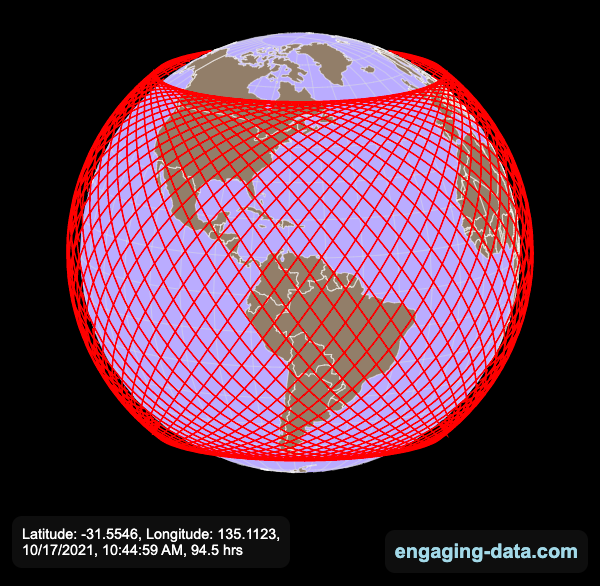
There is basically a line at a certain latitude where the density of population is highest. So must sats circle between between that area.
But to cover the things further north (or south) respectively, SpaceX also has sats in polar orbit. Those allow for coverage from the poles to the max latitude.
[0] https://science.howstuffworks.com/satellite6.htm
[1] https://en.wikipedia.org/wiki/Orbital_speed#Tangential_veloc...
Also check out
https://satellitetracker3d.com/
For a 3d visualization of Starlink as well as many other (all other?) satellites.
Be sure to zoom out
> Please rotate your device to landscape for the optimal satellite viewing experience.
Ummm...
Much like how it's in Tesla's best interests for the US not to invest in high-speed rail (hence Musk's "Hyperloop" stunt to prevent an infrastructure investment), it's in Starlink's best interests for countries not to invest in broadband technologies (whether it's mobile networks or fiber). I'm not aware of any plans to dissuade governments from those investments yet but I wouldn't be surprised to see it. Presumably Musk is too busy with Twitter at the moment.
is referring to the service area, not the number of competitors.
AFAICT that's exactly what Starlink is trying to do. Their satellites are in a low enough orbit to provide sufficient bandwidth for light web browsing, and they certainly have enough satellites to provide reliable coverage (by satellite standards).
Thing is, satcom is still much more expensive, much slower, and much more power-hungry than what folks have gotten used to with broadband home internet, LTE, and 5G. I have the feeling that it will always be that way - it takes a lot more power to blast a signal into space than it does to send it to a tower down the street, or to the router in your living room. The section of the general population that is willing to make such huge tradeoffs in exchange for truly global coverage is quite small. Militaries and certain types of businesses love it, though.
You already can.
Tons of people driving the Pan-American Highway from Alaska to Argentina are using Starlink now - it works flawlessly no matter what country you're in.
Same for people driving around Africa, across Central Asia, etc.
Pro Tip - order it in a country like Mexico and the monthly fee is way lower.
That sounds like an absolute distopian nightmare and the last person on earth that I want to be running this service is Elon Musk. In general I find it horrendous how a single american company can pollute the night sky for every human being in the world, whether they can use their services or not. Technologically I'm in awe of what Starlink achieves, it's an incredible feat - and yet I still think it's a travesty that it's allowed to exist at all.
Being overly dramatic just makes you sound silly.
> I find it horrendous how a single american company can pollute the night sky for every human being in the world
Except of course that with the visible eye you never even see Starlink and 99.99% of humanity has never seen a single sat, and don't notice it. And of those who have most have seen a short bus of sats for a few seconds. And somehow those people are still alive.
The sky is fine and not polluted.
There are some concerns about earth based astronomy but they are often overblown. And sats are just one of many things humans do that make astronomy harder.
More regulation to take into account astronomy make some sense, but SpaceX has been a model citizen in that regard.
I look at the sky regularly in a low light area and I've not seen any "pollution", but maybe I don't know how to look?
That pollution is much much less than the light pollution from cities and aircraft (both visual and noise).
If we’re going to care about pollution of the night sky it seems more effective to take on those cases that are already very intrusive.
Given that Musk was the only person with the ambition, capital, and ability to deliver such a project, you're basically saying that you'd rather have Starlink not exist at all than to have Musk in charge.
>it's an incredible feat - and yet I still think it's a travesty that it's allowed to exist at all.
Confirmed: You'd rather have every Starlink customer go dark than have someone you've been told to dislike provide those customers with a service they willingly sign up for.
Dystopia, indeed.
This visualization has revealed another reason to me: the satellites hit the northern extent of their orbit and dwell over our province. Who knew orbital mechanics would work out in our favour.
Here's a map of the ISS orbit (similar inclination) over time which shows the effect: https://engaging-data.com/pages/scripts/iss/iss3.png
Most are in a five year orbit. This means that if SpaceX loses control of the satellite it will deorbit in five years due to atmospheric drag. Under control they deorbit within hours. They plan on switching to a one year orbit in the future.
They have purposefully deorbitted hundreds of satellites. They had a couple of early satellites deorbit naturally without control, but all starlinks currently orbiting are under control.
Starlinks are designed to burn up in atmosphere. On deorbit they do not reach the Earth.
I imagine Starlinks are like other Musk products and get updates multiple times per month, but that's a guess.
> They had a couple of early satellites deorbit naturally without control, but all starlinks currently orbiting are under control.
A trivial check at any online database would find that there are many not under control. And satellites also still deorbit naturally without control pretty regularly.
Or do satellites need some power to continue to stay in orbit?
If satellites can deorbit without power what forces would cause that?
You can see the base station locations there, which is helpful in visualizing how the system works in various locales.
- 9,494 active satellites
USA 2926 China 493 United Kingdom 450
So the 5k plus from Starlink are in this count yet?
Taxes, US regulation, military shenanigans?
This one is particularly interesting for the sheer density of it - that's a TON of satellites. On a related note, anyone who hasn't done so should get to their country's lowest light-pollution area and do some star gazing (for Americans, I suggest Badlands National Park). With constellations like Starlink, we won't have those kinds of night skies for much longer.
There's a wikipedia page for list of starlink launches and just scrolling through it and skimming takes a considerable amount of time.
https://en.wikipedia.org/wiki/List_of_Starlink_and_Starshiel...
SpaceX has little reason to thwart any competition since it's just creating more demand for their services, thus in theory helping to reduce the cost of putting mass into orbit, funding future efforts and further solidifying their position as the industry leader.
Not that SpaceX could/would thwart competition since it would be met with a great deal of pressure from the gov.
You can literally see the satellites at night and they do not traverse horizon to horizon 1/10th as fast as depicted here.
Does that feel very slow to anyone else?
Imagine what that globe with red dots will look like then!
https://www.space.com/spacex-starlink-satellites.html
>The U.S. Federal Communications Commission (FCC) has granted SpaceX permission to fly 12,000 Starlink satellites, and the company has filed paperwork with an international regulator to loft up to 30,000 additional spacecraft.
When applying for permits, it makes sense to vastly overshoot your actual goal, it gives you negotiation reserves.
> 1 days, 17 hours, 0 mins, 21 sec ago.
> The next Starlink mission launches in
> 51 minutes, 19 seconds.
> Over the last 365 days, Starlink launches every
> 5.14 days on average.
Insane launch cadence on display. And it is only going to get better.
I'm pretty sure if a global vote was held on the question of "Would you like to have 10,000 satellites launched so you have the option of paying a US company for broadband anywhere in the world?", the vote outcome would be a firm 'No'.
What still amazes me is that the orbit seems to not be owned by any country. Reading from another comment it looks like the FCC regulated this - but I'm still confused since it covers multiple countries, and I'm pretty sure not everyone had a saying in whether they agreed on this.
As a possible future user, it's still spectacular though.
It's less than half, but not by that much.
Starlink has satellites in several orbits, but at least one I know they're using is 319mi (they have approval for shells as low as 210mi, but I'm not sure if they're using that yet). A human's central vision is about 60 degrees (NOT the same thing as your full field of view). The radius of the earth ranges between 3950 and 3963 miles. I'll call it 3955 for our purposes.
(3955+319) gives us a radius of 4274 miles. Throw in that 17,000mph (27,000 km/hr) figure, one can determine that a Starlink satellite moves at about 3.78 degrees per minute with respect to the center of Earth.
To make things simpler, (again, back of the envelope), I'm going to calculate this using basic trig. The radius of the earth is much larger than the satellite's orbit, so this shouldn't skew the numbers too much.
Imagine standing on the ground and looking straight upwards into the night sky. At a distance of 319 miles, your 60 degree field of view covers a plane that's 2⋅319⋅tan(30°) = 368 miles wide.
This plane cuts a chord through the satellite's circular orbit. Those two points are 2⋅arcsin(368 / (2⋅4274)) = 4.93 degrees apart.
Knowing both the angle between the two points on the chord and the angular speed of the satellite with respect to Earth, we can determine that the Starlink satellite will spend roughly 1.3 minutes (1 minute and 18 seconds) within your central field of view. So, the satellite is definitely not fast enough for the naked eye to miss it, assuming it's big and/or bright enough.
Normally, you'd be right about a picnic table hundreds of miles away. That's tiny and you'd never see it, no matter what speed it was moving at. However, satellites are highly reflective and because they're sitting high above Earth, they can be hit by sunlight even during the night. Maybe(?) they wouldn't be visible in the problem I just laid out, where you're looking straight up, but turn your head a bit and it becomes feasible.
Throw in the fact that there are thousands of them all marching in a spherical parade around Earth, and it's totally reasonable that they'd be visible from the ground. In fact, there's a whole website dedicated to this very phenomenon: https://findstarlink.com/. If we didn't have so much light pollution on the ground in my neck of the woods, the website indicates that I could see them a couple times a night.
> Starlink is the world’s most advanced satellite internet constellation, beaming terabytes per second to the most remote parts of Earth. Made possible by the advent of reusable rocketry, Starlink marks the beginning of a new age of orbital technology.
And 188 Gbit/s is still quite far away from Tbytes/s.
Also the later counters of Tbytes of "bandwidth" per day are somewhat weird measures. Unfortunately way too often people denote the measure of data/time as bandwidth while it is more accurately named throughput. Also as a rate it shouldn't be counting up like that. I suspect it means data transferred today.
Generally speaking I think the website is quite cool, but I wish they'd dial down the fanboyism.
My understanding was the intent is to serve traffic across the mesh and only downlink it at the closest terrestrial point, which should allow for significantly more.
"The Starlink constellation could serve up to 188.160 MB/sec to Earth."
So is that dot a decimal point? I suppose so, because it's used like that in the following numbers
"9,373,421.84 gigabytes total bandwidth to Earth so far today"
But isnt the 188 MB/sec the bandwith and the 9 million gigabytes the transferred amount of data? How can that amount go up way faster than 188 MB / sec?
I'm confused.
The maps nice though.
I don't see any reason why anyone living in or <100km near a city would ever want this. 5G mobile can already provide 500Mbps and fiber is just unbeatable. At least the night sky was ruined for a billionaire's useless constellation.
Because not every country has widespread consumer-grade 5G and fiber-optic infrastructure set up? I swear some of you here live in a bubble and don't consider that there's an entire world much bigger than just your <insert place of residence>.
I live in that kind of a country in the Balkan, and the overwhelming majority of people here get way less than 100mbs download speed in their homes, no matter how much they're willing to pay for better internet, because at the end of the day, there is no infrastructure, and the monopoly (*technically* a duopoly) of isps don't see any reason whatsoever to broaden their infrastructure
Previously I subscribed to a local ISP that only supported 5mb/s, then one of the large Telcos (Bell) offered a 4G wireless internet, but it only had 100GB cap. With the overage charges I incurred the cost was greater than Starlink and then they oversold the service so it was nearly unusable from the time the kids got home from school until about 9pm.
Starlink has been rock solid for me, it's been well worth the money.
Also, 100mbps internet is not achievable via normal means for most of the worlds population. Your view appears fairly narrow.
Starlink really is a game-changer for people who don't have other good Internet options. And there are a lot of them even if they don't live on a montaintop in Wyoming someplace. Can everyone in rural locations afford broadband at all? No. But Starlink is actually pretty competitive with equivalent broadband offerings.
I am a long way from being a Musk fanboy but Starlink is genuinely extremely useful for a lot of people.
Do you think being within 100km of a city guarantees good service? I used to live literally right on the outskirts of a major British city, the best internet I could get was 10mbps ADSL, not because there was nothing better in the area but because the local exchange was oversubscribed and no one could connect us with no estimate of when a space might free up. Also mobile signal was really crappy because it was in a valley.
But even ignoring that weird edge case - plenty of small villages around here where internet is really poor and there are no 5G masts anywhere nearby. A friend of mine has starlink because the only other option was 36mbps through BT, even though he lives few miles out of a city.
>>. At least the night sky was ruined for a billionaire's useless constellation.
On that we 10000% agree.
With all software in the cloud now (e.g. WMS) losing connectivity can cause a facility to stop, so having an entirely segregated line on an entirely separate technology platform is worth a lot. Lots of production/warehouse facilities struggle to get truly redundant lines to them, and often are sitting outside of 4G range.
By the way, I think that comment was from the 2023 SpaceX all-hands talk that was posted online if you wish to find it yourself.
I think the primary motivation for lower orbits would be compatibility with cellular telephones. While they have gotten it to work at current altitudes, it must be a lot easier at lower ones.
Other reasons could be decreased latency, less overlap/interference between coverage areas, reduced chance of Kessler syndrome, decreased power usage for transmission & reception.
I live in Los Angeles (the city, not the county), directly in between Century City and UCLA - https://maps.app.goo.gl/vUetG5fBjaiCkfXm8.
When we moved into our house in 2020, the best wired internet we could get was 12mbit/sec ADSL. There were no 5G providers. It took months to get one cable ISP to pull wire to enable us to get >100mbit/sec downstream, but it's still limited to 20mbit/sec upstream.
Currently there is fiber internet from AT&T that comes within 200 meters of our house, but they have no announced plans come to our block.
A quick search confirmed for us that it was from a recent Starlink launch, and not aliens.
> Important: The Google Fi Terms of Service require you to activate and use Google Fi service mainly in the United States (not including territories) for at least one day before using Google Fi abroad. If the majority of your usage occurs outside of the United States over a consecutive 90-day period, we will suspend your international data. Learn more at our Help Center.
Agree that fixing broader light pollution is a separate and important issue.
99.9999% of human who live have never seen a Starlink sat so this pollution is really not all that crazy. In fact most people find it interesting when they accidentally see one.
Also sats have been visible since literally 70 years, and many are more visible then Starlink.
Oversimplified.
No, that's not what I'm saying. I'm saying having Musk in charge makes it distopian, but even without him at the helm I'd rather it didn't exist.
>>Confirmed: You'd rather have every Starlink customer go dark than have someone you've been told to dislike provide those customers with a service they willingly sign up for.
No, I'd rather not have my sky polluted to satisfy an American billionaire's fancy, even if he has willing and paying customers. The night sky is a common good of every single person on earth, and he's playing with it to make money. I'd have the exact same complaint about any competing constallation, and in fact I am going to have it because Amazon is building a competing service themselves.
But that good shouldn't to serve millions of people with something they need.
You rather have it totally unused instead at all.
> I'd have the exact same complaint about any competing constallation, and in fact I am going to have it because Amazon is building a competing service themselves.
I have bad news for you because there are about 10 other major constellation in development and those are only the ones that are a public.
Not a single country has put major effort into stopping it.
Pretty much every country agrees that this space should be used to serve the needs of its people.
Only because nobody can sensibility obtain 100Mbps as a connection. I'm still stuck on 2Mb ADSL.
Where games are now 30-60GB in download, family streaming is a thing. This would be topped pretty easily.
You'd have to download 17 of those games every day to saturate your 100 Mbps connection.
It's about 350 hours of Netflix streaming per day.
And where does the atmosphere end? :) From Wikipedia[1]:
Exosphere: 700 to 10,000 km (440 to 6,200 miles)
The exosphere is the outermost layer of Earth's atmosphere (though it is so tenuous that some scientists consider it to be part of interplanetary space rather than part of the atmosphere).
After they reach their target orbit they go into dark mode and you will never see them unless you operate like a top 10 in the world telescope.
It was both amazing and disturbing.
I remember as a kid (far before Starlink existed) that we'd always go stargazing when we were camping (far from any city light pollution). And the longer you'd watch, the more you would see 'stars move'.
The ISS is also very clearly visible. It's pretty wild to see it re-appear every 90 minutes or so. Insane to think how fast that thing is moving.
Without the shield, you’re right that the satellites would be visible post insertion.
Kinda makes me wonder what we're going to do about all these satellites in 50-60 years when there's thousands of decommissioned ones floating around.
Higher orbit debris could last a lot longer.
I do a little stargazing with binoculars.
I have family on a rural network with solar-powered relays setup on islands. New retirees to the area are just buying starlink without even asking about the local net. So it is no longer being expanded to new locations/islands. The new people also dont want relays on thier land. They dont support the local/cheap option it because they have been sold starlink by whatever off-grid company is setting up thier new cabin.
From my experience it is quite the opposite: they know you have nowhere else to go so you will buy their connection anyway.
Much depends on geography. In the flat areas of the midwest there are tall towers serving expansive areas. Those are the ones with licenses and local monopolies. But in rough or mountainous terrain the net requires lots of little relay stations and is done using non-licensed 2.4ghz spectrum. Those small companies remain friendly because they know anyone can jump in and compete. The one my family is on relies on a chain of relays on islands to connect a couple villages to a local cell tower location where there is fiber. Everyone knows the cell service is bad and there is no wired internet. So when the relay stations need fixing, boats and skilled labor show up to help get the town back online.
Has your family tried talking to any of them about it?
The US is notorious for its lack of competition in local broadband providers but this is less true for other countries. So while Starlink may disrupt local monopolies of higher prices and worse quality in some places, especially in the US, in the long term it's rational to expect them to aim to replace the monopoly, not to continue having to compete.
Is it that I say that monopolies can increase efficiency (e.g. Apple making their own chips and having their own stores)? Is it that companies often disrupt industries by pricing out competition at a loss before hiking prices? Is it that US broadband providers often operate in effective monopoly positions? Is it that Starlink can be disruptive to those monopolies? Is it that it's rational to expect SpaceX to want to be the new monopoly rather than being stuck in permanent competition?
Heck, I literally use Starlink because cable wasn't available and I didn't want to pay for copper until we'll be connected to fiber hopefully later this year. I'm not arguing Starlink isn't useful to consumers in the short term or that there aren't legitimate use cases that can't be equally served by other existing technologies. That doesn't mean there aren't obvious problems with it.
>So when the relay stations need fixing, boats and skilled labor show up to help get the town back online.
I'm sure if you factor in the costs of this plus the nontangible costs of downtime, Starlink is far superior, even if it is more expensive.
* 3 billion people don't care because they don't use the internet
* 7 billion people don't care because they wouldn't be able to afford it anyway
* 7 billion people don't care because the question doesn't make much sense to them nor do they really understand what it is about
* 4 billion people likely won't participate because voting is not an activity they are familiar with and/or is not something they desire to participate in.
Direct democracy also has a pretty bad track record in producing just, principled, and reasoned results.
But nearly all 7.8 billion live under the night sky and see 'moving stars'. And that's why I think a global vote would come out saying 'no'.
I think you're right that the vote would be no, but not for the same reason you do.
I think many people reading:
> Would you like to have 10,000 satellites launched
... would stop right there and say "I have no idea what that is, so no"
So... you're critizing having no elections by assuming the outcome of one based purely on personal intuition? I think you're making the same mistake you seem to criticize.
Also just think about the impracticality of doing something like that and at the same time the fact that of that 7.5B, 90% probably wouldn't care. How many complaints about starlink have you received from, idk, China or Zimbawe or rural Russia?
People can be trusted a lot more in the second category, which is generally also their right. If they have valid concerns that are getting dismissed, they're not gonna like talking to you.
I know personally that when I chose from menus at restaurants I am hilariously bad at picking what I like, while my wife is consistently better at choosing what I like.
But yes, they're not big enough to cause a "space junk preventing space travel" kind of scenario.
And it's absolutely not true that the US is the only country that has a say here. International regulatory bodies exist as well. Maybe the citizens of some countries don't have effective governments that express their will at the UN but that's not SpaceX's fault. There is a process to have everyone's voice heard. It's not the wild west.
And I think you underestimate how much people like and want truly global wireless internet service. The value to the world is enormous.
I’m British, so this question definitely applies to me, by the way.
7% of the world has a college degree.
The median full-time fast food worker in the US is in the top 6% income, globally.
There’s always going to be capex to bring the internet to far-flung places, but my point was that starlink means it’s no longer “dig a 100km trench and install a fibre” expensive.
It's always funny to me when I see this "7.8 billion people didn't choose a private corporation", as if they chose the american government lol.
It's surprising to me so many people are angry over the sky being polluted visually, and not over common air poisoning by burning fuel, river pollution by dumping waste, ocean and sea pollution by ship transportation, plastic pollution, and many other... Rain water is already above (arbitrary) safe toxicity level and so shouldn't be drunk... So what you're doing is you're in a house fire and complain on some noise. This doesn't mean of course you're wrong: the pollution is a problem to astronomers and to the safety of space ventures.
And of course once all goes to hell and you have a chain reaction of destroyed satellites destroying other satellites - each next satellite moves the scenario towards a positive feedback loop.
There is no orbital solution in which this happens to any meaningful extent. Even worst-case scenarios of massive anti-satellite activity create localised messes that clear in a few months.
One implication is that the distribution of debris in orbit could render space activities and the use of satellites in specific orbital ranges difficult for many generations.
Sure, if you overload a high orbit you could render it unusable for a long time. In its worst case, it’s still highly localised. Congestion in LEO has tradeoffs, but Kessler syndrome (much less a scenario) isn’t one of them.
> However, even a catastrophic Kessler scenario at LEO would pose minimal risk for launches continuing past LEO, or satellites travelling at medium Earth orbit (MEO) or geosynchronous orbit (GEO). The catastrophic scenarios predict an increase in the number of collisions per year, as opposed to a physically impassable barrier to space exploration that occurs in higher orbits.
There's also a statement by SpaceX about why Starlink won't cause this but that's not worth the paper it's printed on given that SpaceX would of course say that.
It does sound like the Kessler syndrome risk is higher for heavier, higher orbit satellites so a more likely issue would be a higher orbit satellite starting a debris cascade that could take out Starlink (and cause Kessler syndrome) rather than Starlink satellites going haywire and causing the cascade themselves.
A Kessler scenario, not syndrome. Localised to a set of orbits within which you see a rise of collisions. The number of affected orbits doesn’t increase for more than a few months, at which point the problem is constrained within space.