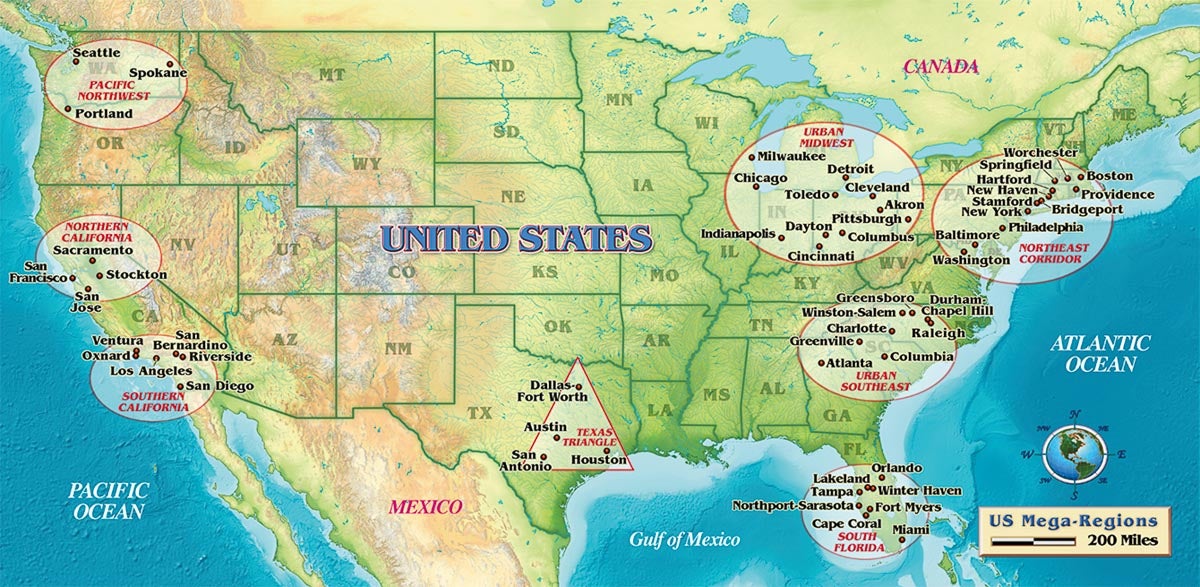
The Texas Triangle: A rising megaregion unlike all others (2021)(kinder.rice.edu) |
The Texas Triangle: A rising megaregion unlike all others (2021)(kinder.rice.edu) |
[0]: https://www.texascentral.com/project/
Edit: Whoops, wrong project. Still, the plans are there, we just need willing politicians.
Is this a state policy? It isn't necessarily a city one, see https://www.star-telegram.com/news/local/fort-worth/article2... and related which I've seen pop up in the news at time for decades. "The City Council has authorized the use of eminent domain 29 times in the past two years, the most the city has used the land grabbing tactic since 2013."
The people downvoting this have clearly never had government agents steal anything from them. Or believe that when they do, it’s always “for the greater good”.
Best private alternative I've found is Vonlane (https://vonlane.com/) - takes longer than flying but it's a business class bus so you can get work done.
Unless you have exceptionally fast and direct rail, the train is almost always slower than driving, even in Europe, when counted door to door.
This is in contrast with e.g. the "Northeast Corridor," where dense towns (sometimes denser than Texas's urban cores) line the roads and rail links between the major cities.
1. Distinctive set of demographic and economic realities
This is not a very compelling argument. Different places have different people. We should not be surprised by this observation.
2. Integrated economic system within a single state
Same article also cites other one-state megaregions like Florida, Southern California, Nortern California.
Much better than boring old oval megaregions.
Yeah, this also seems pretty unsurprising. California, Texas, and Florida are the three largest states by population, and Texas and California are second and third by area respectively. Florida does seem like a bit of an outlier here due to being much smaller, but because of Florida's shape, the majority of the state doesn't border any other, so this seems more like a geographic property of the megaregion rather than a political one.
[1] https://kinder.rice.edu/sites/g/files/bxs4896/files/images/U...
https://www.texastribune.org/2024/04/02/university-texas-aus...
https://www.texastribune.org/2021/03/09/texas-legislature-ab...
Said it for years, thinking you're safe because you live in a comparatively liberal community or subculture within a state dominated by right wing zealots is foolish in the extreme.
They "came" for "immigrants," trans kids, gay marriage, women's rights, etc., and they're going for more.
I would never move there, I won't travel there, and my daughters sure as f--k won't apply to colleges there or take jobs there.
Not until Abbot and Paxton and Cruz and their ilk are gone forever.
If you were going to include Spokane, it isn't that much of a stretch to include Boise as well.
The author has several associations, but his official title on LinkedIn is: Director for Economic Growth at George W. Bush Institute https://www.linkedin.com/in/cullum-clark-09549159/
I feel like articles like this is mentally preparing the American public for a potential secession states forming post-election.
There's still a ton of farmland/open/rural space, but you pass a number of smaller cities along the highway (Waco, Temple, West, etc), and some of them have been exploding economically. Some are unrecognizable from how they used to look
I can't really compare it to the Northeast Corridor, though. I lived in NYC, but not long enough to really have a connection much beyond the city.
My place is inside the 610 in Houston. More precisely Third Ward/Museum District.
I think even most Texans wouldn't put Austin and Dallas in the same region. Dallas is radically different from Houston as well.
That said, if you look at what they are calling mega-regions, I think there are many departures from what people in those areas would think. For instance, most people in North Carolina would think of the Triangle as its own thing and Atlanta as another, separate thing. Here, they are saying that Atlanta and the Triangle are the same. Maybe because of people connections? Not sure? But that would strike people in the Southeast as strangely as looping Austin-Dallas-Houston into the same thing strikes Texans.
ETA:
Actually, now that I've looked more closely at the map, I'm not sure it lines up at all with what most people would think? I notice in the Midwest region, Columbus and Dayton are on the map in spite of Chicago's rail links to St Louis, Urbana-Champaign, and perhaps the most baffling omission on the map, Minneapolis? They got some serious economic firepower up there in that metro, and more commercial links between them and Chicago than anyone else in the region. Maybe because Minneapolis is thought to be its own thing? Whereas they don't believe Dayton or Columbus are their own thing?
It'd be interesting to read how these regions were determined? On the surface, yes, many of them seem a bit, off?
https://en.wikipedia.org/wiki/Megaregions_of_the_United_Stat...
1. Pretty much all the cities in Texas are rather progressive now - like pretty much everywhere else it's an urban/rural divide now. Houston was the first city in the US with a lesbian mayor.
2. Austin is still the tech center, but I've started to see more companies (and people) move to Houston or Dallas as Austin has gotten ridiculously expensive.
3. You are correct about the wide expanses of nothingness in between the major urban/suburban areas, but I don't think that's quite critical to the author's thesis. That said, as Austin has gotten more expensive I lot of areas further out that I used to think of "nothingness" now have seen big booms. Lots of places between Austin and San Antonio in particular feel like they've exploded over the past decade.
4. One thing that I think that you're likely to miss from asking HNers is that, at least among people I know, there is much more "connectedness" among the cities between people and industries not in tech vs. those in tech. E.g. on the upper end folks I know in legal and banking travel fairly frequently between some of these cities, and on the lower end I know a bunch of Mexican immigrants that have friends and family spread out in San Antonio, Houston and Austin.
The big question in my mind is climate change. I've lived in Austin for a quarter century, and while our summers are always hot, last year was a new beast entirely - relentess week after week after week of 105-110 weather. I'm doing everything I can to get out of Austin in the summer now.
Plus, very few are even thinking of flying between the cities. Car ownership is high that flying to visit one of the other cities is definitely an edge case.
But more to your point, there are plenty of other sizable cities that are not part of the megaregions the author highlights, and I would agree that those cities are less dynamic and less engines of economic growth due to their isolation - places like Phoenix, Salt Lake City, Minneapolis, etc. The only difference I think is that it "feels" to me like there is an emerging megaregion on the eastern slope of the Front Range in Colorado, i.e. Ft. Collins-Boulder-Denver-Colorado Springs area.
However that someone in Dallas is more likely to choose a supplier in Austin than one in Boston is interesting - once you leave Dallas does the extra distance to Boston mean anything? I can come up with all kinds of weird ideas.
https://www.tsl.texas.gov/ref/abouttx/annexation/march1845.h...
"Third. New States, of convenient size, not exceeding four in number, in addition to said State of Texas, and having sufficient population, may hereafter, by the consent of said State, be formed out of the territory thereof, which shall be entitled to admission under the provisions of the federal constitution. "
(This is Texas trivia for mutual amusement, not a serious suggestion.)
I’m not here to debate transit philosophy.
Similarly Marseille to Paris is only 3.5h by train while driving is almost 8h. It entirely depends on your source and destination. Between major economic hubs train is usually faster than driving, and as you can see by a significant amount. For other routes the train is similar or slightly slower.
In North America, on the other hand, the train is almost always MUCH MUCH slower than driving, if you can take it at all. Not to mention far more expensive.
Other than that problem, though, I can't imagine a more fun rail business trip than along the beaches of the Pacific.
As more fine grained details, from my place in Burbank to my friend's place in Carlsbad was 99 miles. It took longer to drive that than it takes me to drive from Dallas to Austin with is twice as far.
That's not to say we shouldn't have the trains, it's part of the entire transportation package.
The key is you build the transportation framework first, and let the city grow up around it.
I used to use it all the time, it was only faster than driving on Friday afternoons, and even then half the time it would be quite a close cut.
Much, much more comfortable and fun! But not exactly faster, especially when I counted getting dropped off in time to catch the train and getting picked up on the other end.
Edit: to follow up on your Friday comment. I made the mistake of not driving down on a Friday night, and waited until the next morning. The mistake was not knowing anything about the ponies running that weekend, and half of the LA basin was trying to get there. That was the one and only time I was sitting on the highway where I felt like I was in one of those disaster movies where everyone is trying to flee. I kept looking to see if someone was taking advantage and shooting some b-roll. It took me nearly 6 hours that day.
More so though, door-to-door is probably the most charitable metric for driving compared to trains. I presume door-to-door drive time is not assuming peak rush hour traffic?
Which is what makes the metric a bit weird: (A) makes odd assumptions about traffic conditions, (B) does not take into account that you can save time by being on a train - you can sleep, eat, do work, relax, pee when you want to, whatever.. If you drive door-to-door, all you will have done is likely just driven door to door. Less so with a train trip.
It can't be just about money - governments successfully negotiate with unions that hold the whole country over a barrel with strikes of essential services.
But eminent domain to build vital infrastructure? No - forced confiscation is the only solution. Strange.
When there are potentially tens of thousands of property owners along that path, each property owner can derail the whole thing or add enormous costs, so they have an insanely strong negotiating position. If you were just to attempt to negotiate with each property owner, the cost would make building new rail in a populated area impossible.
There has never been any real length of railroad built through a populated area with many landowners without some kind of government intervention akin to eminent domain.
So the government is in a position of "we'll give you X for this, but if you don't agree we'll just take it from you", which is a... non-Texan position for government to be in, to say the least.
Texas government doesn't seem to have that reservation when it comes to highway expansions within cities, that's for sure.
Now imagine that you had to negotiate with 10,000 homeowners. At least one of them is going to insist that their place is worth one billion dollars and count on you caving because they can hold up the entire project.
That's why forced confiscation - because people try to hold the project hostage for ransom.
Unions hold countries hostage by closing down rail or airports. Still, a solution that doesn't cost 1 billion dollars per person is always found.
> imagine that you had to negotiate with 10,000 homeowners
Imagine you offer them 2-10x market value. With a confidentiality clause. And the threat of confiscation or project abandonment. I believe an amiable solution would be found in most cases.
(Also China is a huge, spread out place just like the US, so miss me with those arguments about that being the reason passenger rail doesn't work here.)
Overall, it doesn't really strike me that Texas is actually any different from any other state West of the Mississippi. Do you have the data to show otherwise? As-is, in Texas: "Private property can include land and certain improvements that are on that property. Private property may only be taken by a governmental entity or private entity that is authorized by law to do so. Your property may be taken only for a public purpose." [1]
I'm curious if anyone knows of certain restrictions that exist in Texas that do not exist in other states. I would tend to assume that Texas is actually just exactly like the rest of the country when it comes to eminent domain laws.
As for reasons to up-vote or downvote.. There's an interesting history for the national highway system, eminent domain was used very heavily to build highways through the centers of virtually all major cities west of the Mississippi. For sure, it was not the rich parts of the cities that were plowed. So, even a stereo-typical twitter "left'ish" might disagree with you that they must believe eminent domain to be a good thing and always for the greater good. To this extent, I feel your comment is more talking points than actual dialog.
What's more, nobody should ever assume to know what someone else believes, or to assume to know their history. One problem with the human mind, it has trouble grasping that there are 9 billion individuals on this planet who are all different from one another, each and every single one of them.
[1] https://www2.texasattorneygeneral.gov/files/agency/landowner...
But even without this, the cost to build public transportation in the USA is absolutely insane. The latest figures for light rail in Houston indicate it costs $126 million per mile to build. Houston's "inner loop" (most of the densest housing, central Houston area) is 9 miles by 11 miles, and accounts for just 15% of the city of Houston's land area, or <1% of Houston metro land area. In order to get a "light rail" (above-ground subway) within 0.5 miles of everyone in the just the inner loop, you'd need to build 400 miles of light rail: 18 lines going east-west, each 11 miles long, and 22 lines going north-south, each 9 miles long.
So at $150M per mile it would cost $50 billion to build this just for the inner loop, or $330 billion for the entire city of Houston, or $5 trillion for the Houston metropolitan area. Houston's budget last year was $6 billion, and the GDP of Houston metropolitan area is $513 billion/year.
Inner loop: 96 mi^2, 450,000 people
Houston city: 665 mi^2, 2.3M people
Houston metro: 10,062 mi^2, 7.2M people
Granted, if this was built for the inner loop of Houston, the density of both residential and office space would shoot up immensely. People would love to be able to genuinely get around without a car, and right now vehicle congestion is the #1 thing limiting most inner-loop neighborhoods from expanding any more.
They really just need to wait until the older owners start to die off where their kids would rather have a check than the land. It might take a few more generations though. Generational land ownership is a helluva drug
Feudal lords like lording it.
But what about the steelman version of the case? I think it's a lot stronger.
Inter city trains in the UK aren’t running on dedicated high speed lines - they’re Victorian routes, pass through plenty of stops on the way and are generally 2 or 4 tracks.
They do have priority over freight though - which along with incremental upgrades over decades means the trains can run at 125mph for parts of their routes.
If 300 km/h isn't good enough, then get on an airplane. The altitude means much lower aerodynamic drag and the distances you are traveling often need airplanes anyway. Trains are good to around 1000km of travel distance. If your trip is longer fly.
And just to be clear, different societies differ on where they put that marker. Canadians believe in free hospital visits but not (yet) in free drugs, dental, or vision care. Most westerners believe in free fire and police, free schools, and free roads to drive on. Some people are starting to experiment with food and basic housing also being human rights and therefore free, though that's not yet widespread.
A lot of Americans are okay with occasional airline bailouts if it means cheaper ticket prices. So we're definitely okay with taking some things from people for the sake of investing in transportation infrastructure (roads, bridges, parking lots, airports). Just... not for trains.
The question here is to what extent should the government be able to take other things (besides money) from individuals in order to provide other services to some. I believe it should be limited as much as possible, any many agree with me. It would seem Texans generally do too, as no politician has come to power on the promise of building a train from X to Y by any means possible. (Much to the chagrin of random internet commenters who have in all likelihood never traveled from X to Y in their life and never will).
We did exactly that with freeways, and freedom-lovers generally view the open road as a vast source of individual opportunity, not a symbol of the crushing boot of government. Should we not have done that?
Completely different situation. You only need the majority of the workers in the union. No single person or small group of people can hold up the process.
For this situation to be at all similar to a union negation, you’d need to group all affected property owners together, offer them some multiple of property value each and ask for a group vote as a binding decision.
That’s still eminent domain, just potentially with a higher payout, which equates to a higher cost to the taxpayers.
Considering the astonishing inefficiency of government works I really doubt confiscation compensations is a significant expenditure.
If we stopped eminent domain though, property purchase prices probably would become a significant portion of the total expense.
Sure. It's often found in the form of a court decision.
> Imagine you offer them 2-10x market value. With a confidentiality clause. And the threat of confiscation or project abandonment. I believe an amiable solution would be found in most cases.
Sure - in most cases. And for the ones that won't? You're going to have to either abandon the project, wait for them to die, or confiscate.
Then you confiscate, sure. And show publicly that you offered 10x and were refused. But not confiscation by default, in all cases.
I guess my argument is that if you really want something, you better pay up. Like for anything else, from cars and boats to 10x developers. What if the government could come to you whenever they want and say: I forcefully require your work and talent and I will not pay more than market price for it.
On the other hand, if your family has been living on that ranch and tending that land for hundreds of years, and every generation has contributed to building out and maintaining the homestead, the government can’t properly say “well that derelict lot down the way sold for 100k, we’ll give you 1M and call it fair”.
They don't (at least, I don't think they do).
I don't know if I said something that you interpreted as "confiscate first", but that was not what I meant.
I mean if you're gonna f_ck me in the end anyway, at least have the decency to buy me dinner first.