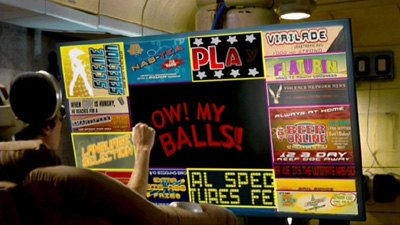
Roku files patent to inject ads via HDMI(patents.google.com) |
Roku files patent to inject ads via HDMI(patents.google.com) |
It doesn’t even have to provide a combined search list. Just something to act as the base OS and launcher for each platform. I know what I want to watch and presumably which one provides it. I just want something to attach to my dumb TV that can play the video.
No suggestions. No promoted content. No ads. No upsell.
Does such a thing exist?
https://arstechnica.com/gadgets/2024/04/what-i-learned-when-...
However I wouldn't say that the streaming services make the interface suitable for consuming via a TV. Windows lost it's Media Centre interface, and most services are hostile to Linux.
Video is still an area where piracy provides the best experience.
You don't need to own other Apple devices to use an Apple TV. If you do, though, there's some convenient integrations, like being able to use an iPhone as a remote, play audio through your AirPods, or stream audio/video from your phone or computer to the TV.
For purchased movies, Apple TV does not impose silly geo-restrictions, unlike Vudu and MoviesAnywhere.
You select whatever video you want to play on your phone or computer and "cast" it to the TV and the video then plays on the TV. There's no suggestions, no promoted content, no upsells, and no ads. Beyond that, a big advantage is you don't have to navigate clunky UIs with a remote, Chromecast barely has a UI at all. When you aren't casting anything it just shows a random picture (usually landscape or cityscape) and the current time.
Another feature I really like and use all the time is the ability to seamlessly switch the TV I'm casting to. Useful for times I start watching something downstairs and then I wanna finish it upstairs.
It's ok, I guess, if Google has all your data already anyway.
You'll need to do a little more legwork to replace them.
I wonder if this is because consumers wont actually pay for it, or because the market is unable to deliver it (due to money grabs, etc)?
I have the 2nd gen, so there were no adverts when I first purchased it.
It’s a dang shame that AppleTV is the only streaming box that doesn’t track what I watch to sell. But that seems to be the world we live in. Aside from being expensive it’s a great product and I definitely recommend it.
we are one deal away from having TVs that autoconnect to xfinity hotspots / amazon sidewalk, to upload telemetry and download ads.
I can see people having to open their TVs to cut the wifi chipset's power/antenna in the future to avoid ads.
If this crap isn't stopped by law it will just keep escalating.
For a long, long time they used to be the "neutral" choice: while Amazon and Google were squabbling and removing each other's apps/products, Roku didn't have any beef with anybody and would therefore have the most complete selection of available streaming apps.
Who did they think this was a good idea? They are doomed.. Who is going to buy this crap?
¹ https://www.theguardian.com/world/2013/oct/30/nsa-sketches-e...
https://www.reddit.com/r/slatestarcodex/comments/bsx72f/say_...
How’s the ink jet printer industry doing these days?
Yeah. If everyone does it the only fix is a law. And clearly we don’t pass those anymore.
A critical mass of consumers is now so passive and docile that they don't change behavior as they're boiled alive.
Every single inkjet printer is trash because they all adopted the same tactics.
All the TV makers went to selling your advertising data. What makes you think they won’t all do this?
Google, Tizen, and WebOS are the major TV players, with Roku also somewhere in the mix.
All three of these companies do some level of surveillance, and yet they, or another proprietary device, are often required to watch streaming services.
You can argue that streaming services are unnecessary, but that means both spending a lot of time and money on physical media, or simply missing out, as many shows are now only showing on streaming, and not broadcast anymore.
HDMI includes multiple protocols: https://news.ycombinator.com/item?id=31828193
HDMI blocked recent AMD contribution: https://news.ycombinator.com/item?id=39543291
Ink jet printing is protected by patents. They will expire eventually.
There's good competition from cheap laser printers.
> If everyone does it the only fix is a law.
What makes you think so? You could first try opening up the market more. You can lower barriers to market entry. Eg for new upstarts, for established companies in other industries trying to branch out, and for foreign would-be rivals, too.
That's true. You will need to install the applications by yourself. A bit of work but worth it, I think.
Last time I tried they didn't work well at all.
What I meant was getting a media server running.
Fast food has usually been more expensive than (not just “not at a discount to”) better food, ceteris paribus, because you are paying for “fast” in both money and quality.
It is less expensive than better food that also has higher grades of service when the demand for service at the level at issue is sufficiently great compared to the demand for speed.
But even if my framing is wrong, the fact remains that fast food has traditionally been cheaper than better (restaurant) food and only recently has that discount started to go away.
Sad and self-correcting by self-eliminating consumers. But that will take time and smaller markets are a net negative for the survivors.
> they don't change behavior as they're boiled alive.
If you want privacy don’t use iCloud.
- iCloud is a privacy nightmare
- iCloud e2ee with ADP is sometimes-kinda e2ee
Edit: I'm a big fan of the Cooler Master GP27Q and GP27U. They both have eye-bleedingly gorgeous HDR and won't break the bank. You can get the Q for about $550 and the U for under $900; the difference is that the Q is 1440p and the U is 4K.
The only criticism I have at all with them is that the firmware is kinda fucky (you will be spending your first few days with it constantly messing with settings, I guarantee) and doing computer stuff can be aggravating with FALD active; for example, I can scroll through a reddit post and watch the background color change between white and various shades of gray as I scroll, depending on the density of the text. But this is a complete non-issue if you're buying it as a TV replacement, and even if you are using it as a regular computer monitor, you get used to it real fast (and you can always turn off FALD when you're not watching something).
I want everything for free or cheap, I’m surprised it sucks, I have no choice. I have no money because I pay too much taxes and my cheap house is too expensive.
There’s a whole world of non shitty products out there that you could buy if you weren’t cheap. Most of them are less expensive than the products you DO buy.
My barista trained in Italy, and doesn’t have a liberal arts degree. I pay less for cappuccino than a drip coffee in Starbucks it doesn’t have any ads on the cup.
That’s my backup plan at least.
They still need a darker room than a TV, though.
Brother and Epson have ink tank printers which take third party refills.
From personal experience Brother is slightly more expensive upfront but much cheaper to run than HP.
Buy a laser printer, duh.
b) most annoyingly, some android TV devices (e.g., nvidia shield, ccwgtv) use renegotiation instead of VRR for framerate matching. The FO48U supports VRR from 48 to 120Hz, which is more than enough to do framerate matching even with blackframe insertion for all desired framerates, but many android TV devices renegotiate instead. That means pressing play on Netflix takes 7 seconds until it starts. Quite annoying.
Still, it's preferable over TVs with shitty built-in OSes.
But I'd take a few seconds of renegotiation over frame rate juddering any day, at least for film content (maybe not so much for shorter Youtube clips).
To operate in China, Apple has to run parts of iCloud on CCP-controlled hardware. Presumably this is to preserve the same government surveillance access that Apple explicitly preserved in the USA at the behest of the FBI (as reported by Reuters).
https://www.reuters.com/article/idUSKBN1ZK1CO/
iCloud syncs the list of recently emailed contacts to Apple, so Apple has your social graph and important contacts even if you don’t use Apple email, iCloud contacts, or iMessage/FaceTime. There is no UI to disable this, it must be done via provisioning profile.
As for ADP - Apple stores file and image plaintext hashes non-e2ee, which allows Apple to see which set of people has unique files, and when. If I make an original meme or document and send it to you, even via AirDrop directly, if we both use iCloud and ADP then Apple knows that we have associated, and when. If you share it to a third person, Apple knows that too. Also, if anyone you iMessage with doesn’t have ADP enabled, your full iMessage conversation history with them remains readable to Apple (and USG et al).
https://support.apple.com/en-us/102651
> Some metadata and usage information stored in iCloud remains under standard data protection, even when Advanced Data Protection is enabled. For example, dates and times when a file or object was modified are used to sort your information, and checksums of file and photo data are used to help Apple de-duplicate and optimize your iCloud and device storage — all without having access to the files and photos themselves. Representative examples are provided in the table below.
Also, iOS in general is a privacy cesspool. You can’t install apps without identifying yourself to Apple, and doing so sends your IP (coarse location), Apple ID (phone number), and device hardware serials to Apple. You can’t ever change or disable this. Even if you don’t use iCloud, the hardware serials are sent to Apple and it maintains a persistent serial-linked connection to Apple for APNS at all times. This cannot be disabled. Additionally the connections happen early in the boot process so they will bypass any user-installable VPNs (provisioning profiles can use old outdated VPN protocols and I think can load before these connections, but approximately nobody uses VPNs in this fashion).
The moment you install a SIM card in an iPhone, the device serial and SIM card phone number are known to Apple and linked, as it will immediately try to register for iMessage without prompting you. This happens even if you don’t use iCloud, and thus is independent of ADP.
This means that wiping the device and swapping SIM cards is useless from a privacy standpoint, as the subsequent phone numbers will be linked by virtue of the device serial (and will also be linked to your IP, bypassing any UI-configured VPN).
You don’t need to trust the provider to not read your files if they are encrypted clientside and they don’t have the keys.
Hilarious. I love how all the streaming companies are hijacking the pause control now. Why do you think I hit pause? Pick one or more of the following:
1. I need to go to the bathroom.
2. I want to inspect the current frame more carefully.
3. I want to see an ad for psoriasis medication.
Hint: One of the above answers is wrong. Think about it and get back to me. I'll wait. (I did hit pause after all.)
Anyone who doesn’t do everything in their power to avoid adverts is part of the problem.
Says everybody until they are wanting to advertise their own product.
When you do, there will be a moment in between when you can see the screen but haven't hit play yet. This is a prime ad opportunity.
If you are watching with others, they may wait for you while you go to the bathroom. They will also be able to see the screen.
Sorry for not being any fun. I just think Roku is behaving somewhat logically here. (I say "somewhat" because there is one issue: speaking for myself at least, would never buy a TV that does this!)
"It is done!", responded the CEO, eyes hidden behind the ceremonial quarterly meeting headdress, shielding them from the immense heat of the lava.
Rather curious that Mr. Ellison owns an island in a volcanic archipelago, isn't it?
LG, Samsung, and Skyworth TVs have also injected popup ads over games/DVDs/Blurays/whatever. LG's OLED monitors have even been pushing ads on PC users.
USB-C connectors using the DisplayPort protocol is the best of all worlds
(To be clear: I want HDMI to die, DisplayPort to win, and AMD to get their crap together. But at the end of the day, we need support on both the GPU and the Monitor/TV side, and that's where it's lacking.)
As to the nature and science education, documentaries, great films and TV shows that entertain and help us experience the human condition through great visual art and storytelling, those can be had without subjecting yourself to advertising (other than whatever advertising they put in the programs themselves) by using ad-free platforms like Jellyfin or Kodi running on whatever available piece of hardware (old laptop with broken screen and keyboard, SBC, discless workstation, ...). There is no reason to give in to the ad juggernaut, it can not force your door or pry open your eyelids to force you to watch. Just don't use anything which pushes ads and you're set.
This is not fantasy, it is the daily reality of countless individuals and families. You don't need to give in to the advertising industry.
First tv ad in 1941, first radio ad in 1922, first newspaper ad in 1704, first known written ad in 3000 bc.
If ads are cheap and margins for your product are high, you don't care if your ad bounces off of 1,000 people as long as it turns 1 into a paying customer.
I never have that; it’s always irrelevant stuff OR stuff I just bought (because the ad tracking know I was on that other site looking at that product; somehow they don’t know I bought it so now I get weeks of a product I no longer want to buy aka fully useless) so will definitely not buy again.
(IANAL.) I'd like to remind Big Co's that contracts aren't valid if there isn't consideration. And continued use of my own TV isn't consideration. (And this is backed by legal precedent, too.)
I wonder if there's a way to flash your TV with some OS that doesn't invade your privacy.
Roku data breach: Over 15k accounts affected
If anything this reflects positively on Roku that they announced it
When given choice, people escape them - via netflix or adblock. The same people spend their free time watching youtube reviews, chatting on gear forums, or recommending each other deals on social media; it looks like people genuinely want to learn about good and fairly priced products.
I sincerely hope we’ll find a better way of reaching an audience than forced ads.
I just subscribe to paramount plus again to watch discovery. Seems perfectly reasonable, they give me a program I want (with no product placement from what I can gather - unlike the JJ Abram’s films with their “Budweiser classic”. I don’t think a self sealing stem boot counts), and I give them £8 a month. Everyone is happy.
However you try to double dip and I don’t give you a penny.
Here's bunnie talking about dealing with HCDP when building out the netv.
https://www.youtube.com/watch?v=gZeCvEa7OqI [starts around 14:30]
I see in the article they mention a more passive monitoring identifying "when there are pauses", but how could that hold up to any scrutiny?
https://en.wikipedia.org/wiki/High-bandwidth_Digital_Content...
They aren’t injecting anything into the video stream they are just showing ads in the same way they’ll show a volume bar.
You could leave OFF common features like motion smoothing, saving you money, and it would honestly be a more "pro" TV.
If Roku wants to display ads, they can already do so if the content originated from their system. If Roku is displaying content originated from an external system, that external system can display their own ads to defeat the detection of pause events. (DirecTV already does this).
I try to stay above stuff... but fuck this.
Because why would I watch things on my 6" smartphone or my 14" laptop, when I already have a 50" screen?
Because I can hook a controller to it and stream games from my Steam library despite owning zero devices running Windows?
Because I never watch cable TV, so why else would I even own a TV?
"Smart" refers to how it benefits the manufacturer more so than the user.
I use a mini PC with an air mouse to add my own "smarts" that I can control.
https://www.privateinternetaccess.com/blog/samsung-smart-tvs...
Anyway, it doesn't violate wiretapping laws, because the resources/budget to uphold the law isn't high enough. A programmer might say they chose availability over consistency.
Source?
Also, do they do it only on Roku TVs, or even Roku devices like their sticks?
Note that this isn't documentation of their data collection practices, this is ad copy providing one example intended to convince advertisers to pay them. They mention TV but my guess is that this applies to every type of roku device, exploiting your data is how they make their money after all, although a stick is probably not capturing the screenshots in 4K. I would also assume that this applies to all content viewed on the device regardless of the app being used and including personal content cast to the device.
https://www.consumerreports.org/electronics/privacy/how-to-t...
The TV makers don't need ACR when you are using apps on their OS. Those apps all report the currently playing title to the OS maker. ACR is used for when you watch broadcast TV or anything coming in over HDMI.
The margins on TVs are surprisingly small, so being able to show you a few dollars of ads every year dramatically improves that margin, which allows the TV to be either a better value or cheaper compared to other sets you see in the store.
Of course with a master of science in computer science, after years and years of posting links to my open source projects; what I need the most is a programming course or a no code platform.
Ultimately I'm not sure there is an end goal, except figuring out reasons to extract more money out of VC's. Buying consumer data to confirm your biases is probably a good one.
But I can't find one anywhere! I even tried e-mailing the sales contact on their Web site, but I haven't heard back. Any pointers?
(I can't find a 55-inch Insignia, either -- that's the other "dumb" brand that gets some recommendations, including in this thread.)
given how affordable blackmagic made SDI and how trivial it is to run some coax the trick is how to get a hdcp stripping hdmi to sdi converter.
The PC controls everything using a gyro/air mouse. The only thing the big dumb TV provides is a HDMI display. No mess, no ads, no injected content, no spying. I have full control of what I choose to see --- sports, movies, etc.. You would be hard pressed to name something I can't get.
https://www.amazon.com/Wireless-Control-Gyroscope-Learning-P...
https://www.amazon.com/Hauppauge-WinTV-DualHD-Tuner-Windows-...
> We should note, however, that this data becomes aggregated, removing personally identifiable information before it is received by advertisers.
On purpose or not it was a great sentence, but if it were premeditated, that only makes it better.
Perhaps not that exact phrasing, but I'd say he said both; https://www.youtube.com/watch?v=-zRN7XLCRhc&t=33m - I have it in my quotes file as
> You need to think of Larry Ellison the way you think of a lawnmower. You don't anthropomorphize your lawnmower, the lawnmower just mows the lawn, you stick your hand in there and it'll chop it off, the end. You don't think 'oh, the lawnmower hates me' -- lawnmower doesn't give a shit about you, lawnmower can't hate you. Don't anthropomorphize the lawnmower. Don't fall into that trap about Oracle.
and a bit later,
> Do not fall into the trap of anthropomorphizing Larry Ellison
Joe had just seen a Dr. Ellison. Coincidence? Yes, absolutely, of course it is.
You're assuming that most companies have decent metrics.
I don't know if I believe that... I can see companies falling for the politician's fallacy (We must do something -> this is something -> we must do this). They have money to spend to promote their product, advertising is a well known way to spend money to promote a product, therefore they buy advertising.
...because most of the rest were for products I already wasn't using.
It may be very targeted compared to traditional television and radio advertising.
Yet it could still be less targeted than ideal.
Let's say my ad was profitable via traditional radio and television advertising.
If only 1% of viewers were in my target audience for traditional television and radio advertising, and Roku can get that number to 2%, they've just doubled my roi.
Targeted doesn't mean perfect, it just means better.
I used to be a heavy Facebook user though and in spite of them having loads of data about me and my interests, the ads were crap.
Yes, it's a shame that other people have different preferences from me sometimes, so that the market for what I want is smaller. But, hey, variety is the spice of life.
You can get pretty far with ad-blockers.
That would just tell them what show you saw. With screenshots they can see what was on the screen when you paused the show, what scenes you rewound and re-watched or fast-forwarded through etc.
For example, if you pause a movie on a scene with boobs, they can assume you like boobs. Pause a lot on screens with text, they can assume you're a slow reader (with how long you tend to pause the screen indicating how much you struggle with reading). Maybe you're the kind of person who has to go back and rewatch scenes with heavy exposition or you like to watch violence and gore frame by frame, or you skip through certain shows just to get to the songs/musical numbers. Pause/rewind a lot and it might indicate that you're busy/distracted, but also that you care enough about what you're seeing that you don't just let the content play.
Even if they already have the title of the show being played, not collecting those twice a second screenshots when they have the ability to would be leaving a ton of data on the table.
Furthermore, I'm not seeing whether they do this on their non-TV devices.
Edit: Seems the question is answered here: https://news.ycombinator.com/item?id=39950370
When I need to replace my TV, I will happily pay the extra 10s of dollars for one which will never do this.
Pricing an ad-free tier is a bit problematic. You would think that it should cost simply the ad-revenue per user more. However, since the more the ad free tier costs, the more advertisers would pay to reach those customers, the marginal ad revenue is higher. Someone on a hypothetical $30/mo ad-free tier has high disposable income, and is probably not being impressed by many ads already.
Content doesn’t appear effortlessly on all your devices. Some subtitle languages may be missing. Less mainstream content may be of low quality, slow to download or missing too. Plus, you have to plan ahead or wait for the download to finish. At this point I would double check the streaming plan price (as long as there is an ad free tier).
However start putting adverts in that and it’s changes, it’s either “don’t watch at all” or “get from pirate bay (or elsewhere)”, because the product I want isn’t available.
20 years ago I used to get tv from places like irc because it was the only way to get the material. 25 years ago I hd no choice by to wait for the vhs to come out.
It’s a service problem, not a price problem. Sadly it seems companies want to make the service bad, which means they throw the baby out with the bath water.
This sucks for those of us in the middle ground (having taste but not unlimited budgets), as we get shoved into "eat shit and smile" group.
I am specifically advocating for using monitors that connect using USB-C connectors and the DisplayPort protocol.
I am not a big fan of the DP connector itself. I have a monitor that supports it, and I’ve used it with that one and others in the past. But USB-C connector (like one of my other monitors has) and DisplayPort protocol is far superior.
The regular DP connector is fine because at least it locks in (sometimes too well), and MiniDP has been pretty great (especially when chaining multiple monitors on systems that support multi-stream, so anything except Apple).
I do have a love/hate relationship with USB-C, mainly because you need to double, triple, and quadruple check that the cable actually has all the wires in it for DP and not just USB 3 or even worse, USB 2.
In a perfect world, HDMI would be a historical artifact. In the current world, it's sadly a necessity for big TVs or many gaming setups :(
This enshittification part looks especially interesting to me. For that you need a user base. So I guess any rules promoting fair competition would be relevant and pro consumer in this context. If the users can easily migrate to a non-enshittified provider, then all is well.
When I come back the next day, all my windows are on the laptop onboard display, and if I'm lucky, resized in a way that makes them movable. If I'm unlucky, I need to close the application, re-open it, and hope it's back in a helpful way.
The 2x 4K panels show me my wallpaper every morning. They don't show me any windows that were on them.
"intuitive" is in the eye of the beholder.
Still a very stupid problem to have to solve.
You can ask Windows to try and remember the location. It's not fool proof, but it works 90% of the time.
In fact, I've got more issues with windows opening on a non-connected screen (and then having to do Winkey + right a couple of times until it shows up on my laptop screen.
I don't know how you expect that machine to know that you're only disabling that monitor temporarily and you expect it to restore your windows at some future time when it reconnects.
If you plug in a new monitor, should windows jump onto it spontaneously?
Do you want them all to auto-minimize? You can probably get that. But it starts with answering the question.
On a laptop, reconfiguring to use monitors as and when you connect/disconnect them can be great.
However, I'm often on a PC with a fixed multi-monitor setup. The situation where one monitor is briefly out is transient. But some windowing systems decide to permanently erase all your painfully eked out settings at the drop of a hat.
The correct behavior in this particular case is actually just to do nothing, the fact that a monitor seems to have gone away should just be ignored. (Because it didn't go away, really. Maybe I'm just messing with it for a sec, or it's a different brand and turns on/off a few seconds after the others)
[IIRC on KDE you can prevent auto-reconfiguration by turning Kscreen OFF ]
That's why I run fluxbox window manager on a non-ubuntu linux distibution.
Leave windoze, leave ubuntu, regain control of your computer...
And searching for 'Dock screen wakes up during sleep' just floods <search engine> with 'screen does not wake up after sleep'. And with <search engine>'s removal of respecting + and -, I am not sure I'll ever find a solution...