Deutsche Bahn introduces "MetaWindow"(railtarget.eu) |
Deutsche Bahn introduces "MetaWindow"(railtarget.eu) |
It's kind of laughable to see this giant, pristine pane of glass in the middle of a city on a train track. The photographer must have come the first day, because by the next this will be covered in graffiti. Which, presumably, won't at all affect its function as a sound barrier, but it think graffiti on a solid background is less grating than graffiti on a clear background will be.
I don't know about how this stuff works, but as a matter of fact there's management bonuses for new development for DB execs, whereas nothing is gained from plain bleak maintenance. So guess why many major train stations in Germany have been undergoing major, multi-billion relocations and redesigns (often with worse throughput metrics).
In the absence of national sensibilities on noise returning to e.g. Swiss levels (where AFAIK balancing noise protection vs. its visual impacts actually is an official planning goal), less ugly noise protection barriers are a worthwhile development. (They've also managed to make freight train noticeably quieter by requiring composite-materials brake shoes, which don't roughen up the wheel treads so much, but beyond that there aren't many more easy gains in noise reduction to be had…)
That‘d be great! Thanks.
The main "problem" currently is not that they modernise too little, but too much.
For the last 5 years or so, during the summer months I need to add one or two hours to nearly all my connections because of construction work that slowly seems to move from cities into the rural regions (I'm not complaining though, no matter what the Bahn does, travellers will be affected one way or another, and I bet most of the delays you are seeing are caused by construction work somewhere at the 'leaf nodes' of the network).
Of course a couple of decades of the "kaputtsparen" mentality didn't help, it would obviously have been better to spread out the required maintenance work and modernization over those decades of infrastructure negligence.
Which is why stuff like "putting quieter brakes on freight trains that don't sound like fingernails on a chalk board" will take at least 20 more years if it will happen at all.
That they have problems with service quality does not mean other problems should not be addressed. Noise pollution has massive health consequences for those living in affected areas.
This is about a physical product. Not a software window; and unrelated to Meta, of Facebook and Instagram fame.
They are separate entities because it's mandated by the EU, the idea being it should promote competition in rail transport.
Yes, punctuality is an issue with Deutsche Bahn. No, this doesn’t fix that instantly. But as an organisation you can work on two things at the same time.
This invention is spectacular. I wish more people would work on noise pollution. It makes a huge difference.
Absolutely agree.
It's one of the most insidious kinds of pollution that has big effects on mental and cardio-vascular health, and is accumulative.
Everything from aircraft, to emergency vehicle sirens, to construction and poor housing, is slowly killing people.
In Europe we've actually made big leaps forward with regulation, building standards for isolation, and abatement laws. But these often go unenforced or even flippantly dismissed and mocked because people don't recognise the harm pathways and effects.
Whenever this topic comes up I am reminded of this (very funny) curmudgeon's screed "On Noise". Although Arthur Schopenhauer was "serious" about this, his acerbic style only gets more funny with time [0].
[0] https://www.gutenberg.org/files/10732/10732-h/10732-h.htm
There are modern long electric passenger trains, that barely make a noise at all. And then there are old freight trains, that can be heard from miles away. Since I doubt this noise barrier will be placed everywhere except at some very special key areas, I rather want the Bahn to focus on better trains in general.
Most rail noise barriers in Germany are completely covered in graffiti [0], so I wouldn't expect them to remain transparent for more than a few weeks.
[0] https://ga.de/imgs/93/8/5/9/3/0/9/1/9/tok_8596521c60eeaa53ee...
And the PhotonicVibes site is here: https://phononic-vibes.com/metawindow-for-railway/
Here is a demo video for a meta material made by them: https://youtu.be/NElK8qKRrBU?si=CfBjUESlu_XUvnn_
Random source: https://www.jrpass.com/blog/why-shinkansen-bullet-trains-no-...
new train tunnels built in Europe are wider and flare out at the end so that there isn't a tunnel boom.
Many public transport projects are dependant on the community around allowing them to be built, mitigating the impact of said projects allows more public transport to be built.
E.g. a tram doesn't go very fast and is also pretty quiet. A train usually runs a lot faster, and causes more noise pollution.
If you can mitigate the noise, then you'll probably be able to build the railway instead of the tram. Allowing more capacity, higher speeds, and a better public transport solution.
Turns out MetaWindow is not an augmented reality display in the train's window, where one can read information on the scenery that one passes through while traveling. What is that city in the distance? When was that church built? How many cows are in that meadow? Stuff one has to know.
The irony is that some years later a television channel started broadcasting railway videos all day long.
Unless you mean that there would still be a normal window, too?
[1] https://www.deutschebahn.com/de/presse/pressestart_zentrales...
They should just use the new picture and not make the previous way of doing things so central. If one just looks at the picture it could appear as if the wall changes translucency dynamically.
(Related, but maybe not technically a metamaterial, previously on HN: https://news.ycombinator.com/item?id=38678415 )
At least the linked youtube video in this comment [1] does not mention anything about frequencies.
[1] https://news.ycombinator.com/item?id=40384778
EDIT: I was wrong about the video. There is _no mention_ about frequencies.
Highways care a lot less about location. Place them a one-minute car ride outside the city, and its noise becomes basically irrelevant. The city grows and swallows the highway? Just place an industrial area or mall between the highway and any homes. When homes aren't an arms-length away you can get away with far more primitive noise reduction.
edit: I did find this cool demo of a similar product of theirs, but seems to be nothing more online about the noise barrier.
This reads like a "we did a cool thing" but without qualitatively demonstrating the merits for the need.
The result being that people still complain about fear of more noise when new infrastructure is proposed (despite freight trains having gotten quieter, too, due to the introduction of new brake shoes), but now they're also complaining about the visual blight, too. (And nobody cares about the views of the train passengers.)
Meanwhile in Switzerland for example the current state is that balancing noise reduction needs vs. the visual impact of noise barriers still is an official planning goal because apparently people haven't been screaming so loudly about noise and nothing else, so the Swiss tend to build fewer and lower noise barriers even today.
(Also purely empirically from my visits there, the UK also doesn't seem to build as many and as high noise barriers, even on infrastructure that has been newly built or rebuilt within the last two decades.)
Analyst: "We could really use a bridge here..." Decision Maker: "I hear you, let's dig a tunnel!"
The Deutsche Bahn has literally decades of maintenance to catch up on. Even if the Deutsche Bahn does everything right from now on, the next decade is going to be very painful for German train commuters.
While the tech described probably has merits, anyone who has been near DB lately would instinctively go: why are you doing this when you cannot get the basics right?
What is meta technology?
As usual, the answer is found by examining assumptions: 1) It's somehow bad, and 2) People strongly want it removed. (And by accepting those two assumptions as true, and it's also true that the street art remains, that argument infers despair.)
I and many people don't think it's Bad (avoiding a specific definition, an endless discussion). I don't mean it's always Good or never Bad, but generally IMHO it ranges from easily ignored to decent to some really inspiring stuff.
And I find it generally inspiring that some kids have the spirit, creativity, initiative, and determination to do it; to express themselves and not be suppressed by society. Adults have so much agency; it's great to see kids seize some, and in a harmless way (they aren't injuring people, risking anything, etc.). I see the suppression of graffiti as telling kids to be 'seen and not heard'. People embrace billionaires who break rules and then kill and impovrish on a mass scale; all these kids are doing is painting something.
I'd almost advocate that kids have free reign to paint public property (that would seem to get out of control, and any announced limit may be an invitation to break it). It's their city too, and adults should have to live with what the kids have to say. (Still - how could that work? Any undecorated or unfinished surface?)
I understand you may not agree; we need to find a balance.
At least some light will still get through in the gaps between graffiti, but I don't think they will end up looking much different than non-transparent barriers.
Edit: Not "all of those" but "many of those"
If you want to live out your "artistic ambitions" do it somewhere away from public property.
[0] https://www.swr.de/swraktuell/rheinland-pfalz/trier/17134459...
You wouldn't admire it if you were in a coffee shop and someone decided to unload their artistic ejaculation on your MacBook. Public infrastructure belongs to the public, no single person is the owner, and you don't get to deface it just because you think it's pretty that way.
Cleanly maintained public infrastructure sends a message: that this is a place where people take these things seriously.
Not that illegal graffiti can't produce great art too, and the illegality is a part of what fuels the culture. But I've come to the conclusion that if a place is likely to be "vandalized" by graffiti anyways you are better off just allowing it and see what people do without the time pressure of avoiding arrest.
Thing is, if I decide not to do that, the impact on my life is relatively minor. What gives graffiti artists the right to impose their personal predilection unto others?
In other words, given your reasoning, what’s stopping me from playing John Coltrane at 110dBA the whole day and night?
And the problem is that 99% of the graffiti in the world is trash tags in stations/trains which has the direct impact of giving a rough feel to any well-meaning location.
So to me, that kind of graffiti is the result of a "me important" mentality which totally disregards the rest of the community who just loses in all fronts (including aesthetics and monetary).
I’m all for street art, but not fond of not being able to navigate because some group decided to let me they were here by making a road sign unintelligible.
That's a shame, because the root issues are in information warfare, the battle to control information spaces.
To the extent The Internet is still considered a "public space";
Is spamming and trolling not a form of digital graffiti?
Is the creation of products and apps that have a negative impact on society not a "narcissistic imposition"?
Is the appropriation of the commons or other private property to spread messages (advertising or graffiti) not the same in the digital realm?
And those who "clean up" graffiti... do we not call then "censors" or "like down/up-voting" when we wish to amplify or make other people's communications in the world disappear because we disagree with them?
At the end of the day we are all still animals shouting to be heard the loudest in our jungle. Online or offline we're party to the same personality traits of quiet orderliness or disorganised expression. What happens in cyberspace hardly seems different from what happens IRL with spray-paint.
Typically noise barriers are such, while trains themselves or stations are not.
Harder persecution both by authorities and self-policing in the subcult community after some prominents were persecuted and agreed with to help normalize the situation has led to the current status quo, which for example in Hungary has normalized the situation pretty much, public transport and stations are generally not vandalized, and some larger well exposed areas were designated as local "legal walls".
I guess the panopticon (cameras becoming cheap and ubiquitous) also helped
[0] https://ga.de/imgs/93/8/5/9/3/0/9/1/9/tok_8596521c60eeaa53eea42eea57c8b7dc/w1200_h630_x662_y525_GA_85197421_2005565667_RGB_190_1_1_2d14a73e871971ed95a819ea6b69b342_1593349745_2005565667_77b22cacaf-f8bed87dc312e74a.jpg
Sort of like Singapore Airlines, which is listed but majority-owned by one of Singapore’s sovereign wealth funds.
People tend to obsess over DB and it's management, but they only control maintenance. All decisions about renovations are made by the government.
So what do you want?
- Wait years for large renovation projects on all major routes, including lengthy closures for work(the current strategy)
- Cancel 25-50%% of all trains permanently, if then people can't travel because it's impossible to get through the door, tough
The latter one is the French solution - just run very few trains, regardless of demand. The last time I wanted to travel by train in France, I simply couldn't because all trains on the route for the entire day were 100% sold out.
Then there's Spain. The last time I wanted to travel there, I didn't because the first(!) train of the day left at lunchtime and arrived mid-afternoon.
The reason for DB reliability problem is 50+ years of infrastructure neglect, fixing it will not be improved by shutting down every other group at DB.
Personally having traveled threw Germany many times, its a mostly amazing. Yes sometimes trains are late sometimes, but the trains themselves are great and travel in them is a joy.
I think what Germans don't understand is how good they have it compared to many places in the world.
> sometimes trains are late sometimes, but the trains themselves are great and travel in them is a joy.
"Sometimes"? Let me tell you about my friends in the German area of NRW. The one that commutes far away regularly gets stranded on the way because the trains arrive so late that there's no connection home till the next day and because, of the two lines that take her home, one is closed. The second one commutes within the city and has decided to buy a car because the SBahn was closed for over a year with a repair that took longer than planned. The other two don't even consider trains in their daily life. My GF at the time had a year-long line closure, we moved to a place with a year-long train closure and I'm living now in an area where my regular train won't run until November (assuming no delay).
Yes, DB trains are pretty nice on the inside. Quiet, too. But what good is a nice train that doesn't take me to where I need to go, or at all? If anything, I think those that don't rely on the trains daily fail to realize how bad the situation is. Ten minutes delay on the one ICE trip on holidays? Sure, whatever, it's fine. Ten minutes delay on a five minutes connection to work? Enjoy wasting half an hour of your life every other day, like I did during my studies.
Switzerland has cut DB off [2] and Scottish fans received warnings [3] about how unreliable German trains are. It is bad.
[1] The DB signal is like the bat signal for comments downplaying DBs issues, but you often don't see it because there's a "Signalstörung" and it shows up an hour later. They usually apologize for the inconvenience.
[2] https://www.iamexpat.de/expat-info/german-expat-news/deutsch...
[3] https://www.indonewyork.com/m/science/european-football-cham...
They should care about how other transportation systems are around the world as a coping mechanism?
I mostly travel around DACH region + Nordics/Spain/Netherlands and sometimes the contrast in terms of reliability, maintenance, and integration makes me feel that Germany is 10+ years back in time.
DB is facing the problem that the network needs substantial overhaul - the problem is that when you do a large-scale renovation, you gotta adhere to current code, not late 19th century code (which is when quite a few of the railways had been built). And that means noise protection anywhere where the tracks are adjacent to residential areas, but NIMBYs will launch intensive protests if they get presented with a massive wall of steel in their backyard - understandably so, these things are an eyesore.
So, it's a prerequisite for DB to tackle its problems... because most of them are caused by the aged infrastructure. Right next to Munich, on the route to Mühldorf, there are still mechanical switches in place, built around 1900 [1].
[1] https://www.merkur.de/lokales/erding/der-bahnausbau-nach-mue...
Though to some extent people got themselves into that situation of their own fault by constantly screaming about noise and nothing else – politicians listened and tightened up the rules for noise protection, with the result that legally noise protection is now weighted 100 % and visual aesthetics 0 %. Whereas to my knowledge the Swiss still take a somewhat more balanced approach, and don't completely disregard the visual impact of noise protection barriers.
> Basically what happens is when a train enters a tunnel at high speed, the air in front of it is compressed and does not have enough time to flow past the trains body. When all released at once, the pressure causes a shockwave that goes boom!
This is basically a very rudimentary version of the piston effect: https://en.wikipedia.org/wiki/Piston_effect
Introverts are chronically overstimulated, and seek to reduce stimulation.
Extraverts are under-stimulated, and therefore work better with even more stimulation.
Anecdotally, in germany, projects to (re-)build trams in cities often fail over local protests, while rail reactivations don't usually succumb to that. HSR does get a lot of local protests, but (IMHO) not really because of the noise and fails less often compared to trams.
I obviously don’t have a solution to this, but it’s hard to argue how spray painting is net good even for kids.
Why don’t you call it what it is: destruction of public property?
You may see it differently, but what you see isn't "what it is", it's just your perspective.
Steelwheel on steel can be very silent.
I used to live by rails with a small incline, and the diesel locomotives made a loud low noise accelerating uphill from a station, while downhill the trains moved far faster and the engines were quite insignificant compared to noises due to speed: mainly the wheel noise and going over the expansion joints.
One of the reasons, why trains are better suited in theory for long distance transport, than trucks. Little friction, so more energy efficient.
It's not like they don't have a point... a lot of former switchyards were converted to residential use in the early 90s and ever since then, but of course the rail tracks that these yards were laid adjacent to still kept operating, and freight trains make an awful lot of noise.
Silent-brake requirements (basically, composite brake pads instead of the old metal-on-metal pads) have eased the noise emissions quite a bit, but damages in the wheels ("flat spots") or in axles still cause persistent and annoying noise. Unfortunately, 99.999% of freight cars are still dumb as fuck and have no sensorics on-board to detect issues, so it takes a loooong time until such cars are taken out of service. Maybe with the adoption of the new automated couplers ("DAK") that are in research at the moment, this will change as all cars have to be retrofit with electricity and smart components anyway so it is cheap to install monitoring on wheels and axles, but that will take another few years.
Additionally, the tracks themselves can cause ungodly amounts of noise due to neglected maintenance. Where rails aren't (properly!) welded together, they cause a bump noise, switches need to be properly lubricated and the wheels need lubrication as well to prevent those horrible screeches... but DB hasn't had the money to properly take care of that for decades now.
> Whereas to my knowledge the Swiss still take a somewhat more balanced approach, and don't completely disregard the visual impact of noise protection barriers.
The Swiss have more silent rail in the first place. Lots of rail-side detectors to check for damages on passing rail cars (an absolute necessity due to the high amount of tunnels, you do not want a train de-railing due to an axle or wheel issue inside a tunnel and catching fire) and about 5-6x the amount per capita invested into their rail system every year.
On top of that, Germany has to deal with rail cars (and trucks) from across the entirety of Europe passing through it - basically all transport from the Dutch and German sea ports towards Eastern and South Eastern Europe goes through Germany, the Swiss have to deal with far less traffic than we do.
It's far nicer and more interesting than yet another development or parking lot.
So not sure community outreach would help with those.
There, we have at least one delta now.
Another difference is that one of them is intentionally designed to capture my attention, usually while I'm driving, to try and get me to fork over my money. So that's another delta.
I don't love graffiti, but I do hate outdoor advertisements.
https://youtu.be/vg5OrytF_a0?t=65
TL;DW: Basically, the conductor alerts the police and stops the train, once they realize that the train is being decorated. If they started moving forward, it could seriously endanger the graffiti sprayers. So that's really the best course of action here.
A bit more than that. And old freight trains are loud, even when empty.
Another example, there is a small local passenger train with a combustion engine. Very loud, whether slow or fast. Unlike the mentioned modern electric one from Alstom, who are so silent, that they are dangerous when they pass by a train station and you are too close to the track. You only notice them moments before they wooosh by.
And if you want more than my anecdota of everyday experience, there are tons of youtube videos of different trains to see that trains can be loud, if that was not a manufacturing concern, or silent. Usually, the older the louder.
I think you missed my point, my fault. Passenger trains and individual train cars do indeed weigh considerably less than fully loaded freight. So yes....its not nothing but they are easily double the weight. Leading to my point that when you are 2.5x+ the weight, its a different engineering problem along with an issue of economics.
Freight cars are not loud only because of age but also because of weight and the challenges on both engineering and cost to remedy it. It is hard to compare a passenger train with a freight train, entirely different beasts.
Hm, for me they are quite simimlar. Just one was build to be more silent mainly for passenger comfort (it is inded nicer in the modern silent ones) and the other for most weight. But you could optimize freight trains for silence as well. All the loud metal scratching noises for example are avoidable, even with more weight. The ones I am talking about were just not build with noise in mind.
What makes a billboard, for example, more legitimate than graffiti?
In the same sense bike thieves are.
The difference between billboards and graffiti is that one is “OK” and the other is not. But in neither case do we get a real choice.
I don’t think billboards have much political legitimacy at all, but there is lots of money behind them, so they’re probably here to stay.
My first thought after seeing the end of the video was "why is this video flipped?" until I realized that it was only the train that was "upside down".
Incentivizing violence? Bold strategy.
And I'd rather see graffiti, even if I find some ugly, than ads all over. And there's way more public ads anywhere than graffiti. I think local urban expressions like stickers and graffiti is pretty cool. The mainstream prefers ads I guess.
For one thing, it can be costly to remove graffiti. And when it's on publicly owned property, who pays for that removal? The public, of course.
If, for example, a train is the target of graffiti, it will often need to be taken out of service. This, then, results in a degraded service to the travelling public.
Furthermore, graffiti artists often put themselves in dangerous situations. Numerous people have been seriously injured or killed when doing graffiti. That not only sucks for them, but also has various knock-on effects.
Some graffiti art can look really nice, whereas others have little artistic value. Regardless, the negative impacts of graffiti should not be overlooked.
The cost incurred here is a choice the owner makes when they disagree with the aesthetics of the graffiti.
And your framing is odd - can you only dislike one of these things? Graffiti or ads? There are successful movements to rid cities and scenic areas of ads, or to tone them down.
The reason is that whoever puts an ad does so on their own property. You don't put an ad on someone else's wall against their will.
Graffiti, on the other hand, is usually done without authorization from the owner of the wall or facade being graffitied.
But you're right, certainly not as bad as a bank robbery.
How about neither?
EDIT, for the mods, artificial or not: Japanese spoliation aesthetics are a safe-ish counterexample for rightwingers as they localize the field of contention to the high local effort-high social payoff quadrant, where existing metrics are not questioned. You really want to constrain debate to the low local effort-high global payoff quadrant, which triggers all stripes, but are most relevant for humanity. Consider a GPT7 that requires only 10 dollars to train. Its worthwhile to think about but scares the bejeezus out of most folks.
Analogously, left wingers want to move the debate to low local effort-low global cost quadrant, because it seems straightforward to redefine cost metrics… moat and bailey dynamics really, quite curious.
Its Art.
I would like to understand why people take offense in it - especially if done on places that are so non-important.
It's a reason it is a crime, although sadly it doesn't seem to be really enforced or punished, given the prevalence.
There is whole subculture, competition and collaboration networks between fan groups.
Some call it bestial street fighting where people lose lives and health but some might find it fascinating…
I get your point though, on reading the comment I replied to, after reading yours, it's clear to me that the equivalence implication is fairly weak. Your interpretation seems more accurate.
They can involve multiple lives being at much greater risk and a large amount of resources allocated to criminals. The fact that it doesn't come from the bank but an insurance agency doesn't change anything. The money comes from somewhere.
The context was the graffiti subculture around the German rail system, although I didn't specify, that's what I was referring to. Of course graffiti on private residences is practically just vandalism. There aren't subcultures around that though, besides subcultures that just revolve around general vandalism.
In that vein, you should probably get graffiti insurance if that's a concern.
I am for tough penalties on the authors of grafitis. At least make them pay the full cost of cleaning them up plus heavy fines.
I somewhat agree with you if we are talking about low effort tagging, especially on homes.
However if I had to choose between some ambitious criminals being given a large amount of money or if some wall getting a bad piece of art on it, I would always choose the latter.
The "furthermore" and the "Regardless, the negative impacts of graffiti should not be overlooked" do feel a bit AI-esq these days, but it was only yesterday that I myself felt like I was writing like an LLM by responding to a "you misunderstood, I meant …" with an "ah, now I understand": https://news.ycombinator.com/item?id=40380692
Seems like you got the idea. Give her some stencils and have some fun.
It's the difference between vandalism and art.
My university for example, in every single room, every single table is scribbled on and marked for years and years. When I arrived there as a fresh faced student I saw scribbles that were 30 years old. Some people left their names, some people said they didn't like professor X, some people left Maxwell's equations on there. I'm so glad the university didn't consider it vandalism. This could be applied to so many more things. It had zero negative impact on my education or experience in the classroom, so how can it be considered vandalism?
Ephemerality is known, understood, accepted, and even leveraged in art. I don't think this is an efficient deterrent, or even a deterrent at all.
It's the other way around, if it isn't quickly removed it will be encouraged: https://en.wikipedia.org/wiki/Broken_windows_theory
The aesthetic argument here is trying to validate a violent act. A lot of graffiti is beautiful, but that doesn’t mean it’s okay.
“Hey, I’m going to hold a gun to your head. If you don’t give me $100 I’ll shoot you. Remember though that the cost incurred here is a choice you’re going to make if you disagree with my actions. I can’t truly force you to do anything…”
I'm going to spray a can of paint on your car and explain to judge that "it's thuuuomas's problem now, since he disagrees with aesthetics of his new car color".
The thing about a big city is it's not just about the people who own the stuff you look at, it's about all the other people who have to look at it. I'll take graffiti over advertising any day. At least graffiti isn't trying to sell me anything or make me depressed or addicted or whatever.
It's all great until your stuff gets destroyed because someone thinks it's better a different way. And when the graffiti is truly spectacular you can find some consolation in the result, maybe truly appreciate it. But that's not the case 99.99% of the time. Most graffiti is just trash, some rando spraying their name somewhere. Takes 10 seconds and 0 talent. It causes extra expense for people or the city to clean up, or it stays there as an eye sore for everyone.
> Most graffiti is just trash
People say that about modern art, and about that crazy 'rock'n'roll'!
Some of the most beautiful art I have seen are graffiti
It is black and white: someone is defacing something that doesn't belong to them. You can call the result whatever you want ("art","expression" etc) but the fundamental issue doesn't change.
Would you be happy to wake up and see your car covered in paint? What about the windows on your house? Would you see this as an "improvement" too?
Just because something is illegal, does not make it immoral or unethical by itself.
I do understand the argument against graffiti, but there’s also something to be said about any kind of expression that’s inherently rebellious and counter-culture.
> Would you be happy to wake up and see your car covered in paint? What about the windows on your house? Would you see this as an "improvement" too?
Correct me if I’m wrong but the vast majority of graffiti is on public walls and facades, and not on houses or cars. At least here in the Netherlands that’s what I’ve seen.
However only very few graffiti "artists" rise above the skill level where their work could be considered beautiful. Usually it's just plain old dick measuring contests like spraying political slogans and overspraying the opposition's, putting your name on as many places as possible or proving their "worth" in the danger of getting caught, with no aesthetically relevant outcome whatsoever.
I’ve seen graffiti art that definitely improved grey ugly walls and barriers. I’ve also seen ugly tags that are nothing more than letters. It’s relative
Let's apply some strict law-and-order to the wealthy and powerful, to corporations, to government officials. Then to all adults. Then I think it would be reasonable for kids with spray cans.
Someone should probably tell that to the graffiti "artists" in my town
As in, "we will leave this unadorned wall, and we won't clean up the graffiti unless it's truly an eyesore, and we won't chase you for it". The wall I most recall was close to quite utilized road, so yes it was very "public facing".
The end result was that it was the one place where I would see actually impressive graffiti, with competition to make better stuff, instead of random vandal tags.
Granted, I have seen competent images which obviously were commissioned by building owners. All of it was bad art though and immensely displeasing.
Most of his work is graffiti’d onto public property without permission.
https://forums.somethingawful.com/showthread.php?threadid=40...
I wish people would be as much against advertising as they are against graffiti.
It's a struggle for everyone to accept different perspectives on art and aesthetics, but we need to accept that others' perspectives exist and are as legitimate as our own.
Could you imagine that one person's "defaced" is another person's "finally some colors"?
The destruction of property, trespassing etc. is obviously on the wrong side of the law, but on purely aesthetical terms this could be argued either way making it for that narrow category a subjective thing. Proponents of graffiti could argue you cannot deface a faceless thing, opponents would argue they like their lawn short, their fence white, the sky blue. One persons order is another persons prison.
Note that I tried to look at the aesthetic question while ignoring the legal question — mainly because you made an aesthetic argument. For many people the two would be entangled however: Something being illegal makes them look at the result unfavourable, even if a similar legal wall mural would strike them as aesthetically superior to the 10 years weathered white wall that it was before.
As an art person I really see truly good graffiti, yet I have to notice that heavily graffitied parts of my city are tourist magnets — so many people tend to like those "defaced" walls.
"Hacker" can have different meanings, but certainly in this case it isn't meant to reference the tech enthusuast anarcho communist subculture.
I know it's commonplace, but let's consider whether extreme expression has any rational substance to it, whether it's somehow more meaningful than an argument with actual reasons.
Outrage is a weapon. Do we want it to be? I think (apologies to the parent comment) it should be disqualifying, shunned, excluded. It's a demonstration that they have no reasoned basis and will not contribute.
Every shitty graffiti is about to be replaced by a better one!
As always, reality has some nuance, and we need to be careful about assumptions.
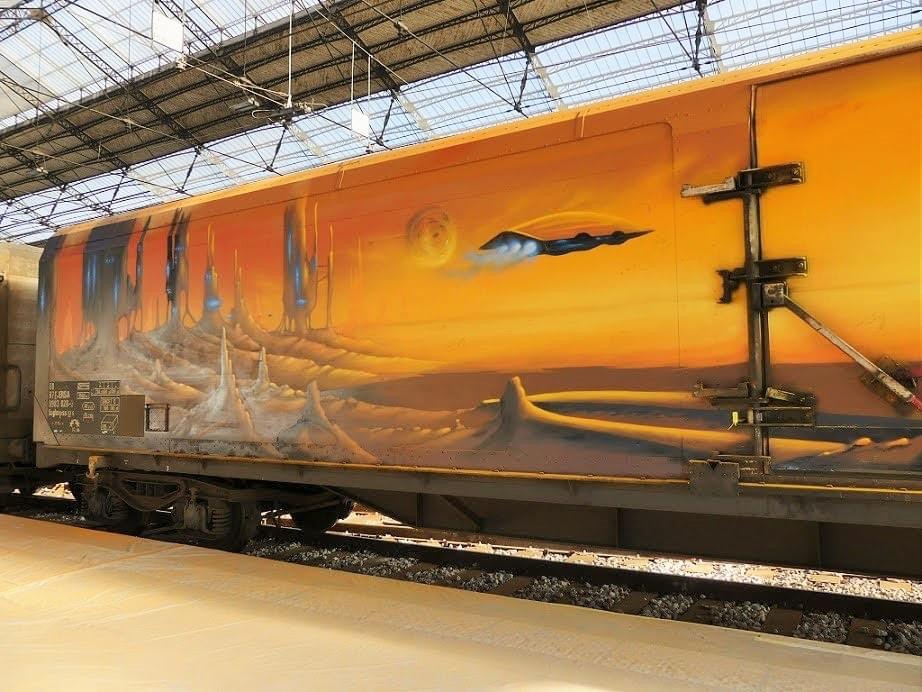
(the OPs photo is actually a perfect example of that, without graffity it would just be a depressing grey wall, I much prefer the colorful "defaced" version)
I am not arguing I personally think tag smeared walls are aesthetical, but I argue that there are people who do indeed do. But most noise-protection-wall-graffiti where I live isn't tagged smearing. If we go by area easily 80% are big colorful motives.
Having known people who do these things I also know that for them the "where" is sometimes more important than the precise what and while the aesthetics won't convince me personally I can't say that I never asked myself the question: "How the hell did they manage to paint this thing in that location?"
And I don't see train stations on instagram, because I don't follow people who post them. But I also don't see couples posting their vacation photos or influencers selfies for the same reason. If I did follow them I would see them.
No. The graffiti I have seen in my life was clearly put there as narcissistic self expression by (usually criminal, if only by trespassing) youths, very rarely I have seen something which comes close to presenting an attempt at improving the environment.
I grant you that I can emphazwith the idea of clearing withering concrete slab with anything at all. But the few times I have seen it be an improvement were when it was a commissioned piece. But even then it was a small improvement at best.
Was the graffiti made with approval of the owner of the building? Does it fit general aesthetics of the city? Yes and yes - it's finally some colors. Otherwise it's a vandalism.
If it's a public building - it's vandalism, unless it was decided by all people living there.
> As an art person I really see truly good graffiti, yet I have to notice that heavily graffitied parts of my city are tourist magnets — so many people tend to like those "defaced" walls.
Yeah, way to make life hell for residents of the neighborhood.
https://lpix.org/4545647/IMG_8335.jpeg https://lpix.org/4545648/IMG_8336.jpeg
What is 0 encouragement/discouragement? It's not obviously easy to define. One definition is doing nothing = 0 encouragement and 0 discouragement. By that definition, not removing graffiti (aka doing nothing) is not encouragement, it's simply doing nothing: a lack of encouragement and a lack of discouragement.
Because we haven't agreed on a definition of 0 encouragement and 0 discouragement, saying "decreasing encouragement" and "increasing discouragement" mean basically the same thing.
There's also the same analogy to refactoring in software engineering. If a project is well maintained with every incoming feature, then a big refactor epic won't be necessary.
"The stop of encouragement will prevent the start of discouragement" doesn't mean that the reverse is true ("the start of discouragement will promote the stop of encouragement"). So it isn't stating basically the same thing.
The big irony in social studies with the broken windows theory is that discouragement often feels easier to practice than maintenance to an outsider. Or, in analogy to software engineering, a one time big refactor feels easier to do than continuous maintenance, as all the work actually included in a refactor (team syncing, product without features etc.) is mostly overlooked during the development if maintenance is not well practiced.
"Doing nothing" results in encouragement in the broken windows theory:
Under the broken windows theory, an ordered and clean environment, one that is maintained, sends the signal that the area is monitored and that criminal behavior is not tolerated. Conversely, a disordered environment, one that is not maintained (broken windows, graffiti, excessive litter), sends the signal that the area is not monitored and that criminal behavior has little risk of detection.
Which gets cleaned up with public money that could be used elsewhere, or stays there as an eyesore.
> It’s not on the front of people’s houses.
Sometimes the sides too.
> people say that about modern art, and about that crazy 'rock'n'roll'!
Did you just compare modern art and rock and roll to the few letter “tag” sprayed in 10 seconds again and again hundreds of time throughout a city? Because that’s what 99.99% of graffiti is, simple tags and doodles [0][1] anyone can make.
Charitably I’ll say you just didn’t pay attention to tagging’s aesthetic effect on a city. The less charitable alternative seeing the “tag = modern art + rock and roll” opinion is that you’re one of the “artist”.
[0] https://www.reddit.com/media?url=https%3A%2F%2Fi.redd.it%2Fy...
[1] https://cooltourspain.com/wp-content/uploads/2020/06/tag-gra...
> Did you just compare modern art and rock and roll to the few letter “tag” sprayed in 10 seconds again and again hundreds of time throughout a city?
Yes! That's what rock'n'roll is at its core, three chords (or fewer) and the truth, and that's how it was characterized - artless noise, etc.
  People try to put us d-down
  Just because we get around
  Things they do look awful c-c-cold
  I hope I die before I get old
> Because that’s what 99.99% of graffiti is, simple tags and doodles [0][1] anyone can make.
It's just noise, I tell you!
Now get off my lawn geezer! :p :)
Same for EDM, maybe it’s just noise to you but you can at least appreciate some effort went into it and every song is different. You don’t like it but you also can’t do it yourself in a way anyone likes.
Most graffiti is plain text tagging like in the pictures I showed above. Tagging is repetitive, same tag again and again, and literally anyone can do it because there’s close to zero effort or creativity involved. Take a spray can, spray a couple of letters, you got a tag. I can replicate all of the tags in those pictures, like a real artist. So I know what I’m talking about. :)
You make it sound like anything is art, “you just don’t understand it”. The problem with that view is that if everything is art, nothing is art. Me taking a breath is art. You just don’t get it.
There is basically no one who makes greater kitsch than him. Everything he makes is steeped in the middle class, liberal, mediocrity of someone who points out that things, which everyone agrees are bad, actually are bad. It seriously is something of the worst "art" I have ever seen and actually makes me quite sympathetic to the post modernists whose movement is a reaction to people like him.
The middle schooler, scribbling on canvas, is at least not trying desperately to impress the most bourgeois group of people the world has ever seen. That alone puts everything he does a serious step above Banksy.
Yes and yes. Overhyped "I'm 14 and this is deep" energy.
So if I graffiti your car because I believe it improves your car; would that be ok with you? It’s art. You should be happy, right?
Graffiti is (partially) just the consequence of not living in that ideal world, but because of all the other problems with graffiti, I'd rather just treat it as the vandalism it usually is in all cases. No sense holding an election before every prosecution or clean and paint job.
This sounds like the words of a “community oversight” committee obstructing the construction of housing, and we already know the effects of that on the housing market. Society has swung too far into allowing other people to tell someone what to do with their property already.
Let me just put it this way, do I get to just move into your home and take it over simply because I believe that I can make it a better home than you can? Do I get to steal your car/property because I believe I can make better use of it?
Stop rationalizing narcissistic behavior and people trying to impose themselves on others. It’s not relative at all. You or the narcissistic graffiti vandals have no right to impose themselves on others.
For whatever reasons, Germany is rather lenient towards graffiti artists which, in my eyes, makes Berlin more enjoyable than it would be otherwise.
I've lived in a lot of places and I've learned that I hate grey boring walls a lot, I much prefer it when they're covered by colorful graffitis. It seems I'm not the only one so some localities tend to be rather lenient towards graffiti artists and even invite them, other places are much stricter and so you can enjoy bleak concrete walls unblemished by any graffitis.
As to your example about homes, well, in France and in some other European countries, in the 90s there was a bit of a left leaning political push for "right to lodgings". This movement made squatting much easier (in France, it was extremely difficult to get rid of squatters if they moved in past 48 hours). I've always personally thought those laws were stupid and they were eventually repealed and amended recently. But that's the way it is with governments, you don't get to agree with all the decisions made. If it's a democracy you have some measures of influence.
People who pretend to make art on walls are absolute minority compared to those who'd prefer to keep walls clean, or painted, or whatever (there are plenty of options between gray, and wannabe artists spraying smileys). But somehow you offer the majority to leave. I don't think that's how it can work really
In reality we just want to live in a city that doesn’t have ugly graffiti all over it.
It’s OK, when you grow up you’ll understand. Walking little kids past a wall that reads FUCK because “the community” (aka a single edgy teen) decided it should is not a comfortable experience.
Not sure why that follows, or how it would avoid the tragedy of the commons, or why we should act as if that’s already the case.
That all aside, how would you feel about people reclaiming public space, parks and public transportation, by blasting loud music in there?
The buildings have a lot more impact then the graffiti, and arguably should have more community voices involved.
But imposing your own preferred art on public commons is a (minor) form of violence, in any economic system. Especially when you do so with paints of questionable chemical composition, or with images/text that is likely to offend.
I would also say that doing the same thing even on your own property can be reprehensible, as long as it is visible to the public. Just because you own a house doesn't mean you should be able to make it look however you want on the outside, especially not in ways that are actively unpleasant to those of us that need to walk by it every day: we the public should have a say in how your private property looks. A most anti-capitalist position.
If the actual majority wanted to get rid of this problem, then it would be stopped, I'm not the one making the laws or deciding whether to apply them.
As for grey walls, there are plenty of gray boring walls in any city in the world, usually those tend to be painted on, in my experience, not colorful walls nor brick walls nor older buildings.
Well, no offence, but you idea of how society works is not particulatly correct. Both individuals, and institutions have to prioritize thousands of issues against limited resources. Because of that majority opinions doesn't necessary become policies. Only those urgent/emotional/tribal enough to become election fuel. Apparently, graffiti cannot compete with plenty of pains citizens experience now.
>A lot of cities even give space to graffiti
Try researching where it came from, and you'll see it's an attempt to civilize behavior cities found impossible to control.
So reality is that graffitists are active, and numerous to extent it's hard to fought them off the walls so to say, and while majority doesn't like it, it's not ready to re-allocate resources from other issues. This leads to equilibrium we are in at the time.
>plenty of gray boring
It makes a good excuse in the internet discussion, but it doesn't correspond to street reality. I'm in a nice medieval quarter now, and see lots of graffity across buildings which neither gray, nor boring. It is as if people who do that don't care about beauty, other humans, and all those good things usually claimed to legitimize the phenomenon
Ok, point to you there, that would infuriate me. To be fair, I haven't traveled back to Europe since Covid (moved to Asia 20ish years ago) and I don't know if the situation has deteriorated. I didn't experience graffitis as much in places that are actually nice but I've liked them in places that are gray and drab and I remember enjoying them in Berlin and in Bruxels.
I live in Hong Kong and here quite a few people express disagreement over the government removing the works of invader and other graffiti artist (the "King of Kowloon") but to be fair, graffitis are really limited to exactly the type of places where not many would complain.
> Well, no offence, but you idea of how society works is not particulatly correct. Both individuals, and institutions have to prioritize thousands of issues against limited resources. Because of that majority opinions doesn't necessary become policies. Only those urgent/emotional/tribal enough to become election fuel. Apparently, graffiti cannot compete with plenty of pains citizens experience now.
I think it's not only limited resources, it's a political wish to be lenient against petty crime, there are plenty of countries with the same resource in term of police that are much stricter against petty crime with much more success. There's more policemen per capita in European countries like Germany, France, Spain than in Singapore, Malaysia or Japan (I was surprised looking at Wikipedia that Hong Kong as more but that makes sense given the response to the protests before COVID) [1]. They could absolutely enforce fines but they don't. Whenever I traveled back to Europe, I've not been as bothered by graffitis nearly as much as I was bothered by dog feces and littering which is absolutely everywhere and never fined.
[1] https://en.wikipedia.org/wiki/List_of_countries_and_dependen...
Sometimes councils put up several designs to be voted on by the public, but they will largely follow a bunch of design norms that will be whatever the architecture firms they hired think is trendy, for example.
And how many election programs even talk about artistic taste? That's not why we elect people, and making that an election point would be a distraction from real problems, so why not let society be and if people are more artistic in one area and make more public art, let them make it?
Even beyond electoral politics, many cities have public NGOs and other organizations that seek to shape this sort of thing from an early stage through various legal means (and sometimes even through civil disobedience, like tying themselves to a building to protect it). If they are broadly in line with the tastes of the people, they tend to thrive; if they are not, they will often die out.
And yes, in certain cities and towns, people actually like the way grafitti looks and are bothered when someone goes and whitewashes a beautifully painted wall. That's perfectly fine, and is a part of the culture and esthetics of that place (and here, destroying the art that people enjoy is an act of violence against the public and/or the artist). But it's also perfectly fine for other places to want neat walls with clean textures, and marring their beautiful walls with grafitti would be an act that goes against the public.
> If it was a swastika or the n-word I would be very concerned about the nature of the community in that neighbourhood and if I'm in danger.
If you lived in a large city like NY or London and you saw a random swastika, your immediate reaction would be to blame your neighbors? How do you know it wasn’t someone from somewhere else?
> If you really need the authorities to tell your community that swastika graffiti should make them angry and call them to action, then your community is screwed already.
Hopefully nobody needs the authorities to tell them things, but they do need authorities to help them enforce already agreed-upon laws. I can’t spent my time running around cleaning up all the graffiti.
Do you think it should be the duty of citizens to stop bank robbers, too?
> Either way, yeah just as we have laws to deal with incitement to violence and hatespeech we can have that with walls if you'd prefer, it just has to be sth actually extreme and targeted.
We literally already have this which is why vandalism is ILLEGAL, but your previous comments were completely dismissive of this!
—-
Seriously, this is like Basic Empathy and Human Emotions 101. Imagine yourself seeing the n-word written several times around your city. Contemplate the anger that you would feel, the desire for someone to do something about it, the realization that even if you dedicated all your free time to finding and stopping these people you probably couldn’t do it yourself. Now replace “n-word” with something someone else finds deeply offensive and imagine yourself as them. Do you STILL think graffiti is totally harmless, or justified as long as you’re vandalizing a megacorp?
Graffiti is prevalent in every major urban center. Yet you hate it.
Seems like you're the one who can't empathize.