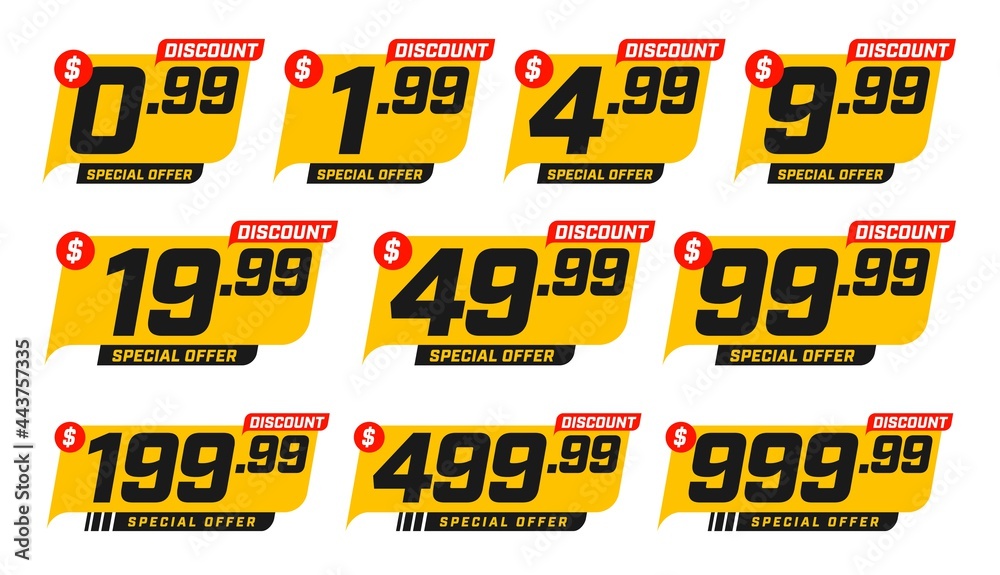
People spend more when prices end in .99 (2018)(kenthendricks.com) |
People spend more when prices end in .99 (2018)(kenthendricks.com) |
(In fact the linked study - the link is broken, but it's available here [0] - is from 2003.)
[0] - https://www.kellogg.northwestern.edu/faculty/anderson_e/htm/...
> Strangely, you won't often see this kind of pricing in offline retail stores, only during promotions
I think I see this whenever I enter a regular supermarket.
> When paying online, people's consumption psychology is more impulsive because you don't take out cash when paying; you just pay a number, and the money is deducted from your bank card
People overwhelmingly pay by card at actual shops and rarely use cash.
This may depend on the location of course.
Integrity means a lot. The software I sell is priced in whole numbers.
However, the magnitude of effect claimed in the article is huge. It's the difference between selling at cost and a huge margin. Between doing well and shutting down your business.
Given the replication crisis is worst in these types of studies - the kinds of studies that beg to be the subject of TED talks - you have to wonder how reproducible these effects are.
Are we selling our integrity for bad science?
When I started my selling software, I priced with something.99 too. I did this because everyone else did. I was unfamiliar with these sorts of things so I followed on.
I am sure that in some business at some point, there was a big positive in switching to that sort of pricing.
When I switched my software to whole numbers, I did not notice a drop in sales. Things continued to grow. Of course, my business is one data point and a small one.
How much of why we tend to do this is because, historically or normally, that is how we've seen it done?
Practices like this stick around because of the desire to be seen making proactive recommendations with putative benefit.
With the dresses there is clearly something odd happening. In all cases except one the cheapest dresses sold the fewest items even compared to ones that were $10 more expensive.
That doesn't cheapen metrics, however. Some pretty meaningful (and, often, annoying) stuff has come from them.
The biggest ones in my mind, the ones my family had always played: they got rid of the game playing involved in buying during sales windows. This eliminated both the urgency to buy and the fun of feeling you were getting a deal other people weren't (this is all from memory I'm afraid)
My own speculation is that he tried to apply hard-line strategies that work when you have a unique good with strictly-set pricing (Apple products), but fall apart when you're selling goods that people can get anywhere for a variety of prices (e.g. Levi's jeans).
It seems that perception of value is more important than actual price. In similar vein there have been many cases where sellers have increased sales of an item significantly by increasing the price to make it seem more valuable.
Of course both techniques can be combined.
JC Penney effect. They do it because it works. And most consumers don't reward honesty with better business. It sucks but at this point it's on the consumer.
And JC Penney was barely more than a decade ago. This phenomenon has been practiced for decades.
>Given the replication crisis is worst in these types of studies - the kinds of studies that beg to be the subject of TED talks - you have to wonder how reproducible these effects are.
Forget the lab tests, there's more than a few other live experiments to study (not just JC Penney, though I'm not sure if they did this even back then).
Also everyone is doing this, and that’s a fact. If you do it differently, people will think there’s something wrong
I wonder what field studies those.
Singalling is honest too, y'know. :)
If a product in a store is $9.86, it suggests there’s a reason for the specificity. The same product at $9.99 feels like it’s priced at the maximum they can get away with.
In a store people often don’t even look at the price, just”I see cheese. Oeh, LESS than $3?”
Completely different target group
That's why apple's pricing looks odd to me. Expensive prices minus one dollar
Nobody trying to sell anything "cares for affordability" any more than if it's not affordable to the customer, he won't buy it.
There are products in US that are in nice metric sizes and weird US sizes. Like the 2L soda.
Why don't you just look at unit prices instead? That's the only price I ever look at and other than edge cases like trying new things or goods that you can't use up fast enough, there's no reason to look at anything else.
If your store doesn't have them, that's a sign you're at the wrong store and everything is overpriced.
Teach your kids this
PS: Walmart, which has pretty good prices, is famous for odd prices everywhere, so your heuristic would fail. All in all, really, a heuristic like this is a pretty weak way to try to be frugal and I can't recommend it. Just check the unit prices and shop at Aldi. Buy commodity ingredients, not trademarked factory food products. You can't help but spend a fraction of what other folks do when you just buy commodities by the unit price at a store serious about prices.
Does it? Has anyone priced out the premium integrity can command?
As anecdotally, it doesn’t seem to matter unless you have a sterling reputation. People with merely a good integrity reputation are better off selling it off until they are low ish integrity.
And if you compete on price, may as well abandon it entirely.
Are we selling our inner peace for outrage over minor things?
This method also helped with inventory control. For example, if the total sales for the day ended in .56, it meant 44 (or 144) items were sold, no matter how many customers bought them.
This pricing strategy stuck around because it was really useful for running a business smoothly.
What illusion?
One possible explanation is that .99 prices are so well established that prices that don't end in 99 stand out, prompting a more conscious analysis by the customer. If round prices were the norm, it would work the other way. Similarly, if prices always ended in .01, those that didn't would stand out.
When a store is selling things for .00 vs. ".99" (or any other fractional amount), I assume it's a premium-priced store. They sure aren't rounding down to those numbers.
(Or, many times when I see .00 numbers, it's slightly upscale clothing stores, who're maybe using .00 to seem more upscale, but who also have near-constant significant "sales". So if I see a .00 without a large "sale" discount, then maybe I'm there the wrong day, or someone hasn't yet been around with the price sticker gun yet that day.)
But when they're using fractional numbers, that says they're more likely targeting more pricing-sensitive buyers, and I'm also not paying for the upscale pretense.
I've seen this on menus and wine menus that write prices like 5 or 4.5 -- everything rounded to 50¢ or $1 -- I think trying to appear upmarket.
- Dress #1 revenues are swapped for the "$5 less" and "$5 more" columns. - Dress #4 units purchased are swapped for the "$5 less" and "$5 more" columns (from the study they've linked before the tables) - Dress #4 revenues are also wrong, even without considering the previous mistake
This doesn't change the conclusion of the paragraph that much (42% instead of 48%), but this doesn't inspire me much confidence for the rest of the article
> This study not only confirmed that .99-ending prices lead to more revenue
Er, surely that depends on the rest of the price e.g. 1.00 v 1.99.
And when you see 0.99 €/gram ? :)
The bottom of the article launches into spoken number frequencies. The caption under the digit frequencies plot claims “the decreasing frequency of numerals is due to the organization of our mental representation of quantities.” This seems to be simply Benford’s law, and the plot of numbers across languages suggests the same. Assigning this to some mental process or cognitive bias for small numbers seems like it might be inventing an incorrect explanation.
My business _buys_ tickets from people, so deals happen when we offer to give them $99 or $104 or whatever for their tickets.
I wonder how this psychology works when someone is offering to _pay_ you? Thoughts?
Do people like to receive money ending in a 9 as much as they like to give it?
Interesting fact, but I wished they wouldn't use the confusing formulation of "adding 4 times more" which sounds to me like a five-fold increase.
This is false and a very basic mistake. Sometimes higher prices lead to more revenue, even with fewer units sold.
I'm sure Hacker News will have some earnest argument for why this form of competition is actually good for people.
Nope, the current consensus this time is HN assuming they know better than a researcher (and decades of business) and inserting their own opinions.
>The kind of person who looks at this sort of thing and says, "Hey we should use this to manipulate people" is the kind of person our society needs less of.
Ever since JC Penney, I grew apathetic. People want to be tricked, why ruin their fun?
Books like Influence the art of persuasion and Thinking fast and slow wrestle a bit with the morality of studying this kind of stuff.
It’s certainly possible to misuse the insights to manipulate others, but it’s also important to be able to recognize when and how you’re being manipulated.
It's the people who use this sort of pricing model that I'm critical of. It's sort of a moot point though, given this method of manipulation is so deeply embedded in our economy at this point.
I never found a solution, but one idea was to scale competing products to a range of, say, 13 through 17. That will never cross any round number boundaries and one also can't use shortcuts like "it's essentially a tenner". I think that's when I discovered that it's very often down to two options and that anything scaled down to a range of 13 and 17 will turn into... 13 and 17! Surprise! I was not the smartest teenager.
Have you, or has anyone else reading this ever noticed this or given it thought, or even found a workable approach?
So, the $0.99 feels like costing 0.
Our mind is a superposition of intuitive sense and reason, so even when we can reason that they're very close in price, our intuitive sense still plays into our decision-making. That's my theory anyways.
If they invented consumer travel to Mars tomorrow I'd have no interest. In 2024 it would be stupid to believe the customer experience would take the form of anything better than the Star Wars hotel.
But there’s some grotesque likelihood to the idea that the world ends up positively littered and we use technology to filter it out.
Perhaps we're so used to everything priced ending in 9 that we now subconsciously think that anything not priced in 9 has something wrong with it?
That seems like bollocks, who cares about a technique for tracking total number of any items sold? That isn't helpful for inventory management at all? And even if you had only a single product, or you totalled sales separately for some reason (and inexplicably by sale price rather than just tallying sales), you could then just divide by the price, you don't need to coerce the total into being a tally mod 100.
Pre-digital calculator salesmen? Time is money and being able to do a quick mental math can be helpful before doing a more detailed inventory
>you could then just divide by the price, you don't need to coerce the total into being a tally mod 100.
That's why they gave more than one reason. Why laser focus on criticizing a single one?
Registers that don't record receipts also don't record when it's opened. Even if they did, cashiers could forego opening it and provide their own pennies in order to pocket the 0.99 difference.
The .99 pricing is typical black & white smiling mid-atlantic accent gray flannel suit slicked hair over-jovial grinning 50s/60s mad men salesman stuff.
Wouldn't the extra labor required offset any potential savings? (More time per transaction means you need to hire more cashiers to keep checkout line length down.)
1 - https://en.wikipedia.org/wiki/Psychological_pricing
2 - https://www.straightdope.com/21341889/why-do-prices-end-in-9...
For instance, when you buy something and get a receipt - it is not for you the customer. It is to keep the employee honest. If there is no receipt, it might not have been entered into the cash register.
Now with electronic payments a lot of this risk has gone away and receipts are becoming optional.
Also, I remember some people telling me in their stores, the last digits of a product were secret code. Like ending in .23 (i made this up) meant the product was being discontinued and only stock on hand was available. There were other codes for other things.
- Expensing purchases to their employer or self-owned business
- Record of sale to be used in returns
- Reconciliation of spending with cheques or credit card statements
- Budgeting and accounting generally
How does opening register reduce risk?
Now if you steal a dollar, your totals at the end of the day are off a dollar.
But, if you take the dollar with no recorded sale, your counts are good.
How is it useful is any of this today? Everyone uses point-of-sale systems and credit cards.
And you're "correcting" an article which has citations, based on what? A story you heard? Citation needed, buddy.
Come on.
>Back then, most registers didn’t print receipts.
Everything wasn't about raw profits once upon a time. So a small piece of mind makes sense.
And even if 9.99 really is 10 for you, it could mean that you're different than most people, rather than the methodology being faulty.
$0.01 doesn't make it affordable, it's just a mind trick. You seem to be aware of this, yet you're defending it.
2. Even if you point it out... What changes. Has anyone ever seriously reconsidered buying a product when you tell them it's $500 instead of $499? What's the harm being done here?
3. What call to action are you suggesting? I'd rather work for laws to include sales tax in US goods' prices than fix this "mind trick".
I can't tell you how to live your life. But those are the reasons I don't really care.
My brother buys these. They survive up to a year in his "care", rather than the usual 3-4 months of flimsier phones. They all end up with cracked screens within months though.
Almost no mainstream consumer electronics nowadays are meant for people who lead active lives (outside of planned and streamlined activities like going to the gym or running) - because the people as a whole generally don't live active lives. If you happen to be an outlier, making your phone survive becomes a serious logistical issue. Sadly carrying one is a necessity in this day and age.
Another example: Many offroad vehicles/trucks nowadays won't survive days of the advertised use-cases without serious damage and are often utterly unsuited for it (the cybertruck isn't an outlier here). These things are being sold to people who like to play pretend. Manufacturers cross their fingers and hope you don't actually.
Notable exceptions to the rule are things like satellite communicators and some dedicated GPS map devices. They seem to have no issue surviving many phones with their own screens and functionality intact. Their manufacturers know you wouldn't buy them if you didn't plan to use them in the advertised conditions.
Look at the form factor of something like the Garmin eTrex[1] series and it should be immediately apparent why these devices can outlive about a dozen phones. Sit on it, throw it on the ground, put it in a backpack and throw it down a cliff, they'll be fine. Maybe dented and scratched, but they'll still help you find your way. They're small devices that are very round-ish in every dimension, and they're also pretty light, meaning there's very little energy that needs to be dissipated when they impact something.
Adding padding and protection only helps up to a point. To make smartphones actually durable, you'd need to take away from them. That means little or no glass at all. Use light materials that functionally survive deformation and point contact impacts. Also preferably it would run on AA batteries.
[1] https://bikepacking.com/wp-content/uploads/2021/06/garmin-et...
I think it was Vertu who first recognized the potential back in early 2000s, The Matrix (1999) made a visual point of it, and since 2007, Apple has been building their entire strategy based on that, with enormous success.
People who need sturdy phones do exist, are few, and they don't brandish them, because these phones are well-beaten.
Although normie friends have commented on why I bought a OnePlus3 instead of something normal like a Samsung.
"Half the lines of code I write are useless, I just don't know which half." - an incompetent coder
"Half the time I spend on the phone is wasted, I just don't know which half" - an incompetent salesperson
"Half of my menu is inedible, I just don't know which half" - an incompetent restauranteur
If I think about it too, half the lines of code being wasted is probably a relatively reasonable measure for writing code. Not because they're actually literally useless, but because you write a lot of scaffolding, a lot of first passes and a lot of code that will be a dead end or superseded before you're done. If you knew before you started exactly what lines of code you'd need to write, you'd be much more efficient, but we don't, so we write a lot of "waste" code too.
Legacy code in a nutshell. On some blue moon you get a chance to do a clean refsctor, but otherwise business doesn't care if 90% of the code is useless.
Even as the refactorer, you know that refactoring can be anywhere from throwing away simple unused code, to removing a seeming unneeded line and causing a forest fire. I imagine that's the equivalent with advertising (i.e I agree with you).
Not if there too a spend of X was required to get the value of X/2.
even returns - it might actually be enough friction that returns would go down.
for example, why would a donut shop give receipts?
I have a friend who recently opened a bar. He did cash in the beginning, but finally got the electronic payments for the bar installed. He immediately caught a bartender stealing.
He noticed that at the start, the bartender got a lot of tips. But when the electronic payment system went in, the tips were not anywhere near as much. He reviewed everything and found the people in the bar do not tip well.
What the bartender was doing was selling drinks and putting many of the cash sales entirely in the tip jar. When the electronic payment system went in, he wasn't handling as much cash and the lower tipping rate showed up.
Because of members of a social club, whose turn it is to buy the donuts, wants to have it to give to the treasurer so that it can count against their monthly dues.
The more general answer is because, at this point in time, a receipt is universally expected. I'm not denying that businesses have internal reasons to hand them out, and keep a copy, I'm saying that customer demand played a role at the time this convention was established. They've become increasingly useless on the customer side, except for business expenses, where they remain vital.
With cash few have exact change and the table can see what you give. This leads to rarely asking for change back and putting higher amounts as it ups your social ranking.
This effect is easier to see in a bar.
Often you need to keep track of dollar per unit sold as some staff will overpour
For what purpose? Say you're a salesman of 7 different products/SKUs; you sold 186 products today. What do you do with that information?
Bankers can tell a lot from a security standpoint based on seemingly frivolous data. Maybe it's the same logic here. If you end every day swelling exactly XX0 products, something is amiss. It at least prompts a deeper investigation, since running through weeks of receipt/data takes more time pre-computer.
This is also the electronic version of an older, paper based system, called Nota Fiscal (lit Fiscal Receipt) ... legally, every single item carried around the country must have one. Of course this was/is a major enabler for selective police action against "undesirable people" moving trivial stuff from a home to another, etc.
Huge difference.
we were told to use specific software. and for sure that software is created by some company that may or may not be government owned. i don't know if there was any choice since, as is typical with foreigners, someone will just tell me their recommendation and not try to explain the differences between choices, unless they matter. ie: just go with the default.
i did have the impression that different regions use different software at least.
i expect that potentially in european countries there are multiple competitors for the same software, but i don't know that either.
so for all i know the amount of choice and control in china could be the same as some countries in europe.
The trial of whole number pricing keeps coming up in Consumer and Retail every 10- 15 years and EVERY time the test shows .99 works. Despite how most of us and even my younger self hated it.
Also, even knowingly false propaganda has an effect on you.
It isn’t as if retailers can fight reality.
Or that they can “come clean” by putting fine print under prices explaining why they are ending prices in 9. Which would create a major distraction messing with any sale.
It is just real-world reliable wackiness that both sellers and purchasers should be aware of.
There is no purely objective way to relate to selling and purchasing prices. Short of very simple scenarios where a spreadsheet actually captured all the real criteria.
Many products make people happier if the price is higher. Is that happiness bump a fraud, or the point?
Just remember to ask for $199,999.99 salary in your next interview!
Both work despite people knowing they exist.
https://skeptics.stackexchange.com/questions/2359/the-origin...
The actual human might care about pain. Therefore, I don't think that the advice is necessarily bad.
Evolution isn't always our friend. There are many examples where our bodies work against us, only to help us evolve better as a species.
Do you mind sharing any references
One manifestation of this phenomenon in it's extreme form is cancer diagnosis and treatments. Barring a few exceptions, most cancer treatments are useless.
The effect seems to be because people subconsciously see the price as $5xx and $4xx. So I would guess yes.
Either way, it's a bit disingenuous to frame it as 'just a penny' (the actual quantity of money being spent isn't the point, it's the effect on people's spending habits) and bringing up some other problem to nullify concerns around this one is just bald-faced whataboutism. You can say you don't really care, and that may be true about addressing the problem, but making arguments for why this isn't actually a problem suggests you care about the topic in a way that compels you to dismiss it, at the very least.
The harm on the micro level is negligible, and you can even argue the macro level doesn't fundentally harm society like so many other modern tactics. Environments aren't impacted, liberties are not breached. Children are not exploited. There's no slippery slope towards some gambling addiction. It's not opening a door for hate.
>You can say you don't really care, and that may be true about addressing the problem, but making arguments for why this isn't actually a problem suggests you care about the topic in a way that compels you to dismiss it, at the very least.
It's a discussion, I care about seeing others viewpoints. But I don't feel very challenged here. The questions above are all the things I'd hope to have more viewpoints revealed on when I made my comment up chain. So far it's simply been 2 instances of "why are you defending this?" a question on me instead of a glimpse into you and the GGP.
It's a conversation, not a debate (invoking privation fallacy doesn't exactly change my mindset here. Even if I'd "lose" a formal debate). So I answered that question. I'm "defending this" because it feels trivial but so many are riled up about this. Claiming they won't even participate in purchasing such products. Which is baffling to me.
I More than free to clarify if that's unclear, but I hope I can hear others' viewpoints as well. Because I don't get the big deal outside of in a moral vaccuum. In reality, it's comparatively trivial even if we only focus on how pricing works (e.g. The US sales tax problem).
I don't think households need to be spending 8% more of money they don't have (if we're considering rising household debt) when they go out shopping. The issue is probably more evocative than it logically should be for some people because of the aroma of deception around it. Making superficial changes to price to take advantage of human distortions in quantity to get them to spend more has at least a shade of deception to it (I don't say that as a valid argument, just hoping to lend some context for why people would get worked up over it).
If you don't think that's adequate to make it a 'problem'... well, fair enough, I'm not entirely convinced either. But I'm not seeing a very strong case being made for the contrary, besides 'other things are more important' and the interesting claim that consumers must not be impacted because they're still buying these products ("Of course they love their job, wouldn't they quit otherwise?")
Thank you for the thoughtful response.
Why would they do that? That might lessen their sales if people knew of the effect, as a nocebo.
> Which would create a major distraction messing with any sale.
And yet we fall for the same tricks again and again. The most politically pressing? The number of people - internationally - who believe in a strongman leader.
MLMs also occur to me. We know MLMs so well that we've literally written laws against them. There are movies, articles, conversations. And yet, every single year, tons of people fall for them.
What other very well-known tricks do people fall for HN?