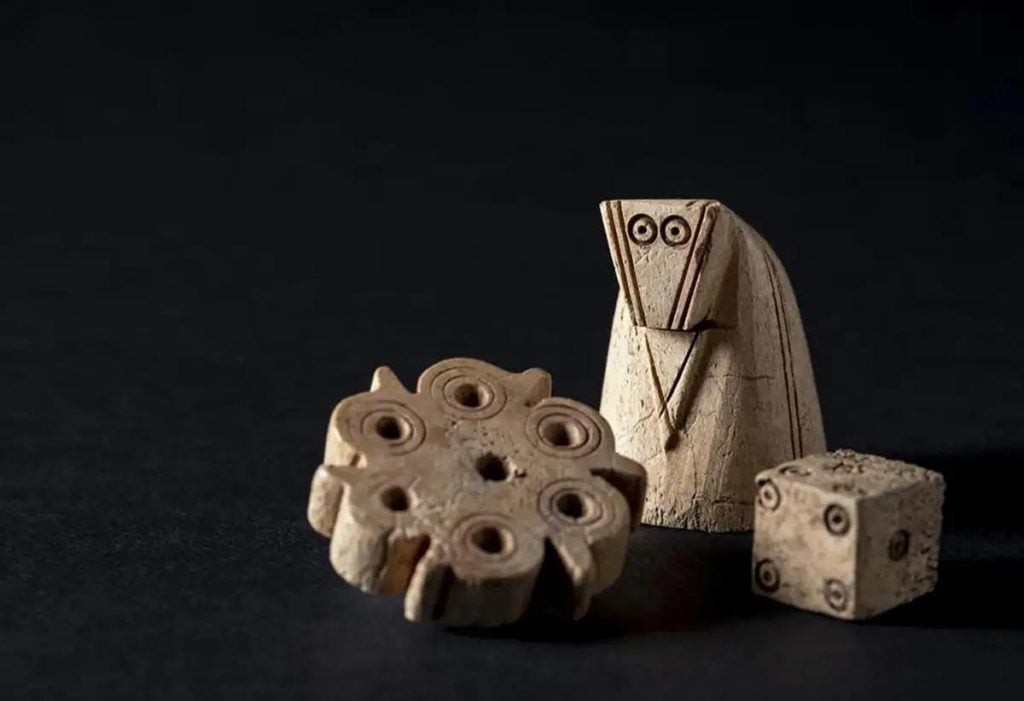
Medieval game pieces emerge from the ruins of a German castle(news.artnet.com) |
Medieval game pieces emerge from the ruins of a German castle(news.artnet.com) |
In CZ, we have about 1000 years of written history. A building from the 11th century is ancient and rare.
In Italy: well, this city is called Naples (Nea Polis = New City in Greek), because it is barely 2600 years old.
Which is like 1k years old aprox.
(Or 160,9 kilometers.)
I have done a couple of road trips within Europe that were over 6000 kilometers.
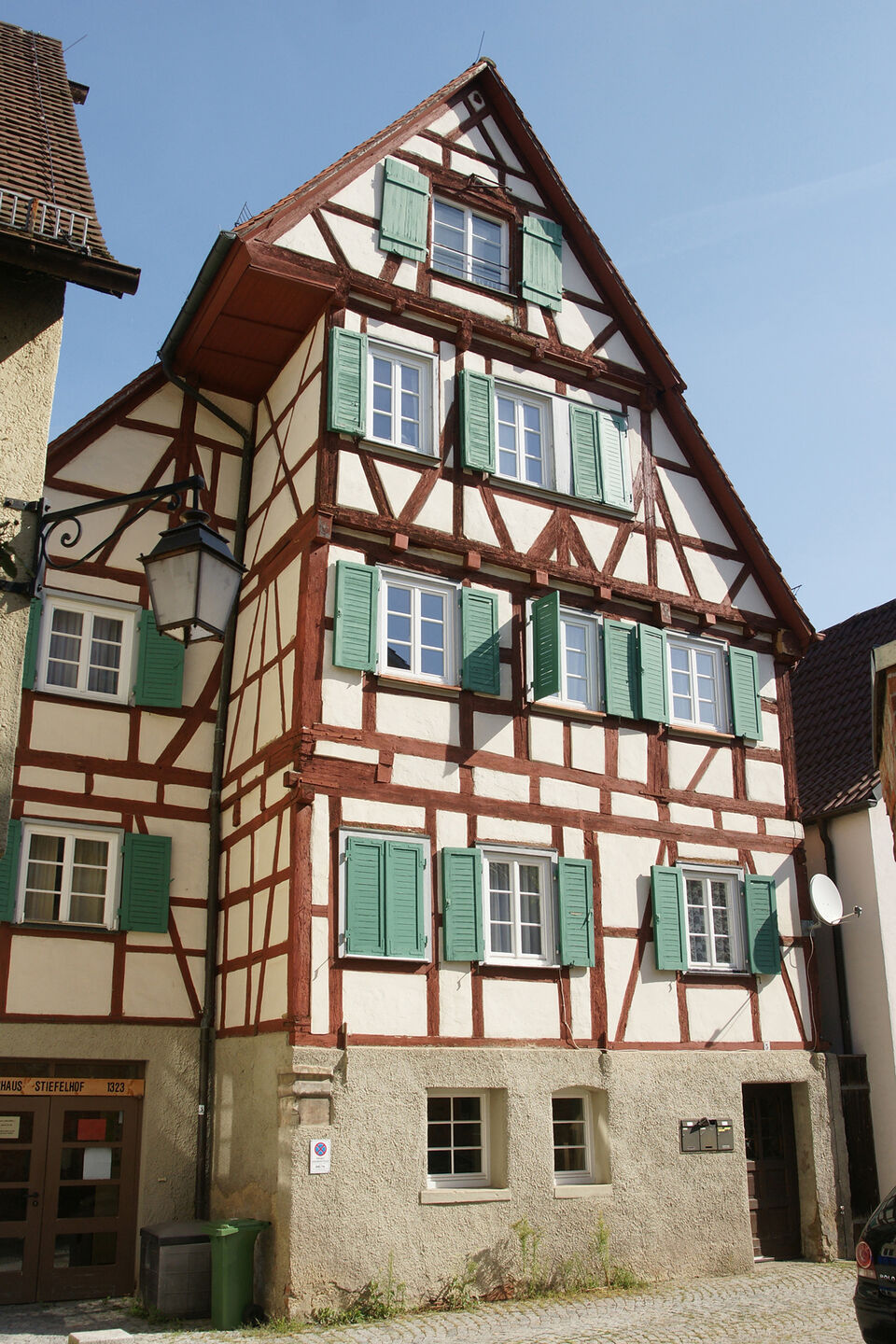
Here is a typical 14th century house from the area where I grew up: https://www.tuebingen.de/i/fullscreen/1440/Bilder/stiefelhof... It is really just a normal apartment building and also doesn't look any different than neighboring houses built 300 years later.
One thing that even impressed this blasé European here who grew up surrounded by towns at least 1,000 years old was the city of Split in Croatia: here, they pragmatically built the entire old town into a ruinous roman palace by Diocletian:
https://en.wikipedia.org/wiki/Diocletian%27s_Palace
https://www.google.com/maps/place/@43.5086065,16.4391912,455...
Wait, seems they were all chopped down after the 1906 earthquake in SF, these are all 100 years old.
(that said, I think it's interesting people can go buy roman coins)
Context is everything.
https://news.artnet.com/app/news-upload/2024/06/medieval-gam...
That trapezoid-faced dude with the gear feels like he's just begging to have an indie puzzle platformer made about him.
I want to 3d print the knight and it seems so strange that I can do that with a thing someone made 800 years ago.
Where is that attested in writing of the time?
> Peter Alfonsi, in his work Disciplina Clericalis, listed chess among the seven skills that a good knight must acquire.
https://en.wikipedia.org/wiki/Disciplina_clericalis
> Disciplina clericalis is a book by Petrus Alphonsi. Written in Latin at the beginning of the 12th century, it is a collection of 33 fables and tales and is the oldest European book of its kind.
The English translation - https://en.wikisource.org/wiki/Disciplina_Clericalis
https://en.wikisource.org/wiki/Disciplina_Clericalis/Tale_4
> Then, the accomplishments are: Riding, swimming, archery, boxing, the chase, chess, writing verse. The virtues (industriae) are: not to be a glutton, a drunkard, a sybarite, not to be given to violence, to lying, covetous, and of evil life." The disciple: "At the present time I do not believe there is any man of this kind."
The latin passage (from https://la.wikisource.org/wiki/Disciplina_clericalis ):
> Probitates vero hae sunt: Equitare, natare, sagittare, cestibus certare, aucupare, scaccis ludere, versificari.
I hadn't known about this if I hadn't seen this article on HN
Here is a description of the site together with a photo: https://www.unsere-burgen.de/de/Burgen-im-LK-Reutlingen/Burg... Judging from the photo, there is no immediately obvious indication that this free standing rock was the site of a castle.
As with all anthropology/archaeology, there is a big difference between “discovered” [by science] and “known” [by the locals]. The locals most certainly know of every castle and even those castles that are now ruins probably have local legends/stories of how there used to be a castle in such and such place.
But none of that counts until an archaeologist/anthropologist comes and writes it down. They then bombastically proclaim to have discovered a thing! (that all the locals already knew about for decades/centuries)
Sauce: my partner studied anthropology and this was a running joke in her program. It is very rare for an academic to be the first to discover anything. Usually they get tipped off by someone local who doesn’t count
What we do have is knowledge encloded in place names ("Burgstall"), but locals won't be any wiser about the history of the thing unless they happen to be the type of person who collects and consumes books written by local history science buffs of earlier generations.
A chance discovery like this usually happens when some known (usually to science far more than to locals!) but not recently disturbed site has to make room for an infrastructure project and the archeologists are sent in to make use of the last chance to see.
See also "Your finger, you fool".
RIP, Terry Pratchett.
This archeological site is a pile of rocks that once was a castle. (The rocks are probably mixed with dirt and plant life and might have been completely buried.)
But I do recommend visiting Germany, where there are way, way more castles than you might expect. In particular I can recommend the "Castle Way" along the Neckar River. Every bend in the river has its own castle, just dozens and dozens of them.
Most are not especially dramatic. Many are just ruins; others are literally just people's homes now. Still, it's a little bit like a D&D fantasy world where there really are just castles everywhere. (And yeah, some of them have genuine dungeons.)
(1) https://www.dw.com/en/does-germany-really-have-25000-castles...
(2) https://www.scrapehero.com/location-reports/McDonalds-USA/
The purpose of those castles was to extract money from the river traffic.
There is an immense number of dilapidated castles, keeps, strongholds or oppida all over Europe, with most of those barely visible to an untrained eye, and they have been catalogized for decades.
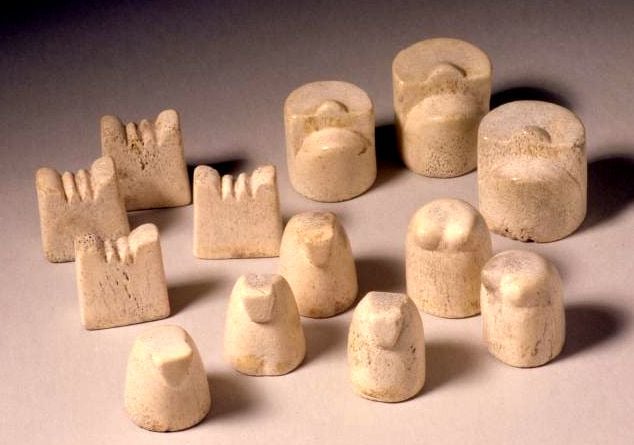
https://www.lovecpokladu.cz/img/2023/gm4pro/Sandomierzské%20...
In that set you can see the rook being castle like on the end, the knight with a "triangular stick out head thing" and an elephant which has two bumps that at first glance made me think breasts rather than tusks. Then the inner two pieces with the king and queen.
The triangular head, however, is that of a horse's head rather than an upside-down miter or jewelry.
Another view of it from a different angle - https://pbs.twimg.com/media/FsPKPECX0AEwYP6?format=jpg&name=...
The bishop itself was a later introduction - https://en.wikipedia.org/wiki/Bishop_(chess)
> The bishop's predecessor in medieval chess, shatranj (originally chaturanga), was the alfil, meaning "elephant", which could leap two squares along any diagonal, and could jump over an intervening piece. As a consequence, each fil was restricted to eight squares, and no fil could attack another. The modern bishop first appeared shortly after 1200 in Courier chess.
That 'chess set' isn't even symmetrical! Two with triangular 'heads', one with 'boobs', one with a square projection!
Couldn't those two with grooves represent bishops? More typical of a mitre than a crown, but hey this was Germany, maybe that's correct there. And yeah, that last link to the early 'bishop' has a slot cut in it too.
Unless they found it with the board set up, then I'm gonna have doubts about any conclusions about correlations with modern chess pieces.
https://fotos.mediafreedom.at/theater/sonstiges/xl/31-honori...
Possibly a horse's mane in the back:
https://sketchfab.com/3d-models/knight-in-chess-springer-ein...
https://en.wikipedia.org/wiki/Lewis_chessmen#/media/File:Lew...
There is one piece next to the king that has the same structure, except no bit on the top signifying the crown.
That set is hand carved out of deer bone - this isn't a super-high quality set (compare with https://en.wikipedia.org/wiki/Lewis_chessmen )
Another set with a similar abstract design - https://www.thehistoricgamesshop.co.uk/early-medieval-chess.... - https://sites.create-cdn.net/siteimages/33/6/5/336500/18/8/3...
> This example of 11th or 12th century chess pieces from Scandinavia, now in the Germanisches Nationalmuseum Nuremberg, shows two kings and a smaller, though similar, queen at the back right. On the left hand side are four rooks, and at the front four knights. There are two bishops between the knights and the two kings.
The pieces between the knights and the kings again have a design that makes me think of breasts again.
However, setting aside that those are bishops / elephants (with tusks), the knights at issue are without decoration have the triangular shaped heads sticking forward.
Here is an Iranian set: https://en.wikipedia.org/wiki/Shatranj#/media/File:Chess_Set...
You can see the horse like shape of the knight and two breast-suggestive elephant pieces.
https://thomasguild.blogspot.com/2013/10/byzantine-chess.htm... is a byzantine set. https://blogger.googleusercontent.com/img/b/R29vZ2xl/AVvXsEg...
> The separate chess pieces of the Sandomierz chess set. All have double/triple decorative lines at the bottom and belong to one playing set. First row: pawn (top view), bishop/elephant (side view), king (overview), counsellor (side view). Second row: king (side view), knight (front view), pawn (overview) and rook (side view). All images of this chess set are from the Sandomierz museum website.
The bishop/elephant again shows the tusks. The second row knight doesn't show the triangular shaped head as well though. You will see that the counsellor (Byzantine doesn't have the queen) is similar to that of the king, without the crown.
I visited some of the oldest mosques in China and documented them with photography. One that sticks out in my memory was in Qingzhou, the old capital of Shandong.
In the grand tradition of autocracy, like many other old things, many ancient structures will lose their battle to fate due to paranoid rulers. In the grand tradition of time, however, the rulers will surely lose their own. The difference is, nobody will weep for them.
My comment was about completely undiscovered ruins/sites. Those are rare. Someone somewhere (could be a notebook) usually knows about it.
As for “no oral traditions in a country with long-standing books” – the Brothers Grimm famously started writing down oral traditions in the 1800’s. That’s only 200 years ago :) For a long long time in most of europe nobody bothered to write down what the peasants have to say.
The concept we both seem to be tiptoeing around is the idea that the best conservation approach is leaving it in the ground, for future archeologists to explore or not explore. I believe that this is a central principle of the modern approach to archeology, and one we laymen struggle to really take in. Yes, there are many sites known to science, but not analyzed to destruction by science.
In the case at issue here, the rock was called "Burgstein" and the forest around it "Burgholz". This names were already mentioned in a book from the 15th century and a book from the late 16th mentions a castle at the "Burgstein".[1] All this was long known,[2] but not all experts were convinced, that there had indeed been a castle on the rock. The new excavation now makes it seem even more likely.
[1] https://www.unsere-burgen.de/de/Burgen-im-LK-Reutlingen/Burg...
[2] For example, one Gottlieb Fri[e]drich Rösler wrote in his "Beiträge zur Naturgeschichte des Herzogthums Wirtemberg" (2. Heft, publ. 1790): "Auf dem Burgstein einem grossen Felsen gegen Abend, auf dem die Aussicht nocht schöner ist, sind auch die Spuren der alten Burg unkenntlich geworden ..." ("On the Burgstein, a large rock towards the Evening [the West], where the view is still more beautiful, even the traces of the old castle have become unrecognisable ..."). See p. 81 of: https://books.google.de/books?id=BY05AAAAcAAJ&printsec=front...
It's no different than any "protection racket" or police force: the money has to come from somewhere to offer protection, so some form of tax is normally used.
A. Some random folks on the internet who have looked at a single picture of a chess piece and maybe play themselves, but apparently no other qualifications.
Or:
B. Medieval historians who have years of education and study, deep familiarity with the subject matter and publish books and papers on the subject, as well as consulting with historians of chess, and who have compared it to other well known, well studied chess sets from the era.
I don't think the latter are infallible, but without something pretty compelling from the former (evidence? what's that?), I'm gonna go with the latter.
Why though!? God dammit.