EU Council to Vote on Chat Scanning Proposal on Thursday(patrick-breyer.de) |
EU Council to Vote on Chat Scanning Proposal on Thursday(patrick-breyer.de) |
Considering the current relationship between the Federal Council and the EU, I don't think it would be close this time around.
Edit: Actually there was a votation for adhesion to the European Economic Area in 1992, but also for full adhesion to the EU in 2001 (rejected at 76.8%). Switzerland is not even close to become a member state.
It hasn't happened, it is postponed to tomorrow.
OTOH this generic page seems to explain it better and in a less sensationalistic way
(on the other other hand I feel that privacy advocates should hire some PR companies to enhance the job of raising awareness - the pro-scanning NGOs put a lot of money on it)
except you don't.
And this is exactly the issue here: by removing police from the streets, doing policing work, not repression as they do in the US, people started feeling less and less secure, which is somewhat also kinda true and they will gladly accept anything that promises more security, which in turn will increase the sense of insecurity and promote more technological surveillance, in a never ending shitty feedback loop.
I don't want a dystopian big brother watching over my back, but that's where we are going if somebody doesn't come up with alternatives to control the abuse.
I would personally vote for government issued public/private key cryptography. Sign with your key to verify that you are a citizen of such and such state, gaining a trusted unique identifier without subjecting yourself to a privacy invasion outside a court order. Or a similar system. I'm not an expert on the matter.
Free spaces are still allowed, but as you don't have an pseudonymous identifier, nobody will trust you and should not. Also legislation around this should be built.
Is it a system I want? No. I think there are better options. Do I see people in this thread proposing any better options? No. So the default seems to be Orwellian as everyone is too dismissive, arrogant and lazy.
1. Internet is bad now
In the 80's a new and truly utopian vision of personal computers, the internet, the web, was actually realised. But since then it's been taken over by monster corporations, the net has simply gone through the same process as systems before it (telegraph, telephone, TV) as described in "The Master Switch" by Tim Wu. In reality, for most users in 2024 it's no longer a utopian freeing force, its the opposite, a completely locked down system governed by utterly ruthless and reckless megacorps.
2. Internet is harmful
There's loads of data appearing about the negative health effects of social media, screentime, etc.
3. Geopolitics
The era of the peace dividend seems to be drawing to a close, and a new era of great power struggles beginning. Western democracies vs Autocracies (China, Russia, Iran, North Korea) It seems the autocratic countries are taking advantage of the weakness of the open net of the west, and using it to spread chaos and discord and destroy them from the inside. Stuff like the "Internet research Agency".
Having the internet restricted by relatively trustworthy regulators like the EU, seems preferable to me to letting megacorps dominate and abuse it, causing harm for profit, or to let autocracies use it to sow chaos. I actually think it'd be a good idea nowadays to ban social media tbh.
I am, indeed dismissive. I don't believe any crime justifies mass surveillance. Client-side scanning in all public chat apps cannot be described any other way. I am therefore opposed to it without any room for subtlety.
That does not mean I don't care about child abuse. If someone wants to propose more funding for law enforcement to investigate crimes against children and additional resources to support victims, I'm all for it.
Of course, but it's also a consequence of being rich countries. Nobody wants to actually be a cop anymore, after studying for years to get a degree and finally get a cop's salary, and I understand them.
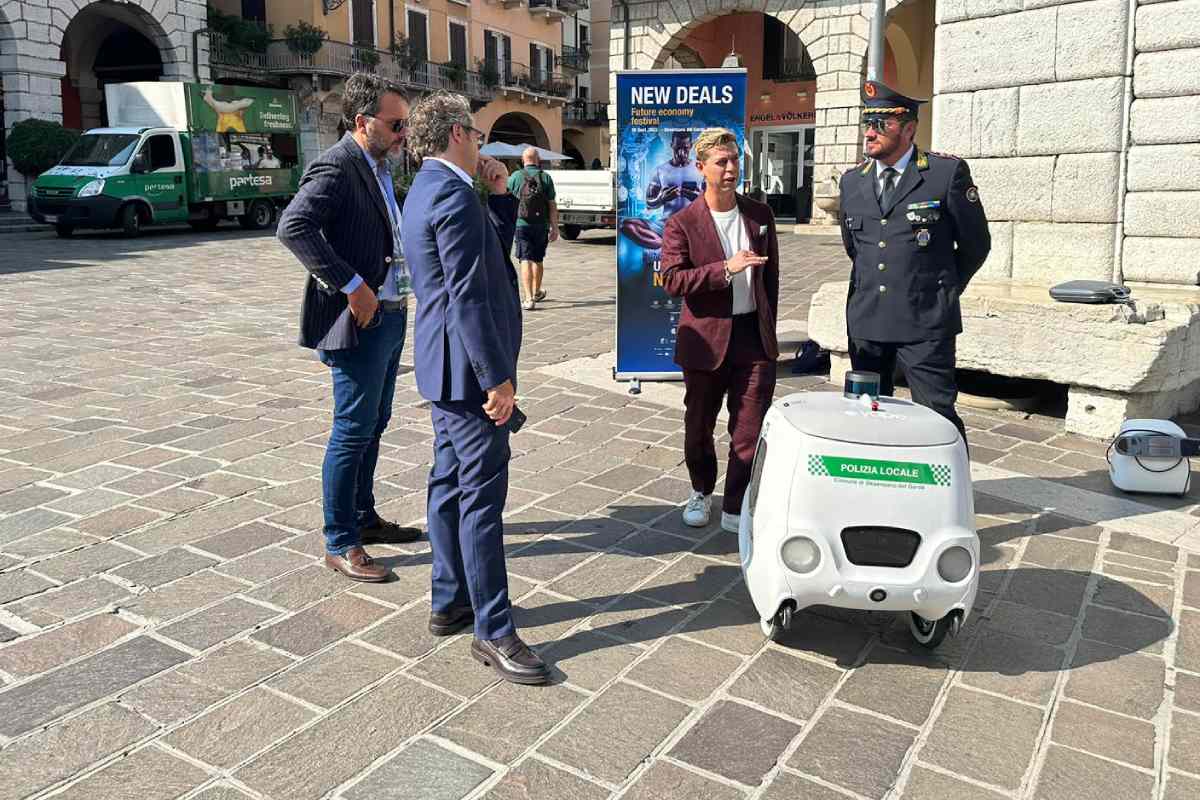
The good news is that unless you are Japanese living in a dystopian anime, automated (kawaiiii) drone repression will never work in practice.
https://theglorioblog.com/wp-content/uploads/2012/10/psychop...
yeah, same here, that's part of the problem though, which reinforces the idea that police can be replaced by autonomous robotic agents. Which is not true.
Some examples from my country, some are laughable, some are horrifying
https://www.gardapost.it/wp-content/uploads/2023/09/robot-ya...
https://www.gedistatic.it/content/gnn/img/ilsecoloxix/2023/1...
> As the commission is the executive branch, candidates are chosen individually by the 27 national governments. Within the EU, the legitimacy of the commission is mainly drawn from the vote of approval that is required from the European Parliament, along with its power to dismiss the body.
So, the part of the EU appointed by member governments is the part driving this. The EU (as often) is being used here as a scapegoat for anti-democratic policies desired by national governments.
But if the representatives are chosen by the, presumably, democratically elected governments how are they "anti-democratic". Unless representative democracies are inherently undemocratic (and therefore most European government themselves undemocratic), I fail to see how this can be described as "anti-democratic".
In basically every democracy there is a way for the elected representatives to push through legislation which is unpopular or only supported by a small portion of the population. But this is an intentional feature.
The member states are as much a part of the EU as the parliament is.
It's disingenuous to say that this is not the EU, of course it's also disingenuous to say that the EU is a monolith who wants this at all levels, but two wrongs don't make a right
Even the idea makes me loose all faith in the institution. How can you be okay with people as deranged as this making rules about the future of your country?
"Not everyone is insane", just isn't a particularly strong point.
As little as it may be, I sent it to the Italian representative group, to the team that oversees telecommunications
Edit if you're Italian you can find the email(s) here, scroll to trasporti e telecomunicazioni https://italiaue.esteri.it/it/chi-siamo/
Let your voice be heard! Contact your representatives (bottom of the page)!
This law is somewhat workable if you assume that App Stores are the only way for mobile apps to be distributed. If users are allowed to sideload, as an app maker from a non-european country, you can just refuse to comply.
This isn't possible with Apple's current implementation of this law, but that implementation is extremely likely to be ruled noncompliant anyway based on what the EU authorities are saying.
Politicians in Europe generally do not appreciate mass, repetitive emailing. It might even have an adversarial effect.
If you want to be helpful, please consider more strategic alternatives such raising awareness among the general public, writing thoughtful arguments, or joining specialized non-profits or political parties.
Nobody likes this. A concise, thoughtful call or message carries a premium in the states, but only if you’re demonstrably a constituent.
The reason is simple: it shows conviction. If you’re willing to pick up the phone, you might be willing to stump for an opponent. If you’re unwilling to do that, or are raving at the politician such that you would never be won over by them, you’re messaging you’re a lost cause.
Send a handwritten letter to cuts through the noise because no one does it anymore.
tough luck, it's their job. if they lash out due to that they are unfit to be in positions of power.
Every few years you get told you can vote for the next liar to do their bidding in your name, and we, the people, keep the circus alive by telling each other "your vote counts! It's your fault if they're all thieves!"
Government won't stop monitoring each and every citizen, and citizens have stopped any form of resistance, political or technological. Even in tech niches like this, cryptoanarchist ideas get routinely derided as useless and scams. We have lost.
I agree.
The tendency to over-criticize and deride is part of the self-inflicted helplessness. Every attempt to improve things gets a fair deal of scorn and criticism...which is not exactly good.
I think people outside of tech (99% of people) are far more likely to support such a law.
You may argue that this is due to them not being sufficiently informed, but that's not to be blamed on representative democracy.
The heavy surveillance states of today will prove an interesting case study of software/data upkeep.
^ https://theguardian.com/technology/2023/aug/02/ai-chatbot-tr...
Let's keep spreading the word about this, the whole Chat Control debate seems to be ignored right now in the media.
Maybe it is not purely by chance that the EU is dealing with this topic during the https://en.wikipedia.org/wiki/UEFA_Euro_2024 ? ;)
So, what's the use of this law anyway?
I do wonder what open source means though. Is Signal opensource? The client is, the server is not... Matrix is fully open source... And Whatsapp (which my country runs on) which has open source encryption...?
This is one of those extremely frustrating laws that's just going to hit everyone EXCEPT the ones who deserve it.
> "End-to-end encrypted messenger services are not excluded from the scope"
This was probably added precisely to include Signal, XMPP with OMEMO, etc.
> "Hosting services affected include web hosting, social media, video streaming services, file hosting and cloud services"
So not even self-hosting NAS, since this probably will be interpreted as "sharing with your family is still providing a file hosting service to them".
Seems like there is something weird about EU and pedophilia. Coincidentally, it seems as if the EU is operating under the thumb of a foreign power. After being involved in the tech sector there, it has been a recurring theme. I never heard about that stuff when working for US tech companies. In other countries, they also handle the problem but they don't constantly virtue-signal about it. Also when I was in the crypto space working on EU-backed projects, I heard rumors that some of the founders had been victims (or maybe also the other way? Like a cult) I inferred that they were being extorted. When I read conspiracy theories about that sort of stuff, it oddly resonates with some of my experiences in the tech sector when you get close to the big money and big politics.
The increase of popularity of conspiracy theories and the recurring theme of pedophilia is also starting to seem suspicious.
Incorrect link to match title, lots of recent discussion: https://news.ycombinator.com/item?id=40710993
Latest example being farmers that are being targeted and until they did not come to Brussels to dump manure in the streets, the EU Comission did not care a bit of the harm they were causing them. And it did not care even then until France used its power to get it to listen.
The EU started as a nice project that is slowly becoming something thst not even in the wildest communist dreams was thought not possible.
https://op.europa.eu/en/web/who-is-who/organization/-/organi...
one click there to get to your particular country.
It sure would be nice if it had a list of people to contact at the top.
Also HN is killing patrick-breyer's site, so it is even more difficult for all these committed people to find the place they should go look for who to contact.
Contact in Denmark - brurep@um.dk is evidently the one.
"Guilty until proven innocent" seems to be the new reality.
"Your child could be used in pornography"
"Criminals are selling weed via text message for €5 a gram"
The Simpsons "won't someone think of the children" meme demonstrates it well.
https://netzpolitik.org/2022/dude-wheres-my-privacy-how-a-ho...
It's like their gun law that was a response to the Islamic terrorists using smuggled ak47 from the balkans but the law flat out bans anything bugger than a pistol pretty much.
  To: info.belgoeurop@diplobel.fed.be, mission.brusselseu@bg-permrep.eu, eu.brussels@embassy.mzv.cz, brurep@um.dk, info@bruessel-eu.diplo.de, permrep.eu@mfa.ee, irlprb@dfa.ie, mea.bruxelles@rp-grece.be, reper.bruselasue@reper.maec.es, courrier.bruxelles-dfra@diplomatie.gouv.fr, hr.perm.rep@mvep.hr, rpue.rpue@esteri.it, cy.perm.rep@mfa.gov.cy, permrep.eu@mfa.gov.lv, office@eu.mfa.lt, bruxelles.rpue@mae.etat.lu, sec.beu@mfa.gov.hu, maltarep@gov.mt, bre@minbuza.nl, bruessel-ov@bmeia.gv.at, bebrustpe@msz.gov.pl, reper@mne.pt, bru@rpro.eu, slomission.eu@gov.si, eu.brussels@mzv.sk, sanomat.eue@formin.fi, representationen.bryssel@gov.se

  Subject: Urgent: Chat Control
  Dear Representative,

  I am writing to express my deep concerns regarding Chat Control. As a citizen of the European Union, I am committed to safeguarding our fundamental rights and freedoms, particularly the right to privacy and the protection of personal data.

  The Chat Control Chat Control poses several significant risks:

  Invasion of Privacy: The proposed measures would lead to the mass surveillance of private communications, undermining the privacy of all EU citizens. This broad surveillance is disproportionate and infringes on our fundamental right to private correspondence.

  Security Risks: Weakening encryption to facilitate the monitoring of communications makes all users more vulnerable to cyberattacks. Encryption is essential for protecting sensitive data, including financial information, personal communications, and sensitive business data.

  Potential for Abuse: Granting authorities the power to monitor private communications without adequate checks and balances can lead to misuse and abuse of power. This undermines trust in both governmental and digital platforms.

  Stifling Innovation: Chat Control could have a chilling effect on tech innovation within the EU. Companies may be discouraged from developing new technologies or offering their services in the EU due to increased regulatory burdens and privacy concerns.

  I urge you to oppose Chat Control and advocate for solutions that protect children online without compromising the privacy and security of all citizens. Alternatives such as targeted interventions, improved digital literacy, and support for responsible online behavior are more effective and less intrusive ways to achieve these goals.

  Protecting the privacy and security of our digital communications is crucial for maintaining trust in the digital economy and upholding the values of the European Union. I hope you will consider these points and vote against Chat Control.

  Thank you for your attention to this critical matter.

  Yours sincerely,
  [your name/address/etc.]
I am writing to express my deep concern regarding the proposed Chat Control legislation, despite not being a resident of the European Union. As someone who values privacy and security in digital communications, I believe this legislation has far-reaching implications that extend beyond the borders of the EU.I started here:
https://op.europa.eu/en/web/who-is-who/organization/-/organi...
Then checked Netherlands under sublevels and wound up here:
https://op.europa.eu/en/web/who-is-who/organization/-/organi...
and that seems to have the email address bre@minbuza.nl ?
and finally I end up at https://www.netherlandsandyou.nl/web/pr-eu-brussels which has no contact info.
I'll try that email address anyway.
I guess this is who I contact? https://www.netherlandsandyou.nl/web/pr-eu-brussels
edit:
Well apparently NL is clear in opposing it but I am a citizen of Ireland (it's not really clear who my representation is in that case) so will try them...
If you go against what people voted for, isn't it denying democracy and the votes of the people ?
No. An explicit feature of a representative democracy is that the will of the majority can be ignored.
The EU isn't a direct democracy where people can vote on particular issues, they vote on national parties, which send representatives to create EU wide parties.
And also the council has its own legitimacy which is not dependent on the EU elections, if the EP voted on this as a lame duck you'd have a point, but that doesn't seem to be happening
[x] 'privacy invasive scanning of everything personal, BUT for the benefit of the children and Kutcher'
Most people (even tech people) didn't/don't know about this and also, most people really don't care in the face of other more urgent things (housing, immigration, climate, inflation, etc etc etc).
If you sit down with them and explain (something like: what if this happens and you agree to the scanning, 20 years from now Putin invades your country and you get dragged off the gulag on day #1 because 17 years ago you sent a derogatory image of him to someone; they said they would delete everything!?!), most would probably vote against, but no-one is doing that.
People voted for the EU Parliament, which has a far more negative attitude to this proposal.
Germany have had some similar tech in place according to Der Spiegel, but the entire increase in positives was found out to be legal dickpics and flirty messages between teenagers etc. The only result was that the police now have a huge database of teenager's naked pictures and kids on the beach, which can hardly be a good way to minimize pedophile activity.
It will be a shitshow beyond comprehension if this eventually gets implemented.
Why would they? People in power and judges are always exempt from warrantless mass surveillance. They get actual privacy.
I think it just shows it won't be possible to implement this in a useful way. Let's hope...
Both I guess...
and permanently lose access to your google acount, even after lots of stress and the police declaring you innocent[1]. Replace google acount by some other important thing.
https://www.theguardian.com/technology/2022/aug/22/google-cs...
For the technologist, it is easy to circumvent in the private sphere of life at least.
I foresee however, a digital ID that will be tied to all your essential services, that you will be required to have in order to live, and that's the tracking and communication point that will be used to get a hold of you.
Kind of like the chinese social credit score, but in the EU of tomorrow, your digital EU idea will be the choking point. Do something out of line, and it can be revoked and with it, your bank, credit cards, health care, travel and other services.
I won't say that future will never happen only because "never" is a long time, but that's not happening in the foreseeable future.
I'm in Germany right now, and theoretically my ID card can be used online.
In practice, "Digitalisierung" is kinda a joke here, much like "paperless office".
For example, I have to visit an office to activate that feature of my ID card, and another to tell them I've moved.
During the pandemic, they briefly realised they didn't need to do that, then they forgot.
Likewise with health, there's more than one health insurance provider just in Germany, let alone the whole EU, and if I move country (not just travel, move) my previous insurance isn't likely to work in the new place anyway — it would take substantial improvements before it would even be possible for someone to corrut it the way you're afraid of.
They're all insane and whining over the smallest things, except the ones aligned to my personal political vieuws, of course.
Nobody wants terrorists, right ?
What we would lose is that secure communication is actually mainstream now. Billions of people, many of whom don't even know what "end to end encrypted" means use messaging services with strong encryption including WhatsApp, Signal, iMessage, even Facebook chat in some cases. These services make mass surveillance difficult or impossible, and targeted surveillance of their users requires significant effort, such as installing malware on a target's device.
I presumed self hosting a chat service becomes illegal with these laws?
"All services normally provided for remuneration (including ad-funded services) are in scope, without no threshold in size, number of users etc."
"Only non-commercial services that are not ad-funded, such as many open source software, are out of scope"
Weird right? But it would be weirder if they would outlaw the application of mathematical operations on your own messages... oh wait that's what they are proposing... Try and stop me. Are they going to put me in jail because I don't want them to read messages between me and my friends or my wife?
Them: "If you don't show us your messages, you are probably going to jail. So if you don't change your mind, and end up in jail without having shown us your messages, that means whatever was in those messages was way worse than going to jail. You probably knew you were going to get a longer sentence if you showed us those messages, and preferred to go with a shorter sentence of 'refusing to collaborate'."
I'm mildly optimistic it'll get better since the EU and EU politicians are getting more visible. I just hope we don't overshoot and end up where the US is right now where people seem to think the president does everything at all times at all levels
Btw, I'm assuming you meant "MEP candidate" when you say "deputy candidate", in english as far as I can tell deputy lost the meaning of "legislature member" in common use, that remained common in Latin languages (italian here, we use the same term)
Just an FYI that it might confuse some people (like it did with me before I switched to thinking about it in italian) why you were asking the deputies of a candidate instead of the candidates themselves
No one asked for this law, but you can convince the populace a posteriori that this is good for them, certainly. It's all part of the game.
The fact that the hoi polloi can be easily persuaded in any direction is not a reason for the people in power to do whatever the f they want with our rights, hiding beneath the banner of democracy.
Also, whoever says that we, the nerds, should do more to educate the masses is disingenuous when the people in power have massive reach. I can go rant on a blog about what this means for our privacy, while the politician goes on a TV show and on mass media campaigns to claim that this law is to save the children from the baddies.
Call me a silly idealist, but representative democracy is a bloody scam.
I think there are only two groups of people who still care about this:
- Tech people who are willing to give up QoL to cling to privacy-respecting alternatives. (People like us.) These people are a tiny minority which would be irrelevant in any democratic system.
- Old people who haven't yet arrived in the digital age. These are also a minority, and keep becoming fewer.
I think the vast majority of people have fully accepted constant surveillance of their digital activity by companies (and therefore governments) as simply the way things are.
To these people, this law is a benefit to security with zero tradeoff.
Normal people have no online privacy whatsoever anyway.
And only evil people would use encryption and anonymization, right?
(Tangent 1: Goverments could educate people in a representative democracy, too. People could also use the educational material readily available. But I think most people don't want to be educated on the majority of topics.)
(Tangent 2: I don't think direct democracy is a good system. I think that the vast majority of people (including me) are incapable of making good laws. I believe only a trained professional, aka a politician, is capable of understanding and predicting all the possible long term effects a law, such as e.g. a trade deal, can have. I certainly cannot.)
(ETA: I would go so far as to say that this law being controversially debated is the result of representative democracy working well. I'd claim that in a direct democracy it could easily get passed without much scrutiny.)
This is a depressing realization. I did convince my mother to use Ublock Origin, just to realize Iphones does not allow it.
The amount of techical competence needed is just way too high when most companoes and states are hostile to your privacy.
This is a perfectly fine statement. The policy is argued to be anti-democratic because of its substance, not because of how democratic the process is by which it is adopted.
A measure with broad popular support can be anti-democratic, a measure only supported by a small portion of the population can be pro-democratic. It's orthogonal and if anything there is an inverse correlation.
But it can do that, if / when it starts getting misused.
There was this "SS not all criminals" political party, AfD in Germany, that got lots of votes during the EU elections. AfD + Chat Control is not any good
I’d call that a minority, especially since Covid.
> not being able to pay with my card in a restaurant for example
An even smaller minority, especially for restaurants, slightly larger for non-chain fast food places that probably also cheat on taxes.
I don’t carry cash with me and pay almost everything with my MC debit or AMEX credit card, even in cases I can’t do that, I’d be able to pay with girocard (non-MC/Visa debit card, a widespread local system) if I had one.
Personal anecdote, but I've been travelling through Germany this winter and outside of motorway petrol stations and big supermarkets pretty much no one would accept my Visa/MasterCard cards - "EC Karten" only everywhere. We went to a big restaurant which I assumed would be ok because I could see the card terminal at the till, and at the end they told me it's EC Karten only - had to drive around at 11pm to find a working ATM just to withdraw some euro to pay them, while my wife and son waited at the restaurant - absolute nonsense.
Doesn't change that it's not a country.
This is simple stuff.
Are you guys being disingenuous?
Common military in practice, common currency, common laws, common courts and highest authority, common passport rules, etc.
The EU does not need to be a country for their rules to have impacts on countries. I think this is pretty self explanatory though?
My initial comment doesn't really make sense in this context
It's been a few years since I've been to Germany, but for comparison, in Norway - while it's nearly unheard of now - you also used to be able to find places that'd take "BankAxept" bank cards, which would be pretty much every domestic debit card, and is similar to EC Karten, but not Visa Electron/Mastercard Maestro debit cards.
If you had a domestic debit card, you'd almost certainly have a Visa/Maestro logo on it as well and so it'd be easy for people to assume that was what they were paying with.
They only took cash.
Overall it seems more common than when I first moved here, but that's starting from a low bar, I'd guess going from 1/6th to 1/2 of the cafes and restaurants.
But from all the comments, I’m starting to wonder if SumUp had some focus on Lübeck and Hamburg for other places to not have the huge advances in card payments of recent years.
That's how effective and democratic this all is.
Just because we give up our responsibility to electorate in hope that they solve our problems. How could they possibly do that for millions of individuals with different problems and needs?
Divide and conquer.
I cannot believe you're comparing that (an effort designed to make recycling more effective, which is generally a good thing) to EU citizens entirely losing our access to privacy in the digital world.
The guys who somehow enjoy throwing away plastic caps, will likely remove it anyway.
The same with the spying, all users will suffer, but those who want to work around it, will find a way.
The irony is that it makes driving more dangerous now, as you need two hands to drink from a water bottle.
These regulations won’t do anything to stop countries in Asia, Africa and other places from pumping their garbage into rivers and oceans…
To be fair I don’t really mind the bottle caps (unlike the plastic straw ban) but it hardly accomplishes anything beautiful allowing people in the EU to feel better about themselves because they are doing their part (which is possibly actually counterproductive).
You cannot solve problems for millions idividuals by centralised regulations.
And if you are too lazy to bring it back or just a person who throws away stuff carelessly, someone else will do (big sorting centers as it's a big revenue-stream, the cleaners, the homelesses, some bored students, etc).
It's really not that big of a deal honestly, you unscrew the bottle, flip the cap up (it kinda locks like that and stays out of your way in one of the designs I've seen, in the other it's just attached and can easily be kept out of the way with a finger), then you drink, I fail to see how you suddenly need two hands as opposed to before...
Stop using weak language and call a spade a spade.
There are many regulations that slightly inconvenience the many, to address the problems of a few. Individually these cases are benign. As a group they compound complexity.
Each new reform should be evaluated on both its benefits and the burden that it brings.
What? That is absurd, you don't need two hands just because the lid remains attached.