Fast Crimes at Lambda School(sandofsky.com) |
Fast Crimes at Lambda School(sandofsky.com) |
How many people got the traditional education route, rack up even MORE debt, still don't end up doing the thing / end up where they want to be?
Is this maybe an easy to see problem that is part of a larger education problem none the less?
Full disclosure: I'm the product of a boot camp. Changed careers and learned to code after age 40. It worked out great for me, but yeah I was in camp with a lot of people who shouldn't have been / it was a waste of time / money for them.
I have to wonder as jobs and careers change, having faster ways to retool seems all but required. At the same time I think those efforts will be hit and miss, and I'm not sure there's a solution to that.
(That doesn't excuse any of the scummy nature of some of the storytelling around bootcamps, but honestly I've worked with university interns and they seem to tell each other their own stories about how much they'll be making and it's interesting how that hype sort of builds.)
You can certainly find universities that charge high prices, deliver a poor education, don’t have their act together, and leave students with a lot of debt and little to show for it.
The difference in this case was that Lambda School was pushed on everyone as the superior bootcamp. It was supposed to be a top-tier bootcamp. One of the best. Famous people like Paul Graham touted it constantly on Twitter and even wrote an essay defending the Lambda School founder when the first criticisms started gaining momentum.
> Is this maybe an easy to see problem that is part of a larger education problem none the less?
Trying to reduce all education options to the same level removes the nuance that makes this story what it is. Of course you can find bad education experiences in many forms, but it’s also easy to discover that Stanford has an excellent CS program while some private no-name for-profit university has no reputation. In this case, the most reputable bootcamp that was being touted by industry titans as the superior education option turned out to be one of the worst. That’s the story.
But I think you would be hard pressed to find a university, even a crappy one, where it's up to the students to TA themselves, there are 100 students to one professor, and the curriculum constantly changes in the middle of a semester. So it's not quite accurate to try and compare Lambda to a traditional univeristy.
But congrats on your success in career changing. It begs the question of whether you could've done that on your own without attending a boot camp.
Granted after that... I was fine learning on my own / that's half the job of programming. But initially I don't think I would have made it over that first hill.
I do think that is a personal learning style thing. When I was younger I was a TERRIBLE formal schooling type learner. When I went back I was appreciative / loved that environment.
It was the force of nature that turned my life on the right path.
It was the best decision I ever made
This wouldn’t have been possible without Austen.
i wish that people would not throw out the baby with the bathwater when changing careers and reskilling people is an inherently messy process that obviously the bootcamp cannot totally control even if were run perfectly, which lambda definitely was not. it just turns off a lot of people like me who actually could potentially change their lives for the better if they were presented simple facts without the extremes of hype or hyperbole.
p.s. for sibling comment - yes it is -normal- for good students to be offered another term as TAs for the next class. this was considered an honor and actually was fairly competitive and i think helped them be really good by the time they got into the job search. TAs are TAs, all colleges have them; they do not replace full instructors, but some of them are worth their weight in gold due to their student empathy.
In what way was it a force of nature, vs just a bootcamp where you applied yourself?
Is there something in the instruction Lambda offered vs other bootcamps?
I don't think an author who understands the domain would write like this. Even if we spot that Lambda was a tire fire that needed to die, the author's outrage doesn't square with realities on the ground in other sectors of postsecondary education, especially in programs that serve lower-income students. I wouldn't launch a general defense of Lambda/Allred but I think the following notes from a practitioner might be interesting.
Postsecondary employment stats are inaccurate across the board and intrinsically hard. In the real world I am mostly only aware of job stats that could be called "fake", and those which are not published. Hiring stats are surprisingly tough to get right and I would wager that the majority of public job stats would be called fake by the man on the street. For example, if you've seen a law school employment statistic, it probably includes (as "hired") all the people who work in another field, or who work part time, or who work on a "contract", etc. As a domain expert I can tell you there is no easy way to legislate this number's production (or outlaw the use of such stats) in a way that generates the outcomes you want, or which vindicates and villainizes the correct schools. Some state regulators make it illegal to publish or market job placement statistics; other state regulators make it mandatory! California's BPPE (for eg) posts them all publicly and a brief review will confirm that there are obvious incorrect filings which the regulator publishes without challenge. Accredited higher ed generally does not have direct state or federal regulatory oversight or rules on hiring stats. My personal opinion is that publishing and marketing hiring stats is good, actually -- even in an imperfect regime, which is the only way to do it -- but my broader point is that well-intended regulatory bodies haven't figured this out yet, and in any case the numbers are all wrong in the same ways that are cited here in shocked tones. Also would you be shocked if your local community college had reported 10% in-field employment? Note that "graduation" and "enrollment" are equally squiggly and intrinsically a part of the same statistic.
Sizable portions of debtholders are (or appear) surprised, unhappy, and/or obviously cheated by profit-taking lenders. I think a lot of us are frustrated that students are faced with impossible choices about debt. Many would say "public payment is the only moral system" but that argument isn't clearly stated here. (As an aside, publicly-funded higher ed tends to exclude poor students, both under the status quo and under proposals for publicly-funded higher ed. This is accomplished through insidious rationing of four-year and graduate institutions, and weak services for working students. Working-class Bachelors' students are routed to University of Phoenix and get $100k+ of debt instead of subsidized in-state tuition.) Putting aside the public funding dream, student debt is how we fund schools today, and vanilla debt has the same issues as ISAs (which are a type of debt). I can't speak to Lambda's ISA structure or administration but I have some general comments about ISAs. An ISA is a newfangled kind of debt that is legally restricted from being very different from debt. (It's basically a vanilla debt, bundled with an insurance product that pays if the alum earns less than $X, and costs extra if the alum earns more than $Y. The insurance can't legally carry high fees, so it can't refund many grads, and complicated administration and adverse incentives also cost a lot. In practice there will be winners and losers vs vanilla debt.) ISAs and conventional debt can be designed well or poorly, and explained well or poorly, but the author is outraged about things which happen abundantly in all these circumstances. I signed college debt paperwork; I griped about the parts I had understood, and the parts I hadn't understood; profit-seeking firms bought and sold my debt and tossed me about on their careless seas. I can personally report that informed low-income students generally love ISAs (the debt-plus-downside-insurance product), and usually dislike vanilla debt, and for this reason I like ISAs at least as much as vanilla debt.
Schools that serve lower-income students are disproportionately judged negatively by middle-class audiences, often with malign motives and/or malign emergent outcomes. Depending on how you lawyer the details, you could say that 90% of community college students waste time and money and never see any benefit. (And they're in a government-subsidized program and only paying a minority of true costs!) I would find that kind of lawyering to be holistically untrue, but I don't think normal people have grounded intuitions about what is normal and OK, and how that is influenced by class and income, part-time vs full-time, accredited vs unaccredited, etc. Many people aren't aware that there is more demand for BA/BS programs than there are subsidized schools -- doubly so if the student is working and lower-class -- and this is the normal audience for for-profit universities. The world's best institution for this audience would have bad employment stats, as compared to a bad b-tier state school, and as compared to middle-class attitudes about predation. Are lower-income students better served if we pass laws against low-success programs, or institute price caps, etc? I observe that schools which serve poor students appear dirty and compromised in myriad ways, even when they are operating at the top or the middle of curve in terms of execution. This shows up in employment stats, in student complaints about debt (rich kids just pay), in employee morale and pay grade, etc. Again, this is true of great schools that serve a vulnerable audience. (Not saying that's the case here. I honestly don't know where Lambda is on the curve, and I honestly don't know which Universities of Phoenix should be shut down. And I'm a domain expert!)
In conclusion: If this author were an all-powerful regulator, what % of postsecondary programs for low-income students would get shut down? (After examining the facts.) Would this benefit low-income students? I honestly don't know and there are no simple answers, but even if I assume that Lamda is an outlier that needs to die, I don't think an author who understands the landscape would write like this.
If you think he's trying to hide on that account, and that's all your evidence, then you're just being emotional.
Don't trust anyone you meet on the internet as they may be the CEO.
My grasp of English isn't without flaws, but that seems to be a pretty direct lie unless he was also a former student at Lambda School.
"I and other dads, had to wait for the train." are you a Dad? Most likely based on general use, but what if you were just the tour guide for the dads.
Where are my people at these days?
They don't want to engage in intellectual/nerdy pissing contests, nor do they want to jump through a million burning hoops to increase their total compensation. They want to show up 9 o'clock, do their work, and leave around 5 - and that's that.
No hacky side projects. No late evenings reading up on shiny new tools, no grinding leetcode and prepping for interviews, no hustles.
(You'll find the geeky hackers at startups, open-source projects, etc.)
At different times for example it was typical for a doctor, architect, or pilot to be an informally educated enthusiast. As programming has matured into a broadly relevant and economically important domain, the dynamics of who does it and how they learn it change, as it also did in those other fields.
You can lament the change but it's never coming back.
And there's certainly still space for people who are curious and intrinsically motivated if you think about the whole pie growing rather than just being cut up differently.
There is just a lot more noise than signal now.
To say something like "The defunding of public colleges" is egregious. It's just factually wrong. Colleges haven't been defunded. In fact college funding has gone up in many states. It's that tuition has risen more than the funding has gone up.
Also, no mention of thousands of people saddled with debt from many public colleges teaching CS or IT or whatever? That's not a scam either???
Lambda School was on-par with an average code bootcamp. Students got a taste of programming, but when it came to getting hired, neither the training nor credentials held a candle to a college degree
Give. Me. A. Fucking. Break.
Lambda seems to have been real bad in the aggregate, but I'm wary of people leveraging that scary story as a vector for restoring college credentialism. Plenty of esteemed colleges have comparable track records, and deserve comparable stories.
Let's skip the math, physics, and other code-free classes give you a foundational understanding of computers [...]
Yes, let's, please. Programmers in the main connect form fields to SQL columns. Calc II is a hazing ritual that supports an elite credential structure, not foundational knowledge for the practice.
In reality, one iOS instructor had just graduated from a competing boot camp before getting hired, having never spent a day in the industry. The head of the data science program was Austen's brother, Ryan, whose only experience was another bootcamp and internship.
Again: real bad. Lambda: not good. But the author knows full well who teaches a lot of university courses, and that's not a great story either.
If you have a disinclination towards purportedly difficult academia such as higher math, you're more than welcome to apply to some kind of a new major, we can call it "software development" where you can fritter away your mortality with impressive courses such as "flexing on others the CSS way" and "Mongo, the SQL to relational databases.", but there are those of us who study computer science with an emphasis on transcendent learning, and not the frontend framework flavor of the day.
Computer science is a STEM discipline, not a trade.
Seeing a huge wave of ponzified educational courses being pushed by influencers and famous people that results in financial ruin.
1%ers, 10x engineers, these are ALL caricatures that is created by course sellers to instill the belief that the participant NEEDS to purchase it.
If I was to create a society based on principles, the founders of Lambda School, should be behind bars.
It has been a bubble now for 13 years. I disagree here. Maybe it's just the new normal? Comparisons between now the the '90s do not hold up. Tech companies today are much bigger, but also generating huge profits, unlike the 90s bubble, in which tech companies were much less profitable or unprofitable relative to valuations.
lol "people could raise ludicrous money" What? Where? Funding rounds are much smaller, more competitive, and more selective today compared to in the 90s. Hardly anyone except for a few lucky people (like the founders of Coinbase or Dropbox) are getting rich overnight anymore, unlike in the 90s. Founders are being offered table scraps worth of funding compared to the generous, multi-million-dollar funding rounds that were common in the 90s.
This is made worse by the fact that running a tech company is more expensive than ever in terms of the complexity of the product (interactive apps are waaaayyy harder to develop than a static html store) and marketing (everything is so expensive and saturated compared to the 90s. Ads are obscenely expensive today and full of click/viewer fraud and worthless, inflated metrics.) and labor costs (coders are much better paid today compared to the 90s relative to inflation).
Sure, you might not like ISAs, but that's not the point. You signed an agreement. The agreement itself is not illegal. If you don't like it, why did you sign it?
Like, what's the expectation here? That you should be able to get a coding education for free? Even if you got a job unrelated to programming, how does that excuse you from needing to pay for tuition for courses you already completed?
personally i'm even rooting for companies that contend against universities
but the litmus test for lambda school is pretty fucking simple
will your company survive if you got austen as your ceo instead of you?
That all changed with the Russian ruble crisis, which hit finance first late in '98 and then took another year for its effects to start hitting the tech industry hard. By 2001 the game was up and it really took until the 2010s to turn around.
Actually in the late 00s and early 2010s it was actually really gross and sort of like crypto. I remember a lot of smooth talking dudes around NY who were raising all kinds of VC money and doing _nothing_ with it but finding shady ways to spend it on themselves/drugs. The money was free and the accountability was absent. That era really didn't last more than about 3-5 years.
The new normal (from the invention of the internet on) would be that tech companies are more competitive, pay better, and have higher risk.
1. They lied about the student success rates
2. They went after graduates for the ISA when they shouldn't (e.g. graduates not working in tech, or continuing the job they had before lambda school)
> Most students weren't hired. What little money the school made came from quietly reselling student debt to hedge funds.
Legally sound, probably? Morally unsound, definitely.
See the subsections titled "Misrepresented their financial interests by selling loans to investors" and "Engaged in illegal contract practices" at https://www.consumerfinance.gov/about-us/newsroom/cfpb-takes...
I do agree with accountability on debts you sign up for, including student loans.
They went after people not meeting the conditions. Simple as that.
According to the article, they have not had court victories to support their claims.
If only I knew at the time I could have simply taken the university to court because my starting salary out of school was $55k.
I don't care one iota about the legal minutiae that says they're technically allowed to collect, it is blatantly obvious what the students thought they were signing and so it's really hard to argue "no actually they agreed to <this other thing>." If you present paperwork that you say is the legalese version of the agreement you discussed, have the other party sign it on that basis, and then it isn't that is the lowest hanging fruit of contracts that should be thrown out.
What? Yes it does. To any native English speaker, “I and other X” means you’re part of X, always.
I had no control over student selection. The bootcamp school accepted everyone. I told them not to, they didn’t care.
Lol. TAs in colleges are graduate students. They aren't undergraduates who can't find a job.
So they're... graduates who can't find a job? I'm not sure you're making the point you're trying to make here.
This is quite different from a using a recent Bootcamp grad, likely without any industry experience, as a TA in a Software Dev Bootcamp. Especially because the main purpose of this is just to inflate job placement statistics.
I'm familiar, thanks.
Why is someone who graduated last year and went into a Master's program different from someone who graduated last year and became a bootcamp TA?
I did teach a 6 week C++ course. Mostly attended by CS students at the local college. Back in the day we didn't teach kids how to code in a CS cirriculum. They were expected to just pick it up themselves. Six weeks really isn't enough to teach how to be good at C++.
I spent a fair amount of time reading Papert and Piaget, trying to develop a theory on how people learn and how to best teach "programming" concepts. I've yet to see ANYONE (myself included) do an excellent job teaching the kind of programming employers want. I saw another comment here about how "programming" is simple, but teaching architecture and putting things together is hard. I would mostly agree with that.
But... there are some techniques that are better than others.
My experience w/ Lambda School was they tried to hire me as an instructor way back when. I talked to them briefly about pedagogy and their approach to modeling learning and how they were going to measure improvements in their cirriculum. I got blank looks. They kept harping about how they were going to iterate, but without the slightest idea how they were going to improve between iterations.
I quietly walked out the door never to return (moving to Seattle to work for Amazon instead.) It looks like I made the right call.
Dartmouth College once had a course called CS23 (Software Engineering) that was infamous for introducing students to "real world" development. The first half of the course was dedicated to C++, with weekly assignments like "implement this data structure class, given the .h file."
The latter half of the course was a 5-person group project with teams chosen by the instructor. The project ran 5 or 6 weeks. And with one week to go, right as the students entered finals, the professors would make a change to the spec. Every time. It was definitely deliberate.
Grades were partly team-based (which sucked if you had a bad team) and partly individual (especially if you had a bad team).
The students who went through this were smart, highly motivated, and had at least 2 or 3 other successful CS classes first. Non-majors almost never took the course.
Time after time, I saw this course turn CS majors into people who could work on real team projects. Not all of them; even in a solid Ivy League CS program some people were a menace to their group. But I'd watch my younger friends go through the experience, starting out naive and coming out with actual instincts on how to ship something.
In a lot of ways, I don't think CS 23 was always well taught. Our professor was a Lisp programmer teaching C++ and his .h files often contained serious errors. But the genius of the course design was that slightly dodgy teaching only added to the overall experience. The course was intended to be a high stakes team project under realistic conditions. Bad team assignments, bugs in the spec, a changing spec, the whole nine yards. And the students were as prepared and qualified as any students could be, going in.
But I think there's a kernel of a good idea here. Once students can program, the best way turn them into developers is to make them build and ship something as a team.
(Dartmouth also had solid theory classes in the major, but that's a story for another day. You couldn't graduate without having done a real project and having written a lot of mathematical proofs.)
I had a semester project like that, in a team of 7, though we didn't had the changing spec... But it was a really good learning experience
They just needed a kick in the butt. Anyone that actually needs to learn how to program for real, won't make it out.
My hope was that the bootcamp might make it easier to find a job, which didn't happen. They put more effort into instruction than into placing applicants. Not sure why; I can easily cover any material that would be covered in a bootcamp myself.
I'm a very amateur teacher, but have received great feedback on my "teaching style",
which I've refined based on two things: how often I get puzzled looks during a technique, how often I get thanked for using a specific technique.
I'm curious what this looks like in the big leagues - how this "scales".
Thanks for your time.
One thing about feedback this is counterintuitive is that, students are generally very bad at understanding what actually helps them learn. When I say learn I mean gain a conceptual understanding and procedural fluency in whatever they are learning that sticks with an ability to appropriately transfer that knowledge beyond the context they've seen it in.
So unfortunately when a student says "that was great!" research has found that to be negatively correlated with learning.
If you want to delve into a study that talks about this and what effective teaching looks like in the long-term I really recommend this study done at the US Air Force Academy [0].
It is the closest thing I have seen to a gold standard study in education where a lot of research is dubious at best:
Look at what Carrell and West handed us with this study:
- 7 year study at the US Air Force Academy - 10,534 students - 421 faculty members - 30 core courses, all standardized (math, science, social science, humanities, and engineering) - Random assignment of students to professors in initial course and follow-on courses
[0] https://www.jstor.org/stable/10.1086/653808
I've got an email in my profile if you want to discuss!
Chefs-kiss
That’s me every time I start a new project ;). Thanks for the chuckle, and please publish a book having that title.
Edit: This is not to suggest 'austenallred received special treatment.
I have first hand experience with their program, albeit 10 years ago, but I would largely say that almost no one who completed the program with me actually needed it and its benefits are largely a forcing function to get you to build a portfolio in a short amount of time and have a peer group to rely on. Everyone from my cohort is still working in industry today if they want to and all seem to be doing well.
ISAs as indentured servitude? The shadowy negotiating a company's validation "behind closed doors?" (Where else are you supposed to do it.)
The criticism of Lambda School can stand on its own without wading into the extreme hyperbole.
Kind of surprised that PG made the comment he did, which seems naive in this regard.
We are all flawed humans. I can empathize so far - but no further, because the thing that comes after "we are all flawed humans" needs to be learning how to manage one's own flawed nature such that its blast radius encompasses blameless others as closely to never as possible. It is not evident Allred has meaningfully done anything remotely resembling that kind of work.
That's ok though. Any civilized country is generally OK with spending taxes to educate people.
Does the government get 9% of that? Or is it capped at the outstanding loan amount?
If the latter, and someone earning $1m pays the same as someone evening $500k, it doesn't seem like an income share agreement.
A valuation of $1B for this business is crazy. Investors were simply underwriting students paying for trade school, there's no tangible tech innovation. Like Theranos, WeWork, and FTX - it's the story of a darling founder who has to justify an unrealistic valuation in a frothy market. They're living in an echo chamber where fraudulent behavior goes unquestioned because everyone wants the upside.
Salaries are based on scarcity. High-skill software engineers were rare at one point, because there weren’t many of them with experience or training. Programs like Lambda School increased the number of people who know how to code while decreasing quality, resulting in fewer unfilled jobs and lower compensation. And again, where is the innovation? In the sketchy ISA?
There's a fine line between the “fake it till you make it” ethos in Silicon Valley and fraudulent behavior that materially hurts investors and consumers. He clearly crossed the line by publicly and repeatedly lying, but he was also incentivized and encouraged to build a hyper-scale business on the backs of people lacking expertise in the job marketplace.
I believe teaching people how to code is a good thing. But it's not a venture-scale business, and never should have been valued as such. A sketchy financial instrument doesn't equal innovation.
- schools need to be selective to keep the quality of the student body high so they persevere to finish the program and succeed
- getting students hired in a competitive field is a very high bar that is much higher compared to most schools
- software is a difficult field with high frustration and a steep learning curve
Lambda was open to everyone, in a tough field, with a high bar for success. Alternatives might be possible in less competitive fields
Their whole deal is, they will offer you a "free" crash course in mobile development (or whatever the new hotness du jour is, these days I'm sure they have AI offerings). I believe the course lasts two months, after which they will prepare a fake résumé for you, apply for contract positions in your name, and have call-center people in India do the phone interviews on your behalf, pretending to be you. You are also coached in how to lie about your experience for the in-person interview. You are obligated to work for two years at wherever they place you (could be one place or many places, I guess). If you do not agree to all of this, you will be assessed a $20,000 charge for your "free" training and billed for such.
The principal in all three companies is Vikram Thadani. He's been running this scam in some form or another since the early 2010s.
Their current site: https://www.enhanceit.com
Old blog post about someone who got skeeved out applying to work for them when they were BrighterBrain:
https://web.archive.org/web/20150308193650/http://shifttohap...
More recent Reddit post about the same shit going on under the EnhanceIT name:
https://www.reddit.com/r/careerguidance/comments/v63p2t/enha...
You were right in 2019, despite being downvoted. Good call. Congrats
Coding is hard, and there is no evidence to suggest it's getting easier , such as dealing with the integration of the front-end with the back-end, or having to deal with libraries and cloud environments and everything else that goes into it. The belief that average people can be turned into proficient coders in months is ludicrous.
They will fire up good old chatGPT and put together million line code systems easy.
The only way would be to filter many candidates going in, but the negative press would be huge. So you end up with huge cohorts of people who can't code, and you have to make the money back somehow. Good teachers need to know how to code well, and those are expensive too. And, let's face it, the internet is full of great material to learn to code for free. If you are not motivated enough to learn by your own, all the time, I don't see how a bootcamp will give you anything.
I’m fairly confident now that the cumulative student journey improvement, work allocation, cross-faculty collaboration, beurocracy-reduction, and general efficiencies we have delivered to a stable large post-secondary institution across all faculties is going to make a larger and longer lasting positive improvement to more students and people’s lives than what Lambda achieved. (With fewer people, less funding, etc)
At that time, I was working in a helpdesk role that I had had for about 5 years. It was a call center job, so I didn't have a lot of control over my schedule, but was able to arrange to keep my schedule for the nine months of the program. About 3 months into the program, they completely changed the structure of the program, which doubled the length to 18 months.
I completed the core curriculum and the capstone project. Throughout the program they kept promising to connect us with career counselors, but kept pushing it back. First it would be after we were halfway through the core curriculum, then when we finished the core curriculum, then when we started the capstone project, then when we finished it. I never once got to speak with any kind of career professional. The closest we got was a peer reviewed resume.
After the capstone project, we started a "computer science" module, which was supposed to be the end of the course. I did a few weeks of the computer science module, but couldn't continue when my shift changed, since this was outside of the original nine months. I tried to make arrangements to finish the module on my own time, but they wouldn't allow this. The only option I was given was to withdraw from the program.
By the time I had finished, the reputation for Lambda was already tanking. I tried sending out resumes, but I couldn't get any traction at all. I did Triplebyte and passed, but only got one interview from that process and it didn't lead to a job.
Meanwhile, I got a pay bump that put me over the 50k. Lambda came after me for the ISA, since I had a job in tech. It didn't matter that it was the same job I had had for 5 years before starting their program.
I went to a lawyer and was told that the contract required arbitration in New York City, which would be too expensive to bother with, so I just paid the ISA.
I later went through a different bootcamp on scholarship and did end up getting a SWE job after that, but was laid off in 2022 when our project was discontinued and am back on the helpdesk. Guess I was never meant to be a programmer lol.
The Vanderbilts and Carnegies of today could do a major public service if they wanted to. Use their names and hire the best researchers in their respective fields and pay them well.
But, I guess, for many people in the US - they want any solution other than that.
Almost none of the US’s problems are the result of not throwing enough taxpayer money at the problem. We throw as much taxpayer money at problems as any other country in the world.
The other baffling thing about Lambda was that companies had to pay Lambda to recruit their students.
https://www.cuesta.edu/student/resources/cashier/cost_of_att...
Additionally, at Cuesta the first month of bus rides is free, and the bus tickets themselves can be purchased at ~50 bucks a month. It's not too hard to find some roommates in town and get some cheap rent, too.
In return, you can get a curriculum that closely follows that of Cal Poly (often with teachers who teach at both institutions!), and a fairly successful transfer program.
Of course once you get into the university the costs are much higher, but you don't have mandatory dorms anymore, but you did two years on the cheap, and when you combine financial aid, scholarships, and federal student loans it's not ridiculous to have $20k or less in debt by the time you graduate. With a decent job in tech, that can be paid off in under a year.
Unfortunately, the job market is really tough right now for fresh grads, so that last part is where this falls apart, but I'd wager it's relatively easier for someone with a proper four-year degree than someone with a bootcamp credential.
I thought people in the US already knew that part of the value of a college is accreditation. Some people would fail in a rigorous 4-year program. Some courses are like grand filters: it does not mean much if one excels first-year calculus, but it is a strong signal that one's talent or discipline is in question if the person fails the first-year calculus. So, statistically, companies get a pretty good signal, at a relatively low cost, on how good a college graduate is.
Just find desperate people who lost their jobs during the pandemic, promise them a new job, collect their phones and emails and start spamming hard, using salespeople named "coaches" and engaging them into a gamified funnel. In the end, sell them idea of taking a loan (or ISA if no bank will give you a loan cause of your credit history) and get part of that loan as an enrolment fee. All of that set-up in the spirit of a charity organisation of course, helping people to "start a new life".
The application was initially made by founders who finished a similar bootcamp as well. Terrible software decisions and randomly assembled tech stack included. Then hiring junior guys to clean up after bootcampers, middle level guys to clean up after fired junior guys, and lastly senior guys (my company) to write some code which actually works.
After application was finally working they got XXX millions of VC funding, and started hiring everything they can, then firing, hiring, firing and so on, we all got fired eventually and I dont even know what's happening there now, but I remember it was a big mess.
Founders are former bank's people, loans are still their bread even after getting into IT. They were totally convinced they are the next unicorn, but just "one talented growth-hacker" away from it, always looking for that hacker but never found him i guess.
I only made a comment long time ago that Lambda School sounded like a good idea to me and I regret how fool I was.
Edit: btw, bitwise, you were right in 2019, despite your response to my comment being downvoted.
it's a good contender against universities and there are handful of companies in other countries that have the same model
the core differentiator and the sole reason those companies are still alive?
they don't have a fucking austen as ceo lol
the first mover advantage he got ended up being his achilles heel
I'm personally biased, but I feel like one bootcamp program that got this right (for a while) was Insight Data Science. For a few years at the start of the 'data boom' there was a market inefficiency where tech needed more people that understood stats and ML and there were a ton of STEM postdocs that wanted to leave academia. The program worked because it wasn't really about teaching any new skills, it was mostly about being able to market the skills you have in a different sector. But after a few years, the market corrected itself and there was no shortage of data/stats people in tech anymore and there were enough resources for those academics to manage the transition on their own. I don't know if the program still exists, but if they do I'm not sure what they could do now to make themselves relevant.
https://www.teamblind.com/post/Insight-data-science-scam-dur...
Unfortunately, they couldn't make enough at it, and have had to pivot away from it. There was a post, hereabouts, recently, that spoke to that.
All the good candidates had proven themselves in other disciplines. Our top candidates my first year mentoring were a master carpenter and a PhD in Jazz.
The typical Bachelor’s in Communications-to-Coder just never panned out at a real-world level.
In the late 90s it made sense for people to switch to software from e.g. HR or accounting or whatever because the field was exploding in a way they couldn't have predicted when picking a field in the 80s or 70s. But why would somebody in their 30s or 40s do this today? They've lived in a world where software was always hot, and if they had the chops and wanted "in" on software they could've done it long ago.
So who is left who plausibly could do the job who isn't already in the industry? Mostly people who couldn't handle or get into college (for whatever reason), but also aren't talented enough to learn on their own. I'm sure there are some people like this, but now you have to wonder: if college wasn't "right" for these people, what pedagogical "secret sauce" can boot camps add to actually get to them?
I think law is similar. Do you really need to be super smart to be a lawyer? Probably not. But you do have to be vaguely interested in reading legal texts and... Jesus no thanks.
That being said the program is a bit more than ~3 months and the students go all in, they’re not doing it part time.
The students come from different backgrounds, some have not graduated highschool, and they come hungry for better opportunities. We’ve tried this with a few companies and that was the only one that has been successful.
That being said, I think it has been difficult for them to scale profitably as it is just a lot of work to find the candidates and provide effective instruction.
I'm in the middle of creating a series on implementing Universal Links and URL Schemes, for iOS. May be a while, before it's ready. I spend a lot of time, testing the supporting materials, and making sure that I'm giving good info.
Preferably the boot camp is in person not online, because physically relocating to the place of instruction is a big part of going all in.
We take care of these requests every day and have bent over backwards (e.g. spending hours writing code) to help people individually in cases where their needs were unusually complex. I can tell you for sure that whether the person is high- or low-status in $whoever's eyes has nothing to do with this. Often I don't even know who the person is.
Our approach boils down to this: we don't want anyone to get in trouble from anything they posted to HN. It doesn't matter who the "anyone" is. Countless times I've deleted posts, redacted personal data and/or randomized usernames for accounts that had long been abusing and trolling HN. I don't rub their nose in it—I just pretend not to have noticed. You'd be surprised how polite and thankful people become when they need something.
I'm not surprised to see accounts like https://news.ycombinator.com/item?id=40732721 being scurrilously silly, but you've been around here long enough to know better.
Edit: here's the last time this came up: https://news.ycombinator.com/item?id=26949343. It's a more complete explanation than I have time to give right now, and nothing has changed since then.
I’ve literally never felt the need to request a change, even though I’ve written a bunch of boneheaded stuff.
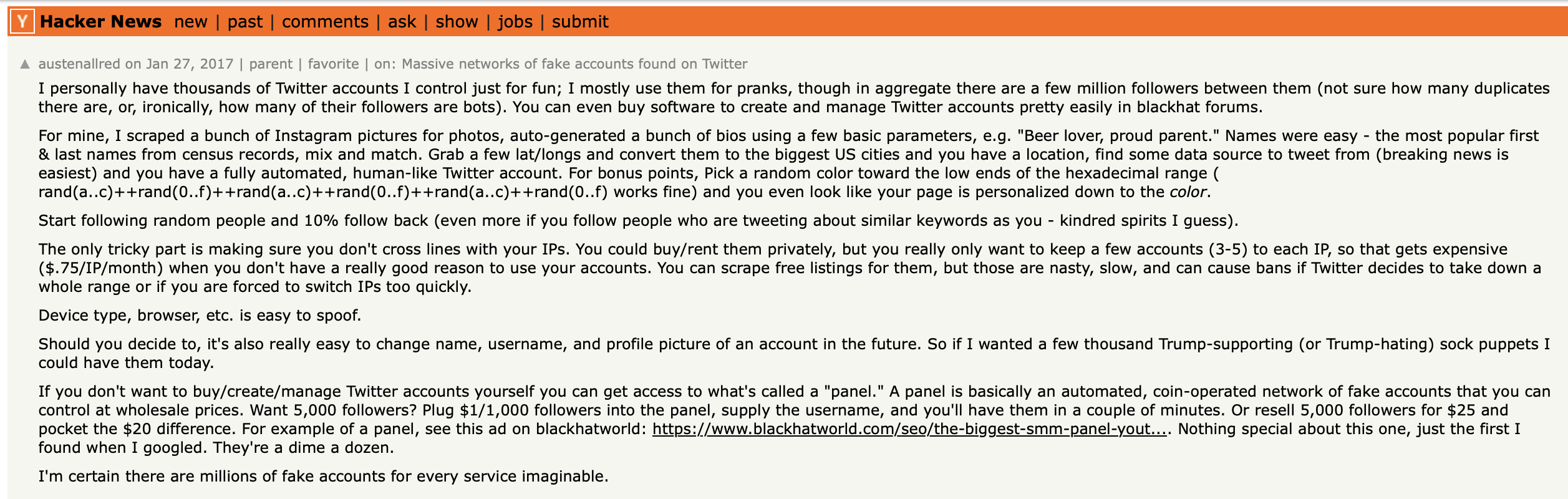
This isn't, IMO, favoritism or protecting YC interests//founders. The thread in question has nothing to do with Lamda, YC, or anything in that regard. It's someone talking about blackhat growth hacking in the open, which might bite them in the ass later. It's a textbook example of HN's stated policy about deletion/redaction in action.
The lesson seems to be to anticipate moderators being accused of conspiracy and malice more when you discuss moderator actions. This appears true not just where the stakes are high, like in startups, but everywhere. If you talk about something that may look like special privileges but you know is normal, acknowledge it to save the moderators some trouble. It may deter some of the accusatory comments and give the passerby a more accurate impression.
Edit: also, here's the last time this came up: https://news.ycombinator.com/item?id=26949343. It's a more complete explanation than I have time to give right now, and nothing has changed since then.
I suspect one of the problems with these programs is they're supply constrained; if you want to scale them, you're betting there's a lot of people with the requisite IQ, self control, motivation, ability to set and carry out long term goals, etc, that fell through the cracks both for college and an industry desperate for engineers. There definitely are some, but it sure doesn't seem like there's a VC-industry or public companies amount of these people.
I can attest to this. AppAcademy essentially gave me free interview prep with many rounds of technical interviews resulting in me landing a role before the admissions process even concluded.
That is an incredibly valuable service to provide.
I don't know how things are lately but given sentiment I hear about hiring from bootcamps, I imagine they haven't been able to hold up the high numbers that they had in their first few years. Would love to hear otherwise though. I still think the program is expensive for what it is, but I don't regret it at all.
My only regret was that I chose between changing careers and putting all my money in crypto at the time...back when Bitcoin was still in double digits. If I'd chosen differently I would be rich beyond my wildest dreams.
We uncritically accept the status quo, and at the same time compare all upstarts against some platonic ideal of what we imagine could exist.
> Not really necessary.
Define "necessary." Is it necessary to write articles at all?
Of course it's all fine and it's all understandable because he's from Utah and Mormon and Utah has a lot of MLMs. And it's relevant later anyway, it illustrates that it's a Potemkin village company / depths of humiliation that Austin moved back to Utah. Blah blah blah.
But a really good example younger me, and even today me, would learn from. Stay focused. Delete the punches that feel good, and you excuse by saying they drive the point home / are explicit. People understood what you're saying without it, so it reads as gratituous.
My favorite example is when he's talking about Lambda not registering with the state:
> Austen claimed the school had made an honest mistake, and the company lawyer, who he claimed told them that since all the classes were online, it didn't need approval. Sure.
And that's it. "Sure". He just smugly dismisses the claim without presenting any actual evidence to establish that that's what happened. This approach only works as journalism if the reader doesn't need to be convinced, but if they don't need to be convinced, why read the story in the first place?
With a fixed-cost tuition program, students who can't afford to pay don't go. This prices out students who would benefit from the program. There is also no recourse if you can't get a job from uni. How do u know if the teachers instructed you properly? Imagine paying $20k for the wrong instruction. Yikes.
The only time an ISA works against the student's favor is when the schools go after students who got a job working in something unrelated (which Lambda appears to have done a lot of) or students who were super successful, because they overpay for the instruction. The latter isn't that bad given the risk-free nature of the ISA, and the former can be resolved with legal action and regulation (which is what's happening).
That's just my $0.02, although I was a Lambda Grad who did the ISA and didn't have any issues.
Another piece of anec-data: I had a non-CS degree coming into Lambda, which definitely helped me during recruitment time. I think that had I gone into a CS program, I would have done fine and possibly even landed a better gig than I got after Lambda, but I didn't want to shell out $50k over 2 years on the chance of that happening, so I was happy to take the ISA. 5 years post-grad, I'm making 4x what I was making pre-Lambda, and my ISA was paid off after 2 years, but as is true with most things: your mileage may vary.
The other issue for all of the examples you cited (and Lambda) is an-almost complete failure for the VCs and accelerators and other gatekeepers to effectively carry out due diligence.
I say "almost" because in the case of Theranos, some investors did pass, according to the documentary and WSJ reporting. And there may be others that passed on Lambda and WeWork that will never come to light.
But FTX - the transcript of the Sequoia internal chat supposedly vetting SBF is laughably amateur and shows the mindset that allows VCs to be duped by pattern matching and specific personality types (Ivy dropout, MIT mad scientist, charismatic new age genius, etc.):
> That’s when SBF told Sequoia about the so-called super-app: “I want FTX to be a place where you can do anything you want with your next dollar. You can buy bitcoin. You can send money in whatever currency to any friend anywhere in the world. You can buy a banana. You can do anything you want with your money from inside FTX.”
> Suddenly, the chat window on Sequoia’s side of the Zoom lights up with partners freaking out.
> “I LOVE THIS FOUNDER,” typed one partner.
> “I am a 10 out of 10,” pinged another.
> “YES!!!” exclaimed a third
It's sad. For every Theranos out there, there are probably 100 feasible, solid business ideas that are technically sound that get passed up because the founders don't wear black turtlenecks and didn't drop out of Stanford or whatever.
If I could go back in time and reset my Character, I'd put all my skill points into "Charisma" and cruise through life as a billionaire, fooling everyone.
I agree that VCs have an incentive to inject high-octane fuel into the growth engine of a company, but the decision to use that fuel for an ICBM or a Spaceship is ultimately that of the founders.
For anybody out there, if you want to gain coding skills but cannot or do not wish to do a four-year degree program, community colleges in the USA can help close that skill gap for a price much more reasonable than a boot camp. Consider those, or state universities, and potentially save yourself a whole lot of trouble getting caught in a costly trap.
Getting both kids and adults (especially kids) to figure out how to program is easy if you understand that most of the concepts are better taught visually through p5js or what have you. Once they leave that sandbox, however, and have to contend with what has to go into developing a production React app, it's a different animal.
Programming is easy. Putting a bunch of black-boxes together in order to build some app or whatever is much, much harder and more complex (and, arguably, I think that calling it programming is kind of deceptive. You're technically doing programming, but you really feel like you are? I can't say I do.)
Incidentally this is perhaps why I'm calmer than others when it comes to AI getting better and better at programming. All these researchers and companies have done is given me another black box to manage. They mean to assault my castle by first repairing its walls.
I took a bootcamp. One day and another student and I were working on something and a third member of our group (who had other issues) was really frustrated and took it out on us and then went to the teacher.
She told the teacher "they just get it and I don't".
But in truth the other student and I were not "just getting it", we were failing frequently, we had made no more progress on what was a fairly elementary task than she did. We just kept trying ... kept our hands on the keyboard and came up with new things to try. We were no less frustrated too.
Now there's more to it than just typing like coming up with those ideas / thinking it through, but the grit to do that is not something many people have just to start.
Amusingly that seems to be a problem with seasoned programmers too. I work with some good guys who do their job well enough, but man they hit a little cognitive dissonance and they just fall apart. I'm not better and very much not smarter, I just keep thinking about the problem and keep trying. A troubleshooting mindset, curiosity, and will to keep going is hard to really test for and give to someone.
I would argue that putting a bunch of black boxes together is relatively easy compared all the other stuff you have to do the more senior you become.
Like resolving inter-personal / inter-team problems interfering with "coding". Or convincing your manager, a skip level manager, a skip-skip level manager and a skip-skip-skip level manager that we should do something new and they need to hand the team some money and people to get it done.
This is why I think those low-level "invert a binary tree" and "find a substring in a string" questions are not really that great if you're trying to find someone to actually build an application. Many more people know how to invert a binary tree than know how to go from an empty text file to a non-trivial mobile app distributed in an App Store.
This is why I like high level design questions like: "Design an application that takes a user's GPS location, draws it on a map, and shows the 10 nearest restaurants." I'm not expecting them to open up their IDE and start coding. I want to see someone who can draw boxes and lines connecting them, and write the right words in those boxes. I want them to show which of those lines are network calls, which of them are IPC, and which of them are API calls within the actual app. Which of them are provided by the operating system and which of them will they need to write themselves? Then show what one of those lines might look like as an API. I don't care if they know the exact code that should be in those boxes. I want to know they are thinking sensibly about how everything fits together.
Very little of a software developers day is spent writing application code.
People don't want to code. People want to make a living, and the people who exported their jobs overseas and gig-ized what was left told them to "learn to code."
I also think there’s a ton of value in everybody learning a little bit of programming to help them automate things like office jobs. But that’s have to be carefully handled with nice intuitive libraries and thoughtfully restricted network stuff.
Getting teachers for this sort of stuff is hard, but maybe the tech bubble will pop soon.
not sure yet where this will go. the first student that tried that gave up after a few days. don't know why. maybe he felt it wasn't for him. fine.
  Wizard: Why, anybody can have a brain. Therefore, by virtue of the authority vested in me, I hereby confer upon you the Honorary Degree of T.H.D.

  Scarecrow: “Th.D.”?

  Wizard: Yeah, that’s “Doctor of Thinkology.”
If the point were relevant, then we might as well consider government spending on K-12 schooling the same way.
But general taxation is obviously not what we're talking about here. We're talking about the extra money someone pays in return for the government supporting their degree.
Consider three ways to teach:
A) Do what's best for the student's long term learning. ("deep learning".)
B) Optimize for the student doing well on a specific type of test (e.g. AP Calculus AB). ("teach to the test")
C) Optimize for the student doing well on a specific set of questions known in advance.
In the study, instructors had all three options.
In most high stakes testing, instructors have only options A and B.
The study seems to conflate B and C.
But A and B are more similar, than are B and C.
It would have been an interesting study if the instructors hadn't had access to the exams beforehand.
(Although typical US university high stakes exams are designed by course instructors who can do (C), I don't see this as relevant, as instructors can more easily help their students do well by making the tests easier.)
Everything else they need, we will teach them. We think of our company as a university. They will never need a college degree unless it’s a compliance requirement for some reason.
The reality for the program we use is also that these individuals have a very strong support network of people who can help them while they’re not working for X months. And that is with a stipend.
In addition to drive and aptitude, there is a very large situational aspect to this approach that further refines the funnel.
This tends to attract an enormous amount of non-education related work like loan servicing companies, bloated school administration, etc. Now schools mission is not just to educate it is to get a piece of that huge loan pie. It creates perverse incentives like universities competing on how fancy their dorms are or whatever meanwhile they are trying to drive down all costs like turning full time professors into part time employees who have to get second jobs to make ends meet. Kids become just loan delivery mechanisms to administration.
What a subsidy would be is just... giving the money directly to the schools. Like is done with high school.
How’s that working out for K-12? Baltimore spends over $20,000 per student on their schools—more than the US average, and significantly more than most developed countries—but their schools are awful. As I said, none of this is an issue of not throwing enough money at the problem.
We do get occasional corporate takedown requests, often from the lawyers of someone who noticed that someone said a bad thing about their company (or occasionally themselves) on HN years ago. But I try to do less in cases where we're not hearing from an HN user directly, and least of all when they lead with a stick (e.g. legal threats). I do check with YC's legal people though, but they love HN and totally get it and are on the community's side.
That’s hilarious, and a look behind the curtain I didn’t expect to get when making this post.
It does leave the question of why, but I cannot begin to imagine either.
But there are vastly more important factors. One is that there are other moderators. They just don't post publicly.
By far the most important is HN's community. We have so many dedicated users who care about the quality of this place, and they send a steady stream of heads-ups about things we need to look at*. That's the reason for your "god mod" impression—it would be impossible for one person, or even a team, to see all these things, but what I'm actually looking at are things that other people have seen and are bringing to our/my attention, whether by flagging them or by emailing hn@ycombinator.com. So it's a "given enough eyeballs" thing.
We can always use more such help, so if you (or anyone) notice something that we should probably be looking at, please flag it and/or email hn@ycombinator.com. We usually can look at it pretty quickly—though it may take me longer to reply and my worst-case latency is shameful.
* For example, I've got 3 or 4 emails at present asking about why "I Will Fucking Piledrive You If You Mention AI Again" (https://news.ycombinator.com/from?site=mataroa.blog) has been posted 14 times and keeps getting flagged. Yeah, that's probably something we should look at.
I suspect we're in a bubble. Consider the charts at the end of https://users.ssc.wisc.edu/~hauser/merit_01_081502_complete...., specifically the "Computer occs." results. I don't think most people are smart enough to become professional programmers if they have to compete with existing professional programmers for jobs. I do think that if you look around the average office which employs programmers, most of the people in non-technical roles could have become a professional programmer, but that's a biased sample.
And I make no mention of professional success especially in the face of a competitive market and no definition of success so I'm not sure where you're pulling any of this from.
Did a few stints at a couple boot camps as an instructor. Many other students thoughts that too because it’s half the boot camps’ marketing efforts.
But it was a big lie both times. They are friendly with a few startups who are looking for cheap labor at terrible conditions and they only have a handful of positions. « Career services » in the worst boot camp was an intern that changed every six months because you can’t have a longer internship and then they’d have to pay that person an actual salary. Swap for a new free intern and voila you can market your « dedicated career and placement service for graduates only »…
A despicable industry.
Those who actually make it are rare and had grit, luck, and sometimes previous knowledge. Most graduates stay unemployed a very long time, or underemployed if they’re lucky.
Don’t go to a boot camp. Use the tuition to sustain yourself while you’re learning using free resources. The ROI is much better.
If you insist on attending a boot camp, find graduates and ex instructors on LinkedIn first and talk to them to get a sense of what it’s like. Don’t just throw thousands at a shady organization without doing your own research.
The thing that has been the most helpful to me to figure out what I should be learning and how my self-study time should be directed was a memo I got from a friend who worked at Google, explaining how their interview process works and what they expect SWEs to know before they can be hired (this was before that information was widely known outside the company; since then there have been some good write ups from former employees).
Well, there was no tuition. Much like other bootcamps, they offered an ISA. And since the only value I expected them to provide was job placement, that seemed to make sense. So I received nothing of value from them and paid nothing for it.
But this leaves the question open of why they thought this made sense. They had to spend money providing the bootcamp to me. What were they hoping to get out of that?
I agree partly with the lesson but more broadly I think it is that any hint of impartiality//conflict of interest for governing/regulatory bodies will be construed in a negative light. Where I disagree is that you could have saved the mods the trouble. I don't think there was any way you could have worded your original comment, or I mine, or Dang his, that would entirely quell the accusations that followed. There's one person in the thread that continued to insinuate that this isn't a policy or it's a new policy; even though Dang showed his comments about this policy going back almost a decade.
That'd be the (perhaps too) generous thing to do, but there's no evidence at this point that he has any interest in doing that. You said that he "fucked up", but there's zero reason to believe that the past tense and not the continuous present is appropriate here. To my knowledge, he's never offered an apology, an acknowledgement of wrongdoing - either in his predatory business model or his mendacious self-promotion - or a promise to do better. The last word we have from Mr. Allred is that he believes that everyone who criticizes him is a "hater" who's just too stupid to appreciate his genius.
The message of turning the other cheek is beautiful, but perhaps a little impractical to those of us who aren't totally Christ-like all the time, and - in the context of a conversation discussing clear wrongdoing - a little banal. We're not single-handedly going to stop him from doing whatever he wants with Bloom but we should say, very loudly, that until further evidence arises his history implies that he's not to be trusted and advise everyone within a hundred yards of him to be wary.
Oh hell no. He gets my empathy, sure. Empathy is good for a cup of hot cocoa and a hug if he shows up at my doorstep in tears. But give him more chances to perpetrate fraud after he's been so thoroughly exposed? Hellllll no.
There's a big difference between an honest mistake and a dishonest one. Given the harm he's seemingly caused people through the dishonesty, it doesn't make sense to give him the opportunity to continue lying and harming people
Edit for typo
You're a beast, dang, and I highly respect you for it.
Your examples are just absurd.
Software development and software engineering is such a vast and broad field that your comparison doesn't really apply. It's more of an indictment of your particular position than anything.
If all you were doing was tweaking Tailwind styles, and installing and managing WordPress, then I suppose your assessment is somewhat applicable.
But for those of us who have worked as proper software engineers (I don't particularly care if this sounds pretentious), I've never encountered more intellectually challenging problems than developing brand-new solutions and algorithms to solve complex issues.
If you had said "doctor" or even "nurse practitioner," then maybe. But the idea that working as a nurse (for 99% of nursing work) is as intellectually challenging as software engineering is just patently absurd. I don't even know what marine upholsterer is so I can't comment on that one.
The same goes for welding, even if we went so far as as to say UNDERWATER welding. This is a position that nobody in their right mind would claim is intellectually challenging. That being said it is highly paid for two reasons: it's a very high-skill job requiring substantial training (in much the same way as getting your ATP), and it comes with a set of significant risks.
Let me give you ONE example. Just one.
I remember my first job out of university as a C++/C# developer. We had a large technically minded QA team. A lot of our feature work was in SDK plugins developed as DLLs which we would license to external companies.
We were running into an issue where it was difficult for the QA team to quickly iterate/field test our work without us having to write custom test harnesses for them.
I remember reading through the SDK reference manual for C# and reading about this concept of Reflection which would allow one to dynamically discover information about classes, methods, properties, fields, events even to the point of examining the actual arguments that could be passed in and their allowable data types.
All of a sudden I realized that I could write an entire dynamic testing harness (which I dubbed "Pandora's Box") that could dynamically generate UI to run tests by pointing it at any of our managed DLLs with support for feeding in CSV to manage regression tests as well.
I did this - I came to the realization, I figured out how to implement it, everything was me. I soon left the company after a couple years, and learned later that it became an important internal tool used for many subsequent years beyond my tenure.
That is one just ONE example of a thousand things that I've personally come up with and developed in my stint as a software engineer. And that was 6 months out of university as a mere associate software engineer.
I also came up with a novel way of doing OCR 15 years ago by combining genetic algorithm spinning up tesseracts with markov probability modeling against a common English corpus which exponentially improved our company's SOTA text recognition. And ON and ON and ON.
Someone making a deal to give up their future earnings for several years in exchange for a trip to the American colonies and a better life isn't fundamentally different than giving up your future earnings to a coding bootcamp in exchange for a trip to FAANG.
The difference is in the degree of future earnings ceded.
An indentured servant was generally forced to work a specific job until things were paid back (and often at below market wages). Somebody with an ISA is free to do whatever they wish, they just have to pay
I remember this take. It's the kind of thing that only makes sense in a dorm room full of financially secure people that ignore that this is simply creates a slave class of economically disadvantaged.
But trying to claw earnings from jobs that didn't relate to the school violates the letter and spirit of the agreement and shows the disproportionate power of the parties.
Equity in what property?
honk honk honk
As someone who can do both but values the latter skills much more, I wonder about what these “low level questions” actually optimize for selection at some companies.
Part of me says that many companies want to select for willingness to “play the game” / conform rather than actually code deliverable product. In fact, being able to go from blank page to decent app in an app store might be considered a contra-indicator of a good applicant — easier for them to bail and do their own thing or be a hired gun.
Most orgs I’ve seen need a relatively small percentage of their devs to be creators and builders, but a large percentage need to be good maintainers and tweakers of existing code. These are vastly different skill sets and personalities, imho.
Thoughts on this?
And what sort of company / department do you work at that needs/wants a lot kf true builders?
In my experience, a good growth company will have at least the three following stages that can yield a healthy ROI with good builders:
1. Initial product (start up stage).
2. Secondary products and upsells.
3. Internal tools, iterative, and often in perpetuity for the life of the company.
I am not sure the “builders” should ever be more than about 5-10% of the programmers except in early stage 1.
I could figure it out, but the issue is that it will take time, and it is stressful. A new college grad by contrast still remembers Data Structures 101, and how to manipulate trees. This kind of "bozo filter" favors both new grads, and people who spend a lot of time memorizing trivia in order to solve these problems quickly.
"Invert a binary tree" like questions just filter out anyone who hasn't recently graduated with a CS degree or recently and deliberately studied algorithms. I don't think they're that useful if you want to find a leader.
People want the easy money that a programming job represents and resent anything that gets in the way of getting it.
Nothing I've done on the job involves deep computer science. There are people who need to know that stuff, but they are specialists. Building CRUD servers or web frontends uses very little of what I studied in college, beyond basic understanding of data structures and algorithmic complexity.
I'm glad I learned CS, and wish I had learned more of it, but it should not be a requirement for getting a code-monkey job.
On the other hand, calculus prerequisites are a filter that filters out anyone who might be inclined to say "math is hard" and give up, which might correlate with people who say "computers are hard" and give up. Or in other words, it's easier to say "Prerequisite: Calculus 2" than it is to say "Prerequisite: be sufficiently determined to complete something many people find hard and give up on, or be one of the people who found it easy to begin with". And lo and behold, rather than getting people taking an advanced CS class and giving up, you instead get people not taking the class in the first place because they don't meet the prerequisites, which makes numbers look a lot better.
This is not the best solution for the problem. It's the solution most CS programs take, though.
(Necessary disclaimer because internet discourse: this is a comment on CS education in general, not a comment on Lambda School in any aspect.)
I think the issue is that many programs expect students to understand 'the basics' of calculus as an academic mathematician understands them, which I would consider to be more suitable as an upper level elective for a CS program.
A fun exercise would be to have graduating CS students take the same calculus exams that were required for admission to the program. I would expect that 10% would score much higher and the other 90% would score much lower.
Spending too long in STEM academics absolutely warps your view of the mathematical skill floor I think.
The bootcamp's selection process is basically picking winners. I was nearly unique among my cohort for my background. It was overwhelmingly ivy grads and silver spoon kids.
They're selecting for people that can afford to move to one of the most expensive cities in the world without working for 6 months. I managed it only by saving enough to pay my rent ahead of time and living off of credit cards for the rest of my spending. I ate a lot of dollar pizza and 6/$1 dumplings that year.
I'm exactly the person that would live cheaply and work on open source full time if I could afford to.
I'll be kicking myself for life for that, but I also have to remind myself that if I had held onto those worthless coins worth fractions of a penny, I almost certainly would have cashed out well before they were at their peak value, and spent them on a pizza or some darknet weed or something else dumb. This at least helps me cope with knowing what could have been...
Really cool! How different is Arc running HN or your extension from Arc3.1, the last-released version?
At the language level, we've changed things but not super much. It's maybe 30% different.
At the application level there have been many changes and it's more like 80% different.
While technically being against the ‘rule’ against editorializing titles, I guess in this case it was to make it less sensational xD
"Please use the original title, unless it is misleading or linkbait; don't editorialize." - https://news.ycombinator.com/newsguidelines.html
It's always interesting to to me that although the rule cuts both ways, people only tend to remember one. Maybe that 'unless' needs to be phrased more clearly?
If you go on vacation, is there a backup? And if you retire, or God forbid, get incapacitated from some unforeseen event, is there a continuity plan? I assume contingencies exist
Contingencies exist! There are other mods who know how everything works, and have been at it a long time. I trust them and they'll do a great job if I get hit by a bus. It would just be hard on them to weather the public side of the job.
One thing that would suck if I get hit by a bus is that the people who know the code and the people who know how moderation works aren't the same pepole. That's not optimal.
Use it or lose it.
I’m sure chain rule, product rule, and polynomials would come right back to you, and everyone has to look up the trig functions anyway.
https://news.ycombinator.com/item?id=11240350 has discussion of one change we made to Arc, though it's already 8 years old - the midpoint between today and the original release of Arc, I guess.
That doesn't mean we don't care about protecting users with privacy and other concerns—we certainly do, and like I said we take care of these every day. We just try to do it with more precise tools than wholesale deletion.
It's fundamentally a tradeoff: we're trying to balance the community interests of a public forum with the need to protect individuals. There's no perfect answer, but we're committed to both sides of it. Of the people who ask us for these things, well over 90% end up satisfied. Probably over 99%, but I don't want to make claims I'm not sure of!
Now you’re active participant in a cover up. They want to delete something, edit something? Fine. The controls are there. Everyone knows that. But that’s not what this is. This is taking extraordinary action to gaslight and coverup. That’s what’s trash. It’s the secrecy. It’s changing of the archive. That’s what trash.
In all my decades of dealing with public forums, I have never seen this as something done in a reputable forum, outside of a court order.
It’s a betrayal of trust. The fact that you’re not defending it on the merits, but rather that it’s supposedly open to all that knew about the secret door is just the chef’s kiss of abuse of power. If I was asked to do this, I would quit.
Dang, every time you do this, it shows contempt to everyone on this forum. It’s absolute trash. It is bad, and you should feel bad. But of course, you don’t feel bad about doing it. You feel good about it.
Is gnabgib an actual moderator here or did he made a bot account that does regex matching to some words to try to do backseat moderating to farm points?
His account made numerous robotic comments that missed the key context which a human would not have missed.
p.s. I'm not the sole moderator here, fortunately—just the only one who posts publicly.
I have seen a lot of selective application of HN rules over the (many) years. My 2 cents.
We try not to delete posts that got replies, because doing so would be unfair to the other commenters in the thread. What I've done so far is reassign it to a random user ID, so it's as if you'd used a throwaway account to post it and there's no link to your main account. Does that work?
There are tons of smart, hard-working people who have a mentality of "You should be able to do everything correctly and have it work correctly the first time, or maybe on the second try with some minor adjustments". And I think these people will find no joy in being a software developer and typically don't survive bootcamps.
It’s like being a plumber if your tools did surprising things or simply broke and required repair regularly, you had to learn totally new (and usually not any better) tools every year or two, and you did the actual work with a crappy remote-control robot, mostly crammed into dark spaces, with no schematics or plan or even ability to personally see the outline of the general area you’re working in and lights that only illuminate about 2 feet ahead.
Lots of the time all your shit you need to do the other shit is broken or is lying to you, and you’re also in some awful little mess that you can’t be sure there’s any real way out of because you can’t goddamn see anything.
“Ok time for standup!” now try not to slip and say “fuck everything, I hate life, all of this is bullshit and I’m pretty sure we don’t even need to be doing it. No blockers.” Keep on your mask that presents you as employably-stable.
It kinda fucking sucks. I get why people don’t want to do it.
[edit] oh and it’s that plus all the usual offices-suck dehumanizing , quietly degrading, pointless-feeling, politically- and ethically-nasty (cf Moral Mazes), boring shit that people’ve complained about in much the same way since the 50s or so (e.g. Yates’ Revolutionary Road)
> ...
> But I had enjoyed working on the hard projects I'd encountered in my programing class back in high school. They were challenges I wanted to overcome. I changed my major and dove into college CS courses, which were full of hard problems -- but hard problems that I wanted to solve. I didn't mind being frustrated for an entire semester one year, working in assembly language and JCL, because I wanted to solve the puzzles.
> Maybe this is what people mean when they tell us to "find our passion", but that phrase seems pretty abstract to me. Maybe instead we should encourage people to find the hard problems they like to work on. Which problems do you want to keep working on, even when they turn out to be harder than you expected? Which kinds of frustration do you enjoy, or at least are willing to endure while you figure things out? Answers to these very practical questions might help you find a place where you can build an interesting and rewarding life.
> ...
... And there's also Programming Sucks ( https://www.stilldrinking.org/programming-sucks ) which takes a rather hyperbolic style of writing on the subject.
The penultimate part of it is:
> Eventually every programmer wakes up and before they're fully conscious they see their whole world and every relationship in it as chunks of code, and they trade stories about it as if sleepiness triggering acid trips is a normal thing that happens to people. This is a world where people eschew sex to write a programming language for orangutans. All programmers are forcing their brains to do things brains were never meant to do in a situation they can never make better, ten to fifteen hours a day, five to seven days a week, and every one of them is slowly going mad.
For a lot of people writing prose is like this too (https://bessstillman.substack.com/p/on-writing-or-not). Back when I taught English to college students, it felt like getting students used to creating the smallest fraction of writing possible—getting them started—was a key skill, as was trying to teach the kind of free association that leads to deeper insights. Learning to manage frustration is of vital import to many people who want or need to learn to write better.
University courses for programming generally get around this issue by having a CS110 type course that functions as a weed out class where people can find out if they have the ability to do the basic problem solving and logical thinking to succeed in that path or not. I imagine it's hard to implement something like that as part of a bootcamp though. The bootcamp really should be pre-screening people using some basic testing or such, but often they are more commercially minded and willing to accept students that will obviously fail because it keeps a steady supply of cash coming in.
Their utility is apparent if you want to just cut numbers down, but I'm not sure they automatically produce the best results if we're hoping to get all the people who could "get it".
My college weed out course experience (20+ years ago) was the first programming class I ever took. It was a C class where a dude read from the book. There was limited to no other resources outside books / internet was limited then. It did it's thing, there were fewer students by the end. I only rediscovered that I actually did like coding decades later.
The varying quality of college courses I think also kinda prove that point. It's awfully easy to say "well it's a weed out course" and just make a crappy course.
But I'm 100% with you on some way of filtering and maybe giving them most of their money back. Granted that last part ... that's going to run into the business folks call and they won't want to do that.
That’s the stuff that gets me unblocked much faster than a newbie, and lets me spot shortcuts and connections and opportunities that save sometimes months of work. That stuff’s what lets me scan an exception message and stack trace fairly quickly for the one or two pieces that matter, even in some unfamiliar environment.
One of the projects I'm leading is a small R&D effort to see if a new technique will improve one of our core algorithms. And I have a very bright new junior programmer who has been with the company about 2 years and has a little post-college experience at another company, so he's not totally new.
When I give him work, he gets stuck (it's R&D after all), and blames the library or the API or things like that. It's like the "no there's not a bug in the compiler meme".
I'll take a good chunk of my day and pair with him to show him how to get around the problems, and it seems like he gets it, and then the next week when we sync up, he's back to blaming the tools.
My wife's opinion is that it just take a LONG time to learn that you're usually the one who's wrong, not the tools. And she pointed out that we both spent about 5 years in grad school. The biggest lesson of grad school is that you never know what's going on and that you need to figure out your tools, and that you're always the dumb one.
I've always been a little disappointed that I wasted so many prime earning years in grad school, but I think I agree with her here. Grad school is as close to the old "apprentice" model where you don't earn much (if any) money because you're primary goal is to learn the field and you really spend most of your time being in the way or annoying to your grad advisor. You don't bring much value in the time you're there. Much of that is learning how to deal with failure and working around that. (Edited to add: last week I found my archive of code that I wrote in grad school. I was surprised how little code I produced in those years and how I could now have solved the problem in about a week or so since I understand what tooling I now have at my disposal. But I did learn a ton in those years.)
I'm trying to figure out a way to get those lessons to my junior teammates (without making them feel as worthless as I did in grad school).
To bring this back to the topic, maybe Lamba school like boot camps are a problem just because the time is so compressed. You need time to keep learning the lesson that it's not the compiler, it's you. And then you can learn the problem solving of how do _I_ make this work.
Lots of self-taught from a young age people learn this, so it's not the grad school that's as important as the freedom to have time to learn (while not being on the hook to be providing value to someone who's paying you).
Not saying it's fair and I understand people need to support themselves, but I do think that the best problem solvers have put in the time and there's not real substitute for time.
But more importantly, in digging in -- to me, that's a big part that's missing in leveling up the next generation -- like hey, there's a stack trace, let's go look at the lines of code in our source libraries and think about them instead of flailing around randomly like most people seem to.
In my grandparent post I mentioned that I could redo my PhD thesis in about a week of work. Much of that is that I know where the dead ends lie now. But a lot is also that I could just take advantage of numpy and I could just write everything in vector math now and not need to code up my own linear algebra stuff.
Much of my company and field is full of nerds that are a bit outcast (including me). I hate the overuse of the term "bullying", but I'd say that most of the people I work with daily weren't the most loved kids in school.
So I don't want to add "boss thinks I'm doing a bad job" anxiety on someone by telling them that they're not matching my expectations. And If I put myself back to being 3 years or so out of college, I was probably behaving the same way, and maybe time to figure it out is what he needs.
My grad advisor was a real not nice guy, and even after all these years I still don't really like him. But he was what _I_ needed and my reaction to his pressure was to become a much better problem solver. I know I shouldn't act like him, but I haven't had many great role models in how to talk to someone about their performance.
I want to him to get the message that "he's smart and I know he'll figure it out" and not the message that "he's a bad employee and that he needs to start worrying about being let go in this bad job market"
It gets a bad rap, but for me, it was a really useful way to think about giving people the messages they need to hear.
Good luck! It's not easy, but it's key to leveling up as a professional, and I would argue, as a human being.