A New Kind Of Dance Science (combinatorics of social dancing)(zacksdancelab.com) |
A New Kind Of Dance Science (combinatorics of social dancing)(zacksdancelab.com) |
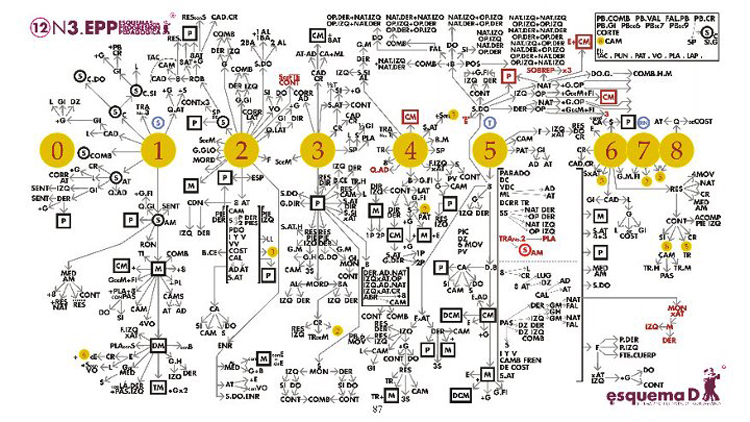
For each basic configuration of leader and follower and their bodies they looked at all permutations.
Then they constrained it first to the subset of those that are possible to do at all, kinesiologically.
Then further to the subset of those that could be danced with reasonable comfort.
And finally the subset of those that are easy enough to be taught to students and would work on a crowded social dancefloor.
None of this was done with the help of computers.
The most systemic documentation of this is possibly Mauricio Castro's book "Tango -- the structure of the dance".
But lately a lot of new books were published on tango technique; I may be out of the loop.
A friend of mine who's also a tango professional is currently looking into the feasibility of doing a PhD thesis on this topic.
He wants to use ML to spit spit out the full motion tree of tango.
Both to be able to document it automatically, i.e. using generated 3D animations, as well as to discover new combinations the manual approach used by Naveira, Frumboli and Salas, over a quarter century ago, will have missed.
Some things are just hard to write down with fidelity. Think of tastes: we can have cookbooks, but its hard to reproduce the exact ingredients of grandma's cooking, or that one restaurant. Smells are even harder to express in words. Dance is kinda like that.
None of which is to say that one shouldn't do it, or try. Quite the contrary. It's a good challenge! Even if you could write it all down, leaving a bit of mystery/mystique would be a good idea, but I don't fear that mystique will be lost.
This is obviously untrue. For simple math reasons.
If you believe that, I suggest reading an intro to combinatorics.
Or just doing the math in your head for a combination of two steps. Leader does forward step towards follower's forward cross.
Just in one system (cross or parallel) and considering how deep the step is (outside, sacada, deep sacada/behind/in front) and where the leader steps (behind free foot, next to outside, next to inside, in the middle between legs, next to to standing foot inside, next to outside, in front), we can reasonably say we have 21 possibilities. Now multiply by system and that's 42. Now multiply by combinations of systems on one side and that's 84. This still makes a lot of simplifications but we're talking one step. Furthermore, if we mirror, we can't just assume the same observations apply, as tango has an open and closed side, etc. etc.
The endeavor is also not about capturing the essence of a dance but about exploring a motion space; structurally and kinesiologically.
Tango, specifically, will elude documenting on so many levels, otherwise, it's not even worth talking about.
good dancing like good fighting isn‘t mechanical either, it is good because it relies on little imperfections. Just like MIDI files cannot replace a concert pianist.
In the end I think motion capture of extremities along with some easing of paths and compression of point-clouds (think bezier curves) might be more worthwhile than a notation.
I wonder how true this is. Specifically I think you could simplify the moves into steps with "who hits who" states. You could normalise out the rhythm, following the "everything's in 4/4 if you don't count like a nerd" idea.
So you'd end up with just the key frames of either contacts/impact or change of the movement direction. Would martial arts really have even more variety here?
Dance is a physical, kinesthetic language.
And to riff on some of the posters, it's this expression and communication between the dancers that makes dancing worth dancing. There's also the social communication between the group, cultural "dialects" and "accents" (on1 vs on2, stylings, etc.)
I began dancing when I realized there was an entire spectrum of the senses closed off to me from overthinking. Besides the specifics of "body language," good dancers can convey intense amounts of emotion. I met someone who could "talk" to me for hours and she never needed to say a word. While the poster attempts to represent dancing in terms of a symbolic language, I'd recommend anyone interested in dance to also try the opposite: realize the physicality is the language and medium of expression. It's more fun, and I promise you your style of thinking will enlarge and grow.
As I got more into chess and with the advancement of chess computers and championships, I felt there was little creativity left to have fun with the game.
So for dancing, it's literally meant to be "danced".
Of course you can figure out all the combinations and so on, but being overly analytical about it removes -- for me -- the entire reason to do it : to escape the intellectual world and do something kinesthetic.
I understand I am probably an outlier here on HN. :)
Well, the problem is that with all the online resources, you quickly learn that chess is more about blunder avoidance than any brilliant, dynamic scheme.
That takes a lot of the fun out of chess.
Having said that I'm pretty excited about the topic and what the author can do with it.
Then there are many more layers on top: palms facing up/down/side, cupped or pressed against, which part of the hand/arm/body are you holding, which one's on top, compression or stretch, at what height, etc.
There's more topology as well when you start bringing in other characteristics of a position, like relative distance and orientation of the dances, you can find more equivalence classes for the other types of equivalences that fall out of that.
Guy L. Steele Jr.https://en.wikipedia.org/wiki/Guy_L._Steele_Jr.
The post is "almost" scholarly because it does not try to look into what others did before or currently, eg. prior attempts at notation of dance. I would be very surprised if there weren't any. Modeling cultural practices is also somewhat of a hot topic in the so called "Digital humanities" for what that is worth. A quick search for example brought up this article which talks about Dance Studies and attempts at digitization:
https://humanitiesfutures.org/papers/digital-research-in-dan...
Anyways "ornithology for birds" is pretty fitting as this seems to just be anthropology for humans.
As to whether this all will be useful for learning how to dance, it remains to be seen. I didn't learn how to dance from diagrams and notation, but I also don't think there's that many good diagrams and notations to learn from, so it's hard to say whether it would have been effective or not. My answer at this point is to try and produce stuff that helps people and see whether it's possible or not.
Thing is, the more I learned the more I started to use internally consistent vocabulary, so I no longer needed analogs, but would construct new moves from older simpler ones.
I don’t think though that this article captures the complexity of of social dance, maybe that’s why its so universally fun? Its not just arms, legs and body positions - there is weight transfer, musicality, disparity between partner’s skill levels, let alone all other dancers around you that you need to track so as not to have an accident. And thats before you start adding shines, styling and body movement.
There _is_ an underlying system of course - every move has a finite possible exits, if you dance “by the rules” but dance evolution is all about breaking those rules. And if you’re at that level, you can start mixing other dances into your move set … Its all incredibly hard to reason about.
Maybe thats why the gold standard is just to record your lessons and get back to them when you want to.
Then again, I have never danced.
It's interesting, because you have to do something active about it. If you move into hammerlock, you can't continue moving the same way anymore, so you have to decide on some combination of releasing hands, rotating in the other direction, staying and playing in that position, etc.
The reasoning goes: "if I understand and represent this choreography properly, I will be better at the activity of dance." Dancing, for them, is the end result of understanding a representation and then doing it.
But the psychological shift is "if I understand my emotions and body properly, I will be able to use the representation of dance to convey that." While dance obviously needs a backing vocabulary of basics and moves, great dancers accidentally come up with better dance moves because their body mechanics combined with the dance's structure, musicality, and emotion constrain what they do. They—and I'm going to use this word intentionally—literally think and communicate through dancing. To use your phrasing, the "semantic" meaning of the dance is their emotions: the actual activity of dance is simply the representational outlet for that.
When you're with a good dancer, your brain shuts off but you're still stuck within the aforementioned set of constraints. And that's when the magic happens. That's when you actually start speaking. That's when your improvised move is the only way you could have possibly said what you wanted to say.
It depends, but yes. Martial arts is not just boxing. Take the following choreography from one style of Pencak silat: