Will we ever get fusion power?(construction-physics.com) |
Will we ever get fusion power?(construction-physics.com) |
https://brilliantlightpower.com/shareholder-meeting-presenta...
https://web.archive.org/web/20151122183613/https://brilliant...
BrilliantLight has developed a commercially competitive, nonpolluting source of energy from water. A SunCell™ catalytically converts H2O-based solid fuel directly into brilliant light which is converted to electricity using photovoltaic panels.
If they actually had this "commercially competitive, nonpolluting source of energy" they'd be selling the machines or selling the electricity by now.
What puts fusion development in peril is the rapid improvement of known renewable technologies, and the likelihood that 100% renewables is possible in the near future using only those technologies at lower cost.
Though the main suncell page mostly just claims to be a solar concentrator? Like, okay, you can do that, but carefully aimed mirrors don't really save you any money over the same surface area of solar cells. Or twice the area of solar cells, looking at the efficiency claim on that page.
You misunderstand the suncell - the source of UV light is a hydrogen reaction when it bumps into a catalyst able to accept the right amount of energy that pushes the "ground state" electron into a lower energy orbit nearer to the nucleus releasing said energy. Solar concentrator photovoltaic cells are used to convert the intense UV light into electricity because they are cheaper per kW and much smaller.
The "Don't you want a Nobel prize?" argument is a very good way to detect pseudoscience.
But that's not got anything to do with Brilliant Light's claims, which so far do not stand up to scrutiny.
The only reason to hold back so much is that it's not real.
That's the thing, they don't need to get the system working reliably, they just need one little part to show off.
> They have many patents but have had some patents rescinded after skeptics objections about "breaking known laws of physics"
There's a good way to get those patents not rescinded...
> available to qualified parties
The only reason to play this game is because it's fake.
1. I think it's highly likely that, at some point (and probably in the not-too distant future with ITER and DEMO), humans will produce fusion reactors that are self-sustaining with net positive output (ignition).
2. Given the inherent complexity and difficulty with fusion, I think it's unlikely to ever be cost competitive with simpler power generation technologies.
3. Perhaps most importantly, at least in the next human lifetime, I think fusion will be largely irrelevant in the quest for carbon-free power generation, mostly as a result of the timescales required. I think right now that everyone pretty much understands that the problem with decarbonization tech is base load and storage: carbon-free renewables like solar and wind are already the cheapest form of energy generation, but they're intermittent and unreliable. Given the latest climate data, I think it's imperative that we develop base load and storage tech in the text 10/20/50 years, or we're REALLY f'd. But I haven't heard even fusion's biggest boosters say that fusion will be ready for large scale deployment in those timeframes, at cost-competitive economics. Point being, by the time I think fusion might be ready for large scale deployment, we better have already solved the base load and storage problems with cheaper tech.
But as you said, of course it's an open question whether fusion will actually be more economical at scale. It could conceivably turn out to be a day late and a dollar short on Earth, and more relevant elsewhere.
I'm keeping my eye on Helion (the one Sam Altman invested in). Seems they're making some pretty big claims, and have already entered into contracts to deliver to customers by 2030 or face financial penalties. Could still be vaporware, but they seem to think they have something.
It's a well done article that had a lot of research behind it.
FWIW if you're interested in Fusion the book 'The Future of Fusion Energy' is very good.
https://www.goodreads.com/book/show/43700662-the-future-of-f...
Also Commonwealth Fusion Systems put out a lot of interesting stuff about how they are going. Even having a look at their YouTube channel is worthwhile.
Metaculus has a lot of stuff on predictions about when fusion will be made viable :
Whatever happened to Lockheed's compact fusion program?[1]
[1] https://www.lockheedmartin.com/en-us/products/compact-fusion...
My long run prediction is that ITER will work and everything people on HN kept insisting would work in 5 years will suffer a similar fate.
I'll stake my claim now that I think Helion is probably not going anywhere (just a vibe, but there's something off about their recent big marketing push).
    South Australia has just chalked up what is undoubtedly a world first – a run of
    more than 10 consecutive days over which the average production of wind and solar
    accounted for 100 per cent of local demand.

    No other gigawatt scale grid in the world has come close to this amount of “variable
    renewable energy”, or for such a long time.

    RenewEconomy reported on Monday that South Australia had just enjoyed a seven day
    run of wind and solar that produced more than 104 per cent of average demand. Closer
    inspection proved it was even more impressive than that.


    According to Geoff Eldridge at data providers GPE NemLog2, the supply of wind and
    solar averaged 100 per cent of local demand for 10 days and 9 hours (a total of 249
    hours) from 08:20 on Friday, December 9, to 1720, Monday, December 19. [1]
Denmark is a nice example why this matter. During optimal weather their wind power produce around twice their local demand. However, in terms of actually consumption each year they need to import about 50% of their total amount of energy. This despite the fact that they export more energy than they import. The only way that would make mathematically sense is if export and import occur during different periods over the year.
This has multiple issues. The biggest being that they are heavily dependent on nearby countries fossil fueled power plants. A secondary problem is that prices they get for exports are low, since optimal weather conditions means a general surplus of energy in EU, while periods of bad weather results low supply and very high import costs. Their exports do not pay for their imports, despite exporting more than importing (in terms of energy, not money).
One can not remove the word averages and conclude that they ran fully on solar/wind/storage for 10+ days. It would be the same as saying that Denmark is running fully on wind a decade+.
Was compelling. Belief we're prepared to invest seems lacking.
I think achieving multi second "stable" plasma conditions has been amazing. But, I think that's a cigarette lighter held next to petrified wood (to use an atomic bomb era analogy) away from ignition as a useful energy over time equation.
We're also somewhat behind "what's embrittlement" or "what's xenon poisoning" problems. Things which don't emerge until a few months in your life of run-time. Again, from early fission reactor design, these things can sink a project.
Or, unexpected fission or other nasty behaviours. Things which make it hard to get inside the structure to fix it. The unknown unknowns in this feel huge. But, linear energy in, energy out, and the approach to viable ignition temperature. That's science and engineering at its best.
Fusors tapped out. "Mr fusion" isn't happening.
Can you, or anyone, explain the lore here? I get it's impossible to light it on fire, but what's the context? I tried searching for the expression and couldn't find anything.
From "Dark Sun" by Richard Rhodes.
Of the fusion startups mentioned in the article, I’d say that makes Zap Energy the one worth gambling on (if you’re a gambler that is), as its success apparently depends on exploiting a fluid dynamics effect which was not well known in the past (“shear flow”). If this sufficiently solves the confinement problem, the resulting device looks ludicrously simple in comparison to contemporaries.
Of course it may not work at all, I sure don’t know if it will; but if you had to invest in one of these, that seems like the one where successful power generation actually creates a marketable product.
The entire premise of fusion generation is based on world view where the limiting factor for generating electricity was the cost of providing fuel for combustion to generate heat. This thinking was pretty natural if you looked around the world in the first half of the 20th century when coal and steam engines were still kings of energy. This was a pre-semiconductor and pre-plastic age. That's why they ended up using long of fairly primitive technologies: a chemical (combustion) process to generate heat, a heat capture process to boil a tank of water, a mechanical process to convert the steam pressure into mechanical energy, and an electro-magnetic process to extract usable electricity.
But in an age of advanced materials and semiconductors, it feels more and more that fusion is an attempt to solve a problem that is no longer really relevant. Working towards a "better" heat source for an electricity generation process which still involves steam-age tech is akin to trying to breed faster/cheaper horses to improve modern transport.
The cost of fuel is almost negligible for fission - non-fuel operating costs are killing off perfectly functioning nuclear plants like at Indian Point[1] - so the problem that fusion will "solve" is not actually a significant problem.
I'm convinced that we have moved beyond boiling water and generating heat, etc. in electricity generation. We no longer need massive steam engines to generate electricity. Modern technologies like wind, solar and batteries dispense with all this cost and complexity and the shackles of Carnot efficiency.
[1] https://en.wikipedia.org/wiki/Indian_Point_Energy_Center
Will we get fusion power in the next few decades? I wouldn't bet on it, but I also wouldn't bet against it.
> Perón is the only Argentine president elected three times and holds the highest percentage of votes (61.86%) in clean elections with universal suffrage.
https://dothemath.ucsd.edu/2012/04/economist-meets-physicist...
However, with advances like REBCO tape and so on, it's far more realistic now. I hope we get it in my lifetime, but I'm not confident.
By 2013 (25 years later), still no real progress on protein folding.
In 2018 (30 years later) AlphaFold was revealed.
technical challenges aside, fusion power as a research + building + disvtributil project is so expensive - for the same amount of money we could already build a decentralized solution out of over-abundant solar cells, but it seems looking for the one big thing is still more interesting.
They'll have unlimited energy based on some quantum shit.
...probably mining the center of the earth after finding it is methane or similar like thomas gold theorized, something like jupiter.
With no evidence, I believe that there is a quantum computing algorithm for fusion. It feels like there might be some way of using quantum computers to fuse "qubits" in such a way as to generate netenergy, one particle at a time.
But of course, ancients fantasized a boat could land on the moon.
We already have technology that can take the electromagnetic waves this fusion power plant produces and directly convert it into electricity without needing pesky intermediaries like boiling water to turn a turbine.
This technology is relatively cheap to produce, extraordinarily safe, can last for decades with minor maintenance, can scale almost indefinitely, and there are many practical improvements we can make to it that are going to applied commercially in years and not decades.
I don't doubt that trying to achieve commercially viable fusion is a worthy engineering and science challenge and that we will learn and develop many useful technologies along the the way - but fusion is probably the hardest engineering challenge humanity has ever attempted and after many decades of R&D there is still no clear path to commercial viability.
Solar panels today work, and they work well, and we can practically throw endless amounts of money building them and it will work. Today. And we needed solutions that work today, not 50 years from now... maybe.
IIRC, the sum total of all fusion research throughout all of history is USD$100-200B. It's obvious governments/industry/humanity doesn't really want it, or they'd go fund it.
Modern designs depend on material science and computing abilities which could never have been made in the 70's no matter how much money was thrown at it.
But you're right about better alternatives. Right now that alterative is a combination of solar, wind, hydro and storage, with perhaps a bit of more exotic systems (wave power? solar towers?) in the mix.
It took 12 years to build first unit of Belarusian NPP - of a type that's been built by the dozen for decades, and in a country where all-powerful government controls and owns everything, there is no NIMBY or the "society" thing in the Western understanding at all, and where if you try to protest you just disappear. Can't be done faster. By 2036, fossil fuel electricity will be a thing of the past in some places, and quickly disappearing in all others.
The country's current fleet stands at 56 reactors. China expects to build 6 to 8 new nuclear power plants each year for the foreseeable future and is projected to pass the U.S. in nuclear-generated electricity by 2030. In total, China intends to build a total of 150 new nuclear reactors between 2020 and 2035.
China is also expanding coal power stations (while closing older shitty coal stations) to provide base energy for its planned and ongoing expansion of both solar and nuclear.
Currently something of the order of 60% of the energy requirement of building solar (for local use and for global supply) in China comes directly from coal power.
I'm all for renewables, it's the sensible direction.
I'm also big on factual statements.
Had we shoved as much money at fusion as we have at, say, horizontal drilling for liquified dinosaurs, we'd have fusion right now.
The argument "with funding, it will come" is cargo cult thinking, reversing cause and effect.
It must be done, we have no choice (longterm).
Anti nuclear sentiment had been building in Germany since at least the 70s. Then Chernobyl happened in 1986 and it got even stronger. It was part of what propelled the Greens into the administration 1998.
That administration reached an agreement for the nuclear exit in 2000 and the first plant went offline in 2003.
Merkels cabinet tried to extend the planned runtimes for the remaining plants, and it was that extension that was rolled backed after Fukushima.
Now, you can think that it was a big mistake, but it certainly was not a knee jerk reaction. It was a decision that was 50 years in the making.
If a fusion reactor can be made practicable, then we have a clean, low-radiation power generation system that will still work in the face of nuclear / asteroid-impact / supervolcanic winter.
...granted, any of those events could take out most or all of the hypothetical reactors, but it still seems worth noting to me.
Wind, solar and batteries are products of combustion-fueled industry. The extent to which we have electrified the world industrial base is minimal, and to do so at the current scale on the basis of wind and solar would take a larger quantity of several metals than is available in the crust, to set aside the consequences of a massive expansion in mining, the poor recycling rates for most of the relevant materials, and the fact that, even with a much-improved recovery rate, this would only buy us on the order of several hundred years.
A more promising energy production system for a resource-limited world is thorium molten salt, which is comfortably Carnot in spirit, relatively cheap and easy to build, fuel and operate, no danger of meltdown, no "dual-use" for weapons, can consume existing nuclear waste... And we would do well to explore alternative battery chemistries as lithium is neither unique nor optimal, simply popular, and our hunger for it at present seems to be motivating some unpleasant political machinations.
Yes they do give a much better return than any thermal source according to any recent study of LCOE I've come across. Reflected in investment numbers - renewables account for 70% of new global capacity added last year.
Wind, solar and batteries are products of an energy intensive process NOT a combustion based process.
The shift to electricity as the primary energy source is well underway in multiple industries and sectors. Growth appears slow because industrial equipment is built to last decades. In transport (equally as energy hungry as industry), it's happening a lot faster as with domestic (induction cooking and heat pump sales).
Thorium molten salt, promising? You mean they were back in the 1950s/1960s in Oak Ridge? The first experimental molten salt reactor ran for a few days before springing a leak and being decommissioned. Or the later one in the 1960s which ran for 4 years (only managing to operate for 40% of the time)? There's a whole bunch of reasons that the PWR emerged as the dominant nuclear generation tech from forest of experimental reactor designs in the mid 20th century.
The bigger problem is that fusion plants aren't useful for making weapons. Fission plants were basically a side project of the nuclear arms race, which is why they're a dying industry now. The world already has all of the nuclear bombs it will ever need and despite all of the promises they never managed to compete on cost. It's so much easier and cheaper to install wind turbines, solar panels, and grid scale batteries that there will probably never be a market for a commercial fusion power plant.
The sun is able to use gravity containment. Terrestrial fusion has to use magnetic and physical containment. The extremely high energy neutrons produced rapidly deteriorate common engineering materials. A replacement schedule is very difficult because of induced radioactivity, which means that the reactor cladding would need to be replaced by robots most likely.
https://en.wikipedia.org/wiki/International_Fusion_Materials...
China are churning out regular old fission plants, and have 27 under construction right now. Even still, the average build time is 7 years.
So even if we get some breakthrough and figure out how to build a commercial fusion plant, it's a certainty it won't be up and running for something like 10-15 years. Solar and batteries will be so cheap there won't be any discussions.
Battery prices are pretty stable, which is huge problem for wind and solar energy.
Similarly, we should keep investing in the prospect of commercially viable fusion reactors. The harnessing of fusion reactors would be instantly revolutionary as opposed to the incremental progress solar promises. Therein lies the difference. Once is not necessarily better than the other.
And it's not a zero-sum game.
Renewables all together is growing faster than nuclear ever did. And solar is now a huge part of that.
We have models where solar or solar+wind is providing all the power to everything from small remote weather stations through houses to large islands. Some small countries and regions are getting close too.
It’s clear that we have all the technologies we need to do 100% renewables. There’s studies that indicate that the long term costs of this is lower than the traditional fossil and nuclear energy infrastructure. We just need to build the factories to continue scaling up. And of course the transition is more expensive than it’ll be when we just maintain and expand on the system.
Solar power can 100% solve our energy needs today. It’s cost effective at the unit level. It works at scale. It decentralizes nicely. Did I mention that it works? Every home could have rooftop solar for less than it costs to produce centralized power plants. (I have rooftop solar and it cost significantly less than a new car now my power costs won’t go up for 20 years at which point the panels might need a refresh but that part of the system is the cheapest part)
We could easily flip from subsidizing fossil fuels to subsidizing rooftop solar today and realize significant gains (higher roi by shifting the investment). If you spent one years investment in fusion and fossil fuel subsidies on deploying rooftop solar and grid scale batteries you’d change the energy story permanently. Energy would suddenly be plentiful. Fossil fuels would permanently shift out of relevance. Fission reactors would look like quaint and staggeringly expensive tools of a bygone age. And fusion which DOES NOT WORK. Would look even more like a silly dream.(We are no closer to fusion than we were 30 years ago.)
Why the fuck are we still talking about fusion when we have something that works?
But not tonight
Distribution and storage are way more tractable problems than fusion.
If you want to be really ambitious you can go to space and have 100% capacity :).
It’s never going to be cheaper than solar, but it does have the advantage of working at night and through cloud cover.
In the very long run it might make more sense to launch whatever’s using the power into space as well, saving on the cost of the transmission and receiving infrastructure, but also removing further sources of pollution from Earth.
https://ieeexplore.ieee.org/document/9837910
"With every iteration in the research and with every technological breakthrough in these areas, 100% RE systems become increasingly viable. Even former critics must admit that adding e-fuels through PtX makes 100% RE possible at costs similar to fossil fuels. These critics are still questioning whether 100% RE is the cheapest solution but no longer claim it would be unfeasible or prohibitively expensive."
"Rotation Of Earth Plunges Entire North American Continent Into Darkness"
https://www.theonion.com/rotation-of-earth-plunges-entire-no...
The transition to EVs - which is a hard necessity to solve climate change, and well on the way - implies battery production that’s already within an order of magnitude of storing enough solar to supply power year round. As long as you’re not too close to the poles, but most people don’t live there anyway (said as someone who lives relatively close to the arctic circle.. so I don’t mean to ignore our people, there’s just not that many of us so doesn’t matter so much in terms of global warming impact)
Nuclear energy can often benefit from some energy storage too. One of the first pumped hydro plants was to balance nuclear. It’s the opposite problem: people consume most of their energy during the day (when the sun is shining!) but nuclear should ideally run 100% 24/7.
I suspect a renaissance of nuclear, whether it’s fusion or fission, will also be paired with lots of battery storage. As batteries will probably soon be a cheaper way of load balancing than having to ramp production from nuclear up and down.
> insulting vacuum rendering the radiation harmless
Not even this is correct. Vacuum doesn't really "insulate" against radiation, at least not very effectively. It's the earth magnetic field and atmosphere that protects us. And even with that it's not harmless – surely you heard of "sunburn" and "skin cancer"?
Helion Energy has a contract to deliver Microsoft a fusion reactor by 2028. It's only four years away so we don't need to speculate about it. Helion will either deliver or they won't:
https://www.reuters.com/technology/microsoft-buy-power-nucle...
https://www.youtube.com/watch?v=_bDXXWQxK38
MIT's Commonwealth Fusion Systems has started construction of their small scale SPARC reactor. Once that has proven itself they will build a larger scale ARC reactor. They should get to first plasma in 2025:
https://www.youtube.com/watch?v=w3Giq6NuPYs
https://energy.mit.edu/news/mit-designed-project-achieves-ma...
https://www.technologyreview.com/2024/04/23/1090425/mits-sup...
If it takes 7 years to build something that is known and has been done a couple of hundred times before, I think it's safe to say it will take more than 4 years to build something of similar complexity that has never been done before.
This is ultimately a capital game and without enough capital researchers and engineers have to go with the safest bets lest they lose funding. So you get ITER which will almost certainly work but has taken forever to build because it's a gargantuan feat of overengineering in all the ways that matter to make sure it works.
And for what it's worth, ITER's new baseline schedule will be announced this upcoming Wednesday (July 3). Likely first plasma will be in the next 2 or 3 years with first fusion operation some time between 2035 and 2040.
Given the extortionate cost of building and maintenance and nonzero risks, its only really "benefit" is for the military industrial complex to keep a ready supply of nuclear skills and supply chains.
It's the latter that formed the basis of the American led PR campaign to shame Germany. Pioneering a low carbon zero nuclear generation mix was threatening to established nuclear. It had fuck all to do with the environment. None of them ever gave two shits about Poland's chronic coal addiction next door.
Indeed even theoretically we can do 86% multi and 99% with quantum dots——in the current state of technology these remain science fiction considering the commercial manufacturing processes available.
That said, we still need a grid to distribute electricity to places that consume more energy than roof space. Think apartment blocks, factories etc. And yes, a huge chunk of that load can still be supplied by grid-scale solar and wind etc.
Even with large-scale storage (another fruitful place to spent investment money) there's going to need to be peak-generation.
However you look at it, I don't think fusion will be the answer. Since fusion was first proposed and the landscape of requirements have shifted. By the time it's practical, it'll be solving a problem we dont have.
The science may lead to a working reactor. But no one will build it at scale because it simply won't solve the problem well have then.
https://en.wikipedia.org/wiki/Helion_Energy#Development_hist...
The prototype currently under construction is Polaris. It's 25% larger than the previous prototype and they expect it to achieve net electricity production:
The future is wind/solar/battery on cost alone.
Yes? What did you think it was, chopped liver?
Sure, modern materials make for a more modern wind turbine. But they don't shift the paradigm. Nothing has since fission, right?
> Wind, solar and batteries are products of an energy intensive process NOT a combustion based process.
The fact remains that energy intensive industry is currently accomplished mainly via combustion. The degree of electrification is small and an effort to fully electrify faces what appear to be prohibitive resource limitations. If you have any ideas on this point I would be interested to hear them.
Electrification is happening in personal transport. We have made minimal progress towards an electric shipping fleet, electric air travel, electric trucking, etc. And if we do begin to make serious progress, it will come with serious environmental (and likely political) costs.
Oak Ridge was a testbed. The Chinese have an MSR that has been selling power to the grid for several years. Copenhagen Atomics is building them to fit into shipping containers. Is this not enough to prove the technology viable? The main reason traditional fission became dominant, as I understand, is that it allowed nuclear-capable nations to conceal nuclear weapons programs with energy programs. And once the supply chain and institutional expertise gets some inertia, it is hard to change tracks.
But the most obvious difference, and that which contributes most to the paradigm shift, is the difference in price.
The existence of technology alone isn't enough to shift any paradigm - the tech has to be relatively cheap - transistors were a curiosity until they became cheap and then they shifted the paradigm, same thing happened with integrated circuits and nearly every technology breakthrough in history.
Batteries, PV and wind turbines are mass-produced and their prices are falling as you'd expect given the expansion in production (between 80% and 95% in the last 15 years). This has been the way since Henry Ford and is not going to change. What is also inevitable is that once mass-production is introduced into any human endeavour, then the existing technology is doomed.
The TMSR-LF1 in China has not being selling into the grid for several years. It was never envisaged to do so - it's absolutely tiny (only 2MW) and it's intended that it will operate intermittently for the first 5 or more years before they try running it continuously. This is a science experiment, not a viable commercial reactor. The 2nd Oak Ridge reactor back in the 1960s was 7 or 8 times bigger - although it never managed to run properly and only ever achieved 7MW of output.
I really don't understand why thorium liquid salt reactor enthusiasm is widespread. It's just one of endless reactor designs which failed to make it into commercial operation because of a host of genuine technical/engineering reasons. Just read the wikipedia page[1] - the list of disadvantages is longer than the list of advantages. For every problem it solves, it introduces several more.
1) Apparently much lower resource requirements for construction, maintenance, and mining/refining the fuel, than for traditional nuclear power, and also (!) the wind and solar equivalent. We don't have the metals, as far as we know, to maintain a fleet of wind turbines, solar panels, and batteries for very long without an almost perfect recycling rate.
2) Some designs can consume spent nuclear fuel. This is a more cost-effective (and more sane) option for disposing nuclear waste than burying it.
3) Steady availability. Wind and solar are unreliable, so you need a buffer, which means batteries (or pumped hydro, or rapidly spinning hunks of metal, or something).
Mass production is a force to be reckoned with, and the cost of wind and solar has fallen relative to other power sources, but given the dominance (still) of combustion, this not only reflects economies of scale in manufacturing wind/solar equipment, which I don't by any means deny, but it reflects also the rising costs of of legacy fuels. It is not getting easier to find coal, oil, or many of the metals we use to manufacture energy systems and the material economies they sustain.
It seems to me we need an energy system that can function reliably in a world facing resource shortages and other stressors, and in this context smaller scale, modular power plants may even be an advantage.
I know TMSR-LF1 is small and a research program; I thought it had sold some power, but might have been misinformed
The price of batteries has declined by 97% in the last three decades: https://ourworldindata.org/battery-price-decline
Prices are decreasing much slower now. At this pace, large scale energy storage for replacing stable energy sources like coal and fission power plants is far out of reach.
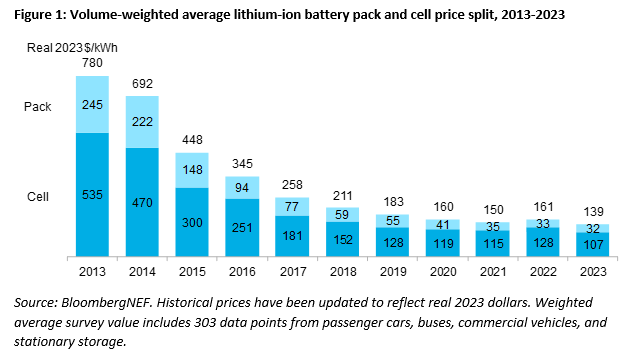
Your linked source shows the price in the last 4 years going from
cell: $128->$107
Pack: $55->$32
Real: $183->$139
So the price has dropped 25% in the last 4 years. That is NOT relatively stable by any definition.
Or winter sufficiently close to the north pole (i.e. significant proportion of Europe). Days get short and it’s usually cloudy so solar becomes extremely inefficient.
Over-provisioning by 7x might not be extremely practical.
I guess there is a lot of space in Spain that could be filled with solar panels (production only falls by ~50% there in winter so it’s not to bad) but there is certainly not enough grid capacity to transfer all of that north (and building new infrastructure is painfully slow and expensive in Europe so it will take a few decades to solve that)
My point is that solar is only a part of the solution and wind/etc. is probably more practical and more important in much of Europe.
* Capable of 100% capacity - power generation can be 24/7/365 if in orbits around the sun or stationed at the Earth-Sun Lagrange points.
* Greater panel efficiency - less energy lost to the atmosphere that can be captured by the panels, closer orbits will increase efficiency even more due to more power/area
* Surface area - minimum 1x10^20 square kilometers of area you can build panels
There are of course many cons - but it could be a vital part to a space based industry - you need a lot of fuel or power to really do anything in space, and the power from space based solar could to be used to kickstart a fuel production facility off Earth. Fun stuff but not very terrestrially relevant.
EDIT: Some more numbers: You get about 40% more power/area in space vs on the ground. You need about ~22 TW to "power" humanity. So you need about 70,000 km^2 of space based solar assuming 25% end to end efficiency, which might be a generous estimate. So lets round it to 100,000 km^2. But thats a significantly smaller area than the terrestrial equivalent of about 500,000 km^2. Right now it costs about $1B installed for a square kilometer solar installation, so we if can build solar panels on the Moon or something anywhere close to the same cost as on Earth (very very BIG if), potentially a difference of $400T dollars at todays terrestrial prices.
Those number are inconsistent with each other. Seems you calculated with 400% more power/area in space vs on the ground. That seems incorrect to me, as it would make space solar convert close to 100% of incident solar energy to electricity.
i.e. we know a well defined lower bound on the conditions required for energy positive fusion.
These bounds are more or less what we expected so sustainable energy positive fusion is essentially guaranteed to be feasible, it's just ungodly expensive until we can learn how to reduce the lower bounds for fusion or improve our ability to achieve those conditions.
So ITER will work. There really isn't a discussion on whether ITER will work or not. Like technically there's a small fraction of a percent chance it won't work for a number or reasons but even then it's less likely to be "it will never work" and more "we need to make changes and it'll work eventually".
This is actually part of the reason for the updated baseline schedule. It's apparently going to be far more aggressive now that there are better assurances that the existing model is in line with experimental evidence.
ITER won't be a power plant of course. It's a research facility first and foremost but it will produce power at a 10 to 1 ratio relative to the input which should be a net 450GW of power before you factor in the secondary equipment.
Containment and chilling will require quite a bit of energy of course but all together the energy usage for the reactor facilities should still be less than the produced power.
But yes ITER isn't designed to produce power out to the grid. It's just designed to work sustainably and any power it does produce will almost certainly just be sunk into a resistive load on site. It's a research project to build a viable nuclear power plant first and foremost.
----
Then provided ITER doesn't outright fail, the DEMO reactor will be built and that facility will be optimized for power generation and will be built to the requirements to efficiently produce energy (vs ITER which is significantly overbuilt "to produce power at Q=10 so help me god"). The DEMO project will of course actually hook up to the grid with the intent of being a sustained base load power generator.
Not if you live in Northern Europe. Solar is basically worthless there during winter. I’m not even talking about polar nights, just places like Denmark where the difference in production between January and June is 20x. No batteries (that we know of) would solve that.
4 months of the year (almost 5 if it's a really bad year like last year), there's virtually no production.
I work in the smart energy field, including with home batteries. The de facto standard size is still 10 kWh because the promised drop in price hasn't yet materialized on this market. I'd fill that up in 45 minutes during a sunny summer day. I maybe can use half of that during the night. If I were to charge my car during the night, then sure, I could use that, but it's just 10 kWh. That's like an 1/8th of the car battery.
50 kWh? Okay great, I'd fill that up in 5 hours. Don't really know what I'd use those 50 kWh for. Charge my car? Okay sure, but I don't drive every day, and never in the morning, so it makes so much more sense to do solar surplus charging once or twice a week. You rarely want to charge to 100% SoC anyway, and you should probably leave some additional capacity for FCR purposes.
100 kWh? The problem is that in summer when I can fill that in a day (assuming max power scales with the capacity), I cannot really empty the battery because my consumption is so much lower during the summer. I will only top it up a little bit every day at best.
What I really need is a fucking 10 MWh sand battery underneath my driveway that I can seasonally charge and then use during the winter for heating. Maybe it could also keep my driveway snow and ice free? Who knows.
And A/C in the summer I guess. That is actually what I'm going to get, because it turned out to be more stressful and agonizing to see 100 kWh go out on the grid for almost no monetary gain than I thought it would. Call me egotistical I guess.
Domestic solar is kind of a scam. I knew that going in, but I didn't anticipate the accompanying stress.
2. Domestic solar is just a way to save money. If you bought more than you need then you wasted money. A typical consumer would be fine with 10 kwp system + 10kwh battery which in Europe costs now less than 20,000 EUR.
That's along ways away. It'll take a lot of costly electrical infrastructure to move that power.
Even worse, if you want to work during the night, you also want the solar panels about 45 degrees west. So like in South America. Tough luck for those places where that sweet spot is in the middle of a large ocean.
If we're talking about batteries, trains don't need them. While we'll never get rid of cars/trucks entirely, we are massively overdependent on cars/trucks for the bulk of our transport and (land-based) shipping needs. Especially in cities.
The real reason for fusion was that fission is not a renewable resource. In a few thousand years there will be a fuel problem with fission and we would be forced to switch to fusion if we had a fully nuclear power system.
This might sound like the same attitude that put us in our present climate crisis, but that was on the order of decades to centuries. Thousands of years include such unbelievable potential of technological development that there seems no point in trying to predict the actual challenges we'll face.
That leaves low stakes idle speculation.
Solar decreases as 1/r^2. Cube root? Where did that come from?
Of course there are technical challenges of building out UHVDC everywhere. This probably means a joule isn’t perfectly fungible.
Perhaps Europe’s problem was being overly reliant on only one supplier.
I would much rather see a world where governments are at least partially in charge of the grid to ensure that their population gets their share of the capacity.
Solar panels are now being produced and install at gigawatt scale. Per year. (Over 400gw per year, and climbing). Capital is being supplied by individuals (rooftop) and companies (utilities).
I'm not sure what leap-frog tech you have in mind, but its not fusion.
In the 60s fusion was touted as "free energy for all". But fusion is very (very) much not "free". The cost of a fusion plant will make your eyes water. The lead-time to build it will be measured in years. The output from one plant won't move the needle (we'd need hundreds of them). Electricity from these plants will be expensive, because at the very least it'll need to generate a return to the investors. And that's before we factor in running costs which (I guess) won't be cheap.
The problem with fusion is not physics, it's economics. As long as we present fusion as a physics problem interest remains. Because once we view it as an economics problem it dies overnight.
But that's no longer the world we live in. The lowest cost energy is now from intermittent sources, and the optimal grid design will look very different.
Nuclear, fission or fusion, is the opposite. It's all fixed cost. A higher fixed cost than solar or wind.
Natural gas just trade pollution, a problem for the future, in return for cheaper energy price today.
True. But if we’re talking about rare - maybe once a year or two - dunkelflaute, then the gas power plants aren’t actually going to consume much gas at all. And thus the CO2 emissions will become negligible.
Those gas power plants already exist in most industrial countries. They’ll have made their return on investment so using them for backup will be fairly cheap. Especially in the coming age of robots/ drones for inspection work.
To get to zero emission we can just use biogas or hydrogen. If the consumption is low this will be sustainable and financially viable since the fuel cost will be a very small part of the total operating costs, and making the hydrogen will be very cheap since there will be an abundance of days with excess electricity.
So I don’t see that we will actually have a problem w.r.t. energy storage. Battery storage for short term has already outpaced pumped hydro. The transition to EVs already imply battery production capacity on a scale to handle energy balancing for hours or even days.
Trash burning power plants is a good solution for seasonal demand. Yeah, reuse and recycle first. But eventually when materials degrade we should burn it to avoid landfills.
Saying
> There will be times when the wind doesn't blow and the sun doesn't shine
Is just FUD. The wind is blowing and the sun is shining in many places within 2000km no matter where you live
And oil and gas are energy dense enough (and storing it is cheap/easy enough), it’s possible and common to stockpile months to years worth of supplies. All it takes is some big metal tanks.
Not sure how that is going to play out when it takes a decade plus to build a HVDC line, that line is in a fixed position (so easy to sabotage/destroy) and it’s orders of magnitude more expensive to store electricity - so most places will be lucky to even have a couple of days worth of storage.
I’m honestly not sure which will be more dramatic looking if someone bombs it though.
For somewhere with constant good insolation and low winter energy needs (like the Australian Outback, for instance), not likely to be a problem. Australia has never been meaningfully invaded or bombed either. So centralization is likely not a huge concern for them.
For somewhere with peak energy needs that coincide with minimal insolation (and often wind!), like long dark winters? And temps that can easily result in people freezing to death? And that has a history of conflict with neighbors?
Like Germany, France, Norway, Finland, etc.
Yikes.
We have decarbonized a lot in the US already, but we still have a long ways to go. A future of just solar, wind, and storage is still a very long ways off. We'd need a lot of load that is responsive to price and we're just not there yet. That's unattractive politically. People are fine with renewables until all those fixed costs creep into their bills and they're told that they have to go to dynamic pricing to make you hyper conserve electricity during the times you want to use it the most.
Yes, we'll eventually get there, but I strongly believe that gas will still be a big player as a backstop/reserve...maybe with carbon capture technology which runs all out during times of renewable abundance to counter the carbon output of the gas. Will it be practical though?
It’s not clear there would be much longer time periods. Build enough low carbon generation to guarantee a surplus every day and you have a surplus every day.
Anyone claiming we need days worth of storage is inherently making an argument that days worth of storage is cheaper than simply building more generation and generation is really cheap while batteries aren’t.
I often point to this, but it's such a fun and useful site I'll do it again.
What you get is typically (it depends on where you are) producing steady output from solar + wind requires some hours of batteries (typically much less than a day) and usually a fairly large backup of hydrogen (particularly far from the equator). The hydrogen gets burned in combined cycle plants with a mediocre round trip efficiency; most of the stored energy goes through batteries and back again at high round trip efficiency.
So, yes, one does need days worth of storage, but it's not batteries, it's a rainy day hydrogen account where storage capacity is very cheap.
I'd bet the chinese could run a line from Bejing to Lhasa in 6 months.
Not without very large capacity gas/etc. plants available on standby (unless you’re fine with will below 99% availability)
Even if they have to run 10% of the time, we've still taken an enormous cut out of greenhouse gases. We would turn our attention to many other sources of greenhouse gas (agriculture, concrete, transportation, etc.)
Batteries have huge potential, simply due to the fact that they're so broadly defined - must store energy, output it as electricity on demand, and be cheap. There's a high chance that we find some way to make grid-scale batteries extremely cheaply, in the future.
In the mean time, getting to 90% will basically stop climate change in its tracks, giving us time to research dirt-cheap batteries.
(And yeah, batteries will probably never be enough for any place out of the tropics.)
Suffice to say, less then 99% available is pretty terrible. You should come down and talk to a South African.
If we had one hour per day without power that would be about 95% availability. Most of us wouldn't even notice that if it happened in the middle of the night.
If we had 100% availability with an 18-day stretch without power that would be about 95% availability, but it would be hugely disruptive.
And even > 90% would be very expensive to achieve in winter in much of Europe (of course there are alternatives to solar so it’s not such a huge issue)
I live off-grid, with solar and LifePo4, but I'm not naive enough to think that would scale to an economy any time soon. And for the record, no below 99% availability should be seen as unacceptable.
Given the U.S. consumes about 4 petawatts hours of electricity per year, It would take about 13,600,000 acres or 21,250 square miles of solar panels to meet the total electricity requirements of the United States for a year.
You mean 4 petawatt HOURS per year, right?
Does that increase the required land area to half the United States?
As aristofun claimed?
You realize that this is ridiculously large, un feasible area, right?
Which proves my point of this shitty energy sources being not scalable.
Energy density doesn't matter, cost does.
It would not be necessary to "cover half the country", as you would know if you had done the arithmetic.
Any other easily debunked points you'd like to bring up?
At face value, how is this sentence not implying something like that a car battery that gives 10 miles of range and takes up most of the weight and volume of the vehicle would be perfectly okay, if it cost $10 (including installation), and could be fully charged for 10 cents.
"Energy density" is one of the canonical nuclear bad faith arguments. Do you think he was talking about putting a nuclear reactor in your car?
Of course, it frequently happens involuntarily, and just saying "get used to it" is pessimistic, as you say.
Both reflect the same thing: it's politically untenable to voluntarily accept poor reliability of electricity supply.
You sound like a politician - i hope you never get any power.
Of course corn and solar panels are different. For one thing, an acre of solar panels produces vastly more economic value per year than an acre of corn. What the corn observation does is show that the idea that this is too much area is insipid nonsense.
I could have easily compared the area to other things, like golf courses, parking lots, roads, or areas given over to fossil fuel production.
I don’t argue with stupid people, sorry.
Expensive for now. I'd expect that to be a cheap battery bank in <10 years.
That ship already sailed, many countries are already doing it.
Germany is shutting down it's nukes [2]
Actually, lots of countries are very quickly increasing how much of their energy needs come from green sources [3]
You can't deny reality
[1] https://www.bbc.com/news/articles/ckkg0wl7dkro
[2] https://www.base.bund.de/EN/ns/nuclear-phase-out/nuclear-pha...
[3] https://www.climatecouncil.org.au/11-countries-leading-the-c...
After failing to successfully launch a Trident missile for 8 years it probably wouldn't change much.
You've only managed to send to Ukraine what the US spends on parks.
Honestly at some point you all need to accept that you really aren't a meaningful player in geopolitics anymore and focus on getting GDP per capital higher than that of Americas poorest state.
Seriously you can't afford to not dump feces in your waterways, what other option do you have.
Uncle Sam and the Polish will keep you safe. The only threat you need to worry about is the machete gangs you keep importing to keep your Pret delivery under 3 quid.
Energy security is something every country should aim for, regardless of the size or perceived importance of the country.
AND not OR. To actually need 2 weeks of storage you would need both 0 output in solar for 2 weeks and 0 wind for two weeks and 0 output from hydro. That doesn’t happen.
You still get solar power on cloudy days, it just takes more panels to generate some specific level of power.
The goal is to minimize X$ for generation + Y$ for storage while guaranteeing sufficient supply. Any study approaching things from any other set of assumptions is going to give you nonsensical answers.
Now my personal power output does tank during this period, but such extremes are local events. Further hydro, nuclear, and geothermal just don’t care about clouds.
Another point here is that demand shaping is an effective way to deal with fluctuating supply of power. By creating financial incentives, you can get energy consumers to scale up or down their consumption of power. Night tariffs are still common in places with a lot of static generation, for example. With solar generation now being so common, we even get occasional negative energy rates in some places where the static generation can't be scaled down.
Batteries and cables are a key enabler for demand shaping. Also, the time windows that energy gets sold for are getting shorter. It used to be that you'd buy x amounts of mwh for some price for hours. It's now getting down to minutes. That means grids can respond more rapidly to fluctuations in supply and demand. And of course it creates incentives for companies to invest in being able to scale up or down their energy consumption from the grid and benefit from these price fluctuations. For example by having batteries and using their roofs for solar generation.
Base load is of course a very flimsy concept and the discussions about it tend to be very hand wavy and rarely cite specific numbers in GW needed. Because as soon as you do that, you can talk solutions: cables, storage, more solar (it always generates some power), etc. And cost.
Hysterical assertions that we need to spend double digit percentages of GDP on things like nuclear or fusion kind of fall over when you apply some rationality to that. How much power for how much $? Maybe do something less mad and cheaper instead. Build some cables. Add some off shore wind. Much cheaper, faster, and way less risky.
Of course the reality is that we still have plenty of base load for the foreseeable future. That's why the vast increases in wind and solar generation, which are now the dominant source of power in a growing number of places, isn't really causing any outages or rolling blackouts. Whatever amount of base load we need, apparently it's way less than we currently have because we have been removing lots of it from the grid.
If someone was starting from scratch and looking at fossils, the arguments against would be so obvious and compelling that any arguments for would look insane. Nukes aren't much better.
The arguments against renewables are purely opportunistic and political.
We need clean energy now, not 10/20/50 years from now. We could have clean energy with some fairly cheap local build out - panels over carparks, for example - combined with regional power farms, and buffered with existing storage technologies and an improved grid.
https://www.forbes.com/sites/nishandegnarain/2020/09/25/loud...
Further, the economics will dictate what happens not just our current predictions. It makes a real difference if solar panels are 25% or 30% efficient in 2035+ similarly how flexible demand for charging EV’s is and how expensive battery storage ends up being etc.
> I find that fact that the UK would depend on another country for power generation in a serious way really really dumb.
Very erudite, but the UK imports 40% of its energy. It is already heavily dependent on other countries.
Building out more renewables and importing the extra 20% whenever the wind isn't blowing so hard isn't a risk to national security.
If the lines were cut you would be in a total war situation where
1. power would be rationed anyways
2. The wide distribution of renewables would be much harder to destroy than a handful of oil terminals, rigs, and ports.
> We might as well sell off our armed forces.
I don't see how this is relevant outside of the UK's desire to defend its foreign energy interests / trade, which it very obviously cant do anyways.
Where we import from matters, importing from France and the Nordic countries is far more viable and easily defensible than importing from Morocco. It is still not a great idea to rely on them.
I agree that renewable generation being more distributed is harder to destroy than oil infrastructure (not that anyone has the operational capacity to attack the UKs infrastructure barring the USA with any great success) but that is not what it is a risk - the HVDC lines are! They are much easier to take out. If renewables require a HVDCs to less stable and friendly areas of the world then they make the UK more vulnerable - it is dumb.
>> We might as well sell off our armed forces.
> I don't see how this is relevant outside of the UK's desire to defend its foreign energy interests / trade, which it very obviously cant do anyways.
That's hyperbole, selling off our armed forces is a naive move that no nation would rationally do, as is becoming so incredibly dependent on a chain of other countries for electricity generation.
I prefer a solution that does not involve rationing electricity.
Heavy industry will tend to migrate to sunnier areas.
A hypothetical estimate of 100% NYC’s electricity from Southern Arizona to NYC across HVDC adds up to ~1,300$/per person for infrastructure that lasts ~50 years.
East/west is even cheaper because people on both ends would want to move electricity. Florida solar kicks in early in the morning for California and California solar is still available late into the evening Florida time. You have some losses across HVDC, but you have losses and battery degradation with storage.
So, if by short distances you’re talking 1,000+km and 10GW then sure it’s billions. However, the US is only so big and Billion’s don’t actually mean much to move over 2% of the US’s total electricity.
It will take some time, you can't build this level of infrastructure overnight.
Here's another from today: https://driveteslacanada.ca/news/contact-energy-picks-tesla-...