I suppose, having written the old Mac computer game Glider, it might be obvious why I am drawn to it since it kind of looks like an insanely large "house" that someone might have created for the game.
On the other hand I feel like I have had dreams in spaces that I imagine are like this — and I feel like these dreams may have pre-dated the game I wrote?
Or maybe it's a kind of Blade Runner vibe of the future that the city gives off — or like the early police chase scene in Chung King Express ... [1]
I imagine it as having both good and bad qualities. I imagine crime is always present — but that too exploration is always there too. A younger me would have loved to try to get lost, try to find my way home.
By the way, 8 year old me loved Glider! Nice work.
https://farm6.staticflickr.com/5749/23487975024_13a1504a6b_c...
https://farm2.staticflickr.com/1584/24008226682_5f6c6d1f6c_c...
https://farm2.staticflickr.com/1570/23820565720_559b380eb2_c...
("Stormtrooper!")
As opposed to cyberpunk, because yes on that: spend money on wiring, computers and noodles, not on wall paint.
If you're into technology - like anyone on Hacker News - you're probably fascinated by seeing high complexity in a small space. That's one of the things about tech that makes it exciting to me. Look at my smartwatch - so much complexity crammed into something so small. Such high entropy. It's just fundamentally interesting because there's so much there.
I know it was no treat for the people that lived there, tho. Conditions sucked.
(Bit of a tangent, but I also wonder if there's a link between this and my (very bad) social media addiction. There's just so much stuff to look at on a place like reddit or tiktok. Such high information density.)
This diagram sort of reminds me of playing Sim Tower, or those books of cross sections of things that were popular entertainment when I was a kid. I guess they hit the same part of the brain.
Kowloon seems to exist outside/before these restrictions, and might therefore feel more "free" in some way. It might also be why fantasy/science fiction fantasy tends to take place in a slightly more "lawless" and uninhibited world.
I doubt most of the people who lived there felt that way. There were rules enforced by the powerful people living there, it just wasn’t enforced formally via laws. Instead, strongmen imposed their own rules.
In the same way that people living in Chaos yearn for a Franco or an old King because they symbolize order, regardless of the realities of their reign. Just a projection space that is sufficiently ill-defined that it becomes a canvas.
Right now, space is criminally underused in cities or allocated so inefficiently that we don't really need acrologies yet. We can get more green in cities and making these places more pleasant and human space to live.
I don't foresee a future where any city feels the desire to model itself after the Kowloon Walled City in terms of density, because in order for that to happen it would have to imply that physical space itself is the bottleneck for the population, rather than things like the availability of energy/food/water (which was true for the KWC for historical/political reasons).
I lived in Hong Kong just under 10 years, and a friend of a friend grew up in the walled city.
The more interesting question is why so many people feel this place in the first place. Why this puzzling fascination? I don't have this with any other place.
Why do the pictures feel like home?
While I shouldn't, I remember it as people struggling to make ends meet but also as an incredibly happy place because of the tightly knitted social fabric. The need to help others and the need to be helped creates top notch relationships.
Most recently, the setting of the video game Stray is basically Kowloon with the serial numbers filed off.
Nominative determinism?
https://staging.cohostcdn.org/attachment/11357255-b6b9-4a57-...
And the main article doesn't show any interesting parts of the image on mobile; just the left side with a lot of white space and some words that I cannot read.
Can't scroll to the right. Can't zoom out. Can't long-press and open the image separately.
tl;dr, can't see shit.
Try:
  $ A='https://web.archive.org/web/20240701123410'
  $ B='https://staging.cohostcdn.org/attachment'
  $ C='11357255-b6b9-4a57-98eb-823776a4a828'
  $ D='KowloonWalledCityGrandPanorama.jpg'
  $ wget "$A/$B/$C/$D"
https://i.pinimg.com/736x/cd/ed/93/cded9349a59088ff02dcf6017...
The alms house is the center of present day Kowloon Walled City Park. It's a nice place, I've been there. I learned a fair bit about KWC I didn't know before, like there were only 2 standpipes for water for 35 fucking thousand people!
https://upload.wikimedia.org/wikipedia/commons/a/a7/Kowloon_...
atm battling roaches in my apt so first thought looking at that ^ was wondering how many millions of cockroaches lived in that thing.
It's always bothered me how yellow-tinted this image is. I guess there was a heat wave or maybe they had just finished reseeding the grass or something.
Note the "hole" in the center - that's where the alms house was/is.
It's literally just a sunset (which adds a rose-yellow tint). You can tell by the building shadows.
It reminds me of the hive cities of Warhammer 40k.
Another analysis of Kowloon I enjoyed is this one by the architect Dami Lee [1].
[1] https://m.youtube.com/watch?v=WLn_QTFVZgE&pp=ygUFIzJhYWI%3D
It reminds me of "Doubling Up" the 1946 drawing by Saul Steinberg that was one of the sources for Georges Perec's "Life a User's Manual" which - no spoilers - is a book set in a similar densely populated building (aside: a couple of years ago I pitched a Playdate game based on these things) https://www.fitzroyandfinn.co.uk/journal/georges-perec
There are plenty of illegal buildings, modified for residence in a haphazard manner with shoulder-width roads passing underneath them.
Ps: I said that in a joking way but it's a serious question: Is it safe? I would really like to see such a living environment, it is fascinating.
September of last year 54 died in a fire because trucks couldn't get close enough to fight the fire (not to mention no fire exits, bars on windows, people couldn't escape).
This past May fourteen died in a fire. Fire department was handing out axes and told resident to bust through walls if a fire happened.
Some photos here, but these are relatively decent houses, many of them not illegal, just built long ago. They get much, much more complex and much, much more run down condition, including lots of illegal construction.
https://e.vnexpress.net/photo/news/narrow-hanoi-alleyways-im...
I also wish I had a chance to visit his megastructure. Sure it was a slum but an epic one at that.
Rule of law has been abandoned.
More generally, all economic growth has been moved to mainland China. This started to be true around 2016, but was very clear by 2019, and is fully complete now. This is true of construction, shipping, travel, and finance.
https://www.censtatd.gov.hk/en/wbr.html?ecode=B10200082023QQ...
There used to be an incredible multi-story arcade outside Tokyo, あなたのウェアハウス [2], with two of the floors being themed as KWC. The weathering on all the elements (including the escalator and crane games!) was fantastic.
"The survey conducted by the "Kowloon City Expedition" first produced an east-west cross-sectional view. This panorama depicts life when Kowloon City was at its most lively on top of that cross-sectional view. Based on the remnants of life that remained in the area, we have added documentary materials and the results of interviews. If you look at Kowloon City as a whole, where each room was colored by its own lifestyle, you will see that it was a dense city where "anything goes", embracing both the sacred and the profane."
Kowloon isn't the name of the Walled City, Kowloon is where the Walled City was located.
You can still visit Kowloon even today.
Only showing a tiny part and auto-scrolling at a fixed non-user controlled speed is an annoying choice.
If you find the idea of the KWC even vaguely fascinating, you could do worse than ordering this book. (No affiliation except as a very happy customer!)
https://youtu.be/rJA6plpy6F8?si=-fvwdSy5evM2_s9L
Note: Greg Girard is a GREAT photographer
Maybe there's some newer versions to check out?
Now on top of all that imagine sharing your apartment, which is not much bigger than a car, with your entire family.
I was wondering about the credibility of these claim and they seem functionally true, though wrong if taken literally. Speaking to water, it seems many apartments had some running water, but not potable/drinking water.
>As with every other alley in the City, it is lined overhead with water pipes installed by private water suppliers linking tanks on the roof to individual premises. Occasionally the water tanks were filled via illegal connections from the mains, but more usually it was ground water supplied for the suppliers’ own boreholes and not fit for drinking.
>Fresh drinking water for the whole City was supplied from just eight standpipes, seven on the periphery and just this one actually inside the City’s confines. Unsurprisingly, many of the Walled City’s food factories tended to choose premises nearby and the myriad of hoses allowed tanks to be filled directly, rather than by bucket as most of the residents had to do, even those living on the upper levels.
Likewise, the elevator fact was true for most residents.
>There were only two lifts in the entire City, so most people had to walk up with one or two buckets-full every day.
Sewage seems like it was addressed at some point, but not clear to what extent this was available within apartments.
>Health problems were also a major concern. Before the Government got together with the Kai Fong to install a mains sewage line in the 1970s, raw human waste exited the City via open drains driven down the side of the tiny streets. Much of this sewage seeped away, forgotten, into the ground, leaving the underlying geology of the area like a giant septic tank.
Sources:
https://www.architectural-review.com/essays/kowloon-walled-c...
But I do think that some building regulations need a rethink - I believe there is a requirement in many American cities/states to have two staircases in apartment buildings, which really restricts how you can organise the building
So, essentially Berlin inside the ring. Each "kiez" (a neighbourhood) is sort of a village of its own.
As far as I understand this happened even before the handover.
When I say “free” and “uninhibited”, I am talking only about the mind playing with fantasy, not the actual lived experience of residents
And the resulting pest presence yes. Yuck :)
>Medical and dental care were no problem at all: many of the residents were doctors and dentists with Chinese qualifications and years of experience but lacking the expensive pieces of paper required to practise in the colony. They set up their neat little clinics in the City, oases of cleanliness and order, and charged their patients a fraction of what they would pay outside.
Source: City Of Darkness: Life In Kowloon Walled City (1993)
Some glimpses of it in the movie Subway I think? It's not the main station in that movie, which is Chatelet Les Halles - vast spaces where it's hard to keep track of orientation yes, but seemingly very simple vertically: flat. Which is misleading: most Paris subway stations are complex vertically because of the need to straddle and connect different sides of rail tracks crossing at different levels, while leaving intact different sides of other tunnels, sewers, etc.
First how people think of subway stations: https://www.gettyimages.com/detail/news-photo/illustration-o...
And then how they are. Except these diagrams do not show the businesses...
https://old.reddit.com/r/interestingasfuck/comments/v6v4no/3...
https://preview.redd.it/axr7x8yi9x391.png?width=960&crop=sma...
https://old.reddit.com/r/InfrastructurePorn/comments/v6axqk/...
https://old.reddit.com/r/transit/comments/1aw7ht7/why_are_so...
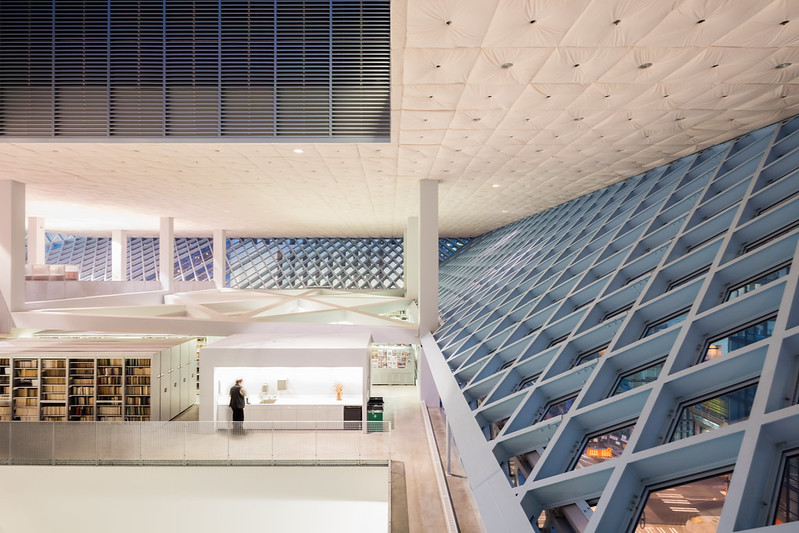
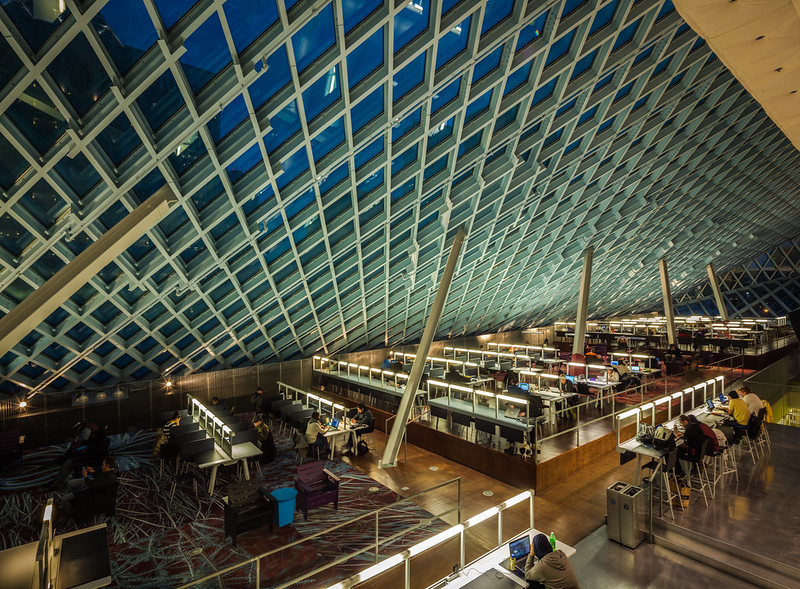
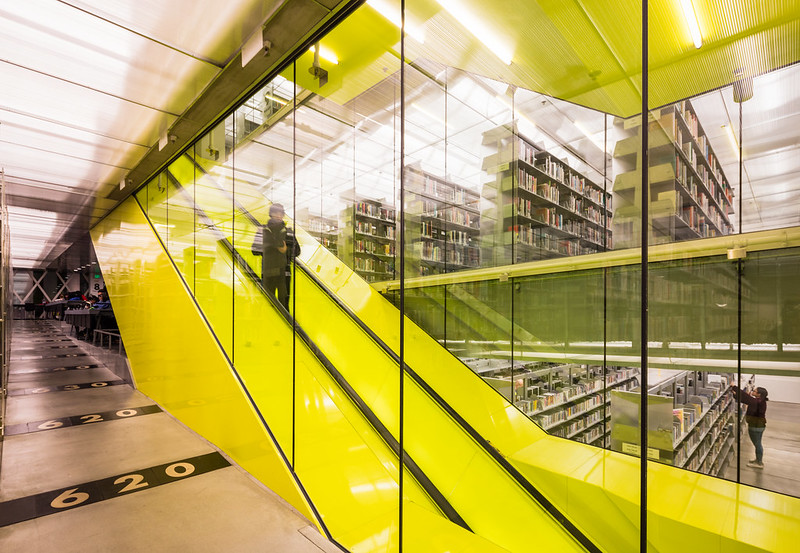
Even the Seattle Central Public Library - a real building - did it better, with tilted multi-floor window planes, escalators, multi-floor corkscrew walking path with numbering on the floor, unexpected openings overlooking big open spaces, etc.
In the treaty between China and the UK handing over HK, the people were promised eventual universal suffrage for the Chief Executive (governor/mayor). The elections for Chief Executive are held every 5 years, and there are protests every 5 years asking for universal suffrage. In 2014, there were tents on the main roads, and students making makeshift barricades, a small number of people being beaten and/or pepper sprayed by police.
The protests in 2019 were very different. It looked crazy on television, but in person it actually wasn't very scary. I lived in a neighborhood with a lot of immigrants from Fujian province who got in a big brawl with protesters half a block from my flat. Unfortunately, some subway stations and a few shops were burned, but it wasn't random arson. The subway company is majority-owned by the government, and police were using stations as makeshift police stations. The businesses that got burned had owners with large business interests in the mainland and had spoken out against protesters. That's not to say the arson was justified, but I was never worried someone would torch my building.
Though, as an obvious Westerner, any protester would have assumed that I supported at least peaceful protest for democracy. On the other hand, with all of the propaganda/rumors saying all of the protesters were organized and paid by the CIA, I was careful not to do anything that would feed into that. I had a strong sense that as long as I minded my own business, both the police and the protesters would likely leave me alone.
In 2019, a journalist was charged with misuse of a police database because they looked up the license plate of a van that dropped off a bunch of triad thugs to beat up protesters in a subway station. The journalist discovered the van belonged to a pro-mainland politician.
Also, sometime around the 2019 protests (a bit earlier, if I remember), there was a dual-citizen bookstore owner in Causeway Bay who published a book about Xi's mistresses . He disappeared. His wife didn't know where he was. The Hong Kong government had no record of his having crossed passport control at any airport, pier, or land crossing with mainland China. A bit later, he showed up in the mainland to give a televised statement that he had gone to the mainland of his own free will to confess to a DUI case several years prior, and asking his second country (Sweden or Switzerland, I forget) to stop investigating his disappearance. Absolutely nothing fishy about that. (As I remember, the bookstore had 5 owners, and at least 4 of them had similar legal troubles. I believe only the one had an unexplainable border crossing into the mainland.)
2024 is another election year. I worry a bit what will happen, but I get the feeling the government has finally broken the will of the protesters.
Did you also live in North Point? I still remember the eerie vibes of the days after, almost every single shop was closed, and corners were guarded by certain people. A couple of days after, I went out for a walk, and came home to a standoff between protesters and riot police. I ended up going to Macau for a couple of days so to avoid the chaos.
I also felt that as a foreigner it was rather difficult, protesters would assume you're on their side, until you slightly criticized some of their actions, then you were just labelled as misinformed, and "you wouldn't understand as a foreigner". So I mostly just stuck to myself and refrained from discussing it with locals.