Open Letter to the European Commission(nixos.org) |
Open Letter to the European Commission(nixos.org) |
* It is written in almost broken English.
* It does not explain one of its core concepts. What the heck is Cluster 4? This is an open letter; explain (or at the very least link to¹) what you’re talking about so that people can understand your message.
* It’s a wall of text with (comparatively) too much spacing between lines and not enough between paragraphs.
* It asks people to sign the letter by republishing it “on your website and add to the list of signatories”, like it’s an email chain from the early 2000s. Talk about limiting your own reach. Most people don’t have their own website, and even if they did you’re making it nigh impossible to count who signs it.
* It meanders instead of going straight to the point. I was lost trying to figure out what the hell the letter was about until I jumped to the very last sentence:
> In this perpective, we urge you to claim for preserving the NGI programme as part of the 2025 funding programme.
That should have been the first sentence!
The goal of the letter looks good, but the execution leaves it in a poor state for success.
¹ Here’s what I found: https://research-and-innovation.ec.europa.eu/funding/funding...
In such terms most EU States have done "something", and the EU have done something (for instance the digital euro actually in an initial phase is based on GNU Taler, with the development badly handled in semi-secrecy by a private-public consortium), but most of their actions was bad in design terms. Sometimes the public have offered mere FLOSS supporting infra, of dubious quality and ultimately not that needed (if you develop a serious FLOSS project you likely already have a personal infra to work on it, you might like funds to keep it up but not change it for a State offered "as is" new infra) but they do not provide a damn FLOSS coherent evolutionary line.
We have for instance eIDAS (digital identity, form ID docs to e-signature, e-invoicing etc) ANY EU country have it's own personal variant, formally compatible with all the others except for some "extensions" that breaks practical compatibility most of the time, large parts of eIDAS are public money, public code, but most interesting parts are proprietary with even unclear ownership.
The point is that's about time to MANDATE FLOSS the entire sw stack (with target for the hw one, we can't have open now) and a clear public development and public support to FLOSS projects so we can have one, FLOSS is free, but not gratis.
EU should just focus on reducing legislation, bureaucracy, regulation and taxation instead of trying to construct layers upon layers of "instruments" for achieving something.
Therefore, it seems to me that this letter reopens a debate that has already been addressed, expressing widespread dissatisfaction with a provisional decision that has not yet been formalized. This could potentially weaken the impact of open letters in general.
Regarding substance, our society appears to be moving towards increased centralization of policies, regulations, and funding. This centralization requires more accountability and transparency. Perhaps NGI faces difficulties justifying these funds while supporting independent individuals. In particular, the EU expects investments to produce impacts at a European scale with real and significant adoption. It might be interesting to have a dashboard of key performance indicators (KPI) to demonstrate growth and usage of NGI projects.
On the other hand, it must be noted that adoption remains low within the community. The graph on funding is explicit: two-thirds of projects are again funded by NGI. This may indicate a lack of community buy-in. However, the goal of this European funding is to demonstrate an ability not to rely exclusively on this funding and to generate profitable activity. This confirms my impression that the tech community continues to focus on developing new solutions independently while perhaps forgetting that this community funding should generate real and useful usage. Shouldn't we prioritize usage in our objectives? The report clearly states that new technologies must compete with existing usages. We need to find other solutions—perhaps non-technological ones.
In conclusion, I suggest that the most constructive response to this potential reduction in funding would be to acknowledge that NGI faces competition from other initiatives for similar funding sources. It would then be wise to evaluate our approaches and propose new measures in order to meet expectations. An open letter protesting sends a contrary message against a willingness for adaptation and collaboration. What should we learn from this situation?
origin https://notes.rmkn.fr/share/response-public-letter-ngi
Let's cut the BS, they want money and the whole low key gaslighting about the " sovereignty of a European infrastructure", "country widening" and the whole "Look! USA, China or Russia are way ahead of you guys, you suck and are in danger, please give us money." tell us more about the nixOS organization than the EU one.
I'm not that salty I swear :) Just don't waterboard us with theatrics and BS when all you want is the money like anyone else.
But someone needing money still needs to motivate the reasons-for to the money-giver. So this is perfectly valid.
I will go as a far as saying that your post portrays an ideologically skewed world-view by insinuating that wanting money is something “bad or morally tainted”.
But yes- of course the money-giver has the right to view the pros-and-cons of giving money and decide who receives it. Because the money-giver has the right to push an agenda according to their value system, by deciding who they give money to.
The open letter is about more than nixOS and appeals to the stated ideals of the EU.
Yes, that's why my whole point of contention is not the money but the half-assed cheap tactics to get it.
> "and appeals to the stated ideals of the EU."
This whole letter looks like a toddler with an oversized business suit writing a letter to Santa. It's not the end of the World, it really doesn't matter that much. But I find it funny how they think the EU works and how they think this will get them money.
GP questioned the way in which money was asked for and whether NixOS deserved money due to internal drama. I do not know the politics of NixOS, but if they indeed harm dissenters like other software projects, that would be contrary to the original EU values and therefore they should not get money.
That was the argument as I understood it.
I was surprised to find a few years back that the big consultancy companies actually have teams dedicate to advising companies on these applications and supporting documents. Helping them navigate the complexity.
If you need to pay consultancy companies to navigate the process then you just killed access to smaller companies and universities in less well off economies.
And I completely, entirely agree with you. The process is very, very annoying, long, bureaucratic, uncertain and frustrating.
It's quite transparent actually unlike GP says, but the main problem is that the scale of the complexity involved in those applications means you are going to be paying consultants to help you as part of the process. This means there's a bunch of money flowing towards pure paperwork, and often those consultants also take a success fee which reduces the total amount paid out to the project.
In other words, if you have a 1MM EUR grant, on average 100-150k will be spent ... on the application process across the consortium. And this is just for the winners; given that there's a lot of entities applying to these, I wouldn't be surprised if the "application spend" reaches ~30% of the total. And while not all of it comes out of the grant budget, it's spend triggered by the grant.
Cascade funding (https://en.wikipedia.org/wiki/Cascade_Funding) is .. kind of better? Because it allows smaller projects to exist and apply on their own without as much hassle. The smaller calls are a LOT more competitive however so you don't escape this added work created by the grant application: Many many person-months end up being wasted on the process. But the thing with cascade funding is that every layer of funding that gets cascaded takes a % in operations, and does create additional "work" in the system: It's just spread over more entities and projects. So while it succeeds at "moving more money", a lot of the value-creation is pure busywork.
TBF I don't know a single well-meaning EU civil servant that doesn't think the system needs to be reformed. But into what? How else do you distribute these huge budgets, in open, transparent and democratic way to so many people without creating these huge and complex systems, all while maintaining good checks against fraud? It's easy to say "we can do better" especially here on HN but solving this is magnitudes harder than the types of scale problems Google & Meta face, and it's cross-disciplinary not just engineering. The EU has funded really fantastic and inspiring things, we shouldn't dismiss the whole thing outright.
Furthermore, the amount of funding for these projects is peanuts for governments.
For instance, I once looked at a R&D program for commercial software for which one of the cornerstone criteria was that you HAD to build your software on top of some discount "EU-developed" tools like some bespoke databases and such.
I think anyone who has spent any time building actual stuff to sell on the markets will see how detrimental this system is.
Used to be politicians had shame and would get punished for scandals - these days they just double down and shrug it off. I think Trump pioneered the approach but the EU is following suit, as much as us Europeans like to look down on US politics. Shit is just as bad here, we're just smug and pretend we're better on top of it.
Worst part is even if say 10% of the government is egregiously corrupt now - this will be the focus of public discourse and with the bad actors getting rewarded instead of punished it normalizes and encourages their behavior.
What actually is your problem with it? Do YOU know how the EU works?
How does this work? Which EU agencies/institutions are involved, what grants are we talking about?
Companies hire groups of developers based on resumes and at best a few hours of vibes. It's good that public funds are spent in a more "evidence based" manner, but it's ridiculous how inefficient this is.
It should be a lottery if it's that hard to judge. It's R&D for fuck's sake. Risk is inherent in the process.
If we want something with a well understood outcomey then use the usual procurement. WTF.
> Which EU agencies/institutions are involved, what grants are we talking about?
If you google "horizon grant consulting", you will find a lot of examples.
> It should be a lottery if it's that hard to judge.
A lottery encourages a higher amount of low quality submissions.
> It's R&D for fuck's sake.
Well, no, not always. This system applies to the distribution of a LOT of european funds, not just R&D. It's the main way public money moves. If the EU wants to do "something", they'll create a project and do a call for interest, then a call for participation & mentors/evaluators. Mentors/evaluators get remunerated (it's always budgeted for), and will evaluate the proposals. The larger grants require consortiums of multiple members/entities from a minimum amount of different member states, represented by a consortium lead (usually a university will take this role).
Pure R&D goes through the EIC programs (European Investment Council - https://eic.ec.europa.eu/index_en). They are also abhorrently difficult, but they have an excellent reputation and I'd argue they're a lot less broken than Horizon funding. The EIC accelerator (https://eic.ec.europa.eu/eic-funding-opportunities/eic-accel...) is the most competitive accelerator out there; it offers 2.5M of non-dilutive funding so of course it's really interesting, and they tend to fund excellent projects with it.
Horizon programs are more exploratory: The EU has an overarching goal (eg. "we want to move off fossil fuels") and will create thematics for it (eg. "bioplastics", "solar power", "hydrogen"). Those thematics get a variety of calls for more specific proposals on the project.
Here's an example of one of those themes: https://www.cbe.europa.eu/
And here are their current CFPs: https://www.cbe.europa.eu/open-calls-proposals
Take one example "Valorisation of polluted/contaminated wood from industrial and post-consumer waste streams - €7 million" which is available here with the ID HORIZON-JU-CBE-2024-RIA-01: https://ec.europa.eu/info/funding-tenders/opportunities/port...
And you see that they expect projects with specific outcomes (first paragraph, eg they're expecting all projects to result in "New systems combing sorting, cleaning and valorisation of post-consumer and post-industrial wood waste into eco-designed sustainable bio-based products").
---
I have spent some time looking at this and trying to get a feel for what's going on.
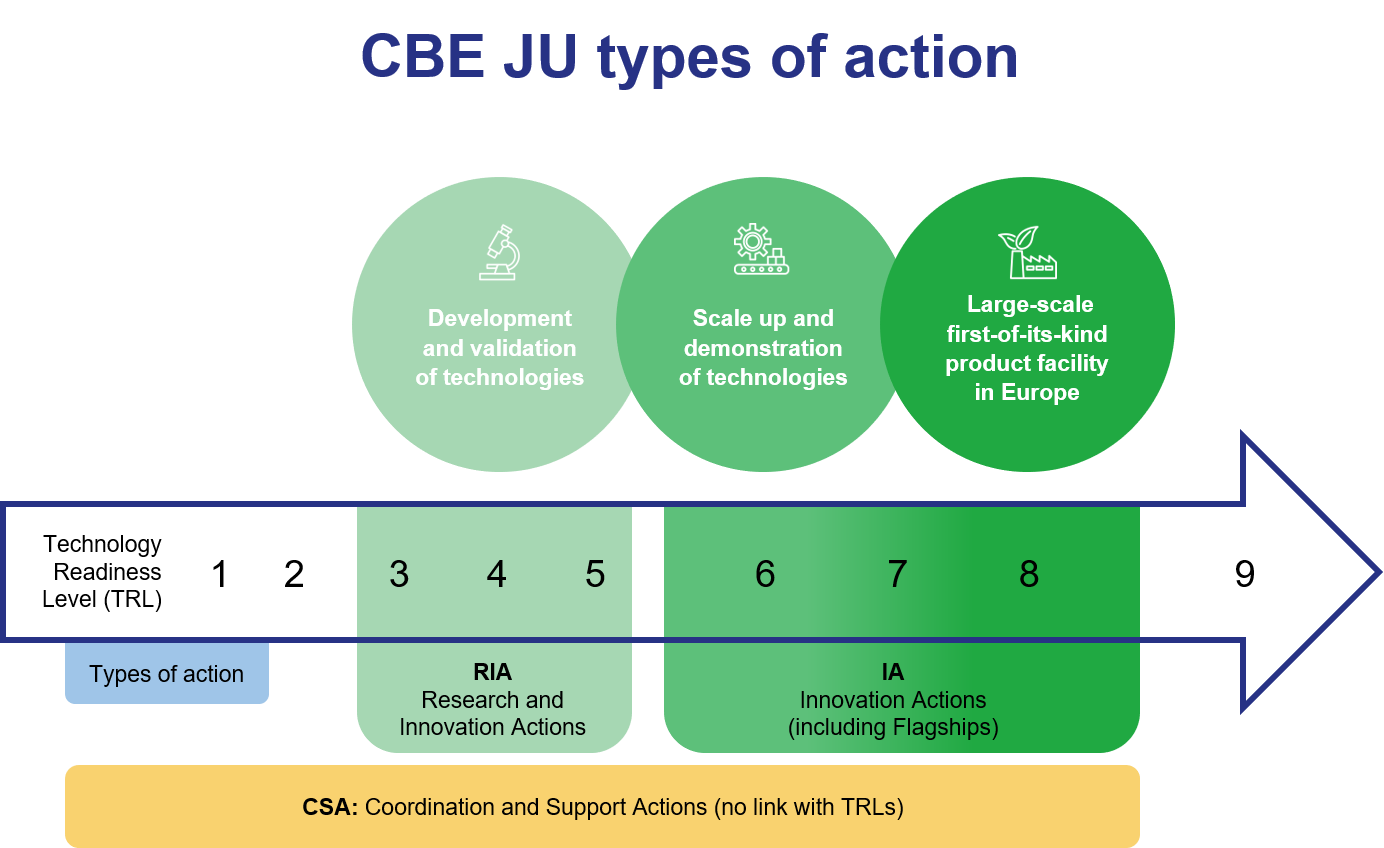
so it's a CFP, as part of this amazing circular bio-economy joint venture make-it-rain for the whole tech-readiness family! [0]
the specific one that you linked is ... research and innovation, but ... it looks extremely broad.
so, okay, it's not "basic research" (much broader than, let's say, "how to get the glue out of furniture leftovers"), but then what's the money for? (shouldn't this consortium already have a ton of projects ready for evaluation?)
and of course the verbiage is thick as fuck. it's not clear for me - again as an example - that if proposals MUST look at regulation induced bottlenecks or it's an "at least one of them" situation. (also, does it mean that think-tank-style NGOs can propose to do a survey of the regulatory framework and in theory get money for that alone? -- yes, I know, I should check the Annexes, and the call-specific docs/forms [but that's only available after registration?])
...
of course there are sections that absolutely seem to be prime candidate for consultant busywork ("avoid overlaps with past, ongoing and upcoming EU funded projects, including those funded under H2020, HEU and the BBI JU and CBE JU, ... P4P ... NEB ...."... WTF!)
...
all in all, it seems that when the EU wants to do something it ought to do an OKR hierarchy. (and yes, that's exactly what's happening with this 2 billion joint this and that. the objective is circular bio everafter, and the "key results" are reuse/recycle (valorization), etc.)
great. good job EU. still, if it costs 100K to file paperwork for this, I want my money back! :D (well, no I don't want it back, I want the grant system to be reformed so it costs 10x or 100x less to file. and let's spend the rest on writing better CFPs and so on.)
[0] https://www.cbe.europa.eu/sites/default/files/inline-images/...
Altogether a fantastic system. /s
It’s not how solutions get built. But I say this from a bed of privilege — it’s true that I have a much better shot at fixing this system than most people in Europe, due to living in brussels.
I’m working on it. We can only do so much.
I'm not sure how the onus is on me to refute anything beyond that. I've added plenty to the discussion upthread.
The fact that you are not even considering that dismantling some of the inefficient central planning could help is rather concerning, but perhaps such is the way of life in Brussels. In that case I only wish you enjoy it while it lasts, since the EU is very rapidly becoming a largely obsolete player in the global economy.