Air Con: $1697 for an on/off switch(blog.hopefullyuseful.com) |
Air Con: $1697 for an on/off switch(blog.hopefullyuseful.com) |
Now imagine a service doing this, with a manager and all the overhead.
Next time just get a dumb thermostat, or perhaps, if you're so inclined, something cheap off-the-shelf like an ecobee.
Fortunately there are some heat pumps that allow you to use any old thermostat; they figure out the right speed to run at using their own temperature sensors.
Regardless, this wasn't really the thermostat: this was a control system that monitors temperatures in each room/zone, and opens and closes the vents to hit the temperature targets in each zone. Pretty sure no dumb (or even generic smart) thermostat can handle that.
In Australia there are exactly zero heat pumps on the market that you can use an ecobee with. It just isn’t an option. There are no off-the-shelf options.
You don’t have to pay $1700 for this garbage $50 tablet, but it is the default that every installer will offer you without mentioning any other options (and the only options are the manufacturer’s proprietary controllers). In this case his builder procured it for him without even telling him the price. He may not even have been given a choice. You have to be extremely motivated to stay on top of every decision like this along with the thousands of other decisions involved in building.
You don't get asked what you want or a choice in changing it to a different device...
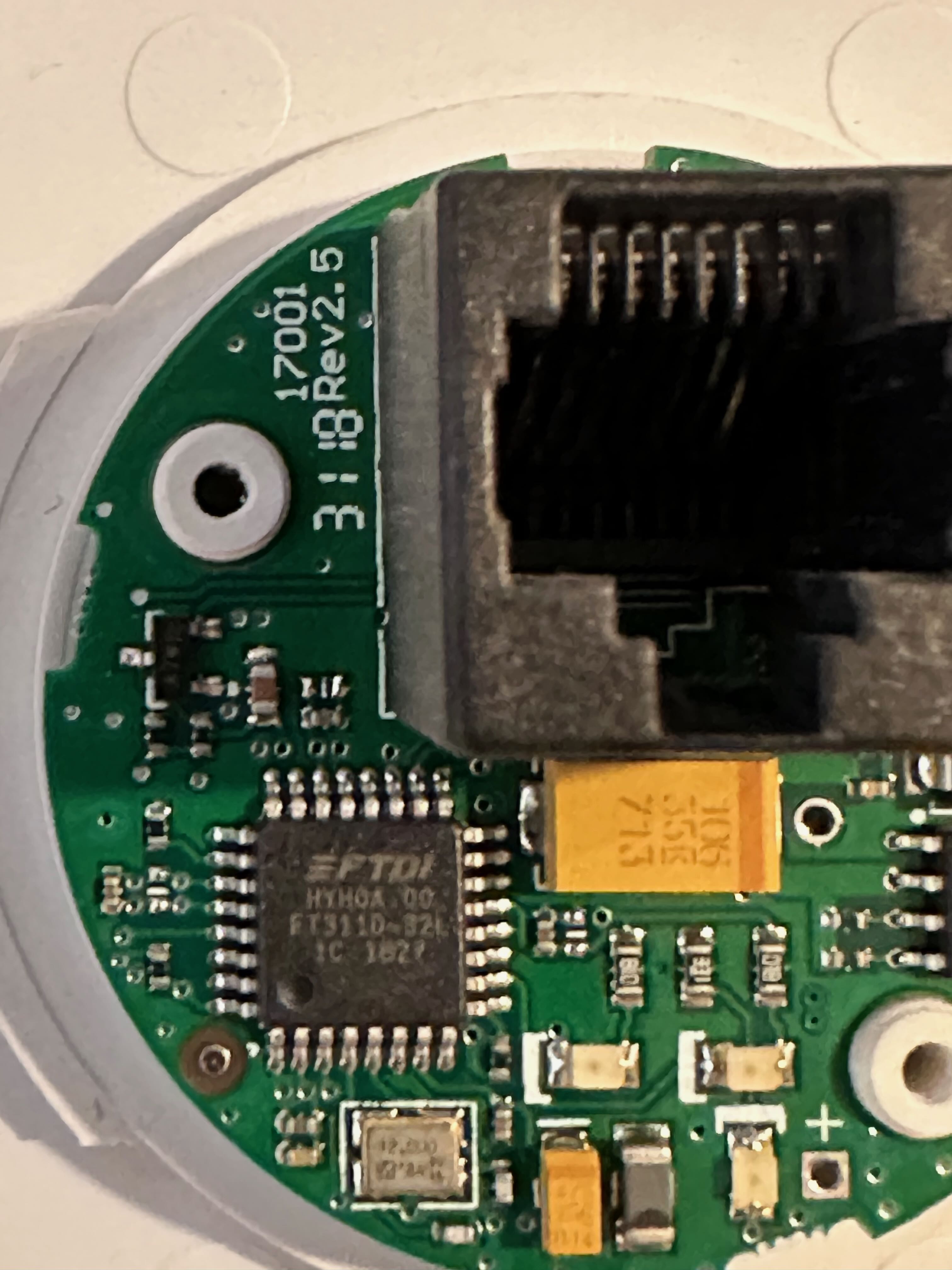
1. PoE to USB
2. Smali debugging
Funnily, I thought it was serial over CAT5 because we have a couple of old network switches that are configured like that.
Defense in depth, baby! (against customers)
Why have one proprietary component when you can have two...
Since it's not just a generic non-programmable serial chip I assume it's also doing something more. But it doesn't do Ethernet so I bet it's not actually PoE but like... power+serial over Cat5
>> actively monitor temperature and adjust vent opening angles and fan speed to achieve desired temperatures across multiple zones.
Who actually wants this junk? Air conditioning is a simple series of bang-bang controllers. A handful of relays turn things on and off as needed. There is no need for "vent opening angles". Vents are open or closed, pumps on or off. The thermal mass of the structure keeps everything within a narrow band as systems cycle. And then the oxymoron buzzwords like "actively monitor". No. Unless it has a little arm to spin a wet bulb, it passively reads the temperatures and sends and over/under signals as needed, something that for decades was done with a blob of mercury on a spring. The moment this system even hiccupped, I would gut it and replace with basic 4-wire thermostats in each zone.
Ah .. takes me back.
For any one thing, it feels like not a huge deal. Oh well, a thing is broken and needs replacement. But at scale, it feels like this is how everything ends up dying, lately.
For example, our LG microwave, oven, and dishwasher all started to fail around the same time simply because the awful membrane buttons collapse or just stop working. You'd expect to start considering appliance replacement when the actual parts that do the _work_ can't function anymore, not because you simply can't turn it on anymore.
I would love to not send three heavy appliances to the landfill just because of a few buttons that don't work anymore, but I have more money than time. What's more, how long will it be until (made up hyperbole incoming), say, the input button on a TV also fails, and then you can only use HDMI 2 until that port wears out from swapping things into it, or, <insert basically any other thing you could possibly own that can be rendered useless simply because the power button stops turning it on>.
It becomes infuriating to think of all the waste that's generated from these little stupid things.
I for one was upset when I bought a HiFi amp from Cambridge Audio (CXA-81) and it came with an IR controller. The only way to be able to control that amp through the app is by means of a DAC which costs another couple of thousand dollars. I refused to accept this as my solution. I wrote a web server that used a Raspberry Pi Zero W and an IR transmitter along with a rudimentary Android app that had a series of buttons which corresponded to the functionalities I needed.
If anyone is interested the web server (written in Go) that the Android app talks to is located here https://github.com/ozfive/CXA81-IR-Remote-Server
I will upload the the Android app source in the next week.
Like some of the commenters, I've been thinking about the growing frustration with these kinds of business practices. It really makes you wonder about the balance between smart technology's convenience and the long-term costs they can impose.
What do you think would be the most effective way to encourage companies to offer more consumer-friendly solutions, especially for minor issues like this? Should there be stronger regulations, or is there a market opportunity for more open-source, user-modifiable systems?
Muradiallaberdee@gmail.com
As I creep closer to retirement, I look forward to spending some of that time contributing to the fight against abusive bullshit like this.
Then to your tablet question: even on simple non-zoned systems, lots of manufacturers have totally moved away from oldschool thermostats that have simple fan/compressor/power/etc.. wires, in favor of "communicating" systems. "Communicating" means there's a proprietary protocol that their thermostats, control boards, and other misc electronics in compressor/condenser assemblies speak; for which there is no standard. A handful of modern advancements kind of necessitate this, such as variable speed compressors (yea, you could totally control that with normal electrical hardware, but....no one cares).
Couple all that with people willing to pay damn near anything to cool off when its 97f outside, and you end up where we are today.
I'm sure as everyone piles onto the mini-split hype train, there's going to be even more fleecing of homeowners for maybe middling quality hardware and installs. Someone (either the HVAC company owners or the hardware manufacturers or maybe both) is making an absolute killing on this; maybe it's time for a career change.
Companies won't stop fighting it. We mustn't stop fighting for it.
> I also don't understand the obsession with "smart" controls on any residential single family home when a basic programmable thermostat already does basically everything.
don't get me started on this. all this "learn your schedule and adapt conditioning to match where you are" is literally the one thing you ARENT supposed to do with efficient heat pumps, which are becoming more and more common. You set it at a temp, maybe you let it bump up 1-2 degrees in the heat of the day and then back down later at night, but any more than that is LESS EFFICIENT and more expensive overall. I don't get it.
I’m contemplating writing an end-to-end manual for a set of laser machines I maintain, including missing schematics, gerber/eagle/fusion files and binaries for the MCU, how to flash it etc. Some parts which are required for servicing are only handed to manufacturer-employed technicians (I obtained those too from retired people). It’s been a riot to get everything and to learn how to disassemble, troubleshoot, fix, reassemble these machines.
But am I ever pissed at the manufacturer and the aftermarket for screwing people over. The markups on simple items are insane and they remove tags and IDs so you don’t know what the parts are. At this point I don’t care what’s proprietary information and what isn’t.
You either waste a tons of money on consumer grade product, and spend even more when they break, or you become a domain expert, hacking your way through it and running HomeAssistant (or similar)
Just get up and use a remote control people. It's not that hard. You really don't need an app to do it remotely. Your life will be fine.
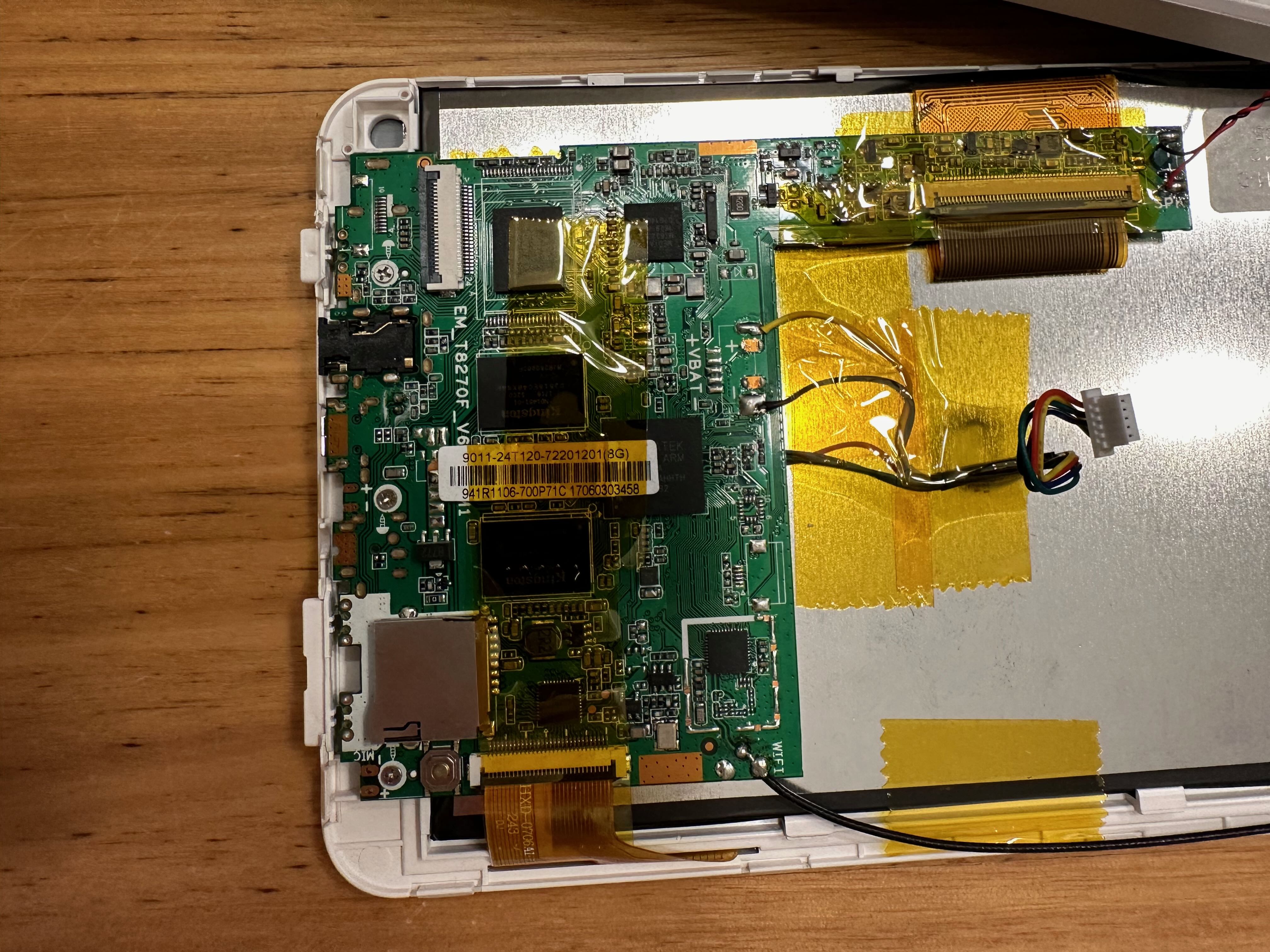
That USB dongle was bodged on to the USB port D+/D- pins going to the tablet's SOC. If you then connect a PC to that port, you have two hosts (SOC & PC), and one peripheral on the same pair of data lines. No bueno.
I can't believe the bodge job inside that tablet. It looks like the prototype became the final product.
[0]quotes because looking at that FTDI chip though my bet is it's actually serial over Cat5...
Not only the remote would never be where it belongs, but I just had to plug in a shelly to have a full automation connected to my home assistant.
The vendors really wanted me to go for their solution until I met a guy who said sure, this is what he did too.
One of the shellies failed right after two years (warranty time in the EU) and fixing costed 20€ + 1 day. In the meantime my automation was replaced with my finger.
I mounted them right next to the roller (in the roller enclosure) and if I did not have that possibility, I would have done it close to the ground to have good access. I do not have a socket per see, rather a small switch on the wall not inside the wall, this is not permitted where I am)
I had a look at cheaper solutions in the past but gave up - I do not have a lot of rollers so the cost difference is likely to be minimal. I like the fact that they work well and it is really a kind of mount-and-forget kind of setup.
Please do this via a script on GitHub
Then it'll make it easier for other people to use on other tablets
It has some very cheap looking digital controller system with a ridiculous amount of complexity around it. There are 2 separate computers involved somehow. Just for spinning the blower. I was operating under the impression that an induction motor could be powered directly from the AC mains.
The complexity is certainly not adding to any sort of comfort, etc. The overall system is unbelievably noisy. This is all so clearly engineered to require as much maintenance as possible on purpose.
It would take me months of figuring to determine how to take 2 wires and turn them into 40. The easy part is throwing it into the plenum in such a way that the wires hang within millimeters of the rotating assembly.
(1) I'm working on monitoring the inverter (Deye) thru a RS485 interface using a small SBC that connects to the IoT restricted VLAN. Will report here as soon as it's ready but will require time. I wonder if the same could be achieved with the AC units (Hisense). One could learn remote signals and send them say from a ESP* board through WiFi, but there would be no feedback from the AC units.
This demonstrates where the new tech products are bringing us: to scrape everything and buy the entire thing again.
This is the direction of the automotive industry as well, so in the future you won't be able to repair a car easily too.
Next time it dies I plan to try to find the defective relay, desolder and resolder it myself. Imagine how much better it would be if there was a read out with an error code on a fridge with easily removable relays you could unplug and replace. I know it is not a priority to make these kinds of things repairable, but I wish it was.
It would be cheaper to ship a replacement PCB with the fridge.
It's definitely predatory practice by the vendor. I wonder how much it would cost to pay someone with your skillset to do this hack -- probably comparable to what they wanted you to pay, if not more?
This almost merits an angry on-site visit, sheesh.
DIY is the way to go, only if you know what you are doing.
The code seems to allow for both "PIC7KS6-EZ" and "PIC7KS6" unless I'm misreading it.
The plan is to get rid of the tablet and put a Amazon echo hub or HA on a tablet that directly controls the aircon in the future
As far as HA integration goes, there's already an adapter available that uses the HTTP API that the tablet exposes. This of course still requires a working tablet though.
The next step for an open solution would be to either write a replacement for the tablet API that talks directly to the control box using RS485 (which will have the benefit of allowing existing integrations to work as-is), or perhaps even ignore the original API and start from scratch with something custom built for HA integration.
The original HTTP API that the tablet exposes is relatively straightforward, but it also commits quite a few sins against HTTP, such as mutating state on GET requests (making CSRF type attacks trivial). This makes a like-for-like replacement a little less palatable in my eyes.
The other tricky thing is that the tablet code is where a lot of the state is kept and the smarts of the system are located. Zone names and config, schedules, temperature sensor pairing, ... replacing the tablet API completely like-for-like might be tricky, but doing just enough to support HA integration (maybe submitting a patch to the existing integration to support the new custom API) is probably a much easier task. There should be no need to rebuild features that HA already has such as scheduling etc.
The system uses RS422, with a base64 encoded AES key in the aaservice binary, and I was contemplating building an esp32 based open source implementation of the controller.
That's a crazy weird coincidence.
https://www.aliexpress.com/item/1005005918675239.html
The connectors on the small RJ45 daughter board are JST-SH 1.0
The yellow lead puts out 4.2v to replicate a Li-Ion battery (as far as I can tell). You can ignore this.
Red is positive
Black is negative
Green is usb d+
Blue is usb d-
https://git.nethack.net/rob/aircon
Essentially it just talks to the android tablet API to do things so it's no help if (when) the tablet dies, but it means I can do things like:
- have the entire unit turn on/off as needed based on average zone temperatures
- open/close vents based on room owners' devices being online, or temperatures of nearby zones
- dump zone temperatures to influxdb
That being said it's more likely the hardware mfg is just trying to claw in more margin.
I should really write that up at some point too.
Shame on this manufacturer.
I usually get the 'oh did not think of that' because logging is a serious afterthought in many cases. It is boring and you just drop in log4j and log away right?
https://www.quora.com/Why-are-West-Australians-called-sandgr...
People like you are the ones that make the internet worth logging on for.
I specifically went for units that were IR controlled rather than any proprietary smart B.S.
For the smarts, I used cheap IR blasters from AliExpress and hooked them up to HomeAssistant.
I just mounted cheap Lenovo tablets to the wall to do the room-dashboard thing to allow controlling lights/AC without a phone.
These kind of horror stories only serve to reinforce my decision.
There is a very real need for modern variable-speed units, and vendors just keep fucking it up by using proprietary protocols locked into their ecosystem. TRANE in the US is similar.
And this is really annoying because variable-speed pumps solve all the problems with short cycling and oversized systems.
What a fun, completely coincidental quirk that that time appears to fall outside the warranty window, hey?
It will most likely be "How do we restrict this hack" and will eventually get into more restricted/quirky hardware & software.
It would be interesting if someone already in AC repair made it part of their business though. That's when you'd see the teeth come out.
A couple of weeks ago my AC blower fan stopped working, the compressor would run. I went up and found out that the capacitor was bad, and took a picture of it, buying a replacement. Took about 15 minutes to replace and I probably saved myself at least $400 (no AC is an emergency in the desert, and they will charge you accordingly).
Fixing household appliances can be fun too!
Fun read otherwise and wonderful to see someone stick it to them this way, but that type of thing really pisses me off.
Redirecting your customers to a third-party/pirate APK redistributor of unknown authenticity... reality defies parody.
But more importantly, what's the actual threat vector here? This isn't his personal phone. Just don't connect the tablet to your Wi-Fi. What's it going to do, sneakily increase your temperature by 1 degree?
Also if you want to integrate the air-con with general smart home stuff.
Why even build those warnings in, if you're going to make your own mechanics ignore them.
As the sibling comment mentions, they are signed files.
In the US, it's common that the input to each zone controller is just a open/close contact, so in the worst case you can call for heat by shorting the right wires together.
I have a smart thermostat that I use the provided app to control, but one of the reasons I went with it is that there's also an http server in the device firmware that can be used to control it (so if they totally ruin the app or turn off the server or whatever, there's a way out).
Yes, it was out of warranty, but it's abhorrent that anyone should have to purchase a whole new anything when a small portion of it can be replaced independently.
There is no specific time when the consumer guarantees no longer apply to products. They may apply even after the manufacturer's warranty period has past.
They’ll then generally go to speak to a supervisor.
The’ll then come back and say they’ve been instructed to help you escalate to ‘senior management’.
A day later they’ll contact you with how to get your product fixed for free.
I’ve not had a significant delay, but you’d be spewing if it was a heat wave in summer.
Essentially, there’s a statutory warranty that exists regardless of any warranty term quoted by the manufacturer, and the manufacturer is on the hook if the product is not fit for purpose or sufficiently “durable”.
[1] https://www.accc.gov.au/consumers/buying-products-and-servic...
The real problem is that the quoted replacement price is so high, given that we know the tablets themselves are like $30 each.
They could control the whole system over POE with a bog standard usb to ethernet adapter, make the app easily run on any android device and charge the customer less for a better more reliable product, but rather than do that they rigged up some janky interface and built a custom enclosure hired out to an overseas manufacturer who bought the parts for $20 and charged the middleman $100 for them, who then charged the dealer $250 for them, who then charged the installer $600 for them, who then charged the customer $1600 for them. (Got to get that 2.5x margin on hardware every step of the way, after all!)
If they had gone with a POE system, wiring would have been cheap, replacement parts plentiful, and customer satisfaction would be sky high. Sure, you would sell fewer full systems, but to me that is a small price to pay for having the most useful and interesting systems on the market with fans creating all sorts of mods and integrations for your equipment and becoming customers for life.
We had an Advantage Air system installed last year, and the cheap, low-powered nature of the tablet was immediately obvious. Nice to know it can fairly easily be replaced with any old device or phone as and when it craps out.
You know that tablet is cheap and is going to die. Figure out the procedure to replace it with something that doesn't suck before you've lost your heat/air conditioning.
I have several Daikin split units and installed Faikins on them. https://github.com/revk/ESP32-Faikin
Having the PCBs made, flashing them, sourcing the connectors,and installing them was a bit involved, but setting them up in home assistant was one of the best things this nerd has ever done.
I wish there was an over-arching collective of hackers who would teach the principles, and help collaborate to decipher these protocols and help build software and microcontrollers to replace proprietary systems like the one Advantage Air has. I bet a simple ESP32 could handle this.
Nice write up though
Basically, they had your setup exactly, but they leave the tab open in Safari and whenever they open Safari to browse the internet, the garage door opens.
Just had to deal with this recently. My gas oven control panel died and one would think to replace the control panel ($300 ish part), but I had my doubts. Pulled everything apart and hooked up a meter to what should be the power coming from the cord, no continuity. Took apart everything on the top two levels of the stovetop to find a thermal switch buried under there that had failed. That thermal switch is forever OOS (was $35 at least for a replacement if you could find one), so I hopped on amazon and bought a 5 pack of microwave thermal safety switches with the same cutoff temps for $6 that fit the push connectors. 10 year old higher end gas oven was fixed for about $1 in parts.
Probably would have been at least $200 from an appliance repair company just for the labor of having to take apart the entire stovetop to get there. Not sure how many people would even bother although it was about $2k new.
How many hours did you spend taking it apart diagnosing the problem, though? I'm guessing at least 2? $100/hr for that seems pretty reasonable to me.
(Granted, I agree with you in that I'd prefer to figure it out and repair it myself, even if it would take me 5x as long as someone trained to do it.)
For an experienced tech I assumed at least $50 for the house call and then a few hours for the disassembly and reassembly.
I've had countless of times where simple/cheap part replacements have negated the need of a very expensive fix, or a complete replacement of a device, it's very satisfying.
I can vividly remember one case, almost two decades ago where a 10 cent o-ring (hardware shop price) has saved an old but otherwise fully functional Ice cube maker and has stopped me from having to buy a new one, or invest relatively too much in a workshop retrofitting it with a replacement to an old, no longer produced valve, at least according to said workshop. To top it off, it has been working perfectly ever since.
I wish there were more organized resources, as well as help forums for DIY repairs/retrofits for household appliances and other common devices. Way too much stuff gets thrown away because of simple part failures and that's just no good.
(solid post, also solid rant, mate)
I would have used wood and nails. You must have terrifically strong emotions!
https://smartlight.me/smart-home-devices/wifi-devices/wifi-d...
Since there's no feedback mechanism, how do you solve for when the state of the unit(s) gets out of sync with HomeAssistant's?
It just doesn't matter that much in my experience. If an issued command didn't work, it's easy to tell anyway (it's hot/cold), and you can just repeat it. HomeAssistant also has bits of special handling for items that don't communicate their state back, called "assumed state".
For the rare times I want to control my AC when being away from home, I have an air monitor nearby. I can just check if the temperature/humidity has changed, and repeat the command if it didn't work. If you _really_ cared you probably could script it to do it automagically, but I didn't feel the need to bother.
https://tasmota.github.io/docs/Tasmota-IR/#sending-ir-comman...
If you are in the room, you'll know soon enough, otherwise I guess it could be possible to rely on the audio feedback (a light beep) that the AC probably emits when it successfully receives a command. (and add a temperature sensor to check that it's working properly)
I guess you should hide those remote in a drawer and remove the batteries when you start using homeassistant
The completely overkill setup would be to get a different remote control, get my DIY receiver to accept that and convert it to my AC unit's IR code, updating HA while at it. The remote's state would be out of sync still, but it'll keep the units in sync with HA.
I have Zigbee contact sensors that provide on/off feedback to HA by detecting if the louvers are open.
I built an esp32 IR sender and put Tasmota IR on it. It has first class support for the Daikin. It can't receive but it seems no need as it's 100% reliable.
Lennox uses a proprietary system like this one but the old school controls were visible on the control boards and due to a freak accident when an installer was levelling the floors for new flooring and cut the old wire I had a 5 wire thermostat wire installed instead of the 4 wire it came with.
Perfect.
$50 thermostat, wired it in. Powers on. Fan powers on. A/C condenser? Nada.
Official replacements were $700+, upgrades were $800.
Checked around, found an offerup seller selling the upgraded model for $400. Deal.
Met the guy, he gave strong, "I stole this, don't ask too many questions" vibes at first glance, and I was about to back out of the deal, but something clicked in my gut and I went with it.
Got it home, wired it up. Fan turns on. No AC. @#$@!#$%@#$^
On a hunch, went outside and checked the power for the heat exchanger. I had unplugged it for safety reasons but plugged it back in afterward, but gave it the snuggy test just in case.
Sparks shot out as it re-engaged. It's Alive!
The $50 one might have done the job, but no point in re-rewiring the whole shebang as the money is already spent.
If this system goes down, I'm going mini-split ductless. Forget this noise.
For one of the rooms i opted for a IR/RF transmitter and the RF covers any RF enabled devices in the house (433mhz + 315mhz[i think but haven’t tested])
There are a fair number of DIY thermostat projects online, but all that I have found were one-offs by their creators, or were for specific kinds of systems like boilers.
I've been batting around the idea of starting a general-purpose IoT thermostat that only uses cheap, widely-available components that anyone can easily duplicate with a BOM and 3D printer.
I use AC units that come with IR remotes (Samsung maybe??) but the timers don't work for some reason. It would be great to hand roll some automation, but I never "hacked" IR remote/receiver systems.
Home Assistant supports a huge range of integrations.
Personally I am using Broadlink RM4 Mini IR blasters. One in each room. They get added to Home Assistant as devices.
Then I use one of the climate add-ons that can send IR commands via the Broadlinks.
Out of curiousity, did you have any resources you were following to set this up? I'm pretty new to HA - basic devices etc seem fine, but I'm not entirely sure where to go next!
I'm using Broadlink RM4 Mini's I got off AliExpress. They've got a powerful enough IR signal that I've found I don't need them sitting way out in the open and obvious. One is tucked behind a TV and not quite in direct LoS, one is behind, but it reflects off the wall just fine, another behind a bedside table.
For the integration/Climate control thing I'm using SmartIR. Configuring it is a bit weird, you have to put it direct into the configuration.yaml file unlike other integrations.
    smartir:
      check_updates: true

    climate:
      - platform: smartir
        name: Bedroom AC
        unique_id: bedroom_ac
        device_code: 1293
        # https://github.com/smartHomeHub/SmartIR/blob/master/docs/CLIMATE.md#available-codes-for-climate-devices
        controller_data: remote.mini4c_bedroom
        temperature_sensor: sensor.airquality_ikea_bedroom_temperature
        humidity_sensor: sensor.airquality_ikea_bedroom_humidity
power_sensor: binary_sensor.contact_bed_acI have a Broadcom one which works well but expensive.
The Broadlinks RM4 minis were pretty cheap on AliExpress. I think I paid about $15 each? Might have to wait for specials to come up to get the lowest price.
I was also told if my unit was a Trane, they weren't allowed to sell me the combo! (My unit is a Goodman.) What a rip off!
Temperature sensors are all standardized for the most part (well, they don't seem to be anything special) but I'm not sure about chlorinators... Mine has a strange (electrical) connector and 100% proprietary threads on the PVC connectors (that were easy enough to reverse engineer in OpenSCAD: https://www.printables.com/model/24144-t-cell-cleaning-stand).
Fortunately there's plenty of 3rd party competition for things like that. Even though I had a Hayward system I was able to purchase a compatible chlorinator off Amazon for a fraction of the price Hayward was charging.
I'm all about stupid, but repairable appliances now.
But the insane control systems compensate for it.
While it would be nice for the protocol to be documented (would realistically only be used by a very small number of users), the only real way you would be able to get a standard for something like this to work is if you went the Bluetooth route and did generic scenario-based profiles (e.g. HFP, A2DP, SPP), and optionally some "GATT" or "generic attribute" parameters. However, as we see with Bluetooth LE, everyone just uses GATT and implements their own little proprietary thing over it and you're back to the same problem.
Some of these systems attempt to be "smart" and just use the 24V C/W/Y1/Y2 etc protocol as a "standards compliant fallback". You don't necessarily lose ALL of the smarts, but the unit has to essentially use physics magic to make an educated guess about the information (for example, if you use a on-off thermostat, you can't really measure the temperature of the setpoint, so you don't know how close you are unless you somehow make an observation over many cycles.
I think that reasonable attempts to address this problem could involve some kind of extension to the old 24V interface - say, by offloading the actual "policy" part of system control to the "thermostat" i.e. have something that goes from 0-10V where 5V is off, 0V is full cooling and 10V is full heating. This allows you to choose your own temperature sensor situation, but complicates setups where more than one zone or thermostat is required. Of course, it will be very difficult for the industry to settle on a solution to this. Qualcomm's Quick Charge 2.0 was a very simple protocol similar to this, which was essentially self-documenting and not something that needed versioning, but of course, needs changed, 3.0 came and went, 4.0 came and went, and by the time USB C and USB PD came around you ended up with a full on data protocol API with all the OSI layers and of course, vendor specific extensions.
You could define some complicated protocol where you don't conform to a standard but you publish an API for your system (of course, there is no incentive to do this), and larger vendors like Control4 or Lutron, Crestron can program their products to interface with it. Unfortunately this doesn't allow the customer full choice over thermostats, because now you have to deal with N vendors x N thermostat vendors, which isn't scalable and you'll end up in dependency hell.
The closest thing I can think of to a standard, and the way it is solved in larger buildings, is through something called BACnet. It appears to use the Bluetooth model of "scenario based profiles", with all of the disadvantages that come with that, but the primary disadvantage is that it has to be to some degree manually configured to route data where it needs to go - and I don't think this is something installers are currently equipped to do at home scale.
Realistically, the "thermostat" is just a vestigial component in modern terms and really, it's just a user interface and thermometer now. Without getting into the wish to have open sourced app control or whatever, it's hard to define what the "thermostat" does and what the "system" is doing, and whether the device that sits on the wall is really a "thermostat" deserving of being interchangeable anyway. I have heard from a friend that does home automation integration that many clients don't like the default thermostat because it doesn't look very aesthetically pleasing. In this case, I'm definitely sympathetic to the need for customizability but it seems difficult to achieve in practice.
Alas, vendors that interface with customers do not sell appliances - they sell "solutions", specifically solutions to the problem of their own making, i.e. them inserting themselves between the buyer and the appliance they're buying.
There really is nothing complicated there. I have some background in lift (elevator) systems, and they have similar requirements. Modern lift systems use variable frequency drives for smooth start/stop, and they came up with compatible protocols that allow users to mix-and-match controllers.
In the end, there just needs to be a simple protocol to command the motor to run at a certain speed. It can be CAN-based, it can be based on RS-485, etc. For additional smarts, throw in readings from the sensors inside the AC units (pressure, coils temperatures).
Then the control units can be made by third parties. They can do all kinds of prediction-based logic, complicated PID controllers, whatever.
> Some of these systems attempt to be "smart" and just use the 24V C/W/Y1/Y2 etc protocol as a "standards compliant fallback". You don't necessarily lose ALL of the smarts
You actually do with TRANE units. They become completely dumb, not even 2-stage emulation.
> The closest thing I can think of to a standard, and the way it is solved in larger buildings, is through something called BACnet.
I have BACnet at home, for wired temperature/humidity sensors, the same RS-485 network is also used for Somfy shades ( https://github.com/Cyberax/py-somfy-sdn ). BACnet is a low-level system, and it needs higher-level profiles. But yes, exposing the motors and the sensors inside the AC units over BACnet would be a great start.
Any tablet worked. The only reason it die not work ootb were completely arbitrary restrictions.
The control boxes can do whatever complicated things they want. But the interface to control them should and can be standardized.
https://www.tesla.com/support/8gb-emmc-recall-frequently-ask...
My guess is that their "RAM Plus" feature (aka swap) combined with the memory hungry modern android apps turned out to be a nasty timebomb. Which has or still is bricking millions of smartphones after a few years of usage.
The underlying flash memory is trash and the controller already does a ton of heavy lifting to keep the data coherent.
Great, right?
The local carrier dealer lied and said the unit wasn't under warranty. They lied again when reminded of the class-action settlement, claiming only part were included and said would cost a fortune in labor.
When I called Carrier and told them what their factory authorized gold/preferred/whatever-they're-called dealer was pulling, Carrier confirmed I was correct and even verified the unit's serial number and said that if the dealer had checked the SN, they would have found it was covered.
The dealer then said 'fine, but those parts are going to take weeks to get from the warehouse' knowing damn well I had no heat, in the winter. They had us over a barrel and they fucking knew it, and I didn't have any way to prove that claim wrong.
At the end of the day, I could probably buy an aftermarket fan off the Internet and install it myself, spending far less than the certified technician would charge to install the "free" OEM replacement part.
I had a Phillips 4K LED TV I purchased on sale in April 2021. The TV was glitchy, and I'd get all sorts of weird problems with it - but nothing really terrible.
Then two weeks into January this year, the picture suddenly becomes a jumbled mess of vertical stripes. One second it's fine, the next second it's broken.
Luckily we have a general 5 year warranty period here in Norway, and TVs are expected to last for at least 5 years. I called the shop, and they told me to just bring the TV.
When I get there with the TV, I notice two other identical TVs. I check out the note that hangs on them, and see that they are broken, with the same symptoms as mine. Both had purchase dates around March / April 2021.
I can only assume some component failure.
Isn't that the point of the warranty? They tell you they think the product will last for X years, and then it lasts about X years, just like they warranted.
Honestly, I think something needs to be done so that companies are held liable for expensive products failing and needing expensive repairs after a year or two.
We've got some pretty fucked up protectionist rules about what you can and can't do in/to your own home. It's nuts.
Now, nobody is actually watching most of the time, so you're usually fine, but it's as stupid as being illegal to replace a tap or existing light fitting. Every so often state governments review the rules and get swamped by trade associations who say the rules are there to prevent people being 'scammed' by untrained 'handymen' and are there for your own protection. This regulatory capture means that legally you need to complete a four year apprenticeship before you're allowed to change a plug! And another one if you want to do any basic water plumbing.
I wouldn't be surprised if what the guy did in this blog is strictly speaking illegal - for instance when it comes to data cables, you need to be a qualified electrician with data specialty to install them. You can plug ethernet cables into your computers yourself (wow! such privilege!), but if you install them even by getting some stick-on plastic conduit and passing the cable through that, you're in contravention and could potentially be fined, up to thousands of dollars. For sticking some plastic tubes to the wall in your own house.
Obviously there is some acceptable line here, but I think the States handles this decently well enough. In Austin where I live you can get what is called a “homeowners permit” in a lot of cases. Meaning the city will come look at your work and as long as it’s up to code you get a legal permit just like a contractor would get (https://www.austintexas.gov/page/homeowners-permit). You can only do this to your own home so it’s not a shortcut to running a chuck in a truck business without a license.
What I think we really need to do though is make publishing these control standards mandatory under right-to-repair laws - no one should need to be reverse engineering them, you bring a product to market you have to provide the complete spec for it's software interface and data.
Do that, and I bet we'd find in a few years every new appliance would support a common serial port standard and come with a code page in the manual for it (ironically the prevalence of Tuya-smart stuff has come very close to making this happen, but they go to absurd lengths to lock you out of the wi-fi microcontrollers).
My fitbit wifi scale, which I love and has been doing a great job for the last 10 years has now lost support to pair it with the new fitbit app, thanks Google!
Perhaps someone has already made a home assistant plugin that does this?
I've done this repair myself, it takes maybe <15 minutes and is almost impossible to mess up. Even if you were find spending a couple hundred dollars to have someone come out and do it, you'd still go hours at least without AC. Which depending on the time of year can be miserable.
You don't need the same model number as the original cap, it just has to have the same voltage rating, capacitance, and number of terminals. You might have to get creative with the mounting solution if the new cap is different than the old one in terms of shape or size.
Also, pro-tip: when you replace a the cap in the outside unit, install it upside-down so that water doesn't pool on top of the cap and rust it out from the top.
I have a gas furnace and I also keep a spare ignitor handy. It's not a matter of "if" those go bad, it's "when."
Just don’t cook yourself with the remaining good capacitance.
Personally, I wonder what could be done to temporarily get the capacitor to “kick” for a few more times to get your home temperature down as you get your replacement. Chill the capacitor?
Buy it from McMaster Carr or Grainger, please!! If you do this repair yourself, short the contacts of the capacitor (ideally with a correctly sized resistor) to discharge it before handling it so you don’t electrocute yourself.
Start caps: https://www.mcmaster.com/products/motor-starter-capacitors/
It stopped heating and it turned out there are solenoids that control the natural gas flow. Quick disassembly (back when products were made for easy repair) and swapping out two $8 solenoids from Amazon and I was back in business.
Unironically one of the proudest moments of my life was when I fixed the the belt on our dryer.
A $10 rubber belt and YouTube and voila!
Simple YouTube video to unscrew the thing, sand off the crud and back in action.
It really is an easy repair. Needs a screwdriver and knowledge enough to shut off the electricity to touch the wires. According to code every one of these condenser units outside has a disconnect right there so you don’t even need to turn off the power at the breaker box. Just pull that disconnect, open up your outdoor condenser unit, snap a pic of the specs on the capacitor (it’s the only thing that looks like a soda can) and order one off Amazon and stash it somewhere. It’s a tiny part. It will take like 5 minutes max and save you several hundred bucks and a lot of sweat eventually.
FWIW, when ac dies it’s usually in this order of root causes:
Float switch: your condensate drain line got clogged because it just does and you need to clear it. You can proactively prevent this by pouring bleach or vinegar down the line periodically (what clogs it is usually some sort of gnarly plant like growth from all the moisture) or if it’s clogged you need to clear it. The hvac guys will charge you 300 bucks to blow pressurized air through the pipe or you can literally just duct tape a wet shop vac to the thing and suck it out yourself. Attachments can be purchased on Amazon for reasonable price.
A capacitor issue is the second most common. If it ain’t the float switch almost always it’s the capacitor. You can increase your capacitor longevity and also decrease your electric bill by changing your air filter regularly but also hosing down the outside condenser coils every few months or so. Almost everyone knows about the air filter but few people know about hosing down the coils. This makes a HUGE difference. We are talking like 20-30% of your electric bill in hot climates if you don’t do it. Just take a hose and spray downward on the grates and get all that dust and dead grass from mowing out of there. You won’t hurt the thing. Why does this help? Well, it’s better to think of AC not as adding cool air. There’s no such thing as adding cool air. Only removal of heat. How does heat get removed out of your house? Through that condenser unit. If those grates are clogged up the heat cannot escape and the unit must work harder to do less effective job. So keep those coils clean.
Everything else after that is way less common. Yeah compressors do die. Motors die. Refrigerant leaks. Computer components die. Thermostats fail. However it’s very rare that the issue is something other than these two things in comparison. Like probably 80% of all HVAC residential calls are probably the above two things I mentioned.
So he unscrews the panel, pulls off the leads, puts in the new capacitor and voila. Then the guy says basically exactly what the above para starting with "A capacitor issue...", including hosing down the coils.
So in 10 minutes I learned another mandatory skill on a Sunday morning, and it only cost $675. (Yes I know better than to place my tongue across the capacitor connectors)
Last year I fixed the condensate drain line clog myself, by uh, well, I was in a hurry, blowing into the pretty grotty drain line. I did purchase the exact model pump for a spare.
I still need to buy a spare capacitor though!
My local HVAC supplier doesn't sell to non-licensed people. I think they don't like dealing with returns from people who don't know what they're doing. I needed a 24vac transformer once. My dad used the same HVAC company for his office for a long time, they still remembered him, and had the part I needed in stock.
My brother's capacitor went out, but we found the part he needed at a local Grainger branch. https://www.grainger.com/category/motors/motor-capacitors
Two summers ago my AC didn't sound right. IIRC the outside unit was clicking on and off. I pulled the breaker. Eventually I decided the problem was with the contactor (a switch controlled by 24vac). I took pictures of where the wires were connected and pulled the contactor. For no particular reason I started taking the old contactor apart, and found a cricket in the middle. I removed the bug, cleaned out the cricket residue, put the contactor back together, and returned it to the outside unit. My AC system resumed working perfectly. https://en.wikipedia.org/wiki/Contactor
Now I could take it back for a warranty replacement, which would give me the same defective unit.
As a result of this, I don't even recommend buying components locally any more. The capacitor from amazon cost about $12 and is still working years later.
log4j had big vulnerability a while back and it was a huge pain to contact all our vendors and find out if they had patched for it or not.
OTOH, they can find an industrial display + a Linux SoM (system-on-module) that can run linux or Android for under $200 in quantity.
Same diff though: no one cared, so they got what was cheap.
Also, good morning from Poland, EU :).
I have home assistant controlling an air conditioner in one room. (Well, mostly Node-RED.)
Every couple minutes it checks the temperature in the room and makes a decision on whether to call for cooling and tells the AC to turn on or off.
If it’s already on and cooling and it tells it to turn on… it’s a no-op, nothing happens. If it tells it to turn on and the command doesn’t go through… the room will stay warm so it will try the same thing in a couple of minutes. Same thing the other way (turning it off).
I have a tiny hardly updated blog where I post stuff I do and assume nobody at all will ever read it. A month ago I got an email from somebody asking about a detail because her granddaughter's toy has the same problem that my daughter's did. It is so rewarding that some work I did for myself can continue to have value for people across the world.
Yes, any tablet worked, but it required running an app customized for the hardware. That only proves that we can standardize at the level of Android app APIs.
It's now out of warranty, but most of these units are built by either Gree (some Trane, Tosot, Gree, some Lennox iirc) or Midea (MrCool, Eco-Air, Senville, Pioneer, Carrier), so searching for the "canonical name" of your system can be helpful in finding parts. (usually, its of a pattern like "M5OG-48HFN1-M", can be found with meticulous googling for catalogs). There is a lot of parts commonality between units. You have to be creative with finding parts on AliExpress as they go by any number of names that you wouldn't expect, and a lot of this stuff is bought by eye (or random dimensions, of which there are some canonical ones for each part) and not by part number unfortunately.
At least Ponzi had style.
Aside from that, you could strap on other capacitors as long as their voltage is the right value. A daisy chain of 50mf capacitors to shore up the blown capacitance might buy you a day or so of usage.
Best bet, if you have an old broken microwave nearby, would be to pull the cap from it and wire it in.
It's not impossible that when this happens, they'd also first push out an update to disable the http server.
Personally, the main thing I can't stand is that you have only limited ability to "choose your own adventure" and just go straight to the thing you're there to buy. I don't want to spend 25 minutes wandering through their corporate-curated displays to get to the kitchen faucets.
I think they still have a good price on AA NiMH batteries, though.
Edit: I am speaking to the US stores, I have no idea what IKEA is like closer to their homeland.
Sure you can, just go down to the basement area where you pick up all the boxes anyway. You only need to browse if you don't know what you want.
Nothing to do with the furniture itself and everything to do with their cockamamie order pickup system.
For the curious I did actually end up using very similar materials to ikea themselves. Pine for wood and melamine particle board. It cost me twice as much and took me 2 days to cut and assemble. Worth it.
The IKEA Tradfri system is all Zigbee based - I have a bunch of their light bulbs and strips, plus a few smart power plugs. I personally have them attached to my own Zigbee controller, but there's also a Home Assistant Tradfri integration if you want to keep using their Smart Hub controller.
There's also a Home Assistant homekit integration, so you can use HA to orchestrate events happening on the Tradfri side to trigger something in the Homekit side, or vice versa.
(I don't have the Tradfri smart hub or Homekit devices, so YMMV on specific possible options)
By the way the tradfri gateway is weird piece of hardware, the thing is mostly empty and only contains small board with apparently the same RFSoC as all the other tradfri peripherals connected somehow to ethernet PHY…
You can! Just pair them with a ZigBee hub directly.
As far as their danger there really isn’t any beyond getting shocked from dealing with live wires. Technically they can retain a bit of a charge so I’ve seen recommendations to wait X amount of time before touching them with your bare hands or to discharge it by touching it with an insulated screwdriver to discharge it but the risk is pretty low. Once the power is off (either at the breaker or via the disconnect at the condenser unit, power only goes in one way to those things so if you turn it off in one place there’s no way you’ll get a zap) it’s a soda can with 3 wires going into it. You just disconnect the 3 wires from the old soda can, remove it, replace and connect the new one. Not that much harder than changing a light bulb.
when power is disconnected they are not charged at all. it's not like the capacitors you might find in a CRT
There's a bunch of similar capacitors on Amazon (or your local hardware store). They're about the size of a soda can. I believe the "old" capacitor in your A/C can zap you if you don't ground the lines together when you pull it out, if you watch youtube videos for this repair they'll ground it with a screwdriver or other metal object.
Some do it with an insulated screwdriver but that’s dangerous because it’s a short, can ark, fuse the driver to the capacitor, and result in a bad day.
With bottom-of-the-barrel (and/or "value add") IoT garbage, hardware suppliers are a commodity, and under competitive pressure, the winners will be ones that can make cheapest hardware that just about outlasts a typical warranty period of their customers' products. Shorter-lived parts will not bring repeat business; longer-lived parts will get value-optimized further. Failing just after warranty period is Just Right.
(Just look at Amazon marketplace if you think I’m exaggerating.)
Customers have been "noticing" this pattern for couple decades now; it's not just in tech, but everywhere across the board - from foodstuffs, through appliances, sports equipment, clothing, hygiene, all the way to computing. Unfortunately, this is a pattern in the same sense a tsunami is - you notice the wave is growing and about to flood everything around you, but there's fuck all you can do about it.
I do not have exact statistics but I believe that this is the most common failure mode of SD cards in embedded systems that we supply (but a friend who works for certain ARM and PowerPC SoC vendor told me that he has statistics that disprove my theory, so take that with a grain of salt).
FWIW there are some things that DO require licensing. Purchasing refrigerant requires an EPA number. Almost no shop will sell you full on ready to install systems without a contractors license. But off the shelf components like this don’t require one and they have unlicensed helpers coming in all the time buying stuff, so confidently pretending you’re one of those is usually enough in a pinch.
Why can I buy as many cans of it that I want for my car then? Is the stuff used in house systems that different?
I think refrigerator and AC repair companies are required to capture and recycle the refrigerant - they don’t seem to have the equipment to capture and measure refrigerant like auto mechanics.
R22 (phased out refrigerant for home AC) has chlorine in it, while R134a doesn’t have chlorine, making it easier on the ozone layer. R134a is being replaced with R1234yf.
The best refrigerant is CO2, but this has the greatest tendency to leak.
A good way to check if a place does retail sale is to ask for the city desk when calling in.
I just got done (mostly) reassembling a wardrobe. It's a bit more wobbly around the edges. I'm not sure if it's because I didn't put the shelves back in the exact spots (wasn't thinking and didn't label them during disassembly) or if it's something else, but once we decide it's not good enough for the room upstairs where it now lives, it's getting put in the dumpster.
Solid wood is expensive, in a lot of the world.
And for furniture, you can't do a good job with cheap wood - if it twists or bows the doors won't close right, or the drawer will be tight. Need a hole in a particular position, but there's a knot? You're going to have a bad time. Wood with loads of knots doesn't look great. And of course, some types of wood cost a lot more than others.
Chipboard with veneer, though? It's super cheap. You can have any colour you like. It machines consistently, with no knots or checks like that. The response to temperature and humidity is even and consistent. If you need more strength, you can just order thicker boards. Sure, you can't leave it outside in the rain - but so what?
The main downside to flat pack furniture is a lot of people don't manage to assemble it right. A nightstand will end up in an awful state if the person who assembled it forgot to nail the back on properly, or used a short screw where a long screw was called for, or put a part in the wrong way around.
Wood veneer over cheaper materials has been common for over a century at this point though.
Also congrats to the OP! Sadly, european aircon appliances are usually built the same way (last only as long as the warranty).
(in fact, replacing basic central heating thermostats with a tablet device has been very successful for one energy company in my country, see https://www.eneco.nl/energieproducten/toon-thermostaat/; it wouldn't have been possible if the thermostat data thing was some complicated / encrypted nonsense)
There is no single control for the whole house but on the other hand I never let it run when I am away and I am never in 2 rooms at the same time so I just close the door so I only have to keep one room cool. I fail to see the need of an aircon I could control remotely with a smartphone or any smart bullshit system that control every room at the same time. And I think if I ever needed that I would probably just control the individual aircon via small esp32 with irtransmitter driven by a home server. That way the individual remotes would still be usable in case of an individual failure.
It is also handy if it is extremely hot like now and we're both out to monitor if it gets over 30 inside, so we can remotely get it cooler so the plants, cats or server will not suffer too much.
Why do work when you can read HN?
Hi from east Asia!
The people who have been in the field for a decade or more can't be arsed putting up with all that and so you get stupid issues which were solved years ago but the devs were not aware of them.
I have mine running through EVCC.io, setting it up was as simple as throwing that thing in a docker container and figuring out the IP address of the chargepoint.
Worst case, you just buy another one. It'll set you back a couple hundred dollars. Unpleasant, but not a big deal.
Air conditioning systems can easily cost more than $10k.
That's just a PWM signal on one of the pilot pins, it's not even that complex.
That entirely depends LOL
So for AC chargers you are correct - 1 or 3 phases that go through a relay and, where required by code such as in Germany, a DC-sensitive RCBO, plus a small control board negotiating with the vehicle and monitoring voltage/current on one side and, again depending on where required by code, negotiating with the grid operator.
DC chargers are one hell of another beast, these have to contain all of the above plus powerful rectifiers, smoothing capacitors, EMI compliance...
I'm pretty sure they capture it and then sell it back to you while making you think that that isn't what's happening.
Depends. For some product lines there's the "commercial grade" stuff available - for TVs, look into Digital Signage product lines and add some sort of TV stick (or an rpi) to them for the brains, for power tools look at what the tradespeople use (it's probably Bosch blue series, Makita or DeWalt), for kitchen equipment ask your nearest restaurant. For computing, I'd go to Apple (if your ecosystem supports it), Lenovo/Dell/HPs business line stuff (you don't need to buy the next day on-site package, but you want the models that do have that as an option because that's the ones that are both made for easy repair and have better components in the first place) or Framework. You pay quite the hefty premium over Chinesium stuff, but it's worth it.
Only thing I'd stay far away from if you're not trained on how to use them is cleaning supplies of all kinds, hair and body shampoo as the commercial ones are way stronger concentrated and you can do serious damage to your (or your loved ones) bodies if you, say, leave them on too long.
In terms of online shopping, if the distributor cooperates with the consumer then there is something to do about it. One of the largest Swiss online shop started to share warranty statistics of all products. That information is quite useful to avoid the cheap and soon to break stuff. Of course it's not perfect, since it only tracks faults within the 2 year warranty period. But it provides a proxy signal for quality. But maybe that only works in smaller markets with less incentives to game the statistics.
Whereas in Australia the answer is, it's all illegal, and if you're not a licensed whoever then they don't want to tell you how it should be done in case gasp you do it yourself.
So of course everyone does do it themselves, and lies about it. And the quality of workmanship from the trades is...poor.
I can and often do do a better job on things myself, because I have more time and I care about getting it right. And with the apparent trade shortage (at least in part caused by how much you need them for real basic shit), it's expensive and half the time the bastards won't answer the phone or don't show up to appointments. So stuff gets done on the down-low or it just doesn't get done at all.
Gotta love the signs at the hardware store saying "You can buy this stuff but if you even think about installing it yourself, that's illegal!"
1. (Australia, New Zealand, slang, dated) A brash and impertinent, possibly violent, troublemaker, especially a youth; a hooligan.
2. (Australia, slang) A high-spirited person who playfully rebels against authority and conventional norms.
Today I learned a new word.
What's left of larrikinism unfortunately seems to be cooked in the head these days. Australian politics is sorely in need of some decent larrikins, but they seem to be AWOL.
The Wowsers are winning :(
Germans tend to obsess over rules and processes in bureaucratic contexts and when it infringes on others but are very open with personal freedoms.
I figure a couple of SWEs could make a startup that completely disrupts these industries with objectively superior technology.
If you can’t sell your product to the dealers because there in bed with the incumbents and the incumbent products generate service call work for the dealer, it doesn’t matter how good the tech is.
This is a people problem, not a technology problem. It can’t be solved by a couple programmers.
Its a shame mobile devices don't have a SMART equivalent, would be nice to have some warning as something approaches the end of its life.
It’s not going to write at twice the rate just because more space is available.
1. Someone owns one of these systems which is functioning perfectly well.
2. They stumble across a link allowing them to download the controller app, and so they install it on their normal tablet, expecting to be able to control the system from their tablet
3a. It doesn't work, so they contact technical support. Technical support wastes a bunch of time before figuring out why the app isn't working, only eventually to realize what's going on.
3b. They can't get the app to work, and so slag the system on social media.
Both have costs both to the people who end up downloading it, and to the company -- costs which could be avoided by having a simple error message.
Paired with their attitude towards repairing the broken tablets, it's clearly also a part of their "planned obsolescence" scam.
Unless you want to build your own nationwide network of installers, you’re relying on third parties who already have existing relationships with pool equipment suppliers, which is why I said it’s a people problem and not a tech problem.
The protocol itself is crazy, with obfuscated ternary data (instead of binary). People who reversed it are heroes.
It’s caused tons of headache for people doing home automation stuff, especially since Chamberlain has cut off API access to home assistant. Then the home assistant people figure they’ll just rig a raspberry pi or something to short two wires, but then they hit this encryption nonsense.
I'm willing to bet money on that it's planned obsolescence, especially considering their "technology keeps moving forward" bullshit.
They made the analysis, how long the flash will live and saw, that it will make it out of the warranty period. Thus they did not opt for more durable and expensive flash and/or software change.
I've seen this myself before. One process step before release of the control module was a write cycle analysis to make sure the unit will live for at least 10 years (i think) before the guaranteed write cycles of the flash memory were consumed.
Source: my customers
https://www.wago.com/de-en/c/installation-terminal-blocks-an...
  Pin 1: RS422 +/B
  Pin 2: RS422 -/A
  Pin 3: ? - appears to be unused; connected to unpopulated pad on PCB
  Pin 4: GND
  Pin 5: ~14.2v DC unloaded
  Pin 6: GND
  Pin 7: ?
  Pin 8: ?
  Shield: GND
I do, have 2 spare USB-C to JST-SH adapters that suit the round advantage air circuit board if anyone wants one (Perth, Free). Email in profile.
You can find out a bit more here https://www.seagate.com/gb/en/blog/ssd-over-provisioning-and...
I also remember a guide a while ago on how to reprogram a SSD to operate in SLC mode instead of MLC. You lost disk capacity but gained a large performance boost and a reduced error rate.
For what it's worth, I bought this for my old chamberlain. https://gotailwind.com
I was looking into replacing the old unit with a new one with myq but then read about all the problems and decided to give this a shot. 3 years in and it's been a good decision.
Now back to connecting an orange-pi zero to the petcube cam someone bought me for Christmas. I've found TTL pins on there and I want to know what's going on...
Unless this scummy manufacturer also works with the aircon makers to lock those to their controllers. (That would be a great lawsuit to watch.)
1 is RS422 B
2 is RS422 A
3 & 5 - GND
4 & 6 - VCC
Not sure what 7 and 8 do.
I got inspired, and have plugged in my scope, and then an RS422 to serial adapter, and I'm getting XML encoded (weird) CAN messages, which I presume are the same as what's on the CAN bus exposed on some of the control box's ports. I'll get out the can analyser tomorrow and check.
Now the trick will be to reverse engineer this protocol. Here's a tiny sample:
<U>setCAN 0201000000236000000000000 </U=ce><U>getCAN 1 </U=00><U>Ping</U=db> <U>ackCAN 1</U=aa><U>Ping</U=db> <U>setCAN </U=b2><U>getCAN 1 </U=00><U>Ping</U=db> <U>ackCAN 1</U=aa><U>Ping</U=db> <U>setCAN </U=b2><U>getCAN 1 </U=00><U>Ping</U=db> <U>ackCAN 1</U=aa><U>Ping</U=db> <U>setCAN </U=b2><U>getCAN 1 </U=00><U>Ping</U=db> <U>ackCAN 1</U=aa><U>Ping</U=db> <U>setCAN </U=b2><U>getCAN 1 </U=00><U>Ping</U=db> <U>ackCAN 1</U=aa><U>Ping</U=db> <string name="parse_block_tag_ping"><U>Ping</U=db></string>
...
private static final byte[] f2305f = "getCAN ".getBytes(Charset.defaultCharset());
private static final byte[] g = MyApp.a().getString(R.string.parse_block_tag_ping).getBytes(Charset.defaultCharset());
private static final byte[] h = MyApp.a().getString(R.string.parse_block_tag_startu).getBytes(Charset.defaultCharset());
private static final byte[] i = "<request>Unknown</request>".getBytes(Charset.defaultCharset());
You place an order with the retailer (online retailers typically allow you to simply type in your prescription values when adding lenses to your online cart; you don't need to show an official written prescription) and specify your doctor's name and phone number. Upon receiving your order, the retailer must call the doctor to see whether the doctor objects (invalid prescription). The retailer is to ship the order only if there is no objection (including no response at all) within 8 business hours. So just give the retailer the name and number of someone who won't immediately object, which is quite easy (e.g. a permanently closed office).
Of course, you need a refraction to know your prescription values. But once that's done, if your vision doesn't change over time, this allows you to ignore the expiration date of the prescription.
Optomitrist asks if your current prescription is ok, asks you to stand 20ft back and read a few letters and you’ve got a script you can use wherever.
On the other hand, maybe I typed that in when I was first signing up two decades ago, and the optometrist I gave them has long since gone out of business?
Trial and error? I guess that might work if you have a simple correction (no astigmatism).
My current hack, which is not as great as yours, is to put a reminder on my calendar for a few days before my 1 year prescription ends. If I order new contacts in the one year period for another year’s worth of contacts (even if I am not out yet), I essentially get to go 2 years between visits. I will try your hack next if I can figure out a good way to get contact info for an office that won’t object.
Neat trick though. I got lasik a few years ago but I would do this if I hadnt
Anecdotally this is far from true. Canada, Australia, the Netherlands, and the UK for example require a prescription for anything more complicated than reading glasses.
There are plenty of reasons why, mostly summed up by your comment about “whatever magnification you need” - eyeglasses for distance vision are infinitely more complex than “magnification” and if you’re buying anything other than reading glasses without a proper exam and matched lenses, you’re doing yourself harm.
Unless of course you are talking about reading glasses, in which case you’re also wrong, as you can get those for a couple of bucks pretty much anywhere in the US with no prescription.
Anything else? Go for it. I fitted a bunch of taps and a toilet, changed single sockets to double+USB sockets, changed light fittings, fixed poorly wired lighting circuits, installed Cat-6 through the walls to a few rooms, all sorts of stuff. And none of it was anyone else's business. You can (should?) get a professional inspection and safety certificate before you sell the house, but that's about it AFAICT.
I'd be happy enough with the situation in Austin, so long as the city inspections were cheap or free. I'd be happy enough to do a short course in the basics before getting some sort of permit. Where we are now is nuts.
(But at least I can buy a pair of generic reading glasses pretty much wherever here!)
The pricing is reasonable enough - it’s cheap enough to actually be worthwhile to do several things yourself that normally you’d have to pay a contractor for. I did it when I ran some electrical conduit to my garage to add a few 120V receptacles in there.
My general rule of thumb is also I won’t touch gas. But also anything like plumbing that is INSIDE walls I usually am looking to have a professional handle as well. It’s harder to fix knucklehead DIY mistakes when they are covered up behind drywall.
It does make me want more plumbing setups like I’ve seen in Europe. When I lived in Sweden I loved for instance that a lot of bathroom plumbing is completely exposed, so DIY’ing plumbing work is actually pretty accessible. Here where you have to dig into the walls to get at it makes it much less appealing since not only do you have to be a a decent plumber you also have to be a decent drywall person as well.
One of the behind-the-scene videos was something like "that old steam-powered whatever they just happened to find in the scrapheap? Yeah, we've got the inspection certificate right here."
Boiler explosions will do that to a country.
I have never needed a prescription to get (non-reading) glasses in the Netherlands. In fact, there are webshops where you can purchase any pair of glasses (obviously, you have to enter the values of an eye examination).
I’m in Canada. To order glasses I just punch the few numbers from the optometrist into any random website and glasses show up. That’s… kind of necessary if you want lenses that actually correct for your vision.
With Americans in this thread talking about them trying to verify with the optometrist and stuff… I don’t think we’re in the same league at all.
I don’t understand how this could possibly work. Contact lenses have at least three parameters to define the lens. It’s not just “magnification”.
If you have an astigmatism, there are two more, and a further two if you have presbyopia (for a total of up to 7). Almost everyone has presbyopia by the age of 65, so it’s not some rare condition.
Do these pharmacies you speak of just have aisles upon aisles of contact lenses?
Here in Japan, you can easily buy contacts from optical stores. They have several shelves behind the counters where they stock many varieties. Sometimes they even put a bunch of unsold/unpopular ones out front for 1/2 off (a lot of these are color contacts). I get mine online; I don't need a prescription.
One thing I did notice, as someone with astigmatism, is that the number of possible values is less here. My axis back in the US was 100, but here I have to use 90; they just don't carry them in all the possible axis values here.
I don't think actual malicious planned obsolescence is as prevalent as many believe. A device breaking right after warranty is not a good strategy to get repeat customers. It's also a huge risk if you miscalculated and you suddenly get a lot of warranty cases. You want a lot of margin there.
I've been involved in the design of a thing myself, where something the manufacturer hadn't clearly communicated - and we just barely caught - could have made the device die just around a typical warranty period for such a device. When we found out, of course we worked on this problem to make sure it didn't die prematurely.
Also, their claim is that they're not outsourcing. If you check their website, it claims everything is designed and manufactured in Australia.
Nevertheless, I'd have given them the benefit of the doubt if it were not for:
1. The only option being a full system replacement.
2. Communication protocol being encrypted.
3. App being locked down to certain hard-coded models.
None of these give me any hope that this is a well-meaning company that just has some issues.
Also, I think a company that sells a product most customers would only buy once or twice in their lives is not a company that expects many repeat customers.
Looking at pictures like [1] and [2]
I suppose it's possible they're making their own generic android tablet control panel,
designed and manufactured in Australia
and they just happened to add a camera, side-mounted USB charging connector, a headphone socket, microsd card slot, and a battery charge level indicator, loads of space for a battery that isn't present, a connector named VBAT
and also a chinese-language bootloader
but accidentally forgot to include the power and data connector they need, poking out the back of the device
so they had someone bodge it on afterwards by hand with a soldering iron
but IMHO it's more likely they mean
"manufactured in Australia from components sourced internationally"
and one of those components is a generic android tablet.
[1] https://www.myplacenz.co.nz/are-you-making-the-most-of-your-... [2] https://blog.hopefullyuseful.com/blog/advantage-air-ezone-ta...
By contrast ACs are on the decadal scale.
Integrating a tablet can't work. It's a dumb idea from the outset.
Similar hardware can work. There are touchscreen UIs that do last for a long time, especially on an AC unit where they're not getting used all the time. But they aren't tablets. In particular I'd finger the lithium ion batteries optimized for tablet-style usage as something you don't put into a system you want to last about ten years. Most of my tablets "die" when the battery just becomes unusable.
And you probably want an LCD chosen for robustness rather than being the cheapest possible high resolution display... again, plenty of LCDs can last for a long time, but the trifecta of "high resolution", "cheap", and "lasts a long time" is asking an awful lot for a fleet of systems. ("Cheap" and "lasts a long time" is, by contrast, readily available; it just won't be pretty. But it'll work fine.) And by "high resolution" I don't mean "retina display", just anything suitable for a tablet. Ye Olde 640x480 is plenty for an AC display, even in monochrome.
You want something pretty, give it a way for a real app to access it on the network. Except don't bother, really, because there's no way you're going to maintain that for 10 years either.
I've been saying this for a while.
Consumers are insanely price-sensitive while also short-sighted. They'll buy a $20 blender that will die in a year rather than the $100 blender that will last a lifetime.
Manufacturers know this and there's a race to the bottom on pricing. To get pricing as low as possible, quality and durability take a hit.
One problem for consumers is that often it's very hard to tell which is which. There is no guarantee that a $60 item won't just be overpriced garbage which is as bad (or worse if they spent much of that money on unnecessarily complex features that reduce reliability) as the $20 one, so always picking the cheaper item that superficially might seem good enough is not necessarily irrational.
(of course this doesen't necessarily apply to all brands yet)
It's so much worse than that... They'll buy a $500 blender that lasts 6 months if it comes with sufficient "smart" technology integration to make them feel like they're buying into a futuristic lifestyle that others can be jealous of.
Hence, home AC units controlled by fancy tablets (which are actually shit) instead of thermostats (analogue or even monochrome LCD digital units) on the wall. Because tracking down wherever your family members wandered off to with the control tablet is so much easier than simply turning a knob or pushing a button that never moves because it's screwed into place... It must be better, it's new and expensive....
Working in the electronics industry, I have never once heard anyone talk about this. Engineers love engineering, and if it was real their would be a whole field devoted to it. But there isn't.
Also, since this board is stacked with software guys...
Planned obsolescence is way easier to implement in software. How many of you have been asked to put a time bomb in a warrantied product?
Planned obsolescence is a term that lay people use to describe unfortunate breaking of things that are sufficiently complex to be considered "a magical black box". In reality it is just another apparition of Murphy's law.
Opting out of a more durable solution when you know the device will break right after warranty is still planned obsolescence.
This device should not need to write to storage. It has to save settings when the user manually changes them, which can't be more than a few kilobytes per year. Any other writes are likely an oversight on the developer's part.
Straight out of Microsoft's playbook.
It's very obvious they just went for the cheapest bottom-of-the-barrel tablet Alibaba has to offer on one of their main products. I wouldn't trust this company to do anything competently.
I mean holy fuck, "native mobile app" and "getting contacts" do not belong in the same sentence in any sane universe.