Can solar costs keep shrinking?(unchartedterritories.tomaspueyo.com) |
Can solar costs keep shrinking?(unchartedterritories.tomaspueyo.com) |
Also, while the costs of the solar modules may fall further, the costs for the whole setup does not. A solar power plant requires a lot of mechanical and electrical parts to get the solar modules installed and connected to the electricity grid plus labor costs.
So at least here in California, inflation and rising labor costs have eaten up all of those savings.
I suspect if these figures were revised for inflation, the same trends we've seen over the past ten years would persist.
In 2020, the Trump administration pressured OPEC to cut production by about 9.7 million barrels a day [1], roughly 10% of the world's production. This was a 2 year deal. Look at the 5 year chart [2] and you can see exactly where this deal starts and ends. This is further confirmed by looking at OPEC oil production [3].
[1]: https://www.reuters.com/article/economy/special-report-trump...
[2]: https://tradingeconomics.com/commodity/crude-oil
[3]: https://ycharts.com/indicators/opec_crude_oil_production
The coincidence in the price rebound over two years reflects pandemic induced demand which took two years to recover and some time for the related supply chain issues to resolve: it is very difficult to shut off and restart an oil well, which is part of the reason why we had an overcapacity of oil during the pandemic which led to negative oil prices. In the same vein, oil prices shot up immediately due to demand pull and slow response from producers.
This persistence in the price increase reflects broader increases due to inflation caused by "helicopter money": the government printed money into the economy, which has inflationary consequences. It's not greedflation, it's governmentflation.
The more interesting thing would be the light reflected by the panels (albedo factor). This could be lower or higher than the surface these panels are placed on.
And roof systems. Cheaper ways to get solar panels on roofs. That's mostly installation cost. Does Tesla's solar roof [1] actually work? Anyone have one?
[1] https://www.fastcompany.com/40422084/inside-steel-pulse-the-...
[2] https://mansionengineer.com/2018/08/10/elon-musk-tesla-and-t...
the latest ridiculous news item in this pathetic story of regulatory capture is a petition from the american alliance for solar manufacturing trade committee to impose retroactive import tariffs on solar panel imports from vietnam and thailand https://www.pv-tech.org/us-manufacturers-seek-retroactive-ta...
the supposed justification for thus kneecapping us heavy industry by cutting it off from the cheapest energy in history? 'dumping': supposedly chinese solar panels (the majority of the panels sold in the world, but under 0.1% of the us market https://www.seia.org/research-resources/solar-market-insight... More) are being sold 'under cost'. but when you dig into the justifications for the supposed 'dumping', it turns out that they amount to things like 'provision of solar-grade polysilicon for ltar (less than adequate remuneration)' and 'funding on infrastructure'. i.e., the us department of commerce is trying to charge chinese solar module manufacturers for the government building power plants and cutting good deals on raw materials with other chinese companies. see barcode:4426784-02 c-570-011 for example (there's apparently no url i can use to link these documents directly). useful starting points may include https://www.federalregister.gov/documents/2023/07/11/2023-14... https://www.govinfo.gov/content/pkg/FR-2014-12-23/pdf/2014-3...
to give you an idea of how ridiculous these justifications are, one of the other documents i got was arguing about whether the fair market price for chinese solar-panel-assembling labor should be determined by comparing it to malaysian electronics-assembly labor or romanian electronics-assembly labor. they ended up settling on turkish labor, so to the extent that wages in the area of china where trina solar assembles their panels are lower than wages in turkey, the us department of commerce is imposing the difference as countervailing tariffs for 'dumping'. the evidentiary standard in these proceedings is 'guilty until proven innocent' ('adverse inference in selecting from the facts otherwise available')
the us keeps imposing new import tariffs against renewable energy; https://finance.yahoo.com/news/analysis-bidens-china-tariff-... documents how they're trying to keep out not just solar panels but also electric cars, but failing, because chinese investment is creating new productive capacity for the relevant goods throughout the world — the opposite of what would happen if dumping was actually happening, since the objective of dumping is to drive competition out of business
the result is that solar energy in the usa is several times more expensive than in the rest of the world, so it's getting installed only very slowly. the contrast between the rather pathetic https://www.seia.org/news/solar-installations-skyrocket-2023... (32.4 gigawatts installed in the usa in 02023, only 8% of the worldwide 430 new gigawatts installed worldwide) and the 216 gigawatts added at the same time in the prc (https://www.spglobal.com/commodityinsights/en/market-insight...) and the astounding 660 gigawatts expected in the prc this year: https://www.pv-tech.org/bnef-global-solar-additions-655gwdc-...
this by itself should make it clear how ridiculous the 'dumping' accusations are. if you're dumping a product, selling it below its production cost in order to eliminate overseas competition, you don't sell it to yourself. that's losing money on every sale and trying to make it up on volume!
so what's happening is that the world is going through the renewable energy transition, solving the problem of global warming, despite the usa fighting tooth and nail to prevent it with its foreign and trade policy. the prc is leading, developing new manufacturing techniques that lower the prices of energy so low that us companies insist they're dumping their solar panels below cost, but mostly investing in securing access for their own domestic industry
the last time a major new source of energy became available was the steam engine, which is still what powers most of the world's electric grid, in the form of steam turbines in nuclear and coal power plants. that enabled new forms of industry and new economic structures. for the last 50 years we've been stuck in an energy crisis as we've run into fossil-fuel resource constraints and dropping eroei. that crisis has finally ended; the future is already here, but it's not widely distributed. usa policy seems focused on ensuring that the future arrives domestically as slowly as possible, enabling china to obtain as large a lead as possible in the new energy-intensive industries enabled by unbelievably cheap solar energy
if you want the us to be the place where builders go to build things, you need to fix this
I'm sorry, what??? Correlation != causation. We have become more energy efficient, and it does not follow at all that cheaper energy will increase our GDP by 2-3x.
- one is speculation, because yes panels get cheaper, so inverters and batteries, but prices to the customers AUGMENT more and more, and current prices for private, domestic p.v., at least in the EU, it's so high that's a nonsense installing them. Personally, since in my country it legal, a thing NOT so common, I've build a small domestic system for 11.500€ while the cheapest offer was a bit more than 30.000€ for essentially the same setup, worst than mine;
- the other is again speculation on many sides, one of the most prominent the push toward utility-run p.v. witch is UNSUSTAINABLE, because it makes the load to large classic power plant vary way too quickly and too much to keep the frequency stable because we can't make enough grid storage and for such usage batteries life span it's way too low, p.v. works very well for self-consumption, with domestic storage as a grid backup, but not more.
If we do not state clearly: the service model where very few own nearly all it's incompatible with the Green New Deal, we have two options: killing large finance capitalism model or falling to implement the New Deal plunging from the first to the third world countries. I'm damn serious.
I completely agree with your core point, which is that there need to be costs associated with impact on the grid, to make sure that there's no incentivization of freeloading in either direction. Whether utilities owe solar owners a one time payment, an ongoing payment, or should be contributing to the financing of new construction of solar panels is an open question imo.
A flat fee that accounts for all the fixed costs that the grid requires, then an additional fee based on usage. There is no magical bullet that removes that. Maintaining lines and transformers and keeping it all monitored and balanced and so on takes money.
That will make it so solar is still viable without making utilities complete money holes.
2) Many/most utilities don't pay retail rates for excess power, so there's already profit built into the arrangement with solar customers.
3) You didn't address a utility charging monthly fixed fees based on income.
I'm hoping to see more decentralized/hyper-local power generation and storage.
With the scale we're dealing with decentralization does not work. You need to centralize for efficiency (i.e. optimize power generation and maintenance per unit of land-area). Though in this case the point is moot, since we don't have any grid-scale storage solutions for wind/solar - making them non-viable as the primary power generation regardless of price.
A battery storage facility that has lost 30% of its capacity after 10 years of operation is still functional with that lower capacity. Compare this to something like a car that has much more limited function with a lowered capacity.
[1] https://en.wikipedia.org/wiki/Solar_power_in_the_United_Stat... [2] https://css.umich.edu/publications/factsheets/energy/us-grid...
Even at current Chinese prices a re-backed grid is just a dream and a nightmare only those who do not know electricity could think it's doable, while it's perfectly possible converge to electricity as we have converged to IP, a single tech for nearly all, not the cheapest but the most universal, that on scale means doing more with less, or implementing the new deal, with self-consumption and small scale storage, so we can shift our loads (and we have very sensible economical incentives to do so) as much as possible augmenting the usage of electricity without augmenting the grid loads. Nights will demand more from the grid, but that's not an issue because most loads except in harsh winters that are more and more rare, happen during the day.
This is a logic, technically sound path toward the new deal. The California model is a logic, financial-capitalism sound way to implement the new deal which actually can't happen. Those who think the contrary simply do not understand the scale and the tech we have so far. We can't produce enough storage and using it for such grid-scale loads means breaking it very quickly, not 10 years of a classic LFP but 1-3 years maximum at a scale we can't sustain for more than few years with skyrocketing costs.
The giant want this because they need this to milk people as much as they can, but it's technically impossible and anyone who think the contrary will see what happen in few years if the trend will keep going like today, with more and more rolling blackouts and large stability issues to the point the EU will look like South Africa's grid now.
For IR in LED bulbs. Don't know, other than inconsequential.
2) They don't and there was a LOT of complaining about not getting paid full rates by early solar adopters.
3) I'm fine with it. The power grid is one of the natural monopolies where state operation makes more sense than the weird quasi private marketless mess we have now and progressive tax structures are normal there so I don't see as much problem with income related grid fees. Also higher income people will generally have larger grid demands meaning they need more excess capacity built in so they probably do cost more to serve.
Maybe our great-great-great-great grandkids can think on it, will be so disappointed if they haven't mastered terraforming yet.
Using a laser beam to dissipate heat is one of those classic hard science fiction bloopers. David Brin is one guilty party (in "Sundiver").
Do you notice anything? The records keep falling ever summer. The battery discharge per day went up by 100% in the last year.
I do not see any bending of the curve. California is the perfect example of building enough batteries can solve the duck curve problem. Even in Texas, with the government actively against renewables and batteries, you see record been set for battery storage all the time https://www.gridstatus.io/records/ercot?record=Maximum%20Pow... Texas quadruple the battery storage in the last year. Difference between California and Texas. California is about 3 years ahead of Texas. When the economics are so much cheaper, battery power is build .
Secondary consider the battery production capacity: actually we do not recycle batteries except few experiments, too expensive to be done on scale, that still recycle only a part of lithium, most efficient recover let's say 80% from a new battery.
What do you expect in 10 years?
VS
what you expect if we re-build on scale modern small buildings where p.v. at a significant slice of latitude it's roughly 50% of total consumption in pure self-consumption? What if a modern home who consume in hot summer ~30kWh/day consume from the grid ~5kWh/day like a home with no A/C and in cold winter consume ~40kWh/day, ~30 from the grid instead of 90-100kWh of a classic one (data ranged from homes in Sweden to Spain)? Because you know the most we get so far was from consuming much less to do much more, where we are far better than generating more from renewables in improvements rate terms. You can't "improve" classic buildings, you can only rebuild them and we haven't enough natural resources to rebuild cities not counting it's practically impossible for mere impact of such megaproject on existing human life.
The reality is that only a spread society of small stuff can evolve, and in a changing world we need to been able to evolve. That's the resilience WEF talk, denying it at the same time.
And Pumped hydro is great wherever it's possible, don't see why it needs to be pitted against BESS.
- https://doi.org/10.1109/PowerAfrica.2017.7991192
- https://doi.org/10.1016/j.ijepes.2022.108701
And you'll learn why we can't keep up grids with massive p.v./eolic and why storage is needed.
An LFP car battery can last 10 years if took to 80% SOC normally, once a month or so to 100% to balance it, with let's say a charge cycle per cell per week. If you use it more it will last less. Now for homes and alike at China prices having enough storage to being able to go without the grid still powered normally from one day to another, normally using the grid a bit, discharging the battery to going not beyond a full cycle per cell per week, it's economically NOT convenient but still doable as a reasonable backup and doing so means shifting loads as much as possible ending up in grid usage when the grid is not much loaded most of the time and while consuming much more electricity (because you ditch natural gas and so on) still not straining the grid because the damn truth is that we can't go all electric tomorrow morning without this model.
Grid storage means hyper-expensive batteries with one or more full cycle per cell per day, typical lifetime 1-3 years, not more. For what? Just to allow more p.v. and eolic in the grid compensating their variability avoiding large scale blackouts. With this model on scale it would be normal to have 3€/$ per kWh as a mean price and we can't even built enough storage for the first generation.
The substantial reality is that the green new deal it's possible only in NEW buildings, where the need of energy to heat/cool is 1/7-1/10 of a "classic" building, and doable only with local energy production. This means smart cities are simply impossible to power on scale, some part of the currently populated world can be powered as well.
Starting what we can, meaning building small buildings residential and commercial, so not smart 15' cities, where anyone do it's best to be semi-autonomous not "in the sharing economy" where few giants loan anything to the 99%, while keep researching on what we can, because that's the best we can do. For the WEF green new deal of smart cities we could be perhaps around 4 billion humans on earth and no more. And that's just for a first generation.
In the west most have stopped the new deal simply because there is no way to implement it in a service model, it could only exists for individuals, so with personal ownership against the Agenda 2030. EVs sales are down because only those who can charge them at home could really enjoy them, the others who try have simply given up. p.v. investments tend to go not so well because for privates it's way too expensive because of speculation and large projects could grow a bit, but not much more without much grid instability.
If you try you can see the same problem everywhere: in Pakistan p.v. have boomed than utilities have started to complaint that people are less and less dependent on them, they arrive at imposing on-site exchange making p.v. economically useless and the energy price exploded as grid stability plummeted but they do not care. In Kazakhstan after the WEF (or Royal Dutch Shell) "liberalization" lobby push there was a full scale revolt and still they can't control energy prices and so on, we see more easily in the third world because they go much faster and unregulated than in the west, but that's where we are going, with many supporting their oppressors...
This is not quite true, because the vast majority of solar generation is consumed on site, avoiding the transmission and distribution costs of delivering electrons that would normally be necessary. Which is just one of a whole motley of dynamics working in favor of solar at larger scales: the arc of solar generation over a 24hr period almost perfectly coincides with actual market demand over the course of the day, with the exception of the afternoon/evening "duck curve", so it's actually relieving pressure on peaking generation.
The important fallacy here is assuming that counterbalancing for the cycles of solar generation requires new investments, when in fact it's relieving pressure on infrastructure that already exists and is already serving those exact counterbalancing purposes. This is in addition to the benefit of offsetting alternative forms of base load generation.
To be clear you are right in an important sense about a pretty fundamental thing. There is indeed a tipping point, and when we reach that tipping point of grid penetration all of the points you have raised will indeed become not merely relevant but crucial. And I forget the exact number, but my understanding is we're nowhere near that tipping point right now. I want to say around 20% of the overall grid being generated from solar power is the tipping point but I'm not sure if that's accurate.
It's kind of like the argument sometimes people want to make about taxes which is that if you overtax it is a drag on the economy, which is hypothetically true but it's true at a given tipping point and it's a tipping point that we're not anywhere near, which doesn't tend to stop the advocates from bringing it up all the time.
I don't believe this is true for a vast swath of residential solar. In spite of HN's love of remote work, a lot of homes are mostly or completely empty during the day, with energy use ramping up in the evenings as people return home.
This results in homes 'selling' electricity to the grid during the day, and buying it back in the evening and overnight.
There is also a lot of scope for demand shifting. For example, timing washer and dryer runs during the day when people are out. Or running AC during the day (even if nobody is home!) so that it doesn't have to work so hard in the evening.
https://energyathaas.wordpress.com/2024/04/22/californias-ex...
https://www.utilitydive.com/news/maine-puc-study-values-sola...
Clearly things become very different at very high penetration. I mean, if everyone is net metering, who is consuming the excess power? Who is paying for the power plants that these people use when not providing their own power? The economics would go all to hell.
I'm all for massive solar investments it's a great path forward but there are issues we'll have to address.
In just the two years since then, prices on batteries and panels have dropped 25% or more, and solar power per square foot at a good price point has gone up significantly (400W monocrystalline panels can be gotten for $200, in the same form factor as the 200W panels I had been budgeting for). I've now lowered my budget to $4000 for the same setup I was planning to spend $6000 on two years ago, and with 400W panels, I no longer need to upgrade to a larger RV to begin the project.
This summer is almost over, so I'm going to wait until spring to start assembling my system in earnest. Anecdotally, this is a game-changer for me. I'm looking toward year-round full-timing starting next summer, because I can now afford the power I need and don't need a larger RV as soon as I thought I would.
I intend to buy undeveloped land far from civilization in the next few years, and I'm now confident that I can DIY a whole-house solar and battery setup so cheaply that access to mains power won't be a factor in deciding where I settle. Even with seasonal variation in power production, I'll manage just fine, and the system will pay for itself in well under five years. In fact it'll pay for itself instantly if you discount the five-figure cost I would otherwise have had to pay for running a new mains power line far into the woods. And by the time I pick some land to settle on, I'll already have enough solar on my RV that I won't even need to augment the system initially; I'll be able to power a small house in a temperate climate directly off the RV itself, while I build a larger solar array (likely ground-mounted to avoid regulations and insurance complications related to roof-mounted setups).
I know my situation is unusual, but the fact that any of this is possible for well under $10k is a huge change from even a decade ago.
I did the full time RV bit in a class A. Hated it. Too small to live in, too big to travel in. Hate that black tank. Had to leave great camping spots once a week to dump and get more water, or hook up to some sort of developed campgrounds. Sucked. Regret not going for a small schoolie to travel in, large house on 5 acres to live in. That's the new plan, anyway. Best of luck.
It's pretty hard to do worse than "the very small amount of water is being sucked dry because there are no regulations around water use." Once the water table compacts, it never comes back...
> Rooftop water collection for water.
It's one of the dries parts of the country. Good fucking luck.
A growing number of people in AZ and NV have to have water trucked in, and that is insanely expensive.
The worst part about any long-term RV situation is the tanks. Full hookup is great, but generally only existed at the kind of campgrounds I try to avoid, where everyone is crammed together. I spent most of my time at state park campgrounds, which usually have decently-large sites, but rarely have sewer hookups (even when they do have water and electric). I got a Rhino tote to empty my tanks without moving the trailer. That helped a lot. It's still both tedious and gross, but it's a lot less time and hassle than moving the trailer. That's only really viable if there's a dump station in the campground, though. I've used it while boondocking, putting the tank in the bed of my pickup, but that sucks a million ways.
I'll probably get sick of full-timing pretty quickly. I'm already sick of it this summer. The past two summers, I wasn't working, and it was a lot less stressful.
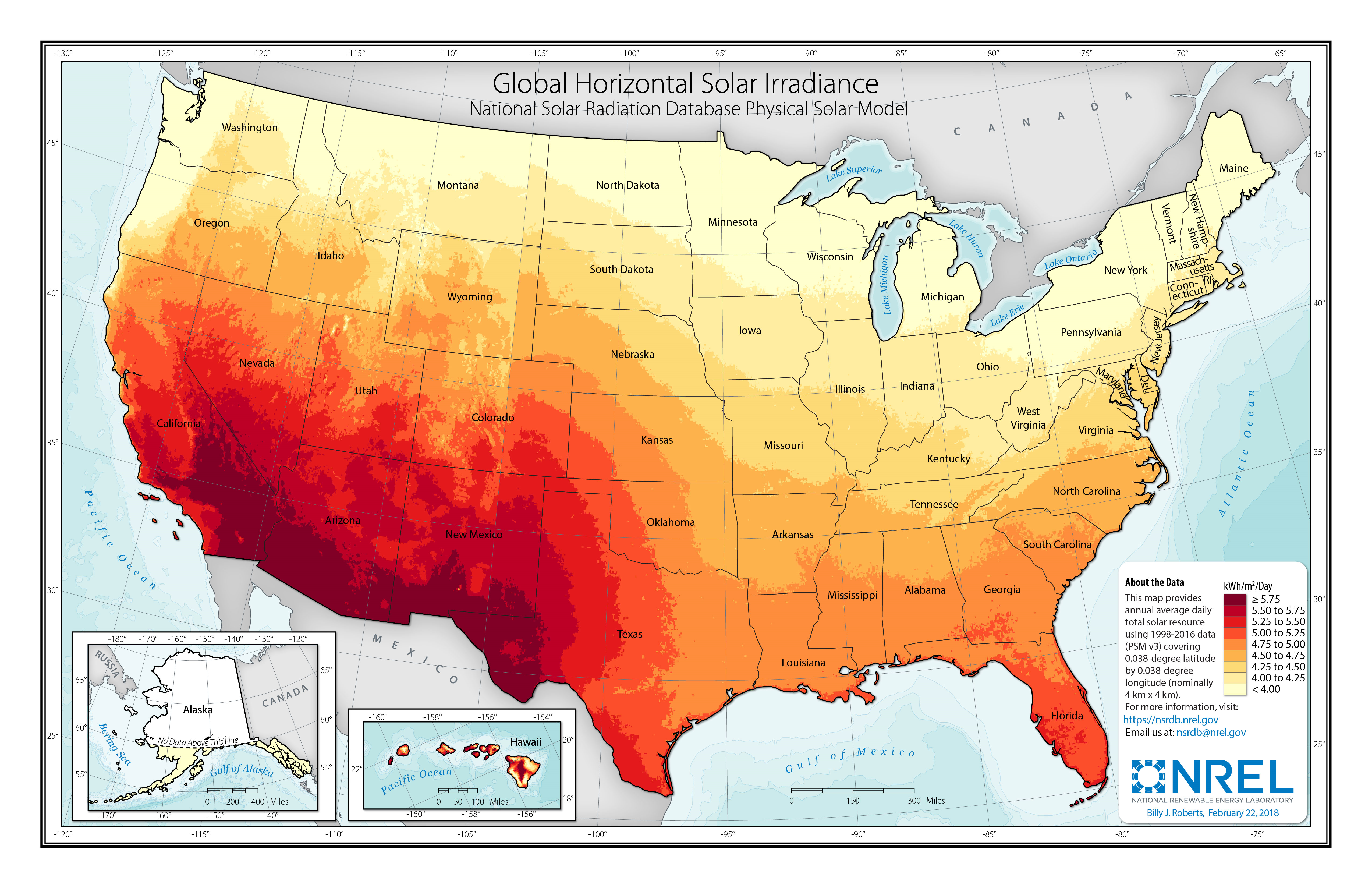
A quick google image search shows a very hot Arizona.
As someone who enjoys following a lot of youtube self-builders around the world I get the impression that most channels I follow have to thread their way through some pretty convoluted and not-self-build nor budget-friendly rules :(
Do you know of any other places in the US that have similar easy-to-self-build but are more wooded and temperate?
What were you a fan of instead?
I do know that there are water condensation machines that could be fed with solar power, but at that point will likely be too expensive for a single family.
I'm always intrigued by this notion, I know plenty of Americans have this kind of plan, but it's never quite as remote as they think, because, y'know you're still in America somewhere.
Unless you're thinking of somewhere in northern Canada.
I'd love to know where is considered 'far from civilization' on the continental US.
Not to mention Slab City: https://en.wikipedia.org/wiki/Slab_City,_California
Infrastructure-wise, roads come before water or electricity, and so plenty of the United States has a road but no power or water. This can even be standard for those who are near civilization.
And like I say, if you want peace and quiet you don't have to put your life at risk by going out of range of water, power, roads, phone coverage etc.
Ignore me, I'm sure I just don't get it.
There are many interpretations and levels of remoteness.
In my case, I want to be away from the sights and sounds and crowds of anything that would be considered urban or suburban. My prime criteria is that I don't want to see another person unless I choose to. I don't want to see a road with cars on it, I don't want to see another house or any other man-made structure that isn't mine. Ideally I don't want to hear anyone else either, but I accept that I may hear things in the distance.
I don't want to be a complete hermit, and I'm not a survivalist looking to be 100% self-sufficient. I want a small-to-midsized town about 30-60 minutes away. Something with a grocery store, gas station, and a post office or other place to receive deliveries. I don't want to be more than an hour away from doctors' offices or a hospital or urgent care. I don't want to be trapped by snow for weeks at a time.
Saying "far from civilization" was a stretch. What I really mean is I don't want to have people all around me. And I don't want to be anywhere near cities and suburban sprawl. I don't want neighbors in any meaningful sense.
Places I'm considering are Maine, Montana, northern Wisconsin, Upper Peninsula Michigan. I would absolutely consider parts of Canada, particularly northern BC. I don't have an easy path to Canadian citizenship, though. Before my Canadian girlfriend passed away last year, we had been planning to look for a secluded lakeside cabin or undeveloped land in BC.
My requirements are dense forest (desert/plains states are right out) and water (lake or canoeable river) on the property itself. I can live with other people using the water, so long as it's not motorboats and a party scene.
Canada is vast and in some places very rugged. "Remote" and "northern" are not related terms. Just look at BC on google maps. Look at the bit of vancouver island that is south of the US border. That is some very remote terrain, but is no way northern. Then scan up into the BC coast. Just a few hundred miles from downtown Vancouver and not a single road to be found. Or start at Whistler and pan west. Hundred of miles of mountains with nothing more than the occasional logging road.
Anywhere not colored
For someone it could be defined as minimal human interaction, for others it could be a function of distance from the nearest urban/ suburban center. For most, it would be some combination of these two.
I've backpacked to some very remote places around the world, but it's hard to beat the USA (western half), Canada, Russia (east of Moscow) and Australia (anywhere not on the coast).
I’d like more land still - I grew up on 60 acres - but I still basically have complete privacy.
Go to Wyoming or Montana. You get a 2 or 3 hr drive outside major cities and you might be the only person around for 10+ miles.
https://www.bbc.com/news/world-us-canada-42104894
With more than 14,000 of them, it's not possible to be more than 115 or so miles from one:
(I'm speaking about large class A RVs like an apartment with washer/dryer etc...)
But as solar becomes more prevalent, I don't see why they don't design RVs more around solar.
It has only been recently that I've seen "all electric" type RVs. Before that, most RVs were hybrid propane/electric or diesel/electric, for example gas stoves, dual propane/electric refrigerators, dual propane/diesel + electric heating and propane or diesel generators.
A future RV could have huge batteries for driving, and then use those batteries for appliances, air conditioning/heat pump and other on-board power. Then add increased solar by not only rooftop solar, but maybe fold-out solar awnings. (it could also charge via EV chargers, or 220 at a campsite)
An RV like this would be modern, comfortable and let you go anywhere.
Part of the reason solar is still a fringe thing for RVs is due to the costs up till now. Another big reason has been solar panel energy density; there simply wasn't enough room on the roof for the thousands of watts you need to generate for true full-time off-grid living with all the creature comforts (most notably air conditioning). Affordable, compact DC-powered refrigerators are still new (but are becoming standard items). Battery cost used to be prohibitive, and battery weight is still a problem. The 1200Ah I'm targeting (at minimum) is going to weigh a few hundred pounds.
If you want a residential-sized fridge, washer/dryer, and air conditioning that you can use 24/7, you need more like 3200W of solar and 2400Ah of battery. The larger the RV, the more expensive it is to cool. RVs have crap insulation, and most RVs are used in hotter southern areas. True self-sufficient electric and solar with no behavioral/comfort sacrifice still requires a lot of space and costs a lot.
The market is headed toward more solar, but the kind of setup you're talking about (and that I'm building for myself) is still quite expensive. And it's a huge cost for people that don't typically need it; the vast majority of people full-timing in RVs are content to do so at a sardine-packed RV park with full hookups. The market isn't going to bear the cost of massive solar installations as standard equipment.
Keep in mind - the dollar is down ~10-15% in that time frame, so in real terms, the previous cost might have been >$6600 in today's dollars vs ~$4000 or a >40% reduction.
The cost of electricity is up ~5.5% compared to last year: https://www.bls.gov/regions/midwest/data/averageenergyprices...
I wanted 2.5 days of power, not including AC, as I'd run the Jenny when needing AC
Solar is (was) coming at a future date with something in the 1200 watt range.
What I found was that we were boondocking roughly 8 nights a year, needing about 2 hours of generator each day to top off the batteries. (FWIW, there's a LOT of power to a gallon of gas) I can charge at home before we leave, exercising the generator is good, because I can rely on it when I need it (where if we right or over-size the solar, you might go a very long time before really needing the generator.
So, I'd like solar (it's quiet), but the $2500 or so to install it probably doesn't have a reasonable ROI. And I really like having AC the few days it's needed away from shorepower.
It's wild, I was able to power an AC brushless motor as well as a corded (technically?) drill. I could have run the drill for an hour at full power.
All around it just improves so fast I'm starting to feel like I do about computers -- the longer I continue to be satisfied with my current setup, the better the next one will be!
i do have one quibble, though, and it's a big one. in the last two years, prices on mainstream solar panels (monocrystalline with warranty) have fallen from €0.25 per peak watt to €0.12 per peak watt; low-cost panels have fallen from €0.17 per peak watt to €0.07 per peak watt.† technically that is 'fallen by 25% or more' because it's fallen by almost 60%. 2400 watts of solar should cost you 290 us dollars plus retail markup, not 1200 dollars. if you're paying 1200 dollars, you're being swindled! https://news.ycombinator.com/item?id=41394506 goes into details on how the swindle works
______
† https://www.solarserver.de/photovoltaik-preis-pv-modul-preis...
Like all things, the raw material cost is trivial. There are the tariffs you mention (I just skimmed your link, and don't speak German), but there's also economy of scale, packaging, logistics, etc. I'm sure I could get 400W panels for as little as $100/ea if I went to the factory myself and bought hundreds of them. Maybe even cheaper. It's not really fair to compare consumer one-off costs to industrial/commercial-scale installation costs.
I had planned to start by putting 4x200W panels on the roof, until I get a large 5th wheel. Now I'm going to put 4-6x 400W on the current trailer for next summer. The price and size of 400W panels dropped enough to make that viable.
I'm generally too lazy to do a writeup/photos of my projects, but I might when I get it installed. There are a lot of writeups out there already though. People are squeezing lots of solar onto vams and small RVs these days.
A lot of people like Will Prowse on YouTube[1]. I've watched a few of his battery test videos and it's influenced what I'll end up buying. I haven't watched any of his solar videos.
I've been lurking in r/SolarDIY[2] as well.
I'm buying a bunch of Victron[3] gear. They have forums, HOWTOs, some videos, plus the various product sheets. They have some circuit diagrams too.
The rest is Google and reading blog posts, DIY articles, price comparisons, etc. There are books, but I haven't read any.
I've got basic electronics chops and tinker with things a bit. I'm by no means an expert.
[1]: https://www.youtube.com/@WillProwse [2]: https://www.reddit.com/r/SolarDIY/ [3]: https://www.victronenergy.com/
I don't mean to straw-man your argument, I was merely thinking that the 'actual' drop must be bigger, considering the inflation in most countries (in some EU countries it approached or hit 10%), so under normal circumstances and/or in the future the drop would/will be at 30%-35% if the same rate continues (prices getting lower - inflation getting lower)
The pallet price of solar panels in the US is below 30 cents a watt.
https://a1solarstore.com/wholesale-solar-panels.html
And from alibaba, it is below 15 cents a watt.
https://www.alibaba.com/product-detail/Longi-solar-Hi-MO-X6-...
With full systems below $1/watt. https://www.alibaba.com/product-detail/Moregosolar-hybrid-so...
So I am a bit skeptical. I also remember around 1975 getting all excited about solar and getting told that costs were dropping so fast that in five years solar would be cheaper than power produced from coal or natural gas. Close to fifty years later I am still waiting.
I bet if you're in San Diego, Dallas or Tampa its already there. We have tons of solar getting built in the state of Michigan area but if you inquire its all either government subsidized or wealthy folks who can afford to not care about the economics.
I am not against solar in the least. But it needs to be pointed out that those of us in the Northern climates need a Plan B whether it be nuclear, geo-thermal or something else.
Batteries continue to get cheaper (also covered). This matters too because storing energy solves the base load "problem". Batteries aren't the only way to store energy either. There continue to be advances in the so-called "power-to-gas" technology, where you essentially use excess power to make fuel, usually from CO2 in the air. This isn't currently economic but it continues to get cheaper. It also provides an upper ceiling on how expensive gas can get.
The LCOE of nuclear in particular is damning [1]. Every single commercial nuclear power reactor has been built with government subsidies too so it doesn't seem like government support is the issue. There are still too many unsolved problems.
Solar is the only method of direct power generation. I think every other method inovles turning a steam turbine. There are no moving parts. They can be installed on everything from wristwatches to power stations to satellites.
[1]: https://www.eia.gov/outlooks/aeo/pdf/electricity_generation....
A few years ago I looked at putting solar panels on my roof.
Both the company who roofed my house, and my insurance company - said it voided any warranty / claims against future roof damage if a solar panel was installed
Installing a solar panel on a roof is not exactly expensive, complex, or difficult. Virtually every house in my neighborhood has them.
It might comparatively more efficient/cheaper per watt to build solar on the ground or on large commercial structures, but that doesn't change the economics for individual home owners, which in many parts of the world are already positive.
I want labor to be paid, and I also want cheap clean energy. Help me square the circle.
This National Renewable Energy Laboratory page has a cost comparison of utility scale solar farms with rooftop systems:
https://www.nrel.gov/solar/market-research-analysis/solar-in...
If you look at the orange portion of the bar for each year (installation labor), you'll see that labor gets paid about 50% more for utility scale farms than for rooftop systems. As of 2023 it's about $0.24 per watt on utility scale systems, $0.18 per watt on rooftops. But the complete rooftop system is much more expensive ($2.70 per watt vs. $1.20 for a large solar farm). The solar farm with one axis tracking will also produce more energy per installed watt over the course of a year. As a result, the cost per kilowatt hour generated from a rooftop solar array is multiples higher than from a utility scale solar farm in the same climate.
The big idea most people fail to grok is that we don't need energy at all, we need certain things energy provides us (light, heating, cooking, entertainment etc). But if I could super insulate my house and use 0 energy to keep it warm, this would not make me poorer. On the contrary.
Amory Lovins came up with the idea of "negawatts" a long time ago.
While there are good (as well as bad) reasons for this, the upshot is that the RoI for residential installations changed abruptly and became significantly worse - more or less overnight.
Due to that, and the low cost of the panels themselves, whether they become cheaper isn't very relevant for the market here (since other costs dominate).
Where?
But that generated electricity is likely to be a region very far from your (or someone else's) consumption - needing a lot of money to lay transmission and distribution lines to the end consumer.
Co-locating with consumption makes the difference in total costs far closer.
Very location dependent, but please don't dismiss offhand without considering the very real transmission costs.
As a comp, SunRun puts out detailed cost estimates for their residential systems each quarter[1]. Their average system cost was $5/watt, but with 50% of their installs having batteries. So for an 8Kw system (if you were buying outright) you should have gotten a quote of $40k with a "half-sized" battery. After US tax incentives, your cost should be <$30k including battery.
But yeah, if you're not in a region where they do a lot of installs, you won't get that price...
[1] "CreationCostMemo" tab in https://d1io3yog0oux5.cloudfront.net/_eb9fb58f3a5f81478f0536...
Solar is much cheaper to produce, but there are many challenges to get a reliable grid. Big centralized power plant that have huge turbines with kinetic energy are much easier and cheaper to handle on the grid than a distributed intermittent production where you somehow need to convert to 60Hz and add storage that has quite some loss.
[1] https://www.euractiv.com/section/energy/interview/german-ele...
It is easier to size the network when the current flows basically in one single direction from power plant to users. When the production is decentralised, you need more transmission lines. You also get more losses in the transmission if you go through more substations. Big turbines helps to keep a stable frequency on the network despite unpredictable consumption changes. With renewables one need to adjust the frequency. One also need to keep the power factor in track. All of this means extra costly hardware on the grid and extra loss.
"Good morning, I would like a 400W solar panel"
"Sir, that will be $4"
> Is there a floor for these costs?
> > Solar manufacturers are investing hundreds of billions in expanded capacity in an all out war for market share against a background of panel price drops of 15-25% per year. There is an extreme economic forcing function towards rapid improvement and ultimately convergence with the Platonically ideal solar panel - some 20 um thick layer of silicon supported by a 100 um thick layer of plastic rolled off a spool - or some other tech that's thinner and cheaper than paper.—Casey Handmer
> Thinner and cheaper than paper. Think about that!
i suspect that at some point people are going to be mounting bare (passivated) silicon dies on string and putting up chicken wire over them to keep the hailstones off, or something like that. think about how plants support their leaves
89x44" for $221.40: https://www.portable-sun.com/products/canadian-solar-540w-bi...
96x48" for $544.00: https://1stwindows.com/retro/milgard2/trinsic/picture-window...
Those were the first that came up in search. I'm seeing other 500 W panels for $100-150 and windows for $1000-2000. But we can safely say that panels are less than half the cost of windows.
The increase in solar panel cost was from Trump's 30% solar tariff in 2018:
https://www.seia.org/research-resources/section-201-solar-ta...
The saddest thing about all of this for me is that we had the tech to manufacture inexpensive solar panels at scale in the 1980s. Just like any of us could design better computer vision sorters for recycling. We're stopped for protectionist geopolitical reasons so that people in entrenched industries don't lose their jobs.
I wish we could be honest about this, because it's what the next US presidential election is about. We can pretend that we live in a free market economy of winners and losers, or we can work together at a meta level above the zero-sum game Nash equilibrium that's leading us inexorably towards species extinction and global climate change:
https://medium.com/nori-carbon-removal/how-to-break-the-clim...
Yes, somebody years ago published a study that said, Uneconomical! because lift costs, panel cost, transmission inefficiencies.
All of those are now drastically changed, by orders of magnitude. It is not a matter of IF orbital solar is economical, but WHEN.
No need to look for doom scenarios here. Interest rates fluctuate. They will be back to some lower point than today but certainly higher than in 2020. LCOE will drop off.
There's no need for solar costs to go down at all anymore. Transition will happen even if they get stuck forever, solar is cheap enough, now it's just about speed at which factories can be deployed, installers trained, etc.
And I don’t mean lithium batteries. More things like molten salt and sand batteries - things that require a bit of planning and infra that is reliant on rare metals etc
Furthermore, for every 1 pound of polysilicon produced...you get 4 pounds of silicon tetrachloride output.
I gambled on $UAN and $AMR guesstimating that the spread of renewables would lead to more nat gas and coal/steel consumption per a kilowatt hour produced globally. I got lucky and it worked out. I'm not bullish on solar costs going below the embodied energy cost of desal per 1000 gallons. (10-14kwh/1000 gallons)
SiCl4 can (and should) be completely recycled in the process that makes silicon, to make more SiHCl3. There is no reason to treat it as waste in a cost optimized system.
If energy was 10 times cheaper than currently and still available (no shortage) then we would automate more tasks and increase the global productivity. We could mine more, build more, to train/run more LLMs.
GDP is tied to energy price and availability. It is likely the main reason why US enjoyed a growing economy thanks to its free oil reserves (and the reason why Texas alone is the 8th economy in the world). Now one could argue that after pumping oil for a century now, it might not be as cheap or plentiful to extract in the future, and we better be prepared for it.
It is all about energy. No energy, and we will reduce to human/manual or animal (bring back the horses!) labor. Productivity will decrease significantly.
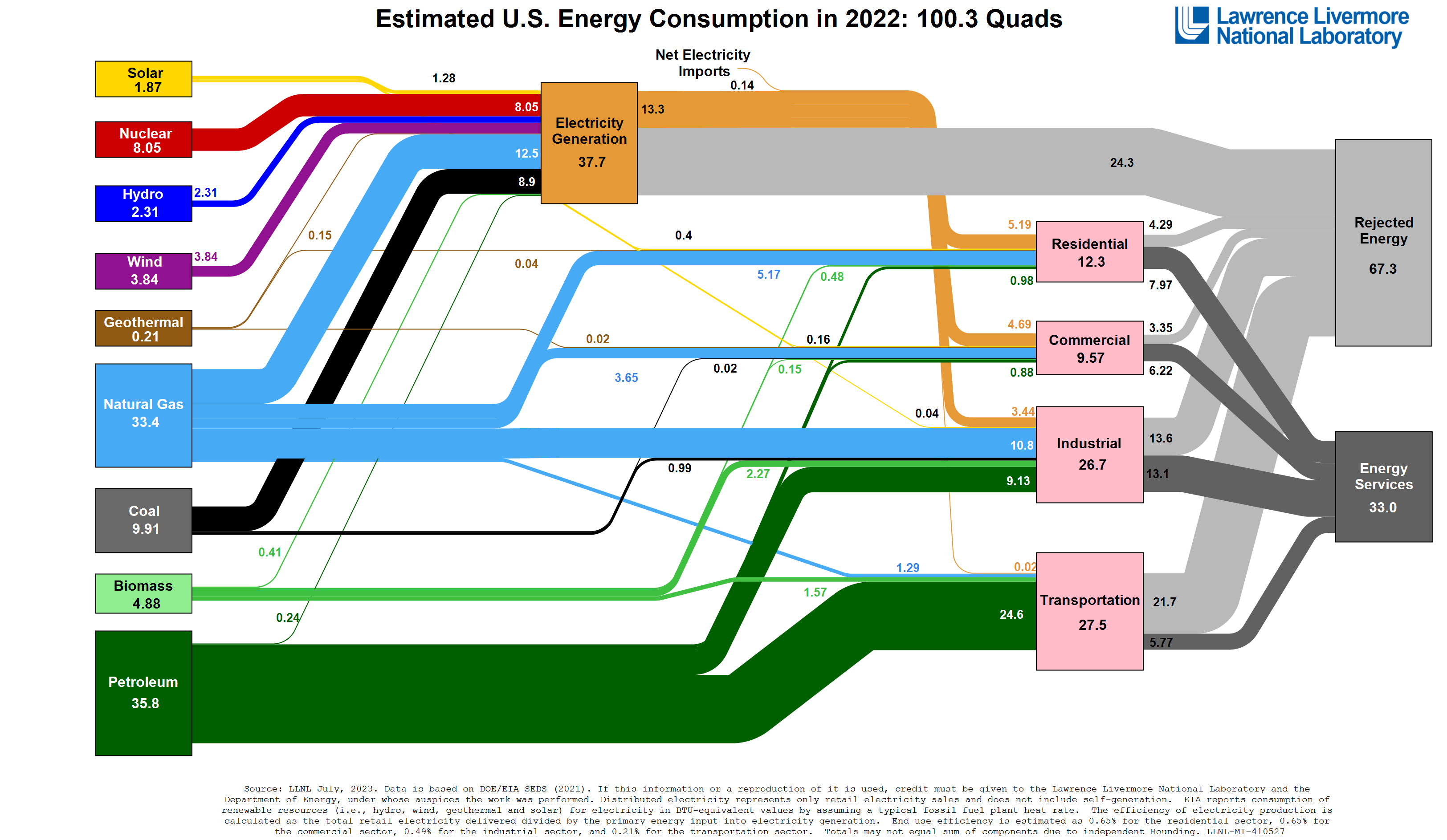
One issue I have with the paper, is that it equates energy and electricity. My favorite chart about US energy: https://flowcharts.llnl.gov/sites/flowcharts/files/2023-10/U...
shows that in 2022, electricity was just 13.3 Quads of the 76.07 Quads of the energy consumed in US by residential, commercial, industrial and transportation. So unless US "electrify" the whole economy having more electricity would only help a small part of the economy.
Sure.
> To increase productivity, we need more machines,
That is just one way to increase productivity. You can also make more efficient machines, come up with more efficient production processes, find alternatives to existing products that are more useful for a given task per quantity, and similar kinds of concepts. This is the point GP was making (there are more ways production changes than increasing energy used), not that energy is completely unrelated to production as a whole.
A graph of major economies percentage of electricity in final energy:
https://preview.redd.it/china-is-electrifying-far-faster-tha...
Many physical things take pretty fixed amounts of energy. Eg heating a liter of water.
for other economic activities, such as solar panel production, aluminum production, and neural network training, energy is a limiting input. reducing the cost of energy will result in more gdp in those sectors
Why? They are correlated and so are reasonable metric to gauge progress when starting from a subsistence economy (as all economies in the world began). At some point, this may be less true when you hit a energy generation ceiling and you start 'optimizing' and trying to do more with the same amount .. but again, we're not there yet so it's a good metric today, and especially for developing economies.
Put another way, you show me GDP per capita or per capita Energy use and I can get a reasonable ballpark for the other as well as a measure for the wealth of that nation.
The author asserts that we should see 5x GDP/c if we had 5x power usage per person and their own graph shows that that's not the case because it's a flawed assumption that ignores increases in efficiency and transitions away from energy intensive manufacturing to service based.
The best evidence for that is that the GDP/c didn't fall off when we fell off the HA curve. In fact I took the GDP per capita and Energy consumption per capita data from world data bank and the ratio between the per capita GDP vs the per capita energy consumption has been going up steadily since we stopped following the HA curve.
Between 1960 and 1970 the ratio between GDP and Energy Consumption per capita was essentially static at .74 then after 1970 the ratio begins to increase showing we're producing more per unit of consumed energy at a nearly linear rate. By 2014 which is the last year they had the Electric power per capita data the ratio was all the way up to 4.2. Eyeballing it the relationship is almost perfectly linear each year we get a little better at producing GDP for each kWh we consume.
I even redid the calculation based on raw energy use in kg oil equivalents and it gets even more drastic. 1960 to 1970 it goes from .53 to .69 GDP/kg oil equivalent [0]. Then after 1970 the rate increases quite distinctly going from .69 to 1.58 in 1980, 3.11 in 1990, 4.5 in 2000, and 6.79 in 2010.
It's pretty clear from the data that we're getting better at producing things with the same amount of energy. It's an assumption that simply making more power would increase the amount of things made.
Electricity use per capita: https://data.worldbank.org/indicator/EG.USE.ELEC.KH.PC?locat...
Energy use per capita in Kg oil equivalents: https://data.worldbank.org/indicator/EG.USE.PCAP.KG.OE?locat...
GDP per capita in current USD: https://data.worldbank.org/indicator/NY.GDP.PCAP.CD?location...
[0] nice.
YUP. Of course there is a strong correlation between energy use and GDP growth; it takes more energy to produce more stuff.
But ultimately, what produces more stuff is harder to measure. To light the factories, more energy used to correlate with more light, until we swap out the incandescent/halogen lighting sources for LEDs. Then, we get more light for something like 16% of the energy usage. Or, getting to the stage of "lights-out" automation, and the same production for zero lighting energy. Same for more efficient motors, swapping ovens for inductive heating, more efficient processes, etc.
Seems that measuring GPD growth by energy consumption is like Bill Gates' famous example of saying that "measuring software progress by lines of code is like measuring progress in aircraft by the weight of the planes". Obviously, in specific cases, all things being equal, more is more, but in reality, fewer LOC and lighter airplanes generally produce more results.
Energy consumption is also about using that stuff. And in rich countries like the USA, a lot of energy goes to using things or just moving people. So it's possible to build more and use less energy, even if you don't reduce the energy cost of building things. They can simply become more efficient to use and move.
In USA, 30% is just homes and commercial sector. 40% is transportation. 30% is "industry". By a sort-of inverse-amdahl's law, it's possible to get lower energy use with more throughput even if we don't make "industry" more efficient.
> Yet the amount of electricity we consume for light globally is roughly the same today as it was in 2010. That’s partly because of population and economic growth in the developing world. But another big reason is there on the Las Vegas Strip: Instead of merely replacing our existing bulbs with LED alternatives, we have come up with ever more extravagant uses for these ever-cheaper lights
NYT: The Paradox Holding Back the Clean Energy Revolution
this is nonsense. lighting hasn't been a significant fraction of the energy usage of factories since they switched from being lighted by fireplaces to gaslighting. not in 02024, not in 01974, not in 01924, not in 01874
> Seems that measuring [gdp] growth by energy consumption is like Bill Gates' famous example
it's true that higher efficiency is better, of course, but your comment embeds the false assumption that higher energy efficiency reduces energy use. in fact, higher energy efficiency usually increases energy use, because it increases the scope of things to which marketed energy can be economically applied more than it reduces the use of marketed energy for things it was already being used for. (this is the well-known jevons paradox mentioned in https://news.ycombinator.com/item?id=41392248). so, even today, it turns out that the countries with the lowest gdp and lowest energy use also have the lowest energy efficiency
similarly, using high-level languages reduces the number of lines of code to implement some given functionality; but you would be completely mistaken if you used that fact to predict that the vast majority of programmers spend their time writing assembly language instead of python because python requires one twentieth of the code to do whatever. many things are done with python not just because companies writing python outcompete companies writing assembly, but also because programs that would be unprofitable to write in assembly language become profitable to write when you can write them in high-level languages!
Oh the irony.
https://wimflyc.blogspot.com/2021/01/the-henry-adams-curve-c...
Henry Adams points out that over 60 years you got 3-4x more power from a ton of coal. That combined with the extra coal dug up, he claims, doubled usable energy every ten years.
But then the modern graph simply shows the coal energy, with (as far as I can tell) no attempt to account for the extra efficiency, even though the modern author of the graph makes explicit reference to the increasing efficiency of steam engines.
This is possibly why energy use has flattened while GDP clips along at its normal exponential curve - we're also more efficient.
I found the following comment about Smil:
"There is a way how to evaluate the quality of prophets, seers and visionaries. Find their 5,10,15 years old predictions. I own the Smil’s book: Energy Myths and Realities: Bringing Science to the Energy Policy Debate (2010). So have a look how good prophet he was 10 years in advance and focus on photovoltaics (I own Czech translation of the book, so I need to re-translate his text back to English, I hope I will not skew his ideas too much):
* To get 1 PWh/year of electricity you need to install about 450 GW worth of solar panels. You need dozens of years to acomplish such task. Reality check: 3 years in current speed, in the future probably faster.
* The cost of PV panels fell from 5 USD/W in 2000 to 4.5 USD/W in 2009. He don’t see much perspective of price plummeting as predicted f.e. by Al Gore (who cited the learning curve, Smil counted with 0.05 USD/W in 2020) or by PV industry (1.5 USD/W in 2020). Smil predicted that PV panels would be 25% cheaper in 2020 and 50% in 2030. Reality check: Current price of PV panels is ~0.2 W/USD. While Smil wrote the book manufacturers finally scaled their production of polysilicone and PV cells to cover the demand. Competition among them set the cost of PV panel on the freefall trajectory. PV panels cost less than he predicted for 2030 in 2011.
How credible are such visionaries?"
I will add that in 2023, 447 GW of PV was installed globally. So, we're at the point where Smil's "dozens of years" is being done each and every year.
We want things that are the same but less intense, or that are much better at a fractional increase in input.
And we really need it if we want a planet worth living on fifty years from now. So to ignore this desire is dangerous.
I did the rough math [0] and we get 10x as much GDP out of each kg oil equivalent used as we did in the 1970s when the article bemoans us falling off the HA curve. That was one of my core problems with their point, the amount of energy used is not directly tied to the economic value of the output.
Perhaps this comes down to a quality of life vs GDP per capita not being identical. While I could use more energy to consume more, I don't have a very strong desire to go much above my current level of consumption.
But outside of the wealthy there is still huge latent demand for energy and what comes with it.
I was wondering if there was any way to bring 10.000 Einsteins online. Einsteins who know all about physics, programming, math and so on, cranking up ideas days and night. If the Einsteins never sleep, that would be ideal.
Yes, this was a central simplifying fallacy in the article for me too.
Plenty of phenomena follow a logistic curve [1] — which starts out exponential but then flattens out when it reaches constraints or fills a niche or fully satisfies a need or something.
The initial exponential growth may have been a period where economic productivity was constrained in a major by energy availability. We still have some energy constraints, but they seem to be secondary — and in many areas energy requirements have fallen, as others have pointed out in this discussion. It's too complicated to simply flatten, but modern energy use does seem to broadly resemble a logistic curve.
---
so, with the advent of innovations that dramatically drop the cost of energy, we should expect to see energy use grow faster than gdp. that's decoupling but in the opposite direction from the decoupling you're talking about, which has been driven by the 01973–02023 energy crisis
Put another way, instead of producing the products we consume, we offshore production (and the associated energy consumption)
It's always a little hard to read logarithmic values other than those explicitly labelled but it looks like up to a 5-7x difference in energy consumption can have basically no effect on the GDP per capita!
If we would have more energy we would get much richer and not more poor like right now.
German electricity is expensive because gas is expensive in Germany. Electricity will be expensive in Germany until Germany completely stops using gas shipped in via container ship.
Perhaps author is nodding towards replacing fossil fuels with electricity.
Decarbonizing steel uses a lot more energy. Ditto cement, plastics, fertilizers, HVAC, etc.
Anyone care to guess how much more energy our glorious renewable energy future perfect economy will require? 4x? 6x?
Fossil fuels waste most of their energy as heat. Gasoline cars are ~30% efficient, EV's are ~90%.
And heat pumps are often 200-500% efficient, unlike fossil fuel furnaces which cap out around 95%.
Transportation and heating use far more fuel than industrial uses.
unless the humans die out as yet another sad single-planet species
A classic example here is cars. A typical Tesla would have about 65kwh of usable battery. A gallon of fuel represents about 31 kwh. So, a 1 to 1 replacement would mean that Tesla would have about 8x less range than it actually has compared to a car with e.g. a 15 gallon tank and. pretty decent mileage of 16 miles to the gallon. Reason: a Tesla manages about 4-5 miles per kwh which amounts to about 250-300 miles range. Let's low ball that to 250. Meaning, you can drive about 8 cars more per kwh of electricity than per kwh of ICE car. Switching all road traffic to electric would mean we actually save a lot of energy. Maybe not 8x but it's going to be substantially less than what we currently consume in fuel for road traffic.
People underestimate how quickly this is going. Most commercial fleets are switching sooner rather than later. They have to, the cost savings are to large to ignore. That's most of the traffic on roads and it's not going to take decades.
Heating and cooling with heat pumps is the similar. A good heat pump that is installed properly should deliver a COP of about 4. Meaning you get 4 units of heat (or cooling) for every kwh you put in. A gas heater has a COP of slightly below 1. 1 is it's theoretical maximum. So switching industrial and domestic heating/cooling over to heat pumps is going to deliver some pretty significant savings as well. Mostly industries have barely scratched the surface on this topic. Industrial heating is mostly still based on burning gas or other fossil fuels. That's because gas used to be cheap and electricity used to be expensive.
Now that that cost has flipped around, companies are slow to adapt. But eventually some companies will start figuring this out and once they do it might save them a lot of money and make them a lot more competitive. And all that is before you consider using cheap off peak electricity when wholesale energy prices occasionally go negative!
4x-5x overall more electricity usage sounds about right. I expect it to be more because as energy keeps on getting cheaper we'll keep on finding new uses for it as energy prices keep on dropping. Assuming everything stays the same is not a great way to make predictions about the future. Things rarely do. But it's not that unreasonable to assume a 5x increase to happen over the next few decades. But it will cost us a lot less than our current energy spending. If we keep on going at the pace we are currently going we'll get there easily. And there are good reasons to expect things to speed up actually.
Solar cost will keep on shrinking. Especially in the US there is a lot of potential for improvements. That's because cost is currently inflated due to a combination of import tariffs and asinine regulations that mean installation cost is insanely high compared to other countries. Some of that regulation is courtesy of fossil fuel companies lobbying for this. But both are fixable problems. And more importantly, both are non technical problems. Meaning that international competition between countries (and domestically between states) will force the issue ultimately.
They got the "fuck off" price because there's far more demand that supply at the moment. When businesses have more work than they can handle, they'll give customers quotes with absurd markups like that. It's enough money that it's worth the disruption if the customer actually wants it that bad, but they also don't really want the customer.
I don't think I really believe your quote of 40k. Does that even break even on energy bill savings?
Or if you're at all handy and willing to educate yourself, you can DIY it for a fraction of the cost. That's obviously not for everyone, but you don't need any professional skills. You could hire an electrician if you want to be grid-tied.
I should be able to supply a data point of the cost of panels today without getting admonished as being off-topic, rtfm.
There are unfortunate side effects to this, even besides the attacks on net metering that have cut financial returns for existing solar customers. Distributed generation is more resilient. With a battery, you can keep your electricity during a power outage. Outages themselves are more isolated - with a VPP individual neighborhoods could keep power, while if a transmission line to a major solar farm goes down, a whole city could lose power. Large solar farms would be huge targets for warfare or sabotage, and wouldn't last very long at all. Transmission lines to them are vulnerable to natural disasters. Economically, large utilities have more market power and can capture their regulators, leading to higher prices and poor service for consumers.
But the economic benefits of scale make it harder to justify putting panels on each individual home, when the same generation capacity can be built much cheaper at a solar farm.
The "attacks on net metering" are merely acknowledging that the proportion of renewables on the grid is high enough that balancing grid supply and demand is becoming an issue. I'm a big proponent of rooftop solar, but the reality is that 1:1 net metering just doesn't make sense once there's a critical mass of solar installed (the duck curve problem). This is not a problem unique to California or the US. If you look at other places with high solar adoption (Australia, EU), you'll find even stricter policies like negative feed-in tariffs: the utility will charge you for exporting solar to the grid.
Battery storage is a solution to that problem, but that's where prices are still too high. I'm actually surprised that battery storage is not mentioned in the article, because that's a critical component of allowing solar/wind to grow further.
The other major problem is the grid is not setup at all for consumers to also be generators. At least in the UK it is rare/not possible for the DNO to send power back from a neighbourhood to the grid (at least not without a total remodel of the local grid infrastructure).
So we are now hitting problems where solar is not allowed to be connected to the DNO if you have streets with a lot of solar on, because at some point the generation from the houses on the areas local transmission outstrips the demand in summer, and in that case you have too much power and nowhere for it to go (the excess cannot be sent back to the high voltage grid). The DNO cannot turn off individual solar generators easily (and even if they could, do they trust a load of chinese inverters to work reliably remotely?)
I think the key problem with solar/renewables is not undersupply in winter in northern climates (though that is a big one for true net zero) it is oversupply in the summer. It's already causing massive issues in Europe with long spells of negative pricing. Interconnectors don't really help with this because when it is sunny (and potentially windy) in one place in Europe it tends to be similar elsewhere, so everyone has too much power.
This is before the UK adds another huge amount of solar and wind in pipeline by 2030.
Note this comment only applies to northern climates. It's far less of an issue further south because AC load tends to follow solar production much more, but that is far less common in the UK.
Also, here the northern latitude helps, in Germany people start putting solar panels on walls and fences. There is plenty of cheap space and the efficiency isn't too bad considering the cheap panel costs.
Doesn't matter if it doesn't bring down the cost of electricity. For example in california PG&E will still charge a substantial "delivery fee".
Thankfully, the impetus for residential roof solar was always more ideological than practical. There's plenty, PLENTY, of empty unused land within a 95% transmission efficiency (hundreds or even thousands of kilometers depending on tech) of the end user, for all non-island cases.
Utility-scale solar installations also make a lot of sense, but around here transmission capacity for that is still a massive issue. You can install more transmission capacity, but it's not cheap.
As soon as we had it, and I looked at the tiering, time-of-use, etc, and I realized it's all an arbitrage game. I'm selling my roof space and fixed asset back to the power company, and buying power from them.
https://www.youtube.com/watch?v=5AVO1IyfA9M
edit: I see others have linked similar videos, all good sources on this topic.
But they already exist and are pretty popular in Germany to put on your balcony.
But if you put the panels basically anywhere else it becomes a lot more viable. Some houses come with a plug to connect your generator, you can do something similar to plug in your inverter. Then you can later decide to put up a solar fence or put solar panels on the balcony or whatever strikes your fancy
https://electrek.co/2022/12/12/texas-solar-farm-flat-on-the-...
I think the efficiency figures are exaggerated, but the fact remains that such an installation requires less labour.
The aluminium frame was 25%, labor 30% and putting up the scaffold 20%.
I hope thin film solar panels integrated in the actual roof material will become more common going forward as it removes the need for an aluminium frame, you get a new fresh roof, it's lighter, no holes are drilled in the roof etc.
But everything else around solar such as inverters, cables, framing, labor, battery storage is where a large part of the cost now. Innovations in those areas will probably yield better cost reductions than the panels will nowadays. That is just wild to see!
It seems australia removed a lot of roadblocks and solar is very popular.
Simply consider the case of China. They install and export more solar PV than anyone else in the world, and they are aggressively building out wind as well. It is literally impossible to get a better price than China when it comes to renewable energy, yet for some reason the Chinese have decided to dump tens of billions of dollars into nuclear energy.
My understanding is commercial solar (as opposed to household solar) is cheaper than natural gas so that prediction is at least partly true
the numbers you saw for solar in 01975 were wrong, based on at most five years of commercial solar panel production. now we have 50 years of commercial solar panel production to estimate the learning rate from, and consequently for the last five years or so solar is cheaper than power produced from coal or natural gas in most of the world. you should have stopped waiting five years ago
in northern climates your plan b is probably a combination of wind, batteries, thermal energy storage, and emergency generators burning emergency-priced liquid fuels — initially fossil fuels, later electrolysis-sourced
I'm curious about the land use analysis and the embodied energy. Given the capacity factor inherent in my climate, will solar panels ever pay off the energy used to make, ship, and install them? Similar question for batteries. And how much land do we need to cover to handle the P95 dark/calm weeks?
Anyway, interesting stuff. Solar continues to eat the world, slowly but surely. :)
There was a brief period in the US from the late 1960s through the early 1970s where it looked like new nuclear power plants were going to supply electricity cheaper than coal. A few commercial reactors had just been finished on a reasonable schedule and budget. Government cost projections showed that just-completed reactors were competitive with coal and that by the mid 1980s, with rising coal production costs, nuclear would have a clear edge.
Most people who care about the history of nuclear power know about the ballooning costs and schedule overruns for nuclear reactors after Three Mile Island, so that explains part of why this projection didn't pan out.
The other part is that real coal prices fell in the 1980s instead of rising. Increased surface mining of coal reversed the upward price trend for coal as a fuel. At the same time, the thermal efficiency of coal fired power plants kept improving beyond what was considered practical circa 1968. So new coal fired power plants were spending less per gigajoule of fuel and turning more of the fuel into electricity. New coal plants in America became so cost-effective in the 1980s that nuclear would have been hard pressed to compete even without the actual delays and cost overruns that nuclear foundered on. France dodged this environmentally dreadful rise of coal because they didn't have abundant domestic coal like the US, so they were committed to developing non-fossil electricity regardless of improvements in coal technology.
I wonder if those over-optimistic solar cost predictions you saw in 1975 also assumed ever-rising fuel costs. If solar companies expected coal power to keep getting more expensive, that would indirectly accelerate the adoption of solar power (lowering its costs) as well as directly easing the cost benchmark that solar power needed to meet.
Or maybe, like in many other cases, the people working on solar back then were just over-optimistic about improvements and had blind spots about the obstacles ahead.
Costs were ballooning even before TMI.
> The other part is that real coal prices fell in the 1980s instead of rising.
More importantly, 1979 saw the passage of PURPA, which began to open the power market to non-utility providers. There was enormous untapped potential for cogeneration (and, as it turned out, cogeneration-in-name-only) that produced a slug of new output, mostly gas fired, into the grids just after what had been inexorable 7%/year increase in electricity demand in the US suddenly moderated.
In this environment, it was very difficult to make the case for new nuclear power plants.
> I wonder if those over-optimistic solar cost predictions you saw in 1975
In what sense were they over-optimistic? PV has experienced a remarkably relentless cost decline along an experience curve of about 20% decline in cost with each doubling of cumulative production.
Nuclear has received significantly more subsidies than solar or wind (in both the US and EU) and is still not viable (mind you fossils have received by far the most subsidies) .
At this point solar+batteries is a cheaper option in almost all locations except perhaps places with low levels of sunlight combined with high demand, like maybe very high Northern latitudes.
I hope that can be worked out, as I think we'd be well-served by having as many eggs in our energy basket as possible.
Ultimately these regulations are driven by the large fraction of the public that is terrified of nuclear disaster. Unless that changes, costs may not go down significantly.
The problem is, once Chernobyl happened (which might have bankrupted a struggling USSR), every country became wary of nuclear as some hidden costs are now more apparent. The Fukushima disaster didn't help either: Even if you run your plant just fine, a strong earthquake can turn it into a nuclear bomb.
So we are back to basics, collecting photons from far away. Using quantity instead of sci-fi stuff. It's quite safe too, at least the panels themselves.
Please elaborate how? In my understanding electricity access is a problem in many poor countries but what makes the people poor is the lack of any ressources (food, tool, book, pills, land, shelter, money for proxy those…). Electricity may be on the list but it’s far from the first.
Works great for California, not so much for the Northern long dark cold winters.
Waiting for a (mass-)manufacturer to build one with a 48VDC input that anyone can self-install a solar panel and plug-in but switches to a mains-fed 48VDC source as required.
Doesn’t need a battery (the fridge/freezer is one!), gets you some operation during outages, no license required to wire up. Takes advantage of whatever solar is available during the daytime without really wasting any.
Would also love a non-permanently installed doohickey that doesn’t require an electrician to legally install that will gladly push solar into a power strip and handle all the intertie stuff itself.
It shouldn’t be a “whole house or nothing” and a “completely islanded circuit or nothing” dilemma when wanting to partly solarize something. Which I guess Germany has allowed but regulations a big impediment in most places.
One of the problems for residential roof-mounted systems is the wind load that large flat panels introduce. This load needs to be offset with very strong roof penetrations. You need to drive large bolts directly into the trusses of the roof which requires a bit of expertise, and has risks if you knick the edge of a piece of structural timber.
Contrast this with the round tubes used by solar thermal that don't introduce large wind loads, and nearly any DIYer can drill holes in their roof to support them.
Similarly, most solar installations on steeper roofs here in Germany are either made without penetrations at all (by hooking special frames into the roof structure under the roof tiles), or they use very basic screws that tie into the existing roof structure. Our neighbor did his solar installation himself on a pretty steep roof, something you would absolutely not do if there were any risk of structural damage.
Or countries could be heterogenous and care about climate change, energy independence and jobs.
Realpolitick, the political economy, remains important. The sausage factory. Tariffs are the hush money to secure the ongoing support for Bidenomics.
It's super important that every player has its own domestic production. Even if USA's (or EU's) total global market share < 5%, it's worthwhile. De-risk supply chains, national security, upkeep of domestic competency, etc.
Quid pro quo. China could liberalize their economy too. Allow foreign direct investment. Drop their own tarriffs. But they're not (yet?) willing to forfeit autonomy in exchange for "free trade".
--
I get what you're saying. I too agree that fighting climate crisis is our top priority. These slap fights are infuriating. But, for better or worse, you and I aren't in charge.
I bought a pallet just after the tariffs were announced and the price today is cheaper.
400W solar panel costs $200 and weighs 40 lbs. If Starship gets down to $100/lb, that is $4000 to put a panel in space. There are thin film panel that weight way less but cost more that would improve the launch cost but still be expensive. That means that will be cheaperp to have many panels on Earth and have enough left for storage.
Every number you mention is going in the right direction to favor orbital.
Don't imagine space-solar will look (or weigh) anything at all like a terrestrial model.
Solar input in orbit is higher than what is received at ground, but similar order of magnitude. I am not sure there are real world designs for beaming power 100km from space, but you are going to take some amount of loss in transforming the power to a transmissible form, beaming it through the atmosphere, and reassembling it on the ground. Unless you have a pin point death beam, the power is going to be transmitted to a relatively large area, requiring a large amount of land to receive it. Why not just build solar panels there?
Seems far easier to overbuild panels on the ground + batteries.
On a sunny day, it's only something like 30% brighter above the atmosphere IIRC. I guess you beat cloud cover (assuming you can deliver it to ground through the clouds efficienly), but I agree it doesn't seem worth it.
A base assumption is often that orbital solar requires a panel in space, but even that might not be the case.
Like right now my mind is trying to imagine a solar powered desiccator and water recollection device that could dehydrate all compost and bodily excretions.
I can get 200+ acres in Maine for the same price as 5 acres in NJ, and have much higher confidence that nothing is going to be built adjacent to me. Especially if I get land abutting conservation land.
There's also the case that rooftop solar preferably gets used locally and not fed in to the grid. So there you actually remove a lot of inefficiencies and costs because in the case of rooftop solar being consumed locally, there is nothing to transmit in the grid in either direction. So overall, my layman view of the situation is that the high grid costs are an overblown issue, especially because you would need to upgrade the grid anyway if everyone charged their car and electricity came from large plants only.
Electric "transformers" (aka machines) are more efficient in general than their fossil fuel counterparts (less heat).
Electrification (with matching electricity production) is a matter of national security. If/when fossil fuel would become either more scarce or more expensive (or both), all hell will break loose. There would be conflicts and chaos.
China is planning for long term, and putting resources in to it.
Unfortunately, the US democracy is not suitable for long term planning (while politicians can have very long terms, they are always busy planning for their re-election, not planning long term for the country). Who would have the fortitude to plan for a 10, 20, 50 years time horizon ?
US should plan for electrification (production + grid) and give a strong signal to the industry so the industry can plan ahead (e.g. GE,etc. can prepare production from gas stove to electric stoves, car manufacturers and dealers to electric vehicles, logistic companies to be ready to use electric trucks and trains, etc.), and no flip-flopping signals like we get now. The industry needs to feel confident that their investments would hold decades from now.
All this would takes years, and cost a lot. And the benefits would only be visible decades from now (no incentive for politicians). But at the time, any nation still dependent on fossil fuel, would be crushed.
Right, but it is an easy example to explain at the outset and why in the literal next sentence I mentioned: "Same for more efficient motors, swapping ovens for inductive heating, more efficient processes, etc."
>> embeds the false assumption that higher energy efficiency reduces energy use
NO. I am describing a COMPLETELY different effect. I am not talking about marketing anything, but the results of improved process efficiencies.
If Company X, or an entire industry, switch from large inefficient ovens to spot-heating, and still produce the same number of widgets for 10% of the energy, the energy used has entirely decoupled from economic output. Same GDP, lower energy consumption. Or, if the new widgets are cheaper and more get sold, then greater GDP and smaller energy consumption number.
The point is, regardless of all the knock-on and sometimes paradoxical effects, the previously strong 1:1 correlation of energy use to GDP starts to break when efficiency-enabling technologies gain widespread adoption.
There are also paradoxical questions such as what happens when Company X switches entirely from oil heat and electricity to on-site solar & batteries, producing the same number of widgets using the same total energy? The GDP seems to go down because oil is no longer being pumped, transported, refined, and transported again to Company X's factories, but the output is the same, so the same net goods flow into the economy. The entire enterprise of getting refined oil to Company X is now shown to be redundant to production. But also, the energy usage as measured at the grid went to zero.
Again, the point is, the not only is the relationship of energy-GDP unstable, the entire measurement of GDP is problematic.
Are any AI companies making money now? Losses can’t go on forever.
what about harvesting water from the air ? I've heard that modern techniques can work in 15% humidity ?
also, trucking in water once a year can augment the supply ? at 10c per gallon, it doesn't seem crazy... https://www.reddit.com/r/TinyHouses/comments/10qj5ey/no_well...
There is plenty of land with reliable water there.
Rainwater for irrigation, maybe. But the reality is, most of AZ gets monsoons a couple months a year, and then essentially zero precipitation. So unless you have land favorable for setting up a dam or something, you’re going to have a hard time living off that kind of setup.
Flagstaff and Phoenix/far south being a bit different.
Is it saying Smil said (is that meant to be countered with?) PV would cost 0.05 USD/W in 2020? Or was that meant to be Al Gore claiming that price? It seems it can't be his predicted reduction as he said 25% less, so did he want to say that is would be 3.38 USD/W in 2020 (75% of the 2009 price)?
And the current cost - 0.2W/USD is 5 USD a Watt - are the units reversed there? A quick google shows a variety of prices, with nothing being 20 cents a Watt [0] - $0.5-1.50 for the less efficient thin film types quoted here. All seem quite a bit cheaper than $4.5 a watt though.
[0] https://www.forbes.com/home-improvement/solar/cost-of-solar-...
His doomerism and degrowth perspective points to the early JP, writing articles mocking Obama for lack of progress with EVs points to the latter.
Either way he managed to convince Bill Gates to massively misinvest in climate solutions and while doing so loudly bad mouth all the actual solutions so that alone is a massive net negative for humanity (and, more parochially, for the USA, which is super ironic given his anti-communist stance--another weird JP parallel--as he's been super helpful to the Chinese by letting them solve all the problems he claimed were inpossible and dissuaded US companies from investing in).
There is a reason that the Kardashev scale is about energy utilization.
The reason why now we most enjoy some time off (weekend, vacation, retirement) is thank to the machines that can produce more with less humans. Now humans mostly drive the machines.
I guess the ultimate extreme evolution would be machine driving machines, so humans could be out of the loop, except for the initial input goal. And machine would extract/mine/recycle, transform, transport, deliver everything we ever need. It would be one big machine (with lots of energy) extracting (and hopefully recycling) earth elements to satisfy humans.
See also that machine in fiction, breaking down: E.M. Forster's "The Machine Stops" from 1909, available free at Project Gutenberg https://www.gutenberg.org/cache/epub/72890/pg72890-images.ht...
There are losses in practice, of course, to friction, air resistance, etc. but the laws of physics don't impose any lower bound on these.
In principle I can imagine that being true - but that's not represented in our world, so it is an open question if you can 'build more and use less energy' in the real world.
It's basically a piece wise function if you graph it. 1960 to 1970 the GPD/energy unit ratio is largely stable then after that it begins increasing monotonically going from .69 to 7.94.
USA GDP is still on basically the same exponential curve, yet energy is flat. That's the counter example. The rest is exposition.
I know some people here Germany that have picked up some panels at their local Aldi and are using them. Yields are pretty anemic but they aren't that expensive either. Kind of cool that Germany is encouraging this.
Certainly RBMK reactors are old and have some shortcomings, but a number of them is still running without incidents. Newer designs are significantly more safe by construction.
But the public, sadly, is beholden to legends and emotions, as it has been for millennia. Having an educated opinion is work, it takes time and effort, and a human only has a limited amount of both.
This is entirely false. No civilian nuclear power plant anywhere on earth has the level of fuel enrichment necessary to become a bomb.
If you have credible sources, please do share.
And there's more than enough desert that isn't sand dunes. Even the Sahara is only 25% dunes.
For example: https://eyouagro.com/blog/citrus-fruits-wind-protection-nett...
Reduces land costs because the land is already being used for crops of one sort or another. Agrivoltaics ftw.
it's going to be pretty hard to dethrone silicon after the amount of supply-chain and process optimization that's gone into lowering its costs, but in some sense things like what you're describing seem to make it inevitable at some point
Parking lots are tougher, but I saw the first one this year.
This is arguably a false economy.
~75% of costs for the power grid are not in volume electricity generation, but in maintenance. They haven't priced it that way in most places to encourage power-saving and reduce the need for new infrastructure construction, but they'll be forced to if every roof sprouts solar cells.
If volume electricity generation is the concern, doing it in a field is dramatically cheaper than doing it on a roof.
That said the growth in renewables will still take some years to make a big dent in coal in China so the nuclear power is welcome!
We've been effectively spoiled with this capability, and we need to be weaned off quite abruptly. Just because we've been spoiled and expect the grid to give us on-demand energy in the middle of the night, doesn't mean we have to continue doing so.
Remote is somewhere like Nullarbor, which is 183 miles from Ceduna (population < 6000). It's over 1000km to Adelaide (population 1.3m) or 1600km to Perth (population 1.9m).
My sister lived in Wingellina[1][2], Western Australia which was a 6 hour drive on unpaved, 4WD required track from Alice Springs. That's close to one of the most difficult, isolated places to get to in Australia, but even there isn't a week on Camels. Maybe going further west into the Great Sandy Desert might get close (although you get close to small townships in WA if you go too far).
The Empty Quarter has low population density but is smaller than isolated areas in Australia.
There are probably places in Siberia and Canada that are fairly isolated too.
I agree that there are more isolated islands. The Pitcairn Islands is the most obvious case.
[1] https://maps.app.goo.gl/Q2wL9KCa9aXht3YS9
[2] https://en.wikipedia.org/wiki/Wingellina,_Western_Australia
But a good example of remote is Nulato, Alaska.
Point is, yes USA is huge (let alone Australia) and skews our sense of distance, but 100 miles is not as trivial distance as we sometimes instinctively feel :-)
I can leave Denver and be DEEP into Wyoming in 2 hours, or it can take 90 minutes to go 60 miles in Rural Virginia (80mph speed limit vs 60 mph speed limit)
If your vehicle breaks down, how screwed are you?
Do you have cell coverage to call for help?
Will anyone be passing by to flag down, any time soon?
How far away is the nearest LEO agency, fire department, ambulance?
How far away is the nearest place for water, food, etc?
Some people just love not having people around, in which case you really want low average weekly population density within say 5-10km (out of easy visibility and hearing).
Some people are concerned about civilization collapse or civil war or... something (ie, the prepper type). In that case you can imagine population dispersing away from (and possibly towards) major population centers over a period of months, and you want true isolation.
I know you didn’t mean Low Earth Orbit agency, but the thought is funny.
If you’re not more than 1000+ km from the nearest satellite, you’re not in a remote area!
> aluminum production
Dropping energy costs an by 75% only drops smelting prices by about 30% and finished goods by even less.
to take one example, the last time we got access to a major new source of energy was something like watt's steam-engine in 01776. one of the effects of this was the widespread replacement of steel cans (which hadn't been invented in 01776) and glass bottles with aluminum cans in the 01970s, 200 years later. another was the replacement of travel by ship with travel by air, also about 200 years later. the delay is because many intermediating innovations were required, for example, in the aluminum-can case:
- the discovery of electrolysis;
- the discovery of aluminum;
- the discovery of canning;
- the hall–héroult process;
- improved aluminum alloys that permitted the use of 100μm-thick cans;
- the invention of deep drawing;
- epoxy liners that made aluminum cans chemically stable to acidic contents such as coca-cola;
- long-distance trucking which increased the cost imposed by heavier glass bottles.
I think you're right, but also that the majority of the problems with the worlds economies (in the richer nations) are because of similar generalizations, and as such I think it important to rebuke them.
Having more cheap energy available is good (all else being equal), but optimising for higher energy usage is absurd.
It's overseas owners are constantly playing hardball with the country over the price they pay. Feels like every year they threaten to shut the smelter down unless they get better electricity rates.
[0] https://en.m.wikipedia.org/wiki/Tiwai_Point_Aluminium_Smelte...
not just in our lifetimes; within a decade
as for embodied energy, the energy payback time on solar panels has been on the order of a few months to a year or two for decades now; see https://iea-pvps.org/snapshot-reports/snapshot-2024/ for a comprehensive overview, http://www.mdpi.com/1996-1073/9/8/622/htm for a detailed analysis from 02016, or https://www.nrel.gov/docs/fy05osti/37322.pdf for an easily digestible but outdated explanation from 02004. you're right that it depends on capacity factor! according to https://www.spglobal.com/marketintelligence/en/news-insights... the capacity factor across the border from you in kentucky is better than 25%, which is about as good as you can expect anywhere, but in much of your area only 10–15%, so you might need to multiply those payback times by as much as 2. https://atb.nrel.gov/img/electricity/2021/p19/v1/solar-annua... provides more detailed ghi (global horizontal irradiance) data for the usa which makes it look like it ought to be more like 20%. i'd be very interested in actual numbers by us state
batteries use an insignificant amount of land, but probably overprovisioning of solar production is cheaper than batteries until you get into those 95th percentiles you're talking about. so probably we're talking about something like 10× the land use for solar panels that would be needed to meet demand on average? it depends a lot on how much demand flexibility there is; will dunkelflaute electrical grid demand be 20% of average grid demand, 2%, or 0.2%? that's a question that depends on things like what new designs people come up with for aluminum smelters and haber-bosch fertilizer plants, which is impossible to anticipate ahead of time
once you're established you can collect rainwater. https://ca.water.usgs.gov/mojave/ says:
> Most areas of the basin floor receive 4 to 6 inches of precipitation per year, although annual precipitation can be greater than 40 inches in the southern and eastern San Bernardino and the San Gabriel Mountains (Lines, 1996). Recharge to the groundwater system from direct infiltration of precipitation is minimal.
in modern units "4 inches" is 100 millimeters, so that's about 3 nanometers per second
each person needs about 6 liters of water per day (burning man recommendation, including hygiene, dishwashing, etc., but not garden irrigation) or 70 microliters per second. 70 microliters divided by 3 nanometers is about 20 square meters, so even in the desert you don't need a large catchment to keep your cistern full. this isn't the atacama
if you want to be far from civilization in america, though, the atacama is pretty good for that. parts of patagonia might be better and do have rain
Personally I like the idea of a three-season thermal mass store, a big tank of water or pile of sand that you dump heat into when it's sunny, and extract it at will the rest of the day/week.
Not sure how much energy a garden can use, could you elaborate?
Look at a map and see what is furthest from a highway, but technically accessible by some sort of old road or trail. Look at a mineral rights map and find the most remote gold rush era mining claims.
You won’t see people often in these places because your standard 4x4 lacks the fuel range to get there- gasoline engines have very poor range at low speeds. You need something capable but also fuel efficient- usually something with a small diesel engine, which are not very available in the US market. More remote places also tend to have a lot of cumulative water damage to trails so are very technical- requiring a lot of patience (e.g. stacking rocks for hours) and a lot of driving skill.
And 115 miles? That’s a huge distance.
Not huge enough when you're considering how the McDonald's have driven out little hole-in-the-wall places and that the presence of such a fast food restaurant requires a busy highway, or a reasonably dense population center.
I did the math on the data elsewhere in this thread [0] and in an outcome that should surprise no one there's a transition around 1970 where the ratio between power used and gdp created per capita changes drastically, in 1970 we produced .69 units of GDP per unit of energy and in 2014 we were producing 7.94 using inflation adjusted dollars and oil kg equivalent per capita. We just moved into a different type of economy and there's no data in the graph or article to back up the assertion that falling off the HA curve and consuming ~5x less power per capita our GDP is somehow 5x smaller.
Of course this only tells us about the current state of things, but there are lots of things that would seem ludicrous today that would be feasible if we had a lot more cheap energy. Mass desalation, carbon drawdown, synthetic fuels, electric arc furnaces etc. will all needs loads of energy.
The signum is wrong. In the long term you want it to be one, not zero.
It will show up as decrease in exports because other countries (or societies or tribes or whatever you want to call them) will want less of what your country is selling.
Which then shows up as decreasing purchasing power for things that you do want from other countries (i.e. you getting poorer).
Luckily for the US, that does not seem to be the case given the resilience of the purchasing power of the USD.
Tragically, I got wonksniped by Pueyo's Henry Adams Curve shout out.
TIL He's referring the Roots of Progress thesis. The mythical "stagnation" phenomonen that some "rationalists" used to obsess over.
From the hip: the mistake is measuring national vs global per capita energy use. As many, many have noted, we delegated our energy consumption by moving our mfg overseas.
Mystery solved.
Further, notice similarity between Roots of Progress' graph and https://wtfhappenedin1971.com/
Spoiler: Neoliberalism happened. aka globalization, austerity, supply-side economics
--
FWIW: Omitting Pueyo's tangent about the Henry Adams Curve, I found this article to be a great overview of solar PV's current position on its cost-learning-curve.
And I agree the cost of solar PV will decrease for some time. Even faster than the most optimistic projections, which has been the norm for years.
Exciting times.
I look forward to Pueyo's article explaining why price of electricity continues to rise despite decreasing production costs. Transmission? Utility monopolies? Financing?
That's economics 201. The price of a commodity is the cost of the marginal producer. So it doesn't matter how cheap some producers are, the price of a commodity is set by the most expensive producer that is meeting demand. So price of electricity won't drop until cheap producers can meet 100% of demand.
Until that happens, cheap producers enjoy outsized profits, encouraging more cheap producers to join the market.
Those who can buy their energy in bulk and store it efficiently, or only consume when the price is lower than X, will pay a lower rate than those who cannot store energy, or who pay to have someone else store it (again, arbitrage)
The OP said "I also remember around 1975 getting all excited about solar and getting told that costs were dropping so fast that in five years solar would be cheaper than power produced from coal or natural gas."
That would mean PV cost parity with coal-generated electricity in the early 1980s. Actual PV cost declines have been remarkable but they didn't go that quickly.
One show I watched as a kid, Blue Peter, introduced Thrust SSC as a car that would go faster than the speed of light. (Or perhaps my memory of that is wrong, too…)
Efficency in the use of energy ti generate the same amount of lumens, because it would be REALLY fun to have a 100W led lamp in my bathroom mirror (my parents still have 2 of these traditional lights ).
I mean...energy conversion to lumen is fine but i think it's a little pedantic
Money is fungible and not unlimited. A dollar given to you by your neighbors in their taxes to subsidize you would have gone much, much further if the money would have been spent to build solar by your power utility.
Also, it can be politically and technically expedient to provide incentives, even if it is not the theoretically most efficient use of that money. For example if it increases acceptance for renewables in the broader population or jump starts an industry (as it has in Germany).
>Rooftop solar photovoltaic installations on residential buildings and nuclear power have the highest unsubsidized levelized costs of energy generation in the United States. If not for federal and state subsidies, rooftop solar PV would come with a price tag between 117 and 282 U.S. dollars per megawatt hour. …
https://www.statista.com/statistics/493797/estimated-leveliz...
It is understandable that anyone getting free money thinks it is good. But if the less well off people (renters, etc.) learn that they are paying more for power to subsidize wealthier residents (when that money could have gone a lot further if spent on other solar projects) - don't you think that might lower enthusiasm for government subsidizing the move away from fossil fuels? This sort of reverse Robin Hood policy hurts everyone in the long run.
When grid scale batteries drop in price, the substations can also store energy. Then the feeder lines only ever need to support the base load power draw.
Solar is so cheap, that even in off grid installations, the battery bank can be a fraction of what it previously would have been sized for. Modern batteries can be charged much faster and workloads can be shifted to the sunny part of the day.
Part of the idea to me is that, if you want to be a nuclear civilization, you need government scale investment in not just building plants but in improving the designs.
You need to stay in for decades, stay evolving, where-as France simply isn't big enough, doesn't have enough demand to keep at building again and again (to the scale that they would iterate on new significantly improved fuel cycles).
America's efforts like the Integral Fast Reactor, a fast reactor with on site pyro processing, seemed so promising. A safe & proliferation-safe way to not just reprocess but to keep burning tons of the transuranics (something France doesn't really do, afaik). But we gave up. The related PRISM designs have been kicking around for decades now, and I think one might even maybe get built, but generally the atmosphere around nuclear feels like it's building old/boring designs & not trying at all to advance. Then externalizing the massive incredibly long lived waste problems.
I haven't done any research in a bit, but India for a while was talking a big game about building out Thorium reactors, at scale, and I distantly recall that seemed to have some potential to be an improved fuel cycle over the basic designs/fuel-cycles we've had for so long.
I don't get this. France had 71% of their grid nuclear in 2018. From 1980 until 2000, the only new power installed in France was nuclear. What do you mean "keep building"? Reach 100% nuclear, banning/removing all other forms of energy? Even more than that and export energy?
On the other side, even France sees the increased competition of renewables. This summer they even had to take three nuclear reactors temporarily off grid, because demand for nuclear was just too low.
Compared to just 50 years ago, I would say that our lifestyles are on average vastly more consumptive, despite being more environmentally aware. We seem unwilling to make the sacrifices that really matter.
I think that some time in the future, our time will be seen as one of massive entitlement. As technology makes things possible, we feel entitled to make use of it if we can afford it. How many people in the 50's were using trucks to drag boats and horse floats around in the suburbs? These are the kind of reasons people will give for their consumption. e.g. "this is the lifestyle I want, it's possible, and why am I not entitled to it if I can afford to pay for it?" (in the financial sense only of course).
We have nuclear power (and soon nuclear fusion) - we can completely decouple energy production from environmental damage.
And trying to force degrowth on populations just makes matters worse, as their economy collapses (Europe), or they resort to even worse forms of energy production like deforestation and wood burning (Sub-Saharan Africa and remote South America).
We just need to use nuclear power.
If you had a magic wand and created 100 TW of nuclear power tomorrow then the papers would fill with stories about Heat Pollution.
Related video: https://www.youtube.com/watch?v=v33nbi7gKcY
is that available in the usa? because the swindle that caymanjim is being subjected to is kind of a usa-only thing
the longer comment of mine i linked explains in more detail how you're getting swindled. in english!
If we had laser power beaming it might make sense to put large PV installations around the Earth-Sun L2 point, so the power could be beamed to collectors on Earth's night side. Each beam would serve a series of collectors as the Earth rotated. The market in the Pacific would quickly be saturated, I imagine.
Witness the clause 'at its zenith'. That means, too much atmosphere is in the way the rest of the day to matter.
In space, the sun is always at its zenith, if you look the right direction. Further, you have the opportunity to convert all of it, rather than the 50% that reaches the ground.
So we should allow them to subsidize the Western energy transition? And cost the CCP money at the same time? Literally have the Chinese taxpayer pay for cheap Western energy?
I see the same dynamic playing out with EVs:
"EVs are too expensive we have to subsidize them!"
<China produces EVs that are cheaper than Western cars>
"EVs are too cheap, we have to tariff them!"
This is just handing taxpayer cash to Tesla shareholders with extra steps.
> many of the technical innovations that make cheap solar possible today
Name some? Because it looks to me like a straightforward learning and scaling curve in Chinese factories. If they were actually infringing US patents they'd be blocked on that basis, which tells me they aren't.
They also require a lot of big expensive infrastructure like reprocessing facilities, expensive safety-escorted transportation, secure facilities, etc.
One of the compelling deployment cases is to revamp existing coal fired plants with SMRs, which would be a huge win in addressing climate change.
None of this is meant to disparage or dismiss solar and other renewables; it's meant to be complementary.
Some technologies are inherently high unit cost and capital-intensive. Aerospace is a classic example, and it's why we're still flying on 1970s-tech airplanes and why rockets are just now becoming reusable. Aerospace advances at a crawl because each unit is so expensive.
Another factor of this living is that once the honeymoon period wears off, there is a dawning on many people that their tolerance for failure has dropped significantly. A break down of a vehicle can become a very big issue very fast when the nearest town is an hour away.
I'm not looking for a forever home. I figure I might live in the middle of nowhere for a decade or so and then who knows. Maybe move closer to town and have a nice place to visit part of the year.
Genuinely curious - when did this become a thing? I have a couple of relatively recent fridges (less than 10 yrs old, and same model still sold today) that constantly cycle on/off, and spend more time off than they do on.
I'd imagine a variable speed system (like are available in inverter-based heat pumps today) could be designed to run nearly constantly, but the variability of things like room temp, fridge loading (empty fridges are less efficient than full ones), open/closing doors, and the addition of warm/hot things in the fridge would make it so there's always a need for cycling at some level...
And yeah, at least the fan turns off when you open the door, and I’d imagine if you put a bunch of ice into the fridge, it wouldn’t need to run at all for a while.
Meanwhile my local electric code (Ontario Canada) still requires a dedicated circuit for the fridge, which will now basically hum along at 1-2amps and never brownout/trip a circuit. What a waste.
2) You still need firm, dispatchable power. Batteries are a bridge, not the only solution.
Batteries are not cost or resource efficient for winter where I live. Less than 8 hours of sunlight is not enough to heat a house during the day let alone night. There simply isn't enough solar generation even when overprovisioned to last.
Batteries aren't the solution to seasonal variation, are they? Discharging once a year means the batteries either need to be ultra-cheap or the electricity they provide would be very expensive. Batteries provide easy access and relatively efficient round trips, but at a high capital cost.
For me it is somewhat mysterious that wind/solar proponents view hydrogen (and methane/ammonia) as an unnecessary competing technology.
There is far more desert land than we would need. It doesn't have to be infinite for it not to be a significant constraint.
> Dispatchable power
Batteries + burning e-fuels in turbines or fuel cells
2) nuclear also needs dispatchable power, it doesn't work well if it needs to constantly ramp up and down. Batteries are vital to full nuclear for this exact reason.
Cherry on top some powerful player blew up Nordstream forcing Germany to buy exorbitantly expensive LNG.
Your argument to stop using LNG doesn’t work if you have many parts of industry build with gas infrastructure which can’t be replaced just like that.
German wholesale electricity prices are relatively low by European standards - so far this year about 8th cheapest - about 13% cheaper than of France, for example[1]. This reflects the blended cost of production. Household prices are higher than average - because domestic consumption of electricity is taxed more heavily in Germany than the average in Europe.
[0] https://oec.world/en/profile/hs/electrical-energy [1] https://ember-climate.org/data-catalogue/european-wholesale-...
The issue is that Germany exports "waste" electricity. It almost always exports cheap power, and imports at high rates. In negative price events, you will almost always see Germany in the exporter list.
For instance, today, France imported from Germany between 10:30 and 15:45, when market prices reached bottom, and exported to Germany when prices soared, including between 18h and 21h [1].
Another issue is that Germany's inability to control its power production is big enough that it can't be compensated by cross-border trades. That's what can be seen today between 18h and 21h [2], where the price spread between France and Germany became very large.
This kind of pattern has been happening all week.
[1]: https://www.rte-france.com/en/eco2mix/cross-border-electrici... [2]: https://www.rte-france.com/en/eco2mix/market-data
Note that these are the prices generators receive for selling electricity on the spot market. They are not the same as the prices paid by electricity consumers, which can also include taxes, levies, network charges, subsidies, and supplier profits. They also do not account for hedging.
> Household prices are higher than average - because domestic consumption of electricity is taxed more heavily in Germany than the average in Europe.
https://www.bmwk.de/Redaktion/EN/Artikel/Energy/electircity-... shows 19% VAT, which is definitely a choice by the government. However even before taxes and levies Eurostat showed the price in Germany is about 0.28 EUR/MWh versus 0.22 EUR/MWh in France.
One reason Germany has been able to shift so much electricity to France is the EU Renewable Energy Directive (which excludes nuclear power but includes biomass and biofuels). Intermittent power from Germany counts against any power generated by France's nuclear power stations, helping to meet percentage consumption targets.
https://energy.ec.europa.eu/topics/renewable-energy/renewabl...
Germany is exporting because it produces useless renewable power. It is useless because it does not satisfy the demand. The demand is on dark, cold days, it is for processes that are useless if they are interrupted.
Have you honestly tried buying steel for a project? I have, the vast majority of European suppliers are now borderline useless. Delivering early is as bad as delivering late, bad enough that if the product was free I'd think twice, and they do both.
And no, storage of energy is not cost-competitive. Not even with nuclear. Not even within two orders of magnitude at the scale required, which is not kWh, not MWh, not even GWh, but tens of TWh. The best I've seen gives you time to cold start a gas plant, and that's it. That is what the battery sector gives as achievement. It's not enough and it's not close.
Part of that is, that EU-wide there are increasing costs to producing CO2. Which makes power from coal and gas more expensive. This caused a strong drop in coal energy in germany in 23, as there were cheaper alternatives. This trend is expected to continue.
Gas costs saw a spike due to the war Russia started and their attempt at blackmailing Germany and consequently cutting gas delivery to Germany. Gas usage has been reduced and gas prices are roughly back to pre-war levels. But indeed, the LNG part of it is more expensive than the russian gas. On the other side, switching heating to heat pumps will reduce the overal gas consumption drastically.
Gas never bore a main load of the grid, it is mostly for supporting short time demands. This role will be important with renewables, but the overall amount of gas energy will drop
At the same time, buildup of renewables has been greatly sped up by the current government, the electricity is already generated buy almost 60% renewables.
Germany was forced already before that, since Russia used the Gas to blackmail Germany
They can't, so it isn't.
It would be boring if we were all like me and clumped together.
You can tell solar+storage is cheaper than anything else except conditionally wind at least in the US because people have stopped building new generation capacity for anything else.
[0] https://www.woodmac.com/press-releases/chinas-solar-producti...
Solar + Storage is cheaper than a gas peaker plant, but it is not cost competitive with a base load gas plant.
Energy producers in Texas are are adding 8x as much solar capacity (24 GW) as natural gas capacity (3 GW) [1] over 2024-2025. Do you believe that the entire Texas power plant industry is deliberately choosing less profitable and capital inefficient generation?
That could be the case, they may optimistically forecasted or undercounted potential future problems, but at this point in time their calculations seem to show that solar is tremendously more cost efficient to deploy over its expected lifetime.
It could also be the case that there are just subsidies for renewable energy in Texas that tip the balance. But at the scales we are now discussing, 10-20% of total energy generating capacity, the total value of those subsidies would need to be quite tremendous (in the G$ to 10 G$ per year range).
[1] https://www.eia.gov/todayinenergy/detail.php?id=61783#:~:tex....
But you're of course correct that this is a giant subsidy, and unfortunately it was funded by other rate payers rather than a central government, which was a nutty system from the beginning.
Net metering could still make sense; your residential solar installation might make enough to cover the gap.
A fun thing about Baja is that often these super remote fuel stations end up being closed or out of fuel, so you can't realistically do it without having the supplies and fuel for at least 2x what it looks like you should need.
That's basically where I'm getting my "two days" from- the time from one fuel station to the next with about ~8 hours of actual travel per day.
- We want a minimal payment around 80€/MWh because we provide base load. (Average price in Europe this year is 65€).
- We want our obsolete centrals to have their lifespan extended to (depending on the source) 50, 75 or even 100 years. At 80€/MWh guaranteed.
- We want the government to deal with the residues. Maybe we pay half the cost.
- We want the regulators to ease safety requirements, so our building and manteinance costs are competitive.
And now:
- Do you remember we wanted our centrals lifespans extended? Now we want them demolished and replaced, because after 40 years they are old. Government should pay/finance it, even when budgets blow up 5x.
- Do you remember that we wanted to be paid extra for being the baseload? Now we want to be the whole grid, 70% is not enough. At 80€ guaranteed, no competition guaranteed, financed by the state, and if anything goes wrong we won't pay shit.
I kinda wonder how low or high voltage it could run on out-of-the-box but there might be other stuff that runs off straight 120V (e.g. defrost cycle).
I lived in midtown Manhattan and I loved being able to go out at 3am in the middle of the winter and find a fresh produce stand on the corner outside my apartment, get falafel wraps and Ethiopian and Thai and sushi and all the other great food during my lunch break, and have museums and concerts and Broadway shows within walking distance.
I lived in the Cayman Islands and had a roommate, could walk to the beach and to my favorite bars, my house was the primary hangout spot for all my friends. I was socializing daily there, and it was a small community where I knew just about everyone everywhere I went.
I'm old now. I don't drink anymore. I have no interest in parties. Even when I live in or near a city, I don't take advantage of much of anything it has to offer. I'm sick of the noise and filth and crowds, the crime and homelessness, the lack of privacy that comes with urban living. All my friends are older, have kids, live in the suburbs and are scattered all over the country. The eight months of the year that I'm not on the road in my RV, I'm living in a cookie-cutter suburban house and have no local friends at all. I exchange pleasantries with the neighbors.
My entire social life is online now, and when I can, I'm traveling. I want maximum peace and quiet. I'll go visit friends and family every couple months if I want to socialize. If/when I do settle down at my far-from-civilization objective, I may very well start feeling lonely and seek out social clubs or social hobbies. But I'll be glad to have my seclusion to return to.
I'd rather have people I trust a bit around me than privacy, in general. For sure people there help each other out when help is needed. It just feels to be a more resilient, robust to errors kind of society than me and my stuff out there.
Now I'm living in San Jose, but I've passed the 8 year mark in my current location and in fact am accumulating connections with the people on the block and nearby. I go to stores where the workers stay year after year, so I am familiar to people. I've started going to classes at a local university. It's still not the connected feel of a small East coast town (Californians do seem to like their fences around the backyard and not to appreciate comments on their personal decisions), but pleasant. If only there was a grocery store I could walk to.
Lots of remote forested areas in Georgia and Alabama, but I can also understand opposition to the heat.
I would give a lot consideration to TN and NC mountains.
I also recommend finding a town that caters to rich tech people who want to live this remote fantasy, there are quite a few of them. It's so much more enjoyable than the actual remote living towns that no one wants to be in so they're just an aging population of dead enders and people hooked on drugs. Or at least an area with a University nearby so that you can go somewhere with some energy/vibrance and the latest cool trendy food. The realities of dead end small town/no town america can be pretty soul crushing.
Disney style curated small town america catering to the wealthy can be a pretty great place to live and have energy/vibrancy. Plus you'll have a good revolving supply of new people cycling through thinking they want to live the lifestyle (before the realities set in) bringing in the latest trends, starting food places, etc. Just make sure they aren't the 'escaping from California' types blathering about how great it is to be in a 'free' state and be away from commie land. That toxicity can overload a small community quick. You can get away with 'individualists' in a larger community where their actual freeloading on society is subsidized by normal people, but with too big a ratio basic civilian institutions get paralyzed for years until people remember/relearn society requires a social component.
Also, I a bought a ramshackle building at auction that I am turning into a community workshop. It will be fun!
If it's an hour away, does it really qualify as "urgent" care?
Large distances for planned care is probably manageable. For urgent care not so much. Living alone also means not having someone else that can signal the emergency services when something is wrong.
Maybe pick up a personal anti choking device (https://www.amazon.com/anti-choking-device/s?k=anti+choking+...) as well.
By and large most of BC wasn't economic enough to justify solar as a replacement for grid power, but I haven't checked those numbers in a while. We do have relatively cheap hydro power, so there's not a hugely strong incentive either. There's other reasons that might justify an install however, especially for off-grid folks.
Governments are investing in solar because they want to be ahead in the renewable economy, where energy literally just falls from the sky. Is that a subsidy? I guess. It is also a good strategic move.
Are petrochemicals taxed or subsidized? I have no idea, it is a big tangled web. What are the costs of staying plausibly friendly with Saudi Arabia and other OPEC members, who pays that bill?
I’m not going to try and defend either way, but I don’t believe anybody who says they have an answer. If they did manage to analyze the entire global economy somehow (where to even start) I don’t think they’d post the answer here.
I doubt the $8.50/month is the "right" charge for maintaining a grid connection, but it's what MidAmerican Energy has gotten approved in Iowa. Presumably their charges for transmission and energy cover everything adequately.
What's happening in California is new rooftop solar doesn't pencil out unless you pair it with batteries (ie you self-consume all your excess), and even then it gets iffy.
There's also the trend where operators charge fixed costs for connectivity. So even if you self-consume everything, you still pay $15-$50/mo just for the connection. That gets trickier because it punishes low-usage users like apartment dwellers and small households because that looks the same as a solar house that self-consumes most of their electricity.
$2,500/kW of capacity isn't too expensive, given the alternatives.
https://www.latitudemedia.com/news/catalyst-the-cost-of-nucl...
The recent batch of 11 reactors authorised by China are perhaps 2.8B USD each for 1.1GW plant (plus a high temperature gas reactor).
that large grid also needs regulation, billing, and political stability. (a reactor is an appealing target for both russian glide bombs and enron-style scams.) and the reactor is not dispatchable over timescales of less than a day, while you can short out a solar panel in microseconds
fundamentally the reactor can't compete economically because it's shackled to a pricey steam engine. the reactor itself is a triviality, just a pile of fuel larger than the critical mass. some of them formed naturally at oklo billions of years ago. what's hard is integrating that energy release mechanism into a machine, and that's because the humans are still terrible at making machines
As for the renters: many of them currently have decided to buy small plug in PV sets, since their installation has been allowed under German law recently. No incentives for those, either.
And I’ll repeat myself: incentives can have valuable political goals that have nothing to do with cost effective buildout of solar. In Germany, these incentives have contributed massively to improving popular sentiment towards PV and acceptance of government subsidies for renewables generally.
I suspect the cost differences between ground based solar installed by a utility and consumer rooftop solar aren't really that different in Germany. Most of the cost of rooftop solar are the soft costs, with the bulk often being the labor costs for the work on the roof. The costs for the actual panels is very low these days.
>...In Germany, these incentives have contributed massively to improving popular sentiment towards PV and acceptance of government subsidies for renewables generally.
To repeat myself, I do understand that people like getting free money. In terms of public opinion, I see this survey that was done on the energy transition: https://andel.dk/wp-content/uploads/Andel-Holding-European-s...
>...The share of positive citizens varies across countries from 45% to 80%. Croatia and Denmark are the most positive, while the Czech Republic, Germany and Estonia are the most negative.
My claim was based on averaging over the time-series - so the average wholesale prices since 2015 and not just the prices for 2024.
Over the extended period, French wholesale prices have been 12% higher on average than those in Germany.
I'm using Ah because I'm used to talking to people about 12V battery systems, and Ah is the most prominent number when talking about battery capacity (when the voltage is already implied or agreed upon).
You're absolutely right though, and I should have been more clear about it.
Anyway, thanks for explaining it.
> The market isn't going to bear the cost of massive solar installations as standard equipment.
so doing some math...
Larger class A RVs seem to cost $300k and up, and retirees seem to happily pay for all conveniences. For "normal" people, who haven't cashed in their retirement, the good thing is that they depreciate like a car instead of appreciating like a house.
if you used all of a 40ft RV roof (40'x8') you could get ~ 5000 watts
If you had fold-out solar awnings, I don't know what you could get... 10k? 15k?
With a large tesla battery pack, you could get 100kwh of batteries.
I remember when tesla first came out with their cars. The batteries seemed unnecessarily large and expensive compared to 24 kwh batteries in other cars. But they survived the test of time/longevity being both practical and not charged and discharged 100% every day.
I think it will happen, I just wonder when.
The cost certainly would the most make sense on gigantic $300k class As, which also conveniently have space for lots of panels and lots of batteries. And indeed you see the most elaborate factory-installed solar setups on those beasts. That's a tiny market, though.
I think you're right about the future. It won't be long before thousands of watts of solar come standard on most RVs. In fact I don't think it will be all that long (decade or two maybe?) before the RV is clad in some kind of solar material. Like every square inch of the surface is generating solar.
It might also push people more toward smart-grid tech, which is a desirable outcome. You might pick a dishwasher that can actually help shave the peak, if it saves you money.
In C&I land, you have things like demand charges (billing by your max kW, not just kWh), demand-eligibility tiers (your electric arc-furnace plant is going to have very different charges than your warehouse), and even fun things like many flavors of demand ratchets (you have a fixed charge based on your maximum kW in last 3, 6, 12 months, or your maximum kW during the most grid-strained periods last year, or a million other variations).
C&I billing gets very creative.
Some utilities are even today experimenting with demand charges in the Resi space (don't run your dryer while charging your EV!)
2022 is not an outlier in this regard - on an aggregate basis Germany has been the biggest net exporter of electricity in the world over the last 20 years.
Nothing "waste" about it, the imports and exports in the link are priced in USD, so if your thesis is true, then it would mean even bigger _volumes_ of electric exports.
Yeah, 2022 was absolutely not an outlier in electricity production in Europe...
> the imports and exports in the link are priced in USD, so if your thesis is true, then it would mean even bigger _volumes_ of electric exports.
That is, indeed, true. Germany's export prices are noticeably lower than Germany's import prices for electricity [1].
That means Germany exports _a lot_ of cheap electricity when electricity is abundant, and requires some expensive electricity when it is not. From the pov of reliability of supply, it's not great. From the PoV of market participants, however, that's pretty good, of course.
[1]: average export/import price, fig. 4 - https://www.ffe.de/en/publications/electricity-imports-to-ge...
Warmer humid climates, it’s common to only get (at most) a few months of ‘no bugs’.
Chiggers, ticks, noseeums, mosquitos, black flies, etc.
Also, warmer humid environment mosquitos are usually tiny, sneaky, and disease carrying.
Cold area mosquitos tend to be huge, obnoxious, and less disease carrying. Easier to kill, but will bite through thick sweatshirts, type thing. (Yes really!)
Or go southwest US and only have the occasional horsefly to worry about.
I still plan to spend much of the year traveling in an RV even after I settle somewhere. I'd be happy to spend the winter holed up in a cabin with a wood stove though.
Coming back to NJ, a neighbor mentioned that they are still fighting the civil war in the south, which the media seems to also resonate well.
Just a based view from a NJ resident
My first phase DC system, currently in my RV, is a single 12V lead-acid battery, single 100W solar panel, 12VDC->120VAC inverter, a few buck converters for 5V electronics and USB ports, and a bunch of stuff running off 12V (my cell modem/router and my Beelink mini-PC are 12V direct). 12V adapter for Starlink PoE. I'm waffling on getting one or two 280Ah 12V batteries to wire in parallel, or just sticking with my crappy 12V lead-acid battery for the rest of this year and getting multiple 48V LiFePO4 when I do the full solar build-out next year.
You're not supposed to mix-and-match battery brands, manufacturing dates, time in use, etc. because if there's too much of a mismatch, they'll all degrade faster (so I've read). This is what's preventing me from incrementally building up a 12V battery bank by adding another 280Ah every few months. Instead I'm planning to milk what I have as long as possible, pick a voltage, and buy a whole bank of batteries and solar panels all at once.
Otherwise, you can tax what you don't like to oblivion or subsidise what you do like until it appears viable, but in neither case are you getting a true picture of the cost. The subsidies/tax moves a simple cost question, into the murky world of politics and society and opinion.
We are only pretending to discuss costs if the social infrastructure is determining taxes/subsidies.
When I can afford it, the next project is add enough battery capacity to effectively go off grid.
Here’s a $51k quote for 12kW with 5kW battery: https://www.reddit.com/r/solar/s/Fema45FkDx
Highly recommend MGE if you’re in the Cape Cod area. Not sure how far off Cape they’ll go if not.
Thank you for responding!!!
But the cost of a dishwasher is a small fraction of the rounding error, and I was rounding up quite a bit in both cases — even the (more expensive) German one is EUR 8903 with dishwasher, hob, sink, delivery, installation, and all taxes.
https://www.cbc.ca/news/canada/calgary/okotoks-drake-landing...
Also if we're talking about heating, there's also the possibility of geothermal heat pumps, which seem to work everywhere, and while they have a high one-time capital cost but I'm pretty sure can more or less keep trucking along providing unbelievably cheap heat pretty much forever - even if you have to replace components, you probably won't ever have to redig the shaft again, which is a huge factor in the cost.
How much is society willing to spend collectively to upgrade our housing stock for this? Not to mention triple-paned windows are not standard by any sufficiently large builder on new construction. Double-paned? Certainly.
Geothermal is great. But in an already built city, it's not feasible to install quickly. There is also a lack of legal framework or precedent in place to heat multiple properties from a single source. I tried very hard to obtain a quote for this and it was well over 50k for a single family home, and nobody would actually do it because of the big city I live in. Want a heat pump too? That's another 25k. Throwing down 100k up-front is not a reasonable request to a typical homeowner.
Geothermal is also a great shift for natural gas utilities. Delivery of weak heat sources to heat pumps is being explored in many areas.
Nuclear is the equivalent of throwing down 100k on a house for a massive custom-drilled ground-source heat pump solution. So in these difficult areas, we need to consider the alternatives.
I wonder how much upgraded insulation and geothermal heat pump(/district heating) could be paid for by the cost to build a new nuclear power plant - or even by the difference in cost to build that power plant versus to get sufficient solar and batteries to, in combination with the insulation, generate comparable temperature control.
If you read opinions from operators and incident reports you'll find that large power plants like nuclear are actually a much bigger problem for network management, because if you have to take down a nuclear plant for some reason, you suddenly have a huge issue providing that electricity with fast dispatchable generation.
The kitchen I got here, is a permanent installation, because my partner didn't want the normal German style.
Needs an inverter though, but if you have solar you already should be ok
https://midlandbatteries.com/products/dyness-15kwh-dl5-0c-ba...
A solar farm is more than just solar panels. This 3.5GW solar farm cost 2.13B USD, so by your estimates the panels make up just 1/5 of the cost of the farm. I'd expect the load factor of the nuclear power station to offset the solar farm's nameplate capacity advantage, and lead to steadier prices/fewer storage requirements etc etc.
https://www.pv-magazine.com/2024/06/06/worlds-largest-solar-...
> and it needs to be installed far from the point of use
Note that this is a problem for solar farms in China; they are installed where land is not valuable. Hence all the HVDC transmission records being broken in China. Plus nuclear power stations can be close to populations. For instance https://en.wikipedia.org/wiki/Daya_Bay_Nuclear_Power_Plant is 50km from Hong Kong.
> the reactor is not dispatchable over timescales of less than a day
Modern reactors have load following capabilities, e.g. the AP1000 can ramp up 5% a minute within the 15%-100% band.
So capital costs vs capital costs on a per Wh basis isn’t in favor of Solar it favors nuclear which has less flexibility. IE: 24 GWh per day of battery backed solar can dump half that power over 2 hours @ 6GW. 24GWh of nuclear IE a 1GWh reactor caps out at 1GW. If you want to ramp to 6GW of output nuclear needs several nuclear reactors and all of their associated costs.
> Modern reactors have load following capabilities
Load following isn’t free for nuclear, any time you’re not operating at 100% you’re losing money. Batteries are inherently way more flexible.
It also costs more to build a load following reactor and they have more experience maintenance issue due to thermal stress. Nuclear inherently favors steady state operations due to the Xe pit (https://en.wikipedia.org/wiki/Iodine_pit) but it also requires being taken offline for long periods for maintaining, refurbishing, and or refueling.
https://www.iea.org/reports/projected-costs-of-generating-el... page 59 table 3.13a puts O&M for nuclear in the USA at about 12 USD/MWh plus just over 9 USD/MWh for fuel, and table 3.14 puts O&M for utility scale solar at around 6 USD/MWh or so.
As for batteries, I think a few hundred USD/kWh is a reasonable guesstimate of cost (raw LiFePO4 cells are now sub-100 USD/kWh). Backing up each hour of production of a 1GW power station would cost a few hundred million USD, plus the cost of the solar farm to charge the battery up.
> 24 GWh per day of battery backed solar can dump half that power over 2 hours @ 6GW
At which point the transmission becomes the limitation; the grid operator probably wants a fairly stable flow of electricity through the wires to maximise utilisation so the 6GW is not realistic, nor would moving the electricity during the day to load-adjacent storage be efficient.
> Load following isn’t free for nuclear, any time you’re not operating at 100% you’re losing money.
I was responding to the point that solar panels are inherently more flexible because you can turn them off (because ...????). The same reasoning you've made about nuclear load following being uneconomical can be made about pure solar too.
> Nuclear inherently favors steady state operations due to the Xe pit
Operators change the boron concentration to offset the negative change in reactivity due to Xe-135 levels. For PWRs this is not a big problem, you just have to know it is there and do the calculation for I/Xe concentrations given the power levels.
especially if it's cheaper to put up more solar panels somewhere more overcast than to build hvdc transmission lines from urumqi to shanghai
it turns out that, if you use solar panels the same way you'd use nuclear reactors, by centralizing them hundreds or thousands of kilometers away from where the energy is used (as in this case), or by concreting over prime beachfront property (which nuclear power plants need) to build giant solar farms on, they can cost almost as much as nuclear reactors do, or even more
this is analogous to how factories first used electric motors: they installed a giant electric motor in the factory's powerhouse to drive the line shafts, replacing the steam-engine the powerhouse was built for. consequently electrification famously didn't increase factory productivity for decades
when i said that nuclear power plants 'need to be installed far from the point of use', i didn't mean that they couldn't be tens of kilometers, or even single-digit kilometers, from the point of use. i meant that they can't be single-digit meters from the point of use. solar panels can, and that dramatically drops costs
i appreciate the correction about the ap1000! naval nuclear reactors have been able to rapidly ramp up and down since forever, so it's good to see that capability making it into commercial nuclear power
Transmission costs, yes. Plus if the solar is behind-the-meter you might avoid some of the taxes and levies applied to grid electricity.
(Note that I realise the focus of my comment from here on down has changed from China to the UK, but then again I've not helped install a solar installation over there!)
However with UK rooftop solar home-owners do not have much negotiating power as the market supply is restricted by the MCS scheme (Microgeneration Certification Scheme). This may be changing in the future (Flexi-Orb scheme), but until a greater pool of competent installers are in the market the prices will not decrease.
A relative had 6.4kW solar (and 5kW hybrid inverter) installed last summer for around £7,000. I added in some batteries for another few thousand. The panels generated around 5,100 kWh last year, for a capacity factor of around 9%.
https://www.fwi.co.uk/business/alternative-land-uses-leasing...
as an example, a 100-megawatt electric arc furnace might occupy 1000 square meters, and it's amenable to solar's intermittent energy supply in a way that blast furnaces aren't, but even at the ideal kilowatt per square meter, it needs 100 000 square meters of solar panels to power it, about ten city blocks. more plausibly it needs several times that. you can't physically fit those panels closer than hundreds of meters from the arc furnace, and land costs mean you probably have to put them out in the countryside, likely tens of kilometers away
But if you compare the predictability of nuclear to that of wind/solar, nuclear is a lot easier to plan, and also requires way less (if any) contribution from other sources.
Also, I would argue that the current prices for building nuclear plants is at least 2-4x higher than they should be (depending on location).
If the regulations for nuclear were to be scaled back to a point where the net average harm caused per GWh was just slightly less than for the alternatives, and if we allowed a free, competitive market for the construction, nuclear would become a lot cheaper than today.
This part is wrong. Electricity demand is varies about 50% over the course of the day and about 50% over the course of a year, so a 100% nuclear grid would only be operating at ~50% capacity which would double the costs.
On a local scale, renewables aren't predictable, but over large areas (e.g. US/EU), almost all of the variability cancels out (especially since wind and solar are anti-correlated with each other). Both nuclear and solar/wind grids (or a combination of both) will require some amount of over-capacity/hydro storage/battery storage/gas-peaker plants to economically provide consistent power. My guess is that we'll settle on some combination of over-provisioned solar/wind for seasonal variation combined with hydro/gas for daily and battery for hourly and faster variation. (and possibly using demand side shaping like desalination/water heating to use excess energy).
I find it somewhat hard to believe that nuclear plants could easily be made dramatically cheaper and easier to build if regulation wasn't a problem because if that were the case, we would expect to see China and India building lots of nuclear reactors cheaply. There's obviously further room for reactor design optimization, but I don't think it's as simple as just blaming regulation.
> This part is wrong.
France used to provide 75% of their electricity demand from Nuclear. Add their hydro power, and it was 85-90%. I'm not aware of any other country reaching similar figures using wind/solar, ever.
Some countries (like Denmark) have surpassed 50% from wind/solar, but at least in the case of Denmark, that relies heavily on supplementing it with hydropower from Norway/Sweden.
> On a local scale, renewables aren't predictable, but over large areas ....
The continent wide grid capacity needed for this is not only expensive, it's also fragile. If you add the extra grid costs to wind and solar, it's no longer very cheap.
Nuclear also benefits from a grid, but rely a lot less on it than wind/solar does. Even if you cut off the grid (due to an EU breakup, let's say), countries with nuclear power would be fine.
> I find it somewhat hard to believe that nuclear plants could easily be made dramatically cheaper
Almost anything of that sort CAN be made a lot cheaper, as long as a free market is allowed to operate and economies of scale are achieved. On top of that, technological progress makes it possible to get more from less over time (including safety).
As for China and India, well China IS building a lot more Nuclear than anyone else (probably everyone else combined). Cost estimations for them are uncertain, but seem cheaper than Korea. (Korean prices are assumed to be ~$40/MWh).
I believe that there is a lot left on the table in terms of efficiencies to be gained if competition and innovation across countries were encouraged, but even if you chose NOT to believe that, well at least nuclear has shown that it can deliver up to 75%.
Wind + solar has not shown anything similar, at least not yet.
Ex: Your quoted fuel costs would be 0.9c/kWh in (2020 publish date) = 1.3c/kWh in 2024. O&M is often quoted as 4x fuel costs so 5.2kWh. “Fuel costs account for about 28% of a nuclear plant's operating expenses.” https://en.wikipedia.org/wiki/Economics_of_nuclear_power_pla...
A battery system which costs 200$/kWh and does 5,000 cycles = 5c/kWh. (Not every kWh from a solar farm needs to be stored, but this is just a ballpark comparison.)
> At which point the transmission becomes the limitation; the grid operator probably wants a fairly stable flow of electricity through the wires to maximise utilisation
You’re missing the forest for the trees here. Utilization follows demand, a state with peak demand of 6GW is going to have transmission lines setup for 6GW. But comparing the options you have nuclear with 4x 1.5GW reactors averaging ~40% utilization or batteries backed by solar. Run the numbers and Solar wins by a landslide.
Page 41 states
All costs are reported here in 2018 USD terms.
Insurance is required for any industrial facility. The IEA report does not mention insurance. https://world-nuclear.org/information-library/safety-and-sec... puts insurance costs at around 1M USD/year (and separate conditional payments if an accident does happen), which divided by 9M MWh/reactor does not work out to much.
> setting money aside for decommissioning
For nuclear between 0.01 and 0.39 USD/MWh, and solar between 0.03 and 0.58 USD/MWh (depending on discounting).
> O&M is often quoted as 4x fuel costs
The data in the IEA report differs; it is somewhere between the fuel costs and twice the fuel costs.
> Not every kWh from a solar farm needs to be stored
Rooftop solar will cannibalise the utility solar's daytime market. The demand for utility solar's energy will for the most part occur when the sun does not shine.
> a state with peak demand of 6GW is going to have transmission lines setup for 6GW.
But this ignores the physicality of the grid; power stations are dispatched based on location as well as availability because transmission is expensive to build and limited in capacity.
> you have nuclear with 4x 1.5GW reactors averaging ~40% utilization
So your demand model is 2GW for 22 hours and 6GW for 2 hours, right? Are there many places which exhibit such wild swings? Dynamic pricing/load shifting, pumped hydro and OCGTs would be the traditional solutions.
So even further out of date.
> O&M is often quoted as 4x fuel costs The data in the IEA report differs; it is somewhere between the fuel costs and twice the fuel costs.
Operations & Maintenance must include fuel costs… They are doing the thing where they break actual costs into several buckets to make actual operational costs seem lower. Refurbishment isn’t maintenance yadda yadda.
Same deal is going on with insurance. That 1.1 M / year covers some nuclear accidents, but the self insurance risk is quite significant even if you exclude the risk subsidy assumed by governments. IE: In the event of a large scale disaster insurance doesn’t make the reactor owner whole meaning their out the value of 1 or more nuclear reactors.
So yea 1.1M / year only works out to 0.01c/kWh but that’s an underestimate.
> Rooftop solar will cannibalise the utility solar's daytime market. The demand for utility solar's energy will for the most part occur when the sun does not shine.
Even assuming vastly more rooftop solar… PV panels produce power on a long tail curve not just at peak hours. Rooftop solar however only supplies the grid with power after the houses needs are met which is a significantly narrower area.
there are particularly perverse grid incentives in some places which result in pv farms continuing to operate when grid prices go negative, too, but that's just a fake market; nothing about the generation technology requires that. if you close a contactor to short out your solar panel, it stops dumping any energy into the grid in nanoseconds, literally faster than the contact bounce in your contactor, without any damage or risk to the panel, power electronics, or the rest of the plant
with respect to transmission and battery storage, while there is some reason to locate pv farms some distance from the energy consumers—the consumers may be tightly packed and/or in a cloudy area—there is no reason to locate battery storage far away from energy consumers. you want batteries to be as spread-out as possible, as close to the load as possible, for many reasons: to avoid time-of-day congestion of transmission capacity (and even distribution! point-of-use batteries reduce or eliminate the need to overprovision distribution capacity); to prevent fires from spreading from one battery to another; to eliminate power outages caused by problems in transmission and distribution; to eliminate transmission and distribution energy losses for stored energy; and to reduce the opportunities for rent-seeking by transmission and distribution operators. the land use, climate, and safety considerations that sometimes limit the distribution of pv spreading-out don't apply to spreading battery storage out
as for the o&m costs: while the iea does wonderful work, and i appreciate you pointing to this very informative open-access report, this report is from december 02020, and it's largely built on data from previous years, much of it from plants built years earlier. the main topic of the tomas pueyo article we're commenting on here is how lower prices for solar panels are forcing people to design new solar power generation in ways that 'waste' solar panels in order to commensurately reduce the other associated costs, such as the operation & maintenance costs you refer to in table 3.14
with that in mind, looking at https://www.solarserver.de/photovoltaik-preis-pv-modul-preis..., pvxchange's current mainstream panel price index is €0,12 per peak watt, and in september 02017 (probably about the average time the plants profiled in the iea report were being built, and as far back as the data currently on that page goes, though archive.org has older versions) it was €0,42 per peak watt. that is to say, solar pv modules cost 250% more at the time. those solar farms were designed for a very different world than the one we live in today, one that could tolerate much higher o&m costs in order to make better use of the comparatively scarcer solar panels
Do you have references for how much a solar plant costs to build and maintain? A breakdown of costs would be good.
> Operations & Maintenance must include fuel costs…
I presume this was done to make section 5.4 "Fuel cost sensitivity" easy.
> Rooftop solar however only supplies the grid with power after the houses needs are met which is a significantly narrower area.
What about if people are over-specifying their solar PV system to make use of net-energy-metering (or high feed in tariffs) to reduce their annual bill (for instance in California)?
Don’t just think about what happens when these systems are at 100% output. At 5% output that home is sucking power from the grid while the solar far is providing the grid with power. Which means even if every home and business adds panels a solar farm will still supply some electricity directly.